







 تكلم مع الذكاء الاصطناعي


Deck 12: Deficits and Debt
ملء الشاشة (f)

سؤال

سؤال
سؤال
سؤال
سؤال
سؤال
سؤال
سؤال
سؤال
سؤال
سؤال
سؤال
سؤال
سؤال
سؤال
سؤال
سؤال
سؤال
سؤال
سؤال
سؤال
سؤال
سؤال
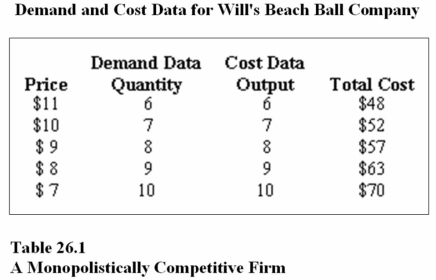 Refer to Table 26.1. At the profit-maximizing output and price, Will's Beach Ball Company will earn a profit equal to
A) $18.
B) $70.
C) $72.
D) -$12.
سؤال
سؤال
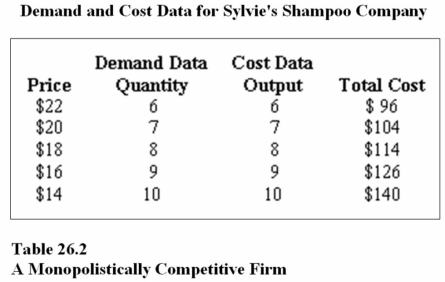 Refer to Table 26.2. To maximize profit, Sylvie's Shampoo Company. should produce _______ bottles of shampoo and charge a price of _______ each.
A) 6; $22
B) 7; $20
C) 8; $18
D) 9; $16
سؤال
سؤال
سؤال
سؤال
سؤال
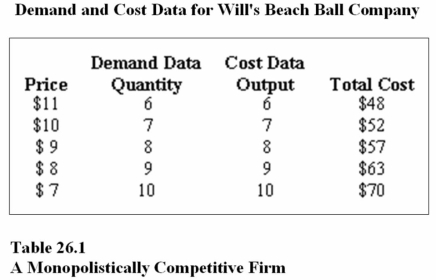 Refer to Table 26.1. At the profit-maximizing output and price, Will's Beach Ball Company will earn a ________ economic profit, and ________ the market will occur.
A) negative; exit from
B) negative; entry into
C) positive; exit from
D) positive; entry into
سؤال
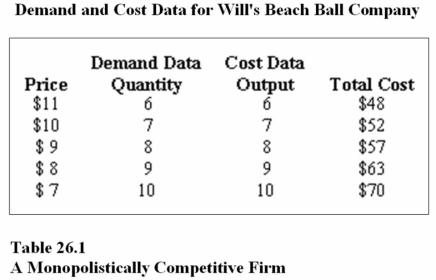 Refer to Table 26.1. In order to maximize profit, Will's Beach Ball Company should produce _______ and charge a price of _______ each.
A) 6 beach balls; $11
B) 7 beach balls; $10
C) 8 beach balls; $9
D) 9 beach balls; $8
سؤال
سؤال
سؤال
سؤال
سؤال
سؤال
سؤال
سؤال
سؤال
سؤال
سؤال
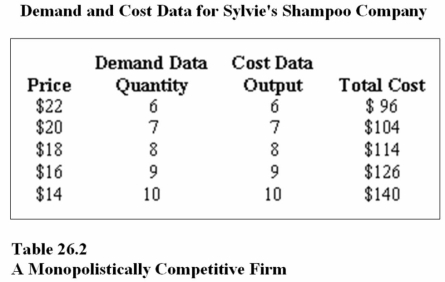 Refer to Table 26.2. At the profit-maximizing output and price, Sylvie's Shampoo Company. will earn a ________ economic profit, and ________ the market will occur.
A) negative; entry into
B) negative; exit from
C) positive; entry into
D) positive; exit from
سؤال
سؤال
سؤال
سؤال
سؤال
سؤال
سؤال
سؤال
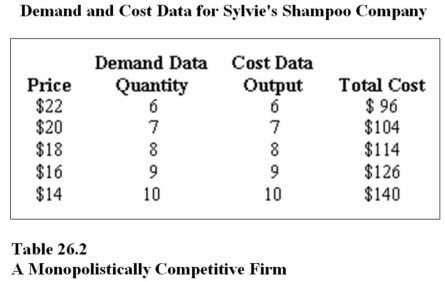 Refer to Table 26.2. At the profit-maximizing output and price, Sylvie's Shampoo Company. will earn a profit equal to
A) $36.
B) $30.
C) $140.
D) $144.
سؤال
سؤال
سؤال
سؤال
سؤال
سؤال
سؤال
سؤال
سؤال
سؤال
سؤال
سؤال
سؤال
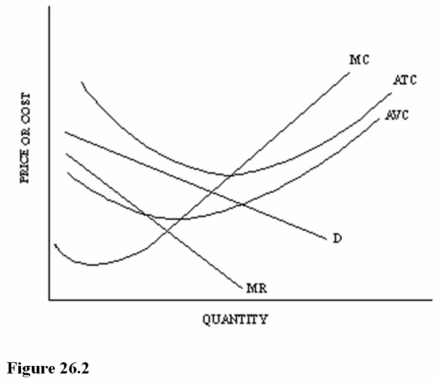 Refer to Figure 26.2 for a monopolistically competitive firm. At the profit-maximizing output and price, this firm is
A) Earning an economic profit.
B) Earning an economic loss.
C) Breaking even.
D) Earning a monopoly profit.
سؤال
سؤال
سؤال
سؤال
سؤال
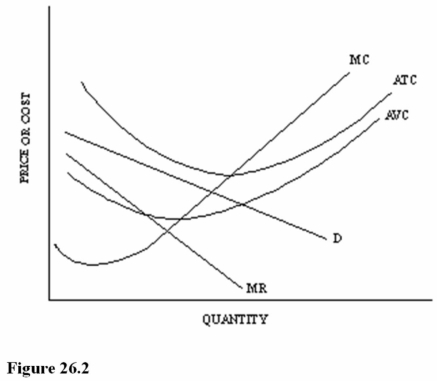 Refer to Figure 26.2 for a monopolistically competitive firm. At the profit-maximizing output and price, this firm is experiencing economic
A) Profits and should stay in this market in the long run.
B) Profits but could make even higher economic profits producing the next best alternative good.
C) Losses but should keep producing in the short run.
D) Losses and should shut down in the short run.
سؤال
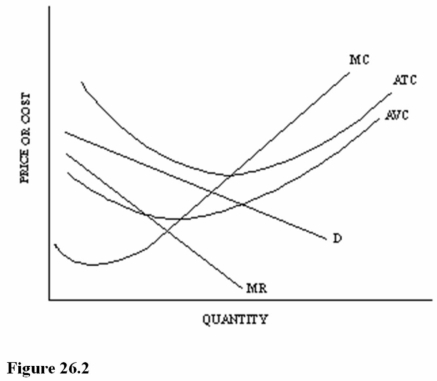 Refer to Figure 26.2 for a monopolistically competitive firm. At the profit-maximizing output and price, this firm is producing at an output level that achieves
A) Productive efficiency.
B) Allocative efficiency.
C) Maximum economies of scale.
D) Neither productive nor allocative efficiency.
سؤال
سؤال
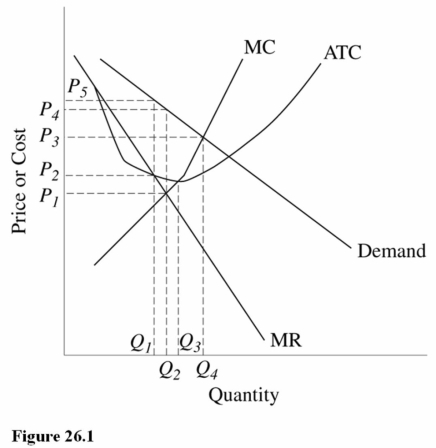 Refer to Figure 26.1 for a monopolistically competitive firm. The profit-maximizing output and price combination for this firm in the short run is
A) Q1, P1.
B) Q2, P4.
C) Q2, P1.
D) Q4, P3.
سؤال
سؤال
سؤال
سؤال
سؤال
سؤال
سؤال
 Refer to Figure 26.1. The output that maximizes production efficiency for this firm is
A) Q1.
B) Q2.
C) Q3.
D) Q4.
سؤال
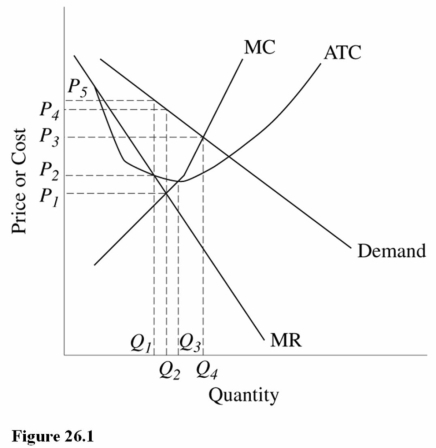 Refer to Figure 26.1. The output level that will be produced by this firm in the long run is
A) Q1.
B) Q2.
C) Q3.
D) Q4.
سؤال

فتح الحزمة
قم بالتسجيل لفتح البطاقات في هذه المجموعة!
Unlock Deck
Unlock Deck
1/149

العب

ملء الشاشة (f)
Deck 12: Deficits and Debt
1
Monopolistically competitive firms have a "monopoly" element to them because
A) There is only one seller.
B) There are high barriers to entry.
C) Brand loyalty gives them a captive audience.
D) The cross-price elasticity is very high.
A) There is only one seller.
B) There are high barriers to entry.
C) Brand loyalty gives them a captive audience.
D) The cross-price elasticity is very high.
C
2
Which of the following characterizes monopolistic competition?
A) Many interdependent firms sell a homogeneous product.
B) A few firms produce a particular type of product.
C) Many firms produce a particular type of product, but each maintains some independent control over its own price.
D) A few firms produce all of the market supply of a good.
A) Many interdependent firms sell a homogeneous product.
B) A few firms produce a particular type of product.
C) Many firms produce a particular type of product, but each maintains some independent control over its own price.
D) A few firms produce all of the market supply of a good.
C
3
The kinked oligopoly demand curve does not describe the demand curve for monopolistic competition because in monopolistically competitive markets,
A) Firms are not as interdependent as oligopolistic firms.
B) Firms have no market power.
C) There is not as much product differentiation as in oligopoly.
D) There is no nonprice competition.
A) Firms are not as interdependent as oligopolistic firms.
B) Firms have no market power.
C) There is not as much product differentiation as in oligopoly.
D) There is no nonprice competition.
A
4
Which of the following industries is not an example of monopolistic competition?
A) Pizza delivery.
B) Toys.
C) Notebook computers.
D) Airlines.
A) Pizza delivery.
B) Toys.
C) Notebook computers.
D) Airlines.
فتح الحزمة
افتح القفل للوصول البطاقات البالغ عددها 149 في هذه المجموعة.
فتح الحزمة
k this deck
5
The combined market share of the top four firms in a monopolistically competitive industry will typically be in the range of
A) Zero to 2 percent.
B) Zero to 5 percent.
C) 20 to 40 percent.
D) 70 to 100 percent.
A) Zero to 2 percent.
B) Zero to 5 percent.
C) 20 to 40 percent.
D) 70 to 100 percent.
فتح الحزمة
افتح القفل للوصول البطاقات البالغ عددها 149 في هذه المجموعة.
فتح الحزمة
k this deck
6
If a monopolistically competitive firm raises its price, it will
A) Not lose any of its customers.
B) Lose most of its customers.
C) Lose some of its customers, but nowhere close to all its customers.
D) Lose all of its customers.
A) Not lose any of its customers.
B) Lose most of its customers.
C) Lose some of its customers, but nowhere close to all its customers.
D) Lose all of its customers.
فتح الحزمة
افتح القفل للوصول البطاقات البالغ عددها 149 في هذه المجموعة.
فتح الحزمة
k this deck
7
A monopolistically competitive industry is characterized by ________ concentration ratios and ________ entry barriers.
A) high; high
B) high; low
C) low; high
D) low; low
A) high; high
B) high; low
C) low; high
D) low; low
فتح الحزمة
افتح القفل للوصول البطاقات البالغ عددها 149 في هذه المجموعة.
فتح الحزمة
k this deck
8
Entry into a market characterized by monopolistic competition is generally
A) Entirely blocked by existing firms.
B) Very easy because few barriers exist.
C) As difficult as in oligopoly.
D) More difficult than entry into monopolized markets.
A) Entirely blocked by existing firms.
B) Very easy because few barriers exist.
C) As difficult as in oligopoly.
D) More difficult than entry into monopolized markets.
فتح الحزمة
افتح القفل للوصول البطاقات البالغ عددها 149 في هذه المجموعة.
فتح الحزمة
k this deck
9
A major difference between monopoly and monopolistic competition is
A) One maximizes profits by setting MR equal to MC, and the other does not.
B) The number of firms in the market.
C) One type of firm has market power, and the other does not.
D) One has a downward-sloping demand curve, and the other does not.
A) One maximizes profits by setting MR equal to MC, and the other does not.
B) The number of firms in the market.
C) One type of firm has market power, and the other does not.
D) One has a downward-sloping demand curve, and the other does not.
فتح الحزمة
افتح القفل للوصول البطاقات البالغ عددها 149 في هذه المجموعة.
فتح الحزمة
k this deck
10
If there are many firms in an industry producing goods that are similar but slightly different, this is an example of
A) Perfect competition.
B) Monopolistic competition.
C) Oligopoly.
D) Monopoly.
A) Perfect competition.
B) Monopolistic competition.
C) Oligopoly.
D) Monopoly.
فتح الحزمة
افتح القفل للوصول البطاقات البالغ عددها 149 في هذه المجموعة.
فتح الحزمة
k this deck
11
Each producer in monopolistic competition has
A) Complete market power.
B) Substantial market power.
C) Some market power.
D) No market power.
A) Complete market power.
B) Substantial market power.
C) Some market power.
D) No market power.
فتح الحزمة
افتح القفل للوصول البطاقات البالغ عددها 149 في هذه المجموعة.
فتح الحزمة
k this deck
12
In monopolistic competition, a firm
A) Has no market power.
B) Captures significant economies of scale.
C) Has a downward-sloping demand curve.
D) Has a standardized product that all firms produce.
A) Has no market power.
B) Captures significant economies of scale.
C) Has a downward-sloping demand curve.
D) Has a standardized product that all firms produce.
فتح الحزمة
افتح القفل للوصول البطاقات البالغ عددها 149 في هذه المجموعة.
فتح الحزمة
k this deck
13
Which of the following is not characteristic of monopolistic competition?
A) Many firms in an industry.
B) Low concentration ratios.
C) Some market power.
D) Firms have zero control over price.
A) Many firms in an industry.
B) Low concentration ratios.
C) Some market power.
D) Firms have zero control over price.
فتح الحزمة
افتح القفل للوصول البطاقات البالغ عددها 149 في هذه المجموعة.
فتح الحزمة
k this deck
14
A major difference between oligopoly and monopolistic competition is that monopolistically competitive firms and oligopolies do not
A) Have high concentration ratios.
B) Have many competitors.
C) Have high barriers to entry.
D) Confront a downward-sloping demand curve.
A) Have high concentration ratios.
B) Have many competitors.
C) Have high barriers to entry.
D) Confront a downward-sloping demand curve.
فتح الحزمة
افتح القفل للوصول البطاقات البالغ عددها 149 في هذه المجموعة.
فتح الحزمة
k this deck
15
Monopolistically competitive industries are characterized by all of the following except
A) Homogenous products.
B) Low entry barriers.
C) Low concentration ratios.
D) Independent production decisions.
A) Homogenous products.
B) Low entry barriers.
C) Low concentration ratios.
D) Independent production decisions.
فتح الحزمة
افتح القفل للوصول البطاقات البالغ عددها 149 في هذه المجموعة.
فتح الحزمة
k this deck
16
Which of the following is similar for oligopoly and monopolistic competition?
A) Both have many firms.
B) Both have low concentration ratios.
C) Both have market power.
D) Both make independent production decisions.
A) Both have many firms.
B) Both have low concentration ratios.
C) Both have market power.
D) Both make independent production decisions.
فتح الحزمة
افتح القفل للوصول البطاقات البالغ عددها 149 في هذه المجموعة.
فتح الحزمة
k this deck
17
The competitive dimension of monopolistic competition is that
A) High barriers to entry tend to push economic profits toward zero.
B) Consumers view each firm's products as interchangeable.
C) Low barriers to entry tend to push economic profits toward zero.
D) Each firm in the industry will lose all of its customers if it raises its price.
A) High barriers to entry tend to push economic profits toward zero.
B) Consumers view each firm's products as interchangeable.
C) Low barriers to entry tend to push economic profits toward zero.
D) Each firm in the industry will lose all of its customers if it raises its price.
فتح الحزمة
افتح القفل للوصول البطاقات البالغ عددها 149 في هذه المجموعة.
فتح الحزمة
k this deck
18
A concentration ratio measures the
A) Proportion of industry output produced by all firms.
B) Proportion of industry output produced by the largest firms.
C) Dollar value of total industry output produced by all firms.
D) Dollar value of total industry output produced by the largest firms.
A) Proportion of industry output produced by all firms.
B) Proportion of industry output produced by the largest firms.
C) Dollar value of total industry output produced by all firms.
D) Dollar value of total industry output produced by the largest firms.
فتح الحزمة
افتح القفل للوصول البطاقات البالغ عددها 149 في هذه المجموعة.
فتح الحزمة
k this deck
19
The demand curve faced by a monopolistically competitive firm is
A) Downward-sloping.
B) Flat.
C) Kinked.
D) Upward-sloping.
A) Downward-sloping.
B) Flat.
C) Kinked.
D) Upward-sloping.
فتح الحزمة
افتح القفل للوصول البطاقات البالغ عددها 149 في هذه المجموعة.
فتح الحزمة
k this deck
20
One of the main differences between an oligopoly and a monopolistically competitive firm is that a monopolistically competitive firm
A) Faces a horizontal demand curve; an oligopoly does not.
B) Is relatively independent; an oligopoly is interdependent.
C) Has no market power; an oligopoly has some market power.
D) Has high barriers to entry; an oligopoly does not.
A) Faces a horizontal demand curve; an oligopoly does not.
B) Is relatively independent; an oligopoly is interdependent.
C) Has no market power; an oligopoly has some market power.
D) Has high barriers to entry; an oligopoly does not.
فتح الحزمة
افتح القفل للوصول البطاقات البالغ عددها 149 في هذه المجموعة.
فتح الحزمة
k this deck
21
Brand loyalty
A) Makes the demand curve facing the firm more price-elastic.
B) Leads to one price for all brands.
C) Exists even when products are virtually identical.
D) Is possible only when there are a few firms in the market.
A) Makes the demand curve facing the firm more price-elastic.
B) Leads to one price for all brands.
C) Exists even when products are virtually identical.
D) Is possible only when there are a few firms in the market.
فتح الحزمة
افتح القفل للوصول البطاقات البالغ عددها 149 في هذه المجموعة.
فتح الحزمة
k this deck
22
The cross-price elasticity of demand for the products of monopolistically competitive firms is
A) Very high.
B) Low.
C) An indication that most of the products are complementary goods.
D) The same as in perfect competition.
A) Very high.
B) Low.
C) An indication that most of the products are complementary goods.
D) The same as in perfect competition.
فتح الحزمة
افتح القفل للوصول البطاقات البالغ عددها 149 في هذه المجموعة.
فتح الحزمة
k this deck
23
Refer to Table 26.1. At the profit-maximizing output and price, Will's Beach Ball Company will earn a profit equal toA) $18.
B) $70.
C) $72.
D) -$12.
فتح الحزمة
افتح القفل للوصول البطاقات البالغ عددها 149 في هذه المجموعة.
فتح الحزمة
k this deck
24
A monopolistically competitive firm maximizes profits or minimizes losses in the short run by
A) Setting price equal to marginal cost.
B) Producing at the output level where ATC is minimized.
C) Producing at the output level where MR equals MC.
D) Producing at the output level where MC equals ATC.
A) Setting price equal to marginal cost.
B) Producing at the output level where ATC is minimized.
C) Producing at the output level where MR equals MC.
D) Producing at the output level where MC equals ATC.
فتح الحزمة
افتح القفل للوصول البطاقات البالغ عددها 149 في هذه المجموعة.
فتح الحزمة
k this deck
25
Refer to Table 26.2. To maximize profit, Sylvie's Shampoo Company. should produce _______ bottles of shampoo and charge a price of _______ each.A) 6; $22
B) 7; $20
C) 8; $18
D) 9; $16
فتح الحزمة
افتح القفل للوصول البطاقات البالغ عددها 149 في هذه المجموعة.
فتح الحزمة
k this deck
26
Product differentiation occurs when
A) A completely new process is used to produce a familiar product.
B) One firm produces many varieties of a product.
C) Buyers perceive differences in the products of several companies.
D) Sellers perceive differences in the products of several companies.
A) A completely new process is used to produce a familiar product.
B) One firm produces many varieties of a product.
C) Buyers perceive differences in the products of several companies.
D) Sellers perceive differences in the products of several companies.
فتح الحزمة
افتح القفل للوصول البطاقات البالغ عددها 149 في هذه المجموعة.
فتح الحزمة
k this deck
27
Product differentiation refers to
A) Features that make one product appear different from competing products in the same market.
B) Different prices for the same product in a certain market.
C) The selling of identical products in different markets.
D) The charging of different prices for the same product in different markets.
A) Features that make one product appear different from competing products in the same market.
B) Different prices for the same product in a certain market.
C) The selling of identical products in different markets.
D) The charging of different prices for the same product in different markets.
فتح الحزمة
افتح القفل للوصول البطاقات البالغ عددها 149 في هذه المجموعة.
فتح الحزمة
k this deck
28
Which of the following most characterizes monopolistic competition?
A) Price leadership.
B) Product differentiation.
C) Price discrimination.
D) Economies of scale.
A) Price leadership.
B) Product differentiation.
C) Price discrimination.
D) Economies of scale.
فتح الحزمة
افتح القفل للوصول البطاقات البالغ عددها 149 في هذه المجموعة.
فتح الحزمة
k this deck
29
Firms in a monopolistically competitive market will
A) Produce efficiently.
B) Make economic profits in the long run.
C) Use the profit-maximizing rule MC = MR.
D) Produce at the minimum of ATC.
A) Produce efficiently.
B) Make economic profits in the long run.
C) Use the profit-maximizing rule MC = MR.
D) Produce at the minimum of ATC.
فتح الحزمة
افتح القفل للوصول البطاقات البالغ عددها 149 في هذه المجموعة.
فتح الحزمة
k this deck
30
Refer to Table 26.1. At the profit-maximizing output and price, Will's Beach Ball Company will earn a ________ economic profit, and ________ the market will occur.A) negative; exit from
B) negative; entry into
C) positive; exit from
D) positive; entry into
فتح الحزمة
افتح القفل للوصول البطاقات البالغ عددها 149 في هذه المجموعة.
فتح الحزمة
k this deck
31
Refer to Table 26.1. In order to maximize profit, Will's Beach Ball Company should produce _______ and charge a price of _______ each.A) 6 beach balls; $11
B) 7 beach balls; $10
C) 8 beach balls; $9
D) 9 beach balls; $8
فتح الحزمة
افتح القفل للوصول البطاقات البالغ عددها 149 في هذه المجموعة.
فتح الحزمة
k this deck
32
Large cities typically have many drugstores that offer different levels of service and product selection. The drugstore market in big cities can best be classified as
A) A competitive market.
B) Monopolistic competition.
C) Oligopoly.
D) Monopoly.
A) A competitive market.
B) Monopolistic competition.
C) Oligopoly.
D) Monopoly.
فتح الحزمة
افتح القفل للوصول البطاقات البالغ عددها 149 في هذه المجموعة.
فتح الحزمة
k this deck
33
A monopolistically competitive firm can raise its price somewhat without fear of great change in unit sales because of
A) Brand loyalty.
B) Economies of scale.
C) Inelastic demand.
D) Large market shares of firms in the market.
A) Brand loyalty.
B) Economies of scale.
C) Inelastic demand.
D) Large market shares of firms in the market.
فتح الحزمة
افتح القفل للوصول البطاقات البالغ عددها 149 في هذه المجموعة.
فتح الحزمة
k this deck
34
When a monopolistically competitive firm advertises, it is attempting to increase
A) The demand and decrease the price elasticity of demand for its product.
B) The demand and increase the price elasticity of demand for its product.
C) Long-run profits.
D) Market demand.
A) The demand and decrease the price elasticity of demand for its product.
B) The demand and increase the price elasticity of demand for its product.
C) Long-run profits.
D) Market demand.
فتح الحزمة
افتح القفل للوصول البطاقات البالغ عددها 149 في هذه المجموعة.
فتح الحزمة
k this deck
35
Cross price elasticity measures
A) The change in quantity demanded for one good due to a change in the price of another good.
B) How sensitive quantity demanded is to a change in price.
C) The change in quantity demanded when income changes.
D) How complements and substitutes differ from one another.
A) The change in quantity demanded for one good due to a change in the price of another good.
B) How sensitive quantity demanded is to a change in price.
C) The change in quantity demanded when income changes.
D) How complements and substitutes differ from one another.
فتح الحزمة
افتح القفل للوصول البطاقات البالغ عددها 149 في هذه المجموعة.
فتح الحزمة
k this deck
36
If a monopolistic competitor is maximizing profit, it is producing at a point where marginal cost
A) Is less than price.
B) Equals price.
C) Is greater than price.
D) Equals average total cost.
A) Is less than price.
B) Equals price.
C) Is greater than price.
D) Equals average total cost.
فتح الحزمة
افتح القفل للوصول البطاقات البالغ عددها 149 في هذه المجموعة.
فتح الحزمة
k this deck
37
The main difference between perfect competition and monopolistic competition is
A) The degree of product differentiation.
B) The long-run economic profits that are expected.
C) The number of firms in the market.
D) The ease of entry and exit.
A) The degree of product differentiation.
B) The long-run economic profits that are expected.
C) The number of firms in the market.
D) The ease of entry and exit.
فتح الحزمة
افتح القفل للوصول البطاقات البالغ عددها 149 في هذه المجموعة.
فتح الحزمة
k this deck
38
Brand loyalty usually makes the demand curve for a product
A) More price-elastic.
B) Less price-elastic.
C) Unitary elastic.
D) More income-elastic.
A) More price-elastic.
B) Less price-elastic.
C) Unitary elastic.
D) More income-elastic.
فتح الحزمة
افتح القفل للوصول البطاقات البالغ عددها 149 في هذه المجموعة.
فتح الحزمة
k this deck
39
Which of the following is an example of product differentiation?
A) Two shampoos differ only in their labels, but consumers pay $0.20 more for the label they recognize.
B) Sugar can be made from sugar beets or sugar cane, and consumers cannot tell the difference.
C) Consumers substitute SUVs for cars because SUVs accommodate more passengers.
D) Mills produce softwood and hardwood, but the two are used for different purposes.
A) Two shampoos differ only in their labels, but consumers pay $0.20 more for the label they recognize.
B) Sugar can be made from sugar beets or sugar cane, and consumers cannot tell the difference.
C) Consumers substitute SUVs for cars because SUVs accommodate more passengers.
D) Mills produce softwood and hardwood, but the two are used for different purposes.
فتح الحزمة
افتح القفل للوصول البطاقات البالغ عددها 149 في هذه المجموعة.
فتح الحزمة
k this deck
40
A monopolistically competitive firm can raise its price somewhat without fear of great change in unit sales because
A) The demand for its product is typically very price-elastic.
B) Its demand curve is horizontal.
C) Of product differentiation and brand loyalty.
D) Of the gap in its marginal revenue curve.
A) The demand for its product is typically very price-elastic.
B) Its demand curve is horizontal.
C) Of product differentiation and brand loyalty.
D) Of the gap in its marginal revenue curve.
فتح الحزمة
افتح القفل للوصول البطاقات البالغ عددها 149 في هذه المجموعة.
فتح الحزمة
k this deck
41
If new firms enter a monopolistically competitive market, the demand curves for the existing firms will shift to the
A) Left and become more price-inelastic.
B) Left, and there will be no change in price elasticity.
C) Left and become more price-elastic.
D) Right, and there will be no change in price elasticity.
A) Left and become more price-inelastic.
B) Left, and there will be no change in price elasticity.
C) Left and become more price-elastic.
D) Right, and there will be no change in price elasticity.
فتح الحزمة
افتح القفل للوصول البطاقات البالغ عددها 149 في هذه المجموعة.
فتح الحزمة
k this deck
42
Refer to Table 26.2. At the profit-maximizing output and price, Sylvie's Shampoo Company. will earn a ________ economic profit, and ________ the market will occur.A) negative; entry into
B) negative; exit from
C) positive; entry into
D) positive; exit from
فتح الحزمة
افتح القفل للوصول البطاقات البالغ عددها 149 في هذه المجموعة.
فتح الحزمة
k this deck
43
In monopolistic competition, the entry of new firms will cause all of the following to happen except
A) Long-run economic profits will be zero.
B) The industry cost curves will shift to the left.
C) The firm's demand curve will shift to the left.
D) The market supply curve will shift to the right.
A) Long-run economic profits will be zero.
B) The industry cost curves will shift to the left.
C) The firm's demand curve will shift to the left.
D) The market supply curve will shift to the right.
فتح الحزمة
افتح القفل للوصول البطاقات البالغ عددها 149 في هذه المجموعة.
فتح الحزمة
k this deck
44
Which of the following is true about a monopolistically competitive firm in the long run?
A) It is as efficient as a purely competitive firm.
B) It tends to realize only a normal profit.
C) It produces at the level where costs are minimized.
D) It will practice marginal cost pricing.
A) It is as efficient as a purely competitive firm.
B) It tends to realize only a normal profit.
C) It produces at the level where costs are minimized.
D) It will practice marginal cost pricing.
فتح الحزمة
افتح القفل للوصول البطاقات البالغ عددها 149 في هذه المجموعة.
فتح الحزمة
k this deck
45
Which of the following characterizes the difference between oligopoly and monopolistic competition?
A) Oligopolists are independent of each other; monopolistically competitive firms are interdependent.
B) Monopolistically competitive firms experience zero long-run economic profit; oligopolists may experience positive long-run economic profit.
C) There are many oligopolists but only a few monopolistically competitive firms.
D) Monopolistically competitive firms face horizontal demand curves; oligopolists face downward-sloping demand curves.
A) Oligopolists are independent of each other; monopolistically competitive firms are interdependent.
B) Monopolistically competitive firms experience zero long-run economic profit; oligopolists may experience positive long-run economic profit.
C) There are many oligopolists but only a few monopolistically competitive firms.
D) Monopolistically competitive firms face horizontal demand curves; oligopolists face downward-sloping demand curves.
فتح الحزمة
افتح القفل للوصول البطاقات البالغ عددها 149 في هذه المجموعة.
فتح الحزمة
k this deck
46
When new firms enter a monopolistically competitive industry, ceteris paribus, the
A) Market price decreases.
B) Market price increases.
C) Market price remains unchanged.
D) Change in market price cannot be determined based on the information given.
A) Market price decreases.
B) Market price increases.
C) Market price remains unchanged.
D) Change in market price cannot be determined based on the information given.
فتح الحزمة
افتح القفل للوصول البطاقات البالغ عددها 149 في هذه المجموعة.
فتح الحزمة
k this deck
47
In monopolistic competition, a firm's demand curve is tangent to the ATC curve in the long run because
A) Barriers to entry are high.
B) Entry eliminates economic profit, and exit eliminates losses.
C) Advertising is ineffective in differentiating the product.
D) Producers are price takers.
A) Barriers to entry are high.
B) Entry eliminates economic profit, and exit eliminates losses.
C) Advertising is ineffective in differentiating the product.
D) Producers are price takers.
فتح الحزمة
افتح القفل للوصول البطاقات البالغ عددها 149 في هذه المجموعة.
فتح الحزمة
k this deck
48
Both perfect competitors and monopolistic competitors
A) Experience product differentiation.
B) Earn zero economic profit in the long run.
C) Find prices pushed to the minimum of long-run ATC by entry.
D) Use marginal cost pricing.
A) Experience product differentiation.
B) Earn zero economic profit in the long run.
C) Find prices pushed to the minimum of long-run ATC by entry.
D) Use marginal cost pricing.
فتح الحزمة
افتح القفل للوصول البطاقات البالغ عددها 149 في هذه المجموعة.
فتح الحزمة
k this deck
49
If new firms enter a monopolistically competitive market, the demand curves for the existing firms will
A) Shift to the left.
B) Shift to the right.
C) Remain unchanged.
D) Remain unchanged, but the market demand curve will shift to the right.
A) Shift to the left.
B) Shift to the right.
C) Remain unchanged.
D) Remain unchanged, but the market demand curve will shift to the right.
فتح الحزمة
افتح القفل للوصول البطاقات البالغ عددها 149 في هذه المجموعة.
فتح الحزمة
k this deck
50
Refer to Table 26.2. At the profit-maximizing output and price, Sylvie's Shampoo Company. will earn a profit equal toA) $36.
B) $30.
C) $140.
D) $144.
فتح الحزمة
افتح القفل للوصول البطاقات البالغ عددها 149 في هذه المجموعة.
فتح الحزمة
k this deck
51
When new firms enter a monopolistically competitive industry, the market
A) Supply curve shifts to the left.
B) Supply curve shifts to the right.
C) Demand curve shifts to the left.
D) Demand curve shifts to the right.
A) Supply curve shifts to the left.
B) Supply curve shifts to the right.
C) Demand curve shifts to the left.
D) Demand curve shifts to the right.
فتح الحزمة
افتح القفل للوصول البطاقات البالغ عددها 149 في هذه المجموعة.
فتح الحزمة
k this deck
52
Which of the following characterizes monopolistic competition?
A) Price leadership.
B) Zero long-run profit.
C) Retaliation.
D) Marginal cost pricing.
A) Price leadership.
B) Zero long-run profit.
C) Retaliation.
D) Marginal cost pricing.
فتح الحزمة
افتح القفل للوصول البطاقات البالغ عددها 149 في هذه المجموعة.
فتح الحزمة
k this deck
53
Which of the following is not true about a monopolistic competitor?
A) It maximizes profit at the point where MC = MR.
B) It produces less output than a perfectly competitive firm, ceteris paribus.
C) It charges a higher price than a perfectly competitive firm, ceteris paribus.
D) It can earn economic profits in the long run.
A) It maximizes profit at the point where MC = MR.
B) It produces less output than a perfectly competitive firm, ceteris paribus.
C) It charges a higher price than a perfectly competitive firm, ceteris paribus.
D) It can earn economic profits in the long run.
فتح الحزمة
افتح القفل للوصول البطاقات البالغ عددها 149 في هذه المجموعة.
فتح الحزمة
k this deck
54
One of the reasons for low cross-price elasticity in monopolistic competition and high cross-price elasticity in perfect competition is that
A) Firms in perfect competition differentiate their products.
B) In monopolistic competition brand loyal consumers view other available products as poor substitutes.
C) Consumers do not have perfect substitutes in perfect competition.
D) To save money, firms in monopolistic competition do not advertise.
A) Firms in perfect competition differentiate their products.
B) In monopolistic competition brand loyal consumers view other available products as poor substitutes.
C) Consumers do not have perfect substitutes in perfect competition.
D) To save money, firms in monopolistic competition do not advertise.
فتح الحزمة
افتح القفل للوصول البطاقات البالغ عددها 149 في هذه المجموعة.
فتح الحزمة
k this deck
55
In a monopolistically competitive market with negative economic profits,
A) Firms will enter until accounting profits are zero.
B) Firms will enter until economic profits are zero.
C) Firms will exit until economic profits are zero.
D) No entry or exit will occur.
A) Firms will enter until accounting profits are zero.
B) Firms will enter until economic profits are zero.
C) Firms will exit until economic profits are zero.
D) No entry or exit will occur.
فتح الحزمة
افتح القفل للوصول البطاقات البالغ عددها 149 في هذه المجموعة.
فتح الحزمة
k this deck
56
If economic profits are earned in a monopolistically competitive market,
A) More firms will enter the market.
B) The market supply curve will shift to the left.
C) Price will rise.
D) The market demand curve will shift to the right.
A) More firms will enter the market.
B) The market supply curve will shift to the left.
C) Price will rise.
D) The market demand curve will shift to the right.
فتح الحزمة
افتح القفل للوصول البطاقات البالغ عددها 149 في هذه المجموعة.
فتح الحزمة
k this deck
57
In monopolistic competition, if economic profits are being earned, which of the following will not happen?
A) New firms will enter.
B) Entry will cause the market supply curve to shift to the right.
C) Entry will cause the firm's demand curve to shift to the left.
D) Entry will cause the market price to rise.
A) New firms will enter.
B) Entry will cause the market supply curve to shift to the right.
C) Entry will cause the firm's demand curve to shift to the left.
D) Entry will cause the market price to rise.
فتح الحزمة
افتح القفل للوصول البطاقات البالغ عددها 149 في هذه المجموعة.
فتح الحزمة
k this deck
58
Entry into a market characterized by monopolistic competition
A) Is rare because firms have market power.
B) Is frequent because barriers to entry are low.
C) Occurs when a firm's demand is everywhere below its long-run average cost curve.
D) Results from economies of scale.
A) Is rare because firms have market power.
B) Is frequent because barriers to entry are low.
C) Occurs when a firm's demand is everywhere below its long-run average cost curve.
D) Results from economies of scale.
فتح الحزمة
افتح القفل للوصول البطاقات البالغ عددها 149 في هذه المجموعة.
فتح الحزمة
k this deck
59
In the short run, a monopolistically competitive firm
A) May make economic profits, but it fails to make economic profits in the long run because of the entry of new firms.
B) May make profits just as it does in the long run because firms can enter easily.
C) Produces at a rate at which long-run average cost equals price, but not at which long-run marginal cost equals marginal revenue.
D) Makes profits just as it does in the long run because entry is blocked.
A) May make economic profits, but it fails to make economic profits in the long run because of the entry of new firms.
B) May make profits just as it does in the long run because firms can enter easily.
C) Produces at a rate at which long-run average cost equals price, but not at which long-run marginal cost equals marginal revenue.
D) Makes profits just as it does in the long run because entry is blocked.
فتح الحزمة
افتح القفل للوصول البطاقات البالغ عددها 149 في هذه المجموعة.
فتح الحزمة
k this deck
60
For which of the following market structures will the firm's demand curve be tangent to the ATC curve in the long run?
A) Duopoly.
B) Monopolistic competition.
C) Oligopoly.
D) Monopoly.
A) Duopoly.
B) Monopolistic competition.
C) Oligopoly.
D) Monopoly.
فتح الحزمة
افتح القفل للوصول البطاقات البالغ عددها 149 في هذه المجموعة.
فتح الحزمة
k this deck
61
Which of the following market structures will have higher output in the long run than monopolistic competition, ceteris paribus?
A) Perfect competition.
B) Monopoly.
C) Duopoly.
D) Oligopoly.
A) Perfect competition.
B) Monopoly.
C) Duopoly.
D) Oligopoly.
فتح الحزمة
افتح القفل للوصول البطاقات البالغ عددها 149 في هذه المجموعة.
فتح الحزمة
k this deck
62
Which of the following is true about a monopolistically competitive industry?
A) Marginal cost pricing occurs.
B) There is excess capacity.
C) Resources are allocated efficiently.
D) It produces at the minimum of ATC.
A) Marginal cost pricing occurs.
B) There is excess capacity.
C) Resources are allocated efficiently.
D) It produces at the minimum of ATC.
فتح الحزمة
افتح القفل للوصول البطاقات البالغ عددها 149 في هذه المجموعة.
فتح الحزمة
k this deck
63
Refer to Figure 26.2 for a monopolistically competitive firm. At the profit-maximizing output and price, this firm isA) Earning an economic profit.
B) Earning an economic loss.
C) Breaking even.
D) Earning a monopoly profit.
فتح الحزمة
افتح القفل للوصول البطاقات البالغ عددها 149 في هذه المجموعة.
فتح الحزمة
k this deck
64
In monopolistic competition there is allocative inefficiency because
A) Price is greater than the minimum ATC.
B) Production is not at the minimum ATC.
C) Of excess capacity.
D) Price is greater than MC.
A) Price is greater than the minimum ATC.
B) Production is not at the minimum ATC.
C) Of excess capacity.
D) Price is greater than MC.
فتح الحزمة
افتح القفل للوصول البطاقات البالغ عددها 149 في هذه المجموعة.
فتح الحزمة
k this deck
65
Compared to the outcome under a marginal cost pricing strategy, a monopolistically competitive firm will produce a
A) Lower output and charge a higher price.
B) Greater output and charge a higher price.
C) Lower output and charge a lower price.
D) Greater output and charge a lower price.
A) Lower output and charge a higher price.
B) Greater output and charge a higher price.
C) Lower output and charge a lower price.
D) Greater output and charge a lower price.
فتح الحزمة
افتح القفل للوصول البطاقات البالغ عددها 149 في هذه المجموعة.
فتح الحزمة
k this deck
66
Which of the following market structures will have lower output in the long run than perfect competition, ceteris paribus?
A) Monopolistic competition, but not oligopoly or monopoly.
B) Monopolistic competition, oligopoly, and monopoly.
C) Monopolistic competition and oligopoly, but not monopoly.
D) Oligopoly and monopoly, but not monopolistic competition.
A) Monopolistic competition, but not oligopoly or monopoly.
B) Monopolistic competition, oligopoly, and monopoly.
C) Monopolistic competition and oligopoly, but not monopoly.
D) Oligopoly and monopoly, but not monopolistic competition.
فتح الحزمة
افتح القفل للوصول البطاقات البالغ عددها 149 في هذه المجموعة.
فتح الحزمة
k this deck
67
Monopolistic competition results in allocative
A) Inefficiency and productive efficiency.
B) Inefficiency and productive inefficiency.
C) Efficiency and productive efficiency.
D) Efficiency and productive inefficiency.
A) Inefficiency and productive efficiency.
B) Inefficiency and productive inefficiency.
C) Efficiency and productive efficiency.
D) Efficiency and productive inefficiency.
فتح الحزمة
افتح القفل للوصول البطاقات البالغ عددها 149 في هذه المجموعة.
فتح الحزمة
k this deck
68
Refer to Figure 26.2 for a monopolistically competitive firm. At the profit-maximizing output and price, this firm is experiencing economicA) Profits and should stay in this market in the long run.
B) Profits but could make even higher economic profits producing the next best alternative good.
C) Losses but should keep producing in the short run.
D) Losses and should shut down in the short run.
فتح الحزمة
افتح القفل للوصول البطاقات البالغ عددها 149 في هذه المجموعة.
فتح الحزمة
k this deck
69
Refer to Figure 26.2 for a monopolistically competitive firm. At the profit-maximizing output and price, this firm is producing at an output level that achievesA) Productive efficiency.
B) Allocative efficiency.
C) Maximum economies of scale.
D) Neither productive nor allocative efficiency.
فتح الحزمة
افتح القفل للوصول البطاقات البالغ عددها 149 في هذه المجموعة.
فتح الحزمة
k this deck
70
Which of the following real-world situations is the result of excess capacity in a monopolistically competitive market?
A) A factory producing women's clothing produces more than it can sell during a season.
B) Gas stations with infrequently used pumps are located at all four corners of an intersection.
C) A retail auto tire store orders too much inventory.
D) Monopolistically competitive firms do not exist in the real world.
A) A factory producing women's clothing produces more than it can sell during a season.
B) Gas stations with infrequently used pumps are located at all four corners of an intersection.
C) A retail auto tire store orders too much inventory.
D) Monopolistically competitive firms do not exist in the real world.
فتح الحزمة
افتح القفل للوصول البطاقات البالغ عددها 149 في هذه المجموعة.
فتح الحزمة
k this deck
71
Refer to Figure 26.1 for a monopolistically competitive firm. The profit-maximizing output and price combination for this firm in the short run isA) Q1, P1.
B) Q2, P4.
C) Q2, P1.
D) Q4, P3.
فتح الحزمة
افتح القفل للوصول البطاقات البالغ عددها 149 في هذه المجموعة.
فتح الحزمة
k this deck
72
Which of the following market structures will have higher prices in the long run than perfect competition, ceteris paribus?
A) Monopolistic competition and monopoly, but not oligopoly.
B) Oligopoly and monopoly, but not monopolistic competition.
C) Monopoly, but not oligopoly or monopolistic competition.
D) Monopolistic competition, monopoly, and oligopoly.
A) Monopolistic competition and monopoly, but not oligopoly.
B) Oligopoly and monopoly, but not monopolistic competition.
C) Monopoly, but not oligopoly or monopolistic competition.
D) Monopolistic competition, monopoly, and oligopoly.
فتح الحزمة
افتح القفل للوصول البطاقات البالغ عددها 149 في هذه المجموعة.
فتح الحزمة
k this deck
73
Which of the following market structures will have only normal profit in the long run?
A) Monopoly.
B) Duopoly.
C) Monopolistic competition.
D) Oligopoly.
A) Monopoly.
B) Duopoly.
C) Monopolistic competition.
D) Oligopoly.
فتح الحزمة
افتح القفل للوصول البطاقات البالغ عددها 149 في هذه المجموعة.
فتح الحزمة
k this deck
74
Monopolistic competition results in
A) Allocative efficiency.
B) Production efficiency.
C) The wrong mix of output.
D) Marginal cost pricing.
A) Allocative efficiency.
B) Production efficiency.
C) The wrong mix of output.
D) Marginal cost pricing.
فتح الحزمة
افتح القفل للوصول البطاقات البالغ عددها 149 في هذه المجموعة.
فتح الحزمة
k this deck
75
Monopolistically competitive firms are productively inefficient because long-run equilibrium occurs at an output rate where
A) MC is greater than MR.
B) Price is greater than MC.
C) ATC is greater than minimum ATC.
D) Diseconomies of scale exist.
A) MC is greater than MR.
B) Price is greater than MC.
C) ATC is greater than minimum ATC.
D) Diseconomies of scale exist.
فتح الحزمة
افتح القفل للوصول البطاقات البالغ عددها 149 في هذه المجموعة.
فتح الحزمة
k this deck
76
Suppose that an economy wants to eliminate the resource waste associated with excess capacity in monopolistically competitive markets. Which of the following would achieve this goal?
A) Firms are allowed to establish significant barriers to entry.
B) Firms are encouraged to produce less output.
C) Firms are required to set price equal to marginal cost.
D) Firms are required to charge the same price.
A) Firms are allowed to establish significant barriers to entry.
B) Firms are encouraged to produce less output.
C) Firms are required to set price equal to marginal cost.
D) Firms are required to charge the same price.
فتح الحزمة
افتح القفل للوصول البطاقات البالغ عددها 149 في هذه المجموعة.
فتح الحزمة
k this deck
77
Marginal cost pricing means that
A) Goods are offered for sale at prices equal to average total cost.
B) Firms produce where marginal cost equals marginal revenue.
C) Firms produce where marginal cost equals zero.
D) Goods are offered for sale at prices equal to marginal cost.
A) Goods are offered for sale at prices equal to average total cost.
B) Firms produce where marginal cost equals marginal revenue.
C) Firms produce where marginal cost equals zero.
D) Goods are offered for sale at prices equal to marginal cost.
فتح الحزمة
افتح القفل للوصول البطاقات البالغ عددها 149 في هذه المجموعة.
فتح الحزمة
k this deck
78
Refer to Figure 26.1. The output that maximizes production efficiency for this firm isA) Q1.
B) Q2.
C) Q3.
D) Q4.
فتح الحزمة
افتح القفل للوصول البطاقات البالغ عددها 149 في هذه المجموعة.
فتح الحزمة
k this deck
79
Refer to Figure 26.1. The output level that will be produced by this firm in the long run isA) Q1.
B) Q2.
C) Q3.
D) Q4.
فتح الحزمة
افتح القفل للوصول البطاقات البالغ عددها 149 في هذه المجموعة.
فتح الحزمة
k this deck
80
Which of the following market structures will have lower prices in the long run than monopoly, ceteris paribus?
A) Perfect competition, oligopoly, and monopolistic competition.
B) Perfect competition, but not oligopoly or monopolistic competition.
C) Perfect competition and oligopoly, but not monopolistic competition.
D) Oligopoly and monopolistic competition, but not perfect competition.
A) Perfect competition, oligopoly, and monopolistic competition.
B) Perfect competition, but not oligopoly or monopolistic competition.
C) Perfect competition and oligopoly, but not monopolistic competition.
D) Oligopoly and monopolistic competition, but not perfect competition.
فتح الحزمة
افتح القفل للوصول البطاقات البالغ عددها 149 في هذه المجموعة.
فتح الحزمة
k this deck
فتح الحزمة
افتح القفل للوصول البطاقات البالغ عددها 149 في هذه المجموعة.






