







 تكلم مع الذكاء الاصطناعي


Deck 20: Movement of Energy in Ecosystems
ملء الشاشة (f)

سؤال

سؤال
سؤال
سؤال
سؤال
سؤال
سؤال
سؤال
سؤال
سؤال
سؤال
سؤال
سؤال
سؤال
سؤال
سؤال
سؤال
سؤال
سؤال
سؤال
سؤال
سؤال
سؤال
سؤال
سؤال
سؤال
سؤال
سؤال
سؤال
سؤال
سؤال
سؤال
سؤال
سؤال
سؤال
سؤال
سؤال
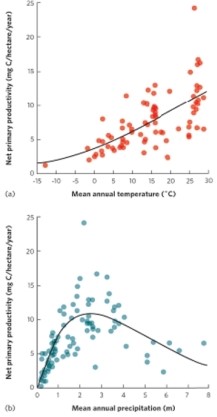 (Figure 20.9) The figure shows that as mean annual temperature increases, net primary productivity also increases. Net primary productivity increases with mean annual precipitation until approximately 3 meters of precipitation, after which productivity declines. Why does this decline occur?
 سؤال
سؤال
سؤال
سؤال
سؤال
سؤال
سؤال
سؤال
سؤال
سؤال
سؤال
سؤال
سؤال
سؤال
سؤال
سؤال
سؤال
سؤال
سؤال
سؤال
سؤال
سؤال
سؤال
سؤال
سؤال
سؤال
سؤال
سؤال
سؤال
سؤال
سؤال

فتح الحزمة
قم بالتسجيل لفتح البطاقات في هذه المجموعة!
Unlock Deck
Unlock Deck
1/68

العب

ملء الشاشة (f)
Deck 20: Movement of Energy in Ecosystems
1
What proportion of solar radiation captured by photosynthesis is used for plant growth and reproduction?
A) 60 percent
B) 80 percent
C) 50 percent
D) 40 percent
A) 60 percent
B) 80 percent
C) 50 percent
D) 40 percent
D
2
Why can plants use only a small portion of the light energy that strikes the surface of a leaf?
not answered
3
Terrestrial secondary productivity is _____ correlated with primary productivity, and aquatic secondary productivity is _____ correlated with primary productivity.
A) positively; positively
B) positively; negatively
C) negatively; negatively
D) negatively; positively
A) positively; positively
B) positively; negatively
C) negatively; negatively
D) negatively; positively
A
4
Why have non-native earthworms caused a decline in salamander populations in North America?
A) Earthworms are predators of newly hatched salamanders.
B) Earthworms caused reductions in insects that salamanders eat.
C) Earthworms disturb soil, which makes it less hospitable to salamanders.
D) Earthworms outcompete salamanders for soil nutrients.
A) Earthworms are predators of newly hatched salamanders.
B) Earthworms caused reductions in insects that salamanders eat.
C) Earthworms disturb soil, which makes it less hospitable to salamanders.
D) Earthworms outcompete salamanders for soil nutrients.
فتح الحزمة
افتح القفل للوصول البطاقات البالغ عددها 68 في هذه المجموعة.
فتح الحزمة
k this deck
5
Which of the following is NOT used to measure primary production?
A) uptake and release of O2
B) net movement of 14C
C) release of CO2
D) changes in standing crop
A) uptake and release of O2
B) net movement of 14C
C) release of CO2
D) changes in standing crop
فتح الحزمة
افتح القفل للوصول البطاقات البالغ عددها 68 في هذه المجموعة.
فتح الحزمة
k this deck
6
What is the source of most energy that moves through ecosystems?
A) oceans
B) soil nutrients
C) the Sun
D) Earth's core
A) oceans
B) soil nutrients
C) the Sun
D) Earth's core
فتح الحزمة
افتح القفل للوصول البطاقات البالغ عددها 68 في هذه المجموعة.
فتح الحزمة
k this deck
7
The rate at which solar or chemical energy is captured and converted to chemical bonds by photosynthesis or chemosynthesis is called
A) secondary productivity.
B) net primary productivity.
C) gross primary productivity.
D) primary productivity
A) secondary productivity.
B) net primary productivity.
C) gross primary productivity.
D) primary productivity
فتح الحزمة
افتح القفل للوصول البطاقات البالغ عددها 68 في هذه المجموعة.
فتح الحزمة
k this deck
8
Measuring the change in biomass from the beginning to the end of the growing season gives an estimate of
A) herbivory.
B) standing crop.
C) gross primary productivity.
D) net primary productivity.
A) herbivory.
B) standing crop.
C) gross primary productivity.
D) net primary productivity.
فتح الحزمة
افتح القفل للوصول البطاقات البالغ عددها 68 في هذه المجموعة.
فتح الحزمة
k this deck
9
Which technique allows measurement of conditions on Earth from a distant location?
A) remote sensing
B) remote monitoring
C) satellite sensing
D) satellite monitoring
A) remote sensing
B) remote monitoring
C) satellite sensing
D) satellite monitoring
فتح الحزمة
افتح القفل للوصول البطاقات البالغ عددها 68 في هذه المجموعة.
فتح الحزمة
k this deck
10
Standing crop is determined by _____ productivity.
A) net primary
B) gross primary
C) net secondary
D) gross secondary
A) net primary
B) gross primary
C) net secondary
D) gross secondary
فتح الحزمة
افتح القفل للوصول البطاقات البالغ عددها 68 في هذه المجموعة.
فتح الحزمة
k this deck
11
The rate of consumer biomass accumulation in a given area is called _____ productivity.
A) gross secondary
B) net secondary
C) gross primary
D) net primary
A) gross secondary
B) net secondary
C) gross primary
D) net primary
فتح الحزمة
افتح القفل للوصول البطاقات البالغ عددها 68 في هذه المجموعة.
فتح الحزمة
k this deck
12
Energy that an organism uses to add to its biomass is
A) egested.
B) respired.
C) assimilated.
D) secondary.
A) egested.
B) respired.
C) assimilated.
D) secondary.
فتح الحزمة
افتح القفل للوصول البطاقات البالغ عددها 68 في هذه المجموعة.
فتح الحزمة
k this deck
13
Which of the following units is commonly used to express GPP?
A) kJ/m2/y
B) kPa/m2/y
C) kg/m2/y
D) kmol/m2/y
A) kJ/m2/y
B) kPa/m2/y
C) kg/m2/y
D) kmol/m2/y
فتح الحزمة
افتح القفل للوصول البطاقات البالغ عددها 68 في هذه المجموعة.
فتح الحزمة
k this deck
14
Which is the portion of energy that an organism uses to maintain its body temperature?
A) primary
B) secondary
C) egested
D) respired
A) primary
B) secondary
C) egested
D) respired
فتح الحزمة
افتح القفل للوصول البطاقات البالغ عددها 68 في هذه المجموعة.
فتح الحزمة
k this deck
15
Net primary productivity is calculated as
A) GPP ÷ respiration.
B) GPP × respiration.
C) respiration - GPP.
D) GPP - respiration.
A) GPP ÷ respiration.
B) GPP × respiration.
C) respiration - GPP.
D) GPP - respiration.
فتح الحزمة
افتح القفل للوصول البطاقات البالغ عددها 68 في هذه المجموعة.
فتح الحزمة
k this deck
16
The biomass of producers in a given area of an ecosystem at a particular moment is called
A) net primary production.
B) ecosystem mass.
C) the standing crop.
D) the standing harvest.
A) net primary production.
B) ecosystem mass.
C) the standing crop.
D) the standing harvest.
فتح الحزمة
افتح القفل للوصول البطاقات البالغ عددها 68 في هذه المجموعة.
فتح الحزمة
k this deck
17
What percentage of solar energy is captured by plants for photosynthesis?
A) 50 percent
B) 1 percent
C) 99 percent
D) 25 percent
A) 50 percent
B) 1 percent
C) 99 percent
D) 25 percent
فتح الحزمة
افتح القفل للوصول البطاقات البالغ عددها 68 في هذه المجموعة.
فتح الحزمة
k this deck
18
Terrestrial primary productivity can be quantified by measuring the uptake and release of
A) carbon dioxide.
B) water vapor.
C) nitrate.
D) methane.
A) carbon dioxide.
B) water vapor.
C) nitrate.
D) methane.
فتح الحزمة
افتح القفل للوصول البطاقات البالغ عددها 68 في هذه المجموعة.
فتح الحزمة
k this deck
19
When an animal eats fruit with hard seeds that cannot be digested and are excreted whole as a waste product, the seeds constitute _____ energy.
A) assimilated
B) egested
C) respired
D) kinetic
A) assimilated
B) egested
C) respired
D) kinetic
فتح الحزمة
افتح القفل للوصول البطاقات البالغ عددها 68 في هذه المجموعة.
فتح الحزمة
k this deck
20
Which of the following factors is NOT used for quantifying primary productivity over time?
A) the change in consumer biomass
B) the change in producer biomass
C) the movement of carbon dioxide
D) the movement of oxygen
A) the change in consumer biomass
B) the change in producer biomass
C) the movement of carbon dioxide
D) the movement of oxygen
فتح الحزمة
افتح القفل للوصول البطاقات البالغ عددها 68 في هذه المجموعة.
فتح الحزمة
k this deck
21
Experiments on how soil fertility limits terrestrial NPP demonstrate that _____ constrain(s) NPP.
A) nitrogen
B) phosphorus
C) nitrogen and phosphorus
D) micronutrients
A) nitrogen
B) phosphorus
C) nitrogen and phosphorus
D) micronutrients
فتح الحزمة
افتح القفل للوصول البطاقات البالغ عددها 68 في هذه المجموعة.
فتح الحزمة
k this deck
22
Iron is lost from oceans when it combines with _____ and precipitates.
A) nitrogen
B) silicon
C) phosphorus
D) carbon
A) nitrogen
B) silicon
C) phosphorus
D) carbon
فتح الحزمة
افتح القفل للوصول البطاقات البالغ عددها 68 في هذه المجموعة.
فتح الحزمة
k this deck
23
Aquatic ecosystems can be limited by silicon because
A) there are few silicon organisms in the upper waters.
B) many organisms compete for the silicon.
C) silicon sinks slower than nitrogen or phosphorus.
D) silicon sinks faster than nitrogen or phosphorus.
A) there are few silicon organisms in the upper waters.
B) many organisms compete for the silicon.
C) silicon sinks slower than nitrogen or phosphorus.
D) silicon sinks faster than nitrogen or phosphorus.
فتح الحزمة
افتح القفل للوصول البطاقات البالغ عددها 68 في هذه المجموعة.
فتح الحزمة
k this deck
24
Which of the following is NOT a low-productivity aquatic ecosystem?
A) open ocean
B) coral reef
C) forest stream
D) deep ocean
A) open ocean
B) coral reef
C) forest stream
D) deep ocean
فتح الحزمة
افتح القفل للوصول البطاقات البالغ عددها 68 في هذه المجموعة.
فتح الحزمة
k this deck
25
Aquatic NPP is primarily limited by
A) fertility.
B) light.
C) temperature.
D) salinity.
A) fertility.
B) light.
C) temperature.
D) salinity.
فتح الحزمة
افتح القفل للوصول البطاقات البالغ عددها 68 في هذه المجموعة.
فتح الحزمة
k this deck
26
Which of the following ecosystems has the highest levels of primary productivity?
A) coral reef
B) swamp
C) lake
D) salt marsh
A) coral reef
B) swamp
C) lake
D) salt marsh
فتح الحزمة
افتح القفل للوصول البطاقات البالغ عددها 68 في هذه المجموعة.
فتح الحزمة
k this deck
27
What are the major drivers of NPP?
A) fertility and precipitation
B) temperature and pH
C) temperature and precipitation
D) fertility and temperature
A) fertility and precipitation
B) temperature and pH
C) temperature and precipitation
D) fertility and temperature
فتح الحزمة
افتح القفل للوصول البطاقات البالغ عددها 68 في هذه المجموعة.
فتح الحزمة
k this deck
28
Which of the following is NOT a high-productivity aquatic ecosystem?
A) estuary
B) coral reef
C) salt marsh
D) open ocean
A) estuary
B) coral reef
C) salt marsh
D) open ocean
فتح الحزمة
افتح القفل للوصول البطاقات البالغ عددها 68 في هذه المجموعة.
فتح الحزمة
k this deck
29
Terrestrial NPP is greatest in _____ ecosystems, and aquatic NPP is greatest in _____ ecosystems.
A) tropical; coastal
B) tropical; open-water
C) polar; tropical
D) tropical; tropical
A) tropical; coastal
B) tropical; open-water
C) polar; tropical
D) tropical; tropical
فتح الحزمة
افتح القفل للوصول البطاقات البالغ عددها 68 في هذه المجموعة.
فتح الحزمة
k this deck
30
Which of the following ecosystems has the lowest levels of primary productivity?
A) desert scrub
B) temperate grassland
C) savanna
D) tundra
A) desert scrub
B) temperate grassland
C) savanna
D) tundra
فتح الحزمة
افتح القفل للوصول البطاقات البالغ عددها 68 في هذه المجموعة.
فتح الحزمة
k this deck
31
Between latitudes of 30° N and 30° S, NPP is primarily constrained by
A) temperature.
B) fertility.
C) pH.
D) precipitation.
A) temperature.
B) fertility.
C) pH.
D) precipitation.
فتح الحزمة
افتح القفل للوصول البطاقات البالغ عددها 68 في هذه المجموعة.
فتح الحزمة
k this deck
32
A terrestrial ecosystem has an NPP of 850 g C/m2/y and respiration of 1.25 kg C/m2/y. What is the ecosystem GPP in kilograms per meter squared per second?
فتح الحزمة
افتح القفل للوصول البطاقات البالغ عددها 68 في هذه المجموعة.
فتح الحزمة
k this deck
33
What nutrient fertilization has been discussed as a way to counteract global warming? How would the nutrient(s) affect global warming, and what are the drawbacks, if any?
فتح الحزمة
افتح القفل للوصول البطاقات البالغ عددها 68 في هذه المجموعة.
فتح الحزمة
k this deck
34
In addition to nitrogen and phosphorus, what nutrients can limit productivity in the open ocean?
A) silicon and magnesium
B) silicon and iron
C) manganese and iron
D) molybdenum and manganese
A) silicon and magnesium
B) silicon and iron
C) manganese and iron
D) molybdenum and manganese
فتح الحزمة
افتح القفل للوصول البطاقات البالغ عددها 68 في هذه المجموعة.
فتح الحزمة
k this deck
35
NPP varies with _____ around the world.
A) elevation
B) soil type
C) longitude
D) latitude
A) elevation
B) soil type
C) longitude
D) latitude
فتح الحزمة
افتح القفل للوصول البطاقات البالغ عددها 68 في هذه المجموعة.
فتح الحزمة
k this deck
36
Compilation of data from many experiments on nutrients and NPP in marine ecosystems shows that ecosystems with hard bottoms are generally limited by _____, while soft-bottomed ecosystems are generally limited by _____.
A) nitrogen; phosphorus
B) nitrogen; nitrogen and phosphorus
C) phosphorus; nitrogen
D) phosphorus; nitrogen and phosphorus
A) nitrogen; phosphorus
B) nitrogen; nitrogen and phosphorus
C) phosphorus; nitrogen
D) phosphorus; nitrogen and phosphorus
فتح الحزمة
افتح القفل للوصول البطاقات البالغ عددها 68 في هذه المجموعة.
فتح الحزمة
k this deck
37
(Figure 20.9) The figure shows that as mean annual temperature increases, net primary productivity also increases. Net primary productivity increases with mean annual precipitation until approximately 3 meters of precipitation, after which productivity declines. Why does this decline occur? فتح الحزمة
افتح القفل للوصول البطاقات البالغ عددها 68 في هذه المجموعة.
فتح الحزمة
k this deck
38
What is the primary reason that estuaries and coral reefs are so productive?
A) high temperatures due to tropical location
B) low levels of herbivory
C) high light levels due to shallow waters
D) high nutrient levels from runoff
A) high temperatures due to tropical location
B) low levels of herbivory
C) high light levels due to shallow waters
D) high nutrient levels from runoff
فتح الحزمة
افتح القفل للوصول البطاقات البالغ عددها 68 في هذه المجموعة.
فتح الحزمة
k this deck
39
In fertilization experiments in a lake in Ontario, which of the following nutrients were shown to have the greatest limitation on productivity?
A) nitrogen
B) carbon
C) phosphorus
D) All three nutrients equally limited productivity.
A) nitrogen
B) carbon
C) phosphorus
D) All three nutrients equally limited productivity.
فتح الحزمة
افتح القفل للوصول البطاقات البالغ عددها 68 في هذه المجموعة.
فتح الحزمة
k this deck
40
Silicon is used primarily by
A) zooxanthellae.
B) zooplankton.
C) diatoms.
D) algae.
A) zooxanthellae.
B) zooplankton.
C) diatoms.
D) algae.
فتح الحزمة
افتح القفل للوصول البطاقات البالغ عددها 68 في هذه المجموعة.
فتح الحزمة
k this deck
41
What accounts for the pyramid shape of the diagram that represents energy in trophic groups in an ecosystem?
A) Energy produced by consumers is greater than energy stored by producers.
B) Energy stored by consumers is greater than energy stored by producers.
C) Energy is gained as it moves from one trophic level to the next.
D) Energy is lost as it moves from one trophic level to the next.
A) Energy produced by consumers is greater than energy stored by producers.
B) Energy stored by consumers is greater than energy stored by producers.
C) Energy is gained as it moves from one trophic level to the next.
D) Energy is lost as it moves from one trophic level to the next.
فتح الحزمة
افتح القفل للوصول البطاقات البالغ عددها 68 في هذه المجموعة.
فتح الحزمة
k this deck
42
The study of the balance of nutrients in ecological interactions is called
A) ecosystem ecology.
B) ecological stoichiometry.
C) chemical ecology.
D) stoichiometric biochemistry.
A) ecosystem ecology.
B) ecological stoichiometry.
C) chemical ecology.
D) stoichiometric biochemistry.
فتح الحزمة
افتح القفل للوصول البطاقات البالغ عددها 68 في هذه المجموعة.
فتح الحزمة
k this deck
43
Energy (J)
Terrestrial Ecosystem
Aquatic Ecosystem
Net production available in lower trophic level
1,500
1,500
Consumed energy
375
826
Assimilated energy
260
550
Net production energy
84
210
Calculate in joules the four types of ecological efficiencies for the terrestrial and aquatic ecosystems from the table. Which ecosystem is more ecologically efficient?
Terrestrial Ecosystem
Aquatic Ecosystem
Net production available in lower trophic level
1,500
1,500
Consumed energy
375
826
Assimilated energy
260
550
Net production energy
84
210
Calculate in joules the four types of ecological efficiencies for the terrestrial and aquatic ecosystems from the table. Which ecosystem is more ecologically efficient?
فتح الحزمة
افتح القفل للوصول البطاقات البالغ عددها 68 في هذه المجموعة.
فتح الحزمة
k this deck
44
Assimilation energy is the percentage of consumed energy that is
A) used for reproduction.
B) digested and absorbed.
C) used for growth.
D) consumed by the next higher trophic level.
A) used for reproduction.
B) digested and absorbed.
C) used for growth.
D) consumed by the next higher trophic level.
فتح الحزمة
افتح القفل للوصول البطاقات البالغ عددها 68 في هذه المجموعة.
فتح الحزمة
k this deck
45
The average energy residence time is calculated as
A) energy in a trophic level times net productivity.
B) net productivity times energy in a trophic level.
C) energy in a trophic level divided by net productivity.
D) net productivity divided by energy present in a trophic level.
A) energy in a trophic level times net productivity.
B) net productivity times energy in a trophic level.
C) energy in a trophic level divided by net productivity.
D) net productivity divided by energy present in a trophic level.
فتح الحزمة
افتح القفل للوصول البطاقات البالغ عددها 68 في هذه المجموعة.
فتح الحزمة
k this deck
46
The percentage of energy or biomass in a trophic level that is consumed by the next higher trophic level is called _____ efficiency.
A) consumption
B) predation
C) assimilation
D) net production
A) consumption
B) predation
C) assimilation
D) net production
فتح الحزمة
افتح القفل للوصول البطاقات البالغ عددها 68 في هذه المجموعة.
فتح الحزمة
k this deck
47
Consumption efficiency is calculated as
A) consumed energy times net production energy of the next lower trophic level.
B) net production energy of the next lower trophic level divided by consumed energy.
C) consumed energy divided by net production energy of the next higher trophic level.
D) consumed energy divided by net production energy of the next lower trophic level.
A) consumed energy times net production energy of the next lower trophic level.
B) net production energy of the next lower trophic level divided by consumed energy.
C) consumed energy divided by net production energy of the next higher trophic level.
D) consumed energy divided by net production energy of the next lower trophic level.
فتح الحزمة
افتح القفل للوصول البطاقات البالغ عددها 68 في هذه المجموعة.
فتح الحزمة
k this deck
48
As a rule of thumb, ecologists use _____ as a value for food chain efficiency.
A) 10 percent
B) 25 percent
C) 15 percent
D) 20 percent
A) 10 percent
B) 25 percent
C) 15 percent
D) 20 percent
فتح الحزمة
افتح القفل للوصول البطاقات البالغ عددها 68 في هذه المجموعة.
فتح الحزمة
k this deck
49
The lowest level in marine trophic pyramids is
A) phytoplankton.
B) zooplankton.
C) pelagic fish.
D) periplankton.
A) phytoplankton.
B) zooplankton.
C) pelagic fish.
D) periplankton.
فتح الحزمة
افتح القفل للوصول البطاقات البالغ عددها 68 في هذه المجموعة.
فتح الحزمة
k this deck
50
Food chain efficiency is the percentage of _____ from one trophic level compared to the next _____ trophic level.
A) net production; higher
B) net production; lower
C) consumed energy; higher
D) consumed energy; lower
A) net production; higher
B) net production; lower
C) consumed energy; higher
D) consumed energy; lower
فتح الحزمة
افتح القفل للوصول البطاقات البالغ عددها 68 في هذه المجموعة.
فتح الحزمة
k this deck
51
Aquatic ecosystems typically have _____ trophic levels, while terrestrial ecosystems typically have _____ trophic levels.
A) two; three
B) four; five
C) three or four; six
D) five; three or four
A) two; three
B) four; five
C) three or four; six
D) five; three or four
فتح الحزمة
افتح القفل للوصول البطاقات البالغ عددها 68 في هذه المجموعة.
فتح الحزمة
k this deck
52
Net production energy divided by assimilation energy is _____ efficiency.
A) consumption
B) assimilation
C) net assimilation
D) net production
A) consumption
B) assimilation
C) net assimilation
D) net production
فتح الحزمة
افتح القفل للوصول البطاقات البالغ عددها 68 في هذه المجموعة.
فتح الحزمة
k this deck
53
Red abalone (Haliotis rufescens) has a ratio of nitrogen to phosphorus of 45:1. The abalone consumes giant kelp (Macrocystis pyrifera), which has a ratio of nitrogen to phosphorus of 20:1. Would you expect this trophic level to have a high or low ecological efficiency? Why?
فتح الحزمة
افتح القفل للوصول البطاقات البالغ عددها 68 في هذه المجموعة.
فتح الحزمة
k this deck
54
Why when measuring primary productivity is O2 uptake perhaps a more reliable technique than CO2 uptake?
فتح الحزمة
افتح القفل للوصول البطاقات البالغ عددها 68 في هذه المجموعة.
فتح الحزمة
k this deck
55
What is at the top level of a four-level, terrestrial trophic pyramid?
A) quaternary consumers
B) tertiary consumers
C) secondary consumers
D) producers
A) quaternary consumers
B) tertiary consumers
C) secondary consumers
D) producers
فتح الحزمة
افتح القفل للوصول البطاقات البالغ عددها 68 في هذه المجموعة.
فتح الحزمة
k this deck
56
Biomass residence time is the length of time that
A) biomass takes to move through the food chain.
B) energy takes to move through the food chain.
C) energy spends in a given trophic level.
D) biomass spends in a given trophic level.
A) biomass takes to move through the food chain.
B) energy takes to move through the food chain.
C) energy spends in a given trophic level.
D) biomass spends in a given trophic level.
فتح الحزمة
افتح القفل للوصول البطاقات البالغ عددها 68 في هذه المجموعة.
فتح الحزمة
k this deck
57
In which ecosystem does leaf litter have the shortest residence time?
A) humid tropical forest
B) temperate forest
C) dry tropical forest
D) boreal forest
A) humid tropical forest
B) temperate forest
C) dry tropical forest
D) boreal forest
فتح الحزمة
افتح القفل للوصول البطاقات البالغ عددها 68 في هذه المجموعة.
فتح الحزمة
k this deck
58
Differentiate between gross primary productivity (GPP) and net primary productivity (NPP).
فتح الحزمة
افتح القفل للوصول البطاقات البالغ عددها 68 في هذه المجموعة.
فتح الحزمة
k this deck
59
Ecological efficiency is also called _____ efficiency.
A) trophic pyramid
B) food chain
C) assimilation
D) net production
A) trophic pyramid
B) food chain
C) assimilation
D) net production
فتح الحزمة
افتح القفل للوصول البطاقات البالغ عددها 68 في هذه المجموعة.
فتح الحزمة
k this deck
60
In aquatic ecosystems, trophic pyramids of biomass are inverted because
A) most biomass is found in the producers.
B) the standing biomass of algae is lower than the standing biomass of consumers.
C) the life span of producers is very long compared to that of consumers.
D) consumers do not rapidly consume producers.
A) most biomass is found in the producers.
B) the standing biomass of algae is lower than the standing biomass of consumers.
C) the life span of producers is very long compared to that of consumers.
D) consumers do not rapidly consume producers.
فتح الحزمة
افتح القفل للوصول البطاقات البالغ عددها 68 في هذه المجموعة.
فتح الحزمة
k this deck
61
In terms of NPP (net primary productivity), the most productive terrestrial systems are found in _____, while the most productive aquatic systems are found in _____.
A) temperate forests; open ocean
B) boreal forest; salt marshes
C) savannas; coral reefs
D) tropical forests; freshwater marshes
A) temperate forests; open ocean
B) boreal forest; salt marshes
C) savannas; coral reefs
D) tropical forests; freshwater marshes
فتح الحزمة
افتح القفل للوصول البطاقات البالغ عددها 68 في هذه المجموعة.
فتح الحزمة
k this deck
62
Researchers have found that whales consume approximately _____ of the ocean's NPP (net primary productivity).
A) 88 percent
B) 50 percent
C) 12 percent
D) 3 percent
A) 88 percent
B) 50 percent
C) 12 percent
D) 3 percent
فتح الحزمة
افتح القفل للوصول البطاقات البالغ عددها 68 في هذه المجموعة.
فتح الحزمة
k this deck
63
The decline of red-backed salamanders in some regions of eastern North America appears to be related to
A) an increase in non-native earthworms.
B) an increase in predatory songbirds like the ovenbird.
C) a decrease in forest productivity.
D) an increase in forest nutrient cycling by bacteria and fungi.
A) an increase in non-native earthworms.
B) an increase in predatory songbirds like the ovenbird.
C) a decrease in forest productivity.
D) an increase in forest nutrient cycling by bacteria and fungi.
فتح الحزمة
افتح القفل للوصول البطاقات البالغ عددها 68 في هذه المجموعة.
فتح الحزمة
k this deck
64
When looking at net production efficiencies, we would likely
A) see homeotherms having a higher efficiency than poikilotherms.
B) see homeotherms having a lower efficiency than poikilotherms.
C) see homeotherms and poikilotherms having the same net production efficiencies.
D) not be able to determine since net production efficiencies cannot be quantified for poikilotherms.
A) see homeotherms having a higher efficiency than poikilotherms.
B) see homeotherms having a lower efficiency than poikilotherms.
C) see homeotherms and poikilotherms having the same net production efficiencies.
D) not be able to determine since net production efficiencies cannot be quantified for poikilotherms.
فتح الحزمة
افتح القفل للوصول البطاقات البالغ عددها 68 في هذه المجموعة.
فتح الحزمة
k this deck
65
Using remote sensing, an ecosystem with high absorption of blue and red wavelengths and high reflectance of green reflectance would likely be found
A) in the polar regions.
B) in the tropical rainforest.
C) in the desert.
D) in the open ocean.
A) in the polar regions.
B) in the tropical rainforest.
C) in the desert.
D) in the open ocean.
فتح الحزمة
افتح القفل للوصول البطاقات البالغ عددها 68 في هذه المجموعة.
فتح الحزمة
k this deck
66
The 10 percent ecological efficiency rule of thumb has implications for humans in what way?
A) The 10 percent rule can instruct humans as to which systems need the most protection.
B) Understanding the 10 percent rule might protect species from extinction.
C) Recognizing the 10 percent efficiency rule may provide insight into future human diets on an increasingly populated planet.
D) The 10 percent ecological efficiency rule points to the open ocean as a means to increase worldwide food production.
A) The 10 percent rule can instruct humans as to which systems need the most protection.
B) Understanding the 10 percent rule might protect species from extinction.
C) Recognizing the 10 percent efficiency rule may provide insight into future human diets on an increasingly populated planet.
D) The 10 percent ecological efficiency rule points to the open ocean as a means to increase worldwide food production.
فتح الحزمة
افتح القفل للوصول البطاقات البالغ عددها 68 في هذه المجموعة.
فتح الحزمة
k this deck
67
Why do aquatic systems tend to have more trophic levels than terrestrial systems?
فتح الحزمة
افتح القفل للوصول البطاقات البالغ عددها 68 في هذه المجموعة.
فتح الحزمة
k this deck
68
What term describes the total mass of trees, shrubs, herbaceous plants, and grasses present in a given forest on a given day?
A) NPP, or net primary productivity
B) GPP, or gross primary productivity
C) primary productivity
D) standing crop
A) NPP, or net primary productivity
B) GPP, or gross primary productivity
C) primary productivity
D) standing crop
فتح الحزمة
افتح القفل للوصول البطاقات البالغ عددها 68 في هذه المجموعة.
فتح الحزمة
k this deck
فتح الحزمة
افتح القفل للوصول البطاقات البالغ عددها 68 في هذه المجموعة.






