







 تكلم مع الذكاء الاصطناعي


Deck 9: Comparative Advantage, Exchange Rates, and Globalization
ملء الشاشة (f)

سؤال

سؤال
سؤال
سؤال
سؤال
سؤال
سؤال
سؤال
سؤال
سؤال
سؤال
Refer to the table shown. From this table we can conclude that: 
A) France has a comparative advantage in both goods.
B) France has a comparative advantage in wine and Germany has a comparative advantage in electric generators.
C) Germany has a comparative advantage in wine and France has a comparative advantage in electric generators.
D) Germany has a comparative advantage in both goods.
A) France has a comparative advantage in both goods.
B) France has a comparative advantage in wine and Germany has a comparative advantage in electric generators.
C) Germany has a comparative advantage in wine and France has a comparative advantage in electric generators.
D) Germany has a comparative advantage in both goods.
سؤال
سؤال
سؤال
سؤال
We can conclude from the table shown that Spain has a comparative advantage in the production of tables.

سؤال
Refer to the table shown. From this table we can conclude that if the two countries trade with each other, it is most likely that: 
A) France exports both goods to Germany.
B) Germany exports both goods to France.
C) France exports wine to Germany and imports electric generators from Germany.
D) France exports electric generators to Germany and imports wine from Germany.
A) France exports both goods to Germany.
B) Germany exports both goods to France.
C) France exports wine to Germany and imports electric generators from Germany.
D) France exports electric generators to Germany and imports wine from Germany.
سؤال
We can conclude from the table shown that Morocco has a comparative advantage in the production of tables.

سؤال
سؤال
سؤال
سؤال
Refer to the graph shown. 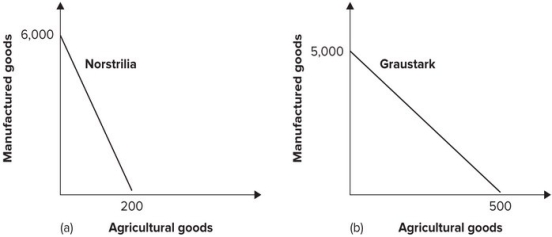 We can conclude from the diagram that:
A) Graustark has a comparative advantage in both goods.
B) Norstrilia has a comparative advantage in both goods.
C) Norstrilia has a comparative advantage in manufacturing and Graustark has a comparative advantage in agriculture.
D) Norstrilia has a comparative advantage in agriculture and Graustark has a comparative advantage in manufacturing.
We can conclude from the diagram that:A) Graustark has a comparative advantage in both goods.
B) Norstrilia has a comparative advantage in both goods.
C) Norstrilia has a comparative advantage in manufacturing and Graustark has a comparative advantage in agriculture.
D) Norstrilia has a comparative advantage in agriculture and Graustark has a comparative advantage in manufacturing.
سؤال
Production Possibility Schedules for Two South Pacific Island Nations  In Tuvalu, the opportunity cost of producing one coconut (in terms of mangoes) is:
A) 0.
B) 1/3.
C) 3.
D) 400.
In Tuvalu, the opportunity cost of producing one coconut (in terms of mangoes) is:A) 0.
B) 1/3.
C) 3.
D) 400.
سؤال
Production Possibility Schedules for Two South Pacific Island Nations  Which of the following statements is true?
A) Gains from trade are possible for both countries.
B) Only Kiribati will benefit from trade with Tuvalu.
C) Only Tuvalu will benefit from trade with Kiribati.
D) No gains from trade are possible for either Kiribati or Tuvalu.
Which of the following statements is true?A) Gains from trade are possible for both countries.
B) Only Kiribati will benefit from trade with Tuvalu.
C) Only Tuvalu will benefit from trade with Kiribati.
D) No gains from trade are possible for either Kiribati or Tuvalu.
سؤال
Refer to the table shown.  Botswana's opportunity cost of producing nickel (in terms of gold) is:
A) 3/5.
B) 5/3.
C) 60.
D) 100.
Botswana's opportunity cost of producing nickel (in terms of gold) is:A) 3/5.
B) 5/3.
C) 60.
D) 100.
سؤال
Refer to the graph shown. 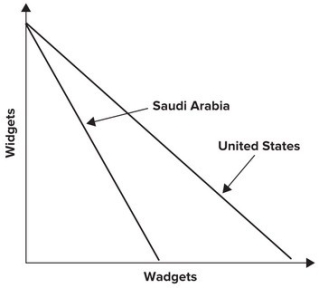 The graph demonstrates Saudi Arabia's and the United States' production possibility curves for widgets and wadgets. Given these production possibility curves, you would suggest that:
A) Saudi Arabia specialize in widgets and the United States in wadgets.
B) No trade should take place.
C) Saudi Arabia specialize in wadgets and the United States in widgets.
D) Both countries should produce an equal amount of each.
The graph demonstrates Saudi Arabia's and the United States' production possibility curves for widgets and wadgets. Given these production possibility curves, you would suggest that:A) Saudi Arabia specialize in widgets and the United States in wadgets.
B) No trade should take place.
C) Saudi Arabia specialize in wadgets and the United States in widgets.
D) Both countries should produce an equal amount of each.
سؤال
Refer to the table shown.  A comparative advantage in the production of gold is held by:
A) Zimbabwe.
B) Botswana.
C) neither country.
D) both countries.
A comparative advantage in the production of gold is held by:A) Zimbabwe.
B) Botswana.
C) neither country.
D) both countries.
سؤال
Production Possibility Schedules for Two South Pacific Island Nations  A comparative advantage in the production of coconuts is held by:
A) Kiribati.
B) Tuvalu.
C) both countries.
D) neither country.
A comparative advantage in the production of coconuts is held by:A) Kiribati.
B) Tuvalu.
C) both countries.
D) neither country.
سؤال
Refer to the graph shown. 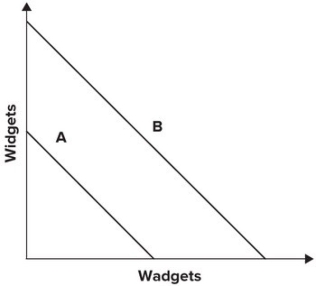 Given these production possibility curves, you would suggest that:
A) Country A should specialize in widgets and Country B in wadgets.
B) No trade should take place.
C) Country A should specialize in wadgets and Country B in widgets.
D) Both countries should produce an equal amount of each.
Given these production possibility curves, you would suggest that:A) Country A should specialize in widgets and Country B in wadgets.
B) No trade should take place.
C) Country A should specialize in wadgets and Country B in widgets.
D) Both countries should produce an equal amount of each.
سؤال
سؤال
Refer to the table shown.  In this example:
A) there are gains from trade for Botswana.
B) there are gains from trade for Zimbabwe.
C) there are gains from trade for both countries.
D) there are no possible gains from trade.
In this example:A) there are gains from trade for Botswana.
B) there are gains from trade for Zimbabwe.
C) there are gains from trade for both countries.
D) there are no possible gains from trade.
سؤال
سؤال
سؤال
Production Possibility Schedules for Two South Pacific Island Nations  In Kiribati, the opportunity cost of producing one mango (in terms of coconuts) is:
A) 0.
B) 1/4.
C) 4.
D) 400.
In Kiribati, the opportunity cost of producing one mango (in terms of coconuts) is:A) 0.
B) 1/4.
C) 4.
D) 400.
سؤال
سؤال
Production Possibility Schedules for Two South Pacific Island Nations  A comparative advantage in the production of mangoes is held by:
A) Kiribati.
B) Tuvalu.
C) both countries.
D) neither country.
A comparative advantage in the production of mangoes is held by:A) Kiribati.
B) Tuvalu.
C) both countries.
D) neither country.
سؤال
Refer to the graph shown. 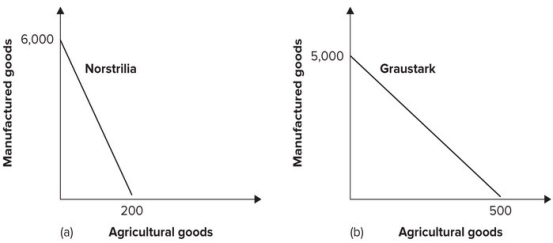 We would expect that if the two countries trade with each other (and neither trades with the rest of the world):
A) Norstrilia will export manufactured goods and Graustark will export agricultural goods.
B) Norstrilia will export agricultural goods and Graustark will export manufactured goods.
C) Norstrilia will export both goods to Graustark, which will have a permanent trade deficit.
D) Graustark will export both goods to Norstrilia, which will have a permanent trade deficit.
We would expect that if the two countries trade with each other (and neither trades with the rest of the world):A) Norstrilia will export manufactured goods and Graustark will export agricultural goods.
B) Norstrilia will export agricultural goods and Graustark will export manufactured goods.
C) Norstrilia will export both goods to Graustark, which will have a permanent trade deficit.
D) Graustark will export both goods to Norstrilia, which will have a permanent trade deficit.
سؤال
سؤال
سؤال
سؤال
سؤال
سؤال
سؤال
سؤال
سؤال
سؤال
سؤال
سؤال
سؤال
سؤال
سؤال
سؤال
سؤال
سؤال
سؤال
سؤال
سؤال
سؤال
سؤال
سؤال
سؤال
سؤال
سؤال
سؤال
سؤال
سؤال
سؤال
سؤال
سؤال
سؤال
سؤال
سؤال
سؤال
سؤال
سؤال
سؤال
سؤال
سؤال
سؤال
سؤال

فتح الحزمة
قم بالتسجيل لفتح البطاقات في هذه المجموعة!
Unlock Deck
Unlock Deck
1/107

العب

ملء الشاشة (f)
Deck 9: Comparative Advantage, Exchange Rates, and Globalization
1
When a country runs a trade deficit, it does so by:
A) borrowing from foreign countries or selling assets to them.
B) borrowing from foreign countries or buying assets from them.
C) lending to foreign countries or selling assets to them.
D) lending to foreign countries or buying assets from them.
A) borrowing from foreign countries or selling assets to them.
B) borrowing from foreign countries or buying assets from them.
C) lending to foreign countries or selling assets to them.
D) lending to foreign countries or buying assets from them.
A
2
The more competition there is in international trade, the larger the traders' proportion of the gains from trade.
False
3
If Americans demand goods produced in Mexico, it leads to a demand for Mexican pesos and a supply of U.S. dollars on the foreign exchange market.
True
4
Specialization according to comparative advantage means that a country is producing the goods:
A) that it wants to consume.
B) for which it has a relatively high opportunity cost.
C) for which it has a relatively low opportunity cost.
D) that it can produce at zero cost.
A) that it wants to consume.
B) for which it has a relatively high opportunity cost.
C) for which it has a relatively low opportunity cost.
D) that it can produce at zero cost.
فتح الحزمة
افتح القفل للوصول البطاقات البالغ عددها 107 في هذه المجموعة.
فتح الحزمة
k this deck
5
Immediately after World War II, the United States ran trade:
A) deficits and was an international lender.
B) deficits and was an international borrower.
C) surpluses and was an international lender.
D) surpluses and was an international borrower.
A) deficits and was an international lender.
B) deficits and was an international borrower.
C) surpluses and was an international lender.
D) surpluses and was an international borrower.
فتح الحزمة
افتح القفل للوصول البطاقات البالغ عددها 107 في هذه المجموعة.
فتح الحزمة
k this deck
6
When a country runs a trade surplus, it will:
A) borrow from foreign countries or sell assets to them.
B) borrow from foreign countries or buy assets from them.
C) lend to foreign countries or sell assets to them.
D) lend to foreign countries or buy assets from them.
A) borrow from foreign countries or sell assets to them.
B) borrow from foreign countries or buy assets from them.
C) lend to foreign countries or sell assets to them.
D) lend to foreign countries or buy assets from them.
فتح الحزمة
افتح القفل للوصول البطاقات البالغ عددها 107 في هذه المجموعة.
فتح الحزمة
k this deck
7
The United States has a trade deficit when the value of the goods and services we import exceeds the value of the goods and services we export.
فتح الحزمة
افتح القفل للوصول البطاقات البالغ عددها 107 في هذه المجموعة.
فتح الحزمة
k this deck
8
People with intellectual property rights are on the low end of the income distribution that is created from globalization.
فتح الحزمة
افتح القفل للوصول البطاقات البالغ عددها 107 في هذه المجموعة.
فتح الحزمة
k this deck
9
The balance of trade measures the:
A) difference between the value of imports and that of exports.
B) share of U.S. imports coming from various regions of the world.
C) share of U.S. exports going to various regions of the world.
D) exchange rate needed to make imports equal exports.
A) difference between the value of imports and that of exports.
B) share of U.S. imports coming from various regions of the world.
C) share of U.S. exports going to various regions of the world.
D) exchange rate needed to make imports equal exports.
فتح الحزمة
افتح القفل للوصول البطاقات البالغ عددها 107 في هذه المجموعة.
فتح الحزمة
k this deck
10
Economic models take into account the effect of trade on the distribution of income.
فتح الحزمة
افتح القفل للوصول البطاقات البالغ عددها 107 في هذه المجموعة.
فتح الحزمة
k this deck
11
Refer to the table shown. From this table we can conclude that:
A) France has a comparative advantage in both goods.
B) France has a comparative advantage in wine and Germany has a comparative advantage in electric generators.
C) Germany has a comparative advantage in wine and France has a comparative advantage in electric generators.
D) Germany has a comparative advantage in both goods.
A) France has a comparative advantage in both goods.
B) France has a comparative advantage in wine and Germany has a comparative advantage in electric generators.
C) Germany has a comparative advantage in wine and France has a comparative advantage in electric generators.
D) Germany has a comparative advantage in both goods.
فتح الحزمة
افتح القفل للوصول البطاقات البالغ عددها 107 في هذه المجموعة.
فتح الحزمة
k this deck
12
Smaller countries tend to get a larger share of the gains from trade than do larger countries.
فتح الحزمة
افتح القفل للوصول البطاقات البالغ عددها 107 في هذه المجموعة.
فتح الحزمة
k this deck
13
A currency has depreciated in value if it takes more of a foreign currency to buy it.
فتح الحزمة
افتح القفل للوصول البطاقات البالغ عددها 107 في هذه المجموعة.
فتح الحزمة
k this deck
14
Countries can expect to gain from international trade as long as they:
A) keep production diversified.
B) specialize according to their comparative advantage.
C) produce only those goods for which they have a relatively high opportunity cost.
D) use trade restrictions to reduce competition for domestic producers.
A) keep production diversified.
B) specialize according to their comparative advantage.
C) produce only those goods for which they have a relatively high opportunity cost.
D) use trade restrictions to reduce competition for domestic producers.
فتح الحزمة
افتح القفل للوصول البطاقات البالغ عددها 107 في هذه المجموعة.
فتح الحزمة
k this deck
15
We can conclude from the table shown that Spain has a comparative advantage in the production of tables.
فتح الحزمة
افتح القفل للوصول البطاقات البالغ عددها 107 في هذه المجموعة.
فتح الحزمة
k this deck
16
Refer to the table shown. From this table we can conclude that if the two countries trade with each other, it is most likely that:
A) France exports both goods to Germany.
B) Germany exports both goods to France.
C) France exports wine to Germany and imports electric generators from Germany.
D) France exports electric generators to Germany and imports wine from Germany.
A) France exports both goods to Germany.
B) Germany exports both goods to France.
C) France exports wine to Germany and imports electric generators from Germany.
D) France exports electric generators to Germany and imports wine from Germany.
فتح الحزمة
افتح القفل للوصول البطاقات البالغ عددها 107 في هذه المجموعة.
فتح الحزمة
k this deck
17
We can conclude from the table shown that Morocco has a comparative advantage in the production of tables.
فتح الحزمة
افتح القفل للوصول البطاقات البالغ عددها 107 في هذه المجموعة.
فتح الحزمة
k this deck
18
Suppose foreign shrimp prices drop by 32 percent and importers gain a 90 percent market share. From this information, what would economists strongly suspect about this industry?
A) Foreigners have a comparative advantage in shrimping.
B) Americans have a comparative advantage in shrimping.
C) Foreign sellers probably are colluding on price to maximize profits.
D) The large sales of foreigners indicate that they are better strategic bargainers than Americans are.
A) Foreigners have a comparative advantage in shrimping.
B) Americans have a comparative advantage in shrimping.
C) Foreign sellers probably are colluding on price to maximize profits.
D) The large sales of foreigners indicate that they are better strategic bargainers than Americans are.
فتح الحزمة
افتح القفل للوصول البطاقات البالغ عددها 107 في هذه المجموعة.
فتح الحزمة
k this deck
19
Manufacturing wages have risen significantly for 20 years.
فتح الحزمة
افتح القفل للوصول البطاقات البالغ عددها 107 في هذه المجموعة.
فتح الحزمة
k this deck
20
Globalization represents:
A) a return to isolationism.
B) the opposite of isolationism.
C) the economic complement of political isolationism.
D) the political complement of economic isolationism.
A) a return to isolationism.
B) the opposite of isolationism.
C) the economic complement of political isolationism.
D) the political complement of economic isolationism.
فتح الحزمة
افتح القفل للوصول البطاقات البالغ عددها 107 في هذه المجموعة.
فتح الحزمة
k this deck
21
Refer to the graph shown. We can conclude from the diagram that:
A) Graustark has a comparative advantage in both goods.
B) Norstrilia has a comparative advantage in both goods.
C) Norstrilia has a comparative advantage in manufacturing and Graustark has a comparative advantage in agriculture.
D) Norstrilia has a comparative advantage in agriculture and Graustark has a comparative advantage in manufacturing.
We can conclude from the diagram that:A) Graustark has a comparative advantage in both goods.
B) Norstrilia has a comparative advantage in both goods.
C) Norstrilia has a comparative advantage in manufacturing and Graustark has a comparative advantage in agriculture.
D) Norstrilia has a comparative advantage in agriculture and Graustark has a comparative advantage in manufacturing.
فتح الحزمة
افتح القفل للوصول البطاقات البالغ عددها 107 في هذه المجموعة.
فتح الحزمة
k this deck
22
Production Possibility Schedules for Two South Pacific Island Nations In Tuvalu, the opportunity cost of producing one coconut (in terms of mangoes) is:
A) 0.
B) 1/3.
C) 3.
D) 400.
In Tuvalu, the opportunity cost of producing one coconut (in terms of mangoes) is:A) 0.
B) 1/3.
C) 3.
D) 400.
فتح الحزمة
افتح القفل للوصول البطاقات البالغ عددها 107 في هذه المجموعة.
فتح الحزمة
k this deck
23
Production Possibility Schedules for Two South Pacific Island Nations Which of the following statements is true?
A) Gains from trade are possible for both countries.
B) Only Kiribati will benefit from trade with Tuvalu.
C) Only Tuvalu will benefit from trade with Kiribati.
D) No gains from trade are possible for either Kiribati or Tuvalu.
Which of the following statements is true?A) Gains from trade are possible for both countries.
B) Only Kiribati will benefit from trade with Tuvalu.
C) Only Tuvalu will benefit from trade with Kiribati.
D) No gains from trade are possible for either Kiribati or Tuvalu.
فتح الحزمة
افتح القفل للوصول البطاقات البالغ عددها 107 في هذه المجموعة.
فتح الحزمة
k this deck
24
Refer to the table shown. Botswana's opportunity cost of producing nickel (in terms of gold) is:
A) 3/5.
B) 5/3.
C) 60.
D) 100.
Botswana's opportunity cost of producing nickel (in terms of gold) is:A) 3/5.
B) 5/3.
C) 60.
D) 100.
فتح الحزمة
افتح القفل للوصول البطاقات البالغ عددها 107 في هذه المجموعة.
فتح الحزمة
k this deck
25
Refer to the graph shown. The graph demonstrates Saudi Arabia's and the United States' production possibility curves for widgets and wadgets. Given these production possibility curves, you would suggest that:
A) Saudi Arabia specialize in widgets and the United States in wadgets.
B) No trade should take place.
C) Saudi Arabia specialize in wadgets and the United States in widgets.
D) Both countries should produce an equal amount of each.
The graph demonstrates Saudi Arabia's and the United States' production possibility curves for widgets and wadgets. Given these production possibility curves, you would suggest that:A) Saudi Arabia specialize in widgets and the United States in wadgets.
B) No trade should take place.
C) Saudi Arabia specialize in wadgets and the United States in widgets.
D) Both countries should produce an equal amount of each.
فتح الحزمة
افتح القفل للوصول البطاقات البالغ عددها 107 في هذه المجموعة.
فتح الحزمة
k this deck
26
Refer to the table shown. A comparative advantage in the production of gold is held by:
A) Zimbabwe.
B) Botswana.
C) neither country.
D) both countries.
A comparative advantage in the production of gold is held by:A) Zimbabwe.
B) Botswana.
C) neither country.
D) both countries.
فتح الحزمة
افتح القفل للوصول البطاقات البالغ عددها 107 في هذه المجموعة.
فتح الحزمة
k this deck
27
Production Possibility Schedules for Two South Pacific Island Nations A comparative advantage in the production of coconuts is held by:
A) Kiribati.
B) Tuvalu.
C) both countries.
D) neither country.
A comparative advantage in the production of coconuts is held by:A) Kiribati.
B) Tuvalu.
C) both countries.
D) neither country.
فتح الحزمة
افتح القفل للوصول البطاقات البالغ عددها 107 في هذه المجموعة.
فتح الحزمة
k this deck
28
Refer to the graph shown. Given these production possibility curves, you would suggest that:
A) Country A should specialize in widgets and Country B in wadgets.
B) No trade should take place.
C) Country A should specialize in wadgets and Country B in widgets.
D) Both countries should produce an equal amount of each.
Given these production possibility curves, you would suggest that:A) Country A should specialize in widgets and Country B in wadgets.
B) No trade should take place.
C) Country A should specialize in wadgets and Country B in widgets.
D) Both countries should produce an equal amount of each.
فتح الحزمة
افتح القفل للوصول البطاقات البالغ عددها 107 في هذه المجموعة.
فتح الحزمة
k this deck
29
If nations trade on the basis of comparative advantage:
A) a nation usually can gain from trade only at the expense of its trading partners.
B) exporting nations gain from trade and importing nations lose.
C) importing nations gain from trade and exporting nations lose.
D) all trading partners can gain from trade.
A) a nation usually can gain from trade only at the expense of its trading partners.
B) exporting nations gain from trade and importing nations lose.
C) importing nations gain from trade and exporting nations lose.
D) all trading partners can gain from trade.
فتح الحزمة
افتح القفل للوصول البطاقات البالغ عددها 107 في هذه المجموعة.
فتح الحزمة
k this deck
30
Refer to the table shown. In this example:
A) there are gains from trade for Botswana.
B) there are gains from trade for Zimbabwe.
C) there are gains from trade for both countries.
D) there are no possible gains from trade.
In this example:A) there are gains from trade for Botswana.
B) there are gains from trade for Zimbabwe.
C) there are gains from trade for both countries.
D) there are no possible gains from trade.
فتح الحزمة
افتح القفل للوصول البطاقات البالغ عددها 107 في هذه المجموعة.
فتح الحزمة
k this deck
31
A widget has an opportunity cost of 4 wadgets in Saudi Arabia and 2 wadgets in the United States. Given these opportunity costs, you would suggest that:
A) Saudi Arabia specialize in widgets and the United States in wadgets.
B) No trade should take place.
C) Saudi Arabia specialize in wadgets and the United States in widgets.
D) Both countries should produce an equal amount of each.
A) Saudi Arabia specialize in widgets and the United States in wadgets.
B) No trade should take place.
C) Saudi Arabia specialize in wadgets and the United States in widgets.
D) Both countries should produce an equal amount of each.
فتح الحزمة
افتح القفل للوصول البطاقات البالغ عددها 107 في هذه المجموعة.
فتح الحزمة
k this deck
32
The country with a comparative advantage in the production of good X is the one that:
A) has the greatest technical efficiency in producing good X.
B) has the greatest supply of the natural resources used in producing good X.
C) can produce good X with the least labor.
D) can produce good X at the lowest opportunity cost.
A) has the greatest technical efficiency in producing good X.
B) has the greatest supply of the natural resources used in producing good X.
C) can produce good X with the least labor.
D) can produce good X at the lowest opportunity cost.
فتح الحزمة
افتح القفل للوصول البطاقات البالغ عددها 107 في هذه المجموعة.
فتح الحزمة
k this deck
33
Production Possibility Schedules for Two South Pacific Island Nations In Kiribati, the opportunity cost of producing one mango (in terms of coconuts) is:
A) 0.
B) 1/4.
C) 4.
D) 400.
In Kiribati, the opportunity cost of producing one mango (in terms of coconuts) is:A) 0.
B) 1/4.
C) 4.
D) 400.
فتح الحزمة
افتح القفل للوصول البطاقات البالغ عددها 107 في هذه المجموعة.
فتح الحزمة
k this deck
34
Assume that in Canada the opportunity cost of producing one television set is two bushels of wheat. Assume that in the United States the opportunity cost of producing one bushel of wheat is two television sets. If these two countries specialize according to comparative advantage and then trade with each other:
A) Canada will export both televisions and wheat.
B) Canada will export wheat and import televisions.
C) the United States will export wheat and import televisions.
D) the United States will export both televisions and wheat.
A) Canada will export both televisions and wheat.
B) Canada will export wheat and import televisions.
C) the United States will export wheat and import televisions.
D) the United States will export both televisions and wheat.
فتح الحزمة
افتح القفل للوصول البطاقات البالغ عددها 107 في هذه المجموعة.
فتح الحزمة
k this deck
35
Production Possibility Schedules for Two South Pacific Island Nations A comparative advantage in the production of mangoes is held by:
A) Kiribati.
B) Tuvalu.
C) both countries.
D) neither country.
A comparative advantage in the production of mangoes is held by:A) Kiribati.
B) Tuvalu.
C) both countries.
D) neither country.
فتح الحزمة
افتح القفل للوصول البطاقات البالغ عددها 107 في هذه المجموعة.
فتح الحزمة
k this deck
36
Refer to the graph shown. We would expect that if the two countries trade with each other (and neither trades with the rest of the world):
A) Norstrilia will export manufactured goods and Graustark will export agricultural goods.
B) Norstrilia will export agricultural goods and Graustark will export manufactured goods.
C) Norstrilia will export both goods to Graustark, which will have a permanent trade deficit.
D) Graustark will export both goods to Norstrilia, which will have a permanent trade deficit.
We would expect that if the two countries trade with each other (and neither trades with the rest of the world):A) Norstrilia will export manufactured goods and Graustark will export agricultural goods.
B) Norstrilia will export agricultural goods and Graustark will export manufactured goods.
C) Norstrilia will export both goods to Graustark, which will have a permanent trade deficit.
D) Graustark will export both goods to Norstrilia, which will have a permanent trade deficit.
فتح الحزمة
افتح القفل للوصول البطاقات البالغ عددها 107 في هذه المجموعة.
فتح الحزمة
k this deck
37
A nation's comparative advantage in the production of an item is determined by:
A) which country has already specialized in the production of the item.
B) the total and marginal costs of producing the item.
C) the opportunity cost of producing the item relative to a trading partner's opportunity cost.
D) wage rates and other input costs.
A) which country has already specialized in the production of the item.
B) the total and marginal costs of producing the item.
C) the opportunity cost of producing the item relative to a trading partner's opportunity cost.
D) wage rates and other input costs.
فتح الحزمة
افتح القفل للوصول البطاقات البالغ عددها 107 في هذه المجموعة.
فتح الحزمة
k this deck
38
At one time, most of the cars produced in Mexico were sold in Mexico. Today, however, Mexico both exports and imports cars. How can comparative advantage explain these data?
A) It cannot; comparative advantage predicts that a country either exports a product or imports it, not both.
B) The pattern is not due to comparative advantage but to government restrictions on production.
C) Mexico has a comparative disadvantage in automobiles.
D) Mexico specializes in the production of high-end cars, which it exports, and imports low-end cars that can be produced at lower cost elsewhere.
A) It cannot; comparative advantage predicts that a country either exports a product or imports it, not both.
B) The pattern is not due to comparative advantage but to government restrictions on production.
C) Mexico has a comparative disadvantage in automobiles.
D) Mexico specializes in the production of high-end cars, which it exports, and imports low-end cars that can be produced at lower cost elsewhere.
فتح الحزمة
افتح القفل للوصول البطاقات البالغ عددها 107 في هذه المجموعة.
فتح الحزمة
k this deck
39
Assume that in Canada the opportunity cost of producing one television set is two bushels of wheat. Assume that in the United States the opportunity cost of producing one bushel of wheat is two television sets. If these two countries specialize according to comparative advantage and then trade with each other:
A) Canada will import both televisions and wheat.
B) Canada will import wheat and export televisions.
C) the United States will import wheat and export televisions.
D) the United States will import both televisions and wheat.
A) Canada will import both televisions and wheat.
B) Canada will import wheat and export televisions.
C) the United States will import wheat and export televisions.
D) the United States will import both televisions and wheat.
فتح الحزمة
افتح القفل للوصول البطاقات البالغ عددها 107 في هذه المجموعة.
فتح الحزمة
k this deck
40
If the United States were to stop trading with other nations, economists would predict that in the long run the United States would end up with:
A) more jobs.
B) lower prices.
C) a higher standard of living.
D) a lower standard of living.
A) more jobs.
B) lower prices.
C) a higher standard of living.
D) a lower standard of living.
فتح الحزمة
افتح القفل للوصول البطاقات البالغ عددها 107 في هذه المجموعة.
فتح الحزمة
k this deck
41
In considering the distribution of the gains from trade:
A) Smaller countries usually get a larger proportion of the gains from trade.
B) Larger countries usually get a larger proportion of the gains from trade.
C) The gains are generally split equally between small and large countries.
D) No statement can be made about the general nature of the split.
A) Smaller countries usually get a larger proportion of the gains from trade.
B) Larger countries usually get a larger proportion of the gains from trade.
C) The gains are generally split equally between small and large countries.
D) No statement can be made about the general nature of the split.
فتح الحزمة
افتح القفل للوصول البطاقات البالغ عددها 107 في هذه المجموعة.
فتح الحزمة
k this deck
42
The fact that the United States has a trade deficit means that:
A) the United States is producing more than it is consuming.
B) foreign countries can have comparative advantages in all goods.
C) foreign countries can have comparative advantages in more goods compared to the United States.
D) the United States is lending more to foreign countries than it is borrowing from foreign countries.
A) the United States is producing more than it is consuming.
B) foreign countries can have comparative advantages in all goods.
C) foreign countries can have comparative advantages in more goods compared to the United States.
D) the United States is lending more to foreign countries than it is borrowing from foreign countries.
فتح الحزمة
افتح القفل للوصول البطاقات البالغ عددها 107 في هذه المجموعة.
فتح الحزمة
k this deck
43
Workers in education, healthcare and government sectors have:
A) seen their incomes fall just like in manufacturing.
B) been mostly hurt from globalization.
C) benefited from globalization in terms of lower consumer prices.
D) been hurt because the sector has been shrinking.
A) seen their incomes fall just like in manufacturing.
B) been mostly hurt from globalization.
C) benefited from globalization in terms of lower consumer prices.
D) been hurt because the sector has been shrinking.
فتح الحزمة
افتح القفل للوصول البطاقات البالغ عددها 107 في هذه المجموعة.
فتح الحزمة
k this deck
44
When considering outsourcing, most laypeople:
A) recognize its benefits to raising foreign wages.
B) oppose it because of the visible loss of jobs.
C) support it because they enjoy lower consumer prices.
D) recognize it frees resources for other jobs for which the U.S. has a comparative advantage.
A) recognize its benefits to raising foreign wages.
B) oppose it because of the visible loss of jobs.
C) support it because they enjoy lower consumer prices.
D) recognize it frees resources for other jobs for which the U.S. has a comparative advantage.
فتح الحزمة
افتح القفل للوصول البطاقات البالغ عددها 107 في هذه المجموعة.
فتح الحزمة
k this deck
45
The group that benefited the most from international trade has been people who:
A) financed international trade.
B) managed firms.
C) owners of firms.
D) no one has benefited.
A) financed international trade.
B) managed firms.
C) owners of firms.
D) no one has benefited.
فتح الحزمة
افتح القفل للوصول البطاقات البالغ عددها 107 في هذه المجموعة.
فتح الحزمة
k this deck
46
Why are the gains from trade often difficult to recognize?
A) The United States does not keep accurate records of employment.
B) The gains are spread out over a wide variety of goods and consumers.
C) There are no gains from trade.
D) The gains are in services, which are difficult to measure.
A) The United States does not keep accurate records of employment.
B) The gains are spread out over a wide variety of goods and consumers.
C) There are no gains from trade.
D) The gains are in services, which are difficult to measure.
فتح الحزمة
افتح القفل للوصول البطاقات البالغ عددها 107 في هذه المجموعة.
فتح الحزمة
k this deck
47
On average, globalization has:
A) been insignificant.
B) left Americans no better or not worse off.
C) hurt Americans.
D) benefited Americans.
A) been insignificant.
B) left Americans no better or not worse off.
C) hurt Americans.
D) benefited Americans.
فتح الحزمة
افتح القفل للوصول البطاقات البالغ عددها 107 في هذه المجموعة.
فتح الحزمة
k this deck
48
Most economists:
A) focus on the costs of international trade and discount its benefits in lower consumer prices.
B) include the effects of trade on the distribution of income.
C) recognize both the costs of international trade in lost jobs and the benefits in terms of lower prices.
D) support free trade because it raises the wages of those in countries who can hardly meet their basic needs.
A) focus on the costs of international trade and discount its benefits in lower consumer prices.
B) include the effects of trade on the distribution of income.
C) recognize both the costs of international trade in lost jobs and the benefits in terms of lower prices.
D) support free trade because it raises the wages of those in countries who can hardly meet their basic needs.
فتح الحزمة
افتح القفل للوصول البطاقات البالغ عددها 107 في هذه المجموعة.
فتح الحزمة
k this deck
49
Economists:
A) are not concerned with the distributional effects of trade.
B) cannot measure the distributional effects of trade.
C) do not generally include the distributional effects of trade in their models.
D) disagree with laypeople that the distributional effects of trade are important.
A) are not concerned with the distributional effects of trade.
B) cannot measure the distributional effects of trade.
C) do not generally include the distributional effects of trade in their models.
D) disagree with laypeople that the distributional effects of trade are important.
فتح الحزمة
افتح القفل للوصول البطاقات البالغ عددها 107 في هذه المجموعة.
فتح الحزمة
k this deck
50
Which of the following puts downward pressure on U.S. manufacturing wages?
A) A declining value of the dollar
B) Rising foreign wages
C) Technological innovation
D) Immigration
A) A declining value of the dollar
B) Rising foreign wages
C) Technological innovation
D) Immigration
فتح الحزمة
افتح القفل للوصول البطاقات البالغ عددها 107 في هذه المجموعة.
فتح الحزمة
k this deck
51
The analysis of international trade suggests that trading companies earn higher than normal profits in:
A) the long run but not in the short run.
B) the short run but not in the long run.
C) both the short run and the long run.
D) neither the short run nor the long run.
A) the long run but not in the short run.
B) the short run but not in the long run.
C) both the short run and the long run.
D) neither the short run nor the long run.
فتح الحزمة
افتح القفل للوصول البطاقات البالغ عددها 107 في هذه المجموعة.
فتح الحزمة
k this deck
52
In the past, presidential candidates have argued that free trade with Mexico would result in massive job losses in the United States because Mexican wages were so low. Which of the following is the best explanation of why few economists agree with this position?
A) Economists did not believe that any jobs would be lost in the United States.
B) Economists believed that the U.S. unemployment rate would rise.
C) Although economists agreed that in some areas the United States would lose jobs, they expected that the United States would gain jobs in other areas.
D) Although economists predicted that unemployment would rise, the increased profits of corporations would raise stock prices enough to compensate for the lost jobs.
A) Economists did not believe that any jobs would be lost in the United States.
B) Economists believed that the U.S. unemployment rate would rise.
C) Although economists agreed that in some areas the United States would lose jobs, they expected that the United States would gain jobs in other areas.
D) Although economists predicted that unemployment would rise, the increased profits of corporations would raise stock prices enough to compensate for the lost jobs.
فتح الحزمة
افتح القفل للوصول البطاقات البالغ عددها 107 في هذه المجموعة.
فتح الحزمة
k this deck
53
The U.S. textile industry is relatively small because the United States imports most of its clothing. A clear result of the importation of clothing is that:
A) there is less variety available than there would be without imports.
B) the quality of clothing is lower than it would be without imports.
C) the price of clothing is higher than it would be without imports.
D) the price of clothing is lower than it would be without imports.
A) there is less variety available than there would be without imports.
B) the quality of clothing is lower than it would be without imports.
C) the price of clothing is higher than it would be without imports.
D) the price of clothing is lower than it would be without imports.
فتح الحزمة
افتح القفل للوصول البطاقات البالغ عددها 107 في هذه المجموعة.
فتح الحزمة
k this deck
54
If countries decide they will no longer buy U.S. assets or lend to the United States:
A) adjustments will be set in motion to equalize comparative advantages.
B) adjustments will be set in motion so that the United States has more comparative advantages.
C) the United States can begin to run a trade deficit.
D) There is no reason foreign countries will not want to buy more U.S. assets than the United States buys of foreign assets.
A) adjustments will be set in motion to equalize comparative advantages.
B) adjustments will be set in motion so that the United States has more comparative advantages.
C) the United States can begin to run a trade deficit.
D) There is no reason foreign countries will not want to buy more U.S. assets than the United States buys of foreign assets.
فتح الحزمة
افتح القفل للوصول البطاقات البالغ عددها 107 في هذه المجموعة.
فتح الحزمة
k this deck
55
In the United States, globalization has caused workers in the education, health care, and government sectors to face:
A) lower wages.
B) higher prices on consumer goods.
C) little or no downward pressure on their wages.
D) longer hours to compete with the higher production levels abroad.
A) lower wages.
B) higher prices on consumer goods.
C) little or no downward pressure on their wages.
D) longer hours to compete with the higher production levels abroad.
فتح الحزمة
افتح القفل للوصول البطاقات البالغ عددها 107 في هذه المجموعة.
فتح الحزمة
k this deck
56
In the United States globalization has played:
A) a significant role in growing income disparity because some sectors have benefited and others have not.
B) little role in growing income disparity because all Americans are consumers who have enjoyed lower prices.
C) a significant role in growing income disparity because foreign workers' incomes have risen.
D) little role in growing income disparity because while some jobs were lost, the gain in jobs balanced out those that were lost.
A) a significant role in growing income disparity because some sectors have benefited and others have not.
B) little role in growing income disparity because all Americans are consumers who have enjoyed lower prices.
C) a significant role in growing income disparity because foreign workers' incomes have risen.
D) little role in growing income disparity because while some jobs were lost, the gain in jobs balanced out those that were lost.
فتح الحزمة
افتح القفل للوصول البطاقات البالغ عددها 107 في هذه المجموعة.
فتح الحزمة
k this deck
57
Economists and laypeople see the pros and cons of international trade in different ways. Which of the following is one of those ways?
A) Laypeople enjoy the benefits of trade in terms of lower consumer prices.
B) Laypeople believe in the law of one price and economists do not.
C) Laypeople tend to think of foreign trade only in terms of manufactured goods.
D) Laypeople recognize that the United States has a comparative advantage in services.
A) Laypeople enjoy the benefits of trade in terms of lower consumer prices.
B) Laypeople believe in the law of one price and economists do not.
C) Laypeople tend to think of foreign trade only in terms of manufactured goods.
D) Laypeople recognize that the United States has a comparative advantage in services.
فتح الحزمة
افتح القفل للوصول البطاقات البالغ عددها 107 في هذه المجموعة.
فتح الحزمة
k this deck
58
The loss of jobs due to international trade is often:
A) more visible than the decline in consumer prices due to international trade.
B) less visible than the decline in prices due to international trade.
C) greater than the benefit of trade in the form of decline in prices.
D) spread across all sectors while decline in prices is concentrated in one sector.
A) more visible than the decline in consumer prices due to international trade.
B) less visible than the decline in prices due to international trade.
C) greater than the benefit of trade in the form of decline in prices.
D) spread across all sectors while decline in prices is concentrated in one sector.
فتح الحزمة
افتح القفل للوصول البطاقات البالغ عددها 107 في هذه المجموعة.
فتح الحزمة
k this deck
59
Which of the following statements correctly summarizes a difference between the layperson's and the economist's views of the net benefits of trade?
A) Economists often argue that the gains from trade in the form of low consumer prices tend to be widespread and not easily recognizable while the costs in jobs lost tend to be concentrated and readily identifiable.
B) Economists often argue that most U.S. jobs are at risk of outsourcing while laypeople intuitively recognize that inherent in comparative advantage is that each country has a comparative advantage in the production of some good.
C) Economists focus on trade in manufactured goods while laypeople also focus on trade involving the services of people who manage the trade.
D) Economists most often argue that the costs of trade outweigh the benefits while laypeople often argue that the benefits of trade outweigh the costs.
A) Economists often argue that the gains from trade in the form of low consumer prices tend to be widespread and not easily recognizable while the costs in jobs lost tend to be concentrated and readily identifiable.
B) Economists often argue that most U.S. jobs are at risk of outsourcing while laypeople intuitively recognize that inherent in comparative advantage is that each country has a comparative advantage in the production of some good.
C) Economists focus on trade in manufactured goods while laypeople also focus on trade involving the services of people who manage the trade.
D) Economists most often argue that the costs of trade outweigh the benefits while laypeople often argue that the benefits of trade outweigh the costs.
فتح الحزمة
افتح القفل للوصول البطاقات البالغ عددها 107 في هذه المجموعة.
فتح الحزمة
k this deck
60
Country A's cost of widgets is $4.00 and cost of wadgets is $8.00. Country B's cost of widgets is 8 euros and cost of wadgets is 16 euros. Which of the following would you suggest?
A) Country A should specialize in widgets and Country B in wadgets.
B) Trade of widgets for wadgets would not benefit the countries.
C) Country A should specialize in wadgets and Country B in widgets.
D) Both countries should produce an equal amount of each.
A) Country A should specialize in widgets and Country B in wadgets.
B) Trade of widgets for wadgets would not benefit the countries.
C) Country A should specialize in wadgets and Country B in widgets.
D) Both countries should produce an equal amount of each.
فتح الحزمة
افتح القفل للوصول البطاقات البالغ عددها 107 في هذه المجموعة.
فتح الحزمة
k this deck
61
What economists call the law of one price depends on:
A) government action.
B) people seeking to exploit profit opportunities.
C) random chance.
D) the inertia effect.
A) government action.
B) people seeking to exploit profit opportunities.
C) random chance.
D) the inertia effect.
فتح الحزمة
افتح القفل للوصول البطاقات البالغ عددها 107 في هذه المجموعة.
فتح الحزمة
k this deck
62
When comparative advantage is based on transferable factors, the law of one price tends to:
A) erode the advantage away.
B) amplify the advantage.
C) stabilize the advantage.
D) make the advantage into an inherent comparative advantage.
A) erode the advantage away.
B) amplify the advantage.
C) stabilize the advantage.
D) make the advantage into an inherent comparative advantage.
فتح الحزمة
افتح القفل للوصول البطاقات البالغ عددها 107 في هذه المجموعة.
فتح الحزمة
k this deck
63
The decline in the price of American goods is due in part to:
A) agglomeration effects of firms.
B) declines in productivity.
C) trade barriers that allow domestic firms to lower prices.
D) globalization and increased trade.
A) agglomeration effects of firms.
B) declines in productivity.
C) trade barriers that allow domestic firms to lower prices.
D) globalization and increased trade.
فتح الحزمة
افتح القفل للوصول البطاقات البالغ عددها 107 في هذه المجموعة.
فتح الحزمة
k this deck
64
The foreign exchange rate is the rate at which:
A) taxes are imposed on foreign imports.
B) foreign goods are traded between domestic consumers.
C) one country's currency can be traded for another country's currency.
D) immigrants are exchanged between countries.
A) taxes are imposed on foreign imports.
B) foreign goods are traded between domestic consumers.
C) one country's currency can be traded for another country's currency.
D) immigrants are exchanged between countries.
فتح الحزمة
افتح القفل للوصول البطاقات البالغ عددها 107 في هذه المجموعة.
فتح الحزمة
k this deck
65
The United States imports:
A) only manufactured goods.
B) only services.
C) neither manufactured goods nor services.
D) both manufactured goods and services.
A) only manufactured goods.
B) only services.
C) neither manufactured goods nor services.
D) both manufactured goods and services.
فتح الحزمة
افتح القفل للوصول البطاقات البالغ عددها 107 في هذه المجموعة.
فتح الحزمة
k this deck
66
A common economically unfounded fear held by laypeople is that:
A) globalization will result in the United States losing most jobs because wages are so much higher in the United States.
B) globalization will result in dramatically higher prices because most services will be outsourced.
C) the United States has a comparative advantage in the production of all goods.
D) a U.S. trade surplus will result in a dramatically lower dollar.
A) globalization will result in the United States losing most jobs because wages are so much higher in the United States.
B) globalization will result in dramatically higher prices because most services will be outsourced.
C) the United States has a comparative advantage in the production of all goods.
D) a U.S. trade surplus will result in a dramatically lower dollar.
فتح الحزمة
افتح القفل للوصول البطاقات البالغ عددها 107 في هذه المجموعة.
فتح الحزمة
k this deck
67
The Mexican demand for American goods leads to the demand for:
A) Mexican pesos and the supply of U.S. dollars on the foreign exchange market.
B) U.S. dollars and Mexican pesos on the foreign exchange market.
C) U.S. dollars and the supply of Mexican pesos on the foreign exchange market.
D) U.S. dollars and the supply of U.S. dollars on the foreign exchange market.
A) Mexican pesos and the supply of U.S. dollars on the foreign exchange market.
B) U.S. dollars and Mexican pesos on the foreign exchange market.
C) U.S. dollars and the supply of Mexican pesos on the foreign exchange market.
D) U.S. dollars and the supply of U.S. dollars on the foreign exchange market.
فتح الحزمة
افتح القفل للوصول البطاقات البالغ عددها 107 في هذه المجموعة.
فتح الحزمة
k this deck
68
The text mentions 10 sources of U.S. comparative advantage. Which of the following is not one of them?
A) Relatively open immigration laws
B) Religious diversity
C) Skills of the U.S. labor force
D) A large stock of intellectual property rights
A) Relatively open immigration laws
B) Religious diversity
C) Skills of the U.S. labor force
D) A large stock of intellectual property rights
فتح الحزمة
افتح القفل للوصول البطاقات البالغ عددها 107 في هذه المجموعة.
فتح الحزمة
k this deck
69
If 1 Canadian dollar costs 0.60 U.S. dollars, 1 U.S. dollar costs:
A) 0.40 Canadian dollars.
B) 0.60 Canadian dollars.
C) 1.40 Canadian dollars.
D) 1.67 Canadian dollars.
A) 0.40 Canadian dollars.
B) 0.60 Canadian dollars.
C) 1.40 Canadian dollars.
D) 1.67 Canadian dollars.
فتح الحزمة
افتح القفل للوصول البطاقات البالغ عددها 107 في هذه المجموعة.
فتح الحزمة
k this deck
70
The price of an acre of land in rural Nevada is a few hundred dollars. The price of an acre of land in downtown New York is many millions of dollars. How does the law of one price explain this difference?
A) It cannot; there are unexplainable exceptions to the law of one price.
B) It suggests that in the long run price of land will be equalized regardless of location.
C) The law of one price depends on the ability of resources to move; location by its very nature cannot be mobile.
D) The law of one price applies only to resources involved in international trade.
A) It cannot; there are unexplainable exceptions to the law of one price.
B) It suggests that in the long run price of land will be equalized regardless of location.
C) The law of one price depends on the ability of resources to move; location by its very nature cannot be mobile.
D) The law of one price applies only to resources involved in international trade.
فتح الحزمة
افتح القفل للوصول البطاقات البالغ عددها 107 في هذه المجموعة.
فتح الحزمة
k this deck
71
How are goods manufactured in other countries creating jobs in the United States?
A) People whose jobs were outsourced are now discouraged workers.
B) U.S. firms are specializing in managing the trade of these goods.
C) Foreign countries are importing U.S. natural resources.
D) People who have lost jobs have more time to shop and therefore increase demand for goods.
A) People whose jobs were outsourced are now discouraged workers.
B) U.S. firms are specializing in managing the trade of these goods.
C) Foreign countries are importing U.S. natural resources.
D) People who have lost jobs have more time to shop and therefore increase demand for goods.
فتح الحزمة
افتح القفل للوصول البطاقات البالغ عددها 107 في هذه المجموعة.
فتح الحزمة
k this deck
72
Which of the following is eroding the U.S. comparative advantage?
A) The spread of technology
B) The law of one price
C) A depreciating dollar
D) Intellectual property rights
A) The spread of technology
B) The law of one price
C) A depreciating dollar
D) Intellectual property rights
فتح الحزمة
افتح القفل للوصول البطاقات البالغ عددها 107 في هذه المجموعة.
فتح الحزمة
k this deck
73
The text calls the type of comparative advantage that is not easily changed, such as climate:
A) stable comparative advantage.
B) inherent comparative advantage.
C) equilibrium comparative advantage.
D) permanent comparative advantage.
A) stable comparative advantage.
B) inherent comparative advantage.
C) equilibrium comparative advantage.
D) permanent comparative advantage.
فتح الحزمة
افتح القفل للوصول البطاقات البالغ عددها 107 في هذه المجموعة.
فتح الحزمة
k this deck
74
Transferable comparative advantages are:
A) based on factors that are relatively unchangeable.
B) based on factors that can change relatively easily.
C) becoming more like inherent comparative advantages with technological innovations.
D) rarely eroded over time.
A) based on factors that are relatively unchangeable.
B) based on factors that can change relatively easily.
C) becoming more like inherent comparative advantages with technological innovations.
D) rarely eroded over time.
فتح الحزمة
افتح القفل للوصول البطاقات البالغ عددها 107 في هذه المجموعة.
فتح الحزمة
k this deck
75
One of the 10 sources of U.S. comparative advantage mentioned in the text is:
A) religious diversity.
B) a large military.
C) a high ratio of lawyers to the population.
D) stable U.S. government institutions.
A) religious diversity.
B) a large military.
C) a high ratio of lawyers to the population.
D) stable U.S. government institutions.
فتح الحزمة
افتح القفل للوصول البطاقات البالغ عددها 107 في هذه المجموعة.
فتح الحزمة
k this deck
76
When people talk about U.S. intellectual property rights, what are they talking about?
A) The existence of high-quality educational institutions such as the Ivy League schools.
B) Ideas and knowledge protected by patents and copyrights.
C) The human capital of the U.S. labor force.
D) The abstract nature of ownership in corporate organizations.
A) The existence of high-quality educational institutions such as the Ivy League schools.
B) Ideas and knowledge protected by patents and copyrights.
C) The human capital of the U.S. labor force.
D) The abstract nature of ownership in corporate organizations.
فتح الحزمة
افتح القفل للوصول البطاقات البالغ عددها 107 في هذه المجموعة.
فتح الحزمة
k this deck
77
The text refers to the type of comparative advantage that can be gained or lost because of changes in skills of workers or types of capital as:
A) unstable comparative advantage.
B) transferable comparative advantage.
C) non-equilibrium comparative advantage.
D) temporary comparative advantage.
A) unstable comparative advantage.
B) transferable comparative advantage.
C) non-equilibrium comparative advantage.
D) temporary comparative advantage.
فتح الحزمة
افتح القفل للوصول البطاقات البالغ عددها 107 في هذه المجموعة.
فتح الحزمة
k this deck
78
The text mentions 10 sources of U.S. comparative advantage. Which of the following is not one of them?
A) Wealth from past production
B) The fact that English is the international language of business
C) A substantial policy to limit immigration
D) Extensive natural resources
A) Wealth from past production
B) The fact that English is the international language of business
C) A substantial policy to limit immigration
D) Extensive natural resources
فتح الحزمة
افتح القفل للوصول البطاقات البالغ عددها 107 في هذه المجموعة.
فتح الحزمة
k this deck
79
If the euro rises in price, it becomes:
A) cheaper for Americans to buy European products and cheaper for Europeans to buy American products.
B) cheaper for Americans to buy European products but more expensive for Europeans to buy American products.
C) more expensive for Americans to buy European products but cheaper for Europeans to buy American products.
D) more expensive for Americans to buy European products and more expensive for Europeans to buy American products.
A) cheaper for Americans to buy European products and cheaper for Europeans to buy American products.
B) cheaper for Americans to buy European products but more expensive for Europeans to buy American products.
C) more expensive for Americans to buy European products but cheaper for Europeans to buy American products.
D) more expensive for Americans to buy European products and more expensive for Europeans to buy American products.
فتح الحزمة
افتح القفل للوصول البطاقات البالغ عددها 107 في هذه المجموعة.
فتح الحزمة
k this deck
80
Suppose that the U.S. dollar buys 100 Japanese yen. Gold costs $500 per ounce in New York and 20,000 yen per ounce in Tokyo. What does the law of one price predict will happen?
A) Nothing will happen.
B) Traders will avoid the U.S. market and exchange only in Tokyo, where the price of gold is lower.
C) Traders will buy gold in the United States and sell it in Japan.
D) Traders will buy gold in Japan and sell it in the United States.
A) Nothing will happen.
B) Traders will avoid the U.S. market and exchange only in Tokyo, where the price of gold is lower.
C) Traders will buy gold in the United States and sell it in Japan.
D) Traders will buy gold in Japan and sell it in the United States.
فتح الحزمة
افتح القفل للوصول البطاقات البالغ عددها 107 في هذه المجموعة.
فتح الحزمة
k this deck
فتح الحزمة
افتح القفل للوصول البطاقات البالغ عددها 107 في هذه المجموعة.






