







 تكلم مع الذكاء الاصطناعي


Deck 5: Birth, Death and Movement
ملء الشاشة (f)

سؤال
In Figure 5.5,from autumn to spring (March to October)what is the trend in nitrogen allocation to parts of the plant not directly involved with reproduction for this perennial plant from the Southern Hemisphere? 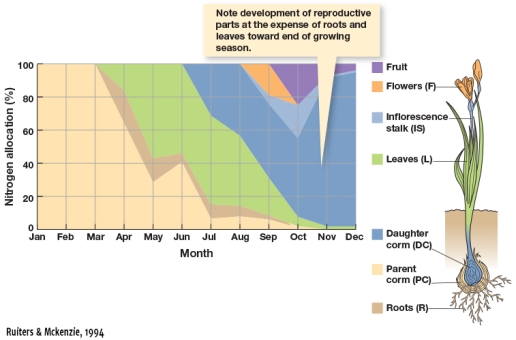
A) The trend is negative as more nitrogen is being sent to parts associated with reproduction.
B) The trend is positive since the plant is investing in reserves for winter
C) The trend is flat.
D) The trend is negative as less and less nitrogen is being sent to parts associated with reproduction.
A) The trend is negative as more nitrogen is being sent to parts associated with reproduction.
B) The trend is positive since the plant is investing in reserves for winter
C) The trend is flat.
D) The trend is negative as less and less nitrogen is being sent to parts associated with reproduction.

سؤال
سؤال
According to Figure 5.5,which of the following statements is accurate about the perennial Sparaxis grandiflora found in South Africa? 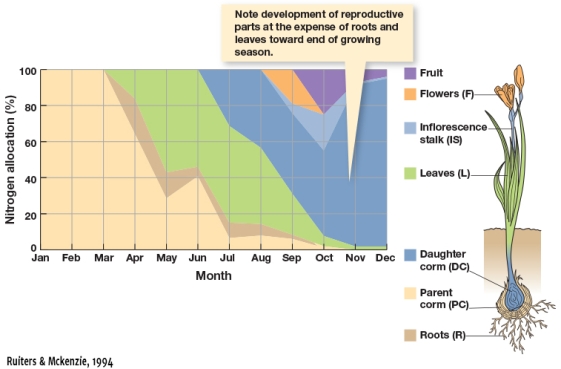
A) In January all nitrogen is being supplied to parts of the plant associated with reproduction
B) Leaves and roots receive approximately the same amounts of nitrogen
C) Fruit receive a small proportion of the cumulative nitrogen a plant uses
D) In summer, leaves receive a greater proportion of nitrogen than the daughter corm.
A) In January all nitrogen is being supplied to parts of the plant associated with reproduction
B) Leaves and roots receive approximately the same amounts of nitrogen
C) Fruit receive a small proportion of the cumulative nitrogen a plant uses
D) In summer, leaves receive a greater proportion of nitrogen than the daughter corm.
سؤال
سؤال
سؤال
سؤال
سؤال
سؤال
سؤال
سؤال
In Figure 5.9,how does probability of reproduction change as a function of leaf area? 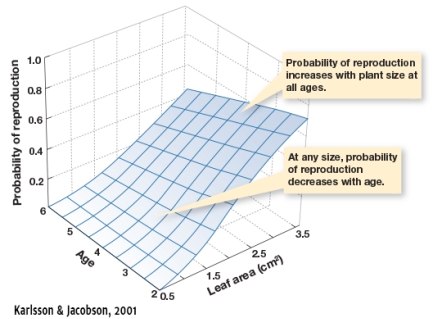
A) Probability of reproduction increases
B) Probability of reproduction decreases
C) There is no change in the probability
D) It cannot be ascertained without figuring in age
A) Probability of reproduction increases
B) Probability of reproduction decreases
C) There is no change in the probability
D) It cannot be ascertained without figuring in age
سؤال
سؤال
سؤال
In Figure 5.9,at what age will a tree with a leaf area of 3.0 cm have a 40% chance of reproduction? 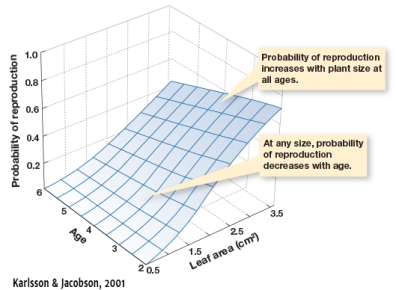
A) At 2 years of age
B) At 3 years of age
C) At 5 years of age
D) At 6 years of age or later
A) At 2 years of age
B) At 3 years of age
C) At 5 years of age
D) At 6 years of age or later
سؤال
In Figure 5.3,what is the trend of the line? 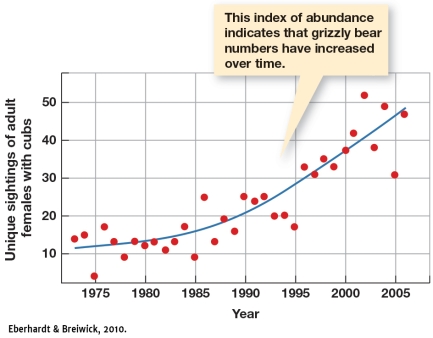
A) The trend of the line is negative
B) The trend of the line is flat
C) There is no trend
D) The trend of the line is positive
A) The trend of the line is negative
B) The trend of the line is flat
C) There is no trend
D) The trend of the line is positive
سؤال
سؤال
سؤال
سؤال
سؤال
سؤال
Which of the following statements can you not conclude with any certainty is true based off the data depicted in Figure 5.3 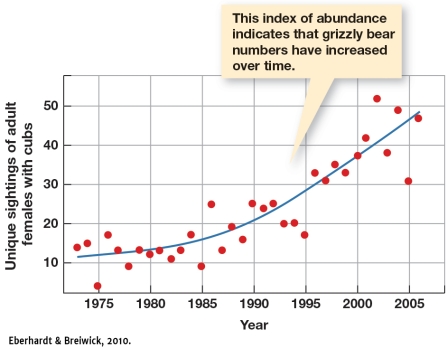
A) There has been an increase in the number of unique sightings of adult females grizzly bears with cubs from 1990 to 2005
B) There has been an increase in the number of male grizzly bears
C) There has been an increase in the number of unique sightings of adult female grizzly bears with cubs from 1960 to 1975 and from 2005 to 2012.
D) Net recruitment has increased 5 fold since 1975 to 2005
A) There has been an increase in the number of unique sightings of adult females grizzly bears with cubs from 1990 to 2005
B) There has been an increase in the number of male grizzly bears
C) There has been an increase in the number of unique sightings of adult female grizzly bears with cubs from 1960 to 1975 and from 2005 to 2012.
D) Net recruitment has increased 5 fold since 1975 to 2005
سؤال
سؤال
Using Table 5.2,what is one potential explanation as to why mx (proportion of female young produced per surviving individual in each class)decreases from age class 8 to 15? 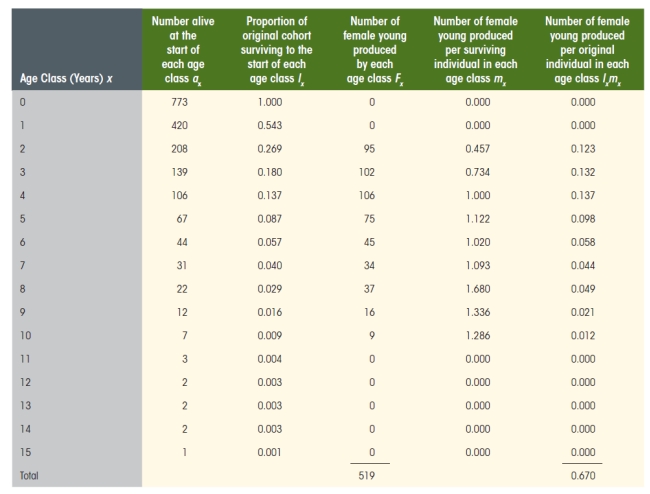
A) There is more competition in females from age 8 to 15 because the total number of females increases exponentially in this age range.
B) The proportion of original cohort surviving during this range.
C) The number of surviving individuals is so low during this range.
D) None of the above.
A) There is more competition in females from age 8 to 15 because the total number of females increases exponentially in this age range.
B) The proportion of original cohort surviving during this range.
C) The number of surviving individuals is so low during this range.
D) None of the above.
سؤال
In Figure 5.11a,how many years pass for a cohort before greater than 50 percent of the cohort is lost? 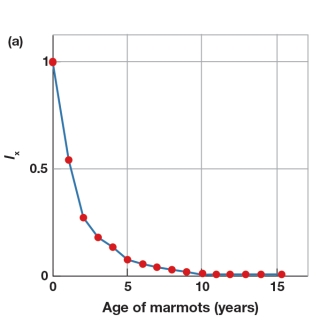
A) More than 5 years
B) More than 10 years
C) Less than 1 year
D) Less than 5 years
A) More than 5 years
B) More than 10 years
C) Less than 1 year
D) Less than 5 years
سؤال
سؤال
Using Table 5.2,how would you describe the trend in l (proportion of original cohort surviving to the start of each age class)as a function of age class? 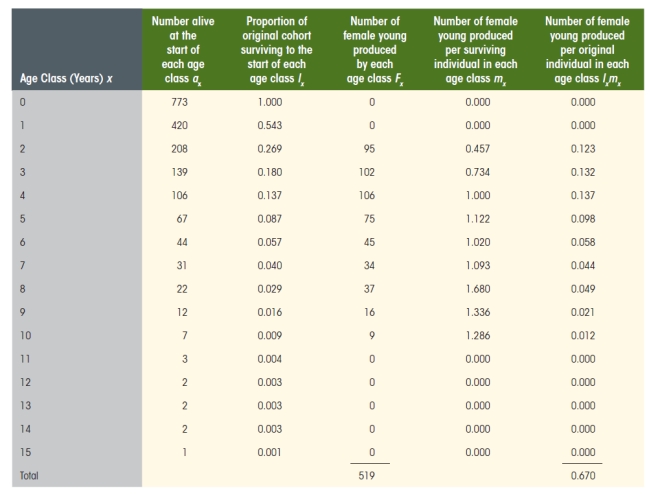
A) The trend is positive
B) The trend is flat
C) The trend is negative
D) None of the above
A) The trend is positive
B) The trend is flat
C) The trend is negative
D) None of the above
سؤال
سؤال
سؤال
سؤال
Based on the survivorship curves shown in Figure 5.13,which depicts circumstances where risk of mortality is greatest at older ages? 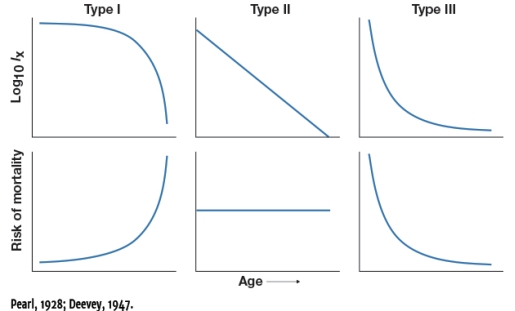
A) Type I
B) Type II
C) Type III
D) Type I and II
A) Type I
B) Type II
C) Type III
D) Type I and II
سؤال
سؤال
سؤال
سؤال
سؤال
سؤال
سؤال
Based on Figure 5.11,at what age group do marmots appear to experience the lowest risk of mortality? 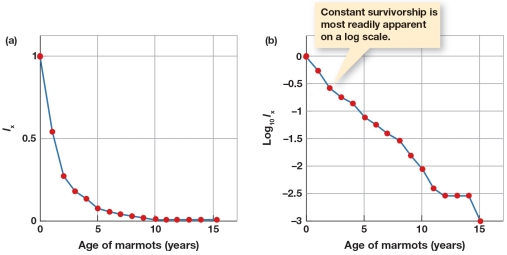
A) Age 0 to 5
B) Age 5 to 10
C) Age 10 to 15
D) Beyond 15 years of age
A) Age 0 to 5
B) Age 5 to 10
C) Age 10 to 15
D) Beyond 15 years of age
سؤال
سؤال
سؤال
سؤال
سؤال
سؤال
سؤال
سؤال
سؤال
سؤال
سؤال
سؤال
سؤال

فتح الحزمة
قم بالتسجيل لفتح البطاقات في هذه المجموعة!
Unlock Deck
Unlock Deck
1/50

العب

ملء الشاشة (f)
Deck 5: Birth, Death and Movement
1
In Figure 5.5,from autumn to spring (March to October)what is the trend in nitrogen allocation to parts of the plant not directly involved with reproduction for this perennial plant from the Southern Hemisphere?
A) The trend is negative as more nitrogen is being sent to parts associated with reproduction.
B) The trend is positive since the plant is investing in reserves for winter
C) The trend is flat.
D) The trend is negative as less and less nitrogen is being sent to parts associated with reproduction.
A) The trend is negative as more nitrogen is being sent to parts associated with reproduction.
B) The trend is positive since the plant is investing in reserves for winter
C) The trend is flat.
D) The trend is negative as less and less nitrogen is being sent to parts associated with reproduction.
A
2
In a mark and recapture study you initially collect 50 frogs.You mark and release those 50 and plan to collect again in another week.The following week you collect 50 frogs and 10 of them are from your previous mark and recapture.How large would you estimate the population to be?
A) The population is estimated to contain approximately 90 individuals
B) The population is estimated to contain approximately 250 individuals
C) The population is estimated to contain approximately 100 individuals
D) None of the above
A) The population is estimated to contain approximately 90 individuals
B) The population is estimated to contain approximately 250 individuals
C) The population is estimated to contain approximately 100 individuals
D) None of the above
B
3
According to Figure 5.5,which of the following statements is accurate about the perennial Sparaxis grandiflora found in South Africa?
A) In January all nitrogen is being supplied to parts of the plant associated with reproduction
B) Leaves and roots receive approximately the same amounts of nitrogen
C) Fruit receive a small proportion of the cumulative nitrogen a plant uses
D) In summer, leaves receive a greater proportion of nitrogen than the daughter corm.
A) In January all nitrogen is being supplied to parts of the plant associated with reproduction
B) Leaves and roots receive approximately the same amounts of nitrogen
C) Fruit receive a small proportion of the cumulative nitrogen a plant uses
D) In summer, leaves receive a greater proportion of nitrogen than the daughter corm.
C
4
You are not sure what type of organism you are studying,but you know that it has a definitive number of developmental stages and body parts.It is also motile.How would you classify this organism?
A) This organism should be classified as a genet
B) It should be classified as a unitary organism
C) It should not be classified at all.
D) This should be classified as a modular organism
A) This organism should be classified as a genet
B) It should be classified as a unitary organism
C) It should not be classified at all.
D) This should be classified as a modular organism
فتح الحزمة
افتح القفل للوصول البطاقات البالغ عددها 50 في هذه المجموعة.
فتح الحزمة
k this deck
5
You are shopping at a plant nursery and come across a plant you have never seen.The sign indicates it is a flowering biennial.What should you already know about this plant?
A) It is likely iteroparous
B) It is likely poisonous
C) It is likely semelparous
D) None of the above
A) It is likely iteroparous
B) It is likely poisonous
C) It is likely semelparous
D) None of the above
فتح الحزمة
افتح القفل للوصول البطاقات البالغ عددها 50 في هذه المجموعة.
فتح الحزمة
k this deck
6
What commonly triggers mating?
A) Temperature
B) Density of intraspecifics
C) Photoperiod
D) None of the above.
A) Temperature
B) Density of intraspecifics
C) Photoperiod
D) None of the above.
فتح الحزمة
افتح القفل للوصول البطاقات البالغ عددها 50 في هذه المجموعة.
فتح الحزمة
k this deck
7
A perennial plant (Sparaxus grandiflora)must invest resources differently when it starts to enter a reproductive stage.Which of the following choices explains how a perennial plant may deal with this?
A) The plant does nothing different since it is a perennial
B) The plant experiences trade-offs no matter if it is a perennial or annual. Therefore, it will likely have to reduce root growth and leaf development to compensate for the resources used for reproduction.
C) The plant will not experience any trade-offs since it has evolved to reproduce and grow simultaneously
D) None of the above
A) The plant does nothing different since it is a perennial
B) The plant experiences trade-offs no matter if it is a perennial or annual. Therefore, it will likely have to reduce root growth and leaf development to compensate for the resources used for reproduction.
C) The plant will not experience any trade-offs since it has evolved to reproduce and grow simultaneously
D) None of the above
فتح الحزمة
افتح القفل للوصول البطاقات البالغ عددها 50 في هذه المجموعة.
فتح الحزمة
k this deck
8
What term describes a group of individuals of one species?
A) Cohort
B) Population
C) Carrying capacity
D) Guild
A) Cohort
B) Population
C) Carrying capacity
D) Guild
فتح الحزمة
افتح القفل للوصول البطاقات البالغ عددها 50 في هذه المجموعة.
فتح الحزمة
k this deck
9
You find a lake that is 50 meters in diameter while you are exploring part of a very arid environment in the southwest United States.You have surveyed 100's of kilometers of this habitat and found no other lakes.It appears to be fed by some underground seep.In it there are many small fish.Which of the following best describes these fish?
A) These fish are semelparous annual
B) The fish are a population
C) These fish are semelparous perennial
D) The fish are likely modular
A) These fish are semelparous annual
B) The fish are a population
C) These fish are semelparous perennial
D) The fish are likely modular
فتح الحزمة
افتح القفل للوصول البطاقات البالغ عددها 50 في هذه المجموعة.
فتح الحزمة
k this deck
10
Which organism completes its entire life cycle in a single year?
A) An annual
B) A biennial
C) A perennial
D) An iteroparous perennial
A) An annual
B) A biennial
C) A perennial
D) An iteroparous perennial
فتح الحزمة
افتح القفل للوصول البطاقات البالغ عددها 50 في هذه المجموعة.
فتح الحزمة
k this deck
11
In Figure 5.9,how does probability of reproduction change as a function of leaf area?
A) Probability of reproduction increases
B) Probability of reproduction decreases
C) There is no change in the probability
D) It cannot be ascertained without figuring in age
A) Probability of reproduction increases
B) Probability of reproduction decreases
C) There is no change in the probability
D) It cannot be ascertained without figuring in age
فتح الحزمة
افتح القفل للوصول البطاقات البالغ عددها 50 في هذه المجموعة.
فتح الحزمة
k this deck
12
You are doing a research project to determine the age of maple trees in a series of 100 square meter plots.Your data are interesting because many of the trees that are the same age are not the same size,even though they are within a few kilometers of one another.Why might this be?
A) Trees are long-lived and unitary organisms. As a result, some individuals may have experience competition and predation that has affected growth and development.
B) Trees of the same age should all grow differently because they are semelparous perennials.
C) Trees are long-lived and modular organisms. As a result, some individuals may have experience competition and predation that has affected growth and development.
D) Trees of the same age should all grow differently because they are iteroparous annuals.
A) Trees are long-lived and unitary organisms. As a result, some individuals may have experience competition and predation that has affected growth and development.
B) Trees of the same age should all grow differently because they are semelparous perennials.
C) Trees are long-lived and modular organisms. As a result, some individuals may have experience competition and predation that has affected growth and development.
D) Trees of the same age should all grow differently because they are iteroparous annuals.
فتح الحزمة
افتح القفل للوصول البطاقات البالغ عددها 50 في هذه المجموعة.
فتح الحزمة
k this deck
13
This multicellular outgrowth is the product of a modular organism.It will proceed through its own life cycle,and its development will be indeterminate.This growth is known as which of the following terms?
A) Genet
B) Module
C) Genetic individual
D) Cohort
A) Genet
B) Module
C) Genetic individual
D) Cohort
فتح الحزمة
افتح القفل للوصول البطاقات البالغ عددها 50 في هذه المجموعة.
فتح الحزمة
k this deck
14
In Figure 5.9,at what age will a tree with a leaf area of 3.0 cm have a 40% chance of reproduction?
A) At 2 years of age
B) At 3 years of age
C) At 5 years of age
D) At 6 years of age or later
A) At 2 years of age
B) At 3 years of age
C) At 5 years of age
D) At 6 years of age or later
فتح الحزمة
افتح القفل للوصول البطاقات البالغ عددها 50 في هذه المجموعة.
فتح الحزمة
k this deck
15
In Figure 5.3,what is the trend of the line?
A) The trend of the line is negative
B) The trend of the line is flat
C) There is no trend
D) The trend of the line is positive
A) The trend of the line is negative
B) The trend of the line is flat
C) There is no trend
D) The trend of the line is positive
فتح الحزمة
افتح القفل للوصول البطاقات البالغ عددها 50 في هذه المجموعة.
فتح الحزمة
k this deck
16
If you were going to concisely describe an annual,what would you say?
A) Many annuals are semelparous, have bursts of flowering, set seed, and then go dormant until the following year when they can reproduce again.
B) Many annuals are iteroparous, have bursts of flowering, set seed, and then die.
C) Many annuals are iteroparous, have bursts of flowering, set seed, and then get eaten.
D) Many annuals are semelparous, have bursts of flowering, set seed, and then die.
A) Many annuals are semelparous, have bursts of flowering, set seed, and then go dormant until the following year when they can reproduce again.
B) Many annuals are iteroparous, have bursts of flowering, set seed, and then die.
C) Many annuals are iteroparous, have bursts of flowering, set seed, and then get eaten.
D) Many annuals are semelparous, have bursts of flowering, set seed, and then die.
فتح الحزمة
افتح القفل للوصول البطاقات البالغ عددها 50 في هذه المجموعة.
فتح الحزمة
k this deck
17
Which of the following choices best describes an iteroparous organism?
A) An iteroparous species breeds only once and invests all of its energy into reproduction.
B) An iteroparous species breeds many times in its life and invests all of its energy into reproduction.
C) An iteroparous species breeds many times and invests its energy into reproduction, growth and development.
D) An iteroparous species breeds only once but invests all of its energy into growth and development.
A) An iteroparous species breeds only once and invests all of its energy into reproduction.
B) An iteroparous species breeds many times in its life and invests all of its energy into reproduction.
C) An iteroparous species breeds many times and invests its energy into reproduction, growth and development.
D) An iteroparous species breeds only once but invests all of its energy into growth and development.
فتح الحزمة
افتح القفل للوصول البطاقات البالغ عددها 50 في هذه المجموعة.
فتح الحزمة
k this deck
18
Which choice accurately defines what a genet is?
A) A genet is a single-celled zygote that has died
B) A genet is a term used to describe a module
C) A genet is a genetic individual that started as a single-celled zygote
D) A genet is a multicellular outgrowth from a module
A) A genet is a single-celled zygote that has died
B) A genet is a term used to describe a module
C) A genet is a genetic individual that started as a single-celled zygote
D) A genet is a multicellular outgrowth from a module
فتح الحزمة
افتح القفل للوصول البطاقات البالغ عددها 50 في هذه المجموعة.
فتح الحزمة
k this deck
19
An organism that has indeterminate development and grows by the repeated production of modules is defined as which type of organism?
A) Indefinite
B) Indeterminiable
C) Modular
D) Unitary
A) Indefinite
B) Indeterminiable
C) Modular
D) Unitary
فتح الحزمة
افتح القفل للوصول البطاقات البالغ عددها 50 في هذه المجموعة.
فتح الحزمة
k this deck
20
Which of the following is not a modular organism?
A) Creosote bush
B) Streptococcus bacteria
C) Quercus spp. oak tree
D) Baetis spp. mayfly
A) Creosote bush
B) Streptococcus bacteria
C) Quercus spp. oak tree
D) Baetis spp. mayfly
فتح الحزمة
افتح القفل للوصول البطاقات البالغ عددها 50 في هذه المجموعة.
فتح الحزمة
k this deck
21
Which of the following statements can you not conclude with any certainty is true based off the data depicted in Figure 5.3
A) There has been an increase in the number of unique sightings of adult females grizzly bears with cubs from 1990 to 2005
B) There has been an increase in the number of male grizzly bears
C) There has been an increase in the number of unique sightings of adult female grizzly bears with cubs from 1960 to 1975 and from 2005 to 2012.
D) Net recruitment has increased 5 fold since 1975 to 2005
A) There has been an increase in the number of unique sightings of adult females grizzly bears with cubs from 1990 to 2005
B) There has been an increase in the number of male grizzly bears
C) There has been an increase in the number of unique sightings of adult female grizzly bears with cubs from 1960 to 1975 and from 2005 to 2012.
D) Net recruitment has increased 5 fold since 1975 to 2005
فتح الحزمة
افتح القفل للوصول البطاقات البالغ عددها 50 في هذه المجموعة.
فتح الحزمة
k this deck
22
Which method would you employ if you wanted to create a life table for a population of tamarinds?
A) Use a cohort life table
B) Use a static life table
C) Neither work because tamarinds have overlapping generations
D) Neither work because tamarinds are semelparous
A) Use a cohort life table
B) Use a static life table
C) Neither work because tamarinds have overlapping generations
D) Neither work because tamarinds are semelparous
فتح الحزمة
افتح القفل للوصول البطاقات البالغ عددها 50 في هذه المجموعة.
فتح الحزمة
k this deck
23
Using Table 5.2,what is one potential explanation as to why mx (proportion of female young produced per surviving individual in each class)decreases from age class 8 to 15?
A) There is more competition in females from age 8 to 15 because the total number of females increases exponentially in this age range.
B) The proportion of original cohort surviving during this range.
C) The number of surviving individuals is so low during this range.
D) None of the above.
A) There is more competition in females from age 8 to 15 because the total number of females increases exponentially in this age range.
B) The proportion of original cohort surviving during this range.
C) The number of surviving individuals is so low during this range.
D) None of the above.
فتح الحزمة
افتح القفل للوصول البطاقات البالغ عددها 50 في هذه المجموعة.
فتح الحزمة
k this deck
24
In Figure 5.11a,how many years pass for a cohort before greater than 50 percent of the cohort is lost?
A) More than 5 years
B) More than 10 years
C) Less than 1 year
D) Less than 5 years
A) More than 5 years
B) More than 10 years
C) Less than 1 year
D) Less than 5 years
فتح الحزمة
افتح القفل للوصول البطاقات البالغ عددها 50 في هذه المجموعة.
فتح الحزمة
k this deck
25
An iteroparous organism:
A) Can only be an annual species
B) Can be an annual or perennial species
C) Can breed more than once
D) Never breed
A) Can only be an annual species
B) Can be an annual or perennial species
C) Can breed more than once
D) Never breed
فتح الحزمة
افتح القفل للوصول البطاقات البالغ عددها 50 في هذه المجموعة.
فتح الحزمة
k this deck
26
Using Table 5.2,how would you describe the trend in l (proportion of original cohort surviving to the start of each age class)as a function of age class?
A) The trend is positive
B) The trend is flat
C) The trend is negative
D) None of the above
A) The trend is positive
B) The trend is flat
C) The trend is negative
D) None of the above
فتح الحزمة
افتح القفل للوصول البطاقات البالغ عددها 50 في هذه المجموعة.
فتح الحزمة
k this deck
27
A survivorship curve of Type I:
A) Shows risk of mortality is greatest at older ages
B) Is typical of humans
C) Shows number of surviving individuals is greatest at younger ages
D) Is not likely to occur in wild populations of animals and plants
A) Shows risk of mortality is greatest at older ages
B) Is typical of humans
C) Shows number of surviving individuals is greatest at younger ages
D) Is not likely to occur in wild populations of animals and plants
فتح الحزمة
افتح القفل للوصول البطاقات البالغ عددها 50 في هذه المجموعة.
فتح الحزمة
k this deck
28
Which of the following are examples of dispersal?
A) The passive transport of seeds on a duck to another site
B) A honey badger leaving its mothers care
C) A bird flying from California to Alaska for the winter
D) A young male mountain lion seeking out its own territory
A) The passive transport of seeds on a duck to another site
B) A honey badger leaving its mothers care
C) A bird flying from California to Alaska for the winter
D) A young male mountain lion seeking out its own territory
فتح الحزمة
افتح القفل للوصول البطاقات البالغ عددها 50 في هذه المجموعة.
فتح الحزمة
k this deck
29
Select which of the following choices are correct.
A) A tree is a modular organism
B) Leaves of a tree are modules
C) A sapling arising from the same seed of a tree is a module
D) Modular organisms have determinate development
A) A tree is a modular organism
B) Leaves of a tree are modules
C) A sapling arising from the same seed of a tree is a module
D) Modular organisms have determinate development
فتح الحزمة
افتح القفل للوصول البطاقات البالغ عددها 50 في هذه المجموعة.
فتح الحزمة
k this deck
30
Based on the survivorship curves shown in Figure 5.13,which depicts circumstances where risk of mortality is greatest at older ages?
A) Type I
B) Type II
C) Type III
D) Type I and II
A) Type I
B) Type II
C) Type III
D) Type I and II
فتح الحزمة
افتح القفل للوصول البطاقات البالغ عددها 50 في هذه المجموعة.
فتح الحزمة
k this deck
31
If R0 were calculated as 0.88 for a population of desert mice,what would this imply?
A) That 12% of the population died.
B) Each generation the population declined by 12%.
C) Each generation is procuring an extra 88% of the population.
D) That 88% of the population has been lost.
A) That 12% of the population died.
B) Each generation the population declined by 12%.
C) Each generation is procuring an extra 88% of the population.
D) That 88% of the population has been lost.
فتح الحزمة
افتح القفل للوصول البطاقات البالغ عددها 50 في هذه المجموعة.
فتح الحزمة
k this deck
32
What term describes individuals of a population that are all born within a particular period?
A) Symbiont
B) Cohort
C) Guild
D) None of the above
A) Symbiont
B) Cohort
C) Guild
D) None of the above
فتح الحزمة
افتح القفل للوصول البطاقات البالغ عددها 50 في هذه المجموعة.
فتح الحزمة
k this deck
33
Which of the following are examples of migration?
A) Directional movement of a large number of a species from one location to another.
B) Monarchs flying to Mexico once a year then returning to distant parts of North America later in the year.
C) Individuals moving away from one another.
D) Humpback whales traveling to warmer waters to give birth to calves.
A) Directional movement of a large number of a species from one location to another.
B) Monarchs flying to Mexico once a year then returning to distant parts of North America later in the year.
C) Individuals moving away from one another.
D) Humpback whales traveling to warmer waters to give birth to calves.
فتح الحزمة
افتح القفل للوصول البطاقات البالغ عددها 50 في هذه المجموعة.
فتح الحزمة
k this deck
34
Which terms describe generalized spatial patterns that may be exhibited by organisms?
A) Aggregated
B) Random
C) Regular
D) Segregated
A) Aggregated
B) Random
C) Regular
D) Segregated
فتح الحزمة
افتح القفل للوصول البطاقات البالغ عددها 50 في هذه المجموعة.
فتح الحزمة
k this deck
35
A Type III survivorship curve:
A) Depicts how survivorship occurs for many wild plants and animals.
B) Shows many offspring die initially.
C) Shows that old-aged individuals experience a lower risk of mortality.
D) Shows that the number of surviving individuals is not a function of age.
A) Depicts how survivorship occurs for many wild plants and animals.
B) Shows many offspring die initially.
C) Shows that old-aged individuals experience a lower risk of mortality.
D) Shows that the number of surviving individuals is not a function of age.
فتح الحزمة
افتح القفل للوصول البطاقات البالغ عددها 50 في هذه المجموعة.
فتح الحزمة
k this deck
36
What measurement gives an overall idea of whether a population has increased or decreased in a generation?
A) The summation of all offspring produced by the proportion of surviving individuals
B) Fecundity
C) The product of the proportion of surviving individuals and the proportion of those survivors that reproduce
D) The basic reproductive rate
A) The summation of all offspring produced by the proportion of surviving individuals
B) Fecundity
C) The product of the proportion of surviving individuals and the proportion of those survivors that reproduce
D) The basic reproductive rate
فتح الحزمة
افتح القفل للوصول البطاقات البالغ عددها 50 في هذه المجموعة.
فتح الحزمة
k this deck
37
Based on Figure 5.11,at what age group do marmots appear to experience the lowest risk of mortality?
A) Age 0 to 5
B) Age 5 to 10
C) Age 10 to 15
D) Beyond 15 years of age
A) Age 0 to 5
B) Age 5 to 10
C) Age 10 to 15
D) Beyond 15 years of age
فتح الحزمة
افتح القفل للوصول البطاقات البالغ عددها 50 في هذه المجموعة.
فتح الحزمة
k this deck
38
Population growth that is S-shaped:
A) Often occurs with organisms with very short life cycles
B) Will show reduced increases in growth as the population reaches the carrying capacity
C) Grow exponentially as the population reaches the carrying capacity
D) Often occurs with organisms that have extremely long life cycles
A) Often occurs with organisms with very short life cycles
B) Will show reduced increases in growth as the population reaches the carrying capacity
C) Grow exponentially as the population reaches the carrying capacity
D) Often occurs with organisms that have extremely long life cycles
فتح الحزمة
افتح القفل للوصول البطاقات البالغ عددها 50 في هذه المجموعة.
فتح الحزمة
k this deck
39
A Type II survivorship curve:
A) Shows that mortality is constant
B) Shows that younger individuals die sooner than older individuals
C) Is typical of seeds
D) Shows that the risk of mortality is the same regardless of age
A) Shows that mortality is constant
B) Shows that younger individuals die sooner than older individuals
C) Is typical of seeds
D) Shows that the risk of mortality is the same regardless of age
فتح الحزمة
افتح القفل للوصول البطاقات البالغ عددها 50 في هذه المجموعة.
فتح الحزمة
k this deck
40
Which of the following are necessary for determining average density?
A) The total number of individuals
B) The original number of individuals at a location prior to dispersal
C) The total size of a habitat
D) The total population size 3 generations ago
A) The total number of individuals
B) The original number of individuals at a location prior to dispersal
C) The total size of a habitat
D) The total population size 3 generations ago
فتح الحزمة
افتح القفل للوصول البطاقات البالغ عددها 50 في هذه المجموعة.
فتح الحزمة
k this deck
41
If you were studying the life history of a population of howler monkeys in Costa Rica,the survivorship curve would look most like Type _______.
A) I
B) II
C) III
D) I and III
A) I
B) II
C) III
D) I and III
فتح الحزمة
افتح القفل للوصول البطاقات البالغ عددها 50 في هذه المجموعة.
فتح الحزمة
k this deck
42
If dN/dt = rN,then any increase in the population will be _______
A) Linear
B) Logistic
C) Exponential
D) S-shaped
A) Linear
B) Logistic
C) Exponential
D) S-shaped
فتح الحزمة
افتح القفل للوصول البطاقات البالغ عددها 50 في هذه المجموعة.
فتح الحزمة
k this deck
43
You have been researching species of bacteria found in the rocky intertidal zone.These bacteria are likely __________ because they live in a disturbed habitat,reproduce quickly,and invest little energy in growth or development.
A) K species
B) r species
C) r/K
D) None of the above
A) K species
B) r species
C) r/K
D) None of the above
فتح الحزمة
افتح القفل للوصول البطاقات البالغ عددها 50 في هذه المجموعة.
فتح الحزمة
k this deck
44
You are studying salamanders to test if offspring fitness is affected by the number of eggs a female oviposits.What you learn is that females that lay more eggs produce smaller offspring.This is an example of ________ and means that there is __________ to high reproductive output for these salamanders.
A) r species; a benefit
B) a tradeoff; a cost
C) k species; a benefit
D) a tradeoff; an advantage
A) r species; a benefit
B) a tradeoff; a cost
C) k species; a benefit
D) a tradeoff; an advantage
فتح الحزمة
افتح القفل للوصول البطاقات البالغ عددها 50 في هذه المجموعة.
فتح الحزمة
k this deck
45
__________ denotes a populations intrinsic rate of natural increase.
A) r
B) K
C) N
D) t
A) r
B) K
C) N
D) t
فتح الحزمة
افتح القفل للوصول البطاقات البالغ عددها 50 في هذه المجموعة.
فتح الحزمة
k this deck
46
You have studied a population of garter snakes to understand how recruitment changes over time.When the density of snakes was at an average of 5 per 50 square meters recruitment was low.When that density increased to 20 per 50 square meters recruitment was also low.However,when densities were near 12 garter snakes per 50 square meters recruitment was at its highest.This is an example of a ___________ curve.
A) Calibration
B) Dome-shaped net-recruitment
C) Type I
D) Sigmoidal
A) Calibration
B) Dome-shaped net-recruitment
C) Type I
D) Sigmoidal
فتح الحزمة
افتح القفل للوصول البطاقات البالغ عددها 50 في هذه المجموعة.
فتح الحزمة
k this deck
47
When an individual male leaves a pack in search of its own territory,this is referred to as _________?
A) Migration
B) Dispersal
C) Exodus
D) None of the above
A) Migration
B) Dispersal
C) Exodus
D) None of the above
فتح الحزمة
افتح القفل للوصول البطاقات البالغ عددها 50 في هذه المجموعة.
فتح الحزمة
k this deck
48
If birth and death rates are density dependent,then the density of a population will cycle near ______________
A) Multiple times
B) On the carrying capacity
C) Always when mortality is at its lowest
D) Always when birth rates are at the highest
A) Multiple times
B) On the carrying capacity
C) Always when mortality is at its lowest
D) Always when birth rates are at the highest
فتح الحزمة
افتح القفل للوصول البطاقات البالغ عددها 50 في هذه المجموعة.
فتح الحزمة
k this deck
49
The mass movement of elk across North America is an example of ________?
A) Dispersal
B) Migration
C) Exposure
D) Exodus
A) Dispersal
B) Migration
C) Exposure
D) Exodus
فتح الحزمة
افتح القفل للوصول البطاقات البالغ عددها 50 في هذه المجموعة.
فتح الحزمة
k this deck
50
You are running an experiment in the laboratory to study the population growth of a species of Tribolium spp..You notice that the population multiplies over each successive interval of time.The growth of this population is therefore _____________.
A) Logistic
B) Exponential
C) Logarithmic
D) S-shaped
A) Logistic
B) Exponential
C) Logarithmic
D) S-shaped
فتح الحزمة
افتح القفل للوصول البطاقات البالغ عددها 50 في هذه المجموعة.
فتح الحزمة
k this deck
فتح الحزمة
افتح القفل للوصول البطاقات البالغ عددها 50 في هذه المجموعة.






