







 تكلم مع الذكاء الاصطناعي


Deck 16: Evolution of Low-Mass Stars
ملء الشاشة (f)

سؤال

سؤال
سؤال
سؤال
سؤال
سؤال
سؤال
سؤال
سؤال
سؤال
سؤال
سؤال
سؤال
سؤال
سؤال
Using the data in the figure shown below, identify the spectral type of a star that has a main-sequence lifetime of about 500 billion years. 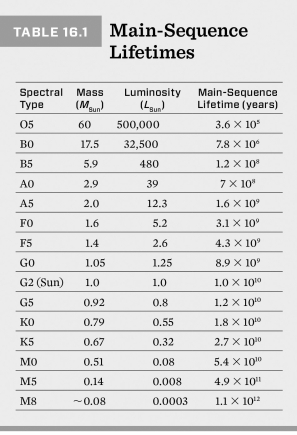
A) A5
B) F5
C) K0
D) G2
E) M5
A) A5
B) F5
C) K0
D) G2
E) M5
سؤال
The main-sequence lifetime of a star is given by which equation?
A) t M/L
M/L
B) t L/M
L/M
C) t M 2/L
M 2/L
D) t L2/L
L2/L
E) t M/L2
M/L2
A) t
M/LB) t
L/MC) t
M 2/LD) t
L2/LE) t
M/L2 سؤال
Use the figure shown below and the relationship t M/L to estimate the main-sequence lifetime of a star with a mass equal to 10 times that of the Sun.(Note that the Sun's main-sequence lifetime is about 1010 years.) 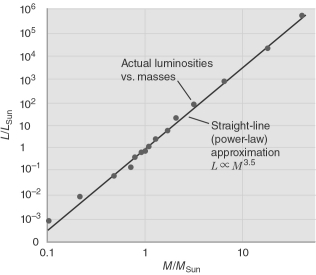
A) 3 million years
B) 30 million years
C) 300 million years
D) 3 billion years
E) 30 billion years
A) 3 million years
B) 30 million years
C) 300 million years
D) 3 billion years
E) 30 billion years
سؤال
سؤال
سؤال
سؤال
سؤال
سؤال
During evolutionary phase A in the figure shown below, the star is ________.In evolutionary phase B, it is ________. 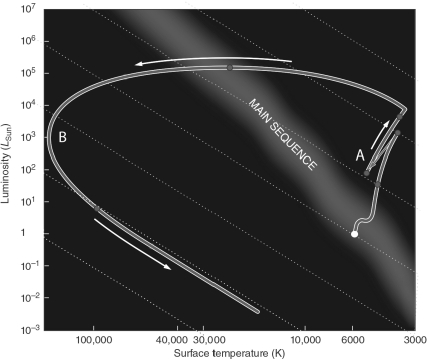
A) expanding; expanding
B) expanding; contracting
C) contracting; losing mass
D) contracting; contracting
E) gaining mass; contracting
A) expanding; expanding
B) expanding; contracting
C) contracting; losing mass
D) contracting; contracting
E) gaining mass; contracting
سؤال
سؤال
The following figure illustrates the 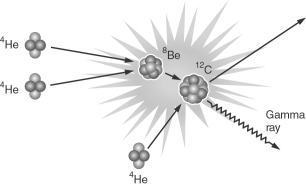
A) proton-proton chain.
B) process of electron-degeneracy.
C) beryllium decay process.
D) alpha decay chain.
E) triple-alpha process.
A) proton-proton chain.
B) process of electron-degeneracy.
C) beryllium decay process.
D) alpha decay chain.
E) triple-alpha process.
سؤال
سؤال
سؤال
سؤال
سؤال
سؤال
سؤال
سؤال
سؤال
Place the evolutionary stages shown in the figure below in order from earliest to latest. 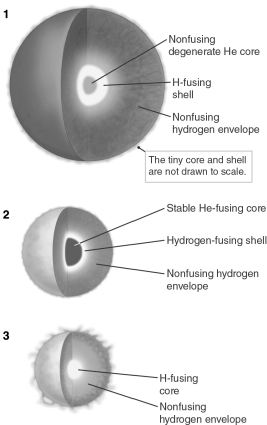
A) 1, 2, 3
B) 2, 3, 1
C) 3, 2, 1
D) 3, 1, 2
E) 2, 1, 3
A) 1, 2, 3
B) 2, 3, 1
C) 3, 2, 1
D) 3, 1, 2
E) 2, 1, 3
سؤال
سؤال
سؤال
سؤال
The figure below depicts helium fusion in a late-stage star with certain elements labeled A, B, and C.What are these elements, in the order A, B, C? 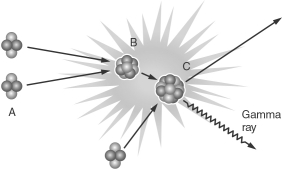
A) hydrogen, helium, carbon
B) hydrogen, lithium, beryllium
C) helium, carbon, iron
D) helium, beryllium, carbon
E) hydrogen, hydrogen, carbon
A) hydrogen, helium, carbon
B) hydrogen, lithium, beryllium
C) helium, carbon, iron
D) helium, beryllium, carbon
E) hydrogen, hydrogen, carbon
سؤال
Using the figure shown below, identify the star with the smallest radius. 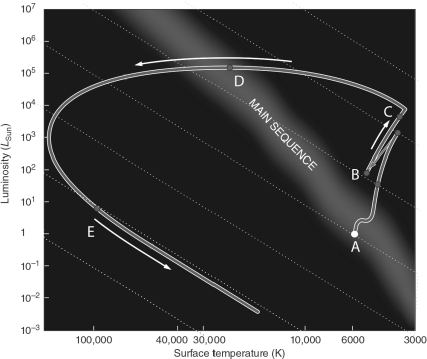
A) star A
B) star B
C) star C
D) star D
E) star E
A) star A
B) star B
C) star C
D) star D
E) star E
سؤال
سؤال
سؤال
سؤال
سؤال
سؤال
سؤال
سؤال
سؤال
سؤال
سؤال
سؤال
سؤال
سؤال
سؤال
سؤال
سؤال
سؤال
سؤال
سؤال
سؤال
سؤال
The figure below depicts the evolution in chemical composition of the Sun's interior at three different times during its life.How do the relative percentages of hydrogen and helium change at a fractional radius of 0.1 solar radii, from the time the Sun formed until it exhausts its core supply of hydrogen in 5 billion years? 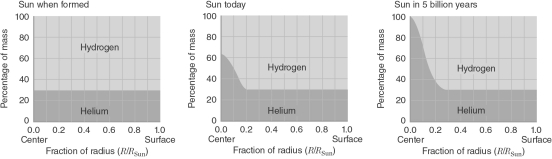
سؤال
سؤال
سؤال
سؤال
سؤال
سؤال
سؤال
سؤال
سؤال
سؤال
سؤال
سؤال
Consider a 1 MSUN star's journey up the red giant branch.Its luminosity will change from 10 LSUN to nearly 1,000 LSUN.How will its temperature and radius change as the star ascends? (Recall that
L R2T4.)
L
R2T4.) سؤال
سؤال
سؤال
سؤال
سؤال
سؤال
سؤال

فتح الحزمة
قم بالتسجيل لفتح البطاقات في هذه المجموعة!
Unlock Deck
Unlock Deck
1/100

العب

ملء الشاشة (f)
Deck 16: Evolution of Low-Mass Stars
1
A feature unique to main-sequence stars is that
A) hydrostatic equilibrium exists at all radii.
B) energy transport occurs via convection throughout much of their interiors.
C) carbon burning occurs in their cores.
D) they emit strong surface winds.
E) hydrogen burning occurs in their cores.
A) hydrostatic equilibrium exists at all radii.
B) energy transport occurs via convection throughout much of their interiors.
C) carbon burning occurs in their cores.
D) they emit strong surface winds.
E) hydrogen burning occurs in their cores.
hydrogen burning occurs in their cores.
2
As a main-sequence star burns its core supply of hydrogen, what happens?
A) Helium begins to fuse throughout the core.
B) Helium fuses in a shell surrounding the core.
C) Helium fusion takes place only at the very center of the core, where temperature and pressure are highest.
D) Helium builds up in the core.
E) Helium builds up everywhere in the star's interior.
A) Helium begins to fuse throughout the core.
B) Helium fuses in a shell surrounding the core.
C) Helium fusion takes place only at the very center of the core, where temperature and pressure are highest.
D) Helium builds up in the core.
E) Helium builds up everywhere in the star's interior.
Helium builds up in the core.
3
A 10 MSUN star will evolve through the same phases as a
A) 1 MSUN star.
B) 5 MSUN star.
C) 20 MSUN star.
D) 0.5 MSUN star.
E) 0.08 MSUN star.
A) 1 MSUN star.
B) 5 MSUN star.
C) 20 MSUN star.
D) 0.5 MSUN star.
E) 0.08 MSUN star.
20 MSUN star.
4
The Sun will become a red giant star in about
A) 15 billion years.
B) 10 billion years.
C) 5 billion years.
D) 1 billion years.
E) 50 million years.
A) 15 billion years.
B) 10 billion years.
C) 5 billion years.
D) 1 billion years.
E) 50 million years.
فتح الحزمة
افتح القفل للوصول البطاقات البالغ عددها 100 في هذه المجموعة.
فتح الحزمة
k this deck
5
The ________ a main-sequence star is, the more hydrogen it has to burn, and the ________ its main-sequence lifetime.
A) more massive; shorter
B) more massive; longer
C) less massive; shorter
D) less massive; longer
E) larger; longer
A) more massive; shorter
B) more massive; longer
C) less massive; shorter
D) less massive; longer
E) larger; longer
فتح الحزمة
افتح القفل للوصول البطاقات البالغ عددها 100 في هذه المجموعة.
فتح الحزمة
k this deck
6
Stars evolve primarily because
A) they convert all their mass to energy.
B) they lose all their mass into space.
C) their core temperatures decrease steadily as they evolve.
D) they use up the fuel in their cores.
E) they run out of rotational energy.
A) they convert all their mass to energy.
B) they lose all their mass into space.
C) their core temperatures decrease steadily as they evolve.
D) they use up the fuel in their cores.
E) they run out of rotational energy.
فتح الحزمة
افتح القفل للوصول البطاقات البالغ عددها 100 في هذه المجموعة.
فتح الحزمة
k this deck
7
If a main-sequence star's core temperature increased, fusion reaction rates would ________ because the protons would be moving ________.
A) decrease; slower
B) increase; faster
C) increase; slower
D) remain unchanged; the same speed as before
E) decrease; faster
A) decrease; slower
B) increase; faster
C) increase; slower
D) remain unchanged; the same speed as before
E) decrease; faster
فتح الحزمة
افتح القفل للوصول البطاقات البالغ عددها 100 في هذه المجموعة.
فتح الحزمة
k this deck
8
The percentage of hydrogen in the Sun's core today is roughly ________ of what it was originally.
A) half
B) one-third
C) one-quarter
D) 10 percent
E) less than 1 percent
A) half
B) one-third
C) one-quarter
D) 10 percent
E) less than 1 percent
فتح الحزمة
افتح القفل للوصول البطاقات البالغ عددها 100 في هذه المجموعة.
فتح الحزمة
k this deck
9
The low-end mass cutoff for stars occurs at approximately
A) 0.08 MSUN.
B) 0.1 MSUN.
C) 0.8 MSUN.
D) 1 MSUN.
E) 10 MSUN.
A) 0.08 MSUN.
B) 0.1 MSUN.
C) 0.8 MSUN.
D) 1 MSUN.
E) 10 MSUN.
فتح الحزمة
افتح القفل للوصول البطاقات البالغ عددها 100 في هذه المجموعة.
فتح الحزمة
k this deck
10
The largest low-mass stars have masses that are approximately
A) 1.5 MSUN.
B) 1 MSUN.
C) 3 MSUN.
D) 5 MSUN.
E) 10 MSUN.
A) 1.5 MSUN.
B) 1 MSUN.
C) 3 MSUN.
D) 5 MSUN.
E) 10 MSUN.
فتح الحزمة
افتح القفل للوصول البطاقات البالغ عددها 100 في هذه المجموعة.
فتح الحزمة
k this deck
11
How long will a 2 MSUN star live as a main-sequence star?
A) 12 million years
B) 180 million years
C) 1.8 billion years
D) 12 billion years
E) 18 billion years
A) 12 million years
B) 180 million years
C) 1.8 billion years
D) 12 billion years
E) 18 billion years
فتح الحزمة
افتح القفل للوصول البطاقات البالغ عددها 100 في هذه المجموعة.
فتح الحزمة
k this deck
12
The luminosity of a star depends on
A) its mass and age.
B) its mass.
C) its age.
D) its distance.
E) its mass, age, and distance.
A) its mass and age.
B) its mass.
C) its age.
D) its distance.
E) its mass, age, and distance.
فتح الحزمة
افتح القفل للوصول البطاقات البالغ عددها 100 في هذه المجموعة.
فتح الحزمة
k this deck
13
What factor is most important in determining a star's position on the main sequence and its subsequent evolution?
A) temperature
B) pressure
C) mass
D) radius
E) color
A) temperature
B) pressure
C) mass
D) radius
E) color
فتح الحزمة
افتح القفل للوصول البطاقات البالغ عددها 100 في هذه المجموعة.
فتح الحزمة
k this deck
14
If the Milky Way formed stars at approximately a constant rate over the last 14 billion years, what fraction of the M-type stars that ever formed in it can still be found as main-sequence stars today? (Note that M-type stars have a mass of approximately 0.5 MSUN.)
A) 10 percent
B) 33 percent
C) 50 percent
D) 75 percent
E) 100 percent
A) 10 percent
B) 33 percent
C) 50 percent
D) 75 percent
E) 100 percent
فتح الحزمة
افتح القفل للوصول البطاقات البالغ عددها 100 في هذه المجموعة.
فتح الحزمة
k this deck
15
Using the data in the figure shown below, identify the spectral type of a star that has a main-sequence lifetime of about 500 billion years.
A) A5
B) F5
C) K0
D) G2
E) M5
A) A5
B) F5
C) K0
D) G2
E) M5
فتح الحزمة
افتح القفل للوصول البطاقات البالغ عددها 100 في هذه المجموعة.
فتح الحزمة
k this deck
16
The main-sequence lifetime of a star is given by which equation?
A) t M/L
B) t L/M
C) t M 2/L
D) t L2/L
E) t M/L2
A) t
M/LB) t
L/MC) t
M 2/LD) t
L2/LE) t
M/L2 فتح الحزمة
افتح القفل للوصول البطاقات البالغ عددها 100 في هذه المجموعة.
فتح الحزمة
k this deck
17
Use the figure shown below and the relationship t M/L to estimate the main-sequence lifetime of a star with a mass equal to 10 times that of the Sun.(Note that the Sun's main-sequence lifetime is about 1010 years.)
A) 3 million years
B) 30 million years
C) 300 million years
D) 3 billion years
E) 30 billion years
A) 3 million years
B) 30 million years
C) 300 million years
D) 3 billion years
E) 30 billion years
فتح الحزمة
افتح القفل للوصول البطاقات البالغ عددها 100 في هذه المجموعة.
فتح الحزمة
k this deck
18
Which star spends the longest time as a main-sequence star?
A) 0.5 MSUN
B) 1 MSUN
C) 3 MSUN
D) 6 MSUN
E) 10 MSUN
A) 0.5 MSUN
B) 1 MSUN
C) 3 MSUN
D) 6 MSUN
E) 10 MSUN
فتح الحزمة
افتح القفل للوصول البطاقات البالغ عددها 100 في هذه المجموعة.
فتح الحزمة
k this deck
19
As a low-mass main-sequence star runs out of fuel in its core, it grows more luminous. How is this possible?
A) It explodes.
B) It begins to fuse helium in the core.
C) The core expands as it runs out of fuel.
D) The core shrinks, bringing more hydrogen fuel into the fusing region.
E) Convection takes place throughout the interior, bringing more fuel to the core.
A) It explodes.
B) It begins to fuse helium in the core.
C) The core expands as it runs out of fuel.
D) The core shrinks, bringing more hydrogen fuel into the fusing region.
E) Convection takes place throughout the interior, bringing more fuel to the core.
فتح الحزمة
افتح القفل للوصول البطاقات البالغ عددها 100 في هذه المجموعة.
فتح الحزمة
k this deck
20
When a star depletes its core supply of hydrogen, the core will
A) explode.
B) spin faster.
C) merge with the outer layers.
D) shrink.
E) immediately begin fusing helium into carbon.
A) explode.
B) spin faster.
C) merge with the outer layers.
D) shrink.
E) immediately begin fusing helium into carbon.
فتح الحزمة
افتح القفل للوصول البطاقات البالغ عددها 100 في هذه المجموعة.
فتح الحزمة
k this deck
21
When a star is stably fusing helium in its core, it is a ________ star.
A) main-sequence
B) asymptotic giant branch
C) helium flash
D) horizontal branch
E) white dwarf
A) main-sequence
B) asymptotic giant branch
C) helium flash
D) horizontal branch
E) white dwarf
فتح الحزمة
افتح القفل للوصول البطاقات البالغ عددها 100 في هذه المجموعة.
فتح الحزمة
k this deck
22
When matter is packed so tightly together that quantum physics will not allow the electrons to get any closer, it is called
A) electron-degenerate.
B) neutron-degenerate
C) nucleon-degenerate.
D) quantum-limited.
E) exotic matter.
A) electron-degenerate.
B) neutron-degenerate
C) nucleon-degenerate.
D) quantum-limited.
E) exotic matter.
فتح الحزمة
افتح القفل للوصول البطاقات البالغ عددها 100 في هذه المجموعة.
فتح الحزمة
k this deck
23
During evolutionary phase A in the figure shown below, the star is ________.In evolutionary phase B, it is ________.
A) expanding; expanding
B) expanding; contracting
C) contracting; losing mass
D) contracting; contracting
E) gaining mass; contracting
A) expanding; expanding
B) expanding; contracting
C) contracting; losing mass
D) contracting; contracting
E) gaining mass; contracting
فتح الحزمة
افتح القفل للوصول البطاقات البالغ عددها 100 في هذه المجموعة.
فتح الحزمة
k this deck
24
Helium burns in the core of a horizontal branch star via the ________ and produces ________.
A) triple-alpha reaction; carbon
B) proton-proton chain; lithium
C) triple-alpha reaction; oxygen
D) proton-proton chain; iron
E) proton-proton chain; calcium
A) triple-alpha reaction; carbon
B) proton-proton chain; lithium
C) triple-alpha reaction; oxygen
D) proton-proton chain; iron
E) proton-proton chain; calcium
فتح الحزمة
افتح القفل للوصول البطاقات البالغ عددها 100 في هذه المجموعة.
فتح الحزمة
k this deck
25
The following figure illustrates the
A) proton-proton chain.
B) process of electron-degeneracy.
C) beryllium decay process.
D) alpha decay chain.
E) triple-alpha process.
A) proton-proton chain.
B) process of electron-degeneracy.
C) beryllium decay process.
D) alpha decay chain.
E) triple-alpha process.
فتح الحزمة
افتح القفل للوصول البطاقات البالغ عددها 100 في هذه المجموعة.
فتح الحزمة
k this deck
26
As a red giant star evolves, hydrogen shell burning proceeds increasingly faster due to
A) rotational energy from the star's rapid rotation.
B) heat released from the core's contraction.
C) pressure from the contracting envelope.
D) release of energy stored in magnetic fields.
E) energy from the fusion of heavier elements.
A) rotational energy from the star's rapid rotation.
B) heat released from the core's contraction.
C) pressure from the contracting envelope.
D) release of energy stored in magnetic fields.
E) energy from the fusion of heavier elements.
فتح الحزمة
افتح القفل للوصول البطاقات البالغ عددها 100 في هذه المجموعة.
فتح الحزمة
k this deck
27
As a subgiant star becomes a red giant, its luminosity increases while its temperature remains approximately constant.What does this mean?
A) The radius is decreasing.
B) The radius is increasing.
C) The star is getting hotter.
D) The star is losing mass.
E) The star is rotating more slowly.
A) The radius is decreasing.
B) The radius is increasing.
C) The star is getting hotter.
D) The star is losing mass.
E) The star is rotating more slowly.
فتح الحزمة
افتح القفل للوصول البطاقات البالغ عددها 100 في هذه المجموعة.
فتح الحزمة
k this deck
28
A 1-MSUN red giant star's energy comes from
A) hydrogen burning to helium in its core.
B) helium burning to carbon in its core.
C) hydrogen burning to helium in a shell surrounding its core.
D) helium burning to carbon in a shell surrounding its core.
E) hydrogen burning to carbon in a shell surrounding its core.
A) hydrogen burning to helium in its core.
B) helium burning to carbon in its core.
C) hydrogen burning to helium in a shell surrounding its core.
D) helium burning to carbon in a shell surrounding its core.
E) hydrogen burning to carbon in a shell surrounding its core.
فتح الحزمة
افتح القفل للوصول البطاقات البالغ عددها 100 في هذه المجموعة.
فتح الحزمة
k this deck
29
A low-mass star that burns helium in its core and hydrogen in a shell surrounding the core is ________ than a similar star that burns hydrogen only ________.
A) more luminous; in its core
B) more luminous; in a shell around a degenerate core
C) less luminous; in a shell around a degenerate core
D) less luminous; in its core
E) The relative luminosities depend strongly on the mass of the star.
A) more luminous; in its core
B) more luminous; in a shell around a degenerate core
C) less luminous; in a shell around a degenerate core
D) less luminous; in its core
E) The relative luminosities depend strongly on the mass of the star.
فتح الحزمة
افتح القفل للوصول البطاقات البالغ عددها 100 في هذه المجموعة.
فتح الحزمة
k this deck
30
A star's surface temperature during the horizontal branch phase is determined primarily by its
A) luminosity.
B) mass and chemical composition.
C) magnetic field strength.
D) rotation rate.
E) radius.
A) luminosity.
B) mass and chemical composition.
C) magnetic field strength.
D) rotation rate.
E) radius.
فتح الحزمة
افتح القفل للوصول البطاقات البالغ عددها 100 في هذه المجموعة.
فتح الحزمة
k this deck
31
When a star burns hydrogen in a shell, how does the energy released compare with when the star burned hydrogen in the core?
A) There will be an equal amount of energy produced.
B) There will be less energy produced.
C) There will be more energy produced.
D) There will be more energy produced only if the star's mass exceeds that of the Sun.
E) There will be less energy produced only if the star's mass is less than that of the Sun.
A) There will be an equal amount of energy produced.
B) There will be less energy produced.
C) There will be more energy produced.
D) There will be more energy produced only if the star's mass exceeds that of the Sun.
E) There will be less energy produced only if the star's mass is less than that of the Sun.
فتح الحزمة
افتح القفل للوصول البطاقات البالغ عددها 100 في هذه المجموعة.
فتح الحزمة
k this deck
32
If there were mixing processes in a main-sequence star with a radiative zone (there aren't) that churned up all the material in the interior, we would expect that the main-sequence lifetime would be ________ because ________.
A) shorter; the star would turn into a giant faster
B) shorter; the star would burn hydrogen faster and have a higher luminosity
C) longer; helium nuclei have a higher mass than hydrogen nuclei
D) shorter; the star would never turn into a red giant
E) longer; more hydrogen would be available to burn
A) shorter; the star would turn into a giant faster
B) shorter; the star would burn hydrogen faster and have a higher luminosity
C) longer; helium nuclei have a higher mass than hydrogen nuclei
D) shorter; the star would never turn into a red giant
E) longer; more hydrogen would be available to burn
فتح الحزمة
افتح القفل للوصول البطاقات البالغ عددها 100 في هذه المجموعة.
فتح الحزمة
k this deck
33
________ keeps the core of a red giant star from collapsing.
A) Pressure from protons
B) Pressure from neutrons
C) Radiation pressure from hydrogen fusion
D) Degenerate pressure from electrons
E) Angular momentum
A) Pressure from protons
B) Pressure from neutrons
C) Radiation pressure from hydrogen fusion
D) Degenerate pressure from electrons
E) Angular momentum
فتح الحزمة
افتح القفل للوصول البطاقات البالغ عددها 100 في هذه المجموعة.
فتح الحزمة
k this deck
34
Place the evolutionary stages shown in the figure below in order from earliest to latest.
A) 1, 2, 3
B) 2, 3, 1
C) 3, 2, 1
D) 3, 1, 2
E) 2, 1, 3
A) 1, 2, 3
B) 2, 3, 1
C) 3, 2, 1
D) 3, 1, 2
E) 2, 1, 3
فتح الحزمة
افتح القفل للوصول البطاقات البالغ عددها 100 في هذه المجموعة.
فتح الحزمة
k this deck
35
When helium fusion begins in the core of a red giant star, the situation quickly gets out of control because electron-degeneracy pressure does not respond to changes in
A) luminosity.
B) density.
C) gravity.
D) temperature.
E) magnetic field strength.
A) luminosity.
B) density.
C) gravity.
D) temperature.
E) magnetic field strength.
فتح الحزمة
افتح القفل للوصول البطاقات البالغ عددها 100 في هذه المجموعة.
فتح الحزمة
k this deck
36
Degenerate refers to a state of matter at
A) low density.
B) high density.
C) low luminosity.
D) high luminosity.
E) high temperature.
A) low density.
B) high density.
C) low luminosity.
D) high luminosity.
E) high temperature.
فتح الحزمة
افتح القفل للوصول البطاقات البالغ عددها 100 في هذه المجموعة.
فتح الحزمة
k this deck
37
When a spectral-type G2 star like the Sun leaves the main sequence, its
A) luminosity and surface temperature both stay the same.
B) luminosity and surface temperature both decrease.
C) luminosity increases and its surface temperature decreases.
D) luminosity and surface temperature both increase.
E) luminosity decreases and its surface temperature increases.
A) luminosity and surface temperature both stay the same.
B) luminosity and surface temperature both decrease.
C) luminosity increases and its surface temperature decreases.
D) luminosity and surface temperature both increase.
E) luminosity decreases and its surface temperature increases.
فتح الحزمة
افتح القفل للوصول البطاقات البالغ عددها 100 في هذه المجموعة.
فتح الحزمة
k this deck
38
The figure below depicts helium fusion in a late-stage star with certain elements labeled A, B, and C.What are these elements, in the order A, B, C?
A) hydrogen, helium, carbon
B) hydrogen, lithium, beryllium
C) helium, carbon, iron
D) helium, beryllium, carbon
E) hydrogen, hydrogen, carbon
A) hydrogen, helium, carbon
B) hydrogen, lithium, beryllium
C) helium, carbon, iron
D) helium, beryllium, carbon
E) hydrogen, hydrogen, carbon
فتح الحزمة
افتح القفل للوصول البطاقات البالغ عددها 100 في هذه المجموعة.
فتح الحزمة
k this deck
39
Using the figure shown below, identify the star with the smallest radius.
A) star A
B) star B
C) star C
D) star D
E) star E
A) star A
B) star B
C) star C
D) star D
E) star E
فتح الحزمة
افتح القفل للوصول البطاقات البالغ عددها 100 في هذه المجموعة.
فتح الحزمة
k this deck
40
During which phase of the evolution of a low-mass star does it have two separate regions of nuclear burning occurring in its interior?
A) pre-main sequence
B) main sequence
C) red giant
D) horizontal branch
E) white dwarf
A) pre-main sequence
B) main sequence
C) red giant
D) horizontal branch
E) white dwarf
فتح الحزمة
افتح القفل للوصول البطاقات البالغ عددها 100 في هذه المجموعة.
فتح الحزمة
k this deck
41
When a star leaves the main sequence, which of the following is a possible outcome for a planet orbiting that star?
A) The planet may be engulfed by the expanding star.
B) The planet may move to a more distant orbit.
C) The planet may move to a less distant orbit.
D) The planet may be destroyed by the star's tidal forces.
E) All of these are possibilities.
A) The planet may be engulfed by the expanding star.
B) The planet may move to a more distant orbit.
C) The planet may move to a less distant orbit.
D) The planet may be destroyed by the star's tidal forces.
E) All of these are possibilities.
فتح الحزمة
افتح القفل للوصول البطاقات البالغ عددها 100 في هذه المجموعة.
فتح الحزمة
k this deck
42
A low-mass main-sequence star's climb up the red giant branch is halted by
A) the end of hydrogen shell burning.
B) the beginning of helium fusion in the core.
C) electron-degeneracy pressure in the core.
D) instabilities in the star's expanding outer layers.
E) an explosion that destroys the star.
A) the end of hydrogen shell burning.
B) the beginning of helium fusion in the core.
C) electron-degeneracy pressure in the core.
D) instabilities in the star's expanding outer layers.
E) an explosion that destroys the star.
فتح الحزمة
افتح القفل للوصول البطاقات البالغ عددها 100 في هذه المجموعة.
فتح الحزمة
k this deck
43
A particular asymptotic giant branch star has approximately the same mass as the Sun but 100 times its radius.Compared with the Sun, what is the escape velocity from that star?
A) 0.01 times that of the Sun
B) 0.1 times that of the Sun
C) the same as that of the Sun
D) 10 times that of the Sun
E) 100 times that of the Sun
A) 0.01 times that of the Sun
B) 0.1 times that of the Sun
C) the same as that of the Sun
D) 10 times that of the Sun
E) 100 times that of the Sun
فتح الحزمة
افتح القفل للوصول البطاقات البالغ عددها 100 في هذه المجموعة.
فتح الحزمة
k this deck
44
What is a planetary nebula?
A) a planet surrounded by a glowing shell of gas
B) the disk of gas and dust surrounding a young star that will soon form a star system
C) the ejected envelope of a giant star surrounding the remnant of a star
D) a type of young, medium-mass star
E) leftover gas from a supernova explosion
A) a planet surrounded by a glowing shell of gas
B) the disk of gas and dust surrounding a young star that will soon form a star system
C) the ejected envelope of a giant star surrounding the remnant of a star
D) a type of young, medium-mass star
E) leftover gas from a supernova explosion
فتح الحزمة
افتح القفل للوصول البطاقات البالغ عددها 100 في هذه المجموعة.
فتح الحزمة
k this deck
45
A star like the Sun will eventually become a(n) ________ star.
A) proton-degenerate brown dwarf
B) neutron-degenerate black hole
C) electron-degenerate white dwarf
D) electron-degenerate red dwarf
E) type M main-sequence
A) proton-degenerate brown dwarf
B) neutron-degenerate black hole
C) electron-degenerate white dwarf
D) electron-degenerate red dwarf
E) type M main-sequence
فتح الحزمة
افتح القفل للوصول البطاقات البالغ عددها 100 في هذه المجموعة.
فتح الحزمة
k this deck
46
Asymptotic giant branch stars have high mass-loss rates because they
A) are rotating quickly.
B) have weak magnetic fields.
C) have strong magnetic fields.
D) have low surface gravity.
E) have high surface temperatures.
A) are rotating quickly.
B) have weak magnetic fields.
C) have strong magnetic fields.
D) have low surface gravity.
E) have high surface temperatures.
فتح الحزمة
افتح القفل للوصول البطاقات البالغ عددها 100 في هذه المجموعة.
فتح الحزمة
k this deck
47
In a white dwarf, what is the source of pressure that halts its contraction as it cools?
A) thermal pressure of the extremely hot gas
B) electrons packed so closely that they become incompressible
C) neutrons that resist being pressed further together
D) carbon nuclei that repel each other strongly because they each contain six protons
E) rapid rotation
A) thermal pressure of the extremely hot gas
B) electrons packed so closely that they become incompressible
C) neutrons that resist being pressed further together
D) carbon nuclei that repel each other strongly because they each contain six protons
E) rapid rotation
فتح الحزمة
افتح القفل للوصول البطاقات البالغ عددها 100 في هذه المجموعة.
فتح الحزمة
k this deck
48
Asymptotic giant branch stars have ________ luminosities, ________ radii, and ________ escape velocities.
A) large; large; large
B) large; small; large
C) large; large; small
D) small; large; small
E) small; small; large
A) large; large; large
B) large; small; large
C) large; large; small
D) small; large; small
E) small; small; large
فتح الحزمة
افتح القفل للوصول البطاقات البالغ عددها 100 في هذه المجموعة.
فتح الحزمة
k this deck
49
A star like the Sun will lose ________ of its mass before it evolves to become a white dwarf.
A) almost none
B) about half
C) about 90%
D) the vast majority (about 99%)
E) absolutely none
A) almost none
B) about half
C) about 90%
D) the vast majority (about 99%)
E) absolutely none
فتح الحزمة
افتح القفل للوصول البطاقات البالغ عددها 100 في هذه المجموعة.
فتح الحزمة
k this deck
50
What ionizes the gas in a planetary nebula and makes it visible?
A) X-ray photons emitted by a pulsar
B) ultraviolet photons emitted by a white dwarf
C) the shock wave from a supernova
D) hydrogen burning in the nebular gas
E) infrared photons from a nova explosion
A) X-ray photons emitted by a pulsar
B) ultraviolet photons emitted by a white dwarf
C) the shock wave from a supernova
D) hydrogen burning in the nebular gas
E) infrared photons from a nova explosion
فتح الحزمة
افتح القفل للوصول البطاقات البالغ عددها 100 في هذه المجموعة.
فتح الحزمة
k this deck
51
You observe a 0.8 MSUN white dwarf in a binary orbit around a main-sequence star of mass 1.4 MSUN.Which of the following is most likely the original mass of the star that became the white dwarf?
A) 0.5 MSUN
B) 1 MSUN
C) 0.8 MSUN
D) 1.4 MSUN
E) 3 MSUN
A) 0.5 MSUN
B) 1 MSUN
C) 0.8 MSUN
D) 1.4 MSUN
E) 3 MSUN
فتح الحزمة
افتح القفل للوصول البطاقات البالغ عددها 100 في هذه المجموعة.
فتح الحزمة
k this deck
52
Even while the Sun is still on the main sequence, it may eventually threaten life on Earth due to its
A) increasing size.
B) increasing luminosity.
C) decreasing luminosity.
D) more energetic solar flares.
E) decreasing size.
A) increasing size.
B) increasing luminosity.
C) decreasing luminosity.
D) more energetic solar flares.
E) decreasing size.
فتح الحزمة
افتح القفل للوصول البطاقات البالغ عددها 100 في هذه المجموعة.
فتح الحزمة
k this deck
53
One star in a binary will almost always become a red giant before the other because
A) one star is always larger in radius than the other.
B) binaries always have one star twice as massive as the other.
C) small differences in main-sequence masses yield large differences in main-sequence lifetimes.
D) the more massive binary star always gets more mass from the less massive binary star when both are main-sequence stars.
E) one star always spins faster than the other.
A) one star is always larger in radius than the other.
B) binaries always have one star twice as massive as the other.
C) small differences in main-sequence masses yield large differences in main-sequence lifetimes.
D) the more massive binary star always gets more mass from the less massive binary star when both are main-sequence stars.
E) one star always spins faster than the other.
فتح الحزمة
افتح القفل للوصول البطاقات البالغ عددها 100 في هذه المجموعة.
فتح الحزمة
k this deck
54
As a white dwarf star gradually cools, its radius stays approximately constant.What is happening to the white dwarf's luminosity?
A) It stays the same.
B) It increases.
C) It increases and then decreases periodically.
D) It decreases.
E) You can't tell from the information given.
A) It stays the same.
B) It increases.
C) It increases and then decreases periodically.
D) It decreases.
E) You can't tell from the information given.
فتح الحزمة
افتح القفل للوصول البطاقات البالغ عددها 100 في هذه المجموعة.
فتح الحزمة
k this deck
55
The Sun eventually will become a
A) nova.
B) neutron star.
C) black hole.
D) white dwarf.
E) type M main-sequence star.
A) nova.
B) neutron star.
C) black hole.
D) white dwarf.
E) type M main-sequence star.
فتح الحزمة
افتح القفل للوصول البطاقات البالغ عددها 100 في هذه المجموعة.
فتح الحزمة
k this deck
56
An asymptotic giant branch star loses mass to the interstellar medium because
A) it explodes violently.
B) it has low surface gravity.
C) collisions with particles in the interstellar medium strip away gas.
D) its rotation speed increases.
E) its helium core has less gravitational attraction than a hydrogen one.
A) it explodes violently.
B) it has low surface gravity.
C) collisions with particles in the interstellar medium strip away gas.
D) its rotation speed increases.
E) its helium core has less gravitational attraction than a hydrogen one.
فتح الحزمة
افتح القفل للوصول البطاقات البالغ عددها 100 في هذه المجموعة.
فتح الحزمة
k this deck
57
The gas in a planetary nebula is composed of
A) primarily hydrogen from the surrounding interstellar medium.
B) primarily hydrogen from the post-asymptotic giant branch star.
C) hydrogen and heavier elements like helium and carbon processed in the core of the post-asymptotic giant branch star.
D) primarily helium from the post-asymptotic giant branch star.
E) carbon and helium from the nuclear reactions that took place on the horizontal branch.
A) primarily hydrogen from the surrounding interstellar medium.
B) primarily hydrogen from the post-asymptotic giant branch star.
C) hydrogen and heavier elements like helium and carbon processed in the core of the post-asymptotic giant branch star.
D) primarily helium from the post-asymptotic giant branch star.
E) carbon and helium from the nuclear reactions that took place on the horizontal branch.
فتح الحزمة
افتح القفل للوصول البطاقات البالغ عددها 100 في هذه المجموعة.
فتح الحزمة
k this deck
58
The core of an asymptotic giant branch star is filled with
A) hydrogen gas.
B) electron-degenerate hydrogen.
C) helium gas.
D) electron-degenerate helium.
E) electron-degenerate carbon.
A) hydrogen gas.
B) electron-degenerate hydrogen.
C) helium gas.
D) electron-degenerate helium.
E) electron-degenerate carbon.
فتح الحزمة
افتح القفل للوصول البطاقات البالغ عددها 100 في هذه المجموعة.
فتح الحزمة
k this deck
59
What is the escape velocity from the surface of a 1 MSUN AGB star that has a radius of 100 RSUN?
A) 60 km/s
B) 120 km/s
C) 240 km/s
D) 620 km/s
E) 800 km/s
A) 60 km/s
B) 120 km/s
C) 240 km/s
D) 620 km/s
E) 800 km/s
فتح الحزمة
افتح القفل للوصول البطاقات البالغ عددها 100 في هذه المجموعة.
فتح الحزمة
k this deck
60
What would you need to measure in a planetary nebula to determine how long ago its parent star died?
A) the mass of the white dwarf
B) the mass and radius of the white dwarf
C) the nebula's temperature and radius
D) the nebula's radius and expansion velocity
E) the composition of the gas in the nebula
A) the mass of the white dwarf
B) the mass and radius of the white dwarf
C) the nebula's temperature and radius
D) the nebula's radius and expansion velocity
E) the composition of the gas in the nebula
فتح الحزمة
افتح القفل للوصول البطاقات البالغ عددها 100 في هذه المجموعة.
فتح الحزمة
k this deck
61
The figure below depicts the evolution in chemical composition of the Sun's interior at three different times during its life.How do the relative percentages of hydrogen and helium change at a fractional radius of 0.1 solar radii, from the time the Sun formed until it exhausts its core supply of hydrogen in 5 billion years?
فتح الحزمة
افتح القفل للوصول البطاقات البالغ عددها 100 في هذه المجموعة.
فتح الحزمة
k this deck
62
A 1-MSUN star in a binary system could eventually create which chemical element and eject it into the interstellar medium?
A) carbon
B) helium
C) iron
D) all of these
E) none of these
A) carbon
B) helium
C) iron
D) all of these
E) none of these
فتح الحزمة
افتح القفل للوصول البطاقات البالغ عددها 100 في هذه المجموعة.
فتح الحزمة
k this deck
63
Explain the two different forms of pressure that support the core of a low-mass main-sequence star and the core of a low-mass red giant star.
فتح الحزمة
افتح القفل للوصول البطاقات البالغ عددها 100 في هذه المجموعة.
فتح الحزمة
k this deck
64
Why does the core of a main-sequence star have to be hotter to burn helium into carbon than hydrogen into helium?
فتح الحزمة
افتح القفل للوصول البطاقات البالغ عددها 100 في هذه المجموعة.
فتح الحزمة
k this deck
65
Calculate the main-sequence lifetimes of the following stars of different spectral types: B0 (18 MSUN), B5 (6 MSUN), A5 (2 MSUN), F5 (1.3 MSUN), and M0 (0.5 MSUN).What trend do you notice in your results?
فتح الحزمة
افتح القفل للوصول البطاقات البالغ عددها 100 في هذه المجموعة.
فتح الحزمة
k this deck
66
A Type Ia supernova occurs when a white dwarf exceeds a mass of
A) 0.8 MSUN.
B) 1.4 MSUN.
C) 2.3 MSUN.
D) 5.4 MSUN.
E) 10 MSUN.
A) 0.8 MSUN.
B) 1.4 MSUN.
C) 2.3 MSUN.
D) 5.4 MSUN.
E) 10 MSUN.
فتح الحزمة
افتح القفل للوصول البطاقات البالغ عددها 100 في هذه المجموعة.
فتح الحزمة
k this deck
67
How can the core of a star be degenerate with respect to the electrons but nondegenerate with respect to the nuclei?
فتح الحزمة
افتح القفل للوصول البطاقات البالغ عددها 100 في هذه المجموعة.
فتح الحزمة
k this deck
68
Novae and Type Ia supernovae can occur in binary star systems because ________ can mean large differences in their ________.
A) large differences in the stars' temperatures; sizes
B) small differences in the stars' masses; main-sequence lifetimes
C) small differences in the stars' sizes; main-sequence lifetimes
D) small differences in the stars' separation; main-sequence lifetimes
E) large differences in the stars' masses; separation
A) large differences in the stars' temperatures; sizes
B) small differences in the stars' masses; main-sequence lifetimes
C) small differences in the stars' sizes; main-sequence lifetimes
D) small differences in the stars' separation; main-sequence lifetimes
E) large differences in the stars' masses; separation
فتح الحزمة
افتح القفل للوصول البطاقات البالغ عددها 100 في هذه المجموعة.
فتح الحزمة
k this deck
69
What are the three major mass ranges for stars?
فتح الحزمة
افتح القفل للوصول البطاقات البالغ عددها 100 في هذه المجموعة.
فتح الحزمة
k this deck
70
How many times longer does a 2 MSUN main-sequence star live compared to a 10 MSUN main-sequence star?
فتح الحزمة
افتح القفل للوصول البطاقات البالغ عددها 100 في هذه المجموعة.
فتح الحزمة
k this deck
71
Describe the structure of a red giant star just before the helium flash takes place.How does this compare with the structure of a horizontal branch star?
فتح الحزمة
افتح القفل للوصول البطاقات البالغ عددها 100 في هذه المجموعة.
فتح الحزمة
k this deck
72
Considering how long it took for life to arise on Earth, which of the stellar spectral types shown below would be the LEAST likely to have planets with life?
A) B0
B) G2
C) K0
D) M0
E) M5
A) B0
B) G2
C) K0
D) M0
E) M5
فتح الحزمة
افتح القفل للوصول البطاقات البالغ عددها 100 في هذه المجموعة.
فتح الحزمة
k this deck
73
Consider a 1 MSUN star's journey up the red giant branch.Its luminosity will change from 10 LSUN to nearly 1,000 LSUN.How will its temperature and radius change as the star ascends? (Recall that
L R2T4.)
L
R2T4.) فتح الحزمة
افتح القفل للوصول البطاقات البالغ عددها 100 في هذه المجموعة.
فتح الحزمة
k this deck
74
A nova is the result of which explosive situation?
A) mass transfer onto a white dwarf
B) helium burning in a degenerate stellar core
C) a white dwarf that exceeds the Chandrasekhar limit
D) the collision of members of a binary system
E) runaway nuclear reactions in the core
A) mass transfer onto a white dwarf
B) helium burning in a degenerate stellar core
C) a white dwarf that exceeds the Chandrasekhar limit
D) the collision of members of a binary system
E) runaway nuclear reactions in the core
فتح الحزمة
افتح القفل للوصول البطاقات البالغ عددها 100 في هذه المجموعة.
فتح الحزمة
k this deck
75
Explain what the triple-alpha process is and when it takes place in evolving stars.
فتح الحزمة
افتح القفل للوصول البطاقات البالغ عددها 100 في هذه المجموعة.
فتح الحزمة
k this deck
76
If an 0.8 MSUN white dwarf could accrete matter from a binary companion at a rate of 10-9 MSUN/yr, how long would it take before it exploded as a Type Ia supernova?
A) 600,000 years
B) 20 million years
C) 200 million years
D) 600 million years
E) 1 billion years
A) 600,000 years
B) 20 million years
C) 200 million years
D) 600 million years
E) 1 billion years
فتح الحزمة
افتح القفل للوصول البطاقات البالغ عددها 100 في هذه المجموعة.
فتح الحزمة
k this deck
77
What are two ways that Type Ia supernovae can be produced?
A) mass transfer and stellar mergers
B) helium flash and stellar mergers
C) mass transfer and helium flash
D) helium fusion and mass transfer
E) iron fusion and mass transfer
A) mass transfer and stellar mergers
B) helium flash and stellar mergers
C) mass transfer and helium flash
D) helium fusion and mass transfer
E) iron fusion and mass transfer
فتح الحزمة
افتح القفل للوصول البطاقات البالغ عددها 100 في هذه المجموعة.
فتح الحزمة
k this deck
78
The Roche lobe of a star is the
A) distance from the star where planets will be destroyed.
B) maximum distance between stars in a binary system.
C) limit to the star's radius before it is officially a red giant.
D) region around that star where its gravity is dominant.
E) maximum distance within which all planets will be tidally locked to the star.
A) distance from the star where planets will be destroyed.
B) maximum distance between stars in a binary system.
C) limit to the star's radius before it is officially a red giant.
D) region around that star where its gravity is dominant.
E) maximum distance within which all planets will be tidally locked to the star.
فتح الحزمة
افتح القفل للوصول البطاقات البالغ عددها 100 في هذه المجموعة.
فتح الحزمة
k this deck
79
A Type Ia supernova can be as luminous as
A) 10 billion suns.
B) 1 billion suns.
C) 1 million suns.
D) 1,000 suns.
E) 10 suns.
A) 10 billion suns.
B) 1 billion suns.
C) 1 million suns.
D) 1,000 suns.
E) 10 suns.
فتح الحزمة
افتح القفل للوصول البطاقات البالغ عددها 100 في هذه المجموعة.
فتح الحزمة
k this deck
80
If a main-sequence star were gaining mass by being in an interacting binary system, what would happen to that star's luminosity and why?
A) The luminosity would increase because the star would become a nova.
B) The luminosity would increase because the star's central pressure would rise and the rate of nuclear reactions would increase.
C) The luminosity would decrease because the outgoing energy has to pass through more layers in the star.
D) The luminosity would decrease because high-mass stars are fainter.
E) The luminosity would decrease because the star would quickly turn into a white dwarf.
A) The luminosity would increase because the star would become a nova.
B) The luminosity would increase because the star's central pressure would rise and the rate of nuclear reactions would increase.
C) The luminosity would decrease because the outgoing energy has to pass through more layers in the star.
D) The luminosity would decrease because high-mass stars are fainter.
E) The luminosity would decrease because the star would quickly turn into a white dwarf.
فتح الحزمة
افتح القفل للوصول البطاقات البالغ عددها 100 في هذه المجموعة.
فتح الحزمة
k this deck
فتح الحزمة
افتح القفل للوصول البطاقات البالغ عددها 100 في هذه المجموعة.






