







 تكلم مع الذكاء الاصطناعي


Deck 9: Bacterial and Viral Genetic Systems
ملء الشاشة (f)

سؤال

سؤال
سؤال
سؤال
سؤال
سؤال
سؤال
سؤال
سؤال
سؤال
سؤال
سؤال
سؤال
سؤال
سؤال
سؤال
سؤال
سؤال
سؤال
سؤال
سؤال
سؤال
سؤال
سؤال
سؤال
سؤال
سؤال
سؤال
سؤال
سؤال
سؤال
سؤال
سؤال
سؤال
سؤال
سؤال
سؤال
The figure below shows a partial chromosome map of an E. coli Hfr strain. Each mark equals 10 minutes. If transfer of genes begins at "*" and goes in the direction of the arrow, which of the predicted results from this map is MOST likely to be observed? 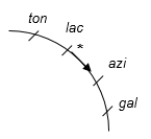
A) gal will be the first and ton will be the last gene to be transferred.
B) lac and azi will rarely be transferred together.
C) Ten minutes after transfer of ton, azi will be transferred.
D) It would take 30 minutes to transfer all of the genes that are shown.
E) All the chromosomal genes will be transferred by the end.
A) gal will be the first and ton will be the last gene to be transferred.
B) lac and azi will rarely be transferred together.
C) Ten minutes after transfer of ton, azi will be transferred.
D) It would take 30 minutes to transfer all of the genes that are shown.
E) All the chromosomal genes will be transferred by the end.
سؤال
سؤال
سؤال
سؤال
سؤال
سؤال
سؤال
سؤال
سؤال
سؤال
سؤال
سؤال
سؤال
سؤال
سؤال
سؤال
سؤال
سؤال
سؤال
سؤال
سؤال
سؤال
سؤال
سؤال
سؤال
You are using phages to map three toxin-production genes (R, Y, and
G) in a new bacterium. You grow phages in a strain of the bacteria that produces all three toxins (R+, Y+, G+), isolate the phage, and then infect a second bacterial strain that cannot produce any of the toxins (R-, Y-, G-). The recipient bacteria are then grown on colorimetric media (media that change color in response to toxin presence) to see which toxin genes are transferred together by the phage. The data are as follows:

a. What kind of mapping is this called?
b. Which gene is in the middle?
c. Which of the outside genes is closer to the middle gene?
G) in a new bacterium. You grow phages in a strain of the bacteria that produces all three toxins (R+, Y+, G+), isolate the phage, and then infect a second bacterial strain that cannot produce any of the toxins (R-, Y-, G-). The recipient bacteria are then grown on colorimetric media (media that change color in response to toxin presence) to see which toxin genes are transferred together by the phage. The data are as follows:
a. What kind of mapping is this called?
b. Which gene is in the middle?
c. Which of the outside genes is closer to the middle gene?
سؤال
سؤال
سؤال
سؤال
سؤال
سؤال
سؤال
A virulent bacteriophage is used to infect a prototrophic bacterial culture. Phages are collected from the culture and are used to infect a new bacterial strain that has several auxotrophies. After infection, rare prototrophs are found: 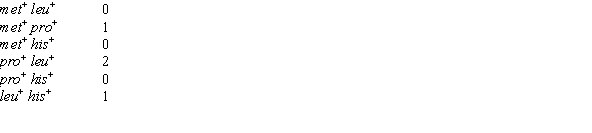 How are the auxotrophy genes organized on the bacterial chromosome?
How are the auxotrophy genes organized on the bacterial chromosome? سؤال
سؤال

فتح الحزمة
قم بالتسجيل لفتح البطاقات في هذه المجموعة!
Unlock Deck
Unlock Deck
1/71

العب

ملء الشاشة (f)
Deck 9: Bacterial and Viral Genetic Systems
1
Which of the following features would NOT be considered an advantage for using organisms such as bacteria and viruses for genetic studies?
A) rapid reproduction and high progeny number
B) haploid genome for expressing mutations
C) complete absence of recombination, which maintains the integrity of the genome
D) low cost to maintain and little storage space required
E) genomes being small and readily subjected to genetic manipulation
A) rapid reproduction and high progeny number
B) haploid genome for expressing mutations
C) complete absence of recombination, which maintains the integrity of the genome
D) low cost to maintain and little storage space required
E) genomes being small and readily subjected to genetic manipulation
C
2
The transfer of DNA from a donor cell to a recipient cell through a cytoplasmic connection is called:
A) transformation.
B) transduction.
C) the lysogenic cycle.
D) the lytic cycle.
E) conjugation.
A) transformation.
B) transduction.
C) the lysogenic cycle.
D) the lytic cycle.
E) conjugation.
E
3
In order to better understand arginine biosynthesis in bacteria, a microbial geneticist might first isolate mutant bacterial strains.
a. What characteristics must these mutant bacteria have?
b. Outline a strategy for isolating such mutants.
c. List three possible methods for mapping the genetic location of the mutations in these strains.
a. What characteristics must these mutant bacteria have?
b. Outline a strategy for isolating such mutants.
c. List three possible methods for mapping the genetic location of the mutations in these strains.
not answered
4
Which of the following statements about nutritional requirements and growth of bacteria is NOT true?
A) Culture media developed for bacteria must contain a carbon source and essential elements for the survival of the bacteria.
B) Auxotrophic mutants can grow on Moderate that lacks a carbon source because they can synthesize their own nutrients.
C) Each bacterium has specific nutritional needs and conditions for successful cultivation.
D) Prototrophic bacterial strains can grow on minimal media.
E) The growth rate of bacteria on specific media can be assessed by the number and size of bacterial colonies.
A) Culture media developed for bacteria must contain a carbon source and essential elements for the survival of the bacteria.
B) Auxotrophic mutants can grow on Moderate that lacks a carbon source because they can synthesize their own nutrients.
C) Each bacterium has specific nutritional needs and conditions for successful cultivation.
D) Prototrophic bacterial strains can grow on minimal media.
E) The growth rate of bacteria on specific media can be assessed by the number and size of bacterial colonies.
فتح الحزمة
افتح القفل للوصول البطاقات البالغ عددها 71 في هذه المجموعة.
فتح الحزمة
k this deck
5
A bacterium of genotype a+b+c+d+ is the donor in a cotransformation mapping. The recipient is a-b-c-d-. Data from the transformed cells (genotype and percent of each cotransformant) are shown below. What is the order of the genes?
A) a c b d
B) a d c b
C) c b a d
D) c a d b
E) b c d a
A) a c b d
B) a d c b
C) c b a d
D) c a d b
E) b c d a
فتح الحزمة
افتح القفل للوصول البطاقات البالغ عددها 71 في هذه المجموعة.
فتح الحزمة
k this deck
6
Which of the following statements about genetic exchange in bacteria is NOT true?
A) In conjugation there has to be a physical connection between the donor cell and the recipient cell.
B) Plasmids do not have to integrate into the host cell chromosome in order to be replicated.
C) Interrupted conjugation results in the production of Hfr strains.
D) The order of gene transfer is not the same for different Hfr strains.
E) Antibiotic resistance can be transferred from one bacterial cell to another by conjugation.
A) In conjugation there has to be a physical connection between the donor cell and the recipient cell.
B) Plasmids do not have to integrate into the host cell chromosome in order to be replicated.
C) Interrupted conjugation results in the production of Hfr strains.
D) The order of gene transfer is not the same for different Hfr strains.
E) Antibiotic resistance can be transferred from one bacterial cell to another by conjugation.
فتح الحزمة
افتح القفل للوصول البطاقات البالغ عددها 71 في هذه المجموعة.
فتح الحزمة
k this deck
7
Cotransformation between two genes is more likely if they are:
A) close to one another.
B) far apart from one another.
C) both next to the F factor.
D) both oriented in the same direction.
E) not located on the same chromosome.
A) close to one another.
B) far apart from one another.
C) both next to the F factor.
D) both oriented in the same direction.
E) not located on the same chromosome.
فتح الحزمة
افتح القفل للوصول البطاقات البالغ عددها 71 في هذه المجموعة.
فتح الحزمة
k this deck
8
How are Hfr strains of bacteria different from F+ strains?
A) Cells of F+ strains are able to transfer chromosomal genes, whereas cells of Hfr strains cannot.
B) Cells of Hfr strains cannot initiate conjugation with F- cells.
C) The F factor is integrated into the bacterial chromosome in all or most cells of an Hfr strain but in only a few cells in an F+ strain.
D) Cells of Hfr strains carry F´ plasmids, whereas F+ cells do not.
E) Cells of Hfr strains can initiate conjugation with F+ cells or other Hfr cells.
A) Cells of F+ strains are able to transfer chromosomal genes, whereas cells of Hfr strains cannot.
B) Cells of Hfr strains cannot initiate conjugation with F- cells.
C) The F factor is integrated into the bacterial chromosome in all or most cells of an Hfr strain but in only a few cells in an F+ strain.
D) Cells of Hfr strains carry F´ plasmids, whereas F+ cells do not.
E) Cells of Hfr strains can initiate conjugation with F+ cells or other Hfr cells.
فتح الحزمة
افتح القفل للوصول البطاقات البالغ عددها 71 في هذه المجموعة.
فتح الحزمة
k this deck
9
Which of the following will have the LEAST influence on the efficiency of transformation in E. coli bacteria?
A) calcium chloride treatment
B) heat shock
C) electrical field
D) chilling on ice
E) using high concentrations of DNA
A) calcium chloride treatment
B) heat shock
C) electrical field
D) chilling on ice
E) using high concentrations of DNA
فتح الحزمة
افتح القفل للوصول البطاقات البالغ عددها 71 في هذه المجموعة.
فتح الحزمة
k this deck
10
Bacterial strains that can produce all the necessary compounds and therefore grow on minimal media are called:
A) autotrophs.
B) heterotrophs.
C) prototrophs.
D) omnitrophs.
E) auxotrophs.
A) autotrophs.
B) heterotrophs.
C) prototrophs.
D) omnitrophs.
E) auxotrophs.
فتح الحزمة
افتح القفل للوصول البطاقات البالغ عددها 71 في هذه المجموعة.
فتح الحزمة
k this deck
11
Which of the following statements about antibiotic resistance in bacteria is NOT true?
A) Antibiotic resistance cannot be conferred by conjugation as conjugation only affects the fertility of bacteria.
B) The antibiotic resistance gene can be transmitted to bacteria via transformation or transduction.
C) Environments where antibiotics are frequently used such as hospitals are under higher risk of giving rise to bacteria with antibiotic resistance.
D) Antibiotic resistance often originates from the microbes that produce antibiotics for their own survival.
E) The plasmid containing the antibiotic resistance gene can pass the gene to genetically unrelated bacteria.
A) Antibiotic resistance cannot be conferred by conjugation as conjugation only affects the fertility of bacteria.
B) The antibiotic resistance gene can be transmitted to bacteria via transformation or transduction.
C) Environments where antibiotics are frequently used such as hospitals are under higher risk of giving rise to bacteria with antibiotic resistance.
D) Antibiotic resistance often originates from the microbes that produce antibiotics for their own survival.
E) The plasmid containing the antibiotic resistance gene can pass the gene to genetically unrelated bacteria.
فتح الحزمة
افتح القفل للوصول البطاقات البالغ عددها 71 في هذه المجموعة.
فتح الحزمة
k this deck
12
leu- bacteria are mixed in a flask with leu+ bacteria, and soon all bacteria are leu+. However, if the leu- cells are on one side of a U-tube, which is divided into two compartments by a filter with fine pores, and the leu+ cells are on the other, the leu- cells do not become prototrophic. Which process is likely to produce this observed result?
A) conjugation
B) transduction
C) transformation
D) reciprocal translocation
E) transfection
A) conjugation
B) transduction
C) transformation
D) reciprocal translocation
E) transfection
فتح الحزمة
افتح القفل للوصول البطاقات البالغ عددها 71 في هذه المجموعة.
فتح الحزمة
k this deck
13
A bacterial cell transfers chromosomal genes to F- cells, but it rarely causes them to become F+. The bacterial cell is:
A) Hfr.
B) lysogenic.
C) auxtrophic.
D) lytic.
E) F+.
A) Hfr.
B) lysogenic.
C) auxtrophic.
D) lytic.
E) F+.
فتح الحزمة
افتح القفل للوصول البطاقات البالغ عددها 71 في هذه المجموعة.
فتح الحزمة
k this deck
14
Which of the following statements about bacterial genome is NOT true?
A) All bacteria contain a single circular double-stranded DNA as their genome.
B) Some bacteria may have linear chromosomes instead of a circular one.
C) In addition to a chromosome, many bacteria possess small extrachromosomal DNA called plasmids.
D) Each plasmid contains an origin of replication that allows independent replication for its maintenance.
E) The F factor, which is important for bacterial conjugation, is found as a circular episome of E. coli.
A) All bacteria contain a single circular double-stranded DNA as their genome.
B) Some bacteria may have linear chromosomes instead of a circular one.
C) In addition to a chromosome, many bacteria possess small extrachromosomal DNA called plasmids.
D) Each plasmid contains an origin of replication that allows independent replication for its maintenance.
E) The F factor, which is important for bacterial conjugation, is found as a circular episome of E. coli.
فتح الحزمة
افتح القفل للوصول البطاقات البالغ عددها 71 في هذه المجموعة.
فتح الحزمة
k this deck
15
When the F factor integrates into the E. coli chromosome, the result is an _____ strain.
A) Hfr
B) F-
C) F+
D) F´
E) F+/-
A) Hfr
B) F-
C) F+
D) F´
E) F+/-
فتح الحزمة
افتح القفل للوصول البطاقات البالغ عددها 71 في هذه المجموعة.
فتح الحزمة
k this deck
16
What are plasmids and what purposes do they serve?
فتح الحزمة
افتح القفل للوصول البطاقات البالغ عددها 71 في هذه المجموعة.
فتح الحزمة
k this deck
17
What is the result of conjugation between F´ and F- cells?
A) one F+ cells
B) two F´ cells
C) two F+ cells
D) one Hfr cell and one F- cell
E) two Hfr cells
A) one F+ cells
B) two F´ cells
C) two F+ cells
D) one Hfr cell and one F- cell
E) two Hfr cells
فتح الحزمة
افتح القفل للوصول البطاقات البالغ عددها 71 في هذه المجموعة.
فتح الحزمة
k this deck
18
Which of the following horizontal gene transfer mechanisms specifically uses time as a basic unit of mapping?
A) transformation
B) crossing over
C) transduction
D) conjugation
E) recombination
A) transformation
B) crossing over
C) transduction
D) conjugation
E) recombination
فتح الحزمة
افتح القفل للوصول البطاقات البالغ عددها 71 في هذه المجموعة.
فتح الحزمة
k this deck
19
Bacterial mutants that require supplemental nutrients in their growth media are called:
A) autotrophs.
B) heterotrophs.
C) prototrophs.
D) omnitrophs.
E) auxotrophs.
A) autotrophs.
B) heterotrophs.
C) prototrophs.
D) omnitrophs.
E) auxotrophs.
فتح الحزمة
افتح القفل للوصول البطاقات البالغ عددها 71 في هذه المجموعة.
فتح الحزمة
k this deck
20
Bacterial cells containing an F plasmid that has acquired bacterial chromosomal genes are called:
A) F+.
B) F'.
C) F-.
D) Hfr.
A) F+.
B) F'.
C) F-.
D) Hfr.
فتح الحزمة
افتح القفل للوصول البطاقات البالغ عددها 71 في هذه المجموعة.
فتح الحزمة
k this deck
21
In a transformation experiment in the bacterium Streptococcus, the donor has the genotype d+e+f+ (order is not known). The recipient strain is d-e-f- and f+ transformants are selected for. The complete genotype is determined for each of the f+ transformants and the results are shown below. What is the cotransformation frequency between f and e?
A) 28.8%
B) 71.2%
C) 7.9%
D) 23.0%
E) 40.6%
A) 28.8%
B) 71.2%
C) 7.9%
D) 23.0%
E) 40.6%
فتح الحزمة
افتح القفل للوصول البطاقات البالغ عددها 71 في هذه المجموعة.
فتح الحزمة
k this deck
22
List and describe three different ways that DNA from one bacterium can be transferred into bacterial cells.
فتح الحزمة
افتح القفل للوصول البطاقات البالغ عددها 71 في هذه المجموعة.
فتح الحزمة
k this deck
23
A transformation experiment is performed with a donor strain that is resistant to four drugs: A, B, C, and D determined by genes A, B, C, and D. The recipient strain is sensitive to all four drugs. The treated recipient-cell population is divided up and plated on media containing various combinations of the drugs. A cell that is resistant to the added drug(s) will form a colony. The table below shows the results. One of the genes is quite distant from the other three that are tightly linked. Which gene is distant from the other three?
A) A
B) B
C) C
D) D
E) A or C
A) A
B) B
C) C
D) D
E) A or C
فتح الحزمة
افتح القفل للوصول البطاقات البالغ عددها 71 في هذه المجموعة.
فتح الحزمة
k this deck
24
Which of the following statements is FALSE?
A) When Hfr cells are crossed with F- cells, most of the recipient cells remain F-.
B) The F plasmid or factor is capable of integrating into the bacterial chromosome at several different sites.
C) F+ cells are normally capable of undergoing conjugation with F- and Hfr recipient cells.
D) F+ cells can convert F- cells to F+ upon conjugation.
E) Hfr cells are capable of transferring part of the bacterial chromosome to recipient cells upon conjugation.
A) When Hfr cells are crossed with F- cells, most of the recipient cells remain F-.
B) The F plasmid or factor is capable of integrating into the bacterial chromosome at several different sites.
C) F+ cells are normally capable of undergoing conjugation with F- and Hfr recipient cells.
D) F+ cells can convert F- cells to F+ upon conjugation.
E) Hfr cells are capable of transferring part of the bacterial chromosome to recipient cells upon conjugation.
فتح الحزمة
افتح القفل للوصول البطاقات البالغ عددها 71 في هذه المجموعة.
فتح الحزمة
k this deck
25
Integrated, inactive phage DNA is called a:
A) progeny.
B) prophage.
C) transformant.
D) transductant.
E) conjugate.
A) progeny.
B) prophage.
C) transformant.
D) transductant.
E) conjugate.
فتح الحزمة
افتح القفل للوصول البطاقات البالغ عددها 71 في هذه المجموعة.
فتح الحزمة
k this deck
26
You are mapping five bacterial genes using cotransformation frequencies. The genes are designated A, B, C, D, and E. You perform a series of crosses and measure the percent cotransformation between all pairs of genes. The results are shown in the table below. Percent contransformation between gene pairs
What is the CORRECT order for the five genes?
A) A B C D E
B) C E A B D
C) D A B E C
D) B E A C D
E) E A D B C
What is the CORRECT order for the five genes?
A) A B C D E
B) C E A B D
C) D A B E C
D) B E A C D
E) E A D B C
فتح الحزمة
افتح القفل للوصول البطاقات البالغ عددها 71 في هذه المجموعة.
فتح الحزمة
k this deck
27
Outline the steps involved in mapping a bacterial chromosome by conjugation.
فتح الحزمة
افتح القفل للوصول البطاقات البالغ عددها 71 في هذه المجموعة.
فتح الحزمة
k this deck
28
What causes an F- cell to be converted to F+?
فتح الحزمة
افتح القفل للوصول البطاقات البالغ عددها 71 في هذه المجموعة.
فتح الحزمة
k this deck
29
You cross an Hfr strain of ala+ his- val+ genotype with an F- strain of ala- his+ val- genotype and wish to recover F- ala+ his+val- recombinants. Which of the following media should you use that will allow the recombinants to grow and form colonies but not allow growth of the two parental strains?
A) Minimal Moderate with histidine and valine but no alanine
B) Minimal Moderate with valine but no alanine or histidine
C) Minimal Moderate with histidine and alanine but no valine
D) Minimal Moderate with no histidine, alanine, or valine
E) Minimal Moderate with alanine but no histidine or valine
A) Minimal Moderate with histidine and valine but no alanine
B) Minimal Moderate with valine but no alanine or histidine
C) Minimal Moderate with histidine and alanine but no valine
D) Minimal Moderate with no histidine, alanine, or valine
E) Minimal Moderate with alanine but no histidine or valine
فتح الحزمة
افتح القفل للوصول البطاقات البالغ عددها 71 في هذه المجموعة.
فتح الحزمة
k this deck
30
What causes an F- cell to be converted to Hfr in the presence of F+ cells?
فتح الحزمة
افتح القفل للوصول البطاقات البالغ عددها 71 في هذه المجموعة.
فتح الحزمة
k this deck
31
(a) Explain how chromosomal genes are transferred from donors to recipients when cells of an F+ strain are mixed with F- cells. (b) Explain why transfer of chromosomal genes occurs at a higher frequency when cells of an Hfr strain are mixed with F- cells.
فتح الحزمة
افتح القفل للوصول البطاقات البالغ عددها 71 في هذه المجموعة.
فتح الحزمة
k this deck
32
Explain the significance of horizontal gene transfer to bacterial evolution and to our ability to discern relationships between different groups of bacteria.
فتح الحزمة
افتح القفل للوصول البطاقات البالغ عددها 71 في هذه المجموعة.
فتح الحزمة
k this deck
33
(a) What is an F´ plasmid and how is it formed? (b) Explain how an F´ can be used to construct a bacterial strain that is partially diploid. (c) Explain how partial diploid strains can be used to assess interactions between different alleles (e.g., lac + and lac-).
فتح الحزمة
افتح القفل للوصول البطاقات البالغ عددها 71 في هذه المجموعة.
فتح الحزمة
k this deck
34
A transformation experiment is performed with a donor strain that is resistant to four drugs, A, B, C, and D, determined by genes A, B, C, and D. The recipient strain is sensitive to all four drugs. The treated recipient-cell population is divided up and plated on media containing various combinations of the drugs. A cell that is resistant to the added drug(s) will form a colony. The table below shows the results. One of the genes is quite distant from the other three that are tightly linked. What is the probable order of the three tightly linked genes?
A) DAC
B) ACB
C) BDC
D) DCA
E) ADC
A) DAC
B) ACB
C) BDC
D) DCA
E) ADC
فتح الحزمة
افتح القفل للوصول البطاقات البالغ عددها 71 في هذه المجموعة.
فتح الحزمة
k this deck
35
The process of transferring DNA from one bacterium to another through a bacteriophage is called:
A) conjugation.
B) induction.
C) transformation.
D) transduction.
E) infection.
A) conjugation.
B) induction.
C) transformation.
D) transduction.
E) infection.
فتح الحزمة
افتح القفل للوصول البطاقات البالغ عددها 71 في هذه المجموعة.
فتح الحزمة
k this deck
36
You perform interrupted conjugation using an a+b+c+d+l+m+n+o+ Hfr strain and an F- strain that is a-b-c-d-l-m-n-o-. You observe the following genes transferred together in order from last to first:
n+a+c+m+
o+m+c+a+n+
o+b+d+l+n+
What is the map order of the genes?
n+a+c+m+
o+m+c+a+n+
o+b+d+l+n+
What is the map order of the genes?
فتح الحزمة
افتح القفل للوصول البطاقات البالغ عددها 71 في هذه المجموعة.
فتح الحزمة
k this deck
37
The figure below shows a partial chromosome map of an E. coli Hfr strain. Each mark equals 10 minutes. If transfer of genes begins at "*" and goes in the direction of the arrow, which of the predicted results from this map is MOST likely to be observed?
A) gal will be the first and ton will be the last gene to be transferred.
B) lac and azi will rarely be transferred together.
C) Ten minutes after transfer of ton, azi will be transferred.
D) It would take 30 minutes to transfer all of the genes that are shown.
E) All the chromosomal genes will be transferred by the end.
A) gal will be the first and ton will be the last gene to be transferred.
B) lac and azi will rarely be transferred together.
C) Ten minutes after transfer of ton, azi will be transferred.
D) It would take 30 minutes to transfer all of the genes that are shown.
E) All the chromosomal genes will be transferred by the end.
فتح الحزمة
افتح القفل للوصول البطاقات البالغ عددها 71 في هذه المجموعة.
فتح الحزمة
k this deck
38
The table below shows the results of interrupted-mating experiments with three different Hfr strains. What is the order of the genes, starting with C?
A) C, G, A, D, F, B, E
B) C, F, D, B, A, E, G
C) C, B, E, D, F, G, A
D) C, G, A, B, E, D, F
E) C, D, F, G, A, B, E
A) C, G, A, D, F, B, E
B) C, F, D, B, A, E, G
C) C, B, E, D, F, G, A
D) C, G, A, B, E, D, F
E) C, D, F, G, A, B, E
فتح الحزمة
افتح القفل للوصول البطاقات البالغ عددها 71 في هذه المجموعة.
فتح الحزمة
k this deck
39
HIV belongs to a group of viruses called _____ viruses.
A) dsDNA
B) ssDNA
C) ssRNA-RT
D) dsDNA-RT
E) ssRNA
A) dsDNA
B) ssDNA
C) ssRNA-RT
D) dsDNA-RT
E) ssRNA
فتح الحزمة
افتح القفل للوصول البطاقات البالغ عددها 71 في هذه المجموعة.
فتح الحزمة
k this deck
40
Outline the steps involved in mapping a bacterial chromosome by cotransformation.
فتح الحزمة
افتح القفل للوصول البطاقات البالغ عددها 71 في هذه المجموعة.
فتح الحزمة
k this deck
41
To MOST readily demonstrate transformation of bacteria in the laboratory one could extract DNA from:
A) an auxotroph and add it to prototrophic cells.
B) arg- cells and add it to arg+ cells.
C) streps (sensitive) and add it to strepr (resistant) cells.
D) arg+ cells and add it to arg- cells.
E) both arg- and arg+ cells, mix them, and select for recombinants.
A) an auxotroph and add it to prototrophic cells.
B) arg- cells and add it to arg+ cells.
C) streps (sensitive) and add it to strepr (resistant) cells.
D) arg+ cells and add it to arg- cells.
E) both arg- and arg+ cells, mix them, and select for recombinants.
فتح الحزمة
افتح القفل للوصول البطاقات البالغ عددها 71 في هذه المجموعة.
فتح الحزمة
k this deck
42
In E. coli, a P1 generalized transduction was carried out using a donor strain of ara+ leu+ ilvH+ genotype. The recipient strain was ara- leu- ilvH-. 381 ara+ transductants were first recovered and then the remaining genotypes of these 381 were determined and the results are shown below: Which gene is in the middle?
A) ara
B) leu
C) ilvH
D) ara or ilvH
E) leu or ara
A) ara
B) leu
C) ilvH
D) ara or ilvH
E) leu or ara
فتح الحزمة
افتح القفل للوصول البطاقات البالغ عددها 71 في هذه المجموعة.
فتح الحزمة
k this deck
43
The life cycle of virulent phages that always kill their host cell and never become inactive prophages would be the _____ cycle.
A) lethal
B) lytic
C) temperate
D) strict
E) lysogenic
A) lethal
B) lytic
C) temperate
D) strict
E) lysogenic
فتح الحزمة
افتح القفل للوصول البطاقات البالغ عددها 71 في هذه المجموعة.
فتح الحزمة
k this deck
44
The human immunodeficiency virus (HIV) is what type of virus?
A) a DNA virus that can infect a type of human blood cell
B) a double-stranded RNA virus that can recombine with the genomes of similar viruses from other species
C) a single-stranded RNA virus that can undergo reverse transcription
D) a single-stranded DNA virus that uses reverse transcriptase to make a provirus
E) a double-stranded DNA virus that can infect both humans and chimpanzees simultaneously
A) a DNA virus that can infect a type of human blood cell
B) a double-stranded RNA virus that can recombine with the genomes of similar viruses from other species
C) a single-stranded RNA virus that can undergo reverse transcription
D) a single-stranded DNA virus that uses reverse transcriptase to make a provirus
E) a double-stranded DNA virus that can infect both humans and chimpanzees simultaneously
فتح الحزمة
افتح القفل للوصول البطاقات البالغ عددها 71 في هذه المجموعة.
فتح الحزمة
k this deck
45
A recipient gal- bio- attl- strain of E. coli is transduced by P1 phage from a donor wild-type gal+ bio+ attl+ strain. (attl- is a mutant which can't form a l prophage because the site for l integration is missing or defective.) gal+ transductants are selected for by plating the recipient cells on a Moderate with galactose as the sole carbon or energy source. Replica plating and testing for lysogenic ability give the complete genotypes of 106 transductants: Class 1:
Class 2:
Class 3:
Class 4: What is the frequency of cotransduction between gal and attl?
A) 33%
B) 25%
C) 8.5%
D) 67%
E) 46%
Class 2:
Class 3:
Class 4: What is the frequency of cotransduction between gal and attl?
A) 33%
B) 25%
C) 8.5%
D) 67%
E) 46%
فتح الحزمة
افتح القفل للوصول البطاقات البالغ عددها 71 في هذه المجموعة.
فتح الحزمة
k this deck
46
What does the enzyme reverse transcriptase do?
A) Using the amino acid sequence of a protein as a template, it makes an RNA molecule.
B) Using RNA as a template, it makes a DNA molecule.
C) Using RNA as a template, it makes an RNA molecule.
D) Using DNA as a template, it makes an RNA molecule.
E) Using DNA as a template, it makes a DNA molecule.
A) Using the amino acid sequence of a protein as a template, it makes an RNA molecule.
B) Using RNA as a template, it makes a DNA molecule.
C) Using RNA as a template, it makes an RNA molecule.
D) Using DNA as a template, it makes an RNA molecule.
E) Using DNA as a template, it makes a DNA molecule.
فتح الحزمة
افتح القفل للوصول البطاقات البالغ عددها 71 في هذه المجموعة.
فتح الحزمة
k this deck
47
Which type of transduction is used to map distances between phage genes?
A) generalized transduction
B) specialized transduction
C) targeted transduction
D) random transduction
E) discontinuous transduction
A) generalized transduction
B) specialized transduction
C) targeted transduction
D) random transduction
E) discontinuous transduction
فتح الحزمة
افتح القفل للوصول البطاقات البالغ عددها 71 في هذه المجموعة.
فتح الحزمة
k this deck
48
Which explanation is one of the reasons for the ability of the influenza virus to evolve rapidly?
A) Its single-stranded DNA genome is sensitive to environmental factors that create mutations.
B) The enzyme that replicates its RNA genome is prone to make mistakes that result in mutations.
C) Its ability to integrate into the host genome allows it to remain in host cells for long periods of time.
D) It can convert its RNA genome into a DNA copy by using the enzyme reverse transcriptase.
E) It has the ability to replicate its genome both within the host cell and outside of it.
A) Its single-stranded DNA genome is sensitive to environmental factors that create mutations.
B) The enzyme that replicates its RNA genome is prone to make mistakes that result in mutations.
C) Its ability to integrate into the host genome allows it to remain in host cells for long periods of time.
D) It can convert its RNA genome into a DNA copy by using the enzyme reverse transcriptase.
E) It has the ability to replicate its genome both within the host cell and outside of it.
فتح الحزمة
افتح القفل للوصول البطاقات البالغ عددها 71 في هذه المجموعة.
فتح الحزمة
k this deck
49
A wild-type strain (h+r+) of phage T2 was mixed with a double mutant (hr) for host range (h) and rapid lysis (r) and used with a high multiplicity of infection to infect E. coli B. The progeny from the cross were titered (counted) on a mixture of E. coli B and E. coli B/2 strains. The following plaques were scored: hr,212; h+r,114; hr+,106; h+r+,188
What is the approximate recombination frequency for these two loci?
A) 35%
B) 24%
C) 14%
D) 11%
E) 65%
What is the approximate recombination frequency for these two loci?
A) 35%
B) 24%
C) 14%
D) 11%
E) 65%
فتح الحزمة
افتح القفل للوصول البطاقات البالغ عددها 71 في هذه المجموعة.
فتح الحزمة
k this deck
50
Two different strains of a mutant phage infected a single bacterium. One phage strain is d-e+ and the other is d+e-. The phages go through the lytic cycle and produce progeny. What will be the recombinant genotypes in the progeny?
A) d-e+ and d+e-
B) d+e+ and d-e-
C) d-e+ and d+e+
D) d+e+ and d+e-
E) d-e+ and d-e-
A) d-e+ and d+e-
B) d+e+ and d-e-
C) d-e+ and d+e+
D) d+e+ and d+e-
E) d-e+ and d-e-
فتح الحزمة
افتح القفل للوصول البطاقات البالغ عددها 71 في هذه المجموعة.
فتح الحزمة
k this deck
51
Which of the following statements about retroviruses is FALSE?
A) All retroviruses contain oncogenes, which can induce the formation of tumors.
B) All retroviruses contain gag genes whose product forms the viral protein coat.
C) All retroviruses require pol genes, which are critical for retrotranscription.
D) All retroviral genomes have gag, pol, and env genes.
E) Not all RNA viruses are retroviruses.
A) All retroviruses contain oncogenes, which can induce the formation of tumors.
B) All retroviruses contain gag genes whose product forms the viral protein coat.
C) All retroviruses require pol genes, which are critical for retrotranscription.
D) All retroviral genomes have gag, pol, and env genes.
E) Not all RNA viruses are retroviruses.
فتح الحزمة
افتح القفل للوصول البطاقات البالغ عددها 71 في هذه المجموعة.
فتح الحزمة
k this deck
52
Two different strains of a mutant phage infect a single bacterium. One phage strain is d- and the other is e-. Some of the progeny phages are genotype d+e+, and some are d-e-. What genetic phenomenon does this demonstrate?
A) complementation
B) specialized transduction
C) generalized transduction
D) recombination
E) conjugation
A) complementation
B) specialized transduction
C) generalized transduction
D) recombination
E) conjugation
فتح الحزمة
افتح القفل للوصول البطاقات البالغ عددها 71 في هذه المجموعة.
فتح الحزمة
k this deck
53
A mapping study was done with the E. coli genes cheA, cheB, eda, and supD using P1 generalized transduction. The frequency of cotransduction was determined for pairs of genes as shown below. What is the MOST probable order for the four genes?
A) cheA-supD-eda-cheB
B) cheA-eda-cheB-supD
C) supD-cheA-eda-cheB
D) supD-cheA-cheB-eda
E) cheB-cheA-eda-supD
A) cheA-supD-eda-cheB
B) cheA-eda-cheB-supD
C) supD-cheA-eda-cheB
D) supD-cheA-cheB-eda
E) cheB-cheA-eda-supD
فتح الحزمة
افتح القفل للوصول البطاقات البالغ عددها 71 في هذه المجموعة.
فتح الحزمة
k this deck
54
In E. coli, a P1 generalized transduction was carried out using a donor strain of ara+ leu+ ilvH+ genotype. The recipient strain was ara- leu- ilvH-. 381 ara+ transductants were first recovered and then the remaining genotypes of these 381 were determined and the results are shown below: What is the cotransduction frequency between ara and leu?
A) 8.4%
B) 58%
C) 68%
D) 92%
E) 2.4%
A) 8.4%
B) 58%
C) 68%
D) 92%
E) 2.4%
فتح الحزمة
افتح القفل للوصول البطاقات البالغ عددها 71 في هذه المجموعة.
فتح الحزمة
k this deck
55
Generalized transduction by phage P1 of four E. coli genes (a, b, c, and d) shows the following percentages of cotransduction: What is the CORRECT order of the four genes?
A) a b c d
B) b a d c
C) d a c b
D) d c a b
E) b d a c
A) a b c d
B) b a d c
C) d a c b
D) d c a b
E) b d a c
فتح الحزمة
افتح القفل للوصول البطاقات البالغ عددها 71 في هذه المجموعة.
فتح الحزمة
k this deck
56
Some retroviruses contain genes that can stimulate cell division and cause tumors in host cells. Such genes are called:
A) oncogenes.
B) lytic genes.
C) prophage genes.
D) capsid genes.
E) envelope genes.
A) oncogenes.
B) lytic genes.
C) prophage genes.
D) capsid genes.
E) envelope genes.
فتح الحزمة
افتح القفل للوصول البطاقات البالغ عددها 71 في هذه المجموعة.
فتح الحزمة
k this deck
57
Plaques produced by the temperate phage lambda on E. coli are turbid, since some bacteria remain viable within the plaque area. Plaques produced by the virulent phage T4 are usually clear. Which statement is the BEST explanation for this difference?
A) Lambda can propogate via the lytic or lysogenic cycle.
B) T4 carries a smaller DNA genome than lambda.
C) Recombination occurs more frequently between lambda genomes than T4 genomes.
D) Lambda often carries a portion of the sex factor.
E) T4 will not infect E. coli cells that are growing.
A) Lambda can propogate via the lytic or lysogenic cycle.
B) T4 carries a smaller DNA genome than lambda.
C) Recombination occurs more frequently between lambda genomes than T4 genomes.
D) Lambda often carries a portion of the sex factor.
E) T4 will not infect E. coli cells that are growing.
فتح الحزمة
افتح القفل للوصول البطاقات البالغ عددها 71 في هذه المجموعة.
فتح الحزمة
k this deck
58
A new strain of H1N1 influenza virus that can infect humans consists of RNA parts from which three strains of influenza virus?
A) swine, human, and chimpanzee
B) bird, human, and monkey
C) human, bird, and chimpanzee
D) human, bird, and swine
E) human, monkey, and chimpanzee
A) swine, human, and chimpanzee
B) bird, human, and monkey
C) human, bird, and chimpanzee
D) human, bird, and swine
E) human, monkey, and chimpanzee
فتح الحزمة
افتح القفل للوصول البطاقات البالغ عددها 71 في هذه المجموعة.
فتح الحزمة
k this deck
59
Which of the following statements concerning the role of reverse transcriptase in the life cycle of certain RNA viruses is FALSE?
A) It is produced from the pol gene.
B) It makes DNA from an RNA template.
C) It is essential for producing a provirus.
D) It is part of the life cycle of retroviruses.
E) It is very accurate and leads to a low mutation rate.
A) It is produced from the pol gene.
B) It makes DNA from an RNA template.
C) It is essential for producing a provirus.
D) It is part of the life cycle of retroviruses.
E) It is very accurate and leads to a low mutation rate.
فتح الحزمة
افتح القفل للوصول البطاقات البالغ عددها 71 في هذه المجموعة.
فتح الحزمة
k this deck
60
Two mutations that affect plaque morphology in a particular phage (a- and b-) have been isolated. Phages carrying both mutations (a-b-) are mixed with wild-type phage (a+b+) and added to a culture of bacterial cells. Following infection and lysis, samples of the phage lysate are collected and cultured on bacterial cells. The following numbers of plaques are observed: What is the frequency of recombination between the a and b genes?
A) 7%
B) 14%
C) 42%
D) 28%
E) 36%
A) 7%
B) 14%
C) 42%
D) 28%
E) 36%
فتح الحزمة
افتح القفل للوصول البطاقات البالغ عددها 71 في هذه المجموعة.
فتح الحزمة
k this deck
61
HIV has a high mutation rate. What causes this, and how might this be advantageous to the virus?
فتح الحزمة
افتح القفل للوصول البطاقات البالغ عددها 71 في هذه المجموعة.
فتح الحزمة
k this deck
62
You are using phages to map three toxin-production genes (R, Y, and
G) in a new bacterium. You grow phages in a strain of the bacteria that produces all three toxins (R+, Y+, G+), isolate the phage, and then infect a second bacterial strain that cannot produce any of the toxins (R-, Y-, G-). The recipient bacteria are then grown on colorimetric media (media that change color in response to toxin presence) to see which toxin genes are transferred together by the phage. The data are as follows:
a. What kind of mapping is this called?
b. Which gene is in the middle?
c. Which of the outside genes is closer to the middle gene?
G) in a new bacterium. You grow phages in a strain of the bacteria that produces all three toxins (R+, Y+, G+), isolate the phage, and then infect a second bacterial strain that cannot produce any of the toxins (R-, Y-, G-). The recipient bacteria are then grown on colorimetric media (media that change color in response to toxin presence) to see which toxin genes are transferred together by the phage. The data are as follows:
a. What kind of mapping is this called?
b. Which gene is in the middle?
c. Which of the outside genes is closer to the middle gene?
فتح الحزمة
افتح القفل للوصول البطاقات البالغ عددها 71 في هذه المجموعة.
فتح الحزمة
k this deck
63
Outline the steps involved in mapping bacterial genes by generalized transduction.
فتح الحزمة
افتح القفل للوصول البطاقات البالغ عددها 71 في هذه المجموعة.
فتح الحزمة
k this deck
64
A retrovirus has an RNA genome but integrates into the DNA chromosome of a host cell. Explain how it does this.
فتح الحزمة
افتح القفل للوصول البطاقات البالغ عددها 71 في هذه المجموعة.
فتح الحزمة
k this deck
65
What is the difference between specialized and generalized transduction?
فتح الحزمة
افتح القفل للوصول البطاقات البالغ عددها 71 في هذه المجموعة.
فتح الحزمة
k this deck
66
Two phage phenotypes are controlled by the genes a and b. In a mapping experiment, a culture of bacteria is infected simultaneously with an a-b+ strain and an a+b- strain. When plaques are analyzed, five out of 1000 have the a+b+ or a-b- phenotype. Based on the information, how far apart are genes a and b?
فتح الحزمة
افتح القفل للوصول البطاقات البالغ عددها 71 في هذه المجموعة.
فتح الحزمة
k this deck
67
You are studying a new phage that infects H. pylori. You have isolated two mutant strains of the phage, each producing a different plaque phenotype due to a specific mutation: rough (r) and big (b). You co-infect H. pylori with both strains by adding a mixture of phages to a culture of cells. You collect the cell lysate containing progeny phages, plate diluted phages on a lawn of H. pylori cells, and observe 970 rough plaques, 890 big plaques, 0 rough and big plaques, and 0 normal, wild-type plaques.
a. What is the recombination frequency between the r locus and the b locus?
b. How can you explain the results?
a. What is the recombination frequency between the r locus and the b locus?
b. How can you explain the results?
فتح الحزمة
افتح القفل للوصول البطاقات البالغ عددها 71 في هذه المجموعة.
فتح الحزمة
k this deck
68
How does a virulent phage differ from a temperate phage?
فتح الحزمة
افتح القفل للوصول البطاقات البالغ عددها 71 في هذه المجموعة.
فتح الحزمة
k this deck
69
A virulent bacteriophage is used to infect a prototrophic bacterial culture. Phages are collected from the culture and are used to infect a new bacterial strain that has several auxotrophies. After infection, rare prototrophs are found: How are the auxotrophy genes organized on the bacterial chromosome?
How are the auxotrophy genes organized on the bacterial chromosome? فتح الحزمة
افتح القفل للوصول البطاقات البالغ عددها 71 في هذه المجموعة.
فتح الحزمة
k this deck
70
(a) Explain the mechanism that leads to rapid evolution of the virus that causes influenza. (b) Distinguish between antigenic drift and antigenic shift, and explain the significance of each to influenza evolution and the occurrence of influenza in humans.
فتح الحزمة
افتح القفل للوصول البطاقات البالغ عددها 71 في هذه المجموعة.
فتح الحزمة
k this deck
71
Both retroviruses and lysogenic bacteriophages employ a mechanism that allows them to be replicated and passed from cell to cell without producing viruses. What is the common mechanism that these two very different viruses use?
فتح الحزمة
افتح القفل للوصول البطاقات البالغ عددها 71 في هذه المجموعة.
فتح الحزمة
k this deck
فتح الحزمة
افتح القفل للوصول البطاقات البالغ عددها 71 في هذه المجموعة.






