







 تكلم مع الذكاء الاصطناعي


Deck 19: Electrochemistry: the Quest for Clean Energy
ملء الشاشة (f)

سؤال

سؤال
سؤال
سؤال
سؤال
سؤال
سؤال
سؤال
سؤال
سؤال
سؤال
سؤال
سؤال
سؤال
سؤال
سؤال
سؤال
سؤال
سؤال
سؤال
سؤال
سؤال
سؤال
سؤال
A voltaic cell is constructed based on the oxidation of zinc metal and the reduction of silver cations. Solutions of silver nitrate and zinc nitrate also were used. Locate the zinc nitrate on the diagram. 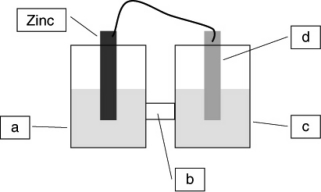
A) a
B) b
C) c
D) d
A) a
B) b
C) c
D) d
سؤال
سؤال
سؤال
سؤال
A voltaic cell is constructed based on the oxidation of zinc metal and the reduction of silver cations. Solutions of silver nitrate and zinc nitrate also were used. Locate the silver metal on the diagram. 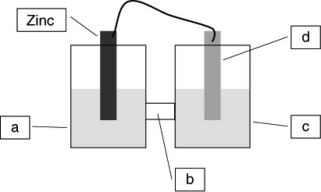
A) a
B) b
C) c
D) d
A) a
B) b
C) c
D) d
سؤال
سؤال
سؤال
سؤال
سؤال
Which cell diagram is correct for this electrochemical cell? 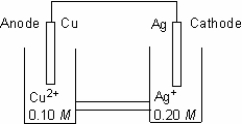
A) Ag(s)|Ag+(aq) (0.20 M)||Cu(s)|Cu2+(aq) (0.10 M)
B) Ag(s)|Cu2+(aq) (0.10 M)||Ag+(aq) (0.20 M)|Cu(s)
C) Ag+(aq) (0.20 M)|Ag(s)||Cu2+(aq) (0.10 M)|Cu(s)
D) Cu(s)|Cu2+(aq) (0.10 M)||Ag+(aq) (0.20 M)|Ag(s)
E) Cu(s)|Cu2+(aq) (0.10 M)||Ag(s)| Ag+(aq) (0.20 M)
A) Ag(s)|Ag+(aq) (0.20 M)||Cu(s)|Cu2+(aq) (0.10 M)
B) Ag(s)|Cu2+(aq) (0.10 M)||Ag+(aq) (0.20 M)|Cu(s)
C) Ag+(aq) (0.20 M)|Ag(s)||Cu2+(aq) (0.10 M)|Cu(s)
D) Cu(s)|Cu2+(aq) (0.10 M)||Ag+(aq) (0.20 M)|Ag(s)
E) Cu(s)|Cu2+(aq) (0.10 M)||Ag(s)| Ag+(aq) (0.20 M)
سؤال
سؤال
سؤال
سؤال
سؤال
سؤال
A voltaic cell is constructed based on the oxidation of zinc metal and the reduction of silver cations. Solutions of silver nitrate and zinc nitrate also were used. Locate the silver nitrate on the diagram. 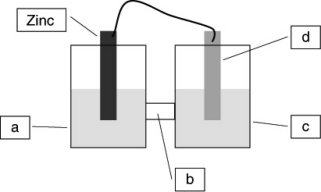
A) a
B) b
C) c
D) d
A) a
B) b
C) c
D) d
سؤال
سؤال
سؤال
سؤال
سؤال
سؤال
سؤال
سؤال
سؤال
سؤال
سؤال
سؤال
سؤال
سؤال
سؤال
سؤال
سؤال
سؤال
سؤال
سؤال
سؤال
سؤال
سؤال
سؤال
سؤال
سؤال
سؤال
سؤال
سؤال
سؤال
A pH meter uses an electrode arrangement that provides a voltage that depends on [H+], in accord with the Nernst equation. The following plot illustrates this dependence. What effect would changing temperature have on the measurement and this plot? ![<strong>A pH meter uses an electrode arrangement that provides a voltage that depends on [H<sup>+</sup>], in accord with the Nernst equation. The following plot illustrates this dependence. What effect would changing temperature have on the measurement and this plot? </strong> A) A change of temperature would have no effect. B) An increase in temperature would increase the slope. C) An increase in temperature would decrease the slope. D) An increase in temperature would increase the y intercept. E) An increase in temperature would decrease the y intercept. <div style=padding-top: 35px>](https://d2lvgg3v3hfg70.cloudfront.net/TB3834/11eb0df4_171a_415b_9431_ff27affe6062_TB3834_00.jpg)
A) A change of temperature would have no effect.
B) An increase in temperature would increase the slope.
C) An increase in temperature would decrease the slope.
D) An increase in temperature would increase the y intercept.
E) An increase in temperature would decrease the y intercept.
A) A change of temperature would have no effect.
B) An increase in temperature would increase the slope.
C) An increase in temperature would decrease the slope.
D) An increase in temperature would increase the y intercept.
E) An increase in temperature would decrease the y intercept.
سؤال
سؤال
سؤال
سؤال
سؤال
سؤال
سؤال
سؤال
سؤال
سؤال
سؤال

فتح الحزمة
قم بالتسجيل لفتح البطاقات في هذه المجموعة!
Unlock Deck
Unlock Deck
1/143

العب

ملء الشاشة (f)
Deck 19: Electrochemistry: the Quest for Clean Energy
1
Oxidation is the ________
A) gain of electrons.
B) loss of electrons.
C) gain of protons.
D) loss of protons.
E) loss of mass.
A) gain of electrons.
B) loss of electrons.
C) gain of protons.
D) loss of protons.
E) loss of mass.
loss of electrons.
2
Fuel cells are being developed for commercial use that use hydrogen as a fuel. In these cells, hydrogen combines with oxygen in the air to produce water as the only product. This combination appears to be a perfect source of energy, except hydrogen is highly explosive and challenging to store. The fuel cells produce no waste products because the water essentially is recycled, and the energy is obtained from the sun rather than from fossil fuels. When 1 mol of oxygen gas is ________ in the fuel cell, ________mole(s) of electrons are transferred.
A) reduced, 1
B) reduced, 2
C) oxidized, 2
D) reduced, 4
E) oxidized, 4
A) reduced, 1
B) reduced, 2
C) oxidized, 2
D) reduced, 4
E) oxidized, 4
reduced, 4
3
What is the oxidation number of chromium in the ionic compound ammonium dichromate, (NH4)2Cr2O7?
A) +3
B) +4
C) +5
D) +6
E) +7
A) +3
B) +4
C) +5
D) +6
E) +7
+6
4
Reduction refers to ________
A) a decrease in oxidation number.
B) an increase in oxidation number.
C) a gain in the number of protons.
D) a decrease in the atomic number.
E) loss of mass.
A) a decrease in oxidation number.
B) an increase in oxidation number.
C) a gain in the number of protons.
D) a decrease in the atomic number.
E) loss of mass.
فتح الحزمة
افتح القفل للوصول البطاقات البالغ عددها 143 في هذه المجموعة.
فتح الحزمة
k this deck
5
You have a job as a summer intern in an orange juice processing plant. Part of your job is to determine the amount of vitamin C in a given quantity of orange juice. To make this determination, you titrate the orange juice with I3-, the triiodide ion. To make sure you know what you are doing, your supervisor asks you how many electrons are transferred in the reaction. The reaction describing the titration is given below. What is your response?
Ascorbate + H2O + I3- dehydroascorbate + 2H+ + 3I-
A) 1
B) 2
C) 4
D) 0
E) It is impossible to tell.
Ascorbate + H2O + I3- dehydroascorbate + 2H+ + 3I-
A) 1
B) 2
C) 4
D) 0
E) It is impossible to tell.
فتح الحزمة
افتح القفل للوصول البطاقات البالغ عددها 143 في هذه المجموعة.
فتح الحزمة
k this deck
6
Which one of the following items does not characterize a reducing agent?
A) A reducing agent loses electrons.
B) A reducing agent causes another species to be reduced.
C) The oxidation number of a reducing agent increases.
D) A good reducing agent is a metal in a high oxidation state, such as Mn7+.
E) An example of a good reducing agent is an alkali metal, such as Na.
A) A reducing agent loses electrons.
B) A reducing agent causes another species to be reduced.
C) The oxidation number of a reducing agent increases.
D) A good reducing agent is a metal in a high oxidation state, such as Mn7+.
E) An example of a good reducing agent is an alkali metal, such as Na.
فتح الحزمة
افتح القفل للوصول البطاقات البالغ عددها 143 في هذه المجموعة.
فتح الحزمة
k this deck
7
The following reaction occurs in a new battery called the super iron battery. In this reaction, ________ is oxidized.
2K2FeO4(aq) + 3Zn(s) Fe2O3(s) + ZnO(s) + 2K2ZnO2(aq)
A) Fe in K2FeO4
B) Zn metal
C) Fe in Fe2O3
D) Zn in ZnO
E) Zn in K2ZnO2
2K2FeO4(aq) + 3Zn(s) Fe2O3(s) + ZnO(s) + 2K2ZnO2(aq)
A) Fe in K2FeO4
B) Zn metal
C) Fe in Fe2O3
D) Zn in ZnO
E) Zn in K2ZnO2
فتح الحزمة
افتح القفل للوصول البطاقات البالغ عددها 143 في هذه المجموعة.
فتح الحزمة
k this deck
8
When aluminum metal is obtained from aluminum oxide (Al2O3), ________ moles of electrons must be transferred for each mole of aluminum oxide processed.
A) 2
B) 3
C) 4
D) 6
E) 9
A) 2
B) 3
C) 4
D) 6
E) 9
فتح الحزمة
افتح القفل للوصول البطاقات البالغ عددها 143 في هذه المجموعة.
فتح الحزمة
k this deck
9
In the smelting of iron from iron oxide according to the equation
Fe2O3(s) + 3CO(g) 2Fe(s) + 3CO2(g)
What is the change in oxidation number for iron?
A) +3
B) -3
C) +2
D) -2
E) 0
Fe2O3(s) + 3CO(g) 2Fe(s) + 3CO2(g)
What is the change in oxidation number for iron?
A) +3
B) -3
C) +2
D) -2
E) 0
فتح الحزمة
افتح القفل للوصول البطاقات البالغ عددها 143 في هذه المجموعة.
فتح الحزمة
k this deck
10
Which one of the following items does not characterize an oxidizing agent?
A) An oxidizing agent gains electrons.
B) An oxidizing agent causes another species to be oxidized.
C) The oxidation number of an oxidizing agent decreases.
D) A good oxidizing agent is a metal in a high oxidation state, such as Mn7+.
E) An example of a good oxidizing agent is an alkali metal, such as Na.
A) An oxidizing agent gains electrons.
B) An oxidizing agent causes another species to be oxidized.
C) The oxidation number of an oxidizing agent decreases.
D) A good oxidizing agent is a metal in a high oxidation state, such as Mn7+.
E) An example of a good oxidizing agent is an alkali metal, such as Na.
فتح الحزمة
افتح القفل للوصول البطاقات البالغ عددها 143 في هذه المجموعة.
فتح الحزمة
k this deck
11
For the following reaction, which statement, A-D, is not correct? If more than one is not correct, respond E.
2Au + 4Cl2 2AuCl4-
A) Au is the reducing agent.
B) Cl2 is the oxidizing agent.
C) Au is oxidized.
D) The equation is balanced.
E) More than one statement is not correct.
2Au + 4Cl2 2AuCl4-
A) Au is the reducing agent.
B) Cl2 is the oxidizing agent.
C) Au is oxidized.
D) The equation is balanced.
E) More than one statement is not correct.
فتح الحزمة
افتح القفل للوصول البطاقات البالغ عددها 143 في هذه المجموعة.
فتح الحزمة
k this deck
12
Oxidation refers to ________
A) an increase in oxidation number.
B) a decrease in oxidation number.
C) a gain in the number of protons.
D) an increase in the atomic number.
E) an increase in mass.
A) an increase in oxidation number.
B) a decrease in oxidation number.
C) a gain in the number of protons.
D) an increase in the atomic number.
E) an increase in mass.
فتح الحزمة
افتح القفل للوصول البطاقات البالغ عددها 143 في هذه المجموعة.
فتح الحزمة
k this deck
13
Glancing at a periodic table, where do you expect to find elements that are good oxidizing agents?
A) on the right (except for the last group)
B) in the middle left
C) in the top left
D) at the bottom
E) in the transition metals
A) on the right (except for the last group)
B) in the middle left
C) in the top left
D) at the bottom
E) in the transition metals
فتح الحزمة
افتح القفل للوصول البطاقات البالغ عددها 143 في هذه المجموعة.
فتح الحزمة
k this deck
14
The following reaction occurs in a new battery called the super iron battery. In this reaction, ________ is reduced.
2K2FeO4(aq) + 3Zn(s) Fe2O3(s) + ZnO(s) + 2K2ZnO2(aq)
A) Fe in K2FeO4
B) Zn metal
C) Fe in Fe2O3
D) Zn in ZnO
E) Zn in K2ZnO2
2K2FeO4(aq) + 3Zn(s) Fe2O3(s) + ZnO(s) + 2K2ZnO2(aq)
A) Fe in K2FeO4
B) Zn metal
C) Fe in Fe2O3
D) Zn in ZnO
E) Zn in K2ZnO2
فتح الحزمة
افتح القفل للوصول البطاقات البالغ عددها 143 في هذه المجموعة.
فتح الحزمة
k this deck
15
When hydrogen reacts with a metal to form a hydride (e.g., CaH2), what are the oxidation numbers of the calcium, in this case, and hydrogen, respectively, in the product?
A) -2 and +1
B) +1 and -2
C) +2 and -1
D) 0 and 0
E) +2 and -2
A) -2 and +1
B) +1 and -2
C) +2 and -1
D) 0 and 0
E) +2 and -2
فتح الحزمة
افتح القفل للوصول البطاقات البالغ عددها 143 في هذه المجموعة.
فتح الحزمة
k this deck
16
The following reaction occurs in a newly developed battery. This battery is called the super iron battery because iron occurs in the unusual oxidation state of ________
2K2FeO4(aq) + 3Zn(s) Fe2O3(s) + ZnO(s) + 2K2ZnO2(aq)
A) +1.
B) +2.
C) +3.
D) +6.
E) +9.
2K2FeO4(aq) + 3Zn(s) Fe2O3(s) + ZnO(s) + 2K2ZnO2(aq)
A) +1.
B) +2.
C) +3.
D) +6.
E) +9.
فتح الحزمة
افتح القفل للوصول البطاقات البالغ عددها 143 في هذه المجموعة.
فتح الحزمة
k this deck
17
Fuel cells are being developed for commercial use that use hydrogen as a fuel. In these cells, hydrogen combines with oxygen in the air to produce water as the only product. This combination appears to be a perfect source of energy, except hydrogen is highly explosive and challenging to store. The fuel cells produce no waste products because the water essentially is recycled, and the energy is obtained from the sun rather than from fossil fuels. When 1 mol of hydrogen gas is ________ in the fuel cell, ________mole(s) of electrons are transferred.
A) reduced, 1
B) reduced, 2
C) oxidized, 2
D) reduced, 4
E) oxidized, 4
A) reduced, 1
B) reduced, 2
C) oxidized, 2
D) reduced, 4
E) oxidized, 4
فتح الحزمة
افتح القفل للوصول البطاقات البالغ عددها 143 في هذه المجموعة.
فتح الحزمة
k this deck
18
The following reaction occurs in basic solution. Identify the oxidizing agent. Note that the reaction equation is not balanced.
H2O(l) + Zn(s) + NO3-(aq) + OH-(aq) Zn(OH)42-(aq) + NH3(aq)
A) Zn(s)
B) NO3-(aq)
C) OH-(aq)
D) H2O(l)
E) NH3(aq)
H2O(l) + Zn(s) + NO3-(aq) + OH-(aq) Zn(OH)42-(aq) + NH3(aq)
A) Zn(s)
B) NO3-(aq)
C) OH-(aq)
D) H2O(l)
E) NH3(aq)
فتح الحزمة
افتح القفل للوصول البطاقات البالغ عددها 143 في هذه المجموعة.
فتح الحزمة
k this deck
19
Reduction is the ________
A) gain of electrons.
B) loss of electrons.
C) gain of protons.
D) loss of protons.
E) loss of mass.
A) gain of electrons.
B) loss of electrons.
C) gain of protons.
D) loss of protons.
E) loss of mass.
فتح الحزمة
افتح القفل للوصول البطاقات البالغ عددها 143 في هذه المجموعة.
فتح الحزمة
k this deck
20
Where in the periodic table do you find the elements that are the best reducing agents with the most negative standard reduction potentials?
A) in group 16
B) on the left
C) in the middle
D) at the bottom
E) in group 17
A) in group 16
B) on the left
C) in the middle
D) at the bottom
E) in group 17
فتح الحزمة
افتح القفل للوصول البطاقات البالغ عددها 143 في هذه المجموعة.
فتح الحزمة
k this deck
21
Which statement regarding voltaic cells is not correct?
A) Reduction occurs at the cathode.
B) Anions move through the barrier or bridge toward the electrode where oxidation is occurring.
C) The electrode where reduction is occurring is represented by a positive sign.
D) Electrons flow in the external circuit from the cathode to the anode.
E) Electrons flow in the external circuit toward the electrode represented by a positive sign.
A) Reduction occurs at the cathode.
B) Anions move through the barrier or bridge toward the electrode where oxidation is occurring.
C) The electrode where reduction is occurring is represented by a positive sign.
D) Electrons flow in the external circuit from the cathode to the anode.
E) Electrons flow in the external circuit toward the electrode represented by a positive sign.
فتح الحزمة
افتح القفل للوصول البطاقات البالغ عددها 143 في هذه المجموعة.
فتح الحزمة
k this deck
22
The diagram below represents a voltaic cell. In this cell, the electron flow is from ________
Cd(s)|Cd2+(aq)||Fe2+(aq),Fe3+(aq)|Pt(s)
A) Pt to Cd2+.
B) Pt to Cd.
C) Fe2+ to Cd2+.
D) Cd2+ to Fe3+.
E) Cd to Fe3+.
Cd(s)|Cd2+(aq)||Fe2+(aq),Fe3+(aq)|Pt(s)
A) Pt to Cd2+.
B) Pt to Cd.
C) Fe2+ to Cd2+.
D) Cd2+ to Fe3+.
E) Cd to Fe3+.
فتح الحزمة
افتح القفل للوصول البطاقات البالغ عددها 143 في هذه المجموعة.
فتح الحزمة
k this deck
23
This is a true story; can you explain what happened? Prior to a really important dinner party, the hostess discovered that her silverware was very tarnished. She needed a quick fix. She remembered reading that the tarnish (Ag2S) would be removed if you immersed the silverware in a hot solution of baking soda (NaHCO3) in a pan lined with aluminum foil. So she did, and so it was, but she noticed a bit of a rotten egg smell (H2S) being produced. Which one of the following statements cannot represent what might have been happening? MetalMetal ion
silver/silver(I)
aluminum/aluminum(III)
A) Al Al3+ + 3e-
B) Ag+ + e- Ag
C) 2HCO3- +S2- H2S + 2CO32-
D) 3Ag2S + 2Al +3H2O 6Ag + Al2O3 +3H2S
E) 2HCO3- +Ag2S H2S + 2CO32- + 2Ag
silver/silver(I)
aluminum/aluminum(III)
A) Al Al3+ + 3e-
B) Ag+ + e- Ag
C) 2HCO3- +S2- H2S + 2CO32-
D) 3Ag2S + 2Al +3H2O 6Ag + Al2O3 +3H2S
E) 2HCO3- +Ag2S H2S + 2CO32- + 2Ag
فتح الحزمة
افتح القفل للوصول البطاقات البالغ عددها 143 في هذه المجموعة.
فتح الحزمة
k this deck
24
A voltaic cell is constructed based on the oxidation of zinc metal and the reduction of silver cations. Solutions of silver nitrate and zinc nitrate also were used. Locate the zinc nitrate on the diagram.
A) a
B) b
C) c
D) d
A) a
B) b
C) c
D) d
فتح الحزمة
افتح القفل للوصول البطاقات البالغ عددها 143 في هذه المجموعة.
فتح الحزمة
k this deck
25
The diagram below represents a voltaic cell. Which one of the statements about this cell is not correct.
Zn(s)|Zn2+(1.0 M)||Cu2+(1.0 M)|Cu(s)
A) The mass of the zinc electrode decreases during discharge.
B) The copper electrode is the anode.
C) Electrons flow through the external circuit from the zinc electrode to the copper electrode.
D) Reduction occurs at the copper electrode during discharge.
E) The concentration of copper ions decreases during discharge.
Zn(s)|Zn2+(1.0 M)||Cu2+(1.0 M)|Cu(s)
A) The mass of the zinc electrode decreases during discharge.
B) The copper electrode is the anode.
C) Electrons flow through the external circuit from the zinc electrode to the copper electrode.
D) Reduction occurs at the copper electrode during discharge.
E) The concentration of copper ions decreases during discharge.
فتح الحزمة
افتح القفل للوصول البطاقات البالغ عددها 143 في هذه المجموعة.
فتح الحزمة
k this deck
26
This is a true story; can you explain what happened? Prior to a really important dinner party, the hostess discovered that her silverware was very tarnished. She needed a quick fix. She remembered reading that the tarnish (Ag2S) would be removed if you immersed the silverware in a hot solution of baking soda (NaHCO3) in a pan lined with aluminum foil. So she did, and so it was, but she noticed a bit of a rotten egg smell (H2S) being produced. MetalMetal ion
silver/silver(I)
aluminum/aluminum(III)
A) Aluminum ions react with S2-, form an aluminum sulfide precipitate, and gaseous carbon dioxide is released.
B) Silver ions in the presence of the baking soda, (NaHCO3), oxidize the sulfide to elemental sulfur that attacks the aluminum foil, which produces the smelly aluminum sulfide.
C) The aluminum acts as a reducing agent for the silver(I) in the silver sulfide; then the bicarbonate ion protonates the sulfide ion that is released.
D) Aluminum is plated onto the silver surface, making it shiny again, and then the reaction of the bicarbonate with the aluminum oxide releases CO2.
E) Silver in Ag2S reduces the aluminum, becomes metallic silver in the process, and releases hydrogen sulfide, H2S.
silver/silver(I)
aluminum/aluminum(III)
A) Aluminum ions react with S2-, form an aluminum sulfide precipitate, and gaseous carbon dioxide is released.
B) Silver ions in the presence of the baking soda, (NaHCO3), oxidize the sulfide to elemental sulfur that attacks the aluminum foil, which produces the smelly aluminum sulfide.
C) The aluminum acts as a reducing agent for the silver(I) in the silver sulfide; then the bicarbonate ion protonates the sulfide ion that is released.
D) Aluminum is plated onto the silver surface, making it shiny again, and then the reaction of the bicarbonate with the aluminum oxide releases CO2.
E) Silver in Ag2S reduces the aluminum, becomes metallic silver in the process, and releases hydrogen sulfide, H2S.
فتح الحزمة
افتح القفل للوصول البطاقات البالغ عددها 143 في هذه المجموعة.
فتح الحزمة
k this deck
27
Which statement about a voltaic cell is not correct?
A) The standard reduction potential is a measure of the propensity for a reduction half-reaction to occur when concentrations are 1 M, the pressure is 1 atm, and the temperature is 298 K.
B) A reduction half-reaction with a standard reduction potential,
, when reversed becomes an oxidation half-reaction with
=
C) The standard cell potential,
, is a measure of the electromotive force (emf) generated by the cell reactions at 298 K when concentrations are 1 M and the pressure is 1 atm.
D) The emf of a cell is a measure of the force with which the cell pumps electrons from the cathode to the anode.
E) The cell voltage measured with a voltmeter is not necessarily the standard cell potential.
A) The standard reduction potential is a measure of the propensity for a reduction half-reaction to occur when concentrations are 1 M, the pressure is 1 atm, and the temperature is 298 K.
B) A reduction half-reaction with a standard reduction potential,
, when reversed becomes an oxidation half-reaction with
=
C) The standard cell potential,
, is a measure of the electromotive force (emf) generated by the cell reactions at 298 K when concentrations are 1 M and the pressure is 1 atm.
D) The emf of a cell is a measure of the force with which the cell pumps electrons from the cathode to the anode.
E) The cell voltage measured with a voltmeter is not necessarily the standard cell potential.
فتح الحزمة
افتح القفل للوصول البطاقات البالغ عددها 143 في هذه المجموعة.
فتح الحزمة
k this deck
28
A voltaic cell is constructed based on the oxidation of zinc metal and the reduction of silver cations. Solutions of silver nitrate and zinc nitrate also were used. Locate the silver metal on the diagram.
A) a
B) b
C) c
D) d
A) a
B) b
C) c
D) d
فتح الحزمة
افتح القفل للوصول البطاقات البالغ عددها 143 في هذه المجموعة.
فتح الحزمة
k this deck
29
Consider the following standard reduction potentials. Which reaction A-D will proceed spontaneously as written from left to right?
A) Mg2+(aq) + Zn(s) Mg(s) + Zn2+(aq)
B) Mg2+(aq) + 2Cu+(aq) Mg(s) + 2Cu2+(aq)
C) Zn2+(aq) + 2Cu+(aq) Zn(s) + 2Cu2+(aq)
D) Zn(s) + 2Cu2+(aq) Zn2+(aq) + 2Cu+(aq)
E) None of these will proceed spontaneously.
A) Mg2+(aq) + Zn(s) Mg(s) + Zn2+(aq)
B) Mg2+(aq) + 2Cu+(aq) Mg(s) + 2Cu2+(aq)
C) Zn2+(aq) + 2Cu+(aq) Zn(s) + 2Cu2+(aq)
D) Zn(s) + 2Cu2+(aq) Zn2+(aq) + 2Cu+(aq)
E) None of these will proceed spontaneously.
فتح الحزمة
افتح القفل للوصول البطاقات البالغ عددها 143 في هذه المجموعة.
فتح الحزمة
k this deck
30
Which statement about a voltaic cell is not correct?
A) Electrons are produced as a product at the cathode.
B) Reduction occurs at the cathode.
C) Usually the cathode is a metal strip.
D) In the external circuit, electrons flow toward the cathode.
E) Chemical species can have their oxidation number decreased at the cathode.
A) Electrons are produced as a product at the cathode.
B) Reduction occurs at the cathode.
C) Usually the cathode is a metal strip.
D) In the external circuit, electrons flow toward the cathode.
E) Chemical species can have their oxidation number decreased at the cathode.
فتح الحزمة
افتح القفل للوصول البطاقات البالغ عددها 143 في هذه المجموعة.
فتح الحزمة
k this deck
31
Which statement is not correct for a voltaic cell?
A) The electron flow in the external circuit is from the negative electrode to the positive electrode.
B) The electron flow in the external circuit is from the anode to the cathode.
C) Electrons are transferred from the oxidizing agent to the reducing agent.
D) Chemical energy is transformed into electrical energy by a spontaneous redox reaction.
E) Positive ions diffuse through a porous bridge from the anode compartment to the cathode compartment.
A) The electron flow in the external circuit is from the negative electrode to the positive electrode.
B) The electron flow in the external circuit is from the anode to the cathode.
C) Electrons are transferred from the oxidizing agent to the reducing agent.
D) Chemical energy is transformed into electrical energy by a spontaneous redox reaction.
E) Positive ions diffuse through a porous bridge from the anode compartment to the cathode compartment.
فتح الحزمة
افتح القفل للوصول البطاقات البالغ عددها 143 في هذه المجموعة.
فتح الحزمة
k this deck
32
Proteins containing a certain functional group (identified as RSH) can be titrated with triiodide ion to produce another functional group (identified as RSSR). The reaction equation is given below. What is oxidized and what is reduced in this reaction?
2RSH + I3- 3I- + RSSR + 2H+
A) RSH is oxidized, I3- is reduced.
B) RSH is reduced, I is oxidized.
C) Both RSH and I are oxidized.
D) Both RSH and I are reduced.
E) This reaction is not oxidation-reduction.
2RSH + I3- 3I- + RSSR + 2H+
A) RSH is oxidized, I3- is reduced.
B) RSH is reduced, I is oxidized.
C) Both RSH and I are oxidized.
D) Both RSH and I are reduced.
E) This reaction is not oxidation-reduction.
فتح الحزمة
افتح القفل للوصول البطاقات البالغ عددها 143 في هذه المجموعة.
فتح الحزمة
k this deck
33
Which cell diagram is correct for this electrochemical cell?
A) Ag(s)|Ag+(aq) (0.20 M)||Cu(s)|Cu2+(aq) (0.10 M)
B) Ag(s)|Cu2+(aq) (0.10 M)||Ag+(aq) (0.20 M)|Cu(s)
C) Ag+(aq) (0.20 M)|Ag(s)||Cu2+(aq) (0.10 M)|Cu(s)
D) Cu(s)|Cu2+(aq) (0.10 M)||Ag+(aq) (0.20 M)|Ag(s)
E) Cu(s)|Cu2+(aq) (0.10 M)||Ag(s)| Ag+(aq) (0.20 M)
A) Ag(s)|Ag+(aq) (0.20 M)||Cu(s)|Cu2+(aq) (0.10 M)
B) Ag(s)|Cu2+(aq) (0.10 M)||Ag+(aq) (0.20 M)|Cu(s)
C) Ag+(aq) (0.20 M)|Ag(s)||Cu2+(aq) (0.10 M)|Cu(s)
D) Cu(s)|Cu2+(aq) (0.10 M)||Ag+(aq) (0.20 M)|Ag(s)
E) Cu(s)|Cu2+(aq) (0.10 M)||Ag(s)| Ag+(aq) (0.20 M)
فتح الحزمة
افتح القفل للوصول البطاقات البالغ عددها 143 في هذه المجموعة.
فتح الحزمة
k this deck
34
The electrodes on batteries are labeled + and -. The ________ is labeled ________, and ________ occurs there.
A) anode; positive; oxidation
B) anode; negative; reduction
C) cathode; positive; reduction
D) cathode; negative; reduction
E) cathode; positive; oxidation
A) anode; positive; oxidation
B) anode; negative; reduction
C) cathode; positive; reduction
D) cathode; negative; reduction
E) cathode; positive; oxidation
فتح الحزمة
افتح القفل للوصول البطاقات البالغ عددها 143 في هذه المجموعة.
فتح الحزمة
k this deck
35
This is a true story; can you explain what happened? Prior to a really important dinner party, the hostess discovered that her silverware was very tarnished. She needed a quick fix. She remembered reading that the tarnish (Ag2S) would be removed if you immersed the silverware in a hot solution of baking soda (NaHCO3) in a pan lined with aluminum foil. So she did, and so it was, but she noticed a bit of a rotten egg smell (H2S) being produced. Which one of the following statements cannot represent what might have been happening? Metal/Metal ion
A) Al Al3+ + 3e-
B) Ag+ + e- Ag
C) 2HCO3- +S2- H2S + 2CO32-
D) HCO3- +S2- HS- + CO32-
E) 2HCO3- +Ag2S H2S + 2CO32- + 2Ag
A) Al Al3+ + 3e-
B) Ag+ + e- Ag
C) 2HCO3- +S2- H2S + 2CO32-
D) HCO3- +S2- HS- + CO32-
E) 2HCO3- +Ag2S H2S + 2CO32- + 2Ag
فتح الحزمة
افتح القفل للوصول البطاقات البالغ عددها 143 في هذه المجموعة.
فتح الحزمة
k this deck
36
The electrodes on batteries are labeled + and -. The ________ is labeled ________, and ________ occurs there.
A) anode; positive; oxidation
B) anode; negative; oxidation
C) cathode; positive; oxidation
D) cathode; negative; reduction
E) anode; positive; reduction
A) anode; positive; oxidation
B) anode; negative; oxidation
C) cathode; positive; oxidation
D) cathode; negative; reduction
E) anode; positive; reduction
فتح الحزمة
افتح القفل للوصول البطاقات البالغ عددها 143 في هذه المجموعة.
فتح الحزمة
k this deck
37
Which statement about a cathode in a voltaic cell is not correct?
A) Oxidation occurs at the cathode.
B) Reduction occurs at the cathode.
C) Usually the cathode is a metal strip.
D) In the external circuit, electrons flow toward the cathode.
E) Chemical species can have their oxidation number decreased at the cathode.
A) Oxidation occurs at the cathode.
B) Reduction occurs at the cathode.
C) Usually the cathode is a metal strip.
D) In the external circuit, electrons flow toward the cathode.
E) Chemical species can have their oxidation number decreased at the cathode.
فتح الحزمة
افتح القفل للوصول البطاقات البالغ عددها 143 في هذه المجموعة.
فتح الحزمة
k this deck
38
Consider an electrochemical cell with a Zn electrode in ZnSO4(aq) and a Cu electrode in CuSO4(aq). The overall chemical reaction is
Zn(s) + Cu2+(aq) Zn2+(aq) + Cu(s)
Which one of the following statements is correct?
A) Copper is oxidized at the anode.
B) One mole of electrons is transferred in this reaction.
C) Zinc is reduced at the cathode.
D) Copper ions are reduced at the cathode.
E) Electrons travel from the Cu electrode to the Zn electrode.
Zn(s) + Cu2+(aq) Zn2+(aq) + Cu(s)
Which one of the following statements is correct?
A) Copper is oxidized at the anode.
B) One mole of electrons is transferred in this reaction.
C) Zinc is reduced at the cathode.
D) Copper ions are reduced at the cathode.
E) Electrons travel from the Cu electrode to the Zn electrode.
فتح الحزمة
افتح القفل للوصول البطاقات البالغ عددها 143 في هذه المجموعة.
فتح الحزمة
k this deck
39
A voltaic cell is constructed based on the oxidation of zinc metal and the reduction of silver cations. Solutions of silver nitrate and zinc nitrate also were used. Locate the silver nitrate on the diagram.
A) a
B) b
C) c
D) d
A) a
B) b
C) c
D) d
فتح الحزمة
افتح القفل للوصول البطاقات البالغ عددها 143 في هذه المجموعة.
فتح الحزمة
k this deck
40
Consider the following standard reduction potentials. Which reaction A-D will proceed spontaneously as written from left to right?
A) 2Cr3+(aq) + 3Cd(s) 2Cr(s) + 3Cd2+(aq)
B) 2Cr3+(aq) + 3Ni(s) 2Cr(s) + 3Ni2+(aq)
C) Cd2+(aq) + Ni(s) Cd(s) + Ni2+(aq)
D) Cd(s) + Ni2+(aq) Cd2+(aq) + Ni(s)
E) None of these will proceed spontaneously.
A) 2Cr3+(aq) + 3Cd(s) 2Cr(s) + 3Cd2+(aq)
B) 2Cr3+(aq) + 3Ni(s) 2Cr(s) + 3Ni2+(aq)
C) Cd2+(aq) + Ni(s) Cd(s) + Ni2+(aq)
D) Cd(s) + Ni2+(aq) Cd2+(aq) + Ni(s)
E) None of these will proceed spontaneously.
فتح الحزمة
افتح القفل للوصول البطاقات البالغ عددها 143 في هذه المجموعة.
فتح الحزمة
k this deck
41
Based on the information in the table of standard reduction potentials below, what is the standard cell potential for an electrochemical cell that has iron, Fe, and magnesium, Mg, electrodes? Also, identify the cathode. Standard Reduction Potentials (volts) in Aqueous
Solution
A) +3.14 V with Fe as the cathode
B) +3.14 V with Mg as the cathode
C) -3.14 V with Fe as the cathode
D) -3.14 V with Mg as the cathode
E) +1.60 V with Fe as the cathode
Solution
A) +3.14 V with Fe as the cathode
B) +3.14 V with Mg as the cathode
C) -3.14 V with Fe as the cathode
D) -3.14 V with Mg as the cathode
E) +1.60 V with Fe as the cathode
فتح الحزمة
افتح القفل للوصول البطاقات البالغ عددها 143 في هذه المجموعة.
فتح الحزمة
k this deck
42
What is the standard cell potential for a voltaic cell using the Pb2+/Pb and Mg2+/Mg half-reactions? Which metal is the cathode? Standard Reduction Potentials (volts) in Aqueous
Solution
A) -2.25 V, Pb is the cathode
B) +2.25 V, Mg is the cathode
C) -2.25 V, Mg is the cathode
D) +2.25 V, Pb is the cathode
E) -2.49 V, Mg is the cathode
Solution
A) -2.25 V, Pb is the cathode
B) +2.25 V, Mg is the cathode
C) -2.25 V, Mg is the cathode
D) +2.25 V, Pb is the cathode
E) -2.49 V, Mg is the cathode
فتح الحزمة
افتح القفل للوصول البطاقات البالغ عددها 143 في هذه المجموعة.
فتح الحزمة
k this deck
43
Consider the following standard reduction potentials. The Cr/Cr3+ half-reaction can be paired with the other two to produce voltaic cells because ________
A) Cr is a powerful oxidizing agent.
B) Cr is a powerful reducing agent.
C) Cr3+ is a powerful oxidizing agent.
D) Cr3+ is a powerful reducing agent
E) Cd and Ni are readily oxidized.
A) Cr is a powerful oxidizing agent.
B) Cr is a powerful reducing agent.
C) Cr3+ is a powerful oxidizing agent.
D) Cr3+ is a powerful reducing agent
E) Cd and Ni are readily oxidized.
فتح الحزمة
افتح القفل للوصول البطاقات البالغ عددها 143 في هذه المجموعة.
فتح الحزمة
k this deck
44
Identify the strongest reducing agent in the following half-reactions. The standard reduction potentials are listed.
A) Cr
B) MnO2
C) Hg2SO4
D) Sn
E) Hg
A) Cr
B) MnO2
C) Hg2SO4
D) Sn
E) Hg
فتح الحزمة
افتح القفل للوصول البطاقات البالغ عددها 143 في هذه المجموعة.
فتح الحزمة
k this deck
45
Copper is oxidized by nitric acid. If this property were used in an electrochemical cell, what would the standard cell potential be? The relevant reduction reactions and standard reduction potentials are given below.
A) -0.62 V
B) +0.62 V
C) -1.30 V
D) +1.30 V
E) +0.68 V
A) -0.62 V
B) +0.62 V
C) -1.30 V
D) +1.30 V
E) +0.68 V
فتح الحزمة
افتح القفل للوصول البطاقات البالغ عددها 143 في هذه المجموعة.
فتح الحزمة
k this deck
46
The standard hydrogen electrode is ________
A) used to calibrate voltmeters.
B) used to produce a set of standard reduction potentials.
C) needed to activate electrochemical cells.
D) often overlooked in measuring standard reduction potentials.
E) used to produce a standard cell potential of exactly 1 V.
A) used to calibrate voltmeters.
B) used to produce a set of standard reduction potentials.
C) needed to activate electrochemical cells.
D) often overlooked in measuring standard reduction potentials.
E) used to produce a standard cell potential of exactly 1 V.
فتح الحزمة
افتح القفل للوصول البطاقات البالغ عددها 143 في هذه المجموعة.
فتح الحزمة
k this deck
47
The numerical value of the Faraday constant is approximately 96,500. This value represents ________
A) the coulombs of charge carried by one mole of electrons.
B) the number of electrons required to produce a charge of one coulomb.
C) the number of electrons required to produce one mole of electrical charge.
D) the number of ions produced by removing one mole of electrons.
E) the electrical current produced by transferring one mole of electrons.
A) the coulombs of charge carried by one mole of electrons.
B) the number of electrons required to produce a charge of one coulomb.
C) the number of electrons required to produce one mole of electrical charge.
D) the number of ions produced by removing one mole of electrons.
E) the electrical current produced by transferring one mole of electrons.
فتح الحزمة
افتح القفل للوصول البطاقات البالغ عددها 143 في هذه المجموعة.
فتح الحزمة
k this deck
48
In one episode of the 1960s television sitcom, Gilligan's Island, the famous "professor" constructed voltaic cells to use as substitutes for their radio's dead batteries. A single D-cell has an emf of 1.5 V. Which scraps of metal from their damaged boat, the Minnow, could best be used to create a 1.5 V voltaic cell? Assume that coconuts make great beakers and that seawater is a terrific electrolyte. Metal/Metal ion
A) silver anode and lead cathode
B) aluminum anode and lead cathode
C) iron anode and aluminum cathode
D) aluminum anode and silver cathode
E) lead cathode and silver anode
A) silver anode and lead cathode
B) aluminum anode and lead cathode
C) iron anode and aluminum cathode
D) aluminum anode and silver cathode
E) lead cathode and silver anode
فتح الحزمة
افتح القفل للوصول البطاقات البالغ عددها 143 في هذه المجموعة.
فتح الحزمة
k this deck
49
Use the table of standard reduction potentials below to identify the metal or metal ion that is the strongest oxidizing agent. Standard Reduction Potentials (volts) in Aqueous
Solution
A) Pb4+
B) Pb2+
C) K+
D) K
E) Al
Solution
A) Pb4+
B) Pb2+
C) K+
D) K
E) Al
فتح الحزمة
افتح القفل للوصول البطاقات البالغ عددها 143 في هذه المجموعة.
فتح الحزمة
k this deck
50
Luke Skywalker found that the batteries for his lightsaber were running low. A cryptic inscription on the handle translated roughly into "Four AA dark-side batteries required." The total voltage produced by the four 1.50 V batteries in series therefore was 6.00 volts. If the cell reaction transfers one electron for each mole of the reactants, what is the Gibbs free-energy change for the redox reaction in each of Luke's batteries?
A) -145 kJ/mol
B) +145 kJ/mol
C) 869 kJ/mol
D) -869 kJ/mol
E) +579 kJ/mol
A) -145 kJ/mol
B) +145 kJ/mol
C) 869 kJ/mol
D) -869 kJ/mol
E) +579 kJ/mol
فتح الحزمة
افتح القفل للوصول البطاقات البالغ عددها 143 في هذه المجموعة.
فتح الحزمة
k this deck
51
The magnitude of the charge on a mole of electrons is ________
A) 1 C.
B) 9.65 C.
C) 9.65 *104 C.
D) 6.02 *1023 C.
E) 9650 C.
A) 1 C.
B) 9.65 C.
C) 9.65 *104 C.
D) 6.02 *1023 C.
E) 9650 C.
فتح الحزمة
افتح القفل للوصول البطاقات البالغ عددها 143 في هذه المجموعة.
فتح الحزمة
k this deck
52
Use the table of standard reduction potentials below to identify the metal or metal ion that is the strongest reducing agent. Standard Reduction Potentials (volts) in Aqueous
Solution
A) Pb4+
B) Pb2+
C) K+
D) K
E) Al
Solution
A) Pb4+
B) Pb2+
C) K+
D) K
E) Al
فتح الحزمة
افتح القفل للوصول البطاقات البالغ عددها 143 في هذه المجموعة.
فتح الحزمة
k this deck
53
The work involved in moving exactly 1 mole of electrons through a potential difference of exactly 1 V is ________
A) 1 J.
B) 1 kJ.
C) 96.5 J.
D) 6.02 kJ.
E) 96.5 kJ.
A) 1 J.
B) 1 kJ.
C) 96.5 J.
D) 6.02 kJ.
E) 96.5 kJ.
فتح الحزمة
افتح القفل للوصول البطاقات البالغ عددها 143 في هذه المجموعة.
فتح الحزمة
k this deck
54
The change in free energy for a reaction, G, depends on the stoichiometric coefficients used in writing the reaction, but cell potentials, E, do not depend on these coefficients. Which statement accounts for this difference?
A) These quantities ( G and E) are not related, so this difference is not an issue.
B) The free-energy change is defined for general reactions, and the electromotive force is defined for electrochemical reactions, so this difference is not an issue.
C) The difference is not relevant because the units differ: kJ/mol for G, and V for E.
D) The change in free energy depends on both the reaction and the amount of material reacting, while the cell potential depends only on the cell composition.
E) The statement is false. G does not depend on the stoichiometric coefficients.
A) These quantities ( G and E) are not related, so this difference is not an issue.
B) The free-energy change is defined for general reactions, and the electromotive force is defined for electrochemical reactions, so this difference is not an issue.
C) The difference is not relevant because the units differ: kJ/mol for G, and V for E.
D) The change in free energy depends on both the reaction and the amount of material reacting, while the cell potential depends only on the cell composition.
E) The statement is false. G does not depend on the stoichiometric coefficients.
فتح الحزمة
افتح القفل للوصول البطاقات البالغ عددها 143 في هذه المجموعة.
فتح الحزمة
k this deck
55
If the potential of a voltaic cell is +1.20 V, what is the free-energy change when one mole of electrons is transferred in the oxidation-reduction reaction?
A) 116 kJ
B) 1.20 kJ
C) -1.20 kJ
D) -116 kJ
E) +602 kJ
A) 116 kJ
B) 1.20 kJ
C) -1.20 kJ
D) -116 kJ
E) +602 kJ
فتح الحزمة
افتح القفل للوصول البطاقات البالغ عددها 143 في هذه المجموعة.
فتح الحزمة
k this deck
56
Which statement does not correctly describe a standard hydrogen electrode (SHE)?
A) The SHE is assigned a standard reduction potential of exactly 1 V.
B) 2H+(aq) + 2e- H2(g)
C) Pt|H2(g, 1atm)|H+(aq, 1 M)||
D) ||H+(aq, 1 M)|H2(g, 1atm)|Pt
E) The SHE consists of a platinum electrode immersed in an acid solution and a stream of hydrogen gas.
A) The SHE is assigned a standard reduction potential of exactly 1 V.
B) 2H+(aq) + 2e- H2(g)
C) Pt|H2(g, 1atm)|H+(aq, 1 M)||
D) ||H+(aq, 1 M)|H2(g, 1atm)|Pt
E) The SHE consists of a platinum electrode immersed in an acid solution and a stream of hydrogen gas.
فتح الحزمة
افتح القفل للوصول البطاقات البالغ عددها 143 في هذه المجموعة.
فتح الحزمة
k this deck
57
Using the following data, determine the standard cell potential E° for an electrochemical cell with zinc as the anode, lead as the cathode, and solutions of the respective ions.
Zn(s) + Pb2+(aq) Zn2+(aq) + Pb(s)
A) +1.274 V
B) -0.637 V
C) +0.889 V
D) -0.889 V
E) +0.637 V
Zn(s) + Pb2+(aq) Zn2+(aq) + Pb(s)
A) +1.274 V
B) -0.637 V
C) +0.889 V
D) -0.889 V
E) +0.637 V
فتح الحزمة
افتح القفل للوصول البطاقات البالغ عددها 143 في هذه المجموعة.
فتح الحزمة
k this deck
58
Consider the following standard reduction potentials. The Mg/Mg2+ half-reaction can be paired with the other two to produce voltaic cells because ________
A) Mg is a powerful oxidizing agent.
B) Mg is a powerful reducing agent.
C) Mg2+ is a powerful reducing agent.
D) Mg2+ is a powerful oxidizing agent.
E) Zn and Cu+ are readily oxidized.
A) Mg is a powerful oxidizing agent.
B) Mg is a powerful reducing agent.
C) Mg2+ is a powerful reducing agent.
D) Mg2+ is a powerful oxidizing agent.
E) Zn and Cu+ are readily oxidized.
فتح الحزمة
افتح القفل للوصول البطاقات البالغ عددها 143 في هذه المجموعة.
فتح الحزمة
k this deck
59
Using the following data, determine the standard cell potential for the electrochemical cell constructed using the following reaction, where zinc is the anode and lead is the cathode.
A) +0.637 V
B) -0.637 V
C) +1.274 V
D) -0.889 V
E) +0.889 V
A) +0.637 V
B) -0.637 V
C) +1.274 V
D) -0.889 V
E) +0.889 V
فتح الحزمة
افتح القفل للوصول البطاقات البالغ عددها 143 في هذه المجموعة.
فتح الحزمة
k this deck
60
The spontaneous redox reaction in a voltaic cell has ________
A) a negative value of Ecell and a negative value of G.
B) a positive value of Ecell and a positive value of G.
C) a negative value of Ecell and a positive value of G.
D) a positive value of Ecell and a negative value of G.
E) a positive value of Ecell and a value of zero for G.
A) a negative value of Ecell and a negative value of G.
B) a positive value of Ecell and a positive value of G.
C) a negative value of Ecell and a positive value of G.
D) a positive value of Ecell and a negative value of G.
E) a positive value of Ecell and a value of zero for G.
فتح الحزمة
افتح القفل للوصول البطاقات البالغ عددها 143 في هذه المجموعة.
فتح الحزمة
k this deck
61
When a voltaic cell reaches equilibrium, ________
A) = 0.
B) Ecell = 0.
C) Ecell = K.
D) = K.
E) Ecell = Q.
A) = 0.
B) Ecell = 0.
C) Ecell = K.
D) = K.
E) Ecell = Q.
فتح الحزمة
افتح القفل للوصول البطاقات البالغ عددها 143 في هذه المجموعة.
فتح الحزمة
k this deck
62
Which statement does not correctly describe a "dead" battery with a voltage of 0?
A) The free-energy change for the reaction now is 0.
B) All the reactants have been converted into products.
C) The products and reactants now are in equilibrium.
D) Q = K
E) cell potential = 0
A) The free-energy change for the reaction now is 0.
B) All the reactants have been converted into products.
C) The products and reactants now are in equilibrium.
D) Q = K
E) cell potential = 0
فتح الحزمة
افتح القفل للوصول البطاقات البالغ عددها 143 في هذه المجموعة.
فتح الحزمة
k this deck
63
An electrochemical cell has both a silver anode and a silver cathode. The solutions of silver nitrate in contact with the electrodes have different concentrations. Which statement(s) correctly describe this cell?
I. The cell potential is 0.
II. The cell potential is negative.
III. The cell potential is positive.
IV. No electrons will flow through the external circuit.
A) I only
B) II only
C) III only
D) I and IV
E) II and IV
I. The cell potential is 0.
II. The cell potential is negative.
III. The cell potential is positive.
IV. No electrons will flow through the external circuit.
A) I only
B) II only
C) III only
D) I and IV
E) II and IV
فتح الحزمة
افتح القفل للوصول البطاقات البالغ عددها 143 في هذه المجموعة.
فتح الحزمة
k this deck
64
Neuron cells generate electrical signals by concentration gradients across membranes. Assuming a potassium ion concentration of 0.003 M inside the cell, and a concentration of 0.135 M outside the cell, what is the electrical potential across the cell membrane? Body temperature is 310 K. The sign identifies the change in the electrical potential across the membrane and which way the ions flow.
A) +204 mV
B) +102 mV
C) +10.0 mV
D) -204 mV
E) -136 mV
A) +204 mV
B) +102 mV
C) +10.0 mV
D) -204 mV
E) -136 mV
فتح الحزمة
افتح القفل للوصول البطاقات البالغ عددها 143 في هذه المجموعة.
فتح الحزمة
k this deck
65
Consider the voltaic cell based on the following reaction:
Ma(s) + Mb+(aq) Ma+(aq) + Mb(s)
Two students are assigned to measure the standard cell potential. Yvonne claims that both solutions of ions have to be at exactly 1.00 M concentration, but Zelda is sure that the measurement will be the same if the concentrations of the two solutions are equal, but not necessarily 1.00 M. What do you think? (The temperature is controlled at 25°C, so that's not an issue.)
A) Yvonne is right because by definition standard cell potentials must be measured at concentrations of 1.00 M.
B) Yvonne is right because she understands the Nernst equation and what it describes.
C) Zelda is right because she understands the Nernst equation and what it describes.
D) Zelda is right because cell potentials do not depend on the concentration.
E) Both are right because cell potentials do not depend on the concentration.
Ma(s) + Mb+(aq) Ma+(aq) + Mb(s)
Two students are assigned to measure the standard cell potential. Yvonne claims that both solutions of ions have to be at exactly 1.00 M concentration, but Zelda is sure that the measurement will be the same if the concentrations of the two solutions are equal, but not necessarily 1.00 M. What do you think? (The temperature is controlled at 25°C, so that's not an issue.)
A) Yvonne is right because by definition standard cell potentials must be measured at concentrations of 1.00 M.
B) Yvonne is right because she understands the Nernst equation and what it describes.
C) Zelda is right because she understands the Nernst equation and what it describes.
D) Zelda is right because cell potentials do not depend on the concentration.
E) Both are right because cell potentials do not depend on the concentration.
فتح الحزمة
افتح القفل للوصول البطاقات البالغ عددها 143 في هذه المجموعة.
فتح الحزمة
k this deck
66
A concentration cell is constructed by using the same half-reaction for both the cathode and anode. What is the value of Ecell for a concentration cell that combines silver electrodes in contact with 0.10 M silver nitrate and 0.00003 M silver nitrate solutions? ( = +0.80 V for Ag/Ag+)
A) +0.21 V
B) +0.59 V
C) +0.80 V
D) -0.21 V
E) +1.01 V
A) +0.21 V
B) +0.59 V
C) +0.80 V
D) -0.21 V
E) +1.01 V
فتح الحزمة
افتح القفل للوصول البطاقات البالغ عددها 143 في هذه المجموعة.
فتح الحزمة
k this deck
67
Cadmium is a toxic heavy metal. The U.S. Environmental Protection Agency limits the concentration of cadmium ions in drinking water to less than 4 * 10-8 M. Assess the feasibility of monitoring of cadmium in drinking water using a voltaic cell based on the following half-reactions. If the silver ion concentration were 1.000 M, what cadmium ion concentration at 298 K would increase the cell potential by 10 mV from the standard cell potential?
A) 0.36 M
B) 4.6 M
C) 0.46 M
D) 0.68 M
E) 6.8 M
A) 0.36 M
B) 4.6 M
C) 0.46 M
D) 0.68 M
E) 6.8 M
فتح الحزمة
افتح القفل للوصول البطاقات البالغ عددها 143 في هذه المجموعة.
فتح الحزمة
k this deck
68
What is true when a battery (voltaic cell) is dead?
A)
= 0 and Q = K
B) Ecell = 0 and Q = K
C) Ecell = 0 and Q = 0
D)
= 0 and Q = 0
E) Ecell = 0 and K = 0
A)
= 0 and Q = K
B) Ecell = 0 and Q = K
C) Ecell = 0 and Q = 0
D)
= 0 and Q = 0
E) Ecell = 0 and K = 0
فتح الحزمة
افتح القفل للوصول البطاقات البالغ عددها 143 في هذه المجموعة.
فتح الحزمة
k this deck
69
A pH meter uses an electrode arrangement that provides a voltage that depends on [H+], in accord with the Nernst equation. The following plot illustrates this dependence. What effect would changing temperature have on the measurement and this plot?
A) A change of temperature would have no effect.
B) An increase in temperature would increase the slope.
C) An increase in temperature would decrease the slope.
D) An increase in temperature would increase the y intercept.
E) An increase in temperature would decrease the y intercept.
A) A change of temperature would have no effect.
B) An increase in temperature would increase the slope.
C) An increase in temperature would decrease the slope.
D) An increase in temperature would increase the y intercept.
E) An increase in temperature would decrease the y intercept.
فتح الحزمة
افتح القفل للوصول البطاقات البالغ عددها 143 في هذه المجموعة.
فتح الحزمة
k this deck
70
What is the standard cell potential for this electrochemical cell?
It consists of two compartments, labeled C1 and C2.
The temperature is 298 K.
C1 consists of a copper metal electrode immersed in a 0.30 M copper(II) sulfate solution.
C2 consists of a copper metal electrode immersed in a 1.5 M copper(II) sulfate solution.
Cu2+ + 2e- Cu, = +0.34 V
A) +0.34 V
B) -0.34 V
C) 0.0 V
D) +0.68 V
E) More information is needed to decide.
It consists of two compartments, labeled C1 and C2.
The temperature is 298 K.
C1 consists of a copper metal electrode immersed in a 0.30 M copper(II) sulfate solution.
C2 consists of a copper metal electrode immersed in a 1.5 M copper(II) sulfate solution.
Cu2+ + 2e- Cu, = +0.34 V
A) +0.34 V
B) -0.34 V
C) 0.0 V
D) +0.68 V
E) More information is needed to decide.
فتح الحزمة
افتح القفل للوصول البطاقات البالغ عددها 143 في هذه المجموعة.
فتح الحزمة
k this deck
71
An electrochemical cell is constructed with a zinc metal anode in contact with a 0.052 M solution of zinc nitrate and a silver cathode in contact with a 0.0042 M solution of silver(I) nitrate. What is the value of Q to use in the Nernst equation for this cell?
A) 2,900
B) 12
C) 8.1 *10-2
D) 3.4 *10-4
E) 1.00
A) 2,900
B) 12
C) 8.1 *10-2
D) 3.4 *10-4
E) 1.00
فتح الحزمة
افتح القفل للوصول البطاقات البالغ عددها 143 في هذه المجموعة.
فتح الحزمة
k this deck
72
Lead is a toxic metal. The U.S. Environmental Protection Agency limits the concentration of lead ions in drinking water to less than 5 *10-8 M. Assess the feasibility of monitoring of lead in drinking water using a voltaic cell based on the following half-reactions. If the zinc ion concentration were 0.100 M, what lead ion concentration at 298 K would decrease the cell potential by 10 mV from the standard cell potential?
A) 0.012 M
B) 0.22 M
C) 0.046 M
D) 0.15 M
E) 0.022 M
A) 0.012 M
B) 0.22 M
C) 0.046 M
D) 0.15 M
E) 0.022 M
فتح الحزمة
افتح القفل للوصول البطاقات البالغ عددها 143 في هذه المجموعة.
فتح الحزمة
k this deck
73
Cadmium is a toxic heavy metal. The U.S. Environmental Protection Agency limits the concentration of cadmium ions in drinking water to less than 4 * 10-8 M. Assess the feasibility of monitoring of cadmium in drinking water using a voltaic cell based on the following half-reactions. If the silver ion concentration were 0.100 M, what cadmium ion concentration at 298 K would increase the cell potential by 10 mV from the standard cell potential?
A) 3.6 * 10-2 M
B) 4.6*10-2 M
C) 4.6 * 10-3 M
D) 6.8 *10-3 M
E) 6.8 *10-2 M
A) 3.6 * 10-2 M
B) 4.6*10-2 M
C) 4.6 * 10-3 M
D) 6.8 *10-3 M
E) 6.8 *10-2 M
فتح الحزمة
افتح القفل للوصول البطاقات البالغ عددها 143 في هذه المجموعة.
فتح الحزمة
k this deck
74
Does pH have an effect on the cell potential (Ecell) for the following oxidation-reduction reaction?
5Fe2+(aq) + MnO4-(aq) + 8H+(aq) 5Fe3+(aq) + Mn2+(aq) + 4H2O(l)
A) Yes, because Ecell values for all redox reactions depend on the pH.
B) Yes, because Ecell values for redox reactions involving the hydronium ion depend on the pH.
C) No, because Ecell values for redox reactions depend only on the major species in the reaction, in this case, Fe2+, MnO4-, Fe3+, and Mn2+.
D) No, because Ecell values for redox reactions depend on concentrations and temperatures but not on pH.
E) No, because Ecell values for redox reactions do not depend on the pH.
5Fe2+(aq) + MnO4-(aq) + 8H+(aq) 5Fe3+(aq) + Mn2+(aq) + 4H2O(l)
A) Yes, because Ecell values for all redox reactions depend on the pH.
B) Yes, because Ecell values for redox reactions involving the hydronium ion depend on the pH.
C) No, because Ecell values for redox reactions depend only on the major species in the reaction, in this case, Fe2+, MnO4-, Fe3+, and Mn2+.
D) No, because Ecell values for redox reactions depend on concentrations and temperatures but not on pH.
E) No, because Ecell values for redox reactions do not depend on the pH.
فتح الحزمة
افتح القفل للوصول البطاقات البالغ عددها 143 في هذه المجموعة.
فتح الحزمة
k this deck
75
The standard cell potential for the nickel-cadmium battery is 1.35 V, and the cell reaction can be written as
2NiO(OH)(s) + 2H2O(l) + Cd(s) 2Ni(OH)2(s) + Cd(OH)2(s)
Which one of the following statements do you expect to be true based on the Nernst equation? Note Q = reaction quotient, and K = equilibrium constant for the cell reaction.
A) As the battery is used, the cell voltage approaches zero because Q approaches K, in value.
B) When the battery no longer works, the cell voltage is zero because Q = K.
C) As the battery is used, the cell voltage does not change because Q equals 1.
D) When the battery is fully charged, Q > K.
E) When the battery is fully charged, Q < K.
2NiO(OH)(s) + 2H2O(l) + Cd(s) 2Ni(OH)2(s) + Cd(OH)2(s)
Which one of the following statements do you expect to be true based on the Nernst equation? Note Q = reaction quotient, and K = equilibrium constant for the cell reaction.
A) As the battery is used, the cell voltage approaches zero because Q approaches K, in value.
B) When the battery no longer works, the cell voltage is zero because Q = K.
C) As the battery is used, the cell voltage does not change because Q equals 1.
D) When the battery is fully charged, Q > K.
E) When the battery is fully charged, Q < K.
فتح الحزمة
افتح القفل للوصول البطاقات البالغ عددها 143 في هذه المجموعة.
فتح الحزمة
k this deck
76
A concentration cell is constructed by using the same half-reaction for both the cathode and anode. What is the value of standard cell potential, , for a concentration cell that combines a silver anode in contact with 0.10 M silver nitrate and a silver cathode in contact with 0.00003 M silver nitrate? (
= +0.80 V for Ag/Ag+)
A) -0.21 V
B) 0.00 V
C) +0.80 V
D) -0.80 V
E) +0.21 V
= +0.80 V for Ag/Ag+)
A) -0.21 V
B) 0.00 V
C) +0.80 V
D) -0.80 V
E) +0.21 V
فتح الحزمة
افتح القفل للوصول البطاقات البالغ عددها 143 في هذه المجموعة.
فتح الحزمة
k this deck
77
An electrochemical cell is represented below. Which statement about this cell is not correct?
Cu(s)|Cu2+(aq) (0.20 M)||Ag+(aq) (0.10 M)|Ag(s)
A) Copper is oxidized.
B) Silver ion is reduced.
C) Two moles of electrons are transferred in the balanced reaction equation.
D) Electrons flow from the copper to the silver electrode.
E) The cell potential is determined by the standard half-cell potentials alone.
Cu(s)|Cu2+(aq) (0.20 M)||Ag+(aq) (0.10 M)|Ag(s)
A) Copper is oxidized.
B) Silver ion is reduced.
C) Two moles of electrons are transferred in the balanced reaction equation.
D) Electrons flow from the copper to the silver electrode.
E) The cell potential is determined by the standard half-cell potentials alone.
فتح الحزمة
افتح القفل للوصول البطاقات البالغ عددها 143 في هذه المجموعة.
فتح الحزمة
k this deck
78
Zinc-air batteries are actively being researched because one reactant (oxygen) is provided in infinite supply for free. The standard cell potential for this battery is 1.65 V. Calculate the cell potential when the partial pressure of oxygen in the cell is 0.190 atm and the temperature is 25.0°C. The reaction in the cell converts Zn(s) and O2(g) into ZnO(s).
2Zn(s) + O2 (g) 2ZnO(s)
A) 1.61 V
B) 1.62 V
C) 1.64 V
D) 1.66 V
E) 1.69 V
2Zn(s) + O2 (g) 2ZnO(s)
A) 1.61 V
B) 1.62 V
C) 1.64 V
D) 1.66 V
E) 1.69 V
فتح الحزمة
افتح القفل للوصول البطاقات البالغ عددها 143 في هذه المجموعة.
فتح الحزمة
k this deck
79
An electrochemical cell with a standard hydrogen electrode and a cathode consisting of a metallic chromium electrode, Cr(s), in contact with a 1.00 M chromium solution, Cr3+(aq), was constructed. The voltage produced by this cell was measured at 25°C. Which statements describe the results of this measurement, assuming the conditions are ideal? The cell voltage with the appropriate sign equals ________
I. the cell potential.
II. the electromotive force.
III. the standard cell potential.
IV. the standard reduction potential for Cr/Cr3+.
A) I only
B) I and II
C) I, II, and III
D) I, II, III, and IV
E) III only
I. the cell potential.
II. the electromotive force.
III. the standard cell potential.
IV. the standard reduction potential for Cr/Cr3+.
A) I only
B) I and II
C) I, II, and III
D) I, II, III, and IV
E) III only
فتح الحزمة
افتح القفل للوصول البطاقات البالغ عددها 143 في هذه المجموعة.
فتح الحزمة
k this deck
80
The Nernst equation can be used to calculate ________
A) standard cell potentials from standard reduction potentials.
B) the change in standard Gibbs free energy from standard cell potentials.
C) cell potentials from standard cell potentials when the conditions of concentration and temperature are not standard.
D) cell potentials given the temperature and reactant concentrations.
E) cell potentials from standard oxidation potentials.
A) standard cell potentials from standard reduction potentials.
B) the change in standard Gibbs free energy from standard cell potentials.
C) cell potentials from standard cell potentials when the conditions of concentration and temperature are not standard.
D) cell potentials given the temperature and reactant concentrations.
E) cell potentials from standard oxidation potentials.
فتح الحزمة
افتح القفل للوصول البطاقات البالغ عددها 143 في هذه المجموعة.
فتح الحزمة
k this deck
فتح الحزمة
افتح القفل للوصول البطاقات البالغ عددها 143 في هذه المجموعة.






