Deck 20: Model Building

ملء الشاشة (f)
exit full mode
سؤال
In explaining the income earned by university graduates, which of the following independent variables is best represented by an indicator variable in a regression model?

A) Grade point average.
B) Gender
C) Number of years since graduating from high school.
D) Age
استخدم زر المسافة أو
up arrow
down arrow
لقلب البطاقة.
سؤال
The model <strong>The model   +   is referred to as a:</strong> A) first-order model with two predictor variables with no interaction. B) first-order model with two predictor variables with interaction. C) second-order model with three predictor variables with no interaction. D) second-order model with three predictor variables with interaction. <div style=padding-top: 35px> + <strong>The model   +   is referred to as a:</strong> A) first-order model with two predictor variables with no interaction. B) first-order model with two predictor variables with interaction. C) second-order model with three predictor variables with no interaction. D) second-order model with three predictor variables with interaction. <div style=padding-top: 35px> is referred to as a:

A) first-order model with two predictor variables with no interaction.
B) first-order model with two predictor variables with interaction.
C) second-order model with three predictor variables with no interaction.
D) second-order model with three predictor variables with interaction.
سؤال
Which of the following best describes Stepwise regression?

A) Stepwise regression may involve adding one independent variable at a time.
B) Stepwise regression may involve deleting one independent variable at a time.
C) Stepwise regression may involve dividing one independent variable at a time.
D) Stepwise regression may involve adding or deleting one independent variable at a time.
سؤال
In explaining starting salaries for graduates of computer science programs, which of the following independent variables would not be adequately represented with a dummy variable?

A) Grade point average.
B) Gender.
C) Race.
D) Marital status.
سؤال
Which of the following describes the numbers that an indicator variable can have in a regression model?

A) 0 and 1
B) 1 and 2
C) 0, 1 and 2
D) None of these choices are correct.
سؤال
The model <strong>The model   +   is referred to as a:</strong> A) first-order model with one predictor variable. B) first-order model with two predictor variables. C) second-order model with one predictor variable. D) second-order model with two predictor variables. <div style=padding-top: 35px> + <strong>The model   +   is referred to as a:</strong> A) first-order model with one predictor variable. B) first-order model with two predictor variables. C) second-order model with one predictor variable. D) second-order model with two predictor variables. <div style=padding-top: 35px> is referred to as a:

A) first-order model with one predictor variable.
B) first-order model with two predictor variables.
C) second-order model with one predictor variable.
D) second-order model with two predictor variables.
سؤال
Which of the following is another name for a dummy variable?

A) Independent variable
B) Dependent variable
C) Indicator variable
D) Y variable
سؤال
The graph of the model  The graph of the model   = \beta _ { 0 } + \beta _ { 1 } x _ { i } + \beta _ { 2 } x _ { i } ^ { 2 }  is shaped like a straight line going upwards.<div style=padding-top: 35px>  =β0+β1xi+β2xi2= \beta _ { 0 } + \beta _ { 1 } x _ { i } + \beta _ { 2 } x _ { i } ^ { 2 } is shaped like a straight line going upwards.
سؤال
Suppose that the estimated regression equation for 200 business graduates is ŷ = 20 000 + 2000x + 1500I,
Where y is the starting salary, x is the grade point average and I is an indicator variable that takes the value of 1 if the student is a computer information systems major and 0 if not. A business administration major graduate with a grade point average of 4 would have an average starting salary of:

A) $20 000.
B) $26 000.
C) $29 500.
D) $28 000.
سؤال
In general, to represent a categorical independent variable that has m possible categories, which of the following is the number of dummy variables that can be used in the regression model?

A) (m + 1) dummy variables.
B) m dummy variables.
C) (1 − m) dummy variables.
D) (m - 1) dummy variables.
سؤال
In a stepwise regression procedure, if two independent variables are highly correlated, then:

A) both variables will enter the equation.
B) only one variable will enter the equation.
C) neither variable will enter the equation.
D) None of these choices are correct.
سؤال
Suppose that the sample regression equation of a model is  Suppose that the sample regression equation of a model is   = 4 + 1.5 x _ { 1 } + 2 x _ { 2 } - x _ { 1 } x _ { 2 }  . If we examine the relationship between  x _ { 1 }  and y for four different values of  x _ { 2 }  , we observe that the four equations produced differ only in the intercept term.<div style=padding-top: 35px>  =4+1.5x1+2x2x1x2= 4 + 1.5 x _ { 1 } + 2 x _ { 2 } - x _ { 1 } x _ { 2 } . If we examine the relationship between x1x _ { 1 } and y for four different values of x2x _ { 2 } , we observe that the four equations produced differ only in the intercept term.
سؤال
When we plot x versus y, the graph of the model <strong>When we plot x versus y, the graph of the model   +   is shaped like a:</strong> A) straight line going upwards. B) straight line going downwards. C) circle. D) parabola. <div style=padding-top: 35px> + <strong>When we plot x versus y, the graph of the model   +   is shaped like a:</strong> A) straight line going upwards. B) straight line going downwards. C) circle. D) parabola. <div style=padding-top: 35px> is shaped like a:

A) straight line going upwards.
B) straight line going downwards.
C) circle.
D) parabola.
سؤال
In explaining the amount of money spent on children's clothes each month, which of the following independent variables is best represented with an indicator variable?

A) Age.
B) Height.
C) Gender.
D) Weight.
سؤال
Suppose that the sample regression line of a first order model is  <strong>Suppose that the sample regression line of a first order model is    = 8 + 2 x _ { 1 } + 3 x _ { 2 }  . If we examine the relationship between y and  x _ { 1 }  for four different values of  x _ { 2 }  , we observe that the:</strong> A) effect of x  1  on y remains the same no matter what the value of x  2  . B) effect of x  1  on y remains the same no matter what the value of x  1  . C) only difference in the four equations produced is the coefficient of x  2  . D) None of these choices are correct. <div style=padding-top: 35px>  =8+2x1+3x2 = 8 + 2 x _ { 1 } + 3 x _ { 2 } . If we examine the relationship between y and x1x _ { 1 } for four different values of x2x _ { 2 } , we observe that the:

A) effect of x 11 on y remains the same no matter what the value of x 22 .
B) effect of x 11 on y remains the same no matter what the value of x 11 .
C) only difference in the four equations produced is the coefficient of x 22 .
D) None of these choices are correct.
سؤال
In explaining students' test scores, which of the following independent variables would not be adequately represented by an indicator variable?

A) Gender
B) Cultural background
C) Number of hours studying for the test
D) Marital status
سؤال
For the regression equation  <strong>For the regression equation    = 20 + 8 x _ { 1 } + 5 x _ { 2 } + 3 x _ { 1 } x _ { 2 }  , which combination of  x _ { 1 }  and  x _ { 2 }  , respectively, results in the largest average value of y?</strong> A) 3 and 5. B) 5 and 3. C) 6 and 3. D) 3 and 6. <div style=padding-top: 35px>  =20+8x1+5x2+3x1x2 = 20 + 8 x _ { 1 } + 5 x _ { 2 } + 3 x _ { 1 } x _ { 2 } , which combination of x1x _ { 1 } and x2x _ { 2 } , respectively, results in the largest average value of y?

A) 3 and 5.
B) 5 and 3.
C) 6 and 3.
D) 3 and 6.
سؤال
Which of the following is not an advantage of multiple regression as compared with analysis of variance?

A) Multiple regression can be used to estimate the relationship between the dependent variable and independent variables.
B) Multiple regression handles qualitative variables better than analysis of variance.
C) Multiple regression handles problems with more than two independent variables better than analysis of variance.
D) All of the above are advantages of multiple regression as compared with analysis of variance.
سؤال
Suppose that the sample regression equation of a model is  <strong>Suppose that the sample regression equation of a model is    = 10 + 4 x _ { 1 } + 3 x _ { 2 } - x _ { 1 } x _ { 2 }  . If we examine the relationship between  x _ { 1 }  and y for three different values of  x _ { 2 }  , we observe that the:</strong> A) three equations produced differ only in the intercept. B) coefficient of  x _ { 2 }  remains unchanged. C) coefficient of  x _ { 1 }  varies. D) three equations produced differ not only in the intercept term but the coefficient of  x _ { 1 }  , also varies. <div style=padding-top: 35px>  =10+4x1+3x2x1x2 = 10 + 4 x _ { 1 } + 3 x _ { 2 } - x _ { 1 } x _ { 2 } . If we examine the relationship between x1x _ { 1 } and y for three different values of x2x _ { 2 } , we observe that the:

A) three equations produced differ only in the intercept.
B) coefficient of x2x _ { 2 } remains unchanged.
C) coefficient of x1x _ { 1 } varies.
D) three equations produced differ not only in the intercept term but the coefficient of x1x _ { 1 } , also varies.
سؤال
The following model <strong>The following model   +   is used whenever the statistician believes that, on average, y is linearly related to:</strong> A)   , and the predictor variables do not interact. B)   , and the predictor variables do not interact. C)   and the predictor variables do not interact or to   , and the predictor variables do not interact. D)   and the predictor variables do not interact and to   , and the predictor variables do not interact. <div style=padding-top: 35px> + <strong>The following model   +   is used whenever the statistician believes that, on average, y is linearly related to:</strong> A)   , and the predictor variables do not interact. B)   , and the predictor variables do not interact. C)   and the predictor variables do not interact or to   , and the predictor variables do not interact. D)   and the predictor variables do not interact and to   , and the predictor variables do not interact. <div style=padding-top: 35px> is used whenever the statistician believes that, on average, y is linearly related to:

A) <strong>The following model   +   is used whenever the statistician believes that, on average, y is linearly related to:</strong> A)   , and the predictor variables do not interact. B)   , and the predictor variables do not interact. C)   and the predictor variables do not interact or to   , and the predictor variables do not interact. D)   and the predictor variables do not interact and to   , and the predictor variables do not interact. <div style=padding-top: 35px> , and the predictor variables do not interact.
B) <strong>The following model   +   is used whenever the statistician believes that, on average, y is linearly related to:</strong> A)   , and the predictor variables do not interact. B)   , and the predictor variables do not interact. C)   and the predictor variables do not interact or to   , and the predictor variables do not interact. D)   and the predictor variables do not interact and to   , and the predictor variables do not interact. <div style=padding-top: 35px> , and the predictor variables do not interact.
C) <strong>The following model   +   is used whenever the statistician believes that, on average, y is linearly related to:</strong> A)   , and the predictor variables do not interact. B)   , and the predictor variables do not interact. C)   and the predictor variables do not interact or to   , and the predictor variables do not interact. D)   and the predictor variables do not interact and to   , and the predictor variables do not interact. <div style=padding-top: 35px> and the predictor variables do not interact or to <strong>The following model   +   is used whenever the statistician believes that, on average, y is linearly related to:</strong> A)   , and the predictor variables do not interact. B)   , and the predictor variables do not interact. C)   and the predictor variables do not interact or to   , and the predictor variables do not interact. D)   and the predictor variables do not interact and to   , and the predictor variables do not interact. <div style=padding-top: 35px> , and the predictor variables do not interact.
D) <strong>The following model   +   is used whenever the statistician believes that, on average, y is linearly related to:</strong> A)   , and the predictor variables do not interact. B)   , and the predictor variables do not interact. C)   and the predictor variables do not interact or to   , and the predictor variables do not interact. D)   and the predictor variables do not interact and to   , and the predictor variables do not interact. <div style=padding-top: 35px> and the predictor variables do not interact and to <strong>The following model   +   is used whenever the statistician believes that, on average, y is linearly related to:</strong> A)   , and the predictor variables do not interact. B)   , and the predictor variables do not interact. C)   and the predictor variables do not interact or to   , and the predictor variables do not interact. D)   and the predictor variables do not interact and to   , and the predictor variables do not interact. <div style=padding-top: 35px> , and the predictor variables do not interact.
سؤال
Stepwise regression is an iterative procedure that can only add one independent variable at a time.
سؤال
The model  The model    = \beta _ { 0 } + \beta _ { 1 } x _ { 1 } + \beta _ { 2 } x _ { 2 }  is referred to as a first-order model with two predictor variables with no interaction.<div style=padding-top: 35px>
=β0+β1x1+β2x2= \beta _ { 0 } + \beta _ { 1 } x _ { 1 } + \beta _ { 2 } x _ { 2 } is referred to as a first-order model with two predictor variables with no interaction.
سؤال
In the first-order model ŷ = 8 + 3x1 +5x2, a unit increase in In the first-order model ŷ = 8 + 3x<sub>1</sub> +5x<sub>2</sub>, a unit increase in   , while holding   constant, increases the value of   on average by 3 units.<div style=padding-top: 35px> , while holding In the first-order model ŷ = 8 + 3x<sub>1</sub> +5x<sub>2</sub>, a unit increase in   , while holding   constant, increases the value of   on average by 3 units.<div style=padding-top: 35px> constant, increases the value of In the first-order model ŷ = 8 + 3x<sub>1</sub> +5x<sub>2</sub>, a unit increase in   , while holding   constant, increases the value of   on average by 3 units.<div style=padding-top: 35px> on average by 3 units.
سؤال
In the first-order model  In the first-order model   = 60 + 40x<sub>1</sub> -10x<sub>2</sub> + 5x<sub>1</sub>x<sub>2</sub>, a unit increase in x<sub>1</sub>, while holding x<sub>2</sub> constant at 1, increases the value of  y  on average by 45 units.<div style=padding-top: 35px>  = 60 + 40x1 -10x2 + 5x1x2, a unit increase in x1, while holding x2 constant at 1, increases the value of yy on average by 45 units.
سؤال
In a first-order model with two predictors, In a first-order model with two predictors,   and   , an interaction term may be used when the relationship between the dependent variable   and the predictor variables is linear.<div style=padding-top: 35px> and In a first-order model with two predictors,   and   , an interaction term may be used when the relationship between the dependent variable   and the predictor variables is linear.<div style=padding-top: 35px> , an interaction term may be used when the relationship between the dependent variable In a first-order model with two predictors,   and   , an interaction term may be used when the relationship between the dependent variable   and the predictor variables is linear.<div style=padding-top: 35px> and the predictor variables is linear.
سؤال
Regression analysis allows the statistics practitioner to use mathematical models to realistically describe relationships between the dependent variable and independent variables.
سؤال
Suppose that the sample regression line of a first-order model is  Suppose that the sample regression line of a first-order model is    = 4 + 3 x _ { 1 } + 2 x _ { 2 }  . If we examine the relationship between y and  x _ { 1 }  for three different values of  x _ { 2 }  , we observe that the effect of  x _ { 1 }  on  y  remains the same no matter what the value of  x _ { 2 }  .<div style=padding-top: 35px>  =4+3x1+2x2 = 4 + 3 x _ { 1 } + 2 x _ { 2 } . If we examine the relationship between y and x1x _ { 1 } for three different values of x2x _ { 2 } , we observe that the effect of x1x _ { 1 } on yy remains the same no matter what the value of x2x _ { 2 } .
سؤال
In general, to represent a nominal independent variable that has n possible categories, we would create n dummy variables.
سؤال
In explaining the amount of money spent on children's toys during Christmas each year, the independent variable 'gender' is best represented by a dummy variable.
سؤال
In a stepwise regression procedure, if two independent variables are highly correlated, then one variable usually eliminates the second variable.
سؤال
Stepwise regression is especially useful when there are many independent variables.
سؤال
In the first-order model  In the first-order model    = 50 + 25 x _ { 1 } - 10 x _ { 2 } - 6 x _ { 1 } x _ { 2 }  , a unit increase in  x _ { 2 }  , while holding  x _ { 1 }  constant at a value of 3, decreases the value of  y  on average by 3 units.<div style=padding-top: 35px>
=50+25x110x26x1x2= 50 + 25 x _ { 1 } - 10 x _ { 2 } - 6 x _ { 1 } x _ { 2 } , a unit increase in x2x _ { 2 } , while holding x1x _ { 1 } constant at a value of 3, decreases the value of yy on average by 3 units.
سؤال
In the first-order regression model ŷ = 12 + 6x1 +8x2 + 4x1x2, a unit increase in x1 increases the value of In the first-order regression model ŷ = 12 + 6x<sub>1</sub> +8x<sub>2</sub> + 4x<sub>1</sub>x<sub>2</sub>, a unit increase in x<sub>1</sub> increases the value of   on average by 6 units.<div style=padding-top: 35px> on average by 6 units.
سؤال
In the first-order model  In the first-order model    = 75 - 12 x _ { 1 } + 5 x _ { 2 } - 3 x _ { 1 } x _ { 2 }  , a unit increase in  x _ { 1 }  , while holding  x _ { 2 }  constant at a value of 2, decreases the value of  y  on average by 8 units.<div style=padding-top: 35px>
=7512x1+5x23x1x2= 75 - 12 x _ { 1 } + 5 x _ { 2 } - 3 x _ { 1 } x _ { 2 } , a unit increase in x1x _ { 1 } , while holding x2x _ { 2 } constant at a value of 2, decreases the value of yy on average by 8 units.
سؤال
Suppose that the sample regression equation of a model is  Suppose that the sample regression equation of a model is     = 4.7 + 2.2 x _ { 1 } + 2.6 x _ { 2 } - x _ { 1 } x _ { 2 }  . If we examine the relationship between y and  x _ { 2 }  for  x _ { 1 }  = 1, 2 and 3, we observe that the three equations produced not only differ in the intercept term, but the coefficient of  x _ { 2 }  also varies.<div style=padding-top: 35px>
=4.7+2.2x1+2.6x2x1x2 = 4.7 + 2.2 x _ { 1 } + 2.6 x _ { 2 } - x _ { 1 } x _ { 2 } . If we examine the relationship between y and x2x _ { 2 } for x1x _ { 1 } = 1, 2 and 3, we observe that the three equations produced not only differ in the intercept term, but the coefficient of x2x _ { 2 } also varies.
سؤال
In regression analysis, indicator variables may be used as independent variables.
سؤال
The model  The model   = \beta _ { 0 } + \beta _ { 1 } x _ { 1 } + \beta _ { 2 } x _ { 2 }  is used whenever the statistician believes that, on average,  y  is linearly related to  x _ { 1 }  and  x _ { 2 }  , and the predictor variables do not interact.<div style=padding-top: 35px>  =β0+β1x1+β2x2= \beta _ { 0 } + \beta _ { 1 } x _ { 1 } + \beta _ { 2 } x _ { 2 } is used whenever the statistician believes that, on average, yy is linearly related to x1x _ { 1 } and x2x _ { 2 } , and the predictor variables do not interact.
سؤال
The model y = β\beta 0 + β\beta 1x +  The model y =  \beta <sub>0</sub> +  \beta <sub>1</sub>x +   is referred to as a simple linear regression model.<div style=padding-top: 35px>  is referred to as a simple linear regression model.
سؤال
The model y = β\beta 0 + β\beta 1x + β\beta 2x2 + … + β\beta pxp +  The model y =  \beta <sub>0</sub> +  \beta <sub>1</sub>x +  \beta <sub>2</sub>x<sup>2</sup> + … +  \beta <sub>p</sub>x<sup>p</sup> +   is referred to as a polynomial model with p predictor variables.<div style=padding-top: 35px>  is referred to as a polynomial model with p predictor variables.
سؤال
The model  The model   = \beta _ { 0 } + \beta _ { 1 } x _ { 1 } + \beta _ { 2 } x _ { 2 } + \beta _ { 3 } x _ { 1 } x _ { 2 }  is referred to as a second-order model with two predictor variables with interaction.<div style=padding-top: 35px>  =β0+β1x1+β2x2+β3x1x2= \beta _ { 0 } + \beta _ { 1 } x _ { 1 } + \beta _ { 2 } x _ { 2 } + \beta _ { 3 } x _ { 1 } x _ { 2 } is referred to as a second-order model with two predictor variables with interaction.
سؤال
Consider the following data for two variables, x and y. x7103531041458y35.028.545.045.055.025.037.527.530.027.5\begin{array} { | c | c c c c c c c c c c | } \hline x & 7 & 10 & 3 & 5 & 3 & 10 & 4 & 14 & 5 & 8 \\\hline y & 35.0 & 28.5 & 45.0 & 45.0 & 55.0 & 25.0 & 37.5 & 27.5 & 30.0 & 27.5 \\\hline\end{array} Use Excel to develop an estimated regression equation of the form ? = b0 +b1x + b2x2..
سؤال
Consider the following data for two variables, x and y, where x is the age of a particular make of car
and y is the selling price, in thousands of dollars. Consider the following data for two variables, x and y, where x is the age of a particular make of car and y is the selling price, in thousands of dollars.   Use Excel to test whether the population slope is positive, at the 1% level of significance.<div style=padding-top: 35px> Use Excel to test whether the population slope is positive, at the 1% level of significance.
سؤال
Consider the following data for two variables, x and y. x7103531041458y35.028.545.045.055.025.037.527.530.027.5\begin{array} { | c | c c c c c c c c c c | } \hline x & 7 & 10 & 3 & 5 & 3 & 10 & 4 & 14 & 5 & 8 \\\hline y & 35.0 & 28.5 & 45.0 & 45.0 & 55.0 & 25.0 & 37.5 & 27.5 & 30.0 & 27.5 \\\hline\end{array} Use the model in  Consider the following data for two variables, x and y.  \begin{array} { | c | c c c c c c c c c c | } \hline x & 7 & 10 & 3 & 5 & 3 & 10 & 4 & 14 & 5 & 8 \\ \hline y & 35.0 & 28.5 & 45.0 & 45.0 & 55.0 & 25.0 & 37.5 & 27.5 & 30.0 & 27.5 \\ \hline \end{array}  Use the model in   = 66.799 -7.307x + 0.324x<sup>2</sup> to predict the value of y when x = 10.<div style=padding-top: 35px>  = 66.799 -7.307x + 0.324x2 to predict the value of y when x = 10.
سؤال
A regression analysis was performed to study the relationship between a dependent variable and four independent variables. The following information was obtained:
r2 = 0.95, SSR = 9800, n = 50.
ANOVA A regression analysis was performed to study the relationship between a dependent variable and four independent variables. The following information was obtained: r<sup>2</sup> = 0.95, SSR = 9800, n = 50. ANOVA   Test the overall validity of the model at the 5% significance level.<div style=padding-top: 35px> Test the overall validity of the model at the 5% significance level.
سؤال
Consider the following data for two variables, x and y. x7103531041458y35.028.545.045.055.025.037.527.530.027.5\begin{array} { | c | c c c c c c c c c c | } \hline x & 7 & 10 & 3 & 5 & 3 & 10 & 4 & 14 & 5 & 8 \\\hline y & 35.0 & 28.5 & 45.0 & 45.0 & 55.0 & 25.0 & 37.5 & 27.5 & 30.0 & 27.5 \\\hline\end{array} Use Excel to determine whether there is sufficient evidence at the 1% significance level to infer that the relationship between y, x and x2x ^ { 2 } in  Consider the following data for two variables, x and y.  \begin{array} { | c | c c c c c c c c c c | } \hline x & 7 & 10 & 3 & 5 & 3 & 10 & 4 & 14 & 5 & 8 \\ \hline y & 35.0 & 28.5 & 45.0 & 45.0 & 55.0 & 25.0 & 37.5 & 27.5 & 30.0 & 27.5 \\ \hline \end{array}  Use Excel to determine whether there is sufficient evidence at the 1% significance level to infer that the relationship between y, x and  x ^ { 2 }  in  = 66.799 -7.307x + 0.324x<sup>2</sup> is significant.<div style=padding-top: 35px>  = 66.799 -7.307x + 0.324x2 is significant.
سؤال
In regression analysis, we can use 11 indicator variables to represent 12 months of the year.
سؤال
A regression analysis was performed to study the relationship between a dependent variable and four independent variables. The following information was obtained:
r2 = 0.95, SSR = 9800, n = 50.
Create the ANOVA table.
سؤال
Consider the following data for two variables, x and y. Consider the following data for two variables, x and y.   Use Excel to find the coefficient of determination. What does this statistic tell you about this curvilinear model?<div style=padding-top: 35px> Use Excel to find the coefficient of determination. What does this statistic tell you about this curvilinear model?
سؤال
An avid football fan was in the process of examining the factors that determine the success or failure of football teams. He noticed that teams with many rookies and teams with many veterans seem to do quite poorly. To further analyse his beliefs, he took a random sample of 20 teams and proposed a second-order model with one independent variable. The selected model is: An avid football fan was in the process of examining the factors that determine the success or failure of football teams. He noticed that teams with many rookies and teams with many veterans seem to do quite poorly. To further analyse his beliefs, he took a random sample of 20 teams and proposed a second-order model with one independent variable. The selected model is:   . where y = winning team's percentage. x = average years of professional experience. The computer output is shown below: THE REGRESSION EQUATION IS:       S = 16.1 R-Sq = 43.9%. ANALYSIS OF VARIANCE   Test to determine at the 10% significance level if the linear term should be retained.<div style=padding-top: 35px> .
where
y = winning team's percentage.
x = average years of professional experience.
The computer output is shown below:
THE REGRESSION EQUATION IS: An avid football fan was in the process of examining the factors that determine the success or failure of football teams. He noticed that teams with many rookies and teams with many veterans seem to do quite poorly. To further analyse his beliefs, he took a random sample of 20 teams and proposed a second-order model with one independent variable. The selected model is:   . where y = winning team's percentage. x = average years of professional experience. The computer output is shown below: THE REGRESSION EQUATION IS:       S = 16.1 R-Sq = 43.9%. ANALYSIS OF VARIANCE   Test to determine at the 10% significance level if the linear term should be retained.<div style=padding-top: 35px> An avid football fan was in the process of examining the factors that determine the success or failure of football teams. He noticed that teams with many rookies and teams with many veterans seem to do quite poorly. To further analyse his beliefs, he took a random sample of 20 teams and proposed a second-order model with one independent variable. The selected model is:   . where y = winning team's percentage. x = average years of professional experience. The computer output is shown below: THE REGRESSION EQUATION IS:       S = 16.1 R-Sq = 43.9%. ANALYSIS OF VARIANCE   Test to determine at the 10% significance level if the linear term should be retained.<div style=padding-top: 35px> An avid football fan was in the process of examining the factors that determine the success or failure of football teams. He noticed that teams with many rookies and teams with many veterans seem to do quite poorly. To further analyse his beliefs, he took a random sample of 20 teams and proposed a second-order model with one independent variable. The selected model is:   . where y = winning team's percentage. x = average years of professional experience. The computer output is shown below: THE REGRESSION EQUATION IS:       S = 16.1 R-Sq = 43.9%. ANALYSIS OF VARIANCE   Test to determine at the 10% significance level if the linear term should be retained.<div style=padding-top: 35px> S = 16.1 R-Sq = 43.9%.
ANALYSIS OF VARIANCE An avid football fan was in the process of examining the factors that determine the success or failure of football teams. He noticed that teams with many rookies and teams with many veterans seem to do quite poorly. To further analyse his beliefs, he took a random sample of 20 teams and proposed a second-order model with one independent variable. The selected model is:   . where y = winning team's percentage. x = average years of professional experience. The computer output is shown below: THE REGRESSION EQUATION IS:       S = 16.1 R-Sq = 43.9%. ANALYSIS OF VARIANCE   Test to determine at the 10% significance level if the linear term should be retained.<div style=padding-top: 35px> Test to determine at the 10% significance level if the linear term should be retained.
سؤال
A traffic consultant has analysed the factors that affect the number of traffic fatalities. She has come to the conclusion that two important variables are the number of cars and the number of tractor-trailer trucks. She proposed the second-order model with interaction: A traffic consultant has analysed the factors that affect the number of traffic fatalities. She has come to the conclusion that two important variables are the number of cars and the number of tractor-trailer trucks. She proposed the second-order model with interaction:     . Where: y = number of annual fatalities per shire.   = number of cars registered in the shire (in units of 10 000).   = number of trucks registered in the shire (in units of 1000). The computer output (based on a random sample of 35 shires) is shown below. THE REGRESSION EQUATION IS     .   S = 15.2 R-Sq = 47.2%. ANALYSIS OF VARIANCE   Is there enough evidence at the 5% significance level to conclude that the model is useful in predicting the number of fatalities?<div style=padding-top: 35px> A traffic consultant has analysed the factors that affect the number of traffic fatalities. She has come to the conclusion that two important variables are the number of cars and the number of tractor-trailer trucks. She proposed the second-order model with interaction:     . Where: y = number of annual fatalities per shire.   = number of cars registered in the shire (in units of 10 000).   = number of trucks registered in the shire (in units of 1000). The computer output (based on a random sample of 35 shires) is shown below. THE REGRESSION EQUATION IS     .   S = 15.2 R-Sq = 47.2%. ANALYSIS OF VARIANCE   Is there enough evidence at the 5% significance level to conclude that the model is useful in predicting the number of fatalities?<div style=padding-top: 35px> .
Where:
y = number of annual fatalities per shire. A traffic consultant has analysed the factors that affect the number of traffic fatalities. She has come to the conclusion that two important variables are the number of cars and the number of tractor-trailer trucks. She proposed the second-order model with interaction:     . Where: y = number of annual fatalities per shire.   = number of cars registered in the shire (in units of 10 000).   = number of trucks registered in the shire (in units of 1000). The computer output (based on a random sample of 35 shires) is shown below. THE REGRESSION EQUATION IS     .   S = 15.2 R-Sq = 47.2%. ANALYSIS OF VARIANCE   Is there enough evidence at the 5% significance level to conclude that the model is useful in predicting the number of fatalities?<div style=padding-top: 35px> = number of cars registered in the shire (in units of 10 000). A traffic consultant has analysed the factors that affect the number of traffic fatalities. She has come to the conclusion that two important variables are the number of cars and the number of tractor-trailer trucks. She proposed the second-order model with interaction:     . Where: y = number of annual fatalities per shire.   = number of cars registered in the shire (in units of 10 000).   = number of trucks registered in the shire (in units of 1000). The computer output (based on a random sample of 35 shires) is shown below. THE REGRESSION EQUATION IS     .   S = 15.2 R-Sq = 47.2%. ANALYSIS OF VARIANCE   Is there enough evidence at the 5% significance level to conclude that the model is useful in predicting the number of fatalities?<div style=padding-top: 35px> = number of trucks registered in the shire (in units of 1000).
The computer output (based on a random sample of 35 shires) is shown below.
THE REGRESSION EQUATION IS A traffic consultant has analysed the factors that affect the number of traffic fatalities. She has come to the conclusion that two important variables are the number of cars and the number of tractor-trailer trucks. She proposed the second-order model with interaction:     . Where: y = number of annual fatalities per shire.   = number of cars registered in the shire (in units of 10 000).   = number of trucks registered in the shire (in units of 1000). The computer output (based on a random sample of 35 shires) is shown below. THE REGRESSION EQUATION IS     .   S = 15.2 R-Sq = 47.2%. ANALYSIS OF VARIANCE   Is there enough evidence at the 5% significance level to conclude that the model is useful in predicting the number of fatalities?<div style=padding-top: 35px> A traffic consultant has analysed the factors that affect the number of traffic fatalities. She has come to the conclusion that two important variables are the number of cars and the number of tractor-trailer trucks. She proposed the second-order model with interaction:     . Where: y = number of annual fatalities per shire.   = number of cars registered in the shire (in units of 10 000).   = number of trucks registered in the shire (in units of 1000). The computer output (based on a random sample of 35 shires) is shown below. THE REGRESSION EQUATION IS     .   S = 15.2 R-Sq = 47.2%. ANALYSIS OF VARIANCE   Is there enough evidence at the 5% significance level to conclude that the model is useful in predicting the number of fatalities?<div style=padding-top: 35px> . A traffic consultant has analysed the factors that affect the number of traffic fatalities. She has come to the conclusion that two important variables are the number of cars and the number of tractor-trailer trucks. She proposed the second-order model with interaction:     . Where: y = number of annual fatalities per shire.   = number of cars registered in the shire (in units of 10 000).   = number of trucks registered in the shire (in units of 1000). The computer output (based on a random sample of 35 shires) is shown below. THE REGRESSION EQUATION IS     .   S = 15.2 R-Sq = 47.2%. ANALYSIS OF VARIANCE   Is there enough evidence at the 5% significance level to conclude that the model is useful in predicting the number of fatalities?<div style=padding-top: 35px> S = 15.2 R-Sq = 47.2%.
ANALYSIS OF VARIANCE A traffic consultant has analysed the factors that affect the number of traffic fatalities. She has come to the conclusion that two important variables are the number of cars and the number of tractor-trailer trucks. She proposed the second-order model with interaction:     . Where: y = number of annual fatalities per shire.   = number of cars registered in the shire (in units of 10 000).   = number of trucks registered in the shire (in units of 1000). The computer output (based on a random sample of 35 shires) is shown below. THE REGRESSION EQUATION IS     .   S = 15.2 R-Sq = 47.2%. ANALYSIS OF VARIANCE   Is there enough evidence at the 5% significance level to conclude that the model is useful in predicting the number of fatalities?<div style=padding-top: 35px> Is there enough evidence at the 5% significance level to conclude that the model is useful in predicting the number of fatalities?
سؤال
A regression analysis involving 40 observations and five independent variables revealed that the total variation in the dependent variable y is 1080 and that the mean square for error is 30.
Create the ANOVA table.
سؤال
Consider the following data for two variables, x and y. Consider the following data for two variables, x and y.   Use Excel to find the coefficient of determination. What does this statistic tell you about this simple linear model?<div style=padding-top: 35px> Use Excel to find the coefficient of determination. What does this statistic tell you about this simple linear model?
سؤال
An indicator variable (also called a dummy variable) is a variable that can assume either one of two values (usually 0 and 1), where one value represents the existence of a certain condition, and the other value indicates that the condition does not hold.
سؤال
Consider the following data for two variables, x and y. Consider the following data for two variables, x and y.   Use Excel to develop a scatter diagram for the data. Does the scatter diagram suggest an estimated regression equation of the form ŷ = b<sub>0</sub> +b<sub>1</sub>x + b<sub>2</sub>x<sup>2</sup>? Explain.<div style=padding-top: 35px> Use Excel to develop a scatter diagram for the data. Does the scatter diagram suggest an estimated regression equation of the form ŷ = b0 +b1x + b2x2? Explain.
سؤال
An avid football fan was in the process of examining the factors that determine the success or failure of football teams. He noticed that teams with many rookies and teams with many veterans seem to do quite poorly. To further analyse his beliefs, he took a random sample of 20 teams and proposed a second-order model with one independent variable. The selected model is: An avid football fan was in the process of examining the factors that determine the success or failure of football teams. He noticed that teams with many rookies and teams with many veterans seem to do quite poorly. To further analyse his beliefs, he took a random sample of 20 teams and proposed a second-order model with one independent variable. The selected model is:   . where y = winning team's percentage. x = average years of professional experience. The computer output is shown below: THE REGRESSION EQUATION IS:       S = 16.1 R-Sq = 43.9%. ANALYSIS OF VARIANCE   What is the coefficient of determination? Explain what this statistic tells you about the model.<div style=padding-top: 35px> .
where
y = winning team's percentage.
x = average years of professional experience.
The computer output is shown below:
THE REGRESSION EQUATION IS: An avid football fan was in the process of examining the factors that determine the success or failure of football teams. He noticed that teams with many rookies and teams with many veterans seem to do quite poorly. To further analyse his beliefs, he took a random sample of 20 teams and proposed a second-order model with one independent variable. The selected model is:   . where y = winning team's percentage. x = average years of professional experience. The computer output is shown below: THE REGRESSION EQUATION IS:       S = 16.1 R-Sq = 43.9%. ANALYSIS OF VARIANCE   What is the coefficient of determination? Explain what this statistic tells you about the model.<div style=padding-top: 35px> An avid football fan was in the process of examining the factors that determine the success or failure of football teams. He noticed that teams with many rookies and teams with many veterans seem to do quite poorly. To further analyse his beliefs, he took a random sample of 20 teams and proposed a second-order model with one independent variable. The selected model is:   . where y = winning team's percentage. x = average years of professional experience. The computer output is shown below: THE REGRESSION EQUATION IS:       S = 16.1 R-Sq = 43.9%. ANALYSIS OF VARIANCE   What is the coefficient of determination? Explain what this statistic tells you about the model.<div style=padding-top: 35px> An avid football fan was in the process of examining the factors that determine the success or failure of football teams. He noticed that teams with many rookies and teams with many veterans seem to do quite poorly. To further analyse his beliefs, he took a random sample of 20 teams and proposed a second-order model with one independent variable. The selected model is:   . where y = winning team's percentage. x = average years of professional experience. The computer output is shown below: THE REGRESSION EQUATION IS:       S = 16.1 R-Sq = 43.9%. ANALYSIS OF VARIANCE   What is the coefficient of determination? Explain what this statistic tells you about the model.<div style=padding-top: 35px> S = 16.1 R-Sq = 43.9%.
ANALYSIS OF VARIANCE An avid football fan was in the process of examining the factors that determine the success or failure of football teams. He noticed that teams with many rookies and teams with many veterans seem to do quite poorly. To further analyse his beliefs, he took a random sample of 20 teams and proposed a second-order model with one independent variable. The selected model is:   . where y = winning team's percentage. x = average years of professional experience. The computer output is shown below: THE REGRESSION EQUATION IS:       S = 16.1 R-Sq = 43.9%. ANALYSIS OF VARIANCE   What is the coefficient of determination? Explain what this statistic tells you about the model.<div style=padding-top: 35px> What is the coefficient of determination? Explain what this statistic tells you about the model.
سؤال
We interpret the coefficients in a multiple regression model by holding all variables in the model constant.
سؤال
An avid football fan was in the process of examining the factors that determine the success or failure of football teams. He noticed that teams with many rookies and teams with many veterans seem to do quite poorly. To further analyse his beliefs, he took a random sample of 20 teams and proposed a second-order model with one independent variable. The selected model is: y=β0+β1x+β2x2+εy = \beta _ { 0 } + \beta _ { 1 } x + \beta _ { 2 } x ^ { 2 } + \varepsilon .
where
y = winning team's percentage.
x = average years of professional experience.
The computer output is shown below:
THE REGRESSION EQUATION IS: y=y = 32.6+5.96x0.48x232.6 + 5.96 x - 0.48 x ^ { 2 }  Predictor  Coef S2DevT Constant 32.619.31.689x5.962.412.473x20.480.222.182\begin{array} { | c | r c r | } \hline \text { Predictor } & \text { Coef } & S 2 D e v & T \\\hline \text { Constant } & 32.6 & 19.3 & 1.689 \\x & 5.96 & 2.41 & 2.473 \\x ^ { 2 } & - 0.48 & 0.22 & - 2.182 \\\hline\end{array} S = 16.1 R-Sq = 43.9%.
ANALYSIS OF VARIANCE  Source of Variation df SS  MS F Regression 2345217266.663 Error 174404259.059 Total 197856\begin{array} { | l | c c c c | } \hline \text { Source of Variation } & d f & \text { SS } & \text { MS } & F \\\hline \text { Regression } & 2 & 3452 & 1726 & 6.663 \\\text { Error } & 17 & 4404 & 259.059 & \\\hline \text { Total } & 19 & 7856 & & \\\hline\end{array} Do these results allow us to conclude at the 5% significance level that the model is useful in predicting the team's winning percentage?
سؤال
A regression analysis involving 40 observations and five independent variables revealed that the total variation in the dependent variable y is 1080 and that the mean square for error is 30. A regression analysis involving 40 observations and five independent variables revealed that the total variation in the dependent variable y is 1080 and that the mean square for error is 30.   Test the significance of the overall equation at the 5% level of significance.<div style=padding-top: 35px> Test the significance of the overall equation at the 5% level of significance.
سؤال
An avid football fan was in the process of examining the factors that determine the success or failure of football teams. He noticed that teams with many rookies and teams with many veterans seem to do quite poorly. To further analyse his beliefs, he took a random sample of 20 teams and proposed a second-order model with one independent variable. The selected model is: An avid football fan was in the process of examining the factors that determine the success or failure of football teams. He noticed that teams with many rookies and teams with many veterans seem to do quite poorly. To further analyse his beliefs, he took a random sample of 20 teams and proposed a second-order model with one independent variable. The selected model is:   . where y = winning team's percentage. x = average years of professional experience. The computer output is shown below: THE REGRESSION EQUATION IS:       S = 16.1 R-Sq = 43.9%. ANALYSIS OF VARIANCE   Test to determine at the 10% significance level whether the   term should be retained.<div style=padding-top: 35px> .
where
y = winning team's percentage.
x = average years of professional experience.
The computer output is shown below:
THE REGRESSION EQUATION IS: An avid football fan was in the process of examining the factors that determine the success or failure of football teams. He noticed that teams with many rookies and teams with many veterans seem to do quite poorly. To further analyse his beliefs, he took a random sample of 20 teams and proposed a second-order model with one independent variable. The selected model is:   . where y = winning team's percentage. x = average years of professional experience. The computer output is shown below: THE REGRESSION EQUATION IS:       S = 16.1 R-Sq = 43.9%. ANALYSIS OF VARIANCE   Test to determine at the 10% significance level whether the   term should be retained.<div style=padding-top: 35px> An avid football fan was in the process of examining the factors that determine the success or failure of football teams. He noticed that teams with many rookies and teams with many veterans seem to do quite poorly. To further analyse his beliefs, he took a random sample of 20 teams and proposed a second-order model with one independent variable. The selected model is:   . where y = winning team's percentage. x = average years of professional experience. The computer output is shown below: THE REGRESSION EQUATION IS:       S = 16.1 R-Sq = 43.9%. ANALYSIS OF VARIANCE   Test to determine at the 10% significance level whether the   term should be retained.<div style=padding-top: 35px> An avid football fan was in the process of examining the factors that determine the success or failure of football teams. He noticed that teams with many rookies and teams with many veterans seem to do quite poorly. To further analyse his beliefs, he took a random sample of 20 teams and proposed a second-order model with one independent variable. The selected model is:   . where y = winning team's percentage. x = average years of professional experience. The computer output is shown below: THE REGRESSION EQUATION IS:       S = 16.1 R-Sq = 43.9%. ANALYSIS OF VARIANCE   Test to determine at the 10% significance level whether the   term should be retained.<div style=padding-top: 35px> S = 16.1 R-Sq = 43.9%.
ANALYSIS OF VARIANCE An avid football fan was in the process of examining the factors that determine the success or failure of football teams. He noticed that teams with many rookies and teams with many veterans seem to do quite poorly. To further analyse his beliefs, he took a random sample of 20 teams and proposed a second-order model with one independent variable. The selected model is:   . where y = winning team's percentage. x = average years of professional experience. The computer output is shown below: THE REGRESSION EQUATION IS:       S = 16.1 R-Sq = 43.9%. ANALYSIS OF VARIANCE   Test to determine at the 10% significance level whether the   term should be retained.<div style=padding-top: 35px> Test to determine at the 10% significance level whether the An avid football fan was in the process of examining the factors that determine the success or failure of football teams. He noticed that teams with many rookies and teams with many veterans seem to do quite poorly. To further analyse his beliefs, he took a random sample of 20 teams and proposed a second-order model with one independent variable. The selected model is:   . where y = winning team's percentage. x = average years of professional experience. The computer output is shown below: THE REGRESSION EQUATION IS:       S = 16.1 R-Sq = 43.9%. ANALYSIS OF VARIANCE   Test to determine at the 10% significance level whether the   term should be retained.<div style=padding-top: 35px> term should be retained.
سؤال
Consider the following data for two variables, x and y, where x is the age of a particular make of car
and y is the selling price, in thousands of dollars. x7103531041458y35.028.545.045.055.025.037.527.530.027.5\begin{array} { | c | c c c c c c c c c c | } \hline x & 7 & 10 & 3 & 5 & 3 & 10 & 4 & 14 & 5 & 8 \\\hline y & 35.0 & 28.5 & 45.0 & 45.0 & 55.0 & 25.0 & 37.5 & 27.5 & 30.0 & 27.5 \\\hline\end{array} a. Use Excel to develop an estimated regression equation of the form  Consider the following data for two variables, x and y, where x is the age of a particular make of car and y is the selling price, in thousands of dollars.  \begin{array} { | c | c c c c c c c c c c | } \hline x & 7 & 10 & 3 & 5 & 3 & 10 & 4 & 14 & 5 & 8 \\ \hline y & 35.0 & 28.5 & 45.0 & 45.0 & 55.0 & 25.0 & 37.5 & 27.5 & 30.0 & 27.5 \\ \hline \end{array}  a. Use Excel to develop an estimated regression equation of the form   = b<sub>0</sub> +b<sub>1</sub>x. b. Interpret the intercept. c. Interpret the slope.<div style=padding-top: 35px>  = b0 +b1x.
b. Interpret the intercept.
c. Interpret the slope.
سؤال
A traffic consultant has analysed the factors that affect the number of traffic fatalities. She has come to the conclusion that two important variables are the number of cars and the number of tractor-trailer trucks. She proposed the second-order model with interaction: A traffic consultant has analysed the factors that affect the number of traffic fatalities. She has come to the conclusion that two important variables are the number of cars and the number of tractor-trailer trucks. She proposed the second-order model with interaction:     . Where: y = number of annual fatalities per shire.   = number of cars registered in the shire (in units of 10 000).   = number of trucks registered in the shire (in units of 1000). The computer output (based on a random sample of 35 shires) is shown below. THE REGRESSION EQUATION IS     .   S = 15.2 R-Sq = 47.2%. ANALYSIS OF VARIANCE   Test at the 1% significance level to determine whether the   term should be retained in the model.<div style=padding-top: 35px> A traffic consultant has analysed the factors that affect the number of traffic fatalities. She has come to the conclusion that two important variables are the number of cars and the number of tractor-trailer trucks. She proposed the second-order model with interaction:     . Where: y = number of annual fatalities per shire.   = number of cars registered in the shire (in units of 10 000).   = number of trucks registered in the shire (in units of 1000). The computer output (based on a random sample of 35 shires) is shown below. THE REGRESSION EQUATION IS     .   S = 15.2 R-Sq = 47.2%. ANALYSIS OF VARIANCE   Test at the 1% significance level to determine whether the   term should be retained in the model.<div style=padding-top: 35px> .
Where:
y = number of annual fatalities per shire. A traffic consultant has analysed the factors that affect the number of traffic fatalities. She has come to the conclusion that two important variables are the number of cars and the number of tractor-trailer trucks. She proposed the second-order model with interaction:     . Where: y = number of annual fatalities per shire.   = number of cars registered in the shire (in units of 10 000).   = number of trucks registered in the shire (in units of 1000). The computer output (based on a random sample of 35 shires) is shown below. THE REGRESSION EQUATION IS     .   S = 15.2 R-Sq = 47.2%. ANALYSIS OF VARIANCE   Test at the 1% significance level to determine whether the   term should be retained in the model.<div style=padding-top: 35px> = number of cars registered in the shire (in units of 10 000). A traffic consultant has analysed the factors that affect the number of traffic fatalities. She has come to the conclusion that two important variables are the number of cars and the number of tractor-trailer trucks. She proposed the second-order model with interaction:     . Where: y = number of annual fatalities per shire.   = number of cars registered in the shire (in units of 10 000).   = number of trucks registered in the shire (in units of 1000). The computer output (based on a random sample of 35 shires) is shown below. THE REGRESSION EQUATION IS     .   S = 15.2 R-Sq = 47.2%. ANALYSIS OF VARIANCE   Test at the 1% significance level to determine whether the   term should be retained in the model.<div style=padding-top: 35px> = number of trucks registered in the shire (in units of 1000).
The computer output (based on a random sample of 35 shires) is shown below.
THE REGRESSION EQUATION IS A traffic consultant has analysed the factors that affect the number of traffic fatalities. She has come to the conclusion that two important variables are the number of cars and the number of tractor-trailer trucks. She proposed the second-order model with interaction:     . Where: y = number of annual fatalities per shire.   = number of cars registered in the shire (in units of 10 000).   = number of trucks registered in the shire (in units of 1000). The computer output (based on a random sample of 35 shires) is shown below. THE REGRESSION EQUATION IS     .   S = 15.2 R-Sq = 47.2%. ANALYSIS OF VARIANCE   Test at the 1% significance level to determine whether the   term should be retained in the model.<div style=padding-top: 35px> A traffic consultant has analysed the factors that affect the number of traffic fatalities. She has come to the conclusion that two important variables are the number of cars and the number of tractor-trailer trucks. She proposed the second-order model with interaction:     . Where: y = number of annual fatalities per shire.   = number of cars registered in the shire (in units of 10 000).   = number of trucks registered in the shire (in units of 1000). The computer output (based on a random sample of 35 shires) is shown below. THE REGRESSION EQUATION IS     .   S = 15.2 R-Sq = 47.2%. ANALYSIS OF VARIANCE   Test at the 1% significance level to determine whether the   term should be retained in the model.<div style=padding-top: 35px> . A traffic consultant has analysed the factors that affect the number of traffic fatalities. She has come to the conclusion that two important variables are the number of cars and the number of tractor-trailer trucks. She proposed the second-order model with interaction:     . Where: y = number of annual fatalities per shire.   = number of cars registered in the shire (in units of 10 000).   = number of trucks registered in the shire (in units of 1000). The computer output (based on a random sample of 35 shires) is shown below. THE REGRESSION EQUATION IS     .   S = 15.2 R-Sq = 47.2%. ANALYSIS OF VARIANCE   Test at the 1% significance level to determine whether the   term should be retained in the model.<div style=padding-top: 35px> S = 15.2 R-Sq = 47.2%.
ANALYSIS OF VARIANCE A traffic consultant has analysed the factors that affect the number of traffic fatalities. She has come to the conclusion that two important variables are the number of cars and the number of tractor-trailer trucks. She proposed the second-order model with interaction:     . Where: y = number of annual fatalities per shire.   = number of cars registered in the shire (in units of 10 000).   = number of trucks registered in the shire (in units of 1000). The computer output (based on a random sample of 35 shires) is shown below. THE REGRESSION EQUATION IS     .   S = 15.2 R-Sq = 47.2%. ANALYSIS OF VARIANCE   Test at the 1% significance level to determine whether the   term should be retained in the model.<div style=padding-top: 35px> Test at the 1% significance level to determine whether the A traffic consultant has analysed the factors that affect the number of traffic fatalities. She has come to the conclusion that two important variables are the number of cars and the number of tractor-trailer trucks. She proposed the second-order model with interaction:     . Where: y = number of annual fatalities per shire.   = number of cars registered in the shire (in units of 10 000).   = number of trucks registered in the shire (in units of 1000). The computer output (based on a random sample of 35 shires) is shown below. THE REGRESSION EQUATION IS     .   S = 15.2 R-Sq = 47.2%. ANALYSIS OF VARIANCE   Test at the 1% significance level to determine whether the   term should be retained in the model.<div style=padding-top: 35px> term should be retained in the model.
سؤال
An economist is analysing the incomes of professionals (physicians, dentists and lawyers). He realises that an important factor is the number of years of experience. However, he wants to know if there are differences among the three professional groups. He takes a random sample of 125 professionals and estimates the multiple regression model: An economist is analysing the incomes of professionals (physicians, dentists and lawyers). He realises that an important factor is the number of years of experience. However, he wants to know if there are differences among the three professional groups. He takes a random sample of 125 professionals and estimates the multiple regression model:   . where y = annual income (in $1000).   = years of experience.   = 1 if physician. = 0 if not.   = 1 if dentist. = 0 if not. The computer output is shown below. THE REGRESSION EQUATION IS     .   S = 42.6 R-Sq = 30.9%.   Is there enough evidence at the 5% significance level to conclude that income and experience are linearly related?<div style=padding-top: 35px> .
where
y
= annual income (in $1000). An economist is analysing the incomes of professionals (physicians, dentists and lawyers). He realises that an important factor is the number of years of experience. However, he wants to know if there are differences among the three professional groups. He takes a random sample of 125 professionals and estimates the multiple regression model:   . where y = annual income (in $1000).   = years of experience.   = 1 if physician. = 0 if not.   = 1 if dentist. = 0 if not. The computer output is shown below. THE REGRESSION EQUATION IS     .   S = 42.6 R-Sq = 30.9%.   Is there enough evidence at the 5% significance level to conclude that income and experience are linearly related?<div style=padding-top: 35px> = years of experience. An economist is analysing the incomes of professionals (physicians, dentists and lawyers). He realises that an important factor is the number of years of experience. However, he wants to know if there are differences among the three professional groups. He takes a random sample of 125 professionals and estimates the multiple regression model:   . where y = annual income (in $1000).   = years of experience.   = 1 if physician. = 0 if not.   = 1 if dentist. = 0 if not. The computer output is shown below. THE REGRESSION EQUATION IS     .   S = 42.6 R-Sq = 30.9%.   Is there enough evidence at the 5% significance level to conclude that income and experience are linearly related?<div style=padding-top: 35px> = 1 if physician.
= 0 if not. An economist is analysing the incomes of professionals (physicians, dentists and lawyers). He realises that an important factor is the number of years of experience. However, he wants to know if there are differences among the three professional groups. He takes a random sample of 125 professionals and estimates the multiple regression model:   . where y = annual income (in $1000).   = years of experience.   = 1 if physician. = 0 if not.   = 1 if dentist. = 0 if not. The computer output is shown below. THE REGRESSION EQUATION IS     .   S = 42.6 R-Sq = 30.9%.   Is there enough evidence at the 5% significance level to conclude that income and experience are linearly related?<div style=padding-top: 35px> = 1 if dentist.
= 0 if not.
The computer output is shown below.
THE REGRESSION EQUATION IS An economist is analysing the incomes of professionals (physicians, dentists and lawyers). He realises that an important factor is the number of years of experience. However, he wants to know if there are differences among the three professional groups. He takes a random sample of 125 professionals and estimates the multiple regression model:   . where y = annual income (in $1000).   = years of experience.   = 1 if physician. = 0 if not.   = 1 if dentist. = 0 if not. The computer output is shown below. THE REGRESSION EQUATION IS     .   S = 42.6 R-Sq = 30.9%.   Is there enough evidence at the 5% significance level to conclude that income and experience are linearly related?<div style=padding-top: 35px> An economist is analysing the incomes of professionals (physicians, dentists and lawyers). He realises that an important factor is the number of years of experience. However, he wants to know if there are differences among the three professional groups. He takes a random sample of 125 professionals and estimates the multiple regression model:   . where y = annual income (in $1000).   = years of experience.   = 1 if physician. = 0 if not.   = 1 if dentist. = 0 if not. The computer output is shown below. THE REGRESSION EQUATION IS     .   S = 42.6 R-Sq = 30.9%.   Is there enough evidence at the 5% significance level to conclude that income and experience are linearly related?<div style=padding-top: 35px> . An economist is analysing the incomes of professionals (physicians, dentists and lawyers). He realises that an important factor is the number of years of experience. However, he wants to know if there are differences among the three professional groups. He takes a random sample of 125 professionals and estimates the multiple regression model:   . where y = annual income (in $1000).   = years of experience.   = 1 if physician. = 0 if not.   = 1 if dentist. = 0 if not. The computer output is shown below. THE REGRESSION EQUATION IS     .   S = 42.6 R-Sq = 30.9%.   Is there enough evidence at the 5% significance level to conclude that income and experience are linearly related?<div style=padding-top: 35px> S = 42.6 R-Sq = 30.9%. An economist is analysing the incomes of professionals (physicians, dentists and lawyers). He realises that an important factor is the number of years of experience. However, he wants to know if there are differences among the three professional groups. He takes a random sample of 125 professionals and estimates the multiple regression model:   . where y = annual income (in $1000).   = years of experience.   = 1 if physician. = 0 if not.   = 1 if dentist. = 0 if not. The computer output is shown below. THE REGRESSION EQUATION IS     .   S = 42.6 R-Sq = 30.9%.   Is there enough evidence at the 5% significance level to conclude that income and experience are linearly related?<div style=padding-top: 35px> Is there enough evidence at the 5% significance level to conclude that income and experience are linearly related?
سؤال
A traffic consultant has analysed the factors that affect the number of traffic fatalities. She has come to the conclusion that two important variables are the number of cars and the number of tractor-trailer trucks. She proposed the second-order model with interaction: A traffic consultant has analysed the factors that affect the number of traffic fatalities. She has come to the conclusion that two important variables are the number of cars and the number of tractor-trailer trucks. She proposed the second-order model with interaction:     . Where: y = number of annual fatalities per shire.   = number of cars registered in the shire (in units of 10 000).   = number of trucks registered in the shire (in units of 1000). The computer output (based on a random sample of 35 shires) is shown below. THE REGRESSION EQUATION IS     .   S = 15.2 R-Sq = 47.2%. ANALYSIS OF VARIANCE   Test at the 1% significance level to determine whether the   term should be retained in the model.<div style=padding-top: 35px> A traffic consultant has analysed the factors that affect the number of traffic fatalities. She has come to the conclusion that two important variables are the number of cars and the number of tractor-trailer trucks. She proposed the second-order model with interaction:     . Where: y = number of annual fatalities per shire.   = number of cars registered in the shire (in units of 10 000).   = number of trucks registered in the shire (in units of 1000). The computer output (based on a random sample of 35 shires) is shown below. THE REGRESSION EQUATION IS     .   S = 15.2 R-Sq = 47.2%. ANALYSIS OF VARIANCE   Test at the 1% significance level to determine whether the   term should be retained in the model.<div style=padding-top: 35px> .
Where:
y = number of annual fatalities per shire. A traffic consultant has analysed the factors that affect the number of traffic fatalities. She has come to the conclusion that two important variables are the number of cars and the number of tractor-trailer trucks. She proposed the second-order model with interaction:     . Where: y = number of annual fatalities per shire.   = number of cars registered in the shire (in units of 10 000).   = number of trucks registered in the shire (in units of 1000). The computer output (based on a random sample of 35 shires) is shown below. THE REGRESSION EQUATION IS     .   S = 15.2 R-Sq = 47.2%. ANALYSIS OF VARIANCE   Test at the 1% significance level to determine whether the   term should be retained in the model.<div style=padding-top: 35px> = number of cars registered in the shire (in units of 10 000). A traffic consultant has analysed the factors that affect the number of traffic fatalities. She has come to the conclusion that two important variables are the number of cars and the number of tractor-trailer trucks. She proposed the second-order model with interaction:     . Where: y = number of annual fatalities per shire.   = number of cars registered in the shire (in units of 10 000).   = number of trucks registered in the shire (in units of 1000). The computer output (based on a random sample of 35 shires) is shown below. THE REGRESSION EQUATION IS     .   S = 15.2 R-Sq = 47.2%. ANALYSIS OF VARIANCE   Test at the 1% significance level to determine whether the   term should be retained in the model.<div style=padding-top: 35px> = number of trucks registered in the shire (in units of 1000).
The computer output (based on a random sample of 35 shires) is shown below.
THE REGRESSION EQUATION IS A traffic consultant has analysed the factors that affect the number of traffic fatalities. She has come to the conclusion that two important variables are the number of cars and the number of tractor-trailer trucks. She proposed the second-order model with interaction:     . Where: y = number of annual fatalities per shire.   = number of cars registered in the shire (in units of 10 000).   = number of trucks registered in the shire (in units of 1000). The computer output (based on a random sample of 35 shires) is shown below. THE REGRESSION EQUATION IS     .   S = 15.2 R-Sq = 47.2%. ANALYSIS OF VARIANCE   Test at the 1% significance level to determine whether the   term should be retained in the model.<div style=padding-top: 35px> A traffic consultant has analysed the factors that affect the number of traffic fatalities. She has come to the conclusion that two important variables are the number of cars and the number of tractor-trailer trucks. She proposed the second-order model with interaction:     . Where: y = number of annual fatalities per shire.   = number of cars registered in the shire (in units of 10 000).   = number of trucks registered in the shire (in units of 1000). The computer output (based on a random sample of 35 shires) is shown below. THE REGRESSION EQUATION IS     .   S = 15.2 R-Sq = 47.2%. ANALYSIS OF VARIANCE   Test at the 1% significance level to determine whether the   term should be retained in the model.<div style=padding-top: 35px> . A traffic consultant has analysed the factors that affect the number of traffic fatalities. She has come to the conclusion that two important variables are the number of cars and the number of tractor-trailer trucks. She proposed the second-order model with interaction:     . Where: y = number of annual fatalities per shire.   = number of cars registered in the shire (in units of 10 000).   = number of trucks registered in the shire (in units of 1000). The computer output (based on a random sample of 35 shires) is shown below. THE REGRESSION EQUATION IS     .   S = 15.2 R-Sq = 47.2%. ANALYSIS OF VARIANCE   Test at the 1% significance level to determine whether the   term should be retained in the model.<div style=padding-top: 35px> S = 15.2 R-Sq = 47.2%.
ANALYSIS OF VARIANCE A traffic consultant has analysed the factors that affect the number of traffic fatalities. She has come to the conclusion that two important variables are the number of cars and the number of tractor-trailer trucks. She proposed the second-order model with interaction:     . Where: y = number of annual fatalities per shire.   = number of cars registered in the shire (in units of 10 000).   = number of trucks registered in the shire (in units of 1000). The computer output (based on a random sample of 35 shires) is shown below. THE REGRESSION EQUATION IS     .   S = 15.2 R-Sq = 47.2%. ANALYSIS OF VARIANCE   Test at the 1% significance level to determine whether the   term should be retained in the model.<div style=padding-top: 35px> Test at the 1% significance level to determine whether the A traffic consultant has analysed the factors that affect the number of traffic fatalities. She has come to the conclusion that two important variables are the number of cars and the number of tractor-trailer trucks. She proposed the second-order model with interaction:     . Where: y = number of annual fatalities per shire.   = number of cars registered in the shire (in units of 10 000).   = number of trucks registered in the shire (in units of 1000). The computer output (based on a random sample of 35 shires) is shown below. THE REGRESSION EQUATION IS     .   S = 15.2 R-Sq = 47.2%. ANALYSIS OF VARIANCE   Test at the 1% significance level to determine whether the   term should be retained in the model.<div style=padding-top: 35px> term should be retained in the model.
سؤال
A traffic consultant has analysed the factors that affect the number of traffic fatalities. She has come to the conclusion that two important variables are the number of cars and the number of tractor-trailer trucks. She proposed the second-order model with interaction: A traffic consultant has analysed the factors that affect the number of traffic fatalities. She has come to the conclusion that two important variables are the number of cars and the number of tractor-trailer trucks. She proposed the second-order model with interaction:     . Where: y = number of annual fatalities per shire.   = number of cars registered in the shire (in units of 10 000).   = number of trucks registered in the shire (in units of 1000). The computer output (based on a random sample of 35 shires) is shown below. THE REGRESSION EQUATION IS     .   S = 15.2 R-Sq = 47.2%. ANALYSIS OF VARIANCE   Test at the 1% significance level to determine whether the   term should be retained in the model.<div style=padding-top: 35px> A traffic consultant has analysed the factors that affect the number of traffic fatalities. She has come to the conclusion that two important variables are the number of cars and the number of tractor-trailer trucks. She proposed the second-order model with interaction:     . Where: y = number of annual fatalities per shire.   = number of cars registered in the shire (in units of 10 000).   = number of trucks registered in the shire (in units of 1000). The computer output (based on a random sample of 35 shires) is shown below. THE REGRESSION EQUATION IS     .   S = 15.2 R-Sq = 47.2%. ANALYSIS OF VARIANCE   Test at the 1% significance level to determine whether the   term should be retained in the model.<div style=padding-top: 35px> .
Where:
y = number of annual fatalities per shire. A traffic consultant has analysed the factors that affect the number of traffic fatalities. She has come to the conclusion that two important variables are the number of cars and the number of tractor-trailer trucks. She proposed the second-order model with interaction:     . Where: y = number of annual fatalities per shire.   = number of cars registered in the shire (in units of 10 000).   = number of trucks registered in the shire (in units of 1000). The computer output (based on a random sample of 35 shires) is shown below. THE REGRESSION EQUATION IS     .   S = 15.2 R-Sq = 47.2%. ANALYSIS OF VARIANCE   Test at the 1% significance level to determine whether the   term should be retained in the model.<div style=padding-top: 35px> = number of cars registered in the shire (in units of 10 000). A traffic consultant has analysed the factors that affect the number of traffic fatalities. She has come to the conclusion that two important variables are the number of cars and the number of tractor-trailer trucks. She proposed the second-order model with interaction:     . Where: y = number of annual fatalities per shire.   = number of cars registered in the shire (in units of 10 000).   = number of trucks registered in the shire (in units of 1000). The computer output (based on a random sample of 35 shires) is shown below. THE REGRESSION EQUATION IS     .   S = 15.2 R-Sq = 47.2%. ANALYSIS OF VARIANCE   Test at the 1% significance level to determine whether the   term should be retained in the model.<div style=padding-top: 35px> = number of trucks registered in the shire (in units of 1000).
The computer output (based on a random sample of 35 shires) is shown below.
THE REGRESSION EQUATION IS A traffic consultant has analysed the factors that affect the number of traffic fatalities. She has come to the conclusion that two important variables are the number of cars and the number of tractor-trailer trucks. She proposed the second-order model with interaction:     . Where: y = number of annual fatalities per shire.   = number of cars registered in the shire (in units of 10 000).   = number of trucks registered in the shire (in units of 1000). The computer output (based on a random sample of 35 shires) is shown below. THE REGRESSION EQUATION IS     .   S = 15.2 R-Sq = 47.2%. ANALYSIS OF VARIANCE   Test at the 1% significance level to determine whether the   term should be retained in the model.<div style=padding-top: 35px> A traffic consultant has analysed the factors that affect the number of traffic fatalities. She has come to the conclusion that two important variables are the number of cars and the number of tractor-trailer trucks. She proposed the second-order model with interaction:     . Where: y = number of annual fatalities per shire.   = number of cars registered in the shire (in units of 10 000).   = number of trucks registered in the shire (in units of 1000). The computer output (based on a random sample of 35 shires) is shown below. THE REGRESSION EQUATION IS     .   S = 15.2 R-Sq = 47.2%. ANALYSIS OF VARIANCE   Test at the 1% significance level to determine whether the   term should be retained in the model.<div style=padding-top: 35px> . A traffic consultant has analysed the factors that affect the number of traffic fatalities. She has come to the conclusion that two important variables are the number of cars and the number of tractor-trailer trucks. She proposed the second-order model with interaction:     . Where: y = number of annual fatalities per shire.   = number of cars registered in the shire (in units of 10 000).   = number of trucks registered in the shire (in units of 1000). The computer output (based on a random sample of 35 shires) is shown below. THE REGRESSION EQUATION IS     .   S = 15.2 R-Sq = 47.2%. ANALYSIS OF VARIANCE   Test at the 1% significance level to determine whether the   term should be retained in the model.<div style=padding-top: 35px> S = 15.2 R-Sq = 47.2%.
ANALYSIS OF VARIANCE A traffic consultant has analysed the factors that affect the number of traffic fatalities. She has come to the conclusion that two important variables are the number of cars and the number of tractor-trailer trucks. She proposed the second-order model with interaction:     . Where: y = number of annual fatalities per shire.   = number of cars registered in the shire (in units of 10 000).   = number of trucks registered in the shire (in units of 1000). The computer output (based on a random sample of 35 shires) is shown below. THE REGRESSION EQUATION IS     .   S = 15.2 R-Sq = 47.2%. ANALYSIS OF VARIANCE   Test at the 1% significance level to determine whether the   term should be retained in the model.<div style=padding-top: 35px> Test at the 1% significance level to determine whether the A traffic consultant has analysed the factors that affect the number of traffic fatalities. She has come to the conclusion that two important variables are the number of cars and the number of tractor-trailer trucks. She proposed the second-order model with interaction:     . Where: y = number of annual fatalities per shire.   = number of cars registered in the shire (in units of 10 000).   = number of trucks registered in the shire (in units of 1000). The computer output (based on a random sample of 35 shires) is shown below. THE REGRESSION EQUATION IS     .   S = 15.2 R-Sq = 47.2%. ANALYSIS OF VARIANCE   Test at the 1% significance level to determine whether the   term should be retained in the model.<div style=padding-top: 35px> term should be retained in the model.
سؤال
An economist is in the process of developing a model to predict the price of gold. She believes that the two most important variables are the price of a barrel of oil An economist is in the process of developing a model to predict the price of gold. She believes that the two most important variables are the price of a barrel of oil   and the interest rate   She proposes the first-order model with interaction:   . A random sample of 20 daily observations was taken. The computer output is shown below. THE REGRESSION EQUATION IS   Is there sufficient evidence at the 1% significance level to conclude that the price of a barrel of oil and the price of gold are linearly related?<div style=padding-top: 35px> and the interest rate An economist is in the process of developing a model to predict the price of gold. She believes that the two most important variables are the price of a barrel of oil   and the interest rate   She proposes the first-order model with interaction:   . A random sample of 20 daily observations was taken. The computer output is shown below. THE REGRESSION EQUATION IS   Is there sufficient evidence at the 1% significance level to conclude that the price of a barrel of oil and the price of gold are linearly related?<div style=padding-top: 35px> She proposes the first-order model with interaction: An economist is in the process of developing a model to predict the price of gold. She believes that the two most important variables are the price of a barrel of oil   and the interest rate   She proposes the first-order model with interaction:   . A random sample of 20 daily observations was taken. The computer output is shown below. THE REGRESSION EQUATION IS   Is there sufficient evidence at the 1% significance level to conclude that the price of a barrel of oil and the price of gold are linearly related?<div style=padding-top: 35px> .
A random sample of 20 daily observations was taken. The computer output is shown below.
THE REGRESSION EQUATION IS An economist is in the process of developing a model to predict the price of gold. She believes that the two most important variables are the price of a barrel of oil   and the interest rate   She proposes the first-order model with interaction:   . A random sample of 20 daily observations was taken. The computer output is shown below. THE REGRESSION EQUATION IS   Is there sufficient evidence at the 1% significance level to conclude that the price of a barrel of oil and the price of gold are linearly related?<div style=padding-top: 35px> Is there sufficient evidence at the 1% significance level to conclude that the price of a barrel of oil and the price of gold are linearly related?
سؤال
A traffic consultant has analysed the factors that affect the number of traffic fatalities. She has come to the conclusion that two important variables are the number of cars and the number of tractor-trailer trucks. She proposed the second-order model with interaction: A traffic consultant has analysed the factors that affect the number of traffic fatalities. She has come to the conclusion that two important variables are the number of cars and the number of tractor-trailer trucks. She proposed the second-order model with interaction:     . Where: y = number of annual fatalities per shire.   = number of cars registered in the shire (in units of 10 000).   = number of trucks registered in the shire (in units of 1000). The computer output (based on a random sample of 35 shires) is shown below. THE REGRESSION EQUATION IS     .   S = 15.2 R-Sq = 47.2%. ANALYSIS OF VARIANCE   Test at the 1% significance level to determine whether the   term should be retained in the model.<div style=padding-top: 35px> A traffic consultant has analysed the factors that affect the number of traffic fatalities. She has come to the conclusion that two important variables are the number of cars and the number of tractor-trailer trucks. She proposed the second-order model with interaction:     . Where: y = number of annual fatalities per shire.   = number of cars registered in the shire (in units of 10 000).   = number of trucks registered in the shire (in units of 1000). The computer output (based on a random sample of 35 shires) is shown below. THE REGRESSION EQUATION IS     .   S = 15.2 R-Sq = 47.2%. ANALYSIS OF VARIANCE   Test at the 1% significance level to determine whether the   term should be retained in the model.<div style=padding-top: 35px> .
Where:
y = number of annual fatalities per shire. A traffic consultant has analysed the factors that affect the number of traffic fatalities. She has come to the conclusion that two important variables are the number of cars and the number of tractor-trailer trucks. She proposed the second-order model with interaction:     . Where: y = number of annual fatalities per shire.   = number of cars registered in the shire (in units of 10 000).   = number of trucks registered in the shire (in units of 1000). The computer output (based on a random sample of 35 shires) is shown below. THE REGRESSION EQUATION IS     .   S = 15.2 R-Sq = 47.2%. ANALYSIS OF VARIANCE   Test at the 1% significance level to determine whether the   term should be retained in the model.<div style=padding-top: 35px> = number of cars registered in the shire (in units of 10 000). A traffic consultant has analysed the factors that affect the number of traffic fatalities. She has come to the conclusion that two important variables are the number of cars and the number of tractor-trailer trucks. She proposed the second-order model with interaction:     . Where: y = number of annual fatalities per shire.   = number of cars registered in the shire (in units of 10 000).   = number of trucks registered in the shire (in units of 1000). The computer output (based on a random sample of 35 shires) is shown below. THE REGRESSION EQUATION IS     .   S = 15.2 R-Sq = 47.2%. ANALYSIS OF VARIANCE   Test at the 1% significance level to determine whether the   term should be retained in the model.<div style=padding-top: 35px> = number of trucks registered in the shire (in units of 1000).
The computer output (based on a random sample of 35 shires) is shown below.
THE REGRESSION EQUATION IS A traffic consultant has analysed the factors that affect the number of traffic fatalities. She has come to the conclusion that two important variables are the number of cars and the number of tractor-trailer trucks. She proposed the second-order model with interaction:     . Where: y = number of annual fatalities per shire.   = number of cars registered in the shire (in units of 10 000).   = number of trucks registered in the shire (in units of 1000). The computer output (based on a random sample of 35 shires) is shown below. THE REGRESSION EQUATION IS     .   S = 15.2 R-Sq = 47.2%. ANALYSIS OF VARIANCE   Test at the 1% significance level to determine whether the   term should be retained in the model.<div style=padding-top: 35px> A traffic consultant has analysed the factors that affect the number of traffic fatalities. She has come to the conclusion that two important variables are the number of cars and the number of tractor-trailer trucks. She proposed the second-order model with interaction:     . Where: y = number of annual fatalities per shire.   = number of cars registered in the shire (in units of 10 000).   = number of trucks registered in the shire (in units of 1000). The computer output (based on a random sample of 35 shires) is shown below. THE REGRESSION EQUATION IS     .   S = 15.2 R-Sq = 47.2%. ANALYSIS OF VARIANCE   Test at the 1% significance level to determine whether the   term should be retained in the model.<div style=padding-top: 35px> . A traffic consultant has analysed the factors that affect the number of traffic fatalities. She has come to the conclusion that two important variables are the number of cars and the number of tractor-trailer trucks. She proposed the second-order model with interaction:     . Where: y = number of annual fatalities per shire.   = number of cars registered in the shire (in units of 10 000).   = number of trucks registered in the shire (in units of 1000). The computer output (based on a random sample of 35 shires) is shown below. THE REGRESSION EQUATION IS     .   S = 15.2 R-Sq = 47.2%. ANALYSIS OF VARIANCE   Test at the 1% significance level to determine whether the   term should be retained in the model.<div style=padding-top: 35px> S = 15.2 R-Sq = 47.2%.
ANALYSIS OF VARIANCE A traffic consultant has analysed the factors that affect the number of traffic fatalities. She has come to the conclusion that two important variables are the number of cars and the number of tractor-trailer trucks. She proposed the second-order model with interaction:     . Where: y = number of annual fatalities per shire.   = number of cars registered in the shire (in units of 10 000).   = number of trucks registered in the shire (in units of 1000). The computer output (based on a random sample of 35 shires) is shown below. THE REGRESSION EQUATION IS     .   S = 15.2 R-Sq = 47.2%. ANALYSIS OF VARIANCE   Test at the 1% significance level to determine whether the   term should be retained in the model.<div style=padding-top: 35px> Test at the 1% significance level to determine whether the A traffic consultant has analysed the factors that affect the number of traffic fatalities. She has come to the conclusion that two important variables are the number of cars and the number of tractor-trailer trucks. She proposed the second-order model with interaction:     . Where: y = number of annual fatalities per shire.   = number of cars registered in the shire (in units of 10 000).   = number of trucks registered in the shire (in units of 1000). The computer output (based on a random sample of 35 shires) is shown below. THE REGRESSION EQUATION IS     .   S = 15.2 R-Sq = 47.2%. ANALYSIS OF VARIANCE   Test at the 1% significance level to determine whether the   term should be retained in the model.<div style=padding-top: 35px> term should be retained in the model.
سؤال
A professor of accounting wanted to develop a multiple regression model to predict the students' grades in her fourth-year accounting course. She decides that the two most important factors are the student's grade point average (GPA) in the first three years and the student's major. She proposes the model: A professor of accounting wanted to develop a multiple regression model to predict the students' grades in her fourth-year accounting course. She decides that the two most important factors are the student's grade point average (GPA) in the first three years and the student's major. She proposes the model:   . where y = fourth-year accounting course mark (out of 100).   = GPA in first three years (range 0 to 12).   = 1 if student's major is accounting. = 0 if not.   = 1 if student's major is finance. = 0 if not. The computer output is shown below. THE REGRESSION EQUATION IS     .   S = 15.0 R-Sq = 44.2%.   Do these results allow us to conclude at the 1% significance level that on average finance majors outperform those whose majors are not accounting or finance?<div style=padding-top: 35px> .
where
y
= fourth-year accounting course mark (out of 100). A professor of accounting wanted to develop a multiple regression model to predict the students' grades in her fourth-year accounting course. She decides that the two most important factors are the student's grade point average (GPA) in the first three years and the student's major. She proposes the model:   . where y = fourth-year accounting course mark (out of 100).   = GPA in first three years (range 0 to 12).   = 1 if student's major is accounting. = 0 if not.   = 1 if student's major is finance. = 0 if not. The computer output is shown below. THE REGRESSION EQUATION IS     .   S = 15.0 R-Sq = 44.2%.   Do these results allow us to conclude at the 1% significance level that on average finance majors outperform those whose majors are not accounting or finance?<div style=padding-top: 35px> = GPA in first three years (range 0 to 12). A professor of accounting wanted to develop a multiple regression model to predict the students' grades in her fourth-year accounting course. She decides that the two most important factors are the student's grade point average (GPA) in the first three years and the student's major. She proposes the model:   . where y = fourth-year accounting course mark (out of 100).   = GPA in first three years (range 0 to 12).   = 1 if student's major is accounting. = 0 if not.   = 1 if student's major is finance. = 0 if not. The computer output is shown below. THE REGRESSION EQUATION IS     .   S = 15.0 R-Sq = 44.2%.   Do these results allow us to conclude at the 1% significance level that on average finance majors outperform those whose majors are not accounting or finance?<div style=padding-top: 35px> = 1 if student's major is accounting.
= 0 if not. A professor of accounting wanted to develop a multiple regression model to predict the students' grades in her fourth-year accounting course. She decides that the two most important factors are the student's grade point average (GPA) in the first three years and the student's major. She proposes the model:   . where y = fourth-year accounting course mark (out of 100).   = GPA in first three years (range 0 to 12).   = 1 if student's major is accounting. = 0 if not.   = 1 if student's major is finance. = 0 if not. The computer output is shown below. THE REGRESSION EQUATION IS     .   S = 15.0 R-Sq = 44.2%.   Do these results allow us to conclude at the 1% significance level that on average finance majors outperform those whose majors are not accounting or finance?<div style=padding-top: 35px> = 1 if student's major is finance.
= 0 if not.
The computer output is shown below.
THE REGRESSION EQUATION IS A professor of accounting wanted to develop a multiple regression model to predict the students' grades in her fourth-year accounting course. She decides that the two most important factors are the student's grade point average (GPA) in the first three years and the student's major. She proposes the model:   . where y = fourth-year accounting course mark (out of 100).   = GPA in first three years (range 0 to 12).   = 1 if student's major is accounting. = 0 if not.   = 1 if student's major is finance. = 0 if not. The computer output is shown below. THE REGRESSION EQUATION IS     .   S = 15.0 R-Sq = 44.2%.   Do these results allow us to conclude at the 1% significance level that on average finance majors outperform those whose majors are not accounting or finance?<div style=padding-top: 35px> A professor of accounting wanted to develop a multiple regression model to predict the students' grades in her fourth-year accounting course. She decides that the two most important factors are the student's grade point average (GPA) in the first three years and the student's major. She proposes the model:   . where y = fourth-year accounting course mark (out of 100).   = GPA in first three years (range 0 to 12).   = 1 if student's major is accounting. = 0 if not.   = 1 if student's major is finance. = 0 if not. The computer output is shown below. THE REGRESSION EQUATION IS     .   S = 15.0 R-Sq = 44.2%.   Do these results allow us to conclude at the 1% significance level that on average finance majors outperform those whose majors are not accounting or finance?<div style=padding-top: 35px> . A professor of accounting wanted to develop a multiple regression model to predict the students' grades in her fourth-year accounting course. She decides that the two most important factors are the student's grade point average (GPA) in the first three years and the student's major. She proposes the model:   . where y = fourth-year accounting course mark (out of 100).   = GPA in first three years (range 0 to 12).   = 1 if student's major is accounting. = 0 if not.   = 1 if student's major is finance. = 0 if not. The computer output is shown below. THE REGRESSION EQUATION IS     .   S = 15.0 R-Sq = 44.2%.   Do these results allow us to conclude at the 1% significance level that on average finance majors outperform those whose majors are not accounting or finance?<div style=padding-top: 35px> S = 15.0 R-Sq = 44.2%. A professor of accounting wanted to develop a multiple regression model to predict the students' grades in her fourth-year accounting course. She decides that the two most important factors are the student's grade point average (GPA) in the first three years and the student's major. She proposes the model:   . where y = fourth-year accounting course mark (out of 100).   = GPA in first three years (range 0 to 12).   = 1 if student's major is accounting. = 0 if not.   = 1 if student's major is finance. = 0 if not. The computer output is shown below. THE REGRESSION EQUATION IS     .   S = 15.0 R-Sq = 44.2%.   Do these results allow us to conclude at the 1% significance level that on average finance majors outperform those whose majors are not accounting or finance?<div style=padding-top: 35px> Do these results allow us to conclude at the 1% significance level that on average finance majors outperform those whose majors are not accounting or finance?
سؤال
A traffic consultant has analysed the factors that affect the number of traffic fatalities. She has come to the conclusion that two important variables are the number of cars and the number of tractor-trailer trucks. She proposed the second-order model with interaction: A traffic consultant has analysed the factors that affect the number of traffic fatalities. She has come to the conclusion that two important variables are the number of cars and the number of tractor-trailer trucks. She proposed the second-order model with interaction:     . Where: y = number of annual fatalities per shire.   = number of cars registered in the shire (in units of 10 000).   = number of trucks registered in the shire (in units of 1000). The computer output (based on a random sample of 35 shires) is shown below. THE REGRESSION EQUATION IS     .   S = 15.2 R-Sq = 47.2%. ANALYSIS OF VARIANCE   Test at the 1% significance level to determine whether the interaction term should be retained in the model.<div style=padding-top: 35px> A traffic consultant has analysed the factors that affect the number of traffic fatalities. She has come to the conclusion that two important variables are the number of cars and the number of tractor-trailer trucks. She proposed the second-order model with interaction:     . Where: y = number of annual fatalities per shire.   = number of cars registered in the shire (in units of 10 000).   = number of trucks registered in the shire (in units of 1000). The computer output (based on a random sample of 35 shires) is shown below. THE REGRESSION EQUATION IS     .   S = 15.2 R-Sq = 47.2%. ANALYSIS OF VARIANCE   Test at the 1% significance level to determine whether the interaction term should be retained in the model.<div style=padding-top: 35px> .
Where:
y = number of annual fatalities per shire. A traffic consultant has analysed the factors that affect the number of traffic fatalities. She has come to the conclusion that two important variables are the number of cars and the number of tractor-trailer trucks. She proposed the second-order model with interaction:     . Where: y = number of annual fatalities per shire.   = number of cars registered in the shire (in units of 10 000).   = number of trucks registered in the shire (in units of 1000). The computer output (based on a random sample of 35 shires) is shown below. THE REGRESSION EQUATION IS     .   S = 15.2 R-Sq = 47.2%. ANALYSIS OF VARIANCE   Test at the 1% significance level to determine whether the interaction term should be retained in the model.<div style=padding-top: 35px> = number of cars registered in the shire (in units of 10 000). A traffic consultant has analysed the factors that affect the number of traffic fatalities. She has come to the conclusion that two important variables are the number of cars and the number of tractor-trailer trucks. She proposed the second-order model with interaction:     . Where: y = number of annual fatalities per shire.   = number of cars registered in the shire (in units of 10 000).   = number of trucks registered in the shire (in units of 1000). The computer output (based on a random sample of 35 shires) is shown below. THE REGRESSION EQUATION IS     .   S = 15.2 R-Sq = 47.2%. ANALYSIS OF VARIANCE   Test at the 1% significance level to determine whether the interaction term should be retained in the model.<div style=padding-top: 35px> = number of trucks registered in the shire (in units of 1000).
The computer output (based on a random sample of 35 shires) is shown below.
THE REGRESSION EQUATION IS A traffic consultant has analysed the factors that affect the number of traffic fatalities. She has come to the conclusion that two important variables are the number of cars and the number of tractor-trailer trucks. She proposed the second-order model with interaction:     . Where: y = number of annual fatalities per shire.   = number of cars registered in the shire (in units of 10 000).   = number of trucks registered in the shire (in units of 1000). The computer output (based on a random sample of 35 shires) is shown below. THE REGRESSION EQUATION IS     .   S = 15.2 R-Sq = 47.2%. ANALYSIS OF VARIANCE   Test at the 1% significance level to determine whether the interaction term should be retained in the model.<div style=padding-top: 35px> A traffic consultant has analysed the factors that affect the number of traffic fatalities. She has come to the conclusion that two important variables are the number of cars and the number of tractor-trailer trucks. She proposed the second-order model with interaction:     . Where: y = number of annual fatalities per shire.   = number of cars registered in the shire (in units of 10 000).   = number of trucks registered in the shire (in units of 1000). The computer output (based on a random sample of 35 shires) is shown below. THE REGRESSION EQUATION IS     .   S = 15.2 R-Sq = 47.2%. ANALYSIS OF VARIANCE   Test at the 1% significance level to determine whether the interaction term should be retained in the model.<div style=padding-top: 35px> . A traffic consultant has analysed the factors that affect the number of traffic fatalities. She has come to the conclusion that two important variables are the number of cars and the number of tractor-trailer trucks. She proposed the second-order model with interaction:     . Where: y = number of annual fatalities per shire.   = number of cars registered in the shire (in units of 10 000).   = number of trucks registered in the shire (in units of 1000). The computer output (based on a random sample of 35 shires) is shown below. THE REGRESSION EQUATION IS     .   S = 15.2 R-Sq = 47.2%. ANALYSIS OF VARIANCE   Test at the 1% significance level to determine whether the interaction term should be retained in the model.<div style=padding-top: 35px> S = 15.2 R-Sq = 47.2%.
ANALYSIS OF VARIANCE A traffic consultant has analysed the factors that affect the number of traffic fatalities. She has come to the conclusion that two important variables are the number of cars and the number of tractor-trailer trucks. She proposed the second-order model with interaction:     . Where: y = number of annual fatalities per shire.   = number of cars registered in the shire (in units of 10 000).   = number of trucks registered in the shire (in units of 1000). The computer output (based on a random sample of 35 shires) is shown below. THE REGRESSION EQUATION IS     .   S = 15.2 R-Sq = 47.2%. ANALYSIS OF VARIANCE   Test at the 1% significance level to determine whether the interaction term should be retained in the model.<div style=padding-top: 35px> Test at the 1% significance level to determine whether the interaction term should be retained in the model.
سؤال
A traffic consultant has analysed the factors that affect the number of traffic fatalities. She has come to the conclusion that two important variables are the number of cars and the number of tractor-trailer trucks. She proposed the second-order model with interaction: A traffic consultant has analysed the factors that affect the number of traffic fatalities. She has come to the conclusion that two important variables are the number of cars and the number of tractor-trailer trucks. She proposed the second-order model with interaction:     . Where: y = number of annual fatalities per shire.   = number of cars registered in the shire (in units of 10 000).   = number of trucks registered in the shire (in units of 1000). The computer output (based on a random sample of 35 shires) is shown below. THE REGRESSION EQUATION IS     .   S = 15.2 R-Sq = 47.2%. ANALYSIS OF VARIANCE   What is the multiple coefficient of determination? What does this statistic tell you about the model?<div style=padding-top: 35px> A traffic consultant has analysed the factors that affect the number of traffic fatalities. She has come to the conclusion that two important variables are the number of cars and the number of tractor-trailer trucks. She proposed the second-order model with interaction:     . Where: y = number of annual fatalities per shire.   = number of cars registered in the shire (in units of 10 000).   = number of trucks registered in the shire (in units of 1000). The computer output (based on a random sample of 35 shires) is shown below. THE REGRESSION EQUATION IS     .   S = 15.2 R-Sq = 47.2%. ANALYSIS OF VARIANCE   What is the multiple coefficient of determination? What does this statistic tell you about the model?<div style=padding-top: 35px> .
Where:
y = number of annual fatalities per shire. A traffic consultant has analysed the factors that affect the number of traffic fatalities. She has come to the conclusion that two important variables are the number of cars and the number of tractor-trailer trucks. She proposed the second-order model with interaction:     . Where: y = number of annual fatalities per shire.   = number of cars registered in the shire (in units of 10 000).   = number of trucks registered in the shire (in units of 1000). The computer output (based on a random sample of 35 shires) is shown below. THE REGRESSION EQUATION IS     .   S = 15.2 R-Sq = 47.2%. ANALYSIS OF VARIANCE   What is the multiple coefficient of determination? What does this statistic tell you about the model?<div style=padding-top: 35px> = number of cars registered in the shire (in units of 10 000). A traffic consultant has analysed the factors that affect the number of traffic fatalities. She has come to the conclusion that two important variables are the number of cars and the number of tractor-trailer trucks. She proposed the second-order model with interaction:     . Where: y = number of annual fatalities per shire.   = number of cars registered in the shire (in units of 10 000).   = number of trucks registered in the shire (in units of 1000). The computer output (based on a random sample of 35 shires) is shown below. THE REGRESSION EQUATION IS     .   S = 15.2 R-Sq = 47.2%. ANALYSIS OF VARIANCE   What is the multiple coefficient of determination? What does this statistic tell you about the model?<div style=padding-top: 35px> = number of trucks registered in the shire (in units of 1000).
The computer output (based on a random sample of 35 shires) is shown below.
THE REGRESSION EQUATION IS A traffic consultant has analysed the factors that affect the number of traffic fatalities. She has come to the conclusion that two important variables are the number of cars and the number of tractor-trailer trucks. She proposed the second-order model with interaction:     . Where: y = number of annual fatalities per shire.   = number of cars registered in the shire (in units of 10 000).   = number of trucks registered in the shire (in units of 1000). The computer output (based on a random sample of 35 shires) is shown below. THE REGRESSION EQUATION IS     .   S = 15.2 R-Sq = 47.2%. ANALYSIS OF VARIANCE   What is the multiple coefficient of determination? What does this statistic tell you about the model?<div style=padding-top: 35px> A traffic consultant has analysed the factors that affect the number of traffic fatalities. She has come to the conclusion that two important variables are the number of cars and the number of tractor-trailer trucks. She proposed the second-order model with interaction:     . Where: y = number of annual fatalities per shire.   = number of cars registered in the shire (in units of 10 000).   = number of trucks registered in the shire (in units of 1000). The computer output (based on a random sample of 35 shires) is shown below. THE REGRESSION EQUATION IS     .   S = 15.2 R-Sq = 47.2%. ANALYSIS OF VARIANCE   What is the multiple coefficient of determination? What does this statistic tell you about the model?<div style=padding-top: 35px> . A traffic consultant has analysed the factors that affect the number of traffic fatalities. She has come to the conclusion that two important variables are the number of cars and the number of tractor-trailer trucks. She proposed the second-order model with interaction:     . Where: y = number of annual fatalities per shire.   = number of cars registered in the shire (in units of 10 000).   = number of trucks registered in the shire (in units of 1000). The computer output (based on a random sample of 35 shires) is shown below. THE REGRESSION EQUATION IS     .   S = 15.2 R-Sq = 47.2%. ANALYSIS OF VARIANCE   What is the multiple coefficient of determination? What does this statistic tell you about the model?<div style=padding-top: 35px> S = 15.2 R-Sq = 47.2%.
ANALYSIS OF VARIANCE A traffic consultant has analysed the factors that affect the number of traffic fatalities. She has come to the conclusion that two important variables are the number of cars and the number of tractor-trailer trucks. She proposed the second-order model with interaction:     . Where: y = number of annual fatalities per shire.   = number of cars registered in the shire (in units of 10 000).   = number of trucks registered in the shire (in units of 1000). The computer output (based on a random sample of 35 shires) is shown below. THE REGRESSION EQUATION IS     .   S = 15.2 R-Sq = 47.2%. ANALYSIS OF VARIANCE   What is the multiple coefficient of determination? What does this statistic tell you about the model?<div style=padding-top: 35px> What is the multiple coefficient of determination? What does this statistic tell you about the model?
سؤال
An economist is in the process of developing a model to predict the price of gold. She believes that the two most important variables are the price of a barrel of oil An economist is in the process of developing a model to predict the price of gold. She believes that the two most important variables are the price of a barrel of oil   and the interest rate   She proposes the first-order model with interaction:   . A random sample of 20 daily observations was taken. The computer output is shown below. THE REGRESSION EQUATION IS   Is there sufficient evidence at the 1% significance level to conclude that the interest rate and the price of gold are linearly related?<div style=padding-top: 35px> and the interest rate An economist is in the process of developing a model to predict the price of gold. She believes that the two most important variables are the price of a barrel of oil   and the interest rate   She proposes the first-order model with interaction:   . A random sample of 20 daily observations was taken. The computer output is shown below. THE REGRESSION EQUATION IS   Is there sufficient evidence at the 1% significance level to conclude that the interest rate and the price of gold are linearly related?<div style=padding-top: 35px> She proposes the first-order model with interaction: An economist is in the process of developing a model to predict the price of gold. She believes that the two most important variables are the price of a barrel of oil   and the interest rate   She proposes the first-order model with interaction:   . A random sample of 20 daily observations was taken. The computer output is shown below. THE REGRESSION EQUATION IS   Is there sufficient evidence at the 1% significance level to conclude that the interest rate and the price of gold are linearly related?<div style=padding-top: 35px> .
A random sample of 20 daily observations was taken. The computer output is shown below.
THE REGRESSION EQUATION IS An economist is in the process of developing a model to predict the price of gold. She believes that the two most important variables are the price of a barrel of oil   and the interest rate   She proposes the first-order model with interaction:   . A random sample of 20 daily observations was taken. The computer output is shown below. THE REGRESSION EQUATION IS   Is there sufficient evidence at the 1% significance level to conclude that the interest rate and the price of gold are linearly related?<div style=padding-top: 35px> Is there sufficient evidence at the 1% significance level to conclude that the interest rate and the price of gold are linearly related?
سؤال
A traffic consultant has analysed the factors that affect the number of traffic fatalities. She has come to the conclusion that two important variables are the number of cars and the number of tractor-trailer trucks. She proposed the second-order model with interaction: A traffic consultant has analysed the factors that affect the number of traffic fatalities. She has come to the conclusion that two important variables are the number of cars and the number of tractor-trailer trucks. She proposed the second-order model with interaction:     . Where: y = number of annual fatalities per shire.   = number of cars registered in the shire (in units of 10 000).   = number of trucks registered in the shire (in units of 1000). The computer output (based on a random sample of 35 shires) is shown below. THE REGRESSION EQUATION IS     .   S = 15.2 R-Sq = 47.2%. ANALYSIS OF VARIANCE   What does the coefficient of   tell you about the model?<div style=padding-top: 35px> A traffic consultant has analysed the factors that affect the number of traffic fatalities. She has come to the conclusion that two important variables are the number of cars and the number of tractor-trailer trucks. She proposed the second-order model with interaction:     . Where: y = number of annual fatalities per shire.   = number of cars registered in the shire (in units of 10 000).   = number of trucks registered in the shire (in units of 1000). The computer output (based on a random sample of 35 shires) is shown below. THE REGRESSION EQUATION IS     .   S = 15.2 R-Sq = 47.2%. ANALYSIS OF VARIANCE   What does the coefficient of   tell you about the model?<div style=padding-top: 35px> .
Where:
y = number of annual fatalities per shire. A traffic consultant has analysed the factors that affect the number of traffic fatalities. She has come to the conclusion that two important variables are the number of cars and the number of tractor-trailer trucks. She proposed the second-order model with interaction:     . Where: y = number of annual fatalities per shire.   = number of cars registered in the shire (in units of 10 000).   = number of trucks registered in the shire (in units of 1000). The computer output (based on a random sample of 35 shires) is shown below. THE REGRESSION EQUATION IS     .   S = 15.2 R-Sq = 47.2%. ANALYSIS OF VARIANCE   What does the coefficient of   tell you about the model?<div style=padding-top: 35px> = number of cars registered in the shire (in units of 10 000). A traffic consultant has analysed the factors that affect the number of traffic fatalities. She has come to the conclusion that two important variables are the number of cars and the number of tractor-trailer trucks. She proposed the second-order model with interaction:     . Where: y = number of annual fatalities per shire.   = number of cars registered in the shire (in units of 10 000).   = number of trucks registered in the shire (in units of 1000). The computer output (based on a random sample of 35 shires) is shown below. THE REGRESSION EQUATION IS     .   S = 15.2 R-Sq = 47.2%. ANALYSIS OF VARIANCE   What does the coefficient of   tell you about the model?<div style=padding-top: 35px> = number of trucks registered in the shire (in units of 1000).
The computer output (based on a random sample of 35 shires) is shown below.
THE REGRESSION EQUATION IS A traffic consultant has analysed the factors that affect the number of traffic fatalities. She has come to the conclusion that two important variables are the number of cars and the number of tractor-trailer trucks. She proposed the second-order model with interaction:     . Where: y = number of annual fatalities per shire.   = number of cars registered in the shire (in units of 10 000).   = number of trucks registered in the shire (in units of 1000). The computer output (based on a random sample of 35 shires) is shown below. THE REGRESSION EQUATION IS     .   S = 15.2 R-Sq = 47.2%. ANALYSIS OF VARIANCE   What does the coefficient of   tell you about the model?<div style=padding-top: 35px> A traffic consultant has analysed the factors that affect the number of traffic fatalities. She has come to the conclusion that two important variables are the number of cars and the number of tractor-trailer trucks. She proposed the second-order model with interaction:     . Where: y = number of annual fatalities per shire.   = number of cars registered in the shire (in units of 10 000).   = number of trucks registered in the shire (in units of 1000). The computer output (based on a random sample of 35 shires) is shown below. THE REGRESSION EQUATION IS     .   S = 15.2 R-Sq = 47.2%. ANALYSIS OF VARIANCE   What does the coefficient of   tell you about the model?<div style=padding-top: 35px> . A traffic consultant has analysed the factors that affect the number of traffic fatalities. She has come to the conclusion that two important variables are the number of cars and the number of tractor-trailer trucks. She proposed the second-order model with interaction:     . Where: y = number of annual fatalities per shire.   = number of cars registered in the shire (in units of 10 000).   = number of trucks registered in the shire (in units of 1000). The computer output (based on a random sample of 35 shires) is shown below. THE REGRESSION EQUATION IS     .   S = 15.2 R-Sq = 47.2%. ANALYSIS OF VARIANCE   What does the coefficient of   tell you about the model?<div style=padding-top: 35px> S = 15.2 R-Sq = 47.2%.
ANALYSIS OF VARIANCE A traffic consultant has analysed the factors that affect the number of traffic fatalities. She has come to the conclusion that two important variables are the number of cars and the number of tractor-trailer trucks. She proposed the second-order model with interaction:     . Where: y = number of annual fatalities per shire.   = number of cars registered in the shire (in units of 10 000).   = number of trucks registered in the shire (in units of 1000). The computer output (based on a random sample of 35 shires) is shown below. THE REGRESSION EQUATION IS     .   S = 15.2 R-Sq = 47.2%. ANALYSIS OF VARIANCE   What does the coefficient of   tell you about the model?<div style=padding-top: 35px> What does the coefficient of A traffic consultant has analysed the factors that affect the number of traffic fatalities. She has come to the conclusion that two important variables are the number of cars and the number of tractor-trailer trucks. She proposed the second-order model with interaction:     . Where: y = number of annual fatalities per shire.   = number of cars registered in the shire (in units of 10 000).   = number of trucks registered in the shire (in units of 1000). The computer output (based on a random sample of 35 shires) is shown below. THE REGRESSION EQUATION IS     .   S = 15.2 R-Sq = 47.2%. ANALYSIS OF VARIANCE   What does the coefficient of   tell you about the model?<div style=padding-top: 35px> tell you about the model?
سؤال
An economist is analysing the incomes of professionals (physicians, dentists and lawyers). He realises that an important factor is the number of years of experience. However, he wants to know if there are differences among the three professional groups. He takes a random sample of 125 professionals and estimates the multiple regression model: An economist is analysing the incomes of professionals (physicians, dentists and lawyers). He realises that an important factor is the number of years of experience. However, he wants to know if there are differences among the three professional groups. He takes a random sample of 125 professionals and estimates the multiple regression model:   . where y = annual income (in $1000).   = years of experience.   = 1 if physician. = 0 if not.   = 1 if dentist. = 0 if not. The computer output is shown below. THE REGRESSION EQUATION IS     .   S = 42.6 R-Sq = 30.9%.   Is there enough evidence at the1% significant level to conclude that physicians earn more on average than lawyers?<div style=padding-top: 35px> .
where
y
= annual income (in $1000). An economist is analysing the incomes of professionals (physicians, dentists and lawyers). He realises that an important factor is the number of years of experience. However, he wants to know if there are differences among the three professional groups. He takes a random sample of 125 professionals and estimates the multiple regression model:   . where y = annual income (in $1000).   = years of experience.   = 1 if physician. = 0 if not.   = 1 if dentist. = 0 if not. The computer output is shown below. THE REGRESSION EQUATION IS     .   S = 42.6 R-Sq = 30.9%.   Is there enough evidence at the1% significant level to conclude that physicians earn more on average than lawyers?<div style=padding-top: 35px> = years of experience. An economist is analysing the incomes of professionals (physicians, dentists and lawyers). He realises that an important factor is the number of years of experience. However, he wants to know if there are differences among the three professional groups. He takes a random sample of 125 professionals and estimates the multiple regression model:   . where y = annual income (in $1000).   = years of experience.   = 1 if physician. = 0 if not.   = 1 if dentist. = 0 if not. The computer output is shown below. THE REGRESSION EQUATION IS     .   S = 42.6 R-Sq = 30.9%.   Is there enough evidence at the1% significant level to conclude that physicians earn more on average than lawyers?<div style=padding-top: 35px> = 1 if physician.
= 0 if not. An economist is analysing the incomes of professionals (physicians, dentists and lawyers). He realises that an important factor is the number of years of experience. However, he wants to know if there are differences among the three professional groups. He takes a random sample of 125 professionals and estimates the multiple regression model:   . where y = annual income (in $1000).   = years of experience.   = 1 if physician. = 0 if not.   = 1 if dentist. = 0 if not. The computer output is shown below. THE REGRESSION EQUATION IS     .   S = 42.6 R-Sq = 30.9%.   Is there enough evidence at the1% significant level to conclude that physicians earn more on average than lawyers?<div style=padding-top: 35px> = 1 if dentist.
= 0 if not.
The computer output is shown below.
THE REGRESSION EQUATION IS An economist is analysing the incomes of professionals (physicians, dentists and lawyers). He realises that an important factor is the number of years of experience. However, he wants to know if there are differences among the three professional groups. He takes a random sample of 125 professionals and estimates the multiple regression model:   . where y = annual income (in $1000).   = years of experience.   = 1 if physician. = 0 if not.   = 1 if dentist. = 0 if not. The computer output is shown below. THE REGRESSION EQUATION IS     .   S = 42.6 R-Sq = 30.9%.   Is there enough evidence at the1% significant level to conclude that physicians earn more on average than lawyers?<div style=padding-top: 35px> An economist is analysing the incomes of professionals (physicians, dentists and lawyers). He realises that an important factor is the number of years of experience. However, he wants to know if there are differences among the three professional groups. He takes a random sample of 125 professionals and estimates the multiple regression model:   . where y = annual income (in $1000).   = years of experience.   = 1 if physician. = 0 if not.   = 1 if dentist. = 0 if not. The computer output is shown below. THE REGRESSION EQUATION IS     .   S = 42.6 R-Sq = 30.9%.   Is there enough evidence at the1% significant level to conclude that physicians earn more on average than lawyers?<div style=padding-top: 35px> . An economist is analysing the incomes of professionals (physicians, dentists and lawyers). He realises that an important factor is the number of years of experience. However, he wants to know if there are differences among the three professional groups. He takes a random sample of 125 professionals and estimates the multiple regression model:   . where y = annual income (in $1000).   = years of experience.   = 1 if physician. = 0 if not.   = 1 if dentist. = 0 if not. The computer output is shown below. THE REGRESSION EQUATION IS     .   S = 42.6 R-Sq = 30.9%.   Is there enough evidence at the1% significant level to conclude that physicians earn more on average than lawyers?<div style=padding-top: 35px> S = 42.6 R-Sq = 30.9%. An economist is analysing the incomes of professionals (physicians, dentists and lawyers). He realises that an important factor is the number of years of experience. However, he wants to know if there are differences among the three professional groups. He takes a random sample of 125 professionals and estimates the multiple regression model:   . where y = annual income (in $1000).   = years of experience.   = 1 if physician. = 0 if not.   = 1 if dentist. = 0 if not. The computer output is shown below. THE REGRESSION EQUATION IS     .   S = 42.6 R-Sq = 30.9%.   Is there enough evidence at the1% significant level to conclude that physicians earn more on average than lawyers?<div style=padding-top: 35px> Is there enough evidence at the1% significant level to conclude that physicians earn more on average than lawyers?
سؤال
An economist is in the process of developing a model to predict the price of gold. She believes that the two most important variables are the price of a barrel of oil An economist is in the process of developing a model to predict the price of gold. She believes that the two most important variables are the price of a barrel of oil   and the interest rate   She proposes the first-order model with interaction:   . A random sample of 20 daily observations was taken. The computer output is shown below. THE REGRESSION EQUATION IS     .   S = 20.9 R-Sq = 55.4%.   Interpret the coefficient   .<div style=padding-top: 35px> and the interest rate An economist is in the process of developing a model to predict the price of gold. She believes that the two most important variables are the price of a barrel of oil   and the interest rate   She proposes the first-order model with interaction:   . A random sample of 20 daily observations was taken. The computer output is shown below. THE REGRESSION EQUATION IS     .   S = 20.9 R-Sq = 55.4%.   Interpret the coefficient   .<div style=padding-top: 35px> She proposes the first-order model with interaction: An economist is in the process of developing a model to predict the price of gold. She believes that the two most important variables are the price of a barrel of oil   and the interest rate   She proposes the first-order model with interaction:   . A random sample of 20 daily observations was taken. The computer output is shown below. THE REGRESSION EQUATION IS     .   S = 20.9 R-Sq = 55.4%.   Interpret the coefficient   .<div style=padding-top: 35px> .
A random sample of 20 daily observations was taken. The computer output is shown below.
THE REGRESSION EQUATION IS An economist is in the process of developing a model to predict the price of gold. She believes that the two most important variables are the price of a barrel of oil   and the interest rate   She proposes the first-order model with interaction:   . A random sample of 20 daily observations was taken. The computer output is shown below. THE REGRESSION EQUATION IS     .   S = 20.9 R-Sq = 55.4%.   Interpret the coefficient   .<div style=padding-top: 35px> An economist is in the process of developing a model to predict the price of gold. She believes that the two most important variables are the price of a barrel of oil   and the interest rate   She proposes the first-order model with interaction:   . A random sample of 20 daily observations was taken. The computer output is shown below. THE REGRESSION EQUATION IS     .   S = 20.9 R-Sq = 55.4%.   Interpret the coefficient   .<div style=padding-top: 35px> . An economist is in the process of developing a model to predict the price of gold. She believes that the two most important variables are the price of a barrel of oil   and the interest rate   She proposes the first-order model with interaction:   . A random sample of 20 daily observations was taken. The computer output is shown below. THE REGRESSION EQUATION IS     .   S = 20.9 R-Sq = 55.4%.   Interpret the coefficient   .<div style=padding-top: 35px> S = 20.9 R-Sq = 55.4%. An economist is in the process of developing a model to predict the price of gold. She believes that the two most important variables are the price of a barrel of oil   and the interest rate   She proposes the first-order model with interaction:   . A random sample of 20 daily observations was taken. The computer output is shown below. THE REGRESSION EQUATION IS     .   S = 20.9 R-Sq = 55.4%.   Interpret the coefficient   .<div style=padding-top: 35px> Interpret the coefficient An economist is in the process of developing a model to predict the price of gold. She believes that the two most important variables are the price of a barrel of oil   and the interest rate   She proposes the first-order model with interaction:   . A random sample of 20 daily observations was taken. The computer output is shown below. THE REGRESSION EQUATION IS     .   S = 20.9 R-Sq = 55.4%.   Interpret the coefficient   .<div style=padding-top: 35px> .
سؤال
An economist is in the process of developing a model to predict the price of gold. She believes that the two most important variables are the price of a barrel of oil An economist is in the process of developing a model to predict the price of gold. She believes that the two most important variables are the price of a barrel of oil   and the interest rate   She proposes the first-order model with interaction:   . A random sample of 20 daily observations was taken. The computer output is shown below. THE REGRESSION EQUATION IS     .   S = 20.9 R-Sq = 55.4%.   Do these results allow us at the 5% significance level to conclude that the model is useful in predicting the price of gold?<div style=padding-top: 35px> and the interest rate An economist is in the process of developing a model to predict the price of gold. She believes that the two most important variables are the price of a barrel of oil   and the interest rate   She proposes the first-order model with interaction:   . A random sample of 20 daily observations was taken. The computer output is shown below. THE REGRESSION EQUATION IS     .   S = 20.9 R-Sq = 55.4%.   Do these results allow us at the 5% significance level to conclude that the model is useful in predicting the price of gold?<div style=padding-top: 35px> She proposes the first-order model with interaction: An economist is in the process of developing a model to predict the price of gold. She believes that the two most important variables are the price of a barrel of oil   and the interest rate   She proposes the first-order model with interaction:   . A random sample of 20 daily observations was taken. The computer output is shown below. THE REGRESSION EQUATION IS     .   S = 20.9 R-Sq = 55.4%.   Do these results allow us at the 5% significance level to conclude that the model is useful in predicting the price of gold?<div style=padding-top: 35px> .
A random sample of 20 daily observations was taken. The computer output is shown below.
THE REGRESSION EQUATION IS An economist is in the process of developing a model to predict the price of gold. She believes that the two most important variables are the price of a barrel of oil   and the interest rate   She proposes the first-order model with interaction:   . A random sample of 20 daily observations was taken. The computer output is shown below. THE REGRESSION EQUATION IS     .   S = 20.9 R-Sq = 55.4%.   Do these results allow us at the 5% significance level to conclude that the model is useful in predicting the price of gold?<div style=padding-top: 35px> An economist is in the process of developing a model to predict the price of gold. She believes that the two most important variables are the price of a barrel of oil   and the interest rate   She proposes the first-order model with interaction:   . A random sample of 20 daily observations was taken. The computer output is shown below. THE REGRESSION EQUATION IS     .   S = 20.9 R-Sq = 55.4%.   Do these results allow us at the 5% significance level to conclude that the model is useful in predicting the price of gold?<div style=padding-top: 35px> . An economist is in the process of developing a model to predict the price of gold. She believes that the two most important variables are the price of a barrel of oil   and the interest rate   She proposes the first-order model with interaction:   . A random sample of 20 daily observations was taken. The computer output is shown below. THE REGRESSION EQUATION IS     .   S = 20.9 R-Sq = 55.4%.   Do these results allow us at the 5% significance level to conclude that the model is useful in predicting the price of gold?<div style=padding-top: 35px> S = 20.9 R-Sq = 55.4%. An economist is in the process of developing a model to predict the price of gold. She believes that the two most important variables are the price of a barrel of oil   and the interest rate   She proposes the first-order model with interaction:   . A random sample of 20 daily observations was taken. The computer output is shown below. THE REGRESSION EQUATION IS     .   S = 20.9 R-Sq = 55.4%.   Do these results allow us at the 5% significance level to conclude that the model is useful in predicting the price of gold?<div style=padding-top: 35px> Do these results allow us at the 5% significance level to conclude that the model is useful in predicting the price of gold?
سؤال
An economist is in the process of developing a model to predict the price of gold. She believes that the two most important variables are the price of a barrel of oil An economist is in the process of developing a model to predict the price of gold. She believes that the two most important variables are the price of a barrel of oil   and the interest rate   She proposes the first-order model with interaction:   .   Is there sufficient evidence at the 1% significance level to conclude that the interaction term should be retained?<div style=padding-top: 35px> and the interest rate An economist is in the process of developing a model to predict the price of gold. She believes that the two most important variables are the price of a barrel of oil   and the interest rate   She proposes the first-order model with interaction:   .   Is there sufficient evidence at the 1% significance level to conclude that the interaction term should be retained?<div style=padding-top: 35px> She proposes the first-order model with interaction: An economist is in the process of developing a model to predict the price of gold. She believes that the two most important variables are the price of a barrel of oil   and the interest rate   She proposes the first-order model with interaction:   .   Is there sufficient evidence at the 1% significance level to conclude that the interaction term should be retained?<div style=padding-top: 35px> . An economist is in the process of developing a model to predict the price of gold. She believes that the two most important variables are the price of a barrel of oil   and the interest rate   She proposes the first-order model with interaction:   .   Is there sufficient evidence at the 1% significance level to conclude that the interaction term should be retained?<div style=padding-top: 35px> Is there sufficient evidence at the 1% significance level to conclude that the interaction term should be retained?
سؤال
An economist is analysing the incomes of professionals (physicians, dentists and lawyers). He realises that an important factor is the number of years of experience. However, he wants to know if there are differences among the three professional groups. He takes a random sample of 125 professionals and estimates the multiple regression model: An economist is analysing the incomes of professionals (physicians, dentists and lawyers). He realises that an important factor is the number of years of experience. However, he wants to know if there are differences among the three professional groups. He takes a random sample of 125 professionals and estimates the multiple regression model:   . where y = annual income (in $1000).   = years of experience.   = 1 if physician. = 0 if not.   = 1 if dentist. = 0 if not. The computer output is shown below. THE REGRESSION EQUATION IS     .   S = 42.6 R-Sq = 30.9%.   Do these results allow us to conclude at the 1% significance level that the model is useful in predicting the income of professionals?<div style=padding-top: 35px> .
where
y
= annual income (in $1000). An economist is analysing the incomes of professionals (physicians, dentists and lawyers). He realises that an important factor is the number of years of experience. However, he wants to know if there are differences among the three professional groups. He takes a random sample of 125 professionals and estimates the multiple regression model:   . where y = annual income (in $1000).   = years of experience.   = 1 if physician. = 0 if not.   = 1 if dentist. = 0 if not. The computer output is shown below. THE REGRESSION EQUATION IS     .   S = 42.6 R-Sq = 30.9%.   Do these results allow us to conclude at the 1% significance level that the model is useful in predicting the income of professionals?<div style=padding-top: 35px> = years of experience. An economist is analysing the incomes of professionals (physicians, dentists and lawyers). He realises that an important factor is the number of years of experience. However, he wants to know if there are differences among the three professional groups. He takes a random sample of 125 professionals and estimates the multiple regression model:   . where y = annual income (in $1000).   = years of experience.   = 1 if physician. = 0 if not.   = 1 if dentist. = 0 if not. The computer output is shown below. THE REGRESSION EQUATION IS     .   S = 42.6 R-Sq = 30.9%.   Do these results allow us to conclude at the 1% significance level that the model is useful in predicting the income of professionals?<div style=padding-top: 35px> = 1 if physician.
= 0 if not. An economist is analysing the incomes of professionals (physicians, dentists and lawyers). He realises that an important factor is the number of years of experience. However, he wants to know if there are differences among the three professional groups. He takes a random sample of 125 professionals and estimates the multiple regression model:   . where y = annual income (in $1000).   = years of experience.   = 1 if physician. = 0 if not.   = 1 if dentist. = 0 if not. The computer output is shown below. THE REGRESSION EQUATION IS     .   S = 42.6 R-Sq = 30.9%.   Do these results allow us to conclude at the 1% significance level that the model is useful in predicting the income of professionals?<div style=padding-top: 35px> = 1 if dentist.
= 0 if not.
The computer output is shown below.
THE REGRESSION EQUATION IS An economist is analysing the incomes of professionals (physicians, dentists and lawyers). He realises that an important factor is the number of years of experience. However, he wants to know if there are differences among the three professional groups. He takes a random sample of 125 professionals and estimates the multiple regression model:   . where y = annual income (in $1000).   = years of experience.   = 1 if physician. = 0 if not.   = 1 if dentist. = 0 if not. The computer output is shown below. THE REGRESSION EQUATION IS     .   S = 42.6 R-Sq = 30.9%.   Do these results allow us to conclude at the 1% significance level that the model is useful in predicting the income of professionals?<div style=padding-top: 35px> An economist is analysing the incomes of professionals (physicians, dentists and lawyers). He realises that an important factor is the number of years of experience. However, he wants to know if there are differences among the three professional groups. He takes a random sample of 125 professionals and estimates the multiple regression model:   . where y = annual income (in $1000).   = years of experience.   = 1 if physician. = 0 if not.   = 1 if dentist. = 0 if not. The computer output is shown below. THE REGRESSION EQUATION IS     .   S = 42.6 R-Sq = 30.9%.   Do these results allow us to conclude at the 1% significance level that the model is useful in predicting the income of professionals?<div style=padding-top: 35px> . An economist is analysing the incomes of professionals (physicians, dentists and lawyers). He realises that an important factor is the number of years of experience. However, he wants to know if there are differences among the three professional groups. He takes a random sample of 125 professionals and estimates the multiple regression model:   . where y = annual income (in $1000).   = years of experience.   = 1 if physician. = 0 if not.   = 1 if dentist. = 0 if not. The computer output is shown below. THE REGRESSION EQUATION IS     .   S = 42.6 R-Sq = 30.9%.   Do these results allow us to conclude at the 1% significance level that the model is useful in predicting the income of professionals?<div style=padding-top: 35px> S = 42.6 R-Sq = 30.9%. An economist is analysing the incomes of professionals (physicians, dentists and lawyers). He realises that an important factor is the number of years of experience. However, he wants to know if there are differences among the three professional groups. He takes a random sample of 125 professionals and estimates the multiple regression model:   . where y = annual income (in $1000).   = years of experience.   = 1 if physician. = 0 if not.   = 1 if dentist. = 0 if not. The computer output is shown below. THE REGRESSION EQUATION IS     .   S = 42.6 R-Sq = 30.9%.   Do these results allow us to conclude at the 1% significance level that the model is useful in predicting the income of professionals?<div style=padding-top: 35px> Do these results allow us to conclude at the 1% significance level that the model is useful in predicting the income of professionals?
سؤال
A professor of accounting wanted to develop a multiple regression model to predict the students' grades in her fourth-year accounting course. She decides that the two most important factors are the student's grade point average (GPA) in the first three years and the student's major. She proposes the model: A professor of accounting wanted to develop a multiple regression model to predict the students' grades in her fourth-year accounting course. She decides that the two most important factors are the student's grade point average (GPA) in the first three years and the student's major. She proposes the model:   . where y = fourth-year accounting course mark (out of 100).   = GPA in first three years (range 0 to 12).   = 1 if student's major is accounting. = 0 if not.   = 1 if student's major is finance. = 0 if not. The computer output is shown below. THE REGRESSION EQUATION IS     .   S = 15.0 R-Sq = 44.2%.   Do these results allow us to conclude at the 1% significance level that on average accounting majors outperform those whose majors are not accounting or finance?<div style=padding-top: 35px> .
where
y
= fourth-year accounting course mark (out of 100). A professor of accounting wanted to develop a multiple regression model to predict the students' grades in her fourth-year accounting course. She decides that the two most important factors are the student's grade point average (GPA) in the first three years and the student's major. She proposes the model:   . where y = fourth-year accounting course mark (out of 100).   = GPA in first three years (range 0 to 12).   = 1 if student's major is accounting. = 0 if not.   = 1 if student's major is finance. = 0 if not. The computer output is shown below. THE REGRESSION EQUATION IS     .   S = 15.0 R-Sq = 44.2%.   Do these results allow us to conclude at the 1% significance level that on average accounting majors outperform those whose majors are not accounting or finance?<div style=padding-top: 35px> = GPA in first three years (range 0 to 12). A professor of accounting wanted to develop a multiple regression model to predict the students' grades in her fourth-year accounting course. She decides that the two most important factors are the student's grade point average (GPA) in the first three years and the student's major. She proposes the model:   . where y = fourth-year accounting course mark (out of 100).   = GPA in first three years (range 0 to 12).   = 1 if student's major is accounting. = 0 if not.   = 1 if student's major is finance. = 0 if not. The computer output is shown below. THE REGRESSION EQUATION IS     .   S = 15.0 R-Sq = 44.2%.   Do these results allow us to conclude at the 1% significance level that on average accounting majors outperform those whose majors are not accounting or finance?<div style=padding-top: 35px> = 1 if student's major is accounting.
= 0 if not. A professor of accounting wanted to develop a multiple regression model to predict the students' grades in her fourth-year accounting course. She decides that the two most important factors are the student's grade point average (GPA) in the first three years and the student's major. She proposes the model:   . where y = fourth-year accounting course mark (out of 100).   = GPA in first three years (range 0 to 12).   = 1 if student's major is accounting. = 0 if not.   = 1 if student's major is finance. = 0 if not. The computer output is shown below. THE REGRESSION EQUATION IS     .   S = 15.0 R-Sq = 44.2%.   Do these results allow us to conclude at the 1% significance level that on average accounting majors outperform those whose majors are not accounting or finance?<div style=padding-top: 35px> = 1 if student's major is finance.
= 0 if not.
The computer output is shown below.
THE REGRESSION EQUATION IS A professor of accounting wanted to develop a multiple regression model to predict the students' grades in her fourth-year accounting course. She decides that the two most important factors are the student's grade point average (GPA) in the first three years and the student's major. She proposes the model:   . where y = fourth-year accounting course mark (out of 100).   = GPA in first three years (range 0 to 12).   = 1 if student's major is accounting. = 0 if not.   = 1 if student's major is finance. = 0 if not. The computer output is shown below. THE REGRESSION EQUATION IS     .   S = 15.0 R-Sq = 44.2%.   Do these results allow us to conclude at the 1% significance level that on average accounting majors outperform those whose majors are not accounting or finance?<div style=padding-top: 35px> A professor of accounting wanted to develop a multiple regression model to predict the students' grades in her fourth-year accounting course. She decides that the two most important factors are the student's grade point average (GPA) in the first three years and the student's major. She proposes the model:   . where y = fourth-year accounting course mark (out of 100).   = GPA in first three years (range 0 to 12).   = 1 if student's major is accounting. = 0 if not.   = 1 if student's major is finance. = 0 if not. The computer output is shown below. THE REGRESSION EQUATION IS     .   S = 15.0 R-Sq = 44.2%.   Do these results allow us to conclude at the 1% significance level that on average accounting majors outperform those whose majors are not accounting or finance?<div style=padding-top: 35px> . A professor of accounting wanted to develop a multiple regression model to predict the students' grades in her fourth-year accounting course. She decides that the two most important factors are the student's grade point average (GPA) in the first three years and the student's major. She proposes the model:   . where y = fourth-year accounting course mark (out of 100).   = GPA in first three years (range 0 to 12).   = 1 if student's major is accounting. = 0 if not.   = 1 if student's major is finance. = 0 if not. The computer output is shown below. THE REGRESSION EQUATION IS     .   S = 15.0 R-Sq = 44.2%.   Do these results allow us to conclude at the 1% significance level that on average accounting majors outperform those whose majors are not accounting or finance?<div style=padding-top: 35px> S = 15.0 R-Sq = 44.2%. A professor of accounting wanted to develop a multiple regression model to predict the students' grades in her fourth-year accounting course. She decides that the two most important factors are the student's grade point average (GPA) in the first three years and the student's major. She proposes the model:   . where y = fourth-year accounting course mark (out of 100).   = GPA in first three years (range 0 to 12).   = 1 if student's major is accounting. = 0 if not.   = 1 if student's major is finance. = 0 if not. The computer output is shown below. THE REGRESSION EQUATION IS     .   S = 15.0 R-Sq = 44.2%.   Do these results allow us to conclude at the 1% significance level that on average accounting majors outperform those whose majors are not accounting or finance?<div style=padding-top: 35px> Do these results allow us to conclude at the 1% significance level that on average accounting majors outperform those whose majors are not accounting or finance?
سؤال
An economist is analysing the incomes of professionals (physicians, dentists and lawyers). He realises that an important factor is the number of years of experience. However, he wants to know if there are differences among the three professional groups. He takes a random sample of 125 professionals and estimates the multiple regression model: An economist is analysing the incomes of professionals (physicians, dentists and lawyers). He realises that an important factor is the number of years of experience. However, he wants to know if there are differences among the three professional groups. He takes a random sample of 125 professionals and estimates the multiple regression model:   . where y = annual income (in $1000).   = years of experience.   = 1 if physician. = 0 if not.   = 1 if dentist. = 0 if not. The computer output is shown below. THE REGRESSION EQUATION IS     .   S = 42.6 R-Sq = 30.9%.   Is there enough evidence at the 10% significance level to conclude that dentists earn less on average than lawyers?<div style=padding-top: 35px> .
where
y
= annual income (in $1000). An economist is analysing the incomes of professionals (physicians, dentists and lawyers). He realises that an important factor is the number of years of experience. However, he wants to know if there are differences among the three professional groups. He takes a random sample of 125 professionals and estimates the multiple regression model:   . where y = annual income (in $1000).   = years of experience.   = 1 if physician. = 0 if not.   = 1 if dentist. = 0 if not. The computer output is shown below. THE REGRESSION EQUATION IS     .   S = 42.6 R-Sq = 30.9%.   Is there enough evidence at the 10% significance level to conclude that dentists earn less on average than lawyers?<div style=padding-top: 35px> = years of experience. An economist is analysing the incomes of professionals (physicians, dentists and lawyers). He realises that an important factor is the number of years of experience. However, he wants to know if there are differences among the three professional groups. He takes a random sample of 125 professionals and estimates the multiple regression model:   . where y = annual income (in $1000).   = years of experience.   = 1 if physician. = 0 if not.   = 1 if dentist. = 0 if not. The computer output is shown below. THE REGRESSION EQUATION IS     .   S = 42.6 R-Sq = 30.9%.   Is there enough evidence at the 10% significance level to conclude that dentists earn less on average than lawyers?<div style=padding-top: 35px> = 1 if physician.
= 0 if not. An economist is analysing the incomes of professionals (physicians, dentists and lawyers). He realises that an important factor is the number of years of experience. However, he wants to know if there are differences among the three professional groups. He takes a random sample of 125 professionals and estimates the multiple regression model:   . where y = annual income (in $1000).   = years of experience.   = 1 if physician. = 0 if not.   = 1 if dentist. = 0 if not. The computer output is shown below. THE REGRESSION EQUATION IS     .   S = 42.6 R-Sq = 30.9%.   Is there enough evidence at the 10% significance level to conclude that dentists earn less on average than lawyers?<div style=padding-top: 35px> = 1 if dentist.
= 0 if not.
The computer output is shown below.
THE REGRESSION EQUATION IS An economist is analysing the incomes of professionals (physicians, dentists and lawyers). He realises that an important factor is the number of years of experience. However, he wants to know if there are differences among the three professional groups. He takes a random sample of 125 professionals and estimates the multiple regression model:   . where y = annual income (in $1000).   = years of experience.   = 1 if physician. = 0 if not.   = 1 if dentist. = 0 if not. The computer output is shown below. THE REGRESSION EQUATION IS     .   S = 42.6 R-Sq = 30.9%.   Is there enough evidence at the 10% significance level to conclude that dentists earn less on average than lawyers?<div style=padding-top: 35px> An economist is analysing the incomes of professionals (physicians, dentists and lawyers). He realises that an important factor is the number of years of experience. However, he wants to know if there are differences among the three professional groups. He takes a random sample of 125 professionals and estimates the multiple regression model:   . where y = annual income (in $1000).   = years of experience.   = 1 if physician. = 0 if not.   = 1 if dentist. = 0 if not. The computer output is shown below. THE REGRESSION EQUATION IS     .   S = 42.6 R-Sq = 30.9%.   Is there enough evidence at the 10% significance level to conclude that dentists earn less on average than lawyers?<div style=padding-top: 35px> . An economist is analysing the incomes of professionals (physicians, dentists and lawyers). He realises that an important factor is the number of years of experience. However, he wants to know if there are differences among the three professional groups. He takes a random sample of 125 professionals and estimates the multiple regression model:   . where y = annual income (in $1000).   = years of experience.   = 1 if physician. = 0 if not.   = 1 if dentist. = 0 if not. The computer output is shown below. THE REGRESSION EQUATION IS     .   S = 42.6 R-Sq = 30.9%.   Is there enough evidence at the 10% significance level to conclude that dentists earn less on average than lawyers?<div style=padding-top: 35px> S = 42.6 R-Sq = 30.9%. An economist is analysing the incomes of professionals (physicians, dentists and lawyers). He realises that an important factor is the number of years of experience. However, he wants to know if there are differences among the three professional groups. He takes a random sample of 125 professionals and estimates the multiple regression model:   . where y = annual income (in $1000).   = years of experience.   = 1 if physician. = 0 if not.   = 1 if dentist. = 0 if not. The computer output is shown below. THE REGRESSION EQUATION IS     .   S = 42.6 R-Sq = 30.9%.   Is there enough evidence at the 10% significance level to conclude that dentists earn less on average than lawyers?<div style=padding-top: 35px> Is there enough evidence at the 10% significance level to conclude that dentists earn less on average than lawyers?
سؤال
A traffic consultant has analysed the factors that affect the number of traffic fatalities. She has come to the conclusion that two important variables are the number of cars and the number of tractor-trailer trucks. She proposed the second-order model with interaction: A traffic consultant has analysed the factors that affect the number of traffic fatalities. She has come to the conclusion that two important variables are the number of cars and the number of tractor-trailer trucks. She proposed the second-order model with interaction:     . Where: y = number of annual fatalities per shire.   = number of cars registered in the shire (in units of 10 000).   = number of trucks registered in the shire (in units of 1000). The computer output (based on a random sample of 35 shires) is shown below. THE REGRESSION EQUATION IS     .   S = 15.2 R-Sq = 47.2%. ANALYSIS OF VARIANCE   What does the coefficient of   tell you about the model?<div style=padding-top: 35px> A traffic consultant has analysed the factors that affect the number of traffic fatalities. She has come to the conclusion that two important variables are the number of cars and the number of tractor-trailer trucks. She proposed the second-order model with interaction:     . Where: y = number of annual fatalities per shire.   = number of cars registered in the shire (in units of 10 000).   = number of trucks registered in the shire (in units of 1000). The computer output (based on a random sample of 35 shires) is shown below. THE REGRESSION EQUATION IS     .   S = 15.2 R-Sq = 47.2%. ANALYSIS OF VARIANCE   What does the coefficient of   tell you about the model?<div style=padding-top: 35px> .
Where:
y = number of annual fatalities per shire. A traffic consultant has analysed the factors that affect the number of traffic fatalities. She has come to the conclusion that two important variables are the number of cars and the number of tractor-trailer trucks. She proposed the second-order model with interaction:     . Where: y = number of annual fatalities per shire.   = number of cars registered in the shire (in units of 10 000).   = number of trucks registered in the shire (in units of 1000). The computer output (based on a random sample of 35 shires) is shown below. THE REGRESSION EQUATION IS     .   S = 15.2 R-Sq = 47.2%. ANALYSIS OF VARIANCE   What does the coefficient of   tell you about the model?<div style=padding-top: 35px> = number of cars registered in the shire (in units of 10 000). A traffic consultant has analysed the factors that affect the number of traffic fatalities. She has come to the conclusion that two important variables are the number of cars and the number of tractor-trailer trucks. She proposed the second-order model with interaction:     . Where: y = number of annual fatalities per shire.   = number of cars registered in the shire (in units of 10 000).   = number of trucks registered in the shire (in units of 1000). The computer output (based on a random sample of 35 shires) is shown below. THE REGRESSION EQUATION IS     .   S = 15.2 R-Sq = 47.2%. ANALYSIS OF VARIANCE   What does the coefficient of   tell you about the model?<div style=padding-top: 35px> = number of trucks registered in the shire (in units of 1000).
The computer output (based on a random sample of 35 shires) is shown below.
THE REGRESSION EQUATION IS A traffic consultant has analysed the factors that affect the number of traffic fatalities. She has come to the conclusion that two important variables are the number of cars and the number of tractor-trailer trucks. She proposed the second-order model with interaction:     . Where: y = number of annual fatalities per shire.   = number of cars registered in the shire (in units of 10 000).   = number of trucks registered in the shire (in units of 1000). The computer output (based on a random sample of 35 shires) is shown below. THE REGRESSION EQUATION IS     .   S = 15.2 R-Sq = 47.2%. ANALYSIS OF VARIANCE   What does the coefficient of   tell you about the model?<div style=padding-top: 35px> A traffic consultant has analysed the factors that affect the number of traffic fatalities. She has come to the conclusion that two important variables are the number of cars and the number of tractor-trailer trucks. She proposed the second-order model with interaction:     . Where: y = number of annual fatalities per shire.   = number of cars registered in the shire (in units of 10 000).   = number of trucks registered in the shire (in units of 1000). The computer output (based on a random sample of 35 shires) is shown below. THE REGRESSION EQUATION IS     .   S = 15.2 R-Sq = 47.2%. ANALYSIS OF VARIANCE   What does the coefficient of   tell you about the model?<div style=padding-top: 35px> . A traffic consultant has analysed the factors that affect the number of traffic fatalities. She has come to the conclusion that two important variables are the number of cars and the number of tractor-trailer trucks. She proposed the second-order model with interaction:     . Where: y = number of annual fatalities per shire.   = number of cars registered in the shire (in units of 10 000).   = number of trucks registered in the shire (in units of 1000). The computer output (based on a random sample of 35 shires) is shown below. THE REGRESSION EQUATION IS     .   S = 15.2 R-Sq = 47.2%. ANALYSIS OF VARIANCE   What does the coefficient of   tell you about the model?<div style=padding-top: 35px> S = 15.2 R-Sq = 47.2%.
ANALYSIS OF VARIANCE A traffic consultant has analysed the factors that affect the number of traffic fatalities. She has come to the conclusion that two important variables are the number of cars and the number of tractor-trailer trucks. She proposed the second-order model with interaction:     . Where: y = number of annual fatalities per shire.   = number of cars registered in the shire (in units of 10 000).   = number of trucks registered in the shire (in units of 1000). The computer output (based on a random sample of 35 shires) is shown below. THE REGRESSION EQUATION IS     .   S = 15.2 R-Sq = 47.2%. ANALYSIS OF VARIANCE   What does the coefficient of   tell you about the model?<div style=padding-top: 35px> What does the coefficient of A traffic consultant has analysed the factors that affect the number of traffic fatalities. She has come to the conclusion that two important variables are the number of cars and the number of tractor-trailer trucks. She proposed the second-order model with interaction:     . Where: y = number of annual fatalities per shire.   = number of cars registered in the shire (in units of 10 000).   = number of trucks registered in the shire (in units of 1000). The computer output (based on a random sample of 35 shires) is shown below. THE REGRESSION EQUATION IS     .   S = 15.2 R-Sq = 47.2%. ANALYSIS OF VARIANCE   What does the coefficient of   tell you about the model?<div style=padding-top: 35px> tell you about the model?
سؤال
A professor of accounting wanted to develop a multiple regression model to predict the students' grades in her fourth-year accounting course. She decides that the two most important factors are the student's grade point average (GPA) in the first three years and the student's major. She proposes the model: A professor of accounting wanted to develop a multiple regression model to predict the students' grades in her fourth-year accounting course. She decides that the two most important factors are the student's grade point average (GPA) in the first three years and the student's major. She proposes the model:   . where y = fourth-year accounting course mark (out of 100).   = GPA in first three years (range 0 to 12).   = 1 if student's major is accounting. = 0 if not.   = 1 if student's major is finance. = 0 if not. The computer output is shown below. THE REGRESSION EQUATION IS     .   S = 15.0 R-Sq = 44.2%.   Do these results allow us to conclude at the 1% significance level that the model is useful in predicting the fourth-year accounting course mark?<div style=padding-top: 35px> .
where
y
= fourth-year accounting course mark (out of 100). A professor of accounting wanted to develop a multiple regression model to predict the students' grades in her fourth-year accounting course. She decides that the two most important factors are the student's grade point average (GPA) in the first three years and the student's major. She proposes the model:   . where y = fourth-year accounting course mark (out of 100).   = GPA in first three years (range 0 to 12).   = 1 if student's major is accounting. = 0 if not.   = 1 if student's major is finance. = 0 if not. The computer output is shown below. THE REGRESSION EQUATION IS     .   S = 15.0 R-Sq = 44.2%.   Do these results allow us to conclude at the 1% significance level that the model is useful in predicting the fourth-year accounting course mark?<div style=padding-top: 35px> = GPA in first three years (range 0 to 12). A professor of accounting wanted to develop a multiple regression model to predict the students' grades in her fourth-year accounting course. She decides that the two most important factors are the student's grade point average (GPA) in the first three years and the student's major. She proposes the model:   . where y = fourth-year accounting course mark (out of 100).   = GPA in first three years (range 0 to 12).   = 1 if student's major is accounting. = 0 if not.   = 1 if student's major is finance. = 0 if not. The computer output is shown below. THE REGRESSION EQUATION IS     .   S = 15.0 R-Sq = 44.2%.   Do these results allow us to conclude at the 1% significance level that the model is useful in predicting the fourth-year accounting course mark?<div style=padding-top: 35px> = 1 if student's major is accounting.
= 0 if not. A professor of accounting wanted to develop a multiple regression model to predict the students' grades in her fourth-year accounting course. She decides that the two most important factors are the student's grade point average (GPA) in the first three years and the student's major. She proposes the model:   . where y = fourth-year accounting course mark (out of 100).   = GPA in first three years (range 0 to 12).   = 1 if student's major is accounting. = 0 if not.   = 1 if student's major is finance. = 0 if not. The computer output is shown below. THE REGRESSION EQUATION IS     .   S = 15.0 R-Sq = 44.2%.   Do these results allow us to conclude at the 1% significance level that the model is useful in predicting the fourth-year accounting course mark?<div style=padding-top: 35px> = 1 if student's major is finance.
= 0 if not.
The computer output is shown below.
THE REGRESSION EQUATION IS A professor of accounting wanted to develop a multiple regression model to predict the students' grades in her fourth-year accounting course. She decides that the two most important factors are the student's grade point average (GPA) in the first three years and the student's major. She proposes the model:   . where y = fourth-year accounting course mark (out of 100).   = GPA in first three years (range 0 to 12).   = 1 if student's major is accounting. = 0 if not.   = 1 if student's major is finance. = 0 if not. The computer output is shown below. THE REGRESSION EQUATION IS     .   S = 15.0 R-Sq = 44.2%.   Do these results allow us to conclude at the 1% significance level that the model is useful in predicting the fourth-year accounting course mark?<div style=padding-top: 35px> A professor of accounting wanted to develop a multiple regression model to predict the students' grades in her fourth-year accounting course. She decides that the two most important factors are the student's grade point average (GPA) in the first three years and the student's major. She proposes the model:   . where y = fourth-year accounting course mark (out of 100).   = GPA in first three years (range 0 to 12).   = 1 if student's major is accounting. = 0 if not.   = 1 if student's major is finance. = 0 if not. The computer output is shown below. THE REGRESSION EQUATION IS     .   S = 15.0 R-Sq = 44.2%.   Do these results allow us to conclude at the 1% significance level that the model is useful in predicting the fourth-year accounting course mark?<div style=padding-top: 35px> . A professor of accounting wanted to develop a multiple regression model to predict the students' grades in her fourth-year accounting course. She decides that the two most important factors are the student's grade point average (GPA) in the first three years and the student's major. She proposes the model:   . where y = fourth-year accounting course mark (out of 100).   = GPA in first three years (range 0 to 12).   = 1 if student's major is accounting. = 0 if not.   = 1 if student's major is finance. = 0 if not. The computer output is shown below. THE REGRESSION EQUATION IS     .   S = 15.0 R-Sq = 44.2%.   Do these results allow us to conclude at the 1% significance level that the model is useful in predicting the fourth-year accounting course mark?<div style=padding-top: 35px> S = 15.0 R-Sq = 44.2%. A professor of accounting wanted to develop a multiple regression model to predict the students' grades in her fourth-year accounting course. She decides that the two most important factors are the student's grade point average (GPA) in the first three years and the student's major. She proposes the model:   . where y = fourth-year accounting course mark (out of 100).   = GPA in first three years (range 0 to 12).   = 1 if student's major is accounting. = 0 if not.   = 1 if student's major is finance. = 0 if not. The computer output is shown below. THE REGRESSION EQUATION IS     .   S = 15.0 R-Sq = 44.2%.   Do these results allow us to conclude at the 1% significance level that the model is useful in predicting the fourth-year accounting course mark?<div style=padding-top: 35px> Do these results allow us to conclude at the 1% significance level that the model is useful in predicting the fourth-year accounting course mark?
فتح الحزمة
قم بالتسجيل لفتح البطاقات في هذه المجموعة!
Unlock Deck
Unlock Deck
1/92
auto play flashcards
العب
simple tutorial
ملء الشاشة (f)
exit full mode
Deck 20: Model Building
1
In explaining the income earned by university graduates, which of the following independent variables is best represented by an indicator variable in a regression model?

A) Grade point average.
B) Gender
C) Number of years since graduating from high school.
D) Age
B
2
The model <strong>The model   +   is referred to as a:</strong> A) first-order model with two predictor variables with no interaction. B) first-order model with two predictor variables with interaction. C) second-order model with three predictor variables with no interaction. D) second-order model with three predictor variables with interaction. + <strong>The model   +   is referred to as a:</strong> A) first-order model with two predictor variables with no interaction. B) first-order model with two predictor variables with interaction. C) second-order model with three predictor variables with no interaction. D) second-order model with three predictor variables with interaction. is referred to as a:

A) first-order model with two predictor variables with no interaction.
B) first-order model with two predictor variables with interaction.
C) second-order model with three predictor variables with no interaction.
D) second-order model with three predictor variables with interaction.
B
3
Which of the following best describes Stepwise regression?

A) Stepwise regression may involve adding one independent variable at a time.
B) Stepwise regression may involve deleting one independent variable at a time.
C) Stepwise regression may involve dividing one independent variable at a time.
D) Stepwise regression may involve adding or deleting one independent variable at a time.
D
4
In explaining starting salaries for graduates of computer science programs, which of the following independent variables would not be adequately represented with a dummy variable?

A) Grade point average.
B) Gender.
C) Race.
D) Marital status.
فتح الحزمة
افتح القفل للوصول البطاقات البالغ عددها 92 في هذه المجموعة.
فتح الحزمة
k this deck
5
Which of the following describes the numbers that an indicator variable can have in a regression model?

A) 0 and 1
B) 1 and 2
C) 0, 1 and 2
D) None of these choices are correct.
فتح الحزمة
افتح القفل للوصول البطاقات البالغ عددها 92 في هذه المجموعة.
فتح الحزمة
k this deck
6
The model <strong>The model   +   is referred to as a:</strong> A) first-order model with one predictor variable. B) first-order model with two predictor variables. C) second-order model with one predictor variable. D) second-order model with two predictor variables. + <strong>The model   +   is referred to as a:</strong> A) first-order model with one predictor variable. B) first-order model with two predictor variables. C) second-order model with one predictor variable. D) second-order model with two predictor variables. is referred to as a:

A) first-order model with one predictor variable.
B) first-order model with two predictor variables.
C) second-order model with one predictor variable.
D) second-order model with two predictor variables.
فتح الحزمة
افتح القفل للوصول البطاقات البالغ عددها 92 في هذه المجموعة.
فتح الحزمة
k this deck
7
Which of the following is another name for a dummy variable?

A) Independent variable
B) Dependent variable
C) Indicator variable
D) Y variable
فتح الحزمة
افتح القفل للوصول البطاقات البالغ عددها 92 في هذه المجموعة.
فتح الحزمة
k this deck
8
The graph of the model  The graph of the model   = \beta _ { 0 } + \beta _ { 1 } x _ { i } + \beta _ { 2 } x _ { i } ^ { 2 }  is shaped like a straight line going upwards. =β0+β1xi+β2xi2= \beta _ { 0 } + \beta _ { 1 } x _ { i } + \beta _ { 2 } x _ { i } ^ { 2 } is shaped like a straight line going upwards.
فتح الحزمة
افتح القفل للوصول البطاقات البالغ عددها 92 في هذه المجموعة.
فتح الحزمة
k this deck
9
Suppose that the estimated regression equation for 200 business graduates is ŷ = 20 000 + 2000x + 1500I,
Where y is the starting salary, x is the grade point average and I is an indicator variable that takes the value of 1 if the student is a computer information systems major and 0 if not. A business administration major graduate with a grade point average of 4 would have an average starting salary of:

A) $20 000.
B) $26 000.
C) $29 500.
D) $28 000.
فتح الحزمة
افتح القفل للوصول البطاقات البالغ عددها 92 في هذه المجموعة.
فتح الحزمة
k this deck
10
In general, to represent a categorical independent variable that has m possible categories, which of the following is the number of dummy variables that can be used in the regression model?

A) (m + 1) dummy variables.
B) m dummy variables.
C) (1 − m) dummy variables.
D) (m - 1) dummy variables.
فتح الحزمة
افتح القفل للوصول البطاقات البالغ عددها 92 في هذه المجموعة.
فتح الحزمة
k this deck
11
In a stepwise regression procedure, if two independent variables are highly correlated, then:

A) both variables will enter the equation.
B) only one variable will enter the equation.
C) neither variable will enter the equation.
D) None of these choices are correct.
فتح الحزمة
افتح القفل للوصول البطاقات البالغ عددها 92 في هذه المجموعة.
فتح الحزمة
k this deck
12
Suppose that the sample regression equation of a model is  Suppose that the sample regression equation of a model is   = 4 + 1.5 x _ { 1 } + 2 x _ { 2 } - x _ { 1 } x _ { 2 }  . If we examine the relationship between  x _ { 1 }  and y for four different values of  x _ { 2 }  , we observe that the four equations produced differ only in the intercept term. =4+1.5x1+2x2x1x2= 4 + 1.5 x _ { 1 } + 2 x _ { 2 } - x _ { 1 } x _ { 2 } . If we examine the relationship between x1x _ { 1 } and y for four different values of x2x _ { 2 } , we observe that the four equations produced differ only in the intercept term.
فتح الحزمة
افتح القفل للوصول البطاقات البالغ عددها 92 في هذه المجموعة.
فتح الحزمة
k this deck
13
When we plot x versus y, the graph of the model <strong>When we plot x versus y, the graph of the model   +   is shaped like a:</strong> A) straight line going upwards. B) straight line going downwards. C) circle. D) parabola. + <strong>When we plot x versus y, the graph of the model   +   is shaped like a:</strong> A) straight line going upwards. B) straight line going downwards. C) circle. D) parabola. is shaped like a:

A) straight line going upwards.
B) straight line going downwards.
C) circle.
D) parabola.
فتح الحزمة
افتح القفل للوصول البطاقات البالغ عددها 92 في هذه المجموعة.
فتح الحزمة
k this deck
14
In explaining the amount of money spent on children's clothes each month, which of the following independent variables is best represented with an indicator variable?

A) Age.
B) Height.
C) Gender.
D) Weight.
فتح الحزمة
افتح القفل للوصول البطاقات البالغ عددها 92 في هذه المجموعة.
فتح الحزمة
k this deck
15
Suppose that the sample regression line of a first order model is  <strong>Suppose that the sample regression line of a first order model is    = 8 + 2 x _ { 1 } + 3 x _ { 2 }  . If we examine the relationship between y and  x _ { 1 }  for four different values of  x _ { 2 }  , we observe that the:</strong> A) effect of x  1  on y remains the same no matter what the value of x  2  . B) effect of x  1  on y remains the same no matter what the value of x  1  . C) only difference in the four equations produced is the coefficient of x  2  . D) None of these choices are correct.  =8+2x1+3x2 = 8 + 2 x _ { 1 } + 3 x _ { 2 } . If we examine the relationship between y and x1x _ { 1 } for four different values of x2x _ { 2 } , we observe that the:

A) effect of x 11 on y remains the same no matter what the value of x 22 .
B) effect of x 11 on y remains the same no matter what the value of x 11 .
C) only difference in the four equations produced is the coefficient of x 22 .
D) None of these choices are correct.
فتح الحزمة
افتح القفل للوصول البطاقات البالغ عددها 92 في هذه المجموعة.
فتح الحزمة
k this deck
16
In explaining students' test scores, which of the following independent variables would not be adequately represented by an indicator variable?

A) Gender
B) Cultural background
C) Number of hours studying for the test
D) Marital status
فتح الحزمة
افتح القفل للوصول البطاقات البالغ عددها 92 في هذه المجموعة.
فتح الحزمة
k this deck
17
For the regression equation  <strong>For the regression equation    = 20 + 8 x _ { 1 } + 5 x _ { 2 } + 3 x _ { 1 } x _ { 2 }  , which combination of  x _ { 1 }  and  x _ { 2 }  , respectively, results in the largest average value of y?</strong> A) 3 and 5. B) 5 and 3. C) 6 and 3. D) 3 and 6.  =20+8x1+5x2+3x1x2 = 20 + 8 x _ { 1 } + 5 x _ { 2 } + 3 x _ { 1 } x _ { 2 } , which combination of x1x _ { 1 } and x2x _ { 2 } , respectively, results in the largest average value of y?

A) 3 and 5.
B) 5 and 3.
C) 6 and 3.
D) 3 and 6.
فتح الحزمة
افتح القفل للوصول البطاقات البالغ عددها 92 في هذه المجموعة.
فتح الحزمة
k this deck
18
Which of the following is not an advantage of multiple regression as compared with analysis of variance?

A) Multiple regression can be used to estimate the relationship between the dependent variable and independent variables.
B) Multiple regression handles qualitative variables better than analysis of variance.
C) Multiple regression handles problems with more than two independent variables better than analysis of variance.
D) All of the above are advantages of multiple regression as compared with analysis of variance.
فتح الحزمة
افتح القفل للوصول البطاقات البالغ عددها 92 في هذه المجموعة.
فتح الحزمة
k this deck
19
Suppose that the sample regression equation of a model is  <strong>Suppose that the sample regression equation of a model is    = 10 + 4 x _ { 1 } + 3 x _ { 2 } - x _ { 1 } x _ { 2 }  . If we examine the relationship between  x _ { 1 }  and y for three different values of  x _ { 2 }  , we observe that the:</strong> A) three equations produced differ only in the intercept. B) coefficient of  x _ { 2 }  remains unchanged. C) coefficient of  x _ { 1 }  varies. D) three equations produced differ not only in the intercept term but the coefficient of  x _ { 1 }  , also varies.  =10+4x1+3x2x1x2 = 10 + 4 x _ { 1 } + 3 x _ { 2 } - x _ { 1 } x _ { 2 } . If we examine the relationship between x1x _ { 1 } and y for three different values of x2x _ { 2 } , we observe that the:

A) three equations produced differ only in the intercept.
B) coefficient of x2x _ { 2 } remains unchanged.
C) coefficient of x1x _ { 1 } varies.
D) three equations produced differ not only in the intercept term but the coefficient of x1x _ { 1 } , also varies.
فتح الحزمة
افتح القفل للوصول البطاقات البالغ عددها 92 في هذه المجموعة.
فتح الحزمة
k this deck
20
The following model <strong>The following model   +   is used whenever the statistician believes that, on average, y is linearly related to:</strong> A)   , and the predictor variables do not interact. B)   , and the predictor variables do not interact. C)   and the predictor variables do not interact or to   , and the predictor variables do not interact. D)   and the predictor variables do not interact and to   , and the predictor variables do not interact. + <strong>The following model   +   is used whenever the statistician believes that, on average, y is linearly related to:</strong> A)   , and the predictor variables do not interact. B)   , and the predictor variables do not interact. C)   and the predictor variables do not interact or to   , and the predictor variables do not interact. D)   and the predictor variables do not interact and to   , and the predictor variables do not interact. is used whenever the statistician believes that, on average, y is linearly related to:

A) <strong>The following model   +   is used whenever the statistician believes that, on average, y is linearly related to:</strong> A)   , and the predictor variables do not interact. B)   , and the predictor variables do not interact. C)   and the predictor variables do not interact or to   , and the predictor variables do not interact. D)   and the predictor variables do not interact and to   , and the predictor variables do not interact. , and the predictor variables do not interact.
B) <strong>The following model   +   is used whenever the statistician believes that, on average, y is linearly related to:</strong> A)   , and the predictor variables do not interact. B)   , and the predictor variables do not interact. C)   and the predictor variables do not interact or to   , and the predictor variables do not interact. D)   and the predictor variables do not interact and to   , and the predictor variables do not interact. , and the predictor variables do not interact.
C) <strong>The following model   +   is used whenever the statistician believes that, on average, y is linearly related to:</strong> A)   , and the predictor variables do not interact. B)   , and the predictor variables do not interact. C)   and the predictor variables do not interact or to   , and the predictor variables do not interact. D)   and the predictor variables do not interact and to   , and the predictor variables do not interact. and the predictor variables do not interact or to <strong>The following model   +   is used whenever the statistician believes that, on average, y is linearly related to:</strong> A)   , and the predictor variables do not interact. B)   , and the predictor variables do not interact. C)   and the predictor variables do not interact or to   , and the predictor variables do not interact. D)   and the predictor variables do not interact and to   , and the predictor variables do not interact. , and the predictor variables do not interact.
D) <strong>The following model   +   is used whenever the statistician believes that, on average, y is linearly related to:</strong> A)   , and the predictor variables do not interact. B)   , and the predictor variables do not interact. C)   and the predictor variables do not interact or to   , and the predictor variables do not interact. D)   and the predictor variables do not interact and to   , and the predictor variables do not interact. and the predictor variables do not interact and to <strong>The following model   +   is used whenever the statistician believes that, on average, y is linearly related to:</strong> A)   , and the predictor variables do not interact. B)   , and the predictor variables do not interact. C)   and the predictor variables do not interact or to   , and the predictor variables do not interact. D)   and the predictor variables do not interact and to   , and the predictor variables do not interact. , and the predictor variables do not interact.
فتح الحزمة
افتح القفل للوصول البطاقات البالغ عددها 92 في هذه المجموعة.
فتح الحزمة
k this deck
21
Stepwise regression is an iterative procedure that can only add one independent variable at a time.
فتح الحزمة
افتح القفل للوصول البطاقات البالغ عددها 92 في هذه المجموعة.
فتح الحزمة
k this deck
22
The model  The model    = \beta _ { 0 } + \beta _ { 1 } x _ { 1 } + \beta _ { 2 } x _ { 2 }  is referred to as a first-order model with two predictor variables with no interaction.
=β0+β1x1+β2x2= \beta _ { 0 } + \beta _ { 1 } x _ { 1 } + \beta _ { 2 } x _ { 2 } is referred to as a first-order model with two predictor variables with no interaction.
فتح الحزمة
افتح القفل للوصول البطاقات البالغ عددها 92 في هذه المجموعة.
فتح الحزمة
k this deck
23
In the first-order model ŷ = 8 + 3x1 +5x2, a unit increase in In the first-order model ŷ = 8 + 3x<sub>1</sub> +5x<sub>2</sub>, a unit increase in   , while holding   constant, increases the value of   on average by 3 units. , while holding In the first-order model ŷ = 8 + 3x<sub>1</sub> +5x<sub>2</sub>, a unit increase in   , while holding   constant, increases the value of   on average by 3 units. constant, increases the value of In the first-order model ŷ = 8 + 3x<sub>1</sub> +5x<sub>2</sub>, a unit increase in   , while holding   constant, increases the value of   on average by 3 units. on average by 3 units.
فتح الحزمة
افتح القفل للوصول البطاقات البالغ عددها 92 في هذه المجموعة.
فتح الحزمة
k this deck
24
In the first-order model  In the first-order model   = 60 + 40x<sub>1</sub> -10x<sub>2</sub> + 5x<sub>1</sub>x<sub>2</sub>, a unit increase in x<sub>1</sub>, while holding x<sub>2</sub> constant at 1, increases the value of  y  on average by 45 units. = 60 + 40x1 -10x2 + 5x1x2, a unit increase in x1, while holding x2 constant at 1, increases the value of yy on average by 45 units.
فتح الحزمة
افتح القفل للوصول البطاقات البالغ عددها 92 في هذه المجموعة.
فتح الحزمة
k this deck
25
In a first-order model with two predictors, In a first-order model with two predictors,   and   , an interaction term may be used when the relationship between the dependent variable   and the predictor variables is linear. and In a first-order model with two predictors,   and   , an interaction term may be used when the relationship between the dependent variable   and the predictor variables is linear. , an interaction term may be used when the relationship between the dependent variable In a first-order model with two predictors,   and   , an interaction term may be used when the relationship between the dependent variable   and the predictor variables is linear. and the predictor variables is linear.
فتح الحزمة
افتح القفل للوصول البطاقات البالغ عددها 92 في هذه المجموعة.
فتح الحزمة
k this deck
26
Regression analysis allows the statistics practitioner to use mathematical models to realistically describe relationships between the dependent variable and independent variables.
فتح الحزمة
افتح القفل للوصول البطاقات البالغ عددها 92 في هذه المجموعة.
فتح الحزمة
k this deck
27
Suppose that the sample regression line of a first-order model is  Suppose that the sample regression line of a first-order model is    = 4 + 3 x _ { 1 } + 2 x _ { 2 }  . If we examine the relationship between y and  x _ { 1 }  for three different values of  x _ { 2 }  , we observe that the effect of  x _ { 1 }  on  y  remains the same no matter what the value of  x _ { 2 }  . =4+3x1+2x2 = 4 + 3 x _ { 1 } + 2 x _ { 2 } . If we examine the relationship between y and x1x _ { 1 } for three different values of x2x _ { 2 } , we observe that the effect of x1x _ { 1 } on yy remains the same no matter what the value of x2x _ { 2 } .
فتح الحزمة
افتح القفل للوصول البطاقات البالغ عددها 92 في هذه المجموعة.
فتح الحزمة
k this deck
28
In general, to represent a nominal independent variable that has n possible categories, we would create n dummy variables.
فتح الحزمة
افتح القفل للوصول البطاقات البالغ عددها 92 في هذه المجموعة.
فتح الحزمة
k this deck
29
In explaining the amount of money spent on children's toys during Christmas each year, the independent variable 'gender' is best represented by a dummy variable.
فتح الحزمة
افتح القفل للوصول البطاقات البالغ عددها 92 في هذه المجموعة.
فتح الحزمة
k this deck
30
In a stepwise regression procedure, if two independent variables are highly correlated, then one variable usually eliminates the second variable.
فتح الحزمة
افتح القفل للوصول البطاقات البالغ عددها 92 في هذه المجموعة.
فتح الحزمة
k this deck
31
Stepwise regression is especially useful when there are many independent variables.
فتح الحزمة
افتح القفل للوصول البطاقات البالغ عددها 92 في هذه المجموعة.
فتح الحزمة
k this deck
32
In the first-order model  In the first-order model    = 50 + 25 x _ { 1 } - 10 x _ { 2 } - 6 x _ { 1 } x _ { 2 }  , a unit increase in  x _ { 2 }  , while holding  x _ { 1 }  constant at a value of 3, decreases the value of  y  on average by 3 units.
=50+25x110x26x1x2= 50 + 25 x _ { 1 } - 10 x _ { 2 } - 6 x _ { 1 } x _ { 2 } , a unit increase in x2x _ { 2 } , while holding x1x _ { 1 } constant at a value of 3, decreases the value of yy on average by 3 units.
فتح الحزمة
افتح القفل للوصول البطاقات البالغ عددها 92 في هذه المجموعة.
فتح الحزمة
k this deck
33
In the first-order regression model ŷ = 12 + 6x1 +8x2 + 4x1x2, a unit increase in x1 increases the value of In the first-order regression model ŷ = 12 + 6x<sub>1</sub> +8x<sub>2</sub> + 4x<sub>1</sub>x<sub>2</sub>, a unit increase in x<sub>1</sub> increases the value of   on average by 6 units. on average by 6 units.
فتح الحزمة
افتح القفل للوصول البطاقات البالغ عددها 92 في هذه المجموعة.
فتح الحزمة
k this deck
34
In the first-order model  In the first-order model    = 75 - 12 x _ { 1 } + 5 x _ { 2 } - 3 x _ { 1 } x _ { 2 }  , a unit increase in  x _ { 1 }  , while holding  x _ { 2 }  constant at a value of 2, decreases the value of  y  on average by 8 units.
=7512x1+5x23x1x2= 75 - 12 x _ { 1 } + 5 x _ { 2 } - 3 x _ { 1 } x _ { 2 } , a unit increase in x1x _ { 1 } , while holding x2x _ { 2 } constant at a value of 2, decreases the value of yy on average by 8 units.
فتح الحزمة
افتح القفل للوصول البطاقات البالغ عددها 92 في هذه المجموعة.
فتح الحزمة
k this deck
35
Suppose that the sample regression equation of a model is  Suppose that the sample regression equation of a model is     = 4.7 + 2.2 x _ { 1 } + 2.6 x _ { 2 } - x _ { 1 } x _ { 2 }  . If we examine the relationship between y and  x _ { 2 }  for  x _ { 1 }  = 1, 2 and 3, we observe that the three equations produced not only differ in the intercept term, but the coefficient of  x _ { 2 }  also varies.
=4.7+2.2x1+2.6x2x1x2 = 4.7 + 2.2 x _ { 1 } + 2.6 x _ { 2 } - x _ { 1 } x _ { 2 } . If we examine the relationship between y and x2x _ { 2 } for x1x _ { 1 } = 1, 2 and 3, we observe that the three equations produced not only differ in the intercept term, but the coefficient of x2x _ { 2 } also varies.
فتح الحزمة
افتح القفل للوصول البطاقات البالغ عددها 92 في هذه المجموعة.
فتح الحزمة
k this deck
36
In regression analysis, indicator variables may be used as independent variables.
فتح الحزمة
افتح القفل للوصول البطاقات البالغ عددها 92 في هذه المجموعة.
فتح الحزمة
k this deck
37
The model  The model   = \beta _ { 0 } + \beta _ { 1 } x _ { 1 } + \beta _ { 2 } x _ { 2 }  is used whenever the statistician believes that, on average,  y  is linearly related to  x _ { 1 }  and  x _ { 2 }  , and the predictor variables do not interact. =β0+β1x1+β2x2= \beta _ { 0 } + \beta _ { 1 } x _ { 1 } + \beta _ { 2 } x _ { 2 } is used whenever the statistician believes that, on average, yy is linearly related to x1x _ { 1 } and x2x _ { 2 } , and the predictor variables do not interact.
فتح الحزمة
افتح القفل للوصول البطاقات البالغ عددها 92 في هذه المجموعة.
فتح الحزمة
k this deck
38
The model y = β\beta 0 + β\beta 1x +  The model y =  \beta <sub>0</sub> +  \beta <sub>1</sub>x +   is referred to as a simple linear regression model. is referred to as a simple linear regression model.
فتح الحزمة
افتح القفل للوصول البطاقات البالغ عددها 92 في هذه المجموعة.
فتح الحزمة
k this deck
39
The model y = β\beta 0 + β\beta 1x + β\beta 2x2 + … + β\beta pxp +  The model y =  \beta <sub>0</sub> +  \beta <sub>1</sub>x +  \beta <sub>2</sub>x<sup>2</sup> + … +  \beta <sub>p</sub>x<sup>p</sup> +   is referred to as a polynomial model with p predictor variables. is referred to as a polynomial model with p predictor variables.
فتح الحزمة
افتح القفل للوصول البطاقات البالغ عددها 92 في هذه المجموعة.
فتح الحزمة
k this deck
40
The model  The model   = \beta _ { 0 } + \beta _ { 1 } x _ { 1 } + \beta _ { 2 } x _ { 2 } + \beta _ { 3 } x _ { 1 } x _ { 2 }  is referred to as a second-order model with two predictor variables with interaction. =β0+β1x1+β2x2+β3x1x2= \beta _ { 0 } + \beta _ { 1 } x _ { 1 } + \beta _ { 2 } x _ { 2 } + \beta _ { 3 } x _ { 1 } x _ { 2 } is referred to as a second-order model with two predictor variables with interaction.
فتح الحزمة
افتح القفل للوصول البطاقات البالغ عددها 92 في هذه المجموعة.
فتح الحزمة
k this deck
41
Consider the following data for two variables, x and y. x7103531041458y35.028.545.045.055.025.037.527.530.027.5\begin{array} { | c | c c c c c c c c c c | } \hline x & 7 & 10 & 3 & 5 & 3 & 10 & 4 & 14 & 5 & 8 \\\hline y & 35.0 & 28.5 & 45.0 & 45.0 & 55.0 & 25.0 & 37.5 & 27.5 & 30.0 & 27.5 \\\hline\end{array} Use Excel to develop an estimated regression equation of the form ? = b0 +b1x + b2x2..
فتح الحزمة
افتح القفل للوصول البطاقات البالغ عددها 92 في هذه المجموعة.
فتح الحزمة
k this deck
42
Consider the following data for two variables, x and y, where x is the age of a particular make of car
and y is the selling price, in thousands of dollars. Consider the following data for two variables, x and y, where x is the age of a particular make of car and y is the selling price, in thousands of dollars.   Use Excel to test whether the population slope is positive, at the 1% level of significance. Use Excel to test whether the population slope is positive, at the 1% level of significance.

فتح الحزمة
افتح القفل للوصول البطاقات البالغ عددها 92 في هذه المجموعة.
فتح الحزمة
k this deck
43
Consider the following data for two variables, x and y. x7103531041458y35.028.545.045.055.025.037.527.530.027.5\begin{array} { | c | c c c c c c c c c c | } \hline x & 7 & 10 & 3 & 5 & 3 & 10 & 4 & 14 & 5 & 8 \\\hline y & 35.0 & 28.5 & 45.0 & 45.0 & 55.0 & 25.0 & 37.5 & 27.5 & 30.0 & 27.5 \\\hline\end{array} Use the model in  Consider the following data for two variables, x and y.  \begin{array} { | c | c c c c c c c c c c | } \hline x & 7 & 10 & 3 & 5 & 3 & 10 & 4 & 14 & 5 & 8 \\ \hline y & 35.0 & 28.5 & 45.0 & 45.0 & 55.0 & 25.0 & 37.5 & 27.5 & 30.0 & 27.5 \\ \hline \end{array}  Use the model in   = 66.799 -7.307x + 0.324x<sup>2</sup> to predict the value of y when x = 10. = 66.799 -7.307x + 0.324x2 to predict the value of y when x = 10.
فتح الحزمة
افتح القفل للوصول البطاقات البالغ عددها 92 في هذه المجموعة.
فتح الحزمة
k this deck
44
A regression analysis was performed to study the relationship between a dependent variable and four independent variables. The following information was obtained:
r2 = 0.95, SSR = 9800, n = 50.
ANOVA A regression analysis was performed to study the relationship between a dependent variable and four independent variables. The following information was obtained: r<sup>2</sup> = 0.95, SSR = 9800, n = 50. ANOVA   Test the overall validity of the model at the 5% significance level. Test the overall validity of the model at the 5% significance level.

فتح الحزمة
افتح القفل للوصول البطاقات البالغ عددها 92 في هذه المجموعة.
فتح الحزمة
k this deck
45
Consider the following data for two variables, x and y. x7103531041458y35.028.545.045.055.025.037.527.530.027.5\begin{array} { | c | c c c c c c c c c c | } \hline x & 7 & 10 & 3 & 5 & 3 & 10 & 4 & 14 & 5 & 8 \\\hline y & 35.0 & 28.5 & 45.0 & 45.0 & 55.0 & 25.0 & 37.5 & 27.5 & 30.0 & 27.5 \\\hline\end{array} Use Excel to determine whether there is sufficient evidence at the 1% significance level to infer that the relationship between y, x and x2x ^ { 2 } in  Consider the following data for two variables, x and y.  \begin{array} { | c | c c c c c c c c c c | } \hline x & 7 & 10 & 3 & 5 & 3 & 10 & 4 & 14 & 5 & 8 \\ \hline y & 35.0 & 28.5 & 45.0 & 45.0 & 55.0 & 25.0 & 37.5 & 27.5 & 30.0 & 27.5 \\ \hline \end{array}  Use Excel to determine whether there is sufficient evidence at the 1% significance level to infer that the relationship between y, x and  x ^ { 2 }  in  = 66.799 -7.307x + 0.324x<sup>2</sup> is significant. = 66.799 -7.307x + 0.324x2 is significant.

فتح الحزمة
افتح القفل للوصول البطاقات البالغ عددها 92 في هذه المجموعة.
فتح الحزمة
k this deck
46
In regression analysis, we can use 11 indicator variables to represent 12 months of the year.
فتح الحزمة
افتح القفل للوصول البطاقات البالغ عددها 92 في هذه المجموعة.
فتح الحزمة
k this deck
47
A regression analysis was performed to study the relationship between a dependent variable and four independent variables. The following information was obtained:
r2 = 0.95, SSR = 9800, n = 50.
Create the ANOVA table.
فتح الحزمة
افتح القفل للوصول البطاقات البالغ عددها 92 في هذه المجموعة.
فتح الحزمة
k this deck
48
Consider the following data for two variables, x and y. Consider the following data for two variables, x and y.   Use Excel to find the coefficient of determination. What does this statistic tell you about this curvilinear model? Use Excel to find the coefficient of determination. What does this statistic tell you about this curvilinear model?
فتح الحزمة
افتح القفل للوصول البطاقات البالغ عددها 92 في هذه المجموعة.
فتح الحزمة
k this deck
49
An avid football fan was in the process of examining the factors that determine the success or failure of football teams. He noticed that teams with many rookies and teams with many veterans seem to do quite poorly. To further analyse his beliefs, he took a random sample of 20 teams and proposed a second-order model with one independent variable. The selected model is: An avid football fan was in the process of examining the factors that determine the success or failure of football teams. He noticed that teams with many rookies and teams with many veterans seem to do quite poorly. To further analyse his beliefs, he took a random sample of 20 teams and proposed a second-order model with one independent variable. The selected model is:   . where y = winning team's percentage. x = average years of professional experience. The computer output is shown below: THE REGRESSION EQUATION IS:       S = 16.1 R-Sq = 43.9%. ANALYSIS OF VARIANCE   Test to determine at the 10% significance level if the linear term should be retained. .

where
y = winning team's percentage.
x = average years of professional experience.
The computer output is shown below:
THE REGRESSION EQUATION IS: An avid football fan was in the process of examining the factors that determine the success or failure of football teams. He noticed that teams with many rookies and teams with many veterans seem to do quite poorly. To further analyse his beliefs, he took a random sample of 20 teams and proposed a second-order model with one independent variable. The selected model is:   . where y = winning team's percentage. x = average years of professional experience. The computer output is shown below: THE REGRESSION EQUATION IS:       S = 16.1 R-Sq = 43.9%. ANALYSIS OF VARIANCE   Test to determine at the 10% significance level if the linear term should be retained. An avid football fan was in the process of examining the factors that determine the success or failure of football teams. He noticed that teams with many rookies and teams with many veterans seem to do quite poorly. To further analyse his beliefs, he took a random sample of 20 teams and proposed a second-order model with one independent variable. The selected model is:   . where y = winning team's percentage. x = average years of professional experience. The computer output is shown below: THE REGRESSION EQUATION IS:       S = 16.1 R-Sq = 43.9%. ANALYSIS OF VARIANCE   Test to determine at the 10% significance level if the linear term should be retained. An avid football fan was in the process of examining the factors that determine the success or failure of football teams. He noticed that teams with many rookies and teams with many veterans seem to do quite poorly. To further analyse his beliefs, he took a random sample of 20 teams and proposed a second-order model with one independent variable. The selected model is:   . where y = winning team's percentage. x = average years of professional experience. The computer output is shown below: THE REGRESSION EQUATION IS:       S = 16.1 R-Sq = 43.9%. ANALYSIS OF VARIANCE   Test to determine at the 10% significance level if the linear term should be retained. S = 16.1 R-Sq = 43.9%.



ANALYSIS OF VARIANCE An avid football fan was in the process of examining the factors that determine the success or failure of football teams. He noticed that teams with many rookies and teams with many veterans seem to do quite poorly. To further analyse his beliefs, he took a random sample of 20 teams and proposed a second-order model with one independent variable. The selected model is:   . where y = winning team's percentage. x = average years of professional experience. The computer output is shown below: THE REGRESSION EQUATION IS:       S = 16.1 R-Sq = 43.9%. ANALYSIS OF VARIANCE   Test to determine at the 10% significance level if the linear term should be retained. Test to determine at the 10% significance level if the linear term should be retained.
فتح الحزمة
افتح القفل للوصول البطاقات البالغ عددها 92 في هذه المجموعة.
فتح الحزمة
k this deck
50
A traffic consultant has analysed the factors that affect the number of traffic fatalities. She has come to the conclusion that two important variables are the number of cars and the number of tractor-trailer trucks. She proposed the second-order model with interaction: A traffic consultant has analysed the factors that affect the number of traffic fatalities. She has come to the conclusion that two important variables are the number of cars and the number of tractor-trailer trucks. She proposed the second-order model with interaction:     . Where: y = number of annual fatalities per shire.   = number of cars registered in the shire (in units of 10 000).   = number of trucks registered in the shire (in units of 1000). The computer output (based on a random sample of 35 shires) is shown below. THE REGRESSION EQUATION IS     .   S = 15.2 R-Sq = 47.2%. ANALYSIS OF VARIANCE   Is there enough evidence at the 5% significance level to conclude that the model is useful in predicting the number of fatalities? A traffic consultant has analysed the factors that affect the number of traffic fatalities. She has come to the conclusion that two important variables are the number of cars and the number of tractor-trailer trucks. She proposed the second-order model with interaction:     . Where: y = number of annual fatalities per shire.   = number of cars registered in the shire (in units of 10 000).   = number of trucks registered in the shire (in units of 1000). The computer output (based on a random sample of 35 shires) is shown below. THE REGRESSION EQUATION IS     .   S = 15.2 R-Sq = 47.2%. ANALYSIS OF VARIANCE   Is there enough evidence at the 5% significance level to conclude that the model is useful in predicting the number of fatalities? .

Where:
y = number of annual fatalities per shire. A traffic consultant has analysed the factors that affect the number of traffic fatalities. She has come to the conclusion that two important variables are the number of cars and the number of tractor-trailer trucks. She proposed the second-order model with interaction:     . Where: y = number of annual fatalities per shire.   = number of cars registered in the shire (in units of 10 000).   = number of trucks registered in the shire (in units of 1000). The computer output (based on a random sample of 35 shires) is shown below. THE REGRESSION EQUATION IS     .   S = 15.2 R-Sq = 47.2%. ANALYSIS OF VARIANCE   Is there enough evidence at the 5% significance level to conclude that the model is useful in predicting the number of fatalities? = number of cars registered in the shire (in units of 10 000). A traffic consultant has analysed the factors that affect the number of traffic fatalities. She has come to the conclusion that two important variables are the number of cars and the number of tractor-trailer trucks. She proposed the second-order model with interaction:     . Where: y = number of annual fatalities per shire.   = number of cars registered in the shire (in units of 10 000).   = number of trucks registered in the shire (in units of 1000). The computer output (based on a random sample of 35 shires) is shown below. THE REGRESSION EQUATION IS     .   S = 15.2 R-Sq = 47.2%. ANALYSIS OF VARIANCE   Is there enough evidence at the 5% significance level to conclude that the model is useful in predicting the number of fatalities? = number of trucks registered in the shire (in units of 1000).
The computer output (based on a random sample of 35 shires) is shown below.
THE REGRESSION EQUATION IS A traffic consultant has analysed the factors that affect the number of traffic fatalities. She has come to the conclusion that two important variables are the number of cars and the number of tractor-trailer trucks. She proposed the second-order model with interaction:     . Where: y = number of annual fatalities per shire.   = number of cars registered in the shire (in units of 10 000).   = number of trucks registered in the shire (in units of 1000). The computer output (based on a random sample of 35 shires) is shown below. THE REGRESSION EQUATION IS     .   S = 15.2 R-Sq = 47.2%. ANALYSIS OF VARIANCE   Is there enough evidence at the 5% significance level to conclude that the model is useful in predicting the number of fatalities? A traffic consultant has analysed the factors that affect the number of traffic fatalities. She has come to the conclusion that two important variables are the number of cars and the number of tractor-trailer trucks. She proposed the second-order model with interaction:     . Where: y = number of annual fatalities per shire.   = number of cars registered in the shire (in units of 10 000).   = number of trucks registered in the shire (in units of 1000). The computer output (based on a random sample of 35 shires) is shown below. THE REGRESSION EQUATION IS     .   S = 15.2 R-Sq = 47.2%. ANALYSIS OF VARIANCE   Is there enough evidence at the 5% significance level to conclude that the model is useful in predicting the number of fatalities? . A traffic consultant has analysed the factors that affect the number of traffic fatalities. She has come to the conclusion that two important variables are the number of cars and the number of tractor-trailer trucks. She proposed the second-order model with interaction:     . Where: y = number of annual fatalities per shire.   = number of cars registered in the shire (in units of 10 000).   = number of trucks registered in the shire (in units of 1000). The computer output (based on a random sample of 35 shires) is shown below. THE REGRESSION EQUATION IS     .   S = 15.2 R-Sq = 47.2%. ANALYSIS OF VARIANCE   Is there enough evidence at the 5% significance level to conclude that the model is useful in predicting the number of fatalities? S = 15.2 R-Sq = 47.2%.


ANALYSIS OF VARIANCE A traffic consultant has analysed the factors that affect the number of traffic fatalities. She has come to the conclusion that two important variables are the number of cars and the number of tractor-trailer trucks. She proposed the second-order model with interaction:     . Where: y = number of annual fatalities per shire.   = number of cars registered in the shire (in units of 10 000).   = number of trucks registered in the shire (in units of 1000). The computer output (based on a random sample of 35 shires) is shown below. THE REGRESSION EQUATION IS     .   S = 15.2 R-Sq = 47.2%. ANALYSIS OF VARIANCE   Is there enough evidence at the 5% significance level to conclude that the model is useful in predicting the number of fatalities? Is there enough evidence at the 5% significance level to conclude that the model is useful in predicting the number of fatalities?
فتح الحزمة
افتح القفل للوصول البطاقات البالغ عددها 92 في هذه المجموعة.
فتح الحزمة
k this deck
51
A regression analysis involving 40 observations and five independent variables revealed that the total variation in the dependent variable y is 1080 and that the mean square for error is 30.
Create the ANOVA table.
فتح الحزمة
افتح القفل للوصول البطاقات البالغ عددها 92 في هذه المجموعة.
فتح الحزمة
k this deck
52
Consider the following data for two variables, x and y. Consider the following data for two variables, x and y.   Use Excel to find the coefficient of determination. What does this statistic tell you about this simple linear model? Use Excel to find the coefficient of determination. What does this statistic tell you about this simple linear model?


فتح الحزمة
افتح القفل للوصول البطاقات البالغ عددها 92 في هذه المجموعة.
فتح الحزمة
k this deck
53
An indicator variable (also called a dummy variable) is a variable that can assume either one of two values (usually 0 and 1), where one value represents the existence of a certain condition, and the other value indicates that the condition does not hold.
فتح الحزمة
افتح القفل للوصول البطاقات البالغ عددها 92 في هذه المجموعة.
فتح الحزمة
k this deck
54
Consider the following data for two variables, x and y. Consider the following data for two variables, x and y.   Use Excel to develop a scatter diagram for the data. Does the scatter diagram suggest an estimated regression equation of the form ŷ = b<sub>0</sub> +b<sub>1</sub>x + b<sub>2</sub>x<sup>2</sup>? Explain. Use Excel to develop a scatter diagram for the data. Does the scatter diagram suggest an estimated regression equation of the form ŷ = b0 +b1x + b2x2? Explain.
فتح الحزمة
افتح القفل للوصول البطاقات البالغ عددها 92 في هذه المجموعة.
فتح الحزمة
k this deck
55
An avid football fan was in the process of examining the factors that determine the success or failure of football teams. He noticed that teams with many rookies and teams with many veterans seem to do quite poorly. To further analyse his beliefs, he took a random sample of 20 teams and proposed a second-order model with one independent variable. The selected model is: An avid football fan was in the process of examining the factors that determine the success or failure of football teams. He noticed that teams with many rookies and teams with many veterans seem to do quite poorly. To further analyse his beliefs, he took a random sample of 20 teams and proposed a second-order model with one independent variable. The selected model is:   . where y = winning team's percentage. x = average years of professional experience. The computer output is shown below: THE REGRESSION EQUATION IS:       S = 16.1 R-Sq = 43.9%. ANALYSIS OF VARIANCE   What is the coefficient of determination? Explain what this statistic tells you about the model. .

where
y = winning team's percentage.
x = average years of professional experience.
The computer output is shown below:
THE REGRESSION EQUATION IS: An avid football fan was in the process of examining the factors that determine the success or failure of football teams. He noticed that teams with many rookies and teams with many veterans seem to do quite poorly. To further analyse his beliefs, he took a random sample of 20 teams and proposed a second-order model with one independent variable. The selected model is:   . where y = winning team's percentage. x = average years of professional experience. The computer output is shown below: THE REGRESSION EQUATION IS:       S = 16.1 R-Sq = 43.9%. ANALYSIS OF VARIANCE   What is the coefficient of determination? Explain what this statistic tells you about the model. An avid football fan was in the process of examining the factors that determine the success or failure of football teams. He noticed that teams with many rookies and teams with many veterans seem to do quite poorly. To further analyse his beliefs, he took a random sample of 20 teams and proposed a second-order model with one independent variable. The selected model is:   . where y = winning team's percentage. x = average years of professional experience. The computer output is shown below: THE REGRESSION EQUATION IS:       S = 16.1 R-Sq = 43.9%. ANALYSIS OF VARIANCE   What is the coefficient of determination? Explain what this statistic tells you about the model. An avid football fan was in the process of examining the factors that determine the success or failure of football teams. He noticed that teams with many rookies and teams with many veterans seem to do quite poorly. To further analyse his beliefs, he took a random sample of 20 teams and proposed a second-order model with one independent variable. The selected model is:   . where y = winning team's percentage. x = average years of professional experience. The computer output is shown below: THE REGRESSION EQUATION IS:       S = 16.1 R-Sq = 43.9%. ANALYSIS OF VARIANCE   What is the coefficient of determination? Explain what this statistic tells you about the model. S = 16.1 R-Sq = 43.9%.



ANALYSIS OF VARIANCE An avid football fan was in the process of examining the factors that determine the success or failure of football teams. He noticed that teams with many rookies and teams with many veterans seem to do quite poorly. To further analyse his beliefs, he took a random sample of 20 teams and proposed a second-order model with one independent variable. The selected model is:   . where y = winning team's percentage. x = average years of professional experience. The computer output is shown below: THE REGRESSION EQUATION IS:       S = 16.1 R-Sq = 43.9%. ANALYSIS OF VARIANCE   What is the coefficient of determination? Explain what this statistic tells you about the model. What is the coefficient of determination? Explain what this statistic tells you about the model.
فتح الحزمة
افتح القفل للوصول البطاقات البالغ عددها 92 في هذه المجموعة.
فتح الحزمة
k this deck
56
We interpret the coefficients in a multiple regression model by holding all variables in the model constant.
فتح الحزمة
افتح القفل للوصول البطاقات البالغ عددها 92 في هذه المجموعة.
فتح الحزمة
k this deck
57
An avid football fan was in the process of examining the factors that determine the success or failure of football teams. He noticed that teams with many rookies and teams with many veterans seem to do quite poorly. To further analyse his beliefs, he took a random sample of 20 teams and proposed a second-order model with one independent variable. The selected model is: y=β0+β1x+β2x2+εy = \beta _ { 0 } + \beta _ { 1 } x + \beta _ { 2 } x ^ { 2 } + \varepsilon .
where
y = winning team's percentage.
x = average years of professional experience.
The computer output is shown below:
THE REGRESSION EQUATION IS: y=y = 32.6+5.96x0.48x232.6 + 5.96 x - 0.48 x ^ { 2 }  Predictor  Coef S2DevT Constant 32.619.31.689x5.962.412.473x20.480.222.182\begin{array} { | c | r c r | } \hline \text { Predictor } & \text { Coef } & S 2 D e v & T \\\hline \text { Constant } & 32.6 & 19.3 & 1.689 \\x & 5.96 & 2.41 & 2.473 \\x ^ { 2 } & - 0.48 & 0.22 & - 2.182 \\\hline\end{array} S = 16.1 R-Sq = 43.9%.
ANALYSIS OF VARIANCE  Source of Variation df SS  MS F Regression 2345217266.663 Error 174404259.059 Total 197856\begin{array} { | l | c c c c | } \hline \text { Source of Variation } & d f & \text { SS } & \text { MS } & F \\\hline \text { Regression } & 2 & 3452 & 1726 & 6.663 \\\text { Error } & 17 & 4404 & 259.059 & \\\hline \text { Total } & 19 & 7856 & & \\\hline\end{array} Do these results allow us to conclude at the 5% significance level that the model is useful in predicting the team's winning percentage?
فتح الحزمة
افتح القفل للوصول البطاقات البالغ عددها 92 في هذه المجموعة.
فتح الحزمة
k this deck
58
A regression analysis involving 40 observations and five independent variables revealed that the total variation in the dependent variable y is 1080 and that the mean square for error is 30. A regression analysis involving 40 observations and five independent variables revealed that the total variation in the dependent variable y is 1080 and that the mean square for error is 30.   Test the significance of the overall equation at the 5% level of significance. Test the significance of the overall equation at the 5% level of significance.

فتح الحزمة
افتح القفل للوصول البطاقات البالغ عددها 92 في هذه المجموعة.
فتح الحزمة
k this deck
59
An avid football fan was in the process of examining the factors that determine the success or failure of football teams. He noticed that teams with many rookies and teams with many veterans seem to do quite poorly. To further analyse his beliefs, he took a random sample of 20 teams and proposed a second-order model with one independent variable. The selected model is: An avid football fan was in the process of examining the factors that determine the success or failure of football teams. He noticed that teams with many rookies and teams with many veterans seem to do quite poorly. To further analyse his beliefs, he took a random sample of 20 teams and proposed a second-order model with one independent variable. The selected model is:   . where y = winning team's percentage. x = average years of professional experience. The computer output is shown below: THE REGRESSION EQUATION IS:       S = 16.1 R-Sq = 43.9%. ANALYSIS OF VARIANCE   Test to determine at the 10% significance level whether the   term should be retained. .

where
y = winning team's percentage.
x = average years of professional experience.
The computer output is shown below:
THE REGRESSION EQUATION IS: An avid football fan was in the process of examining the factors that determine the success or failure of football teams. He noticed that teams with many rookies and teams with many veterans seem to do quite poorly. To further analyse his beliefs, he took a random sample of 20 teams and proposed a second-order model with one independent variable. The selected model is:   . where y = winning team's percentage. x = average years of professional experience. The computer output is shown below: THE REGRESSION EQUATION IS:       S = 16.1 R-Sq = 43.9%. ANALYSIS OF VARIANCE   Test to determine at the 10% significance level whether the   term should be retained. An avid football fan was in the process of examining the factors that determine the success or failure of football teams. He noticed that teams with many rookies and teams with many veterans seem to do quite poorly. To further analyse his beliefs, he took a random sample of 20 teams and proposed a second-order model with one independent variable. The selected model is:   . where y = winning team's percentage. x = average years of professional experience. The computer output is shown below: THE REGRESSION EQUATION IS:       S = 16.1 R-Sq = 43.9%. ANALYSIS OF VARIANCE   Test to determine at the 10% significance level whether the   term should be retained. An avid football fan was in the process of examining the factors that determine the success or failure of football teams. He noticed that teams with many rookies and teams with many veterans seem to do quite poorly. To further analyse his beliefs, he took a random sample of 20 teams and proposed a second-order model with one independent variable. The selected model is:   . where y = winning team's percentage. x = average years of professional experience. The computer output is shown below: THE REGRESSION EQUATION IS:       S = 16.1 R-Sq = 43.9%. ANALYSIS OF VARIANCE   Test to determine at the 10% significance level whether the   term should be retained. S = 16.1 R-Sq = 43.9%.



ANALYSIS OF VARIANCE An avid football fan was in the process of examining the factors that determine the success or failure of football teams. He noticed that teams with many rookies and teams with many veterans seem to do quite poorly. To further analyse his beliefs, he took a random sample of 20 teams and proposed a second-order model with one independent variable. The selected model is:   . where y = winning team's percentage. x = average years of professional experience. The computer output is shown below: THE REGRESSION EQUATION IS:       S = 16.1 R-Sq = 43.9%. ANALYSIS OF VARIANCE   Test to determine at the 10% significance level whether the   term should be retained. Test to determine at the 10% significance level whether the An avid football fan was in the process of examining the factors that determine the success or failure of football teams. He noticed that teams with many rookies and teams with many veterans seem to do quite poorly. To further analyse his beliefs, he took a random sample of 20 teams and proposed a second-order model with one independent variable. The selected model is:   . where y = winning team's percentage. x = average years of professional experience. The computer output is shown below: THE REGRESSION EQUATION IS:       S = 16.1 R-Sq = 43.9%. ANALYSIS OF VARIANCE   Test to determine at the 10% significance level whether the   term should be retained. term should be retained.
فتح الحزمة
افتح القفل للوصول البطاقات البالغ عددها 92 في هذه المجموعة.
فتح الحزمة
k this deck
60
Consider the following data for two variables, x and y, where x is the age of a particular make of car
and y is the selling price, in thousands of dollars. x7103531041458y35.028.545.045.055.025.037.527.530.027.5\begin{array} { | c | c c c c c c c c c c | } \hline x & 7 & 10 & 3 & 5 & 3 & 10 & 4 & 14 & 5 & 8 \\\hline y & 35.0 & 28.5 & 45.0 & 45.0 & 55.0 & 25.0 & 37.5 & 27.5 & 30.0 & 27.5 \\\hline\end{array} a. Use Excel to develop an estimated regression equation of the form  Consider the following data for two variables, x and y, where x is the age of a particular make of car and y is the selling price, in thousands of dollars.  \begin{array} { | c | c c c c c c c c c c | } \hline x & 7 & 10 & 3 & 5 & 3 & 10 & 4 & 14 & 5 & 8 \\ \hline y & 35.0 & 28.5 & 45.0 & 45.0 & 55.0 & 25.0 & 37.5 & 27.5 & 30.0 & 27.5 \\ \hline \end{array}  a. Use Excel to develop an estimated regression equation of the form   = b<sub>0</sub> +b<sub>1</sub>x. b. Interpret the intercept. c. Interpret the slope. = b0 +b1x.
b. Interpret the intercept.
c. Interpret the slope.
فتح الحزمة
افتح القفل للوصول البطاقات البالغ عددها 92 في هذه المجموعة.
فتح الحزمة
k this deck
61
A traffic consultant has analysed the factors that affect the number of traffic fatalities. She has come to the conclusion that two important variables are the number of cars and the number of tractor-trailer trucks. She proposed the second-order model with interaction: A traffic consultant has analysed the factors that affect the number of traffic fatalities. She has come to the conclusion that two important variables are the number of cars and the number of tractor-trailer trucks. She proposed the second-order model with interaction:     . Where: y = number of annual fatalities per shire.   = number of cars registered in the shire (in units of 10 000).   = number of trucks registered in the shire (in units of 1000). The computer output (based on a random sample of 35 shires) is shown below. THE REGRESSION EQUATION IS     .   S = 15.2 R-Sq = 47.2%. ANALYSIS OF VARIANCE   Test at the 1% significance level to determine whether the   term should be retained in the model. A traffic consultant has analysed the factors that affect the number of traffic fatalities. She has come to the conclusion that two important variables are the number of cars and the number of tractor-trailer trucks. She proposed the second-order model with interaction:     . Where: y = number of annual fatalities per shire.   = number of cars registered in the shire (in units of 10 000).   = number of trucks registered in the shire (in units of 1000). The computer output (based on a random sample of 35 shires) is shown below. THE REGRESSION EQUATION IS     .   S = 15.2 R-Sq = 47.2%. ANALYSIS OF VARIANCE   Test at the 1% significance level to determine whether the   term should be retained in the model. .

Where:
y = number of annual fatalities per shire. A traffic consultant has analysed the factors that affect the number of traffic fatalities. She has come to the conclusion that two important variables are the number of cars and the number of tractor-trailer trucks. She proposed the second-order model with interaction:     . Where: y = number of annual fatalities per shire.   = number of cars registered in the shire (in units of 10 000).   = number of trucks registered in the shire (in units of 1000). The computer output (based on a random sample of 35 shires) is shown below. THE REGRESSION EQUATION IS     .   S = 15.2 R-Sq = 47.2%. ANALYSIS OF VARIANCE   Test at the 1% significance level to determine whether the   term should be retained in the model. = number of cars registered in the shire (in units of 10 000). A traffic consultant has analysed the factors that affect the number of traffic fatalities. She has come to the conclusion that two important variables are the number of cars and the number of tractor-trailer trucks. She proposed the second-order model with interaction:     . Where: y = number of annual fatalities per shire.   = number of cars registered in the shire (in units of 10 000).   = number of trucks registered in the shire (in units of 1000). The computer output (based on a random sample of 35 shires) is shown below. THE REGRESSION EQUATION IS     .   S = 15.2 R-Sq = 47.2%. ANALYSIS OF VARIANCE   Test at the 1% significance level to determine whether the   term should be retained in the model. = number of trucks registered in the shire (in units of 1000).
The computer output (based on a random sample of 35 shires) is shown below.
THE REGRESSION EQUATION IS A traffic consultant has analysed the factors that affect the number of traffic fatalities. She has come to the conclusion that two important variables are the number of cars and the number of tractor-trailer trucks. She proposed the second-order model with interaction:     . Where: y = number of annual fatalities per shire.   = number of cars registered in the shire (in units of 10 000).   = number of trucks registered in the shire (in units of 1000). The computer output (based on a random sample of 35 shires) is shown below. THE REGRESSION EQUATION IS     .   S = 15.2 R-Sq = 47.2%. ANALYSIS OF VARIANCE   Test at the 1% significance level to determine whether the   term should be retained in the model. A traffic consultant has analysed the factors that affect the number of traffic fatalities. She has come to the conclusion that two important variables are the number of cars and the number of tractor-trailer trucks. She proposed the second-order model with interaction:     . Where: y = number of annual fatalities per shire.   = number of cars registered in the shire (in units of 10 000).   = number of trucks registered in the shire (in units of 1000). The computer output (based on a random sample of 35 shires) is shown below. THE REGRESSION EQUATION IS     .   S = 15.2 R-Sq = 47.2%. ANALYSIS OF VARIANCE   Test at the 1% significance level to determine whether the   term should be retained in the model. . A traffic consultant has analysed the factors that affect the number of traffic fatalities. She has come to the conclusion that two important variables are the number of cars and the number of tractor-trailer trucks. She proposed the second-order model with interaction:     . Where: y = number of annual fatalities per shire.   = number of cars registered in the shire (in units of 10 000).   = number of trucks registered in the shire (in units of 1000). The computer output (based on a random sample of 35 shires) is shown below. THE REGRESSION EQUATION IS     .   S = 15.2 R-Sq = 47.2%. ANALYSIS OF VARIANCE   Test at the 1% significance level to determine whether the   term should be retained in the model. S = 15.2 R-Sq = 47.2%.


ANALYSIS OF VARIANCE A traffic consultant has analysed the factors that affect the number of traffic fatalities. She has come to the conclusion that two important variables are the number of cars and the number of tractor-trailer trucks. She proposed the second-order model with interaction:     . Where: y = number of annual fatalities per shire.   = number of cars registered in the shire (in units of 10 000).   = number of trucks registered in the shire (in units of 1000). The computer output (based on a random sample of 35 shires) is shown below. THE REGRESSION EQUATION IS     .   S = 15.2 R-Sq = 47.2%. ANALYSIS OF VARIANCE   Test at the 1% significance level to determine whether the   term should be retained in the model. Test at the 1% significance level to determine whether the A traffic consultant has analysed the factors that affect the number of traffic fatalities. She has come to the conclusion that two important variables are the number of cars and the number of tractor-trailer trucks. She proposed the second-order model with interaction:     . Where: y = number of annual fatalities per shire.   = number of cars registered in the shire (in units of 10 000).   = number of trucks registered in the shire (in units of 1000). The computer output (based on a random sample of 35 shires) is shown below. THE REGRESSION EQUATION IS     .   S = 15.2 R-Sq = 47.2%. ANALYSIS OF VARIANCE   Test at the 1% significance level to determine whether the   term should be retained in the model. term should be retained in the model.
فتح الحزمة
افتح القفل للوصول البطاقات البالغ عددها 92 في هذه المجموعة.
فتح الحزمة
k this deck
62
An economist is analysing the incomes of professionals (physicians, dentists and lawyers). He realises that an important factor is the number of years of experience. However, he wants to know if there are differences among the three professional groups. He takes a random sample of 125 professionals and estimates the multiple regression model: An economist is analysing the incomes of professionals (physicians, dentists and lawyers). He realises that an important factor is the number of years of experience. However, he wants to know if there are differences among the three professional groups. He takes a random sample of 125 professionals and estimates the multiple regression model:   . where y = annual income (in $1000).   = years of experience.   = 1 if physician. = 0 if not.   = 1 if dentist. = 0 if not. The computer output is shown below. THE REGRESSION EQUATION IS     .   S = 42.6 R-Sq = 30.9%.   Is there enough evidence at the 5% significance level to conclude that income and experience are linearly related? .


where
y
= annual income (in $1000). An economist is analysing the incomes of professionals (physicians, dentists and lawyers). He realises that an important factor is the number of years of experience. However, he wants to know if there are differences among the three professional groups. He takes a random sample of 125 professionals and estimates the multiple regression model:   . where y = annual income (in $1000).   = years of experience.   = 1 if physician. = 0 if not.   = 1 if dentist. = 0 if not. The computer output is shown below. THE REGRESSION EQUATION IS     .   S = 42.6 R-Sq = 30.9%.   Is there enough evidence at the 5% significance level to conclude that income and experience are linearly related? = years of experience. An economist is analysing the incomes of professionals (physicians, dentists and lawyers). He realises that an important factor is the number of years of experience. However, he wants to know if there are differences among the three professional groups. He takes a random sample of 125 professionals and estimates the multiple regression model:   . where y = annual income (in $1000).   = years of experience.   = 1 if physician. = 0 if not.   = 1 if dentist. = 0 if not. The computer output is shown below. THE REGRESSION EQUATION IS     .   S = 42.6 R-Sq = 30.9%.   Is there enough evidence at the 5% significance level to conclude that income and experience are linearly related? = 1 if physician.
= 0 if not. An economist is analysing the incomes of professionals (physicians, dentists and lawyers). He realises that an important factor is the number of years of experience. However, he wants to know if there are differences among the three professional groups. He takes a random sample of 125 professionals and estimates the multiple regression model:   . where y = annual income (in $1000).   = years of experience.   = 1 if physician. = 0 if not.   = 1 if dentist. = 0 if not. The computer output is shown below. THE REGRESSION EQUATION IS     .   S = 42.6 R-Sq = 30.9%.   Is there enough evidence at the 5% significance level to conclude that income and experience are linearly related? = 1 if dentist.
= 0 if not.
The computer output is shown below.
THE REGRESSION EQUATION IS An economist is analysing the incomes of professionals (physicians, dentists and lawyers). He realises that an important factor is the number of years of experience. However, he wants to know if there are differences among the three professional groups. He takes a random sample of 125 professionals and estimates the multiple regression model:   . where y = annual income (in $1000).   = years of experience.   = 1 if physician. = 0 if not.   = 1 if dentist. = 0 if not. The computer output is shown below. THE REGRESSION EQUATION IS     .   S = 42.6 R-Sq = 30.9%.   Is there enough evidence at the 5% significance level to conclude that income and experience are linearly related? An economist is analysing the incomes of professionals (physicians, dentists and lawyers). He realises that an important factor is the number of years of experience. However, he wants to know if there are differences among the three professional groups. He takes a random sample of 125 professionals and estimates the multiple regression model:   . where y = annual income (in $1000).   = years of experience.   = 1 if physician. = 0 if not.   = 1 if dentist. = 0 if not. The computer output is shown below. THE REGRESSION EQUATION IS     .   S = 42.6 R-Sq = 30.9%.   Is there enough evidence at the 5% significance level to conclude that income and experience are linearly related? . An economist is analysing the incomes of professionals (physicians, dentists and lawyers). He realises that an important factor is the number of years of experience. However, he wants to know if there are differences among the three professional groups. He takes a random sample of 125 professionals and estimates the multiple regression model:   . where y = annual income (in $1000).   = years of experience.   = 1 if physician. = 0 if not.   = 1 if dentist. = 0 if not. The computer output is shown below. THE REGRESSION EQUATION IS     .   S = 42.6 R-Sq = 30.9%.   Is there enough evidence at the 5% significance level to conclude that income and experience are linearly related? S = 42.6 R-Sq = 30.9%. An economist is analysing the incomes of professionals (physicians, dentists and lawyers). He realises that an important factor is the number of years of experience. However, he wants to know if there are differences among the three professional groups. He takes a random sample of 125 professionals and estimates the multiple regression model:   . where y = annual income (in $1000).   = years of experience.   = 1 if physician. = 0 if not.   = 1 if dentist. = 0 if not. The computer output is shown below. THE REGRESSION EQUATION IS     .   S = 42.6 R-Sq = 30.9%.   Is there enough evidence at the 5% significance level to conclude that income and experience are linearly related? Is there enough evidence at the 5% significance level to conclude that income and experience are linearly related?
فتح الحزمة
افتح القفل للوصول البطاقات البالغ عددها 92 في هذه المجموعة.
فتح الحزمة
k this deck
63
A traffic consultant has analysed the factors that affect the number of traffic fatalities. She has come to the conclusion that two important variables are the number of cars and the number of tractor-trailer trucks. She proposed the second-order model with interaction: A traffic consultant has analysed the factors that affect the number of traffic fatalities. She has come to the conclusion that two important variables are the number of cars and the number of tractor-trailer trucks. She proposed the second-order model with interaction:     . Where: y = number of annual fatalities per shire.   = number of cars registered in the shire (in units of 10 000).   = number of trucks registered in the shire (in units of 1000). The computer output (based on a random sample of 35 shires) is shown below. THE REGRESSION EQUATION IS     .   S = 15.2 R-Sq = 47.2%. ANALYSIS OF VARIANCE   Test at the 1% significance level to determine whether the   term should be retained in the model. A traffic consultant has analysed the factors that affect the number of traffic fatalities. She has come to the conclusion that two important variables are the number of cars and the number of tractor-trailer trucks. She proposed the second-order model with interaction:     . Where: y = number of annual fatalities per shire.   = number of cars registered in the shire (in units of 10 000).   = number of trucks registered in the shire (in units of 1000). The computer output (based on a random sample of 35 shires) is shown below. THE REGRESSION EQUATION IS     .   S = 15.2 R-Sq = 47.2%. ANALYSIS OF VARIANCE   Test at the 1% significance level to determine whether the   term should be retained in the model. .

Where:
y = number of annual fatalities per shire. A traffic consultant has analysed the factors that affect the number of traffic fatalities. She has come to the conclusion that two important variables are the number of cars and the number of tractor-trailer trucks. She proposed the second-order model with interaction:     . Where: y = number of annual fatalities per shire.   = number of cars registered in the shire (in units of 10 000).   = number of trucks registered in the shire (in units of 1000). The computer output (based on a random sample of 35 shires) is shown below. THE REGRESSION EQUATION IS     .   S = 15.2 R-Sq = 47.2%. ANALYSIS OF VARIANCE   Test at the 1% significance level to determine whether the   term should be retained in the model. = number of cars registered in the shire (in units of 10 000). A traffic consultant has analysed the factors that affect the number of traffic fatalities. She has come to the conclusion that two important variables are the number of cars and the number of tractor-trailer trucks. She proposed the second-order model with interaction:     . Where: y = number of annual fatalities per shire.   = number of cars registered in the shire (in units of 10 000).   = number of trucks registered in the shire (in units of 1000). The computer output (based on a random sample of 35 shires) is shown below. THE REGRESSION EQUATION IS     .   S = 15.2 R-Sq = 47.2%. ANALYSIS OF VARIANCE   Test at the 1% significance level to determine whether the   term should be retained in the model. = number of trucks registered in the shire (in units of 1000).
The computer output (based on a random sample of 35 shires) is shown below.
THE REGRESSION EQUATION IS A traffic consultant has analysed the factors that affect the number of traffic fatalities. She has come to the conclusion that two important variables are the number of cars and the number of tractor-trailer trucks. She proposed the second-order model with interaction:     . Where: y = number of annual fatalities per shire.   = number of cars registered in the shire (in units of 10 000).   = number of trucks registered in the shire (in units of 1000). The computer output (based on a random sample of 35 shires) is shown below. THE REGRESSION EQUATION IS     .   S = 15.2 R-Sq = 47.2%. ANALYSIS OF VARIANCE   Test at the 1% significance level to determine whether the   term should be retained in the model. A traffic consultant has analysed the factors that affect the number of traffic fatalities. She has come to the conclusion that two important variables are the number of cars and the number of tractor-trailer trucks. She proposed the second-order model with interaction:     . Where: y = number of annual fatalities per shire.   = number of cars registered in the shire (in units of 10 000).   = number of trucks registered in the shire (in units of 1000). The computer output (based on a random sample of 35 shires) is shown below. THE REGRESSION EQUATION IS     .   S = 15.2 R-Sq = 47.2%. ANALYSIS OF VARIANCE   Test at the 1% significance level to determine whether the   term should be retained in the model. . A traffic consultant has analysed the factors that affect the number of traffic fatalities. She has come to the conclusion that two important variables are the number of cars and the number of tractor-trailer trucks. She proposed the second-order model with interaction:     . Where: y = number of annual fatalities per shire.   = number of cars registered in the shire (in units of 10 000).   = number of trucks registered in the shire (in units of 1000). The computer output (based on a random sample of 35 shires) is shown below. THE REGRESSION EQUATION IS     .   S = 15.2 R-Sq = 47.2%. ANALYSIS OF VARIANCE   Test at the 1% significance level to determine whether the   term should be retained in the model. S = 15.2 R-Sq = 47.2%.



ANALYSIS OF VARIANCE A traffic consultant has analysed the factors that affect the number of traffic fatalities. She has come to the conclusion that two important variables are the number of cars and the number of tractor-trailer trucks. She proposed the second-order model with interaction:     . Where: y = number of annual fatalities per shire.   = number of cars registered in the shire (in units of 10 000).   = number of trucks registered in the shire (in units of 1000). The computer output (based on a random sample of 35 shires) is shown below. THE REGRESSION EQUATION IS     .   S = 15.2 R-Sq = 47.2%. ANALYSIS OF VARIANCE   Test at the 1% significance level to determine whether the   term should be retained in the model. Test at the 1% significance level to determine whether the A traffic consultant has analysed the factors that affect the number of traffic fatalities. She has come to the conclusion that two important variables are the number of cars and the number of tractor-trailer trucks. She proposed the second-order model with interaction:     . Where: y = number of annual fatalities per shire.   = number of cars registered in the shire (in units of 10 000).   = number of trucks registered in the shire (in units of 1000). The computer output (based on a random sample of 35 shires) is shown below. THE REGRESSION EQUATION IS     .   S = 15.2 R-Sq = 47.2%. ANALYSIS OF VARIANCE   Test at the 1% significance level to determine whether the   term should be retained in the model. term should be retained in the model.
فتح الحزمة
افتح القفل للوصول البطاقات البالغ عددها 92 في هذه المجموعة.
فتح الحزمة
k this deck
64
A traffic consultant has analysed the factors that affect the number of traffic fatalities. She has come to the conclusion that two important variables are the number of cars and the number of tractor-trailer trucks. She proposed the second-order model with interaction: A traffic consultant has analysed the factors that affect the number of traffic fatalities. She has come to the conclusion that two important variables are the number of cars and the number of tractor-trailer trucks. She proposed the second-order model with interaction:     . Where: y = number of annual fatalities per shire.   = number of cars registered in the shire (in units of 10 000).   = number of trucks registered in the shire (in units of 1000). The computer output (based on a random sample of 35 shires) is shown below. THE REGRESSION EQUATION IS     .   S = 15.2 R-Sq = 47.2%. ANALYSIS OF VARIANCE   Test at the 1% significance level to determine whether the   term should be retained in the model. A traffic consultant has analysed the factors that affect the number of traffic fatalities. She has come to the conclusion that two important variables are the number of cars and the number of tractor-trailer trucks. She proposed the second-order model with interaction:     . Where: y = number of annual fatalities per shire.   = number of cars registered in the shire (in units of 10 000).   = number of trucks registered in the shire (in units of 1000). The computer output (based on a random sample of 35 shires) is shown below. THE REGRESSION EQUATION IS     .   S = 15.2 R-Sq = 47.2%. ANALYSIS OF VARIANCE   Test at the 1% significance level to determine whether the   term should be retained in the model. .
Where:
y = number of annual fatalities per shire. A traffic consultant has analysed the factors that affect the number of traffic fatalities. She has come to the conclusion that two important variables are the number of cars and the number of tractor-trailer trucks. She proposed the second-order model with interaction:     . Where: y = number of annual fatalities per shire.   = number of cars registered in the shire (in units of 10 000).   = number of trucks registered in the shire (in units of 1000). The computer output (based on a random sample of 35 shires) is shown below. THE REGRESSION EQUATION IS     .   S = 15.2 R-Sq = 47.2%. ANALYSIS OF VARIANCE   Test at the 1% significance level to determine whether the   term should be retained in the model. = number of cars registered in the shire (in units of 10 000). A traffic consultant has analysed the factors that affect the number of traffic fatalities. She has come to the conclusion that two important variables are the number of cars and the number of tractor-trailer trucks. She proposed the second-order model with interaction:     . Where: y = number of annual fatalities per shire.   = number of cars registered in the shire (in units of 10 000).   = number of trucks registered in the shire (in units of 1000). The computer output (based on a random sample of 35 shires) is shown below. THE REGRESSION EQUATION IS     .   S = 15.2 R-Sq = 47.2%. ANALYSIS OF VARIANCE   Test at the 1% significance level to determine whether the   term should be retained in the model. = number of trucks registered in the shire (in units of 1000).
The computer output (based on a random sample of 35 shires) is shown below.
THE REGRESSION EQUATION IS A traffic consultant has analysed the factors that affect the number of traffic fatalities. She has come to the conclusion that two important variables are the number of cars and the number of tractor-trailer trucks. She proposed the second-order model with interaction:     . Where: y = number of annual fatalities per shire.   = number of cars registered in the shire (in units of 10 000).   = number of trucks registered in the shire (in units of 1000). The computer output (based on a random sample of 35 shires) is shown below. THE REGRESSION EQUATION IS     .   S = 15.2 R-Sq = 47.2%. ANALYSIS OF VARIANCE   Test at the 1% significance level to determine whether the   term should be retained in the model. A traffic consultant has analysed the factors that affect the number of traffic fatalities. She has come to the conclusion that two important variables are the number of cars and the number of tractor-trailer trucks. She proposed the second-order model with interaction:     . Where: y = number of annual fatalities per shire.   = number of cars registered in the shire (in units of 10 000).   = number of trucks registered in the shire (in units of 1000). The computer output (based on a random sample of 35 shires) is shown below. THE REGRESSION EQUATION IS     .   S = 15.2 R-Sq = 47.2%. ANALYSIS OF VARIANCE   Test at the 1% significance level to determine whether the   term should be retained in the model. . A traffic consultant has analysed the factors that affect the number of traffic fatalities. She has come to the conclusion that two important variables are the number of cars and the number of tractor-trailer trucks. She proposed the second-order model with interaction:     . Where: y = number of annual fatalities per shire.   = number of cars registered in the shire (in units of 10 000).   = number of trucks registered in the shire (in units of 1000). The computer output (based on a random sample of 35 shires) is shown below. THE REGRESSION EQUATION IS     .   S = 15.2 R-Sq = 47.2%. ANALYSIS OF VARIANCE   Test at the 1% significance level to determine whether the   term should be retained in the model. S = 15.2 R-Sq = 47.2%.


ANALYSIS OF VARIANCE A traffic consultant has analysed the factors that affect the number of traffic fatalities. She has come to the conclusion that two important variables are the number of cars and the number of tractor-trailer trucks. She proposed the second-order model with interaction:     . Where: y = number of annual fatalities per shire.   = number of cars registered in the shire (in units of 10 000).   = number of trucks registered in the shire (in units of 1000). The computer output (based on a random sample of 35 shires) is shown below. THE REGRESSION EQUATION IS     .   S = 15.2 R-Sq = 47.2%. ANALYSIS OF VARIANCE   Test at the 1% significance level to determine whether the   term should be retained in the model. Test at the 1% significance level to determine whether the A traffic consultant has analysed the factors that affect the number of traffic fatalities. She has come to the conclusion that two important variables are the number of cars and the number of tractor-trailer trucks. She proposed the second-order model with interaction:     . Where: y = number of annual fatalities per shire.   = number of cars registered in the shire (in units of 10 000).   = number of trucks registered in the shire (in units of 1000). The computer output (based on a random sample of 35 shires) is shown below. THE REGRESSION EQUATION IS     .   S = 15.2 R-Sq = 47.2%. ANALYSIS OF VARIANCE   Test at the 1% significance level to determine whether the   term should be retained in the model. term should be retained in the model.
فتح الحزمة
افتح القفل للوصول البطاقات البالغ عددها 92 في هذه المجموعة.
فتح الحزمة
k this deck
65
An economist is in the process of developing a model to predict the price of gold. She believes that the two most important variables are the price of a barrel of oil An economist is in the process of developing a model to predict the price of gold. She believes that the two most important variables are the price of a barrel of oil   and the interest rate   She proposes the first-order model with interaction:   . A random sample of 20 daily observations was taken. The computer output is shown below. THE REGRESSION EQUATION IS   Is there sufficient evidence at the 1% significance level to conclude that the price of a barrel of oil and the price of gold are linearly related? and the interest rate An economist is in the process of developing a model to predict the price of gold. She believes that the two most important variables are the price of a barrel of oil   and the interest rate   She proposes the first-order model with interaction:   . A random sample of 20 daily observations was taken. The computer output is shown below. THE REGRESSION EQUATION IS   Is there sufficient evidence at the 1% significance level to conclude that the price of a barrel of oil and the price of gold are linearly related? She proposes the first-order model with interaction: An economist is in the process of developing a model to predict the price of gold. She believes that the two most important variables are the price of a barrel of oil   and the interest rate   She proposes the first-order model with interaction:   . A random sample of 20 daily observations was taken. The computer output is shown below. THE REGRESSION EQUATION IS   Is there sufficient evidence at the 1% significance level to conclude that the price of a barrel of oil and the price of gold are linearly related? .

A random sample of 20 daily observations was taken. The computer output is shown below.
THE REGRESSION EQUATION IS An economist is in the process of developing a model to predict the price of gold. She believes that the two most important variables are the price of a barrel of oil   and the interest rate   She proposes the first-order model with interaction:   . A random sample of 20 daily observations was taken. The computer output is shown below. THE REGRESSION EQUATION IS   Is there sufficient evidence at the 1% significance level to conclude that the price of a barrel of oil and the price of gold are linearly related? Is there sufficient evidence at the 1% significance level to conclude that the price of a barrel of oil and the price of gold are linearly related?
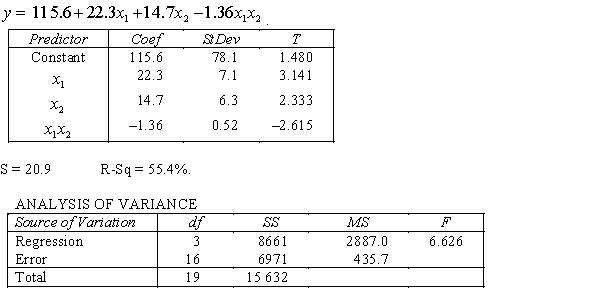
فتح الحزمة
افتح القفل للوصول البطاقات البالغ عددها 92 في هذه المجموعة.
فتح الحزمة
k this deck
66
A traffic consultant has analysed the factors that affect the number of traffic fatalities. She has come to the conclusion that two important variables are the number of cars and the number of tractor-trailer trucks. She proposed the second-order model with interaction: A traffic consultant has analysed the factors that affect the number of traffic fatalities. She has come to the conclusion that two important variables are the number of cars and the number of tractor-trailer trucks. She proposed the second-order model with interaction:     . Where: y = number of annual fatalities per shire.   = number of cars registered in the shire (in units of 10 000).   = number of trucks registered in the shire (in units of 1000). The computer output (based on a random sample of 35 shires) is shown below. THE REGRESSION EQUATION IS     .   S = 15.2 R-Sq = 47.2%. ANALYSIS OF VARIANCE   Test at the 1% significance level to determine whether the   term should be retained in the model. A traffic consultant has analysed the factors that affect the number of traffic fatalities. She has come to the conclusion that two important variables are the number of cars and the number of tractor-trailer trucks. She proposed the second-order model with interaction:     . Where: y = number of annual fatalities per shire.   = number of cars registered in the shire (in units of 10 000).   = number of trucks registered in the shire (in units of 1000). The computer output (based on a random sample of 35 shires) is shown below. THE REGRESSION EQUATION IS     .   S = 15.2 R-Sq = 47.2%. ANALYSIS OF VARIANCE   Test at the 1% significance level to determine whether the   term should be retained in the model. .

Where:
y = number of annual fatalities per shire. A traffic consultant has analysed the factors that affect the number of traffic fatalities. She has come to the conclusion that two important variables are the number of cars and the number of tractor-trailer trucks. She proposed the second-order model with interaction:     . Where: y = number of annual fatalities per shire.   = number of cars registered in the shire (in units of 10 000).   = number of trucks registered in the shire (in units of 1000). The computer output (based on a random sample of 35 shires) is shown below. THE REGRESSION EQUATION IS     .   S = 15.2 R-Sq = 47.2%. ANALYSIS OF VARIANCE   Test at the 1% significance level to determine whether the   term should be retained in the model. = number of cars registered in the shire (in units of 10 000). A traffic consultant has analysed the factors that affect the number of traffic fatalities. She has come to the conclusion that two important variables are the number of cars and the number of tractor-trailer trucks. She proposed the second-order model with interaction:     . Where: y = number of annual fatalities per shire.   = number of cars registered in the shire (in units of 10 000).   = number of trucks registered in the shire (in units of 1000). The computer output (based on a random sample of 35 shires) is shown below. THE REGRESSION EQUATION IS     .   S = 15.2 R-Sq = 47.2%. ANALYSIS OF VARIANCE   Test at the 1% significance level to determine whether the   term should be retained in the model. = number of trucks registered in the shire (in units of 1000).
The computer output (based on a random sample of 35 shires) is shown below.
THE REGRESSION EQUATION IS A traffic consultant has analysed the factors that affect the number of traffic fatalities. She has come to the conclusion that two important variables are the number of cars and the number of tractor-trailer trucks. She proposed the second-order model with interaction:     . Where: y = number of annual fatalities per shire.   = number of cars registered in the shire (in units of 10 000).   = number of trucks registered in the shire (in units of 1000). The computer output (based on a random sample of 35 shires) is shown below. THE REGRESSION EQUATION IS     .   S = 15.2 R-Sq = 47.2%. ANALYSIS OF VARIANCE   Test at the 1% significance level to determine whether the   term should be retained in the model. A traffic consultant has analysed the factors that affect the number of traffic fatalities. She has come to the conclusion that two important variables are the number of cars and the number of tractor-trailer trucks. She proposed the second-order model with interaction:     . Where: y = number of annual fatalities per shire.   = number of cars registered in the shire (in units of 10 000).   = number of trucks registered in the shire (in units of 1000). The computer output (based on a random sample of 35 shires) is shown below. THE REGRESSION EQUATION IS     .   S = 15.2 R-Sq = 47.2%. ANALYSIS OF VARIANCE   Test at the 1% significance level to determine whether the   term should be retained in the model. . A traffic consultant has analysed the factors that affect the number of traffic fatalities. She has come to the conclusion that two important variables are the number of cars and the number of tractor-trailer trucks. She proposed the second-order model with interaction:     . Where: y = number of annual fatalities per shire.   = number of cars registered in the shire (in units of 10 000).   = number of trucks registered in the shire (in units of 1000). The computer output (based on a random sample of 35 shires) is shown below. THE REGRESSION EQUATION IS     .   S = 15.2 R-Sq = 47.2%. ANALYSIS OF VARIANCE   Test at the 1% significance level to determine whether the   term should be retained in the model. S = 15.2 R-Sq = 47.2%.


ANALYSIS OF VARIANCE A traffic consultant has analysed the factors that affect the number of traffic fatalities. She has come to the conclusion that two important variables are the number of cars and the number of tractor-trailer trucks. She proposed the second-order model with interaction:     . Where: y = number of annual fatalities per shire.   = number of cars registered in the shire (in units of 10 000).   = number of trucks registered in the shire (in units of 1000). The computer output (based on a random sample of 35 shires) is shown below. THE REGRESSION EQUATION IS     .   S = 15.2 R-Sq = 47.2%. ANALYSIS OF VARIANCE   Test at the 1% significance level to determine whether the   term should be retained in the model. Test at the 1% significance level to determine whether the A traffic consultant has analysed the factors that affect the number of traffic fatalities. She has come to the conclusion that two important variables are the number of cars and the number of tractor-trailer trucks. She proposed the second-order model with interaction:     . Where: y = number of annual fatalities per shire.   = number of cars registered in the shire (in units of 10 000).   = number of trucks registered in the shire (in units of 1000). The computer output (based on a random sample of 35 shires) is shown below. THE REGRESSION EQUATION IS     .   S = 15.2 R-Sq = 47.2%. ANALYSIS OF VARIANCE   Test at the 1% significance level to determine whether the   term should be retained in the model. term should be retained in the model.
فتح الحزمة
افتح القفل للوصول البطاقات البالغ عددها 92 في هذه المجموعة.
فتح الحزمة
k this deck
67
A professor of accounting wanted to develop a multiple regression model to predict the students' grades in her fourth-year accounting course. She decides that the two most important factors are the student's grade point average (GPA) in the first three years and the student's major. She proposes the model: A professor of accounting wanted to develop a multiple regression model to predict the students' grades in her fourth-year accounting course. She decides that the two most important factors are the student's grade point average (GPA) in the first three years and the student's major. She proposes the model:   . where y = fourth-year accounting course mark (out of 100).   = GPA in first three years (range 0 to 12).   = 1 if student's major is accounting. = 0 if not.   = 1 if student's major is finance. = 0 if not. The computer output is shown below. THE REGRESSION EQUATION IS     .   S = 15.0 R-Sq = 44.2%.   Do these results allow us to conclude at the 1% significance level that on average finance majors outperform those whose majors are not accounting or finance? .

where
y
= fourth-year accounting course mark (out of 100). A professor of accounting wanted to develop a multiple regression model to predict the students' grades in her fourth-year accounting course. She decides that the two most important factors are the student's grade point average (GPA) in the first three years and the student's major. She proposes the model:   . where y = fourth-year accounting course mark (out of 100).   = GPA in first three years (range 0 to 12).   = 1 if student's major is accounting. = 0 if not.   = 1 if student's major is finance. = 0 if not. The computer output is shown below. THE REGRESSION EQUATION IS     .   S = 15.0 R-Sq = 44.2%.   Do these results allow us to conclude at the 1% significance level that on average finance majors outperform those whose majors are not accounting or finance? = GPA in first three years (range 0 to 12). A professor of accounting wanted to develop a multiple regression model to predict the students' grades in her fourth-year accounting course. She decides that the two most important factors are the student's grade point average (GPA) in the first three years and the student's major. She proposes the model:   . where y = fourth-year accounting course mark (out of 100).   = GPA in first three years (range 0 to 12).   = 1 if student's major is accounting. = 0 if not.   = 1 if student's major is finance. = 0 if not. The computer output is shown below. THE REGRESSION EQUATION IS     .   S = 15.0 R-Sq = 44.2%.   Do these results allow us to conclude at the 1% significance level that on average finance majors outperform those whose majors are not accounting or finance? = 1 if student's major is accounting.
= 0 if not. A professor of accounting wanted to develop a multiple regression model to predict the students' grades in her fourth-year accounting course. She decides that the two most important factors are the student's grade point average (GPA) in the first three years and the student's major. She proposes the model:   . where y = fourth-year accounting course mark (out of 100).   = GPA in first three years (range 0 to 12).   = 1 if student's major is accounting. = 0 if not.   = 1 if student's major is finance. = 0 if not. The computer output is shown below. THE REGRESSION EQUATION IS     .   S = 15.0 R-Sq = 44.2%.   Do these results allow us to conclude at the 1% significance level that on average finance majors outperform those whose majors are not accounting or finance? = 1 if student's major is finance.
= 0 if not.
The computer output is shown below.
THE REGRESSION EQUATION IS A professor of accounting wanted to develop a multiple regression model to predict the students' grades in her fourth-year accounting course. She decides that the two most important factors are the student's grade point average (GPA) in the first three years and the student's major. She proposes the model:   . where y = fourth-year accounting course mark (out of 100).   = GPA in first three years (range 0 to 12).   = 1 if student's major is accounting. = 0 if not.   = 1 if student's major is finance. = 0 if not. The computer output is shown below. THE REGRESSION EQUATION IS     .   S = 15.0 R-Sq = 44.2%.   Do these results allow us to conclude at the 1% significance level that on average finance majors outperform those whose majors are not accounting or finance? A professor of accounting wanted to develop a multiple regression model to predict the students' grades in her fourth-year accounting course. She decides that the two most important factors are the student's grade point average (GPA) in the first three years and the student's major. She proposes the model:   . where y = fourth-year accounting course mark (out of 100).   = GPA in first three years (range 0 to 12).   = 1 if student's major is accounting. = 0 if not.   = 1 if student's major is finance. = 0 if not. The computer output is shown below. THE REGRESSION EQUATION IS     .   S = 15.0 R-Sq = 44.2%.   Do these results allow us to conclude at the 1% significance level that on average finance majors outperform those whose majors are not accounting or finance? . A professor of accounting wanted to develop a multiple regression model to predict the students' grades in her fourth-year accounting course. She decides that the two most important factors are the student's grade point average (GPA) in the first three years and the student's major. She proposes the model:   . where y = fourth-year accounting course mark (out of 100).   = GPA in first three years (range 0 to 12).   = 1 if student's major is accounting. = 0 if not.   = 1 if student's major is finance. = 0 if not. The computer output is shown below. THE REGRESSION EQUATION IS     .   S = 15.0 R-Sq = 44.2%.   Do these results allow us to conclude at the 1% significance level that on average finance majors outperform those whose majors are not accounting or finance? S = 15.0 R-Sq = 44.2%. A professor of accounting wanted to develop a multiple regression model to predict the students' grades in her fourth-year accounting course. She decides that the two most important factors are the student's grade point average (GPA) in the first three years and the student's major. She proposes the model:   . where y = fourth-year accounting course mark (out of 100).   = GPA in first three years (range 0 to 12).   = 1 if student's major is accounting. = 0 if not.   = 1 if student's major is finance. = 0 if not. The computer output is shown below. THE REGRESSION EQUATION IS     .   S = 15.0 R-Sq = 44.2%.   Do these results allow us to conclude at the 1% significance level that on average finance majors outperform those whose majors are not accounting or finance? Do these results allow us to conclude at the 1% significance level that on average finance majors outperform those whose majors are not accounting or finance?

فتح الحزمة
افتح القفل للوصول البطاقات البالغ عددها 92 في هذه المجموعة.
فتح الحزمة
k this deck
68
A traffic consultant has analysed the factors that affect the number of traffic fatalities. She has come to the conclusion that two important variables are the number of cars and the number of tractor-trailer trucks. She proposed the second-order model with interaction: A traffic consultant has analysed the factors that affect the number of traffic fatalities. She has come to the conclusion that two important variables are the number of cars and the number of tractor-trailer trucks. She proposed the second-order model with interaction:     . Where: y = number of annual fatalities per shire.   = number of cars registered in the shire (in units of 10 000).   = number of trucks registered in the shire (in units of 1000). The computer output (based on a random sample of 35 shires) is shown below. THE REGRESSION EQUATION IS     .   S = 15.2 R-Sq = 47.2%. ANALYSIS OF VARIANCE   Test at the 1% significance level to determine whether the interaction term should be retained in the model. A traffic consultant has analysed the factors that affect the number of traffic fatalities. She has come to the conclusion that two important variables are the number of cars and the number of tractor-trailer trucks. She proposed the second-order model with interaction:     . Where: y = number of annual fatalities per shire.   = number of cars registered in the shire (in units of 10 000).   = number of trucks registered in the shire (in units of 1000). The computer output (based on a random sample of 35 shires) is shown below. THE REGRESSION EQUATION IS     .   S = 15.2 R-Sq = 47.2%. ANALYSIS OF VARIANCE   Test at the 1% significance level to determine whether the interaction term should be retained in the model. .

Where:
y = number of annual fatalities per shire. A traffic consultant has analysed the factors that affect the number of traffic fatalities. She has come to the conclusion that two important variables are the number of cars and the number of tractor-trailer trucks. She proposed the second-order model with interaction:     . Where: y = number of annual fatalities per shire.   = number of cars registered in the shire (in units of 10 000).   = number of trucks registered in the shire (in units of 1000). The computer output (based on a random sample of 35 shires) is shown below. THE REGRESSION EQUATION IS     .   S = 15.2 R-Sq = 47.2%. ANALYSIS OF VARIANCE   Test at the 1% significance level to determine whether the interaction term should be retained in the model. = number of cars registered in the shire (in units of 10 000). A traffic consultant has analysed the factors that affect the number of traffic fatalities. She has come to the conclusion that two important variables are the number of cars and the number of tractor-trailer trucks. She proposed the second-order model with interaction:     . Where: y = number of annual fatalities per shire.   = number of cars registered in the shire (in units of 10 000).   = number of trucks registered in the shire (in units of 1000). The computer output (based on a random sample of 35 shires) is shown below. THE REGRESSION EQUATION IS     .   S = 15.2 R-Sq = 47.2%. ANALYSIS OF VARIANCE   Test at the 1% significance level to determine whether the interaction term should be retained in the model. = number of trucks registered in the shire (in units of 1000).
The computer output (based on a random sample of 35 shires) is shown below.
THE REGRESSION EQUATION IS A traffic consultant has analysed the factors that affect the number of traffic fatalities. She has come to the conclusion that two important variables are the number of cars and the number of tractor-trailer trucks. She proposed the second-order model with interaction:     . Where: y = number of annual fatalities per shire.   = number of cars registered in the shire (in units of 10 000).   = number of trucks registered in the shire (in units of 1000). The computer output (based on a random sample of 35 shires) is shown below. THE REGRESSION EQUATION IS     .   S = 15.2 R-Sq = 47.2%. ANALYSIS OF VARIANCE   Test at the 1% significance level to determine whether the interaction term should be retained in the model. A traffic consultant has analysed the factors that affect the number of traffic fatalities. She has come to the conclusion that two important variables are the number of cars and the number of tractor-trailer trucks. She proposed the second-order model with interaction:     . Where: y = number of annual fatalities per shire.   = number of cars registered in the shire (in units of 10 000).   = number of trucks registered in the shire (in units of 1000). The computer output (based on a random sample of 35 shires) is shown below. THE REGRESSION EQUATION IS     .   S = 15.2 R-Sq = 47.2%. ANALYSIS OF VARIANCE   Test at the 1% significance level to determine whether the interaction term should be retained in the model. . A traffic consultant has analysed the factors that affect the number of traffic fatalities. She has come to the conclusion that two important variables are the number of cars and the number of tractor-trailer trucks. She proposed the second-order model with interaction:     . Where: y = number of annual fatalities per shire.   = number of cars registered in the shire (in units of 10 000).   = number of trucks registered in the shire (in units of 1000). The computer output (based on a random sample of 35 shires) is shown below. THE REGRESSION EQUATION IS     .   S = 15.2 R-Sq = 47.2%. ANALYSIS OF VARIANCE   Test at the 1% significance level to determine whether the interaction term should be retained in the model. S = 15.2 R-Sq = 47.2%.



ANALYSIS OF VARIANCE A traffic consultant has analysed the factors that affect the number of traffic fatalities. She has come to the conclusion that two important variables are the number of cars and the number of tractor-trailer trucks. She proposed the second-order model with interaction:     . Where: y = number of annual fatalities per shire.   = number of cars registered in the shire (in units of 10 000).   = number of trucks registered in the shire (in units of 1000). The computer output (based on a random sample of 35 shires) is shown below. THE REGRESSION EQUATION IS     .   S = 15.2 R-Sq = 47.2%. ANALYSIS OF VARIANCE   Test at the 1% significance level to determine whether the interaction term should be retained in the model. Test at the 1% significance level to determine whether the interaction term should be retained in the model.
فتح الحزمة
افتح القفل للوصول البطاقات البالغ عددها 92 في هذه المجموعة.
فتح الحزمة
k this deck
69
A traffic consultant has analysed the factors that affect the number of traffic fatalities. She has come to the conclusion that two important variables are the number of cars and the number of tractor-trailer trucks. She proposed the second-order model with interaction: A traffic consultant has analysed the factors that affect the number of traffic fatalities. She has come to the conclusion that two important variables are the number of cars and the number of tractor-trailer trucks. She proposed the second-order model with interaction:     . Where: y = number of annual fatalities per shire.   = number of cars registered in the shire (in units of 10 000).   = number of trucks registered in the shire (in units of 1000). The computer output (based on a random sample of 35 shires) is shown below. THE REGRESSION EQUATION IS     .   S = 15.2 R-Sq = 47.2%. ANALYSIS OF VARIANCE   What is the multiple coefficient of determination? What does this statistic tell you about the model? A traffic consultant has analysed the factors that affect the number of traffic fatalities. She has come to the conclusion that two important variables are the number of cars and the number of tractor-trailer trucks. She proposed the second-order model with interaction:     . Where: y = number of annual fatalities per shire.   = number of cars registered in the shire (in units of 10 000).   = number of trucks registered in the shire (in units of 1000). The computer output (based on a random sample of 35 shires) is shown below. THE REGRESSION EQUATION IS     .   S = 15.2 R-Sq = 47.2%. ANALYSIS OF VARIANCE   What is the multiple coefficient of determination? What does this statistic tell you about the model? .
Where:
y = number of annual fatalities per shire. A traffic consultant has analysed the factors that affect the number of traffic fatalities. She has come to the conclusion that two important variables are the number of cars and the number of tractor-trailer trucks. She proposed the second-order model with interaction:     . Where: y = number of annual fatalities per shire.   = number of cars registered in the shire (in units of 10 000).   = number of trucks registered in the shire (in units of 1000). The computer output (based on a random sample of 35 shires) is shown below. THE REGRESSION EQUATION IS     .   S = 15.2 R-Sq = 47.2%. ANALYSIS OF VARIANCE   What is the multiple coefficient of determination? What does this statistic tell you about the model? = number of cars registered in the shire (in units of 10 000). A traffic consultant has analysed the factors that affect the number of traffic fatalities. She has come to the conclusion that two important variables are the number of cars and the number of tractor-trailer trucks. She proposed the second-order model with interaction:     . Where: y = number of annual fatalities per shire.   = number of cars registered in the shire (in units of 10 000).   = number of trucks registered in the shire (in units of 1000). The computer output (based on a random sample of 35 shires) is shown below. THE REGRESSION EQUATION IS     .   S = 15.2 R-Sq = 47.2%. ANALYSIS OF VARIANCE   What is the multiple coefficient of determination? What does this statistic tell you about the model? = number of trucks registered in the shire (in units of 1000).
The computer output (based on a random sample of 35 shires) is shown below.
THE REGRESSION EQUATION IS A traffic consultant has analysed the factors that affect the number of traffic fatalities. She has come to the conclusion that two important variables are the number of cars and the number of tractor-trailer trucks. She proposed the second-order model with interaction:     . Where: y = number of annual fatalities per shire.   = number of cars registered in the shire (in units of 10 000).   = number of trucks registered in the shire (in units of 1000). The computer output (based on a random sample of 35 shires) is shown below. THE REGRESSION EQUATION IS     .   S = 15.2 R-Sq = 47.2%. ANALYSIS OF VARIANCE   What is the multiple coefficient of determination? What does this statistic tell you about the model? A traffic consultant has analysed the factors that affect the number of traffic fatalities. She has come to the conclusion that two important variables are the number of cars and the number of tractor-trailer trucks. She proposed the second-order model with interaction:     . Where: y = number of annual fatalities per shire.   = number of cars registered in the shire (in units of 10 000).   = number of trucks registered in the shire (in units of 1000). The computer output (based on a random sample of 35 shires) is shown below. THE REGRESSION EQUATION IS     .   S = 15.2 R-Sq = 47.2%. ANALYSIS OF VARIANCE   What is the multiple coefficient of determination? What does this statistic tell you about the model? . A traffic consultant has analysed the factors that affect the number of traffic fatalities. She has come to the conclusion that two important variables are the number of cars and the number of tractor-trailer trucks. She proposed the second-order model with interaction:     . Where: y = number of annual fatalities per shire.   = number of cars registered in the shire (in units of 10 000).   = number of trucks registered in the shire (in units of 1000). The computer output (based on a random sample of 35 shires) is shown below. THE REGRESSION EQUATION IS     .   S = 15.2 R-Sq = 47.2%. ANALYSIS OF VARIANCE   What is the multiple coefficient of determination? What does this statistic tell you about the model? S = 15.2 R-Sq = 47.2%.


ANALYSIS OF VARIANCE A traffic consultant has analysed the factors that affect the number of traffic fatalities. She has come to the conclusion that two important variables are the number of cars and the number of tractor-trailer trucks. She proposed the second-order model with interaction:     . Where: y = number of annual fatalities per shire.   = number of cars registered in the shire (in units of 10 000).   = number of trucks registered in the shire (in units of 1000). The computer output (based on a random sample of 35 shires) is shown below. THE REGRESSION EQUATION IS     .   S = 15.2 R-Sq = 47.2%. ANALYSIS OF VARIANCE   What is the multiple coefficient of determination? What does this statistic tell you about the model? What is the multiple coefficient of determination? What does this statistic tell you about the model?
فتح الحزمة
افتح القفل للوصول البطاقات البالغ عددها 92 في هذه المجموعة.
فتح الحزمة
k this deck
70
An economist is in the process of developing a model to predict the price of gold. She believes that the two most important variables are the price of a barrel of oil An economist is in the process of developing a model to predict the price of gold. She believes that the two most important variables are the price of a barrel of oil   and the interest rate   She proposes the first-order model with interaction:   . A random sample of 20 daily observations was taken. The computer output is shown below. THE REGRESSION EQUATION IS   Is there sufficient evidence at the 1% significance level to conclude that the interest rate and the price of gold are linearly related? and the interest rate An economist is in the process of developing a model to predict the price of gold. She believes that the two most important variables are the price of a barrel of oil   and the interest rate   She proposes the first-order model with interaction:   . A random sample of 20 daily observations was taken. The computer output is shown below. THE REGRESSION EQUATION IS   Is there sufficient evidence at the 1% significance level to conclude that the interest rate and the price of gold are linearly related? She proposes the first-order model with interaction: An economist is in the process of developing a model to predict the price of gold. She believes that the two most important variables are the price of a barrel of oil   and the interest rate   She proposes the first-order model with interaction:   . A random sample of 20 daily observations was taken. The computer output is shown below. THE REGRESSION EQUATION IS   Is there sufficient evidence at the 1% significance level to conclude that the interest rate and the price of gold are linearly related? .

A random sample of 20 daily observations was taken. The computer output is shown below.
THE REGRESSION EQUATION IS An economist is in the process of developing a model to predict the price of gold. She believes that the two most important variables are the price of a barrel of oil   and the interest rate   She proposes the first-order model with interaction:   . A random sample of 20 daily observations was taken. The computer output is shown below. THE REGRESSION EQUATION IS   Is there sufficient evidence at the 1% significance level to conclude that the interest rate and the price of gold are linearly related? Is there sufficient evidence at the 1% significance level to conclude that the interest rate and the price of gold are linearly related?
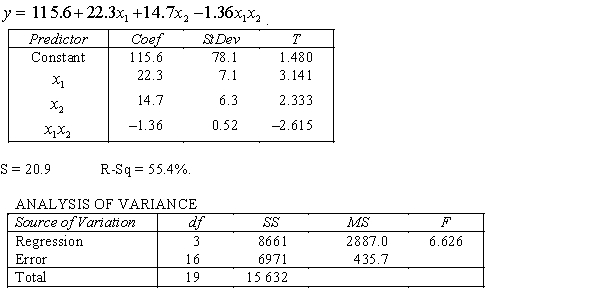
فتح الحزمة
افتح القفل للوصول البطاقات البالغ عددها 92 في هذه المجموعة.
فتح الحزمة
k this deck
71
A traffic consultant has analysed the factors that affect the number of traffic fatalities. She has come to the conclusion that two important variables are the number of cars and the number of tractor-trailer trucks. She proposed the second-order model with interaction: A traffic consultant has analysed the factors that affect the number of traffic fatalities. She has come to the conclusion that two important variables are the number of cars and the number of tractor-trailer trucks. She proposed the second-order model with interaction:     . Where: y = number of annual fatalities per shire.   = number of cars registered in the shire (in units of 10 000).   = number of trucks registered in the shire (in units of 1000). The computer output (based on a random sample of 35 shires) is shown below. THE REGRESSION EQUATION IS     .   S = 15.2 R-Sq = 47.2%. ANALYSIS OF VARIANCE   What does the coefficient of   tell you about the model? A traffic consultant has analysed the factors that affect the number of traffic fatalities. She has come to the conclusion that two important variables are the number of cars and the number of tractor-trailer trucks. She proposed the second-order model with interaction:     . Where: y = number of annual fatalities per shire.   = number of cars registered in the shire (in units of 10 000).   = number of trucks registered in the shire (in units of 1000). The computer output (based on a random sample of 35 shires) is shown below. THE REGRESSION EQUATION IS     .   S = 15.2 R-Sq = 47.2%. ANALYSIS OF VARIANCE   What does the coefficient of   tell you about the model? .

Where:
y = number of annual fatalities per shire. A traffic consultant has analysed the factors that affect the number of traffic fatalities. She has come to the conclusion that two important variables are the number of cars and the number of tractor-trailer trucks. She proposed the second-order model with interaction:     . Where: y = number of annual fatalities per shire.   = number of cars registered in the shire (in units of 10 000).   = number of trucks registered in the shire (in units of 1000). The computer output (based on a random sample of 35 shires) is shown below. THE REGRESSION EQUATION IS     .   S = 15.2 R-Sq = 47.2%. ANALYSIS OF VARIANCE   What does the coefficient of   tell you about the model? = number of cars registered in the shire (in units of 10 000). A traffic consultant has analysed the factors that affect the number of traffic fatalities. She has come to the conclusion that two important variables are the number of cars and the number of tractor-trailer trucks. She proposed the second-order model with interaction:     . Where: y = number of annual fatalities per shire.   = number of cars registered in the shire (in units of 10 000).   = number of trucks registered in the shire (in units of 1000). The computer output (based on a random sample of 35 shires) is shown below. THE REGRESSION EQUATION IS     .   S = 15.2 R-Sq = 47.2%. ANALYSIS OF VARIANCE   What does the coefficient of   tell you about the model? = number of trucks registered in the shire (in units of 1000).
The computer output (based on a random sample of 35 shires) is shown below.
THE REGRESSION EQUATION IS A traffic consultant has analysed the factors that affect the number of traffic fatalities. She has come to the conclusion that two important variables are the number of cars and the number of tractor-trailer trucks. She proposed the second-order model with interaction:     . Where: y = number of annual fatalities per shire.   = number of cars registered in the shire (in units of 10 000).   = number of trucks registered in the shire (in units of 1000). The computer output (based on a random sample of 35 shires) is shown below. THE REGRESSION EQUATION IS     .   S = 15.2 R-Sq = 47.2%. ANALYSIS OF VARIANCE   What does the coefficient of   tell you about the model? A traffic consultant has analysed the factors that affect the number of traffic fatalities. She has come to the conclusion that two important variables are the number of cars and the number of tractor-trailer trucks. She proposed the second-order model with interaction:     . Where: y = number of annual fatalities per shire.   = number of cars registered in the shire (in units of 10 000).   = number of trucks registered in the shire (in units of 1000). The computer output (based on a random sample of 35 shires) is shown below. THE REGRESSION EQUATION IS     .   S = 15.2 R-Sq = 47.2%. ANALYSIS OF VARIANCE   What does the coefficient of   tell you about the model? . A traffic consultant has analysed the factors that affect the number of traffic fatalities. She has come to the conclusion that two important variables are the number of cars and the number of tractor-trailer trucks. She proposed the second-order model with interaction:     . Where: y = number of annual fatalities per shire.   = number of cars registered in the shire (in units of 10 000).   = number of trucks registered in the shire (in units of 1000). The computer output (based on a random sample of 35 shires) is shown below. THE REGRESSION EQUATION IS     .   S = 15.2 R-Sq = 47.2%. ANALYSIS OF VARIANCE   What does the coefficient of   tell you about the model? S = 15.2 R-Sq = 47.2%.


ANALYSIS OF VARIANCE A traffic consultant has analysed the factors that affect the number of traffic fatalities. She has come to the conclusion that two important variables are the number of cars and the number of tractor-trailer trucks. She proposed the second-order model with interaction:     . Where: y = number of annual fatalities per shire.   = number of cars registered in the shire (in units of 10 000).   = number of trucks registered in the shire (in units of 1000). The computer output (based on a random sample of 35 shires) is shown below. THE REGRESSION EQUATION IS     .   S = 15.2 R-Sq = 47.2%. ANALYSIS OF VARIANCE   What does the coefficient of   tell you about the model? What does the coefficient of A traffic consultant has analysed the factors that affect the number of traffic fatalities. She has come to the conclusion that two important variables are the number of cars and the number of tractor-trailer trucks. She proposed the second-order model with interaction:     . Where: y = number of annual fatalities per shire.   = number of cars registered in the shire (in units of 10 000).   = number of trucks registered in the shire (in units of 1000). The computer output (based on a random sample of 35 shires) is shown below. THE REGRESSION EQUATION IS     .   S = 15.2 R-Sq = 47.2%. ANALYSIS OF VARIANCE   What does the coefficient of   tell you about the model? tell you about the model?
فتح الحزمة
افتح القفل للوصول البطاقات البالغ عددها 92 في هذه المجموعة.
فتح الحزمة
k this deck
72
An economist is analysing the incomes of professionals (physicians, dentists and lawyers). He realises that an important factor is the number of years of experience. However, he wants to know if there are differences among the three professional groups. He takes a random sample of 125 professionals and estimates the multiple regression model: An economist is analysing the incomes of professionals (physicians, dentists and lawyers). He realises that an important factor is the number of years of experience. However, he wants to know if there are differences among the three professional groups. He takes a random sample of 125 professionals and estimates the multiple regression model:   . where y = annual income (in $1000).   = years of experience.   = 1 if physician. = 0 if not.   = 1 if dentist. = 0 if not. The computer output is shown below. THE REGRESSION EQUATION IS     .   S = 42.6 R-Sq = 30.9%.   Is there enough evidence at the1% significant level to conclude that physicians earn more on average than lawyers? .


where
y
= annual income (in $1000). An economist is analysing the incomes of professionals (physicians, dentists and lawyers). He realises that an important factor is the number of years of experience. However, he wants to know if there are differences among the three professional groups. He takes a random sample of 125 professionals and estimates the multiple regression model:   . where y = annual income (in $1000).   = years of experience.   = 1 if physician. = 0 if not.   = 1 if dentist. = 0 if not. The computer output is shown below. THE REGRESSION EQUATION IS     .   S = 42.6 R-Sq = 30.9%.   Is there enough evidence at the1% significant level to conclude that physicians earn more on average than lawyers? = years of experience. An economist is analysing the incomes of professionals (physicians, dentists and lawyers). He realises that an important factor is the number of years of experience. However, he wants to know if there are differences among the three professional groups. He takes a random sample of 125 professionals and estimates the multiple regression model:   . where y = annual income (in $1000).   = years of experience.   = 1 if physician. = 0 if not.   = 1 if dentist. = 0 if not. The computer output is shown below. THE REGRESSION EQUATION IS     .   S = 42.6 R-Sq = 30.9%.   Is there enough evidence at the1% significant level to conclude that physicians earn more on average than lawyers? = 1 if physician.
= 0 if not. An economist is analysing the incomes of professionals (physicians, dentists and lawyers). He realises that an important factor is the number of years of experience. However, he wants to know if there are differences among the three professional groups. He takes a random sample of 125 professionals and estimates the multiple regression model:   . where y = annual income (in $1000).   = years of experience.   = 1 if physician. = 0 if not.   = 1 if dentist. = 0 if not. The computer output is shown below. THE REGRESSION EQUATION IS     .   S = 42.6 R-Sq = 30.9%.   Is there enough evidence at the1% significant level to conclude that physicians earn more on average than lawyers? = 1 if dentist.
= 0 if not.
The computer output is shown below.
THE REGRESSION EQUATION IS An economist is analysing the incomes of professionals (physicians, dentists and lawyers). He realises that an important factor is the number of years of experience. However, he wants to know if there are differences among the three professional groups. He takes a random sample of 125 professionals and estimates the multiple regression model:   . where y = annual income (in $1000).   = years of experience.   = 1 if physician. = 0 if not.   = 1 if dentist. = 0 if not. The computer output is shown below. THE REGRESSION EQUATION IS     .   S = 42.6 R-Sq = 30.9%.   Is there enough evidence at the1% significant level to conclude that physicians earn more on average than lawyers? An economist is analysing the incomes of professionals (physicians, dentists and lawyers). He realises that an important factor is the number of years of experience. However, he wants to know if there are differences among the three professional groups. He takes a random sample of 125 professionals and estimates the multiple regression model:   . where y = annual income (in $1000).   = years of experience.   = 1 if physician. = 0 if not.   = 1 if dentist. = 0 if not. The computer output is shown below. THE REGRESSION EQUATION IS     .   S = 42.6 R-Sq = 30.9%.   Is there enough evidence at the1% significant level to conclude that physicians earn more on average than lawyers? . An economist is analysing the incomes of professionals (physicians, dentists and lawyers). He realises that an important factor is the number of years of experience. However, he wants to know if there are differences among the three professional groups. He takes a random sample of 125 professionals and estimates the multiple regression model:   . where y = annual income (in $1000).   = years of experience.   = 1 if physician. = 0 if not.   = 1 if dentist. = 0 if not. The computer output is shown below. THE REGRESSION EQUATION IS     .   S = 42.6 R-Sq = 30.9%.   Is there enough evidence at the1% significant level to conclude that physicians earn more on average than lawyers? S = 42.6 R-Sq = 30.9%. An economist is analysing the incomes of professionals (physicians, dentists and lawyers). He realises that an important factor is the number of years of experience. However, he wants to know if there are differences among the three professional groups. He takes a random sample of 125 professionals and estimates the multiple regression model:   . where y = annual income (in $1000).   = years of experience.   = 1 if physician. = 0 if not.   = 1 if dentist. = 0 if not. The computer output is shown below. THE REGRESSION EQUATION IS     .   S = 42.6 R-Sq = 30.9%.   Is there enough evidence at the1% significant level to conclude that physicians earn more on average than lawyers? Is there enough evidence at the1% significant level to conclude that physicians earn more on average than lawyers?
فتح الحزمة
افتح القفل للوصول البطاقات البالغ عددها 92 في هذه المجموعة.
فتح الحزمة
k this deck
73
An economist is in the process of developing a model to predict the price of gold. She believes that the two most important variables are the price of a barrel of oil An economist is in the process of developing a model to predict the price of gold. She believes that the two most important variables are the price of a barrel of oil   and the interest rate   She proposes the first-order model with interaction:   . A random sample of 20 daily observations was taken. The computer output is shown below. THE REGRESSION EQUATION IS     .   S = 20.9 R-Sq = 55.4%.   Interpret the coefficient   . and the interest rate An economist is in the process of developing a model to predict the price of gold. She believes that the two most important variables are the price of a barrel of oil   and the interest rate   She proposes the first-order model with interaction:   . A random sample of 20 daily observations was taken. The computer output is shown below. THE REGRESSION EQUATION IS     .   S = 20.9 R-Sq = 55.4%.   Interpret the coefficient   . She proposes the first-order model with interaction: An economist is in the process of developing a model to predict the price of gold. She believes that the two most important variables are the price of a barrel of oil   and the interest rate   She proposes the first-order model with interaction:   . A random sample of 20 daily observations was taken. The computer output is shown below. THE REGRESSION EQUATION IS     .   S = 20.9 R-Sq = 55.4%.   Interpret the coefficient   . .

A random sample of 20 daily observations was taken. The computer output is shown below.
THE REGRESSION EQUATION IS An economist is in the process of developing a model to predict the price of gold. She believes that the two most important variables are the price of a barrel of oil   and the interest rate   She proposes the first-order model with interaction:   . A random sample of 20 daily observations was taken. The computer output is shown below. THE REGRESSION EQUATION IS     .   S = 20.9 R-Sq = 55.4%.   Interpret the coefficient   . An economist is in the process of developing a model to predict the price of gold. She believes that the two most important variables are the price of a barrel of oil   and the interest rate   She proposes the first-order model with interaction:   . A random sample of 20 daily observations was taken. The computer output is shown below. THE REGRESSION EQUATION IS     .   S = 20.9 R-Sq = 55.4%.   Interpret the coefficient   . . An economist is in the process of developing a model to predict the price of gold. She believes that the two most important variables are the price of a barrel of oil   and the interest rate   She proposes the first-order model with interaction:   . A random sample of 20 daily observations was taken. The computer output is shown below. THE REGRESSION EQUATION IS     .   S = 20.9 R-Sq = 55.4%.   Interpret the coefficient   . S = 20.9 R-Sq = 55.4%. An economist is in the process of developing a model to predict the price of gold. She believes that the two most important variables are the price of a barrel of oil   and the interest rate   She proposes the first-order model with interaction:   . A random sample of 20 daily observations was taken. The computer output is shown below. THE REGRESSION EQUATION IS     .   S = 20.9 R-Sq = 55.4%.   Interpret the coefficient   . Interpret the coefficient An economist is in the process of developing a model to predict the price of gold. She believes that the two most important variables are the price of a barrel of oil   and the interest rate   She proposes the first-order model with interaction:   . A random sample of 20 daily observations was taken. The computer output is shown below. THE REGRESSION EQUATION IS     .   S = 20.9 R-Sq = 55.4%.   Interpret the coefficient   . .


فتح الحزمة
افتح القفل للوصول البطاقات البالغ عددها 92 في هذه المجموعة.
فتح الحزمة
k this deck
74
An economist is in the process of developing a model to predict the price of gold. She believes that the two most important variables are the price of a barrel of oil An economist is in the process of developing a model to predict the price of gold. She believes that the two most important variables are the price of a barrel of oil   and the interest rate   She proposes the first-order model with interaction:   . A random sample of 20 daily observations was taken. The computer output is shown below. THE REGRESSION EQUATION IS     .   S = 20.9 R-Sq = 55.4%.   Do these results allow us at the 5% significance level to conclude that the model is useful in predicting the price of gold? and the interest rate An economist is in the process of developing a model to predict the price of gold. She believes that the two most important variables are the price of a barrel of oil   and the interest rate   She proposes the first-order model with interaction:   . A random sample of 20 daily observations was taken. The computer output is shown below. THE REGRESSION EQUATION IS     .   S = 20.9 R-Sq = 55.4%.   Do these results allow us at the 5% significance level to conclude that the model is useful in predicting the price of gold? She proposes the first-order model with interaction: An economist is in the process of developing a model to predict the price of gold. She believes that the two most important variables are the price of a barrel of oil   and the interest rate   She proposes the first-order model with interaction:   . A random sample of 20 daily observations was taken. The computer output is shown below. THE REGRESSION EQUATION IS     .   S = 20.9 R-Sq = 55.4%.   Do these results allow us at the 5% significance level to conclude that the model is useful in predicting the price of gold? .
A random sample of 20 daily observations was taken. The computer output is shown below.
THE REGRESSION EQUATION IS An economist is in the process of developing a model to predict the price of gold. She believes that the two most important variables are the price of a barrel of oil   and the interest rate   She proposes the first-order model with interaction:   . A random sample of 20 daily observations was taken. The computer output is shown below. THE REGRESSION EQUATION IS     .   S = 20.9 R-Sq = 55.4%.   Do these results allow us at the 5% significance level to conclude that the model is useful in predicting the price of gold? An economist is in the process of developing a model to predict the price of gold. She believes that the two most important variables are the price of a barrel of oil   and the interest rate   She proposes the first-order model with interaction:   . A random sample of 20 daily observations was taken. The computer output is shown below. THE REGRESSION EQUATION IS     .   S = 20.9 R-Sq = 55.4%.   Do these results allow us at the 5% significance level to conclude that the model is useful in predicting the price of gold? . An economist is in the process of developing a model to predict the price of gold. She believes that the two most important variables are the price of a barrel of oil   and the interest rate   She proposes the first-order model with interaction:   . A random sample of 20 daily observations was taken. The computer output is shown below. THE REGRESSION EQUATION IS     .   S = 20.9 R-Sq = 55.4%.   Do these results allow us at the 5% significance level to conclude that the model is useful in predicting the price of gold? S = 20.9 R-Sq = 55.4%. An economist is in the process of developing a model to predict the price of gold. She believes that the two most important variables are the price of a barrel of oil   and the interest rate   She proposes the first-order model with interaction:   . A random sample of 20 daily observations was taken. The computer output is shown below. THE REGRESSION EQUATION IS     .   S = 20.9 R-Sq = 55.4%.   Do these results allow us at the 5% significance level to conclude that the model is useful in predicting the price of gold? Do these results allow us at the 5% significance level to conclude that the model is useful in predicting the price of gold?


فتح الحزمة
افتح القفل للوصول البطاقات البالغ عددها 92 في هذه المجموعة.
فتح الحزمة
k this deck
75
An economist is in the process of developing a model to predict the price of gold. She believes that the two most important variables are the price of a barrel of oil An economist is in the process of developing a model to predict the price of gold. She believes that the two most important variables are the price of a barrel of oil   and the interest rate   She proposes the first-order model with interaction:   .   Is there sufficient evidence at the 1% significance level to conclude that the interaction term should be retained? and the interest rate An economist is in the process of developing a model to predict the price of gold. She believes that the two most important variables are the price of a barrel of oil   and the interest rate   She proposes the first-order model with interaction:   .   Is there sufficient evidence at the 1% significance level to conclude that the interaction term should be retained? She proposes the first-order model with interaction: An economist is in the process of developing a model to predict the price of gold. She believes that the two most important variables are the price of a barrel of oil   and the interest rate   She proposes the first-order model with interaction:   .   Is there sufficient evidence at the 1% significance level to conclude that the interaction term should be retained? . An economist is in the process of developing a model to predict the price of gold. She believes that the two most important variables are the price of a barrel of oil   and the interest rate   She proposes the first-order model with interaction:   .   Is there sufficient evidence at the 1% significance level to conclude that the interaction term should be retained? Is there sufficient evidence at the 1% significance level to conclude that the interaction term should be retained?
فتح الحزمة
افتح القفل للوصول البطاقات البالغ عددها 92 في هذه المجموعة.
فتح الحزمة
k this deck
76
An economist is analysing the incomes of professionals (physicians, dentists and lawyers). He realises that an important factor is the number of years of experience. However, he wants to know if there are differences among the three professional groups. He takes a random sample of 125 professionals and estimates the multiple regression model: An economist is analysing the incomes of professionals (physicians, dentists and lawyers). He realises that an important factor is the number of years of experience. However, he wants to know if there are differences among the three professional groups. He takes a random sample of 125 professionals and estimates the multiple regression model:   . where y = annual income (in $1000).   = years of experience.   = 1 if physician. = 0 if not.   = 1 if dentist. = 0 if not. The computer output is shown below. THE REGRESSION EQUATION IS     .   S = 42.6 R-Sq = 30.9%.   Do these results allow us to conclude at the 1% significance level that the model is useful in predicting the income of professionals? .


where
y
= annual income (in $1000). An economist is analysing the incomes of professionals (physicians, dentists and lawyers). He realises that an important factor is the number of years of experience. However, he wants to know if there are differences among the three professional groups. He takes a random sample of 125 professionals and estimates the multiple regression model:   . where y = annual income (in $1000).   = years of experience.   = 1 if physician. = 0 if not.   = 1 if dentist. = 0 if not. The computer output is shown below. THE REGRESSION EQUATION IS     .   S = 42.6 R-Sq = 30.9%.   Do these results allow us to conclude at the 1% significance level that the model is useful in predicting the income of professionals? = years of experience. An economist is analysing the incomes of professionals (physicians, dentists and lawyers). He realises that an important factor is the number of years of experience. However, he wants to know if there are differences among the three professional groups. He takes a random sample of 125 professionals and estimates the multiple regression model:   . where y = annual income (in $1000).   = years of experience.   = 1 if physician. = 0 if not.   = 1 if dentist. = 0 if not. The computer output is shown below. THE REGRESSION EQUATION IS     .   S = 42.6 R-Sq = 30.9%.   Do these results allow us to conclude at the 1% significance level that the model is useful in predicting the income of professionals? = 1 if physician.
= 0 if not. An economist is analysing the incomes of professionals (physicians, dentists and lawyers). He realises that an important factor is the number of years of experience. However, he wants to know if there are differences among the three professional groups. He takes a random sample of 125 professionals and estimates the multiple regression model:   . where y = annual income (in $1000).   = years of experience.   = 1 if physician. = 0 if not.   = 1 if dentist. = 0 if not. The computer output is shown below. THE REGRESSION EQUATION IS     .   S = 42.6 R-Sq = 30.9%.   Do these results allow us to conclude at the 1% significance level that the model is useful in predicting the income of professionals? = 1 if dentist.
= 0 if not.
The computer output is shown below.
THE REGRESSION EQUATION IS An economist is analysing the incomes of professionals (physicians, dentists and lawyers). He realises that an important factor is the number of years of experience. However, he wants to know if there are differences among the three professional groups. He takes a random sample of 125 professionals and estimates the multiple regression model:   . where y = annual income (in $1000).   = years of experience.   = 1 if physician. = 0 if not.   = 1 if dentist. = 0 if not. The computer output is shown below. THE REGRESSION EQUATION IS     .   S = 42.6 R-Sq = 30.9%.   Do these results allow us to conclude at the 1% significance level that the model is useful in predicting the income of professionals? An economist is analysing the incomes of professionals (physicians, dentists and lawyers). He realises that an important factor is the number of years of experience. However, he wants to know if there are differences among the three professional groups. He takes a random sample of 125 professionals and estimates the multiple regression model:   . where y = annual income (in $1000).   = years of experience.   = 1 if physician. = 0 if not.   = 1 if dentist. = 0 if not. The computer output is shown below. THE REGRESSION EQUATION IS     .   S = 42.6 R-Sq = 30.9%.   Do these results allow us to conclude at the 1% significance level that the model is useful in predicting the income of professionals? . An economist is analysing the incomes of professionals (physicians, dentists and lawyers). He realises that an important factor is the number of years of experience. However, he wants to know if there are differences among the three professional groups. He takes a random sample of 125 professionals and estimates the multiple regression model:   . where y = annual income (in $1000).   = years of experience.   = 1 if physician. = 0 if not.   = 1 if dentist. = 0 if not. The computer output is shown below. THE REGRESSION EQUATION IS     .   S = 42.6 R-Sq = 30.9%.   Do these results allow us to conclude at the 1% significance level that the model is useful in predicting the income of professionals? S = 42.6 R-Sq = 30.9%. An economist is analysing the incomes of professionals (physicians, dentists and lawyers). He realises that an important factor is the number of years of experience. However, he wants to know if there are differences among the three professional groups. He takes a random sample of 125 professionals and estimates the multiple regression model:   . where y = annual income (in $1000).   = years of experience.   = 1 if physician. = 0 if not.   = 1 if dentist. = 0 if not. The computer output is shown below. THE REGRESSION EQUATION IS     .   S = 42.6 R-Sq = 30.9%.   Do these results allow us to conclude at the 1% significance level that the model is useful in predicting the income of professionals? Do these results allow us to conclude at the 1% significance level that the model is useful in predicting the income of professionals?
فتح الحزمة
افتح القفل للوصول البطاقات البالغ عددها 92 في هذه المجموعة.
فتح الحزمة
k this deck
77
A professor of accounting wanted to develop a multiple regression model to predict the students' grades in her fourth-year accounting course. She decides that the two most important factors are the student's grade point average (GPA) in the first three years and the student's major. She proposes the model: A professor of accounting wanted to develop a multiple regression model to predict the students' grades in her fourth-year accounting course. She decides that the two most important factors are the student's grade point average (GPA) in the first three years and the student's major. She proposes the model:   . where y = fourth-year accounting course mark (out of 100).   = GPA in first three years (range 0 to 12).   = 1 if student's major is accounting. = 0 if not.   = 1 if student's major is finance. = 0 if not. The computer output is shown below. THE REGRESSION EQUATION IS     .   S = 15.0 R-Sq = 44.2%.   Do these results allow us to conclude at the 1% significance level that on average accounting majors outperform those whose majors are not accounting or finance? .

where
y
= fourth-year accounting course mark (out of 100). A professor of accounting wanted to develop a multiple regression model to predict the students' grades in her fourth-year accounting course. She decides that the two most important factors are the student's grade point average (GPA) in the first three years and the student's major. She proposes the model:   . where y = fourth-year accounting course mark (out of 100).   = GPA in first three years (range 0 to 12).   = 1 if student's major is accounting. = 0 if not.   = 1 if student's major is finance. = 0 if not. The computer output is shown below. THE REGRESSION EQUATION IS     .   S = 15.0 R-Sq = 44.2%.   Do these results allow us to conclude at the 1% significance level that on average accounting majors outperform those whose majors are not accounting or finance? = GPA in first three years (range 0 to 12). A professor of accounting wanted to develop a multiple regression model to predict the students' grades in her fourth-year accounting course. She decides that the two most important factors are the student's grade point average (GPA) in the first three years and the student's major. She proposes the model:   . where y = fourth-year accounting course mark (out of 100).   = GPA in first three years (range 0 to 12).   = 1 if student's major is accounting. = 0 if not.   = 1 if student's major is finance. = 0 if not. The computer output is shown below. THE REGRESSION EQUATION IS     .   S = 15.0 R-Sq = 44.2%.   Do these results allow us to conclude at the 1% significance level that on average accounting majors outperform those whose majors are not accounting or finance? = 1 if student's major is accounting.
= 0 if not. A professor of accounting wanted to develop a multiple regression model to predict the students' grades in her fourth-year accounting course. She decides that the two most important factors are the student's grade point average (GPA) in the first three years and the student's major. She proposes the model:   . where y = fourth-year accounting course mark (out of 100).   = GPA in first three years (range 0 to 12).   = 1 if student's major is accounting. = 0 if not.   = 1 if student's major is finance. = 0 if not. The computer output is shown below. THE REGRESSION EQUATION IS     .   S = 15.0 R-Sq = 44.2%.   Do these results allow us to conclude at the 1% significance level that on average accounting majors outperform those whose majors are not accounting or finance? = 1 if student's major is finance.
= 0 if not.
The computer output is shown below.
THE REGRESSION EQUATION IS A professor of accounting wanted to develop a multiple regression model to predict the students' grades in her fourth-year accounting course. She decides that the two most important factors are the student's grade point average (GPA) in the first three years and the student's major. She proposes the model:   . where y = fourth-year accounting course mark (out of 100).   = GPA in first three years (range 0 to 12).   = 1 if student's major is accounting. = 0 if not.   = 1 if student's major is finance. = 0 if not. The computer output is shown below. THE REGRESSION EQUATION IS     .   S = 15.0 R-Sq = 44.2%.   Do these results allow us to conclude at the 1% significance level that on average accounting majors outperform those whose majors are not accounting or finance? A professor of accounting wanted to develop a multiple regression model to predict the students' grades in her fourth-year accounting course. She decides that the two most important factors are the student's grade point average (GPA) in the first three years and the student's major. She proposes the model:   . where y = fourth-year accounting course mark (out of 100).   = GPA in first three years (range 0 to 12).   = 1 if student's major is accounting. = 0 if not.   = 1 if student's major is finance. = 0 if not. The computer output is shown below. THE REGRESSION EQUATION IS     .   S = 15.0 R-Sq = 44.2%.   Do these results allow us to conclude at the 1% significance level that on average accounting majors outperform those whose majors are not accounting or finance? . A professor of accounting wanted to develop a multiple regression model to predict the students' grades in her fourth-year accounting course. She decides that the two most important factors are the student's grade point average (GPA) in the first three years and the student's major. She proposes the model:   . where y = fourth-year accounting course mark (out of 100).   = GPA in first three years (range 0 to 12).   = 1 if student's major is accounting. = 0 if not.   = 1 if student's major is finance. = 0 if not. The computer output is shown below. THE REGRESSION EQUATION IS     .   S = 15.0 R-Sq = 44.2%.   Do these results allow us to conclude at the 1% significance level that on average accounting majors outperform those whose majors are not accounting or finance? S = 15.0 R-Sq = 44.2%. A professor of accounting wanted to develop a multiple regression model to predict the students' grades in her fourth-year accounting course. She decides that the two most important factors are the student's grade point average (GPA) in the first three years and the student's major. She proposes the model:   . where y = fourth-year accounting course mark (out of 100).   = GPA in first three years (range 0 to 12).   = 1 if student's major is accounting. = 0 if not.   = 1 if student's major is finance. = 0 if not. The computer output is shown below. THE REGRESSION EQUATION IS     .   S = 15.0 R-Sq = 44.2%.   Do these results allow us to conclude at the 1% significance level that on average accounting majors outperform those whose majors are not accounting or finance? Do these results allow us to conclude at the 1% significance level that on average accounting majors outperform those whose majors are not accounting or finance?

فتح الحزمة
افتح القفل للوصول البطاقات البالغ عددها 92 في هذه المجموعة.
فتح الحزمة
k this deck
78
An economist is analysing the incomes of professionals (physicians, dentists and lawyers). He realises that an important factor is the number of years of experience. However, he wants to know if there are differences among the three professional groups. He takes a random sample of 125 professionals and estimates the multiple regression model: An economist is analysing the incomes of professionals (physicians, dentists and lawyers). He realises that an important factor is the number of years of experience. However, he wants to know if there are differences among the three professional groups. He takes a random sample of 125 professionals and estimates the multiple regression model:   . where y = annual income (in $1000).   = years of experience.   = 1 if physician. = 0 if not.   = 1 if dentist. = 0 if not. The computer output is shown below. THE REGRESSION EQUATION IS     .   S = 42.6 R-Sq = 30.9%.   Is there enough evidence at the 10% significance level to conclude that dentists earn less on average than lawyers? .


where
y
= annual income (in $1000). An economist is analysing the incomes of professionals (physicians, dentists and lawyers). He realises that an important factor is the number of years of experience. However, he wants to know if there are differences among the three professional groups. He takes a random sample of 125 professionals and estimates the multiple regression model:   . where y = annual income (in $1000).   = years of experience.   = 1 if physician. = 0 if not.   = 1 if dentist. = 0 if not. The computer output is shown below. THE REGRESSION EQUATION IS     .   S = 42.6 R-Sq = 30.9%.   Is there enough evidence at the 10% significance level to conclude that dentists earn less on average than lawyers? = years of experience. An economist is analysing the incomes of professionals (physicians, dentists and lawyers). He realises that an important factor is the number of years of experience. However, he wants to know if there are differences among the three professional groups. He takes a random sample of 125 professionals and estimates the multiple regression model:   . where y = annual income (in $1000).   = years of experience.   = 1 if physician. = 0 if not.   = 1 if dentist. = 0 if not. The computer output is shown below. THE REGRESSION EQUATION IS     .   S = 42.6 R-Sq = 30.9%.   Is there enough evidence at the 10% significance level to conclude that dentists earn less on average than lawyers? = 1 if physician.
= 0 if not. An economist is analysing the incomes of professionals (physicians, dentists and lawyers). He realises that an important factor is the number of years of experience. However, he wants to know if there are differences among the three professional groups. He takes a random sample of 125 professionals and estimates the multiple regression model:   . where y = annual income (in $1000).   = years of experience.   = 1 if physician. = 0 if not.   = 1 if dentist. = 0 if not. The computer output is shown below. THE REGRESSION EQUATION IS     .   S = 42.6 R-Sq = 30.9%.   Is there enough evidence at the 10% significance level to conclude that dentists earn less on average than lawyers? = 1 if dentist.
= 0 if not.
The computer output is shown below.
THE REGRESSION EQUATION IS An economist is analysing the incomes of professionals (physicians, dentists and lawyers). He realises that an important factor is the number of years of experience. However, he wants to know if there are differences among the three professional groups. He takes a random sample of 125 professionals and estimates the multiple regression model:   . where y = annual income (in $1000).   = years of experience.   = 1 if physician. = 0 if not.   = 1 if dentist. = 0 if not. The computer output is shown below. THE REGRESSION EQUATION IS     .   S = 42.6 R-Sq = 30.9%.   Is there enough evidence at the 10% significance level to conclude that dentists earn less on average than lawyers? An economist is analysing the incomes of professionals (physicians, dentists and lawyers). He realises that an important factor is the number of years of experience. However, he wants to know if there are differences among the three professional groups. He takes a random sample of 125 professionals and estimates the multiple regression model:   . where y = annual income (in $1000).   = years of experience.   = 1 if physician. = 0 if not.   = 1 if dentist. = 0 if not. The computer output is shown below. THE REGRESSION EQUATION IS     .   S = 42.6 R-Sq = 30.9%.   Is there enough evidence at the 10% significance level to conclude that dentists earn less on average than lawyers? . An economist is analysing the incomes of professionals (physicians, dentists and lawyers). He realises that an important factor is the number of years of experience. However, he wants to know if there are differences among the three professional groups. He takes a random sample of 125 professionals and estimates the multiple regression model:   . where y = annual income (in $1000).   = years of experience.   = 1 if physician. = 0 if not.   = 1 if dentist. = 0 if not. The computer output is shown below. THE REGRESSION EQUATION IS     .   S = 42.6 R-Sq = 30.9%.   Is there enough evidence at the 10% significance level to conclude that dentists earn less on average than lawyers? S = 42.6 R-Sq = 30.9%. An economist is analysing the incomes of professionals (physicians, dentists and lawyers). He realises that an important factor is the number of years of experience. However, he wants to know if there are differences among the three professional groups. He takes a random sample of 125 professionals and estimates the multiple regression model:   . where y = annual income (in $1000).   = years of experience.   = 1 if physician. = 0 if not.   = 1 if dentist. = 0 if not. The computer output is shown below. THE REGRESSION EQUATION IS     .   S = 42.6 R-Sq = 30.9%.   Is there enough evidence at the 10% significance level to conclude that dentists earn less on average than lawyers? Is there enough evidence at the 10% significance level to conclude that dentists earn less on average than lawyers?
فتح الحزمة
افتح القفل للوصول البطاقات البالغ عددها 92 في هذه المجموعة.
فتح الحزمة
k this deck
79
A traffic consultant has analysed the factors that affect the number of traffic fatalities. She has come to the conclusion that two important variables are the number of cars and the number of tractor-trailer trucks. She proposed the second-order model with interaction: A traffic consultant has analysed the factors that affect the number of traffic fatalities. She has come to the conclusion that two important variables are the number of cars and the number of tractor-trailer trucks. She proposed the second-order model with interaction:     . Where: y = number of annual fatalities per shire.   = number of cars registered in the shire (in units of 10 000).   = number of trucks registered in the shire (in units of 1000). The computer output (based on a random sample of 35 shires) is shown below. THE REGRESSION EQUATION IS     .   S = 15.2 R-Sq = 47.2%. ANALYSIS OF VARIANCE   What does the coefficient of   tell you about the model? A traffic consultant has analysed the factors that affect the number of traffic fatalities. She has come to the conclusion that two important variables are the number of cars and the number of tractor-trailer trucks. She proposed the second-order model with interaction:     . Where: y = number of annual fatalities per shire.   = number of cars registered in the shire (in units of 10 000).   = number of trucks registered in the shire (in units of 1000). The computer output (based on a random sample of 35 shires) is shown below. THE REGRESSION EQUATION IS     .   S = 15.2 R-Sq = 47.2%. ANALYSIS OF VARIANCE   What does the coefficient of   tell you about the model? .

Where:
y = number of annual fatalities per shire. A traffic consultant has analysed the factors that affect the number of traffic fatalities. She has come to the conclusion that two important variables are the number of cars and the number of tractor-trailer trucks. She proposed the second-order model with interaction:     . Where: y = number of annual fatalities per shire.   = number of cars registered in the shire (in units of 10 000).   = number of trucks registered in the shire (in units of 1000). The computer output (based on a random sample of 35 shires) is shown below. THE REGRESSION EQUATION IS     .   S = 15.2 R-Sq = 47.2%. ANALYSIS OF VARIANCE   What does the coefficient of   tell you about the model? = number of cars registered in the shire (in units of 10 000). A traffic consultant has analysed the factors that affect the number of traffic fatalities. She has come to the conclusion that two important variables are the number of cars and the number of tractor-trailer trucks. She proposed the second-order model with interaction:     . Where: y = number of annual fatalities per shire.   = number of cars registered in the shire (in units of 10 000).   = number of trucks registered in the shire (in units of 1000). The computer output (based on a random sample of 35 shires) is shown below. THE REGRESSION EQUATION IS     .   S = 15.2 R-Sq = 47.2%. ANALYSIS OF VARIANCE   What does the coefficient of   tell you about the model? = number of trucks registered in the shire (in units of 1000).
The computer output (based on a random sample of 35 shires) is shown below.
THE REGRESSION EQUATION IS A traffic consultant has analysed the factors that affect the number of traffic fatalities. She has come to the conclusion that two important variables are the number of cars and the number of tractor-trailer trucks. She proposed the second-order model with interaction:     . Where: y = number of annual fatalities per shire.   = number of cars registered in the shire (in units of 10 000).   = number of trucks registered in the shire (in units of 1000). The computer output (based on a random sample of 35 shires) is shown below. THE REGRESSION EQUATION IS     .   S = 15.2 R-Sq = 47.2%. ANALYSIS OF VARIANCE   What does the coefficient of   tell you about the model? A traffic consultant has analysed the factors that affect the number of traffic fatalities. She has come to the conclusion that two important variables are the number of cars and the number of tractor-trailer trucks. She proposed the second-order model with interaction:     . Where: y = number of annual fatalities per shire.   = number of cars registered in the shire (in units of 10 000).   = number of trucks registered in the shire (in units of 1000). The computer output (based on a random sample of 35 shires) is shown below. THE REGRESSION EQUATION IS     .   S = 15.2 R-Sq = 47.2%. ANALYSIS OF VARIANCE   What does the coefficient of   tell you about the model? . A traffic consultant has analysed the factors that affect the number of traffic fatalities. She has come to the conclusion that two important variables are the number of cars and the number of tractor-trailer trucks. She proposed the second-order model with interaction:     . Where: y = number of annual fatalities per shire.   = number of cars registered in the shire (in units of 10 000).   = number of trucks registered in the shire (in units of 1000). The computer output (based on a random sample of 35 shires) is shown below. THE REGRESSION EQUATION IS     .   S = 15.2 R-Sq = 47.2%. ANALYSIS OF VARIANCE   What does the coefficient of   tell you about the model? S = 15.2 R-Sq = 47.2%.


ANALYSIS OF VARIANCE A traffic consultant has analysed the factors that affect the number of traffic fatalities. She has come to the conclusion that two important variables are the number of cars and the number of tractor-trailer trucks. She proposed the second-order model with interaction:     . Where: y = number of annual fatalities per shire.   = number of cars registered in the shire (in units of 10 000).   = number of trucks registered in the shire (in units of 1000). The computer output (based on a random sample of 35 shires) is shown below. THE REGRESSION EQUATION IS     .   S = 15.2 R-Sq = 47.2%. ANALYSIS OF VARIANCE   What does the coefficient of   tell you about the model? What does the coefficient of A traffic consultant has analysed the factors that affect the number of traffic fatalities. She has come to the conclusion that two important variables are the number of cars and the number of tractor-trailer trucks. She proposed the second-order model with interaction:     . Where: y = number of annual fatalities per shire.   = number of cars registered in the shire (in units of 10 000).   = number of trucks registered in the shire (in units of 1000). The computer output (based on a random sample of 35 shires) is shown below. THE REGRESSION EQUATION IS     .   S = 15.2 R-Sq = 47.2%. ANALYSIS OF VARIANCE   What does the coefficient of   tell you about the model? tell you about the model?
فتح الحزمة
افتح القفل للوصول البطاقات البالغ عددها 92 في هذه المجموعة.
فتح الحزمة
k this deck
80
A professor of accounting wanted to develop a multiple regression model to predict the students' grades in her fourth-year accounting course. She decides that the two most important factors are the student's grade point average (GPA) in the first three years and the student's major. She proposes the model: A professor of accounting wanted to develop a multiple regression model to predict the students' grades in her fourth-year accounting course. She decides that the two most important factors are the student's grade point average (GPA) in the first three years and the student's major. She proposes the model:   . where y = fourth-year accounting course mark (out of 100).   = GPA in first three years (range 0 to 12).   = 1 if student's major is accounting. = 0 if not.   = 1 if student's major is finance. = 0 if not. The computer output is shown below. THE REGRESSION EQUATION IS     .   S = 15.0 R-Sq = 44.2%.   Do these results allow us to conclude at the 1% significance level that the model is useful in predicting the fourth-year accounting course mark? .

where
y
= fourth-year accounting course mark (out of 100). A professor of accounting wanted to develop a multiple regression model to predict the students' grades in her fourth-year accounting course. She decides that the two most important factors are the student's grade point average (GPA) in the first three years and the student's major. She proposes the model:   . where y = fourth-year accounting course mark (out of 100).   = GPA in first three years (range 0 to 12).   = 1 if student's major is accounting. = 0 if not.   = 1 if student's major is finance. = 0 if not. The computer output is shown below. THE REGRESSION EQUATION IS     .   S = 15.0 R-Sq = 44.2%.   Do these results allow us to conclude at the 1% significance level that the model is useful in predicting the fourth-year accounting course mark? = GPA in first three years (range 0 to 12). A professor of accounting wanted to develop a multiple regression model to predict the students' grades in her fourth-year accounting course. She decides that the two most important factors are the student's grade point average (GPA) in the first three years and the student's major. She proposes the model:   . where y = fourth-year accounting course mark (out of 100).   = GPA in first three years (range 0 to 12).   = 1 if student's major is accounting. = 0 if not.   = 1 if student's major is finance. = 0 if not. The computer output is shown below. THE REGRESSION EQUATION IS     .   S = 15.0 R-Sq = 44.2%.   Do these results allow us to conclude at the 1% significance level that the model is useful in predicting the fourth-year accounting course mark? = 1 if student's major is accounting.
= 0 if not. A professor of accounting wanted to develop a multiple regression model to predict the students' grades in her fourth-year accounting course. She decides that the two most important factors are the student's grade point average (GPA) in the first three years and the student's major. She proposes the model:   . where y = fourth-year accounting course mark (out of 100).   = GPA in first three years (range 0 to 12).   = 1 if student's major is accounting. = 0 if not.   = 1 if student's major is finance. = 0 if not. The computer output is shown below. THE REGRESSION EQUATION IS     .   S = 15.0 R-Sq = 44.2%.   Do these results allow us to conclude at the 1% significance level that the model is useful in predicting the fourth-year accounting course mark? = 1 if student's major is finance.
= 0 if not.
The computer output is shown below.
THE REGRESSION EQUATION IS A professor of accounting wanted to develop a multiple regression model to predict the students' grades in her fourth-year accounting course. She decides that the two most important factors are the student's grade point average (GPA) in the first three years and the student's major. She proposes the model:   . where y = fourth-year accounting course mark (out of 100).   = GPA in first three years (range 0 to 12).   = 1 if student's major is accounting. = 0 if not.   = 1 if student's major is finance. = 0 if not. The computer output is shown below. THE REGRESSION EQUATION IS     .   S = 15.0 R-Sq = 44.2%.   Do these results allow us to conclude at the 1% significance level that the model is useful in predicting the fourth-year accounting course mark? A professor of accounting wanted to develop a multiple regression model to predict the students' grades in her fourth-year accounting course. She decides that the two most important factors are the student's grade point average (GPA) in the first three years and the student's major. She proposes the model:   . where y = fourth-year accounting course mark (out of 100).   = GPA in first three years (range 0 to 12).   = 1 if student's major is accounting. = 0 if not.   = 1 if student's major is finance. = 0 if not. The computer output is shown below. THE REGRESSION EQUATION IS     .   S = 15.0 R-Sq = 44.2%.   Do these results allow us to conclude at the 1% significance level that the model is useful in predicting the fourth-year accounting course mark? . A professor of accounting wanted to develop a multiple regression model to predict the students' grades in her fourth-year accounting course. She decides that the two most important factors are the student's grade point average (GPA) in the first three years and the student's major. She proposes the model:   . where y = fourth-year accounting course mark (out of 100).   = GPA in first three years (range 0 to 12).   = 1 if student's major is accounting. = 0 if not.   = 1 if student's major is finance. = 0 if not. The computer output is shown below. THE REGRESSION EQUATION IS     .   S = 15.0 R-Sq = 44.2%.   Do these results allow us to conclude at the 1% significance level that the model is useful in predicting the fourth-year accounting course mark? S = 15.0 R-Sq = 44.2%. A professor of accounting wanted to develop a multiple regression model to predict the students' grades in her fourth-year accounting course. She decides that the two most important factors are the student's grade point average (GPA) in the first three years and the student's major. She proposes the model:   . where y = fourth-year accounting course mark (out of 100).   = GPA in first three years (range 0 to 12).   = 1 if student's major is accounting. = 0 if not.   = 1 if student's major is finance. = 0 if not. The computer output is shown below. THE REGRESSION EQUATION IS     .   S = 15.0 R-Sq = 44.2%.   Do these results allow us to conclude at the 1% significance level that the model is useful in predicting the fourth-year accounting course mark? Do these results allow us to conclude at the 1% significance level that the model is useful in predicting the fourth-year accounting course mark?

فتح الحزمة
افتح القفل للوصول البطاقات البالغ عددها 92 في هذه المجموعة.
فتح الحزمة
k this deck
locked card icon
فتح الحزمة
افتح القفل للوصول البطاقات البالغ عددها 92 في هذه المجموعة.