







 تكلم مع الذكاء الاصطناعي


Deck 10: Monopoly, Cartels, and Price Discrimination
ملء الشاشة (f)

سؤال
The diagram below shows total revenue for a single-price monopolist.  FIGURE 10-3
Refer to Figure 10-3. The profit-maximizing output for the single-price monopolist is
A) Q₁
B) Q₂.
C) Q₃.
D) Q₄.
E) not determinable from the diagram.
FIGURE 10-3Refer to Figure 10-3. The profit-maximizing output for the single-price monopolist is
A) Q₁
B) Q₂.
C) Q₃.
D) Q₄.
E) not determinable from the diagram.

سؤال
سؤال
The figure below shows the demand schedule and demand curve for a product produced by a single-price monopolist. 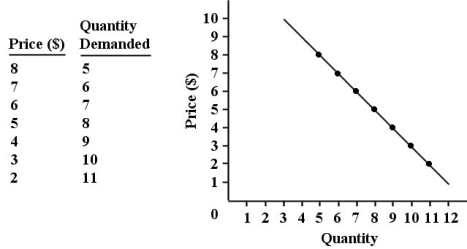 FIGURE 10-1
Refer to Figure 10-1.negative?
A) 9th unit
B) 8th unit
C) 5th unit
D) 6th unit
E) 7th unit
FIGURE 10-1Refer to Figure 10-1.negative?
A) 9th unit
B) 8th unit
C) 5th unit
D) 6th unit
E) 7th unit
سؤال
The diagram below shows total revenue for a single-price monopolist.  FIGURE 10-3
Refer to Figure 10-4. If this single-price monopolist is producing at the profit-maximizing level of output, the total profit is represented by the area
A) 0P0fQ0.
B) P4abP2.
C) P3ceP2.
D) 0P2bQ0.
E) 0P4aQ0.
FIGURE 10-3Refer to Figure 10-4. If this single-price monopolist is producing at the profit-maximizing level of output, the total profit is represented by the area
A) 0P0fQ0.
B) P4abP2.
C) P3ceP2.
D) 0P2bQ0.
E) 0P4aQ0.
سؤال
سؤال
سؤال
سؤال
سؤال
سؤال
سؤال
The diagram below shows total revenue for a single-price monopolist. FIGURE 10-3
Refer to Figure 10-3. The firm's marginal revenue at Q₁ is
A) negative and falling.
B) zero.
C) positive and rising.
D) positive but falling.
E) not determinable from the diagram.
FIGURE 10-3Refer to Figure 10-3. The firm's marginal revenue at Q₁ is
A) negative and falling.
B) zero.
C) positive and rising.
D) positive but falling.
E) not determinable from the diagram.
سؤال
سؤال
سؤال
The diagram below shows a pharmaceutical firm's demand curve and marginal cost curve for a new heart medication for which the firm holds a 20-year patent on its production. 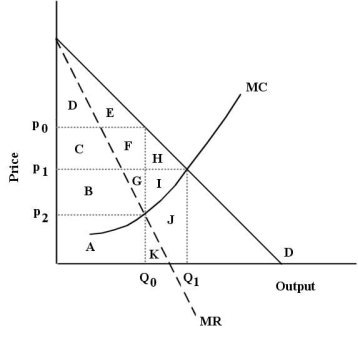 FIGURE 10-5
Refer to Figure 10-5. Assume this pharmaceutical firm charges a single price for its drug. At its profit-maximizing level of output it will produce
A) Q0 units and charge a price of p0.
B) Q₁ units and charge a price of p1.
C) Q0 units and charge a price of p2.
D) Q₁ units and charge a price greater than its average total variable cost.
E) Q0 units and charge the perfectly competitive price.
FIGURE 10-5Refer to Figure 10-5. Assume this pharmaceutical firm charges a single price for its drug. At its profit-maximizing level of output it will produce
A) Q0 units and charge a price of p0.
B) Q₁ units and charge a price of p1.
C) Q0 units and charge a price of p2.
D) Q₁ units and charge a price greater than its average total variable cost.
E) Q0 units and charge the perfectly competitive price.
سؤال
سؤال
The diagram below shows a pharmaceutical firm's demand curve and marginal cost curve for a new heart medication for which the firm holds a 20-year patent on its production.  FIGURE 10-5
Refer to Figure 10-5. Assume this pharmaceutical firm is practicing perfect price discrimination among its buyers. At its profit-maximizing level of output it will produce
A) Q0 units and charge a price of p0 on all units.
B) Q₁ units and charge a price of p1 on the last unit sold.
C) Q0 units and charge a price of p0 on the last unit sold.
D) Q₁ units and charge a price of p1 on all units.
E) - it is not possible to determine with the information provided.
FIGURE 10-5Refer to Figure 10-5. Assume this pharmaceutical firm is practicing perfect price discrimination among its buyers. At its profit-maximizing level of output it will produce
A) Q0 units and charge a price of p0 on all units.
B) Q₁ units and charge a price of p1 on the last unit sold.
C) Q0 units and charge a price of p0 on the last unit sold.
D) Q₁ units and charge a price of p1 on all units.
E) - it is not possible to determine with the information provided.
سؤال
سؤال
سؤال
Suppose that a single-price monopolist knows the following information:  The monopolist could maximize profits by
A) lowering price and increasing output.
B) raising price and leaving output unchanged.
C) lowering price and leaving output unchanged.
D) shutting down.
E) staying at the current price and output.
The monopolist could maximize profits byA) lowering price and increasing output.
B) raising price and leaving output unchanged.
C) lowering price and leaving output unchanged.
D) shutting down.
E) staying at the current price and output.
سؤال
سؤال
سؤال
سؤال
سؤال
سؤال
The figure below shows the demand schedule and demand curve for a product produced by a single-price monopolist. 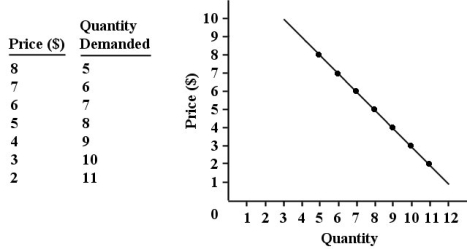 FIGURE 10-1
Refer to Figure 10-1.
A) 34; 28; -6
B) 9; 3; -6
C) 40; 27; -13
D) 3; 9; 6
E) 30; 36; 6
FIGURE 10-1Refer to Figure 10-1.
A) 34; 28; -6
B) 9; 3; -6
C) 40; 27; -13
D) 3; 9; 6
E) 30; 36; 6
سؤال
سؤال
سؤال
سؤال
سؤال
The diagram below shows a pharmaceutical firm's demand curve and marginal cost curve for a new heart medication for which the firm holds a 20-year patent on its production. 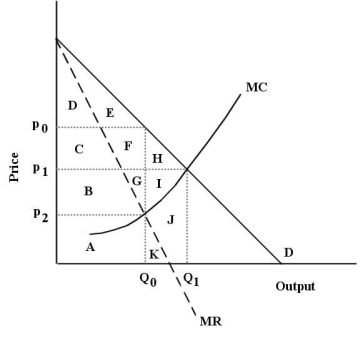 FIGURE 10-5
Refer to Figure 10-5. Assume this pharmaceutical firm is practicing perfect price discrimination among its buyers. At its profit-maximizing level of output, consumer surplus is represented by
A) areas C+F+H.
B) areas D+E.
C) - there is no consumer surplus.
D) areas C+D+E+F+H.
E) - it is not possible to determine with the information provided.
FIGURE 10-5Refer to Figure 10-5. Assume this pharmaceutical firm is practicing perfect price discrimination among its buyers. At its profit-maximizing level of output, consumer surplus is represented by
A) areas C+F+H.
B) areas D+E.
C) - there is no consumer surplus.
D) areas C+D+E+F+H.
E) - it is not possible to determine with the information provided.
سؤال
Consider the following AR and MR curves for a single-price monopolist. 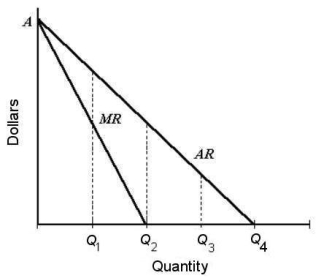 FIGURE 10-2
Refer to Figure 10-2. For a single-price monopolist, the profit-maximizing level of output is
A) Q₁.
B) Q₂.
C) Q₃.
D) Q₄.
E) not determinable from the diagram.
FIGURE 10-2Refer to Figure 10-2. For a single-price monopolist, the profit-maximizing level of output is
A) Q₁.
B) Q₂.
C) Q₃.
D) Q₄.
E) not determinable from the diagram.
سؤال
The figure below shows the demand schedule and demand curve for a product produced by a single-price monopolist. 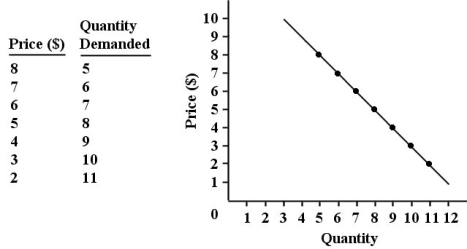 FIGURE 10-1
Refer to Figure 10-4. Suppose this firm experiences an increase in the demand for its product. In the short run, this profit-maximizing monopolist will
A) increase price and produce the same output.
B) lower price and increase output.
C) increase price and reduce output.
D) neither raise price nor change output.
E) increase price and output.
FIGURE 10-1Refer to Figure 10-4. Suppose this firm experiences an increase in the demand for its product. In the short run, this profit-maximizing monopolist will
A) increase price and produce the same output.
B) lower price and increase output.
C) increase price and reduce output.
D) neither raise price nor change output.
E) increase price and output.
سؤال
سؤال
سؤال
The diagram below shows a pharmaceutical firm's demand curve and marginal cost curve for a new heart medication for which the firm holds a 20-year patent on its production. FIGURE 10-5
Refer to Figure 10-5. Assume this pharmaceutical firm charges a single price for its drug. At its profit-maximizing level of output, consumer surplus is represented by
A) areas C+D+E+F.
B) - there is no consumer surplus generated.
C) areas H+I.
D) areas D+E.
E) - it is not possible to determine with the information provided.
FIGURE 10-5Refer to Figure 10-5. Assume this pharmaceutical firm charges a single price for its drug. At its profit-maximizing level of output, consumer surplus is represented by
A) areas C+D+E+F.
B) - there is no consumer surplus generated.
C) areas H+I.
D) areas D+E.
E) - it is not possible to determine with the information provided.
سؤال
سؤال
The figure below shows the demand schedule and demand curve for a product produced by a single-price monopolist. FIGURE 10-1
Refer to Figure 10-1. Suppose this single-price monopolist is initially selling 5 units at $8 each and then reduces the price of the product to $6.
A) 10; 12; 2
B) 8; 6; 2
C) 38; 40; 2
D) 5; 7; -2
E) 14; 14; 0
FIGURE 10-1Refer to Figure 10-1. Suppose this single-price monopolist is initially selling 5 units at $8 each and then reduces the price of the product to $6.
A) 10; 12; 2
B) 8; 6; 2
C) 38; 40; 2
D) 5; 7; -2
E) 14; 14; 0
سؤال
سؤال
The diagram below shows a pharmaceutical firm's demand curve and marginal cost curve for a new heart medication for which the firm holds a 20-year patent on its production. 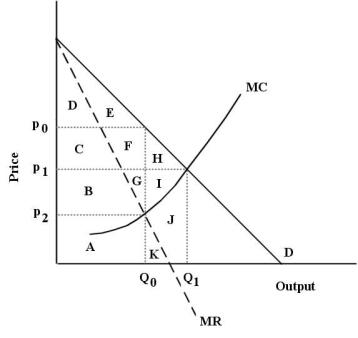 FIGURE 10-5
Refer to Figure 10-5. Assume this pharmaceutical firm is practicing perfect price discrimination among its buyers. At its profit-maximizing level of output, it will generate a deadweight loss to society represented by
A) - there is no deadweight loss generated.
B) areas H+I.
C) areas I+J+K.
D) areas H+I+J+K.
E) - it is not possible to determine with the information provided.
FIGURE 10-5Refer to Figure 10-5. Assume this pharmaceutical firm is practicing perfect price discrimination among its buyers. At its profit-maximizing level of output, it will generate a deadweight loss to society represented by
A) - there is no deadweight loss generated.
B) areas H+I.
C) areas I+J+K.
D) areas H+I+J+K.
E) - it is not possible to determine with the information provided.
سؤال
سؤال
سؤال
سؤال
Consider the following AR and MR curves for a single-price monopolist. 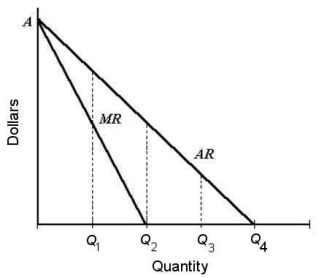 FIGURE 10-2
Refer to Figure 10-2. The price elasticity of demand at Q₁ is
A) less than 1.
B) equal to 1.
C) zero.
D) greater than 1.
E) not determinable from the diagram.
FIGURE 10-2Refer to Figure 10-2. The price elasticity of demand at Q₁ is
A) less than 1.
B) equal to 1.
C) zero.
D) greater than 1.
E) not determinable from the diagram.
سؤال
The diagram below shows a pharmaceutical firm's demand curve and marginal cost curve for a new heart medication for which the firm holds a 20-year patent on its production. 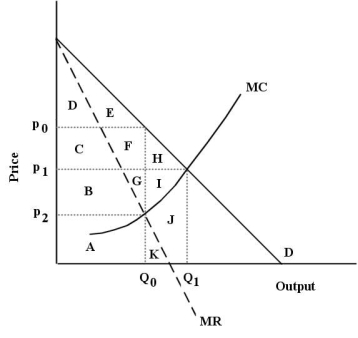 FIGURE 10-5
Refer to Figure 10-5. Assume this pharmaceutical firm charges a single price for its drug. At its profit-maximizing level of output, it will generate a total profit represented by
A) areas B+C+F+G+H+I.
B) the sum of areas A through K.
C) areas A+B+C+F+G.
D) areas D+E.
E) - it is not possible to determine with the information provided.
FIGURE 10-5Refer to Figure 10-5. Assume this pharmaceutical firm charges a single price for its drug. At its profit-maximizing level of output, it will generate a total profit represented by
A) areas B+C+F+G+H+I.
B) the sum of areas A through K.
C) areas A+B+C+F+G.
D) areas D+E.
E) - it is not possible to determine with the information provided.
سؤال
سؤال
سؤال
سؤال
سؤال
سؤال
سؤال
سؤال
The diagram below shows total revenue for a single-price monopolist. 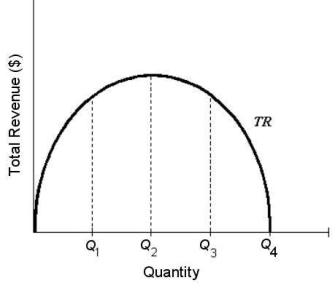 FIGURE 10-3
Refer to Figure 10-3. The price elasticity of demand at Q₃ is
A) less than 1.
B) greater than 1.
C) zero.
D) equal to 1.
E) not determinable from the diagram.
FIGURE 10-3Refer to Figure 10-3. The price elasticity of demand at Q₃ is
A) less than 1.
B) greater than 1.
C) zero.
D) equal to 1.
E) not determinable from the diagram.
سؤال
The diagram below shows a pharmaceutical firm's demand curve and marginal cost curve for a new heart medication for which the firm holds a 20-year patent on its production. FIGURE 10-5
A monopoly is distinguished from a firm operating under any other market structure in the following way: the monopoly
A) faces a demand curve which is identical to the market demand curve.
B) can choose its output level.
C) can choose its level of cost.
D) charges a price higher than its average revenue.
E) does not produce at a profit-maximizing level of output.
FIGURE 10-5A monopoly is distinguished from a firm operating under any other market structure in the following way: the monopoly
A) faces a demand curve which is identical to the market demand curve.
B) can choose its output level.
C) can choose its level of cost.
D) charges a price higher than its average revenue.
E) does not produce at a profit-maximizing level of output.
سؤال
سؤال
سؤال
سؤال
سؤال
The diagram below shows a pharmaceutical firm's demand curve and marginal cost curve for a new heart medication for which the firm holds a 20-year patent on its production. 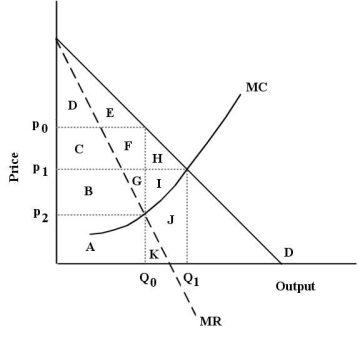 FIGURE 10-5
Refer to Figure 10-5. Assume this pharmaceutical firm charges a single price for its drug. At its profit-maximizing level of output, it will generate a deadweight loss to society represented by
A) areas H+I+J+K.
B) areas I+J+K.
C) areas H+I.
D) - there is no deadweight loss generated.
E) - it is not possible to determine with the information provided.
FIGURE 10-5Refer to Figure 10-5. Assume this pharmaceutical firm charges a single price for its drug. At its profit-maximizing level of output, it will generate a deadweight loss to society represented by
A) areas H+I+J+K.
B) areas I+J+K.
C) areas H+I.
D) - there is no deadweight loss generated.
E) - it is not possible to determine with the information provided.
سؤال
سؤال
سؤال
سؤال
سؤال
سؤال
سؤال
سؤال
Consider the following AR and MR curves for a single-price monopolist. 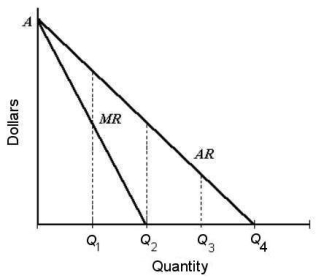 FIGURE 10-2
Refer to Table 10-1. For a single-price monopolist producing and selling 9 units, the marginal revenue earned by selling the 9th unit is
A) -2.
B) -4.
C) 0.
D) 2.
E) 4.
FIGURE 10-2Refer to Table 10-1. For a single-price monopolist producing and selling 9 units, the marginal revenue earned by selling the 9th unit is
A) -2.
B) -4.
C) 0.
D) 2.
E) 4.
سؤال
Consider the following AR and MR curves for a single-price monopolist. 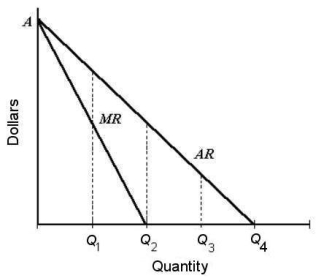 FIGURE 10-2
Refer to Figure 10-2. If marginal costs were positive and constant but less than A, the profit-maximizing output for a single-price monopolist would be
A) greater than zero, but less than Q₁.
B) equal to Q₂.
C) greater than zero, but less than Q₂.
D) between Q₂ and Q₄.
E) 0.
FIGURE 10-2Refer to Figure 10-2. If marginal costs were positive and constant but less than A, the profit-maximizing output for a single-price monopolist would be
A) greater than zero, but less than Q₁.
B) equal to Q₂.
C) greater than zero, but less than Q₂.
D) between Q₂ and Q₄.
E) 0.
سؤال
سؤال
سؤال
سؤال
Consider the following AR and MR curves for a single-price monopolist. FIGURE 10-2
A monopolist faces a straight-line demand curve and is currently producing an output level of2000 units receiving $10 000 in total revenue. At an output of 1 000 units the marginal revenue forthis firm would be
A) 0.
B) $2.50.
C) $5.00.
D) $10.00
E) impossible to tell with the given information.
FIGURE 10-2A monopolist faces a straight-line demand curve and is currently producing an output level of2000 units receiving $10 000 in total revenue. At an output of 1 000 units the marginal revenue forthis firm would be
A) 0.
B) $2.50.
C) $5.00.
D) $10.00
E) impossible to tell with the given information.
سؤال
Consider the following AR and MR curves for a single-price monopolist. FIGURE 10-2
A single-price monopolist is currently producing an output level where P = $20, MR = $13, ATC =$15, and MC = $14. In order to maximize profits, this monopolist should
A) decrease production and increase price.
B) shut down.
C) increase production and reduce price.
D) not change his output level, because he is currently at the profit-maximizing output level.
E) there is insufficient information to make a recommendation.
FIGURE 10-2A single-price monopolist is currently producing an output level where P = $20, MR = $13, ATC =$15, and MC = $14. In order to maximize profits, this monopolist should
A) decrease production and increase price.
B) shut down.
C) increase production and reduce price.
D) not change his output level, because he is currently at the profit-maximizing output level.
E) there is insufficient information to make a recommendation.
سؤال
سؤال
The diagram below shows a pharmaceutical firm's demand curve and marginal cost curve for a new heart medication for which the firm holds a 20-year patent on its production. 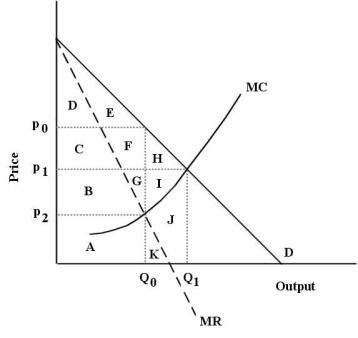 FIGURE 10-5
Refer to Figure 10-5. Suppose this pharmaceutical firm is charging a single price for its drug and is maximizing its profits. If it then begins to perfectly price discriminate among its buyers it will
A) reduce its producer surplus by areas C+F+H.
B) decrease its total output.
C) no longer be equating MR and MC.
D) capture consumer surplus equal to areas D+E+C+F+H.
E) cause a loss of economic surplus to society as a whole.
FIGURE 10-5Refer to Figure 10-5. Suppose this pharmaceutical firm is charging a single price for its drug and is maximizing its profits. If it then begins to perfectly price discriminate among its buyers it will
A) reduce its producer surplus by areas C+F+H.
B) decrease its total output.
C) no longer be equating MR and MC.
D) capture consumer surplus equal to areas D+E+C+F+H.
E) cause a loss of economic surplus to society as a whole.
سؤال
The diagram below shows a pharmaceutical firm's demand curve and marginal cost curve for a new heart medication for which the firm holds a 20-year patent on its production. 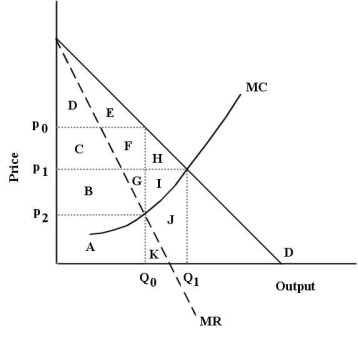 FIGURE 10-5
Refer to Figure 10-5. Assume this pharmaceutical firm has no fixed costs and is practicing perfect price discrimination among its buyers. At its profit-maximizing level of output, it will generate a total profit represented by
A) areas C+F+H.
B) areas B+C+F+G+H+I.
C) the area below the demand curve minus the area below the MC curve, up to Q₁.
D) areas G+I.
E) - it is not possible to determine with the information provided.
FIGURE 10-5Refer to Figure 10-5. Assume this pharmaceutical firm has no fixed costs and is practicing perfect price discrimination among its buyers. At its profit-maximizing level of output, it will generate a total profit represented by
A) areas C+F+H.
B) areas B+C+F+G+H+I.
C) the area below the demand curve minus the area below the MC curve, up to Q₁.
D) areas G+I.
E) - it is not possible to determine with the information provided.
سؤال
Consider the following AR and MR curves for a single-price monopolist. FIGURE 10-2
Refer to Figure 10-2. If marginal costs were zero, the profit-maximizing output for a single-price monopolist would be
A) 0.
B) Q₁.
C) Q₂.
D) Q₃.
E) Q₄.
FIGURE 10-2Refer to Figure 10-2. If marginal costs were zero, the profit-maximizing output for a single-price monopolist would be
A) 0.
B) Q₁.
C) Q₂.
D) Q₃.
E) Q₄.
سؤال
Consider the following AR and MR curves for a single-price monopolist. FIGURE 10-2
Refer to Figure 10-4. In order to maximize its profits, a perfect-price-discriminating monopolist produces the quantity
A) Q0.
B) Q₁.
C) Q₂.
D) Q₃.
E) Q₄.
FIGURE 10-2Refer to Figure 10-4. In order to maximize its profits, a perfect-price-discriminating monopolist produces the quantity
A) Q0.
B) Q₁.
C) Q₂.
D) Q₃.
E) Q₄.
سؤال
سؤال

فتح الحزمة
قم بالتسجيل لفتح البطاقات في هذه المجموعة!
Unlock Deck
Unlock Deck
1/79

العب

ملء الشاشة (f)
Deck 10: Monopoly, Cartels, and Price Discrimination
1
The diagram below shows total revenue for a single-price monopolist. FIGURE 10-3
Refer to Figure 10-3. The profit-maximizing output for the single-price monopolist is
A) Q₁
B) Q₂.
C) Q₃.
D) Q₄.
E) not determinable from the diagram.
FIGURE 10-3Refer to Figure 10-3. The profit-maximizing output for the single-price monopolist is
A) Q₁
B) Q₂.
C) Q₃.
D) Q₄.
E) not determinable from the diagram.
E
2
The demand curve facing a single-price monopolist slopes downward because
A) demand is perfectly inelastic.
B) its average revenue equals its marginal revenue.
C) its demand curve is the market demand curve, which is generally downward sloping.
D) its supply curve is upward sloping.
E) it sells typically to only one consumer.
A) demand is perfectly inelastic.
B) its average revenue equals its marginal revenue.
C) its demand curve is the market demand curve, which is generally downward sloping.
D) its supply curve is upward sloping.
E) it sells typically to only one consumer.
C
3
The figure below shows the demand schedule and demand curve for a product produced by a single-price monopolist. FIGURE 10-1
Refer to Figure 10-1.negative?
A) 9th unit
B) 8th unit
C) 5th unit
D) 6th unit
E) 7th unit
FIGURE 10-1Refer to Figure 10-1.negative?
A) 9th unit
B) 8th unit
C) 5th unit
D) 6th unit
E) 7th unit
E
4
The diagram below shows total revenue for a single-price monopolist. FIGURE 10-3
Refer to Figure 10-4. If this single-price monopolist is producing at the profit-maximizing level of output, the total profit is represented by the area
A) 0P0fQ0.
B) P4abP2.
C) P3ceP2.
D) 0P2bQ0.
E) 0P4aQ0.
FIGURE 10-3Refer to Figure 10-4. If this single-price monopolist is producing at the profit-maximizing level of output, the total profit is represented by the area
A) 0P0fQ0.
B) P4abP2.
C) P3ceP2.
D) 0P2bQ0.
E) 0P4aQ0.
فتح الحزمة
افتح القفل للوصول البطاقات البالغ عددها 79 في هذه المجموعة.
فتح الحزمة
k this deck
5
The cartelization of an industry with a homogeneous product usually means that
A) the demand curve facing the industry must be linear.
B) member firms have agreed to reduce their joint output.
C) member firms have agreed to reduce investment.
D) member firms have agreed to cooperate in reducing costs.
E) the demand curve facing the industry must be elastic.
A) the demand curve facing the industry must be linear.
B) member firms have agreed to reduce their joint output.
C) member firms have agreed to reduce investment.
D) member firms have agreed to cooperate in reducing costs.
E) the demand curve facing the industry must be elastic.
فتح الحزمة
افتح القفل للوصول البطاقات البالغ عددها 79 في هذه المجموعة.
فتح الحزمة
k this deck
6
A monopolistic firm faces a downward-sloping demand curve because
A) the demand for its product is always inelastic.
B) the market price is affected by the amount sold by a monopolistic firm.
C) the monopolistic firm can exploit economies of scale.
D) marginal revenue is negative throughout the feasible range of output.
E) there are a large number of firms in the industry, all selling the same product.
A) the demand for its product is always inelastic.
B) the market price is affected by the amount sold by a monopolistic firm.
C) the monopolistic firm can exploit economies of scale.
D) marginal revenue is negative throughout the feasible range of output.
E) there are a large number of firms in the industry, all selling the same product.
فتح الحزمة
افتح القفل للوصول البطاقات البالغ عددها 79 في هذه المجموعة.
فتح الحزمة
k this deck
7
For a single-price monopolist, the revenue-maximizing level of output occurs at a level of output such that
A) MC = AR.
B) MC = P.
C) MR = AC.
D) MR = MC.
E) MR = 0.
A) MC = AR.
B) MC = P.
C) MR = AC.
D) MR = MC.
E) MR = 0.
فتح الحزمة
افتح القفل للوصول البطاقات البالغ عددها 79 في هذه المجموعة.
فتح الحزمة
k this deck
8
Which of the following products would most easily lend itself to successful price discrimination by a monopolist?
A) cellular phones
B) restaurant meals
C) transport trucks
D) pianos
E) electricity
A) cellular phones
B) restaurant meals
C) transport trucks
D) pianos
E) electricity
فتح الحزمة
افتح القفل للوصول البطاقات البالغ عددها 79 في هذه المجموعة.
فتح الحزمة
k this deck
9
Which one of the following is a natural barrier to entry?
A) threats of punitive price-cutting by existing producers
B) licensing and patent restrictions
C) decreasing returns to scale
D) a positively sloped LRAC curve over the whole range of output
E) a negatively sloped LRAC curve over the whole range of output
A) threats of punitive price-cutting by existing producers
B) licensing and patent restrictions
C) decreasing returns to scale
D) a positively sloped LRAC curve over the whole range of output
E) a negatively sloped LRAC curve over the whole range of output
فتح الحزمة
افتح القفل للوصول البطاقات البالغ عددها 79 في هذه المجموعة.
فتح الحزمة
k this deck
10
One similarity between a monopolist and a perfectly competitive firm is that both
A) choose the price at which to sell their product.
B) need to know the shape of the market demand curve.
C) are large relative to their markets.
D) can make economic profits in the long run.
E) may have similarly shaped cost curves.
A) choose the price at which to sell their product.
B) need to know the shape of the market demand curve.
C) are large relative to their markets.
D) can make economic profits in the long run.
E) may have similarly shaped cost curves.
فتح الحزمة
افتح القفل للوصول البطاقات البالغ عددها 79 في هذه المجموعة.
فتح الحزمة
k this deck
11
The diagram below shows total revenue for a single-price monopolist. FIGURE 10-3
Refer to Figure 10-3. The firm's marginal revenue at Q₁ is
A) negative and falling.
B) zero.
C) positive and rising.
D) positive but falling.
E) not determinable from the diagram.
FIGURE 10-3Refer to Figure 10-3. The firm's marginal revenue at Q₁ is
A) negative and falling.
B) zero.
C) positive and rising.
D) positive but falling.
E) not determinable from the diagram.
فتح الحزمة
افتح القفل للوصول البطاقات البالغ عددها 79 في هذه المجموعة.
فتح الحزمة
k this deck
12
At the profit-maximizing level of output for a single-price monopolist, price
A) is below marginal revenue.
B) exceeds marginal cost.
C) equals marginal cost.
D) always exceeds average total cost.
E) equals marginal revenue.
A) is below marginal revenue.
B) exceeds marginal cost.
C) equals marginal cost.
D) always exceeds average total cost.
E) equals marginal revenue.
فتح الحزمة
افتح القفل للوصول البطاقات البالغ عددها 79 في هذه المجموعة.
فتح الحزمة
k this deck
13
If a monopolist is practising perfect price discrimination, we know that
A) the firm is producing a lower output than it would if it were a single-price monopolist.
B) the firm is facing a perfectly inelastic demand curve.
C) marginal cost is rising as output rises.
D) the firm is selling each unit at a different price and capturing all consumer surplus.
E) the firm is facing a perfectly elastic demand curve.
A) the firm is producing a lower output than it would if it were a single-price monopolist.
B) the firm is facing a perfectly inelastic demand curve.
C) marginal cost is rising as output rises.
D) the firm is selling each unit at a different price and capturing all consumer surplus.
E) the firm is facing a perfectly elastic demand curve.
فتح الحزمة
افتح القفل للوصول البطاقات البالغ عددها 79 في هذه المجموعة.
فتح الحزمة
k this deck
14
The diagram below shows a pharmaceutical firm's demand curve and marginal cost curve for a new heart medication for which the firm holds a 20-year patent on its production. FIGURE 10-5
Refer to Figure 10-5. Assume this pharmaceutical firm charges a single price for its drug. At its profit-maximizing level of output it will produce
A) Q0 units and charge a price of p0.
B) Q₁ units and charge a price of p1.
C) Q0 units and charge a price of p2.
D) Q₁ units and charge a price greater than its average total variable cost.
E) Q0 units and charge the perfectly competitive price.
FIGURE 10-5Refer to Figure 10-5. Assume this pharmaceutical firm charges a single price for its drug. At its profit-maximizing level of output it will produce
A) Q0 units and charge a price of p0.
B) Q₁ units and charge a price of p1.
C) Q0 units and charge a price of p2.
D) Q₁ units and charge a price greater than its average total variable cost.
E) Q0 units and charge the perfectly competitive price.
فتح الحزمة
افتح القفل للوصول البطاقات البالغ عددها 79 في هذه المجموعة.
فتح الحزمة
k this deck
15
A number of firms agreeing together to restrict output and thereby raise prices is known as
A) a natural monopoly.
B) a monopoly.
C) a barrier to entry.
D) a cartel.
E) an oligopoly.
A) a natural monopoly.
B) a monopoly.
C) a barrier to entry.
D) a cartel.
E) an oligopoly.
فتح الحزمة
افتح القفل للوصول البطاقات البالغ عددها 79 في هذه المجموعة.
فتح الحزمة
k this deck
16
The diagram below shows a pharmaceutical firm's demand curve and marginal cost curve for a new heart medication for which the firm holds a 20-year patent on its production. FIGURE 10-5
Refer to Figure 10-5. Assume this pharmaceutical firm is practicing perfect price discrimination among its buyers. At its profit-maximizing level of output it will produce
A) Q0 units and charge a price of p0 on all units.
B) Q₁ units and charge a price of p1 on the last unit sold.
C) Q0 units and charge a price of p0 on the last unit sold.
D) Q₁ units and charge a price of p1 on all units.
E) - it is not possible to determine with the information provided.
FIGURE 10-5Refer to Figure 10-5. Assume this pharmaceutical firm is practicing perfect price discrimination among its buyers. At its profit-maximizing level of output it will produce
A) Q0 units and charge a price of p0 on all units.
B) Q₁ units and charge a price of p1 on the last unit sold.
C) Q0 units and charge a price of p0 on the last unit sold.
D) Q₁ units and charge a price of p1 on all units.
E) - it is not possible to determine with the information provided.
فتح الحزمة
افتح القفل للوصول البطاقات البالغ عددها 79 في هذه المجموعة.
فتح الحزمة
k this deck
17
If a monopolist is practicing perfect price discrimination, then the following equation is true:
A) MR = P for all units.
B) MR = 1/2 P for any unit.
C) P = AVC at the profit-maximizing level of output.
D) MC = 1/2 MR at the profit-maximizing level of output.
E) AR = ATC at the profit-maximizing level of output.
A) MR = P for all units.
B) MR = 1/2 P for any unit.
C) P = AVC at the profit-maximizing level of output.
D) MC = 1/2 MR at the profit-maximizing level of output.
E) AR = ATC at the profit-maximizing level of output.
فتح الحزمة
افتح القفل للوصول البطاقات البالغ عددها 79 في هذه المجموعة.
فتح الحزمة
k this deck
18
Consider a monopolist that is able to distinguish between two distinct market segments, A and B,for its product. Marginal cost is constant at $18 for each unit produced. The firm is currentlyselling its output at a single price and allocating its output across segments such that marginal revenue in segment A is $25 and marginal revenue in segment B is $15. Is this firm maximizing its profit?
A) Yes, because since marginal cost is constant, the firm must set a single price.
B) No, because it is only possible to equate MR and MC when there is a single MR curve.
C) Yes, because it has set a price such that MC is between the MRs of the two market segments.
D) No, this firm can increase its profits by price discriminating across the two market segments.
A) Yes, because since marginal cost is constant, the firm must set a single price.
B) No, because it is only possible to equate MR and MC when there is a single MR curve.
C) Yes, because it has set a price such that MC is between the MRs of the two market segments.
D) No, this firm can increase its profits by price discriminating across the two market segments.
فتح الحزمة
افتح القفل للوصول البطاقات البالغ عددها 79 في هذه المجموعة.
فتح الحزمة
k this deck
19
Suppose that a single-price monopolist knows the following information: The monopolist could maximize profits by
A) lowering price and increasing output.
B) raising price and leaving output unchanged.
C) lowering price and leaving output unchanged.
D) shutting down.
E) staying at the current price and output.
The monopolist could maximize profits byA) lowering price and increasing output.
B) raising price and leaving output unchanged.
C) lowering price and leaving output unchanged.
D) shutting down.
E) staying at the current price and output.
فتح الحزمة
افتح القفل للوصول البطاقات البالغ عددها 79 في هذه المجموعة.
فتح الحزمة
k this deck
20
One of the reasons cartels are considered unstable is that
A) individual members of the cartel have an incentive to violate the cartel agreement.
B) member firms reduce their investment, thereby becoming uncompetitive over time.
C) there are wide fluctuations in price as cartel members vary their output.
D) consumers seek out substitutes to the cartel product.
E) it is inefficient to manage individual firms collectively.
A) individual members of the cartel have an incentive to violate the cartel agreement.
B) member firms reduce their investment, thereby becoming uncompetitive over time.
C) there are wide fluctuations in price as cartel members vary their output.
D) consumers seek out substitutes to the cartel product.
E) it is inefficient to manage individual firms collectively.
فتح الحزمة
افتح القفل للوصول البطاقات البالغ عددها 79 في هذه المجموعة.
فتح الحزمة
k this deck
21
Which of the following statements about a monopoly practicing perfect price discrimination iscorrect?
A) The output will always be less than that produced by a single-price monopolist.
B) It will charge higher prices in those market segments with more elastic demand.
C) The profit-maximizing criterion is MR = P, the same as for perfect competition.
D) Total costs will be lower than that of a single-price monopolist.
E) The demand curve is also the marginal-revenue curve.
A) The output will always be less than that produced by a single-price monopolist.
B) It will charge higher prices in those market segments with more elastic demand.
C) The profit-maximizing criterion is MR = P, the same as for perfect competition.
D) Total costs will be lower than that of a single-price monopolist.
E) The demand curve is also the marginal-revenue curve.
فتح الحزمة
افتح القفل للوصول البطاقات البالغ عددها 79 في هذه المجموعة.
فتح الحزمة
k this deck
22
It is common for a cartel to collapse when one or more firms in the cartel
A) exceed its output quota.
B) is much larger than other cartel members.
C) exit the industry.
D) increase its price above the monopoly price.
E) produce more efficiently than other member firms.
A) exceed its output quota.
B) is much larger than other cartel members.
C) exit the industry.
D) increase its price above the monopoly price.
E) produce more efficiently than other member firms.
فتح الحزمة
افتح القفل للوصول البطاقات البالغ عددها 79 في هذه المجموعة.
فتح الحزمة
k this deck
23
For a single-price monopolist, marginal revenue falls faster than price (as output rises) because
A) the cost of producing extra units of output increases as production is increased.
B) profits are maximized when marginal cost equals marginal revenue.
C) the firm has no supply curve.
D) in order to sell additional units, the price must be lowered on all units.
E) none of the above -- marginal revenue does not fall faster than price.
A) the cost of producing extra units of output increases as production is increased.
B) profits are maximized when marginal cost equals marginal revenue.
C) the firm has no supply curve.
D) in order to sell additional units, the price must be lowered on all units.
E) none of the above -- marginal revenue does not fall faster than price.
فتح الحزمة
افتح القفل للوصول البطاقات البالغ عددها 79 في هذه المجموعة.
فتح الحزمة
k this deck
24
Price discrimination, if possible, allows a price-setting firm to increase its profits by
A) raising the price above the competitive price.
B) shifting its cost curves downward.
C) charging different prices according to the different marginal cost on each unit.
D) charging different prices according to the willingness to pay of each consumer.
E) reducing costs through a reduction in output.
A) raising the price above the competitive price.
B) shifting its cost curves downward.
C) charging different prices according to the different marginal cost on each unit.
D) charging different prices according to the willingness to pay of each consumer.
E) reducing costs through a reduction in output.
فتح الحزمة
افتح القفل للوصول البطاقات البالغ عددها 79 في هذه المجموعة.
فتح الحزمة
k this deck
25
The figure below shows the demand schedule and demand curve for a product produced by a single-price monopolist. FIGURE 10-1
Refer to Figure 10-1.
A) 34; 28; -6
B) 9; 3; -6
C) 40; 27; -13
D) 3; 9; 6
E) 30; 36; 6
FIGURE 10-1Refer to Figure 10-1.
A) 34; 28; -6
B) 9; 3; -6
C) 40; 27; -13
D) 3; 9; 6
E) 30; 36; 6
فتح الحزمة
افتح القفل للوصول البطاقات البالغ عددها 79 في هذه المجموعة.
فتح الحزمة
k this deck
26
A cartel can only succeed in the long run
A) if all firms are experiencing decreasing returns to scale.
B) if the long-run market supply curve is elastic.
C) with authorization from the government.
D) if there is free entry of new firms.
E) if member firms cooperate and resist their individual incentives.
A) if all firms are experiencing decreasing returns to scale.
B) if the long-run market supply curve is elastic.
C) with authorization from the government.
D) if there is free entry of new firms.
E) if member firms cooperate and resist their individual incentives.
فتح الحزمة
افتح القفل للوصول البطاقات البالغ عددها 79 في هذه المجموعة.
فتح الحزمة
k this deck
27
One similarity between a monopoly and a firm in perfect competition is that both
A) face the entire market demand curve.
B) are profit maximizers.
C) set their selling price.
D) have market power.
E) choose their output independent of demand.
A) face the entire market demand curve.
B) are profit maximizers.
C) set their selling price.
D) have market power.
E) choose their output independent of demand.
فتح الحزمة
افتح القفل للوصول البطاقات البالغ عددها 79 في هذه المجموعة.
فتح الحزمة
k this deck
28
Suppose all of the firms in a perfectly competitive industry form a cartel and agree to restrict output, thereby raising the price of the product. Individual Firm A will gain the most from the existence of the cartel if
A) all firms, except Firm A, cooperate and restrict output.
B) all firms, including A, cooperate and restrict output.
C) no firms restrict output.
D) Firm A restricts output, while the other firms do not.
E) all firms revert back to their competitive outputs.
A) all firms, except Firm A, cooperate and restrict output.
B) all firms, including A, cooperate and restrict output.
C) no firms restrict output.
D) Firm A restricts output, while the other firms do not.
E) all firms revert back to their competitive outputs.
فتح الحزمة
افتح القفل للوصول البطاقات البالغ عددها 79 في هذه المجموعة.
فتح الحزمة
k this deck
29
A monopolist is currently producing an output level where price equals marginal cost, and profitsare positive. In order to maximize profits, this monopolist should
A) decrease production and increase price.
B) reduce price and let production adjust to the new price.
C) not change his output level, because he is currently earning profits.
D) shut down.
E) increase production and reduce price.
A) decrease production and increase price.
B) reduce price and let production adjust to the new price.
C) not change his output level, because he is currently earning profits.
D) shut down.
E) increase production and reduce price.
فتح الحزمة
افتح القفل للوصول البطاقات البالغ عددها 79 في هذه المجموعة.
فتح الحزمة
k this deck
30
The diagram below shows a pharmaceutical firm's demand curve and marginal cost curve for a new heart medication for which the firm holds a 20-year patent on its production. FIGURE 10-5
Refer to Figure 10-5. Assume this pharmaceutical firm is practicing perfect price discrimination among its buyers. At its profit-maximizing level of output, consumer surplus is represented by
A) areas C+F+H.
B) areas D+E.
C) - there is no consumer surplus.
D) areas C+D+E+F+H.
E) - it is not possible to determine with the information provided.
FIGURE 10-5Refer to Figure 10-5. Assume this pharmaceutical firm is practicing perfect price discrimination among its buyers. At its profit-maximizing level of output, consumer surplus is represented by
A) areas C+F+H.
B) areas D+E.
C) - there is no consumer surplus.
D) areas C+D+E+F+H.
E) - it is not possible to determine with the information provided.
فتح الحزمة
افتح القفل للوصول البطاقات البالغ عددها 79 في هذه المجموعة.
فتح الحزمة
k this deck
31
Consider the following AR and MR curves for a single-price monopolist. FIGURE 10-2
Refer to Figure 10-2. For a single-price monopolist, the profit-maximizing level of output is
A) Q₁.
B) Q₂.
C) Q₃.
D) Q₄.
E) not determinable from the diagram.
FIGURE 10-2Refer to Figure 10-2. For a single-price monopolist, the profit-maximizing level of output is
A) Q₁.
B) Q₂.
C) Q₃.
D) Q₄.
E) not determinable from the diagram.
فتح الحزمة
افتح القفل للوصول البطاقات البالغ عددها 79 في هذه المجموعة.
فتح الحزمة
k this deck
32
The figure below shows the demand schedule and demand curve for a product produced by a single-price monopolist. FIGURE 10-1
Refer to Figure 10-4. Suppose this firm experiences an increase in the demand for its product. In the short run, this profit-maximizing monopolist will
A) increase price and produce the same output.
B) lower price and increase output.
C) increase price and reduce output.
D) neither raise price nor change output.
E) increase price and output.
FIGURE 10-1Refer to Figure 10-4. Suppose this firm experiences an increase in the demand for its product. In the short run, this profit-maximizing monopolist will
A) increase price and produce the same output.
B) lower price and increase output.
C) increase price and reduce output.
D) neither raise price nor change output.
E) increase price and output.
فتح الحزمة
افتح القفل للوصول البطاقات البالغ عددها 79 في هذه المجموعة.
فتح الحزمة
k this deck
33
Natural barriers to entry include
A) a patent which allows production by only the patent holder.
B) a government-awarded franchise.
C) large economies of scale in the industry.
D) increasing-cost production.
E) control or ownership of the entire supply of an essential raw material.
A) a patent which allows production by only the patent holder.
B) a government-awarded franchise.
C) large economies of scale in the industry.
D) increasing-cost production.
E) control or ownership of the entire supply of an essential raw material.
فتح الحزمة
افتح القفل للوصول البطاقات البالغ عددها 79 في هذه المجموعة.
فتح الحزمة
k this deck
34
One reason movie theatres charge a lower admission price to senior citizens is that
A) government sets the price policies.
B) movie-theatre owners are able to practice perfect price discrimination.
C) senior citizens have a higher willingness-to-pay than other people.
D) senior citizens have a more elastic demand than other movie-goers.
E) senior citizens have a less elastic demand than other movie-goers.
A) government sets the price policies.
B) movie-theatre owners are able to practice perfect price discrimination.
C) senior citizens have a higher willingness-to-pay than other people.
D) senior citizens have a more elastic demand than other movie-goers.
E) senior citizens have a less elastic demand than other movie-goers.
فتح الحزمة
افتح القفل للوصول البطاقات البالغ عددها 79 في هذه المجموعة.
فتح الحزمة
k this deck
35
The diagram below shows a pharmaceutical firm's demand curve and marginal cost curve for a new heart medication for which the firm holds a 20-year patent on its production. FIGURE 10-5
Refer to Figure 10-5. Assume this pharmaceutical firm charges a single price for its drug. At its profit-maximizing level of output, consumer surplus is represented by
A) areas C+D+E+F.
B) - there is no consumer surplus generated.
C) areas H+I.
D) areas D+E.
E) - it is not possible to determine with the information provided.
FIGURE 10-5Refer to Figure 10-5. Assume this pharmaceutical firm charges a single price for its drug. At its profit-maximizing level of output, consumer surplus is represented by
A) areas C+D+E+F.
B) - there is no consumer surplus generated.
C) areas H+I.
D) areas D+E.
E) - it is not possible to determine with the information provided.
فتح الحزمة
افتح القفل للوصول البطاقات البالغ عددها 79 في هذه المجموعة.
فتح الحزمة
k this deck
36
If an industry's demand conditions allow at most one firm to cover its costs while producing at itsMES, this situation is known as
A) natural economic limits.
B) limited competition.
C) declining marginal revenue.
D) a natural monopoly.
E) a discriminating monopoly.
A) natural economic limits.
B) limited competition.
C) declining marginal revenue.
D) a natural monopoly.
E) a discriminating monopoly.
فتح الحزمة
افتح القفل للوصول البطاقات البالغ عددها 79 في هذه المجموعة.
فتح الحزمة
k this deck
37
The figure below shows the demand schedule and demand curve for a product produced by a single-price monopolist. FIGURE 10-1
Refer to Figure 10-1. Suppose this single-price monopolist is initially selling 5 units at $8 each and then reduces the price of the product to $6.
A) 10; 12; 2
B) 8; 6; 2
C) 38; 40; 2
D) 5; 7; -2
E) 14; 14; 0
FIGURE 10-1Refer to Figure 10-1. Suppose this single-price monopolist is initially selling 5 units at $8 each and then reduces the price of the product to $6.
A) 10; 12; 2
B) 8; 6; 2
C) 38; 40; 2
D) 5; 7; -2
E) 14; 14; 0
فتح الحزمة
افتح القفل للوصول البطاقات البالغ عددها 79 في هذه المجموعة.
فتح الحزمة
k this deck
38
If a monopolist's marginal revenue is MR = 12 - 2Q and its marginal cost is MC = 3, then the profit-maximizing quantity is
A) 0.
B) 4.
C) 4.5.
D) 6.
E) 12.
A) 0.
B) 4.
C) 4.5.
D) 6.
E) 12.
فتح الحزمة
افتح القفل للوصول البطاقات البالغ عددها 79 في هذه المجموعة.
فتح الحزمة
k this deck
39
The diagram below shows a pharmaceutical firm's demand curve and marginal cost curve for a new heart medication for which the firm holds a 20-year patent on its production. FIGURE 10-5
Refer to Figure 10-5. Assume this pharmaceutical firm is practicing perfect price discrimination among its buyers. At its profit-maximizing level of output, it will generate a deadweight loss to society represented by
A) - there is no deadweight loss generated.
B) areas H+I.
C) areas I+J+K.
D) areas H+I+J+K.
E) - it is not possible to determine with the information provided.
FIGURE 10-5Refer to Figure 10-5. Assume this pharmaceutical firm is practicing perfect price discrimination among its buyers. At its profit-maximizing level of output, it will generate a deadweight loss to society represented by
A) - there is no deadweight loss generated.
B) areas H+I.
C) areas I+J+K.
D) areas H+I+J+K.
E) - it is not possible to determine with the information provided.
فتح الحزمة
افتح القفل للوصول البطاقات البالغ عددها 79 في هذه المجموعة.
فتح الحزمة
k this deck
40
With regard to price discrimination, we can generally say that a monopolist practicing perfect pricediscrimination _ a single-price monopolist in the same market.
A) generates more consumer surplus than
B) has the same effects on consumer welfare as
C) produces the same output level and charges the same price as
D) produces a lower level of output compared to
E) generates a more efficient outcome for society as a whole compared to
A) generates more consumer surplus than
B) has the same effects on consumer welfare as
C) produces the same output level and charges the same price as
D) produces a lower level of output compared to
E) generates a more efficient outcome for society as a whole compared to
فتح الحزمة
افتح القفل للوصول البطاقات البالغ عددها 79 في هذه المجموعة.
فتح الحزمة
k this deck
41
For a monopolist, the profit-maximizing level of output occurs where
A) MC = 0.
B) MC = AR.
C) MC = price.
D) MR = MC.
E) MR = AC.
A) MC = 0.
B) MC = AR.
C) MC = price.
D) MR = MC.
E) MR = AC.
فتح الحزمة
افتح القفل للوصول البطاقات البالغ عددها 79 في هذه المجموعة.
فتح الحزمة
k this deck
42
Suppose the market for some product can be divided into two segments, and a monopolist can set adifferent price in each segment. The profit-maximizing price discrimination across these two market segments will lead to
A) lower output with total revenue higher than the single best price.
B) higher output with average revenue higher than the best single price.
C) the same output but higher average revenue than the best single price.
D) higher output with average revenue lower than the best single price.
E) lower output with a higher average revenue than the best single price.
A) lower output with total revenue higher than the single best price.
B) higher output with average revenue higher than the best single price.
C) the same output but higher average revenue than the best single price.
D) higher output with average revenue lower than the best single price.
E) lower output with a higher average revenue than the best single price.
فتح الحزمة
افتح القفل للوصول البطاقات البالغ عددها 79 في هذه المجموعة.
فتح الحزمة
k this deck
43
Consider the following AR and MR curves for a single-price monopolist. FIGURE 10-2
Refer to Figure 10-2. The price elasticity of demand at Q₁ is
A) less than 1.
B) equal to 1.
C) zero.
D) greater than 1.
E) not determinable from the diagram.
FIGURE 10-2Refer to Figure 10-2. The price elasticity of demand at Q₁ is
A) less than 1.
B) equal to 1.
C) zero.
D) greater than 1.
E) not determinable from the diagram.
فتح الحزمة
افتح القفل للوصول البطاقات البالغ عددها 79 في هذه المجموعة.
فتح الحزمة
k this deck
44
The diagram below shows a pharmaceutical firm's demand curve and marginal cost curve for a new heart medication for which the firm holds a 20-year patent on its production. FIGURE 10-5
Refer to Figure 10-5. Assume this pharmaceutical firm charges a single price for its drug. At its profit-maximizing level of output, it will generate a total profit represented by
A) areas B+C+F+G+H+I.
B) the sum of areas A through K.
C) areas A+B+C+F+G.
D) areas D+E.
E) - it is not possible to determine with the information provided.
FIGURE 10-5Refer to Figure 10-5. Assume this pharmaceutical firm charges a single price for its drug. At its profit-maximizing level of output, it will generate a total profit represented by
A) areas B+C+F+G+H+I.
B) the sum of areas A through K.
C) areas A+B+C+F+G.
D) areas D+E.
E) - it is not possible to determine with the information provided.
فتح الحزمة
افتح القفل للوصول البطاقات البالغ عددها 79 في هذه المجموعة.
فتح الحزمة
k this deck
45
Suppose you go to a retailer's website and print a coupon that gives you a discount on your nextpurchase at their store. But your friend, who also plans to purchase there, can't be bothered. Youare revealing to the store that
A) you understand price discrimination and your friend does not.
B) you have a higher elasticity of demand than your friend.
C) you have a lower elasticity of demand than your friend.
D) elasticity of demand changes according to the size of the discount offered.
E) you have a lower income than your friend.
A) you understand price discrimination and your friend does not.
B) you have a higher elasticity of demand than your friend.
C) you have a lower elasticity of demand than your friend.
D) elasticity of demand changes according to the size of the discount offered.
E) you have a lower income than your friend.
فتح الحزمة
افتح القفل للوصول البطاقات البالغ عددها 79 في هذه المجموعة.
فتح الحزمة
k this deck
46
Which of the following statements about single-price monopolists is correct?
A) The average revenue curve lies above the demand curve.
B) Price elasticity of demand will be equal to one if the firm is profit-maximizing.
C) Price equals marginal cost at the profit-maximizing level of output.
D) The profit-maximizing level of output is the same as the total revenue-maximizing level of output.
E) AR is greater than MR.
A) The average revenue curve lies above the demand curve.
B) Price elasticity of demand will be equal to one if the firm is profit-maximizing.
C) Price equals marginal cost at the profit-maximizing level of output.
D) The profit-maximizing level of output is the same as the total revenue-maximizing level of output.
E) AR is greater than MR.
فتح الحزمة
افتح القفل للوصول البطاقات البالغ عددها 79 في هذه المجموعة.
فتح الحزمة
k this deck
47
If a single-price monopolist's price equals marginal cost, the firm
A) will find it more profitable to produce a greater output.
B) should definitely shut down.
C) should maintain its current price because it is a price taker.
D) could increase its profits by lowering output and raising price.
E) is producing where MR = MC and thus is maximizing profits.
A) will find it more profitable to produce a greater output.
B) should definitely shut down.
C) should maintain its current price because it is a price taker.
D) could increase its profits by lowering output and raising price.
E) is producing where MR = MC and thus is maximizing profits.
فتح الحزمة
افتح القفل للوصول البطاقات البالغ عددها 79 في هذه المجموعة.
فتح الحزمة
k this deck
48
Relative to a firm that must charge a single price for all of its output, the ability to charge multipleprices gives a firm with market power the ability to capture some or all of the
A) fixed costs.
B) consumer surplus.
C) variable costs.
D) marginal costs.
E) producer surplus.
A) fixed costs.
B) consumer surplus.
C) variable costs.
D) marginal costs.
E) producer surplus.
فتح الحزمة
افتح القفل للوصول البطاقات البالغ عددها 79 في هذه المجموعة.
فتح الحزمة
k this deck
49
Which of the following statements describes a major difference between monopoly and perfect competition?
A) Perfectly competitive firms can never earn economic profits; monopolistic firms always earn economic profits.
B) Monopolistic firms emphasize cost minimization whereas perfectly competitive firms emphasize profit maximization.
C) Monopolistic firms tend to maximize revenue while perfectly competitive firms maximize profit.
D) Perfectly competitive firms cannot maintain positive economic profits in the long run, whereas monopolists can.
E) Monopolists do not consider consumer demand when choosing price and output levels.
A) Perfectly competitive firms can never earn economic profits; monopolistic firms always earn economic profits.
B) Monopolistic firms emphasize cost minimization whereas perfectly competitive firms emphasize profit maximization.
C) Monopolistic firms tend to maximize revenue while perfectly competitive firms maximize profit.
D) Perfectly competitive firms cannot maintain positive economic profits in the long run, whereas monopolists can.
E) Monopolists do not consider consumer demand when choosing price and output levels.
فتح الحزمة
افتح القفل للوصول البطاقات البالغ عددها 79 في هذه المجموعة.
فتح الحزمة
k this deck
50
Suppose the technology of an industry is such that the typical firm's minimum efficient scale is 18 units per day at an average long-run cost of $1600 per unit. If the total quantity demanded at a price of $1750 per unit is 16 units per month, the likely result would be
A) a cartel.
B) a natural monopoly.
C) price discrimination.
D) a competitive industry.
E) a concentrated oligopoly
A) a cartel.
B) a natural monopoly.
C) price discrimination.
D) a competitive industry.
E) a concentrated oligopoly
فتح الحزمة
افتح القفل للوصول البطاقات البالغ عددها 79 في هذه المجموعة.
فتح الحزمة
k this deck
51
Marginal revenue is less than price for a single-price monopolist because the
A) monopolist must worry about how its price setting will lead to entry by other firms.
B) monopolist has achieved economies of scale.
C) firm's output decisions do not affect the selling price.
D) monopolist charges a price higher than the unit production cost.
E) firm must lower its price for all units if it wants to sell more of the product.
A) monopolist must worry about how its price setting will lead to entry by other firms.
B) monopolist has achieved economies of scale.
C) firm's output decisions do not affect the selling price.
D) monopolist charges a price higher than the unit production cost.
E) firm must lower its price for all units if it wants to sell more of the product.
فتح الحزمة
افتح القفل للوصول البطاقات البالغ عددها 79 في هذه المجموعة.
فتح الحزمة
k this deck
52
The diagram below shows total revenue for a single-price monopolist. FIGURE 10-3
Refer to Figure 10-3. The price elasticity of demand at Q₃ is
A) less than 1.
B) greater than 1.
C) zero.
D) equal to 1.
E) not determinable from the diagram.
FIGURE 10-3Refer to Figure 10-3. The price elasticity of demand at Q₃ is
A) less than 1.
B) greater than 1.
C) zero.
D) equal to 1.
E) not determinable from the diagram.
فتح الحزمة
افتح القفل للوصول البطاقات البالغ عددها 79 في هذه المجموعة.
فتح الحزمة
k this deck
53
The diagram below shows a pharmaceutical firm's demand curve and marginal cost curve for a new heart medication for which the firm holds a 20-year patent on its production. FIGURE 10-5
A monopoly is distinguished from a firm operating under any other market structure in the following way: the monopoly
A) faces a demand curve which is identical to the market demand curve.
B) can choose its output level.
C) can choose its level of cost.
D) charges a price higher than its average revenue.
E) does not produce at a profit-maximizing level of output.
FIGURE 10-5A monopoly is distinguished from a firm operating under any other market structure in the following way: the monopoly
A) faces a demand curve which is identical to the market demand curve.
B) can choose its output level.
C) can choose its level of cost.
D) charges a price higher than its average revenue.
E) does not produce at a profit-maximizing level of output.
فتح الحزمة
افتح القفل للوصول البطاقات البالغ عددها 79 في هذه المجموعة.
فتح الحزمة
k this deck
54
Many clothing retailers allow you to go to their website and print a coupon that you then present for a discounted price on your next purchase in the store. In economics we refer to this as
A) arbitrage, a form of price discrimination.
B) a loss-leader, a form of advertising.
C) sales maximization, a form of market segmentation.
D) hurdle pricing, a form of price discrimination.
E) a created entry barrier, a form of price discrimination.
A) arbitrage, a form of price discrimination.
B) a loss-leader, a form of advertising.
C) sales maximization, a form of market segmentation.
D) hurdle pricing, a form of price discrimination.
E) a created entry barrier, a form of price discrimination.
فتح الحزمة
افتح القفل للوصول البطاقات البالغ عددها 79 في هذه المجموعة.
فتح الحزمة
k this deck
55
Consider a monopolist that is able to distinguish between two distinct market segments, A and B, for its product. Marginal cost is constant at $100 for each unit produced. The firm is currently selling its output at a single price and allocating its output across segments such that marginal revenue in segment A is $85 and marginal revenue in segment B is $105. Is this firm maximizing its profit?
A) Yes, because it has set a price such that MC is between the MRs of the two market segments.
B) No, because it is only possible to equate MR and MC when there is a single MR curve.
C) No, this firm can increase its profits by price discriminating across the two market segments.
D) Yes, because since marginal cost is constant, the firm must set a single price.
A) Yes, because it has set a price such that MC is between the MRs of the two market segments.
B) No, because it is only possible to equate MR and MC when there is a single MR curve.
C) No, this firm can increase its profits by price discriminating across the two market segments.
D) Yes, because since marginal cost is constant, the firm must set a single price.
فتح الحزمة
افتح القفل للوصول البطاقات البالغ عددها 79 في هذه المجموعة.
فتح الحزمة
k this deck
56
If a single-price monopolist sets price where the price elasticity of demand exactly equals 1, its
A) total revenue is rising, although marginal revenue is falling.
B) total profits are at a maximum.
C) marginal revenue is always positive.
D) total revenue is falling.
E) total revenue is at its maximum.
A) total revenue is rising, although marginal revenue is falling.
B) total profits are at a maximum.
C) marginal revenue is always positive.
D) total revenue is falling.
E) total revenue is at its maximum.
فتح الحزمة
افتح القفل للوصول البطاقات البالغ عددها 79 في هذه المجموعة.
فتح الحزمة
k this deck
57
The two characteristic problems for cartels are
A) agreeing on the price to be set and preventing new entrants.
B) policing members' prices and restricting output.
C) policing members' output restrictions and preventing new entrants.
D) agreeing on the price to be set and coordinating marketing policies.
E) coordinating marketing policies and policing members' quotas.
A) agreeing on the price to be set and preventing new entrants.
B) policing members' prices and restricting output.
C) policing members' output restrictions and preventing new entrants.
D) agreeing on the price to be set and coordinating marketing policies.
E) coordinating marketing policies and policing members' quotas.
فتح الحزمة
افتح القفل للوصول البطاقات البالغ عددها 79 في هذه المجموعة.
فتح الحزمة
k this deck
58
The diagram below shows a pharmaceutical firm's demand curve and marginal cost curve for a new heart medication for which the firm holds a 20-year patent on its production. FIGURE 10-5
Refer to Figure 10-5. Assume this pharmaceutical firm charges a single price for its drug. At its profit-maximizing level of output, it will generate a deadweight loss to society represented by
A) areas H+I+J+K.
B) areas I+J+K.
C) areas H+I.
D) - there is no deadweight loss generated.
E) - it is not possible to determine with the information provided.
FIGURE 10-5Refer to Figure 10-5. Assume this pharmaceutical firm charges a single price for its drug. At its profit-maximizing level of output, it will generate a deadweight loss to society represented by
A) areas H+I+J+K.
B) areas I+J+K.
C) areas H+I.
D) - there is no deadweight loss generated.
E) - it is not possible to determine with the information provided.
فتح الحزمة
افتح القفل للوصول البطاقات البالغ عددها 79 في هذه المجموعة.
فتح الحزمة
k this deck
59
The main argument of Joseph Schumpeter's idea of "creative destruction" is that
A) the existence of monopolies leads to destruction of the environment.
B) monopoly profits lead to innovation in an effort to sustain them.
C) short-run profits created by the existence of monopolies will lead to antitrust legislation, which will force the fragmentation of monopolies into competitive industries.
D) perfectly competitive industries are characterized by more productive innovation and productivity growth than monopolistic industries, which Schumpeter regarded as destructive.
E) monopolies create profits for themselves at the expense of the destruction of consumer surplus.
A) the existence of monopolies leads to destruction of the environment.
B) monopoly profits lead to innovation in an effort to sustain them.
C) short-run profits created by the existence of monopolies will lead to antitrust legislation, which will force the fragmentation of monopolies into competitive industries.
D) perfectly competitive industries are characterized by more productive innovation and productivity growth than monopolistic industries, which Schumpeter regarded as destructive.
E) monopolies create profits for themselves at the expense of the destruction of consumer surplus.
فتح الحزمة
افتح القفل للوصول البطاقات البالغ عددها 79 في هذه المجموعة.
فتح الحزمة
k this deck
60
If a single-price monopoly is presently producing an output at which marginal revenue is less than marginal cost, it can increase its profits by
A) expanding output and lowering price.
B) reducing output and holding prices unchanged.
C) expanding output and raising price.
D) reducing output and raising prices.
E) reducing barriers to entry.
A) expanding output and lowering price.
B) reducing output and holding prices unchanged.
C) expanding output and raising price.
D) reducing output and raising prices.
E) reducing barriers to entry.
فتح الحزمة
افتح القفل للوصول البطاقات البالغ عددها 79 في هذه المجموعة.
فتح الحزمة
k this deck
61
Which one of the following cases is NOT an example of price discrimination?
A) Electric companies charge different rates to commercial and residential users for electricity.
B) Airlines charge different fares for business people than tourist travelers.
C) Young males are charged higher premiums for car insurance than older males or women.
D) Theatres charge different rates for different age groups.
E) A local phone company charges different telephone rates to residential and business users.
A) Electric companies charge different rates to commercial and residential users for electricity.
B) Airlines charge different fares for business people than tourist travelers.
C) Young males are charged higher premiums for car insurance than older males or women.
D) Theatres charge different rates for different age groups.
E) A local phone company charges different telephone rates to residential and business users.
فتح الحزمة
افتح القفل للوصول البطاقات البالغ عددها 79 في هذه المجموعة.
فتح الحزمة
k this deck
62
Suppose the technology of an industry is such that the typical firm's minimum efficient scale is8000 units per month at an average long-run cost of $5 per unit. If the total quantity demanded at a price of $5 per unit is 8500 units per month, the likely result would be
A) a natural monopoly.
B) price discrimination.
C) perfectly competitive firms.
D) a concentrated oligopoly.
E) a cartel.
A) a natural monopoly.
B) price discrimination.
C) perfectly competitive firms.
D) a concentrated oligopoly.
E) a cartel.
فتح الحزمة
افتح القفل للوصول البطاقات البالغ عددها 79 في هذه المجموعة.
فتح الحزمة
k this deck
63
A likely cause of a natural monopoly is
A) charters.
B) licenses.
C) scale economies.
D) patents.
E) sabotage.
A) charters.
B) licenses.
C) scale economies.
D) patents.
E) sabotage.
فتح الحزمة
افتح القفل للوصول البطاقات البالغ عددها 79 في هذه المجموعة.
فتح الحزمة
k this deck
64
A firm is best described as a natural monopoly if
A) there are no competing firms.
B) its MC curve is downward sloping.
C) it holds an exclusive charter from the government.
D) it can supply the entire market while minimizing its average costs.
E) its ATC curve is upward sloping.
A) there are no competing firms.
B) its MC curve is downward sloping.
C) it holds an exclusive charter from the government.
D) it can supply the entire market while minimizing its average costs.
E) its ATC curve is upward sloping.
فتح الحزمة
افتح القفل للوصول البطاقات البالغ عددها 79 في هذه المجموعة.
فتح الحزمة
k this deck
65
If a monopoly operated in the inelastic range of its linear demand curve,
A) it would be operating at its profit-maximizing position.
B) it would be operating where its AR is negative.
C) its marginal revenue would be negative although its total revenues would be at a maximum.
D) it could raise its total revenue by lowering its price.
E) its marginal revenue would be negative.
A) it would be operating at its profit-maximizing position.
B) it would be operating where its AR is negative.
C) its marginal revenue would be negative although its total revenues would be at a maximum.
D) it could raise its total revenue by lowering its price.
E) its marginal revenue would be negative.
فتح الحزمة
افتح القفل للوصول البطاقات البالغ عددها 79 في هذه المجموعة.
فتح الحزمة
k this deck
66
Consider the following AR and MR curves for a single-price monopolist. FIGURE 10-2
Refer to Table 10-1. For a single-price monopolist producing and selling 9 units, the marginal revenue earned by selling the 9th unit is
A) -2.
B) -4.
C) 0.
D) 2.
E) 4.
FIGURE 10-2Refer to Table 10-1. For a single-price monopolist producing and selling 9 units, the marginal revenue earned by selling the 9th unit is
A) -2.
B) -4.
C) 0.
D) 2.
E) 4.
فتح الحزمة
افتح القفل للوصول البطاقات البالغ عددها 79 في هذه المجموعة.
فتح الحزمة
k this deck
67
Consider the following AR and MR curves for a single-price monopolist. FIGURE 10-2
Refer to Figure 10-2. If marginal costs were positive and constant but less than A, the profit-maximizing output for a single-price monopolist would be
A) greater than zero, but less than Q₁.
B) equal to Q₂.
C) greater than zero, but less than Q₂.
D) between Q₂ and Q₄.
E) 0.
FIGURE 10-2Refer to Figure 10-2. If marginal costs were positive and constant but less than A, the profit-maximizing output for a single-price monopolist would be
A) greater than zero, but less than Q₁.
B) equal to Q₂.
C) greater than zero, but less than Q₂.
D) between Q₂ and Q₄.
E) 0.
فتح الحزمة
افتح القفل للوصول البطاقات البالغ عددها 79 في هذه المجموعة.
فتح الحزمة
k this deck
68
If a competing firm is able to overcome an entry barrier of a monopolized industry, the demand curve of the single firm already in the industry will
A) shift to the left.
B) remain the same in spite of the entry of the other firm.
C) shift to the right.
D) shift to the left and become more elastic.
E) become less elastic.
A) shift to the left.
B) remain the same in spite of the entry of the other firm.
C) shift to the right.
D) shift to the left and become more elastic.
E) become less elastic.
فتح الحزمة
افتح القفل للوصول البطاقات البالغ عددها 79 في هذه المجموعة.
فتح الحزمة
k this deck
69
Consider a monopolist that is able to distinguish between two distinct market segments, A and B,for its product. Marginal cost is constant at $18 for each unit produced. The firm is currentlyselling its output at a single price and allocating its output across segments such that marginal revenue in segment A is $25 and marginal revenue in segment B is $15. How can this firm maximize its profit?
A) maintain the current output and its allocation across segments
B) decrease the output in segments A and B
C) decrease the output in segment A and increase the output in segment B
D) increase the output in segments A and B
E) increase the output in segment A and decrease the output in segment B
A) maintain the current output and its allocation across segments
B) decrease the output in segments A and B
C) decrease the output in segment A and increase the output in segment B
D) increase the output in segments A and B
E) increase the output in segment A and decrease the output in segment B
فتح الحزمة
افتح القفل للوصول البطاقات البالغ عددها 79 في هذه المجموعة.
فتح الحزمة
k this deck
70
The average revenue curve for a single-price monopolist
A) lies below its demand curve.
B) coincides with its demand curve.
C) is a horizontal line, equal to the price of its product.
D) slopes upward to the right.
E) does not exist.
A) lies below its demand curve.
B) coincides with its demand curve.
C) is a horizontal line, equal to the price of its product.
D) slopes upward to the right.
E) does not exist.
فتح الحزمة
افتح القفل للوصول البطاقات البالغ عددها 79 في هذه المجموعة.
فتح الحزمة
k this deck
71
Consider the following AR and MR curves for a single-price monopolist. FIGURE 10-2
A monopolist faces a straight-line demand curve and is currently producing an output level of2000 units receiving $10 000 in total revenue. At an output of 1 000 units the marginal revenue forthis firm would be
A) 0.
B) $2.50.
C) $5.00.
D) $10.00
E) impossible to tell with the given information.
FIGURE 10-2A monopolist faces a straight-line demand curve and is currently producing an output level of2000 units receiving $10 000 in total revenue. At an output of 1 000 units the marginal revenue forthis firm would be
A) 0.
B) $2.50.
C) $5.00.
D) $10.00
E) impossible to tell with the given information.
فتح الحزمة
افتح القفل للوصول البطاقات البالغ عددها 79 في هذه المجموعة.
فتح الحزمة
k this deck
72
Consider the following AR and MR curves for a single-price monopolist. FIGURE 10-2
A single-price monopolist is currently producing an output level where P = $20, MR = $13, ATC =$15, and MC = $14. In order to maximize profits, this monopolist should
A) decrease production and increase price.
B) shut down.
C) increase production and reduce price.
D) not change his output level, because he is currently at the profit-maximizing output level.
E) there is insufficient information to make a recommendation.
FIGURE 10-2A single-price monopolist is currently producing an output level where P = $20, MR = $13, ATC =$15, and MC = $14. In order to maximize profits, this monopolist should
A) decrease production and increase price.
B) shut down.
C) increase production and reduce price.
D) not change his output level, because he is currently at the profit-maximizing output level.
E) there is insufficient information to make a recommendation.
فتح الحزمة
افتح القفل للوصول البطاقات البالغ عددها 79 في هذه المجموعة.
فتح الحزمة
k this deck
73
Consider a monopolist that is able to distinguish between two distinct market segments, A and B,for its product. Marginal cost is constant at $100 for each unit produced. The firm is currentlyselling its output at a single price and allocating its output across segments such that marginal revenue in segment A is $85 and marginal revenue in segment B is $105. How can this firm maximize its profit?
A) increase the output in segments A and B
B) maintain the current output and its allocation across segments
C) decrease the output in segment A and increase the output in segment B
D) increase the output in segment A and decrease the output in segment B
E) decrease the output in segments A and B
A) increase the output in segments A and B
B) maintain the current output and its allocation across segments
C) decrease the output in segment A and increase the output in segment B
D) increase the output in segment A and decrease the output in segment B
E) decrease the output in segments A and B
فتح الحزمة
افتح القفل للوصول البطاقات البالغ عددها 79 في هذه المجموعة.
فتح الحزمة
k this deck
74
The diagram below shows a pharmaceutical firm's demand curve and marginal cost curve for a new heart medication for which the firm holds a 20-year patent on its production. FIGURE 10-5
Refer to Figure 10-5. Suppose this pharmaceutical firm is charging a single price for its drug and is maximizing its profits. If it then begins to perfectly price discriminate among its buyers it will
A) reduce its producer surplus by areas C+F+H.
B) decrease its total output.
C) no longer be equating MR and MC.
D) capture consumer surplus equal to areas D+E+C+F+H.
E) cause a loss of economic surplus to society as a whole.
FIGURE 10-5Refer to Figure 10-5. Suppose this pharmaceutical firm is charging a single price for its drug and is maximizing its profits. If it then begins to perfectly price discriminate among its buyers it will
A) reduce its producer surplus by areas C+F+H.
B) decrease its total output.
C) no longer be equating MR and MC.
D) capture consumer surplus equal to areas D+E+C+F+H.
E) cause a loss of economic surplus to society as a whole.
فتح الحزمة
افتح القفل للوصول البطاقات البالغ عددها 79 في هذه المجموعة.
فتح الحزمة
k this deck
75
The diagram below shows a pharmaceutical firm's demand curve and marginal cost curve for a new heart medication for which the firm holds a 20-year patent on its production. FIGURE 10-5
Refer to Figure 10-5. Assume this pharmaceutical firm has no fixed costs and is practicing perfect price discrimination among its buyers. At its profit-maximizing level of output, it will generate a total profit represented by
A) areas C+F+H.
B) areas B+C+F+G+H+I.
C) the area below the demand curve minus the area below the MC curve, up to Q₁.
D) areas G+I.
E) - it is not possible to determine with the information provided.
FIGURE 10-5Refer to Figure 10-5. Assume this pharmaceutical firm has no fixed costs and is practicing perfect price discrimination among its buyers. At its profit-maximizing level of output, it will generate a total profit represented by
A) areas C+F+H.
B) areas B+C+F+G+H+I.
C) the area below the demand curve minus the area below the MC curve, up to Q₁.
D) areas G+I.
E) - it is not possible to determine with the information provided.
فتح الحزمة
افتح القفل للوصول البطاقات البالغ عددها 79 في هذه المجموعة.
فتح الحزمة
k this deck
76
Consider the following AR and MR curves for a single-price monopolist. FIGURE 10-2
Refer to Figure 10-2. If marginal costs were zero, the profit-maximizing output for a single-price monopolist would be
A) 0.
B) Q₁.
C) Q₂.
D) Q₃.
E) Q₄.
FIGURE 10-2Refer to Figure 10-2. If marginal costs were zero, the profit-maximizing output for a single-price monopolist would be
A) 0.
B) Q₁.
C) Q₂.
D) Q₃.
E) Q₄.
فتح الحزمة
افتح القفل للوصول البطاقات البالغ عددها 79 في هذه المجموعة.
فتح الحزمة
k this deck
77
Consider the following AR and MR curves for a single-price monopolist. FIGURE 10-2
Refer to Figure 10-4. In order to maximize its profits, a perfect-price-discriminating monopolist produces the quantity
A) Q0.
B) Q₁.
C) Q₂.
D) Q₃.
E) Q₄.
FIGURE 10-2Refer to Figure 10-4. In order to maximize its profits, a perfect-price-discriminating monopolist produces the quantity
A) Q0.
B) Q₁.
C) Q₂.
D) Q₃.
E) Q₄.
فتح الحزمة
افتح القفل للوصول البطاقات البالغ عددها 79 في هذه المجموعة.
فتح الحزمة
k this deck
78
A monopolist will be earning positive economic profits
A) when price equals marginal cost.
B) whenever marginal revenue is positive.
C) when price exceeds average total cost.
D) at all times, since it controls the market.
E) whenever marginal revenue equals marginal cost.
A) when price equals marginal cost.
B) whenever marginal revenue is positive.
C) when price exceeds average total cost.
D) at all times, since it controls the market.
E) whenever marginal revenue equals marginal cost.
فتح الحزمة
افتح القفل للوصول البطاقات البالغ عددها 79 في هذه المجموعة.
فتح الحزمة
k this deck
79
The marginal revenue curve facing a single-price monopolist
A) is the same as the demand curve facing the monopolist.
B) at first falls to a minimum and then rises as output is increased.
C) lies below the average revenue curve.
D) is the same as the average revenue facing curve the monopolist.
E) shows the change in the profit for the firm.
A) is the same as the demand curve facing the monopolist.
B) at first falls to a minimum and then rises as output is increased.
C) lies below the average revenue curve.
D) is the same as the average revenue facing curve the monopolist.
E) shows the change in the profit for the firm.
فتح الحزمة
افتح القفل للوصول البطاقات البالغ عددها 79 في هذه المجموعة.
فتح الحزمة
k this deck
فتح الحزمة
افتح القفل للوصول البطاقات البالغ عددها 79 في هذه المجموعة.






