







 تكلم مع الذكاء الاصطناعي


Deck 5: Microbial Metabolism
ملء الشاشة (f)

سؤال

سؤال
سؤال
Figure 5.2
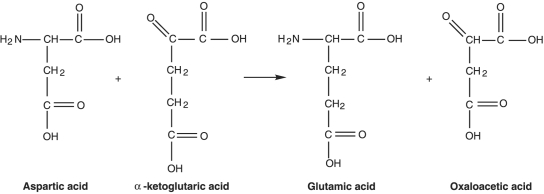
What type of reaction is in Figure 5.2?
A) Reduction
B) Decarboxylation
C) Dehydrogenation
D) Oxidation
E) Transamination
What type of reaction is in Figure 5.2?
A) Reduction
B) Decarboxylation
C) Dehydrogenation
D) Oxidation
E) Transamination
سؤال
سؤال
سؤال
سؤال
سؤال
سؤال
Figure 5.7
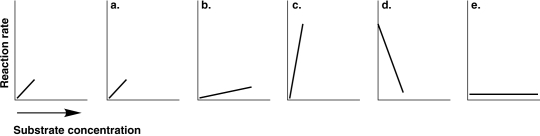
The graph at the left of Figure 5.7 shows the reaction rate for an enzyme at its optimum temperature. Which graph shows enzyme activity at a higher temperature?
A) a
B) b
C) c
D) d
E) e
The graph at the left of Figure 5.7 shows the reaction rate for an enzyme at its optimum temperature. Which graph shows enzyme activity at a higher temperature?
A) a
B) b
C) c
D) d
E) e
سؤال
سؤال
سؤال
سؤال
سؤال
سؤال
سؤال
Figure 5.1
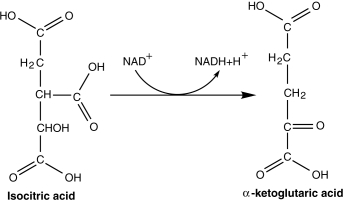
Which compound is being reduced in the reaction in Figure 5.1?
A) Isocitric acid and a- ketoglutaric acid
B) NADH
C) NADH and isocitric acid
D) NAD+
E) a- ketoglutaric acid and NAD+
Which compound is being reduced in the reaction in Figure 5.1?
A) Isocitric acid and a- ketoglutaric acid
B) NADH
C) NADH and isocitric acid
D) NAD+
E) a- ketoglutaric acid and NAD+
سؤال
سؤال
سؤال
سؤال
سؤال
سؤال
سؤال
سؤال
سؤال
سؤال
سؤال
سؤال
Figure 5.4
An enzyme, citrate synthase, in the Krebs cycle is inhibited by ATP; this is an example of all of the following except
A) Noncompetitive inhibition.
B) Competitive inhibition.
C) Feedback inhibition.
D) Allosteric inhibition.
E) None of the above.
An enzyme, citrate synthase, in the Krebs cycle is inhibited by ATP; this is an example of all of the following except
A) Noncompetitive inhibition.
B) Competitive inhibition.
C) Feedback inhibition.
D) Allosteric inhibition.
E) None of the above.
سؤال
Figure 5.6
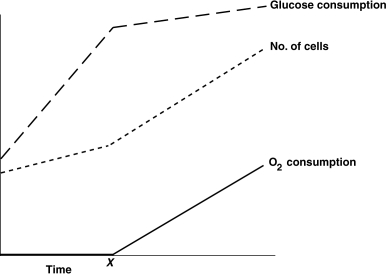
The rates of O₂ and glucose consumption by a bacterial culture are shown in Figure 5.6. Assume a bacterial culture was grown in a glucose medium without O₂. Then O₂ was added at the time marked X. The data indicate that
A) These bacteria can't grow anaerobically.
B) These bacteria get more energy anaerobically.
C) Aerobic metabolism is more efficient than fermentation.
D) These bacteria don't use O₂.
The rates of O₂ and glucose consumption by a bacterial culture are shown in Figure 5.6. Assume a bacterial culture was grown in a glucose medium without O₂. Then O₂ was added at the time marked X. The data indicate that
A) These bacteria can't grow anaerobically.
B) These bacteria get more energy anaerobically.
C) Aerobic metabolism is more efficient than fermentation.
D) These bacteria don't use O₂.
سؤال
Figure 5.5
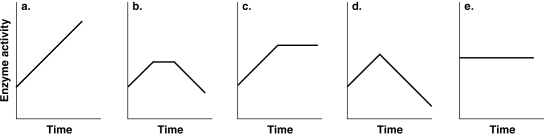
Which of the graphs in Figure 5.5 best illustrates the activity of an enzyme that is saturated with substrate?
A) a
B) b
C) c
D) d
E) e
Which of the graphs in Figure 5.5 best illustrates the activity of an enzyme that is saturated with substrate?
A) a
B) b
C) c
D) d
E) e
سؤال
سؤال
سؤال
Figure 5.3
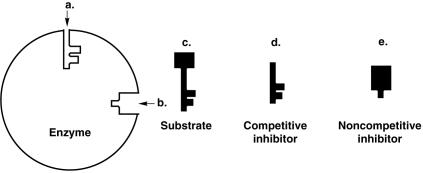
How would a noncompetitive inhibitor interfere with a reaction involving the enzyme in Figure 5.3?
A) It would bind to a.
B) It would bind to b.
C) It would bind to c.
D) It would bind to d.
E) Can't tell.
How would a noncompetitive inhibitor interfere with a reaction involving the enzyme in Figure 5.3?
A) It would bind to a.
B) It would bind to b.
C) It would bind to c.
D) It would bind to d.
E) Can't tell.
سؤال
سؤال
سؤال
سؤال
سؤال

فتح الحزمة
قم بالتسجيل لفتح البطاقات في هذه المجموعة!
Unlock Deck
Unlock Deck
1/38

العب

ملء الشاشة (f)
Deck 5: Microbial Metabolism
1
Aerobic respiration differs from anaerobic respiration in which of the following respects?
A) The final electron acceptors are different.
B) Anaerobic respiration is glycolysis.
C) Aerobic respiration requires the electron transport chain.
D) Aerobic respiration gets electrons from the Krebs cycle.
E) Aerobic respiration produces more ATP.
A) The final electron acceptors are different.
B) Anaerobic respiration is glycolysis.
C) Aerobic respiration requires the electron transport chain.
D) Aerobic respiration gets electrons from the Krebs cycle.
E) Aerobic respiration produces more ATP.
The final electron acceptors are different.
2
Beggiatoa bacteria get energy by oxidizing S2- to S6+. This means they take (1) for their
(2) .
A) 1- protons; 2- NAD+
B) 1- electrons; 2- electron transport chain
C) 1- glucose; 2- glycolysis
D) 1- electrons; 2- fermentation
E) 1- sulfur; 2- photophosphorylation
(2) .
A) 1- protons; 2- NAD+
B) 1- electrons; 2- electron transport chain
C) 1- glucose; 2- glycolysis
D) 1- electrons; 2- fermentation
E) 1- sulfur; 2- photophosphorylation
1- electrons; 2- electron transport chain
3
Figure 5.2
What type of reaction is in Figure 5.2?
A) Reduction
B) Decarboxylation
C) Dehydrogenation
D) Oxidation
E) Transamination
What type of reaction is in Figure 5.2?
A) Reduction
B) Decarboxylation
C) Dehydrogenation
D) Oxidation
E) Transamination
E
4
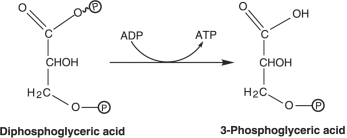
How is ATP generated in the reaction in Figure 5.4?
A) Fermentation
B) Glycolysis
C) Oxidative phosphorylation
D) Substrate- level phosphorylation
E) Photophosphorylation
A) Fermentation
B) Glycolysis
C) Oxidative phosphorylation
D) Substrate- level phosphorylation
E) Photophosphorylation
فتح الحزمة
افتح القفل للوصول البطاقات البالغ عددها 38 في هذه المجموعة.
فتح الحزمة
k this deck
5
All the following are true about substrate- level phosphorylation except
A) It occurs in glycolysis.
B) The oxidation of intermediate metabolic compounds releases energy that is used to generate ATP.
C) No final electron acceptor is required.
D) It involves the direct transfer of a high- energy phosphate group from an intermediate metabolic compound to ADP.
E) All of the above are true.
A) It occurs in glycolysis.
B) The oxidation of intermediate metabolic compounds releases energy that is used to generate ATP.
C) No final electron acceptor is required.
D) It involves the direct transfer of a high- energy phosphate group from an intermediate metabolic compound to ADP.
E) All of the above are true.
فتح الحزمة
افتح القفل للوصول البطاقات البالغ عددها 38 في هذه المجموعة.
فتح الحزمة
k this deck
6
The advantage of the pentose phosphate pathway is that it produces all of the following except
A) Precursors for nucleic acids.
B) NADPH.
C) Precursors for the synthesis of glucose.
D) Precursors for the synthesis of amino acids.
E) Three ATPs.
A) Precursors for nucleic acids.
B) NADPH.
C) Precursors for the synthesis of glucose.
D) Precursors for the synthesis of amino acids.
E) Three ATPs.
فتح الحزمة
افتح القفل للوصول البطاقات البالغ عددها 38 في هذه المجموعة.
فتح الحزمة
k this deck
7
Which of the following is not necessary for respiration?
A) Oxygen
B) Quinones
C) A source of electrons
D) Flavoproteins
E) Cytochromes
A) Oxygen
B) Quinones
C) A source of electrons
D) Flavoproteins
E) Cytochromes
فتح الحزمة
افتح القفل للوصول البطاقات البالغ عددها 38 في هذه المجموعة.
فتح الحزمة
k this deck
8
Uses glucose for carbon and energy.
A) Photoheterotroph
B) Chemoheterotroph
C) Chemoautotroph
D) Photoautotroph
E) None of the above
A) Photoheterotroph
B) Chemoheterotroph
C) Chemoautotroph
D) Photoautotroph
E) None of the above
فتح الحزمة
افتح القفل للوصول البطاقات البالغ عددها 38 في هذه المجموعة.
فتح الحزمة
k this deck
9
Figure 5.7
The graph at the left of Figure 5.7 shows the reaction rate for an enzyme at its optimum temperature. Which graph shows enzyme activity at a higher temperature?
A) a
B) b
C) c
D) d
E) e
The graph at the left of Figure 5.7 shows the reaction rate for an enzyme at its optimum temperature. Which graph shows enzyme activity at a higher temperature?
A) a
B) b
C) c
D) d
E) e
فتح الحزمة
افتح القفل للوصول البطاقات البالغ عددها 38 في هذه المجموعة.
فتح الحزمة
k this deck
10
Which of the following is not true about beta oxidation?
A) It involves the formation of acetyl- CoA.
B) It involves the formation of 2- carbon units.
C) It is a method of catabolizing fatty acids.
D) It is a step in glycolysis.
E) None of the above.
A) It involves the formation of acetyl- CoA.
B) It involves the formation of 2- carbon units.
C) It is a method of catabolizing fatty acids.
D) It is a step in glycolysis.
E) None of the above.
فتح الحزمة
افتح القفل للوصول البطاقات البالغ عددها 38 في هذه المجموعة.
فتح الحزمة
k this deck
11
Which of the following compounds is not an enzyme?
A) Cellulase
B) fi- galactosidase
C) Dehydrogenase
D) Coenzyme A
E) None of the above
A) Cellulase
B) fi- galactosidase
C) Dehydrogenase
D) Coenzyme A
E) None of the above
فتح الحزمة
افتح القفل للوصول البطاقات البالغ عددها 38 في هذه المجموعة.
فتح الحزمة
k this deck
12
Which of the following is not true about photophosphorylation?
A) The oxidation of carrier molecules releases energy.
B) It occurs in photosynthesizing cells.
C) Energy from oxidation reactions is used to generate ATP from ADP.
D) Light liberates an electron from chlorophyll.
E) It requires CO₂.
A) The oxidation of carrier molecules releases energy.
B) It occurs in photosynthesizing cells.
C) Energy from oxidation reactions is used to generate ATP from ADP.
D) Light liberates an electron from chlorophyll.
E) It requires CO₂.
فتح الحزمة
افتح القفل للوصول البطاقات البالغ عددها 38 في هذه المجموعة.
فتح الحزمة
k this deck
13
How many molecules of ATP can be generated from the complete oxidation of glucose to CO₂ and H₂O?
A) 4
B) 76
C) 38
D) 2
E) 34
A) 4
B) 76
C) 38
D) 2
E) 34
فتح الحزمة
افتح القفل للوصول البطاقات البالغ عددها 38 في هذه المجموعة.
فتح الحزمة
k this deck
14
Which of the following is not an end- product of fermentation?
A) Acetone
B) Pyruvic acid
C) Glycerol
D) Ethyl alcohol
E) Lactic acid
A) Acetone
B) Pyruvic acid
C) Glycerol
D) Ethyl alcohol
E) Lactic acid
فتح الحزمة
افتح القفل للوصول البطاقات البالغ عددها 38 في هذه المجموعة.
فتح الحزمة
k this deck
15
Which of the following is the best definition of oxidative phosphorylation?
A) The energy released as carrier molecules are oxidized is used to generate ATP.
B) Electrons are passed through a series of carriers to O₂.
C) The energy released in the reduction of carrier molecules is used to generate ATP.
D) The transfer of a high- energy phosphate group to ADP.
A) The energy released as carrier molecules are oxidized is used to generate ATP.
B) Electrons are passed through a series of carriers to O₂.
C) The energy released in the reduction of carrier molecules is used to generate ATP.
D) The transfer of a high- energy phosphate group to ADP.
فتح الحزمة
افتح القفل للوصول البطاقات البالغ عددها 38 في هذه المجموعة.
فتح الحزمة
k this deck
16
Figure 5.1
Which compound is being reduced in the reaction in Figure 5.1?
A) Isocitric acid and a- ketoglutaric acid
B) NADH
C) NADH and isocitric acid
D) NAD+
E) a- ketoglutaric acid and NAD+
Which compound is being reduced in the reaction in Figure 5.1?
A) Isocitric acid and a- ketoglutaric acid
B) NADH
C) NADH and isocitric acid
D) NAD+
E) a- ketoglutaric acid and NAD+
فتح الحزمة
افتح القفل للوصول البطاقات البالغ عددها 38 في هذه المجموعة.
فتح الحزمة
k this deck
17
Has bacteriochlorophylls and uses alcohols for carbon.
A) Chemoheterotroph
B) Photoheterotroph
C) Chemoautotroph
D) Photoautotroph
E) None of the above
A) Chemoheterotroph
B) Photoheterotroph
C) Chemoautotroph
D) Photoautotroph
E) None of the above
فتح الحزمة
افتح القفل للوصول البطاقات البالغ عددها 38 في هذه المجموعة.
فتح الحزمة
k this deck
18
Assume you are growing bacteria on a lipid medium that started at pH 7. The action of bacterial lipases should cause the pH of the medium to
A) Increase.
B) Decrease.
C) Stay the same.
A) Increase.
B) Decrease.
C) Stay the same.
فتح الحزمة
افتح القفل للوصول البطاقات البالغ عددها 38 في هذه المجموعة.
فتح الحزمة
k this deck
19
Which one of the following would you predict is an allosteric inhibitor of the Krebs cycle enzyme, ketoglutarate dehydrogenase?
A) NADH
B) NAD+
C) Citric acid
D) a- ketoglutaric acid
E) All of the above
A) NADH
B) NAD+
C) Citric acid
D) a- ketoglutaric acid
E) All of the above
فتح الحزمة
افتح القفل للوصول البطاقات البالغ عددها 38 في هذه المجموعة.
فتح الحزمة
k this deck
20
Which of the following is the best definition of fermentation?
A) The oxidation of glucose with organic molecules serving as electron acceptors.
B) The production of energy by substrate- level phosphorylation.
C) The complete catabolism of glucose to CO₂ and H₂O.
D) The production of ethyl alcohol from glucose.
E) The reduction of glucose to pyruvic acid.
A) The oxidation of glucose with organic molecules serving as electron acceptors.
B) The production of energy by substrate- level phosphorylation.
C) The complete catabolism of glucose to CO₂ and H₂O.
D) The production of ethyl alcohol from glucose.
E) The reduction of glucose to pyruvic acid.
فتح الحزمة
افتح القفل للوصول البطاقات البالغ عددها 38 في هذه المجموعة.
فتح الحزمة
k this deck
21
Which statements are true?
1-Electron carriers are located at ribosomes.
2-ATP is a common intermediate between catabolic and anabolic pathways.
3-ATP is used for the long- term storage of energy and so is often found in storage granules. 4-Anaerobic organisms are capable of respiration.
5-ATP is generated by the flow of protons across the cell membrane.
A) 1, 2, 3
B) 2, 3, 5
C) 1, 3, 4
D) 2, 4, 5
E) All
1-Electron carriers are located at ribosomes.
2-ATP is a common intermediate between catabolic and anabolic pathways.
3-ATP is used for the long- term storage of energy and so is often found in storage granules. 4-Anaerobic organisms are capable of respiration.
5-ATP is generated by the flow of protons across the cell membrane.
A) 1, 2, 3
B) 2, 3, 5
C) 1, 3, 4
D) 2, 4, 5
E) All
فتح الحزمة
افتح القفل للوصول البطاقات البالغ عددها 38 في هذه المجموعة.
فتح الحزمة
k this deck
22
Cyanobacteria are an example of this type.
A) Chemoheterotroph
B) Photoautotroph
C) Chemoautotroph
D) Photoheterotroph
E) None of the above
A) Chemoheterotroph
B) Photoautotroph
C) Chemoautotroph
D) Photoheterotroph
E) None of the above
فتح الحزمة
افتح القفل للوصول البطاقات البالغ عددها 38 في هذه المجموعة.
فتح الحزمة
k this deck
23
What percent of the total ATP produced from the complete catabolism of glucose is produced by aerobic respiration?
A) 50%
B) 95%
C) 5%
D) 11%
E) 89%
A) 50%
B) 95%
C) 5%
D) 11%
E) 89%
فتح الحزمة
افتح القفل للوصول البطاقات البالغ عددها 38 في هذه المجموعة.
فتح الحزمة
k this deck
24
A bacterial culture grown in a glucose- peptide medium causes the pH to increase. The bacteria are most likely
A) Fermenting the glucose.
B) Using the peptides.
C) Oxidizing the glucose.
D) Not growing.
A) Fermenting the glucose.
B) Using the peptides.
C) Oxidizing the glucose.
D) Not growing.
فتح الحزمة
افتح القفل للوصول البطاقات البالغ عددها 38 في هذه المجموعة.
فتح الحزمة
k this deck
25
A shipping company employee notices that the inside of ships' hulls where ballast water is stored are deteriorating. The hull paint contained cyanide to prevent microbial growth. Since bacteria were growing on the hulls, you can conclude that the
A) Bacteria were using aerobic respiration.
B) Bacteria were growing by fermentation.
C) Bacteria were using anaerobic respiration.
D) Bacteria were using cytochromes.
E) None of the above.
A) Bacteria were using aerobic respiration.
B) Bacteria were growing by fermentation.
C) Bacteria were using anaerobic respiration.
D) Bacteria were using cytochromes.
E) None of the above.
فتح الحزمة
افتح القفل للوصول البطاقات البالغ عددها 38 في هذه المجموعة.
فتح الحزمة
k this deck
26
Fatty acids are catabolized in
A) The electron transport chain.
B) The Entner Doudoroff pathway.
C) The pentose phosphate pathway.
D) Glycolysis.
E) The Krebs cycle.
A) The electron transport chain.
B) The Entner Doudoroff pathway.
C) The pentose phosphate pathway.
D) Glycolysis.
E) The Krebs cycle.
فتح الحزمة
افتح القفل للوصول البطاقات البالغ عددها 38 في هذه المجموعة.
فتح الحزمة
k this deck
27
Uses CO₂ for carbon and H₂ for energy.
A) Chemoheterotroph
B) Photoheterotroph
C) Photoautotroph
D) Chemoautotroph
E) None of the above
A) Chemoheterotroph
B) Photoheterotroph
C) Photoautotroph
D) Chemoautotroph
E) None of the above
فتح الحزمة
افتح القفل للوصول البطاقات البالغ عددها 38 في هذه المجموعة.
فتح الحزمة
k this deck
28
Figure 5.4
An enzyme, citrate synthase, in the Krebs cycle is inhibited by ATP; this is an example of all of the following except
A) Noncompetitive inhibition.
B) Competitive inhibition.
C) Feedback inhibition.
D) Allosteric inhibition.
E) None of the above.
An enzyme, citrate synthase, in the Krebs cycle is inhibited by ATP; this is an example of all of the following except
A) Noncompetitive inhibition.
B) Competitive inhibition.
C) Feedback inhibition.
D) Allosteric inhibition.
E) None of the above.
فتح الحزمة
افتح القفل للوصول البطاقات البالغ عددها 38 في هذه المجموعة.
فتح الحزمة
k this deck
29
Figure 5.6
The rates of O₂ and glucose consumption by a bacterial culture are shown in Figure 5.6. Assume a bacterial culture was grown in a glucose medium without O₂. Then O₂ was added at the time marked X. The data indicate that
A) These bacteria can't grow anaerobically.
B) These bacteria get more energy anaerobically.
C) Aerobic metabolism is more efficient than fermentation.
D) These bacteria don't use O₂.
The rates of O₂ and glucose consumption by a bacterial culture are shown in Figure 5.6. Assume a bacterial culture was grown in a glucose medium without O₂. Then O₂ was added at the time marked X. The data indicate that
A) These bacteria can't grow anaerobically.
B) These bacteria get more energy anaerobically.
C) Aerobic metabolism is more efficient than fermentation.
D) These bacteria don't use O₂.
فتح الحزمة
افتح القفل للوصول البطاقات البالغ عددها 38 في هذه المجموعة.
فتح الحزمة
k this deck
30
Figure 5.5
Which of the graphs in Figure 5.5 best illustrates the activity of an enzyme that is saturated with substrate?
A) a
B) b
C) c
D) d
E) e
Which of the graphs in Figure 5.5 best illustrates the activity of an enzyme that is saturated with substrate?
A) a
B) b
C) c
D) d
E) e
فتح الحزمة
افتح القفل للوصول البطاقات البالغ عددها 38 في هذه المجموعة.
فتح الحزمة
k this deck
31
Which of the following is not true about anaerobic respiration?
A) It generates ATP.
B) It involves the Krebs cycle.
C) It involves glycolysis only.
D) It requires cytochromes.
E) It involves the reduction of nitrate.
A) It generates ATP.
B) It involves the Krebs cycle.
C) It involves glycolysis only.
D) It requires cytochromes.
E) It involves the reduction of nitrate.
فتح الحزمة
افتح القفل للوصول البطاقات البالغ عددها 38 في هذه المجموعة.
فتح الحزمة
k this deck
32
A strictly fermentative bacterium produces energy
A) By aerobic respiration only.
B) Only in the absence of oxygen.
C) Only in the presence of oxygen.
D) By glycolysis only.
E) By fermentation or aerobic respiration.
A) By aerobic respiration only.
B) Only in the absence of oxygen.
C) Only in the presence of oxygen.
D) By glycolysis only.
E) By fermentation or aerobic respiration.
فتح الحزمة
افتح القفل للوصول البطاقات البالغ عددها 38 في هذه المجموعة.
فتح الحزمة
k this deck
33
Figure 5.3
How would a noncompetitive inhibitor interfere with a reaction involving the enzyme in Figure 5.3?
A) It would bind to a.
B) It would bind to b.
C) It would bind to c.
D) It would bind to d.
E) Can't tell.
How would a noncompetitive inhibitor interfere with a reaction involving the enzyme in Figure 5.3?
A) It would bind to a.
B) It would bind to b.
C) It would bind to c.
D) It would bind to d.
E) Can't tell.
فتح الحزمة
افتح القفل للوصول البطاقات البالغ عددها 38 في هذه المجموعة.
فتح الحزمة
k this deck
34
When oxygen is unavailable, Halobacterium produce ATP by
A) Substrate- level phosphorylation.
B) Fermentation.
C) The Krebs cycle.
D) Photophosphorylation.
E) Oxidative phosphorylation.
A) Substrate- level phosphorylation.
B) Fermentation.
C) The Krebs cycle.
D) Photophosphorylation.
E) Oxidative phosphorylation.
فتح الحزمة
افتح القفل للوصول البطاقات البالغ عددها 38 في هذه المجموعة.
فتح الحزمة
k this deck
35
According to the chemiosmotic mechanism, ATP is generated when
A) Protons are moved across a membrane.
B) Cells lyse in a hypotonic environment.
C) Chlorophyll liberates an electron.
D) A high- energy phosphate group is transferred from an intermediate metabolite to ADP.
E) Electrons are transferred between carrier molecules.
A) Protons are moved across a membrane.
B) Cells lyse in a hypotonic environment.
C) Chlorophyll liberates an electron.
D) A high- energy phosphate group is transferred from an intermediate metabolite to ADP.
E) Electrons are transferred between carrier molecules.
فتح الحزمة
افتح القفل للوصول البطاقات البالغ عددها 38 في هذه المجموعة.
فتح الحزمة
k this deck
36
What is the fate of pyruvic acid in an organism that uses aerobic respiration?
A) It is oxidized in the electron transport chain.
B) It is reduced in the Krebs cycle.
C) It is catabolized in glycolysis.
D) It is reduced to lactic acid.
E) It is oxidized in the Krebs cycle.
A) It is oxidized in the electron transport chain.
B) It is reduced in the Krebs cycle.
C) It is catabolized in glycolysis.
D) It is reduced to lactic acid.
E) It is oxidized in the Krebs cycle.
فتح الحزمة
افتح القفل للوصول البطاقات البالغ عددها 38 في هذه المجموعة.
فتح الحزمة
k this deck
37
Assume you are working for a chemical company and you are responsible for growing a yeast culture that produces ethyl alcohol. The yeasts are growing well on the maltose medium but are not producing alcohol. The most likely explanation is
A) Yeasts don't produce ethyl alcohol.
B) O₂ is in the medium.
C) Not enough protein is provided.
D) The maltose is toxic.
E) None of the above.
A) Yeasts don't produce ethyl alcohol.
B) O₂ is in the medium.
C) Not enough protein is provided.
D) The maltose is toxic.
E) None of the above.
فتح الحزمة
افتح القفل للوصول البطاقات البالغ عددها 38 في هذه المجموعة.
فتح الحزمة
k this deck
38
In green and purple bacteria, electrons to reduce CO2come from
A) C6H12O6
B) H2O
C) Sunlight
D) Chlorophyll
E) CO2
A) C6H12O6
B) H2O
C) Sunlight
D) Chlorophyll
E) CO2
فتح الحزمة
افتح القفل للوصول البطاقات البالغ عددها 38 في هذه المجموعة.
فتح الحزمة
k this deck
فتح الحزمة
افتح القفل للوصول البطاقات البالغ عددها 38 في هذه المجموعة.






