







 تكلم مع الذكاء الاصطناعي


Deck 7: The Control of Microbial Growth
ملء الشاشة (f)

سؤال

سؤال
سؤال
سؤال
سؤال
سؤال
سؤال
سؤال
سؤال
سؤال
سؤال
Figure 7.3
Assume 109 E. coli cells/ml are in a flask.
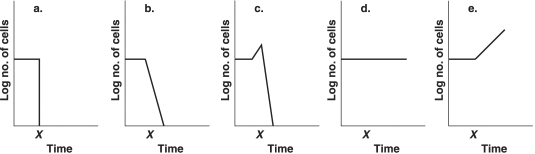
Which graph in Figure 7.3 best depicts the effect of placing the culture at 7°C at time x?
A) a
B) b
C) c
D) d
E) e
Assume 109 E. coli cells/ml are in a flask.
Which graph in Figure 7.3 best depicts the effect of placing the culture at 7°C at time x?
A) a
B) b
C) c
D) d
E) e
سؤال
سؤال
سؤال
سؤال
سؤال
سؤال
سؤال
سؤال
سؤال
سؤال
سؤال
سؤال
Figure 7.1
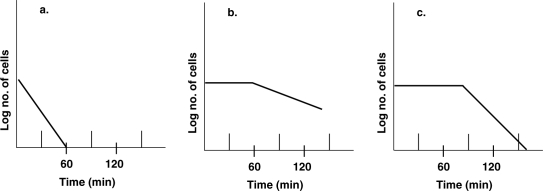
In Figure 7.1, what is the thermal death time for culture a?
A) 150°C
B) 60 min.
C) 100°C
D) 120 min.
E) Can't tell
In Figure 7.1, what is the thermal death time for culture a?
A) 150°C
B) 60 min.
C) 100°C
D) 120 min.
E) Can't tell
سؤال
Figure 7.3
Assume 109 E. coli cells/ml are in a flask.
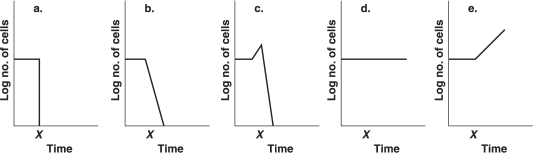
Which graph in Figure 7.3 best depicts the effect of placing the culture in an autoclave for 15 min. at time x?
A) a
B) b
C) c
D) d
E) e
Assume 109 E. coli cells/ml are in a flask.
Which graph in Figure 7.3 best depicts the effect of placing the culture in an autoclave for 15 min. at time x?
A) a
B) b
C) c
D) d
E) e
سؤال
سؤال
سؤال
سؤال
سؤال
سؤال
سؤال
Figure 7.2
A suspension of 106 Bacillus cereus endospores was put in a hot- air oven at 170°C. Plate counts were used to determine the number of endospores surviving at the time intervals shown.
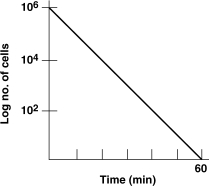
In Figure 7.2, the thermal death time for this culture is
A) 0 min.
B) 40 min.
C) 20 min.
D) 10 min.
E) 60 min.
A suspension of 106 Bacillus cereus endospores was put in a hot- air oven at 170°C. Plate counts were used to determine the number of endospores surviving at the time intervals shown.
In Figure 7.2, the thermal death time for this culture is
A) 0 min.
B) 40 min.
C) 20 min.
D) 10 min.
E) 60 min.
سؤال
سؤال
سؤال
سؤال
سؤال
سؤال
Figure 7.2
A suspension of 106 Bacillus cereus endospores was put in a hot- air oven at 170°C. Plate counts were used to determine the number of endospores surviving at the time intervals shown.
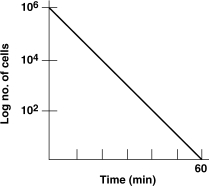
In Figure 7.2, the thermal death point for this culture is
A) 50°C.
B) 30 min.
C) 170°C.
D) 15 min.
E) Can't tell from the data provided.
A suspension of 106 Bacillus cereus endospores was put in a hot- air oven at 170°C. Plate counts were used to determine the number of endospores surviving at the time intervals shown.
In Figure 7.2, the thermal death point for this culture is
A) 50°C.
B) 30 min.
C) 170°C.
D) 15 min.
E) Can't tell from the data provided.
سؤال
Figure 7.2
A suspension of 106 Bacillus cereus endospores was put in a hot- air oven at 170°C. Plate counts were used to determine the number of endospores surviving at the time intervals shown.
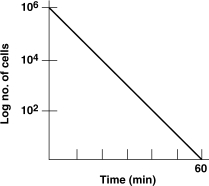
In Figure 7.2, the decimal reduction time (D value) for the culture is approximately
A) 15 min.
B) 0 min.
C) 45 min.
D) 30 min.
E) 60 min.
A suspension of 106 Bacillus cereus endospores was put in a hot- air oven at 170°C. Plate counts were used to determine the number of endospores surviving at the time intervals shown.
In Figure 7.2, the decimal reduction time (D value) for the culture is approximately
A) 15 min.
B) 0 min.
C) 45 min.
D) 30 min.
E) 60 min.
سؤال
Figure 7.1
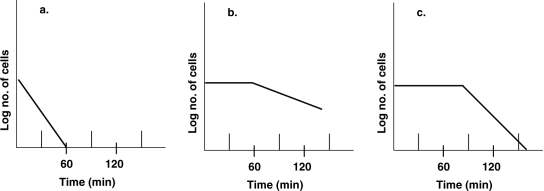
Assume that one culture is a freshly opened package of dried yeast with 0.1% moisture, another culture is the same yeast with 7.5% moisture, and the third culture is a package of yeast mixed with water. Each culture was exposed to 130°C in a hot- air oven. Which graph in Figure 7.1 most likely shows the yeast with 0.1% moisture?
A) a
B) b
C) c
D) a and b
E) b and c
Assume that one culture is a freshly opened package of dried yeast with 0.1% moisture, another culture is the same yeast with 7.5% moisture, and the third culture is a package of yeast mixed with water. Each culture was exposed to 130°C in a hot- air oven. Which graph in Figure 7.1 most likely shows the yeast with 0.1% moisture?
A) a
B) b
C) c
D) a and b
E) b and c
سؤال
سؤال
سؤال
سؤال
سؤال
سؤال

فتح الحزمة
قم بالتسجيل لفتح البطاقات في هذه المجموعة!
Unlock Deck
Unlock Deck
1/45

العب

ملء الشاشة (f)
Deck 7: The Control of Microbial Growth
1
Which of these is not an oxidizing agent?
A) Ozone
B) Iodine
C) Hydrogen peroxide
D) Chlorine
E) None of the above
A) Ozone
B) Iodine
C) Hydrogen peroxide
D) Chlorine
E) None of the above
None of the above
2
Which of the following could be used to sterilize plastic Petri plates in a plastic wrapper?
A) Ultraviolet radiation
B) Sunlight
C) Microwaves
D) Gamma radiation
E) None of the above
A) Ultraviolet radiation
B) Sunlight
C) Microwaves
D) Gamma radiation
E) None of the above
D
3
Table 7.2
The fate of E. coli O157:H7 in apple cider held at 8°C for 2 weeks, with and without preservatives, is shown below:
-In Table 7.2, which preservative is most effective?
A) Benzoate
B) Sorbate
C) Sorbate + benzoate
D) No preservative
The fate of E. coli O157:H7 in apple cider held at 8°C for 2 weeks, with and without preservatives, is shown below:
-In Table 7.2, which preservative is most effective?
A) Benzoate
B) Sorbate
C) Sorbate + benzoate
D) No preservative
Benzoate
4
Table 7.1
A disk- diffusion test using Staphylococcus gave the following results:
-In Table 7.1, which compound was bactericidal?
A) A
B) B
C) C
D) D
E) Can't tell
A disk- diffusion test using Staphylococcus gave the following results:
-In Table 7.1, which compound was bactericidal?
A) A
B) B
C) C
D) D
E) Can't tell
فتح الحزمة
افتح القفل للوصول البطاقات البالغ عددها 45 في هذه المجموعة.
فتح الحزمة
k this deck
5
Which one of the following does not belong with the others?
A) Propylene oxide
B) Beta- propiolactone
C) Hydrogen peroxide
D) Glutaraldehyde
E) Ethylene oxide
A) Propylene oxide
B) Beta- propiolactone
C) Hydrogen peroxide
D) Glutaraldehyde
E) Ethylene oxide
فتح الحزمة
افتح القفل للوصول البطاقات البالغ عددها 45 في هذه المجموعة.
فتح الحزمة
k this deck
6
Which of the following is not a heavy metal?
A) Merthiolate
B) Chlorine
C) Mercurochrome
D) Copper sulfate
E) Silver nitrate
A) Merthiolate
B) Chlorine
C) Mercurochrome
D) Copper sulfate
E) Silver nitrate
فتح الحزمة
افتح القفل للوصول البطاقات البالغ عددها 45 في هذه المجموعة.
فتح الحزمة
k this deck
7
Which one of the following is most useful for disinfecting medical instruments?
A) Quats
B) Benzoic acid
C) Phenol
D) Bisphenols
E) Chlorine
A) Quats
B) Benzoic acid
C) Phenol
D) Bisphenols
E) Chlorine
فتح الحزمة
افتح القفل للوصول البطاقات البالغ عددها 45 في هذه المجموعة.
فتح الحزمة
k this deck
8
Which of the following affects the elimination of bacteria from an object?
A) Number of bacteria present
B) Presence of organic matter
C) Temperature
D) pH
E) All of the above
A) Number of bacteria present
B) Presence of organic matter
C) Temperature
D) pH
E) All of the above
فتح الحزمة
افتح القفل للوصول البطاقات البالغ عددها 45 في هذه المجموعة.
فتح الحزمة
k this deck
9
All of the following contribute to hospital- acquired infections except
A) Bacteria may be present in commercial products such as mouthwash.
B) Some bacteria metabolize disinfectants.
C) Gram- negative bacteria are often resistant to disinfectants.
D) Invasive procedures can provide a portal of entry for bacteria.
E) None of the above.
A) Bacteria may be present in commercial products such as mouthwash.
B) Some bacteria metabolize disinfectants.
C) Gram- negative bacteria are often resistant to disinfectants.
D) Invasive procedures can provide a portal of entry for bacteria.
E) None of the above.
فتح الحزمة
افتح القفل للوصول البطاقات البالغ عددها 45 في هذه المجموعة.
فتح الحزمة
k this deck
10
Which one of the following is most resistant to chemical biocides?
A) Viruses with lipid envelopes
B) Protozoan cysts
C) Gram- positive bacteria
D) Mycobacteria
E) Gram- negative bacteria
A) Viruses with lipid envelopes
B) Protozoan cysts
C) Gram- positive bacteria
D) Mycobacteria
E) Gram- negative bacteria
فتح الحزمة
افتح القفل للوصول البطاقات البالغ عددها 45 في هذه المجموعة.
فتح الحزمة
k this deck
11
Figure 7.3
Assume 109 E. coli cells/ml are in a flask.
Which graph in Figure 7.3 best depicts the effect of placing the culture at 7°C at time x?
A) a
B) b
C) c
D) d
E) e
Assume 109 E. coli cells/ml are in a flask.
Which graph in Figure 7.3 best depicts the effect of placing the culture at 7°C at time x?
A) a
B) b
C) c
D) d
E) e
فتح الحزمة
افتح القفل للوصول البطاقات البالغ عددها 45 في هذه المجموعة.
فتح الحزمة
k this deck
12
Which of the following substances can sterilize?
A) Chlorine
B) Phenolics
C) Ethylene oxide
D) Alcohol
E) Soap
A) Chlorine
B) Phenolics
C) Ethylene oxide
D) Alcohol
E) Soap
فتح الحزمة
افتح القفل للوصول البطاقات البالغ عددها 45 في هذه المجموعة.
فتح الحزمة
k this deck
13
Foods are preserved with all of the following except
A) Potassium sorbate.
B) Sodium propionate.
C) Sodium nitrite.
D) Biguanides.
E) Nisin.
A) Potassium sorbate.
B) Sodium propionate.
C) Sodium nitrite.
D) Biguanides.
E) Nisin.
فتح الحزمة
افتح القفل للوصول البطاقات البالغ عددها 45 في هذه المجموعة.
فتح الحزمة
k this deck
14
Which of these disinfectants acts by denaturing proteins?
A) Phenolics
B) Halogens
C) Alcohols
D) Aldehydes
E) All of the above
A) Phenolics
B) Halogens
C) Alcohols
D) Aldehydes
E) All of the above
فتح الحزمة
افتح القفل للوصول البطاقات البالغ عددها 45 في هذه المجموعة.
فتح الحزمة
k this deck
15
The antimicrobial activity of chlorine is due to which of the following?
A) The formation of ozone
B) The formation of hypochlorous acid
C) The formation of free O
D) The formation of hydrochloric acid
E) Disruption of the plasma membrane
A) The formation of ozone
B) The formation of hypochlorous acid
C) The formation of free O
D) The formation of hydrochloric acid
E) Disruption of the plasma membrane
فتح الحزمة
افتح القفل للوصول البطاقات البالغ عددها 45 في هذه المجموعة.
فتح الحزمة
k this deck
16
Table 7.1
A disk- diffusion test using Staphylococcus gave the following results:
-In Table 7.1, which compound was the most effective against Staphylococcus?
A) A
B) B
C) C
D) D
E) Can't tell
A disk- diffusion test using Staphylococcus gave the following results:
-In Table 7.1, which compound was the most effective against Staphylococcus?
A) A
B) B
C) C
D) D
E) Can't tell
فتح الحزمة
افتح القفل للوصول البطاقات البالغ عددها 45 في هذه المجموعة.
فتح الحزمة
k this deck
17
Which of the following best describes the pattern of microbial death?
A) The pattern varies depending on the species.
B) The pattern varies depending on the antimicrobial agent.
C) The cells in a population die at a constant rate.
D) All of the cells in a culture are never killed.
E) All the cells in a culture die at once.
A) The pattern varies depending on the species.
B) The pattern varies depending on the antimicrobial agent.
C) The cells in a population die at a constant rate.
D) All of the cells in a culture are never killed.
E) All the cells in a culture die at once.
فتح الحزمة
افتح القفل للوصول البطاقات البالغ عددها 45 في هذه المجموعة.
فتح الحزمة
k this deck
18
Which of the following is used for surgical hand scrubs?
A) Soap
B) Phenol
C) Glutaraldehyde
D) Chlorine bleach
E) Chlorhexidine
A) Soap
B) Phenol
C) Glutaraldehyde
D) Chlorine bleach
E) Chlorhexidine
فتح الحزمة
افتح القفل للوصول البطاقات البالغ عددها 45 في هذه المجموعة.
فتح الحزمة
k this deck
19
Which of the following is not used for the disinfection of water?
A) Copper sulfate
B) Gamma radiation
C) Chlorine
D) Ozone
E) None of the above
A) Copper sulfate
B) Gamma radiation
C) Chlorine
D) Ozone
E) None of the above
فتح الحزمة
افتح القفل للوصول البطاقات البالغ عددها 45 في هذه المجموعة.
فتح الحزمة
k this deck
20
Table 7.1
A disk- diffusion test using Staphylococcus gave the following results:
-In Table 7.1, which compound was the most effective against E. coli?
A) A
B) B
C) C
D) D
E) Can't tell
A disk- diffusion test using Staphylococcus gave the following results:
-In Table 7.1, which compound was the most effective against E. coli?
A) A
B) B
C) C
D) D
E) Can't tell
فتح الحزمة
افتح القفل للوصول البطاقات البالغ عددها 45 في هذه المجموعة.
فتح الحزمة
k this deck
21
Which of the following is a limitation of the autoclave?
A) Length of time
B) Ability to kill endospores
C) Ability to inactivate viruses
D) Use with glassware
E) Use with heat- labile materials
A) Length of time
B) Ability to kill endospores
C) Ability to inactivate viruses
D) Use with glassware
E) Use with heat- labile materials
فتح الحزمة
افتح القفل للوصول البطاقات البالغ عددها 45 في هذه المجموعة.
فتح الحزمة
k this deck
22
Which of the following pairs is not correctly matched?
A) Merthiolate - open wounds
B) Ag - burns
C) CuSO₄ - algicide
D) H₂O₂ - open wounds
E) None of the above
A) Merthiolate - open wounds
B) Ag - burns
C) CuSO₄ - algicide
D) H₂O₂ - open wounds
E) None of the above
فتح الحزمة
افتح القفل للوصول البطاقات البالغ عددها 45 في هذه المجموعة.
فتح الحزمة
k this deck
23
Figure 7.1
In Figure 7.1, what is the thermal death time for culture a?
A) 150°C
B) 60 min.
C) 100°C
D) 120 min.
E) Can't tell
In Figure 7.1, what is the thermal death time for culture a?
A) 150°C
B) 60 min.
C) 100°C
D) 120 min.
E) Can't tell
فتح الحزمة
افتح القفل للوصول البطاقات البالغ عددها 45 في هذه المجموعة.
فتح الحزمة
k this deck
24
Figure 7.3
Assume 109 E. coli cells/ml are in a flask.
Which graph in Figure 7.3 best depicts the effect of placing the culture in an autoclave for 15 min. at time x?
A) a
B) b
C) c
D) d
E) e
Assume 109 E. coli cells/ml are in a flask.
Which graph in Figure 7.3 best depicts the effect of placing the culture in an autoclave for 15 min. at time x?
A) a
B) b
C) c
D) d
E) e
فتح الحزمة
افتح القفل للوصول البطاقات البالغ عددها 45 في هذه المجموعة.
فتح الحزمة
k this deck
25
Which of the following treatments is the most effective for controlling microbial growth?
A) 140°C for < 1 sec.
B) 63°C for 30 min.
C) 72°C for 15 sec.
D) They are equivalent treatments.
E) None are effective.
A) 140°C for < 1 sec.
B) 63°C for 30 min.
C) 72°C for 15 sec.
D) They are equivalent treatments.
E) None are effective.
فتح الحزمة
افتح القفل للوصول البطاقات البالغ عددها 45 في هذه المجموعة.
فتح الحزمة
k this deck
26
Bacterial death will result from damage to which of the following structures?
A) Proteins
B) Cell wall
C) Nucleic acids
D) Plasma membrane
E) All of the above
A) Proteins
B) Cell wall
C) Nucleic acids
D) Plasma membrane
E) All of the above
فتح الحزمة
افتح القفل للوصول البطاقات البالغ عددها 45 في هذه المجموعة.
فتح الحزمة
k this deck
27
Table 7.3
The following data were obtained by incubating the bacteria in nutrient medium + disinfectant for 24 hr, then transferring one loopful to nutrient medium (subculturing.)
-In Table 7.3, which disinfectant is the most effective at stopping bacterial growth?
A) Doom
B) K.O.
C) Mortum
D) Sterl
E) Can't tell
The following data were obtained by incubating the bacteria in nutrient medium + disinfectant for 24 hr, then transferring one loopful to nutrient medium (subculturing.)
-In Table 7.3, which disinfectant is the most effective at stopping bacterial growth?
A) Doom
B) K.O.
C) Mortum
D) Sterl
E) Can't tell
فتح الحزمة
افتح القفل للوصول البطاقات البالغ عددها 45 في هذه المجموعة.
فتح الحزمة
k this deck
28
Which of the following is best to sterilize heat- labile solutions?
A) Pasteurization
B) Dry heat
C) Autoclave
D) Membrane filtration
E) None of the above
A) Pasteurization
B) Dry heat
C) Autoclave
D) Membrane filtration
E) None of the above
فتح الحزمة
افتح القفل للوصول البطاقات البالغ عددها 45 في هذه المجموعة.
فتح الحزمة
k this deck
29
Glutaraldehyde is considered one of the most effective disinfectants for hospital use. Which of the following would not be true about glutaraldehyde?
A) Safe to transport.
B) Stains and corrodes.
C) Attacks all microorganisms.
D) Acts rapidly.
E) Not hampered by organic material.
A) Safe to transport.
B) Stains and corrodes.
C) Attacks all microorganisms.
D) Acts rapidly.
E) Not hampered by organic material.
فتح الحزمة
افتح القفل للوصول البطاقات البالغ عددها 45 في هذه المجموعة.
فتح الحزمة
k this deck
30
Table 7.3
The following data were obtained by incubating the bacteria in nutrient medium + disinfectant for 24 hr, then transferring one loopful to nutrient medium (subculturing.)
-In Table 7.3, which disinfectant was most effective against Salmonella?
A) Doom
B) K.O.
C) Mortum
D) Sterl
E) Can't tell
The following data were obtained by incubating the bacteria in nutrient medium + disinfectant for 24 hr, then transferring one loopful to nutrient medium (subculturing.)
-In Table 7.3, which disinfectant was most effective against Salmonella?
A) Doom
B) K.O.
C) Mortum
D) Sterl
E) Can't tell
فتح الحزمة
افتح القفل للوصول البطاقات البالغ عددها 45 في هذه المجموعة.
فتح الحزمة
k this deck
31
Figure 7.2
A suspension of 106 Bacillus cereus endospores was put in a hot- air oven at 170°C. Plate counts were used to determine the number of endospores surviving at the time intervals shown.
In Figure 7.2, the thermal death time for this culture is
A) 0 min.
B) 40 min.
C) 20 min.
D) 10 min.
E) 60 min.
A suspension of 106 Bacillus cereus endospores was put in a hot- air oven at 170°C. Plate counts were used to determine the number of endospores surviving at the time intervals shown.
In Figure 7.2, the thermal death time for this culture is
A) 0 min.
B) 40 min.
C) 20 min.
D) 10 min.
E) 60 min.
فتح الحزمة
افتح القفل للوصول البطاقات البالغ عددها 45 في هذه المجموعة.
فتح الحزمة
k this deck
32
Which of the following is not effective against nonenveloped viruses?
A) Ozone
B) Alcohol
C) Chlorine
D) Ethylene oxide
E) All are equally effective
A) Ozone
B) Alcohol
C) Chlorine
D) Ethylene oxide
E) All are equally effective
فتح الحزمة
افتح القفل للوصول البطاقات البالغ عددها 45 في هذه المجموعة.
فتح الحزمة
k this deck
33
Place the following surfactants in order from the most effective to the least effective antimicrobial a 1- Soap; 2- Anionic detergent; 3- Cationic detergent.
A) 1, 3, 2
B) 3, 1, 2
C) 2, 1, 3
D) 3, 2, 1
E) 1, 2, 3
A) 1, 3, 2
B) 3, 1, 2
C) 2, 1, 3
D) 3, 2, 1
E) 1, 2, 3
فتح الحزمة
افتح القفل للوصول البطاقات البالغ عددها 45 في هذه المجموعة.
فتح الحزمة
k this deck
34
Which of the following does not achieve sterilization?
A) Ethylene oxide
B) Autoclave
C) Dry heat
D) Formaldehyde
E) Pasteurization
A) Ethylene oxide
B) Autoclave
C) Dry heat
D) Formaldehyde
E) Pasteurization
فتح الحزمة
افتح القفل للوصول البطاقات البالغ عددها 45 في هذه المجموعة.
فتح الحزمة
k this deck
35
Which of the following treatments does not yield a sterile product?
A) Gamma radiation
B) Autoclaving
C) 0.45 µm filtration
D) 170°C for 2 hr
E) Ionizing radiation
A) Gamma radiation
B) Autoclaving
C) 0.45 µm filtration
D) 170°C for 2 hr
E) Ionizing radiation
فتح الحزمة
افتح القفل للوصول البطاقات البالغ عددها 45 في هذه المجموعة.
فتح الحزمة
k this deck
36
Phenolics differ from phenol in that phenolics are all of the following except
A) More toxic to human cells.
B) More effective antibacterial agents.
C) Relatively odorless.
D) Nonirritating.
E) All of the above.
A) More toxic to human cells.
B) More effective antibacterial agents.
C) Relatively odorless.
D) Nonirritating.
E) All of the above.
فتح الحزمة
افتح القفل للوصول البطاقات البالغ عددها 45 في هذه المجموعة.
فتح الحزمة
k this deck
37
Figure 7.2
A suspension of 106 Bacillus cereus endospores was put in a hot- air oven at 170°C. Plate counts were used to determine the number of endospores surviving at the time intervals shown.
In Figure 7.2, the thermal death point for this culture is
A) 50°C.
B) 30 min.
C) 170°C.
D) 15 min.
E) Can't tell from the data provided.
A suspension of 106 Bacillus cereus endospores was put in a hot- air oven at 170°C. Plate counts were used to determine the number of endospores surviving at the time intervals shown.
In Figure 7.2, the thermal death point for this culture is
A) 50°C.
B) 30 min.
C) 170°C.
D) 15 min.
E) Can't tell from the data provided.
فتح الحزمة
افتح القفل للوصول البطاقات البالغ عددها 45 في هذه المجموعة.
فتح الحزمة
k this deck
38
Figure 7.2
A suspension of 106 Bacillus cereus endospores was put in a hot- air oven at 170°C. Plate counts were used to determine the number of endospores surviving at the time intervals shown.
In Figure 7.2, the decimal reduction time (D value) for the culture is approximately
A) 15 min.
B) 0 min.
C) 45 min.
D) 30 min.
E) 60 min.
A suspension of 106 Bacillus cereus endospores was put in a hot- air oven at 170°C. Plate counts were used to determine the number of endospores surviving at the time intervals shown.
In Figure 7.2, the decimal reduction time (D value) for the culture is approximately
A) 15 min.
B) 0 min.
C) 45 min.
D) 30 min.
E) 60 min.
فتح الحزمة
افتح القفل للوصول البطاقات البالغ عددها 45 في هذه المجموعة.
فتح الحزمة
k this deck
39
Figure 7.1
Assume that one culture is a freshly opened package of dried yeast with 0.1% moisture, another culture is the same yeast with 7.5% moisture, and the third culture is a package of yeast mixed with water. Each culture was exposed to 130°C in a hot- air oven. Which graph in Figure 7.1 most likely shows the yeast with 0.1% moisture?
A) a
B) b
C) c
D) a and b
E) b and c
Assume that one culture is a freshly opened package of dried yeast with 0.1% moisture, another culture is the same yeast with 7.5% moisture, and the third culture is a package of yeast mixed with water. Each culture was exposed to 130°C in a hot- air oven. Which graph in Figure 7.1 most likely shows the yeast with 0.1% moisture?
A) a
B) b
C) c
D) a and b
E) b and c
فتح الحزمة
افتح القفل للوصول البطاقات البالغ عددها 45 في هذه المجموعة.
فتح الحزمة
k this deck
40
Iodophors differ from iodine (I2) in that iodophors
A) Are combined with a nonionic detergent.
B) Are longer lasting.
C) Don't stain.
D) Are less irritating.
E) All of the above.
A) Are combined with a nonionic detergent.
B) Are longer lasting.
C) Don't stain.
D) Are less irritating.
E) All of the above.
فتح الحزمة
افتح القفل للوصول البطاقات البالغ عددها 45 في هذه المجموعة.
فتح الحزمة
k this deck
41
Table 7.3
The following data were obtained by incubating the bacteria in nutrient medium + disinfectant for 24 hr, then transferring one loopful to nutrient medium (subculturing.)
-In Table 7.3, which disinfectant was bactericidal?
A) Doom
B) K.O.
C) Mortum
D) Sterl
E) Can't tell
The following data were obtained by incubating the bacteria in nutrient medium + disinfectant for 24 hr, then transferring one loopful to nutrient medium (subculturing.)
-In Table 7.3, which disinfectant was bactericidal?
A) Doom
B) K.O.
C) Mortum
D) Sterl
E) Can't tell
فتح الحزمة
افتح القفل للوصول البطاقات البالغ عددها 45 في هذه المجموعة.
فتح الحزمة
k this deck
42
Which concentration of ethyl alcohol is the most effective bactericide?
A) 30%
B) 70%
C) 40%
D) 50%
E) 100%
A) 30%
B) 70%
C) 40%
D) 50%
E) 100%
فتح الحزمة
افتح القفل للوصول البطاقات البالغ عددها 45 في هذه المجموعة.
فتح الحزمة
k this deck
43
Which of the following is not a direct result of heat?
A) Denaturing enzymes
B) Breaking hydrogen bonds
C) Breaking sulfhydryl bonds
D) Cell lysis
E) None of the above
A) Denaturing enzymes
B) Breaking hydrogen bonds
C) Breaking sulfhydryl bonds
D) Cell lysis
E) None of the above
فتح الحزمة
افتح القفل للوصول البطاقات البالغ عددها 45 في هذه المجموعة.
فتح الحزمة
k this deck
44
Which of the following substances is the least effective antimicrobial agent?
A) Cationic detergents
B) Phenolics
C) Iodine
D) Soap
E) Alcohol
A) Cationic detergents
B) Phenolics
C) Iodine
D) Soap
E) Alcohol
فتح الحزمة
افتح القفل للوصول البطاقات البالغ عددها 45 في هذه المجموعة.
فتح الحزمة
k this deck
45
Which one of the following does not belong with the others?
A) Commercial sterilization
B) Sorbic acid
C) Benzoic acid
D) Pasteurization
E) Acid- anionic detergents
A) Commercial sterilization
B) Sorbic acid
C) Benzoic acid
D) Pasteurization
E) Acid- anionic detergents
فتح الحزمة
افتح القفل للوصول البطاقات البالغ عددها 45 في هذه المجموعة.
فتح الحزمة
k this deck
فتح الحزمة
افتح القفل للوصول البطاقات البالغ عددها 45 في هذه المجموعة.






