







 تكلم مع الذكاء الاصطناعي


Deck 18: Electric Forces and Electric Fields
ملء الشاشة (f)

سؤال
Two uncharged conducting spheres, A and B, are suspended from insulating threads so that they touch each other.While a negatively charged rod is held near, but not touching sphere A, someone moves ball B away from A.How will the spheres be charged, if at all? 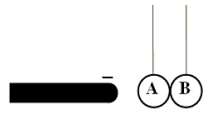

A)
B)
C)
D)
E)
A)
B)
C)
D)
E)

سؤال
سؤال
Four point charges, each of the same magnitude, with varying signs are arranged at the corners of a square as shown.Which of the arrows labeled A, B, C, and D gives the correct direction of the net force that acts on the charge at the upper right corner? 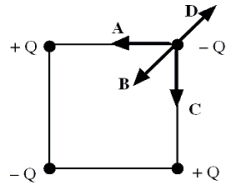
A)A
B)B
C)C
D)D
E)The net force on that charge is zero.
A)A
B)B
C)C
D)D
E)The net force on that charge is zero.
سؤال
سؤال
سؤال
سؤال
سؤال
سؤال
سؤال
Each of three objects has a net charge.Objects A and B attract one another.Objects B and C also attract one another, but objects A and C repel one another.Which one of the following table entries is a possible combination of the signs of the net charges on these three objects? 
A)
B)
C)
D)
E)
A)
B)
C)
D)
E)
سؤال
سؤال
سؤال
Three charges are positioned as indicated in the figure.What are the horizontal and vertical components of the net force exerted on the +15 µC charge by the +11 µC and +13 µC charges? 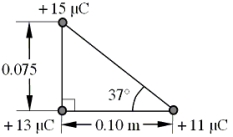

A)
B)
C)
D)
E)
A)
B)
C)
D)
E)
سؤال
سؤال
سؤال
Two uncharged, conducting spheres, A and B, are held at rest on insulating stands and are in contact.A positively charged rod is brought near sphere A as suggested in the figure.While the rod is in place, someone moves sphere B away from A.How will the spheres be charged, if at all? 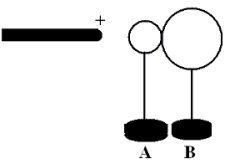

A)
B)
C)
D)
E)
A)
B)
C)
D)
E)
سؤال
سؤال
سؤال
Five styrofoam balls are suspended from insulating threads.Several experiments are performed on the balls; and the following observations are made: 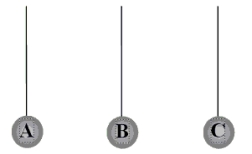
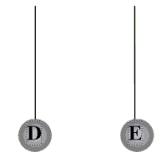
 What are the charges, if any, on each ball?
A)
B)
C)
D)
E)
What are the charges, if any, on each ball? A)
B)
C)
D)
E)
سؤال
سؤال
18-2
Five particles are shot from the left into a region that contains a uniform electric field.The numbered lines show the paths taken by the five particles.A negatively charged particle with a charge -3Q follows path 2 while it moves through this field.Do not consider any effects due to gravity.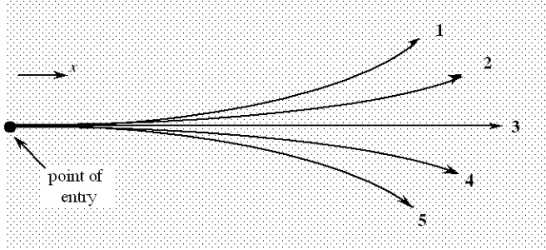
In which direction does the electric field point?
A)toward the top of the page
B)toward the left of the page
C)toward the right of the page
D)toward the bottom of the page
E)out of the page, toward the reader
Five particles are shot from the left into a region that contains a uniform electric field.The numbered lines show the paths taken by the five particles.A negatively charged particle with a charge -3Q follows path 2 while it moves through this field.Do not consider any effects due to gravity.
In which direction does the electric field point?
A)toward the top of the page
B)toward the left of the page
C)toward the right of the page
D)toward the bottom of the page
E)out of the page, toward the reader
سؤال
18-1
The figure shows an equilateral triangle ABC.A positive point charge +q is located at each of the three vertices A, B, and C.Each side of the triangle is of length a.A point charge Q (that may be positive or negative) is placed at the mid-point between B and C.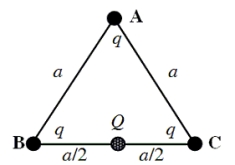
Is it possible to choose the value of Q (that is non-zero) such that the force on Q is zero? Explain why or why not.
A)Yes, because the forces on Q are vectors and three vectors can add to zero.
B)No, because the forces on Q are vectors and three vectors can never add to zero.
C)Yes, because the electric force at the mid-point between B and C is zero whether a charge is placed there or not.
D)No, because the forces on Q due to the charges at B and C point in the same direction.
E)No, because a fourth charge would be needed to cancel the force on Q due to the charge at A.
The figure shows an equilateral triangle ABC.A positive point charge +q is located at each of the three vertices A, B, and C.Each side of the triangle is of length a.A point charge Q (that may be positive or negative) is placed at the mid-point between B and C.
Is it possible to choose the value of Q (that is non-zero) such that the force on Q is zero? Explain why or why not.
A)Yes, because the forces on Q are vectors and three vectors can add to zero.
B)No, because the forces on Q are vectors and three vectors can never add to zero.
C)Yes, because the electric force at the mid-point between B and C is zero whether a charge is placed there or not.
D)No, because the forces on Q due to the charges at B and C point in the same direction.
E)No, because a fourth charge would be needed to cancel the force on Q due to the charge at A.
سؤال
18-2
Five particles are shot from the left into a region that contains a uniform electric field.The numbered lines show the paths taken by the five particles.A negatively charged particle with a charge -3Q follows path 2 while it moves through this field.Do not consider any effects due to gravity.
What is the magnitude of the electric field due to a 6.0 × 10⁻⁹ C charge at a point located 0.025 m from the charge?
A)8.6 × 10² N/C
B)1.2 × 10⁴ N/C
C)1.8 × 10⁵ N/C
D)3.6 × 10⁶ N/C
E)7.2 × 10⁷ N/C
Five particles are shot from the left into a region that contains a uniform electric field.The numbered lines show the paths taken by the five particles.A negatively charged particle with a charge -3Q follows path 2 while it moves through this field.Do not consider any effects due to gravity.
What is the magnitude of the electric field due to a 6.0 × 10⁻⁹ C charge at a point located 0.025 m from the charge?
A)8.6 × 10² N/C
B)1.2 × 10⁴ N/C
C)1.8 × 10⁵ N/C
D)3.6 × 10⁶ N/C
E)7.2 × 10⁷ N/C
سؤال
سؤال
Two particles of the same mass carry charges +3Q and -2Q, respectively.They are shot into a region that contains a uniform electric field as shown.The particles have the same initial velocities in the positive x direction.The lines, numbered 1 through 5, indicate possible paths for the particles.If the electric field points in the negative y direction, what will be the resulting paths for these particles? 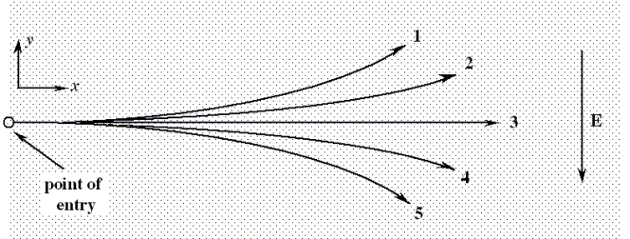
A)path 1 for +3Q and path 4 for -2Q
B)path 3 for +3Q and path 2 for -2Q
C)path 4 for +3Q and path 3 for -2Q
D)path 2 for +3Q and path 5 for -2Q
E)path 5 for +3Q and path 2 for -2Q
A)path 1 for +3Q and path 4 for -2Q
B)path 3 for +3Q and path 2 for -2Q
C)path 4 for +3Q and path 3 for -2Q
D)path 2 for +3Q and path 5 for -2Q
E)path 5 for +3Q and path 2 for -2Q
سؤال
سؤال
At which point (or points) is the electric field zero N/C for the two point charges shown on the x axis? 
A)The electric field is never zero in the vicinity of these charges.
B)The electric field is zero somewhere on the x axis to the left of the +4q charge.
C)The electric field is zero somewhere on the x axis to the right of the -2q charge.
D)The electric field is zero somewhere on the x axis between the two charges, but this point is nearer to the -2q charge.
E)The electric field is zero at two points along the x axis; one such point is to the right of the -2q charge and the other is to the left of the +4q charge.
A)The electric field is never zero in the vicinity of these charges.
B)The electric field is zero somewhere on the x axis to the left of the +4q charge.
C)The electric field is zero somewhere on the x axis to the right of the -2q charge.
D)The electric field is zero somewhere on the x axis between the two charges, but this point is nearer to the -2q charge.
E)The electric field is zero at two points along the x axis; one such point is to the right of the -2q charge and the other is to the left of the +4q charge.
سؤال
An electron traveling horizontally enters a region where a uniform electric field is directed upward.What is the direction of the force exerted on the electron once it has entered the field? 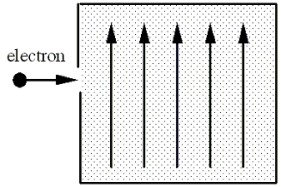
A)to the left
B)to the right
C)upward
D)downward
E)out of the page, toward the reader
A)to the left
B)to the right
C)upward
D)downward
E)out of the page, toward the reader
سؤال
18-2
Five particles are shot from the left into a region that contains a uniform electric field.The numbered lines show the paths taken by the five particles.A negatively charged particle with a charge -3Q follows path 2 while it moves through this field.Do not consider any effects due to gravity.
Which path would be followed by a charge +6Q?
A)path 1
B)path 2
C)path 3
D)path 4
E)path 5
Five particles are shot from the left into a region that contains a uniform electric field.The numbered lines show the paths taken by the five particles.A negatively charged particle with a charge -3Q follows path 2 while it moves through this field.Do not consider any effects due to gravity.
Which path would be followed by a charge +6Q?
A)path 1
B)path 2
C)path 3
D)path 4
E)path 5
سؤال
Four point charges are held fixed at the corners of a square as shown in the figure.Which of the five arrows shown below most accurately shows the direction of the net force on the charge -Q due to the presence of the three other charges? 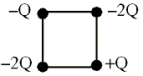
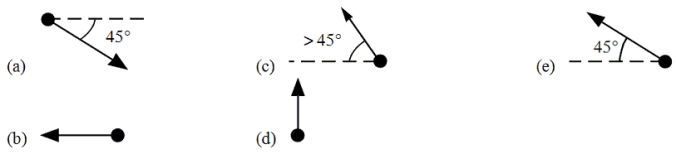
A)a
B)b
C)c
D)d
E)e
A)a
B)b
C)c
D)d
E)e
سؤال
Three charges are located along the x axis as shown in the drawing.The mass of the -1.2 µC is 4.0 × 10⁻⁹ kg.Determine the magnitude and direction of the acceleration of the -1.2 µC charge when it is allowed to move if the other two charges remain fixed. 
A)2 × 10⁵ m/s2, to the right
B)1 × 10⁵ m/s2, to the left
C)7 × 10⁴ m/s2, to the right
D)3 × 10⁵ m/s2, to the left
E)4 × 10⁶ m/s2, to the right
A)2 × 10⁵ m/s2, to the right
B)1 × 10⁵ m/s2, to the left
C)7 × 10⁴ m/s2, to the right
D)3 × 10⁵ m/s2, to the left
E)4 × 10⁶ m/s2, to the right
سؤال
سؤال
In Frame 1, two identical conducting spheres, A and B, carry equal amounts of excess charge that have the same sign.The spheres are separated by a distance d; and sphere A exerts an electrostatic force on sphere B that has a magnitude F.A third sphere, C, which is handled only by an insulating rod, is introduced in Frame 2.Sphere C is identical to A and B except that it is initially uncharged.Sphere C is touched first to sphere A, in Frame 2, and then to sphere B, in Frame 3, and is finally removed in Frame 4. 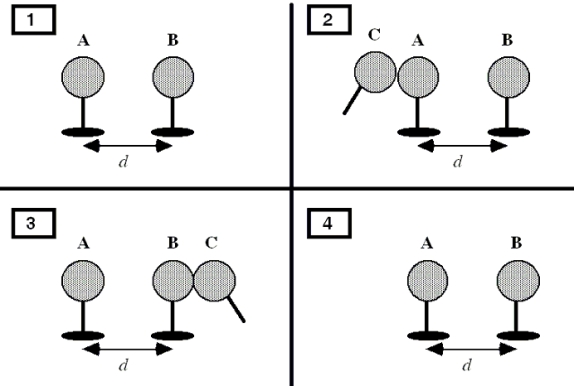 Determine the magnitude of the electrostatic force that sphere A exerts on sphere B in Frame 4.
A)F/2
B)F/3
C)3F/4
D)3F/8
E)zero
Determine the magnitude of the electrostatic force that sphere A exerts on sphere B in Frame 4.A)F/2
B)F/3
C)3F/4
D)3F/8
E)zero
سؤال
18-2
Five particles are shot from the left into a region that contains a uniform electric field.The numbered lines show the paths taken by the five particles.A negatively charged particle with a charge -3Q follows path 2 while it moves through this field.Do not consider any effects due to gravity.
Which path would be followed by a helium atom (an electrically neutral particle)?
A)path 1
B)path 2
C)path 3
D)path 4
E)path 5
Five particles are shot from the left into a region that contains a uniform electric field.The numbered lines show the paths taken by the five particles.A negatively charged particle with a charge -3Q follows path 2 while it moves through this field.Do not consider any effects due to gravity.
Which path would be followed by a helium atom (an electrically neutral particle)?
A)path 1
B)path 2
C)path 3
D)path 4
E)path 5
سؤال
18-3
The figure shows a parallel plate capacitor.The surface charge density on each plate is 8.8 × 10⁻⁸ C/m2.The point P is located 1.0 × 10⁻⁵ m away from the positive plate.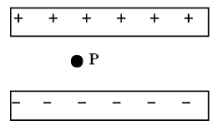
Which one of the following statements concerning the direction of the electric field between the plates is true?
A)It points to the left.
B)It points to the right.
C)It points toward the negative plate.
D)It points toward the positive plate.
E)It points up out of the plane of the page.
The figure shows a parallel plate capacitor.The surface charge density on each plate is 8.8 × 10⁻⁸ C/m2.The point P is located 1.0 × 10⁻⁵ m away from the positive plate.
Which one of the following statements concerning the direction of the electric field between the plates is true?
A)It points to the left.
B)It points to the right.
C)It points toward the negative plate.
D)It points toward the positive plate.
E)It points up out of the plane of the page.
سؤال
سؤال
سؤال
In the figure, point A is a distance L away from a point charge Q.Point B is a distance 4L away from Q.What is the ratio of the electric field at B to that at A, EB/EA? 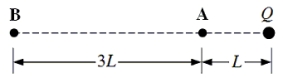
A)1/16
B)1/9
C)1/4
D)1/3
E)This cannot be determined since neither the value of Q nor the length L is specified.
A)1/16
B)1/9
C)1/4
D)1/3
E)This cannot be determined since neither the value of Q nor the length L is specified.
سؤال
A small sphere of mass 2.5 × 10⁻⁵ kg carries a total charge of 6.0 × 10⁻⁸ C.The sphere hangs from a silk thread between two large parallel conducting plates.The excess charge on each plate is equal in magnitude, but opposite in sign.If the thread makes an angle of 30° with the positive plate as shown, what is the magnitude of the charge density on each plate? 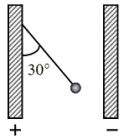
A)2.5 × 10⁻⁹ C/m2
B)5.2 × 10⁻⁹ C/m2
C)1.0 × 10⁻⁹ C/m2
D)2.1 × 10⁻⁸ C/m2
E)4.2 × 10⁻⁸ C/m2
A)2.5 × 10⁻⁹ C/m2
B)5.2 × 10⁻⁹ C/m2
C)1.0 × 10⁻⁹ C/m2
D)2.1 × 10⁻⁸ C/m2
E)4.2 × 10⁻⁸ C/m2
سؤال
Four point charges are placed at the corners of a square as shown in the figure.Each side of the square has length 2.0 m.Determine the magnitude of the electric field at the point P, the center of the square. 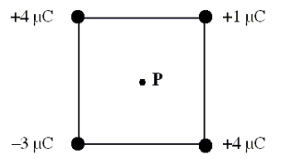
A)2.0 × 10⁻⁶ N/C
B)3.0 × 10⁻⁶ N/C
C)9.0 × 10³ N/C
D)1.8 × 10⁴ N/C
E)2.7 × 10⁴ N/C
A)2.0 × 10⁻⁶ N/C
B)3.0 × 10⁻⁶ N/C
C)9.0 × 10³ N/C
D)1.8 × 10⁴ N/C
E)2.7 × 10⁴ N/C
سؤال
An electric dipole is released from rest in a uniform electric field with the orientation shown.Which entry in the table below correctly describes the net torque and the net force on the dipole? 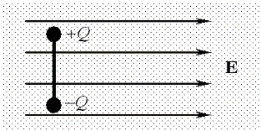

A)
B)
C)
D)
E)
A)
B)
C)
D)
E)
سؤال
سؤال
A solid, conducting sphere of radius a carries an excess charge of +6 µC.This sphere is located at the center of a hollow, conducting sphere with an inner radius of b and an outer radius of c as shown.The hollow sphere also carries a total excess charge of +6 µC.
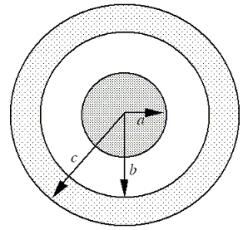
-Determine the excess charge on the outer surface of the outer sphere (a distance c from the center of the system).
A)zero coulombs
B)-6 C
C)+6 C
D)+12 C
E)-12 C
سؤال
A cubical Gaussian surface is placed in a uniform electric field as shown in the figure.The length of each edge of the cube is 1.0 m.The uniform electric field has a magnitude of 5.0 × 10⁸ N/C and passes through the left and right sides of the cube perpendicular to the surface.What is the total electric flux that passes through the cubical Gaussian surface? 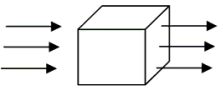
A)5.0 × 10⁸ N.m2/C
B)3.0 × 10⁹ N.m2/C
C)2.5 × 10⁶ N.m2/C
D)1.5 × 10⁷ N.m2/C
E)zero N.m2/C
A)5.0 × 10⁸ N.m2/C
B)3.0 × 10⁹ N.m2/C
C)2.5 × 10⁶ N.m2/C
D)1.5 × 10⁷ N.m2/C
E)zero N.m2/C
سؤال
A helium nucleus is located between the plates of a parallel-plate capacitor as shown.The nucleus has a charge of +2e and a mass of 6.6 × 10⁻²⁷ kg.What is the magnitude of the electric field such that the electric force exactly balances the weight of the helium nucleus so that it remains stationary? 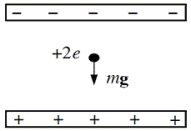
A)4.0 × 10⁻⁷ N/C
B)6.6 × 10⁻²⁶ N/C
C)2.0 × 10⁻⁷ N/C
D)5.0 × 10⁻³ N/C
E)1.4 × 10⁻⁸ N/C
A)4.0 × 10⁻⁷ N/C
B)6.6 × 10⁻²⁶ N/C
C)2.0 × 10⁻⁷ N/C
D)5.0 × 10⁻³ N/C
E)1.4 × 10⁻⁸ N/C
سؤال
سؤال
سؤال
The figure shows the electric field lines in the vicinity of two point charges.Which one of the following statements concerning this situation is true? 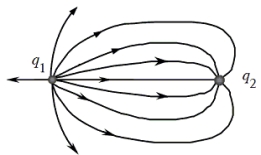
A)q1 is negative and q2 is positive.
B)The magnitude of the ratio (q2/ q1)is less than one.
C)Both q1and q2 have the same sign of charge.
D)The magnitude of the electric field is the same everywhere.
E)The electric field is strongest midway between the charges.
A)q1 is negative and q2 is positive.
B)The magnitude of the ratio (q2/ q1)is less than one.
C)Both q1and q2 have the same sign of charge.
D)The magnitude of the electric field is the same everywhere.
E)The electric field is strongest midway between the charges.
سؤال
سؤال
سؤال
18-4
Two point charges, A and B, lie along a line separated by a distance L.The point x is the midpoint of their separation.
Which combination of charges will yield zero electric field at the point x?
A)+1q and -1q
B)+2q and -3q
C)+1q and -4q
D)-1q and +4q
E)+4q and +4q
Two point charges, A and B, lie along a line separated by a distance L.The point x is the midpoint of their separation.
Which combination of charges will yield zero electric field at the point x?
A)+1q and -1q
B)+2q and -3q
C)+1q and -4q
D)-1q and +4q
E)+4q and +4q
سؤال
سؤال
18-4
Two point charges, A and B, lie along a line separated by a distance L.The point x is the midpoint of their separation.
Which combination of charges would yield the greatest repulsive force between the charges?
A)-2q and -4q
B)+1q and -3q
C)-1q and -4q
D)-2q and +4q
E)+1q and +7q
Two point charges, A and B, lie along a line separated by a distance L.The point x is the midpoint of their separation.
Which combination of charges would yield the greatest repulsive force between the charges?
A)-2q and -4q
B)+1q and -3q
C)-1q and -4q
D)-2q and +4q
E)+1q and +7q
سؤال
A solid, conducting sphere of radius a carries an excess charge of +6 µC.This sphere is located at the center of a hollow, conducting sphere with an inner radius of b and an outer radius of c as shown.The hollow sphere also carries a total excess charge of +6 µC.
-Determine the excess charge on the inner surface of the outer sphere (a distance b from the center of the system).
A)zero coulombs
B)-6 C
C)+6 C
D)+12 C
E)-12 C
سؤال
سؤال
سؤال
A conducting sphere carries a net charge of +6 µC.The sphere is located at the center of a conducting spherical shell that carries a net charge of -2 µC.Determine the excess charge on the outer surface of the spherical shell. 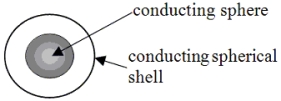
A)-4 µC
B)+4 µC
C)-8 µC
D)+8 µC
E)+6 µC
A)-4 µC
B)+4 µC
C)-8 µC
D)+8 µC
E)+6 µC
سؤال
سؤال
A rigid electric dipole is free to move in the electric field represented in the figure.Which one of the following phrases most accurately describes the initial motion of the dipole if it is released from rest in the position shown? 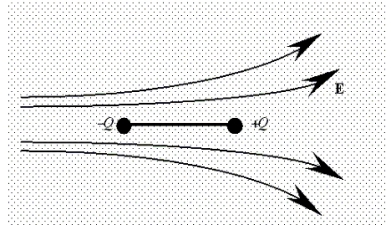
A)It moves to the left.
B)It moves to the right.
C)It does not move at all.
D)It moves toward to the top of the page.
E)It moves toward the bottom of the page.
A)It moves to the left.
B)It moves to the right.
C)It does not move at all.
D)It moves toward to the top of the page.
E)It moves toward the bottom of the page.
سؤال
سؤال
Which one of the following figures shows a qualitatively accurate sketch of the electric field lines in and around this system? 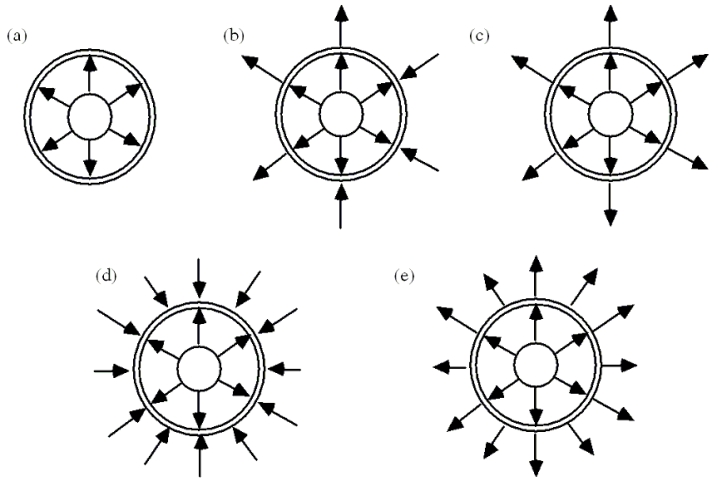
A)a
B)b
C)c
D)d
E)e
A)a
B)b
C)c
D)d
E)e

فتح الحزمة
قم بالتسجيل لفتح البطاقات في هذه المجموعة!
Unlock Deck
Unlock Deck
1/61

العب

ملء الشاشة (f)
Deck 18: Electric Forces and Electric Fields
1
Two uncharged conducting spheres, A and B, are suspended from insulating threads so that they touch each other.While a negatively charged rod is held near, but not touching sphere A, someone moves ball B away from A.How will the spheres be charged, if at all?
A)
B)
C)
D)
E)
A)
B)
C)
D)
E)
2
Consider three identical metal spheres, A, B, and C.Sphere A carries a charge of -2.0 µC; sphere B carries a charge of -6.0 µC; and sphere C carries a charge of +4.0 µC.Spheres A and B are touched together and then separated.Spheres B and C are then touched and separated.Does sphere C end up with an excess or a deficiency of electrons and how many electrons is it?
A)deficiency, 6 × 10¹³
B)excess, 3 × 10¹³
C)excess, 2 × 10¹³
D)deficiency, 3 × 10¹²
E)There is no excess or deficiency of electrons.
A)deficiency, 6 × 10¹³
B)excess, 3 × 10¹³
C)excess, 2 × 10¹³
D)deficiency, 3 × 10¹²
E)There is no excess or deficiency of electrons.
There is no excess or deficiency of electrons.
3
Four point charges, each of the same magnitude, with varying signs are arranged at the corners of a square as shown.Which of the arrows labeled A, B, C, and D gives the correct direction of the net force that acts on the charge at the upper right corner?
A)A
B)B
C)C
D)D
E)The net force on that charge is zero.
A)A
B)B
C)C
D)D
E)The net force on that charge is zero.
B
4
Determine the ratio of the electrostatic force to the gravitational force between a proton and an electron, FE/FG.Note: k = 8.99 × 10⁹ N-m2/C2; G = 6.672 × 10⁻¹¹ N-m2/kg2; me = 9.109 × 10⁻³¹ kg; and mp = 1.672 × 10⁻²⁷ kg.
A)1.24 × 10²³
B)2.52 × 1029
C)1.15 × 1031
D)2.26 × 1039
E)1.42 × 1058
A)1.24 × 10²³
B)2.52 × 1029
C)1.15 × 1031
D)2.26 × 1039
E)1.42 × 1058
فتح الحزمة
افتح القفل للوصول البطاقات البالغ عددها 61 في هذه المجموعة.
فتح الحزمة
k this deck
5
Complete the following statement: When a glass rod is rubbed with silk cloth, the rod becomes positively charged as
A)positive charges are transferred from the silk to the rod.
B)negative charges are transferred from the rod to the silk.
C)positive charges are created on the surface of the rod.
D)negative charges are transferred from the silk to the rod.
E)positive charges are transferred from the rod to the silk.
A)positive charges are transferred from the silk to the rod.
B)negative charges are transferred from the rod to the silk.
C)positive charges are created on the surface of the rod.
D)negative charges are transferred from the silk to the rod.
E)positive charges are transferred from the rod to the silk.
فتح الحزمة
افتح القفل للوصول البطاقات البالغ عددها 61 في هذه المجموعة.
فتح الحزمة
k this deck
6
A charged conductor is brought near an uncharged insulator.Which one of the following statements is true?
A)Both objects will repel each other.
B)Both objects will attract each other.
C)Neither object exerts an electrical force on the other.
D)The objects will repel each other only if the conductor has a negative charge.
E)The objects will attract each other only if the conductor has a positive charge.
A)Both objects will repel each other.
B)Both objects will attract each other.
C)Neither object exerts an electrical force on the other.
D)The objects will repel each other only if the conductor has a negative charge.
E)The objects will attract each other only if the conductor has a positive charge.
فتح الحزمة
افتح القفل للوصول البطاقات البالغ عددها 61 في هذه المجموعة.
فتح الحزمة
k this deck
7
One mole of a substance contains 6.02 × 10²³ protons and an equal number of electrons.If the protons could somehow be separated from the electrons and placed in very small, individual containers separated by a million meters, what would be the magnitude of the electrostatic force exerted by one box on the other?
A)8.7 × 10³ N
B)9.5 × 10⁴ N
C)2.2 × 10⁵ N
D)8.4 × 10⁷ N
E)1.6 × 10⁸ N
A)8.7 × 10³ N
B)9.5 × 10⁴ N
C)2.2 × 10⁵ N
D)8.4 × 10⁷ N
E)1.6 × 10⁸ N
فتح الحزمة
افتح القفل للوصول البطاقات البالغ عددها 61 في هذه المجموعة.
فتح الحزمة
k this deck
8
Two charged particles A and B are located near one another.Both the magnitude and direction of the force that particle A exerts on particle B is independent of
A)the sign of charge B.
B)the sign of charge A.
C)the distance between A and B.
D)the magnitude of the charge on B.
E)The magnitude and direction of the force are dependent on all of the above choices.
A)the sign of charge B.
B)the sign of charge A.
C)the distance between A and B.
D)the magnitude of the charge on B.
E)The magnitude and direction of the force are dependent on all of the above choices.
فتح الحزمة
افتح القفل للوصول البطاقات البالغ عددها 61 في هذه المجموعة.
فتح الحزمة
k this deck
9
An aluminum nail has an excess charge of +3.2 µC.How many electrons must be added to the nail to make it electrically neutral?
A)2.0 × 10¹³
B)2.0 × 10¹⁹
C)3.2 × 10¹⁶
D)3.2 × 10⁶
E)5.0 × 10⁻¹⁴
A)2.0 × 10¹³
B)2.0 × 10¹⁹
C)3.2 × 10¹⁶
D)3.2 × 10⁶
E)5.0 × 10⁻¹⁴
فتح الحزمة
افتح القفل للوصول البطاقات البالغ عددها 61 في هذه المجموعة.
فتح الحزمة
k this deck
10
Each of three objects has a net charge.Objects A and B attract one another.Objects B and C also attract one another, but objects A and C repel one another.Which one of the following table entries is a possible combination of the signs of the net charges on these three objects?
A)
B)
C)
D)
E)
A)
B)
C)
D)
E)
فتح الحزمة
افتح القفل للوصول البطاقات البالغ عددها 61 في هذه المجموعة.
فتح الحزمة
k this deck
11
A -4.0-µC charge is located 0.45 m to the left of a +6.0-µC charge.What is the magnitude and direction of the electrostatic force on the positive charge?
A)2.2 N, to the right
B)2.2 N, to the left
C)1.1 N, to the right
D)1.1 N, to the left
E)4.4 N, to the right
A)2.2 N, to the right
B)2.2 N, to the left
C)1.1 N, to the right
D)1.1 N, to the left
E)4.4 N, to the right
فتح الحزمة
افتح القفل للوصول البطاقات البالغ عددها 61 في هذه المجموعة.
فتح الحزمة
k this deck
12
Two positive point charges Q and 2Q are separated by a distance R.If the charge Q experiences a force of magnitude F when the separation is R, what is the magnitude of the force on the charge 2Q when the separation is 2R ?
A)F/4
B)F/2
C)F
D)2F
E)4F
A)F/4
B)F/2
C)F
D)2F
E)4F
فتح الحزمة
افتح القفل للوصول البطاقات البالغ عددها 61 في هذه المجموعة.
فتح الحزمة
k this deck
13
Three charges are positioned as indicated in the figure.What are the horizontal and vertical components of the net force exerted on the +15 µC charge by the +11 µC and +13 µC charges?
A)
B)
C)
D)
E)
A)
B)
C)
D)
E)
فتح الحزمة
افتح القفل للوصول البطاقات البالغ عددها 61 في هذه المجموعة.
فتح الحزمة
k this deck
14
A conducting sphere has a net charge of -6.4 × 10⁻¹⁷ C.What is the approximate number of excess electrons on the sphere?
A)100
B)200
C)300
D)400
E)500
A)100
B)200
C)300
D)400
E)500
فتح الحزمة
افتح القفل للوصول البطاقات البالغ عددها 61 في هذه المجموعة.
فتح الحزمة
k this deck
15
Which one of the following statements best explains why tiny bits of paper are attracted to a charged rubber rod?
A)Paper is naturally a positive material.
B)Paper is naturally a negative material.
C)The paper becomes electrically polarized by induction.
D)Rubber and paper always attract each other.
E)The paper acquires a net positive charge by induction.
A)Paper is naturally a positive material.
B)Paper is naturally a negative material.
C)The paper becomes electrically polarized by induction.
D)Rubber and paper always attract each other.
E)The paper acquires a net positive charge by induction.
فتح الحزمة
افتح القفل للوصول البطاقات البالغ عددها 61 في هذه المجموعة.
فتح الحزمة
k this deck
16
Two uncharged, conducting spheres, A and B, are held at rest on insulating stands and are in contact.A positively charged rod is brought near sphere A as suggested in the figure.While the rod is in place, someone moves sphere B away from A.How will the spheres be charged, if at all?
A)
B)
C)
D)
E)
A)
B)
C)
D)
E)
فتح الحزمة
افتح القفل للوصول البطاقات البالغ عددها 61 في هذه المجموعة.
فتح الحزمة
k this deck
17
A charge Q exerts a 1.2 N force on another charge q.If the distance between the charges is doubled, what is the magnitude of the force exerted on Q by q?
A)0.30 N
B)0.60 N
C)2.4 N
D)3.6 N
E)4.8 N
A)0.30 N
B)0.60 N
C)2.4 N
D)3.6 N
E)4.8 N
فتح الحزمة
افتح القفل للوصول البطاقات البالغ عددها 61 في هذه المجموعة.
فتح الحزمة
k this deck
18
Complete the following statement: When an ebonite rod is rubbed with animal fur, the rod becomes negatively charged as
A)positive charges are transferred from the fur to the rod.
B)negative charges are transferred from the rod to the fur.
C)negative charges are created on the surface of the rod.
D)negative charges are transferred from the fur to the rod.
E)positive charges are transferred from the rod to the fur.
A)positive charges are transferred from the fur to the rod.
B)negative charges are transferred from the rod to the fur.
C)negative charges are created on the surface of the rod.
D)negative charges are transferred from the fur to the rod.
E)positive charges are transferred from the rod to the fur.
فتح الحزمة
افتح القفل للوصول البطاقات البالغ عددها 61 في هذه المجموعة.
فتح الحزمة
k this deck
19
Five styrofoam balls are suspended from insulating threads.Several experiments are performed on the balls; and the following observations are made: What are the charges, if any, on each ball?
A)
B)
C)
D)
E)
What are the charges, if any, on each ball? A)
B)
C)
D)
E)
فتح الحزمة
افتح القفل للوصول البطاقات البالغ عددها 61 في هذه المجموعة.
فتح الحزمة
k this deck
20
At what separation will two charges, each of magnitude 6.0 C, exert a force of 0.70 N on each other?
A)1.1 × 10⁻⁵ m
B)0.23 m
C)0.48 m
D)0.68 m
E)1.4 m
A)1.1 × 10⁻⁵ m
B)0.23 m
C)0.48 m
D)0.68 m
E)1.4 m
فتح الحزمة
افتح القفل للوصول البطاقات البالغ عددها 61 في هذه المجموعة.
فتح الحزمة
k this deck
21
18-2
Five particles are shot from the left into a region that contains a uniform electric field.The numbered lines show the paths taken by the five particles.A negatively charged particle with a charge -3Q follows path 2 while it moves through this field.Do not consider any effects due to gravity.
In which direction does the electric field point?
A)toward the top of the page
B)toward the left of the page
C)toward the right of the page
D)toward the bottom of the page
E)out of the page, toward the reader
Five particles are shot from the left into a region that contains a uniform electric field.The numbered lines show the paths taken by the five particles.A negatively charged particle with a charge -3Q follows path 2 while it moves through this field.Do not consider any effects due to gravity.
In which direction does the electric field point?
A)toward the top of the page
B)toward the left of the page
C)toward the right of the page
D)toward the bottom of the page
E)out of the page, toward the reader
فتح الحزمة
افتح القفل للوصول البطاقات البالغ عددها 61 في هذه المجموعة.
فتح الحزمة
k this deck
22
18-1
The figure shows an equilateral triangle ABC.A positive point charge +q is located at each of the three vertices A, B, and C.Each side of the triangle is of length a.A point charge Q (that may be positive or negative) is placed at the mid-point between B and C.
Is it possible to choose the value of Q (that is non-zero) such that the force on Q is zero? Explain why or why not.
A)Yes, because the forces on Q are vectors and three vectors can add to zero.
B)No, because the forces on Q are vectors and three vectors can never add to zero.
C)Yes, because the electric force at the mid-point between B and C is zero whether a charge is placed there or not.
D)No, because the forces on Q due to the charges at B and C point in the same direction.
E)No, because a fourth charge would be needed to cancel the force on Q due to the charge at A.
The figure shows an equilateral triangle ABC.A positive point charge +q is located at each of the three vertices A, B, and C.Each side of the triangle is of length a.A point charge Q (that may be positive or negative) is placed at the mid-point between B and C.
Is it possible to choose the value of Q (that is non-zero) such that the force on Q is zero? Explain why or why not.
A)Yes, because the forces on Q are vectors and three vectors can add to zero.
B)No, because the forces on Q are vectors and three vectors can never add to zero.
C)Yes, because the electric force at the mid-point between B and C is zero whether a charge is placed there or not.
D)No, because the forces on Q due to the charges at B and C point in the same direction.
E)No, because a fourth charge would be needed to cancel the force on Q due to the charge at A.
فتح الحزمة
افتح القفل للوصول البطاقات البالغ عددها 61 في هذه المجموعة.
فتح الحزمة
k this deck
23
18-2
Five particles are shot from the left into a region that contains a uniform electric field.The numbered lines show the paths taken by the five particles.A negatively charged particle with a charge -3Q follows path 2 while it moves through this field.Do not consider any effects due to gravity.
What is the magnitude of the electric field due to a 6.0 × 10⁻⁹ C charge at a point located 0.025 m from the charge?
A)8.6 × 10² N/C
B)1.2 × 10⁴ N/C
C)1.8 × 10⁵ N/C
D)3.6 × 10⁶ N/C
E)7.2 × 10⁷ N/C
Five particles are shot from the left into a region that contains a uniform electric field.The numbered lines show the paths taken by the five particles.A negatively charged particle with a charge -3Q follows path 2 while it moves through this field.Do not consider any effects due to gravity.
What is the magnitude of the electric field due to a 6.0 × 10⁻⁹ C charge at a point located 0.025 m from the charge?
A)8.6 × 10² N/C
B)1.2 × 10⁴ N/C
C)1.8 × 10⁵ N/C
D)3.6 × 10⁶ N/C
E)7.2 × 10⁷ N/C
فتح الحزمة
افتح القفل للوصول البطاقات البالغ عددها 61 في هذه المجموعة.
فتح الحزمة
k this deck
24
Which one of the following statements is true concerning the strength of the electric field between two oppositely charged parallel plates?
A)It is zero midway between the plates.
B)It is a maximum midway between the plates.
C)It is a maximum near the positively charged plate.
D)It is a maximum near the negatively charged plate.
E)It is constant between the plates except near the edges.
A)It is zero midway between the plates.
B)It is a maximum midway between the plates.
C)It is a maximum near the positively charged plate.
D)It is a maximum near the negatively charged plate.
E)It is constant between the plates except near the edges.
فتح الحزمة
افتح القفل للوصول البطاقات البالغ عددها 61 في هذه المجموعة.
فتح الحزمة
k this deck
25
Two particles of the same mass carry charges +3Q and -2Q, respectively.They are shot into a region that contains a uniform electric field as shown.The particles have the same initial velocities in the positive x direction.The lines, numbered 1 through 5, indicate possible paths for the particles.If the electric field points in the negative y direction, what will be the resulting paths for these particles?
A)path 1 for +3Q and path 4 for -2Q
B)path 3 for +3Q and path 2 for -2Q
C)path 4 for +3Q and path 3 for -2Q
D)path 2 for +3Q and path 5 for -2Q
E)path 5 for +3Q and path 2 for -2Q
A)path 1 for +3Q and path 4 for -2Q
B)path 3 for +3Q and path 2 for -2Q
C)path 4 for +3Q and path 3 for -2Q
D)path 2 for +3Q and path 5 for -2Q
E)path 5 for +3Q and path 2 for -2Q
فتح الحزمة
افتح القفل للوصول البطاقات البالغ عددها 61 في هذه المجموعة.
فتح الحزمة
k this deck
26
If a +2.0 × 10⁻⁵ C point charge is placed at P, what is the force exerted on it?
A)0.2 N, toward the negative plate
B)0.2 N, toward the positive plate
C)5 × 10⁴ N, toward the positive plate
D)5 × 10⁴ N, toward the negative plate
E)5 × 10⁴ N, into the plane of the page
A)0.2 N, toward the negative plate
B)0.2 N, toward the positive plate
C)5 × 10⁴ N, toward the positive plate
D)5 × 10⁴ N, toward the negative plate
E)5 × 10⁴ N, into the plane of the page
فتح الحزمة
افتح القفل للوصول البطاقات البالغ عددها 61 في هذه المجموعة.
فتح الحزمة
k this deck
27
At which point (or points) is the electric field zero N/C for the two point charges shown on the x axis?
A)The electric field is never zero in the vicinity of these charges.
B)The electric field is zero somewhere on the x axis to the left of the +4q charge.
C)The electric field is zero somewhere on the x axis to the right of the -2q charge.
D)The electric field is zero somewhere on the x axis between the two charges, but this point is nearer to the -2q charge.
E)The electric field is zero at two points along the x axis; one such point is to the right of the -2q charge and the other is to the left of the +4q charge.
A)The electric field is never zero in the vicinity of these charges.
B)The electric field is zero somewhere on the x axis to the left of the +4q charge.
C)The electric field is zero somewhere on the x axis to the right of the -2q charge.
D)The electric field is zero somewhere on the x axis between the two charges, but this point is nearer to the -2q charge.
E)The electric field is zero at two points along the x axis; one such point is to the right of the -2q charge and the other is to the left of the +4q charge.
فتح الحزمة
افتح القفل للوصول البطاقات البالغ عددها 61 في هذه المجموعة.
فتح الحزمة
k this deck
28
An electron traveling horizontally enters a region where a uniform electric field is directed upward.What is the direction of the force exerted on the electron once it has entered the field?
A)to the left
B)to the right
C)upward
D)downward
E)out of the page, toward the reader
A)to the left
B)to the right
C)upward
D)downward
E)out of the page, toward the reader
فتح الحزمة
افتح القفل للوصول البطاقات البالغ عددها 61 في هذه المجموعة.
فتح الحزمة
k this deck
29
18-2
Five particles are shot from the left into a region that contains a uniform electric field.The numbered lines show the paths taken by the five particles.A negatively charged particle with a charge -3Q follows path 2 while it moves through this field.Do not consider any effects due to gravity.
Which path would be followed by a charge +6Q?
A)path 1
B)path 2
C)path 3
D)path 4
E)path 5
Five particles are shot from the left into a region that contains a uniform electric field.The numbered lines show the paths taken by the five particles.A negatively charged particle with a charge -3Q follows path 2 while it moves through this field.Do not consider any effects due to gravity.
Which path would be followed by a charge +6Q?
A)path 1
B)path 2
C)path 3
D)path 4
E)path 5
فتح الحزمة
افتح القفل للوصول البطاقات البالغ عددها 61 في هذه المجموعة.
فتح الحزمة
k this deck
30
Four point charges are held fixed at the corners of a square as shown in the figure.Which of the five arrows shown below most accurately shows the direction of the net force on the charge -Q due to the presence of the three other charges?
A)a
B)b
C)c
D)d
E)e
A)a
B)b
C)c
D)d
E)e
فتح الحزمة
افتح القفل للوصول البطاقات البالغ عددها 61 في هذه المجموعة.
فتح الحزمة
k this deck
31
Three charges are located along the x axis as shown in the drawing.The mass of the -1.2 µC is 4.0 × 10⁻⁹ kg.Determine the magnitude and direction of the acceleration of the -1.2 µC charge when it is allowed to move if the other two charges remain fixed.
A)2 × 10⁵ m/s2, to the right
B)1 × 10⁵ m/s2, to the left
C)7 × 10⁴ m/s2, to the right
D)3 × 10⁵ m/s2, to the left
E)4 × 10⁶ m/s2, to the right
A)2 × 10⁵ m/s2, to the right
B)1 × 10⁵ m/s2, to the left
C)7 × 10⁴ m/s2, to the right
D)3 × 10⁵ m/s2, to the left
E)4 × 10⁶ m/s2, to the right
فتح الحزمة
افتح القفل للوصول البطاقات البالغ عددها 61 في هذه المجموعة.
فتح الحزمة
k this deck
32
Complete the following statement: The magnitude of the electric field at a point in space does not depend upon
A)the distance from the charge causing the field.
B)the sign of the charge causing the field.
C)the magnitude of the charge causing the field.
D)the force that a unit positive charge will experience at that point.
E)the force that a unit negative charge will experience at that point.
A)the distance from the charge causing the field.
B)the sign of the charge causing the field.
C)the magnitude of the charge causing the field.
D)the force that a unit positive charge will experience at that point.
E)the force that a unit negative charge will experience at that point.
فتح الحزمة
افتح القفل للوصول البطاقات البالغ عددها 61 في هذه المجموعة.
فتح الحزمة
k this deck
33
In Frame 1, two identical conducting spheres, A and B, carry equal amounts of excess charge that have the same sign.The spheres are separated by a distance d; and sphere A exerts an electrostatic force on sphere B that has a magnitude F.A third sphere, C, which is handled only by an insulating rod, is introduced in Frame 2.Sphere C is identical to A and B except that it is initially uncharged.Sphere C is touched first to sphere A, in Frame 2, and then to sphere B, in Frame 3, and is finally removed in Frame 4. Determine the magnitude of the electrostatic force that sphere A exerts on sphere B in Frame 4.
A)F/2
B)F/3
C)3F/4
D)3F/8
E)zero
Determine the magnitude of the electrostatic force that sphere A exerts on sphere B in Frame 4.A)F/2
B)F/3
C)3F/4
D)3F/8
E)zero
فتح الحزمة
افتح القفل للوصول البطاقات البالغ عددها 61 في هذه المجموعة.
فتح الحزمة
k this deck
34
18-2
Five particles are shot from the left into a region that contains a uniform electric field.The numbered lines show the paths taken by the five particles.A negatively charged particle with a charge -3Q follows path 2 while it moves through this field.Do not consider any effects due to gravity.
Which path would be followed by a helium atom (an electrically neutral particle)?
A)path 1
B)path 2
C)path 3
D)path 4
E)path 5
Five particles are shot from the left into a region that contains a uniform electric field.The numbered lines show the paths taken by the five particles.A negatively charged particle with a charge -3Q follows path 2 while it moves through this field.Do not consider any effects due to gravity.
Which path would be followed by a helium atom (an electrically neutral particle)?
A)path 1
B)path 2
C)path 3
D)path 4
E)path 5
فتح الحزمة
افتح القفل للوصول البطاقات البالغ عددها 61 في هذه المجموعة.
فتح الحزمة
k this deck
35
18-3
The figure shows a parallel plate capacitor.The surface charge density on each plate is 8.8 × 10⁻⁸ C/m2.The point P is located 1.0 × 10⁻⁵ m away from the positive plate.
Which one of the following statements concerning the direction of the electric field between the plates is true?
A)It points to the left.
B)It points to the right.
C)It points toward the negative plate.
D)It points toward the positive plate.
E)It points up out of the plane of the page.
The figure shows a parallel plate capacitor.The surface charge density on each plate is 8.8 × 10⁻⁸ C/m2.The point P is located 1.0 × 10⁻⁵ m away from the positive plate.
Which one of the following statements concerning the direction of the electric field between the plates is true?
A)It points to the left.
B)It points to the right.
C)It points toward the negative plate.
D)It points toward the positive plate.
E)It points up out of the plane of the page.
فتح الحزمة
افتح القفل للوصول البطاقات البالغ عددها 61 في هذه المجموعة.
فتح الحزمة
k this deck
36
Which one of the following statements is true concerning the magnitude of the electric field at a point in space?
A)It is a measure of the total charge on the object.
B)It is a measure of the electric force on any charged object.
C)It is a measure of the ratio of the charge on an object to its mass.
D)It is a measure of the electric force per unit mass on a test charge.
E)It is a measure of the electric force per unit charge on a test charge.
A)It is a measure of the total charge on the object.
B)It is a measure of the electric force on any charged object.
C)It is a measure of the ratio of the charge on an object to its mass.
D)It is a measure of the electric force per unit mass on a test charge.
E)It is a measure of the electric force per unit charge on a test charge.
فتح الحزمة
افتح القفل للوصول البطاقات البالغ عددها 61 في هذه المجموعة.
فتح الحزمة
k this deck
37
What is the magnitude of the electric field at the point P?
A)8.8 N/C
B)88 N/C
C)1.0 × 10² N/C
D)8.8 × 10² N/C
E)9.9 × 10³ N/C
A)8.8 N/C
B)88 N/C
C)1.0 × 10² N/C
D)8.8 × 10² N/C
E)9.9 × 10³ N/C
فتح الحزمة
افتح القفل للوصول البطاقات البالغ عددها 61 في هذه المجموعة.
فتح الحزمة
k this deck
38
In the figure, point A is a distance L away from a point charge Q.Point B is a distance 4L away from Q.What is the ratio of the electric field at B to that at A, EB/EA?
A)1/16
B)1/9
C)1/4
D)1/3
E)This cannot be determined since neither the value of Q nor the length L is specified.
A)1/16
B)1/9
C)1/4
D)1/3
E)This cannot be determined since neither the value of Q nor the length L is specified.
فتح الحزمة
افتح القفل للوصول البطاقات البالغ عددها 61 في هذه المجموعة.
فتح الحزمة
k this deck
39
A small sphere of mass 2.5 × 10⁻⁵ kg carries a total charge of 6.0 × 10⁻⁸ C.The sphere hangs from a silk thread between two large parallel conducting plates.The excess charge on each plate is equal in magnitude, but opposite in sign.If the thread makes an angle of 30° with the positive plate as shown, what is the magnitude of the charge density on each plate?
A)2.5 × 10⁻⁹ C/m2
B)5.2 × 10⁻⁹ C/m2
C)1.0 × 10⁻⁹ C/m2
D)2.1 × 10⁻⁸ C/m2
E)4.2 × 10⁻⁸ C/m2
A)2.5 × 10⁻⁹ C/m2
B)5.2 × 10⁻⁹ C/m2
C)1.0 × 10⁻⁹ C/m2
D)2.1 × 10⁻⁸ C/m2
E)4.2 × 10⁻⁸ C/m2
فتح الحزمة
افتح القفل للوصول البطاقات البالغ عددها 61 في هذه المجموعة.
فتح الحزمة
k this deck
40
Four point charges are placed at the corners of a square as shown in the figure.Each side of the square has length 2.0 m.Determine the magnitude of the electric field at the point P, the center of the square.
A)2.0 × 10⁻⁶ N/C
B)3.0 × 10⁻⁶ N/C
C)9.0 × 10³ N/C
D)1.8 × 10⁴ N/C
E)2.7 × 10⁴ N/C
A)2.0 × 10⁻⁶ N/C
B)3.0 × 10⁻⁶ N/C
C)9.0 × 10³ N/C
D)1.8 × 10⁴ N/C
E)2.7 × 10⁴ N/C
فتح الحزمة
افتح القفل للوصول البطاقات البالغ عددها 61 في هذه المجموعة.
فتح الحزمة
k this deck
41
An electric dipole is released from rest in a uniform electric field with the orientation shown.Which entry in the table below correctly describes the net torque and the net force on the dipole?
A)
B)
C)
D)
E)
A)
B)
C)
D)
E)
فتح الحزمة
افتح القفل للوصول البطاقات البالغ عددها 61 في هذه المجموعة.
فتح الحزمة
k this deck
42
Two identical conducting spheres carry charges of +5.0 C and -1.0 C, respectively.The centers of the spheres are initially separated by a distance L.The two spheres are brought together so that they are in contact.The spheres are then returned to their original separation L.What is the ratio of the magnitude of the electric force on either sphere after the spheres are touched to that before they were touched?
A)1/1
B)4/5
C)9/5
D)5/1
E)4/9
A)1/1
B)4/5
C)9/5
D)5/1
E)4/9
فتح الحزمة
افتح القفل للوصول البطاقات البالغ عددها 61 في هذه المجموعة.
فتح الحزمة
k this deck
43
A solid, conducting sphere of radius a carries an excess charge of +6 µC.This sphere is located at the center of a hollow, conducting sphere with an inner radius of b and an outer radius of c as shown.The hollow sphere also carries a total excess charge of +6 µC.
-Determine the excess charge on the outer surface of the outer sphere (a distance c from the center of the system).
A)zero coulombs
B)-6 C
C)+6 C
D)+12 C
E)-12 C
فتح الحزمة
افتح القفل للوصول البطاقات البالغ عددها 61 في هذه المجموعة.
فتح الحزمة
k this deck
44
A cubical Gaussian surface is placed in a uniform electric field as shown in the figure.The length of each edge of the cube is 1.0 m.The uniform electric field has a magnitude of 5.0 × 10⁸ N/C and passes through the left and right sides of the cube perpendicular to the surface.What is the total electric flux that passes through the cubical Gaussian surface?
A)5.0 × 10⁸ N.m2/C
B)3.0 × 10⁹ N.m2/C
C)2.5 × 10⁶ N.m2/C
D)1.5 × 10⁷ N.m2/C
E)zero N.m2/C
A)5.0 × 10⁸ N.m2/C
B)3.0 × 10⁹ N.m2/C
C)2.5 × 10⁶ N.m2/C
D)1.5 × 10⁷ N.m2/C
E)zero N.m2/C
فتح الحزمة
افتح القفل للوصول البطاقات البالغ عددها 61 في هذه المجموعة.
فتح الحزمة
k this deck
45
A helium nucleus is located between the plates of a parallel-plate capacitor as shown.The nucleus has a charge of +2e and a mass of 6.6 × 10⁻²⁷ kg.What is the magnitude of the electric field such that the electric force exactly balances the weight of the helium nucleus so that it remains stationary?
A)4.0 × 10⁻⁷ N/C
B)6.6 × 10⁻²⁶ N/C
C)2.0 × 10⁻⁷ N/C
D)5.0 × 10⁻³ N/C
E)1.4 × 10⁻⁸ N/C
A)4.0 × 10⁻⁷ N/C
B)6.6 × 10⁻²⁶ N/C
C)2.0 × 10⁻⁷ N/C
D)5.0 × 10⁻³ N/C
E)1.4 × 10⁻⁸ N/C
فتح الحزمة
افتح القفل للوصول البطاقات البالغ عددها 61 في هذه المجموعة.
فتح الحزمة
k this deck
46
The magnitude of the electric field at a distance of two meters from a negative point charge is E.What is the magnitude of the electric field at the same location if the magnitude of the charge is doubled?
A)E/4
B)E/2
C)E
D)2E
E)4E
A)E/4
B)E/2
C)E
D)2E
E)4E
فتح الحزمة
افتح القفل للوصول البطاقات البالغ عددها 61 في هذه المجموعة.
فتح الحزمة
k this deck
47
What is the magnitude and direction of the electric force on a -3.0 µC charge at a point where the electric field is 2800 N/C and is directed along the +y axis.
A)0.018 N, -y direction
B)0.012 N, +y direction
C)0.0084 N, -y direction
D)0.0056 N, +y direction
E)0.022 N, +x direction
A)0.018 N, -y direction
B)0.012 N, +y direction
C)0.0084 N, -y direction
D)0.0056 N, +y direction
E)0.022 N, +x direction
فتح الحزمة
افتح القفل للوصول البطاقات البالغ عددها 61 في هذه المجموعة.
فتح الحزمة
k this deck
48
The figure shows the electric field lines in the vicinity of two point charges.Which one of the following statements concerning this situation is true?
A)q1 is negative and q2 is positive.
B)The magnitude of the ratio (q2/ q1)is less than one.
C)Both q1and q2 have the same sign of charge.
D)The magnitude of the electric field is the same everywhere.
E)The electric field is strongest midway between the charges.
A)q1 is negative and q2 is positive.
B)The magnitude of the ratio (q2/ q1)is less than one.
C)Both q1and q2 have the same sign of charge.
D)The magnitude of the electric field is the same everywhere.
E)The electric field is strongest midway between the charges.
فتح الحزمة
افتح القفل للوصول البطاقات البالغ عددها 61 في هذه المجموعة.
فتح الحزمة
k this deck
49
A circular loop of wire with a diameter of 0.626 m is rotated in a uniform electric field to a position where the electric flux through the loop is a maximum.At this position, the electric flux is 7.50 × 10⁵ N.m2/C.Determine the magnitude of the electric field.
A)8.88 × 10⁵ N/C
B)1.07 × 10⁶ N/C
C)2.44 × 10⁶ N/C
D)4.24 × 10⁶ N/C
E)6.00 × 10⁶ N/C
A)8.88 × 10⁵ N/C
B)1.07 × 10⁶ N/C
C)2.44 × 10⁶ N/C
D)4.24 × 10⁶ N/C
E)6.00 × 10⁶ N/C
فتح الحزمة
افتح القفل للوصول البطاقات البالغ عددها 61 في هذه المجموعة.
فتح الحزمة
k this deck
50
Which one of the following statements is true concerning the spacing of the electric field lines in the vicinity of two point charges of equal magnitude and opposite sign?
A)The spacing indicates the direction of the electric field.
B)The spacing does not depend on the magnitude of the charges.
C)The spacing is large when the magnitude of the charges is large.
D)The spacing indicates the relative magnitude of the electric field.
E)The spacing is small when the magnitude of the charges is small.
A)The spacing indicates the direction of the electric field.
B)The spacing does not depend on the magnitude of the charges.
C)The spacing is large when the magnitude of the charges is large.
D)The spacing indicates the relative magnitude of the electric field.
E)The spacing is small when the magnitude of the charges is small.
فتح الحزمة
افتح القفل للوصول البطاقات البالغ عددها 61 في هذه المجموعة.
فتح الحزمة
k this deck
51
18-4
Two point charges, A and B, lie along a line separated by a distance L.The point x is the midpoint of their separation.
Which combination of charges will yield zero electric field at the point x?
A)+1q and -1q
B)+2q and -3q
C)+1q and -4q
D)-1q and +4q
E)+4q and +4q
Two point charges, A and B, lie along a line separated by a distance L.The point x is the midpoint of their separation.
Which combination of charges will yield zero electric field at the point x?
A)+1q and -1q
B)+2q and -3q
C)+1q and -4q
D)-1q and +4q
E)+4q and +4q
فتح الحزمة
افتح القفل للوصول البطاقات البالغ عددها 61 في هذه المجموعة.
فتح الحزمة
k this deck
52
Which one of the following statements is true concerning the electrostatic charge on a conductor?
A)The charge is uniformly distributed throughout the volume.
B)The charge is confined to the surface and is uniformly distributed.
C)Most of the charge is on the outer surface, but it is not uniformly distributed.
D)The charge is entirely on the surface and it is distributed according to the shape of the object.
E)The charge is dispersed throughout the volume of the object and distributed according to the object's shape.
A)The charge is uniformly distributed throughout the volume.
B)The charge is confined to the surface and is uniformly distributed.
C)Most of the charge is on the outer surface, but it is not uniformly distributed.
D)The charge is entirely on the surface and it is distributed according to the shape of the object.
E)The charge is dispersed throughout the volume of the object and distributed according to the object's shape.
فتح الحزمة
افتح القفل للوصول البطاقات البالغ عددها 61 في هذه المجموعة.
فتح الحزمة
k this deck
53
18-4
Two point charges, A and B, lie along a line separated by a distance L.The point x is the midpoint of their separation.
Which combination of charges would yield the greatest repulsive force between the charges?
A)-2q and -4q
B)+1q and -3q
C)-1q and -4q
D)-2q and +4q
E)+1q and +7q
Two point charges, A and B, lie along a line separated by a distance L.The point x is the midpoint of their separation.
Which combination of charges would yield the greatest repulsive force between the charges?
A)-2q and -4q
B)+1q and -3q
C)-1q and -4q
D)-2q and +4q
E)+1q and +7q
فتح الحزمة
افتح القفل للوصول البطاقات البالغ عددها 61 في هذه المجموعة.
فتح الحزمة
k this deck
54
A solid, conducting sphere of radius a carries an excess charge of +6 µC.This sphere is located at the center of a hollow, conducting sphere with an inner radius of b and an outer radius of c as shown.The hollow sphere also carries a total excess charge of +6 µC.
-Determine the excess charge on the inner surface of the outer sphere (a distance b from the center of the system).
A)zero coulombs
B)-6 C
C)+6 C
D)+12 C
E)-12 C
فتح الحزمة
افتح القفل للوصول البطاقات البالغ عددها 61 في هذه المجموعة.
فتح الحزمة
k this deck
55
A straight, copper wire has a length of 0.50 m and an excess charge of -1.0 × 10⁻⁵ C distributed uniformly along its length.Find the magnitude of the electric field at a point located 7.5 × 10⁻³ m from the midpoint of the wire.
A)1.9 × 10¹⁰ N/C
B)1.5 ×10⁶ N/C
C)6.1 × 10¹³ N/C
D)7.3 × 10⁸ N/C
E)4.8 × 10⁷ N/C
A)1.9 × 10¹⁰ N/C
B)1.5 ×10⁶ N/C
C)6.1 × 10¹³ N/C
D)7.3 × 10⁸ N/C
E)4.8 × 10⁷ N/C
فتح الحزمة
افتح القفل للوصول البطاقات البالغ عددها 61 في هذه المجموعة.
فتح الحزمة
k this deck
56
What is the electric flux passing through a Gaussian surface that surrounds a +0.075 C point charge?
A)8.5 × 10⁹ N.m2/C
B)6.8 × 10⁸ N.m2/C
C)1.3 × 10⁷ N.m2/C
D)4.9 × 10⁶ N.m2/C
E)7.2 × 10⁵ N.m2/C
A)8.5 × 10⁹ N.m2/C
B)6.8 × 10⁸ N.m2/C
C)1.3 × 10⁷ N.m2/C
D)4.9 × 10⁶ N.m2/C
E)7.2 × 10⁵ N.m2/C
فتح الحزمة
افتح القفل للوصول البطاقات البالغ عددها 61 في هذه المجموعة.
فتح الحزمة
k this deck
57
A conducting sphere carries a net charge of +6 µC.The sphere is located at the center of a conducting spherical shell that carries a net charge of -2 µC.Determine the excess charge on the outer surface of the spherical shell.
A)-4 µC
B)+4 µC
C)-8 µC
D)+8 µC
E)+6 µC
A)-4 µC
B)+4 µC
C)-8 µC
D)+8 µC
E)+6 µC
فتح الحزمة
افتح القفل للوصول البطاقات البالغ عددها 61 في هذه المجموعة.
فتح الحزمة
k this deck
58
A uniform electric field with a magnitude of 125 000 N/C passes through a rectangle with sides of 2.50 m and 5.00 m.The angle between the electric field vector and the vector normal to the rectangular plane is 65.0°.What is the electric flux through the rectangle?
A)1.56 × 10⁶ N.m2/C
B)6.60 × 10⁵ N.m2/C
C)1.42 × 10⁵ N.m2/C
D)5.49 × 10⁴ N.m2/C
E)4.23 × 10⁴ N.m2/C
A)1.56 × 10⁶ N.m2/C
B)6.60 × 10⁵ N.m2/C
C)1.42 × 10⁵ N.m2/C
D)5.49 × 10⁴ N.m2/C
E)4.23 × 10⁴ N.m2/C
فتح الحزمة
افتح القفل للوصول البطاقات البالغ عددها 61 في هذه المجموعة.
فتح الحزمة
k this deck
59
A rigid electric dipole is free to move in the electric field represented in the figure.Which one of the following phrases most accurately describes the initial motion of the dipole if it is released from rest in the position shown?
A)It moves to the left.
B)It moves to the right.
C)It does not move at all.
D)It moves toward to the top of the page.
E)It moves toward the bottom of the page.
A)It moves to the left.
B)It moves to the right.
C)It does not move at all.
D)It moves toward to the top of the page.
E)It moves toward the bottom of the page.
فتح الحزمة
افتح القفل للوصول البطاقات البالغ عددها 61 في هذه المجموعة.
فتح الحزمة
k this deck
60
A total charge of -6.50 µC is uniformly distributed within a sphere that has a radius of 0.150 m.What is the magnitude and direction of the electric field at 0.300 m from the surface of the sphere?
A)2.89 × 10⁵ N/C, radially inward
B)6.49 × 10⁵ N/C, radially outward
C)4.69 × 10⁵ N/C, radially inward
D)9.38 × 10⁵ N/C, radially outward
E)1.30 × 10⁶ N/C, radially inward
A)2.89 × 10⁵ N/C, radially inward
B)6.49 × 10⁵ N/C, radially outward
C)4.69 × 10⁵ N/C, radially inward
D)9.38 × 10⁵ N/C, radially outward
E)1.30 × 10⁶ N/C, radially inward
فتح الحزمة
افتح القفل للوصول البطاقات البالغ عددها 61 في هذه المجموعة.
فتح الحزمة
k this deck
61
Which one of the following figures shows a qualitatively accurate sketch of the electric field lines in and around this system?
A)a
B)b
C)c
D)d
E)e
A)a
B)b
C)c
D)d
E)e
فتح الحزمة
افتح القفل للوصول البطاقات البالغ عددها 61 في هذه المجموعة.
فتح الحزمة
k this deck
فتح الحزمة
افتح القفل للوصول البطاقات البالغ عددها 61 في هذه المجموعة.






