







 تكلم مع الذكاء الاصطناعي


Deck 19: Blood Vessels and Circulation
ملء الشاشة (f)

سؤال

سؤال
سؤال
سؤال
سؤال
سؤال
سؤال
C:\User 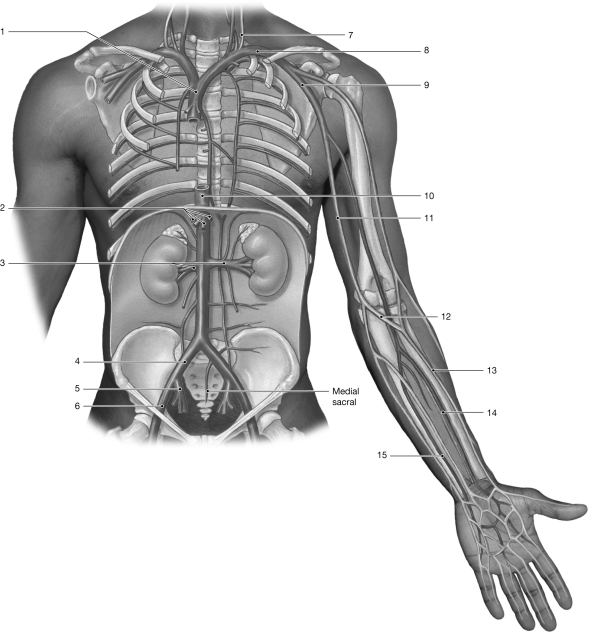 Figure 19- 2 Veins
Use Figure 19- 2 to answer the following questions:
Identify the vein labeled "8."
A) superior vena cava
B) external jugular
C) brachiocephalic
D) subclavian
E) axillary
Figure 19- 2 VeinsUse Figure 19- 2 to answer the following questions:
Identify the vein labeled "8."
A) superior vena cava
B) external jugular
C) brachiocephalic
D) subclavian
E) axillary
سؤال
سؤال
سؤال
سؤال
سؤال
سؤال
سؤال
سؤال
سؤال
سؤال
سؤال
C:\User Figure 19- 2 Veins
Use Figure 19- 2 to answer the following questions:
Which of the following affects blood flow through the body?
A) vessel diameter
B) vascular resistance
C) turbulence
D) blood viscosity
E) all of the above
Figure 19- 2 VeinsUse Figure 19- 2 to answer the following questions:
Which of the following affects blood flow through the body?
A) vessel diameter
B) vascular resistance
C) turbulence
D) blood viscosity
E) all of the above
سؤال
سؤال
سؤال
سؤال
سؤال
سؤال
سؤال
سؤال
سؤال
سؤال
سؤال
سؤال
سؤال
سؤال
سؤال
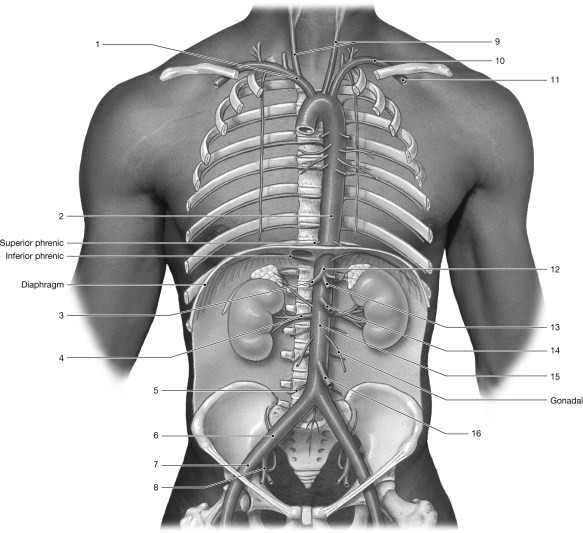 Figure 19- 1 Arteries
Use Figure 19- 1 to answer the following questions:
Identify the artery labeled "12."
A) inferior mesenteric
B) superior mesenteric
C) splenic
D) axillary
E) celiac trunk
سؤال
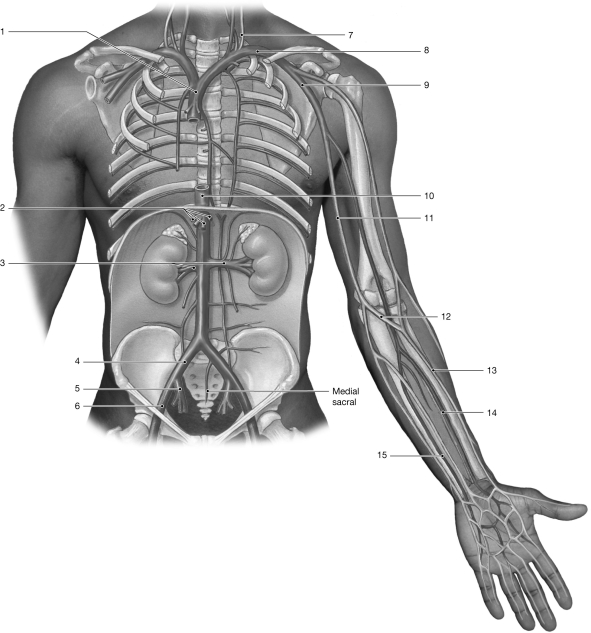 Figure 19- 2 Veins
Use Figure 19- 2 to answer the following questions:
Identify the vein labeled "9."
A) brachial
B) cephalic
C) median cubital
D) axillary
E) basilic
سؤال
سؤال
سؤال
سؤال
سؤال
سؤال
Figure 19- 1 ArteriesUse Figure 19- 1 to answer the following questions:
Blood pressure increases with all of the following, except increased
A) cardiac output.
B) blood volume.
C) parasympathetic innervation.
D) peripheral resistance.
E) force of cardiac contraction.
سؤال
سؤال
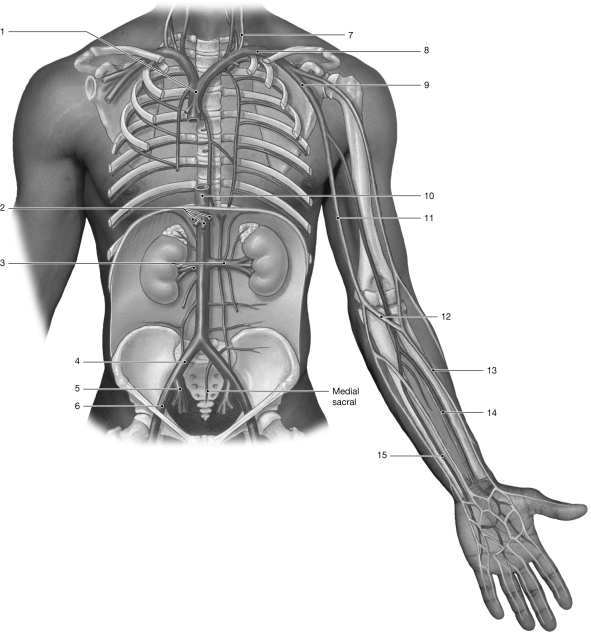 Figure 19- 2 Veins
Use Figure 19- 2 to answer the following questions:
Identify the vein labeled "15."
A) radial
B) basilic
C) axillary
D) brachial
E) ulnar
سؤال
سؤال
سؤال
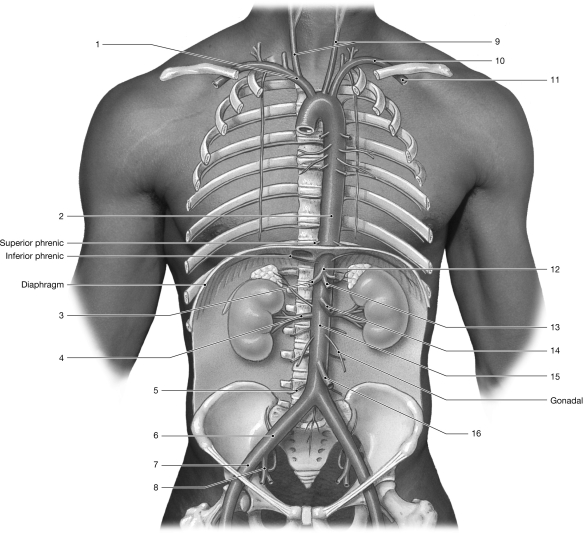 Figure 19- 1 Arteries
Use Figure 19- 1 to answer the following questions:
The layer between the tunica media and the tunica externa in a large artery is the
A) internal elastic membrane.
B) tunica intima.
C) tunica media.
D) tunica externa.
E) external elastic membrane.
سؤال
سؤال
سؤال
Figure 19- 1 ArteriesUse Figure 19- 1 to answer the following questions:
Identify the artery labeled "1."
A) brachiocephalic
B) axillary
C) aorta
D) common carotid
E) brachial
سؤال
سؤال
سؤال
Figure 19- 2 VeinsUse Figure 19- 2 to answer the following questions:
Capillaries with a perforated lining are called
A) sinuses.
B) perforated capillaries.
C) discontinuous capillaries.
D) vasa vasorum.
E) fenestrated capillaries.
سؤال
سؤال
سؤال
سؤال
سؤال
سؤال
سؤال
سؤال
سؤال
سؤال
سؤال
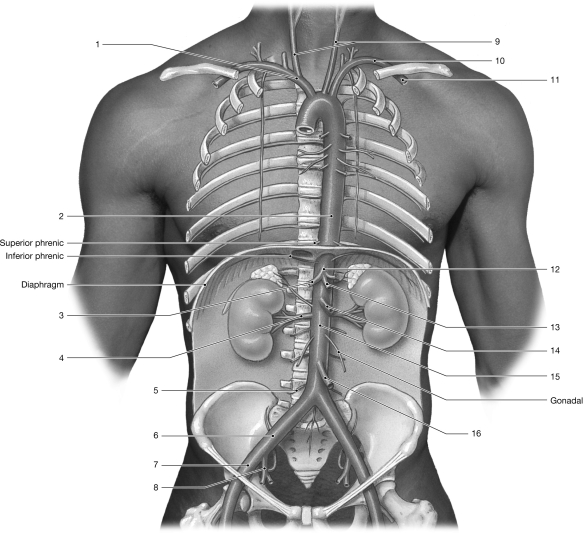 Figure 19- 1 Arteries
Use Figure 19- 1 to answer the following questions:
Identify the artery labeled "16."
A) celiac
B) axillary
C) inferior mesenteric
D) superior mesenteric
E) splenic
سؤال
سؤال
 Figure 19- 1 Arteries
Use Figure 19- 1 to answer the following questions:
Identify the arteries labeled "9."
A) aorta
B) brachial
C) common carotid
D) axillary
E) brachiocephalic
سؤال
سؤال
سؤال
سؤال
سؤال
Figure 19- 1 ArteriesUse Figure 19- 1 to answer the following questions:
The vein is formed by the fusion of the greater saphenous vein, femoral vein, and deep femoral vein.
A) inferior vena cava
B) azygous
C) common iliac
D) external iliac
E) internal iliac
سؤال
سؤال
سؤال
سؤال
سؤال
سؤال
سؤال
سؤال
سؤال
سؤال
سؤال

فتح الحزمة
قم بالتسجيل لفتح البطاقات في هذه المجموعة!
Unlock Deck
Unlock Deck
1/220

العب

ملء الشاشة (f)
Deck 19: Blood Vessels and Circulation
1
Each of the following changes will result in increased blood flow to a tissue, except
A) relaxation of precapillary sphincters.
B) increased hematocrit.
C) increased vessel diameter.
D) decreased peripheral resistance.
E) increased blood pressure.
A) relaxation of precapillary sphincters.
B) increased hematocrit.
C) increased vessel diameter.
D) decreased peripheral resistance.
E) increased blood pressure.
B
2
The brachial and femoral arteries are examples of which type of artery?
A) arteriolar
B) muscular
C) vascular
D) elastic
E) connective
A) arteriolar
B) muscular
C) vascular
D) elastic
E) connective
B
3
The thoroughfare channel ends at the
A) venule.
B) vein.
C) arteriole.
D) capillary.
E) artery.
A) venule.
B) vein.
C) arteriole.
D) capillary.
E) artery.
A
4
Which of the following is the innermost layer of a blood vessel?
A) internal elastic membrane
B) tunica intima
C) external elastic membrane
D) tunica externa
E) tunica media
A) internal elastic membrane
B) tunica intima
C) external elastic membrane
D) tunica externa
E) tunica media
فتح الحزمة
افتح القفل للوصول البطاقات البالغ عددها 220 في هذه المجموعة.
فتح الحزمة
k this deck
5
The inferior vena cava is classified as an)
A) large vein.
B) venule.
C) arteriovenule.
D) medium vein.
E) venous valve.
A) large vein.
B) venule.
C) arteriovenule.
D) medium vein.
E) venous valve.
فتح الحزمة
افتح القفل للوصول البطاقات البالغ عددها 220 في هذه المجموعة.
فتح الحزمة
k this deck
6
In comparing a trained athlete to a nonathlete, which of these comparisons is false?
A) Both hearts weigh about the same.
B) The athlete has a higher exercise cardiac output.
C) The athlete has a higher exercise stroke volume.
D) The athlete has a higher resting stroke volume.
E) The athlete has a lower resting heart rate.
A) Both hearts weigh about the same.
B) The athlete has a higher exercise cardiac output.
C) The athlete has a higher exercise stroke volume.
D) The athlete has a higher resting stroke volume.
E) The athlete has a lower resting heart rate.
فتح الحزمة
افتح القفل للوصول البطاقات البالغ عددها 220 في هذه المجموعة.
فتح الحزمة
k this deck
7
C:\User Figure 19- 2 Veins
Use Figure 19- 2 to answer the following questions:
Identify the vein labeled "8."
A) superior vena cava
B) external jugular
C) brachiocephalic
D) subclavian
E) axillary
Figure 19- 2 VeinsUse Figure 19- 2 to answer the following questions:
Identify the vein labeled "8."
A) superior vena cava
B) external jugular
C) brachiocephalic
D) subclavian
E) axillary
فتح الحزمة
افتح القفل للوصول البطاقات البالغ عددها 220 في هذه المجموعة.
فتح الحزمة
k this deck
8
Which vessel is known as a resistance vessel?
A) connective
B) elastic
C) muscular
D) venule
E) arteriole
A) connective
B) elastic
C) muscular
D) venule
E) arteriole
فتح الحزمة
افتح القفل للوصول البطاقات البالغ عددها 220 في هذه المجموعة.
فتح الحزمة
k this deck
9
The vein that is formed from the fusion of the subclavian with the internal and external jugulars is the vein.
A) iliac
B) axillary
C) brachiocephalic
D) azygos
E) hemiazygos
A) iliac
B) axillary
C) brachiocephalic
D) azygos
E) hemiazygos
فتح الحزمة
افتح القفل للوصول البطاقات البالغ عددها 220 في هذه المجموعة.
فتح الحزمة
k this deck
10
The main control of peripheral resistance occurs in the
A) capillary.
B) venule.
C) arteriole.
D) artery.
E) vein.
A) capillary.
B) venule.
C) arteriole.
D) artery.
E) vein.
فتح الحزمة
افتح القفل للوصول البطاقات البالغ عددها 220 في هذه المجموعة.
فتح الحزمة
k this deck
11
Each of the following will lead to a decrease in blood pressure, except
A) decrease in blood volume.
B) increased levels of aldosterone.
C) release of renin.
D) increased levels of ANP atrial natriuretic peptide).
E) decreased peripheral resistance.
A) decrease in blood volume.
B) increased levels of aldosterone.
C) release of renin.
D) increased levels of ANP atrial natriuretic peptide).
E) decreased peripheral resistance.
فتح الحزمة
افتح القفل للوصول البطاقات البالغ عددها 220 في هذه المجموعة.
فتح الحزمة
k this deck
12
In which of the following would the resistance be greater?
A) a vessel 1 mm in diameter
B) a vessel 10 microns in diameter
A) a vessel 1 mm in diameter
B) a vessel 10 microns in diameter
فتح الحزمة
افتح القفل للوصول البطاقات البالغ عددها 220 في هذه المجموعة.
فتح الحزمة
k this deck
13
Blood moves forward through veins because of all of the following, except
A) the pressure in the veins is lower than in the arteries.
B) valves in the veins preventing the backward flow of blood.
C) muscular compression.
D) the respiratory pump.
E) pumping by the smooth muscle in the wall of the vein.
A) the pressure in the veins is lower than in the arteries.
B) valves in the veins preventing the backward flow of blood.
C) muscular compression.
D) the respiratory pump.
E) pumping by the smooth muscle in the wall of the vein.
فتح الحزمة
افتح القفل للوصول البطاقات البالغ عددها 220 في هذه المجموعة.
فتح الحزمة
k this deck
14
The external iliac artery branches to form the arteries.
A) tibial and popliteal
B) radial and ulnar
C) femoral and deep femoral
D) femoral and popliteal
E) femoral and tibial
A) tibial and popliteal
B) radial and ulnar
C) femoral and deep femoral
D) femoral and popliteal
E) femoral and tibial
فتح الحزمة
افتح القفل للوصول البطاقات البالغ عددها 220 في هذه المجموعة.
فتح الحزمة
k this deck
15
Veins of the upper arm include the veins).
A) basilic
B) brachial
C) cephalic
D) A and C only
E) A, B, and C
A) basilic
B) brachial
C) cephalic
D) A and C only
E) A, B, and C
فتح الحزمة
افتح القفل للوصول البطاقات البالغ عددها 220 في هذه المجموعة.
فتح الحزمة
k this deck
16
The difference between the systolic and diastolic pressures is called the pressure.
A) mean arterial
B) pulse
C) blood
D) critical closing
E) circulatory
A) mean arterial
B) pulse
C) blood
D) critical closing
E) circulatory
فتح الحزمة
افتح القفل للوصول البطاقات البالغ عددها 220 في هذه المجموعة.
فتح الحزمة
k this deck
17
Homeostatic mechanisms in response to blood loss include all of the following, except
A) activation of ADH secretion.
B) increased thirst and water intake.
C) activation of aldosterone secretion.
D) inhibition of EPO secretion.
E) uptake of interstitial fluid due to reduced capillary pressure.
A) activation of ADH secretion.
B) increased thirst and water intake.
C) activation of aldosterone secretion.
D) inhibition of EPO secretion.
E) uptake of interstitial fluid due to reduced capillary pressure.
فتح الحزمة
افتح القفل للوصول البطاقات البالغ عددها 220 في هذه المجموعة.
فتح الحزمة
k this deck
18
C:\User Figure 19- 2 Veins
Use Figure 19- 2 to answer the following questions:
Which of the following affects blood flow through the body?
A) vessel diameter
B) vascular resistance
C) turbulence
D) blood viscosity
E) all of the above
Figure 19- 2 VeinsUse Figure 19- 2 to answer the following questions:
Which of the following affects blood flow through the body?
A) vessel diameter
B) vascular resistance
C) turbulence
D) blood viscosity
E) all of the above
فتح الحزمة
افتح القفل للوصول البطاقات البالغ عددها 220 في هذه المجموعة.
فتح الحزمة
k this deck
19
Fear can result in
A) increased stimulation of the cardioinhibitory center by higher brain centers.
B) increased stimulation of the cardioaccelerator center by higher brain centers.
C) decreased blood pressure.
D) increased heart rate.
E) both B and C
A) increased stimulation of the cardioinhibitory center by higher brain centers.
B) increased stimulation of the cardioaccelerator center by higher brain centers.
C) decreased blood pressure.
D) increased heart rate.
E) both B and C
فتح الحزمة
افتح القفل للوصول البطاقات البالغ عددها 220 في هذه المجموعة.
فتح الحزمة
k this deck
20
RBCs move single file through this structure.
A) vein
B) venule
C) artery
D) capillary
E) arteriole
A) vein
B) venule
C) artery
D) capillary
E) arteriole
فتح الحزمة
افتح القفل للوصول البطاقات البالغ عددها 220 في هذه المجموعة.
فتح الحزمة
k this deck
21
Which of the following is greater?
A) stroke volume during circulatory shock
B) normal stroke volume
C) Both are about the same.
A) stroke volume during circulatory shock
B) normal stroke volume
C) Both are about the same.
فتح الحزمة
افتح القفل للوصول البطاقات البالغ عددها 220 في هذه المجموعة.
فتح الحزمة
k this deck
22
When will the blood pressure be greater?
A) when the peripheral vessels constrict
B) when the peripheral vessels dilate
C) Neither is greater.
A) when the peripheral vessels constrict
B) when the peripheral vessels dilate
C) Neither is greater.
فتح الحزمة
افتح القفل للوصول البطاقات البالغ عددها 220 في هذه المجموعة.
فتح الحزمة
k this deck
23
These vessels may be continuous or fenestrated.
A) capillaries
B) arterioles
C) venules
D) arteries
E) veins
A) capillaries
B) arterioles
C) venules
D) arteries
E) veins
فتح الحزمة
افتح القفل للوصول البطاقات البالغ عددها 220 في هذه المجموعة.
فتح الحزمة
k this deck
24
When a person rises quickly from a sitting position,
A) venous return is decreased.
B) heart rate is reflexly elevated.
C) the carotid baroreceptors become less active.
D) reflex vasoconstriction of peripheral blood vessels occurs.
E) all of the above
A) venous return is decreased.
B) heart rate is reflexly elevated.
C) the carotid baroreceptors become less active.
D) reflex vasoconstriction of peripheral blood vessels occurs.
E) all of the above
فتح الحزمة
افتح القفل للوصول البطاقات البالغ عددها 220 في هذه المجموعة.
فتح الحزمة
k this deck
25
During exercise
A) venous return increases.
B) vasodilation occurs at the active skeletal muscles.
C) both cardiac output and stroke volume increase.
D) all of the above
E) A and C only
A) venous return increases.
B) vasodilation occurs at the active skeletal muscles.
C) both cardiac output and stroke volume increase.
D) all of the above
E) A and C only
فتح الحزمة
افتح القفل للوصول البطاقات البالغ عددها 220 في هذه المجموعة.
فتح الحزمة
k this deck
26
To defend blood volume against dehydration, the body
A) experiences a recall of interstitial fluids.
B) experiences an increase in the blood colloidal osmotic pressure.
C) increases water intake.
D) accelerates reabsorption of water at the kidneys.
E) all of the above
A) experiences a recall of interstitial fluids.
B) experiences an increase in the blood colloidal osmotic pressure.
C) increases water intake.
D) accelerates reabsorption of water at the kidneys.
E) all of the above
فتح الحزمة
افتح القفل للوصول البطاقات البالغ عددها 220 في هذه المجموعة.
فتح الحزمة
k this deck
27
Which of the following would you expect to have the lowest resting heart rate?
A) a person with heart failure
B) an 80- year- old woman
C) a teenager with a sedentary lifestyle
D) a trained athlete
E) an unconditioned adult
A) a person with heart failure
B) an 80- year- old woman
C) a teenager with a sedentary lifestyle
D) a trained athlete
E) an unconditioned adult
فتح الحزمة
افتح القفل للوصول البطاقات البالغ عددها 220 في هذه المجموعة.
فتح الحزمة
k this deck
28
Capillaries that have a complete lining are called
A) continuous capillaries.
B) sinusoids.
C) fenestrated capillaries.
D) vasa vasorum.
E) sinusoidal capillaries.
A) continuous capillaries.
B) sinusoids.
C) fenestrated capillaries.
D) vasa vasorum.
E) sinusoidal capillaries.
فتح الحزمة
افتح القفل للوصول البطاقات البالغ عددها 220 في هذه المجموعة.
فتح الحزمة
k this deck
29
The vessel that receives blood from the head, neck, chest, shoulders, and arms is the
A) superior vena cava.
B) inferior vena cava.
C) internal jugular vein.
D) coronary sinus.
E) external jugular vein.
A) superior vena cava.
B) inferior vena cava.
C) internal jugular vein.
D) coronary sinus.
E) external jugular vein.
فتح الحزمة
افتح القفل للوصول البطاقات البالغ عددها 220 في هذه المجموعة.
فتح الحزمة
k this deck
30
Increased levels of carbon dioxide in the blood will result in decreased
A) heart rate.
B) cardiac output.
C) parasympathetic stimulation of the heart.
D) blood flow to the lungs.
E) none of the above
A) heart rate.
B) cardiac output.
C) parasympathetic stimulation of the heart.
D) blood flow to the lungs.
E) none of the above
فتح الحزمة
افتح القفل للوصول البطاقات البالغ عددها 220 في هذه المجموعة.
فتح الحزمة
k this deck
31
Which of the following statements is false concerning the movement of fluid between capillaries and interstitial space?
A) Blood osmotic pressure moves fluid from the interstitial space to the capillary.
B) The osmotic pressure of the interstitial fluid is less than the blood osmotic pressure.
C) The net filtration pressure is usually zero.
D) Blood hydrostatic pressure forces fluid from the capillary to the interstitial space.
E) The hydrostatic pressure of the interstitial fluid is largely unimportant in determining fluid movement.
A) Blood osmotic pressure moves fluid from the interstitial space to the capillary.
B) The osmotic pressure of the interstitial fluid is less than the blood osmotic pressure.
C) The net filtration pressure is usually zero.
D) Blood hydrostatic pressure forces fluid from the capillary to the interstitial space.
E) The hydrostatic pressure of the interstitial fluid is largely unimportant in determining fluid movement.
فتح الحزمة
افتح القفل للوصول البطاقات البالغ عددها 220 في هذه المجموعة.
فتح الحزمة
k this deck
32
ADH and aldosterone secretion are part of the body's long- term compensation for
A) a heavy meal.
B) a serious hemorrhage.
C) a heart attack.
D) prolonged exercise.
E) hypertension.
A) a heavy meal.
B) a serious hemorrhage.
C) a heart attack.
D) prolonged exercise.
E) hypertension.
فتح الحزمة
افتح القفل للوصول البطاقات البالغ عددها 220 في هذه المجموعة.
فتح الحزمة
k this deck
33
Figure 19- 1 ArteriesUse Figure 19- 1 to answer the following questions:
Identify the artery labeled "12."
A) inferior mesenteric
B) superior mesenteric
C) splenic
D) axillary
E) celiac trunk
فتح الحزمة
افتح القفل للوصول البطاقات البالغ عددها 220 في هذه المجموعة.
فتح الحزمة
k this deck
34
Figure 19- 2 VeinsUse Figure 19- 2 to answer the following questions:
Identify the vein labeled "9."
A) brachial
B) cephalic
C) median cubital
D) axillary
E) basilic
فتح الحزمة
افتح القفل للوصول البطاقات البالغ عددها 220 في هذه المجموعة.
فتح الحزمة
k this deck
35
Which of the following factors will increase the net filtration pressure to move fluid out of capillaries?
A) decreased plasma albumen
B) increased blood hydrostatic pressure
C) increased tissue hydrostatic pressure
D) both A and B
E) A, B, and C
A) decreased plasma albumen
B) increased blood hydrostatic pressure
C) increased tissue hydrostatic pressure
D) both A and B
E) A, B, and C
فتح الحزمة
افتح القفل للوصول البطاقات البالغ عددها 220 في هذه المجموعة.
فتح الحزمة
k this deck
36
At the level of the first rib, the axillary vein becomes the vein.
A) innominate
B) azygos
C) cephalic
D) subclavian
E) external jugular
A) innominate
B) azygos
C) cephalic
D) subclavian
E) external jugular
فتح الحزمة
افتح القفل للوصول البطاقات البالغ عددها 220 في هذه المجموعة.
فتح الحزمة
k this deck
37
Blood from the dorsal venous arch is drained by the veins).
A) great saphenous
B) posterior tibial
C) small saphenous
D) A, B, and C
E) A and C only
A) great saphenous
B) posterior tibial
C) small saphenous
D) A, B, and C
E) A and C only
فتح الحزمة
افتح القفل للوصول البطاقات البالغ عددها 220 في هذه المجموعة.
فتح الحزمة
k this deck
38
Complications related to arteriosclerosis account for roughly percent of deaths in the United States.
A) 30
B) 25
C) 60
D) 20
E) 50
A) 30
B) 25
C) 60
D) 20
E) 50
فتح الحزمة
افتح القفل للوصول البطاقات البالغ عددها 220 في هذه المجموعة.
فتح الحزمة
k this deck
39
The two common iliac veins form the
A) femoral vein.
B) greater saphenous vein.
C) hepatic portal vein.
D) innominate vein.
E) inferior vena cava.
A) femoral vein.
B) greater saphenous vein.
C) hepatic portal vein.
D) innominate vein.
E) inferior vena cava.
فتح الحزمة
افتح القفل للوصول البطاقات البالغ عددها 220 في هذه المجموعة.
فتح الحزمة
k this deck
40
Figure 19- 1 ArteriesUse Figure 19- 1 to answer the following questions:
Blood pressure increases with all of the following, except increased
A) cardiac output.
B) blood volume.
C) parasympathetic innervation.
D) peripheral resistance.
E) force of cardiac contraction.
فتح الحزمة
افتح القفل للوصول البطاقات البالغ عددها 220 في هذه المجموعة.
فتح الحزمة
k this deck
41
After blood leaves the capillaries, it enters the
A) arterioles.
B) arteries.
C) veins.
D) venules.
E) capillaries.
A) arterioles.
B) arteries.
C) veins.
D) venules.
E) capillaries.
فتح الحزمة
افتح القفل للوصول البطاقات البالغ عددها 220 في هذه المجموعة.
فتح الحزمة
k this deck
42
Figure 19- 2 VeinsUse Figure 19- 2 to answer the following questions:
Identify the vein labeled "15."
A) radial
B) basilic
C) axillary
D) brachial
E) ulnar
فتح الحزمة
افتح القفل للوصول البطاقات البالغ عددها 220 في هذه المجموعة.
فتح الحزمة
k this deck
43
When the popliteal vein reaches the femur, it becomes the vein.
A) external iliac
B) femoral
C) deep femoral
D) lumbar
E) internal iliac
A) external iliac
B) femoral
C) deep femoral
D) lumbar
E) internal iliac
فتح الحزمة
افتح القفل للوصول البطاقات البالغ عددها 220 في هذه المجموعة.
فتح الحزمة
k this deck
44
Venoconstriction reduces the diameter of which vessel?
A) vein
B) venule
C) arteriole
D) capillary
E) artery
A) vein
B) venule
C) arteriole
D) capillary
E) artery
فتح الحزمة
افتح القفل للوصول البطاقات البالغ عددها 220 في هذه المجموعة.
فتح الحزمة
k this deck
45
Figure 19- 1 ArteriesUse Figure 19- 1 to answer the following questions:
The layer between the tunica media and the tunica externa in a large artery is the
A) internal elastic membrane.
B) tunica intima.
C) tunica media.
D) tunica externa.
E) external elastic membrane.
فتح الحزمة
افتح القفل للوصول البطاقات البالغ عددها 220 في هذه المجموعة.
فتح الحزمة
k this deck
46
Total peripheral resistance is related to all of the following, except the
A) osmolarity of interstitial fluids.
B) blood vessel diameter.
C) flow characteristics.
D) blood viscosity.
E) length of a blood vessel.
A) osmolarity of interstitial fluids.
B) blood vessel diameter.
C) flow characteristics.
D) blood viscosity.
E) length of a blood vessel.
فتح الحزمة
افتح القفل للوصول البطاقات البالغ عددها 220 في هذه المجموعة.
فتح الحزمة
k this deck
47
A vein that measures 5 mm would be considered
A) a medium vein.
B) a large vein.
C) an arteriovenule.
D) a venule.
E) a venous valve.
A) a medium vein.
B) a large vein.
C) an arteriovenule.
D) a venule.
E) a venous valve.
فتح الحزمة
افتح القفل للوصول البطاقات البالغ عددها 220 في هذه المجموعة.
فتح الحزمة
k this deck
48
Figure 19- 1 ArteriesUse Figure 19- 1 to answer the following questions:
Identify the artery labeled "1."
A) brachiocephalic
B) axillary
C) aorta
D) common carotid
E) brachial
فتح الحزمة
افتح القفل للوصول البطاقات البالغ عددها 220 في هذه المجموعة.
فتح الحزمة
k this deck
49
Factors that increase the risk of atherosclerosis include which of the following?
A) high cholesterol
B) smoking
C) lack of exercise
D) obesity
E) all of the above
A) high cholesterol
B) smoking
C) lack of exercise
D) obesity
E) all of the above
فتح الحزمة
افتح القفل للوصول البطاقات البالغ عددها 220 في هذه المجموعة.
فتح الحزمة
k this deck
50
Arrange the structures in the following list in the order that blood will encounter as it flows from the output side to the input side of the cardiovascular flow circuit. 1. venules
2) arterioles
3) capillaries
4) elastic arteries
5) medium veins
6) large veins
7) muscular arteries
A) 7, 4, 2, 3, 1, 5, 6
B) 2, 7, 6, 3, 1, 5, 6
C) 6, 5, 1, 3, 2, 7, 4
D) 4, 7, 2, 3, 1, 5, 6
E) 5, 6, 1, 3, 2, 7, 4
2) arterioles
3) capillaries
4) elastic arteries
5) medium veins
6) large veins
7) muscular arteries
A) 7, 4, 2, 3, 1, 5, 6
B) 2, 7, 6, 3, 1, 5, 6
C) 6, 5, 1, 3, 2, 7, 4
D) 4, 7, 2, 3, 1, 5, 6
E) 5, 6, 1, 3, 2, 7, 4
فتح الحزمة
افتح القفل للوصول البطاقات البالغ عددها 220 في هذه المجموعة.
فتح الحزمة
k this deck
51
Figure 19- 2 VeinsUse Figure 19- 2 to answer the following questions:
Capillaries with a perforated lining are called
A) sinuses.
B) perforated capillaries.
C) discontinuous capillaries.
D) vasa vasorum.
E) fenestrated capillaries.
فتح الحزمة
افتح القفل للوصول البطاقات البالغ عددها 220 في هذه المجموعة.
فتح الحزمة
k this deck
52
When carotid and aortic baroreceptors slow their discharge,
A) heart rate increases.
B) heart rate decreases.
C) stroke volume increases.
D) both A and C
E) both B and C
A) heart rate increases.
B) heart rate decreases.
C) stroke volume increases.
D) both A and C
E) both B and C
فتح الحزمة
افتح القفل للوصول البطاقات البالغ عددها 220 في هذه المجموعة.
فتح الحزمة
k this deck
53
After entering the arm, the axillary artery becomes the artery.
A) ulnar
B) brachial
C) digital
D) subclavian
E) radial
A) ulnar
B) brachial
C) digital
D) subclavian
E) radial
فتح الحزمة
افتح القفل للوصول البطاقات البالغ عددها 220 في هذه المجموعة.
فتح الحزمة
k this deck
54
Which of the following changes doesn't occur during exercise compared to rest?
A) Skin blood flow is lower.
B) Cardiac output is higher.
C) Abdominal viscera blood flow is lower.
D) Heart blood flow is higher.
E) Kidney blood flow is lower.
A) Skin blood flow is lower.
B) Cardiac output is higher.
C) Abdominal viscera blood flow is lower.
D) Heart blood flow is higher.
E) Kidney blood flow is lower.
فتح الحزمة
افتح القفل للوصول البطاقات البالغ عددها 220 في هذه المجموعة.
فتح الحزمة
k this deck
55
Each of the following factors would increase cardiac output, except
A) stimulation of the heart by epinephrine.
B) decreased parasympathetic stimulation of the heart.
C) increased venous return.
D) increased blood concentration of glucose.
E) increased sympathetic stimulation of the heart.
A) stimulation of the heart by epinephrine.
B) decreased parasympathetic stimulation of the heart.
C) increased venous return.
D) increased blood concentration of glucose.
E) increased sympathetic stimulation of the heart.
فتح الحزمة
افتح القفل للوصول البطاقات البالغ عددها 220 في هذه المجموعة.
فتح الحزمة
k this deck
56
The divides the aorta into the thoracic aorta and the abdominal aorta.
A) mediastinum
B) pericardium
C) diaphragm
D) pleura
E) peritoneum
A) mediastinum
B) pericardium
C) diaphragm
D) pleura
E) peritoneum
فتح الحزمة
افتح القفل للوصول البطاقات البالغ عددها 220 في هذه المجموعة.
فتح الحزمة
k this deck
57
Venoconstriction _ the amount of blood within the venous system, which _ the volume in the arterial and capillary systems.
A) doubles; decreases
B) increases; reduces
C) decreases; doubles
D) reduces; increases
E) none of the above
A) doubles; decreases
B) increases; reduces
C) decreases; doubles
D) reduces; increases
E) none of the above
فتح الحزمة
افتح القفل للوصول البطاقات البالغ عددها 220 في هذه المجموعة.
فتح الحزمة
k this deck
58
Branches off the aortic arch include the
A) left subclavian artery.
B) brachiocephalic trunk.
C) left common carotid artery.
D) all of the above
E) B and C only
A) left subclavian artery.
B) brachiocephalic trunk.
C) left common carotid artery.
D) all of the above
E) B and C only
فتح الحزمة
افتح القفل للوصول البطاقات البالغ عددها 220 في هذه المجموعة.
فتح الحزمة
k this deck
59
A sample of tissue displays many large flattened spaces lined by fenestrated endothelium. Blood moves slowly through these spaces. This tissue sample most likely came from the
A) heart.
B) lungs.
C) skin.
D) kidneys.
E) liver.
A) heart.
B) lungs.
C) skin.
D) kidneys.
E) liver.
فتح الحزمة
افتح القفل للوصول البطاقات البالغ عددها 220 في هذه المجموعة.
فتح الحزمة
k this deck
60
The vascular pressure that declines from roughly 35 mm Hg to about 18 mm Hg is the
A) venous pressure.
B) peripheral pressure.
C) diastolic pressure.
D) capillary hydrostatic pressure.
E) pulse pressure.
A) venous pressure.
B) peripheral pressure.
C) diastolic pressure.
D) capillary hydrostatic pressure.
E) pulse pressure.
فتح الحزمة
افتح القفل للوصول البطاقات البالغ عددها 220 في هذه المجموعة.
فتح الحزمة
k this deck
61
The fusion of the brachiocephalic veins forms the
A) innominate vein.
B) subclavian vein.
C) superior vena cava.
D) inferior vena cava.
E) azygos vein.
A) innominate vein.
B) subclavian vein.
C) superior vena cava.
D) inferior vena cava.
E) azygos vein.
فتح الحزمة
افتح القفل للوصول البطاقات البالغ عددها 220 في هذه المجموعة.
فتح الحزمة
k this deck
62
Figure 19- 1 ArteriesUse Figure 19- 1 to answer the following questions:
Identify the artery labeled "16."
A) celiac
B) axillary
C) inferior mesenteric
D) superior mesenteric
E) splenic
فتح الحزمة
افتح القفل للوصول البطاقات البالغ عددها 220 في هذه المجموعة.
فتح الحزمة
k this deck
63
Clinically, the term blood pressure usually refers to
A) arteriovenous pressure.
B) peripheral pressure.
C) capillary hydrostatic pressure.
D) arterial pressure.
E) pulse pressure
A) arteriovenous pressure.
B) peripheral pressure.
C) capillary hydrostatic pressure.
D) arterial pressure.
E) pulse pressure
فتح الحزمة
افتح القفل للوصول البطاقات البالغ عددها 220 في هذه المجموعة.
فتح الحزمة
k this deck
64
Figure 19- 1 ArteriesUse Figure 19- 1 to answer the following questions:
Identify the arteries labeled "9."
A) aorta
B) brachial
C) common carotid
D) axillary
E) brachiocephalic
فتح الحزمة
افتح القفل للوصول البطاقات البالغ عددها 220 في هذه المجموعة.
فتح الحزمة
k this deck
65
Which of the following are the smallest venous vessels?
A) medium veins
B) venous valves
C) venules
D) arteriovenules
E) large veins
A) medium veins
B) venous valves
C) venules
D) arteriovenules
E) large veins
فتح الحزمة
افتح القفل للوصول البطاقات البالغ عددها 220 في هذه المجموعة.
فتح الحزمة
k this deck
66
If blood pressure doubled, the blood flow through a vessel would be
A) four times greater.
B) unchanged.
C) doubled.
D) 1/4 as much.
E) halved.
A) four times greater.
B) unchanged.
C) doubled.
D) 1/4 as much.
E) halved.
فتح الحزمة
افتح القفل للوصول البطاقات البالغ عددها 220 في هذه المجموعة.
فتح الحزمة
k this deck
67
Which of the following is most likely to result from an aneurysm in a brain artery?
A) hypotension
B) myocardial infarction
C) quadriplegia
D) stroke
E) pulmonary embolism
A) hypotension
B) myocardial infarction
C) quadriplegia
D) stroke
E) pulmonary embolism
فتح الحزمة
افتح القفل للوصول البطاقات البالغ عددها 220 في هذه المجموعة.
فتح الحزمة
k this deck
68
Elevated levels of the hormones ANP and BNP will produce increased
A) venous return and preload.
B) salt and water loss through the kidneys.
C) blood volume.
D) sodium ion levels in blood.
E) both B and D
A) venous return and preload.
B) salt and water loss through the kidneys.
C) blood volume.
D) sodium ion levels in blood.
E) both B and D
فتح الحزمة
افتح القفل للوصول البطاقات البالغ عددها 220 في هذه المجموعة.
فتح الحزمة
k this deck
69
Figure 19- 1 ArteriesUse Figure 19- 1 to answer the following questions:
The vein is formed by the fusion of the greater saphenous vein, femoral vein, and deep femoral vein.
A) inferior vena cava
B) azygous
C) common iliac
D) external iliac
E) internal iliac
فتح الحزمة
افتح القفل للوصول البطاقات البالغ عددها 220 في هذه المجموعة.
فتح الحزمة
k this deck
70
Which of the following lumen diameters would be typical of a muscular artery?
A) 0.4 mm
B) 0.4 cm
C) 0.2 mm
D) 1.0 cm
E) none of the above
A) 0.4 mm
B) 0.4 cm
C) 0.2 mm
D) 1.0 cm
E) none of the above
فتح الحزمة
افتح القفل للوصول البطاقات البالغ عددها 220 في هذه المجموعة.
فتح الحزمة
k this deck
71
Which of the following obeys the rule that arteries carry blood away from the heart?
A) common carotid artery
B) right coronary artery
C) marginal artery
D) left circumflex artery
E) left descending artery
A) common carotid artery
B) right coronary artery
C) marginal artery
D) left circumflex artery
E) left descending artery
فتح الحزمة
افتح القفل للوصول البطاقات البالغ عددها 220 في هذه المجموعة.
فتح الحزمة
k this deck
72
Veins of the brain empty into
A) coronary sinuses.
B) dural sinuses.
C) external jugular veins.
D) the circle of Willis.
E) vertebral veins.
A) coronary sinuses.
B) dural sinuses.
C) external jugular veins.
D) the circle of Willis.
E) vertebral veins.
فتح الحزمة
افتح القفل للوصول البطاقات البالغ عددها 220 في هذه المجموعة.
فتح الحزمة
k this deck
73
The hormone that produces cardiovascular effects similar to activation of the sympathetic nervous system is:
A) bradykinin.
B) tachykinin.
C) acetylcholine.
D) epinephrine.
E) sympathetic neuropeptide.
A) bradykinin.
B) tachykinin.
C) acetylcholine.
D) epinephrine.
E) sympathetic neuropeptide.
فتح الحزمة
افتح القفل للوصول البطاقات البالغ عددها 220 في هذه المجموعة.
فتح الحزمة
k this deck
74
The two vertebral arteries fuse to form a large artery, the
A) circle of Willis.
B) external carotid artery.
C) basilar artery.
D) common carotid artery.
E) internal carotid artery.
A) circle of Willis.
B) external carotid artery.
C) basilar artery.
D) common carotid artery.
E) internal carotid artery.
فتح الحزمة
افتح القفل للوصول البطاقات البالغ عددها 220 في هذه المجموعة.
فتح الحزمة
k this deck
75
Branches of the thoracic aorta include all of the following, except the arteries.
A) esophageal
B) basilar
C) superior phrenic
D) bronchial
E) intercostal
A) esophageal
B) basilar
C) superior phrenic
D) bronchial
E) intercostal
فتح الحزمة
افتح القفل للوصول البطاقات البالغ عددها 220 في هذه المجموعة.
فتح الحزمة
k this deck
76
An important artery that supplies blood to the brain is the artery.
A) internal carotid
B) external carotid
C) mental
D) maxillary
E) azygos
A) internal carotid
B) external carotid
C) mental
D) maxillary
E) azygos
فتح الحزمة
افتح القفل للوصول البطاقات البالغ عددها 220 في هذه المجموعة.
فتح الحزمة
k this deck
77
Of the following arteries, the one that is an elastic artery is
A) the brachial artery.
B) the subclavian artery.
C) the femoral artery.
D) the external carotid artery.
E) none of the above
A) the brachial artery.
B) the subclavian artery.
C) the femoral artery.
D) the external carotid artery.
E) none of the above
فتح الحزمة
افتح القفل للوصول البطاقات البالغ عددها 220 في هذه المجموعة.
فتح الحزمة
k this deck
78
Which of the following conditions is least likely to lead to renin release?
A) increased sympathetic activity
B) circulatory shock
C) hypertension
D) vasospasm of the renal arteries
E) renal artery thrombus
A) increased sympathetic activity
B) circulatory shock
C) hypertension
D) vasospasm of the renal arteries
E) renal artery thrombus
فتح الحزمة
افتح القفل للوصول البطاقات البالغ عددها 220 في هذه المجموعة.
فتح الحزمة
k this deck
79
The blood colloid osmotic pressure mostly depends on the
A) concentration of plasma glucose.
B) concentration of plasma proteins.
C) number of red blood cells.
D) concentration of plasma sodium ions.
E) concentration of plasma waste products.
A) concentration of plasma glucose.
B) concentration of plasma proteins.
C) number of red blood cells.
D) concentration of plasma sodium ions.
E) concentration of plasma waste products.
فتح الحزمة
افتح القفل للوصول البطاقات البالغ عددها 220 في هذه المجموعة.
فتح الحزمة
k this deck
80
Which layer of a blood vessel contains concentric sheets of smooth muscle tissue?
A) internal elastic membrane
B) external elastic membrane
C) tunica externa
D) tunica media
E) tunica intima
A) internal elastic membrane
B) external elastic membrane
C) tunica externa
D) tunica media
E) tunica intima
فتح الحزمة
افتح القفل للوصول البطاقات البالغ عددها 220 في هذه المجموعة.
فتح الحزمة
k this deck
فتح الحزمة
افتح القفل للوصول البطاقات البالغ عددها 220 في هذه المجموعة.






