







 تكلم مع الذكاء الاصطناعي


Deck 23: Electric Potential
ملء الشاشة (f)

سؤال

سؤال
سؤال
سؤال
سؤال
سؤال
سؤال
سؤال
سؤال
سؤال
سؤال
سؤال
سؤال
سؤال
سؤال
سؤال
سؤال
سؤال
سؤال
سؤال
سؤال
سؤال
سؤال
سؤال
سؤال
سؤال
سؤال
FIGURE 23-1 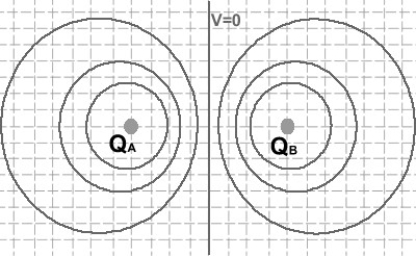
Fig. 23-1 shows equipotentials surrounding a pair of charges QA and QB. The value of the potential half-way between the charges is indicated. Which of the statements below applies to the charges?
A)The two charges have the same sign and equal magnitudes.
B)Nothing can be said about the charges.
C)The two charges have the same sign but different magnitudes.
D)The two charges have opposite signs and equal magnitudes.
E)The two charges have opposite signs and different magnitudes.
Fig. 23-1 shows equipotentials surrounding a pair of charges QA and QB. The value of the potential half-way between the charges is indicated. Which of the statements below applies to the charges?
A)The two charges have the same sign and equal magnitudes.
B)Nothing can be said about the charges.
C)The two charges have the same sign but different magnitudes.
D)The two charges have opposite signs and equal magnitudes.
E)The two charges have opposite signs and different magnitudes.
سؤال
سؤال
سؤال
سؤال
سؤال
سؤال
سؤال
سؤال
سؤال
FIGURE 23-2 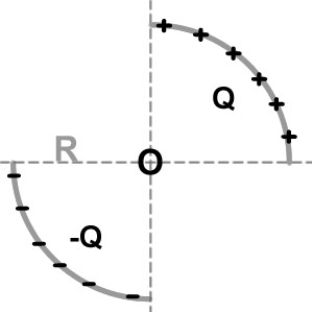
Fig. 23-2 shows two arcs of a circle on which charges +Q and -Q have been spread uniformly. What is the value of the electric potential at the center of the circle?
Fig. 23-2 shows two arcs of a circle on which charges +Q and -Q have been spread uniformly. What is the value of the electric potential at the center of the circle?
سؤال
سؤال
سؤال
سؤال
FIGURE 23-3 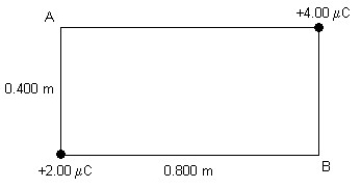
Two point charges of magnitude +4.00 μC and +2.00 μC are placed at the opposite corners of a rectangle as shown in Fig. 23-3.
(a) What is the potential at point A due to these charges?
(b) What is the potential at point B due to these charges?
(c) What is the potential difference between points A and B?
Two point charges of magnitude +4.00 μC and +2.00 μC are placed at the opposite corners of a rectangle as shown in Fig. 23-3.
(a) What is the potential at point A due to these charges?
(b) What is the potential at point B due to these charges?
(c) What is the potential difference between points A and B?
سؤال
FIGURE 23-10 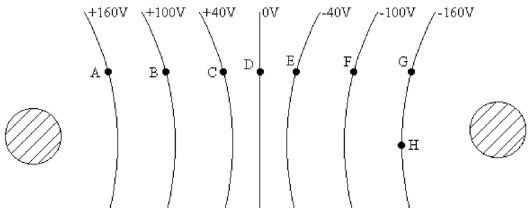
The equipotential surfaces between two spherical conductors are shown in Fig. 23-10, with the value of the potential marked for each line. What is the potential difference between points G and D?
A)+160 V
B)-160 V
C)+320 V
D)0 V
E)None of the other choices is correct.
The equipotential surfaces between two spherical conductors are shown in Fig. 23-10, with the value of the potential marked for each line. What is the potential difference between points G and D?
A)+160 V
B)-160 V
C)+320 V
D)0 V
E)None of the other choices is correct.
سؤال
FIGURE 23-12 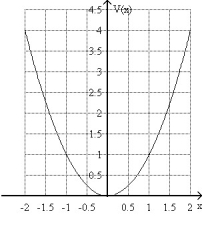
Fig. 23-12 shows the variations of the electric potential V (in arbitrary units) as a function of the position x (also in arbitrary units). Which of the choices below correctly describes the orientation of the electric field along the x axis?
A)E is positive from x = -2 to x = 2.
B)E is positive from x = -2 to x = 0, and negative from 0 to x= 2.
C)E is negative from x = -2 to x = 0, and positive from 0 to x= 2.
D)E is negative from x = -2 to x = 2.
E)More information is needed to answer the question.
Fig. 23-12 shows the variations of the electric potential V (in arbitrary units) as a function of the position x (also in arbitrary units). Which of the choices below correctly describes the orientation of the electric field along the x axis?
A)E is positive from x = -2 to x = 2.
B)E is positive from x = -2 to x = 0, and negative from 0 to x= 2.
C)E is negative from x = -2 to x = 0, and positive from 0 to x= 2.
D)E is negative from x = -2 to x = 2.
E)More information is needed to answer the question.
سؤال
سؤال
سؤال
سؤال
سؤال
FIGURE 23-9 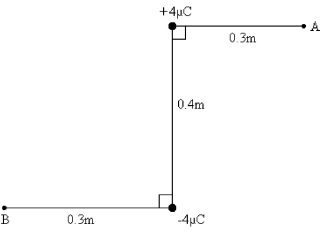
Two point charges of magnitude +4.0 μC and -4.0 μC are placed as shown in Fig. 23-9. What is the potential difference between points A and B?
A)48 V
B)96 V
C)0 V
D)96 × 103V
E)48 × 103V
Two point charges of magnitude +4.0 μC and -4.0 μC are placed as shown in Fig. 23-9. What is the potential difference between points A and B?
A)48 V
B)96 V
C)0 V
D)96 × 103V
E)48 × 103V
سؤال
FIGURE 23-11 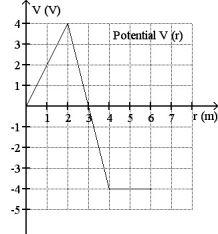
Fig. 23-11 shows the variation of the electric potential V (measured in Volts) as a function of the radial direction r (measured in meters). For which range of r is the magnitude of the electric field the largest?
A)from r = 2 m to r = 4 m
B)from r = 4 m to r = 6 m
C)from r = 0 to r = 2 m
D)The magnitude of the field is the same everywhere.
E)More information is needed to answer the question.
Fig. 23-11 shows the variation of the electric potential V (measured in Volts) as a function of the radial direction r (measured in meters). For which range of r is the magnitude of the electric field the largest?
A)from r = 2 m to r = 4 m
B)from r = 4 m to r = 6 m
C)from r = 0 to r = 2 m
D)The magnitude of the field is the same everywhere.
E)More information is needed to answer the question.
سؤال
سؤال
FIGURE 23-4 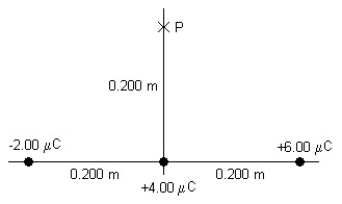
Three point charges of -2.00 μC, +4.00 μC, and +6.00 μC are placed along the x axis as shown in Fig. 23-4. What is the electrical potential at point P due to these charges?
A)-307 × 103V
B)+307 × 103V
C)-154 × 103V
D)+154 × 103V
E)0 V
Three point charges of -2.00 μC, +4.00 μC, and +6.00 μC are placed along the x axis as shown in Fig. 23-4. What is the electrical potential at point P due to these charges?
A)-307 × 103V
B)+307 × 103V
C)-154 × 103V
D)+154 × 103V
E)0 V
سؤال
FIGURE 23-5 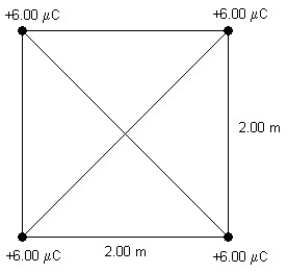
Four equal point charges of magnitude 6.00 μC are placed at the corners of a square 2.00 m on each side, as shown in Fig. 23-5. What is the electric potential of these charges at the center of this square?
A)76.4 kV
B)38.2 kV
C)306 kV
D)153 kV
E)61.0 kV
Four equal point charges of magnitude 6.00 μC are placed at the corners of a square 2.00 m on each side, as shown in Fig. 23-5. What is the electric potential of these charges at the center of this square?
A)76.4 kV
B)38.2 kV
C)306 kV
D)153 kV
E)61.0 kV
سؤال
FIGURE 23-8 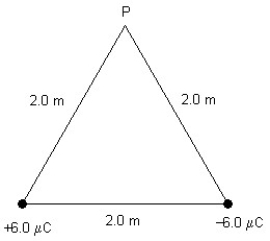
Two charges of magnitude 6.0 μC, but opposite signs, are placed at the corners of the base of an equilateral triangle, as shown in Fig. 23-8. What is the electric potential at the vertex, P, of the triangle due to these charges?
A)27 kV
B)54 kV
C)90 kV
D)108 V
E)0 V
Two charges of magnitude 6.0 μC, but opposite signs, are placed at the corners of the base of an equilateral triangle, as shown in Fig. 23-8. What is the electric potential at the vertex, P, of the triangle due to these charges?
A)27 kV
B)54 kV
C)90 kV
D)108 V
E)0 V
سؤال
سؤال
FIGURE 23-6 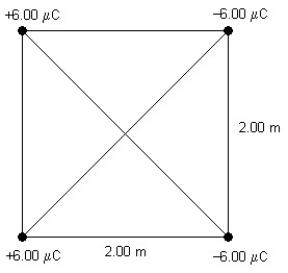
Four equal point charges of magnitude 6.00 μC and of varying signs are placed at the corners of a square 2.00 m on each side, as shown in Fig. 23-6. What is the electric potential at the center of this square due to these charges?
A)76.4 kV
B)0 V
C)153 kV
D)61.0 kV
E)306 kV
Four equal point charges of magnitude 6.00 μC and of varying signs are placed at the corners of a square 2.00 m on each side, as shown in Fig. 23-6. What is the electric potential at the center of this square due to these charges?
A)76.4 kV
B)0 V
C)153 kV
D)61.0 kV
E)306 kV
سؤال
سؤال
سؤال
FIGURE 23-7 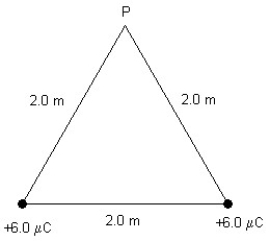
Two identical charges of magnitude 6.0 μC are placed at the corners of the base of an equilateral triangle, as shown in Fig. 23-7. What is the electric potential at the vertex, P, of the triangle due to these charges?
A)54 kV
B)108 V
C)0 V
D)90 kV
E)27 kV
Two identical charges of magnitude 6.0 μC are placed at the corners of the base of an equilateral triangle, as shown in Fig. 23-7. What is the electric potential at the vertex, P, of the triangle due to these charges?
A)54 kV
B)108 V
C)0 V
D)90 kV
E)27 kV
سؤال
سؤال
سؤال
سؤال
سؤال
سؤال
سؤال
سؤال
سؤال
سؤال
سؤال
سؤال
سؤال

فتح الحزمة
قم بالتسجيل لفتح البطاقات في هذه المجموعة!
Unlock Deck
Unlock Deck
1/70

العب

ملء الشاشة (f)
Deck 23: Electric Potential
1
Three negative charges of equal magnitudes are positioned along the x-axis at x = -a, x=0, and x = +a respectively. The charge located at x=0 is moved away along the y-axis to a position (x,y) = (0, +a). How does the potential energy of the system of charges change as a result?
A)The potential energy may increase or decrease depending on the magnitude of the charges.
B)The potential energy increases.
C)The potential energy decreases.
D)The potential energy stays the same.
E)More information is needed to answer the question.
A)The potential energy may increase or decrease depending on the magnitude of the charges.
B)The potential energy increases.
C)The potential energy decreases.
D)The potential energy stays the same.
E)More information is needed to answer the question.
The potential energy decreases.
2
A negative charge, if free, tries to move
A)from high potential to low potential.
B)from low potential to high potential.
C)toward infinity.
D)away from infinity.
E)in the direction of the electric field.
A)from high potential to low potential.
B)from low potential to high potential.
C)toward infinity.
D)away from infinity.
E)in the direction of the electric field.
from low potential to high potential.
3
The component of the electric field in any direction is equal to the negative of the rate of change of the electric potential with distance in that direction.
True
4
For an electron moving in a direction opposite to the electric field
A)its potential energy increases and its electric potential decreases.
B)its potential energy decreases and its electric potential increases.
C)its potential energy increases and its electric potential increases.
D)its potential energy decreases and its electric potential decreases.
E)both its potential energy and it electric potential remain constant.
A)its potential energy increases and its electric potential decreases.
B)its potential energy decreases and its electric potential increases.
C)its potential energy increases and its electric potential increases.
D)its potential energy decreases and its electric potential decreases.
E)both its potential energy and it electric potential remain constant.
فتح الحزمة
افتح القفل للوصول البطاقات البالغ عددها 70 في هذه المجموعة.
فتح الحزمة
k this deck
5
The direction of an electric field is from higher to lower potential.
فتح الحزمة
افتح القفل للوصول البطاقات البالغ عددها 70 في هذه المجموعة.
فتح الحزمة
k this deck
6
A negative charge is moved from point A to point B along an equipotential surface. Which of the following statements is true for this case?
A)The negative charge performs work in moving from point A to point B.
B)Work is required to move the negative charge from point A to point B.
C)Work is both required and performed in moving the negative charge from point A to point B.
D)No work is required to move the negative charge from point A to point B.
E)Not enough information is given to make a statement about the work involved.
A)The negative charge performs work in moving from point A to point B.
B)Work is required to move the negative charge from point A to point B.
C)Work is both required and performed in moving the negative charge from point A to point B.
D)No work is required to move the negative charge from point A to point B.
E)Not enough information is given to make a statement about the work involved.
فتح الحزمة
افتح القفل للوصول البطاقات البالغ عددها 70 في هذه المجموعة.
فتح الحزمة
k this deck
7
For a proton moving in the direction of the electric field
A)its potential energy increases and its electric potential decreases.
B)its potential energy decreases and its electric potential increases.
C)its potential energy increases and its electric potential increases.
D)its potential energy decreases and its electric potential decreases.
E)both its potential energy and it electric potential remain constant.
A)its potential energy increases and its electric potential decreases.
B)its potential energy decreases and its electric potential increases.
C)its potential energy increases and its electric potential increases.
D)its potential energy decreases and its electric potential decreases.
E)both its potential energy and it electric potential remain constant.
فتح الحزمة
افتح القفل للوصول البطاقات البالغ عددها 70 في هذه المجموعة.
فتح الحزمة
k this deck
8
If the electric field is zero in some region of space is the electric potential zero there as well? Explain.
فتح الحزمة
افتح القفل للوصول البطاقات البالغ عددها 70 في هذه المجموعة.
فتح الحزمة
k this deck
9
An equipotential surface must be
A)parallel to the electric field at every point.
B)oriented 30° with respect to the electric field at every point.
C)oriented 60° with respect to the electric field at every point.
D)perpendicular to the electric field at every point.
E)equal to the electric field at every point.
A)parallel to the electric field at every point.
B)oriented 30° with respect to the electric field at every point.
C)oriented 60° with respect to the electric field at every point.
D)perpendicular to the electric field at every point.
E)equal to the electric field at every point.
فتح الحزمة
افتح القفل للوصول البطاقات البالغ عددها 70 في هذه المجموعة.
فتح الحزمة
k this deck
10
Every point on an equipotential surface is at the same potential.
فتح الحزمة
افتح القفل للوصول البطاقات البالغ عددها 70 في هذه المجموعة.
فتح الحزمة
k this deck
11
The potential outside a uniformly charged sphere is the same as if all the charge were concentrated at its center.
فتح الحزمة
افتح القفل للوصول البطاقات البالغ عددها 70 في هذه المجموعة.
فتح الحزمة
k this deck
12
When a proton moves in a direction of the electric field, its potential increases but its potential energy decreases.
فتح الحزمة
افتح القفل للوصول البطاقات البالغ عددها 70 في هذه المجموعة.
فتح الحزمة
k this deck
13
The potential of a uniformly charged sphere is lowest at
A)infinity.
B)a distance from the sphere equal to its radius.
C)a distance from the sphere equal to its diameter.
D)the surface of the sphere.
E)the center of the sphere.
A)infinity.
B)a distance from the sphere equal to its radius.
C)a distance from the sphere equal to its diameter.
D)the surface of the sphere.
E)the center of the sphere.
فتح الحزمة
افتح القفل للوصول البطاقات البالغ عددها 70 في هذه المجموعة.
فتح الحزمة
k this deck
14
All points on the perpendicular bisector of the line joining two equal but opposite charges have a potential of zero.
فتح الحزمة
افتح القفل للوصول البطاقات البالغ عددها 70 في هذه المجموعة.
فتح الحزمة
k this deck
15
Explain why equipotential surfaces are always perpendicular to the electric field vectors.
فتح الحزمة
افتح القفل للوصول البطاقات البالغ عددها 70 في هذه المجموعة.
فتح الحزمة
k this deck
16
The direction in which the potential changes at the greatest rate is in the direction
A)of the gradient of the potential.
B)perpendicular to the electric field.
C)perpendicular to the gradient of the potential.
D)of the partial derivative with respect to x.
E)cannot be determined
A)of the gradient of the potential.
B)perpendicular to the electric field.
C)perpendicular to the gradient of the potential.
D)of the partial derivative with respect to x.
E)cannot be determined
فتح الحزمة
افتح القفل للوصول البطاقات البالغ عددها 70 في هذه المجموعة.
فتح الحزمة
k this deck
17
The change in electric potential energy, Ub - Ua, is the work done on a charge by the electric force as it moves from point a to point b.
فتح الحزمة
افتح القفل للوصول البطاقات البالغ عددها 70 في هذه المجموعة.
فتح الحزمة
k this deck
18
How much work is required to move a charge from one location on an equipotential to another point on the same equipotential? Explain.
فتح الحزمة
افتح القفل للوصول البطاقات البالغ عددها 70 في هذه المجموعة.
فتح الحزمة
k this deck
19
The work done in moving a positive charge against an electric field does not depend on the path chosen in moving the charge in that field. Based on the statement, what kind of force field is the electrostatic field?
A)discrete
B)quantized
C)polarized
D)conservative
E)nonconservative
A)discrete
B)quantized
C)polarized
D)conservative
E)nonconservative
فتح الحزمة
افتح القفل للوصول البطاقات البالغ عددها 70 في هذه المجموعة.
فتح الحزمة
k this deck
20
Equipotential lines and electric field lines meet perpendicular to one another.
فتح الحزمة
افتح القفل للوصول البطاقات البالغ عددها 70 في هذه المجموعة.
فتح الحزمة
k this deck
21
The electric potential at the origin of an xy-coordinate system is 40 V. A -8.0-μC charge is brought from x = +∞ to that point. What is the electric potential energy of this charge at the origin?
A)-3.2 × 10⁻⁴ J
B)3.2 × 10⁻⁴ J
C)-40 μJ
D)40 μJ
E)8.0 μJ
A)-3.2 × 10⁻⁴ J
B)3.2 × 10⁻⁴ J
C)-40 μJ
D)40 μJ
E)8.0 μJ
فتح الحزمة
افتح القفل للوصول البطاقات البالغ عددها 70 في هذه المجموعة.
فتح الحزمة
k this deck
22
The voltage between two parallel plates separated by a distance of 3.0 cm is 120 V. The electric field between the plates is
A)3.6 V/m.
B)up to 4000 V/m depending on position.
C)2000 V/m halfway between the plate.
D)4000 V/m.
E)7.2 V/m.
A)3.6 V/m.
B)up to 4000 V/m depending on position.
C)2000 V/m halfway between the plate.
D)4000 V/m.
E)7.2 V/m.
فتح الحزمة
افتح القفل للوصول البطاقات البالغ عددها 70 في هذه المجموعة.
فتح الحزمة
k this deck
23
Two uniformly distributed rings of charge, one of total charge Q1 and radius r1 and the other of total charge Q2 and radius r2, have the same center. The potential at the center is
فتح الحزمة
افتح القفل للوصول البطاقات البالغ عددها 70 في هذه المجموعة.
فتح الحزمة
k this deck
24
A charge Q distributed uniformly along the edge of a ring of radius R. What is the electric potential due to this charge at a distance x = R from the center the ring along its axis?
فتح الحزمة
افتح القفل للوصول البطاقات البالغ عددها 70 في هذه المجموعة.
فتح الحزمة
k this deck
25
If the electric field is 12 V/m in the positive x-direction, what is the potential difference between the origin, (0, 0), and the point (3.0 m, 4.0 m)?
A)48 V with the origin at the higher potential
B)48 V with the origin at the lower potential
C)36 V with the origin at the lower potential
D)36 V with the origin at the higher potential
E)cannot be determined
A)48 V with the origin at the higher potential
B)48 V with the origin at the lower potential
C)36 V with the origin at the lower potential
D)36 V with the origin at the higher potential
E)cannot be determined
فتح الحزمة
افتح القفل للوصول البطاقات البالغ عددها 70 في هذه المجموعة.
فتح الحزمة
k this deck
26
If an electric field of magnitude 25 V/m makes an angle of 30° with a path of length 10 m, then the integral of E∙dl over this path has a value of
A)30 V.
B)250 V.
C)125 V.
D)217 V.
E)-250 V.
A)30 V.
B)250 V.
C)125 V.
D)217 V.
E)-250 V.
فتح الحزمة
افتح القفل للوصول البطاقات البالغ عددها 70 في هذه المجموعة.
فتح الحزمة
k this deck
27
FIGURE 23-1
Fig. 23-1 shows equipotentials surrounding a pair of charges QA and QB. The value of the potential half-way between the charges is indicated. Which of the statements below applies to the charges?
A)The two charges have the same sign and equal magnitudes.
B)Nothing can be said about the charges.
C)The two charges have the same sign but different magnitudes.
D)The two charges have opposite signs and equal magnitudes.
E)The two charges have opposite signs and different magnitudes.
Fig. 23-1 shows equipotentials surrounding a pair of charges QA and QB. The value of the potential half-way between the charges is indicated. Which of the statements below applies to the charges?
A)The two charges have the same sign and equal magnitudes.
B)Nothing can be said about the charges.
C)The two charges have the same sign but different magnitudes.
D)The two charges have opposite signs and equal magnitudes.
E)The two charges have opposite signs and different magnitudes.
فتح الحزمة
افتح القفل للوصول البطاقات البالغ عددها 70 في هذه المجموعة.
فتح الحزمة
k this deck
28
Computer monitors are often referred to as CRT's. CRT stands for
A)computer registration tube.
B)color relay transmission.
C)computer resource transmission.
D)nothing; it's computer jargon.
E)cathode ray tube.
A)computer registration tube.
B)color relay transmission.
C)computer resource transmission.
D)nothing; it's computer jargon.
E)cathode ray tube.
فتح الحزمة
افتح القفل للوصول البطاقات البالغ عددها 70 في هذه المجموعة.
فتح الحزمة
k this deck
29
A half-ring (semicircle) of uniformly distributed charge Q has radius r. The potential at its center is
فتح الحزمة
افتح القفل للوصول البطاقات البالغ عددها 70 في هذه المجموعة.
فتح الحزمة
k this deck
30
An 800 V/m electric field is directed along the +x-axis. If the potential at x = 0 m is 2000 V, what is the potential at x = 2 m?
A)200 V
B)400 V
C)600 V
D)800 V
E)1000 V
A)200 V
B)400 V
C)600 V
D)800 V
E)1000 V
فتح الحزمة
افتح القفل للوصول البطاقات البالغ عددها 70 في هذه المجموعة.
فتح الحزمة
k this deck
31
Two equal charges Q are separated by a distance d. One of the charges is released and moves away from the other due to the force between them. When the moving charge is a distance 3d from the other charge, what is its kinetic energy?
فتح الحزمة
افتح القفل للوصول البطاقات البالغ عددها 70 في هذه المجموعة.
فتح الحزمة
k this deck
32
One electron-volt corresponds to
A)8.0 × 10⁻²⁰ J.
B)1.6 × 10⁻¹⁹ J.
C)9.5 × 10⁻¹⁷ J.
D)1.9 × 10⁻¹⁶ J.
A)8.0 × 10⁻²⁰ J.
B)1.6 × 10⁻¹⁹ J.
C)9.5 × 10⁻¹⁷ J.
D)1.9 × 10⁻¹⁶ J.
فتح الحزمة
افتح القفل للوصول البطاقات البالغ عددها 70 في هذه المجموعة.
فتح الحزمة
k this deck
33
Electric dipoles always consist of two charges that are
A)equal in magnitude; opposite in sign.
B)equal in magnitude; both are negative.
C)equal in magnitude; both are positive.
D)unequal in magnitude; opposite in sign.
E)unequal in magnitude; both are negative.
A)equal in magnitude; opposite in sign.
B)equal in magnitude; both are negative.
C)equal in magnitude; both are positive.
D)unequal in magnitude; opposite in sign.
E)unequal in magnitude; both are negative.
فتح الحزمة
افتح القفل للوصول البطاقات البالغ عددها 70 في هذه المجموعة.
فتح الحزمة
k this deck
34
Cathode rays are now known to be
A)electrons.
B)visible light rays.
C)protons.
D)x-rays.
E)short wavelength light rays.
A)electrons.
B)visible light rays.
C)protons.
D)x-rays.
E)short wavelength light rays.
فتح الحزمة
افتح القفل للوصول البطاقات البالغ عددها 70 في هذه المجموعة.
فتح الحزمة
k this deck
35
At a certain point in space there is a potential of 400 V. What is the potential energy of a +2-μC charge at that point in space?
A)80 × 10-6 J
B)800 J
C)400 J
D)200 J
E)8 × 10⁻⁴ J
A)80 × 10-6 J
B)800 J
C)400 J
D)200 J
E)8 × 10⁻⁴ J
فتح الحزمة
افتح القفل للوصول البطاقات البالغ عددها 70 في هذه المجموعة.
فتح الحزمة
k this deck
36
FIGURE 23-2
Fig. 23-2 shows two arcs of a circle on which charges +Q and -Q have been spread uniformly. What is the value of the electric potential at the center of the circle?
Fig. 23-2 shows two arcs of a circle on which charges +Q and -Q have been spread uniformly. What is the value of the electric potential at the center of the circle?
فتح الحزمة
افتح القفل للوصول البطاقات البالغ عددها 70 في هذه المجموعة.
فتح الحزمة
k this deck
37
At a certain point in space the electric potential is 20 V. A 4.0-μC charge is brought from infinity to that point. What is the electric potential energy of this charge at that point?
A)- 80 μJ
B)80 μJ
C)- 20 μJ
D)20 μJ
E)4.0 μJ
A)- 80 μJ
B)80 μJ
C)- 20 μJ
D)20 μJ
E)4.0 μJ
فتح الحزمة
افتح القفل للوصول البطاقات البالغ عددها 70 في هذه المجموعة.
فتح الحزمة
k this deck
38
Three electric charges QA = q, QB = -q, and QC = -2q are located at the points A (x = + a, y = 0), B (x = -a, y = 0), and C (x = 0, y = +2a) respectively. What is the value of the electric potential at the origin?
فتح الحزمة
افتح القفل للوصول البطاقات البالغ عددها 70 في هذه المجموعة.
فتح الحزمة
k this deck
39
The energy acquired by a particle carrying a charge equal to that on the electron as a result of moving through a potential difference of one volt is referred to as
A)a joule.
B)an electron-volt.
C)a proton-volt.
D)a neutron-volt.
E)a coulomb.
A)a joule.
B)an electron-volt.
C)a proton-volt.
D)a neutron-volt.
E)a coulomb.
فتح الحزمة
افتح القفل للوصول البطاقات البالغ عددها 70 في هذه المجموعة.
فتح الحزمة
k this deck
40
FIGURE 23-3
Two point charges of magnitude +4.00 μC and +2.00 μC are placed at the opposite corners of a rectangle as shown in Fig. 23-3.
(a) What is the potential at point A due to these charges?
(b) What is the potential at point B due to these charges?
(c) What is the potential difference between points A and B?
Two point charges of magnitude +4.00 μC and +2.00 μC are placed at the opposite corners of a rectangle as shown in Fig. 23-3.
(a) What is the potential at point A due to these charges?
(b) What is the potential at point B due to these charges?
(c) What is the potential difference between points A and B?
فتح الحزمة
افتح القفل للوصول البطاقات البالغ عددها 70 في هذه المجموعة.
فتح الحزمة
k this deck
41
FIGURE 23-10
The equipotential surfaces between two spherical conductors are shown in Fig. 23-10, with the value of the potential marked for each line. What is the potential difference between points G and D?
A)+160 V
B)-160 V
C)+320 V
D)0 V
E)None of the other choices is correct.
The equipotential surfaces between two spherical conductors are shown in Fig. 23-10, with the value of the potential marked for each line. What is the potential difference between points G and D?
A)+160 V
B)-160 V
C)+320 V
D)0 V
E)None of the other choices is correct.
فتح الحزمة
افتح القفل للوصول البطاقات البالغ عددها 70 في هذه المجموعة.
فتح الحزمة
k this deck
42
FIGURE 23-12
Fig. 23-12 shows the variations of the electric potential V (in arbitrary units) as a function of the position x (also in arbitrary units). Which of the choices below correctly describes the orientation of the electric field along the x axis?
A)E is positive from x = -2 to x = 2.
B)E is positive from x = -2 to x = 0, and negative from 0 to x= 2.
C)E is negative from x = -2 to x = 0, and positive from 0 to x= 2.
D)E is negative from x = -2 to x = 2.
E)More information is needed to answer the question.
Fig. 23-12 shows the variations of the electric potential V (in arbitrary units) as a function of the position x (also in arbitrary units). Which of the choices below correctly describes the orientation of the electric field along the x axis?
A)E is positive from x = -2 to x = 2.
B)E is positive from x = -2 to x = 0, and negative from 0 to x= 2.
C)E is negative from x = -2 to x = 0, and positive from 0 to x= 2.
D)E is negative from x = -2 to x = 2.
E)More information is needed to answer the question.
فتح الحزمة
افتح القفل للوصول البطاقات البالغ عددها 70 في هذه المجموعة.
فتح الحزمة
k this deck
43
A charge of 1.5 μC is located at (0, 0) and a charge of 2.1 μC is located at (4 m, 0). What is the potential at (4 m, 3 m)?
A)7000 V
B)9000 V
C)9000 V at 37°
D)7000 V at 37°
E)cannot be determined
A)7000 V
B)9000 V
C)9000 V at 37°
D)7000 V at 37°
E)cannot be determined
فتح الحزمة
افتح القفل للوصول البطاقات البالغ عددها 70 في هذه المجموعة.
فتح الحزمة
k this deck
44
Two charges QA = +q and QB = - 3q are located on the x-axis at x= 0 and x= d respectively. Where is the electric potential equal to zero?
A)x= 3d/4
B)x= d/3
C)x = d/4
D)x= 2d/3
E)x= d/2
A)x= 3d/4
B)x= d/3
C)x = d/4
D)x= 2d/3
E)x= d/2
فتح الحزمة
افتح القفل للوصول البطاقات البالغ عددها 70 في هذه المجموعة.
فتح الحزمة
k this deck
45
Two electric charges QA = + 1.0 μC and QB= - 2.0 μC are located 0.50 m apart. How much work is needed to move the charges apart and double the distance between them?
A)-36 × 10-3J
B)+18 × 10-3
C)0
D)+36 × 10-3
E)-18 × 10-3
A)-36 × 10-3J
B)+18 × 10-3
C)0
D)+36 × 10-3
E)-18 × 10-3
فتح الحزمة
افتح القفل للوصول البطاقات البالغ عددها 70 في هذه المجموعة.
فتح الحزمة
k this deck
46
A large plate carries a uniform charge density σ = 8.85 × 10⁻⁹ C/ m2. A pattern showing equipotential surfaces with a 5 V potential difference would appear as
A)a series of planes perpendicular to the plate, 1 cm apart.
B)a series of lines perpendicular to the plate, 1 cm apart.
C)a series of lines parallel to the plate, 1 cm apart.
D)a series of circles of radius 1 cm, parallel to the plate.
E)a series of planes parallel to the plate, 1 cm apart.
A)a series of planes perpendicular to the plate, 1 cm apart.
B)a series of lines perpendicular to the plate, 1 cm apart.
C)a series of lines parallel to the plate, 1 cm apart.
D)a series of circles of radius 1 cm, parallel to the plate.
E)a series of planes parallel to the plate, 1 cm apart.
فتح الحزمة
افتح القفل للوصول البطاقات البالغ عددها 70 في هذه المجموعة.
فتح الحزمة
k this deck
47
FIGURE 23-9
Two point charges of magnitude +4.0 μC and -4.0 μC are placed as shown in Fig. 23-9. What is the potential difference between points A and B?
A)48 V
B)96 V
C)0 V
D)96 × 103V
E)48 × 103V
Two point charges of magnitude +4.0 μC and -4.0 μC are placed as shown in Fig. 23-9. What is the potential difference between points A and B?
A)48 V
B)96 V
C)0 V
D)96 × 103V
E)48 × 103V
فتح الحزمة
افتح القفل للوصول البطاقات البالغ عددها 70 في هذه المجموعة.
فتح الحزمة
k this deck
48
FIGURE 23-11
Fig. 23-11 shows the variation of the electric potential V (measured in Volts) as a function of the radial direction r (measured in meters). For which range of r is the magnitude of the electric field the largest?
A)from r = 2 m to r = 4 m
B)from r = 4 m to r = 6 m
C)from r = 0 to r = 2 m
D)The magnitude of the field is the same everywhere.
E)More information is needed to answer the question.
Fig. 23-11 shows the variation of the electric potential V (measured in Volts) as a function of the radial direction r (measured in meters). For which range of r is the magnitude of the electric field the largest?
A)from r = 2 m to r = 4 m
B)from r = 4 m to r = 6 m
C)from r = 0 to r = 2 m
D)The magnitude of the field is the same everywhere.
E)More information is needed to answer the question.
فتح الحزمة
افتح القفل للوصول البطاقات البالغ عددها 70 في هذه المجموعة.
فتح الحزمة
k this deck
49
The equipotential surfaces between two spherical conductors are shown in Fig. 23-10, with the value of the potential marked for each line. What is the potential difference between points A and G?
A)320 V
B)160 V
C)-160 V/m
D)0 V
E)None of the other choices is correct.
A)320 V
B)160 V
C)-160 V/m
D)0 V
E)None of the other choices is correct.
فتح الحزمة
افتح القفل للوصول البطاقات البالغ عددها 70 في هذه المجموعة.
فتح الحزمة
k this deck
50
FIGURE 23-4
Three point charges of -2.00 μC, +4.00 μC, and +6.00 μC are placed along the x axis as shown in Fig. 23-4. What is the electrical potential at point P due to these charges?
A)-307 × 103V
B)+307 × 103V
C)-154 × 103V
D)+154 × 103V
E)0 V
Three point charges of -2.00 μC, +4.00 μC, and +6.00 μC are placed along the x axis as shown in Fig. 23-4. What is the electrical potential at point P due to these charges?
A)-307 × 103V
B)+307 × 103V
C)-154 × 103V
D)+154 × 103V
E)0 V
فتح الحزمة
افتح القفل للوصول البطاقات البالغ عددها 70 في هذه المجموعة.
فتح الحزمة
k this deck
51
FIGURE 23-5
Four equal point charges of magnitude 6.00 μC are placed at the corners of a square 2.00 m on each side, as shown in Fig. 23-5. What is the electric potential of these charges at the center of this square?
A)76.4 kV
B)38.2 kV
C)306 kV
D)153 kV
E)61.0 kV
Four equal point charges of magnitude 6.00 μC are placed at the corners of a square 2.00 m on each side, as shown in Fig. 23-5. What is the electric potential of these charges at the center of this square?
A)76.4 kV
B)38.2 kV
C)306 kV
D)153 kV
E)61.0 kV
فتح الحزمة
افتح القفل للوصول البطاقات البالغ عددها 70 في هذه المجموعة.
فتح الحزمة
k this deck
52
FIGURE 23-8
Two charges of magnitude 6.0 μC, but opposite signs, are placed at the corners of the base of an equilateral triangle, as shown in Fig. 23-8. What is the electric potential at the vertex, P, of the triangle due to these charges?
A)27 kV
B)54 kV
C)90 kV
D)108 V
E)0 V
Two charges of magnitude 6.0 μC, but opposite signs, are placed at the corners of the base of an equilateral triangle, as shown in Fig. 23-8. What is the electric potential at the vertex, P, of the triangle due to these charges?
A)27 kV
B)54 kV
C)90 kV
D)108 V
E)0 V
فتح الحزمة
افتح القفل للوصول البطاقات البالغ عددها 70 في هذه المجموعة.
فتح الحزمة
k this deck
53
Four point charges, each of charge 2.5 x 10⁻⁵, are located on the x- and y-axes, one at each of the locations (0, 2.0 m), (0, -2.0 m), (2.0 m, 0), and (-2.0 m, 0). The potential at the origin is
A)2.3 × 10⁵ V.
B)4.5 × 10⁵ V.
C)3.5 × 10⁵ V.
D)1.1 × 10⁵ V.
E)0.
A)2.3 × 10⁵ V.
B)4.5 × 10⁵ V.
C)3.5 × 10⁵ V.
D)1.1 × 10⁵ V.
E)0.
فتح الحزمة
افتح القفل للوصول البطاقات البالغ عددها 70 في هذه المجموعة.
فتح الحزمة
k this deck
54
FIGURE 23-6
Four equal point charges of magnitude 6.00 μC and of varying signs are placed at the corners of a square 2.00 m on each side, as shown in Fig. 23-6. What is the electric potential at the center of this square due to these charges?
A)76.4 kV
B)0 V
C)153 kV
D)61.0 kV
E)306 kV
Four equal point charges of magnitude 6.00 μC and of varying signs are placed at the corners of a square 2.00 m on each side, as shown in Fig. 23-6. What is the electric potential at the center of this square due to these charges?
A)76.4 kV
B)0 V
C)153 kV
D)61.0 kV
E)306 kV
فتح الحزمة
افتح القفل للوصول البطاقات البالغ عددها 70 في هذه المجموعة.
فتح الحزمة
k this deck
55
A +8.00-μC charge is situated along the +y-axis at y = 0.400 m. What is the electric potential at the origin because of this charge?
A)+180 × 103 V
B)-180 × 103 V
C)0 V
D)-288 × 103 V
E)+288 × 103 V
A)+180 × 103 V
B)-180 × 103 V
C)0 V
D)-288 × 103 V
E)+288 × 103 V
فتح الحزمة
افتح القفل للوصول البطاقات البالغ عددها 70 في هذه المجموعة.
فتح الحزمة
k this deck
56
Two charges QA = +2 μC and QB = - 6μC are located on the x-axis at xA= - 1 cm and xB= +2 cm respectively. Where should a third charge, QC = + 3μC, be placed on the positive x-axis so that the potential at the origin is equal to zero?
A)x = 4 cm
B)x = +1 cm
C)x =+2 cm
D)x = 3 cm
E)x = 5 cm
A)x = 4 cm
B)x = +1 cm
C)x =+2 cm
D)x = 3 cm
E)x = 5 cm
فتح الحزمة
افتح القفل للوصول البطاقات البالغ عددها 70 في هذه المجموعة.
فتح الحزمة
k this deck
57
FIGURE 23-7
Two identical charges of magnitude 6.0 μC are placed at the corners of the base of an equilateral triangle, as shown in Fig. 23-7. What is the electric potential at the vertex, P, of the triangle due to these charges?
A)54 kV
B)108 V
C)0 V
D)90 kV
E)27 kV
Two identical charges of magnitude 6.0 μC are placed at the corners of the base of an equilateral triangle, as shown in Fig. 23-7. What is the electric potential at the vertex, P, of the triangle due to these charges?
A)54 kV
B)108 V
C)0 V
D)90 kV
E)27 kV
فتح الحزمة
افتح القفل للوصول البطاقات البالغ عددها 70 في هذه المجموعة.
فتح الحزمة
k this deck
58
If the potential is given by 6/ x2, the x-component of the electric field is
A)-12 x-3.
B)-6x.
C)12 x-3.
D)12x.
E)6x.
A)-12 x-3.
B)-6x.
C)12 x-3.
D)12x.
E)6x.
فتح الحزمة
افتح القفل للوصول البطاقات البالغ عددها 70 في هذه المجموعة.
فتح الحزمة
k this deck
59
Two point charges of magnitude 4.0 μC and -4.0 μC are situated along the x-axis at x1 = 2.0 m and x2 = -2.0 m, respectively. What is the electric potential at the origin of the xy-coordinate system?
A)-36 × 103 V
B)0 V
C)36 × 103V
D)-48 × 103V
E)48 × 103V
A)-36 × 103 V
B)0 V
C)36 × 103V
D)-48 × 103V
E)48 × 103V
فتح الحزمة
افتح القفل للوصول البطاقات البالغ عددها 70 في هذه المجموعة.
فتح الحزمة
k this deck
60
Three charges QA = -2.0 μC, QB= 6.0 μC, and QC= -4.0 μC are located along the y-axis at yA= -4.0 cm, yB = 0, and yC = 2.0 cm respectively. Calculate the electric potential at the point x = 6.0 cm on the x-axis.
A)0.81 × 10⁵ V
B)-0.81 × 10⁵ V
C)0.41 × 10⁵ V
D)0
E)-0.41 × 10⁵ V
A)0.81 × 10⁵ V
B)-0.81 × 10⁵ V
C)0.41 × 10⁵ V
D)0
E)-0.41 × 10⁵ V
فتح الحزمة
افتح القفل للوصول البطاقات البالغ عددها 70 في هذه المجموعة.
فتح الحزمة
k this deck
61
If a charge of 12 μC is located 5.0 cm from a charge of 6.5 μC, the potential energy of this arrangement is
A)1.4 × 10⁻⁵ J.
B)14 J.
C)0.
D)2.8 × 10⁻⁴ J.
E)281 J.
A)1.4 × 10⁻⁵ J.
B)14 J.
C)0.
D)2.8 × 10⁻⁴ J.
E)281 J.
فتح الحزمة
افتح القفل للوصول البطاقات البالغ عددها 70 في هذه المجموعة.
فتح الحزمة
k this deck
62
If an electron is accelerated from rest through a potential difference of 25,000 volts in a color television picture tube, its kinetic energy will be
A)16 J.
B)2.5 × 10⁴ J.
C)4.0 × 10⁻⁵J.
D)1.6 J.
E)4.0 × 10⁻¹⁵ J.
A)16 J.
B)2.5 × 10⁴ J.
C)4.0 × 10⁻⁵J.
D)1.6 J.
E)4.0 × 10⁻¹⁵ J.
فتح الحزمة
افتح القفل للوصول البطاقات البالغ عددها 70 في هذه المجموعة.
فتح الحزمة
k this deck
63
Two point charges q1 = 4.0 μC and q2 = -8.0 μC are placed along the x-axis at x1 = 0 m and x2 = 0.20 m, respectively. What is the electric potential energy of this system of charges?
A)+1.4 J
B)-1.4 J
C)-32 J
D)4.0 J
E)-4.0 J
A)+1.4 J
B)-1.4 J
C)-32 J
D)4.0 J
E)-4.0 J
فتح الحزمة
افتح القفل للوصول البطاقات البالغ عددها 70 في هذه المجموعة.
فتح الحزمة
k this deck
64
The electric potential of a charge distribution is given by the equation V(x) = 3 x2 y2 + y z3 - 2 z3x, where x, y, z are measured in meters and V is measured in volts. Calculate the magnitude of the electric field vector at the position (x,y,z) = (1.0, 1.0, 1.0).
A)4.3 V/m
B)2.0 V/m
C)-8.1 V/m
D)8.6 V/m
E)74 V/m
A)4.3 V/m
B)2.0 V/m
C)-8.1 V/m
D)8.6 V/m
E)74 V/m
فتح الحزمة
افتح القفل للوصول البطاقات البالغ عددها 70 في هذه المجموعة.
فتح الحزمة
k this deck
65
If the potential is given by V = xy - 3 z-2, then the electric field has a y-component of
A)x + y - 6 z-3.
B)-y.
C)-x.
D)x + y.
E)cannot be determined
A)x + y - 6 z-3.
B)-y.
C)-x.
D)x + y.
E)cannot be determined
فتح الحزمة
افتح القفل للوصول البطاقات البالغ عددها 70 في هذه المجموعة.
فتح الحزمة
k this deck
66
If a particle with a charge of 2 coulombs moves through a potential difference of 12 volts, its change in kinetic energy will a have magnitude of
A)12 J.
B)6 J.
C)8 J.
D)1/6 J.
E)24 J.
A)12 J.
B)6 J.
C)8 J.
D)1/6 J.
E)24 J.
فتح الحزمة
افتح القفل للوصول البطاقات البالغ عددها 70 في هذه المجموعة.
فتح الحزمة
k this deck
67
If an electron is accelerated through a potential difference of 500 V between two parallel plates separated by a distance of 2.0 cm. The change in kinetic energy of the electron during this motion is
A)100 eV.
B)2000 eV.
C)250 eV.
D)500 eV.
E)1000 eV.
A)100 eV.
B)2000 eV.
C)250 eV.
D)500 eV.
E)1000 eV.
فتح الحزمة
افتح القفل للوصول البطاقات البالغ عددها 70 في هذه المجموعة.
فتح الحزمة
k this deck
68
The electric potential of a charge distribution is given by V(x, y) = 2xy - x2 - y. At which point is the electric field equal to zero?
A)x = 0.5, y = 1
B)x = 1, y = 1
C)x = 1, y = 0.5
D)x = 0.5, y = 0.5
E)x =0, y = 0
A)x = 0.5, y = 1
B)x = 1, y = 1
C)x = 1, y = 0.5
D)x = 0.5, y = 0.5
E)x =0, y = 0
فتح الحزمة
افتح القفل للوصول البطاقات البالغ عددها 70 في هذه المجموعة.
فتح الحزمة
k this deck
69
Three equal charges of magnitude + 4.00 μC are placed at the corners of an equilateral triangle of side 2.00 cm. What is the electric potential energy of the system of these charges?
A)90.0 J
B)900 mJ
C)0 J
D)216 mJ
E)21.6 J
A)90.0 J
B)900 mJ
C)0 J
D)216 mJ
E)21.6 J
فتح الحزمة
افتح القفل للوصول البطاقات البالغ عددها 70 في هذه المجموعة.
فتح الحزمة
k this deck
70
An electron is accelerated from rest through a potential difference of 1000 volts giving it a kinetic energy of
A)1.6 × 10⁻²² eV.
B)0.001 eV.
C)1.6 × 10⁻¹⁶ J.
D)1.6 × 10⁻²² J.
E)1.6 × 10⁻¹⁶ eV.
A)1.6 × 10⁻²² eV.
B)0.001 eV.
C)1.6 × 10⁻¹⁶ J.
D)1.6 × 10⁻²² J.
E)1.6 × 10⁻¹⁶ eV.
فتح الحزمة
افتح القفل للوصول البطاقات البالغ عددها 70 في هذه المجموعة.
فتح الحزمة
k this deck
فتح الحزمة
افتح القفل للوصول البطاقات البالغ عددها 70 في هذه المجموعة.






