







 تكلم مع الذكاء الاصطناعي


Deck 12: Fractal Geometry: the Kinky Nature of Nature
ملء الشاشة (f)

سؤال
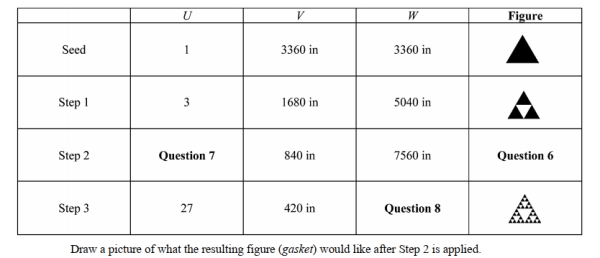
Refer to the information from table shown above ; what is the total length of the darkened boundary of the Sierpinski gasket created if the Step process were to continue indefinitely?

سؤال
You plan on constructing a Sierpinski gasket by starting with a seed triangle whose perimeter is 3360
in. The table below gives the following information where U is the number of darkened triangles at a particular step, V is the perimeter of each darkened triangle, and W is the total length of the darkened boundary of the figure (gasket) obtained in a particular step.
in. The table below gives the following information where U is the number of darkened triangles at a particular step, V is the perimeter of each darkened triangle, and W is the total length of the darkened boundary of the figure (gasket) obtained in a particular step.
سؤال
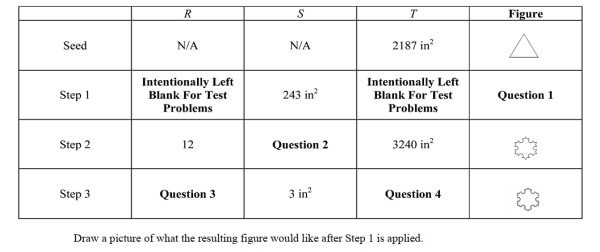
Refer to the table shown above ; how many triangles will be added in Step 3?
سؤال
The following is called the Chaos Game. Start with a square ABCD in which A is located at (0,0), B is located at (27,0), C is located at (27,27) , and D is located at (0,27) . Then, roll a fair die. We will say that A is the winner if we roll a 1, B is the winner if we roll a 2, C is the winner if we roll a 3 , and D is the winner if we roll a 4 . If we roll a 5 or 6 , we disregard the roll and roll again. Each roll of the die generates a point inside or on the boundary of the square according to the following rules.
- Start: Roll the die. Mark the winning vertex and call it P1 .
- Step 1: Roll the die again. From P1 move two-thirds of the way straight towards the next winning vertex. Mark this point and call it P2 .
- Steps 2,3, etc.: Continue rolling the die, each time moving to a point two-thirds of the way from the last position to the winning vertex.
The grid below show the square ABCD .
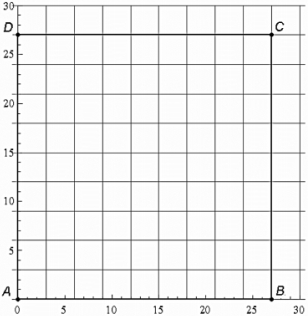
What would be the sequence (1,2,3) was rolled?
- Start: Roll the die. Mark the winning vertex and call it P1 .
- Step 1: Roll the die again. From P1 move two-thirds of the way straight towards the next winning vertex. Mark this point and call it P2 .
- Steps 2,3, etc.: Continue rolling the die, each time moving to a point two-thirds of the way from the last position to the winning vertex.
The grid below show the square ABCD .
What would be the sequence (1,2,3) was rolled?
سؤال
You plan on constructing a Koch snowflake by starting with a seed triangle whose perimeter is X. The table below gives the following information where M is the number of sides at a particular step, L is the length of each side, and P is the total perimeter of the figure. 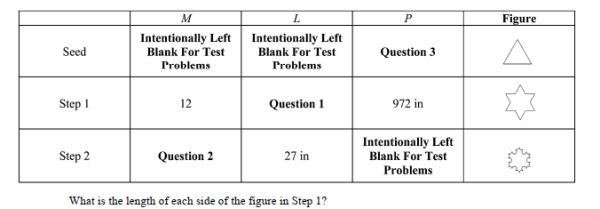
سؤال
To answer the following question, refer to the Mandelbrot replacement process described by:
Start: Choose an arbitrary complex number s , called the seed of the Mandelbrot sequence. Set the seed s as the initial term of the sequence:
Recursive Procedure: To find the next term in the sequence, square the preceding term and add the seed:
If the seed is , then find the term
Start: Choose an arbitrary complex number s , called the seed of the Mandelbrot sequence. Set the seed s as the initial term of the sequence:
Recursive Procedure: To find the next term in the sequence, square the preceding term and add the seed:
If the seed is
, then find the term سؤال
Refer to the table shown above ; how many sides does the figure have in Step 2?
سؤال
Refer to the information from table shown above ; what is the total length of the darkened boundary of the resulting figure (Sierpinski gasket) in Step 3?
سؤال
Refer to the information from table shown above ; what is the perimeter of the Koch snowflake created if the
Step process were to continue indefinitely?
سؤال
The following is called the Chaos Game. Start with a square ABCD in which A is located at (0,0), B is located at (27,0), C is located at (27,27) , and D is located at (0,27) . Then, roll a fair die. We will say that A is the winner if we roll a 1, B is the winner if we roll a 2, C is the winner if we roll a 3, and D is the winner if we roll a 4 . If we roll a 5 or 6 , we disregard the roll and roll again. Each roll of the die generates a point inside or on the boundary of the square according to the following rules.
- Start: Roll the die. Mark the winning vertex and call it P1.
- Step 1: Roll the die again. From P1 move two-thirds of the way straight towards the next winning vertex. Mark this point and call it P2 .
- Steps 2,3, etc.: Continue rolling the die, each time moving to a point two-thirds of the way from the last position to the winning vertex.
The grid below show the square ABCD .
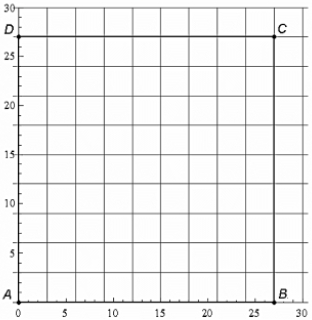
What would be the resulting coordinates of P3 if the sequence of (4,1,4) was rolled?
- Start: Roll the die. Mark the winning vertex and call it P1.
- Step 1: Roll the die again. From P1 move two-thirds of the way straight towards the next winning vertex. Mark this point and call it P2 .
- Steps 2,3, etc.: Continue rolling the die, each time moving to a point two-thirds of the way from the last position to the winning vertex.
The grid below show the square ABCD .
What would be the resulting coordinates of P3 if the sequence of (4,1,4) was rolled?
سؤال
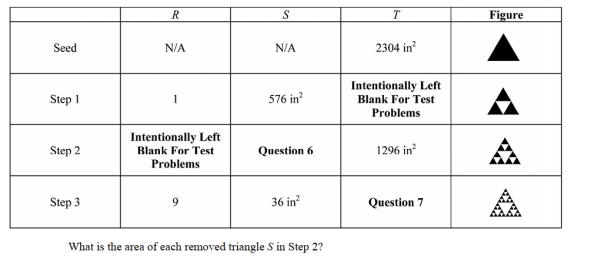
Refer to the table shown above ; what is the total area T in Step 3?
سؤال
Refer to the table shown above ; what is the area of each added triangle in Step 2?
سؤال
Refer to the table shown above ; what is the total area of the figure after Step 3?
سؤال
Refer to the table shown above ; what is the original perimeter X of the seed triangle
سؤال
Refer to the table shown above; how many darkened triangles are there in Step 2?
سؤال
Refer to the information in the table above ; what is the area of the Koch snowflake created if the Step
process were to continue indefinitely?
سؤال
You plan on constructing a Koch snowflake by starting with a seed triangle whose area is 2187 in2. The table below gives the following information where R is the number of triangles added at a particular step, S is the area of each added triangle, and T is the total area of the newly created figure.
سؤال
To answer the following question, refer to the Mandelbrot replacement process described by:
- Start: Choose an arbitrary complex number s , called the seed of the Mandelbrot sequence. Set the seed as the initial term of the sequence:
- Recursive Procedure: To find the next term in the sequence, square the preceding term and add the seed:
If the seed is , then find the term https://d2lvgg3v3hfg70.cloudfront.net/TB34225555/
 .
.
- Start: Choose an arbitrary complex number s , called the seed of the Mandelbrot sequence. Set the seed as the initial term of the sequence:
- Recursive Procedure: To find the next term in the sequence, square the preceding term and add the seed:
If the seed is
, then find the term https://d2lvgg3v3hfg70.cloudfront.net/TB34225555/. سؤال
سؤال
You plan on constructing a Sierpinski gasket by starting with a seed triangle whose area is 2304 in2. The table below gives the following information where R is the number of triangles removed at a particular step, S is the area of each removed triangle, and T is the total area of the newly created figure.
سؤال
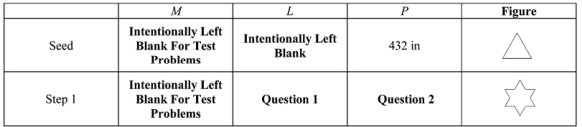
Refer to the information from table shown above ; what is the perimeter of the Koch snowflake created if the Step process were to continue indefinitely?
A) 810 in
B) 2073 in
C) 4651 in
D) Infinite perimeter.
E) None of the above.
سؤال
You plan on constructing a Sierpinski gasket by starting with a seed triangle whose perimeter is X. The table below gives the following information where U is the number of darkened triangles at a particular step, V is the perimeter of each darkened triangle, and W is the length of the darkened boundary of the figure (gasket) obtained in a particular step. 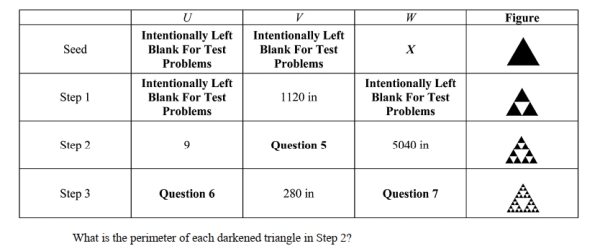
A) 440 in
B) 560 in
C) 760 in
D) 840 in
E) None of the above.
A) 440 in
B) 560 in
C) 760 in
D) 840 in
E) None of the above.
سؤال
سؤال
You plan on constructing a Sierpinski gasket by starting with a seed triangle whose area is 6720 in2. The table below gives the following information where R is the number of triangles removed at a
Particular step, S is the area of each removed triangle, and T is the total area of the newly created figure.
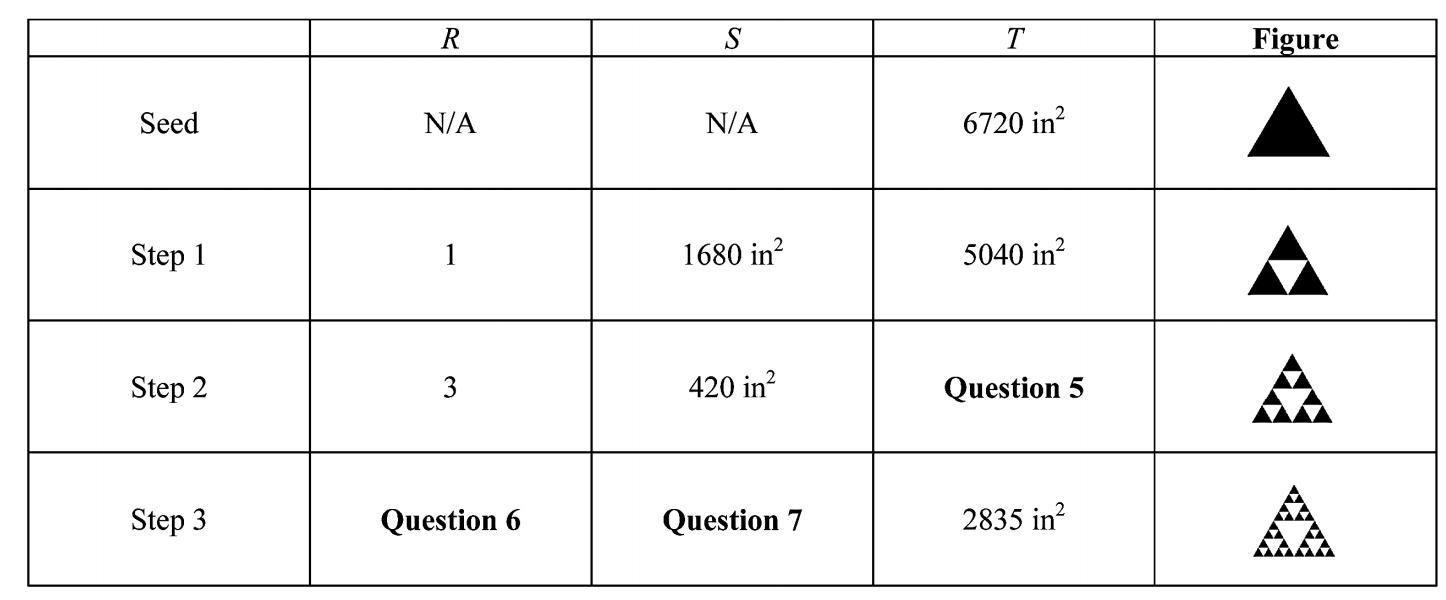
What is the total area of the figure after step 2 ?
A) 2160 in2
B) 3780 in2
C) 4310in2
D) 6300in2
E) None of the above.
Particular step, S is the area of each removed triangle, and T is the total area of the newly created figure.
What is the total area of the figure after step 2 ?
A) 2160 in2
B) 3780 in2
C) 4310in2
D) 6300in2
E) None of the above.
سؤال
To answer the following question, refer to the Mandelbrot replacement process described by:
- Start: Choose an arbitrary complex number s, called the seed of the Mandelbrot sequence. Set the seed s to be the initial term of the sequence:
- Recursive Procedure: To find the next term in the sequence, square the preceding term and add the seed:
Which of the statements below is correct?
A) The seed initiates a Mandelbrot sequence which is escaping.
B) The seed initiates a Mandelbrot sequence which is periodic.
C) The seed initiates a Mandelbrot sequence which is attracted.
D) All of the above.
E) None of the above.
- Start: Choose an arbitrary complex number s, called the seed of the Mandelbrot sequence. Set the seed s to be the initial term of the sequence:
- Recursive Procedure: To find the next term in the sequence, square the preceding term and add the seed:
Which of the statements below is correct?
A) The seed
initiates a Mandelbrot sequence which is escaping.B) The seed
initiates a Mandelbrot sequence which is periodic.C) The seed
initiates a Mandelbrot sequence which is attracted.D) All of the above.
E) None of the above.
سؤال
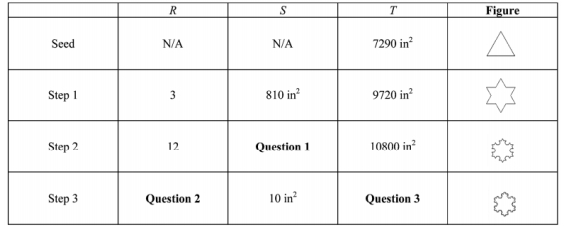
Refer to the table shown above ; how many triangles will be added in Step 3?
A) 18
B) 24
C) 36
D) 48
E) None of the above.
سؤال
Refer to the table shown above ; what is the total perimeter length in Step 1?
(a) 324 in
(b) 576 in
(c) 648 in
(d) 1296 in
(e) None of the above.
سؤال
The following is called the Chaos Game. Start with a square ABCD in which A is located at (0, 0), B is
located at (27, 0), C is located at (27, 27), and D is located at (0, 27). Then, roll a fair die. We will say
that A is the winner if we roll a 1, B is the winner if we roll a 2, C is the winner if we roll a 3, and D is
the winner if we roll a 4. If we roll a 5 or 6, we disregard the roll and roll again. Each roll of the die generates a point inside or on the boundary of the square according to the following rules.
Start: Roll the die. Mark the winning vertex and call it P1.
Step 1: Roll the die again. From P1 move two-thirds of the way straight towards the next
winning vertex. Mark this point and call it P2.
Steps 2, 3, etc.: Continue rolling the die, each time moving to a point two-thirds of the way
from the last position to the winning vertex.
The grid below show the square ABCD.
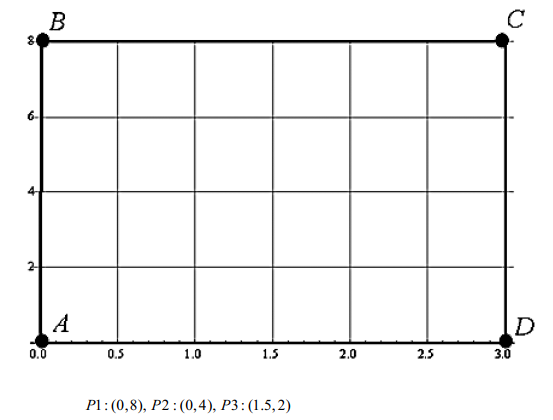
A) (2,1,4)
B) (1,3,3)
C) (2,1,3)
D) (2,3,1)
E) None of the above.
located at (27, 0), C is located at (27, 27), and D is located at (0, 27). Then, roll a fair die. We will say
that A is the winner if we roll a 1, B is the winner if we roll a 2, C is the winner if we roll a 3, and D is
the winner if we roll a 4. If we roll a 5 or 6, we disregard the roll and roll again. Each roll of the die generates a point inside or on the boundary of the square according to the following rules.
Start: Roll the die. Mark the winning vertex and call it P1.
Step 1: Roll the die again. From P1 move two-thirds of the way straight towards the next
winning vertex. Mark this point and call it P2.
Steps 2, 3, etc.: Continue rolling the die, each time moving to a point two-thirds of the way
from the last position to the winning vertex.
The grid below show the square ABCD.
A) (2,1,4)
B) (1,3,3)
C) (2,1,3)
D) (2,3,1)
E) None of the above.
سؤال
Refer to the table shown above ; what is the area of each of the triangles removed during Step 3 ?
A) 90 in2
B) 125 in2
C) 240 in2
D) 380 in2
E) None of the above.
سؤال
The following is called the Chaos Game. Start with rectangle ABCD in which A is located at (0, 0), B
is located at (0, 8), C is located at (3, 8), and D is located at (3, 0). Then, roll a fair die. We will say
that A is the winner if we roll a 1, B is the winner if we roll a 2, C is the winner if we roll a 3, and D is
the winner if we roll a 4. If we roll a 5 or 6, we disregard the roll and roll again. Each roll of the die generates a point inside or on the boundary of the square according to the following rules.
Start: Roll the die. Mark the winning vertex and call it P1.
Step 1: Roll the die again. From P1 move one-half of the way straight toward the next
winning vertex. Mark this point and call it P2. Steps 2, 3, etc.: Continue rolling the die, each time moving to a point one-half of the way
from the last position to the winning vertex.
The grid below shows rectangle ABCD.
https://d2lvgg3v3hfg70.cloudfront.net/TB6029/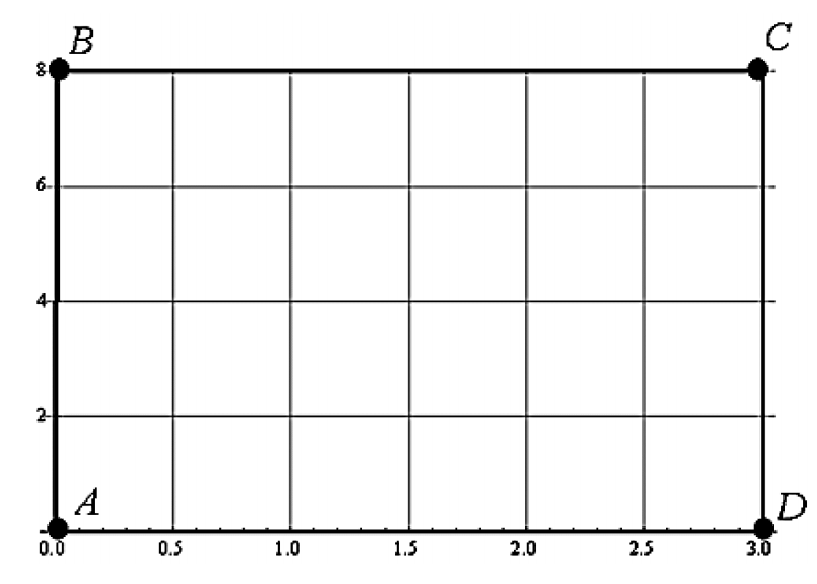 .
.
What sequence of rolls would produce the following sequence of marked points?
P1: (0,8), P2 : (1.5,8), P3 : (0.75, 4)
(a) (2,3,1)
(b) (1,4,2)
(c) (2,1,4)
(d) (2,4,3)
(e) None of the above.
is located at (0, 8), C is located at (3, 8), and D is located at (3, 0). Then, roll a fair die. We will say
that A is the winner if we roll a 1, B is the winner if we roll a 2, C is the winner if we roll a 3, and D is
the winner if we roll a 4. If we roll a 5 or 6, we disregard the roll and roll again. Each roll of the die generates a point inside or on the boundary of the square according to the following rules.
Start: Roll the die. Mark the winning vertex and call it P1.
Step 1: Roll the die again. From P1 move one-half of the way straight toward the next
winning vertex. Mark this point and call it P2. Steps 2, 3, etc.: Continue rolling the die, each time moving to a point one-half of the way
from the last position to the winning vertex.
The grid below shows rectangle ABCD.
https://d2lvgg3v3hfg70.cloudfront.net/TB6029/
.What sequence of rolls would produce the following sequence of marked points?
P1: (0,8), P2 : (1.5,8), P3 : (0.75, 4)
(a) (2,3,1)
(b) (1,4,2)
(c) (2,1,4)
(d) (2,4,3)
(e) None of the above.
سؤال
You plan on constructing a Koch snowflake by starting with a seed triangle whose area is 7290 in2. The table below gives the following information where R is the number of triangles added at a particular step, S is the area of each added triangle, and T is the total area of the newly created figure.
What is the area of each added triangle in Step 2 ?
A) 45 in2
B) 90 in2
C) 105 in2
D) 162 in2
E) None of the above.
What is the area of each added triangle in Step 2 ?
A) 45 in2
B) 90 in2
C) 105 in2
D) 162 in2
E) None of the above.
سؤال
You plan on constructing a Koch snowflake by starting with a seed triangle whose perimeter is 432 in. The table below gives the following information where M is the number of sides at a particular step, L
Is the length of each side, and P is the total perimeter of the figure. What is the length of each side of the figure in Step 1?
A) 36 in
B) 48 in
C) 72 in
D) 144 in
E) None of the above.
Is the length of each side, and P is the total perimeter of the figure. What is the length of each side of the figure in Step 1?
A) 36 in
B) 48 in
C) 72 in
D) 144 in
E) None of the above.
سؤال
Refer to the table shown above ; how many triangles are removed during Step 3?
A) 9
B) 18
C) 27
D) 36
E) None of the above.
سؤال
Refer to the information in the table shown above ; how many darkened triangles are there in Step 3?
A) 18
B) 27
C) 36
D) 45
E) None of the above.
سؤال
Refer to the information from the table shown above ; what is the total length of the darkened boundary of the resulting figure (gasket) in Step 3?
A) 5670 in
B) 6720 in
C) 7560 in
D) 8960 in
E) None of the above.
سؤال
Refer to the table shown above ; what is the total area of the figure after Step 3?
A) 11280 in2
B) 12630 in2
C) 14320 in2
D) 16440 in2
E) None of the above.
سؤال
سؤال
To answer the following question, refer to the Mandelbrot replacement process described by:
a. Start: Choose an arbitrary complex number s , called the seed of the Mandelbrot sequence. Set the seed s as the initial term of the sequence:
b. Recursive Procedure: To find the next term in the sequence, square the preceding term and add the seed:
Which of the statements below is correct?
A) The seed initiates a Mandelbrot sequence which is escaping.
B) The seed initiates a Mandelbrot sequence which is periodic.
C) The seed initiates a Mandelbrot sequence which is attracted.
D) All of the above.
E) None of the above.
a. Start: Choose an arbitrary complex number s , called the seed of the Mandelbrot sequence. Set the seed s as the initial term of the sequence:
b. Recursive Procedure: To find the next term in the sequence, square the preceding term and add the seed:
Which of the statements below is correct?
A) The seed
initiates a Mandelbrot sequence which is escaping.B) The seed
initiates a Mandelbrot sequence which is periodic.C) The seed
initiates a Mandelbrot sequence which is attracted.D) All of the above.
E) None of the above.
سؤال
Two Koch snowflakes are shown below. One was created by starting with a seed triangle whose perimeter was 10 units while the other was created by starting with a seed triangle whose perimeter was 30 units. Assuming that the iterative process continues indefinitely, which of the snowflakes below has the larger perimeter? 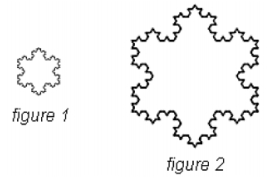
A) figure 1
B) figure 2
C) figures 1 and 2 both have infinite perimeter.
D) Insufficient information.
E) None of the above.
A) figure 1
B) figure 2
C) figures 1 and 2 both have infinite perimeter.
D) Insufficient information.
E) None of the above.

فتح الحزمة
قم بالتسجيل لفتح البطاقات في هذه المجموعة!
Unlock Deck
Unlock Deck
1/39

العب

ملء الشاشة (f)
Deck 12: Fractal Geometry: the Kinky Nature of Nature
1
Refer to the information from table shown above ; what is the total length of the darkened boundary of the Sierpinski gasket created if the Step process were to continue indefinitely?
Infinite length
2
You plan on constructing a Sierpinski gasket by starting with a seed triangle whose perimeter is 3360
in. The table below gives the following information where U is the number of darkened triangles at a particular step, V is the perimeter of each darkened triangle, and W is the total length of the darkened boundary of the figure (gasket) obtained in a particular step.
in. The table below gives the following information where U is the number of darkened triangles at a particular step, V is the perimeter of each darkened triangle, and W is the total length of the darkened boundary of the figure (gasket) obtained in a particular step.
6.

3
Refer to the table shown above ; how many triangles will be added in Step 3?
48
4
The following is called the Chaos Game. Start with a square ABCD in which A is located at (0,0), B is located at (27,0), C is located at (27,27) , and D is located at (0,27) . Then, roll a fair die. We will say that A is the winner if we roll a 1, B is the winner if we roll a 2, C is the winner if we roll a 3 , and D is the winner if we roll a 4 . If we roll a 5 or 6 , we disregard the roll and roll again. Each roll of the die generates a point inside or on the boundary of the square according to the following rules.
- Start: Roll the die. Mark the winning vertex and call it P1 .
- Step 1: Roll the die again. From P1 move two-thirds of the way straight towards the next winning vertex. Mark this point and call it P2 .
- Steps 2,3, etc.: Continue rolling the die, each time moving to a point two-thirds of the way from the last position to the winning vertex.
The grid below show the square ABCD .
What would be the sequence (1,2,3) was rolled?
- Start: Roll the die. Mark the winning vertex and call it P1 .
- Step 1: Roll the die again. From P1 move two-thirds of the way straight towards the next winning vertex. Mark this point and call it P2 .
- Steps 2,3, etc.: Continue rolling the die, each time moving to a point two-thirds of the way from the last position to the winning vertex.
The grid below show the square ABCD .
What would be the sequence (1,2,3) was rolled?
فتح الحزمة
افتح القفل للوصول البطاقات البالغ عددها 39 في هذه المجموعة.
فتح الحزمة
k this deck
5
You plan on constructing a Koch snowflake by starting with a seed triangle whose perimeter is X. The table below gives the following information where M is the number of sides at a particular step, L is the length of each side, and P is the total perimeter of the figure.
فتح الحزمة
افتح القفل للوصول البطاقات البالغ عددها 39 في هذه المجموعة.
فتح الحزمة
k this deck
6
To answer the following question, refer to the Mandelbrot replacement process described by:
Start: Choose an arbitrary complex number s , called the seed of the Mandelbrot sequence. Set the seed s as the initial term of the sequence:
Recursive Procedure: To find the next term in the sequence, square the preceding term and add the seed:
If the seed is , then find the term
Start: Choose an arbitrary complex number s , called the seed of the Mandelbrot sequence. Set the seed s as the initial term of the sequence:
Recursive Procedure: To find the next term in the sequence, square the preceding term and add the seed:
If the seed is
, then find the term فتح الحزمة
افتح القفل للوصول البطاقات البالغ عددها 39 في هذه المجموعة.
فتح الحزمة
k this deck
7
Refer to the table shown above ; how many sides does the figure have in Step 2?
فتح الحزمة
افتح القفل للوصول البطاقات البالغ عددها 39 في هذه المجموعة.
فتح الحزمة
k this deck
8
Refer to the information from table shown above ; what is the total length of the darkened boundary of the resulting figure (Sierpinski gasket) in Step 3?
فتح الحزمة
افتح القفل للوصول البطاقات البالغ عددها 39 في هذه المجموعة.
فتح الحزمة
k this deck
9
Refer to the information from table shown above ; what is the perimeter of the Koch snowflake created if the
Step process were to continue indefinitely?
فتح الحزمة
افتح القفل للوصول البطاقات البالغ عددها 39 في هذه المجموعة.
فتح الحزمة
k this deck
10
The following is called the Chaos Game. Start with a square ABCD in which A is located at (0,0), B is located at (27,0), C is located at (27,27) , and D is located at (0,27) . Then, roll a fair die. We will say that A is the winner if we roll a 1, B is the winner if we roll a 2, C is the winner if we roll a 3, and D is the winner if we roll a 4 . If we roll a 5 or 6 , we disregard the roll and roll again. Each roll of the die generates a point inside or on the boundary of the square according to the following rules.
- Start: Roll the die. Mark the winning vertex and call it P1.
- Step 1: Roll the die again. From P1 move two-thirds of the way straight towards the next winning vertex. Mark this point and call it P2 .
- Steps 2,3, etc.: Continue rolling the die, each time moving to a point two-thirds of the way from the last position to the winning vertex.
The grid below show the square ABCD .
What would be the resulting coordinates of P3 if the sequence of (4,1,4) was rolled?
- Start: Roll the die. Mark the winning vertex and call it P1.
- Step 1: Roll the die again. From P1 move two-thirds of the way straight towards the next winning vertex. Mark this point and call it P2 .
- Steps 2,3, etc.: Continue rolling the die, each time moving to a point two-thirds of the way from the last position to the winning vertex.
The grid below show the square ABCD .
What would be the resulting coordinates of P3 if the sequence of (4,1,4) was rolled?
فتح الحزمة
افتح القفل للوصول البطاقات البالغ عددها 39 في هذه المجموعة.
فتح الحزمة
k this deck
11
Refer to the table shown above ; what is the total area T in Step 3?
فتح الحزمة
افتح القفل للوصول البطاقات البالغ عددها 39 في هذه المجموعة.
فتح الحزمة
k this deck
12
Refer to the table shown above ; what is the area of each added triangle in Step 2?
فتح الحزمة
افتح القفل للوصول البطاقات البالغ عددها 39 في هذه المجموعة.
فتح الحزمة
k this deck
13
Refer to the table shown above ; what is the total area of the figure after Step 3?
فتح الحزمة
افتح القفل للوصول البطاقات البالغ عددها 39 في هذه المجموعة.
فتح الحزمة
k this deck
14
Refer to the table shown above ; what is the original perimeter X of the seed triangle
فتح الحزمة
افتح القفل للوصول البطاقات البالغ عددها 39 في هذه المجموعة.
فتح الحزمة
k this deck
15
Refer to the table shown above; how many darkened triangles are there in Step 2?
فتح الحزمة
افتح القفل للوصول البطاقات البالغ عددها 39 في هذه المجموعة.
فتح الحزمة
k this deck
16
Refer to the information in the table above ; what is the area of the Koch snowflake created if the Step
process were to continue indefinitely?
فتح الحزمة
افتح القفل للوصول البطاقات البالغ عددها 39 في هذه المجموعة.
فتح الحزمة
k this deck
17
You plan on constructing a Koch snowflake by starting with a seed triangle whose area is 2187 in2. The table below gives the following information where R is the number of triangles added at a particular step, S is the area of each added triangle, and T is the total area of the newly created figure.
فتح الحزمة
افتح القفل للوصول البطاقات البالغ عددها 39 في هذه المجموعة.
فتح الحزمة
k this deck
18
To answer the following question, refer to the Mandelbrot replacement process described by:
- Start: Choose an arbitrary complex number s , called the seed of the Mandelbrot sequence. Set the seed as the initial term of the sequence:
- Recursive Procedure: To find the next term in the sequence, square the preceding term and add the seed:
If the seed is , then find the term https://d2lvgg3v3hfg70.cloudfront.net/TB34225555/.
- Start: Choose an arbitrary complex number s , called the seed of the Mandelbrot sequence. Set the seed as the initial term of the sequence:
- Recursive Procedure: To find the next term in the sequence, square the preceding term and add the seed:
If the seed is
, then find the term https://d2lvgg3v3hfg70.cloudfront.net/TB34225555/. فتح الحزمة
افتح القفل للوصول البطاقات البالغ عددها 39 في هذه المجموعة.
فتح الحزمة
k this deck
19
Refer to the information shown above ; what is the total area of the Sierpinski gasket created if the Step process were to continue indefinitely?
فتح الحزمة
افتح القفل للوصول البطاقات البالغ عددها 39 في هذه المجموعة.
فتح الحزمة
k this deck
20
You plan on constructing a Sierpinski gasket by starting with a seed triangle whose area is 2304 in2. The table below gives the following information where R is the number of triangles removed at a particular step, S is the area of each removed triangle, and T is the total area of the newly created figure.
فتح الحزمة
افتح القفل للوصول البطاقات البالغ عددها 39 في هذه المجموعة.
فتح الحزمة
k this deck
21
Refer to the information from table shown above ; what is the perimeter of the Koch snowflake created if the Step process were to continue indefinitely?
A) 810 in
B) 2073 in
C) 4651 in
D) Infinite perimeter.
E) None of the above.
فتح الحزمة
افتح القفل للوصول البطاقات البالغ عددها 39 في هذه المجموعة.
فتح الحزمة
k this deck
22
You plan on constructing a Sierpinski gasket by starting with a seed triangle whose perimeter is X. The table below gives the following information where U is the number of darkened triangles at a particular step, V is the perimeter of each darkened triangle, and W is the length of the darkened boundary of the figure (gasket) obtained in a particular step.
A) 440 in
B) 560 in
C) 760 in
D) 840 in
E) None of the above.
A) 440 in
B) 560 in
C) 760 in
D) 840 in
E) None of the above.
فتح الحزمة
افتح القفل للوصول البطاقات البالغ عددها 39 في هذه المجموعة.
فتح الحزمة
k this deck
23
Which of the following is an example of fractal behavior in nature?
A) a digital photograph
B) a skyscraper
C) a lightening bolt
D) All of the above.
E) None of the above.
A) a digital photograph
B) a skyscraper
C) a lightening bolt
D) All of the above.
E) None of the above.
فتح الحزمة
افتح القفل للوصول البطاقات البالغ عددها 39 في هذه المجموعة.
فتح الحزمة
k this deck
24
You plan on constructing a Sierpinski gasket by starting with a seed triangle whose area is 6720 in2. The table below gives the following information where R is the number of triangles removed at a
Particular step, S is the area of each removed triangle, and T is the total area of the newly created figure.
What is the total area of the figure after step 2 ?
A) 2160 in2
B) 3780 in2
C) 4310in2
D) 6300in2
E) None of the above.
Particular step, S is the area of each removed triangle, and T is the total area of the newly created figure.
What is the total area of the figure after step 2 ?
A) 2160 in2
B) 3780 in2
C) 4310in2
D) 6300in2
E) None of the above.
فتح الحزمة
افتح القفل للوصول البطاقات البالغ عددها 39 في هذه المجموعة.
فتح الحزمة
k this deck
25
To answer the following question, refer to the Mandelbrot replacement process described by:
- Start: Choose an arbitrary complex number s, called the seed of the Mandelbrot sequence. Set the seed s to be the initial term of the sequence:
- Recursive Procedure: To find the next term in the sequence, square the preceding term and add the seed:
Which of the statements below is correct?
A) The seed initiates a Mandelbrot sequence which is escaping.
B) The seed initiates a Mandelbrot sequence which is periodic.
C) The seed initiates a Mandelbrot sequence which is attracted.
D) All of the above.
E) None of the above.
- Start: Choose an arbitrary complex number s, called the seed of the Mandelbrot sequence. Set the seed s to be the initial term of the sequence:
- Recursive Procedure: To find the next term in the sequence, square the preceding term and add the seed:
Which of the statements below is correct?
A) The seed
initiates a Mandelbrot sequence which is escaping.B) The seed
initiates a Mandelbrot sequence which is periodic.C) The seed
initiates a Mandelbrot sequence which is attracted.D) All of the above.
E) None of the above.
فتح الحزمة
افتح القفل للوصول البطاقات البالغ عددها 39 في هذه المجموعة.
فتح الحزمة
k this deck
26
Refer to the table shown above ; how many triangles will be added in Step 3?
A) 18
B) 24
C) 36
D) 48
E) None of the above.
فتح الحزمة
افتح القفل للوصول البطاقات البالغ عددها 39 في هذه المجموعة.
فتح الحزمة
k this deck
27
Refer to the table shown above ; what is the total perimeter length in Step 1?
(a) 324 in
(b) 576 in
(c) 648 in
(d) 1296 in
(e) None of the above.
فتح الحزمة
افتح القفل للوصول البطاقات البالغ عددها 39 في هذه المجموعة.
فتح الحزمة
k this deck
28
The following is called the Chaos Game. Start with a square ABCD in which A is located at (0, 0), B is
located at (27, 0), C is located at (27, 27), and D is located at (0, 27). Then, roll a fair die. We will say
that A is the winner if we roll a 1, B is the winner if we roll a 2, C is the winner if we roll a 3, and D is
the winner if we roll a 4. If we roll a 5 or 6, we disregard the roll and roll again. Each roll of the die generates a point inside or on the boundary of the square according to the following rules.
Start: Roll the die. Mark the winning vertex and call it P1.
Step 1: Roll the die again. From P1 move two-thirds of the way straight towards the next
winning vertex. Mark this point and call it P2.
Steps 2, 3, etc.: Continue rolling the die, each time moving to a point two-thirds of the way
from the last position to the winning vertex.
The grid below show the square ABCD.
A) (2,1,4)
B) (1,3,3)
C) (2,1,3)
D) (2,3,1)
E) None of the above.
located at (27, 0), C is located at (27, 27), and D is located at (0, 27). Then, roll a fair die. We will say
that A is the winner if we roll a 1, B is the winner if we roll a 2, C is the winner if we roll a 3, and D is
the winner if we roll a 4. If we roll a 5 or 6, we disregard the roll and roll again. Each roll of the die generates a point inside or on the boundary of the square according to the following rules.
Start: Roll the die. Mark the winning vertex and call it P1.
Step 1: Roll the die again. From P1 move two-thirds of the way straight towards the next
winning vertex. Mark this point and call it P2.
Steps 2, 3, etc.: Continue rolling the die, each time moving to a point two-thirds of the way
from the last position to the winning vertex.
The grid below show the square ABCD.
A) (2,1,4)
B) (1,3,3)
C) (2,1,3)
D) (2,3,1)
E) None of the above.
فتح الحزمة
افتح القفل للوصول البطاقات البالغ عددها 39 في هذه المجموعة.
فتح الحزمة
k this deck
29
Refer to the table shown above ; what is the area of each of the triangles removed during Step 3 ?
A) 90 in2
B) 125 in2
C) 240 in2
D) 380 in2
E) None of the above.
فتح الحزمة
افتح القفل للوصول البطاقات البالغ عددها 39 في هذه المجموعة.
فتح الحزمة
k this deck
30
The following is called the Chaos Game. Start with rectangle ABCD in which A is located at (0, 0), B
is located at (0, 8), C is located at (3, 8), and D is located at (3, 0). Then, roll a fair die. We will say
that A is the winner if we roll a 1, B is the winner if we roll a 2, C is the winner if we roll a 3, and D is
the winner if we roll a 4. If we roll a 5 or 6, we disregard the roll and roll again. Each roll of the die generates a point inside or on the boundary of the square according to the following rules.
Start: Roll the die. Mark the winning vertex and call it P1.
Step 1: Roll the die again. From P1 move one-half of the way straight toward the next
winning vertex. Mark this point and call it P2. Steps 2, 3, etc.: Continue rolling the die, each time moving to a point one-half of the way
from the last position to the winning vertex.
The grid below shows rectangle ABCD.
https://d2lvgg3v3hfg70.cloudfront.net/TB6029/.
What sequence of rolls would produce the following sequence of marked points?
P1: (0,8), P2 : (1.5,8), P3 : (0.75, 4)
(a) (2,3,1)
(b) (1,4,2)
(c) (2,1,4)
(d) (2,4,3)
(e) None of the above.
is located at (0, 8), C is located at (3, 8), and D is located at (3, 0). Then, roll a fair die. We will say
that A is the winner if we roll a 1, B is the winner if we roll a 2, C is the winner if we roll a 3, and D is
the winner if we roll a 4. If we roll a 5 or 6, we disregard the roll and roll again. Each roll of the die generates a point inside or on the boundary of the square according to the following rules.
Start: Roll the die. Mark the winning vertex and call it P1.
Step 1: Roll the die again. From P1 move one-half of the way straight toward the next
winning vertex. Mark this point and call it P2. Steps 2, 3, etc.: Continue rolling the die, each time moving to a point one-half of the way
from the last position to the winning vertex.
The grid below shows rectangle ABCD.
https://d2lvgg3v3hfg70.cloudfront.net/TB6029/
.What sequence of rolls would produce the following sequence of marked points?
P1: (0,8), P2 : (1.5,8), P3 : (0.75, 4)
(a) (2,3,1)
(b) (1,4,2)
(c) (2,1,4)
(d) (2,4,3)
(e) None of the above.
فتح الحزمة
افتح القفل للوصول البطاقات البالغ عددها 39 في هذه المجموعة.
فتح الحزمة
k this deck
31
You plan on constructing a Koch snowflake by starting with a seed triangle whose area is 7290 in2. The table below gives the following information where R is the number of triangles added at a particular step, S is the area of each added triangle, and T is the total area of the newly created figure.
What is the area of each added triangle in Step 2 ?
A) 45 in2
B) 90 in2
C) 105 in2
D) 162 in2
E) None of the above.
What is the area of each added triangle in Step 2 ?
A) 45 in2
B) 90 in2
C) 105 in2
D) 162 in2
E) None of the above.
فتح الحزمة
افتح القفل للوصول البطاقات البالغ عددها 39 في هذه المجموعة.
فتح الحزمة
k this deck
32
You plan on constructing a Koch snowflake by starting with a seed triangle whose perimeter is 432 in. The table below gives the following information where M is the number of sides at a particular step, L
Is the length of each side, and P is the total perimeter of the figure. What is the length of each side of the figure in Step 1?
A) 36 in
B) 48 in
C) 72 in
D) 144 in
E) None of the above.
Is the length of each side, and P is the total perimeter of the figure. What is the length of each side of the figure in Step 1?
A) 36 in
B) 48 in
C) 72 in
D) 144 in
E) None of the above.
فتح الحزمة
افتح القفل للوصول البطاقات البالغ عددها 39 في هذه المجموعة.
فتح الحزمة
k this deck
33
Refer to the table shown above ; how many triangles are removed during Step 3?
A) 9
B) 18
C) 27
D) 36
E) None of the above.
فتح الحزمة
افتح القفل للوصول البطاقات البالغ عددها 39 في هذه المجموعة.
فتح الحزمة
k this deck
34
Refer to the information in the table shown above ; how many darkened triangles are there in Step 3?
A) 18
B) 27
C) 36
D) 45
E) None of the above.
فتح الحزمة
افتح القفل للوصول البطاقات البالغ عددها 39 في هذه المجموعة.
فتح الحزمة
k this deck
35
Refer to the information from the table shown above ; what is the total length of the darkened boundary of the resulting figure (gasket) in Step 3?
A) 5670 in
B) 6720 in
C) 7560 in
D) 8960 in
E) None of the above.
فتح الحزمة
افتح القفل للوصول البطاقات البالغ عددها 39 في هذه المجموعة.
فتح الحزمة
k this deck
36
Refer to the table shown above ; what is the total area of the figure after Step 3?
A) 11280 in2
B) 12630 in2
C) 14320 in2
D) 16440 in2
E) None of the above.
فتح الحزمة
افتح القفل للوصول البطاقات البالغ عددها 39 في هذه المجموعة.
فتح الحزمة
k this deck
37
Which of the following is an example of fractal behavior in nature?
A) coastline
B) mountain ridge
C) head of cauliflower
D) All of the above.
E) None of the above.
A) coastline
B) mountain ridge
C) head of cauliflower
D) All of the above.
E) None of the above.
فتح الحزمة
افتح القفل للوصول البطاقات البالغ عددها 39 في هذه المجموعة.
فتح الحزمة
k this deck
38
To answer the following question, refer to the Mandelbrot replacement process described by:
a. Start: Choose an arbitrary complex number s , called the seed of the Mandelbrot sequence. Set the seed s as the initial term of the sequence:
b. Recursive Procedure: To find the next term in the sequence, square the preceding term and add the seed:
Which of the statements below is correct?
A) The seed initiates a Mandelbrot sequence which is escaping.
B) The seed initiates a Mandelbrot sequence which is periodic.
C) The seed initiates a Mandelbrot sequence which is attracted.
D) All of the above.
E) None of the above.
a. Start: Choose an arbitrary complex number s , called the seed of the Mandelbrot sequence. Set the seed s as the initial term of the sequence:
b. Recursive Procedure: To find the next term in the sequence, square the preceding term and add the seed:
Which of the statements below is correct?
A) The seed
initiates a Mandelbrot sequence which is escaping.B) The seed
initiates a Mandelbrot sequence which is periodic.C) The seed
initiates a Mandelbrot sequence which is attracted.D) All of the above.
E) None of the above.
فتح الحزمة
افتح القفل للوصول البطاقات البالغ عددها 39 في هذه المجموعة.
فتح الحزمة
k this deck
39
Two Koch snowflakes are shown below. One was created by starting with a seed triangle whose perimeter was 10 units while the other was created by starting with a seed triangle whose perimeter was 30 units. Assuming that the iterative process continues indefinitely, which of the snowflakes below has the larger perimeter?
A) figure 1
B) figure 2
C) figures 1 and 2 both have infinite perimeter.
D) Insufficient information.
E) None of the above.
A) figure 1
B) figure 2
C) figures 1 and 2 both have infinite perimeter.
D) Insufficient information.
E) None of the above.
فتح الحزمة
افتح القفل للوصول البطاقات البالغ عددها 39 في هذه المجموعة.
فتح الحزمة
k this deck
فتح الحزمة
افتح القفل للوصول البطاقات البالغ عددها 39 في هذه المجموعة.






