







 تكلم مع الذكاء الاصطناعي


Deck 53: Introduction to Ecology: Population Ecology
ملء الشاشة (f)

سؤال

سؤال
سؤال
سؤال
سؤال
سؤال
سؤال
سؤال
سؤال
سؤال
سؤال
سؤال
سؤال
ANALYZING DATA. The population of India in 2009 was 1.171 million, and its growth rate was 1.6% per year. Calculate the 2010 population of India.
سؤال
سؤال
سؤال
سؤال
سؤال
سؤال
سؤال
سؤال
سؤال

فتح الحزمة
قم بالتسجيل لفتح البطاقات في هذه المجموعة!
Unlock Deck
Unlock Deck
1/22

العب

ملء الشاشة (f)
Deck 53: Introduction to Ecology: Population Ecology
1
How might pigs at a trough be an example of exploitation competition of interference competition
Pigs at a trough can be seen as an example of exploitation competition if they all equally share the food that is available. If the pigs split the food at the trough amongst themselves, this ensures that each pig at the trough will receive an equal amount of food at low population densities, and an inadequate amount at higher densities.
This likely occurs in the scenario that all the pigs are roughly the same size and age, since no individual pig is exerting dominance. Pigs at a trough can also be seen as an example of interference competition if there is a more dominant group of pigs. If there are larger or more aggressive pigs, they are likely to exhibit interference competition as they would obtain a larger proportion of the food available at the expense of the less dominant pigs.
This likely occurs in the scenario that all the pigs are roughly the same size and age, since no individual pig is exerting dominance. Pigs at a trough can also be seen as an example of interference competition if there is a more dominant group of pigs. If there are larger or more aggressive pigs, they are likely to exhibit interference competition as they would obtain a larger proportion of the food available at the expense of the less dominant pigs.
2
Population _____ is the number of individuals of a species per unit of habitat area or volume at a given time.
A)dispersion
B)density
C)survivorship
D)age structure
E)demographics
A)dispersion
B)density
C)survivorship
D)age structure
E)demographics
Population density refers to the number of individuals of a species per unit of volume or area at a given time. Density can vary according to the type of environment and time of the year. Thus, the correct answer (b) density.
Population dispersion is the spacing of members relative to each other in different manners. This means (a) is incorrect.
Survivorship refers to the probability that an individual will survive according to its age; (c) does not apply here since it is unrelated to the proportion of number of individuals to a given area.
Age structure refers to the organization and proportion of different cohorts. This does not define the number of individuals relative to a certain amount of land, so (d) is incorrect.
Demographics are statistics related to aspects of human population outside of the quantity of individuals for a given amount of space. This eliminates (e).
Population dispersion is the spacing of members relative to each other in different manners. This means (a) is incorrect.
Survivorship refers to the probability that an individual will survive according to its age; (c) does not apply here since it is unrelated to the proportion of number of individuals to a given area.
Age structure refers to the organization and proportion of different cohorts. This does not define the number of individuals relative to a certain amount of land, so (d) is incorrect.
Demographics are statistics related to aspects of human population outside of the quantity of individuals for a given amount of space. This eliminates (e).
3
Explain why the population size of a species that competes by interference competition is often near the carrying capacity, whereas the population size of a species that competes by exploitation competition is often greater than or below the carrying capacity.
Interference competition will typically be near carrying capacity with little drop in population size. The small decreases in population size are due to the expected deaths of individuals that are unable to compete for food and resources successfully against more dominant individuals.
In interference competition, there is always a group of dominant individuals that will receive an adequate supply of limited resources, increasing their chances for survival and reproduction to sustain the population.
Conversely, exploitation competition can lead to a drop in population to zero. Since all individuals share a limited resource equally, this promotes a high survival rate at lower population densities, leading to a population greater than the carrying capacity.
At higher densities, exploitation competition increases the risks that all individuals will die out since none of them would receive an adequate supply of food. This causes a large drop in population size that is below the carrying capacity.
In interference competition, there is always a group of dominant individuals that will receive an adequate supply of limited resources, increasing their chances for survival and reproduction to sustain the population.
Conversely, exploitation competition can lead to a drop in population to zero. Since all individuals share a limited resource equally, this promotes a high survival rate at lower population densities, leading to a population greater than the carrying capacity.
At higher densities, exploitation competition increases the risks that all individuals will die out since none of them would receive an adequate supply of food. This causes a large drop in population size that is below the carrying capacity.
4
Which of the following patterns of cars parked along a street is an example of uniform dispersion
A)five cars parked next to one another in the middle, leaving two empty spaces at one end and three empty spaces at the other end
B)five cars parked in this pattern: car, empty space, car, empty space, and so on
C)five cars parked in no discernible pattern, sometimes having empty spaces on each side and sometimes parked next to another car
A)five cars parked next to one another in the middle, leaving two empty spaces at one end and three empty spaces at the other end
B)five cars parked in this pattern: car, empty space, car, empty space, and so on
C)five cars parked in no discernible pattern, sometimes having empty spaces on each side and sometimes parked next to another car
فتح الحزمة
افتح القفل للوصول البطاقات البالغ عددها 22 في هذه المجموعة.
فتح الحزمة
k this deck
5
A female elephant bears a single offspring every two to four years. Based on this information, which survivorship curve do you think is representative of elephants Explain your answer.
فتح الحزمة
افتح القفل للوصول البطاقات البالغ عددها 22 في هذه المجموعة.
فتح الحزمة
k this deck
6
The per capita growth rate of a population where dispersal is not a factor is expressed as
A)i + e
B)b d
C)dN / dt
D)rN ( K N )
E)( K N )÷ K
A)i + e
B)b d
C)dN / dt
D)rN ( K N )
E)( K N )÷ K
فتح الحزمة
افتح القفل للوصول البطاقات البالغ عددها 22 في هذه المجموعة.
فتح الحزمة
k this deck
7
EVOLUTION LINK. In developing his scientific theory of evolution by natural selection, Charles Darwin considered four main observations: heritable variation among individuals in a population, overproduction of offspring, limits on population growth, and differential reproductive success. Compare how these observations may apply to populations that tend to fit the concepts of r selection and K selection.
فتح الحزمة
افتح القفل للوصول البطاقات البالغ عددها 22 في هذه المجموعة.
فتح الحزمة
k this deck
8
The maximum rate at which a population could increase under ideal conditions is known as its
A)total fertility rate
B)survivorship
C)intrinsic rate of increase
D)doubling time
E)age structure
A)total fertility rate
B)survivorship
C)intrinsic rate of increase
D)doubling time
E)age structure
فتح الحزمة
افتح القفل للوصول البطاقات البالغ عددها 22 في هذه المجموعة.
فتح الحزمة
k this deck
9
ANALYZING DATA. In Bolivia, 39% of the population is younger than age 15, and 4% is older than In Austria, 16% of the population is younger than 15, and 16% is older than Which country will have the highest growth rate over the next two decades Why
فتح الحزمة
افتح القفل للوصول البطاقات البالغ عددها 22 في هذه المجموعة.
فتح الحزمة
k this deck
10
When r is a positive number, the population size is
A)stable
B)increasing
C)decreasing
D)either increasing or decreasing, depending on interference competition
E)either increasing or stable, depending on whether the species is semelparous
A)stable
B)increasing
C)decreasing
D)either increasing or decreasing, depending on interference competition
E)either increasing or stable, depending on whether the species is semelparous
فتح الحزمة
افتح القفل للوصول البطاقات البالغ عددها 22 في هذه المجموعة.
فتح الحزمة
k this deck
11
ANALYZING DATA. The 2009 population of the Netherlands was 16.5 million, and its land area is 15,768 square miles. The 2009 population of the United States was 306.8 million, and its land area is 3,717,796 square miles. Which country has the greater population density
فتح الحزمة
افتح القفل للوصول البطاقات البالغ عددها 22 في هذه المجموعة.
فتح الحزمة
k this deck
12
In a graph of population size versus time, a J-shaped curve is characteristic of
A)exponential population growth
B)logistic population growth
C)zero population growth
D)replacement-level fertility
E)population growth momentum
A)exponential population growth
B)logistic population growth
C)zero population growth
D)replacement-level fertility
E)population growth momentum
فتح الحزمة
افتح القفل للوصول البطاقات البالغ عددها 22 في هذه المجموعة.
فتح الحزمة
k this deck
13
ANALYZING DATA. The population of India in 2009 was 1.171 million, and its growth rate was 1.6% per year. Calculate the 2010 population of India.
فتح الحزمة
افتح القفل للوصول البطاقات البالغ عددها 22 في هذه المجموعة.
فتح الحزمة
k this deck
14
The largest population that can be maintained by a particular environment for an indefinite period is known as a
A)semelparous population
B)population undergoing exponential growth
C)metapopulation
D)population's carrying capacity
E)source population
A)semelparous population
B)population undergoing exponential growth
C)metapopulation
D)population's carrying capacity
E)source population
فتح الحزمة
افتح القفل للوصول البطاقات البالغ عددها 22 في هذه المجموعة.
فتح الحزمة
k this deck
15
ANALYZING DATA. The world population in 2009 was 6.8 billion, and its annual growth rate was 1.2%. If the birth rate was 20 per 1000 people in the year 2009, what was the death rate, expressed as number per 1000 people
فتح الحزمة
افتح القفل للوصول البطاقات البالغ عددها 22 في هذه المجموعة.
فتح الحزمة
k this deck
16
Giant bamboos live many years without reproducing, then send up a huge flowering stalk and die shortly thereafter. Giant bamboo is therefore an example of
A)iteroparity
B)a source population
C)a metapopulation
D)an r strategist
E)semelparity
A)iteroparity
B)a source population
C)a metapopulation
D)an r strategist
E)semelparity
فتح الحزمة
افتح القفل للوصول البطاقات البالغ عددها 22 في هذه المجموعة.
فتح الحزمة
k this deck
17
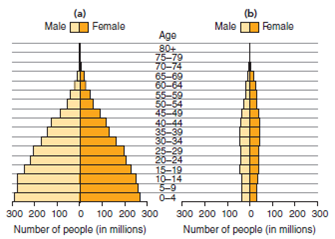
ANALYZING DATA. Consider the age structure diagrams for counties
A)and
B)following. Which diagram is consistent with negative growth momentum Why
A)and
B)following. Which diagram is consistent with negative growth momentum Why
فتح الحزمة
افتح القفل للوصول البطاقات البالغ عددها 22 في هذه المجموعة.
فتح الحزمة
k this deck
18
Predation, disease, and competition are examples of _____ factors.
A)density-dependent
B)density-independent
C)survivorship
D)dispersal
E)semelparous
A)density-dependent
B)density-independent
C)survivorship
D)dispersal
E)semelparous
فتح الحزمة
افتح القفل للوصول البطاقات البالغ عددها 22 في هذه المجموعة.
فتح الحزمة
k this deck
19
SCIENCE, TECHNOLOGY, AND SOCIETY. In what ways has technology contributed to consumption overpopulation Can you propose some applications of technology that might help alleviate its effects
فتح الحزمة
افتح القفل للوصول البطاقات البالغ عددها 22 في هذه المجموعة.
فتح الحزمة
k this deck
20
_____ competition occurs within a population, and _____ competition occurs among populations of different species.
A)Interspecific; intraspecific
B)Intraspecific; interspecific
C)Type I survivorship; Type II survivorship
D)Interference; exploitation
E)Exploitation; interference.
A)Interspecific; intraspecific
B)Intraspecific; interspecific
C)Type I survivorship; Type II survivorship
D)Interference; exploitation
E)Exploitation; interference.
فتح الحزمة
افتح القفل للوصول البطاقات البالغ عددها 22 في هذه المجموعة.
فتح الحزمة
k this deck
21
A highly developed country has a
A)long doubling time
B)low infant mortality rate
C)high GNI PPP per capita
D)a and b
E)a, b, and c
A)long doubling time
B)low infant mortality rate
C)high GNI PPP per capita
D)a and b
E)a, b, and c
فتح الحزمة
افتح القفل للوصول البطاقات البالغ عددها 22 في هذه المجموعة.
فتح الحزمة
k this deck
22
The continued growth of a population with a young age structure, even after its fertility rate has declined, is known as
A)population doubling
B)iteroparity
C)population growth momentum
D)r selection
E)density dependence
A)population doubling
B)iteroparity
C)population growth momentum
D)r selection
E)density dependence
فتح الحزمة
افتح القفل للوصول البطاقات البالغ عددها 22 في هذه المجموعة.
فتح الحزمة
k this deck
فتح الحزمة
افتح القفل للوصول البطاقات البالغ عددها 22 في هذه المجموعة.






