







 تكلم مع الذكاء الاصطناعي


Deck 35: Government Spending, Taxes, and Fiscal Policy
ملء الشاشة (f)

سؤال

سؤال
سؤال
سؤال
The following equation provides an alternative calculation to determine a developing country's financing gap:

In this equation, FG is the financing gap; A is a variable that captures the country's starting income together with its ability to turn investment into growth (expressed in dollars) ; g is the targeted growth rate; and I D is the amount of domestic investment currently in the economy. Assume that A = $50,000,000,000, g = 0.08, and I D = $500,000,000, and answer the questions that follow.
a. What is the size of the financing gap?
b. Assume that the population of the United States is 300 million. How much would each U.S. citizen have to pay to fill the financing gap?
c. What percentage of GDP per capita in the United States does your answer from (b) represent if GDP per capita is currently $45,000?
Now assume that the United States decides to donate the amount of the financing gap to the developing country as aid. Assume also that there are administrative and competitive costs associated with receiving aid. Specifically, 23 cents of every dollar spent on aid will go to administrative costs. Also, for every dollar received from abroad intended to be used for investment, 50 cents will be used for noninvestment purposes.
d. Calculate the real increase in investment dollars the aid from the United States will provide in the recipient country.
In this equation, FG is the financing gap; A is a variable that captures the country's starting income together with its ability to turn investment into growth (expressed in dollars) ; g is the targeted growth rate; and I D is the amount of domestic investment currently in the economy. Assume that A = $50,000,000,000, g = 0.08, and I D = $500,000,000, and answer the questions that follow.
a. What is the size of the financing gap?
b. Assume that the population of the United States is 300 million. How much would each U.S. citizen have to pay to fill the financing gap?
c. What percentage of GDP per capita in the United States does your answer from (b) represent if GDP per capita is currently $45,000?
Now assume that the United States decides to donate the amount of the financing gap to the developing country as aid. Assume also that there are administrative and competitive costs associated with receiving aid. Specifically, 23 cents of every dollar spent on aid will go to administrative costs. Also, for every dollar received from abroad intended to be used for investment, 50 cents will be used for noninvestment purposes.
d. Calculate the real increase in investment dollars the aid from the United States will provide in the recipient country.
سؤال
سؤال
سؤال
سؤال
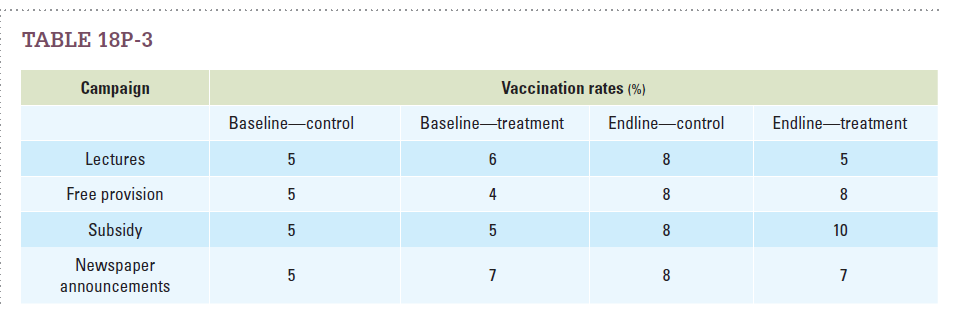
Table 18P-3 displays the results of a study on how to improve vaccination rates in a developing nation. The baseline numbers represent the rates of vaccination at the beginning of the study, while the endline numbers represent the rates of vaccination at the study's conclusion. Answer the following questions.
a. Which campaign(s) had a positive effect on vaccination rates in comparison to the control group?
b. Which campaign had the largest positive effect on vaccination rates in comparison to the control group?
c. Which campaign(s) had a negative effect on vaccination rates in comparison to the control group?
d. Which campaign(s) had no effect on vaccination rates in comparison to the control group?
a. Which campaign(s) had a positive effect on vaccination rates in comparison to the control group?
b. Which campaign had the largest positive effect on vaccination rates in comparison to the control group?
c. Which campaign(s) had a negative effect on vaccination rates in comparison to the control group?
d. Which campaign(s) had no effect on vaccination rates in comparison to the control group?
سؤال
سؤال
سؤال
سؤال
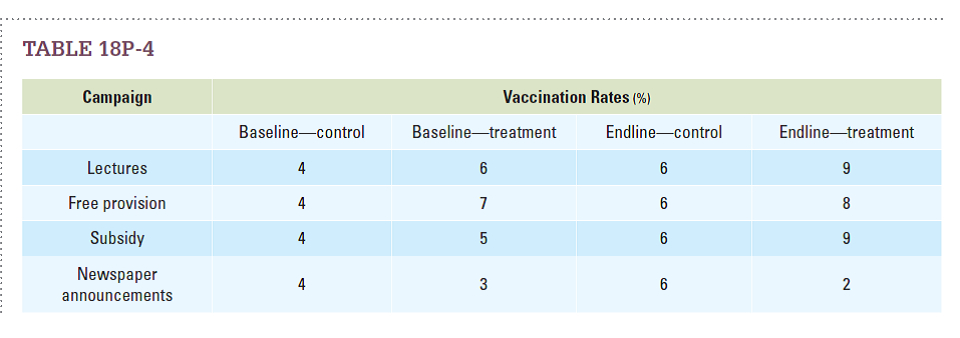
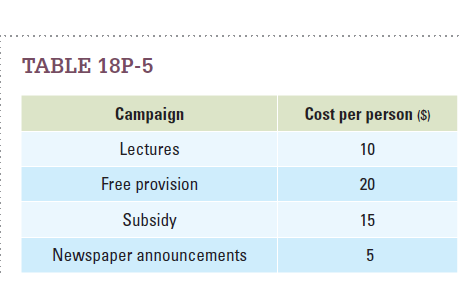
Table 18P-4 displays the results of a study on how to improve vaccination rates in a developing nation. The baseline numbers represent the rates of vaccination at the beginning of the study, and the endline numbers represent the rates of vaccination at the study's conclusion. Rank the campaigns in order from most effective to least effective. Then refer to Table 18-P-5, which shows the cost per person of each campaign. Combining information from the two tables, rank the campaigns that resulted in an increase in vaccinations from high to low in terms of cost effectiveness (based on treatment effect alone).
سؤال
سؤال
سؤال
سؤال
سؤال
سؤال
سؤال
سؤال
سؤال
سؤال
سؤال
Table 18P-1 shows the levels and annual growth rates of economic indicators for two countries, Nationavia and Countrystan. Assume these growth rates will remain constant for the foreseeable future. Use this data to determine whether each of the following statements is true, false, or indeterminable.
a. The theory of income convergence (that national incomes in poor countries will "catch up" to those in wealthier countries) holds for Nationavia and Countrystan.
b. Countrystan has higher levels of human capital than Nationavia.
c. Inequality is greater in Nationavia.
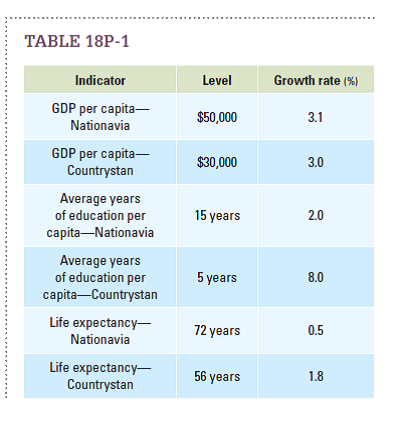
d. In 10 years, it's likely that Countrystan will have higher levels of human capital than Nationavia.
a. The theory of income convergence (that national incomes in poor countries will "catch up" to those in wealthier countries) holds for Nationavia and Countrystan.
b. Countrystan has higher levels of human capital than Nationavia.
c. Inequality is greater in Nationavia.
d. In 10 years, it's likely that Countrystan will have higher levels of human capital than Nationavia.
سؤال
سؤال
سؤال
سؤال
سؤال
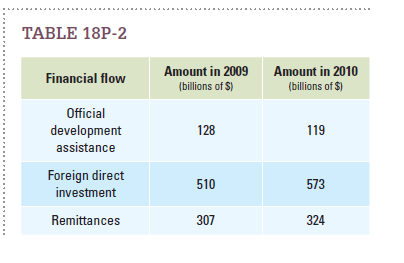
Table 18P-2 shows the size of various flows to developing countries in 2009 and 2010 in billions of dollars.
a. Rank each of the flows in 2010 as a percentage of ODA (official development assistance) in 2009, from highest to lowest.
b. Rank each of the flows in terms of their growth rates from 2009 to 2010, from highest to lowest.
a. Rank each of the flows in 2010 as a percentage of ODA (official development assistance) in 2009, from highest to lowest.
b. Rank each of the flows in terms of their growth rates from 2009 to 2010, from highest to lowest.
سؤال
سؤال
سؤال
سؤال

فتح الحزمة
قم بالتسجيل لفتح البطاقات في هذه المجموعة!
Unlock Deck
Unlock Deck
1/32

العب

ملء الشاشة (f)
Deck 35: Government Spending, Taxes, and Fiscal Policy
1
How can health and education work together to spur economic development? What does this imply about the best way to spend aid funds with the goal of increasing educational attainment in a developing nation?
Economic development:
Economic development refers to sustained economic growth along with high quality of life. Economic growth is measured through the gross domestic product of an economy and quality of life is measured through standard of living, education, health, sanitation, stable political environment, etc.Thus, economic development refers to sustained increase in gross domestic product along with high standard of living, higher level of education, higher level of public health, proper sanitation, stable political environment etc.Factors of Economic Development:
Education and Health are important factors of Economic development. These improve the quality of human capital and thereby tend to improve the capabilities of economic development. Education:
Education improves the knowledge and there by improves the quality of human capital, which tends to increase the efficiency and productivity through innovations. This leads to increase an economic development.
Health :
Health is important factor of maintaining the efficiency of production. With proper medication, good health enhanced the capability human capital.
Economic development refers to sustained economic growth along with high quality of life. Economic growth is measured through the gross domestic product of an economy and quality of life is measured through standard of living, education, health, sanitation, stable political environment, etc.Thus, economic development refers to sustained increase in gross domestic product along with high standard of living, higher level of education, higher level of public health, proper sanitation, stable political environment etc.Factors of Economic Development:
Education and Health are important factors of Economic development. These improve the quality of human capital and thereby tend to improve the capabilities of economic development. Education:
Education improves the knowledge and there by improves the quality of human capital, which tends to increase the efficiency and productivity through innovations. This leads to increase an economic development.
Health :
Health is important factor of maintaining the efficiency of production. With proper medication, good health enhanced the capability human capital.
2
Say that the United States is considering giving direct aid to a nation run by a dictator known for his lavish lifestyle while the nation's citizens suffer through a terrible famine. What might be a problem with giving aid to this nation? Name at least one way to fix the problem.
Aid to the Nation:
Foreign Nations like US, UK gives donations or grants to the developing nations like Sierra Leone to achieve some political, economic or military purpose. These aids are given influence and strengthen the political and military ally at the international level.
Problem of aid:
Aid is given by developed nations to developing nations at the cost of taxpayer's of developed nations. Sometimes purpose of aid is diverted and embezzled by done country.
This embezzlement kills the purpose of donations and has little benefit to the citizen of done country.
This problem of embezzlement can be addressed by monitoring the use of the donated fund, and also set certain measurable goals of economic development in the recipient nations.
Foreign Nations like US, UK gives donations or grants to the developing nations like Sierra Leone to achieve some political, economic or military purpose. These aids are given influence and strengthen the political and military ally at the international level.
Problem of aid:
Aid is given by developed nations to developing nations at the cost of taxpayer's of developed nations. Sometimes purpose of aid is diverted and embezzled by done country.
This embezzlement kills the purpose of donations and has little benefit to the citizen of done country.
This problem of embezzlement can be addressed by monitoring the use of the donated fund, and also set certain measurable goals of economic development in the recipient nations.
3
While listening to the radio on the way to school, you hear a politician from a small, low-income nation say the following: "Over the last five years, there has been a 10 percent increase in the number of children attending school full time. We can expect to see these children grow up to be more productive workers, because their human capital has increased."
Is the politician's statement true, false, or somewhere in between? Explain your answer.
Is the politician's statement true, false, or somewhere in between? Explain your answer.
Human Capital:
Education is one of the most important factors to improve the quality of Human capital. The quality of education depends on quality teachers, schools and books. Teaching environment is also another factors improve the learning capacity of students. Statement of Politician
The statement of politician is neither complete true nor false, it is somewhere between true and false. Only increasing attendance does not improve the quality of learning outcome. Besides attendance, quality teachers, classroom space and other infrastructure and, textbooks are important factor improve the learning outcomes which improve the quality of human capital.
Education is one of the most important factors to improve the quality of Human capital. The quality of education depends on quality teachers, schools and books. Teaching environment is also another factors improve the learning capacity of students. Statement of Politician
The statement of politician is neither complete true nor false, it is somewhere between true and false. Only increasing attendance does not improve the quality of learning outcome. Besides attendance, quality teachers, classroom space and other infrastructure and, textbooks are important factor improve the learning outcomes which improve the quality of human capital.
4
The following equation provides an alternative calculation to determine a developing country's financing gap:
In this equation, FG is the financing gap; A is a variable that captures the country's starting income together with its ability to turn investment into growth (expressed in dollars) ; g is the targeted growth rate; and I D is the amount of domestic investment currently in the economy. Assume that A = $50,000,000,000, g = 0.08, and I D = $500,000,000, and answer the questions that follow.
a. What is the size of the financing gap?
b. Assume that the population of the United States is 300 million. How much would each U.S. citizen have to pay to fill the financing gap?
c. What percentage of GDP per capita in the United States does your answer from (b) represent if GDP per capita is currently $45,000?
Now assume that the United States decides to donate the amount of the financing gap to the developing country as aid. Assume also that there are administrative and competitive costs associated with receiving aid. Specifically, 23 cents of every dollar spent on aid will go to administrative costs. Also, for every dollar received from abroad intended to be used for investment, 50 cents will be used for noninvestment purposes.
d. Calculate the real increase in investment dollars the aid from the United States will provide in the recipient country.
In this equation, FG is the financing gap; A is a variable that captures the country's starting income together with its ability to turn investment into growth (expressed in dollars) ; g is the targeted growth rate; and I D is the amount of domestic investment currently in the economy. Assume that A = $50,000,000,000, g = 0.08, and I D = $500,000,000, and answer the questions that follow.
a. What is the size of the financing gap?
b. Assume that the population of the United States is 300 million. How much would each U.S. citizen have to pay to fill the financing gap?
c. What percentage of GDP per capita in the United States does your answer from (b) represent if GDP per capita is currently $45,000?
Now assume that the United States decides to donate the amount of the financing gap to the developing country as aid. Assume also that there are administrative and competitive costs associated with receiving aid. Specifically, 23 cents of every dollar spent on aid will go to administrative costs. Also, for every dollar received from abroad intended to be used for investment, 50 cents will be used for noninvestment purposes.
d. Calculate the real increase in investment dollars the aid from the United States will provide in the recipient country.
فتح الحزمة
افتح القفل للوصول البطاقات البالغ عددها 32 في هذه المجموعة.
فتح الحزمة
k this deck
5
Explain how better health care in a developing nation, such as increasing the number of immunized children, can have economic effects beyond fewer sick kids.
فتح الحزمة
افتح القفل للوصول البطاقات البالغ عددها 32 في هذه المجموعة.
فتح الحزمة
k this deck
6
What are goods-in-kind donations, and how can they hurt the economies they're meant to help?
فتح الحزمة
افتح القفل للوصول البطاقات البالغ عددها 32 في هذه المجموعة.
فتح الحزمة
k this deck
7
Classify each of the following as an institution or organization. a. The United States Agency for International Development, a U.S. government agency that channels aid abroad.
B) The United Nations Development Program.
C) The UN Declaration of Human Rights, an agreement among members of the United Nations regarding the rights of individuals.
D) The United Nations.
E) The Sarbanes-Oxley Act (SOX), which established rules for how publicly traded firms must report information in their financial documents.
B) The United Nations Development Program.
C) The UN Declaration of Human Rights, an agreement among members of the United Nations regarding the rights of individuals.
D) The United Nations.
E) The Sarbanes-Oxley Act (SOX), which established rules for how publicly traded firms must report information in their financial documents.
فتح الحزمة
افتح القفل للوصول البطاقات البالغ عددها 32 في هذه المجموعة.
فتح الحزمة
k this deck
8
Table 18P-3 displays the results of a study on how to improve vaccination rates in a developing nation. The baseline numbers represent the rates of vaccination at the beginning of the study, while the endline numbers represent the rates of vaccination at the study's conclusion. Answer the following questions.
a. Which campaign(s) had a positive effect on vaccination rates in comparison to the control group?
b. Which campaign had the largest positive effect on vaccination rates in comparison to the control group?
c. Which campaign(s) had a negative effect on vaccination rates in comparison to the control group?
d. Which campaign(s) had no effect on vaccination rates in comparison to the control group?
a. Which campaign(s) had a positive effect on vaccination rates in comparison to the control group?
b. Which campaign had the largest positive effect on vaccination rates in comparison to the control group?
c. Which campaign(s) had a negative effect on vaccination rates in comparison to the control group?
d. Which campaign(s) had no effect on vaccination rates in comparison to the control group?
فتح الحزمة
افتح القفل للوصول البطاقات البالغ عددها 32 في هذه المجموعة.
فتح الحزمة
k this deck
9
"I'm thinking about writing a paper for class on development economics," your friend tells you over lunch. "I'm going to focus on important institutions like government bodies and economic agencies." Is your friend using the term institutions correctly? Why or why not?
فتح الحزمة
افتح القفل للوصول البطاقات البالغ عددها 32 في هذه المجموعة.
فتح الحزمة
k this deck
10
Explain briefly how you could set up an RCT to evaluate whether providing free breakfasts to elementary- school students helps them learn.
فتح الحزمة
افتح القفل للوصول البطاقات البالغ عددها 32 في هذه المجموعة.
فتح الحزمة
k this deck
11
A given nation has a good titling system, but theft of productive equipment is rampant, with few consequences for those who steal. What is the term development economists use for what's lacking in this economy? What effect will this lack likely have on economic growth and economic development? Give one way to improve the situation.
فتح الحزمة
افتح القفل للوصول البطاقات البالغ عددها 32 في هذه المجموعة.
فتح الحزمة
k this deck
12
Table 18P-4 displays the results of a study on how to improve vaccination rates in a developing nation. The baseline numbers represent the rates of vaccination at the beginning of the study, and the endline numbers represent the rates of vaccination at the study's conclusion. Rank the campaigns in order from most effective to least effective. Then refer to Table 18-P-5, which shows the cost per person of each campaign. Combining information from the two tables, rank the campaigns that resulted in an increase in vaccinations from high to low in terms of cost effectiveness (based on treatment effect alone).
فتح الحزمة
افتح القفل للوصول البطاقات البالغ عددها 32 في هذه المجموعة.
فتح الحزمة
k this deck
13
How can capital be considered "dead," and what do we mean by making this capital "alive"?
فتح الحزمة
افتح القفل للوصول البطاقات البالغ عددها 32 في هذه المجموعة.
فتح الحزمة
k this deck
14
List three shortcomings of using an RCT to evaluate the success of a given economic program.
فتح الحزمة
افتح القفل للوصول البطاقات البالغ عددها 32 في هذه المجموعة.
فتح الحزمة
k this deck
15
In a small town in the midwestern United States lives a drug dealer and manufacturer who supplies the illegal, addictive drug crystal meth. The drug dealer insists that making and selling the drug is what gives him the most satisfaction among any possible use of his time and resources. Using the utility-maximization approach, should he be allowed to continue supplying the drug? What about with the capabilities approach? Explain your answer.
فتح الحزمة
افتح القفل للوصول البطاقات البالغ عددها 32 في هذه المجموعة.
فتح الحزمة
k this deck
16
The small, landlocked nation of Wheatleyton is just starting to develop an agricultural sector. Firms in this sector appeal to the government to temporarily limit imports of agricultural goods from other nations with more experience and larger scale, resulting in import prices so low domestic firms can't compete. What is this desired policy called? What problems are associated with it, and how can we reduce them?
فتح الحزمة
افتح القفل للوصول البطاقات البالغ عددها 32 في هذه المجموعة.
فتح الحزمة
k this deck
17
Are capabilities and utility the same thing? If so, why do economists use two different terms for the same concept? If not, explain the difference, both in terms of their definitions and when each is best used in economic analysis.
فتح الحزمة
افتح القفل للوصول البطاقات البالغ عددها 32 في هذه المجموعة.
فتح الحزمة
k this deck
18
International trade is associated with economic growth and development-open economies tend to grow faster than closed economies, all else equal. Given this information, should a nation seeking to grow and develop faster use the method of import substitution or export-led growth? How would each of these two methods affect GDP through its net exports component?
فتح الحزمة
افتح القفل للوصول البطاقات البالغ عددها 32 في هذه المجموعة.
فتح الحزمة
k this deck
19
Professor Bucks and Professor Liber are having a debate about the role of economic growth in contributing to economic development. Professor Bucks contends that economic growth is the only thing to consider in development, as people's utility is directly related to their income. Professor Liber agrees that income is directly related to development, but says that there are other things to consider. Given what we've learned in this chapter, pick the option that is most correct according to the capabilities approach. a. Professor Bucks is correct, because increases in income are the only way to measure economic development
B) Professor Bucks is correct, because capabilities always increase when income does.
C) Professor Liber is correct, because income is unrelated to capabilities, which are the most important factor in development.
D) Professor Liber is correct, because income is related to development, but it is not the only contributor to capabilities.
B) Professor Bucks is correct, because capabilities always increase when income does.
C) Professor Liber is correct, because income is unrelated to capabilities, which are the most important factor in development.
D) Professor Liber is correct, because income is related to development, but it is not the only contributor to capabilities.
فتح الحزمة
افتح القفل للوصول البطاقات البالغ عددها 32 في هذه المجموعة.
فتح الحزمة
k this deck
20
The small nation of Movieheim wants to develop a film industry. It is considering two options for doing so:
Option A: Reimburse relocation expenses for firms and give tax breaks to acting schools, film studios, digital artists, etc., to encourage them to work together and share ideas.
Option B: Make the purchase and exhibition of foreign films illegal for the next 10 years. What would development economists call each of these options? Which is more likely to encourage long-term economic development, and why?
Option A: Reimburse relocation expenses for firms and give tax breaks to acting schools, film studios, digital artists, etc., to encourage them to work together and share ideas.
Option B: Make the purchase and exhibition of foreign films illegal for the next 10 years. What would development economists call each of these options? Which is more likely to encourage long-term economic development, and why?
فتح الحزمة
افتح القفل للوصول البطاقات البالغ عددها 32 في هذه المجموعة.
فتح الحزمة
k this deck
21
Determine whether each of the following is true or false.
a. The chance to see a musical is an example of a capability.
b. The freedom to practice religion is not a capability because it is not directly related to economic development.
c. Economists will make the same conclusions and recommendations using the utility-maximization approach as they will using the capabilities approach.
d. The capabilities approach works better for analyzing what's best for society, while the utility-maximization approach works better for analyzing what's best for an individual.
a. The chance to see a musical is an example of a capability.
b. The freedom to practice religion is not a capability because it is not directly related to economic development.
c. Economists will make the same conclusions and recommendations using the utility-maximization approach as they will using the capabilities approach.
d. The capabilities approach works better for analyzing what's best for society, while the utility-maximization approach works better for analyzing what's best for an individual.
فتح الحزمة
افتح القفل للوصول البطاقات البالغ عددها 32 في هذه المجموعة.
فتح الحزمة
k this deck
22
Determine whether each of the following is an example of import substitution, export-led growth, or clustering. a. The government gives a $50 million grant to a leading university to work with car manufacturers and to research new ways to produce more fuel-efficient vehicles.
B) The government gives $50 million to a domestic car company to subsidize its shipping costs to other countries.
C) The government enacts a tariff on all cars imported from abroad.
B) The government gives $50 million to a domestic car company to subsidize its shipping costs to other countries.
C) The government enacts a tariff on all cars imported from abroad.
فتح الحزمة
افتح القفل للوصول البطاقات البالغ عددها 32 في هذه المجموعة.
فتح الحزمة
k this deck
23
Table 18P-1 shows the levels and annual growth rates of economic indicators for two countries, Nationavia and Countrystan. Assume these growth rates will remain constant for the foreseeable future. Use this data to determine whether each of the following statements is true, false, or indeterminable.
a. The theory of income convergence (that national incomes in poor countries will "catch up" to those in wealthier countries) holds for Nationavia and Countrystan.
b. Countrystan has higher levels of human capital than Nationavia.
c. Inequality is greater in Nationavia.
d. In 10 years, it's likely that Countrystan will have higher levels of human capital than Nationavia.
a. The theory of income convergence (that national incomes in poor countries will "catch up" to those in wealthier countries) holds for Nationavia and Countrystan.
b. Countrystan has higher levels of human capital than Nationavia.
c. Inequality is greater in Nationavia.
d. In 10 years, it's likely that Countrystan will have higher levels of human capital than Nationavia.
فتح الحزمة
افتح القفل للوصول البطاقات البالغ عددها 32 في هذه المجموعة.
فتح الحزمة
k this deck
24
Consider separately each of the following hypothetical scenarios about South Africa and answer the included questions. Assume in each case that medical school has an 80 percent success rate-in other words, 80 percent of people who attend medical school graduate and become doctors.
a. No doctors are allowed to emigrate, and the number of people going to medical school is given by D = 100,000 x I, where I is an index relating the income of doctors to those in other professions. If I = 4, how many students will go to medical school? How many more doctors will there be in South Africa?
b. The United States decides to offer visas for any doctors from South Africa. Additionally, I in the above equation changes to 10. Assume that 30 percent of doctors educated in South Africa immigrate to the United States. How many students will go to medical school? How many will become doctors? How many of those doctors will practice in South Africa, and how many will practice in the United States?
c. The United States decides to limit the number of doctors from South Africa who can obtain visas to no more than 10 percent of those graduating from medical school. Assume that I remains at 10. How many students will go to medical school? How many will become doctors? How many of those doctors will practice in South Africa, and how many will practice in the United States?
a. No doctors are allowed to emigrate, and the number of people going to medical school is given by D = 100,000 x I, where I is an index relating the income of doctors to those in other professions. If I = 4, how many students will go to medical school? How many more doctors will there be in South Africa?
b. The United States decides to offer visas for any doctors from South Africa. Additionally, I in the above equation changes to 10. Assume that 30 percent of doctors educated in South Africa immigrate to the United States. How many students will go to medical school? How many will become doctors? How many of those doctors will practice in South Africa, and how many will practice in the United States?
c. The United States decides to limit the number of doctors from South Africa who can obtain visas to no more than 10 percent of those graduating from medical school. Assume that I remains at 10. How many students will go to medical school? How many will become doctors? How many of those doctors will practice in South Africa, and how many will practice in the United States?
فتح الحزمة
افتح القفل للوصول البطاقات البالغ عددها 32 في هذه المجموعة.
فتح الحزمة
k this deck
25
Are economic growth and economic development the same? Why or why not?
فتح الحزمة
افتح القفل للوصول البطاقات البالغ عددها 32 في هذه المجموعة.
فتح الحزمة
k this deck
26
How can emigration help the home economy in terms of income? Are the benefits of migration on income limited to those who actually migrate? Why or why not?
فتح الحزمة
افتح القفل للوصول البطاقات البالغ عددها 32 في هذه المجموعة.
فتح الحزمة
k this deck
27
In Nation A, GDP per capita is $21,000 and is growing annually at a rate of 1.4 percent. The average citizen in Nation A lives for 51 years, and this figure is growing at 6 percent per year. Additionally, the average person in Nation A has 9 years of education, growing annually at 5.1 percent, and 60 percent of Nation A's population is currently literate, growing at a rate of 2 percent.
In Nation B, GDP per capita is $40,000 and is growing annually at a rate of 0.8 percent. The average citizen in Nation B lives for 68 years, and this value is growing at 2 percent per year. The average person in Nation B has 10.5 years of education, increasing 2 percent annually, while 78 percent of its population is literate, a figure growing at 0.5 percent annually.
Which nation is experiencing more economic growth? Which is wealthier? Which currently has more capabilities for its citizens? And which is experiencing more economic development?
In Nation B, GDP per capita is $40,000 and is growing annually at a rate of 0.8 percent. The average citizen in Nation B lives for 68 years, and this value is growing at 2 percent per year. The average person in Nation B has 10.5 years of education, increasing 2 percent annually, while 78 percent of its population is literate, a figure growing at 0.5 percent annually.
Which nation is experiencing more economic growth? Which is wealthier? Which currently has more capabilities for its citizens? And which is experiencing more economic development?
فتح الحزمة
افتح القفل للوصول البطاقات البالغ عددها 32 في هذه المجموعة.
فتح الحزمة
k this deck
28
Table 18P-2 shows the size of various flows to developing countries in 2009 and 2010 in billions of dollars.
a. Rank each of the flows in 2010 as a percentage of ODA (official development assistance) in 2009, from highest to lowest.
b. Rank each of the flows in terms of their growth rates from 2009 to 2010, from highest to lowest.
a. Rank each of the flows in 2010 as a percentage of ODA (official development assistance) in 2009, from highest to lowest.
b. Rank each of the flows in terms of their growth rates from 2009 to 2010, from highest to lowest.
فتح الحزمة
افتح القفل للوصول البطاقات البالغ عددها 32 في هذه المجموعة.
فتح الحزمة
k this deck
29
Does economic growth lead to development? Or does the causation run the other way, with economic development leading to growth? Explain.
فتح الحزمة
افتح القفل للوصول البطاقات البالغ عددها 32 في هذه المجموعة.
فتح الحزمة
k this deck
30
How does emigration affect wages and income in the migrant's country of origin? In the country they immigrate to?
فتح الحزمة
افتح القفل للوصول البطاقات البالغ عددها 32 في هذه المجموعة.
فتح الحزمة
k this deck
31
Imagine that you are the leader of a low-income nation. You have identified lack of access to health care as a major contributor to your nation's low income, and the United States has offered to help by providing funds to build more health clinics. Will this solve the problem? Why or why not? If it won't, what's one alternative to using these foreign aid dollars to build clinics?
فتح الحزمة
افتح القفل للوصول البطاقات البالغ عددها 32 في هذه المجموعة.
فتح الحزمة
k this deck
32
The president of an organization specializing in foreign investment says the following at a shareholder meeting: "Our one-year program was a failure. We were hoping for a 6 percent return on our investment, but we got only 3 percent." Use the idea of impact investing to provide an alternative argument that the program was not a failure.
فتح الحزمة
افتح القفل للوصول البطاقات البالغ عددها 32 في هذه المجموعة.
فتح الحزمة
k this deck
فتح الحزمة
افتح القفل للوصول البطاقات البالغ عددها 32 في هذه المجموعة.






