



Deck 4: Labor Market Equilibrium

ملء الشاشة (f)
exit full mode
سؤال
Discuss the implications of equilibrium for a competitive economy containing many regional markets when labor and firms are free to enter and exit the various markets. Why is the resulting allocation of labor efficient
استخدم زر المسافة أو
up arrow
down arrow
لقلب البطاقة.
سؤال
The immigration surplus, though seemingly small in the United States, redistributes wealth from workers to firms. Present a back-of-the-envelope calculation of the losses accruing to native workers and of the gains accruing to firms. Do these calculations help explain why some segments of society are emotional in their support of changes in immigration policy that would either increase or decrease the immigrant flow
سؤال
Suppose the supply curve of physicists is given by w = 10 + 5 E , while the demand curve is given by w = 50 - 3 E. Calculate the equilibrium wage and employment level. Suppose now that the demand for physicists increases to w = 70 - 3 E. Assume the market is subject to cobwebs. Calculate the wage and employment level in each round as the wage and employment levels adjust to the demand shock. (Recall that each round occurs on the demand curve - when the firm posts a wage and hires workers). What is the new equilibrium wage and employment level
سؤال
Show how the imposition of a minimum wage on a monopsony can increase both wages and employment.
سؤال
Show what happens to producer surplus, worker surplus, and the gains from trade as workers migrate from a low-wage to a high-wage region.
سؤال
Labor demand for low-skilled workers in the United States is w = 24 - 0.1 E where E is the number of workers (in millions) and w is the hourly wage. There are 120 million domestic U.S. low-skilled workers who supply labor inelastically. If the U.S. opened its borders to immigration, 20 million low-skill immigrants would enter the U.S. and supply labor inelastically. What is the market-clearing wage if immigration is not allowed What is the market-clearing wage with open borders How much is the immigration surplus when the U.S. opens its borders How much surplus is transferred from domestic workers to domestic firms
سؤال
The 1986 Immigration Reform and Control Act (IRCA) made it illegal for employers in the United States to knowingly hire illegal aliens. The legislation, however, has not reduced the flow of illegal aliens into the country. As a result, it has been proposed that the penalties against employers who break the law be substantially increased. Suppose that illegal aliens, who tend to be less skilled workers, are complements with native workers. What will happen to the wage of native workers if the penalties for hiring illegal aliens increase
سؤال
Consider the policy application of hurricanes and the labor market that was presented in the text.
a. How do labor demand and labor supply typically shift following a natural disaster
b. The data on changes in employment and wages in Table 4-5 suggest that the magnitude of relative shifts in labor demand and labor supply depend on the severity of the natural disaster. According to the data, does labor demand shift more relative to labor supply in mild or in extreme natural disasters. Provide intuition for this finding.
Reference Table 4-5
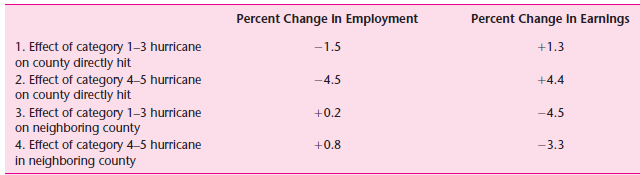
Consider the policy application of hurricanes and the labor market that was presented in the text. a. How do labor demand and labor supply typically shift following a natural disaster b. The data on changes in employment and wages in Table 4-5 suggest that the magnitude of relative shifts in labor demand and labor supply depend on the severity of the natural disaster. According to the data, does labor demand shift more relative to labor supply in mild or in extreme natural disasters. Provide intuition for this finding. Reference Table 4-5  <div style=padding-top: 35px>
سؤال
Describe the impact of a payroll tax on wages and employment in a competitive industry. Why is part of the tax shifted to workers What is the deadweight loss of the payroll tax
سؤال
Suppose the Cobb-Douglas production function given in Equation 4-1 applies to a developing country. Instead of thinking of immigration from a developing to a developed country, suppose a developed country invests large amounts of capital (foreign direct investment, or FDI) in a developing country.
a. How does an increase in FDI affect labor productivity in the developing country How will wages respond in the short-run
b. What are the long-run implications of FDI, especially in terms of potential future immigration from the developing country
Reference Equation 4-1
Suppose the Cobb-Douglas production function given in Equation 4-1 applies to a developing country. Instead of thinking of immigration from a developing to a developed country, suppose a developed country invests large amounts of capital (foreign direct investment, or FDI) in a developing country. a. How does an increase in FDI affect labor productivity in the developing country How will wages respond in the short-run b. What are the long-run implications of FDI, especially in terms of potential future immigration from the developing country Reference Equation 4-1  <div style=padding-top: 35px>
سؤال
a. What happens to wages and employment if the government imposes a payroll tax on a monopsonist Compare the response in the monopsonistic market to the response that would have been observed in a competitive labor market.
b. Suppose a firm is a perfectly discriminating monopsonist. The government imposes a minimum wage on this market. What happens to wages and employment
سؤال
Why does the payroll tax have the same impact on wages and employment regardless of whether it is imposed on workers or on firms
سؤال
An economy consists of two regions, the North and the South. The short-run elasticity of labor demand in each region is -0.5. Labor supply is perfectly inelastic within both regions. The labor market is initially in an economy-wide equilibrium, with 600,000 people employed in the North and 400,000 in the South at a wage of $15 per hour. Suddenly, 20,000 people immigrate from abroad and initially settle in the South. They possess the same skills as the native residents and also supply their labor inelastically.
(a) What will be the effect of this immigration on wages in each of the regions in the short run (before any migration between the North and the South occurs)
(b) Suppose 1,000 native-born persons per year migrate from the South to the North in response to every dollar differential in the hourly wage between the two regions. What will be the ratio of wages in the two regions after the first-year native labor responds to the entry of the immigrants
(c) What will be the effect of this immigration on wages and employment in each of the regions in the long run (after native workers respond by moving across regions to take advantage of whatever wage differentials may exist) Assume labor demand does not change in either region.
سؤال
How do mandated benefits affect labor market outcomes Why do these outcomes differ from those resulting from a payroll tax What is the deadweight loss arising from mandated benefits
سؤال
A firm faces a perfectly elastic demand for its output at a price of $6 per unit of output. The firm, however, faces an upward-sloped labor supply curve of
E = 20 w - 120
where E is the number of workers hired each hour and w is the hourly wage rate. Thus, the firm faces an upward-sloped marginal cost of labor curve of
MC E = 6 + 0.1 E
Each hour of labor produces five units of output. How many workers should the firm hire each hour to maximize profits What wage will the firm pay What are the firms hourly profits
سؤال
Do immigrants reduce the wage of native workers Do immigrants "take jobs away" from native workers
سؤال
Polly's Pet Store has a local monopoly on the grooming of dogs. The daily inverse demand curve for pet grooming is:
P = 20 - 0.1 Q
where P is the price of each grooming and Q is the number of groomings given each day. This implies that Polly's marginal revenue is:
MR = 20 - 0.2 Q.
Each worker Polly hires can groom 20 dogs each day. What is Polly's labor demand curve as a function of w , the daily wage that Polly takes as given
سؤال
The Key West Parrot Shop has a monopoly on the sale of parrot souvenir caps in Key West. The inverse demand curve for caps is:
P = 30 - 0.4 Q
where P is the price of a cap and Q is the number of caps sold per hour. Thus, the marginal revenue for the Parrot Shop is:
MR = 30 - 0.8 Q.
The Parrot Shop is the only employer in town, and faces an hourly supply of labor given by:
w = 0.9 E + 5
where w is the hourly wage rate and E is the number of workers hired each hour. The marginal cost associated with hiring E workers, therefore, is:
MC E = 1.8 E + 5.
Each worker produces two caps per hour. How many workers should the Parrot Shop hire each hour to maximize its profit What wage will it pay How much will it charge for each cap
سؤال
Figure 4-9 discusses the changes to a labor market equilibrium when the government mandates an employee benefit for which the cost exceeds the worker's valuation (panel a) and for which the cost equals the worker's valuation (panel b).
a. Provide a similar graph to those in Figure 4-9 when the cost of the benefit is less than the worker's valuation and discuss how the equilibrium level of employment and wages has changed. Is there deadweight loss associated with the mandated benefit
b. Why is the situation in which a mandated benefit would cost less than the worker's valuation less important for public policy purposes than when the cost of the mandated benefit exceeds the worker's valuation
Reference Figure 4-9
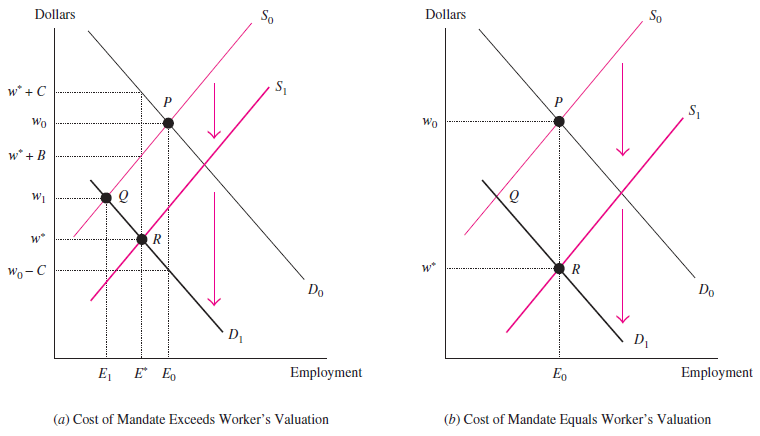
Figure 4-9 discusses the changes to a labor market equilibrium when the government mandates an employee benefit for which the cost exceeds the worker's valuation (panel a) and for which the cost equals the worker's valuation (panel b). a. Provide a similar graph to those in Figure 4-9 when the cost of the benefit is less than the worker's valuation and discuss how the equilibrium level of employment and wages has changed. Is there deadweight loss associated with the mandated benefit b. Why is the situation in which a mandated benefit would cost less than the worker's valuation less important for public policy purposes than when the cost of the mandated benefit exceeds the worker's valuation Reference Figure 4-9  <div style=padding-top: 35px>
سؤال
Describe the trends in wages and employment implied by the cobweb model for the engineering market. What would happen to the cobwebs if an economics consulting firm sold information on the history of wages and employment in the engineering market
سؤال
What is the producer surplus What is the worker surplus Show that a competitive market equilibrium maximizes the gains from trade.
سؤال
Ann owns a lawn mowing company. She has 400 lawns she needs to cut each week. Her weekly revenue from these 400 lawns is $20,000. Given an 18-inch deck push mower, a laborer can cut each lawn in two hours. Given a 60-inch deck riding mower, a laborer can cut each lawn in 30 minutes. Labor is supplied inelastically at $5.00 per hour. Each laborer works 8 hours a day and 5 days each week.
(a) If Ann decides to have her workers use push mowers, how many push mowers will Ann rent and how many workers will she hire
(b) If she decides to have her workers use riding mowers, how many riding mowers will Ann rent and how many workers will she hire
(c) Suppose the weekly rental cost (including gas and maintenance) for each push mower is $250 and for each riding mower is $1,800. What equipment will Ann rent How many workers will she employ How much profit will she earn
(d) Suppose the government imposes a 20 percent payroll tax (paid by employers) on all labor and offers a 20 percent subsidy on the rental cost of capital. What equipment will Ann rent How many workers will she employ How much profit will she earn
سؤال
In the United States, labor supply tends to be inelastic relative to labor demand, and according to law, payroll taxes are essentially assessed evenly between workers and firms. Given the above situation, are workers or firms more likely to bear the additional burden of an increased payroll tax in the United States Could this burden be shifted to the firms by assessing the increase in payroll taxes on just firms rather than having firms and workers continue to be assessed payroll taxes equally
سؤال
Describe the hiring decision of a perfectly discriminating monopsonist and of a non-discriminating monopsonist. In what sense do monopsonists "exploit" workers
فتح الحزمة
قم بالتسجيل لفتح البطاقات في هذه المجموعة!
Unlock Deck
Unlock Deck
1/24
auto play flashcards
العب
simple tutorial
ملء الشاشة (f)
exit full mode
Deck 4: Labor Market Equilibrium
1
Discuss the implications of equilibrium for a competitive economy containing many regional markets when labor and firms are free to enter and exit the various markets. Why is the resulting allocation of labor efficient
Let's discuss the implications of equilibrium by taking two markets A and B, where labour and firms are free to enter and exit, with the help of following figures: Let's discuss the implications of equilibrium by taking two markets A and B, where labour and firms are free to enter and exit, with the help of following figures:   Market A is shown in figure (a), and market B is shown in figure (b). In both the figures, D A and D B are the demand curves for labour for both A and B markets. The supply curves S A and S B are verticals in both the markets, showing that the supply of labour is perfectly inelastic in both the markets. Initially both the markets are in equilibrium at wage rate w a and w b. To start with, the wage rate in the market A is higher than that of B. Now, as the wage rate in market is A is higher than that of B, and as labour and firms are free to enter and exit the markets, therefore, the workers market B will migrate to market A anticipating higher wages. Similarly, the firms from market A will get attracted to market B where the wages are low, and thus the firms will move towards market B. As a result of migration, the supply curve of labour in market B will shift towards left. The new supply curve S' B cut the demand curve at higher point, and thus the wages increases from w b to w 0 in market B. On the other hand, the supply curve will shift towards right in market A as result of migration of labour. The new supply curve S' A cuts the demand curve at lower point, and thus wages falls from w A to w 0. In both the markets the wages are now same. And the value of marginal product of labour is equal to the wage in both the markets, which shows that the resources are efficiently allocated in the economy. Thus, the possibility of free entry and exit for labour and firms in various regional markets brings out the equilibrium of wages for a competitive economy. Let's define why the allocation of labour as result of free entry and exit of labour and firms is efficient: In the above figure, as the workers move from market B to market A, the producer surplus and worker surplus also reduces (as shown by shaded area in figure b) because of the rise in wages. On the other hand, as the workers migrate to market A, the wages falls, and thus the producer surplus and worker surplus increases (as shown by the shaded area in figure a). As we compare both the shaded areas, it is clear that the gains in market A are more than the losses in market B. Therefore, it can be said that the allocation of labour as result of migration is efficient. Market A is shown in figure (a), and market B is shown in figure (b). In both the figures, D A and D B are the demand curves for labour for both A and B markets. The supply curves S A and S B are verticals in both the markets, showing that the supply of labour is perfectly inelastic in both the markets. Initially both the markets are in equilibrium at wage rate w a and w b. To start with, the wage rate in the market A is higher than that of B.
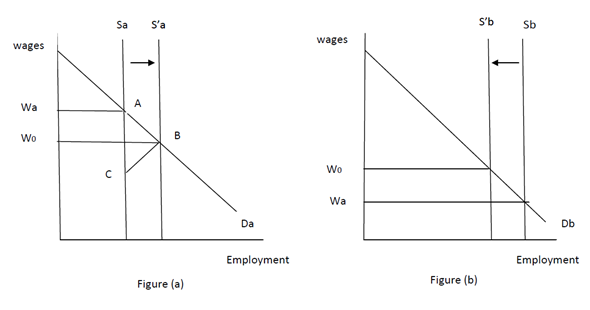
Now, as the wage rate in market is A is higher than that of B, and as labour and firms are free to enter and exit the markets, therefore, the workers market B will migrate to market A anticipating higher wages. Similarly, the firms from market A will get attracted to market B where the wages are low, and thus the firms will move towards market B. As a result of migration, the supply curve of labour in market B will shift towards left. The new supply curve S' B cut the demand curve at higher point, and thus the wages increases from w b to w 0 in market B. On the other hand, the supply curve will shift towards right in market A as result of migration of labour. The new supply curve S' A cuts the demand curve at lower point, and thus wages falls from w A to w 0.
In both the markets the wages are now same. And the value of marginal product of labour is equal to the wage in both the markets, which shows that the resources are efficiently allocated in the economy.
Thus, the possibility of free entry and exit for labour and firms in various regional markets brings out the equilibrium of wages for a competitive economy.
Let's define why the allocation of labour as result of free entry and exit of labour and firms is efficient:
In the above figure, as the workers move from market B to market A, the producer surplus and worker surplus also reduces (as shown by shaded area in figure b) because of the rise in wages. On the other hand, as the workers migrate to market A, the wages falls, and thus the producer surplus and worker surplus increases (as shown by the shaded area in figure a). As we compare both the shaded areas, it is clear that the gains in market A are more than the losses in market B. Therefore, it can be said that the allocation of labour as result of migration is efficient.
2
The immigration surplus, though seemingly small in the United States, redistributes wealth from workers to firms. Present a back-of-the-envelope calculation of the losses accruing to native workers and of the gains accruing to firms. Do these calculations help explain why some segments of society are emotional in their support of changes in immigration policy that would either increase or decrease the immigrant flow
Immigration Surplus : Immigration surplus is a positive economic impact of the immigrants in the form of increased national income of the native nation. Immigration surplus occurs when native wage rate falls due to the increase in labour supply caused by the entry of the immigrants. Immigration causes redistribution of income from native workers to firms.
Let's present the calculation of the losses occurring to native workers, and the gains accruing to firms as a result of immigration surplus.
The dollar value of immigration surplus is given by following formula:
Immigration surplus = Immigration Surplus : Immigration surplus is a positive economic impact of the immigrants in the form of increased national income of the native nation. Immigration surplus occurs when native wage rate falls due to the increase in labour supply caused by the entry of the immigrants. Immigration causes redistribution of income from native workers to firms. Let's present the calculation of the losses occurring to native workers, and the gains accruing to firms as a result of immigration surplus. The dollar value of immigration surplus is given by following formula: Immigration surplus =   Putting the Immigration surplus as a fraction of national income:   change in native rate)   (% change in employment)     (labour's share of national income)Or, it can be rewritten as:   We can explain it with the help of an example. Suppose due to immigration there is 10% increase labour supply in the U.S. And this 10% increase in supply would cause a 3-4% fall in wages. And the labour's share of national income is 0.7. So,   Therefore, the losses occurring to native workers and the gains accruing to firms due to immigration are 0.13 percent. Though the losses occurring due to immigration are small, but still native workers do face the losses which make a difference for them, therefore it is quite valid that some segments are emotional in their support of changes in immigration policy. Putting the Immigration surplus as a fraction of national income: Immigration Surplus : Immigration surplus is a positive economic impact of the immigrants in the form of increased national income of the native nation. Immigration surplus occurs when native wage rate falls due to the increase in labour supply caused by the entry of the immigrants. Immigration causes redistribution of income from native workers to firms. Let's present the calculation of the losses occurring to native workers, and the gains accruing to firms as a result of immigration surplus. The dollar value of immigration surplus is given by following formula: Immigration surplus =   Putting the Immigration surplus as a fraction of national income:   change in native rate)   (% change in employment)     (labour's share of national income)Or, it can be rewritten as:   We can explain it with the help of an example. Suppose due to immigration there is 10% increase labour supply in the U.S. And this 10% increase in supply would cause a 3-4% fall in wages. And the labour's share of national income is 0.7. So,   Therefore, the losses occurring to native workers and the gains accruing to firms due to immigration are 0.13 percent. Though the losses occurring due to immigration are small, but still native workers do face the losses which make a difference for them, therefore it is quite valid that some segments are emotional in their support of changes in immigration policy. change in native rate) Immigration Surplus : Immigration surplus is a positive economic impact of the immigrants in the form of increased national income of the native nation. Immigration surplus occurs when native wage rate falls due to the increase in labour supply caused by the entry of the immigrants. Immigration causes redistribution of income from native workers to firms. Let's present the calculation of the losses occurring to native workers, and the gains accruing to firms as a result of immigration surplus. The dollar value of immigration surplus is given by following formula: Immigration surplus =   Putting the Immigration surplus as a fraction of national income:   change in native rate)   (% change in employment)     (labour's share of national income)Or, it can be rewritten as:   We can explain it with the help of an example. Suppose due to immigration there is 10% increase labour supply in the U.S. And this 10% increase in supply would cause a 3-4% fall in wages. And the labour's share of national income is 0.7. So,   Therefore, the losses occurring to native workers and the gains accruing to firms due to immigration are 0.13 percent. Though the losses occurring due to immigration are small, but still native workers do face the losses which make a difference for them, therefore it is quite valid that some segments are emotional in their support of changes in immigration policy. (% change in employment) Immigration Surplus : Immigration surplus is a positive economic impact of the immigrants in the form of increased national income of the native nation. Immigration surplus occurs when native wage rate falls due to the increase in labour supply caused by the entry of the immigrants. Immigration causes redistribution of income from native workers to firms. Let's present the calculation of the losses occurring to native workers, and the gains accruing to firms as a result of immigration surplus. The dollar value of immigration surplus is given by following formula: Immigration surplus =   Putting the Immigration surplus as a fraction of national income:   change in native rate)   (% change in employment)     (labour's share of national income)Or, it can be rewritten as:   We can explain it with the help of an example. Suppose due to immigration there is 10% increase labour supply in the U.S. And this 10% increase in supply would cause a 3-4% fall in wages. And the labour's share of national income is 0.7. So,   Therefore, the losses occurring to native workers and the gains accruing to firms due to immigration are 0.13 percent. Though the losses occurring due to immigration are small, but still native workers do face the losses which make a difference for them, therefore it is quite valid that some segments are emotional in their support of changes in immigration policy. Immigration Surplus : Immigration surplus is a positive economic impact of the immigrants in the form of increased national income of the native nation. Immigration surplus occurs when native wage rate falls due to the increase in labour supply caused by the entry of the immigrants. Immigration causes redistribution of income from native workers to firms. Let's present the calculation of the losses occurring to native workers, and the gains accruing to firms as a result of immigration surplus. The dollar value of immigration surplus is given by following formula: Immigration surplus =   Putting the Immigration surplus as a fraction of national income:   change in native rate)   (% change in employment)     (labour's share of national income)Or, it can be rewritten as:   We can explain it with the help of an example. Suppose due to immigration there is 10% increase labour supply in the U.S. And this 10% increase in supply would cause a 3-4% fall in wages. And the labour's share of national income is 0.7. So,   Therefore, the losses occurring to native workers and the gains accruing to firms due to immigration are 0.13 percent. Though the losses occurring due to immigration are small, but still native workers do face the losses which make a difference for them, therefore it is quite valid that some segments are emotional in their support of changes in immigration policy. (labour's share of national income)Or, it can be rewritten as: Immigration Surplus : Immigration surplus is a positive economic impact of the immigrants in the form of increased national income of the native nation. Immigration surplus occurs when native wage rate falls due to the increase in labour supply caused by the entry of the immigrants. Immigration causes redistribution of income from native workers to firms. Let's present the calculation of the losses occurring to native workers, and the gains accruing to firms as a result of immigration surplus. The dollar value of immigration surplus is given by following formula: Immigration surplus =   Putting the Immigration surplus as a fraction of national income:   change in native rate)   (% change in employment)     (labour's share of national income)Or, it can be rewritten as:   We can explain it with the help of an example. Suppose due to immigration there is 10% increase labour supply in the U.S. And this 10% increase in supply would cause a 3-4% fall in wages. And the labour's share of national income is 0.7. So,   Therefore, the losses occurring to native workers and the gains accruing to firms due to immigration are 0.13 percent. Though the losses occurring due to immigration are small, but still native workers do face the losses which make a difference for them, therefore it is quite valid that some segments are emotional in their support of changes in immigration policy. We can explain it with the help of an example. Suppose due to immigration there is 10% increase labour supply in the U.S. And this 10% increase in supply would cause a 3-4% fall in wages. And the labour's share of national income is 0.7.



So, Immigration Surplus : Immigration surplus is a positive economic impact of the immigrants in the form of increased national income of the native nation. Immigration surplus occurs when native wage rate falls due to the increase in labour supply caused by the entry of the immigrants. Immigration causes redistribution of income from native workers to firms. Let's present the calculation of the losses occurring to native workers, and the gains accruing to firms as a result of immigration surplus. The dollar value of immigration surplus is given by following formula: Immigration surplus =   Putting the Immigration surplus as a fraction of national income:   change in native rate)   (% change in employment)     (labour's share of national income)Or, it can be rewritten as:   We can explain it with the help of an example. Suppose due to immigration there is 10% increase labour supply in the U.S. And this 10% increase in supply would cause a 3-4% fall in wages. And the labour's share of national income is 0.7. So,   Therefore, the losses occurring to native workers and the gains accruing to firms due to immigration are 0.13 percent. Though the losses occurring due to immigration are small, but still native workers do face the losses which make a difference for them, therefore it is quite valid that some segments are emotional in their support of changes in immigration policy. Therefore, the losses occurring to native workers and the gains accruing to firms due to immigration are 0.13 percent. Though the losses occurring due to immigration are small, but still native workers do face the losses which make a difference for them, therefore it is quite valid that some segments are emotional in their support of changes in immigration policy.

3
Suppose the supply curve of physicists is given by w = 10 + 5 E , while the demand curve is given by w = 50 - 3 E. Calculate the equilibrium wage and employment level. Suppose now that the demand for physicists increases to w = 70 - 3 E. Assume the market is subject to cobwebs. Calculate the wage and employment level in each round as the wage and employment levels adjust to the demand shock. (Recall that each round occurs on the demand curve - when the firm posts a wage and hires workers). What is the new equilibrium wage and employment level
Given,
Initial demand curve: w = 50-3E, and initial supply curve: w = 10+5E
Let's find out the equilibrium wage and employment by equating the demand and supply curves: Given, Initial demand curve: w = 50-3E, and initial supply curve: w = 10+5E Let's find out the equilibrium wage and employment by equating the demand and supply curves:       Therefore, initial employment is E = 5 , let's find equilibrium wage:   Therefore, equilibrium employment (E) = 5 , and wage (w) = $35 Let's find out the equilibrium employment and wage when demand increases: New demand curve:   Equating new demand curve with initial supply curve: 10+5E = 70-3E     When, E = 7.5 , let's find out new equilibrium wage:   Therefore, the new equilibrium wage (w) is $47.5 , and new equilibrium employment (E) is 7.5. As the market is subject to cobwebs, let's calculate the wage and employment in each round as the wage and employment levels adjust to the demand shock. Here we have also assumed that the supply of the physicists is inelastic. And each round occurs on the new demand curve: First round : when labour demand increases and when original employment (E) is 5. Putting E = 5, in new demand equation to get the value of w.     Second round : at wage rate (w) = $55, the supply of labour is:       Putting the value of E = 9, in new demand curve: w = 70-3E   Therefore, in second round E = 9 , and w = $43 And so on....  Given, Initial demand curve: w = 50-3E, and initial supply curve: w = 10+5E Let's find out the equilibrium wage and employment by equating the demand and supply curves:       Therefore, initial employment is E = 5 , let's find equilibrium wage:   Therefore, equilibrium employment (E) = 5 , and wage (w) = $35 Let's find out the equilibrium employment and wage when demand increases: New demand curve:   Equating new demand curve with initial supply curve: 10+5E = 70-3E     When, E = 7.5 , let's find out new equilibrium wage:   Therefore, the new equilibrium wage (w) is $47.5 , and new equilibrium employment (E) is 7.5. As the market is subject to cobwebs, let's calculate the wage and employment in each round as the wage and employment levels adjust to the demand shock. Here we have also assumed that the supply of the physicists is inelastic. And each round occurs on the new demand curve: First round : when labour demand increases and when original employment (E) is 5. Putting E = 5, in new demand equation to get the value of w.     Second round : at wage rate (w) = $55, the supply of labour is:       Putting the value of E = 9, in new demand curve: w = 70-3E   Therefore, in second round E = 9 , and w = $43 And so on....  Given, Initial demand curve: w = 50-3E, and initial supply curve: w = 10+5E Let's find out the equilibrium wage and employment by equating the demand and supply curves:       Therefore, initial employment is E = 5 , let's find equilibrium wage:   Therefore, equilibrium employment (E) = 5 , and wage (w) = $35 Let's find out the equilibrium employment and wage when demand increases: New demand curve:   Equating new demand curve with initial supply curve: 10+5E = 70-3E     When, E = 7.5 , let's find out new equilibrium wage:   Therefore, the new equilibrium wage (w) is $47.5 , and new equilibrium employment (E) is 7.5. As the market is subject to cobwebs, let's calculate the wage and employment in each round as the wage and employment levels adjust to the demand shock. Here we have also assumed that the supply of the physicists is inelastic. And each round occurs on the new demand curve: First round : when labour demand increases and when original employment (E) is 5. Putting E = 5, in new demand equation to get the value of w.     Second round : at wage rate (w) = $55, the supply of labour is:       Putting the value of E = 9, in new demand curve: w = 70-3E   Therefore, in second round E = 9 , and w = $43 And so on....  Therefore, initial employment is E = 5 , let's find equilibrium wage: Given, Initial demand curve: w = 50-3E, and initial supply curve: w = 10+5E Let's find out the equilibrium wage and employment by equating the demand and supply curves:       Therefore, initial employment is E = 5 , let's find equilibrium wage:   Therefore, equilibrium employment (E) = 5 , and wage (w) = $35 Let's find out the equilibrium employment and wage when demand increases: New demand curve:   Equating new demand curve with initial supply curve: 10+5E = 70-3E     When, E = 7.5 , let's find out new equilibrium wage:   Therefore, the new equilibrium wage (w) is $47.5 , and new equilibrium employment (E) is 7.5. As the market is subject to cobwebs, let's calculate the wage and employment in each round as the wage and employment levels adjust to the demand shock. Here we have also assumed that the supply of the physicists is inelastic. And each round occurs on the new demand curve: First round : when labour demand increases and when original employment (E) is 5. Putting E = 5, in new demand equation to get the value of w.     Second round : at wage rate (w) = $55, the supply of labour is:       Putting the value of E = 9, in new demand curve: w = 70-3E   Therefore, in second round E = 9 , and w = $43 And so on....  Therefore, equilibrium employment (E) = 5 , and wage (w) = $35



Let's find out the equilibrium employment and wage when demand increases:
New demand curve: Given, Initial demand curve: w = 50-3E, and initial supply curve: w = 10+5E Let's find out the equilibrium wage and employment by equating the demand and supply curves:       Therefore, initial employment is E = 5 , let's find equilibrium wage:   Therefore, equilibrium employment (E) = 5 , and wage (w) = $35 Let's find out the equilibrium employment and wage when demand increases: New demand curve:   Equating new demand curve with initial supply curve: 10+5E = 70-3E     When, E = 7.5 , let's find out new equilibrium wage:   Therefore, the new equilibrium wage (w) is $47.5 , and new equilibrium employment (E) is 7.5. As the market is subject to cobwebs, let's calculate the wage and employment in each round as the wage and employment levels adjust to the demand shock. Here we have also assumed that the supply of the physicists is inelastic. And each round occurs on the new demand curve: First round : when labour demand increases and when original employment (E) is 5. Putting E = 5, in new demand equation to get the value of w.     Second round : at wage rate (w) = $55, the supply of labour is:       Putting the value of E = 9, in new demand curve: w = 70-3E   Therefore, in second round E = 9 , and w = $43 And so on....  Equating new demand curve with initial supply curve:


10+5E = 70-3E Given, Initial demand curve: w = 50-3E, and initial supply curve: w = 10+5E Let's find out the equilibrium wage and employment by equating the demand and supply curves:       Therefore, initial employment is E = 5 , let's find equilibrium wage:   Therefore, equilibrium employment (E) = 5 , and wage (w) = $35 Let's find out the equilibrium employment and wage when demand increases: New demand curve:   Equating new demand curve with initial supply curve: 10+5E = 70-3E     When, E = 7.5 , let's find out new equilibrium wage:   Therefore, the new equilibrium wage (w) is $47.5 , and new equilibrium employment (E) is 7.5. As the market is subject to cobwebs, let's calculate the wage and employment in each round as the wage and employment levels adjust to the demand shock. Here we have also assumed that the supply of the physicists is inelastic. And each round occurs on the new demand curve: First round : when labour demand increases and when original employment (E) is 5. Putting E = 5, in new demand equation to get the value of w.     Second round : at wage rate (w) = $55, the supply of labour is:       Putting the value of E = 9, in new demand curve: w = 70-3E   Therefore, in second round E = 9 , and w = $43 And so on....  Given, Initial demand curve: w = 50-3E, and initial supply curve: w = 10+5E Let's find out the equilibrium wage and employment by equating the demand and supply curves:       Therefore, initial employment is E = 5 , let's find equilibrium wage:   Therefore, equilibrium employment (E) = 5 , and wage (w) = $35 Let's find out the equilibrium employment and wage when demand increases: New demand curve:   Equating new demand curve with initial supply curve: 10+5E = 70-3E     When, E = 7.5 , let's find out new equilibrium wage:   Therefore, the new equilibrium wage (w) is $47.5 , and new equilibrium employment (E) is 7.5. As the market is subject to cobwebs, let's calculate the wage and employment in each round as the wage and employment levels adjust to the demand shock. Here we have also assumed that the supply of the physicists is inelastic. And each round occurs on the new demand curve: First round : when labour demand increases and when original employment (E) is 5. Putting E = 5, in new demand equation to get the value of w.     Second round : at wage rate (w) = $55, the supply of labour is:       Putting the value of E = 9, in new demand curve: w = 70-3E   Therefore, in second round E = 9 , and w = $43 And so on....  When, E = 7.5 , let's find out new equilibrium wage: Given, Initial demand curve: w = 50-3E, and initial supply curve: w = 10+5E Let's find out the equilibrium wage and employment by equating the demand and supply curves:       Therefore, initial employment is E = 5 , let's find equilibrium wage:   Therefore, equilibrium employment (E) = 5 , and wage (w) = $35 Let's find out the equilibrium employment and wage when demand increases: New demand curve:   Equating new demand curve with initial supply curve: 10+5E = 70-3E     When, E = 7.5 , let's find out new equilibrium wage:   Therefore, the new equilibrium wage (w) is $47.5 , and new equilibrium employment (E) is 7.5. As the market is subject to cobwebs, let's calculate the wage and employment in each round as the wage and employment levels adjust to the demand shock. Here we have also assumed that the supply of the physicists is inelastic. And each round occurs on the new demand curve: First round : when labour demand increases and when original employment (E) is 5. Putting E = 5, in new demand equation to get the value of w.     Second round : at wage rate (w) = $55, the supply of labour is:       Putting the value of E = 9, in new demand curve: w = 70-3E   Therefore, in second round E = 9 , and w = $43 And so on....  Therefore, the new equilibrium wage (w) is $47.5 , and new equilibrium employment
(E) is 7.5.
As the market is subject to cobwebs, let's calculate the wage and employment in each round as the wage and employment levels adjust to the demand shock. Here we have also assumed that the supply of the physicists is inelastic. And each round occurs on the new demand curve:
First round : when labour demand increases and when original employment (E) is 5.
Putting E = 5, in new demand equation to get the value of w. Given, Initial demand curve: w = 50-3E, and initial supply curve: w = 10+5E Let's find out the equilibrium wage and employment by equating the demand and supply curves:       Therefore, initial employment is E = 5 , let's find equilibrium wage:   Therefore, equilibrium employment (E) = 5 , and wage (w) = $35 Let's find out the equilibrium employment and wage when demand increases: New demand curve:   Equating new demand curve with initial supply curve: 10+5E = 70-3E     When, E = 7.5 , let's find out new equilibrium wage:   Therefore, the new equilibrium wage (w) is $47.5 , and new equilibrium employment (E) is 7.5. As the market is subject to cobwebs, let's calculate the wage and employment in each round as the wage and employment levels adjust to the demand shock. Here we have also assumed that the supply of the physicists is inelastic. And each round occurs on the new demand curve: First round : when labour demand increases and when original employment (E) is 5. Putting E = 5, in new demand equation to get the value of w.     Second round : at wage rate (w) = $55, the supply of labour is:       Putting the value of E = 9, in new demand curve: w = 70-3E   Therefore, in second round E = 9 , and w = $43 And so on....  Given, Initial demand curve: w = 50-3E, and initial supply curve: w = 10+5E Let's find out the equilibrium wage and employment by equating the demand and supply curves:       Therefore, initial employment is E = 5 , let's find equilibrium wage:   Therefore, equilibrium employment (E) = 5 , and wage (w) = $35 Let's find out the equilibrium employment and wage when demand increases: New demand curve:   Equating new demand curve with initial supply curve: 10+5E = 70-3E     When, E = 7.5 , let's find out new equilibrium wage:   Therefore, the new equilibrium wage (w) is $47.5 , and new equilibrium employment (E) is 7.5. As the market is subject to cobwebs, let's calculate the wage and employment in each round as the wage and employment levels adjust to the demand shock. Here we have also assumed that the supply of the physicists is inelastic. And each round occurs on the new demand curve: First round : when labour demand increases and when original employment (E) is 5. Putting E = 5, in new demand equation to get the value of w.     Second round : at wage rate (w) = $55, the supply of labour is:       Putting the value of E = 9, in new demand curve: w = 70-3E   Therefore, in second round E = 9 , and w = $43 And so on....  Second round : at wage rate (w) = $55, the supply of labour is: Given, Initial demand curve: w = 50-3E, and initial supply curve: w = 10+5E Let's find out the equilibrium wage and employment by equating the demand and supply curves:       Therefore, initial employment is E = 5 , let's find equilibrium wage:   Therefore, equilibrium employment (E) = 5 , and wage (w) = $35 Let's find out the equilibrium employment and wage when demand increases: New demand curve:   Equating new demand curve with initial supply curve: 10+5E = 70-3E     When, E = 7.5 , let's find out new equilibrium wage:   Therefore, the new equilibrium wage (w) is $47.5 , and new equilibrium employment (E) is 7.5. As the market is subject to cobwebs, let's calculate the wage and employment in each round as the wage and employment levels adjust to the demand shock. Here we have also assumed that the supply of the physicists is inelastic. And each round occurs on the new demand curve: First round : when labour demand increases and when original employment (E) is 5. Putting E = 5, in new demand equation to get the value of w.     Second round : at wage rate (w) = $55, the supply of labour is:       Putting the value of E = 9, in new demand curve: w = 70-3E   Therefore, in second round E = 9 , and w = $43 And so on....  Given, Initial demand curve: w = 50-3E, and initial supply curve: w = 10+5E Let's find out the equilibrium wage and employment by equating the demand and supply curves:       Therefore, initial employment is E = 5 , let's find equilibrium wage:   Therefore, equilibrium employment (E) = 5 , and wage (w) = $35 Let's find out the equilibrium employment and wage when demand increases: New demand curve:   Equating new demand curve with initial supply curve: 10+5E = 70-3E     When, E = 7.5 , let's find out new equilibrium wage:   Therefore, the new equilibrium wage (w) is $47.5 , and new equilibrium employment (E) is 7.5. As the market is subject to cobwebs, let's calculate the wage and employment in each round as the wage and employment levels adjust to the demand shock. Here we have also assumed that the supply of the physicists is inelastic. And each round occurs on the new demand curve: First round : when labour demand increases and when original employment (E) is 5. Putting E = 5, in new demand equation to get the value of w.     Second round : at wage rate (w) = $55, the supply of labour is:       Putting the value of E = 9, in new demand curve: w = 70-3E   Therefore, in second round E = 9 , and w = $43 And so on....  Given, Initial demand curve: w = 50-3E, and initial supply curve: w = 10+5E Let's find out the equilibrium wage and employment by equating the demand and supply curves:       Therefore, initial employment is E = 5 , let's find equilibrium wage:   Therefore, equilibrium employment (E) = 5 , and wage (w) = $35 Let's find out the equilibrium employment and wage when demand increases: New demand curve:   Equating new demand curve with initial supply curve: 10+5E = 70-3E     When, E = 7.5 , let's find out new equilibrium wage:   Therefore, the new equilibrium wage (w) is $47.5 , and new equilibrium employment (E) is 7.5. As the market is subject to cobwebs, let's calculate the wage and employment in each round as the wage and employment levels adjust to the demand shock. Here we have also assumed that the supply of the physicists is inelastic. And each round occurs on the new demand curve: First round : when labour demand increases and when original employment (E) is 5. Putting E = 5, in new demand equation to get the value of w.     Second round : at wage rate (w) = $55, the supply of labour is:       Putting the value of E = 9, in new demand curve: w = 70-3E   Therefore, in second round E = 9 , and w = $43 And so on....  Putting the value of E = 9, in new demand curve: w = 70-3E Given, Initial demand curve: w = 50-3E, and initial supply curve: w = 10+5E Let's find out the equilibrium wage and employment by equating the demand and supply curves:       Therefore, initial employment is E = 5 , let's find equilibrium wage:   Therefore, equilibrium employment (E) = 5 , and wage (w) = $35 Let's find out the equilibrium employment and wage when demand increases: New demand curve:   Equating new demand curve with initial supply curve: 10+5E = 70-3E     When, E = 7.5 , let's find out new equilibrium wage:   Therefore, the new equilibrium wage (w) is $47.5 , and new equilibrium employment (E) is 7.5. As the market is subject to cobwebs, let's calculate the wage and employment in each round as the wage and employment levels adjust to the demand shock. Here we have also assumed that the supply of the physicists is inelastic. And each round occurs on the new demand curve: First round : when labour demand increases and when original employment (E) is 5. Putting E = 5, in new demand equation to get the value of w.     Second round : at wage rate (w) = $55, the supply of labour is:       Putting the value of E = 9, in new demand curve: w = 70-3E   Therefore, in second round E = 9 , and w = $43 And so on....  Therefore, in second round E = 9 , and w = $43


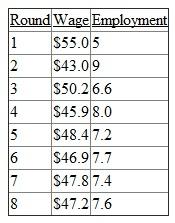
And so on.... Given, Initial demand curve: w = 50-3E, and initial supply curve: w = 10+5E Let's find out the equilibrium wage and employment by equating the demand and supply curves:       Therefore, initial employment is E = 5 , let's find equilibrium wage:   Therefore, equilibrium employment (E) = 5 , and wage (w) = $35 Let's find out the equilibrium employment and wage when demand increases: New demand curve:   Equating new demand curve with initial supply curve: 10+5E = 70-3E     When, E = 7.5 , let's find out new equilibrium wage:   Therefore, the new equilibrium wage (w) is $47.5 , and new equilibrium employment (E) is 7.5. As the market is subject to cobwebs, let's calculate the wage and employment in each round as the wage and employment levels adjust to the demand shock. Here we have also assumed that the supply of the physicists is inelastic. And each round occurs on the new demand curve: First round : when labour demand increases and when original employment (E) is 5. Putting E = 5, in new demand equation to get the value of w.     Second round : at wage rate (w) = $55, the supply of labour is:       Putting the value of E = 9, in new demand curve: w = 70-3E   Therefore, in second round E = 9 , and w = $43 And so on....
4
Show how the imposition of a minimum wage on a monopsony can increase both wages and employment.
فتح الحزمة
افتح القفل للوصول البطاقات البالغ عددها 24 في هذه المجموعة.
فتح الحزمة
k this deck
5
Show what happens to producer surplus, worker surplus, and the gains from trade as workers migrate from a low-wage to a high-wage region.
فتح الحزمة
افتح القفل للوصول البطاقات البالغ عددها 24 في هذه المجموعة.
فتح الحزمة
k this deck
6
Labor demand for low-skilled workers in the United States is w = 24 - 0.1 E where E is the number of workers (in millions) and w is the hourly wage. There are 120 million domestic U.S. low-skilled workers who supply labor inelastically. If the U.S. opened its borders to immigration, 20 million low-skill immigrants would enter the U.S. and supply labor inelastically. What is the market-clearing wage if immigration is not allowed What is the market-clearing wage with open borders How much is the immigration surplus when the U.S. opens its borders How much surplus is transferred from domestic workers to domestic firms
فتح الحزمة
افتح القفل للوصول البطاقات البالغ عددها 24 في هذه المجموعة.
فتح الحزمة
k this deck
7
The 1986 Immigration Reform and Control Act (IRCA) made it illegal for employers in the United States to knowingly hire illegal aliens. The legislation, however, has not reduced the flow of illegal aliens into the country. As a result, it has been proposed that the penalties against employers who break the law be substantially increased. Suppose that illegal aliens, who tend to be less skilled workers, are complements with native workers. What will happen to the wage of native workers if the penalties for hiring illegal aliens increase
فتح الحزمة
افتح القفل للوصول البطاقات البالغ عددها 24 في هذه المجموعة.

فتح الحزمة
k this deck
8
Consider the policy application of hurricanes and the labor market that was presented in the text.
a. How do labor demand and labor supply typically shift following a natural disaster
b. The data on changes in employment and wages in Table 4-5 suggest that the magnitude of relative shifts in labor demand and labor supply depend on the severity of the natural disaster. According to the data, does labor demand shift more relative to labor supply in mild or in extreme natural disasters. Provide intuition for this finding.
Reference Table 4-5
Consider the policy application of hurricanes and the labor market that was presented in the text. a. How do labor demand and labor supply typically shift following a natural disaster b. The data on changes in employment and wages in Table 4-5 suggest that the magnitude of relative shifts in labor demand and labor supply depend on the severity of the natural disaster. According to the data, does labor demand shift more relative to labor supply in mild or in extreme natural disasters. Provide intuition for this finding. Reference Table 4-5
فتح الحزمة
افتح القفل للوصول البطاقات البالغ عددها 24 في هذه المجموعة.

فتح الحزمة
k this deck
9
Describe the impact of a payroll tax on wages and employment in a competitive industry. Why is part of the tax shifted to workers What is the deadweight loss of the payroll tax
فتح الحزمة
افتح القفل للوصول البطاقات البالغ عددها 24 في هذه المجموعة.
فتح الحزمة
k this deck
10
Suppose the Cobb-Douglas production function given in Equation 4-1 applies to a developing country. Instead of thinking of immigration from a developing to a developed country, suppose a developed country invests large amounts of capital (foreign direct investment, or FDI) in a developing country.
a. How does an increase in FDI affect labor productivity in the developing country How will wages respond in the short-run
b. What are the long-run implications of FDI, especially in terms of potential future immigration from the developing country
Reference Equation 4-1
Suppose the Cobb-Douglas production function given in Equation 4-1 applies to a developing country. Instead of thinking of immigration from a developing to a developed country, suppose a developed country invests large amounts of capital (foreign direct investment, or FDI) in a developing country. a. How does an increase in FDI affect labor productivity in the developing country How will wages respond in the short-run b. What are the long-run implications of FDI, especially in terms of potential future immigration from the developing country Reference Equation 4-1
فتح الحزمة
افتح القفل للوصول البطاقات البالغ عددها 24 في هذه المجموعة.
فتح الحزمة
k this deck
11
a. What happens to wages and employment if the government imposes a payroll tax on a monopsonist Compare the response in the monopsonistic market to the response that would have been observed in a competitive labor market.
b. Suppose a firm is a perfectly discriminating monopsonist. The government imposes a minimum wage on this market. What happens to wages and employment
فتح الحزمة
افتح القفل للوصول البطاقات البالغ عددها 24 في هذه المجموعة.
فتح الحزمة
k this deck
12
Why does the payroll tax have the same impact on wages and employment regardless of whether it is imposed on workers or on firms
فتح الحزمة
افتح القفل للوصول البطاقات البالغ عددها 24 في هذه المجموعة.
فتح الحزمة
k this deck
13
An economy consists of two regions, the North and the South. The short-run elasticity of labor demand in each region is -0.5. Labor supply is perfectly inelastic within both regions. The labor market is initially in an economy-wide equilibrium, with 600,000 people employed in the North and 400,000 in the South at a wage of $15 per hour. Suddenly, 20,000 people immigrate from abroad and initially settle in the South. They possess the same skills as the native residents and also supply their labor inelastically.
(a) What will be the effect of this immigration on wages in each of the regions in the short run (before any migration between the North and the South occurs)
(b) Suppose 1,000 native-born persons per year migrate from the South to the North in response to every dollar differential in the hourly wage between the two regions. What will be the ratio of wages in the two regions after the first-year native labor responds to the entry of the immigrants
(c) What will be the effect of this immigration on wages and employment in each of the regions in the long run (after native workers respond by moving across regions to take advantage of whatever wage differentials may exist) Assume labor demand does not change in either region.
فتح الحزمة
افتح القفل للوصول البطاقات البالغ عددها 24 في هذه المجموعة.
فتح الحزمة
k this deck
14
How do mandated benefits affect labor market outcomes Why do these outcomes differ from those resulting from a payroll tax What is the deadweight loss arising from mandated benefits
فتح الحزمة
افتح القفل للوصول البطاقات البالغ عددها 24 في هذه المجموعة.
فتح الحزمة
k this deck
15
A firm faces a perfectly elastic demand for its output at a price of $6 per unit of output. The firm, however, faces an upward-sloped labor supply curve of
E = 20 w - 120
where E is the number of workers hired each hour and w is the hourly wage rate. Thus, the firm faces an upward-sloped marginal cost of labor curve of
MC E = 6 + 0.1 E
Each hour of labor produces five units of output. How many workers should the firm hire each hour to maximize profits What wage will the firm pay What are the firms hourly profits
فتح الحزمة
افتح القفل للوصول البطاقات البالغ عددها 24 في هذه المجموعة.
فتح الحزمة
k this deck
16
Do immigrants reduce the wage of native workers Do immigrants "take jobs away" from native workers
فتح الحزمة
افتح القفل للوصول البطاقات البالغ عددها 24 في هذه المجموعة.
فتح الحزمة
k this deck
17
Polly's Pet Store has a local monopoly on the grooming of dogs. The daily inverse demand curve for pet grooming is:
P = 20 - 0.1 Q
where P is the price of each grooming and Q is the number of groomings given each day. This implies that Polly's marginal revenue is:
MR = 20 - 0.2 Q.
Each worker Polly hires can groom 20 dogs each day. What is Polly's labor demand curve as a function of w , the daily wage that Polly takes as given
فتح الحزمة
افتح القفل للوصول البطاقات البالغ عددها 24 في هذه المجموعة.
فتح الحزمة
k this deck
18
The Key West Parrot Shop has a monopoly on the sale of parrot souvenir caps in Key West. The inverse demand curve for caps is:
P = 30 - 0.4 Q
where P is the price of a cap and Q is the number of caps sold per hour. Thus, the marginal revenue for the Parrot Shop is:
MR = 30 - 0.8 Q.
The Parrot Shop is the only employer in town, and faces an hourly supply of labor given by:
w = 0.9 E + 5
where w is the hourly wage rate and E is the number of workers hired each hour. The marginal cost associated with hiring E workers, therefore, is:
MC E = 1.8 E + 5.
Each worker produces two caps per hour. How many workers should the Parrot Shop hire each hour to maximize its profit What wage will it pay How much will it charge for each cap
فتح الحزمة
افتح القفل للوصول البطاقات البالغ عددها 24 في هذه المجموعة.
فتح الحزمة
k this deck
19
Figure 4-9 discusses the changes to a labor market equilibrium when the government mandates an employee benefit for which the cost exceeds the worker's valuation (panel a) and for which the cost equals the worker's valuation (panel b).
a. Provide a similar graph to those in Figure 4-9 when the cost of the benefit is less than the worker's valuation and discuss how the equilibrium level of employment and wages has changed. Is there deadweight loss associated with the mandated benefit
b. Why is the situation in which a mandated benefit would cost less than the worker's valuation less important for public policy purposes than when the cost of the mandated benefit exceeds the worker's valuation
Reference Figure 4-9
Figure 4-9 discusses the changes to a labor market equilibrium when the government mandates an employee benefit for which the cost exceeds the worker's valuation (panel a) and for which the cost equals the worker's valuation (panel b). a. Provide a similar graph to those in Figure 4-9 when the cost of the benefit is less than the worker's valuation and discuss how the equilibrium level of employment and wages has changed. Is there deadweight loss associated with the mandated benefit b. Why is the situation in which a mandated benefit would cost less than the worker's valuation less important for public policy purposes than when the cost of the mandated benefit exceeds the worker's valuation Reference Figure 4-9
فتح الحزمة
افتح القفل للوصول البطاقات البالغ عددها 24 في هذه المجموعة.
فتح الحزمة
k this deck
20
Describe the trends in wages and employment implied by the cobweb model for the engineering market. What would happen to the cobwebs if an economics consulting firm sold information on the history of wages and employment in the engineering market
فتح الحزمة
افتح القفل للوصول البطاقات البالغ عددها 24 في هذه المجموعة.
فتح الحزمة
k this deck
21
What is the producer surplus What is the worker surplus Show that a competitive market equilibrium maximizes the gains from trade.
فتح الحزمة
افتح القفل للوصول البطاقات البالغ عددها 24 في هذه المجموعة.
فتح الحزمة
k this deck
22
Ann owns a lawn mowing company. She has 400 lawns she needs to cut each week. Her weekly revenue from these 400 lawns is $20,000. Given an 18-inch deck push mower, a laborer can cut each lawn in two hours. Given a 60-inch deck riding mower, a laborer can cut each lawn in 30 minutes. Labor is supplied inelastically at $5.00 per hour. Each laborer works 8 hours a day and 5 days each week.
(a) If Ann decides to have her workers use push mowers, how many push mowers will Ann rent and how many workers will she hire
(b) If she decides to have her workers use riding mowers, how many riding mowers will Ann rent and how many workers will she hire
(c) Suppose the weekly rental cost (including gas and maintenance) for each push mower is $250 and for each riding mower is $1,800. What equipment will Ann rent How many workers will she employ How much profit will she earn
(d) Suppose the government imposes a 20 percent payroll tax (paid by employers) on all labor and offers a 20 percent subsidy on the rental cost of capital. What equipment will Ann rent How many workers will she employ How much profit will she earn
فتح الحزمة
افتح القفل للوصول البطاقات البالغ عددها 24 في هذه المجموعة.
فتح الحزمة
k this deck
23
In the United States, labor supply tends to be inelastic relative to labor demand, and according to law, payroll taxes are essentially assessed evenly between workers and firms. Given the above situation, are workers or firms more likely to bear the additional burden of an increased payroll tax in the United States Could this burden be shifted to the firms by assessing the increase in payroll taxes on just firms rather than having firms and workers continue to be assessed payroll taxes equally
فتح الحزمة
افتح القفل للوصول البطاقات البالغ عددها 24 في هذه المجموعة.
فتح الحزمة
k this deck
24
Describe the hiring decision of a perfectly discriminating monopsonist and of a non-discriminating monopsonist. In what sense do monopsonists "exploit" workers
فتح الحزمة
افتح القفل للوصول البطاقات البالغ عددها 24 في هذه المجموعة.
فتح الحزمة
k this deck
locked card icon
فتح الحزمة
افتح القفل للوصول البطاقات البالغ عددها 24 في هذه المجموعة.