







 تكلم مع الذكاء الاصطناعي


Deck 24: Price-Searcher Markets With High Entry Barriers
ملء الشاشة (f)

سؤال

سؤال
سؤال
سؤال
سؤال
سؤال
سؤال
سؤال
Suppose that you produce and sell children's tables in a local market. Past experience enables you to estimate your demand and marginal cost schedules. This information is presented in the accompanying table.
a. Fill in the missing revenue and cost schedules.
b. Assuming you are currently charging $55 per table set, what should you do if you want to maximize profits?
c. Given your demand and cost estimates, what price should you charge if you want to maximize your weekly profit? What output should you produce? What is your maximum weekly profit?

a. Fill in the missing revenue and cost schedules.
b. Assuming you are currently charging $55 per table set, what should you do if you want to maximize profits?
c. Given your demand and cost estimates, what price should you charge if you want to maximize your weekly profit? What output should you produce? What is your maximum weekly profit?
سؤال

فتح الحزمة
قم بالتسجيل لفتح البطاقات في هذه المجموعة!
Unlock Deck
Unlock Deck
1/9

العب

ملء الشاشة (f)
Deck 24: Price-Searcher Markets With High Entry Barriers
1
"Monopoly is good for producers but bad for consumers. The gains of the former offset the losses of the latter. On balance, there is no reason to think that monopoly is bad for the economy." Is this statement true? Why or why not?
Monopoly is a situation where there is only one supplier in the economy. This gives an unfair advantage to the producers to charge high prices from the consumers and thus earn super normal profits. However, this leads to losses for consumers as they have to pay high prices for products. Although the gains from the former offset the losses of the latter, such a price differentiation leads to an unequal distribution of income from the consumers to a few producers. Thus, it cannot be concluded that monopoly is good for an economy.
2
Compare the price and output policy of a purely competitive industry with the policy that would be established by a profit-maximizing monopolist or cartel. Who benefits and who is hurt? Construct the appropriate graphs to illustrate your answer.
NO ANSWER
3
Does economic theory indicate that an ideal regulatory agency that forces a monopolist to charge a price equal to either marginal or average total cost will improve economic efficiency? Explain. Does economic theory suggest that a regulatory agency will in fact regulate in a manner consistent with economic efficiency? What are some of the factors that complicate the regulatory function?
Regulatory agencies help in setting or regulating prices so that the producers do not charge abnormally high prices from consumers. By forcing a monopolist to charge price equal to either marginal or average total cost, regulatory agencies are able to achieve lower prices in the market and thus improve economic efficiency.
Although it is not possible for a regulatory agency to fix a price equal to the monopolist's average or marginal price, it tries its best to lower down the prices and achieve the best possible level of economic efficiency. A lot of factors complicate the regulatory function. Some of them are:
1. Monopolists would never disclose their complete financial accounts to the agency. As a result, a lot of data would be manipulated.
2. Monopolists would not agree to drastically cut down their prices.
3. The reforms suggested by the agency might not get implemented as expected because of corruption or thing leading to the delay.
Although it is not possible for a regulatory agency to fix a price equal to the monopolist's average or marginal price, it tries its best to lower down the prices and achieve the best possible level of economic efficiency. A lot of factors complicate the regulatory function. Some of them are:
1. Monopolists would never disclose their complete financial accounts to the agency. As a result, a lot of data would be manipulated.
2. Monopolists would not agree to drastically cut down their prices.
3. The reforms suggested by the agency might not get implemented as expected because of corruption or thing leading to the delay.
4
Is a monopolist subject to any competitive pressures? Explain. Would an unregulated monopolist have an incentive to operate and produce efficiently? Why or why not?
فتح الحزمة
افتح القفل للوصول البطاقات البالغ عددها 9 في هذه المجموعة.
فتح الحزمة
k this deck
5
How will high entry barriers into a market influence (a) the long-run profitability of the firms, (b) the cost efficiency of the firms in the industry, (c) the likelihood that some inefficient (high-cost) firms will survive, and (d) the incentive of entrepreneurs to develop substitutes for the product supplied by the firms? Are competitive pressures present in markets with high barriers to entry? Discuss.
فتح الحزمة
افتح القفل للوصول البطاقات البالغ عددها 9 في هذه المجموعة.
فتح الحزمة
k this deck
6
In large cities, taxi fares are often set above the market equilibrium rate. Sometimes, the number of licenses is limited in order to maintain the above-market price. Other times, licenses are automatically granted to anyone wanting to operate a taxi. When taxi fares are set above market equilibrium, compare and contrast resource allocation under the restricted license system (assume the licenses are tradable) and the free-entry system. In which case will it be easier for customers to get a taxi? In which case will the amount of capital required to enter the taxi business be greater?
فتح الحزمة
افتح القفل للوصول البطاقات البالغ عددها 9 في هذه المجموعة.
فتح الحزمة
k this deck
7
We have a theory to explain the equilibrium price and output for monopoly, but not for oligopoly. Why? How can game theory help us understand the decisions made by oligopolists?
فتح الحزمة
افتح القفل للوصول البطاقات البالغ عددها 9 في هذه المجموعة.
فتح الحزمة
k this deck
8
Suppose that you produce and sell children's tables in a local market. Past experience enables you to estimate your demand and marginal cost schedules. This information is presented in the accompanying table.
a. Fill in the missing revenue and cost schedules.
b. Assuming you are currently charging $55 per table set, what should you do if you want to maximize profits?
c. Given your demand and cost estimates, what price should you charge if you want to maximize your weekly profit? What output should you produce? What is your maximum weekly profit?
a. Fill in the missing revenue and cost schedules.
b. Assuming you are currently charging $55 per table set, what should you do if you want to maximize profits?
c. Given your demand and cost estimates, what price should you charge if you want to maximize your weekly profit? What output should you produce? What is your maximum weekly profit?
فتح الحزمة
افتح القفل للوصول البطاقات البالغ عددها 9 في هذه المجموعة.
فتح الحزمة
k this deck
9
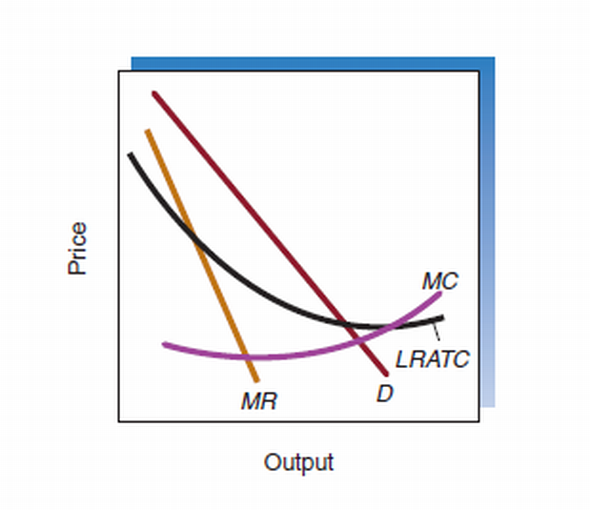
The accompanying diagram shows demand and longrun cost conditions in an industry.
a. Explain why the industry is likely to be monopolized.
b. Indicate the price that a profit-maximizing monopolist would charge and label it P.
c. Indicate the monopolist's output level and label it Q.
d. Indicate the maximum profits of the monopolist.
e. Will the profits attract competitors to the industry? Why or why not? Explain.
a. Explain why the industry is likely to be monopolized.
b. Indicate the price that a profit-maximizing monopolist would charge and label it P.
c. Indicate the monopolist's output level and label it Q.
d. Indicate the maximum profits of the monopolist.
e. Will the profits attract competitors to the industry? Why or why not? Explain.
فتح الحزمة
افتح القفل للوصول البطاقات البالغ عددها 9 في هذه المجموعة.
فتح الحزمة
k this deck
فتح الحزمة
افتح القفل للوصول البطاقات البالغ عددها 9 في هذه المجموعة.






