



Deck 12: Fiscal Policy

ملء الشاشة (f)
exit full mode
سؤال
( a ) The multiplier process depicted in Table 12.1 is based on an MPC of 0.75. Recompute the first five cycles using an MPC of 0.80.
( b ) How much more consumption occurs in the first five cycles?
( c ) What is the value of the multiplier in this case?
استخدم زر المسافة أو
up arrow
down arrow
لقلب البطاقة.
سؤال
What do people do with that fraction of their income they save?
سؤال
Suppose the government increases education spending by $20 billion. How much additional consumption will this increase cause?
سؤال
How long does the multiplier process take? How many cycles are likely to occur in a year's time? How will this alter the impact of fiscal policy?
سؤال
By how much would the 2008 tax rebates have shifted AD if the MPC was 0.90? (see Headline, p. 263).
سؤال
Do fiscal policymakers really need to know the magnitudes of the MPC and multipliers? Could they get along as well without such information?
سؤال
If taxes were cut by $1 trillion and the MPC was 0.80, by how much would total spending
( a ) Increase in the first year with two spending cycles?
( b ) Increase over five years, with two spending cycles per year?
( c ) Increase over an infinite time period?
سؤال
If the guidelines for fiscal policy (Table 12.2) are so simple, why does the economy ever suffer from unemployment or inflation?
سؤال
How much would AD eventually increase with Obama's increased appropriations spending (Headline, p. 257) if consumers had an MPC of 0.9?
سؤال
At the end of 2009 businesses bought more inventory, increasing GDP. What would happen if consumers didn't buy those goods?
سؤال
What was the short-run (1 month) MPC for the 2008 tax rebates (Headline, p. 263)?
سؤال
What did consumers buy with their 2008 tax rebates (Headline p. 263? Why did food purchases increase so little?
سؤال
What are the factors in the Headline on p. 253 that might depress consumer spending? How do they affect spending?
سؤال
Would a constitutional amendment that would require the federal government to balance its budget (incur no deficits) be desirable? Explain.
سؤال
If the marginal propensity to save is 0.05, how large is the multiplier? If the marginal propensity to save doubles to 0.10, what happens to the multiplier?
سؤال
How long does it take you to spend any income you receive? What happens to the dollars you spend?
سؤال
If the MPC were 0.9, how much spending would occur at step 5 in Figure 12.6? How many spending rounds would occur before consumer spending increased by $300 billion?
سؤال
What is your MPC? Would a welfare recipient and a millionaire have the same MPC? What determines a person's MPC?
فتح الحزمة
قم بالتسجيل لفتح البطاقات في هذه المجموعة!
Unlock Deck
Unlock Deck
1/18
auto play flashcards
العب
simple tutorial
ملء الشاشة (f)
exit full mode
Deck 12: Fiscal Policy
1
( a ) The multiplier process depicted in Table 12.1 is based on an MPC of 0.75. Recompute the first five cycles using an MPC of 0.80.
( b ) How much more consumption occurs in the first five cycles?
( c ) What is the value of the multiplier in this case?
(a) If the MPC is 0.8 the following table shows how through successive spending cycles the multiplier process leads to expansion of aggregate real income up to the first five cycles. The computations are shown in the table as follows:
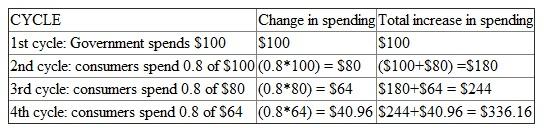
(a) If the MPC is 0.8 the following table shows how through successive spending cycles the multiplier process leads to expansion of aggregate real income up to the first five cycles. The computations are shown in the table as follows:   (b) The table below shows the consumption amounts that occur at each of the first five spending cycles for MPC = 0.75 and MPC = 0.80. The last column of the table shows how much more consumption occurs when MPC = 0.80 at each cycle.   To find the total amount by which consumption is higher when MPC = 80 percent, we simply add the differences at each cycle. Thus, as can be seen from the table, consumption is higher when MPC = 0.80 by the following amount:   (c) The value of the multiplier is:  (b) The table below shows the consumption amounts that occur at each of the first five spending cycles for MPC = 0.75 and MPC = 0.80. The last column of the table shows how much more consumption occurs when MPC = 0.80 at each cycle.
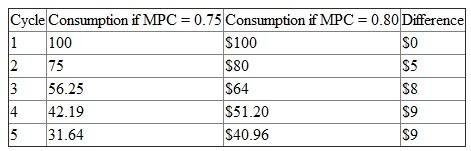
(a) If the MPC is 0.8 the following table shows how through successive spending cycles the multiplier process leads to expansion of aggregate real income up to the first five cycles. The computations are shown in the table as follows:   (b) The table below shows the consumption amounts that occur at each of the first five spending cycles for MPC = 0.75 and MPC = 0.80. The last column of the table shows how much more consumption occurs when MPC = 0.80 at each cycle.   To find the total amount by which consumption is higher when MPC = 80 percent, we simply add the differences at each cycle. Thus, as can be seen from the table, consumption is higher when MPC = 0.80 by the following amount:   (c) The value of the multiplier is:  To find the total amount by which consumption is higher when MPC = 80 percent, we simply add the differences at each cycle. Thus, as can be seen from the table, consumption is higher when MPC = 0.80 by the following amount:

(a) If the MPC is 0.8 the following table shows how through successive spending cycles the multiplier process leads to expansion of aggregate real income up to the first five cycles. The computations are shown in the table as follows:   (b) The table below shows the consumption amounts that occur at each of the first five spending cycles for MPC = 0.75 and MPC = 0.80. The last column of the table shows how much more consumption occurs when MPC = 0.80 at each cycle.   To find the total amount by which consumption is higher when MPC = 80 percent, we simply add the differences at each cycle. Thus, as can be seen from the table, consumption is higher when MPC = 0.80 by the following amount:   (c) The value of the multiplier is:  (c) The value of the multiplier is:

(a) If the MPC is 0.8 the following table shows how through successive spending cycles the multiplier process leads to expansion of aggregate real income up to the first five cycles. The computations are shown in the table as follows:   (b) The table below shows the consumption amounts that occur at each of the first five spending cycles for MPC = 0.75 and MPC = 0.80. The last column of the table shows how much more consumption occurs when MPC = 0.80 at each cycle.   To find the total amount by which consumption is higher when MPC = 80 percent, we simply add the differences at each cycle. Thus, as can be seen from the table, consumption is higher when MPC = 0.80 by the following amount:   (c) The value of the multiplier is:
2
What do people do with that fraction of their income they save?
People either hold the fraction of income they save in the form of cash or alternatively deposit it to a bank or other financial institution. If the money is held or "put under the mattress", it does not contribute to the expansion of the economy. Moreover, inflation erodes the value of the money holding over time. However, if the money is deposited to a bank, it can be used to make loans to other people of businesses, and this leads to expansion of the economy.
3
Suppose the government increases education spending by $20 billion. How much additional consumption will this increase cause?
If government increases government spending on education by $ 20 billion the exact amount by which consumption will increase depends on what the MPC is. Assuming MPC is denoted by the fraction
If government increases government spending on education by $ 20 billion the exact amount by which consumption will increase depends on what the MPC is. Assuming MPC is denoted by the fraction   , total spending will increase by (in billions)   Of this, the amount that will be allocated to consumption alone is the fraction   . Therefore, the additional consumption this increase causes will be (in billions)   So, if for example we assume that   = 0.75, then the increase in total spending can be calculated (in billions) as:   Now since the MPC is 0.75, of this increase in spending, 75 percent is spent on consumption expenditure. Therefore, the amount of this increase in spending that is spent on consumption is:   Therefore, given a hypothetical MPC of 0.75 if the government increases spending by $20 billion, consumption spending increases by $60 billion. , total spending will increase by (in billions)



If government increases government spending on education by $ 20 billion the exact amount by which consumption will increase depends on what the MPC is. Assuming MPC is denoted by the fraction   , total spending will increase by (in billions)   Of this, the amount that will be allocated to consumption alone is the fraction   . Therefore, the additional consumption this increase causes will be (in billions)   So, if for example we assume that   = 0.75, then the increase in total spending can be calculated (in billions) as:   Now since the MPC is 0.75, of this increase in spending, 75 percent is spent on consumption expenditure. Therefore, the amount of this increase in spending that is spent on consumption is:   Therefore, given a hypothetical MPC of 0.75 if the government increases spending by $20 billion, consumption spending increases by $60 billion. Of this, the amount that will be allocated to consumption alone is the fraction
If government increases government spending on education by $ 20 billion the exact amount by which consumption will increase depends on what the MPC is. Assuming MPC is denoted by the fraction   , total spending will increase by (in billions)   Of this, the amount that will be allocated to consumption alone is the fraction   . Therefore, the additional consumption this increase causes will be (in billions)   So, if for example we assume that   = 0.75, then the increase in total spending can be calculated (in billions) as:   Now since the MPC is 0.75, of this increase in spending, 75 percent is spent on consumption expenditure. Therefore, the amount of this increase in spending that is spent on consumption is:   Therefore, given a hypothetical MPC of 0.75 if the government increases spending by $20 billion, consumption spending increases by $60 billion. .
Therefore, the additional consumption this increase causes will be (in billions)
If government increases government spending on education by $ 20 billion the exact amount by which consumption will increase depends on what the MPC is. Assuming MPC is denoted by the fraction   , total spending will increase by (in billions)   Of this, the amount that will be allocated to consumption alone is the fraction   . Therefore, the additional consumption this increase causes will be (in billions)   So, if for example we assume that   = 0.75, then the increase in total spending can be calculated (in billions) as:   Now since the MPC is 0.75, of this increase in spending, 75 percent is spent on consumption expenditure. Therefore, the amount of this increase in spending that is spent on consumption is:   Therefore, given a hypothetical MPC of 0.75 if the government increases spending by $20 billion, consumption spending increases by $60 billion. So, if for example we assume that
If government increases government spending on education by $ 20 billion the exact amount by which consumption will increase depends on what the MPC is. Assuming MPC is denoted by the fraction   , total spending will increase by (in billions)   Of this, the amount that will be allocated to consumption alone is the fraction   . Therefore, the additional consumption this increase causes will be (in billions)   So, if for example we assume that   = 0.75, then the increase in total spending can be calculated (in billions) as:   Now since the MPC is 0.75, of this increase in spending, 75 percent is spent on consumption expenditure. Therefore, the amount of this increase in spending that is spent on consumption is:   Therefore, given a hypothetical MPC of 0.75 if the government increases spending by $20 billion, consumption spending increases by $60 billion. = 0.75, then the increase in total spending can be calculated (in billions) as:
If government increases government spending on education by $ 20 billion the exact amount by which consumption will increase depends on what the MPC is. Assuming MPC is denoted by the fraction   , total spending will increase by (in billions)   Of this, the amount that will be allocated to consumption alone is the fraction   . Therefore, the additional consumption this increase causes will be (in billions)   So, if for example we assume that   = 0.75, then the increase in total spending can be calculated (in billions) as:   Now since the MPC is 0.75, of this increase in spending, 75 percent is spent on consumption expenditure. Therefore, the amount of this increase in spending that is spent on consumption is:   Therefore, given a hypothetical MPC of 0.75 if the government increases spending by $20 billion, consumption spending increases by $60 billion. Now since the MPC is 0.75, of this increase in spending, 75 percent is spent on consumption expenditure. Therefore, the amount of this increase in spending that is spent on consumption is:

If government increases government spending on education by $ 20 billion the exact amount by which consumption will increase depends on what the MPC is. Assuming MPC is denoted by the fraction   , total spending will increase by (in billions)   Of this, the amount that will be allocated to consumption alone is the fraction   . Therefore, the additional consumption this increase causes will be (in billions)   So, if for example we assume that   = 0.75, then the increase in total spending can be calculated (in billions) as:   Now since the MPC is 0.75, of this increase in spending, 75 percent is spent on consumption expenditure. Therefore, the amount of this increase in spending that is spent on consumption is:   Therefore, given a hypothetical MPC of 0.75 if the government increases spending by $20 billion, consumption spending increases by $60 billion. Therefore, given a hypothetical MPC of 0.75 if the government increases spending by $20 billion, consumption spending increases by $60 billion.
4
How long does the multiplier process take? How many cycles are likely to occur in a year's time? How will this alter the impact of fiscal policy?
فتح الحزمة
افتح القفل للوصول البطاقات البالغ عددها 18 في هذه المجموعة.
فتح الحزمة
k this deck
5
By how much would the 2008 tax rebates have shifted AD if the MPC was 0.90? (see Headline, p. 263).
فتح الحزمة
افتح القفل للوصول البطاقات البالغ عددها 18 في هذه المجموعة.
فتح الحزمة
k this deck
6
Do fiscal policymakers really need to know the magnitudes of the MPC and multipliers? Could they get along as well without such information?
فتح الحزمة
افتح القفل للوصول البطاقات البالغ عددها 18 في هذه المجموعة.
فتح الحزمة
k this deck
7
If taxes were cut by $1 trillion and the MPC was 0.80, by how much would total spending
( a ) Increase in the first year with two spending cycles?
( b ) Increase over five years, with two spending cycles per year?
( c ) Increase over an infinite time period?
فتح الحزمة
افتح القفل للوصول البطاقات البالغ عددها 18 في هذه المجموعة.

فتح الحزمة
k this deck
8
If the guidelines for fiscal policy (Table 12.2) are so simple, why does the economy ever suffer from unemployment or inflation?
فتح الحزمة
افتح القفل للوصول البطاقات البالغ عددها 18 في هذه المجموعة.

فتح الحزمة
k this deck
9
How much would AD eventually increase with Obama's increased appropriations spending (Headline, p. 257) if consumers had an MPC of 0.9?
فتح الحزمة
افتح القفل للوصول البطاقات البالغ عددها 18 في هذه المجموعة.
فتح الحزمة
k this deck
10
At the end of 2009 businesses bought more inventory, increasing GDP. What would happen if consumers didn't buy those goods?
فتح الحزمة
افتح القفل للوصول البطاقات البالغ عددها 18 في هذه المجموعة.
فتح الحزمة
k this deck
11
What was the short-run (1 month) MPC for the 2008 tax rebates (Headline, p. 263)?
فتح الحزمة
افتح القفل للوصول البطاقات البالغ عددها 18 في هذه المجموعة.
فتح الحزمة
k this deck
12
What did consumers buy with their 2008 tax rebates (Headline p. 263? Why did food purchases increase so little?
فتح الحزمة
افتح القفل للوصول البطاقات البالغ عددها 18 في هذه المجموعة.
فتح الحزمة
k this deck
13
What are the factors in the Headline on p. 253 that might depress consumer spending? How do they affect spending?
فتح الحزمة
افتح القفل للوصول البطاقات البالغ عددها 18 في هذه المجموعة.
فتح الحزمة
k this deck
14
Would a constitutional amendment that would require the federal government to balance its budget (incur no deficits) be desirable? Explain.
فتح الحزمة
افتح القفل للوصول البطاقات البالغ عددها 18 في هذه المجموعة.
فتح الحزمة
k this deck
15
If the marginal propensity to save is 0.05, how large is the multiplier? If the marginal propensity to save doubles to 0.10, what happens to the multiplier?
فتح الحزمة
افتح القفل للوصول البطاقات البالغ عددها 18 في هذه المجموعة.
فتح الحزمة
k this deck
16
How long does it take you to spend any income you receive? What happens to the dollars you spend?
فتح الحزمة
افتح القفل للوصول البطاقات البالغ عددها 18 في هذه المجموعة.
فتح الحزمة
k this deck
17
If the MPC were 0.9, how much spending would occur at step 5 in Figure 12.6? How many spending rounds would occur before consumer spending increased by $300 billion?
فتح الحزمة
افتح القفل للوصول البطاقات البالغ عددها 18 في هذه المجموعة.
فتح الحزمة
k this deck
18
What is your MPC? Would a welfare recipient and a millionaire have the same MPC? What determines a person's MPC?
فتح الحزمة
افتح القفل للوصول البطاقات البالغ عددها 18 في هذه المجموعة.
فتح الحزمة
k this deck
locked card icon
فتح الحزمة
افتح القفل للوصول البطاقات البالغ عددها 18 في هذه المجموعة.