







 تكلم مع الذكاء الاصطناعي


Deck 24: Monopoly
ملء الشاشة (f)

سؤال

سؤال
سؤال
سؤال
سؤال
سؤال
سؤال
سؤال
سؤال
سؤال
سؤال
سؤال
سؤال
سؤال
سؤال
سؤال
سؤال
سؤال
سؤال
سؤال
سؤال
سؤال
سؤال
سؤال
سؤال
سؤال
سؤال
سؤال
سؤال
سؤال
سؤال
سؤال
سؤال
سؤال
سؤال
سؤال
سؤال
سؤال
سؤال
سؤال
سؤال
سؤال
سؤال
سؤال
سؤال
سؤال
سؤال
سؤال
سؤال
سؤال
سؤال
Exhibit 24-1
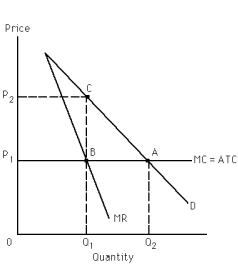
Refer to Exhibit 24-1.If the product is produced under single-price monopoly,what do profits equal at the profit maximizing level of output?
A) area 0P1BQ1
B) area BCA
C) area P1P2CB
D) area P2CAP1
E) none of the above
Refer to Exhibit 24-1.If the product is produced under single-price monopoly,what do profits equal at the profit maximizing level of output?
A) area 0P1BQ1
B) area BCA
C) area P1P2CB
D) area P2CAP1
E) none of the above
سؤال
سؤال
سؤال
سؤال
سؤال
سؤال
سؤال
Exhibit 24-1
Refer to Exhibit 24-1.If the product is produced under single-price monopoly,what quantity will be produced and what price will be charged in order to maximize profit?
A) Q2 units at P1
B) Q1 units at P1
C) Q1 units at P2
D) Q2 units at P2
Refer to Exhibit 24-1.If the product is produced under single-price monopoly,what quantity will be produced and what price will be charged in order to maximize profit?
A) Q2 units at P1
B) Q1 units at P1
C) Q1 units at P2
D) Q2 units at P2
سؤال
سؤال
سؤال
سؤال
سؤال
سؤال
سؤال
سؤال
Exhibit 24-1
Refer to Exhibit 24-1 The deadweight loss of the profit-maximizing monopoly is identified by what area?
A) area Q1BAQ2
B) area BCA
C) area P1P2CB
D) area 0P1BQ1
E) none of the above
Refer to Exhibit 24-1 The deadweight loss of the profit-maximizing monopoly is identified by what area?
A) area Q1BAQ2
B) area BCA
C) area P1P2CB
D) area 0P1BQ1
E) none of the above
سؤال
سؤال
Exhibit 24-2
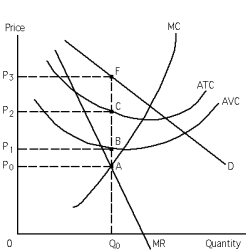
Refer to Exhibit 24-2.Total revenue at the profit-maximizing quantity of output is the
A) area 0P0AQ0.
B) area 0P3FQ0.
C) distance from Q0 to A.
D) distance from Q0 to D.
E) none of the above
Refer to Exhibit 24-2.Total revenue at the profit-maximizing quantity of output is the
A) area 0P0AQ0.
B) area 0P3FQ0.
C) distance from Q0 to A.
D) distance from Q0 to D.
E) none of the above
سؤال
سؤال
سؤال
Exhibit 24-1
Refer to Exhibit 24-1.If the product is produced under single-price monopoly,what does total revenue equal at the profit maximizing level of output?
A) area 0P2CQ1
B) area BCA
C) area P1P2CB
D) area P2CAP1
E) none of the above
Refer to Exhibit 24-1.If the product is produced under single-price monopoly,what does total revenue equal at the profit maximizing level of output?
A) area 0P2CQ1
B) area BCA
C) area P1P2CB
D) area P2CAP1
E) none of the above
سؤال
Exhibit 24-1
Refer to Exhibit 24-1.According to economist Gordon Tullock,what area is subject to rent seeking activity?
A) area Q1BAQ2
B) area BCA
C) area P1P2CB
D) area 0P1BQ1
E) none of the above
Refer to Exhibit 24-1.According to economist Gordon Tullock,what area is subject to rent seeking activity?
A) area Q1BAQ2
B) area BCA
C) area P1P2CB
D) area 0P1BQ1
E) none of the above
سؤال
سؤال
سؤال
Exhibit 24-2
Refer to Exhibit 24-2.The profit-maximizing monopolist produces Q? units and charges a price of
A) P0.
B) P1.
C) P3.
D) P2.
E) none of the above
Refer to Exhibit 24-2.The profit-maximizing monopolist produces Q? units and charges a price of
A) P0.
B) P1.
C) P3.
D) P2.
E) none of the above
سؤال
سؤال
سؤال
Exhibit 24-1
Refer to Exhibit 24-1.If the product is produced under single-price monopoly,what do total costs equal at the profit maximizing level of output?
A) area 0P1BQ1
B) area BCA
C) area P1P2CB
D) area P2CAP1
E) none of the above
Refer to Exhibit 24-1.If the product is produced under single-price monopoly,what do total costs equal at the profit maximizing level of output?
A) area 0P1BQ1
B) area BCA
C) area P1P2CB
D) area P2CAP1
E) none of the above
سؤال
سؤال

فتح الحزمة
قم بالتسجيل لفتح البطاقات في هذه المجموعة!
Unlock Deck
Unlock Deck
1/191

العب

ملء الشاشة (f)
Deck 24: Monopoly
1
Which of the following is the best example of a barrier to entry into a monopolistic industry?
A) diminishing returns
B) comparative advantage
C) high price elasticity of demand
D) a public franchise
A) diminishing returns
B) comparative advantage
C) high price elasticity of demand
D) a public franchise
D
2
Firm X is a single seller of good X.There are,however,two substitutes for good X.Given this,
A) Firm X cannot be a monopolist because the theory of monopoly assumes there are no close substitutes for the good the single seller sells.
B) Firm X can be a monopolist because we do not know if the two substitutes are close substitutes; additionally, it may be that Firm X acts as if the assumption of no close substitutes holds.
C) Firm X cannot be a monopolist because if substitutes exist for the good it produces, its demand curve is horizontal and monopolists face downward-sloping demand curves.
D) none of the above
A) Firm X cannot be a monopolist because the theory of monopoly assumes there are no close substitutes for the good the single seller sells.
B) Firm X can be a monopolist because we do not know if the two substitutes are close substitutes; additionally, it may be that Firm X acts as if the assumption of no close substitutes holds.
C) Firm X cannot be a monopolist because if substitutes exist for the good it produces, its demand curve is horizontal and monopolists face downward-sloping demand curves.
D) none of the above
B
3
A seller that has the ability (to some degree)to control the price of the product it sells is called a price
A) taker.
B) searcher.
C) breaker.
D) twister.
A) taker.
B) searcher.
C) breaker.
D) twister.
B
4
A right granted to a firm by government that permits the firm to provide a particular good or service and excludes others from doing the same is called
A) a natural monopoly.
B) a comparative advantage.
C) an economy of scale.
D) a public franchise.
A) a natural monopoly.
B) a comparative advantage.
C) an economy of scale.
D) a public franchise.
فتح الحزمة
افتح القفل للوصول البطاقات البالغ عددها 191 في هذه المجموعة.
فتح الحزمة
k this deck
5
Which of the following statements is false?
A) A price searcher must lower price to sell an additional unit of its product.
B) For a price searcher, price equals marginal revenue for all units except the first.
C) For a price searcher, price is greater than marginal revenue for all units except the first.
D) A price searcher, like a price taker, produces that quantity of output for which marginal revenue equals marginal cost.
A) A price searcher must lower price to sell an additional unit of its product.
B) For a price searcher, price equals marginal revenue for all units except the first.
C) For a price searcher, price is greater than marginal revenue for all units except the first.
D) A price searcher, like a price taker, produces that quantity of output for which marginal revenue equals marginal cost.
فتح الحزمة
افتح القفل للوصول البطاقات البالغ عددها 191 في هذه المجموعة.
فتح الحزمة
k this deck
6
Which of the following is the best example of a monopoly?
A) a local public utility
B) a fast-food restaurant
C) a department store
D) a wheat farmer
A) a local public utility
B) a fast-food restaurant
C) a department store
D) a wheat farmer
فتح الحزمة
افتح القفل للوصول البطاقات البالغ عددها 191 في هذه المجموعة.
فتح الحزمة
k this deck
7
Which of the following is an example of a legal barrier to entry?
A) a public franchise
B) a patent
C) exclusive ownership of a scarce resource
D) a and b
E) a, b, and c
A) a public franchise
B) a patent
C) exclusive ownership of a scarce resource
D) a and b
E) a, b, and c
فتح الحزمة
افتح القفل للوصول البطاقات البالغ عددها 191 في هذه المجموعة.
فتح الحزمة
k this deck
8
If economies of scale are so pronounced in an industry that only one firm can survive in the industry,this firm is called a(n)__________ monopoly.
A) financial
B) natural
C) structured
D) independent
A) financial
B) natural
C) structured
D) independent
فتح الحزمة
افتح القفل للوصول البطاقات البالغ عددها 191 في هذه المجموعة.
فتح الحزمة
k this deck
9
A monopoly may exist because
A) government has refused to grant a public franchise.
B) one firm has the exclusive ownership of a necessary resource.
C) the firm is so large and is currently experiencing such vast diseconomies of scale that it can out-compete all newcomers.
D) a and b
E) a, b, and c
A) government has refused to grant a public franchise.
B) one firm has the exclusive ownership of a necessary resource.
C) the firm is so large and is currently experiencing such vast diseconomies of scale that it can out-compete all newcomers.
D) a and b
E) a, b, and c
فتح الحزمة
افتح القفل للوصول البطاقات البالغ عددها 191 في هذه المجموعة.
فتح الحزمة
k this deck
10
A public franchise is a right granted
A) to one firm by another firm; for example, McDonald's Corporation grants restaurant owners a franchise to make its hamburgers.
B) to a firm by government that prevents other firms from producing the same product or service.
C) to a cooperative of buyers that allows the group to purchase goods at wholesale prices.
D) by government that enables a person to engage in arbitrage.
A) to one firm by another firm; for example, McDonald's Corporation grants restaurant owners a franchise to make its hamburgers.
B) to a firm by government that prevents other firms from producing the same product or service.
C) to a cooperative of buyers that allows the group to purchase goods at wholesale prices.
D) by government that enables a person to engage in arbitrage.
فتح الحزمة
افتح القفل للوصول البطاقات البالغ عددها 191 في هذه المجموعة.
فتح الحزمة
k this deck
11
In the United States,patents are granted to inventors of a product or process for a period of
A) unlimited time.
B) 10 years.
C) 20 years.
D) 25 years.
A) unlimited time.
B) 10 years.
C) 20 years.
D) 25 years.
فتح الحزمة
افتح القفل للوصول البطاقات البالغ عددها 191 في هذه المجموعة.
فتح الحزمة
k this deck
12
Suppose Firm X is a monopolist and is receiving positive economic profits.What prevents other firms from directly competing away the profits?
A) high barriers to entry
B) antitrust laws
C) low barriers to entry
D) diseconomies of scale
E) none of the above
A) high barriers to entry
B) antitrust laws
C) low barriers to entry
D) diseconomies of scale
E) none of the above
فتح الحزمة
افتح القفل للوصول البطاقات البالغ عددها 191 في هذه المجموعة.
فتح الحزمة
k this deck
13
The theory of monopoly assumes that the monopoly firm
A) faces a downward-sloping supply curve that is the same as its marginal revenue curve.
B) faces a downward-sloping demand curve.
C) produces more than the perfectly competitive firm under identical demand and cost conditions.
D) produces a product for which there are many close substitutes.
E) none of the above
A) faces a downward-sloping supply curve that is the same as its marginal revenue curve.
B) faces a downward-sloping demand curve.
C) produces more than the perfectly competitive firm under identical demand and cost conditions.
D) produces a product for which there are many close substitutes.
E) none of the above
فتح الحزمة
افتح القفل للوصول البطاقات البالغ عددها 191 في هذه المجموعة.
فتح الحزمة
k this deck
14
A price searcher is
A) a person who actively seeks out the best price for a product that he or she wishes to buy.
B) a firm that seeks out buyers who are willing to pay the price that the seller is asking for the product.
C) a firm that has the ability to control to some degree the price of the product it sells.
D) actually any firm or consumer, because each market "player" searches for the best price at which it can sell or buy.
A) a person who actively seeks out the best price for a product that he or she wishes to buy.
B) a firm that seeks out buyers who are willing to pay the price that the seller is asking for the product.
C) a firm that has the ability to control to some degree the price of the product it sells.
D) actually any firm or consumer, because each market "player" searches for the best price at which it can sell or buy.
فتح الحزمة
افتح القفل للوصول البطاقات البالغ عددها 191 في هذه المجموعة.
فتح الحزمة
k this deck
15
A price searcher
A) faces a horizontal demand curve.
B) is a seller that searches for good employees and pays them a low wage.
C) is a seller that searches for the best location to sell its product.
D) is a seller that has the ability to control to some degree the price of the product it sells.
E) none of the above
A) faces a horizontal demand curve.
B) is a seller that searches for good employees and pays them a low wage.
C) is a seller that searches for the best location to sell its product.
D) is a seller that has the ability to control to some degree the price of the product it sells.
E) none of the above
فتح الحزمة
افتح القفل للوصول البطاقات البالغ عددها 191 في هذه المجموعة.
فتح الحزمة
k this deck
16
A natural monopoly exists when
A) a monopolist produces a product, the main component of which is a natural resource.
B) economies of scale are so large that only one firm can survive and achieve low unit costs.
C) a firm is the exclusive owner of a key resource necessary to produce the firm's product.
D) there are no close substitutes for a firm's product.
A) a monopolist produces a product, the main component of which is a natural resource.
B) economies of scale are so large that only one firm can survive and achieve low unit costs.
C) a firm is the exclusive owner of a key resource necessary to produce the firm's product.
D) there are no close substitutes for a firm's product.
فتح الحزمة
افتح القفل للوصول البطاقات البالغ عددها 191 في هذه المجموعة.
فتح الحزمة
k this deck
17
Which of the following is not an example of a legal barrier to entry?
A) a beautician's license
B) a patent
C) exclusive ownership of raw materials
D) a public franchise
E) a copyright
A) a beautician's license
B) a patent
C) exclusive ownership of raw materials
D) a public franchise
E) a copyright
فتح الحزمة
افتح القفل للوصول البطاقات البالغ عددها 191 في هذه المجموعة.
فتح الحزمة
k this deck
18
Public franchises,patents,and government licenses are examples of __________ barriers to entry.
A) social
B) legal
C) cultural
D) geographic
A) social
B) legal
C) cultural
D) geographic
فتح الحزمة
افتح القفل للوصول البطاقات البالغ عددها 191 في هذه المجموعة.
فتح الحزمة
k this deck
19
Which of the following is an assumption of the theory of monopoly?
A) There are extremely high barriers to entry.
B) There are many sellers.
C) The product has a number of close substitutes.
D) The product is of extremely high quality.
A) There are extremely high barriers to entry.
B) There are many sellers.
C) The product has a number of close substitutes.
D) The product is of extremely high quality.
فتح الحزمة
افتح القفل للوصول البطاقات البالغ عددها 191 في هذه المجموعة.
فتح الحزمة
k this deck
20
Which of the following is not an example of a legal barrier to entry?
A) a public franchise
B) economies of scale
C) a government license
D) a patent
A) a public franchise
B) economies of scale
C) a government license
D) a patent
فتح الحزمة
افتح القفل للوصول البطاقات البالغ عددها 191 في هذه المجموعة.
فتح الحزمة
k this deck
21
Which of the following statements is true?
A) The monopolist can sell all it can produce at the market price.
B) The marginal revenue curve of the single-price monopolist lies above its demand curve.
C) The marginal revenue curve of the single-price monopolist is the same as its demand curve.
D) The marginal revenue curve of the single-price monopolist lies below its demand curve.
A) The monopolist can sell all it can produce at the market price.
B) The marginal revenue curve of the single-price monopolist lies above its demand curve.
C) The marginal revenue curve of the single-price monopolist is the same as its demand curve.
D) The marginal revenue curve of the single-price monopolist lies below its demand curve.
فتح الحزمة
افتح القفل للوصول البطاقات البالغ عددها 191 في هذه المجموعة.
فتح الحزمة
k this deck
22
In maximizing profits,a single-price monopolist will charge a price that is
A) less than marginal cost.
B) equal to marginal cost.
C) greater than marginal cost.
D) There is not enough information to answer the question.
A) less than marginal cost.
B) equal to marginal cost.
C) greater than marginal cost.
D) There is not enough information to answer the question.
فتح الحزمة
افتح القفل للوصول البطاقات البالغ عددها 191 في هذه المجموعة.
فتح الحزمة
k this deck
23
Which of the following statements is false?
A) The monopolist faces a horizontal demand curve.
B) For the single-price monopolist, marginal revenue is less than price.
C) For the monopolist, revenue maximization and profit maximization are usually not the same.
D) The monopolist is a price searcher.
A) The monopolist faces a horizontal demand curve.
B) For the single-price monopolist, marginal revenue is less than price.
C) For the monopolist, revenue maximization and profit maximization are usually not the same.
D) The monopolist is a price searcher.
فتح الحزمة
افتح القفل للوصول البطاقات البالغ عددها 191 في هذه المجموعة.
فتح الحزمة
k this deck
24
Which of the following statements is false?
A) The monopolist has the ability to control to some degree the price of the product it sells.
B) The monopolist faces a downward-sloping demand curve.
C) The monopolist is a price taker.
D) The monopoly firm is the industry.
A) The monopolist has the ability to control to some degree the price of the product it sells.
B) The monopolist faces a downward-sloping demand curve.
C) The monopolist is a price taker.
D) The monopoly firm is the industry.
فتح الحزمة
افتح القفل للوصول البطاقات البالغ عددها 191 في هذه المجموعة.
فتح الحزمة
k this deck
25
The Townsend Acts
A) are anti-trust laws passed in the U.S. in the 1930's to limit monopoly power.
B) allow district attorneys the opportunity to plea bargain with accused criminals.
C) were British laws enacted in the 1760's that imposed taxes on products imported to the American colonies, leading (in part) to the Boston Tea Party.
D) were enacted in the late 1800's to permit regulation of natural monopolies.
A) are anti-trust laws passed in the U.S. in the 1930's to limit monopoly power.
B) allow district attorneys the opportunity to plea bargain with accused criminals.
C) were British laws enacted in the 1760's that imposed taxes on products imported to the American colonies, leading (in part) to the Boston Tea Party.
D) were enacted in the late 1800's to permit regulation of natural monopolies.
فتح الحزمة
افتح القفل للوصول البطاقات البالغ عددها 191 في هذه المجموعة.
فتح الحزمة
k this deck
26
Which of the following is characteristic of the monopoly firm?
A) It produces the quantity of output at which marginal revenue equals marginal cost, MR = MC.
B) It charges a price per unit for its product that is equal to marginal cost.
C) It always earns a profit, because it is a single seller of a product.
D) a and b
E) a and c
A) It produces the quantity of output at which marginal revenue equals marginal cost, MR = MC.
B) It charges a price per unit for its product that is equal to marginal cost.
C) It always earns a profit, because it is a single seller of a product.
D) a and b
E) a and c
فتح الحزمة
افتح القفل للوصول البطاقات البالغ عددها 191 في هذه المجموعة.
فتح الحزمة
k this deck
27
For the monopoly firm that does not engage in perfect price discrimination,
A) the marginal revenue curve lies below the demand curve.
B) the marginal revenue curve and demand curve are the same.
C) the marginal revenue curve lies above the demand curve.
D) marginal revenue equals price.
E) c and d
A) the marginal revenue curve lies below the demand curve.
B) the marginal revenue curve and demand curve are the same.
C) the marginal revenue curve lies above the demand curve.
D) marginal revenue equals price.
E) c and d
فتح الحزمة
افتح القفل للوصول البطاقات البالغ عددها 191 في هذه المجموعة.
فتح الحزمة
k this deck
28
If a monopolist wishes to sell an additional unit of the good,then
A) it must raise its price to signal consumers that its product is now a more important part of their budget, and they will purchase more.
B) like a competitive firm, it can simply make more output available and not lower price.
C) it must lower price.
D) it can raise price and not worry that sales will decrease.
E) a and d
A) it must raise its price to signal consumers that its product is now a more important part of their budget, and they will purchase more.
B) like a competitive firm, it can simply make more output available and not lower price.
C) it must lower price.
D) it can raise price and not worry that sales will decrease.
E) a and d
فتح الحزمة
افتح القفل للوصول البطاقات البالغ عددها 191 في هذه المجموعة.
فتح الحزمة
k this deck
29
A monopolist maximizes profits at the output at which
A) total revenue is at its greatest, assuming that the firm has both fixed and variable costs.
B) price equals marginal cost.
C) price exceeds marginal cost by the greatest amount.
D) none of the above
A) total revenue is at its greatest, assuming that the firm has both fixed and variable costs.
B) price equals marginal cost.
C) price exceeds marginal cost by the greatest amount.
D) none of the above
فتح الحزمة
افتح القفل للوصول البطاقات البالغ عددها 191 في هذه المجموعة.
فتح الحزمة
k this deck
30
For a monopolist,if price is above average total cost,the monopolist is
A) earning an economic profit.
B) taking an economic loss.
C) minimizing total fixed costs.
D) minimizing total variable costs.
A) earning an economic profit.
B) taking an economic loss.
C) minimizing total fixed costs.
D) minimizing total variable costs.
فتح الحزمة
افتح القفل للوصول البطاقات البالغ عددها 191 في هذه المجموعة.
فتح الحزمة
k this deck
31
Which of the following statements is true?
A) As a consequence of the monopoly firm producing the quantity of output at which price equals marginal cost, it is resource allocative efficient.
B) As a consequence of the perfectly competitive firm producing the quantity of output at which price equals marginal cost, it is resource allocative efficient.
C) a and b
D) none of the above
A) As a consequence of the monopoly firm producing the quantity of output at which price equals marginal cost, it is resource allocative efficient.
B) As a consequence of the perfectly competitive firm producing the quantity of output at which price equals marginal cost, it is resource allocative efficient.
C) a and b
D) none of the above
فتح الحزمة
افتح القفل للوصول البطاقات البالغ عددها 191 في هذه المجموعة.
فتح الحزمة
k this deck
32
The perfectly competitive firm charges a price equal to __________ while the monopolist charges a price __________.
A) marginal revenue; equal to marginal cost
B) marginal cost; greater than marginal cost
C) marginal revenue; greater than marginal revenue
D) average total cost; greater than average total cost
E) b and c
A) marginal revenue; equal to marginal cost
B) marginal cost; greater than marginal cost
C) marginal revenue; greater than marginal revenue
D) average total cost; greater than average total cost
E) b and c
فتح الحزمة
افتح القفل للوصول البطاقات البالغ عددها 191 في هذه المجموعة.
فتح الحزمة
k this deck
33
Which of the following statements is true?
A) A monopolist can charge whatever price it wants without losing any customers, by virtue of its monopoly position.
B) A monopolist can always increase its profits by increasing its price.
C) In the monopoly market structure, there are low barriers to entry.
D) A monopolist is assured of positive economic profits.
E) none of the above
A) A monopolist can charge whatever price it wants without losing any customers, by virtue of its monopoly position.
B) A monopolist can always increase its profits by increasing its price.
C) In the monopoly market structure, there are low barriers to entry.
D) A monopolist is assured of positive economic profits.
E) none of the above
فتح الحزمة
افتح القفل للوصول البطاقات البالغ عددها 191 في هذه المجموعة.
فتح الحزمة
k this deck
34
The seller of good X sells 1,000 units of the good. Each unit is being sold for the highest price each consumer is willing to pay for the good.The seller practices
A) second-degree price discrimination.
B) third-degree price discrimination.
C) perfect price discrimination.
D) marginal revenue pricing.
E) rent seeking.
A) second-degree price discrimination.
B) third-degree price discrimination.
C) perfect price discrimination.
D) marginal revenue pricing.
E) rent seeking.
فتح الحزمة
افتح القفل للوصول البطاقات البالغ عددها 191 في هذه المجموعة.
فتح الحزمة
k this deck
35
A monopolist can sell 26,000 units at a price of $10 per unit.Lowering price by $1 raises the quantity demanded by 500 units.What is the change in total revenue resulting from this price change?
A) $21,500
B) $12,500
C) $65,500
D) -$21,500
A) $21,500
B) $12,500
C) $65,500
D) -$21,500
فتح الحزمة
افتح القفل للوصول البطاقات البالغ عددها 191 في هذه المجموعة.
فتح الحزمة
k this deck
36
Economic rent is a payment in excess of
A) average fixed cost.
B) average variable cost.
C) opportunity cost.
D) explicit cost, but not necessarily implicit cost.
E) none of the above
A) average fixed cost.
B) average variable cost.
C) opportunity cost.
D) explicit cost, but not necessarily implicit cost.
E) none of the above
فتح الحزمة
افتح القفل للوصول البطاقات البالغ عددها 191 في هذه المجموعة.
فتح الحزمة
k this deck
37
Maximizing total revenue turns out to be the same as maximizing profit only when
A) average fixed cost declines continually as output rises.
B) a firm has no fixed costs.
C) a firm has no variable costs.
D) a firm has both variable and fixed costs.
A) average fixed cost declines continually as output rises.
B) a firm has no fixed costs.
C) a firm has no variable costs.
D) a firm has both variable and fixed costs.
فتح الحزمة
افتح القفل للوصول البطاقات البالغ عددها 191 في هذه المجموعة.
فتح الحزمة
k this deck
38
In order for a monopolist to be earning a profit,price must be greater than
A) average total cost.
B) marginal revenue.
C) total cost.
D) marginal cost.
A) average total cost.
B) marginal revenue.
C) total cost.
D) marginal cost.
فتح الحزمة
افتح القفل للوصول البطاقات البالغ عددها 191 في هذه المجموعة.
فتح الحزمة
k this deck
39
A monopolist can sell 7,000 units at a price of $5 per unit.Lowering price to all buyers by $1 raises the quantity demanded by 500 units.What is the change in total revenue resulting from this price change?
A) $6,000
B) $5,000
C) -$5,000
D) -$18,000
A) $6,000
B) $5,000
C) -$5,000
D) -$18,000
فتح الحزمة
افتح القفل للوصول البطاقات البالغ عددها 191 في هذه المجموعة.
فتح الحزمة
k this deck
40
Rent seeking occurs when the seller charges
A) different prices for the product it sells, and the price differences do not reflect cost differences.
B) the highest price each consumer would be willing to pay for the product rather than go without it.
C) a uniform price per unit for one specific quantity, a lower price for an additional quantity, and so on.
D) a and c
E) none of the above
A) different prices for the product it sells, and the price differences do not reflect cost differences.
B) the highest price each consumer would be willing to pay for the product rather than go without it.
C) a uniform price per unit for one specific quantity, a lower price for an additional quantity, and so on.
D) a and c
E) none of the above
فتح الحزمة
افتح القفل للوصول البطاقات البالغ عددها 191 في هذه المجموعة.
فتح الحزمة
k this deck
41
Suppose a monopolist practices perfect price discrimination.Its marginal revenue curve
A) will lie below the demand curve.
B) will lie above the demand curve.
C) will coincide with the demand curve.
D) has no definite relationship with the demand curve.
A) will lie below the demand curve.
B) will lie above the demand curve.
C) will coincide with the demand curve.
D) has no definite relationship with the demand curve.
فتح الحزمة
افتح القفل للوصول البطاقات البالغ عددها 191 في هذه المجموعة.
فتح الحزمة
k this deck
42
If a perfectly competitive firm and a single-price monopolist face the same demand and cost curves,then the competitive firm will produce a
A) greater output and charge a lower price than the monopolist.
B) greater output but charge the same price as the monopolist.
C) greater output and charge a higher price than the monopolist.
D) smaller output and charge a lower price than the monopolist.
E) smaller output and charge a higher price than the monopolist.
A) greater output and charge a lower price than the monopolist.
B) greater output but charge the same price as the monopolist.
C) greater output and charge a higher price than the monopolist.
D) smaller output and charge a lower price than the monopolist.
E) smaller output and charge a higher price than the monopolist.
فتح الحزمة
افتح القفل للوصول البطاقات البالغ عددها 191 في هذه المجموعة.
فتح الحزمة
k this deck
43
Which of the following statements is false?
A) The perfectly competitive firm and the perfectly price-discriminating monopolist both exhibit resource-allocative efficiency.
B) The perfectly competitive firm, unlike the single-price monopolist, exhibits resource-allocative efficiency.
C) The perfectly competitive firm charges the same price for each unit of the good it sells.
D) The perfectly price-discriminating monopolist charges the same price for each unit of the good it sells.
A) The perfectly competitive firm and the perfectly price-discriminating monopolist both exhibit resource-allocative efficiency.
B) The perfectly competitive firm, unlike the single-price monopolist, exhibits resource-allocative efficiency.
C) The perfectly competitive firm charges the same price for each unit of the good it sells.
D) The perfectly price-discriminating monopolist charges the same price for each unit of the good it sells.
فتح الحزمة
افتح القفل للوصول البطاقات البالغ عددها 191 في هذه المجموعة.
فتح الحزمة
k this deck
44
Third-degree price discrimination is discrimination among
A) units.
B) quantities.
C) buyers.
D) prices.
A) units.
B) quantities.
C) buyers.
D) prices.
فتح الحزمة
افتح القفل للوصول البطاقات البالغ عددها 191 في هذه المجموعة.
فتح الحزمة
k this deck
45
Which of the following statements is true?
A) The perfectly competitive firm produces a level of output at which P=MC.
B) The single-price monopolist produces a level of output at which P > MC.
C) The perfectly price-discriminating monopolist produces a level of output at which P>MC.
D) a and b
E) all of the above
A) The perfectly competitive firm produces a level of output at which P=MC.
B) The single-price monopolist produces a level of output at which P > MC.
C) The perfectly price-discriminating monopolist produces a level of output at which P>MC.
D) a and b
E) all of the above
فتح الحزمة
افتح القفل للوصول البطاقات البالغ عددها 191 في هذه المجموعة.
فتح الحزمة
k this deck
46
If a monopolist practices perfect price discrimination,then it will have
A) a greater total revenue and sell a greater output than if it were not practicing price discrimination.
B) a smaller total revenue and sell a smaller output than if it were not practicing price discrimination.
C) the same total revenue but sell a larger output than if it were not practicing price discrimination.
D) the same total revenue but sell a smaller output than if it were not practicing price discrimination.
A) a greater total revenue and sell a greater output than if it were not practicing price discrimination.
B) a smaller total revenue and sell a smaller output than if it were not practicing price discrimination.
C) the same total revenue but sell a larger output than if it were not practicing price discrimination.
D) the same total revenue but sell a smaller output than if it were not practicing price discrimination.
فتح الحزمة
افتح القفل للوصول البطاقات البالغ عددها 191 في هذه المجموعة.
فتح الحزمة
k this deck
47
If a perfectly competitive firm and a single-price monopolist face the same demand and cost curves,then
A) the competitive firm will attain resource-allocative efficiency, but the monopolist will not.
B) the competitive firm will attain resource-allocative efficiency, but the monopolist may or may not, depending upon the demand for its product.
C) the competitive firm will not attain resource-allocative efficiency, but the monopolist will.
D) both the competitive firm and the monopolist will attain resource-allocative efficiency.
E) neither the competitive firm nor the monopolist will attain resource-allocative efficiency.
A) the competitive firm will attain resource-allocative efficiency, but the monopolist will not.
B) the competitive firm will attain resource-allocative efficiency, but the monopolist may or may not, depending upon the demand for its product.
C) the competitive firm will not attain resource-allocative efficiency, but the monopolist will.
D) both the competitive firm and the monopolist will attain resource-allocative efficiency.
E) neither the competitive firm nor the monopolist will attain resource-allocative efficiency.
فتح الحزمة
افتح القفل للوصول البطاقات البالغ عددها 191 في هذه المجموعة.
فتح الحزمة
k this deck
48
Arbitrage is
A) a form of negotiation between two parties having a disagreement.
B) buying a good in one market and selling it in another for a profit.
C) a form of price discrimination where the producer sells its product at two different prices.
D) a means of deciding the most efficient way of producing a product.
A) a form of negotiation between two parties having a disagreement.
B) buying a good in one market and selling it in another for a profit.
C) a form of price discrimination where the producer sells its product at two different prices.
D) a means of deciding the most efficient way of producing a product.
فتح الحزمة
افتح القفل للوصول البطاقات البالغ عددها 191 في هذه المجموعة.
فتح الحزمة
k this deck
49
Your school pays one rate for the first one million kilowatts of electricity and a lower rate for any power it uses over one million kilowatts.What is occurring here?
A) perfect price discrimination
B) second-degree price discrimination
C) third-degree price discrimination
D) economies of scale
A) perfect price discrimination
B) second-degree price discrimination
C) third-degree price discrimination
D) economies of scale
فتح الحزمة
افتح القفل للوصول البطاقات البالغ عددها 191 في هذه المجموعة.
فتح الحزمة
k this deck
50
Which of the following is not a necessary condition of price discrimination?
A) The seller must be a price searcher.
B) The seller must be able to distinguish between customers willing to pay different prices.
C) It must cost the seller more to service some customers than others.
D) Reselling the product must be extremely costly or must not be possible
A) The seller must be a price searcher.
B) The seller must be able to distinguish between customers willing to pay different prices.
C) It must cost the seller more to service some customers than others.
D) Reselling the product must be extremely costly or must not be possible
فتح الحزمة
افتح القفل للوصول البطاقات البالغ عددها 191 في هذه المجموعة.
فتح الحزمة
k this deck
51
Exhibit 24-1
Refer to Exhibit 24-1.If the product is produced under single-price monopoly,what do profits equal at the profit maximizing level of output?
A) area 0P1BQ1
B) area BCA
C) area P1P2CB
D) area P2CAP1
E) none of the above
Refer to Exhibit 24-1.If the product is produced under single-price monopoly,what do profits equal at the profit maximizing level of output?
A) area 0P1BQ1
B) area BCA
C) area P1P2CB
D) area P2CAP1
E) none of the above
فتح الحزمة
افتح القفل للوصول البطاقات البالغ عددها 191 في هذه المجموعة.
فتح الحزمة
k this deck
52
Second-degree price discrimination is discrimination among
A) units.
B) quantities.
C) buyers.
D) prices.
A) units.
B) quantities.
C) buyers.
D) prices.
فتح الحزمة
افتح القفل للوصول البطاقات البالغ عددها 191 في هذه المجموعة.
فتح الحزمة
k this deck
53
For a firm that perfectly price discriminates,
A) price is less than marginal revenue.
B) price is greater than marginal revenue.
C) price equals marginal revenue.
D) price has no definite relationship with marginal revenue.
A) price is less than marginal revenue.
B) price is greater than marginal revenue.
C) price equals marginal revenue.
D) price has no definite relationship with marginal revenue.
فتح الحزمة
افتح القفل للوصول البطاقات البالغ عددها 191 في هذه المجموعة.
فتح الحزمة
k this deck
54
Suppose Johnny,seven years old,is selling lemonade and he sells each of his buyers the refreshment for the maximum price that each buyer is willing to pay.Johnny is practicing
A) perfect competition.
B) perfect price discrimination.
C) second-degree price discrimination.
D) third-degree price discrimination.
A) perfect competition.
B) perfect price discrimination.
C) second-degree price discrimination.
D) third-degree price discrimination.
فتح الحزمة
افتح القفل للوصول البطاقات البالغ عددها 191 في هذه المجموعة.
فتح الحزمة
k this deck
55
Perfect price discrimination is discrimination among
A) units.
B) quantities.
C) buyers.
D) prices.
A) units.
B) quantities.
C) buyers.
D) prices.
فتح الحزمة
افتح القفل للوصول البطاقات البالغ عددها 191 في هذه المجموعة.
فتح الحزمة
k this deck
56
A monopolist practicing (perfect)price discrimination has
A) a larger deadweight loss triangle than a single-price monopolist has.
B) the same deadweight loss triangle as a single-price monopolist.
C) a deadweight loss triangle one-half the size of what it would be with uniform pricing.
D) no deadweight loss triangle.
A) a larger deadweight loss triangle than a single-price monopolist has.
B) the same deadweight loss triangle as a single-price monopolist.
C) a deadweight loss triangle one-half the size of what it would be with uniform pricing.
D) no deadweight loss triangle.
فتح الحزمة
افتح القفل للوصول البطاقات البالغ عددها 191 في هذه المجموعة.
فتح الحزمة
k this deck
57
If a perfectly competitive firm and a perfectly price-discriminating monopolist face the same demand and cost curves,then
A) the competitive firm will attain resource-allocative efficiency, but the monopolist will not.
B) the competitive firm will attain resource-allocative efficiency, but the monopolist may or may not, depending upon the demand for its product.
C) the competitive firm will not attain resource-allocative efficiency, but the monopolist will.
D) both the competitive firm and the monopolist will attain resource-allocative efficiency.
E) neither the competitive firm nor the monopolist will attain resource-allocative efficiency.
A) the competitive firm will attain resource-allocative efficiency, but the monopolist will not.
B) the competitive firm will attain resource-allocative efficiency, but the monopolist may or may not, depending upon the demand for its product.
C) the competitive firm will not attain resource-allocative efficiency, but the monopolist will.
D) both the competitive firm and the monopolist will attain resource-allocative efficiency.
E) neither the competitive firm nor the monopolist will attain resource-allocative efficiency.
فتح الحزمة
افتح القفل للوصول البطاقات البالغ عددها 191 في هذه المجموعة.
فتح الحزمة
k this deck
58
Exhibit 24-1
Refer to Exhibit 24-1.If the product is produced under single-price monopoly,what quantity will be produced and what price will be charged in order to maximize profit?
A) Q2 units at P1
B) Q1 units at P1
C) Q1 units at P2
D) Q2 units at P2
Refer to Exhibit 24-1.If the product is produced under single-price monopoly,what quantity will be produced and what price will be charged in order to maximize profit?
A) Q2 units at P1
B) Q1 units at P1
C) Q1 units at P2
D) Q2 units at P2
فتح الحزمة
افتح القفل للوصول البطاقات البالغ عددها 191 في هذه المجموعة.
فتح الحزمة
k this deck
59
If a single-price monopolist and a perfectly price-discriminating monopolist face the same demand and cost curves,then
A) the single-price monopolist will attain resource-allocative efficiency, but the discriminating monopolist will not.
B) the single-price monopolist will attain resource-allocative efficiency, but the discriminating monopolist may or may not, depending upon the demand for its product.
C) the single-price monopolist will not attain resource-allocative efficiency, but the discriminating monopolist will.
D) both the single-price and the discriminating monopolist will attain resource-allocative efficiency.
E) neither the single-price nor the discriminating monopolist will attain resource-allocative efficiency.
A) the single-price monopolist will attain resource-allocative efficiency, but the discriminating monopolist will not.
B) the single-price monopolist will attain resource-allocative efficiency, but the discriminating monopolist may or may not, depending upon the demand for its product.
C) the single-price monopolist will not attain resource-allocative efficiency, but the discriminating monopolist will.
D) both the single-price and the discriminating monopolist will attain resource-allocative efficiency.
E) neither the single-price nor the discriminating monopolist will attain resource-allocative efficiency.
فتح الحزمة
افتح القفل للوصول البطاقات البالغ عددها 191 في هذه المجموعة.
فتح الحزمة
k this deck
60
Suppose the local pharmacy charges lower prices to senior citizens than it charges to younger customers. The pharmacy is practicing
A) perfect price discrimination.
B) second-degree price discrimination.
C) arbitrage.
D) third-degree price discrimination.
E) non-cost discrimination.
A) perfect price discrimination.
B) second-degree price discrimination.
C) arbitrage.
D) third-degree price discrimination.
E) non-cost discrimination.
فتح الحزمة
افتح القفل للوصول البطاقات البالغ عددها 191 في هذه المجموعة.
فتح الحزمة
k this deck
61
A monopolist can sell 8,000 units at a price of $15.Lowering price by $2 raises the quantity demanded by 2,000 units.What is the change in total revenue that results from this price change?
A) $10,000
B) $4,000
C) $130,000
D) $90,000
A) $10,000
B) $4,000
C) $130,000
D) $90,000
فتح الحزمة
افتح القفل للوصول البطاقات البالغ عددها 191 في هذه المجموعة.
فتح الحزمة
k this deck
62
Individuals who spend resources to influence public policy in a way that will redistribute income to themselves are
A) stabilizing the economy.
B) rent seeking.
C) engaging in collusion.
D) minimizing explicit costs.
A) stabilizing the economy.
B) rent seeking.
C) engaging in collusion.
D) minimizing explicit costs.
فتح الحزمة
افتح القفل للوصول البطاقات البالغ عددها 191 في هذه المجموعة.
فتح الحزمة
k this deck
63
Which of the following is true at the level of output which maximizes profits for a perfectly price-discriminating monopolist?
A) P > MC.
B) P < ATC.
C) P < MC.
D) a and b
E) none of the above
A) P > MC.
B) P < ATC.
C) P < MC.
D) a and b
E) none of the above
فتح الحزمة
افتح القفل للوصول البطاقات البالغ عددها 191 في هذه المجموعة.
فتح الحزمة
k this deck
64
By adhering to the MR = MC rule,a single-price monopoly
A) will always have an above-zero profit.
B) will always have a normal profit.
C) maximizes its profit, which may in some cases mean minimizing its losses.
D) is not earning as large a profit as it can by setting MR = (MC - P).
A) will always have an above-zero profit.
B) will always have a normal profit.
C) maximizes its profit, which may in some cases mean minimizing its losses.
D) is not earning as large a profit as it can by setting MR = (MC - P).
فتح الحزمة
افتح القفل للوصول البطاقات البالغ عددها 191 في هذه المجموعة.
فتح الحزمة
k this deck
65
The term "arbitrage" refers to
A) buying a good in a market where its price is high and selling the good in another market where its price is lower.
B) buying a good in a market where its price is low and selling the good in another market where its price is higher.
C) selling a good in a market where its price is high.
D) selling a good in a market where its price is low.
A) buying a good in a market where its price is high and selling the good in another market where its price is lower.
B) buying a good in a market where its price is low and selling the good in another market where its price is higher.
C) selling a good in a market where its price is high.
D) selling a good in a market where its price is low.
فتح الحزمة
افتح القفل للوصول البطاقات البالغ عددها 191 في هذه المجموعة.
فتح الحزمة
k this deck
66
Exhibit 24-1
Refer to Exhibit 24-1 The deadweight loss of the profit-maximizing monopoly is identified by what area?
A) area Q1BAQ2
B) area BCA
C) area P1P2CB
D) area 0P1BQ1
E) none of the above
Refer to Exhibit 24-1 The deadweight loss of the profit-maximizing monopoly is identified by what area?
A) area Q1BAQ2
B) area BCA
C) area P1P2CB
D) area 0P1BQ1
E) none of the above
فتح الحزمة
افتح القفل للوصول البطاقات البالغ عددها 191 في هذه المجموعة.
فتح الحزمة
k this deck
67
"Rent seeking" is socially wasteful because
A) resources devoted to transferring rents are not used to produce goods.
B) wage income is converted into profit income.
C) it results in higher prices than would exist without monopoly.
D) it discourages innovation and risk taking.
A) resources devoted to transferring rents are not used to produce goods.
B) wage income is converted into profit income.
C) it results in higher prices than would exist without monopoly.
D) it discourages innovation and risk taking.
فتح الحزمة
افتح القفل للوصول البطاقات البالغ عددها 191 في هذه المجموعة.
فتح الحزمة
k this deck
68
Exhibit 24-2
Refer to Exhibit 24-2.Total revenue at the profit-maximizing quantity of output is the
A) area 0P0AQ0.
B) area 0P3FQ0.
C) distance from Q0 to A.
D) distance from Q0 to D.
E) none of the above
Refer to Exhibit 24-2.Total revenue at the profit-maximizing quantity of output is the
A) area 0P0AQ0.
B) area 0P3FQ0.
C) distance from Q0 to A.
D) distance from Q0 to D.
E) none of the above
فتح الحزمة
افتح القفل للوصول البطاقات البالغ عددها 191 في هذه المجموعة.
فتح الحزمة
k this deck
69
For a single-price monopoly,marginal revenue is
A) equal to price for the first unit of output.
B) less than price for all units of output after the first unit.
C) greater than price.
D) horizontal.
E) a and b
A) equal to price for the first unit of output.
B) less than price for all units of output after the first unit.
C) greater than price.
D) horizontal.
E) a and b
فتح الحزمة
افتح القفل للوصول البطاقات البالغ عددها 191 في هذه المجموعة.
فتح الحزمة
k this deck
70
The demand curve facing a monopolist is always
A) the same as the industry demand curve.
B) perfectly inelastic.
C) perfectly elastic.
D) unit elastic.
A) the same as the industry demand curve.
B) perfectly inelastic.
C) perfectly elastic.
D) unit elastic.
فتح الحزمة
افتح القفل للوصول البطاقات البالغ عددها 191 في هذه المجموعة.
فتح الحزمة
k this deck
71
Exhibit 24-1
Refer to Exhibit 24-1.If the product is produced under single-price monopoly,what does total revenue equal at the profit maximizing level of output?
A) area 0P2CQ1
B) area BCA
C) area P1P2CB
D) area P2CAP1
E) none of the above
Refer to Exhibit 24-1.If the product is produced under single-price monopoly,what does total revenue equal at the profit maximizing level of output?
A) area 0P2CQ1
B) area BCA
C) area P1P2CB
D) area P2CAP1
E) none of the above
فتح الحزمة
افتح القفل للوصول البطاقات البالغ عددها 191 في هذه المجموعة.
فتح الحزمة
k this deck
72
Exhibit 24-1
Refer to Exhibit 24-1.According to economist Gordon Tullock,what area is subject to rent seeking activity?
A) area Q1BAQ2
B) area BCA
C) area P1P2CB
D) area 0P1BQ1
E) none of the above
Refer to Exhibit 24-1.According to economist Gordon Tullock,what area is subject to rent seeking activity?
A) area Q1BAQ2
B) area BCA
C) area P1P2CB
D) area 0P1BQ1
E) none of the above
فتح الحزمة
افتح القفل للوصول البطاقات البالغ عددها 191 في هذه المجموعة.
فتح الحزمة
k this deck
73
The difference between profit seeking under perfect competition and profit seeking under monopoly is that
A) under the former output will increase and price will decrease, whereas under the latter only output will increase.
B) under the former output will increase and price may increase, whereas under the latter output will increase and price will decrease.
C) under the former new firms will enter the industry, whereas under the latter the firm will simply raise its price and earn higher profits.
D) none of the above
A) under the former output will increase and price will decrease, whereas under the latter only output will increase.
B) under the former output will increase and price may increase, whereas under the latter output will increase and price will decrease.
C) under the former new firms will enter the industry, whereas under the latter the firm will simply raise its price and earn higher profits.
D) none of the above
فتح الحزمة
افتح القفل للوصول البطاقات البالغ عددها 191 في هذه المجموعة.
فتح الحزمة
k this deck
74
Barriers to entry include all of the following except
A) exclusive ownership of a scarce resource.
B) patents.
C) public franchises.
D) diseconomies of scale.
E) government licenses.
A) exclusive ownership of a scarce resource.
B) patents.
C) public franchises.
D) diseconomies of scale.
E) government licenses.
فتح الحزمة
افتح القفل للوصول البطاقات البالغ عددها 191 في هذه المجموعة.
فتح الحزمة
k this deck
75
Exhibit 24-2
Refer to Exhibit 24-2.The profit-maximizing monopolist produces Q? units and charges a price of
A) P0.
B) P1.
C) P3.
D) P2.
E) none of the above
Refer to Exhibit 24-2.The profit-maximizing monopolist produces Q? units and charges a price of
A) P0.
B) P1.
C) P3.
D) P2.
E) none of the above
فتح الحزمة
افتح القفل للوصول البطاقات البالغ عددها 191 في هذه المجموعة.
فتح الحزمة
k this deck
76
At the quantity where a single-price monopolist maximizes profit,price will be
A) equal to marginal cost.
B) equal to marginal revenue.
C) greater than marginal cost.
D) less than marginal cost.
E) less than marginal revenue.
A) equal to marginal cost.
B) equal to marginal revenue.
C) greater than marginal cost.
D) less than marginal cost.
E) less than marginal revenue.
فتح الحزمة
افتح القفل للوصول البطاقات البالغ عددها 191 في هذه المجموعة.
فتح الحزمة
k this deck
77
If a price-discriminating monopoly charges a lower price to individuals in City X,it is likely that the firm
A) believes that the demand of individuals in City X is relatively inelastic.
B) believes that the demand of individuals in City X is relatively elastic.
C) wants to shift the demand of individuals in City X.
D) cares about the well-being of the individuals in City X.
A) believes that the demand of individuals in City X is relatively inelastic.
B) believes that the demand of individuals in City X is relatively elastic.
C) wants to shift the demand of individuals in City X.
D) cares about the well-being of the individuals in City X.
فتح الحزمة
افتح القفل للوصول البطاقات البالغ عددها 191 في هذه المجموعة.
فتح الحزمة
k this deck
78
Exhibit 24-1
Refer to Exhibit 24-1.If the product is produced under single-price monopoly,what do total costs equal at the profit maximizing level of output?
A) area 0P1BQ1
B) area BCA
C) area P1P2CB
D) area P2CAP1
E) none of the above
Refer to Exhibit 24-1.If the product is produced under single-price monopoly,what do total costs equal at the profit maximizing level of output?
A) area 0P1BQ1
B) area BCA
C) area P1P2CB
D) area P2CAP1
E) none of the above
فتح الحزمة
افتح القفل للوصول البطاقات البالغ عددها 191 في هذه المجموعة.
فتح الحزمة
k this deck
79
In general,electric,gas,and water companies are examples of __________ monopolies.
A) unregulated
B) patent
C) natural
D) government
A) unregulated
B) patent
C) natural
D) government
فتح الحزمة
افتح القفل للوصول البطاقات البالغ عددها 191 في هذه المجموعة.
فتح الحزمة
k this deck
80
A single-price monopolist sets a price of $35 and is selling more than one unit of the product.Which of the following is true?
A) The average cost of that unit must be $35.
B) The marginal cost of that unit must be $35.
C) The marginal revenue of that unit must be $35.
D) The marginal revenue of that unit must be less than $35.
A) The average cost of that unit must be $35.
B) The marginal cost of that unit must be $35.
C) The marginal revenue of that unit must be $35.
D) The marginal revenue of that unit must be less than $35.
فتح الحزمة
افتح القفل للوصول البطاقات البالغ عددها 191 في هذه المجموعة.
فتح الحزمة
k this deck
فتح الحزمة
افتح القفل للوصول البطاقات البالغ عددها 191 في هذه المجموعة.






