







 تكلم مع الذكاء الاصطناعي


Deck 14: Monetary Policy
ملء الشاشة (f)

سؤال
Suppose the following data apply:

( a ) How large is the money supply (M1)?
( b ) How much excess reserves are there?
( c ) What is the money multiplier?
( d ) What is the available lending capacity?
( a ) How large is the money supply (M1)?
( b ) How much excess reserves are there?
( c ) What is the money multiplier?
( d ) What is the available lending capacity?

سؤال
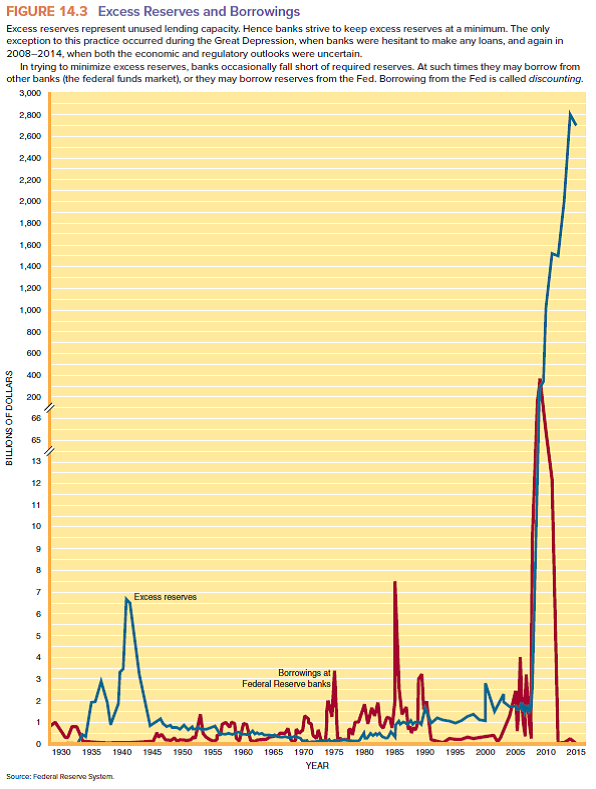
Why do banks want to maintain as little excess reserves as possible? Under what circumstances might banks desire to hold excess reserves? ( Hint: See Figure 14.3.)
سؤال
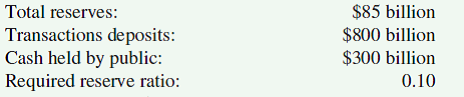
Assume that the following data describe the condition of the commercial banking system:
( a ) How large is the money supply (M1)?
( b ) Are the banks fully utilizing their lending capacity? Now assume that the public transfers $20 billion in cash into transactions accounts.
( c ) What would happen to the money supply initially (before any lending takes place)?
( d ) How much would the total lending capacity of the banking system be after this portfolio switch?
( e ) How large would the money supply be if the banks fully utilized their lending capacity?
( f ) What three steps could the Fed take to offset this potential growth in M1?
( a ) How large is the money supply (M1)?
( b ) Are the banks fully utilizing their lending capacity? Now assume that the public transfers $20 billion in cash into transactions accounts.
( c ) What would happen to the money supply initially (before any lending takes place)?
( d ) How much would the total lending capacity of the banking system be after this portfolio switch?
( e ) How large would the money supply be if the banks fully utilized their lending capacity?
( f ) What three steps could the Fed take to offset this potential growth in M1?
سؤال
سؤال
سؤال
سؤال
سؤال
سؤال
سؤال
سؤال
سؤال
Which aggregate supply curve in Figure 14.6 does the Fed chair fear the most? Why?

سؤال
سؤال
سؤال
سؤال
سؤال

فتح الحزمة
قم بالتسجيل لفتح البطاقات في هذه المجموعة!
Unlock Deck
Unlock Deck
1/17

العب

ملء الشاشة (f)
Deck 14: Monetary Policy
1
Suppose the following data apply:
( a ) How large is the money supply (M1)?
( b ) How much excess reserves are there?
( c ) What is the money multiplier?
( d ) What is the available lending capacity?
( a ) How large is the money supply (M1)?
( b ) How much excess reserves are there?
( c ) What is the money multiplier?
( d ) What is the available lending capacity?
(a) Calculate money supply (M1) -  The Money supply (M1) is $900 billion.
(b) Total reserves = $36 billion
Required reserve ratio = 0.05
Transaction deposits = $600 billion
Calculate required reserves - The required reserves are $30 billion.
Calculate Excess reserves - The excess reserves are $6 billion.
(c) Calculate Money Multiplier - The Money multiplier is 20.
(d) Available lending capacity of banking system is equal to excess reserves it held.
In given case, banking system holds $6 billion as excess reserves.
So, the available lending capacity is $6 billion.
The Money supply (M1) is $900 billion. (b) Total reserves = $36 billion
Required reserve ratio = 0.05
Transaction deposits = $600 billion
Calculate required reserves -
The required reserves are $30 billion.Calculate Excess reserves -
The excess reserves are $6 billion. (c) Calculate Money Multiplier -
The Money multiplier is 20. (d) Available lending capacity of banking system is equal to excess reserves it held.
In given case, banking system holds $6 billion as excess reserves.
So, the available lending capacity is $6 billion.
2
Why do banks want to maintain as little excess reserves as possible? Under what circumstances might banks desire to hold excess reserves? ( Hint: See Figure 14.3.)
Excess reserves determine the lending capacity of banks. It is through lending activity that banks earn majority of their income.
Thus, banks always want to lend more and more, so that, they can maximize their income.
Since, excess reserves determine the lending capacity of banks; they want to keep as little excess reserves as possible so that more and more loans can be dispensed which in result will enable the banks to maximize their income.
Thus, being an income-earning resource, banks want to utilize more and more of excess reserves for lending purpose rather than keeping them at bank itself.
When economic situation within country is not conducive and fear of loan default is on higher side that banks might desire to hold excess reserves rather than utilizing them for lending.
This is because adverse economic scenario can lead to loan default or loans becoming non-performing assets. In such situation, instead of earning income, bank can lose their income earning assets as whole which can severely reduce the profitability of banks not only in present but in future time period as well.
Thus, banks always want to lend more and more, so that, they can maximize their income.
Since, excess reserves determine the lending capacity of banks; they want to keep as little excess reserves as possible so that more and more loans can be dispensed which in result will enable the banks to maximize their income.
Thus, being an income-earning resource, banks want to utilize more and more of excess reserves for lending purpose rather than keeping them at bank itself.
When economic situation within country is not conducive and fear of loan default is on higher side that banks might desire to hold excess reserves rather than utilizing them for lending.
This is because adverse economic scenario can lead to loan default or loans becoming non-performing assets. In such situation, instead of earning income, bank can lose their income earning assets as whole which can severely reduce the profitability of banks not only in present but in future time period as well.
3
Assume that the following data describe the condition of the commercial banking system:
( a ) How large is the money supply (M1)?
( b ) Are the banks fully utilizing their lending capacity? Now assume that the public transfers $20 billion in cash into transactions accounts.
( c ) What would happen to the money supply initially (before any lending takes place)?
( d ) How much would the total lending capacity of the banking system be after this portfolio switch?
( e ) How large would the money supply be if the banks fully utilized their lending capacity?
( f ) What three steps could the Fed take to offset this potential growth in M1?
( a ) How large is the money supply (M1)?
( b ) Are the banks fully utilizing their lending capacity? Now assume that the public transfers $20 billion in cash into transactions accounts.
( c ) What would happen to the money supply initially (before any lending takes place)?
( d ) How much would the total lending capacity of the banking system be after this portfolio switch?
( e ) How large would the money supply be if the banks fully utilized their lending capacity?
( f ) What three steps could the Fed take to offset this potential growth in M1?
(a) M1 measure of money supply includes currency in circulation, transaction deposits, and traveler's checks.
Calculate money supply (M1) - The Money supply (M1) is $900 billion.
(b) Total reserves = $85 billion
Required reserve ratio = 0.10
Transaction deposits = $800 billion
Calculate required reserves - The required reserves are $80 billion.
Calculate Excess reserves - Banks are said to be fully utilizing their lending capacity when excess reserves with banks are zero. However, in given case, banks have excess reserves of $5 billion.
So, banks are not fully utilizing their lending capacity.
(c) Both currency in circulation (cash held by public) and transaction deposits are part of M1.
When public transfers $20 billion in cash into transactions account, one component of M1 (cash held by public) is decreasing while another component of M1 (transaction deposits) is increasing and that also by same amount.
When one component of a total increases and another decreases and that also by same amount, total remain unchanged.
So, initially (before any lending takes place), money supply will remain unchanged. (d) New transaction deposits = $20 billion
Required reserve ratio = 0.10
Calculate required reserves with respect to new deposits - The required reserves with respect to new deposits are $2 billion.
Calculate Excess reserves created by new deposits - Calculate Total excess reserves with banking system after portfolio switch -
  The total excess reserves with banking system after portfolio switch are $23 billion.
Quantum of excess reserves determines the lending capacity of banking system.
Banks have excess reserves of $23 billion after portfolio switch.
Thus, the total lending capacity of the banking system is $23 billion after this portfolio switch.
(e) When banks make a loan they do not pay cash but opens a transaction deposit in name of borrower with the amount of loan. Borrower can withdraw money (amount of loan) from this account as and when he needs money.
In the given case, total lending capacity of the banking system is $23 billion. If banks fully utilize their lending capacity then they will dispense the loan amounting $23 billion.
This lending of $23 billion will create transaction deposits of $23 billion.
Transaction deposits are counted as part of money supply. So, this increase in transaction deposits will increase the money supply by $23 billion.
Thus, total money supply would be ($1,100 billion+$23 billion) $1,123 billion.
(f) Three steps that the Fed could take to offset this potential growth in M1 -
1. Fed can raise the reserve requirement.
2. Fed can raise the discount rate.
3. Fed can undertake the open market sale of government securities.
Calculate money supply (M1) -
The Money supply (M1) is $900 billion. (b) Total reserves = $85 billion
Required reserve ratio = 0.10
Transaction deposits = $800 billion
Calculate required reserves -
The required reserves are $80 billion.Calculate Excess reserves -
Banks are said to be fully utilizing their lending capacity when excess reserves with banks are zero. However, in given case, banks have excess reserves of $5 billion.So, banks are not fully utilizing their lending capacity.
(c) Both currency in circulation (cash held by public) and transaction deposits are part of M1.
When public transfers $20 billion in cash into transactions account, one component of M1 (cash held by public) is decreasing while another component of M1 (transaction deposits) is increasing and that also by same amount.
When one component of a total increases and another decreases and that also by same amount, total remain unchanged.
So, initially (before any lending takes place), money supply will remain unchanged. (d) New transaction deposits = $20 billion
Required reserve ratio = 0.10
Calculate required reserves with respect to new deposits -
The required reserves with respect to new deposits are $2 billion.Calculate Excess reserves created by new deposits -
Calculate Total excess reserves with banking system after portfolio switch - The total excess reserves with banking system after portfolio switch are $23 billion.Quantum of excess reserves determines the lending capacity of banking system.
Banks have excess reserves of $23 billion after portfolio switch.
Thus, the total lending capacity of the banking system is $23 billion after this portfolio switch.
(e) When banks make a loan they do not pay cash but opens a transaction deposit in name of borrower with the amount of loan. Borrower can withdraw money (amount of loan) from this account as and when he needs money.
In the given case, total lending capacity of the banking system is $23 billion. If banks fully utilize their lending capacity then they will dispense the loan amounting $23 billion.
This lending of $23 billion will create transaction deposits of $23 billion.
Transaction deposits are counted as part of money supply. So, this increase in transaction deposits will increase the money supply by $23 billion.
Thus, total money supply would be ($1,100 billion+$23 billion) $1,123 billion.
(f) Three steps that the Fed could take to offset this potential growth in M1 -
1. Fed can raise the reserve requirement.
2. Fed can raise the discount rate.
3. Fed can undertake the open market sale of government securities.
4
Why do people hold bonds rather than larger savings account or checking account balances? Under what circumstances might they change their portfolios, moving their funds out of bonds and into bank accounts?
فتح الحزمة
افتح القفل للوصول البطاقات البالغ عددها 17 في هذه المجموعة.
فتح الحزمة
k this deck
5
Suppose the Federal Reserve decided to purchase $30 billion worth of government securities in the open market.
( a ) By how much will M1 change initially if the entire $30 billion is deposited into transaction accounts?
( b ) How will the lending capacity of the banking system be affected if the reserve requirement is 10 percent?
( c ) How will banks induce investors to utilize this expanded lending capacity?
( a ) By how much will M1 change initially if the entire $30 billion is deposited into transaction accounts?
( b ) How will the lending capacity of the banking system be affected if the reserve requirement is 10 percent?
( c ) How will banks induce investors to utilize this expanded lending capacity?
فتح الحزمة
افتح القفل للوصول البطاقات البالغ عددها 17 في هذه المجموعة.
فتح الحزمة
k this deck
6
If the Federal Reserve banks mailed everyone a brandnew $100 bill, what would happen to prices, output, and income? Illustrate with aggregate demand and supply curves.
فتح الحزمة
افتح القفل للوصول البطاقات البالغ عددها 17 في هذه المجموعة.
فتح الحزمة
k this deck
7
Suppose the economy is initially in equilibrium at an output level of 100 and a price level of 100. The Fed then manages to shift aggregate demand rightward by 20.
( a ) Illustrate the initial equilibrium ( E 1) and the shift of AD.
( b ) Show what happens to output and prices if the aggregate supply curve is (i) horizontal, (ii) vertical, and (iii) upward-sloping.
( a ) Illustrate the initial equilibrium ( E 1) and the shift of AD.
( b ) Show what happens to output and prices if the aggregate supply curve is (i) horizontal, (ii) vertical, and (iii) upward-sloping.
فتح الحزمة
افتح القفل للوصول البطاقات البالغ عددها 17 في هذه المجموعة.
فتح الحزمة
k this deck
8
How does an increase in the money supply get into the hands of consumers? What do they do with it?
فتح الحزمة
افتح القفل للوصول البطاقات البالغ عددها 17 في هذه المجموعة.
فتح الحزمة
k this deck
9
What was the money multiplier in China
( a ) Before the change in reserve requirements?
( b ) After the change in reserve requirements? (See the News Wire "Reserve Requirements.")
( a ) Before the change in reserve requirements?
( b ) After the change in reserve requirements? (See the News Wire "Reserve Requirements.")
فتح الحزمة
افتح القفل للوصول البطاقات البالغ عددها 17 في هذه المجموعة.
فتح الحزمة
k this deck
10
Is a reduction in interest rates likely to affect spending on pizza? What kinds of spending are sensitive to interest rate fluctuations?
فتح الحزمة
افتح القفل للوصول البطاقات البالغ عددها 17 في هذه المجموعة.
فتح الحزمة
k this deck
11
According to the News Wire "Reserve Requirements,"
( a ) By how much did excess reserves in China increase (in yuan)?
( b ) By how much did the lending capacity of Chinese banks increase as a result?
( a ) By how much did excess reserves in China increase (in yuan)?
( b ) By how much did the lending capacity of Chinese banks increase as a result?
فتح الحزمة
افتح القفل للوصول البطاقات البالغ عددها 17 في هذه المجموعة.
فتح الحزمة
k this deck
12
Which aggregate supply curve in Figure 14.6 does the Fed chair fear the most? Why?
فتح الحزمة
افتح القفل للوصول البطاقات البالغ عددها 17 في هذه المجموعة.
فتح الحزمة
k this deck
13
If every one-point change in the federal funds rate alters aggregate demand by $200 billion, how far did AD shift in response to the News Wire "Discount Rates"?
فتح الحزمة
افتح القفل للوصول البطاقات البالغ عددها 17 في هذه المجموعة.
فتح الحزمة
k this deck
14
Would you advocate monetary restraint or stimulus for today's economy? Who would disagree with you?
فتح الحزمة
افتح القفل للوصول البطاقات البالغ عددها 17 في هذه المجموعة.
فتح الحزمة
k this deck
15
POLICY PERSPECTIVES From June 2008 to June 2009, M1 increased from $1,400 billion to $1,656 billion.
( a ) By what percentage did M1 increase?
( b ) If the Fed had used a fixed rule of 3 percent growth of M1, how large would M1 have been in 2009?
( a ) By what percentage did M1 increase?
( b ) If the Fed had used a fixed rule of 3 percent growth of M1, how large would M1 have been in 2009?
فتح الحزمة
افتح القفل للوصول البطاقات البالغ عددها 17 في هذه المجموعة.
فتح الحزمة
k this deck
16
POLICY PERSPECTIVES Like all human institutions, the Fed makes occasional errors in altering the money supply. Would a constant (fixed) rate of money supply growth eliminate errors?
فتح الحزمة
افتح القفل للوصول البطاقات البالغ عددها 17 في هذه المجموعة.
فتح الحزمة
k this deck
17
POLICY PERSPECTIVES Congress sometimes demands more control of monetary policy. Is this a good idea? Why is fiscal policy, but not monetary policy, entrusted to elected politicians?
فتح الحزمة
افتح القفل للوصول البطاقات البالغ عددها 17 في هذه المجموعة.
فتح الحزمة
k this deck
فتح الحزمة
افتح القفل للوصول البطاقات البالغ عددها 17 في هذه المجموعة.






