







 تكلم مع الذكاء الاصطناعي


Deck 6: The Economics of Education: Crisis and Reform
ملء الشاشة (f)

سؤال

سؤال
سؤال
سؤال
سؤال
سؤال
سؤال
سؤال
سؤال
سؤال
سؤال
سؤال
سؤال
سؤال
سؤال

فتح الحزمة
قم بالتسجيل لفتح البطاقات في هذه المجموعة!
Unlock Deck
Unlock Deck
1/15

العب

ملء الشاشة (f)
Deck 6: The Economics of Education: Crisis and Reform
1
Drawing on the data presented in this chapter, discuss the crisis in K-12.
When compared to other countries, the United States seems to be averagely performing in the realm of K-12 education. While this might not seem like a huge problem in and of itself, it cannot be ignored that the United States spends more money per student than any other country. Education in the United States is , in fact, one of its most expensive endeavors.
The crisis perception comes into play when one recognizes that the money spent on education is not providing the optimal results to fully justify the level of spending. This also reflects that it may take more than simply throwing money at educational reform in order to bring it about.
The crisis perception comes into play when one recognizes that the money spent on education is not providing the optimal results to fully justify the level of spending. This also reflects that it may take more than simply throwing money at educational reform in order to bring it about.
2
Show graphically and explain how a purely private market for K-12 might work. How responsive would such a system be?
Currently, public education is a public service which everyone has the ability to benefit from without the factors of privacy or exclusivity built into it. However, if education were a private market, it would be treated more like an exclusive privilege than a valuable commodity.
Functioning as a private market, education would lend itself to be treated like any other private or semiprivate good or service. It would only be sought after during periods when its benefits were felt the most, in this case, during the early stages of learning. Once the basic skills were learned, however, demand for education would decrease as it would become more and more focused on specific concentrations.
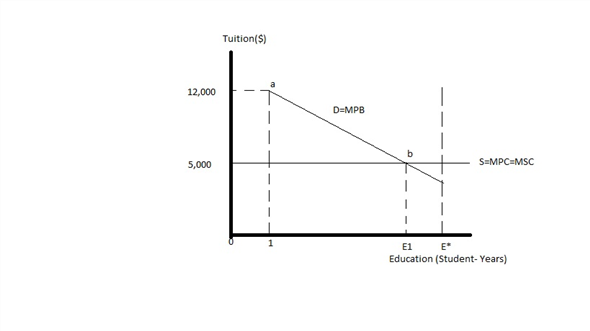
Functioning as a private market, education would lend itself to be treated like any other private or semiprivate good or service. It would only be sought after during periods when its benefits were felt the most, in this case, during the early stages of learning. Once the basic skills were learned, however, demand for education would decrease as it would become more and more focused on specific concentrations.
3
Relying on the concepts of marginal private and social benefits, explain why a purely private system of K-12 might not lead to enrollment levels that maximize social well-being.
In the United States, K-12 education is offered as a public resource without the restrictions of privacy or rivalry. As such, it allows students to learn as much as they can about the world around them and enables them to decide the career or future that they desire for themselves. Because those who are successful in their educational endeavors are more likely to continue their education through college or career training and contribute their skills to society, education contributes highly to the overall marginal social benefit. Additionally, it increases work force for various companies and firms, thus increasing their marginal private benefits.
Making education a private system that extracted payments from students or their parents would cause most families to not enroll their children after a certain grade level. This would reduce the number of skilled workers in society and cause a reduction in marginal social benefit. Marginal private benefit would fluctuate as there would be fewer candidates to choose from the work force. However, as these candidates would probably benefit from smaller class sizes and more time with their instructors, they would likely be more highly skilled and sought after. Their high level of skill would ultimately result in higher private benefits for the firms.
Making education a private system that extracted payments from students or their parents would cause most families to not enroll their children after a certain grade level. This would reduce the number of skilled workers in society and cause a reduction in marginal social benefit. Marginal private benefit would fluctuate as there would be fewer candidates to choose from the work force. However, as these candidates would probably benefit from smaller class sizes and more time with their instructors, they would likely be more highly skilled and sought after. Their high level of skill would ultimately result in higher private benefits for the firms.
4
List and briefly explain any externalities in consumption that you think exist for K-12.
فتح الحزمة
افتح القفل للوصول البطاقات البالغ عددها 15 في هذه المجموعة.
فتح الحزمة
k this deck
5
How does the existence of externalities in consumption arising from K-12 influence the question of who should pay for schooling?
فتح الحزمة
افتح القفل للوصول البطاقات البالغ عددها 15 في هذه المجموعة.
فتح الحزمة
k this deck
6
How might tuition subsidies be used to cause a purely private system of K-12 to produce the socially optimal enrollment level?
فتح الحزمة
افتح القفل للوصول البطاقات البالغ عددها 15 في هذه المجموعة.
فتح الحزمة
k this deck
7
Explain the arguments in favor of a voucher program. Now explain the arguments against such a program. What evidence is there in support of each view?
فتح الحزمة
افتح القفل للوصول البطاقات البالغ عددها 15 في هذه المجموعة.
فتح الحزمة
k this deck
8
Discuss: "Class size matters little to student achievement."
فتح الحزمة
افتح القفل للوصول البطاقات البالغ عددها 15 في هذه المجموعة.
فتح الحزمة
k this deck
9
Discuss: "Because of the extensive externalities arising from K-12, government production of K-12 is economically called for."
فتح الحزمة
افتح القفل للوصول البطاقات البالغ عددها 15 في هذه المجموعة.
فتح الحزمة
k this deck
10
What role, if any, do you think teacher pay might play in an effective reform of K-12?
فتح الحزمة
افتح القفل للوصول البطاقات البالغ عددها 15 في هذه المجموعة.
فتح الحزمة
k this deck
11
Suppose the legislature of the state that you live in decides to invest an additional $100 million in K-12 education in hopes of improving student performance. Which of the following ways of spending the money would you expect to be most successful:
a. Dividing the money equally among the schools in the state to increase teacher salaries.
b. Dividing the money equally among the schools in the state to reduce class sizes in all grades.
c. Dividing the money equally among the schools in the state to reduce class sizes in the lower grades.
d. Using the money to reduce class sizes in the lower grades and giving a disproportionate share to schools in the state's poorer areas.
a. Dividing the money equally among the schools in the state to increase teacher salaries.
b. Dividing the money equally among the schools in the state to reduce class sizes in all grades.
c. Dividing the money equally among the schools in the state to reduce class sizes in the lower grades.
d. Using the money to reduce class sizes in the lower grades and giving a disproportionate share to schools in the state's poorer areas.
فتح الحزمة
افتح القفل للوصول البطاقات البالغ عددها 15 في هذه المجموعة.
فتح الحزمة
k this deck
12
The existence of positive externalities in consumption from K-12 education leads one to conclude that public subsidies of K-12 may be economically appropriate. If this is correct, are such subsidies as defensible for private as for public schools?
فتح الحزمة
افتح القفل للوصول البطاقات البالغ عددها 15 في هذه المجموعة.
فتح الحزمة
k this deck
13
Discuss: "You cannot correct the problems of K-12 in the United States by simply 'throwing money' at the schools."
فتح الحزمة
افتح القفل للوصول البطاقات البالغ عددها 15 في هذه المجموعة.
فتح الحزمة
k this deck
14
If a state decides to significantly reduce class sizes and wants to maintain instructor qualifications, why will it likely be required to increase teacher salaries?
فتح الحزمة
افتح القفل للوصول البطاقات البالغ عددها 15 في هذه المجموعة.
فتح الحزمة
k this deck
15
Relying on the National Assessment of Educational Progress report titled "Comparing Private Schools and Public Schools Using Hierarchical Linear Modeling," what can be said about the relative effectiveness of public and private schools in terms of student learning?
فتح الحزمة
افتح القفل للوصول البطاقات البالغ عددها 15 في هذه المجموعة.
فتح الحزمة
k this deck
فتح الحزمة
افتح القفل للوصول البطاقات البالغ عددها 15 في هذه المجموعة.






