







 تكلم مع الذكاء الاصطناعي


Deck 10: The Deaths of Stars
ملء الشاشة (f)

سؤال

سؤال
سؤال
سؤال
سؤال
سؤال
سؤال
سؤال
سؤال
سؤال
سؤال
سؤال
In the diagram below, which point indicates the location on the H-R diagram of a one-solar-mass star when it undergoes helium flash? 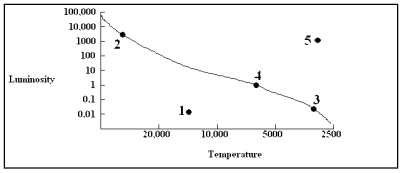
A) 1
B) 2
C) 3
D) 4
E) 5
A) 1
B) 2
C) 3
D) 4
E) 5
سؤال
سؤال
What is the approximate age of the star cluster in the H-R diagram below? Hint: Main-sequence stars of spectral types between A and B have core supplies of hydrogen sufficient to last about 250 million years, between A and F about 2 billion years, type G about 10 billion years, and between K and M about 30 billion years. 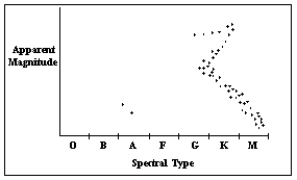
A) 200 million years
B) 2 billion years
C) 10 billion years
D) 30 billion years
E) The age of the cluster cannot be estimated from an H-R diagram of the cluster.
A) 200 million years
B) 2 billion years
C) 10 billion years
D) 30 billion years
E) The age of the cluster cannot be estimated from an H-R diagram of the cluster.
سؤال
سؤال
سؤال
سؤال
سؤال
سؤال
سؤال
سؤال
سؤال
About how long will a 0.5-  star spend on the main sequence?
A) 5 billion years
B) 57 billion years
C) 570 million years
D) 5 million years
E) 500 thousand years
star spend on the main sequence?A) 5 billion years
B) 57 billion years
C) 570 million years
D) 5 million years
E) 500 thousand years
سؤال
سؤال
سؤال
سؤال
سؤال
سؤال
سؤال
سؤال
سؤال
سؤال
سؤال
سؤال
The diagram below shows a light curve from a supernova. How many days after maximum light did it take for the supernova to decrease in brightness by a factor of 100? 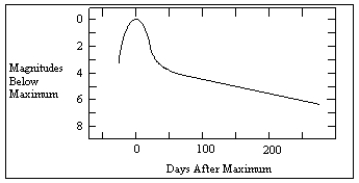
A) less than 50
B) 50
C) 150
D) 250
E) more than 250
A) less than 50
B) 50
C) 150
D) 250
E) more than 250
سؤال
سؤال
سؤال
Stars with masses between 0.4-  and 4-
A) undergo thermonuclear fusion of hydrogen and helium, but never get hot enough to ignite carbon.
B) undergo thermonuclear fusion of hydrogen, but never get hot enough to ignite helium.
C) produce type I supernovae after they exhaust their nuclear fuels.
D) produce type II supernovae after they exhaust their nuclear fuels.
E) undergo carbon detonation.
and 4- A) undergo thermonuclear fusion of hydrogen and helium, but never get hot enough to ignite carbon.
B) undergo thermonuclear fusion of hydrogen, but never get hot enough to ignite helium.
C) produce type I supernovae after they exhaust their nuclear fuels.
D) produce type II supernovae after they exhaust their nuclear fuels.
E) undergo carbon detonation.
سؤال
سؤال
سؤال
سؤال
سؤال
سؤال
سؤال
سؤال
سؤال
سؤال
سؤال
سؤال
سؤال
سؤال
سؤال
سؤال
سؤال
سؤال
سؤال
The figure shows an HST image of the red giant star, Betelgeuse. In the red giant stage, hydrogen is being fused to helium 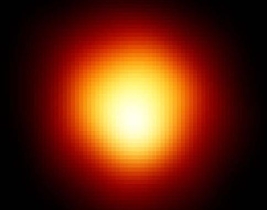
A) on the surface of the star.
B) in the center of the star's helium core.
C) on the outside of the star's helium core.
D) Neither helium nor hydrogen is being fused in the red giant stage.
A) on the surface of the star.
B) in the center of the star's helium core.
C) on the outside of the star's helium core.
D) Neither helium nor hydrogen is being fused in the red giant stage.
سؤال
سؤال
سؤال
سؤال
سؤال
سؤال
سؤال
سؤال
سؤال
سؤال
سؤال
سؤال
سؤال
سؤال
The image shows the Crab Nebula. The Crab Nebula is 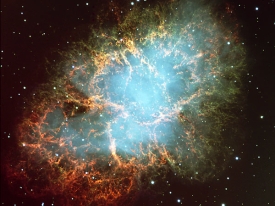
A) a planetary nebula.
B) a name for the cloud of gas and dust which later became our solar system.
C) an ejected cloud of gas from a supernova.
D) in the constellation Orion, containing many bright young blue stars.
A) a planetary nebula.
B) a name for the cloud of gas and dust which later became our solar system.
C) an ejected cloud of gas from a supernova.
D) in the constellation Orion, containing many bright young blue stars.
سؤال
سؤال
سؤال
سؤال
سؤال
سؤال
سؤال
سؤال
سؤال

فتح الحزمة
قم بالتسجيل لفتح البطاقات في هذه المجموعة!
Unlock Deck
Unlock Deck
1/115

العب

ملء الشاشة (f)
Deck 10: The Deaths of Stars
1
Giant and supergiant stars are rare because
A) they do not form as often as main-sequence stars.
B) the star blows up before the giant or supergiant stage is reached
C) the giant or supergiant stage is very short.
D) the giant or supergiant stage is very long
A) they do not form as often as main-sequence stars.
B) the star blows up before the giant or supergiant stage is reached
C) the giant or supergiant stage is very short.
D) the giant or supergiant stage is very long
the giant or supergiant stage is very short.
2
If the stars at the turnoff point of a cluster have a mass of 3M, what is the age of the cluster?
A) 3.0*1010 years
B) 3.3*109 years
C) 6.4*108 years
D) 1.6*1011 years
E) The age of a star cluster cannot be determined from the mass of stars at the turnoff point.
A) 3.0*1010 years
B) 3.3*109 years
C) 6.4*108 years
D) 1.6*1011 years
E) The age of a star cluster cannot be determined from the mass of stars at the turnoff point.
6.4*108 years
3
Stars within a cluster that are at the turnoff point
A) have life expectancies that are equal to the age of the cluster.
B) are stars that are just becoming white dwarfs.
C) are stars that are just entering the main sequence portion of their evolution.
D) are stars that are about to supernova.
E) are stars that are generally spectral type G stars.
A) have life expectancies that are equal to the age of the cluster.
B) are stars that are just becoming white dwarfs.
C) are stars that are just entering the main sequence portion of their evolution.
D) are stars that are about to supernova.
E) are stars that are generally spectral type G stars.
have life expectancies that are equal to the age of the cluster.
4
A(n) ____ is a collection of 105 to 106 stars in a region 10 to 30 pc in diameter. The stars in the collection tend to be more than 109 years old and mostly yellow and red stars.
A) Herbig-Haro object
B) globular cluster
C) open cluster
D) giant cluster
E) supernova
A) Herbig-Haro object
B) globular cluster
C) open cluster
D) giant cluster
E) supernova
فتح الحزمة
افتح القفل للوصول البطاقات البالغ عددها 115 في هذه المجموعة.
فتح الحزمة
k this deck
5
Star clusters are important to our study of stars because
A) all stars formed in star clusters.
B) the sun was once a member of a globular cluster.
C) they give us a method to test the our theories and models of stellar evolution.
D) they are the only objects that contain Cepheid variables.
E) all of the above.
A) all stars formed in star clusters.
B) the sun was once a member of a globular cluster.
C) they give us a method to test the our theories and models of stellar evolution.
D) they are the only objects that contain Cepheid variables.
E) all of the above.
فتح الحزمة
افتح القفل للوصول البطاقات البالغ عددها 115 في هذه المجموعة.
فتح الحزمة
k this deck
6
Helium flash occurs
A) because helium is very explosive and cannot be controlled when the nuclear reactions occur.
B) because degenerate electrons in the core do not allow the core to expand as it heats up.
C) in Cepheid variables.
D) in stars with masses less than 0.4 M.
E) none of the above.
A) because helium is very explosive and cannot be controlled when the nuclear reactions occur.
B) because degenerate electrons in the core do not allow the core to expand as it heats up.
C) in Cepheid variables.
D) in stars with masses less than 0.4 M.
E) none of the above.
فتح الحزمة
افتح القفل للوصول البطاقات البالغ عددها 115 في هذه المجموعة.
فتح الحزمة
k this deck
7
The Crab nebula is
A) a planetary nebula.
B) a Bok globule.
C) an open cluster.
D) an absorption nebula.
E) a supernova remnant.
A) a planetary nebula.
B) a Bok globule.
C) an open cluster.
D) an absorption nebula.
E) a supernova remnant.
فتح الحزمة
افتح القفل للوصول البطاقات البالغ عددها 115 في هذه المجموعة.
فتح الحزمة
k this deck
8
Which of the following nuclear fuels does a one-solar-mass star use over the course of its entire evolution?
A) hydrogen
B) hydrogen and helium
C) hydrogen, helium and carbon
D) hydrogen, helium, carbon, and neon
E) hydrogen, helium, carbon, neon, and oxygen
A) hydrogen
B) hydrogen and helium
C) hydrogen, helium and carbon
D) hydrogen, helium, carbon, and neon
E) hydrogen, helium, carbon, neon, and oxygen
فتح الحزمة
افتح القفل للوصول البطاقات البالغ عددها 115 في هذه المجموعة.
فتح الحزمة
k this deck
9
As a main-sequence star exhausts hydrogen in its core, its surface becomes___ and its energy output per second (luminosity) becomes ____
A) hotter; larger
B) cooler; larger
C) hotter; smaller
D) cooler; smaller
A) hotter; larger
B) cooler; larger
C) hotter; smaller
D) cooler; smaller
فتح الحزمة
افتح القفل للوصول البطاقات البالغ عددها 115 في هذه المجموعة.
فتح الحزمة
k this deck
10
In star clusters, the ____ stars are giant stars fusing helium in their cores and then in their shells.
A) turnoff-point
B) main-sequence
C) turnon-point
D) hydrogen-flash
E) horizontal-branch
A) turnoff-point
B) main-sequence
C) turnon-point
D) hydrogen-flash
E) horizontal-branch
فتح الحزمة
افتح القفل للوصول البطاقات البالغ عددها 115 في هذه المجموعة.
فتح الحزمة
k this deck
11
A star will experience a helium flash if
A) it is less massive than about 3 solar masses.
B) it has become a red giant star.
C) it has formed a helium core.
D) the material in the core has gradually become degenerate.
E) All of the above must be true.
A) it is less massive than about 3 solar masses.
B) it has become a red giant star.
C) it has formed a helium core.
D) the material in the core has gradually become degenerate.
E) All of the above must be true.
فتح الحزمة
افتح القفل للوصول البطاقات البالغ عددها 115 في هذه المجموعة.
فتح الحزمة
k this deck
12
In the diagram below, which point indicates the location on the H-R diagram of a one-solar-mass star when it undergoes helium flash?
A) 1
B) 2
C) 3
D) 4
E) 5
A) 1
B) 2
C) 3
D) 4
E) 5
فتح الحزمة
افتح القفل للوصول البطاقات البالغ عددها 115 في هذه المجموعة.
فتح الحزمة
k this deck
13
In the orbital plane of a binary star system matter can be transferred from one star to the other at the ________, located directly between the two stars is the point where the Roche lobes meet.
A) turnoff points
B) horizontal branch
C) Lagrangian points
D) synchrotron points
E) radiation belts
A) turnoff points
B) horizontal branch
C) Lagrangian points
D) synchrotron points
E) radiation belts
فتح الحزمة
افتح القفل للوصول البطاقات البالغ عددها 115 في هذه المجموعة.
فتح الحزمة
k this deck
14
What is the approximate age of the star cluster in the H-R diagram below? Hint: Main-sequence stars of spectral types between A and B have core supplies of hydrogen sufficient to last about 250 million years, between A and F about 2 billion years, type G about 10 billion years, and between K and M about 30 billion years.
A) 200 million years
B) 2 billion years
C) 10 billion years
D) 30 billion years
E) The age of the cluster cannot be estimated from an H-R diagram of the cluster.
A) 200 million years
B) 2 billion years
C) 10 billion years
D) 30 billion years
E) The age of the cluster cannot be estimated from an H-R diagram of the cluster.
فتح الحزمة
افتح القفل للوصول البطاقات البالغ عددها 115 في هذه المجموعة.
فتح الحزمة
k this deck
15
A mass is transferred in a normal star in a binary system toward a white dwarf, the material forms a rapidly growing whirlpool of material known as a(n)
A) accretion disk.
B) Lagrangian point.
C) Algol paradox.
D) planetary nebula.
E) supernova remnant.
A) accretion disk.
B) Lagrangian point.
C) Algol paradox.
D) planetary nebula.
E) supernova remnant.
فتح الحزمة
افتح القفل للوصول البطاقات البالغ عددها 115 في هذه المجموعة.
فتح الحزمة
k this deck
16
As a main-sequence star exhausts hydrogen in its core, it next becomes
A) a protostar.
B) a red giant star.
C) a white dwarf star.
A) a protostar.
B) a red giant star.
C) a white dwarf star.
فتح الحزمة
افتح القفل للوصول البطاقات البالغ عددها 115 في هذه المجموعة.
فتح الحزمة
k this deck
17
____ is a form of electromagnetic radiation produced by rapidly moving electrons spiraling through magnetic fields.
A) Lagrangian radiation
B) Accretion
C) Ultraviolet radiation
D) Synchrotron radiation
E) Infrared radiation
A) Lagrangian radiation
B) Accretion
C) Ultraviolet radiation
D) Synchrotron radiation
E) Infrared radiation
فتح الحزمة
افتح القفل للوصول البطاقات البالغ عددها 115 في هذه المجموعة.
فتح الحزمة
k this deck
18
Stars in a star cluster
A) all have the same age.
B) all have the same chemical composition.
C) all have the same luminosity.
D) all of the above.
E) a and b above.
A) all have the same age.
B) all have the same chemical composition.
C) all have the same luminosity.
D) all of the above.
E) a and b above.
فتح الحزمة
افتح القفل للوصول البطاقات البالغ عددها 115 في هذه المجموعة.
فتح الحزمة
k this deck
19
A(n) ____ is a collection of 100 to 1000 stars in a region about 25 pc in diameter. The stars in the collection are typically quite young.
A) Herbig-Haro object
B) globular cluster
C) open cluster
D) giant cluster
E) supernova
A) Herbig-Haro object
B) globular cluster
C) open cluster
D) giant cluster
E) supernova
فتح الحزمة
افتح القفل للوصول البطاقات البالغ عددها 115 في هذه المجموعة.
فتح الحزمة
k this deck
20
The triple-alpha process
A) controls the pulsations in Cepheid variable stars.
B) is the nuclear fusion of hydrogen to helium in massive stars.
C) is the process that produces the neutrinos we receive from the sun.
D) requires a temperature of about 5,000,000 K to operate.
E) occurs during helium flash.
A) controls the pulsations in Cepheid variable stars.
B) is the nuclear fusion of hydrogen to helium in massive stars.
C) is the process that produces the neutrinos we receive from the sun.
D) requires a temperature of about 5,000,000 K to operate.
E) occurs during helium flash.
فتح الحزمة
افتح القفل للوصول البطاقات البالغ عددها 115 في هذه المجموعة.
فتح الحزمة
k this deck
21
If the theory that novae occur in close binary systems is correct, then novae should
A) produce synchrotron radiation.
B) occur in regions of star formation.
C) not occur in old star clusters.
D) all be visual binaries.
E) repeat after some interval.
A) produce synchrotron radiation.
B) occur in regions of star formation.
C) not occur in old star clusters.
D) all be visual binaries.
E) repeat after some interval.
فتح الحزمة
افتح القفل للوصول البطاقات البالغ عددها 115 في هذه المجموعة.
فتح الحزمة
k this deck
22
The lowest-mass stars cannot become giants because
A) they do not contain helium.
B) they rotate too slowly.
C) they cannot heat their centers hot enough.
D) they contain strong magnetic fields.
E) they never use up their hydrogen.
A) they do not contain helium.
B) they rotate too slowly.
C) they cannot heat their centers hot enough.
D) they contain strong magnetic fields.
E) they never use up their hydrogen.
فتح الحزمة
افتح القفل للوصول البطاقات البالغ عددها 115 في هذه المجموعة.
فتح الحزمة
k this deck
23
About how long will a 0.5- star spend on the main sequence?
A) 5 billion years
B) 57 billion years
C) 570 million years
D) 5 million years
E) 500 thousand years
star spend on the main sequence?A) 5 billion years
B) 57 billion years
C) 570 million years
D) 5 million years
E) 500 thousand years
فتح الحزمة
افتح القفل للوصول البطاقات البالغ عددها 115 في هذه المجموعة.
فتح الحزمة
k this deck
24
What are the two longest stages in the life of a one-solar-mass star?
A) Protostar, pre-main-sequence
B) Protostar, white dwarf
C) Protostar, main-sequence
D) Main-sequence, white dwarf
A) Protostar, pre-main-sequence
B) Protostar, white dwarf
C) Protostar, main-sequence
D) Main-sequence, white dwarf
فتح الحزمة
افتح القفل للوصول البطاقات البالغ عددها 115 في هذه المجموعة.
فتح الحزمة
k this deck
25
A nova is almost always associated with
A) a very massive star.
B) a very young star.
C) a star undergoing helium flash.
D) a white dwarf in a close binary system.
E) a solar-like star that has exhausted its hydrogen and helium.
A) a very massive star.
B) a very young star.
C) a star undergoing helium flash.
D) a white dwarf in a close binary system.
E) a solar-like star that has exhausted its hydrogen and helium.
فتح الحزمة
افتح القفل للوصول البطاقات البالغ عددها 115 في هذه المجموعة.
فتح الحزمة
k this deck
26
What nuclear fusion mechanism does an isolated white dwarf use to generate energy?
A) proton-proton chain
B) CNO cycle
C) triple alpha process
D) white dwarfs don't generate their own energy.
A) proton-proton chain
B) CNO cycle
C) triple alpha process
D) white dwarfs don't generate their own energy.
فتح الحزمة
افتح القفل للوصول البطاقات البالغ عددها 115 في هذه المجموعة.
فتح الحزمة
k this deck
27
A white dwarf is composed of
A) hydrogen nuclei and degenerate electrons.
B) helium nuclei and normal electrons.
C) carbon and oxygen nuclei and degenerate electrons.
D) degenerate iron nuclei.
E) a helium burning core and a hydrogen burning shell.
A) hydrogen nuclei and degenerate electrons.
B) helium nuclei and normal electrons.
C) carbon and oxygen nuclei and degenerate electrons.
D) degenerate iron nuclei.
E) a helium burning core and a hydrogen burning shell.
فتح الحزمة
افتح القفل للوصول البطاقات البالغ عددها 115 في هذه المجموعة.
فتح الحزمة
k this deck
28
A planetary nebula is
A) the expelled outer envelope of a medium-mass star.
B) produced by a supernova explosion.
C) produced by a nova explosion.
D) a nebula within which planets are forming.
E) a cloud of hot gas surrounding a planet.
A) the expelled outer envelope of a medium-mass star.
B) produced by a supernova explosion.
C) produced by a nova explosion.
D) a nebula within which planets are forming.
E) a cloud of hot gas surrounding a planet.
فتح الحزمة
افتح القفل للوصول البطاقات البالغ عددها 115 في هذه المجموعة.
فتح الحزمة
k this deck
29
A planetary nebula has a radius of 0.5 pc and is expanding at 20 km/s. What is the approximate age of this planetary nebula? (1 pc is equal to 3*1013 km and 1 year is equal to 3.15*107 seconds.)
A) 240 years
B) 790,000 years
C) 96,000 years
D) 960 years
E) 24,000 years
A) 240 years
B) 790,000 years
C) 96,000 years
D) 960 years
E) 24,000 years
فتح الحزمة
افتح القفل للوصول البطاقات البالغ عددها 115 في هذه المجموعة.
فتح الحزمة
k this deck
30
The Chandrasekhar limit tells us that
A) accretion disks can grow hot through friction.
B) neutron stars of more than 3 solar masses are not stable.
C) white dwarfs more massive than 1.4 solar masses are not stable.
D) stars cannot travel through space too fast.
E) stars with a mass less than 0.5 solar masses will not go through helium flash.
A) accretion disks can grow hot through friction.
B) neutron stars of more than 3 solar masses are not stable.
C) white dwarfs more massive than 1.4 solar masses are not stable.
D) stars cannot travel through space too fast.
E) stars with a mass less than 0.5 solar masses will not go through helium flash.
فتح الحزمة
افتح القفل للوصول البطاقات البالغ عددها 115 في هذه المجموعة.
فتح الحزمة
k this deck
31
As a white dwarf cools its radius will not change because
A) pressure due to nuclear reactions in a shell just below the surface keeps it from collapsing.
B) pressure does not depend on temperature for a white dwarf because the electrons are degenerate.
C) pressure does not depend on temperature because the white dwarf is too hot.
D) pressure does not depend on temperature because the star has exhausted all its nuclear fuels.
E) material accreting onto it from a companion maintains a constant radius.
A) pressure due to nuclear reactions in a shell just below the surface keeps it from collapsing.
B) pressure does not depend on temperature for a white dwarf because the electrons are degenerate.
C) pressure does not depend on temperature because the white dwarf is too hot.
D) pressure does not depend on temperature because the star has exhausted all its nuclear fuels.
E) material accreting onto it from a companion maintains a constant radius.
فتح الحزمة
افتح القفل للوصول البطاقات البالغ عددها 115 في هذه المجموعة.
فتح الحزمة
k this deck
32
A Type I supernova is believed to occur when
A) the core of a massive star collapses.
B) hydrogen detonation occurs.
C) a white dwarf exceeds the Chandrasekhar limit.
D) the cores of massive stars collapse.
E) neutrinos in a massive star become degenerate and form a shock wave that explodes the star.
A) the core of a massive star collapses.
B) hydrogen detonation occurs.
C) a white dwarf exceeds the Chandrasekhar limit.
D) the cores of massive stars collapse.
E) neutrinos in a massive star become degenerate and form a shock wave that explodes the star.
فتح الحزمة
افتح القفل للوصول البطاقات البالغ عددها 115 في هذه المجموعة.
فتح الحزمة
k this deck
33
The Algol paradox is explained by considering
A) the degenerate nature of the hydrogen on the surface of the white dwarf.
B) synchrotron radiation.
C) the rate of expansion of the shock wave inside the supernova.
D) the rotation rate of a neutron star.
E) mass transfer between the two stars in a binary system.
A) the degenerate nature of the hydrogen on the surface of the white dwarf.
B) synchrotron radiation.
C) the rate of expansion of the shock wave inside the supernova.
D) the rotation rate of a neutron star.
E) mass transfer between the two stars in a binary system.
فتح الحزمة
افتح القفل للوصول البطاقات البالغ عددها 115 في هذه المجموعة.
فتح الحزمة
k this deck
34
A planetary nebula
A) produces an absorption spectrum.
B) produces an emission spectrum.
C) is contracting to form planets.
D) is contracting to form a star.
E) is the result of carbon detonation in a 1-star.
A) produces an absorption spectrum.
B) produces an emission spectrum.
C) is contracting to form planets.
D) is contracting to form a star.
E) is the result of carbon detonation in a 1-star.
فتح الحزمة
افتح القفل للوصول البطاقات البالغ عددها 115 في هذه المجموعة.
فتح الحزمة
k this deck
35
The diagram below shows a light curve from a supernova. How many days after maximum light did it take for the supernova to decrease in brightness by a factor of 100?
A) less than 50
B) 50
C) 150
D) 250
E) more than 250
A) less than 50
B) 50
C) 150
D) 250
E) more than 250
فتح الحزمة
افتح القفل للوصول البطاقات البالغ عددها 115 في هذه المجموعة.
فتح الحزمة
k this deck
36
Synchrotron radiation is produced
A) in planetary nebulae.
B) by red dwarfs.
C) in massive stars as their iron core collapses.
D) in supernova remnants.
E) by neutrinos.
A) in planetary nebulae.
B) by red dwarfs.
C) in massive stars as their iron core collapses.
D) in supernova remnants.
E) by neutrinos.
فتح الحزمة
افتح القفل للوصول البطاقات البالغ عددها 115 في هذه المجموعة.
فتح الحزمة
k this deck
37
For a star of sun-like mass, what is the last stage of the nuclear fusion?
A) Hydrogen to helium
B) Helium to carbon and oxygen
C) Carbon to magnesium
D) Fusion goes all the way up to iron.
A) Hydrogen to helium
B) Helium to carbon and oxygen
C) Carbon to magnesium
D) Fusion goes all the way up to iron.
فتح الحزمة
افتح القفل للوصول البطاقات البالغ عددها 115 في هذه المجموعة.
فتح الحزمة
k this deck
38
Stars with masses between 0.4- and 4-
A) undergo thermonuclear fusion of hydrogen and helium, but never get hot enough to ignite carbon.
B) undergo thermonuclear fusion of hydrogen, but never get hot enough to ignite helium.
C) produce type I supernovae after they exhaust their nuclear fuels.
D) produce type II supernovae after they exhaust their nuclear fuels.
E) undergo carbon detonation.
and 4- A) undergo thermonuclear fusion of hydrogen and helium, but never get hot enough to ignite carbon.
B) undergo thermonuclear fusion of hydrogen, but never get hot enough to ignite helium.
C) produce type I supernovae after they exhaust their nuclear fuels.
D) produce type II supernovae after they exhaust their nuclear fuels.
E) undergo carbon detonation.
فتح الحزمة
افتح القفل للوصول البطاقات البالغ عددها 115 في هذه المجموعة.
فتح الحزمة
k this deck
39
The theory that the collapse of a massive star's iron core produces neutrinos was supported by
A) the size and structure of the Crab nebula.
B) laboratory measurements of the mass of the neutrino.
C) the brightening of supernovae a few days after they are first visible.
D) underground counts from solar neutrinos.
E) the detection of neutrinos from the supernova of 1987.
A) the size and structure of the Crab nebula.
B) laboratory measurements of the mass of the neutrino.
C) the brightening of supernovae a few days after they are first visible.
D) underground counts from solar neutrinos.
E) the detection of neutrinos from the supernova of 1987.
فتح الحزمة
افتح القفل للوصول البطاقات البالغ عددها 115 في هذه المجموعة.
فتح الحزمة
k this deck
40
Synchrotron radiation is produced by
A) objects with temperature below 10,000 K.
B) high-velocity electrons moving through a magnetic field.
C) cold hydrogen atoms in space.
D) the collapsing cores of massive stars.
E) a helium flash.
A) objects with temperature below 10,000 K.
B) high-velocity electrons moving through a magnetic field.
C) cold hydrogen atoms in space.
D) the collapsing cores of massive stars.
E) a helium flash.
فتح الحزمة
افتح القفل للوصول البطاقات البالغ عددها 115 في هذه المجموعة.
فتح الحزمة
k this deck
41
After what evolutionary stage does a star become a white dwarf?
A) protostar
B) pre-main sequence
C) main sequence
D) giant
A) protostar
B) pre-main sequence
C) main sequence
D) giant
فتح الحزمة
افتح القفل للوصول البطاقات البالغ عددها 115 في هذه المجموعة.
فتح الحزمة
k this deck
42
We know that the central object in a planetary nebula has a surface temperature of at least ____ because the nebula contains large amounts of ionized hydrogen.
A) 50 K
B) 100 K
C) 500 K
D) 5,000 K
E) 25,000 K
A) 50 K
B) 100 K
C) 500 K
D) 5,000 K
E) 25,000 K
فتح الحزمة
افتح القفل للوصول البطاقات البالغ عددها 115 في هذه المجموعة.
فتح الحزمة
k this deck
43
As material leaves an expanding star and begins to fall into a white dwarf companion
A) an accretion disk will form around the white dwarf.
B) the material will cool off because it begins to move at high velocities.
C) the material will fall directly straight onto the surface of the white dwarf.
D) the white dwarf will produce a protostar.
E) the white dwarf's iron core will collapse.
A) an accretion disk will form around the white dwarf.
B) the material will cool off because it begins to move at high velocities.
C) the material will fall directly straight onto the surface of the white dwarf.
D) the white dwarf will produce a protostar.
E) the white dwarf's iron core will collapse.
فتح الحزمة
افتح القفل للوصول البطاقات البالغ عددها 115 في هذه المجموعة.
فتح الحزمة
k this deck
44
A young star cluster will have ____ than an older star cluster.
A) a redder turn-off point
B) a bluer turn-off point
C) fewer stars
D) fewer luminous stars
E) more low mass stars
A) a redder turn-off point
B) a bluer turn-off point
C) fewer stars
D) fewer luminous stars
E) more low mass stars
فتح الحزمة
افتح القفل للوصول البطاقات البالغ عددها 115 في هذه المجموعة.
فتح الحزمة
k this deck
45
Open clusters tend to be ____ than globular clusters.
A) younger and contain fewer stars
B) younger and contain more stars
C) older and contain fewer stars
D) older and contain more stars
E) more luminous and cooler
A) younger and contain fewer stars
B) younger and contain more stars
C) older and contain fewer stars
D) older and contain more stars
E) more luminous and cooler
فتح الحزمة
افتح القفل للوصول البطاقات البالغ عددها 115 في هذه المجموعة.
فتح الحزمة
k this deck
46
In A.D. 1054, Chinese astronomers observed the appearance of a new star, whose location is now occupied by
A) a globular cluster.
B) a planetary nebulae.
C) a white dwarf.
D) a young massive star.
E) a supernova remnant.
A) a globular cluster.
B) a planetary nebulae.
C) a white dwarf.
D) a young massive star.
E) a supernova remnant.
فتح الحزمة
افتح القفل للوصول البطاقات البالغ عددها 115 في هذه المجموعة.
فتح الحزمة
k this deck
47
Why do higher-mass stars live shorter lives on the main sequence than lower-mass stars?
A) Higher-mass stars burn through their nuclear fuel faster.
B) Lower-mass stars don't get their energy from that same nuclear fusion source as higher-mass stars.
C) Higher-mass stars have less hydrogen fuel to burn.
D) Lower-mass stars spend a longer time evolving to the main sequence.
E) All of the above are false.
A) Higher-mass stars burn through their nuclear fuel faster.
B) Lower-mass stars don't get their energy from that same nuclear fusion source as higher-mass stars.
C) Higher-mass stars have less hydrogen fuel to burn.
D) Lower-mass stars spend a longer time evolving to the main sequence.
E) All of the above are false.
فتح الحزمة
افتح القفل للوصول البطاقات البالغ عددها 115 في هذه المجموعة.
فتح الحزمة
k this deck
48
Helium fusion is called the triple-alpha process because
A) the helium nucleus is known as an alpha particle.
B) it occurs very rapidly.
C) it requires a temperature three times greater than that of hydrogen fusion.
D) it is the third source of the primary fusion processes.
E) each reaction produces three carbon nuclei.
A) the helium nucleus is known as an alpha particle.
B) it occurs very rapidly.
C) it requires a temperature three times greater than that of hydrogen fusion.
D) it is the third source of the primary fusion processes.
E) each reaction produces three carbon nuclei.
فتح الحزمة
افتح القفل للوصول البطاقات البالغ عددها 115 في هذه المجموعة.
فتح الحزمة
k this deck
49
Stars that have ejected a planetary nebula eventually become
A) protostars.
B) brown dwarfs.
C) white dwarfs.
D) red giants.
A) protostars.
B) brown dwarfs.
C) white dwarfs.
D) red giants.
فتح الحزمة
افتح القفل للوصول البطاقات البالغ عددها 115 في هذه المجموعة.
فتح الحزمة
k this deck
50
Which of the following nuclear fuels does a one-solar-mass star use over the course of its entire evolution?
A) hydrogen
B) hydrogen and helium
C) hydrogen, helium, and carbon
D) hydrogen, helium, carbon, and neon
E) hydrogen, helium, carbon, neon, and oxygen
A) hydrogen
B) hydrogen and helium
C) hydrogen, helium, and carbon
D) hydrogen, helium, carbon, and neon
E) hydrogen, helium, carbon, neon, and oxygen
فتح الحزمة
افتح القفل للوصول البطاقات البالغ عددها 115 في هذه المجموعة.
فتح الحزمة
k this deck
51
The central star in a planetary nebula
A) is a main-sequence star.
B) is a pre-main-sequence protostar.
C) is a neutron star.
D) will become a white dwarf.
A) is a main-sequence star.
B) is a pre-main-sequence protostar.
C) is a neutron star.
D) will become a white dwarf.
فتح الحزمة
افتح القفل للوصول البطاقات البالغ عددها 115 في هذه المجموعة.
فتح الحزمة
k this deck
52
The explosion of a supernova typically leaves behind
A) a planetary nebula.
B) a shell of hot, expanding gas with a white dwarf at the center.
C) a shell of hot, expanding gas with a pulsar at the center.
D) Nothing is ever left behind.
A) a planetary nebula.
B) a shell of hot, expanding gas with a white dwarf at the center.
C) a shell of hot, expanding gas with a pulsar at the center.
D) Nothing is ever left behind.
فتح الحزمة
افتح القفل للوصول البطاقات البالغ عددها 115 في هذه المجموعة.
فتح الحزمة
k this deck
53
As a star like the sun exhausts hydrogen in its core, the outer layers of the star
A) become hotter and more luminous.
B) become cooler and more luminous.
C) become hotter and less luminous.
D) become cooler and less luminous.
E) become larger in radius and hotter.
A) become hotter and more luminous.
B) become cooler and more luminous.
C) become hotter and less luminous.
D) become cooler and less luminous.
E) become larger in radius and hotter.
فتح الحزمة
افتح القفل للوصول البطاقات البالغ عددها 115 في هذه المجموعة.
فتح الحزمة
k this deck
54
A main-sequence star of 8.5 solar masses can become a white dwarf by
A) exceeding the Chandrasekhar limit.
B) losing mass.
C) gaining mass.
D) remaining at 8.5 solar masses.
A) exceeding the Chandrasekhar limit.
B) losing mass.
C) gaining mass.
D) remaining at 8.5 solar masses.
فتح الحزمة
افتح القفل للوصول البطاقات البالغ عددها 115 في هذه المجموعة.
فتح الحزمة
k this deck
55
Where are elements heavier than iron primarily produced?
A) brown dwarfs
B) white dwarfs
C) supergiants
D) supernovae
A) brown dwarfs
B) white dwarfs
C) supergiants
D) supernovae
فتح الحزمة
افتح القفل للوصول البطاقات البالغ عددها 115 في هذه المجموعة.
فتح الحزمة
k this deck
56
Star clusters are important to our study of the lives of high-mass versus low-mass stars because
A) stars in each cluster all formed at about the same time all with the same mass.
B) the sun was once a member of a globular cluster.
C) stars in each cluster all formed at about the same time but with differing masses.
D) stars in each cluster all formed at different times with differing masses.
E) all of the above.
A) stars in each cluster all formed at about the same time all with the same mass.
B) the sun was once a member of a globular cluster.
C) stars in each cluster all formed at about the same time but with differing masses.
D) stars in each cluster all formed at different times with differing masses.
E) all of the above.
فتح الحزمة
افتح القفل للوصول البطاقات البالغ عددها 115 في هذه المجموعة.
فتح الحزمة
k this deck
57
The figure shows an HST image of the red giant star, Betelgeuse. In the red giant stage, hydrogen is being fused to helium
A) on the surface of the star.
B) in the center of the star's helium core.
C) on the outside of the star's helium core.
D) Neither helium nor hydrogen is being fused in the red giant stage.
A) on the surface of the star.
B) in the center of the star's helium core.
C) on the outside of the star's helium core.
D) Neither helium nor hydrogen is being fused in the red giant stage.
فتح الحزمة
افتح القفل للوصول البطاقات البالغ عددها 115 في هذه المجموعة.
فتح الحزمة
k this deck
58
The energy a white dwarf emits into space is
A) replaced by fusion of hydrogen atoms into helium.
B) replaced by fusion of helium atoms into carbon.
C) not replaced.
A) replaced by fusion of hydrogen atoms into helium.
B) replaced by fusion of helium atoms into carbon.
C) not replaced.
فتح الحزمة
افتح القفل للوصول البطاقات البالغ عددها 115 في هذه المجموعة.
فتح الحزمة
k this deck
59
The Helix and Egg nebulae which originated from (what are today) white dwarf stars are
A) supernova remnants.
B) planetary nebulae.
C) the result of uranium detonation.
D) the result of the collapse of the iron core of each star.
E) nebulae associated with protostars.
A) supernova remnants.
B) planetary nebulae.
C) the result of uranium detonation.
D) the result of the collapse of the iron core of each star.
E) nebulae associated with protostars.
فتح الحزمة
افتح القفل للوصول البطاقات البالغ عددها 115 في هذه المجموعة.
فتح الحزمة
k this deck
60
What will eventually happen to a star after its formation is most affected by its initial
A) speed through space.
B) oxygen content.
C) uranium content.
D) anti-matter content.
E) mass.
A) speed through space.
B) oxygen content.
C) uranium content.
D) anti-matter content.
E) mass.
فتح الحزمة
افتح القفل للوصول البطاقات البالغ عددها 115 في هذه المجموعة.
فتح الحزمة
k this deck
61
The helium flash is the cause of some supernovae.
فتح الحزمة
افتح القفل للوصول البطاقات البالغ عددها 115 في هذه المجموعة.
فتح الحزمة
k this deck
62
Mass can flow from one star in a binary system to its companion through the first ____________________ point.
فتح الحزمة
افتح القفل للوصول البطاقات البالغ عددها 115 في هذه المجموعة.
فتح الحزمة
k this deck
63
A white dwarf whose red giant companion dumps hydrogen onto it may
A) show no effect.
B) explode recurrently as a nova.
C) blow up as a type I supernova.
D) answers B or C
A) show no effect.
B) explode recurrently as a nova.
C) blow up as a type I supernova.
D) answers B or C
فتح الحزمة
افتح القفل للوصول البطاقات البالغ عددها 115 في هذه المجموعة.
فتح الحزمة
k this deck
64
Helium fusion does not begin until the star has entered the giant region of the H-R diagram.
فتح الحزمة
افتح القفل للوصول البطاقات البالغ عددها 115 في هذه المجموعة.
فتح الحزمة
k this deck
65
Electrons moving in a strong magnetic field emit ____________________ radiation.
فتح الحزمة
افتح القفل للوصول البطاقات البالغ عددها 115 في هذه المجموعة.
فتح الحزمة
k this deck
66
Even in degenerate matter, pressure depends on temperature.
فتح الحزمة
افتح القفل للوصول البطاقات البالغ عددها 115 في هذه المجموعة.
فتح الحزمة
k this deck
67
The age of a star cluster can be determined from the ____________________ of the cluster.
فتح الحزمة
افتح القفل للوصول البطاقات البالغ عددها 115 في هذه المجموعة.
فتح الحزمة
k this deck
68
A(n) ____________________ supernova is caused by the collapse of a massive star that has lost its outer envelope of hydrogen.
فتح الحزمة
افتح القفل للوصول البطاقات البالغ عددها 115 في هذه المجموعة.
فتح الحزمة
k this deck
69
Planetary nebulae are sites of planet formation.
فتح الحزمة
افتح القفل للوصول البطاقات البالغ عددها 115 في هذه المجموعة.
فتح الحزمة
k this deck
70
Giant and supergiant stars are rare because that stage of stellar evolution is short.
فتح الحزمة
افتح القفل للوصول البطاقات البالغ عددها 115 في هذه المجموعة.
فتح الحزمة
k this deck
71
The image shows the Crab Nebula. The Crab Nebula is
A) a planetary nebula.
B) a name for the cloud of gas and dust which later became our solar system.
C) an ejected cloud of gas from a supernova.
D) in the constellation Orion, containing many bright young blue stars.
A) a planetary nebula.
B) a name for the cloud of gas and dust which later became our solar system.
C) an ejected cloud of gas from a supernova.
D) in the constellation Orion, containing many bright young blue stars.
فتح الحزمة
افتح القفل للوصول البطاقات البالغ عددها 115 في هذه المجموعة.
فتح الحزمة
k this deck
72
A(n) ____________________ is the sudden expulsion of the outer layers of a moderate mass star that has a dormant carbon core.
فتح الحزمة
افتح القفل للوصول البطاقات البالغ عددها 115 في هذه المجموعة.
فتح الحزمة
k this deck
73
Young star clusters have bluer turn-off points than old clusters.
فتح الحزمة
افتح القفل للوصول البطاقات البالغ عددها 115 في هذه المجموعة.
فتح الحزمة
k this deck
74
Before it ejects a planetary nebula, a star is a
A) red giant.
B) black hole.
C) white dwarf.
D) supernova.
A) red giant.
B) black hole.
C) white dwarf.
D) supernova.
فتح الحزمة
افتح القفل للوصول البطاقات البالغ عددها 115 في هذه المجموعة.
فتح الحزمة
k this deck
75
A gas in which the pressure no longer depends on the temperature of the gas is said to be ____________________.
فتح الحزمة
افتح القفل للوصول البطاقات البالغ عددها 115 في هذه المجموعة.
فتح الحزمة
k this deck
76
The maximum mass of a white dwarf is ____________________ solar masses.
فتح الحزمة
افتح القفل للوصول البطاقات البالغ عددها 115 في هذه المجموعة.
فتح الحزمة
k this deck
77
Stars swell into giants when hydrogen is exhausted in their centers.
فتح الحزمة
افتح القفل للوصول البطاقات البالغ عددها 115 في هذه المجموعة.
فتح الحزمة
k this deck
78
A(n) ____________________ is the expulsion of the outer layers of a moderate-mass star that has a degenerate carbon and oxygen core.
فتح الحزمة
افتح القفل للوصول البطاقات البالغ عددها 115 في هذه المجموعة.
فتح الحزمة
k this deck
79
White dwarf stars are formed from
A) the most massive main-sequence stars.
B) lower-mass main-sequence stars.
C) A main sequence star stays a main-sequence star forever.
D) Main-sequence stars are formed from white dwarf stars.
A) the most massive main-sequence stars.
B) lower-mass main-sequence stars.
C) A main sequence star stays a main-sequence star forever.
D) Main-sequence stars are formed from white dwarf stars.
فتح الحزمة
افتح القفل للوصول البطاقات البالغ عددها 115 في هذه المجموعة.
فتح الحزمة
k this deck
80
A white dwarf star is prevented from collapsing by
A) nuclear energy it is generating.
B) its gravitational force.
C) Hubble's law of extragalactic redshifts.
D) degenerate electron gas pressure.
E) degenerate astronomers observing the star.
A) nuclear energy it is generating.
B) its gravitational force.
C) Hubble's law of extragalactic redshifts.
D) degenerate electron gas pressure.
E) degenerate astronomers observing the star.
فتح الحزمة
افتح القفل للوصول البطاقات البالغ عددها 115 في هذه المجموعة.
فتح الحزمة
k this deck
فتح الحزمة
افتح القفل للوصول البطاقات البالغ عددها 115 في هذه المجموعة.






