







 تكلم مع الذكاء الاصطناعي


Deck 36: Reproduction and Development
ملء الشاشة (f)

سؤال

سؤال
Why Do STDs Vary in Frequency
As a general rule, the incidence of a sexually transmitted disease is expected to increase with increasing frequencies of unprotected sexual contact. With the emergence of AIDS, intense publicity and education has lessened such dangerous behavior. Both the number of sexual partners and the frequency of unprotected sex have fallen significantly in the United States in the last decade. It would follow, then, that the frequencies of sexually transmitted diseases (STDs) like syphilis, gonorrhea, and chlamydia should also be falling.
However, the level of one STD sometimes rises while another falls. What are we to make of this The simplest explanation of such a difference is that the two STDs are occurring in different populations, and one population has rising levels of sexual activity, while the other has falling levels. However, nationwide statistics encompass all population subgroups, and there is no reason to expect subgroups to contain different STDs. Certainly each major subgroup contains all three major STDs mentioned above. So this would seem an unlikely explanation for the frequency of one STD to be rising while another falls.
A second possible explanation would be a change in the infectivity of one of the STDs. A less infective STD would tend to fall in frequency in the population, for the simple reason that fewer sexual contacts result in infection. To assess this possibility, we must examine the individual STDs more closely.
Syphilis is most infective in its initial stage, but this stage lasts only about a month. Most transmissions occur during the much longer second stage, marked by a pink rash and sores in the mouth. The bacteria can be transmitted at this stage by kissing or shared liquids. Any drop in infectivity of this STD would be expected to shorten this stage-but no such shortening has been observed.
Gonorrhea can be transmitted by various forms of sexual contact with an infected individual at any time during the infection. There has been no drop in infectivity per sexual contact reported.
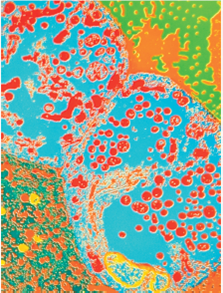
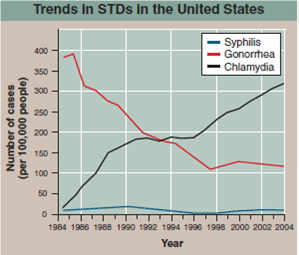
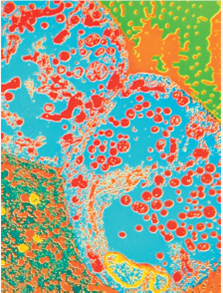
Chlamydia offers the most interesting possibility of changes in infectivity, because of its unusual nature. Chlamydia trachomatis is genetically a bacterium but is an obligate intracellular parasite, much like a virus in this respect-it can reproduce only inside human cells. The red structures in the photo are chlamydia bacteria inside human cells. Like gonorrhea, chlamydia is transmitted through vaginal, anal, or oral intercourse with an infected person. With chlamydia, the person may show no symptoms. Because the disease agent lives inside cells, its infectivity would not be expected to change unless the number of cells of an infected individual to which his or her sex partner would be exposed during intercourse were to change, a very unlikely possibility. So a drop in infectivity doesn't seem very likely. There is, however, a third possible explanation for why the frequency of one STD in a population might rise while the frequency of another STD in that same population falls. To grasp this third possible explanation, we will need to examine carefully the trends in the incidence in the United States of the gonorrhea, chlamydia, and syphilis. Detailed yearly statistics are reported in the graph above.
Making Inferences
a. Gonorrhea: What is the incidence in 1985 in 1995 Has the frequency declined or increased In general, are individuals aware they are infected when they transmit the STD
b. Chlamydia: What is the incidence in 1985 in 1995 Has the frequency declined or increased In general, are individuals aware they are infected when they transmit the STD
As a general rule, the incidence of a sexually transmitted disease is expected to increase with increasing frequencies of unprotected sexual contact. With the emergence of AIDS, intense publicity and education has lessened such dangerous behavior. Both the number of sexual partners and the frequency of unprotected sex have fallen significantly in the United States in the last decade. It would follow, then, that the frequencies of sexually transmitted diseases (STDs) like syphilis, gonorrhea, and chlamydia should also be falling.
However, the level of one STD sometimes rises while another falls. What are we to make of this The simplest explanation of such a difference is that the two STDs are occurring in different populations, and one population has rising levels of sexual activity, while the other has falling levels. However, nationwide statistics encompass all population subgroups, and there is no reason to expect subgroups to contain different STDs. Certainly each major subgroup contains all three major STDs mentioned above. So this would seem an unlikely explanation for the frequency of one STD to be rising while another falls.
A second possible explanation would be a change in the infectivity of one of the STDs. A less infective STD would tend to fall in frequency in the population, for the simple reason that fewer sexual contacts result in infection. To assess this possibility, we must examine the individual STDs more closely.
Syphilis is most infective in its initial stage, but this stage lasts only about a month. Most transmissions occur during the much longer second stage, marked by a pink rash and sores in the mouth. The bacteria can be transmitted at this stage by kissing or shared liquids. Any drop in infectivity of this STD would be expected to shorten this stage-but no such shortening has been observed.
Gonorrhea can be transmitted by various forms of sexual contact with an infected individual at any time during the infection. There has been no drop in infectivity per sexual contact reported.
Chlamydia offers the most interesting possibility of changes in infectivity, because of its unusual nature. Chlamydia trachomatis is genetically a bacterium but is an obligate intracellular parasite, much like a virus in this respect-it can reproduce only inside human cells. The red structures in the photo are chlamydia bacteria inside human cells. Like gonorrhea, chlamydia is transmitted through vaginal, anal, or oral intercourse with an infected person. With chlamydia, the person may show no symptoms. Because the disease agent lives inside cells, its infectivity would not be expected to change unless the number of cells of an infected individual to which his or her sex partner would be exposed during intercourse were to change, a very unlikely possibility. So a drop in infectivity doesn't seem very likely. There is, however, a third possible explanation for why the frequency of one STD in a population might rise while the frequency of another STD in that same population falls. To grasp this third possible explanation, we will need to examine carefully the trends in the incidence in the United States of the gonorrhea, chlamydia, and syphilis. Detailed yearly statistics are reported in the graph above.
Making Inferences
a. Gonorrhea: What is the incidence in 1985 in 1995 Has the frequency declined or increased In general, are individuals aware they are infected when they transmit the STD
b. Chlamydia: What is the incidence in 1985 in 1995 Has the frequency declined or increased In general, are individuals aware they are infected when they transmit the STD
سؤال
سؤال
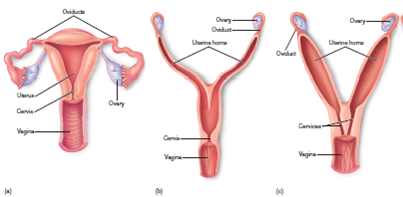
Figure 36.12 Observe the shapes of the uteri shown in the figure. Speculate on the number of offspring the individuals are able to carry at one time.
سؤال
سؤال
Why Do STDs Vary in Frequency
As a general rule, the incidence of a sexually transmitted disease is expected to increase with increasing frequencies of unprotected sexual contact. With the emergence of AIDS, intense publicity and education has lessened such dangerous behavior. Both the number of sexual partners and the frequency of unprotected sex have fallen significantly in the United States in the last decade. It would follow, then, that the frequencies of sexually transmitted diseases (STDs) like syphilis, gonorrhea, and chlamydia should also be falling.
However, the level of one STD sometimes rises while another falls. What are we to make of this The simplest explanation of such a difference is that the two STDs are occurring in different populations, and one population has rising levels of sexual activity, while the other has falling levels. However, nationwide statistics encompass all population subgroups, and there is no reason to expect subgroups to contain different STDs. Certainly each major subgroup contains all three major STDs mentioned above. So this would seem an unlikely explanation for the frequency of one STD to be rising while another falls.
A second possible explanation would be a change in the infectivity of one of the STDs. A less infective STD would tend to fall in frequency in the population, for the simple reason that fewer sexual contacts result in infection. To assess this possibility, we must examine the individual STDs more closely.
Syphilis is most infective in its initial stage, but this stage lasts only about a month. Most transmissions occur during the much longer second stage, marked by a pink rash and sores in the mouth. The bacteria can be transmitted at this stage by kissing or shared liquids. Any drop in infectivity of this STD would be expected to shorten this stage-but no such shortening has been observed.
Gonorrhea can be transmitted by various forms of sexual contact with an infected individual at any time during the infection. There has been no drop in infectivity per sexual contact reported.
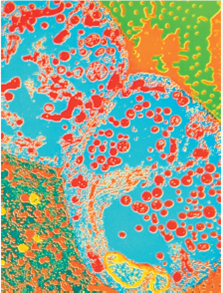
Chlamydia offers the most interesting possibility of changes in infectivity, because of its unusual nature. Chlamydia trachomatis is genetically a bacterium but is an obligate intracellular parasite, much like a virus in this respect-it can reproduce only inside human cells. The red structures in the photo are chlamydia bacteria inside human cells. Like gonorrhea, chlamydia is transmitted through vaginal, anal, or oral intercourse with an infected person. With chlamydia, the person may show no symptoms. Because the disease agent lives inside cells, its infectivity would not be expected to change unless the number of cells of an infected individual to which his or her sex partner would be exposed during intercourse were to change, a very unlikely possibility. So a drop in infectivity doesn't seem very likely. There is, however, a third possible explanation for why the frequency of one STD in a population might rise while the frequency of another STD in that same population falls. To grasp this third possible explanation, we will need to examine carefully the trends in the incidence in the United States of the gonorrhea, chlamydia, and syphilis. Detailed yearly statistics are reported in the graph above.
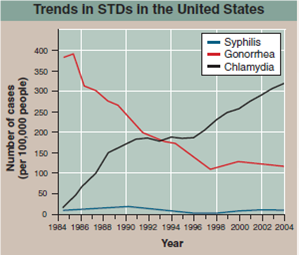
Drawing Conclusions How might heightened public awareness explain why the trend in levels of gonorrhea differs from that of chlamydia
As a general rule, the incidence of a sexually transmitted disease is expected to increase with increasing frequencies of unprotected sexual contact. With the emergence of AIDS, intense publicity and education has lessened such dangerous behavior. Both the number of sexual partners and the frequency of unprotected sex have fallen significantly in the United States in the last decade. It would follow, then, that the frequencies of sexually transmitted diseases (STDs) like syphilis, gonorrhea, and chlamydia should also be falling.
However, the level of one STD sometimes rises while another falls. What are we to make of this The simplest explanation of such a difference is that the two STDs are occurring in different populations, and one population has rising levels of sexual activity, while the other has falling levels. However, nationwide statistics encompass all population subgroups, and there is no reason to expect subgroups to contain different STDs. Certainly each major subgroup contains all three major STDs mentioned above. So this would seem an unlikely explanation for the frequency of one STD to be rising while another falls.
A second possible explanation would be a change in the infectivity of one of the STDs. A less infective STD would tend to fall in frequency in the population, for the simple reason that fewer sexual contacts result in infection. To assess this possibility, we must examine the individual STDs more closely.
Syphilis is most infective in its initial stage, but this stage lasts only about a month. Most transmissions occur during the much longer second stage, marked by a pink rash and sores in the mouth. The bacteria can be transmitted at this stage by kissing or shared liquids. Any drop in infectivity of this STD would be expected to shorten this stage-but no such shortening has been observed.
Gonorrhea can be transmitted by various forms of sexual contact with an infected individual at any time during the infection. There has been no drop in infectivity per sexual contact reported.
Chlamydia offers the most interesting possibility of changes in infectivity, because of its unusual nature. Chlamydia trachomatis is genetically a bacterium but is an obligate intracellular parasite, much like a virus in this respect-it can reproduce only inside human cells. The red structures in the photo are chlamydia bacteria inside human cells. Like gonorrhea, chlamydia is transmitted through vaginal, anal, or oral intercourse with an infected person. With chlamydia, the person may show no symptoms. Because the disease agent lives inside cells, its infectivity would not be expected to change unless the number of cells of an infected individual to which his or her sex partner would be exposed during intercourse were to change, a very unlikely possibility. So a drop in infectivity doesn't seem very likely. There is, however, a third possible explanation for why the frequency of one STD in a population might rise while the frequency of another STD in that same population falls. To grasp this third possible explanation, we will need to examine carefully the trends in the incidence in the United States of the gonorrhea, chlamydia, and syphilis. Detailed yearly statistics are reported in the graph above.
Drawing Conclusions How might heightened public awareness explain why the trend in levels of gonorrhea differs from that of chlamydia
سؤال
سؤال
سؤال
سؤال
سؤال
سؤال
سؤال
سؤال
سؤال
Why Do STDs Vary in Frequency
As a general rule, the incidence of a sexually transmitted disease is expected to increase with increasing frequencies of unprotected sexual contact. With the emergence of AIDS, intense publicity and education has lessened such dangerous behavior. Both the number of sexual partners and the frequency of unprotected sex have fallen significantly in the United States in the last decade. It would follow, then, that the frequencies of sexually transmitted diseases (STDs) like syphilis, gonorrhea, and chlamydia should also be falling.
However, the level of one STD sometimes rises while another falls. What are we to make of this The simplest explanation of such a difference is that the two STDs are occurring in different populations, and one population has rising levels of sexual activity, while the other has falling levels. However, nationwide statistics encompass all population subgroups, and there is no reason to expect subgroups to contain different STDs. Certainly each major subgroup contains all three major STDs mentioned above. So this would seem an unlikely explanation for the frequency of one STD to be rising while another falls.
A second possible explanation would be a change in the infectivity of one of the STDs. A less infective STD would tend to fall in frequency in the population, for the simple reason that fewer sexual contacts result in infection. To assess this possibility, we must examine the individual STDs more closely.
Syphilis is most infective in its initial stage, but this stage lasts only about a month. Most transmissions occur during the much longer second stage, marked by a pink rash and sores in the mouth. The bacteria can be transmitted at this stage by kissing or shared liquids. Any drop in infectivity of this STD would be expected to shorten this stage-but no such shortening has been observed.
Gonorrhea can be transmitted by various forms of sexual contact with an infected individual at any time during the infection. There has been no drop in infectivity per sexual contact reported.
Chlamydia offers the most interesting possibility of changes in infectivity, because of its unusual nature. Chlamydia trachomatis is genetically a bacterium but is an obligate intracellular parasite, much like a virus in this respect-it can reproduce only inside human cells. The red structures in the photo are chlamydia bacteria inside human cells. Like gonorrhea, chlamydia is transmitted through vaginal, anal, or oral intercourse with an infected person. With chlamydia, the person may show no symptoms. Because the disease agent lives inside cells, its infectivity would not be expected to change unless the number of cells of an infected individual to which his or her sex partner would be exposed during intercourse were to change, a very unlikely possibility. So a drop in infectivity doesn't seem very likely. There is, however, a third possible explanation for why the frequency of one STD in a population might rise while the frequency of another STD in that same population falls. To grasp this third possible explanation, we will need to examine carefully the trends in the incidence in the United States of the gonorrhea, chlamydia, and syphilis. Detailed yearly statistics are reported in the graph above.
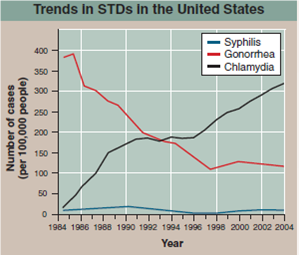
Applying Concepts What is the dependent variable
As a general rule, the incidence of a sexually transmitted disease is expected to increase with increasing frequencies of unprotected sexual contact. With the emergence of AIDS, intense publicity and education has lessened such dangerous behavior. Both the number of sexual partners and the frequency of unprotected sex have fallen significantly in the United States in the last decade. It would follow, then, that the frequencies of sexually transmitted diseases (STDs) like syphilis, gonorrhea, and chlamydia should also be falling.
However, the level of one STD sometimes rises while another falls. What are we to make of this The simplest explanation of such a difference is that the two STDs are occurring in different populations, and one population has rising levels of sexual activity, while the other has falling levels. However, nationwide statistics encompass all population subgroups, and there is no reason to expect subgroups to contain different STDs. Certainly each major subgroup contains all three major STDs mentioned above. So this would seem an unlikely explanation for the frequency of one STD to be rising while another falls.
A second possible explanation would be a change in the infectivity of one of the STDs. A less infective STD would tend to fall in frequency in the population, for the simple reason that fewer sexual contacts result in infection. To assess this possibility, we must examine the individual STDs more closely.
Syphilis is most infective in its initial stage, but this stage lasts only about a month. Most transmissions occur during the much longer second stage, marked by a pink rash and sores in the mouth. The bacteria can be transmitted at this stage by kissing or shared liquids. Any drop in infectivity of this STD would be expected to shorten this stage-but no such shortening has been observed.
Gonorrhea can be transmitted by various forms of sexual contact with an infected individual at any time during the infection. There has been no drop in infectivity per sexual contact reported.
Chlamydia offers the most interesting possibility of changes in infectivity, because of its unusual nature. Chlamydia trachomatis is genetically a bacterium but is an obligate intracellular parasite, much like a virus in this respect-it can reproduce only inside human cells. The red structures in the photo are chlamydia bacteria inside human cells. Like gonorrhea, chlamydia is transmitted through vaginal, anal, or oral intercourse with an infected person. With chlamydia, the person may show no symptoms. Because the disease agent lives inside cells, its infectivity would not be expected to change unless the number of cells of an infected individual to which his or her sex partner would be exposed during intercourse were to change, a very unlikely possibility. So a drop in infectivity doesn't seem very likely. There is, however, a third possible explanation for why the frequency of one STD in a population might rise while the frequency of another STD in that same population falls. To grasp this third possible explanation, we will need to examine carefully the trends in the incidence in the United States of the gonorrhea, chlamydia, and syphilis. Detailed yearly statistics are reported in the graph above.
Applying Concepts What is the dependent variable
سؤال
سؤال
سؤال
سؤال
Figure 36.4 Why do you think that amphibians and many fish have external fertilization, whereas lizards, birds, and mammals rely on internal fertilization


فتح الحزمة
قم بالتسجيل لفتح البطاقات في هذه المجموعة!
Unlock Deck
Unlock Deck
1/19

العب

ملء الشاشة (f)
Deck 36: Reproduction and Development
1
Speculate on why males produce so many sperm and females have, comparatively, so few eggs.
The human gamete, or sperm, is particularly specialized as a carrier of genetic information. Instead of 46 chromosomes found in other male body cells, sperm cells produced by meiosis have 23 chromosomes. Eggs develop in females from cells called oocytes in the external layer of cells known as ovaries that are compact in the abdominal cavity.
Males produce so many sperms and females produce, comparatively, so few viable eggs because the odds against any single sperm cell successfully complete a long journey to the egg and fertilize this are extremely high and a large sperm count is required for successful fertilization. Males with less than 20 million sperms per milliliter are generally considered as sterile.
Males produce so many sperms and females produce, comparatively, so few viable eggs because the odds against any single sperm cell successfully complete a long journey to the egg and fertilize this are extremely high and a large sperm count is required for successful fertilization. Males with less than 20 million sperms per milliliter are generally considered as sterile.
2
Why Do STDs Vary in Frequency
As a general rule, the incidence of a sexually transmitted disease is expected to increase with increasing frequencies of unprotected sexual contact. With the emergence of AIDS, intense publicity and education has lessened such dangerous behavior. Both the number of sexual partners and the frequency of unprotected sex have fallen significantly in the United States in the last decade. It would follow, then, that the frequencies of sexually transmitted diseases (STDs) like syphilis, gonorrhea, and chlamydia should also be falling.
However, the level of one STD sometimes rises while another falls. What are we to make of this The simplest explanation of such a difference is that the two STDs are occurring in different populations, and one population has rising levels of sexual activity, while the other has falling levels. However, nationwide statistics encompass all population subgroups, and there is no reason to expect subgroups to contain different STDs. Certainly each major subgroup contains all three major STDs mentioned above. So this would seem an unlikely explanation for the frequency of one STD to be rising while another falls.
A second possible explanation would be a change in the infectivity of one of the STDs. A less infective STD would tend to fall in frequency in the population, for the simple reason that fewer sexual contacts result in infection. To assess this possibility, we must examine the individual STDs more closely.
Syphilis is most infective in its initial stage, but this stage lasts only about a month. Most transmissions occur during the much longer second stage, marked by a pink rash and sores in the mouth. The bacteria can be transmitted at this stage by kissing or shared liquids. Any drop in infectivity of this STD would be expected to shorten this stage-but no such shortening has been observed.
Gonorrhea can be transmitted by various forms of sexual contact with an infected individual at any time during the infection. There has been no drop in infectivity per sexual contact reported.
Chlamydia offers the most interesting possibility of changes in infectivity, because of its unusual nature. Chlamydia trachomatis is genetically a bacterium but is an obligate intracellular parasite, much like a virus in this respect-it can reproduce only inside human cells. The red structures in the photo are chlamydia bacteria inside human cells. Like gonorrhea, chlamydia is transmitted through vaginal, anal, or oral intercourse with an infected person. With chlamydia, the person may show no symptoms. Because the disease agent lives inside cells, its infectivity would not be expected to change unless the number of cells of an infected individual to which his or her sex partner would be exposed during intercourse were to change, a very unlikely possibility. So a drop in infectivity doesn't seem very likely. There is, however, a third possible explanation for why the frequency of one STD in a population might rise while the frequency of another STD in that same population falls. To grasp this third possible explanation, we will need to examine carefully the trends in the incidence in the United States of the gonorrhea, chlamydia, and syphilis. Detailed yearly statistics are reported in the graph above.
Making Inferences
a. Gonorrhea: What is the incidence in 1985 in 1995 Has the frequency declined or increased In general, are individuals aware they are infected when they transmit the STD
b. Chlamydia: What is the incidence in 1985 in 1995 Has the frequency declined or increased In general, are individuals aware they are infected when they transmit the STD
As a general rule, the incidence of a sexually transmitted disease is expected to increase with increasing frequencies of unprotected sexual contact. With the emergence of AIDS, intense publicity and education has lessened such dangerous behavior. Both the number of sexual partners and the frequency of unprotected sex have fallen significantly in the United States in the last decade. It would follow, then, that the frequencies of sexually transmitted diseases (STDs) like syphilis, gonorrhea, and chlamydia should also be falling.
However, the level of one STD sometimes rises while another falls. What are we to make of this The simplest explanation of such a difference is that the two STDs are occurring in different populations, and one population has rising levels of sexual activity, while the other has falling levels. However, nationwide statistics encompass all population subgroups, and there is no reason to expect subgroups to contain different STDs. Certainly each major subgroup contains all three major STDs mentioned above. So this would seem an unlikely explanation for the frequency of one STD to be rising while another falls.
A second possible explanation would be a change in the infectivity of one of the STDs. A less infective STD would tend to fall in frequency in the population, for the simple reason that fewer sexual contacts result in infection. To assess this possibility, we must examine the individual STDs more closely.
Syphilis is most infective in its initial stage, but this stage lasts only about a month. Most transmissions occur during the much longer second stage, marked by a pink rash and sores in the mouth. The bacteria can be transmitted at this stage by kissing or shared liquids. Any drop in infectivity of this STD would be expected to shorten this stage-but no such shortening has been observed.
Gonorrhea can be transmitted by various forms of sexual contact with an infected individual at any time during the infection. There has been no drop in infectivity per sexual contact reported.
Chlamydia offers the most interesting possibility of changes in infectivity, because of its unusual nature. Chlamydia trachomatis is genetically a bacterium but is an obligate intracellular parasite, much like a virus in this respect-it can reproduce only inside human cells. The red structures in the photo are chlamydia bacteria inside human cells. Like gonorrhea, chlamydia is transmitted through vaginal, anal, or oral intercourse with an infected person. With chlamydia, the person may show no symptoms. Because the disease agent lives inside cells, its infectivity would not be expected to change unless the number of cells of an infected individual to which his or her sex partner would be exposed during intercourse were to change, a very unlikely possibility. So a drop in infectivity doesn't seem very likely. There is, however, a third possible explanation for why the frequency of one STD in a population might rise while the frequency of another STD in that same population falls. To grasp this third possible explanation, we will need to examine carefully the trends in the incidence in the United States of the gonorrhea, chlamydia, and syphilis. Detailed yearly statistics are reported in the graph above.
Making Inferences
a. Gonorrhea: What is the incidence in 1985 in 1995 Has the frequency declined or increased In general, are individuals aware they are infected when they transmit the STD
b. Chlamydia: What is the incidence in 1985 in 1995 Has the frequency declined or increased In general, are individuals aware they are infected when they transmit the STD
In this question we confer altering trends in infection rates for three different STDs i.e. sexually transmitted disease. Because the arrival of the AIDS epidemic, there has been huge info promotion to increase the awareness on how HIV spread. Due to the sexual habits of US population has been changed which reduces the rate of HIV.
In the year 1985 the occurrence of gonorrhoea was approx. 390 cases in 100000 persons. The occurrence of gonorrhoea in the year 1995 was approx. 150 cases in 100000 persons. The rate of gonorrhoea is declined during these 10 year's spans. Gonorrhoea does show symptoms and so persons are most possibly known that they are infect with it and once they convey gonorrhoea
In the year 1985 the occurrence of chlamydia was approx. 40 cases in 100000 persons. The occurrence of chlamydia in the year 1995 was approx. 180 cases in 100000 persons. The rate of chlamydia is increment during these 10 year's spans and this increase is continued.
The other name of Chlamydia is "Sexually Transmitted Disease" or STD since women generally don't show symptoms and therefore, they don't know that they are infected with this disease when the pass on chlamydia
In the year 1985 the occurrence of gonorrhoea was approx. 390 cases in 100000 persons. The occurrence of gonorrhoea in the year 1995 was approx. 150 cases in 100000 persons. The rate of gonorrhoea is declined during these 10 year's spans. Gonorrhoea does show symptoms and so persons are most possibly known that they are infect with it and once they convey gonorrhoea
In the year 1985 the occurrence of chlamydia was approx. 40 cases in 100000 persons. The occurrence of chlamydia in the year 1995 was approx. 180 cases in 100000 persons. The rate of chlamydia is increment during these 10 year's spans and this increase is continued.
The other name of Chlamydia is "Sexually Transmitted Disease" or STD since women generally don't show symptoms and therefore, they don't know that they are infected with this disease when the pass on chlamydia
3
For terrestrial vertebrates, dehydration was a selection pressure that caused the evolution of
A) parthenogenesis.
B) external fertilization.
C) budding.
D) internal fertilization.
A) parthenogenesis.
B) external fertilization.
C) budding.
D) internal fertilization.
Selection pressure is defined as the factors that lead to selection of the individuals for survival and reproduction and this leads to evolution.
Parthenogenesis is a type of reproduction in which offspring develops from unfertilized eggs.
Hence, option (a) is incorrect.
External fertilization is union of male sperm and female egg outside of the body of female.
Hence, option (b) is incorrect.
Budding is asexual reproduction in which bud gives rise to new organism by cell division.
Hence, option (c) is incorrect.
Internal fertilization is defined as union of sperm and egg cell inside the female body during sexual reproduction. It is evolved in terrestrial vertebrates due to strong selective pressure for gametes kept in a non-desiccating environment.
Hence, option
 is the correct answer.
Parthenogenesis is a type of reproduction in which offspring develops from unfertilized eggs.
Hence, option (a) is incorrect.
External fertilization is union of male sperm and female egg outside of the body of female.
Hence, option (b) is incorrect.
Budding is asexual reproduction in which bud gives rise to new organism by cell division.
Hence, option (c) is incorrect.
Internal fertilization is defined as union of sperm and egg cell inside the female body during sexual reproduction. It is evolved in terrestrial vertebrates due to strong selective pressure for gametes kept in a non-desiccating environment.
Hence, option
is the correct answer. 4
Figure 36.12 Observe the shapes of the uteri shown in the figure. Speculate on the number of offspring the individuals are able to carry at one time.
فتح الحزمة
افتح القفل للوصول البطاقات البالغ عددها 19 في هذه المجموعة.
فتح الحزمة
k this deck
5
Explain some of the ways that a woman's use of drugs-alcohol, cocaine, prescription drugs, over-the-counter drugs-can affect the embryo or fetus that she is carrying.
فتح الحزمة
افتح القفل للوصول البطاقات البالغ عددها 19 في هذه المجموعة.
فتح الحزمة
k this deck
6
Why Do STDs Vary in Frequency
As a general rule, the incidence of a sexually transmitted disease is expected to increase with increasing frequencies of unprotected sexual contact. With the emergence of AIDS, intense publicity and education has lessened such dangerous behavior. Both the number of sexual partners and the frequency of unprotected sex have fallen significantly in the United States in the last decade. It would follow, then, that the frequencies of sexually transmitted diseases (STDs) like syphilis, gonorrhea, and chlamydia should also be falling.
However, the level of one STD sometimes rises while another falls. What are we to make of this The simplest explanation of such a difference is that the two STDs are occurring in different populations, and one population has rising levels of sexual activity, while the other has falling levels. However, nationwide statistics encompass all population subgroups, and there is no reason to expect subgroups to contain different STDs. Certainly each major subgroup contains all three major STDs mentioned above. So this would seem an unlikely explanation for the frequency of one STD to be rising while another falls.
A second possible explanation would be a change in the infectivity of one of the STDs. A less infective STD would tend to fall in frequency in the population, for the simple reason that fewer sexual contacts result in infection. To assess this possibility, we must examine the individual STDs more closely.
Syphilis is most infective in its initial stage, but this stage lasts only about a month. Most transmissions occur during the much longer second stage, marked by a pink rash and sores in the mouth. The bacteria can be transmitted at this stage by kissing or shared liquids. Any drop in infectivity of this STD would be expected to shorten this stage-but no such shortening has been observed.
Gonorrhea can be transmitted by various forms of sexual contact with an infected individual at any time during the infection. There has been no drop in infectivity per sexual contact reported.
Chlamydia offers the most interesting possibility of changes in infectivity, because of its unusual nature. Chlamydia trachomatis is genetically a bacterium but is an obligate intracellular parasite, much like a virus in this respect-it can reproduce only inside human cells. The red structures in the photo are chlamydia bacteria inside human cells. Like gonorrhea, chlamydia is transmitted through vaginal, anal, or oral intercourse with an infected person. With chlamydia, the person may show no symptoms. Because the disease agent lives inside cells, its infectivity would not be expected to change unless the number of cells of an infected individual to which his or her sex partner would be exposed during intercourse were to change, a very unlikely possibility. So a drop in infectivity doesn't seem very likely. There is, however, a third possible explanation for why the frequency of one STD in a population might rise while the frequency of another STD in that same population falls. To grasp this third possible explanation, we will need to examine carefully the trends in the incidence in the United States of the gonorrhea, chlamydia, and syphilis. Detailed yearly statistics are reported in the graph above.
Drawing Conclusions How might heightened public awareness explain why the trend in levels of gonorrhea differs from that of chlamydia
As a general rule, the incidence of a sexually transmitted disease is expected to increase with increasing frequencies of unprotected sexual contact. With the emergence of AIDS, intense publicity and education has lessened such dangerous behavior. Both the number of sexual partners and the frequency of unprotected sex have fallen significantly in the United States in the last decade. It would follow, then, that the frequencies of sexually transmitted diseases (STDs) like syphilis, gonorrhea, and chlamydia should also be falling.
However, the level of one STD sometimes rises while another falls. What are we to make of this The simplest explanation of such a difference is that the two STDs are occurring in different populations, and one population has rising levels of sexual activity, while the other has falling levels. However, nationwide statistics encompass all population subgroups, and there is no reason to expect subgroups to contain different STDs. Certainly each major subgroup contains all three major STDs mentioned above. So this would seem an unlikely explanation for the frequency of one STD to be rising while another falls.
A second possible explanation would be a change in the infectivity of one of the STDs. A less infective STD would tend to fall in frequency in the population, for the simple reason that fewer sexual contacts result in infection. To assess this possibility, we must examine the individual STDs more closely.
Syphilis is most infective in its initial stage, but this stage lasts only about a month. Most transmissions occur during the much longer second stage, marked by a pink rash and sores in the mouth. The bacteria can be transmitted at this stage by kissing or shared liquids. Any drop in infectivity of this STD would be expected to shorten this stage-but no such shortening has been observed.
Gonorrhea can be transmitted by various forms of sexual contact with an infected individual at any time during the infection. There has been no drop in infectivity per sexual contact reported.
Chlamydia offers the most interesting possibility of changes in infectivity, because of its unusual nature. Chlamydia trachomatis is genetically a bacterium but is an obligate intracellular parasite, much like a virus in this respect-it can reproduce only inside human cells. The red structures in the photo are chlamydia bacteria inside human cells. Like gonorrhea, chlamydia is transmitted through vaginal, anal, or oral intercourse with an infected person. With chlamydia, the person may show no symptoms. Because the disease agent lives inside cells, its infectivity would not be expected to change unless the number of cells of an infected individual to which his or her sex partner would be exposed during intercourse were to change, a very unlikely possibility. So a drop in infectivity doesn't seem very likely. There is, however, a third possible explanation for why the frequency of one STD in a population might rise while the frequency of another STD in that same population falls. To grasp this third possible explanation, we will need to examine carefully the trends in the incidence in the United States of the gonorrhea, chlamydia, and syphilis. Detailed yearly statistics are reported in the graph above.
Drawing Conclusions How might heightened public awareness explain why the trend in levels of gonorrhea differs from that of chlamydia
فتح الحزمة
افتح القفل للوصول البطاقات البالغ عددها 19 في هذه المجموعة.
فتح الحزمة
k this deck
7
Embryonic development in dogs is an example of
A) viviparity.
B) ovoviviparity.
C) oviparity.
D) parthenogenesis.
A) viviparity.
B) ovoviviparity.
C) oviparity.
D) parthenogenesis.
فتح الحزمة
افتح القفل للوصول البطاقات البالغ عددها 19 في هذه المجموعة.
فتح الحزمة
k this deck
8
Your friend tells you that the most reliable method of contraception and prevention of sexually transmitted disease is communication. Explain what she means.
فتح الحزمة
افتح القفل للوصول البطاقات البالغ عددها 19 في هذه المجموعة.
فتح الحزمة
k this deck
9
Temperature regulation of spermatogenesis in human males is controlled by the position of the
A) seminiferous tubules.
B) epididymis.
C) vas deferens.
D) scrotum.
A) seminiferous tubules.
B) epididymis.
C) vas deferens.
D) scrotum.
فتح الحزمة
افتح القفل للوصول البطاقات البالغ عددها 19 في هذه المجموعة.
فتح الحزمة
k this deck
10
Oocyte development in human females requires the hormones
A) estrogen and testosterone.
B) FSH and LH.
C) progesterone and testosterone.
D) oxytocin and prolactin.
A) estrogen and testosterone.
B) FSH and LH.
C) progesterone and testosterone.
D) oxytocin and prolactin.
فتح الحزمة
افتح القفل للوصول البطاقات البالغ عددها 19 في هذه المجموعة.
فتح الحزمة
k this deck
11
When pregnancy occurs, the endometrium is maintained by the
A) embryo releasing hCG.
B) decrease in levels of progesterone.
C) hypothalamus releasing GnRH.
D) increasing levels of FSH.
A) embryo releasing hCG.
B) decrease in levels of progesterone.
C) hypothalamus releasing GnRH.
D) increasing levels of FSH.
فتح الحزمة
افتح القفل للوصول البطاقات البالغ عددها 19 في هذه المجموعة.
فتح الحزمة
k this deck
12
A human embryo has formed the three germ layers from which all tissues form by the time
A) the blastula forms.
B) neurulation is complete.
C) the blastocyst forms.
D) gastrulation is complete.
A) the blastula forms.
B) neurulation is complete.
C) the blastocyst forms.
D) gastrulation is complete.
فتح الحزمة
افتح القفل للوصول البطاقات البالغ عددها 19 في هذه المجموعة.
فتح الحزمة
k this deck
13
Why are all the parents of parthenogenic offspring female
فتح الحزمة
افتح القفل للوصول البطاقات البالغ عددها 19 في هذه المجموعة.
فتح الحزمة
k this deck
14
In a developing human, the first tissues to begin forming are the
A) skeletal.
B) muscular.
C) nervous.
D) digestive.
A) skeletal.
B) muscular.
C) nervous.
D) digestive.
فتح الحزمة
افتح القفل للوصول البطاقات البالغ عددها 19 في هذه المجموعة.
فتح الحزمة
k this deck
15
Why Do STDs Vary in Frequency
As a general rule, the incidence of a sexually transmitted disease is expected to increase with increasing frequencies of unprotected sexual contact. With the emergence of AIDS, intense publicity and education has lessened such dangerous behavior. Both the number of sexual partners and the frequency of unprotected sex have fallen significantly in the United States in the last decade. It would follow, then, that the frequencies of sexually transmitted diseases (STDs) like syphilis, gonorrhea, and chlamydia should also be falling.
However, the level of one STD sometimes rises while another falls. What are we to make of this The simplest explanation of such a difference is that the two STDs are occurring in different populations, and one population has rising levels of sexual activity, while the other has falling levels. However, nationwide statistics encompass all population subgroups, and there is no reason to expect subgroups to contain different STDs. Certainly each major subgroup contains all three major STDs mentioned above. So this would seem an unlikely explanation for the frequency of one STD to be rising while another falls.
A second possible explanation would be a change in the infectivity of one of the STDs. A less infective STD would tend to fall in frequency in the population, for the simple reason that fewer sexual contacts result in infection. To assess this possibility, we must examine the individual STDs more closely.
Syphilis is most infective in its initial stage, but this stage lasts only about a month. Most transmissions occur during the much longer second stage, marked by a pink rash and sores in the mouth. The bacteria can be transmitted at this stage by kissing or shared liquids. Any drop in infectivity of this STD would be expected to shorten this stage-but no such shortening has been observed.
Gonorrhea can be transmitted by various forms of sexual contact with an infected individual at any time during the infection. There has been no drop in infectivity per sexual contact reported.
Chlamydia offers the most interesting possibility of changes in infectivity, because of its unusual nature. Chlamydia trachomatis is genetically a bacterium but is an obligate intracellular parasite, much like a virus in this respect-it can reproduce only inside human cells. The red structures in the photo are chlamydia bacteria inside human cells. Like gonorrhea, chlamydia is transmitted through vaginal, anal, or oral intercourse with an infected person. With chlamydia, the person may show no symptoms. Because the disease agent lives inside cells, its infectivity would not be expected to change unless the number of cells of an infected individual to which his or her sex partner would be exposed during intercourse were to change, a very unlikely possibility. So a drop in infectivity doesn't seem very likely. There is, however, a third possible explanation for why the frequency of one STD in a population might rise while the frequency of another STD in that same population falls. To grasp this third possible explanation, we will need to examine carefully the trends in the incidence in the United States of the gonorrhea, chlamydia, and syphilis. Detailed yearly statistics are reported in the graph above.
Applying Concepts What is the dependent variable
As a general rule, the incidence of a sexually transmitted disease is expected to increase with increasing frequencies of unprotected sexual contact. With the emergence of AIDS, intense publicity and education has lessened such dangerous behavior. Both the number of sexual partners and the frequency of unprotected sex have fallen significantly in the United States in the last decade. It would follow, then, that the frequencies of sexually transmitted diseases (STDs) like syphilis, gonorrhea, and chlamydia should also be falling.
However, the level of one STD sometimes rises while another falls. What are we to make of this The simplest explanation of such a difference is that the two STDs are occurring in different populations, and one population has rising levels of sexual activity, while the other has falling levels. However, nationwide statistics encompass all population subgroups, and there is no reason to expect subgroups to contain different STDs. Certainly each major subgroup contains all three major STDs mentioned above. So this would seem an unlikely explanation for the frequency of one STD to be rising while another falls.
A second possible explanation would be a change in the infectivity of one of the STDs. A less infective STD would tend to fall in frequency in the population, for the simple reason that fewer sexual contacts result in infection. To assess this possibility, we must examine the individual STDs more closely.
Syphilis is most infective in its initial stage, but this stage lasts only about a month. Most transmissions occur during the much longer second stage, marked by a pink rash and sores in the mouth. The bacteria can be transmitted at this stage by kissing or shared liquids. Any drop in infectivity of this STD would be expected to shorten this stage-but no such shortening has been observed.
Gonorrhea can be transmitted by various forms of sexual contact with an infected individual at any time during the infection. There has been no drop in infectivity per sexual contact reported.
Chlamydia offers the most interesting possibility of changes in infectivity, because of its unusual nature. Chlamydia trachomatis is genetically a bacterium but is an obligate intracellular parasite, much like a virus in this respect-it can reproduce only inside human cells. The red structures in the photo are chlamydia bacteria inside human cells. Like gonorrhea, chlamydia is transmitted through vaginal, anal, or oral intercourse with an infected person. With chlamydia, the person may show no symptoms. Because the disease agent lives inside cells, its infectivity would not be expected to change unless the number of cells of an infected individual to which his or her sex partner would be exposed during intercourse were to change, a very unlikely possibility. So a drop in infectivity doesn't seem very likely. There is, however, a third possible explanation for why the frequency of one STD in a population might rise while the frequency of another STD in that same population falls. To grasp this third possible explanation, we will need to examine carefully the trends in the incidence in the United States of the gonorrhea, chlamydia, and syphilis. Detailed yearly statistics are reported in the graph above.
Applying Concepts What is the dependent variable
فتح الحزمة
افتح القفل للوصول البطاقات البالغ عددها 19 في هذه المجموعة.
فتح الحزمة
k this deck
16
Childbirth before the third trimester is dangerous for a human baby because the
A) respiratory system is not fully formed.
B) circulatory system is not fully formed.
C) digestive system is not fully formed.
D) excretory system is not fully formed.
A) respiratory system is not fully formed.
B) circulatory system is not fully formed.
C) digestive system is not fully formed.
D) excretory system is not fully formed.
فتح الحزمة
افتح القفل للوصول البطاقات البالغ عددها 19 في هذه المجموعة.
فتح الحزمة
k this deck
17
If the offspring are not genetically identical to each other or the parent, then the organism reproduces through
A) fission.
B) sexual reproduction.
C) budding.
D) All of the above.
A) fission.
B) sexual reproduction.
C) budding.
D) All of the above.
فتح الحزمة
افتح القفل للوصول البطاقات البالغ عددها 19 في هذه المجموعة.
فتح الحزمة
k this deck
18
Contractions of the uterus during labor are stimulated by the hormone
A) estrogen.
B) prolactin.
C) oxytocin.
D) progesterone.
A) estrogen.
B) prolactin.
C) oxytocin.
D) progesterone.
فتح الحزمة
افتح القفل للوصول البطاقات البالغ عددها 19 في هذه المجموعة.
فتح الحزمة
k this deck
19
Figure 36.4 Why do you think that amphibians and many fish have external fertilization, whereas lizards, birds, and mammals rely on internal fertilization
فتح الحزمة
افتح القفل للوصول البطاقات البالغ عددها 19 في هذه المجموعة.
فتح الحزمة
k this deck
فتح الحزمة
افتح القفل للوصول البطاقات البالغ عددها 19 في هذه المجموعة.






