







 تكلم مع الذكاء الاصطناعي


Deck 5: Ecological Interactions Among Organisms
ملء الشاشة (f)

سؤال

سؤال
سؤال
سؤال
In a simple laboratory experiment, a researcher maintained two different species of single-celled protists, Paramecium caudatum and Paramecium aurelia . He recorded population growth of each species individually and then mixed a similar number of individuals from each population and recorded their growth rates when living together. The graphs below represent the results of this experiment.
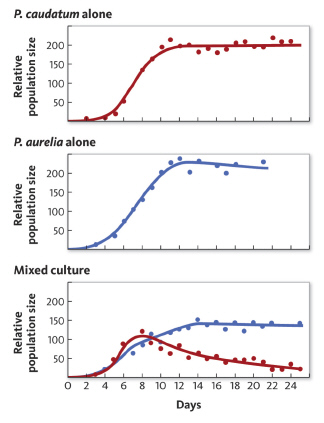
Based on the graph of the mixed culture, what can you determine about the niche for each individual species?
A) There is a large amount of niche overlap.
B) There is minimal niche overlap.
C) Competition for resources is partitioning the available niches.
D) Intraspecific competition is reducing niche overlap.
Based on the graph of the mixed culture, what can you determine about the niche for each individual species?
A) There is a large amount of niche overlap.
B) There is minimal niche overlap.
C) Competition for resources is partitioning the available niches.
D) Intraspecific competition is reducing niche overlap.
سؤال
سؤال
In a simple laboratory experiment, a researcher maintained two different species of single-celled protists, Paramecium caudatum and Paramecium aurelia . He recorded population growth of each species individually and then mixed a similar number of individuals from each population and recorded their growth rates when living together. The graphs below represent the results of this experiment.
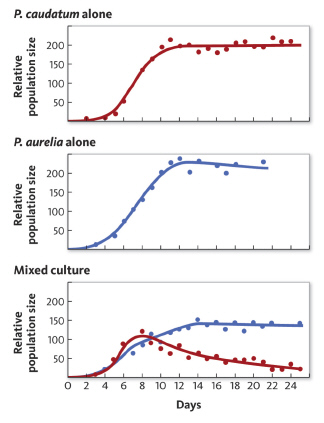
This example represents what type of competition?
A) intraspecific
B) interspecific
This example represents what type of competition?
A) intraspecific
B) interspecific
سؤال
In a simple laboratory experiment, a researcher maintained two different species of single-celled protists, Paramecium caudatum and Paramecium aurelia . He recorded population growth of each species individually and then mixed a similar number of individuals from each population and recorded their growth rates when living together. The graphs below represent the results of this experiment.
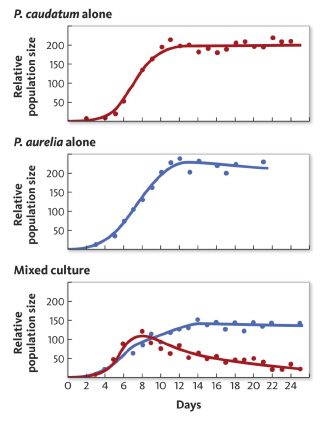
Based on the graph of the mixed culture, what is happening?
A) formation of a dominance hierarchy
B) interspecific competition
C) resource partitioning
D) an increase in species diversity
Based on the graph of the mixed culture, what is happening?
A) formation of a dominance hierarchy
B) interspecific competition
C) resource partitioning
D) an increase in species diversity
سؤال
سؤال
سؤال
The image below represents the termites, bacteria, and protists that together share a mutualistic relationship.
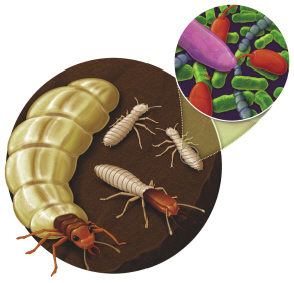
These organisms, which all live together, would be considered a(n) __________.
A) organism
B) population
C) community
D) ecosystem
These organisms, which all live together, would be considered a(n) __________.
A) organism
B) population
C) community
D) ecosystem
سؤال
سؤال
In Chapter 3, you learned about the evolution of the 14 finch-like species on the Galapagos Islands. As shown in the figure below, each species has a different beak shape; thus, each species is adapted to feeding on different food sources.
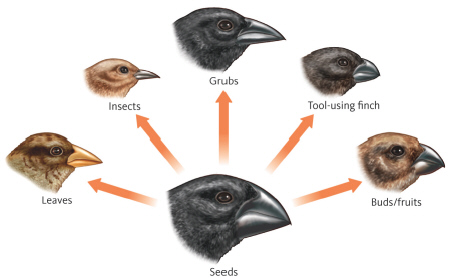
Which of the following statements is true about the Galapagos finches?
A) Because of the different beak shapes, there is little niche overlap.
B) Interspecific competition has eliminated niche overlap.
C) Because of niche overlap, a dominance hierarchy has been established.
D) Intraspecific competition is likely minimal because of the differences in beak shape.
Which of the following statements is true about the Galapagos finches?
A) Because of the different beak shapes, there is little niche overlap.
B) Interspecific competition has eliminated niche overlap.
C) Because of niche overlap, a dominance hierarchy has been established.
D) Intraspecific competition is likely minimal because of the differences in beak shape.
سؤال
سؤال
سؤال
In a simple laboratory experiment, a researcher maintained two different species of single-celled protists, Paramecium caudatum and Paramecium aurelia . He recorded population growth of each species individually and then mixed a similar number of individuals from each population and recorded their growth rates when living together. The graphs below represent the results of this experiment.
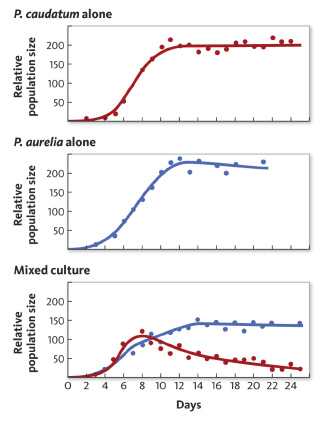
What is the carrying capacity for P. caudatum alone?
A) ~200
B) ~100
C) ~50
D) cannot be determined from graph
What is the carrying capacity for P. caudatum alone?
A) ~200
B) ~100
C) ~50
D) cannot be determined from graph
سؤال
In Chapter 3, you learned about the evolution of the 14 finch-like species on the Galapagos Islands. As shown in the figure below, each species has a different beak shape; thus, each species is adapted to feeding on different food sources.
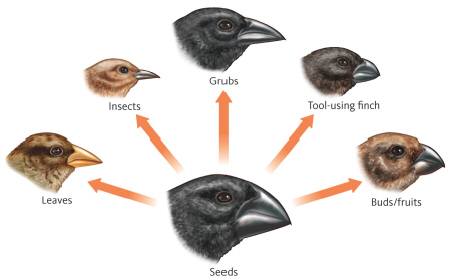
These changes are a result of __________.
A) resource partitioning
B) ecological niche
C) dominance hierarchy
D) mutualism
These changes are a result of __________.
A) resource partitioning
B) ecological niche
C) dominance hierarchy
D) mutualism
سؤال
The image below represents the termites, bacteria, and protists that together share a mutualistic relationship.
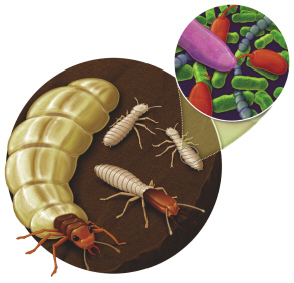
How many domains are represented?
A) one
B) two
C) three
D) four
How many domains are represented?
A) one
B) two
C) three
D) four
سؤال
سؤال
سؤال
سؤال
سؤال
سؤال
Robert Paine was the first biologist to use the term keystone species in the 1960s. He was studying food webs in the rocky, intertidal pools in the Pacific Northwest. At one of his study sites, the dominant organisms in the tidal pools were mussels, barnacles, whelks, and a species of starfish known as Pisaster ochraceus . To examine the relationship between these species, Paine set up an experiment. In one area, he removed all the starfish from the tidal pools, and in an adjacent area, he left the tidal pools as he found them. Prior to removing the starfish, he sampled all the organisms in each pool. After two months, he repeated this sampling. A summary of his results is illustrated in the graph below.
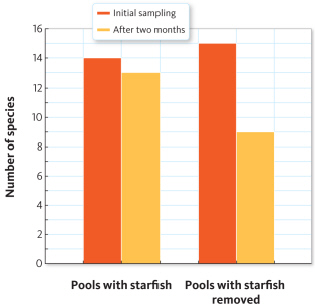
At one of Paine's study sites, the dominant organisms in the tidal pools were mussels, barnacles, whelks, and a species of starfish know as Pisaster ochraceus . These organisms together are a(n) __________.
A) population
B) community
C) ecosystem
D) niche
At one of Paine's study sites, the dominant organisms in the tidal pools were mussels, barnacles, whelks, and a species of starfish know as Pisaster ochraceus . These organisms together are a(n) __________.
A) population
B) community
C) ecosystem
D) niche
سؤال
سؤال
سؤال
Robert Paine was the first biologist to use the term keystone species in the 1960s. He was studying food webs in the rocky, intertidal pools in the Pacific Northwest. At one of his study sites, the dominant organisms in the tidal pools were mussels, barnacles, whelks, and a species of starfish known as Pisaster ochraceus . To examine the relationship between these species, Paine set up an experiment. In one area, he removed all the starfish from the tidal pools, and in an adjacent area, he left the tidal pools as he found them. Prior to removing the starfish, he sampled all the organisms in each pool. After two months, he repeated this sampling. A summary of his results is illustrated in the graph below.
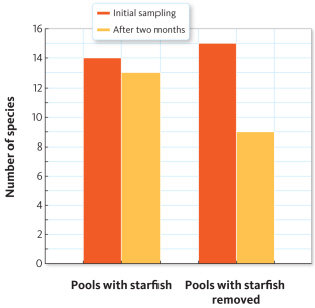
If this was an ecosystem-level study, what additional data might Paine need to collect?
A) predation
B) communication and social groups
C) parasites
D) light levels
If this was an ecosystem-level study, what additional data might Paine need to collect?
A) predation
B) communication and social groups
C) parasites
D) light levels
سؤال
سؤال
Robert Paine was the first biologist to use the term keystone species in the 1960s. He was studying food webs in the rocky, intertidal pools in the Pacific Northwest. At one of his study sites, the dominant organisms in the tidal pools were mussels, barnacles, whelks, and a species of starfish known as Pisaster ochraceus . To examine the relationship between these species, Paine set up an experiment. In one area, he removed all the starfish from the tidal pools, and in an adjacent area, he left the tidal pools as he found them. Prior to removing the starfish, he sampled all the organisms in each pool. After two months, he repeated this sampling. A summary of his results is illustrated in the graph below.
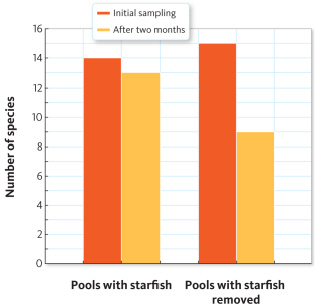
Based on these results, would you consider the starfish to be a keystone predator?
A) Yes, because when they are removed, biodiversity declines.
B) No, because when they are removed, biodiversity declines.
C) Yes, their presence results in higher levels of predation.
D) No, they have little or no impact on the other organisms.
Based on these results, would you consider the starfish to be a keystone predator?
A) Yes, because when they are removed, biodiversity declines.
B) No, because when they are removed, biodiversity declines.
C) Yes, their presence results in higher levels of predation.
D) No, they have little or no impact on the other organisms.
سؤال
سؤال
Robert Paine was the first biologist to use the term keystone species in the 1960s. He was studying food webs in the rocky, intertidal pools in the Pacific Northwest. At one of his study sites, the dominant organisms in the tidal pools were mussels, barnacles, whelks, and a species of starfish known as Pisaster ochraceus . To examine the relationship between these species, Paine set up an experiment. In one area, he removed all the starfish from the tidal pools, and in an adjacent area, he left the tidal pools as he found them. Prior to removing the starfish, he sampled all the organisms in each pool. After two months, he repeated this sampling. A summary of his results is illustrated in the graph below.
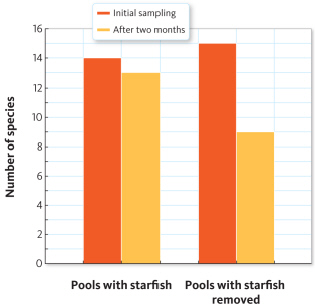
In Paine's study, the starfish are the top predators in this system and eat each of the other species mentioned. Whelks eat both mussels and barnacles, while both mussels and barnacles are filter feeders that feed on small particles in the water, including algae and other autotrophs. In terms of the number of organisms, you would expect __________ to have the highest number of individuals.
A) mussels
B) whelks
C) starfish
D) both whelks and starfish
In Paine's study, the starfish are the top predators in this system and eat each of the other species mentioned. Whelks eat both mussels and barnacles, while both mussels and barnacles are filter feeders that feed on small particles in the water, including algae and other autotrophs. In terms of the number of organisms, you would expect __________ to have the highest number of individuals.
A) mussels
B) whelks
C) starfish
D) both whelks and starfish
سؤال
Robert Paine was the first biologist to use the term keystone species in the 1960s. He was studying food webs in the rocky, intertidal pools in the Pacific Northwest. At one of his study sites, the dominant organisms in the tidal pools were mussels, barnacles, whelks, and a species of starfish known as Pisaster ochraceus . To examine the relationship between these species, Paine set up an experiment. In one area, he removed all the starfish from the tidal pools, and in an adjacent area, he left the tidal pools as he found them. Prior to removing the starfish, he sampled all the organisms in each pool. After two months, he repeated this sampling. A summary of his results is illustrated in the graph below.
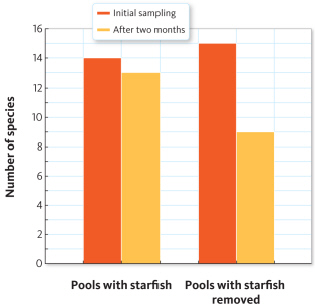
After two months, Paine repeated the sampling. In this experiment, he is sampling the __________.
A) biodiversity
B) first trophic level
C) energy pyramids
D) ecological niche
After two months, Paine repeated the sampling. In this experiment, he is sampling the __________.
A) biodiversity
B) first trophic level
C) energy pyramids
D) ecological niche
سؤال
سؤال
سؤال
سؤال
سؤال
سؤال
سؤال
سؤال
Robert Paine was the first biologist to use the term keystone species in the 1960s. He was studying food webs in the rocky, intertidal pools in the Pacific Northwest. At one of his study sites, the dominant organisms in the tidal pools were mussels, barnacles, whelks, and a species of starfish known as Pisaster ochraceus . To examine the relationship between these species, Paine set up an experiment. In one area, he removed all the starfish from the tidal pools, and in an adjacent area, he left the tidal pools as he found them. Prior to removing the starfish, he sampled all the organisms in each pool. After two months, he repeated this sampling. A summary of his results is illustrated in the graph below.
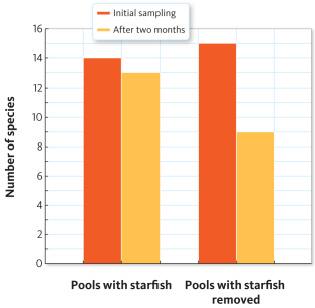
The control group in Paine's study is __________.
A) the tidal pools from which starfish were removed
B) the tidal pools from which starfish were not removed
C) all tidal pools included in the study
The control group in Paine's study is __________.
A) the tidal pools from which starfish were removed
B) the tidal pools from which starfish were not removed
C) all tidal pools included in the study
سؤال
سؤال
Robert Paine was the first biologist to use the term keystone species in the 1960s. He was studying food webs in the rocky, intertidal pools in the Pacific Northwest. At one of his study sites, the dominant organisms in the tidal pools were mussels, barnacles, whelks, and a species of starfish known as Pisaster ochraceus . To examine the relationship between these species, Paine set up an experiment. In one area, he removed all the starfish from the tidal pools, and in an adjacent area, he left the tidal pools as he found them. Prior to removing the starfish, he sampled all the organisms in each pool. After two months, he repeated this sampling. A summary of his results is illustrated in the graph below.
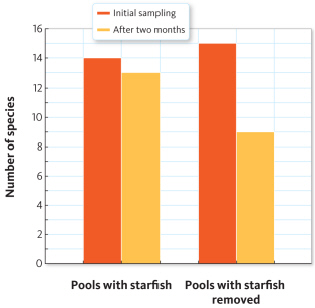
As mussels and barnacles feed, how much of the energy that they take in from food is available to the whelks that eat them?
A) 10 percent
B) 90 percent
C) 1000 calories
D) 10,000 calories
As mussels and barnacles feed, how much of the energy that they take in from food is available to the whelks that eat them?
A) 10 percent
B) 90 percent
C) 1000 calories
D) 10,000 calories

فتح الحزمة
قم بالتسجيل لفتح البطاقات في هذه المجموعة!
Unlock Deck
Unlock Deck
1/41

العب

ملء الشاشة (f)
Deck 5: Ecological Interactions Among Organisms
1
A researcher surveys the number of salamanders in a population in Michigan each year. Over a 10-year period, the number of individuals that she counts in the population varies. This count of individuals refers to the __________.
A) carrying capacity
B) niche
C) species diversity
D) resource partitioning
A) carrying capacity
B) niche
C) species diversity
D) resource partitioning
A
2
Interspecific competition includes all of the following EXCEPT competition for __________.
A) mates
B) food
C) habitat
D) water
A) mates
B) food
C) habitat
D) water
A
3
Susan is studying tree growth in two regions that have been logged. One site was logged 10 years previously, and the second was logged two years prior to her study. In each of these study areas, she counts the number and types of trees that have a diameter greater than 5 cm. At the first site, she finds 10 scotch pines, 20 oak trees, and 5 dogwoods. At the second site she records 15 oak trees and 10 maple trees. Based solely on the trees in Susan's study, which site represents the greater species diversity?
A) site 1
B) site 2
A) site 1
B) site 2
A
4
In a simple laboratory experiment, a researcher maintained two different species of single-celled protists, Paramecium caudatum and Paramecium aurelia . He recorded population growth of each species individually and then mixed a similar number of individuals from each population and recorded their growth rates when living together. The graphs below represent the results of this experiment.
Based on the graph of the mixed culture, what can you determine about the niche for each individual species?
A) There is a large amount of niche overlap.
B) There is minimal niche overlap.
C) Competition for resources is partitioning the available niches.
D) Intraspecific competition is reducing niche overlap.
Based on the graph of the mixed culture, what can you determine about the niche for each individual species?
A) There is a large amount of niche overlap.
B) There is minimal niche overlap.
C) Competition for resources is partitioning the available niches.
D) Intraspecific competition is reducing niche overlap.
فتح الحزمة
افتح القفل للوصول البطاقات البالغ عددها 41 في هذه المجموعة.
فتح الحزمة
k this deck
5
A flock of flamingos wading and feeding in a lake is an example of a(n) __________.
A) organism
B) population
C) community
D) ecosystem
A) organism
B) population
C) community
D) ecosystem
فتح الحزمة
افتح القفل للوصول البطاقات البالغ عددها 41 في هذه المجموعة.
فتح الحزمة
k this deck
6
In a simple laboratory experiment, a researcher maintained two different species of single-celled protists, Paramecium caudatum and Paramecium aurelia . He recorded population growth of each species individually and then mixed a similar number of individuals from each population and recorded their growth rates when living together. The graphs below represent the results of this experiment.
This example represents what type of competition?
A) intraspecific
B) interspecific
This example represents what type of competition?
A) intraspecific
B) interspecific
فتح الحزمة
افتح القفل للوصول البطاقات البالغ عددها 41 في هذه المجموعة.
فتح الحزمة
k this deck
7
In a simple laboratory experiment, a researcher maintained two different species of single-celled protists, Paramecium caudatum and Paramecium aurelia . He recorded population growth of each species individually and then mixed a similar number of individuals from each population and recorded their growth rates when living together. The graphs below represent the results of this experiment.
Based on the graph of the mixed culture, what is happening?
A) formation of a dominance hierarchy
B) interspecific competition
C) resource partitioning
D) an increase in species diversity
Based on the graph of the mixed culture, what is happening?
A) formation of a dominance hierarchy
B) interspecific competition
C) resource partitioning
D) an increase in species diversity
فتح الحزمة
افتح القفل للوصول البطاقات البالغ عددها 41 في هذه المجموعة.
فتح الحزمة
k this deck
8
A researcher surveys the number of salamanders in a population in Michigan each year. Over a 10-year period, the number of individuals that she counts in the population varies. Which of the following might explain the variation in this count from year to year?
A) annual weather conditions
B) competition
C) species diversity
D) annual weather conditions and competition
A) annual weather conditions
B) competition
C) species diversity
D) annual weather conditions and competition
فتح الحزمة
افتح القفل للوصول البطاقات البالغ عددها 41 في هذه المجموعة.
فتح الحزمة
k this deck
9
If you pick up a handful of soil from your garden, everything you are holding in your hand represents a(n) __________.
A) organism
B) population
C) community
D) ecosystem
A) organism
B) population
C) community
D) ecosystem
فتح الحزمة
افتح القفل للوصول البطاقات البالغ عددها 41 في هذه المجموعة.
فتح الحزمة
k this deck
10
The image below represents the termites, bacteria, and protists that together share a mutualistic relationship.
These organisms, which all live together, would be considered a(n) __________.
A) organism
B) population
C) community
D) ecosystem
These organisms, which all live together, would be considered a(n) __________.
A) organism
B) population
C) community
D) ecosystem
فتح الحزمة
افتح القفل للوصول البطاقات البالغ عددها 41 في هذه المجموعة.
فتح الحزمة
k this deck
11
The carrying capacity for a specific population remains constant.
A) True, this represents the number of individuals that the environment can support.
B) False, this does not represent the total number of individuals that an environment can support.
C) True, each year some organisms die and others are produced.
D) False, habitats and environments are not constant, unchanging entities.
A) True, this represents the number of individuals that the environment can support.
B) False, this does not represent the total number of individuals that an environment can support.
C) True, each year some organisms die and others are produced.
D) False, habitats and environments are not constant, unchanging entities.
فتح الحزمة
افتح القفل للوصول البطاقات البالغ عددها 41 في هذه المجموعة.
فتح الحزمة
k this deck
12
In Chapter 3, you learned about the evolution of the 14 finch-like species on the Galapagos Islands. As shown in the figure below, each species has a different beak shape; thus, each species is adapted to feeding on different food sources.
Which of the following statements is true about the Galapagos finches?
A) Because of the different beak shapes, there is little niche overlap.
B) Interspecific competition has eliminated niche overlap.
C) Because of niche overlap, a dominance hierarchy has been established.
D) Intraspecific competition is likely minimal because of the differences in beak shape.
Which of the following statements is true about the Galapagos finches?
A) Because of the different beak shapes, there is little niche overlap.
B) Interspecific competition has eliminated niche overlap.
C) Because of niche overlap, a dominance hierarchy has been established.
D) Intraspecific competition is likely minimal because of the differences in beak shape.
فتح الحزمة
افتح القفل للوصول البطاقات البالغ عددها 41 في هذه المجموعة.
فتح الحزمة
k this deck
13
Among Madagascar hissing cockroaches, males have horns that they use to fight with one another for access to mates. Typically, the largest male with the biggest horns wins most of the fights and tends to mate with most of the females. This is an example of __________.
A) dominance hierarchy
B) intraspecific competition
C) niche partitioning
D) all of these
E) both dominance hierarchy and intraspecific competition
A) dominance hierarchy
B) intraspecific competition
C) niche partitioning
D) all of these
E) both dominance hierarchy and intraspecific competition
فتح الحزمة
افتح القفل للوصول البطاقات البالغ عددها 41 في هذه المجموعة.
فتح الحزمة
k this deck
14
Which of the following is an example of resource competition?
A) male garter snakes vying for access to females
B) cardinals and starlings fighting over seeds in a bird feeder
C) interactions between parasites and their host
D) lions hiding near a water hole to capture prey
A) male garter snakes vying for access to females
B) cardinals and starlings fighting over seeds in a bird feeder
C) interactions between parasites and their host
D) lions hiding near a water hole to capture prey
فتح الحزمة
افتح القفل للوصول البطاقات البالغ عددها 41 في هذه المجموعة.
فتح الحزمة
k this deck
15
In a simple laboratory experiment, a researcher maintained two different species of single-celled protists, Paramecium caudatum and Paramecium aurelia . He recorded population growth of each species individually and then mixed a similar number of individuals from each population and recorded their growth rates when living together. The graphs below represent the results of this experiment.
What is the carrying capacity for P. caudatum alone?
A) ~200
B) ~100
C) ~50
D) cannot be determined from graph
What is the carrying capacity for P. caudatum alone?
A) ~200
B) ~100
C) ~50
D) cannot be determined from graph
فتح الحزمة
افتح القفل للوصول البطاقات البالغ عددها 41 في هذه المجموعة.
فتح الحزمة
k this deck
16
In Chapter 3, you learned about the evolution of the 14 finch-like species on the Galapagos Islands. As shown in the figure below, each species has a different beak shape; thus, each species is adapted to feeding on different food sources.
These changes are a result of __________.
A) resource partitioning
B) ecological niche
C) dominance hierarchy
D) mutualism
These changes are a result of __________.
A) resource partitioning
B) ecological niche
C) dominance hierarchy
D) mutualism
فتح الحزمة
افتح القفل للوصول البطاقات البالغ عددها 41 في هذه المجموعة.
فتح الحزمة
k this deck
17
The image below represents the termites, bacteria, and protists that together share a mutualistic relationship.
How many domains are represented?
A) one
B) two
C) three
D) four
How many domains are represented?
A) one
B) two
C) three
D) four
فتح الحزمة
افتح القفل للوصول البطاقات البالغ عددها 41 في هذه المجموعة.
فتح الحزمة
k this deck
18
In spring, red-winged blackbird males return to their summer grounds where they compete for territories prior to the arrival of females. This is an example of __________.
A) resource partitioning
B) intraspecific competition
C) niche overlap
D) dominance hierarchy
A) resource partitioning
B) intraspecific competition
C) niche overlap
D) dominance hierarchy
فتح الحزمة
افتح القفل للوصول البطاقات البالغ عددها 41 في هذه المجموعة.
فتح الحزمة
k this deck
19
Susan is studying tree growth in two regions that have been logged. One site was logged 10 years previously, and the second was logged two years prior to her study. In each of these study areas, she counts the number and types of trees that have a diameter greater than 5 cm. At the first site, she finds 10 scotch pines, 20 oak trees, and 5 dogwoods. At the second site she records 15 oak trees and 10 maple trees. Her study includes _____ organisms, _____ populations, and _____ communities.
A) 60; 3; 2
B) 3; 2; 60
C) 2; 3; 60
D) 60; 2; 3
A) 60; 3; 2
B) 3; 2; 60
C) 2; 3; 60
D) 60; 2; 3
فتح الحزمة
افتح القفل للوصول البطاقات البالغ عددها 41 في هذه المجموعة.
فتح الحزمة
k this deck
20
Lions are heterotrophic carnivores living on the African savannah. They live in prides with several females and a dominant male. Mating occurs in the summer. This describes the organism's __________.
A) habitat
B) niche
C) food web
D) carrying capacity
A) habitat
B) niche
C) food web
D) carrying capacity
فتح الحزمة
افتح القفل للوصول البطاقات البالغ عددها 41 في هذه المجموعة.
فتح الحزمة
k this deck
21
Which of the following is a disadvantage of living in social groups?
A) disease transmission
B) interspecific competition
C) coevolution
D) communication
A) disease transmission
B) interspecific competition
C) coevolution
D) communication
فتح الحزمة
افتح القفل للوصول البطاقات البالغ عددها 41 في هذه المجموعة.
فتح الحزمة
k this deck
22
The ultimate source(s) of energy, on which all living organisms depend, is(are) __________.
A) the sun
B) autotrophs
C) primary producers
D) the first trophic level
A) the sun
B) autotrophs
C) primary producers
D) the first trophic level
فتح الحزمة
افتح القفل للوصول البطاقات البالغ عددها 41 في هذه المجموعة.
فتح الحزمة
k this deck
23
Robert Paine was the first biologist to use the term keystone species in the 1960s. He was studying food webs in the rocky, intertidal pools in the Pacific Northwest. At one of his study sites, the dominant organisms in the tidal pools were mussels, barnacles, whelks, and a species of starfish known as Pisaster ochraceus . To examine the relationship between these species, Paine set up an experiment. In one area, he removed all the starfish from the tidal pools, and in an adjacent area, he left the tidal pools as he found them. Prior to removing the starfish, he sampled all the organisms in each pool. After two months, he repeated this sampling. A summary of his results is illustrated in the graph below.
At one of Paine's study sites, the dominant organisms in the tidal pools were mussels, barnacles, whelks, and a species of starfish know as Pisaster ochraceus . These organisms together are a(n) __________.
A) population
B) community
C) ecosystem
D) niche
At one of Paine's study sites, the dominant organisms in the tidal pools were mussels, barnacles, whelks, and a species of starfish know as Pisaster ochraceus . These organisms together are a(n) __________.
A) population
B) community
C) ecosystem
D) niche
فتح الحزمة
افتح القفل للوصول البطاقات البالغ عددها 41 في هذه المجموعة.
فتح الحزمة
k this deck
24
A beetle that feeds on the leaves of sunflowers is eaten by a spider. Possums will eat both beetles and spiders. If these organisms were represented in an energy pyramid, which group would have the smallest number of organisms?
A) sunflowers
B) beetles
C) spiders
D) possums
A) sunflowers
B) beetles
C) spiders
D) possums
فتح الحزمة
افتح القفل للوصول البطاقات البالغ عددها 41 في هذه المجموعة.
فتح الحزمة
k this deck
25
If you own a dog, each year, depending on the region where you live, you will need to buy medication that treats roundworms and ticks and fleas. These organisms live either internally or externally on dogs and obtain all their nutrients from the dog. In some cases, dogs are harmed due to these interactions. This describes a __________ relationship.
A) commensal
B) mutualistic
C) parasitic
D) tertiary
A) commensal
B) mutualistic
C) parasitic
D) tertiary
فتح الحزمة
افتح القفل للوصول البطاقات البالغ عددها 41 في هذه المجموعة.
فتح الحزمة
k this deck
26
Robert Paine was the first biologist to use the term keystone species in the 1960s. He was studying food webs in the rocky, intertidal pools in the Pacific Northwest. At one of his study sites, the dominant organisms in the tidal pools were mussels, barnacles, whelks, and a species of starfish known as Pisaster ochraceus . To examine the relationship between these species, Paine set up an experiment. In one area, he removed all the starfish from the tidal pools, and in an adjacent area, he left the tidal pools as he found them. Prior to removing the starfish, he sampled all the organisms in each pool. After two months, he repeated this sampling. A summary of his results is illustrated in the graph below.
If this was an ecosystem-level study, what additional data might Paine need to collect?
A) predation
B) communication and social groups
C) parasites
D) light levels
If this was an ecosystem-level study, what additional data might Paine need to collect?
A) predation
B) communication and social groups
C) parasites
D) light levels
فتح الحزمة
افتح القفل للوصول البطاقات البالغ عددها 41 في هذه المجموعة.
فتح الحزمة
k this deck
27
A beetle that feeds on the leaves of sunflowers is eaten by a spider. Possums will eat both beetles and spiders. The second trophic level in this food web would be filled by the __________.
A) beetle
B) spider
C) possum
D) spider and possum
A) beetle
B) spider
C) possum
D) spider and possum
فتح الحزمة
افتح القفل للوصول البطاقات البالغ عددها 41 في هذه المجموعة.
فتح الحزمة
k this deck
28
Robert Paine was the first biologist to use the term keystone species in the 1960s. He was studying food webs in the rocky, intertidal pools in the Pacific Northwest. At one of his study sites, the dominant organisms in the tidal pools were mussels, barnacles, whelks, and a species of starfish known as Pisaster ochraceus . To examine the relationship between these species, Paine set up an experiment. In one area, he removed all the starfish from the tidal pools, and in an adjacent area, he left the tidal pools as he found them. Prior to removing the starfish, he sampled all the organisms in each pool. After two months, he repeated this sampling. A summary of his results is illustrated in the graph below.
Based on these results, would you consider the starfish to be a keystone predator?
A) Yes, because when they are removed, biodiversity declines.
B) No, because when they are removed, biodiversity declines.
C) Yes, their presence results in higher levels of predation.
D) No, they have little or no impact on the other organisms.
Based on these results, would you consider the starfish to be a keystone predator?
A) Yes, because when they are removed, biodiversity declines.
B) No, because when they are removed, biodiversity declines.
C) Yes, their presence results in higher levels of predation.
D) No, they have little or no impact on the other organisms.
فتح الحزمة
افتح القفل للوصول البطاقات البالغ عددها 41 في هذه المجموعة.
فتح الحزمة
k this deck
29
The Saguaro cactus is a large cactus found in some southwestern desert environments. It plays a central role in providing habitat for a variety of other species, and if these cacti die or are removed from the ecosystem, biodiversity declines. Thus, the Saguaro cactus is a __________.
A) keystone species
B) tertiary consumer
C) generalist
D) trophic level
A) keystone species
B) tertiary consumer
C) generalist
D) trophic level
فتح الحزمة
افتح القفل للوصول البطاقات البالغ عددها 41 في هذه المجموعة.
فتح الحزمة
k this deck
30
Robert Paine was the first biologist to use the term keystone species in the 1960s. He was studying food webs in the rocky, intertidal pools in the Pacific Northwest. At one of his study sites, the dominant organisms in the tidal pools were mussels, barnacles, whelks, and a species of starfish known as Pisaster ochraceus . To examine the relationship between these species, Paine set up an experiment. In one area, he removed all the starfish from the tidal pools, and in an adjacent area, he left the tidal pools as he found them. Prior to removing the starfish, he sampled all the organisms in each pool. After two months, he repeated this sampling. A summary of his results is illustrated in the graph below.
In Paine's study, the starfish are the top predators in this system and eat each of the other species mentioned. Whelks eat both mussels and barnacles, while both mussels and barnacles are filter feeders that feed on small particles in the water, including algae and other autotrophs. In terms of the number of organisms, you would expect __________ to have the highest number of individuals.
A) mussels
B) whelks
C) starfish
D) both whelks and starfish
In Paine's study, the starfish are the top predators in this system and eat each of the other species mentioned. Whelks eat both mussels and barnacles, while both mussels and barnacles are filter feeders that feed on small particles in the water, including algae and other autotrophs. In terms of the number of organisms, you would expect __________ to have the highest number of individuals.
A) mussels
B) whelks
C) starfish
D) both whelks and starfish
فتح الحزمة
افتح القفل للوصول البطاقات البالغ عددها 41 في هذه المجموعة.
فتح الحزمة
k this deck
31
Robert Paine was the first biologist to use the term keystone species in the 1960s. He was studying food webs in the rocky, intertidal pools in the Pacific Northwest. At one of his study sites, the dominant organisms in the tidal pools were mussels, barnacles, whelks, and a species of starfish known as Pisaster ochraceus . To examine the relationship between these species, Paine set up an experiment. In one area, he removed all the starfish from the tidal pools, and in an adjacent area, he left the tidal pools as he found them. Prior to removing the starfish, he sampled all the organisms in each pool. After two months, he repeated this sampling. A summary of his results is illustrated in the graph below.
After two months, Paine repeated the sampling. In this experiment, he is sampling the __________.
A) biodiversity
B) first trophic level
C) energy pyramids
D) ecological niche
After two months, Paine repeated the sampling. In this experiment, he is sampling the __________.
A) biodiversity
B) first trophic level
C) energy pyramids
D) ecological niche
فتح الحزمة
افتح القفل للوصول البطاقات البالغ عددها 41 في هذه المجموعة.
فتح الحزمة
k this deck
32
Spiders are predators that will eat just about any animal they can subdue. A spider that feeds on crickets is thus a __________.
A) specialist and tertiary consumer
B) generalist and tertiary producer
C) specialist and secondary consumer
D) generalist and secondary producer
A) specialist and tertiary consumer
B) generalist and tertiary producer
C) specialist and secondary consumer
D) generalist and secondary producer
فتح الحزمة
افتح القفل للوصول البطاقات البالغ عددها 41 في هذه المجموعة.
فتح الحزمة
k this deck
33
A beetle that feeds on the leaves of sunflowers is eaten by a spider. Possums will eat both beetles and spiders. If the sunflowers represent 2400 calories, how many calories would be available at the level of the possums that eat spiders?
A) 10
B) 2.4
C) 24
D) 1000
A) 10
B) 2.4
C) 24
D) 1000
فتح الحزمة
افتح القفل للوصول البطاقات البالغ عددها 41 في هذه المجموعة.
فتح الحزمة
k this deck
34
A beetle that feeds on the leaves of sunflowers is eaten by a spider. Possums will eat both beetles and spiders. The secondary consumers in this food web is(are) the __________.
A) spider
B) beetle
C) possum
D) spider and possum
A) spider
B) beetle
C) possum
D) spider and possum
فتح الحزمة
افتح القفل للوصول البطاقات البالغ عددها 41 في هذه المجموعة.
فتح الحزمة
k this deck
35
Some species of bean bug, which are common pests on soybean plants, can acquire resistance to a common herbicide by nurturing protective bacteria in their gut. The bacteria grow well in the gut, do not cause any harm, and receive all their nutrients from the bean bug. This is an example of __________.
A) commensalism
B) mutualism
C) predation
D) parasitism
A) commensalism
B) mutualism
C) predation
D) parasitism
فتح الحزمة
افتح القفل للوصول البطاقات البالغ عددها 41 في هذه المجموعة.
فتح الحزمة
k this deck
36
A beetle that feeds on the leaves of sunflowers is eaten by a spider. Possums will eat both beetles and spiders. In this food web, the sunflower is __________.
A) the primary producer
B) the primary consumer
C) the autotroph
D) both the primary producer and autotroph
A) the primary producer
B) the primary consumer
C) the autotroph
D) both the primary producer and autotroph
فتح الحزمة
افتح القفل للوصول البطاقات البالغ عددها 41 في هذه المجموعة.
فتح الحزمة
k this deck
37
Which of the following forms of communication do not rely on vision?
A) tactile
B) pheromones
C) mutualism
D) both tactile and pheromones
A) tactile
B) pheromones
C) mutualism
D) both tactile and pheromones
فتح الحزمة
افتح القفل للوصول البطاقات البالغ عددها 41 في هذه المجموعة.
فتح الحزمة
k this deck
38
Certain types of mites can often be found attached to insects such as cockroaches and beetles. Often they are found around the mouth regions of their host, and they feed on any food particles around the mouth of the insect. This is likely what type of relationship?
A) commensalism
B) mutualism
C) parasitism
D) predation
A) commensalism
B) mutualism
C) parasitism
D) predation
فتح الحزمة
افتح القفل للوصول البطاقات البالغ عددها 41 في هذه المجموعة.
فتح الحزمة
k this deck
39
Robert Paine was the first biologist to use the term keystone species in the 1960s. He was studying food webs in the rocky, intertidal pools in the Pacific Northwest. At one of his study sites, the dominant organisms in the tidal pools were mussels, barnacles, whelks, and a species of starfish known as Pisaster ochraceus . To examine the relationship between these species, Paine set up an experiment. In one area, he removed all the starfish from the tidal pools, and in an adjacent area, he left the tidal pools as he found them. Prior to removing the starfish, he sampled all the organisms in each pool. After two months, he repeated this sampling. A summary of his results is illustrated in the graph below.
The control group in Paine's study is __________.
A) the tidal pools from which starfish were removed
B) the tidal pools from which starfish were not removed
C) all tidal pools included in the study
The control group in Paine's study is __________.
A) the tidal pools from which starfish were removed
B) the tidal pools from which starfish were not removed
C) all tidal pools included in the study
فتح الحزمة
افتح القفل للوصول البطاقات البالغ عددها 41 في هذه المجموعة.
فتح الحزمة
k this deck
40
A beetle that feeds on the leaves of sunflowers is eaten by a spider. Possums will eat both beetles and spiders. If the sunflowers represent 2400 calories, how many calories would be lost as heat as you move from the first to the second trophic level?
A) 240
B) 2160
C) 90
D) 10
A) 240
B) 2160
C) 90
D) 10
فتح الحزمة
افتح القفل للوصول البطاقات البالغ عددها 41 في هذه المجموعة.
فتح الحزمة
k this deck
41
Robert Paine was the first biologist to use the term keystone species in the 1960s. He was studying food webs in the rocky, intertidal pools in the Pacific Northwest. At one of his study sites, the dominant organisms in the tidal pools were mussels, barnacles, whelks, and a species of starfish known as Pisaster ochraceus . To examine the relationship between these species, Paine set up an experiment. In one area, he removed all the starfish from the tidal pools, and in an adjacent area, he left the tidal pools as he found them. Prior to removing the starfish, he sampled all the organisms in each pool. After two months, he repeated this sampling. A summary of his results is illustrated in the graph below.
As mussels and barnacles feed, how much of the energy that they take in from food is available to the whelks that eat them?
A) 10 percent
B) 90 percent
C) 1000 calories
D) 10,000 calories
As mussels and barnacles feed, how much of the energy that they take in from food is available to the whelks that eat them?
A) 10 percent
B) 90 percent
C) 1000 calories
D) 10,000 calories
فتح الحزمة
افتح القفل للوصول البطاقات البالغ عددها 41 في هذه المجموعة.
فتح الحزمة
k this deck
فتح الحزمة
افتح القفل للوصول البطاقات البالغ عددها 41 في هذه المجموعة.






