







 تكلم مع الذكاء الاصطناعي


Deck 20: International Trade
ملء الشاشة (f)

سؤال

سؤال
سؤال
سؤال
سؤال
سؤال
سؤال
سؤال
سؤال
سؤال
Exhibit 34-1 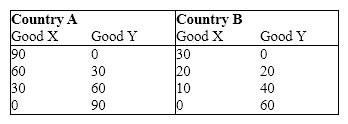 Refer to Exhibit 34-1. The opportunity cost of one unit of Y in country A is
A)1 unit of X.
B)0.75 units of X.
C)2 units of X.
D)10 units of X.
Refer to Exhibit 34-1. The opportunity cost of one unit of Y in country A isA)1 unit of X.
B)0.75 units of X.
C)2 units of X.
D)10 units of X.
سؤال
سؤال
سؤال
سؤال
سؤال
سؤال
سؤال
سؤال
سؤال
سؤال
سؤال
سؤال
Exhibit 34-1 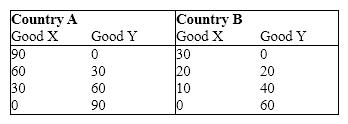 Refer to Exhibit 34-1. The opportunity cost of one unit of X in country B is
A)1 unit of Y.
B)0.33 units of Y.
C)2 units of Y.
D)20 units of Y.
Refer to Exhibit 34-1. The opportunity cost of one unit of X in country B isA)1 unit of Y.
B)0.33 units of Y.
C)2 units of Y.
D)20 units of Y.
سؤال
Exhibit 34-1 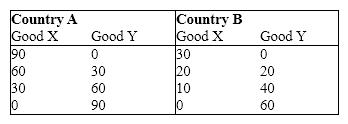 Refer to Exhibit 34-1. Considering the data, which of the following terms of trade would both countries agree to?
A)1 unit of X for 2 units of Y
B)1 unit of X for 3 units of Y
C)1 unit of X for 1 unit of Y
D)1 unit of X for 1.50 units of Y
Refer to Exhibit 34-1. Considering the data, which of the following terms of trade would both countries agree to?A)1 unit of X for 2 units of Y
B)1 unit of X for 3 units of Y
C)1 unit of X for 1 unit of Y
D)1 unit of X for 1.50 units of Y
سؤال
Exhibit 34-1 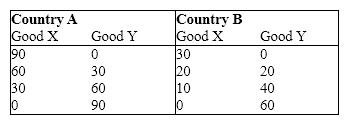 Refer to Exhibit 34-1. Country A is the lower opportunity cost producer of
A)good X.
B)good Y.
C)goods X and Y.
D)neither good X nor good Y.
Refer to Exhibit 34-1. Country A is the lower opportunity cost producer ofA)good X.
B)good Y.
C)goods X and Y.
D)neither good X nor good Y.
سؤال
سؤال
سؤال
سؤال
سؤال
سؤال
Exhibit 34-1 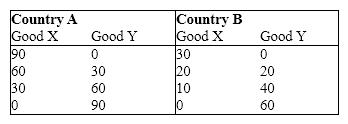 Refer to Exhibit 34-1. The opportunity cost of one unit of X in country A is
A)1 unit of Y.
B)2 units of Y.
C)10 units of Y.
D)0.50 units of Y.
Refer to Exhibit 34-1. The opportunity cost of one unit of X in country A isA)1 unit of Y.
B)2 units of Y.
C)10 units of Y.
D)0.50 units of Y.
سؤال
سؤال
سؤال
سؤال
Exhibit 34-1 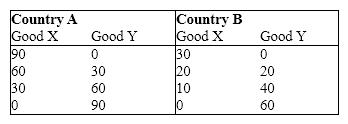 Refer to Exhibit 34-1. Considering the data, which of the following terms of trade would both countries agree to?
A)1 unit of Y for 1 unit of X
B)1 unit of Y for 0.75 units of X
C)1 unit of Y for 0.25 units of X
D)1 unit of Y for 1.50 units of X
Refer to Exhibit 34-1. Considering the data, which of the following terms of trade would both countries agree to?A)1 unit of Y for 1 unit of X
B)1 unit of Y for 0.75 units of X
C)1 unit of Y for 0.25 units of X
D)1 unit of Y for 1.50 units of X
سؤال
سؤال
Exhibit 34-1 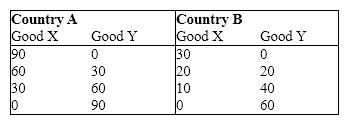 Refer to Exhibit 34-1. The opportunity cost of one unit of Y in country B is
A)0.5 units of X.
B)1 unit of X.
C)2 units of X.
D)20 units of X.
Refer to Exhibit 34-1. The opportunity cost of one unit of Y in country B isA)0.5 units of X.
B)1 unit of X.
C)2 units of X.
D)20 units of X.
سؤال
سؤال
سؤال
Exhibit 34-1 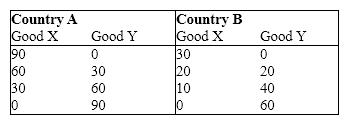
Refer to Exhibit 34-1. Country B is the lower opportunity cost producer of
A)good Y.
B)both goods.
C)neither good.
D)good X.
Refer to Exhibit 34-1. Country B is the lower opportunity cost producer of
A)good Y.
B)both goods.
C)neither good.
D)good X.
سؤال
Exhibit 34-1 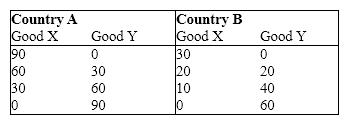 Refer to Exhibit 34-1. If country A is to specialize in the production of one of the two goods (and then trade that good with Country B), which good should it be and why? If Country B is to specialize in the production of one of the two goods (and then trade that good to with Country A), which good should it be and why?
A)Good X for Country A because it is the higher opportunity cost producer of good X; good Y for Country B because it is the higher opportunity cost producer of good Y.
B)Good Y for Country A because it is the lower opportunity cost producer of good Y; good X for Country B because it is the lower opportunity cost producer of good X.
C)Good X for Country A because it is the lower opportunity cost producer of good X; good Y for Country B because it is the lower opportunity cost producer of good Y.
D)Good Y for Country A because it is the higher opportunity cost producer of good Y; good X for Country B because it is the higher opportunity cost producer of good X.
Refer to Exhibit 34-1. If country A is to specialize in the production of one of the two goods (and then trade that good with Country B), which good should it be and why? If Country B is to specialize in the production of one of the two goods (and then trade that good to with Country A), which good should it be and why?A)Good X for Country A because it is the higher opportunity cost producer of good X; good Y for Country B because it is the higher opportunity cost producer of good Y.
B)Good Y for Country A because it is the lower opportunity cost producer of good Y; good X for Country B because it is the lower opportunity cost producer of good X.
C)Good X for Country A because it is the lower opportunity cost producer of good X; good Y for Country B because it is the lower opportunity cost producer of good Y.
D)Good Y for Country A because it is the higher opportunity cost producer of good Y; good X for Country B because it is the higher opportunity cost producer of good X.
سؤال
Exhibit 34-2 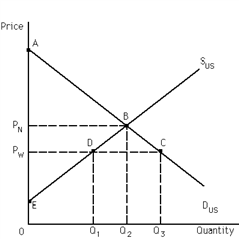
Refer to Exhibit 34-2. The U.S. demand and supply for a good are shown. Under a policy of free trade, the world price is PW. If there is a policy change such that imports are prohibited, the price becomes PN. U.S. producers are better off if imports are __________; specifically, their producers' surplus changes by area __________.
A)permitted; PWDE
B)permitted; PN BDPW
C)prohibited; BDC
D)prohibited; PNBDPW
Refer to Exhibit 34-2. The U.S. demand and supply for a good are shown. Under a policy of free trade, the world price is PW. If there is a policy change such that imports are prohibited, the price becomes PN. U.S. producers are better off if imports are __________; specifically, their producers' surplus changes by area __________.
A)permitted; PWDE
B)permitted; PN BDPW
C)prohibited; BDC
D)prohibited; PNBDPW
سؤال
Exhibit 34-2 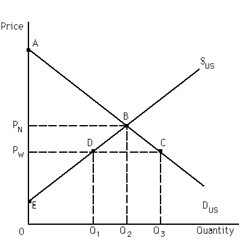
Refer to Exhibit 34-2. The U.S. demand and supply for a good are shown. Under a policy of free trade, the world price is PW. At this price, producers' surplus equals the area of
A)PNBDPW.
B)DBC.
C)PWCBPN.
D)PWDE.
Refer to Exhibit 34-2. The U.S. demand and supply for a good are shown. Under a policy of free trade, the world price is PW. At this price, producers' surplus equals the area of
A)PNBDPW.
B)DBC.
C)PWCBPN.
D)PWDE.
سؤال
سؤال
Exhibit 34-2 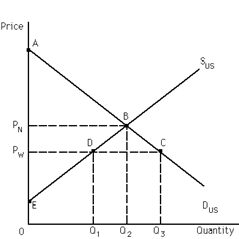
Refer to Exhibit 34-2. The U.S. demand and supply for a good are shown. Under a policy of free trade, where imports are permitted, the world price is PW. If there is a policy change such that imports are prohibited, the price becomes PN, consumers' surplus equals __________ and producers' surplus equals __________.
A)PNAB; PNBE
B)BCD; PNDE
C)PNAD; BCD
D)PNAD; PWBDE
Refer to Exhibit 34-2. The U.S. demand and supply for a good are shown. Under a policy of free trade, where imports are permitted, the world price is PW. If there is a policy change such that imports are prohibited, the price becomes PN, consumers' surplus equals __________ and producers' surplus equals __________.
A)PNAB; PNBE
B)BCD; PNDE
C)PNAD; BCD
D)PNAD; PWBDE
سؤال
Exhibit 34-3 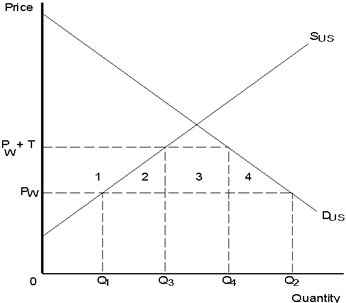
Refer to Exhibit 34-3. The world price is PW. If a tariff is imposed, the price rises to PW + T. Because of the tariff, producers' surplus is __________ by an amount equal to the area of __________.
A)increased; 1 + 2
B)decreased; 1
C)increased; 3 + 4
D)increased; 1
E)decreased; 3
Refer to Exhibit 34-3. The world price is PW. If a tariff is imposed, the price rises to PW + T. Because of the tariff, producers' surplus is __________ by an amount equal to the area of __________.
A)increased; 1 + 2
B)decreased; 1
C)increased; 3 + 4
D)increased; 1
E)decreased; 3
سؤال
سؤال
Exhibit 34-2 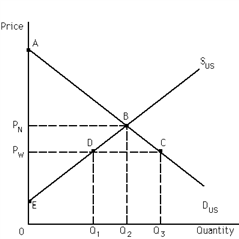
Refer to Exhibit 34-2. The U.S. demand and supply for a good are shown. Under a policy of free trade, the world price is PW. At this price, consumers' surplus equals the area of
A)PW DE.
B)PW AB.
C)PW AC.
D)PW PNBD.
Refer to Exhibit 34-2. The U.S. demand and supply for a good are shown. Under a policy of free trade, the world price is PW. At this price, consumers' surplus equals the area of
A)PW DE.
B)PW AB.
C)PW AC.
D)PW PNBD.
سؤال
سؤال
Exhibit 34-2 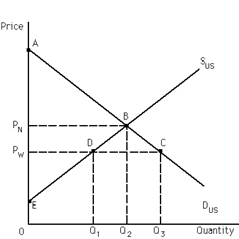
Refer to Exhibit 34-2. The U.S. demand and supply for a good are shown. Under a policy of free trade, the world price is PW. At this price, what quantity of this good do U.S. consumers buy from U.S. producers and what quantity do they import from foreign producers?
A)Q1 from U.S. producers and (Q3 - Q1)from foreign producers
B)Q2 from U.S. producers and (Q3 - Q1)from foreign producers
C)(Q3 - Q1)from U.S. producers and Q1 from foreign producers
D)Q3 from U.S. producers and nothing from foreign producers
Refer to Exhibit 34-2. The U.S. demand and supply for a good are shown. Under a policy of free trade, the world price is PW. At this price, what quantity of this good do U.S. consumers buy from U.S. producers and what quantity do they import from foreign producers?
A)Q1 from U.S. producers and (Q3 - Q1)from foreign producers
B)Q2 from U.S. producers and (Q3 - Q1)from foreign producers
C)(Q3 - Q1)from U.S. producers and Q1 from foreign producers
D)Q3 from U.S. producers and nothing from foreign producers
سؤال
Exhibit 34-3 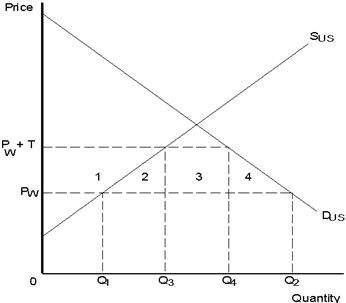
Refer to Exhibit 34-3. The world price is PW. If a tariff is imposed the price rises to PW + T. Because of the tariff, consumers' surplus is reduced by an amount equal to the area of
A)1 + 2 + 3.
B)1 + 2.
C)1 + 2 + 3 + 4.
D)3 + 4.
E)2 + 3 + 4.
Refer to Exhibit 34-3. The world price is PW. If a tariff is imposed the price rises to PW + T. Because of the tariff, consumers' surplus is reduced by an amount equal to the area of
A)1 + 2 + 3.
B)1 + 2.
C)1 + 2 + 3 + 4.
D)3 + 4.
E)2 + 3 + 4.
سؤال
سؤال
سؤال
Exhibit 34-3 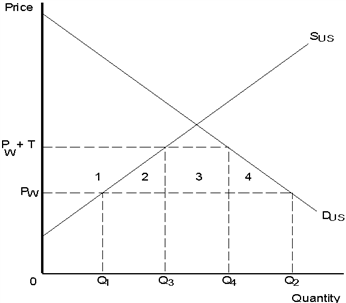
Refer to Exhibit 34-3. The world price is PW. At this price, Americans purchase Q1 from U.S. producers and import the quantity __________ from foreign producers.
A)Q4 - Q1
B)Q2 - Q1
C)Q2 - Q4
D)Q2 - Q3
Refer to Exhibit 34-3. The world price is PW. At this price, Americans purchase Q1 from U.S. producers and import the quantity __________ from foreign producers.
A)Q4 - Q1
B)Q2 - Q1
C)Q2 - Q4
D)Q2 - Q3
سؤال
سؤال
سؤال
سؤال
سؤال
Exhibit 34-2 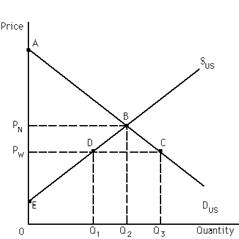
Refer to Exhibit 34-2. The U.S. demand and supply for a good are shown. Under a policy of free trade, the world price is PW. If there is a policy change such that imports are prohibited, the price becomes PN, U.S. consumers are worse off if imports are __________; specifically, their consumers' surplus changes by area __________.
A)prohibited; PWABD
B)permitted; PWDE
C)prohibited; PNBCPW
D)permitted; PN BDPW
Refer to Exhibit 34-2. The U.S. demand and supply for a good are shown. Under a policy of free trade, the world price is PW. If there is a policy change such that imports are prohibited, the price becomes PN, U.S. consumers are worse off if imports are __________; specifically, their consumers' surplus changes by area __________.
A)prohibited; PWABD
B)permitted; PWDE
C)prohibited; PNBCPW
D)permitted; PN BDPW
سؤال
سؤال
Exhibit 34-3 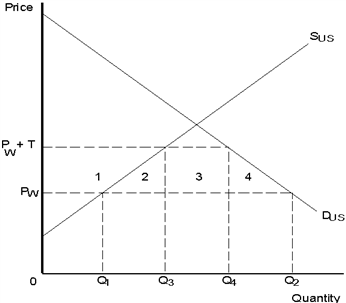
Refer to Exhibit 34-3. The world price is PW. If a tariff is imposed, the price rises to PW + T. Because of the tariff, government collects tariff revenues equal to the area of
A)1.
B)1 + 2.
C)3.
D)1 + 2 + 4.
E)1 + 3.
Refer to Exhibit 34-3. The world price is PW. If a tariff is imposed, the price rises to PW + T. Because of the tariff, government collects tariff revenues equal to the area of
A)1.
B)1 + 2.
C)3.
D)1 + 2 + 4.
E)1 + 3.
سؤال
سؤال
سؤال
سؤال
سؤال
سؤال
Exhibit 34-4 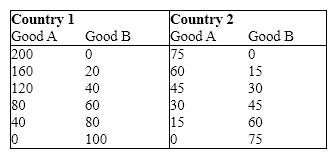 Refer to Exhibit 34-4. The opportunity cost of one unit of good B is __________ for country 1 and __________ for country 2.
A)20A; 15A
B)2A; 1A
C)40A; 15A
D)1\2A; 1A
E)1\40A; 1\15B
Refer to Exhibit 34-4. The opportunity cost of one unit of good B is __________ for country 1 and __________ for country 2.A)20A; 15A
B)2A; 1A
C)40A; 15A
D)1\2A; 1A
E)1\40A; 1\15B
سؤال
Exhibit 34-5 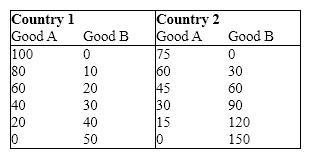 Refer to Exhibit 34-5. The opportunity cost of one unit of good A is __________ for country 1 and __________ for country 2.
A)20B; 15B
B)10B; 15B
C)2B; 1B
D)1\2B; 2B
E)1\10B; 1B
Refer to Exhibit 34-5. The opportunity cost of one unit of good A is __________ for country 1 and __________ for country 2.A)20B; 15B
B)10B; 15B
C)2B; 1B
D)1\2B; 2B
E)1\10B; 1B
سؤال
Exhibit 34-5 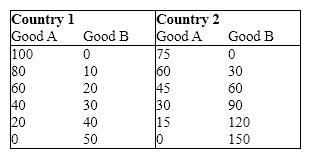 Refer to Exhibit 34-5. The opportunity cost of one unit of good B is __________ for country 1 and __________ for country 2.
A)20A; 15A
B)1\20A; 1\15A
C)10A; 15A
D)1\2A; 1A
E)2A; 1\2A
Refer to Exhibit 34-5. The opportunity cost of one unit of good B is __________ for country 1 and __________ for country 2.A)20A; 15A
B)1\20A; 1\15A
C)10A; 15A
D)1\2A; 1A
E)2A; 1\2A
سؤال
Exhibit 34-6 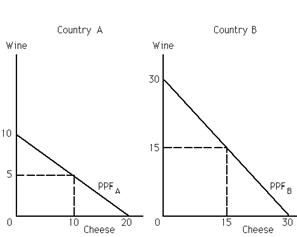
Refer to Exhibit 34-6. The opportunity cost of 1 unit of cheese in terms of units of wine is __________ for country A.
A)1\2
B)2
C)10
D)5
Refer to Exhibit 34-6. The opportunity cost of 1 unit of cheese in terms of units of wine is __________ for country A.
A)1\2
B)2
C)10
D)5
سؤال
سؤال
سؤال
سؤال
سؤال
سؤال
Exhibit 34-4 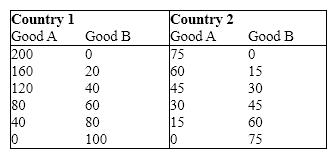 Refer to Exhibit 34-4. Country 1 has a comparative advantage in the production of __________, and country 2 has a comparative advantage in the production of __________.
A)good A; good B
B)good B; good A
C)both goods; neither good
D)neither good; both goods
E)neither good; neither good
Refer to Exhibit 34-4. Country 1 has a comparative advantage in the production of __________, and country 2 has a comparative advantage in the production of __________.A)good A; good B
B)good B; good A
C)both goods; neither good
D)neither good; both goods
E)neither good; neither good
سؤال
Exhibit 34-4 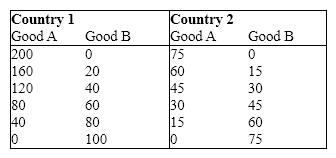 Refer to Exhibit 34-4. The opportunity cost of one unit of good A is __________ for country 1 and __________ for country 2.
A)20B; 15B
B)2B; 1B
C)40B; 15B
D)1\2B; 1B
E)1\20B; 1\15B
Refer to Exhibit 34-4. The opportunity cost of one unit of good A is __________ for country 1 and __________ for country 2.A)20B; 15B
B)2B; 1B
C)40B; 15B
D)1\2B; 1B
E)1\20B; 1\15B
سؤال
سؤال
سؤال
سؤال
Exhibit 34-5 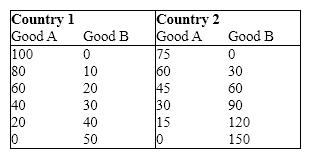 Refer to Exhibit 34-5. Country 1 has a comparative advantage in the production of __________, and country 2 has a comparative advantage in the production of __________.
A)good A; good B
B)good B; good A
C)both goods; neither good
D)neither good; both goods
E)neither good; neither good
Refer to Exhibit 34-5. Country 1 has a comparative advantage in the production of __________, and country 2 has a comparative advantage in the production of __________.A)good A; good B
B)good B; good A
C)both goods; neither good
D)neither good; both goods
E)neither good; neither good

فتح الحزمة
قم بالتسجيل لفتح البطاقات في هذه المجموعة!
Unlock Deck
Unlock Deck
1/153

العب

ملء الشاشة (f)
Deck 20: International Trade
1
Alexander Hamilton used the infant-industry argument to support trade restrictions.
True
2
Dumping occurs when a firm sells goods abroad at a price below their cost and below the price charged in their domestic market.
True
3
The law of comparative advantage can be used to explain why many couples divide up their household duties along gender lines.
True
4
The national defense argument has been used in the past to justify trade restrictions by firms in the peanut industry and the pottery industry.
فتح الحزمة
افتح القفل للوصول البطاقات البالغ عددها 153 في هذه المجموعة.
فتح الحزمة
k this deck
5
When countries engage in specialization and international trade, every individual person in those countries will gain.
فتح الحزمة
افتح القفل للوصول البطاقات البالغ عددها 153 في هذه المجموعة.
فتح الحزمة
k this deck
6
One of the arguments in favor of trade restrictions is the foreign export subsidies argument.
فتح الحزمة
افتح القفل للوصول البطاقات البالغ عددها 153 في هذه المجموعة.
فتح الحزمة
k this deck
7
Major U.S. exports include automobiles and aircraft.
فتح الحزمة
افتح القفل للوصول البطاقات البالغ عددها 153 في هذه المجموعة.
فتح الحزمة
k this deck
8
Two major exports for the United States are
A)clothing and office machines.
B)soybeans and scientific instruments.
C)footwear and fish.
D)coffee and diamonds.
A)clothing and office machines.
B)soybeans and scientific instruments.
C)footwear and fish.
D)coffee and diamonds.
فتح الحزمة
افتح القفل للوصول البطاقات البالغ عددها 153 في هذه المجموعة.
فتح الحزمة
k this deck
9
Comparative advantage is the ability to produce a good at a lower opportunity cost than others.
فتح الحزمة
افتح القفل للوصول البطاقات البالغ عددها 153 في هذه المجموعة.
فتح الحزمة
k this deck
10
Exhibit 34-1 Refer to Exhibit 34-1. The opportunity cost of one unit of Y in country A is
A)1 unit of X.
B)0.75 units of X.
C)2 units of X.
D)10 units of X.
Refer to Exhibit 34-1. The opportunity cost of one unit of Y in country A isA)1 unit of X.
B)0.75 units of X.
C)2 units of X.
D)10 units of X.
فتح الحزمة
افتح القفل للوصول البطاقات البالغ عددها 153 في هذه المجموعة.
فتح الحزمة
k this deck
11
Which of the following is a major import for the United States?
A)corn
B)soybeans
C)coal
D)fish
A)corn
B)soybeans
C)coal
D)fish
فتح الحزمة
افتح القفل للوصول البطاقات البالغ عددها 153 في هذه المجموعة.
فتح الحزمة
k this deck
12
Consumers receive more consumers' surplus when tariffs exist than when they do not exist.
فتح الحزمة
افتح القفل للوصول البطاقات البالغ عددها 153 في هذه المجموعة.
فتح الحزمة
k this deck
13
A tariff raises the price of the product on which the tariff has been placed, decreases consumers' surplus, increases producers' surplus, and generates tariff revenue for the government.
فتح الحزمة
افتح القفل للوصول البطاقات البالغ عددها 153 في هذه المجموعة.
فتح الحزمة
k this deck
14
As a result of a quota, both consumers' surplus and producers' surplus fall.
فتح الحزمة
افتح القفل للوصول البطاقات البالغ عددها 153 في هذه المجموعة.
فتح الحزمة
k this deck
15
Tariffs raise the price of imported goods, but quotas rarely do.
فتح الحزمة
افتح القفل للوصول البطاقات البالغ عددها 153 في هذه المجموعة.
فتح الحزمة
k this deck
16
It is necessary for government officials to analyze cost data to determine what their country should specialize in producing.
فتح الحزمة
افتح القفل للوصول البطاقات البالغ عددها 153 في هذه المجموعة.
فتح الحزمة
k this deck
17
A quota raises the price of the product on which the quota has been placed, decreases consumers' surplus, increases producers' surplus, and generates tariff revenue for the government.
فتح الحزمة
افتح القفل للوصول البطاقات البالغ عددها 153 في هذه المجموعة.
فتح الحزمة
k this deck
18
The term outsourcing is used to describe work done for a company by individuals working for another company in a different country.
فتح الحزمة
افتح القفل للوصول البطاقات البالغ عددها 153 في هذه المجموعة.
فتح الحزمة
k this deck
19
Global technologies, such as electronics, have made up a significant portion of the recent wave of manufacturing offshoring.
فتح الحزمة
افتح القفل للوصول البطاقات البالغ عددها 153 في هذه المجموعة.
فتح الحزمة
k this deck
20
Countries that engage in specialization and trade can consume at a level beyond their production possibilities frontier.
فتح الحزمة
افتح القفل للوصول البطاقات البالغ عددها 153 في هذه المجموعة.
فتح الحزمة
k this deck
21
One country has a comparative advantage over another country in the production of a good if it
A)has a curved production possibilities curve and the other country has a linear production possibilities curve.
B)has a linear production possibilities curve and the other country has a curved production possibilities curve.
C)is a lower opportunity cost producer of the good.
D)has lower fixed costs than the other country.
A)has a curved production possibilities curve and the other country has a linear production possibilities curve.
B)has a linear production possibilities curve and the other country has a curved production possibilities curve.
C)is a lower opportunity cost producer of the good.
D)has lower fixed costs than the other country.
فتح الحزمة
افتح القفل للوصول البطاقات البالغ عددها 153 في هذه المجموعة.
فتح الحزمة
k this deck
22
Exhibit 34-1 Refer to Exhibit 34-1. The opportunity cost of one unit of X in country B is
A)1 unit of Y.
B)0.33 units of Y.
C)2 units of Y.
D)20 units of Y.
Refer to Exhibit 34-1. The opportunity cost of one unit of X in country B isA)1 unit of Y.
B)0.33 units of Y.
C)2 units of Y.
D)20 units of Y.
فتح الحزمة
افتح القفل للوصول البطاقات البالغ عددها 153 في هذه المجموعة.
فتح الحزمة
k this deck
23
Exhibit 34-1 Refer to Exhibit 34-1. Considering the data, which of the following terms of trade would both countries agree to?
A)1 unit of X for 2 units of Y
B)1 unit of X for 3 units of Y
C)1 unit of X for 1 unit of Y
D)1 unit of X for 1.50 units of Y
Refer to Exhibit 34-1. Considering the data, which of the following terms of trade would both countries agree to?A)1 unit of X for 2 units of Y
B)1 unit of X for 3 units of Y
C)1 unit of X for 1 unit of Y
D)1 unit of X for 1.50 units of Y
فتح الحزمة
افتح القفل للوصول البطاقات البالغ عددها 153 في هذه المجموعة.
فتح الحزمة
k this deck
24
Exhibit 34-1 Refer to Exhibit 34-1. Country A is the lower opportunity cost producer of
A)good X.
B)good Y.
C)goods X and Y.
D)neither good X nor good Y.
Refer to Exhibit 34-1. Country A is the lower opportunity cost producer ofA)good X.
B)good Y.
C)goods X and Y.
D)neither good X nor good Y.
فتح الحزمة
افتح القفل للوصول البطاقات البالغ عددها 153 في هذه المجموعة.
فتح الحزمة
k this deck
25
The national defense argument for trade restriction holds that
A)the president should have the authority to erect trade barriers in case of war or national emergency.
B)free trade is a danger to the national defense because open borders increase the likelihood that spies will get into the country.
C)a country should produce those goods necessary for national defense purposes even if it doesn't have a comparative advantage in them.
D)if your enemy erects trade restrictions, so should you.
A)the president should have the authority to erect trade barriers in case of war or national emergency.
B)free trade is a danger to the national defense because open borders increase the likelihood that spies will get into the country.
C)a country should produce those goods necessary for national defense purposes even if it doesn't have a comparative advantage in them.
D)if your enemy erects trade restrictions, so should you.
فتح الحزمة
افتح القفل للوصول البطاقات البالغ عددها 153 في هذه المجموعة.
فتح الحزمة
k this deck
26
Raquel, who earns $900 a week, bought a television set and gained $70 consumers' surplus. What price did she pay for the good?
A)$40
B)$830
C)$160
D)$5
E)There is not enough information to answer the question.
A)$40
B)$830
C)$160
D)$5
E)There is not enough information to answer the question.
فتح الحزمة
افتح القفل للوصول البطاقات البالغ عددها 153 في هذه المجموعة.
فتح الحزمة
k this deck
27
Countries tend to specialize in the production of goods in which they have a comparative advantage because
A)government officials calculate opportunity costs and suggest to people what they ought to produce.
B)people want to make a profit.
C)the Economic Development Office of the United Nations hires economic experts to calculate the opportunity costs of different goods in different countries and then suggests to countries what they ought to produce.
D)the United Nations hires economic experts to calculate the opportunity costs of different goods in different countries and then suggests to countries what they ought to produce.
A)government officials calculate opportunity costs and suggest to people what they ought to produce.
B)people want to make a profit.
C)the Economic Development Office of the United Nations hires economic experts to calculate the opportunity costs of different goods in different countries and then suggests to countries what they ought to produce.
D)the United Nations hires economic experts to calculate the opportunity costs of different goods in different countries and then suggests to countries what they ought to produce.
فتح الحزمة
افتح القفل للوصول البطاقات البالغ عددها 153 في هذه المجموعة.
فتح الحزمة
k this deck
28
"New industries need to be protected or they won't have the opportunity to grow up." This is a statement of the __________ argument for trade restrictions.
A)national-defense
B)infant-industry
C)anti-dumping
D)tariff
A)national-defense
B)infant-industry
C)anti-dumping
D)tariff
فتح الحزمة
افتح القفل للوصول البطاقات البالغ عددها 153 في هذه المجموعة.
فتح الحزمة
k this deck
29
The difference between the highest amount a buyer would be willing to pay for a good and the amount she actually pays for it is
A)producers' surplus.
B)consumers' surplus.
C)marginal revenue.
D)marginal utility.
A)producers' surplus.
B)consumers' surplus.
C)marginal revenue.
D)marginal utility.
فتح الحزمة
افتح القفل للوصول البطاقات البالغ عددها 153 في هذه المجموعة.
فتح الحزمة
k this deck
30
Exhibit 34-1 Refer to Exhibit 34-1. The opportunity cost of one unit of X in country A is
A)1 unit of Y.
B)2 units of Y.
C)10 units of Y.
D)0.50 units of Y.
Refer to Exhibit 34-1. The opportunity cost of one unit of X in country A isA)1 unit of Y.
B)2 units of Y.
C)10 units of Y.
D)0.50 units of Y.
فتح الحزمة
افتح القفل للوصول البطاقات البالغ عددها 153 في هذه المجموعة.
فتح الحزمة
k this deck
31
The sale of goods abroad at a price below their cost and below the price charged in the domestic market is called
A)priming.
B)coping.
C)invading.
D)dumping.
A)priming.
B)coping.
C)invading.
D)dumping.
فتح الحزمة
افتح القفل للوصول البطاقات البالغ عددها 153 في هذه المجموعة.
فتح الحزمة
k this deck
32
The ability to produce a good at a lower opportunity cost than others is called a(n)__________ advantage.
A)complementary
B)comparative
C)natural
D)indigenous
A)complementary
B)comparative
C)natural
D)indigenous
فتح الحزمة
افتح القفل للوصول البطاقات البالغ عددها 153 في هذه المجموعة.
فتح الحزمة
k this deck
33
Producers' surplus is the difference between the price __________ receive for a good and the __________ price for which they would have __________ the good.
A)sellers; maximum; sold
B)buyers; maximum; bought
C)sellers; minimum; sold
D)buyers; minimum; bought
A)sellers; maximum; sold
B)buyers; maximum; bought
C)sellers; minimum; sold
D)buyers; minimum; bought
فتح الحزمة
افتح القفل للوصول البطاقات البالغ عددها 153 في هذه المجموعة.
فتح الحزمة
k this deck
34
Exhibit 34-1 Refer to Exhibit 34-1. Considering the data, which of the following terms of trade would both countries agree to?
A)1 unit of Y for 1 unit of X
B)1 unit of Y for 0.75 units of X
C)1 unit of Y for 0.25 units of X
D)1 unit of Y for 1.50 units of X
Refer to Exhibit 34-1. Considering the data, which of the following terms of trade would both countries agree to?A)1 unit of Y for 1 unit of X
B)1 unit of Y for 0.75 units of X
C)1 unit of Y for 0.25 units of X
D)1 unit of Y for 1.50 units of X
فتح الحزمة
افتح القفل للوصول البطاقات البالغ عددها 153 في هذه المجموعة.
فتح الحزمة
k this deck
35
"Dumping" refers to
A)the sale of goods abroad at a price below their cost and below the price charged in the domestic market.
B)unloading of foreign goods on domestic docks.
C)government actions to remedy "unfair" trade practices.
D)buying goods at low prices in foreign countries and selling them at high prices in the United States.
A)the sale of goods abroad at a price below their cost and below the price charged in the domestic market.
B)unloading of foreign goods on domestic docks.
C)government actions to remedy "unfair" trade practices.
D)buying goods at low prices in foreign countries and selling them at high prices in the United States.
فتح الحزمة
افتح القفل للوصول البطاقات البالغ عددها 153 في هذه المجموعة.
فتح الحزمة
k this deck
36
Exhibit 34-1 Refer to Exhibit 34-1. The opportunity cost of one unit of Y in country B is
A)0.5 units of X.
B)1 unit of X.
C)2 units of X.
D)20 units of X.
Refer to Exhibit 34-1. The opportunity cost of one unit of Y in country B isA)0.5 units of X.
B)1 unit of X.
C)2 units of X.
D)20 units of X.
فتح الحزمة
افتح القفل للوصول البطاقات البالغ عددها 153 في هذه المجموعة.
فتح الحزمة
k this deck
37
The difference between the amount a seller receives for a good and the lowest amount for which he would sell the good is called
A)producers' surplus.
B)windfall gain.
C)consumers' surplus.
D)excess profit.
A)producers' surplus.
B)windfall gain.
C)consumers' surplus.
D)excess profit.
فتح الحزمة
افتح القفل للوصول البطاقات البالغ عددها 153 في هذه المجموعة.
فتح الحزمة
k this deck
38
A tariff is a tax on
A)savings.
B)capital goods.
C)imports.
D)land.
A)savings.
B)capital goods.
C)imports.
D)land.
فتح الحزمة
افتح القفل للوصول البطاقات البالغ عددها 153 في هذه المجموعة.
فتح الحزمة
k this deck
39
Exhibit 34-1
Refer to Exhibit 34-1. Country B is the lower opportunity cost producer of
A)good Y.
B)both goods.
C)neither good.
D)good X.
Refer to Exhibit 34-1. Country B is the lower opportunity cost producer of
A)good Y.
B)both goods.
C)neither good.
D)good X.
فتح الحزمة
افتح القفل للوصول البطاقات البالغ عددها 153 في هذه المجموعة.
فتح الحزمة
k this deck
40
Exhibit 34-1 Refer to Exhibit 34-1. If country A is to specialize in the production of one of the two goods (and then trade that good with Country B), which good should it be and why? If Country B is to specialize in the production of one of the two goods (and then trade that good to with Country A), which good should it be and why?
A)Good X for Country A because it is the higher opportunity cost producer of good X; good Y for Country B because it is the higher opportunity cost producer of good Y.
B)Good Y for Country A because it is the lower opportunity cost producer of good Y; good X for Country B because it is the lower opportunity cost producer of good X.
C)Good X for Country A because it is the lower opportunity cost producer of good X; good Y for Country B because it is the lower opportunity cost producer of good Y.
D)Good Y for Country A because it is the higher opportunity cost producer of good Y; good X for Country B because it is the higher opportunity cost producer of good X.
Refer to Exhibit 34-1. If country A is to specialize in the production of one of the two goods (and then trade that good with Country B), which good should it be and why? If Country B is to specialize in the production of one of the two goods (and then trade that good to with Country A), which good should it be and why?A)Good X for Country A because it is the higher opportunity cost producer of good X; good Y for Country B because it is the higher opportunity cost producer of good Y.
B)Good Y for Country A because it is the lower opportunity cost producer of good Y; good X for Country B because it is the lower opportunity cost producer of good X.
C)Good X for Country A because it is the lower opportunity cost producer of good X; good Y for Country B because it is the lower opportunity cost producer of good Y.
D)Good Y for Country A because it is the higher opportunity cost producer of good Y; good X for Country B because it is the higher opportunity cost producer of good X.
فتح الحزمة
افتح القفل للوصول البطاقات البالغ عددها 153 في هذه المجموعة.
فتح الحزمة
k this deck
41
Exhibit 34-2
Refer to Exhibit 34-2. The U.S. demand and supply for a good are shown. Under a policy of free trade, the world price is PW. If there is a policy change such that imports are prohibited, the price becomes PN. U.S. producers are better off if imports are __________; specifically, their producers' surplus changes by area __________.
A)permitted; PWDE
B)permitted; PN BDPW
C)prohibited; BDC
D)prohibited; PNBDPW
Refer to Exhibit 34-2. The U.S. demand and supply for a good are shown. Under a policy of free trade, the world price is PW. If there is a policy change such that imports are prohibited, the price becomes PN. U.S. producers are better off if imports are __________; specifically, their producers' surplus changes by area __________.
A)permitted; PWDE
B)permitted; PN BDPW
C)prohibited; BDC
D)prohibited; PNBDPW
فتح الحزمة
افتح القفل للوصول البطاقات البالغ عددها 153 في هذه المجموعة.
فتح الحزمة
k this deck
42
Exhibit 34-2
Refer to Exhibit 34-2. The U.S. demand and supply for a good are shown. Under a policy of free trade, the world price is PW. At this price, producers' surplus equals the area of
A)PNBDPW.
B)DBC.
C)PWCBPN.
D)PWDE.
Refer to Exhibit 34-2. The U.S. demand and supply for a good are shown. Under a policy of free trade, the world price is PW. At this price, producers' surplus equals the area of
A)PNBDPW.
B)DBC.
C)PWCBPN.
D)PWDE.
فتح الحزمة
افتح القفل للوصول البطاقات البالغ عددها 153 في هذه المجموعة.
فتح الحزمة
k this deck
43
A quota is
A)a tax imposed on imported goods.
B)a legal limit on the amount of a good that can be produced by foreign owners of a firm located in a host country.
C)a legal limit on the amount of a good that can be imported.
D)an agreement between two countries in which the exporting country voluntarily agrees to limit its exports to the importing country.
A)a tax imposed on imported goods.
B)a legal limit on the amount of a good that can be produced by foreign owners of a firm located in a host country.
C)a legal limit on the amount of a good that can be imported.
D)an agreement between two countries in which the exporting country voluntarily agrees to limit its exports to the importing country.
فتح الحزمة
افتح القفل للوصول البطاقات البالغ عددها 153 في هذه المجموعة.
فتح الحزمة
k this deck
44
Exhibit 34-2
Refer to Exhibit 34-2. The U.S. demand and supply for a good are shown. Under a policy of free trade, where imports are permitted, the world price is PW. If there is a policy change such that imports are prohibited, the price becomes PN, consumers' surplus equals __________ and producers' surplus equals __________.
A)PNAB; PNBE
B)BCD; PNDE
C)PNAD; BCD
D)PNAD; PWBDE
Refer to Exhibit 34-2. The U.S. demand and supply for a good are shown. Under a policy of free trade, where imports are permitted, the world price is PW. If there is a policy change such that imports are prohibited, the price becomes PN, consumers' surplus equals __________ and producers' surplus equals __________.
A)PNAB; PNBE
B)BCD; PNDE
C)PNAD; BCD
D)PNAD; PWBDE
فتح الحزمة
افتح القفل للوصول البطاقات البالغ عددها 153 في هذه المجموعة.
فتح الحزمة
k this deck
45
Exhibit 34-3
Refer to Exhibit 34-3. The world price is PW. If a tariff is imposed, the price rises to PW + T. Because of the tariff, producers' surplus is __________ by an amount equal to the area of __________.
A)increased; 1 + 2
B)decreased; 1
C)increased; 3 + 4
D)increased; 1
E)decreased; 3
Refer to Exhibit 34-3. The world price is PW. If a tariff is imposed, the price rises to PW + T. Because of the tariff, producers' surplus is __________ by an amount equal to the area of __________.
A)increased; 1 + 2
B)decreased; 1
C)increased; 3 + 4
D)increased; 1
E)decreased; 3
فتح الحزمة
افتح القفل للوصول البطاقات البالغ عددها 153 في هذه المجموعة.
فتح الحزمة
k this deck
46
It is argued that certain industries should be protected from foreign competition because they are needed to secure the United States from foreign aggression. This argument is called the __________ argument.
A)saving domestic-jobs
B)low foreign wages
C)foreign export subsidies
D)national defense
A)saving domestic-jobs
B)low foreign wages
C)foreign export subsidies
D)national defense
فتح الحزمة
افتح القفل للوصول البطاقات البالغ عددها 153 في هذه المجموعة.
فتح الحزمة
k this deck
47
Exhibit 34-2
Refer to Exhibit 34-2. The U.S. demand and supply for a good are shown. Under a policy of free trade, the world price is PW. At this price, consumers' surplus equals the area of
A)PW DE.
B)PW AB.
C)PW AC.
D)PW PNBD.
Refer to Exhibit 34-2. The U.S. demand and supply for a good are shown. Under a policy of free trade, the world price is PW. At this price, consumers' surplus equals the area of
A)PW DE.
B)PW AB.
C)PW AC.
D)PW PNBD.
فتح الحزمة
افتح القفل للوصول البطاقات البالغ عددها 153 في هذه المجموعة.
فتح الحزمة
k this deck
48
A tariff is a
A)tax imposed on domestic producers of export goods.
B)legal limit on the amount of a good that can be imported.
C)tax imposed on imported goods.
D)legal limit on the amount of a good that can be produced by foreign owners of a firm located in a host country.
A)tax imposed on domestic producers of export goods.
B)legal limit on the amount of a good that can be imported.
C)tax imposed on imported goods.
D)legal limit on the amount of a good that can be produced by foreign owners of a firm located in a host country.
فتح الحزمة
افتح القفل للوصول البطاقات البالغ عددها 153 في هذه المجموعة.
فتح الحزمة
k this deck
49
Exhibit 34-2
Refer to Exhibit 34-2. The U.S. demand and supply for a good are shown. Under a policy of free trade, the world price is PW. At this price, what quantity of this good do U.S. consumers buy from U.S. producers and what quantity do they import from foreign producers?
A)Q1 from U.S. producers and (Q3 - Q1)from foreign producers
B)Q2 from U.S. producers and (Q3 - Q1)from foreign producers
C)(Q3 - Q1)from U.S. producers and Q1 from foreign producers
D)Q3 from U.S. producers and nothing from foreign producers
Refer to Exhibit 34-2. The U.S. demand and supply for a good are shown. Under a policy of free trade, the world price is PW. At this price, what quantity of this good do U.S. consumers buy from U.S. producers and what quantity do they import from foreign producers?
A)Q1 from U.S. producers and (Q3 - Q1)from foreign producers
B)Q2 from U.S. producers and (Q3 - Q1)from foreign producers
C)(Q3 - Q1)from U.S. producers and Q1 from foreign producers
D)Q3 from U.S. producers and nothing from foreign producers
فتح الحزمة
افتح القفل للوصول البطاقات البالغ عددها 153 في هذه المجموعة.
فتح الحزمة
k this deck
50
Exhibit 34-3
Refer to Exhibit 34-3. The world price is PW. If a tariff is imposed the price rises to PW + T. Because of the tariff, consumers' surplus is reduced by an amount equal to the area of
A)1 + 2 + 3.
B)1 + 2.
C)1 + 2 + 3 + 4.
D)3 + 4.
E)2 + 3 + 4.
Refer to Exhibit 34-3. The world price is PW. If a tariff is imposed the price rises to PW + T. Because of the tariff, consumers' surplus is reduced by an amount equal to the area of
A)1 + 2 + 3.
B)1 + 2.
C)1 + 2 + 3 + 4.
D)3 + 4.
E)2 + 3 + 4.
فتح الحزمة
افتح القفل للوصول البطاقات البالغ عددها 153 في هذه المجموعة.
فتح الحزمة
k this deck
51
Company Z is a U.S. company that has just entered the market for a given good and is the first in this country to produce that good. The good is already being produced in many foreign countries is exported to the United States. If company Z wants to restrict this foreign competition, it will most likely use which of the following arguments?
A)anti-dumping
B)national-defense
C)job-creation
D)infant-industry
E)low-foreign-wages
A)anti-dumping
B)national-defense
C)job-creation
D)infant-industry
E)low-foreign-wages
فتح الحزمة
افتح القفل للوصول البطاقات البالغ عددها 153 في هذه المجموعة.
فتح الحزمة
k this deck
52
Suppose that a tariff is imposed on imported cheese. This will have the effect of __________ the quantity consumed of cheese, __________ consumers' surplus, and __________ the government's tariff revenues.
A)increasing; increasing; increasing
B)decreasing; decreasing; increasing
C)increasing; decreasing; decreasing
D)decreasing; increasing; increasing
E)decreasing; increasing; decreasing
A)increasing; increasing; increasing
B)decreasing; decreasing; increasing
C)increasing; decreasing; decreasing
D)decreasing; increasing; increasing
E)decreasing; increasing; decreasing
فتح الحزمة
افتح القفل للوصول البطاقات البالغ عددها 153 في هذه المجموعة.
فتح الحزمة
k this deck
53
Exhibit 34-3
Refer to Exhibit 34-3. The world price is PW. At this price, Americans purchase Q1 from U.S. producers and import the quantity __________ from foreign producers.
A)Q4 - Q1
B)Q2 - Q1
C)Q2 - Q4
D)Q2 - Q3
Refer to Exhibit 34-3. The world price is PW. At this price, Americans purchase Q1 from U.S. producers and import the quantity __________ from foreign producers.
A)Q4 - Q1
B)Q2 - Q1
C)Q2 - Q4
D)Q2 - Q3
فتح الحزمة
افتح القفل للوصول البطاقات البالغ عددها 153 في هذه المجموعة.
فتح الحزمة
k this deck
54
Suppose that a tariff is imposed on imported cheese. This will have the effect of __________ the price of cheese, __________ consumers' surplus, and __________ producers' surplus.
A)increasing; increasing; increasing
B)decreasing; decreasing; decreasing
C)increasing; increasing; decreasing
D)increasing; decreasing; increasing
E)decreasing; decreasing; increasing
A)increasing; increasing; increasing
B)decreasing; decreasing; decreasing
C)increasing; increasing; decreasing
D)increasing; decreasing; increasing
E)decreasing; decreasing; increasing
فتح الحزمة
افتح القفل للوصول البطاقات البالغ عددها 153 في هذه المجموعة.
فتح الحزمة
k this deck
55
Evidence indicates that tariffs and quotas are
A)beneficial for producers in a protected industry, but not beneficial for the workers in the industry.
B)beneficial for producers in a protected industry, but not beneficial for consumers or workers.
C)beneficial for workers in a protected industry, but not beneficial for producers or consumers.
D)not beneficial for the workers in a protected industry or for consumers.
A)beneficial for producers in a protected industry, but not beneficial for the workers in the industry.
B)beneficial for producers in a protected industry, but not beneficial for consumers or workers.
C)beneficial for workers in a protected industry, but not beneficial for producers or consumers.
D)not beneficial for the workers in a protected industry or for consumers.
فتح الحزمة
افتح القفل للوصول البطاقات البالغ عددها 153 في هذه المجموعة.
فتح الحزمة
k this deck
56
Which of the following is not an argument for trade restrictions?
A)the national defense argument
B)the infant industry argument
C)the comparative advantage argument
D)the antidumping argument
A)the national defense argument
B)the infant industry argument
C)the comparative advantage argument
D)the antidumping argument
فتح الحزمة
افتح القفل للوصول البطاقات البالغ عددها 153 في هذه المجموعة.
فتح الحزمة
k this deck
57
Which of the following founders of the United States used the infant-industry argument to support trade restrictions?
A)Thomas Jefferson
B)Alexander Hamilton
C)James Madison
D)John Jay
A)Thomas Jefferson
B)Alexander Hamilton
C)James Madison
D)John Jay
فتح الحزمة
افتح القفل للوصول البطاقات البالغ عددها 153 في هذه المجموعة.
فتح الحزمة
k this deck
58
Exhibit 34-2
Refer to Exhibit 34-2. The U.S. demand and supply for a good are shown. Under a policy of free trade, the world price is PW. If there is a policy change such that imports are prohibited, the price becomes PN, U.S. consumers are worse off if imports are __________; specifically, their consumers' surplus changes by area __________.
A)prohibited; PWABD
B)permitted; PWDE
C)prohibited; PNBCPW
D)permitted; PN BDPW
Refer to Exhibit 34-2. The U.S. demand and supply for a good are shown. Under a policy of free trade, the world price is PW. If there is a policy change such that imports are prohibited, the price becomes PN, U.S. consumers are worse off if imports are __________; specifically, their consumers' surplus changes by area __________.
A)prohibited; PWABD
B)permitted; PWDE
C)prohibited; PNBCPW
D)permitted; PN BDPW
فتح الحزمة
افتح القفل للوصول البطاقات البالغ عددها 153 في هذه المجموعة.
فتح الحزمة
k this deck
59
"New industries should be protected from older established foreign competitors until they are mature enough to compete on an equal basis." This argument for trade restrictions is called the __________ argument.
A)low-foreign-wages
B)foreign export-subsidies
C)anti-dumping
D)infant-industry
A)low-foreign-wages
B)foreign export-subsidies
C)anti-dumping
D)infant-industry
فتح الحزمة
افتح القفل للوصول البطاقات البالغ عددها 153 في هذه المجموعة.
فتح الحزمة
k this deck
60
Exhibit 34-3
Refer to Exhibit 34-3. The world price is PW. If a tariff is imposed, the price rises to PW + T. Because of the tariff, government collects tariff revenues equal to the area of
A)1.
B)1 + 2.
C)3.
D)1 + 2 + 4.
E)1 + 3.
Refer to Exhibit 34-3. The world price is PW. If a tariff is imposed, the price rises to PW + T. Because of the tariff, government collects tariff revenues equal to the area of
A)1.
B)1 + 2.
C)3.
D)1 + 2 + 4.
E)1 + 3.
فتح الحزمة
افتح القفل للوصول البطاقات البالغ عددها 153 في هذه المجموعة.
فتح الحزمة
k this deck
61
The situation where a country can produce a good at a lower opportunity cost than another country is called a(n)__________ advantage.
A)permanent
B)transitory
C)absolute
D)comparative
E)natural
A)permanent
B)transitory
C)absolute
D)comparative
E)natural
فتح الحزمة
افتح القفل للوصول البطاقات البالغ عددها 153 في هذه المجموعة.
فتح الحزمة
k this deck
62
Which of the following statements about a tariff and a quota is true?
A)With a tariff the government collects revenues, but not with a quota.
B)With a quota the quantity of imports falls, but not with a tariff.
C)With a tariff the domestic price of the good increases, but not with a quota.
D)With a quota the domestic production of the good increases, but not with a tariff.
A)With a tariff the government collects revenues, but not with a quota.
B)With a quota the quantity of imports falls, but not with a tariff.
C)With a tariff the domestic price of the good increases, but not with a quota.
D)With a quota the domestic production of the good increases, but not with a tariff.
فتح الحزمة
افتح القفل للوصول البطاقات البالغ عددها 153 في هذه المجموعة.
فتح الحزمة
k this deck
63
If there is no comparative advantage in the production of either of the two goods produced by countries 1 and 2, then
A)the benefits resulting from trade between the two countries are increased.
B)there are no gains from specialization and trade between the two countries.
C)one country must be more productive in producing all goods than the other.
D)each country should specialize in the production of a particular good.
A)the benefits resulting from trade between the two countries are increased.
B)there are no gains from specialization and trade between the two countries.
C)one country must be more productive in producing all goods than the other.
D)each country should specialize in the production of a particular good.
فتح الحزمة
افتح القفل للوصول البطاقات البالغ عددها 153 في هذه المجموعة.
فتح الحزمة
k this deck
64
Which of the following is an example of a trade restriction?
A)quotas
B)comparative advantage
C)dumping
D)consumers' surplus
A)quotas
B)comparative advantage
C)dumping
D)consumers' surplus
فتح الحزمة
افتح القفل للوصول البطاقات البالغ عددها 153 في هذه المجموعة.
فتح الحزمة
k this deck
65
The effect of a tariff is
A)an increase in consumers' surplus.
B)a decrease in producers' surplus.
C)an increase in tariff revenues for government.
D)a decrease in tariff revenues for government.
A)an increase in consumers' surplus.
B)a decrease in producers' surplus.
C)an increase in tariff revenues for government.
D)a decrease in tariff revenues for government.
فتح الحزمة
افتح القفل للوصول البطاقات البالغ عددها 153 في هذه المجموعة.
فتح الحزمة
k this deck
66
Exhibit 34-4 Refer to Exhibit 34-4. The opportunity cost of one unit of good B is __________ for country 1 and __________ for country 2.
A)20A; 15A
B)2A; 1A
C)40A; 15A
D)1\2A; 1A
E)1\40A; 1\15B
Refer to Exhibit 34-4. The opportunity cost of one unit of good B is __________ for country 1 and __________ for country 2.A)20A; 15A
B)2A; 1A
C)40A; 15A
D)1\2A; 1A
E)1\40A; 1\15B
فتح الحزمة
افتح القفل للوصول البطاقات البالغ عددها 153 في هذه المجموعة.
فتح الحزمة
k this deck
67
Exhibit 34-5 Refer to Exhibit 34-5. The opportunity cost of one unit of good A is __________ for country 1 and __________ for country 2.
A)20B; 15B
B)10B; 15B
C)2B; 1B
D)1\2B; 2B
E)1\10B; 1B
Refer to Exhibit 34-5. The opportunity cost of one unit of good A is __________ for country 1 and __________ for country 2.A)20B; 15B
B)10B; 15B
C)2B; 1B
D)1\2B; 2B
E)1\10B; 1B
فتح الحزمة
افتح القفل للوصول البطاقات البالغ عددها 153 في هذه المجموعة.
فتح الحزمة
k this deck
68
Exhibit 34-5 Refer to Exhibit 34-5. The opportunity cost of one unit of good B is __________ for country 1 and __________ for country 2.
A)20A; 15A
B)1\20A; 1\15A
C)10A; 15A
D)1\2A; 1A
E)2A; 1\2A
Refer to Exhibit 34-5. The opportunity cost of one unit of good B is __________ for country 1 and __________ for country 2.A)20A; 15A
B)1\20A; 1\15A
C)10A; 15A
D)1\2A; 1A
E)2A; 1\2A
فتح الحزمة
افتح القفل للوصول البطاقات البالغ عددها 153 في هذه المجموعة.
فتح الحزمة
k this deck
69
Exhibit 34-6
Refer to Exhibit 34-6. The opportunity cost of 1 unit of cheese in terms of units of wine is __________ for country A.
A)1\2
B)2
C)10
D)5
Refer to Exhibit 34-6. The opportunity cost of 1 unit of cheese in terms of units of wine is __________ for country A.
A)1\2
B)2
C)10
D)5
فتح الحزمة
افتح القفل للوصول البطاقات البالغ عددها 153 في هذه المجموعة.
فتح الحزمة
k this deck
70
Producers' surplus is the difference between the price
A)sellers receive for a good and the maximum price they would have paid for the good.
B)sellers receive for a good and the minimum price for which they could have sold the good.
C)buyers pay for a good and the maximum price they would have paid for the good.
D)buyers pay for a good and the minimum price for which they would have sold the good.
A)sellers receive for a good and the maximum price they would have paid for the good.
B)sellers receive for a good and the minimum price for which they could have sold the good.
C)buyers pay for a good and the maximum price they would have paid for the good.
D)buyers pay for a good and the minimum price for which they would have sold the good.
فتح الحزمة
افتح القفل للوصول البطاقات البالغ عددها 153 في هذه المجموعة.
فتح الحزمة
k this deck
71
The effects of tariffs and quotas are: a(n)__________ in consumers' surplus, and a(n)__________ in producers' surplus.
A)increase; increase
B)increase; decrease
C)decrease; increase
D)decrease; decrease
A)increase; increase
B)increase; decrease
C)decrease; increase
D)decrease; decrease
فتح الحزمة
افتح القفل للوصول البطاقات البالغ عددها 153 في هذه المجموعة.
فتح الحزمة
k this deck
72
International trade exists because countries
A)can make themselves better off through trade.
B)want to be neighborly with each other.
C)want to be political allies.
D)want to improve diplomatic relations with each other.
E)want to avoid war with each other.
A)can make themselves better off through trade.
B)want to be neighborly with each other.
C)want to be political allies.
D)want to improve diplomatic relations with each other.
E)want to avoid war with each other.
فتح الحزمة
افتح القفل للوصول البطاقات البالغ عددها 153 في هذه المجموعة.
فتح الحزمة
k this deck
73
The effects of tariffs and quotas are: a(n)__________ in the prices of imported goods to domestic consumers, and a(n)__________ in imports.
A)increase; increase
B)increase; decrease
C)decrease; increase
D)decrease; decrease
A)increase; increase
B)increase; decrease
C)decrease; increase
D)decrease; decrease
فتح الحزمة
افتح القفل للوصول البطاقات البالغ عددها 153 في هذه المجموعة.
فتح الحزمة
k this deck
74
Dumping refers to a country
A)imposing a retaliatory tariff against the subsidized products of a foreign country.
B)selling a good abroad at a price that is below its cost and lower than the price charged in the domestic market.
C)selling a good abroad at a price that is above its cost and higher than the price charged in the domestic market.
D)selling a good abroad at a price that is equal to the equilibrium price charged in the domestic market.
A)imposing a retaliatory tariff against the subsidized products of a foreign country.
B)selling a good abroad at a price that is below its cost and lower than the price charged in the domestic market.
C)selling a good abroad at a price that is above its cost and higher than the price charged in the domestic market.
D)selling a good abroad at a price that is equal to the equilibrium price charged in the domestic market.
فتح الحزمة
افتح القفل للوصول البطاقات البالغ عددها 153 في هذه المجموعة.
فتح الحزمة
k this deck
75
Exhibit 34-4 Refer to Exhibit 34-4. Country 1 has a comparative advantage in the production of __________, and country 2 has a comparative advantage in the production of __________.
A)good A; good B
B)good B; good A
C)both goods; neither good
D)neither good; both goods
E)neither good; neither good
Refer to Exhibit 34-4. Country 1 has a comparative advantage in the production of __________, and country 2 has a comparative advantage in the production of __________.A)good A; good B
B)good B; good A
C)both goods; neither good
D)neither good; both goods
E)neither good; neither good
فتح الحزمة
افتح القفل للوصول البطاقات البالغ عددها 153 في هذه المجموعة.
فتح الحزمة
k this deck
76
Exhibit 34-4 Refer to Exhibit 34-4. The opportunity cost of one unit of good A is __________ for country 1 and __________ for country 2.
A)20B; 15B
B)2B; 1B
C)40B; 15B
D)1\2B; 1B
E)1\20B; 1\15B
Refer to Exhibit 34-4. The opportunity cost of one unit of good A is __________ for country 1 and __________ for country 2.A)20B; 15B
B)2B; 1B
C)40B; 15B
D)1\2B; 1B
E)1\20B; 1\15B
فتح الحزمة
افتح القفل للوصول البطاقات البالغ عددها 153 في هذه المجموعة.
فتح الحزمة
k this deck
77
Arguments made against free trade include all of the following except
A)national defense considerations justify producing certain goods domestically whether the country has a comparative advantage in their production or not.
B)infant industries should be protected from free trade so that they may have time to develop and compete on an even basis with older, more established foreign industries.
C)dumping is an unfair trade practice that puts domestic producers of substitute goods at a disadvantage that they should be protected against.
D)free trade is inflationary and should be restricted in the domestic interest.
E)if foreign governments subsidize their exports, foreign firms that export are given an unfair advantage that domestic producers should be protected against.
A)national defense considerations justify producing certain goods domestically whether the country has a comparative advantage in their production or not.
B)infant industries should be protected from free trade so that they may have time to develop and compete on an even basis with older, more established foreign industries.
C)dumping is an unfair trade practice that puts domestic producers of substitute goods at a disadvantage that they should be protected against.
D)free trade is inflationary and should be restricted in the domestic interest.
E)if foreign governments subsidize their exports, foreign firms that export are given an unfair advantage that domestic producers should be protected against.
فتح الحزمة
افتح القفل للوصول البطاقات البالغ عددها 153 في هذه المجموعة.
فتح الحزمة
k this deck
78
Consumers' surplus is the difference between the price
A)sellers receive for a good and the maximum price they would have paid for the good.
B)sellers receive for a good and the minimum price for which they could have sold the good.
C)buyers pay for a good and the maximum price they would have paid for the good.
D)buyers pay for a good and the minimum price for which they would have sold the good.
A)sellers receive for a good and the maximum price they would have paid for the good.
B)sellers receive for a good and the minimum price for which they could have sold the good.
C)buyers pay for a good and the maximum price they would have paid for the good.
D)buyers pay for a good and the minimum price for which they would have sold the good.
فتح الحزمة
افتح القفل للوصول البطاقات البالغ عددها 153 في هذه المجموعة.
فتح الحزمة
k this deck
79
If countries 1 and 2 produce only two goods, A and B, and they have the same opportunity cost for the production of good A (and thus good B), then
A)each country will specialize in the production of one good and engage in trade.
B)neither country will specialize in the production of a good, but both will engage in trade.
C)one country will specialize in the production of a good, and both will engage in trade.
D)neither country will specialize in the production of a good, and there will be no incentive for trade.
A)each country will specialize in the production of one good and engage in trade.
B)neither country will specialize in the production of a good, but both will engage in trade.
C)one country will specialize in the production of a good, and both will engage in trade.
D)neither country will specialize in the production of a good, and there will be no incentive for trade.
فتح الحزمة
افتح القفل للوصول البطاقات البالغ عددها 153 في هذه المجموعة.
فتح الحزمة
k this deck
80
Exhibit 34-5 Refer to Exhibit 34-5. Country 1 has a comparative advantage in the production of __________, and country 2 has a comparative advantage in the production of __________.
A)good A; good B
B)good B; good A
C)both goods; neither good
D)neither good; both goods
E)neither good; neither good
Refer to Exhibit 34-5. Country 1 has a comparative advantage in the production of __________, and country 2 has a comparative advantage in the production of __________.A)good A; good B
B)good B; good A
C)both goods; neither good
D)neither good; both goods
E)neither good; neither good
فتح الحزمة
افتح القفل للوصول البطاقات البالغ عددها 153 في هذه المجموعة.
فتح الحزمة
k this deck
فتح الحزمة
افتح القفل للوصول البطاقات البالغ عددها 153 في هذه المجموعة.






