







 تكلم مع الذكاء الاصطناعي


Deck 28: International Trade and Finance
ملء الشاشة (f)

سؤال
Exhibit 15-2 Production possibilities curves for U.S. and Mexico
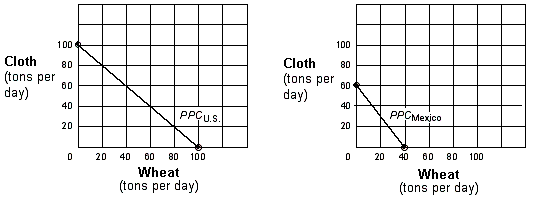
As shown in Exhibit 15-2, the United States has a comparative advantage over Mexico in:
A) wheat, but not in cloth.
B) cloth, but not in wheat.
C) both wheat and cloth.
D) neither wheat nor cloth
As shown in Exhibit 15-2, the United States has a comparative advantage over Mexico in:
A) wheat, but not in cloth.
B) cloth, but not in wheat.
C) both wheat and cloth.
D) neither wheat nor cloth

سؤال
Exhibit 15-1 Production possibilities curves
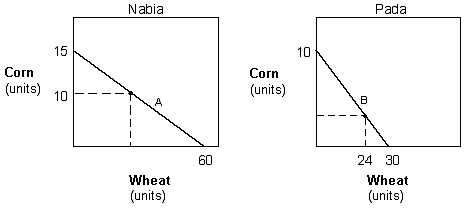
In Exhibit 15-1, the production possibilities curves of wheat and corn for Nabia and Pada are presented. In Nabia the cost of producing one more unit of wheat is equal to:
A) 4 units of corn.
B) 4 units of wheat.
C) 1/4 unit of corn.
D) 15 units of corn.
In Exhibit 15-1, the production possibilities curves of wheat and corn for Nabia and Pada are presented. In Nabia the cost of producing one more unit of wheat is equal to:
A) 4 units of corn.
B) 4 units of wheat.
C) 1/4 unit of corn.
D) 15 units of corn.
سؤال
سؤال
Exhibit 15-1 Production possibilities curves
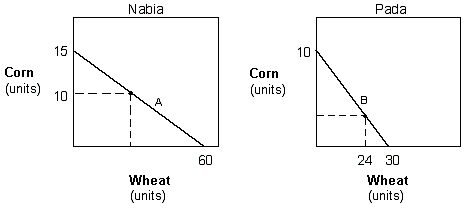
In Exhibit 15-1, the production possibilities curves of wheat and corn for Nabia and Pada are presented. Suppose Pada produces at point B on its PPC. How much corn is the country able to produce?
A) 2.
B) 15.
C) 10.
D) 6.
In Exhibit 15-1, the production possibilities curves of wheat and corn for Nabia and Pada are presented. Suppose Pada produces at point B on its PPC. How much corn is the country able to produce?
A) 2.
B) 15.
C) 10.
D) 6.
سؤال
سؤال
Exhibit 15-1 Production possibilities curves
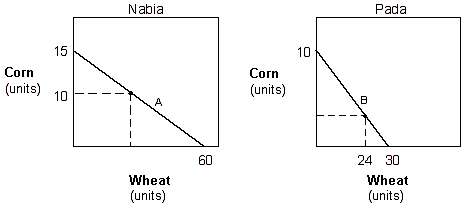
In Exhibit 15-1, the production possibilities curves of wheat and corn for Nabia and Pada are presented. If both countries specialize in one good and trade for the other, :
A) Nabia and Pada will be able to consume at a point to the right of their respective production possibilities curves.
B) Nabia will be able to consume, at the most, the combination represented by point A.
C) Pada will be able to consume, at the most, the combination represented by point B.
D) the citizens of Nabia will consume only corn and the citizens of Pada will consume only wheat.
In Exhibit 15-1, the production possibilities curves of wheat and corn for Nabia and Pada are presented. If both countries specialize in one good and trade for the other, :
A) Nabia and Pada will be able to consume at a point to the right of their respective production possibilities curves.
B) Nabia will be able to consume, at the most, the combination represented by point A.
C) Pada will be able to consume, at the most, the combination represented by point B.
D) the citizens of Nabia will consume only corn and the citizens of Pada will consume only wheat.
سؤال
سؤال
Exhibit 15-1 Production possibilities curves
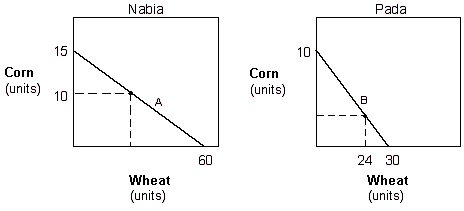
In Exhibit 15-1, the production possibilities curves of wheat and corn for Nabia and Pada are presented. If these two nations trade, Nabia should specialize in the production of:
A) corn.
B) corn and wheat.
C) wheat.
D) neither product since Pada has the absolute advantage in the production of both.
In Exhibit 15-1, the production possibilities curves of wheat and corn for Nabia and Pada are presented. If these two nations trade, Nabia should specialize in the production of:
A) corn.
B) corn and wheat.
C) wheat.
D) neither product since Pada has the absolute advantage in the production of both.
سؤال
سؤال
Exhibit 15-1 Production possibilities curves
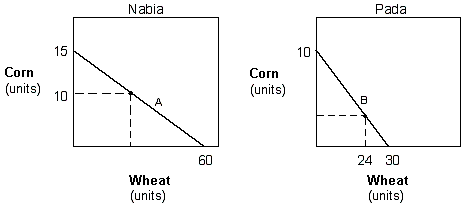
In Exhibit 15-1, the production possibilities curves of wheat and corn for Nabia and Pada are presented. In Pada the cost of producing one more unit of corn is equal to:
A) 3 units of wheat.
B) 3 units of corn.
C) 1/3 unit of wheat.
D) 15 units of wheat.
In Exhibit 15-1, the production possibilities curves of wheat and corn for Nabia and Pada are presented. In Pada the cost of producing one more unit of corn is equal to:
A) 3 units of wheat.
B) 3 units of corn.
C) 1/3 unit of wheat.
D) 15 units of wheat.
سؤال
سؤال
سؤال
Exhibit 15-1 Production possibilities curves
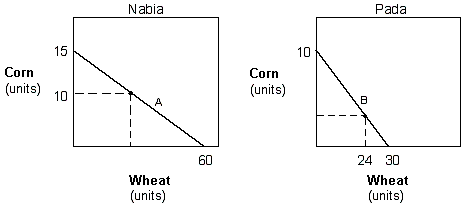
In Exhibit 15-1, the production possibilities curves of wheat and corn for Nabia and Pada are presented. Suppose Nabia produces at point A on its PPC. How many units of wheat is the country able to produce?
A) 15.
B) 60.
C) 40.
D) 20.
In Exhibit 15-1, the production possibilities curves of wheat and corn for Nabia and Pada are presented. Suppose Nabia produces at point A on its PPC. How many units of wheat is the country able to produce?
A) 15.
B) 60.
C) 40.
D) 20.
سؤال
سؤال
سؤال
سؤال
سؤال
سؤال
سؤال
سؤال
Exhibit 15-3 Potatoes and wheat output (tons per day)
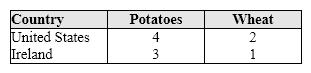
In Exhibit 15-3, the United States has an absolute advantage in producing:
A) potatoes.
B) wheat.
C) both.
D) neither.
In Exhibit 15-3, the United States has an absolute advantage in producing:
A) potatoes.
B) wheat.
C) both.
D) neither.
سؤال
سؤال
Exhibit 15-3 Potatoes and wheat output (tons per day)
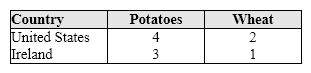
If each nation in Exhibit 15-3 specializes in producing the good for which it has a comparative advantage, then:
A) Ireland would produce neither potatoes or wheat.
B) the United States would produce both potatoes and wheat.
C) the United States would produce potatoes.
D) Ireland would produce potatoes.
If each nation in Exhibit 15-3 specializes in producing the good for which it has a comparative advantage, then:
A) Ireland would produce neither potatoes or wheat.
B) the United States would produce both potatoes and wheat.
C) the United States would produce potatoes.
D) Ireland would produce potatoes.
سؤال
سؤال
سؤال
سؤال
سؤال
سؤال
سؤال
سؤال
سؤال
سؤال
سؤال
سؤال
سؤال
سؤال
سؤال
سؤال
Exhibit 15-4 Coffee and tea output (pounds per hour)
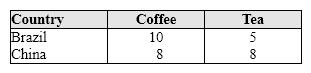
As shown in Exhibit 15-4, the opportunity cost to Brazil of producing one pound of coffee is:
A) 1 pound of tea.
B) 5 pounds of tea.
C) 1/2 pound of tea.
D) 10 pounds of tea.
As shown in Exhibit 15-4, the opportunity cost to Brazil of producing one pound of coffee is:
A) 1 pound of tea.
B) 5 pounds of tea.
C) 1/2 pound of tea.
D) 10 pounds of tea.
سؤال
سؤال
سؤال
سؤال
سؤال
سؤال
سؤال
سؤال
سؤال
سؤال
سؤال
سؤال
Exhibit 15-4 Coffee and tea output (pounds per hour)
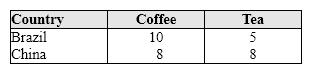
As shown in Exhibit 15-4, if each country produced according to its comparative advantage, Brazil would produce:
A) tea and China would produce coffee.
B) coffee and China would produce tea.
C) both coffee and tea.
D) neither coffee nor tea.
As shown in Exhibit 15-4, if each country produced according to its comparative advantage, Brazil would produce:
A) tea and China would produce coffee.
B) coffee and China would produce tea.
C) both coffee and tea.
D) neither coffee nor tea.
سؤال
سؤال
سؤال
Exhibit 15-4 Coffee and tea output (pounds per hour)
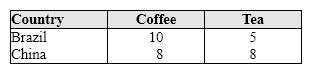
If specialization were carried out by each country in Exhibit 15-4 on the basis of comparative advantage, then:
A) Brazil would produce neither coffee nor tea.
B) China would produce both coffee and tea.
C) Brazil would produce tea and China would produce coffee.
D) Brazil would produce coffee and China would produce tea.
If specialization were carried out by each country in Exhibit 15-4 on the basis of comparative advantage, then:
A) Brazil would produce neither coffee nor tea.
B) China would produce both coffee and tea.
C) Brazil would produce tea and China would produce coffee.
D) Brazil would produce coffee and China would produce tea.
سؤال
سؤال
Exhibit 15-4 Coffee and tea output (pounds per hour)
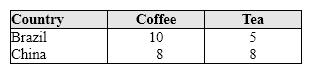
As shown in Exhibit 15-4, compared to Brazil, China has a comparative advantage in the production of:
A) coffee.
B) tea.
C) both coffee and tea.
D) neither coffee nor tea.
As shown in Exhibit 15-4, compared to Brazil, China has a comparative advantage in the production of:
A) coffee.
B) tea.
C) both coffee and tea.
D) neither coffee nor tea.
سؤال
سؤال
سؤال
سؤال
سؤال
سؤال
سؤال
سؤال
سؤال
سؤال
سؤال
سؤال
سؤال
سؤال
سؤال
سؤال
سؤال
سؤال
سؤال
سؤال
سؤال
سؤال
سؤال
سؤال

فتح الحزمة
قم بالتسجيل لفتح البطاقات في هذه المجموعة!
Unlock Deck
Unlock Deck
1/127

العب

ملء الشاشة (f)
Deck 28: International Trade and Finance
1
Exhibit 15-2 Production possibilities curves for U.S. and Mexico
As shown in Exhibit 15-2, the United States has a comparative advantage over Mexico in:
A) wheat, but not in cloth.
B) cloth, but not in wheat.
C) both wheat and cloth.
D) neither wheat nor cloth
As shown in Exhibit 15-2, the United States has a comparative advantage over Mexico in:
A) wheat, but not in cloth.
B) cloth, but not in wheat.
C) both wheat and cloth.
D) neither wheat nor cloth
A
2
Exhibit 15-1 Production possibilities curves
In Exhibit 15-1, the production possibilities curves of wheat and corn for Nabia and Pada are presented. In Nabia the cost of producing one more unit of wheat is equal to:
A) 4 units of corn.
B) 4 units of wheat.
C) 1/4 unit of corn.
D) 15 units of corn.
In Exhibit 15-1, the production possibilities curves of wheat and corn for Nabia and Pada are presented. In Nabia the cost of producing one more unit of wheat is equal to:
A) 4 units of corn.
B) 4 units of wheat.
C) 1/4 unit of corn.
D) 15 units of corn.
C
3
Comparative advantage explains why a nation will benefit from trade when:
A) it exports more than it imports.
B) its trading partners are experiencing offsetting losses.
C) it exports goods for which it is a high-opportunity cost producer, while importing those for which it is a low-opportunity cost producer.
D) it exports goods for which it is a low-opportunity cost producer, while importing those for which it is a high-opportunity cost producer.
A) it exports more than it imports.
B) its trading partners are experiencing offsetting losses.
C) it exports goods for which it is a high-opportunity cost producer, while importing those for which it is a low-opportunity cost producer.
D) it exports goods for which it is a low-opportunity cost producer, while importing those for which it is a high-opportunity cost producer.
D
4
Exhibit 15-1 Production possibilities curves
In Exhibit 15-1, the production possibilities curves of wheat and corn for Nabia and Pada are presented. Suppose Pada produces at point B on its PPC. How much corn is the country able to produce?
A) 2.
B) 15.
C) 10.
D) 6.
In Exhibit 15-1, the production possibilities curves of wheat and corn for Nabia and Pada are presented. Suppose Pada produces at point B on its PPC. How much corn is the country able to produce?
A) 2.
B) 15.
C) 10.
D) 6.
فتح الحزمة
افتح القفل للوصول البطاقات البالغ عددها 127 في هذه المجموعة.
فتح الحزمة
k this deck
5
Opening trade between two nations would:
A) shift their production possibilities curves outward.
B) shift their production possibilities curves inward.
C) leave the production possibilities unchanged and increase their consumption possibilities.
D) leave the production possibilities unchanged and decreased their consumption possibilities.
A) shift their production possibilities curves outward.
B) shift their production possibilities curves inward.
C) leave the production possibilities unchanged and increase their consumption possibilities.
D) leave the production possibilities unchanged and decreased their consumption possibilities.
فتح الحزمة
افتح القفل للوصول البطاقات البالغ عددها 127 في هذه المجموعة.
فتح الحزمة
k this deck
6
Exhibit 15-1 Production possibilities curves
In Exhibit 15-1, the production possibilities curves of wheat and corn for Nabia and Pada are presented. If both countries specialize in one good and trade for the other, :
A) Nabia and Pada will be able to consume at a point to the right of their respective production possibilities curves.
B) Nabia will be able to consume, at the most, the combination represented by point A.
C) Pada will be able to consume, at the most, the combination represented by point B.
D) the citizens of Nabia will consume only corn and the citizens of Pada will consume only wheat.
In Exhibit 15-1, the production possibilities curves of wheat and corn for Nabia and Pada are presented. If both countries specialize in one good and trade for the other, :
A) Nabia and Pada will be able to consume at a point to the right of their respective production possibilities curves.
B) Nabia will be able to consume, at the most, the combination represented by point A.
C) Pada will be able to consume, at the most, the combination represented by point B.
D) the citizens of Nabia will consume only corn and the citizens of Pada will consume only wheat.
فتح الحزمة
افتح القفل للوصول البطاقات البالغ عددها 127 في هذه المجموعة.
فتح الحزمة
k this deck
7
Without trade, the consumption possibilities for two nations are:
A) outside their production possibilities curve.
B) inside their production possibilities curve.
C) along their production possibilities curve.
D) at a point equal to the world production possibilities curve.
A) outside their production possibilities curve.
B) inside their production possibilities curve.
C) along their production possibilities curve.
D) at a point equal to the world production possibilities curve.
فتح الحزمة
افتح القفل للوصول البطاقات البالغ عددها 127 في هذه المجموعة.
فتح الحزمة
k this deck
8
Exhibit 15-1 Production possibilities curves
In Exhibit 15-1, the production possibilities curves of wheat and corn for Nabia and Pada are presented. If these two nations trade, Nabia should specialize in the production of:
A) corn.
B) corn and wheat.
C) wheat.
D) neither product since Pada has the absolute advantage in the production of both.
In Exhibit 15-1, the production possibilities curves of wheat and corn for Nabia and Pada are presented. If these two nations trade, Nabia should specialize in the production of:
A) corn.
B) corn and wheat.
C) wheat.
D) neither product since Pada has the absolute advantage in the production of both.
فتح الحزمة
افتح القفل للوصول البطاقات البالغ عددها 127 في هذه المجموعة.
فتح الحزمة
k this deck
9
If the United States were to adopt a policy of free trade with European countries and Japan, this policy would:
A) help the United States and hurt the other countries because the United States has a larger population.
B) help all of the countries involved because every country would have a comparative advantage in the production of some goods.
C) hurt all of the countries involved because all the countries are capable of producing anything that could be produced in one of the other countries.
D) help the United States and hurt the other countries because the United States has more natural resources than the other countries.
A) help the United States and hurt the other countries because the United States has a larger population.
B) help all of the countries involved because every country would have a comparative advantage in the production of some goods.
C) hurt all of the countries involved because all the countries are capable of producing anything that could be produced in one of the other countries.
D) help the United States and hurt the other countries because the United States has more natural resources than the other countries.
فتح الحزمة
افتح القفل للوصول البطاقات البالغ عددها 127 في هذه المجموعة.
فتح الحزمة
k this deck
10
Exhibit 15-1 Production possibilities curves
In Exhibit 15-1, the production possibilities curves of wheat and corn for Nabia and Pada are presented. In Pada the cost of producing one more unit of corn is equal to:
A) 3 units of wheat.
B) 3 units of corn.
C) 1/3 unit of wheat.
D) 15 units of wheat.
In Exhibit 15-1, the production possibilities curves of wheat and corn for Nabia and Pada are presented. In Pada the cost of producing one more unit of corn is equal to:
A) 3 units of wheat.
B) 3 units of corn.
C) 1/3 unit of wheat.
D) 15 units of wheat.
فتح الحزمة
افتح القفل للوصول البطاقات البالغ عددها 127 في هذه المجموعة.
فتح الحزمة
k this deck
11
Assume the United States can use a given amount of its resources to produce either 20 airplanes or 8 automobiles and Japan can employ the same amount of its resources to produce either 20 airplanes or 10 automobiles. The U.S. should specialize in:
A) airplanes.
B) automobiles.
C) both goods.
D) neither good.
A) airplanes.
B) automobiles.
C) both goods.
D) neither good.
فتح الحزمة
افتح القفل للوصول البطاقات البالغ عددها 127 في هذه المجموعة.
فتح الحزمة
k this deck
12
Suppose Japan has a comparative advantage over Canada in the production of DVDs. This means that Japan:
A) needs fewer resources to produce DVDS than does Canada.
B) has better technology for producing DVDs than does Canada.
C) has a lower opportunity cost of DVD production than does Canada.
D) can produce more DVDs in a given period of time than can Canada.
A) needs fewer resources to produce DVDS than does Canada.
B) has better technology for producing DVDs than does Canada.
C) has a lower opportunity cost of DVD production than does Canada.
D) can produce more DVDs in a given period of time than can Canada.
فتح الحزمة
افتح القفل للوصول البطاقات البالغ عددها 127 في هذه المجموعة.
فتح الحزمة
k this deck
13
Exhibit 15-1 Production possibilities curves
In Exhibit 15-1, the production possibilities curves of wheat and corn for Nabia and Pada are presented. Suppose Nabia produces at point A on its PPC. How many units of wheat is the country able to produce?
A) 15.
B) 60.
C) 40.
D) 20.
In Exhibit 15-1, the production possibilities curves of wheat and corn for Nabia and Pada are presented. Suppose Nabia produces at point A on its PPC. How many units of wheat is the country able to produce?
A) 15.
B) 60.
C) 40.
D) 20.
فتح الحزمة
افتح القفل للوصول البطاقات البالغ عددها 127 في هذه المجموعة.
فتح الحزمة
k this deck
14
Trade between nations A and B:
A) leaves the consumption possibilities of nation A unchanged.
B) leaves the consumption possibilities of nation B unchanged.
C) increases the consumption possibilities of both nations.
D) increases the production possibilities of both nations.
A) leaves the consumption possibilities of nation A unchanged.
B) leaves the consumption possibilities of nation B unchanged.
C) increases the consumption possibilities of both nations.
D) increases the production possibilities of both nations.
فتح الحزمة
افتح القفل للوصول البطاقات البالغ عددها 127 في هذه المجموعة.
فتح الحزمة
k this deck
15
International trade has the potential to ____ the availability of goods and services to ____.
A) increase; those nations who export more than they import
B) increase; nations that have an absolute advantage in the production of a good or service
C) increase; all nations
D) decrease; all nations
A) increase; those nations who export more than they import
B) increase; nations that have an absolute advantage in the production of a good or service
C) increase; all nations
D) decrease; all nations
فتح الحزمة
افتح القفل للوصول البطاقات البالغ عددها 127 في هذه المجموعة.
فتح الحزمة
k this deck
16
A nation benefits from international trade if it:
A) exports more than it imports.
B) imports more than it exports.
C) imports goods for which it is a low opportunity cost producer.
D) exports goods for which it is a low opportunity cost producer.
A) exports more than it imports.
B) imports more than it exports.
C) imports goods for which it is a low opportunity cost producer.
D) exports goods for which it is a low opportunity cost producer.
فتح الحزمة
افتح القفل للوصول البطاقات البالغ عددها 127 في هذه المجموعة.
فتح الحزمة
k this deck
17
What are the benefits and costs to a nation that participates in international trade? Do the benefits outweigh the costs or do the costs outweigh the benefits?
فتح الحزمة
افتح القفل للوصول البطاقات البالغ عددها 127 في هذه المجموعة.
فتح الحزمة
k this deck
18
The theory of comparative advantage suggests that nations should produce a good if they:
A) have the lowest opportunity cost.
B) have the lowest wages.
C) have the most resources.
D) can produce more of the good than any other nation.
A) have the lowest opportunity cost.
B) have the lowest wages.
C) have the most resources.
D) can produce more of the good than any other nation.
فتح الحزمة
افتح القفل للوصول البطاقات البالغ عددها 127 في هذه المجموعة.
فتح الحزمة
k this deck
19
Specialization and trade allow an economy to expand its:
A) production possibilities.
B) consumption possibilities.
C) technological advantage.
D) absolute advantage.
A) production possibilities.
B) consumption possibilities.
C) technological advantage.
D) absolute advantage.
فتح الحزمة
افتح القفل للوصول البطاقات البالغ عددها 127 في هذه المجموعة.
فتح الحزمة
k this deck
20
Comparative advantage indicates that:
A) specialization and exchange will permit trading partners to maximize their joint consumption.
B) a nation can gain from trade only if it is not at an absolute disadvantage in producing all goods.
C) a nation can gain from trade only when its trading partners are not low-wage countries.
D) countries should export products for which they are high-opportunity cost producers.
A) specialization and exchange will permit trading partners to maximize their joint consumption.
B) a nation can gain from trade only if it is not at an absolute disadvantage in producing all goods.
C) a nation can gain from trade only when its trading partners are not low-wage countries.
D) countries should export products for which they are high-opportunity cost producers.
فتح الحزمة
افتح القفل للوصول البطاقات البالغ عددها 127 في هذه المجموعة.
فتح الحزمة
k this deck
21
Exhibit 15-3 Potatoes and wheat output (tons per day)
In Exhibit 15-3, the United States has an absolute advantage in producing:
A) potatoes.
B) wheat.
C) both.
D) neither.
In Exhibit 15-3, the United States has an absolute advantage in producing:
A) potatoes.
B) wheat.
C) both.
D) neither.
فتح الحزمة
افتح القفل للوصول البطاقات البالغ عددها 127 في هذه المجموعة.
فتح الحزمة
k this deck
22
When Brazil can generate a product using fewer labor hours and resources than the United States, an economist would say that Brazil had:
A) a comparative advantage in production of the product.
B) an absolute advantage in production of the product.
C) a higher opportunity cost of producing the product.
D) no incentive to import the product, regardless of the cost-price conditions for other products.
A) a comparative advantage in production of the product.
B) an absolute advantage in production of the product.
C) a higher opportunity cost of producing the product.
D) no incentive to import the product, regardless of the cost-price conditions for other products.
فتح الحزمة
افتح القفل للوصول البطاقات البالغ عددها 127 في هذه المجموعة.
فتح الحزمة
k this deck
23
Exhibit 15-3 Potatoes and wheat output (tons per day)
If each nation in Exhibit 15-3 specializes in producing the good for which it has a comparative advantage, then:
A) Ireland would produce neither potatoes or wheat.
B) the United States would produce both potatoes and wheat.
C) the United States would produce potatoes.
D) Ireland would produce potatoes.
If each nation in Exhibit 15-3 specializes in producing the good for which it has a comparative advantage, then:
A) Ireland would produce neither potatoes or wheat.
B) the United States would produce both potatoes and wheat.
C) the United States would produce potatoes.
D) Ireland would produce potatoes.
فتح الحزمة
افتح القفل للوصول البطاقات البالغ عددها 127 في هذه المجموعة.
فتح الحزمة
k this deck
24
If a country has a lower opportunity cost of producing oranges, then this is:
A) inefficient resource use.
B) an absolute advantage.
C) a situation in which oranges should be imported.
D) a comparative advantage.
A) inefficient resource use.
B) an absolute advantage.
C) a situation in which oranges should be imported.
D) a comparative advantage.
فتح الحزمة
افتح القفل للوصول البطاقات البالغ عددها 127 في هذه المجموعة.
فتح الحزمة
k this deck
25
If one country can produce a good with fewer resources than another country, this is called:
A) specialization.
B) geographic advantage.
C) comparative advantage.
D) absolute advantage.
A) specialization.
B) geographic advantage.
C) comparative advantage.
D) absolute advantage.
فتح الحزمة
افتح القفل للوصول البطاقات البالغ عددها 127 في هذه المجموعة.
فتح الحزمة
k this deck
26
If nation A has a comparative advantage over nation B in the production of a product, this implies:
A) it requires fewer resources in A to produce the good than in B.
B) the cost of producing the good in terms of some other good's production that must be sacrificed is lower in A than in B.
C) that nation B could not benefit by engaging in trade with A.
D) that nation A could not benefit by engaging in trade with B.
A) it requires fewer resources in A to produce the good than in B.
B) the cost of producing the good in terms of some other good's production that must be sacrificed is lower in A than in B.
C) that nation B could not benefit by engaging in trade with A.
D) that nation A could not benefit by engaging in trade with B.
فتح الحزمة
افتح القفل للوصول البطاقات البالغ عددها 127 في هذه المجموعة.
فتح الحزمة
k this deck
27
Absolute advantage occurs when one nation can produce a good ____ its trading partners.
A) in larger quantities than
B) faster than
C) that is desired by
D) more efficiently than
A) in larger quantities than
B) faster than
C) that is desired by
D) more efficiently than
فتح الحزمة
افتح القفل للوصول البطاقات البالغ عددها 127 في هذه المجموعة.
فتح الحزمة
k this deck
28
A country is said to have an absolute advantage in the production of a good when:
A) its opportunity cost of producing the good is lower than another country.
B) it can produce the good using fewer resources than another country.
C) it specializes in the production of the good.
D) it has a favorable exchange rate compared to another country's currency.
A) its opportunity cost of producing the good is lower than another country.
B) it can produce the good using fewer resources than another country.
C) it specializes in the production of the good.
D) it has a favorable exchange rate compared to another country's currency.
فتح الحزمة
افتح القفل للوصول البطاقات البالغ عددها 127 في هذه المجموعة.
فتح الحزمة
k this deck
29
If Japan gives up ten bushels of rice to produce one bicycle, while the United States gives up five bushels of rice to produce one bicycle, then:
A) the opportunity cost of producing bicycles in the United States is higher than in Japan.
B) Japan has a comparative advantage in the production of bicycles.
C) total output will be highest if Japan specializes in rice and the United States specializes in bicycles.
D) total output will be highest if the United States specializes in rice and Japan specializes in bicycles.
A) the opportunity cost of producing bicycles in the United States is higher than in Japan.
B) Japan has a comparative advantage in the production of bicycles.
C) total output will be highest if Japan specializes in rice and the United States specializes in bicycles.
D) total output will be highest if the United States specializes in rice and Japan specializes in bicycles.
فتح الحزمة
افتح القفل للوصول البطاقات البالغ عددها 127 في هذه المجموعة.
فتح الحزمة
k this deck
30
Suppose rice can be produced in country X at a lower cost than in country Y, while tuna can be produced in country Y at a lower cost than in country X. International competition will:
A) destroy the rice market in both countries.
B) drive X to specialize in rice and Y to specialize in tuna.
C) drive Y to specialize in rice and X to specialize in tuna.
D) cause both X and Y to reject international specialization.
A) destroy the rice market in both countries.
B) drive X to specialize in rice and Y to specialize in tuna.
C) drive Y to specialize in rice and X to specialize in tuna.
D) cause both X and Y to reject international specialization.
فتح الحزمة
افتح القفل للوصول البطاقات البالغ عددها 127 في هذه المجموعة.
فتح الحزمة
k this deck
31
If Dana can paint his house faster than Luke, a professional house painter, then:
A) Dana has a comparative advantage in house painting.
B) Dana has an absolute advantage in house painting.
C) Luke has a comparative advantage in house painting.
D) Luke has an absolute advantage in house painting.
A) Dana has a comparative advantage in house painting.
B) Dana has an absolute advantage in house painting.
C) Luke has a comparative advantage in house painting.
D) Luke has an absolute advantage in house painting.
فتح الحزمة
افتح القفل للوصول البطاقات البالغ عددها 127 في هذه المجموعة.
فتح الحزمة
k this deck
32
If Country A has an absolute advantage over Country B in the production of every commodity:
A) mutual gains from trade between Country A and Country B would be impossible.
B) Country B would be able to gain from trade but not country A.
C) the joint output of the two countries could not be increased through specialization and exchange.
D) mutual gains from trade would still be possible.
A) mutual gains from trade between Country A and Country B would be impossible.
B) Country B would be able to gain from trade but not country A.
C) the joint output of the two countries could not be increased through specialization and exchange.
D) mutual gains from trade would still be possible.
فتح الحزمة
افتح القفل للوصول البطاقات البالغ عددها 127 في هذه المجموعة.
فتح الحزمة
k this deck
33
If the opportunity cost of producing cheese is higher in Greece than it is in Italy, then:
A) Greece should specialize in producing cheese.
B) Italy should specialize in producing cheese.
C) both Greece and Italy should produce cheese.
D) Greece gives up fewer goods to produce cheese than Italy does.
A) Greece should specialize in producing cheese.
B) Italy should specialize in producing cheese.
C) both Greece and Italy should produce cheese.
D) Greece gives up fewer goods to produce cheese than Italy does.
فتح الحزمة
افتح القفل للوصول البطاقات البالغ عددها 127 في هذه المجموعة.
فتح الحزمة
k this deck
34
Suppose that Spain has a comparative advantage in hats and Portugal has a comparative advantage in doormats. Under a system of free trade, each country specializes and then trades with the other. If the price starts at four hats per doormat, and then increases to five hats per doormat, then:
A) people in Portugal will not want to buy as many hats.
B) Spain no longer has a comparative advantage in hats.
C) some of the gains from trade shift to Spain.
D) some of the gains from trade shift to Portugal.
A) people in Portugal will not want to buy as many hats.
B) Spain no longer has a comparative advantage in hats.
C) some of the gains from trade shift to Spain.
D) some of the gains from trade shift to Portugal.
فتح الحزمة
افتح القفل للوصول البطاقات البالغ عددها 127 في هذه المجموعة.
فتح الحزمة
k this deck
35
If nation A has an absolute advantage over nation B in the production of a product, this implies that:
A) it requires fewer resources in A to produce the good than in B.
B) the cost of producing the good in terms of some other good's production that must be sacrificed is lower in A than in B.
C) nation B could not benefit by engaging in trade with A.
D) nation A could not benefit by engaging in trade with B.
A) it requires fewer resources in A to produce the good than in B.
B) the cost of producing the good in terms of some other good's production that must be sacrificed is lower in A than in B.
C) nation B could not benefit by engaging in trade with A.
D) nation A could not benefit by engaging in trade with B.
فتح الحزمة
افتح القفل للوصول البطاقات البالغ عددها 127 في هذه المجموعة.
فتح الحزمة
k this deck
36
According to the principle of comparative advantage, total output and consumption levels will be highest when goods are produced in nations according to which of the following conditions?
A) Opportunity costs are lowest.
B) Absolute advantages are highest.
C) Opportunity costs are equal.
D) Absolute advantages are lowest.
A) Opportunity costs are lowest.
B) Absolute advantages are highest.
C) Opportunity costs are equal.
D) Absolute advantages are lowest.
فتح الحزمة
افتح القفل للوصول البطاقات البالغ عددها 127 في هذه المجموعة.
فتح الحزمة
k this deck
37
Which of the following statements is true ?
A) Specialization and trade along the lines of comparative advantage allows nations to consume more than if they were to produce just for themselves.
B) Free trade theory suggests that when trade takes place any gains made by one nation comes at the expense of another.
C) According to the theory of comparative advantage, a nation should specialize in the production of those goods for which it has an absolute advantage.
D) One country can have the comparative advantage in both goods, but it can only have the absolute advantage in one good as long as the opportunity costs are different.
A) Specialization and trade along the lines of comparative advantage allows nations to consume more than if they were to produce just for themselves.
B) Free trade theory suggests that when trade takes place any gains made by one nation comes at the expense of another.
C) According to the theory of comparative advantage, a nation should specialize in the production of those goods for which it has an absolute advantage.
D) One country can have the comparative advantage in both goods, but it can only have the absolute advantage in one good as long as the opportunity costs are different.
فتح الحزمة
افتح القفل للوصول البطاقات البالغ عددها 127 في هذه المجموعة.
فتح الحزمة
k this deck
38
If India has an absolute advantage in rug production when compared to England, then:
A) India should export rugs to England.
B) England should export rugs to India.
C) India uses fewer resources to produce rugs than England.
D) England uses fewer resources to produce rugs than India.
A) India should export rugs to England.
B) England should export rugs to India.
C) India uses fewer resources to produce rugs than England.
D) England uses fewer resources to produce rugs than India.
فتح الحزمة
افتح القفل للوصول البطاقات البالغ عددها 127 في هذه المجموعة.
فتح الحزمة
k this deck
39
Exhibit 15-4 Coffee and tea output (pounds per hour)
As shown in Exhibit 15-4, the opportunity cost to Brazil of producing one pound of coffee is:
A) 1 pound of tea.
B) 5 pounds of tea.
C) 1/2 pound of tea.
D) 10 pounds of tea.
As shown in Exhibit 15-4, the opportunity cost to Brazil of producing one pound of coffee is:
A) 1 pound of tea.
B) 5 pounds of tea.
C) 1/2 pound of tea.
D) 10 pounds of tea.
فتح الحزمة
افتح القفل للوصول البطاقات البالغ عددها 127 في هذه المجموعة.
فتح الحزمة
k this deck
40
Juanita, a lawyer, can type faster than Jill, her secretary. Jill, on the other hand, does not have the ability or skills to practice law. Applying the principles of international trade to this situation, an economic consultant advises Juanita to:
A) fire Jill, practice law during the day, and do her own typing at night.
B) practice law and leave all the typing to the secretary.
C) divide her time equally between typing and practicing law.
D) quit practicing law and take a job as a secretary.
A) fire Jill, practice law during the day, and do her own typing at night.
B) practice law and leave all the typing to the secretary.
C) divide her time equally between typing and practicing law.
D) quit practicing law and take a job as a secretary.
فتح الحزمة
افتح القفل للوصول البطاقات البالغ عددها 127 في هذه المجموعة.
فتح الحزمة
k this deck
41
A tariff is a tax on ____ goods that is designed to ____.
A) exported; protect domestic industries
B) exported; hurt foreign industries
C) imported; made domestic consumers pay more
D) imported; protect domestic industries
A) exported; protect domestic industries
B) exported; hurt foreign industries
C) imported; made domestic consumers pay more
D) imported; protect domestic industries
فتح الحزمة
افتح القفل للوصول البطاقات البالغ عددها 127 في هذه المجموعة.
فتح الحزمة
k this deck
42
Suppose a country with a large domestic textile industry removed all tariffs on imported textiles, we would expect domestic:
A) textile prices to decline.
B) textile production to increase.
C) textile employment to increase.
D) textile prices to rise.
A) textile prices to decline.
B) textile production to increase.
C) textile employment to increase.
D) textile prices to rise.
فتح الحزمة
افتح القفل للوصول البطاقات البالغ عددها 127 في هذه المجموعة.
فتح الحزمة
k this deck
43
A tariff has the effect of granting ____ a larger share of the domestic market.
A) domestic consumers
B) foreign consumers
C) domestic producers
D) foreign producers
A) domestic consumers
B) foreign consumers
C) domestic producers
D) foreign producers
فتح الحزمة
افتح القفل للوصول البطاقات البالغ عددها 127 في هذه المجموعة.
فتح الحزمة
k this deck
44
The primary purpose of WTO is to:
A) protect the United States from cheap foreign labor.
B) foster trade among nations.
C) promote the dumping of foreign products.
D) increase worldwide tariffs.
A) protect the United States from cheap foreign labor.
B) foster trade among nations.
C) promote the dumping of foreign products.
D) increase worldwide tariffs.
فتح الحزمة
افتح القفل للوصول البطاقات البالغ عددها 127 في هذه المجموعة.
فتح الحزمة
k this deck
45
Which of the following statements is true with respect to a tariff on imported cheese?
A) It lowers the price of cheese.
B) It lowers domestic cheese producers' profits.
C) It creates tax revenues for the government.
D) It cannot result in retaliation.
A) It lowers the price of cheese.
B) It lowers domestic cheese producers' profits.
C) It creates tax revenues for the government.
D) It cannot result in retaliation.
فتح الحزمة
افتح القفل للوصول البطاقات البالغ عددها 127 في هذه المجموعة.
فتح الحزمة
k this deck
46
A tariff has the effect of:
A) raising the price of the imported product.
B) increasing the demand for the exported product.
C) increasing the demand for the imported product.
D) increasing the supply of the imported product.
A) raising the price of the imported product.
B) increasing the demand for the exported product.
C) increasing the demand for the imported product.
D) increasing the supply of the imported product.
فتح الحزمة
افتح القفل للوصول البطاقات البالغ عددها 127 في هذه المجموعة.
فتح الحزمة
k this deck
47
The primary benefits derived from tariffs usually accrue to the:
A) domestic consumers of goods protected by the tariffs.
B) foreign producers of goods protected by the tariffs.
C) domestic producers of export goods.
D) domestic suppliers of goods protected by the tariffs.
A) domestic consumers of goods protected by the tariffs.
B) foreign producers of goods protected by the tariffs.
C) domestic producers of export goods.
D) domestic suppliers of goods protected by the tariffs.
فتح الحزمة
افتح القفل للوصول البطاقات البالغ عددها 127 في هذه المجموعة.
فتح الحزمة
k this deck
48
Which of the following would be expected if the tariff on foreign-produced automobiles were increased?
A) The domestic price of automobiles would fall.
B) The supply of foreign automobiles to the domestic market would decline, causing auto prices to rise.
C) The number of unemployed workers in the domestic automobile industry would rise.
D) The demand for foreign-produced automobiles would increase, causing the price of automobiles to increase in other nations.
A) The domestic price of automobiles would fall.
B) The supply of foreign automobiles to the domestic market would decline, causing auto prices to rise.
C) The number of unemployed workers in the domestic automobile industry would rise.
D) The demand for foreign-produced automobiles would increase, causing the price of automobiles to increase in other nations.
فتح الحزمة
افتح القفل للوصول البطاقات البالغ عددها 127 في هذه المجموعة.
فتح الحزمة
k this deck
49
Since World War II, tariff reductions have occurred in large part because of negotiations under the:
A) Industry and Trade Administration Act.
B) Employment Act.
C) Monetary Control Act.
D) General Agreement on Tariffs and Trade.
A) Industry and Trade Administration Act.
B) Employment Act.
C) Monetary Control Act.
D) General Agreement on Tariffs and Trade.
فتح الحزمة
افتح القفل للوصول البطاقات البالغ عددها 127 في هذه المجموعة.
فتح الحزمة
k this deck
50
The rules of the WTO:
A) apply only to domestic trade within a nation.
B) apply to both domestic trade within a nation and international trade with other nations.
C) apply only to trade among nations.
D) include a prohibition of tariffs.
A) apply only to domestic trade within a nation.
B) apply to both domestic trade within a nation and international trade with other nations.
C) apply only to trade among nations.
D) include a prohibition of tariffs.
فتح الحزمة
افتح القفل للوصول البطاقات البالغ عددها 127 في هذه المجموعة.
فتح الحزمة
k this deck
51
Exhibit 15-4 Coffee and tea output (pounds per hour)
As shown in Exhibit 15-4, if each country produced according to its comparative advantage, Brazil would produce:
A) tea and China would produce coffee.
B) coffee and China would produce tea.
C) both coffee and tea.
D) neither coffee nor tea.
As shown in Exhibit 15-4, if each country produced according to its comparative advantage, Brazil would produce:
A) tea and China would produce coffee.
B) coffee and China would produce tea.
C) both coffee and tea.
D) neither coffee nor tea.
فتح الحزمة
افتح القفل للوصول البطاقات البالغ عددها 127 في هذه المجموعة.
فتح الحزمة
k this deck
52
Suppose the United States decides to impose a $1,000 tax on every Japanese minivan sold in the United States. This is an example of:
A) a tariff.
B) free trade.
C) comparative advantage.
D) a quota.
A) a tariff.
B) free trade.
C) comparative advantage.
D) a quota.
فتح الحزمة
افتح القفل للوصول البطاقات البالغ عددها 127 في هذه المجموعة.
فتح الحزمة
k this deck
53
One big difference between tariffs and quotas is that tariffs:
A) raise the price of a good while quotas lower it.
B) generate tax revenues while quotas do not.
C) stimulate international trade while quotas inhibit it.
D) hurt domestic producers while quotas help them.
A) raise the price of a good while quotas lower it.
B) generate tax revenues while quotas do not.
C) stimulate international trade while quotas inhibit it.
D) hurt domestic producers while quotas help them.
فتح الحزمة
افتح القفل للوصول البطاقات البالغ عددها 127 في هذه المجموعة.
فتح الحزمة
k this deck
54
Exhibit 15-4 Coffee and tea output (pounds per hour)
If specialization were carried out by each country in Exhibit 15-4 on the basis of comparative advantage, then:
A) Brazil would produce neither coffee nor tea.
B) China would produce both coffee and tea.
C) Brazil would produce tea and China would produce coffee.
D) Brazil would produce coffee and China would produce tea.
If specialization were carried out by each country in Exhibit 15-4 on the basis of comparative advantage, then:
A) Brazil would produce neither coffee nor tea.
B) China would produce both coffee and tea.
C) Brazil would produce tea and China would produce coffee.
D) Brazil would produce coffee and China would produce tea.
فتح الحزمة
افتح القفل للوصول البطاقات البالغ عددها 127 في هذه المجموعة.
فتح الحزمة
k this deck
55
When a nation totally bans trade with another country, it is imposing a(n):
A) tariff.
B) embargo.
C) quota.
D) trade tax.
A) tariff.
B) embargo.
C) quota.
D) trade tax.
فتح الحزمة
افتح القفل للوصول البطاقات البالغ عددها 127 في هذه المجموعة.
فتح الحزمة
k this deck
56
Exhibit 15-4 Coffee and tea output (pounds per hour)
As shown in Exhibit 15-4, compared to Brazil, China has a comparative advantage in the production of:
A) coffee.
B) tea.
C) both coffee and tea.
D) neither coffee nor tea.
As shown in Exhibit 15-4, compared to Brazil, China has a comparative advantage in the production of:
A) coffee.
B) tea.
C) both coffee and tea.
D) neither coffee nor tea.
فتح الحزمة
افتح القفل للوصول البطاقات البالغ عددها 127 في هذه المجموعة.
فتح الحزمة
k this deck
57
A tax levied on imported goods is called a(n):
A) excise tax.
B) quota.
C) foreign profits tax.
D) tariff.
A) excise tax.
B) quota.
C) foreign profits tax.
D) tariff.
فتح الحزمة
افتح القفل للوصول البطاقات البالغ عددها 127 في هذه المجموعة.
فتح الحزمة
k this deck
58
A tariff differs from a quota in that a tariff is:
A) levied on imports, whereas a quota is imposed on exports.
B) levied on exports, whereas a quota is imposed on imports.
C) a tax levied on exports, whereas a quota is a limit on the number of units of a good that can be exported.
D) a tax imposed on imports, whereas a quota is an absolute limit to the number of units of a good that can be imported.
A) levied on imports, whereas a quota is imposed on exports.
B) levied on exports, whereas a quota is imposed on imports.
C) a tax levied on exports, whereas a quota is a limit on the number of units of a good that can be exported.
D) a tax imposed on imports, whereas a quota is an absolute limit to the number of units of a good that can be imported.
فتح الحزمة
افتح القفل للوصول البطاقات البالغ عددها 127 في هذه المجموعة.
فتح الحزمة
k this deck
59
Which of the following would be expected if the tariff on foreign-produced shoes were decreased?
A) The domestic price of shoes would fall.
B) The supply of foreign shoes to the domestic market would decline, causing shoe prices to rise.
C) The number of unemployed workers in the domestic shoe industry would decline.
D) The demand for foreign-produced shoes would decrease, causing the price of shoes to increase in other nations.
A) The domestic price of shoes would fall.
B) The supply of foreign shoes to the domestic market would decline, causing shoe prices to rise.
C) The number of unemployed workers in the domestic shoe industry would decline.
D) The demand for foreign-produced shoes would decrease, causing the price of shoes to increase in other nations.
فتح الحزمة
افتح القفل للوصول البطاقات البالغ عددها 127 في هذه المجموعة.
فتح الحزمة
k this deck
60
Tariff rates on products imported into the United States:
A) were prohibited by the Constitution.
B) have dropped substantially over the past 50 years.
C) reached an all time high in 1996.
D) have steadily increased since 1920.
A) were prohibited by the Constitution.
B) have dropped substantially over the past 50 years.
C) reached an all time high in 1996.
D) have steadily increased since 1920.
فتح الحزمة
افتح القفل للوصول البطاقات البالغ عددها 127 في هذه المجموعة.
فتح الحزمة
k this deck
61
Which of the following is not an argument used in favor of protectionism?
A) to protect an "infant" industry
B) to reduce prices paid by domestic consumers
C) to preserve national security
D) to protect against "unfair" competition because of cheap foreign labor
A) to protect an "infant" industry
B) to reduce prices paid by domestic consumers
C) to preserve national security
D) to protect against "unfair" competition because of cheap foreign labor
فتح الحزمة
افتح القفل للوصول البطاقات البالغ عددها 127 في هذه المجموعة.
فتح الحزمة
k this deck
62
An import quota on a product protects domestic industries by:
A) reducing the foreign supply to the domestic market and, thereby, raising the domestic price.
B) increasing the foreign supply to the domestic market and, thereby, lowering the domestic price.
C) increasing the domestic demand for the product and, thereby, increasing its price.
D) providing the incentive for domestic producers to improve the efficiency of their operation and, thereby, reduce their per-unit costs of production.
A) reducing the foreign supply to the domestic market and, thereby, raising the domestic price.
B) increasing the foreign supply to the domestic market and, thereby, lowering the domestic price.
C) increasing the domestic demand for the product and, thereby, increasing its price.
D) providing the incentive for domestic producers to improve the efficiency of their operation and, thereby, reduce their per-unit costs of production.
فتح الحزمة
افتح القفل للوصول البطاقات البالغ عددها 127 في هذه المجموعة.
فتح الحزمة
k this deck
63
Imposing a restrictive quota on imported plasma TVs will:
A) increase the price of the plasma TVs and decrease the quantity consumed.
B) increase both the price of the plasma TVs and the quantity consumed.
C) leave the price of the plasma TVs unchanged but decrease the quantity consumed.
D) leave the price and the quantity consumed of plasma TVs unchanged, because domestic producers will expand production to make up for the reduction in imports
A) increase the price of the plasma TVs and decrease the quantity consumed.
B) increase both the price of the plasma TVs and the quantity consumed.
C) leave the price of the plasma TVs unchanged but decrease the quantity consumed.
D) leave the price and the quantity consumed of plasma TVs unchanged, because domestic producers will expand production to make up for the reduction in imports
فتح الحزمة
افتح القفل للوصول البطاقات البالغ عددها 127 في هذه المجموعة.
فتح الحزمة
k this deck
64
The balance of payments:
A) can only be expanded when the government has foreign exchange reserves.
B) is always zero
C) with some nations is different than it is with others
D) is negative when the nation runs a trade deficit
A) can only be expanded when the government has foreign exchange reserves.
B) is always zero
C) with some nations is different than it is with others
D) is negative when the nation runs a trade deficit
فتح الحزمة
افتح القفل للوصول البطاقات البالغ عددها 127 في هذه المجموعة.
فتح الحزمة
k this deck
65
Suppose a quota on foreign-made automobiles is proposed in Congress. Which of the following groups is most likely to oppose the bill?
A) American Automobiles Manufacturers
B) consumers
C) American Steel Workers
D) United Auto Workers
A) American Automobiles Manufacturers
B) consumers
C) American Steel Workers
D) United Auto Workers
فتح الحزمة
افتح القفل للوصول البطاقات البالغ عددها 127 في هذه المجموعة.
فتح الحزمة
k this deck
66
The argument that import restrictions save jobs and promote prosperity fails to recognize that:
A) there are no secondary effects of import restrictions.
B) import restrictions will lower prices in the protected industries.
C) import restrictions cannot create jobs in any industries.
D) U.S. imports provide people in other countries with the dollars power required for the purchase of U.S. exports.
A) there are no secondary effects of import restrictions.
B) import restrictions will lower prices in the protected industries.
C) import restrictions cannot create jobs in any industries.
D) U.S. imports provide people in other countries with the dollars power required for the purchase of U.S. exports.
فتح الحزمة
افتح القفل للوصول البطاقات البالغ عددها 127 في هذه المجموعة.
فتح الحزمة
k this deck
67
The main explanation for why the cheap foreign labor argument is a poor reason for restricting international trade is that:
A) workers who get paid less tend to have lower productivity than those who get paid more.
B) all firms and workers gain when there are no restrictions on international trade.
C) infant industries such as steel and automobiles need to be protected.
D) specialization and free trade usually raise the prices of all the traded goods, so that the workers can get paid more.
A) workers who get paid less tend to have lower productivity than those who get paid more.
B) all firms and workers gain when there are no restrictions on international trade.
C) infant industries such as steel and automobiles need to be protected.
D) specialization and free trade usually raise the prices of all the traded goods, so that the workers can get paid more.
فتح الحزمة
افتح القفل للوصول البطاقات البالغ عددها 127 في هذه المجموعة.
فتح الحزمة
k this deck
68
The argument that foreign trade should be restricted to protect domestic employment and output is based on the idea that:
A) consumers are willing to pay higher prices for domestic goods.
B) producers will not exploit reduced foreign competition by charging higher prices.
C) foreign companies are more costly to deal with than domestic companies.
D) sales of imports come at the expense of domestic goods and jobs.
A) consumers are willing to pay higher prices for domestic goods.
B) producers will not exploit reduced foreign competition by charging higher prices.
C) foreign companies are more costly to deal with than domestic companies.
D) sales of imports come at the expense of domestic goods and jobs.
فتح الحزمة
افتح القفل للوصول البطاقات البالغ عددها 127 في هذه المجموعة.
فتح الحزمة
k this deck
69
"More productive workers receive higher wages than less productive workers." This observation is a major flaw in which of the following arguments for protectionism?
A) the infant industry argument
B) the national security argument
C) the employment argument
D) the cheap foreign labor argument
A) the infant industry argument
B) the national security argument
C) the employment argument
D) the cheap foreign labor argument
فتح الحزمة
افتح القفل للوصول البطاقات البالغ عددها 127 في هذه المجموعة.
فتح الحزمة
k this deck
70
What are the different types of trade barriers? What are the arguments for trade barriers? What are the consequences of trade barriers?
فتح الحزمة
افتح القفل للوصول البطاقات البالغ عددها 127 في هذه المجموعة.
فتح الحزمة
k this deck
71
The North American Free Trade Agreement affects trade between:
A) the United States, Cuba, and Brazil.
B) the United States, Canada, and Mexico.
C) the United States, Puerto Rico, and Cuba.
D) Brazil, Bolivia, Peru, and Columbia.
A) the United States, Cuba, and Brazil.
B) the United States, Canada, and Mexico.
C) the United States, Puerto Rico, and Cuba.
D) Brazil, Bolivia, Peru, and Columbia.
فتح الحزمة
افتح القفل للوصول البطاقات البالغ عددها 127 في هذه المجموعة.
فتح الحزمة
k this deck
72
The term "balance of payments" refers to a nation's:
A) goods exports minus imports.
B) record of all international transactions.
C) capital inflows minus outflows.
D) official reserves inflows minus outflows.
A) goods exports minus imports.
B) record of all international transactions.
C) capital inflows minus outflows.
D) official reserves inflows minus outflows.
فتح الحزمة
افتح القفل للوصول البطاقات البالغ عددها 127 في هذه المجموعة.
فتح الحزمة
k this deck
73
Which of the following statements is true ?
A) A tariff is a physical limit on the quantity of a good allowed to enter a country.
B) An embargo is a tax on an imported good.
C) A quota is a law that bars trade with another country.
D) When a nation exports more than it imports it is running a balance of trade surplus.
A) A tariff is a physical limit on the quantity of a good allowed to enter a country.
B) An embargo is a tax on an imported good.
C) A quota is a law that bars trade with another country.
D) When a nation exports more than it imports it is running a balance of trade surplus.
فتح الحزمة
افتح القفل للوصول البطاقات البالغ عددها 127 في هذه المجموعة.
فتح الحزمة
k this deck
74
Which of the following is the best example of a quota?
A) a tax placed on all small cars sold in the domestic market
B) a limit imposed on the number of men's suits that can be imported from a foreign country
C) a subsidy from the U.S. government to domestic manufacturers of men's suits so they can compete more effectively with foreign producers of men's suits
D) a $100-per-car fee imposed on all small imported cars
A) a tax placed on all small cars sold in the domestic market
B) a limit imposed on the number of men's suits that can be imported from a foreign country
C) a subsidy from the U.S. government to domestic manufacturers of men's suits so they can compete more effectively with foreign producers of men's suits
D) a $100-per-car fee imposed on all small imported cars
فتح الحزمة
افتح القفل للوصول البطاقات البالغ عددها 127 في هذه المجموعة.
فتح الحزمة
k this deck
75
The infant-industry argument about tariffs argues that:
A) it is unfair to levy tariffs on items intended for use by infants.
B) tariffs should be levied on foreign products that compete with new domestic industries only in the short run.
C) if a newly established domestic industry can survive in the short run, a tariff should be levied to protect it from foreign competition in the long run.
D) permanent tariffs should be levied on foreign products that compete with those produced by newly established domestic industries.
A) it is unfair to levy tariffs on items intended for use by infants.
B) tariffs should be levied on foreign products that compete with new domestic industries only in the short run.
C) if a newly established domestic industry can survive in the short run, a tariff should be levied to protect it from foreign competition in the long run.
D) permanent tariffs should be levied on foreign products that compete with those produced by newly established domestic industries.
فتح الحزمة
افتح القفل للوصول البطاقات البالغ عددها 127 في هذه المجموعة.
فتح الحزمة
k this deck
76
Which of the following is an infant-industry argument in favor of restrictions on foreign trade?
A) Foreign producers must be stopped from selling their products in this country below cost of production.
B) Domestic workers must be protected from the lower wages paid in foreign countries.
C) The nation's security demands we ensure an adequate domestic supply capacity of certain products.
D) Industries in the early stages of development must be protected from more mature producers.
A) Foreign producers must be stopped from selling their products in this country below cost of production.
B) Domestic workers must be protected from the lower wages paid in foreign countries.
C) The nation's security demands we ensure an adequate domestic supply capacity of certain products.
D) Industries in the early stages of development must be protected from more mature producers.
فتح الحزمة
افتح القفل للوصول البطاقات البالغ عددها 127 في هذه المجموعة.
فتح الحزمة
k this deck
77
The main problem with using the infant industries argument to justify protecting an industry from foreign competition is that:
A) all industries will claim that they are infant industries in order to gain protection.
B) the protected industry will become too efficient and drive out foreign competition.
C) once in place, it is difficult to remove protection even as the industry matures.
D) it causes the goods that are produced in the protected industry to have lower prices.
A) all industries will claim that they are infant industries in order to gain protection.
B) the protected industry will become too efficient and drive out foreign competition.
C) once in place, it is difficult to remove protection even as the industry matures.
D) it causes the goods that are produced in the protected industry to have lower prices.
فتح الحزمة
افتح القفل للوصول البطاقات البالغ عددها 127 في هذه المجموعة.
فتح الحزمة
k this deck
78
If U.S. buyers purchased $500 billion of foreign goods and foreign buyers purchased $400 billion of U.S. goods, the U.S. balance of trade would be:
A) − $100 billion.
B) $100 billion.
C) $400 billion.
D) -$500 billion.
A) − $100 billion.
B) $100 billion.
C) $400 billion.
D) -$500 billion.
فتح الحزمة
افتح القفل للوصول البطاقات البالغ عددها 127 في هذه المجموعة.
فتح الحزمة
k this deck
79
A basic problem with the infant-industry argument is that:
A) most industries need protection when they are mature, not when they are first established.
B) the amount of the tariff is unlikely to have much impact on the success of an infant industry.
C) political pressure will likely prevent the withdrawal of the tariff when the industry matures.
D) domestic consumers will continue to buy the foreign products anyway, regardless of the tariff.
A) most industries need protection when they are mature, not when they are first established.
B) the amount of the tariff is unlikely to have much impact on the success of an infant industry.
C) political pressure will likely prevent the withdrawal of the tariff when the industry matures.
D) domestic consumers will continue to buy the foreign products anyway, regardless of the tariff.
فتح الحزمة
افتح القفل للوصول البطاقات البالغ عددها 127 في هذه المجموعة.
فتح الحزمة
k this deck
80
In international trade, an infant industry is one:
A) that protects firms that produce products for infants.
B) with a large number of very small firms.
C) in which the firms are experiencing very small profits.
D) in the early stages of its development.
A) that protects firms that produce products for infants.
B) with a large number of very small firms.
C) in which the firms are experiencing very small profits.
D) in the early stages of its development.
فتح الحزمة
افتح القفل للوصول البطاقات البالغ عددها 127 في هذه المجموعة.
فتح الحزمة
k this deck
فتح الحزمة
افتح القفل للوصول البطاقات البالغ عددها 127 في هذه المجموعة.






