







 تكلم مع الذكاء الاصطناعي


Deck 4: Embryology
ملء الشاشة (f)

سؤال
A 55-year-old man was admitted to the hospital due to the suspicion of having sepsis. The patient was diagnosed with pneumonia in a private clinic, 3 days ago. During the previous days, his temperature was not controlled by regular antipyretics. On examination, his blood pressure is 80/50, his pulse is 110/min and regular and his temperature is 40 C. During the evaluation, a central catheter was placed, that passes through the structure indicated by the arrow in the image. What is the origin of this structure?
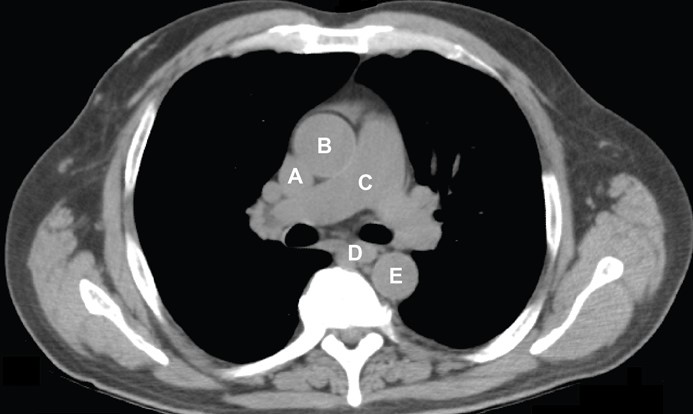
A) The Truncus Arteriosus
B) The Endodermal Foregut
C)Bulbus Cordis
D) Common Cardinal Veins
E) Subcardinal and supracardinal vein.
A) The Truncus Arteriosus
B) The Endodermal Foregut
C)Bulbus Cordis
D) Common Cardinal Veins
E) Subcardinal and supracardinal vein.

سؤال
سؤال
سؤال
سؤال
سؤال
سؤال
In the delivery room, a 1-hour-old baby girl is assessed. Following an easy pregnancy, the baby was delivered at term through spontaneous vaginal delivery. The woman is in her second trimester of pregnancy and has no significant medical history. At 1 and 5 minutes, the Apgar scores were 9 and 9. The patient has been skin-to-skin with her mother and has successfully nursed once. An inspection reveals a rosy, alert baby. Cardiac auscultation demonstrates normal S1 and S2 with no murmurs, as well as normal femoral pulses. Which of the following hemodynamic alterations are most likely to be observed in this infant than before birth? 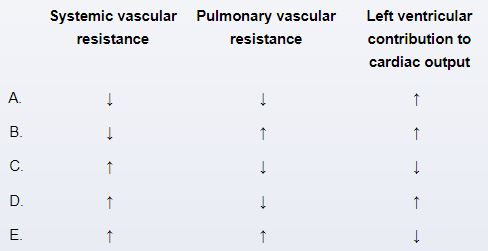
A)A
B)B
C)C
D)D
E)E
A)A
B)B
C)C
D)D
E)E
سؤال
سؤال
سؤال
A 45-year-old woman is sent to the emergency room after having a widespread tonic-clonic seizure. She has no past history of seizures, but she has just developed right arm weakness. Her family history is noteworthy since her mother died of skin cancer. Physical examination reveals a 13-mm skin lesion on her back, as illustrated in the photograph below. 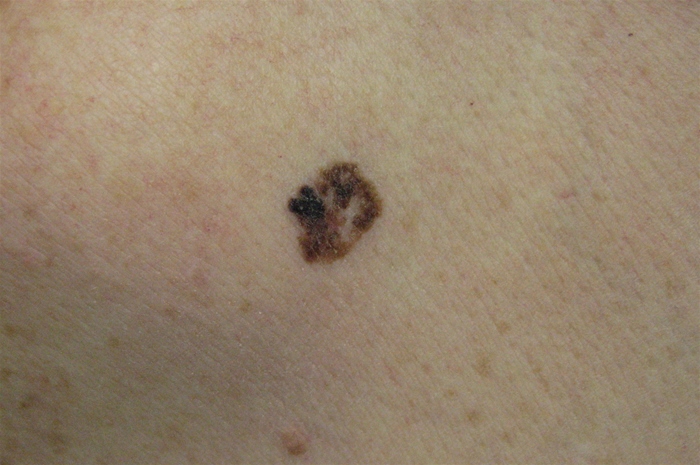 This lesion most likely originated from which of the following embryologic derivatives?
A)Endoderm
B)Mesoderm
C)Neural crest
D)Neuroectoderm
E)Surface ectoderm
This lesion most likely originated from which of the following embryologic derivatives?A)Endoderm
B)Mesoderm
C)Neural crest
D)Neuroectoderm
E)Surface ectoderm
سؤال
سؤال
سؤال
سؤال
سؤال
A 13-year-old child is brought to the clinic because he is having increasing trouble breathing, hoarseness, and dysphagia. The symptoms began gradually six months ago but have drastically worsened in the last four weeks. There is no skin rash, pharyngeal discomfort, fever, weight loss, or lack of appetite. The patient's medical history is ordinary, and he or she is not on any drugs. He has received all of his planned vaccines. The patient's parents and siblings have no history of major health issues. He has normal vital signs and is in the 70th percentile for height and weight. A big, red lingual tumor is discovered during an oropharyngeal examination. The mass is then excised from the patient; histopathologic preparation of the retrieved tissue is shown in the figure below. 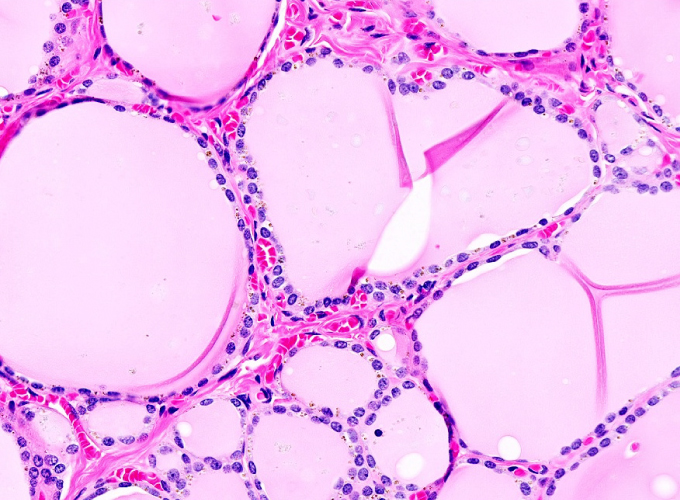 Failure of which of the following embryologic processes is most likely responsible for this patient's lesion?
A)Apoptosis
B)Differentiation
C)Fusion
D)Migration
E)Proliferation
Failure of which of the following embryologic processes is most likely responsible for this patient's lesion?A)Apoptosis
B)Differentiation
C)Fusion
D)Migration
E)Proliferation
سؤال
سؤال
سؤال
سؤال
A 32-year-old woman with gravida 4 para 0 arrives at the clinic for an examination of recurrent pregnancy loss. She has had four spontaneous abortions in a row with the same man. The patient's menstrual periods are 28 days apart, with minor bleeding for 2-3 days in between. She has no chronic medical concerns and does not use any drugs on a regular basis. The patient does not smoke, drink alcohol, or use illegal drugs. The exhibit displays the results of her hysterosalpingogram. 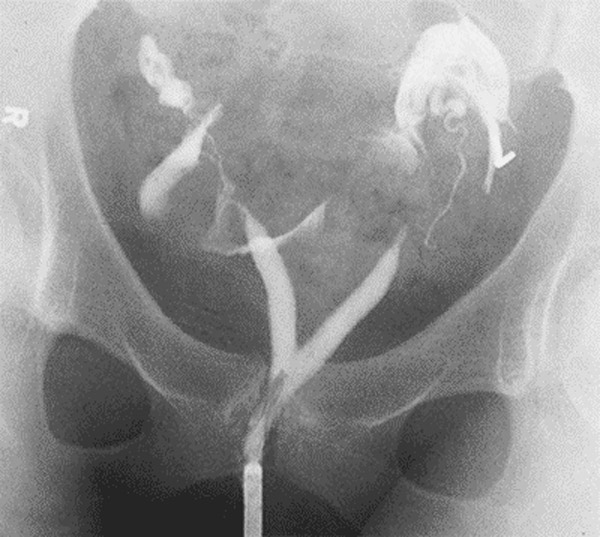 Failure of which of the following processes is the most likely underlying mechanism of this patient's condition?
A)Development of the paramesonephric ducts
B)Differentiation of the mesonephric tubules
C)Fusion of the mesonephric ducts
D)Lateral fusion of the paramesonephric ducts
E)Vertical fusion of the paramesonephric ducts with the urogenital sinus
Failure of which of the following processes is the most likely underlying mechanism of this patient's condition?A)Development of the paramesonephric ducts
B)Differentiation of the mesonephric tubules
C)Fusion of the mesonephric ducts
D)Lateral fusion of the paramesonephric ducts
E)Vertical fusion of the paramesonephric ducts with the urogenital sinus
سؤال
سؤال
سؤال
سؤال
A 23-year-old man arrives to the office complaining of lethargy, loss of appetite, and nonspecific abdominal pain over the past two weeks. There has been no nausea, vomiting, changes in bowel habits, dysuria, urine frequency, or hematuria in the patient. He underwent an appendectomy at the age of 15 for acute appendicitis; his medical history is otherwise normal. He does not use smoke or alcohol and has not traveled recently. At the age of 60, his father was diagnosed with colon cancer. Normal bowel sounds and no guarding or rebound discomfort are seen on physical examination. The picture below is an abdominal CT scan taken as part of this patient's examination. 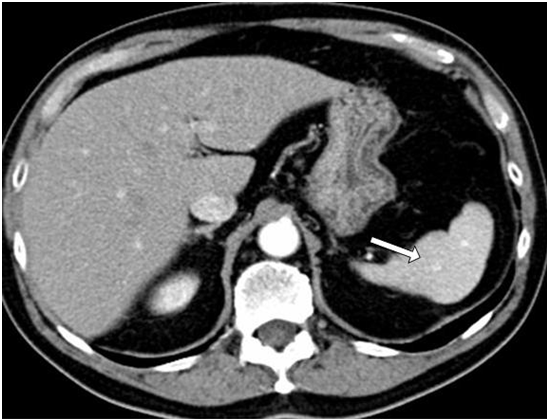 The anatomical structure indicated by the arrow originates from which of the following embryologic divisions?
A)Ectoderm
B)Endoderm
C)Mesoderm
D)Neural crest
E)Notochord
The anatomical structure indicated by the arrow originates from which of the following embryologic divisions?A)Ectoderm
B)Endoderm
C)Mesoderm
D)Neural crest
E)Notochord
سؤال
سؤال
سؤال
A 3-day-old boy is brought to the ER owing to poor feeding, emesis, and lethargy over the previous 24 hours. The patient was born to a 30-year-old lady who had a normal pregnancy by straightforward spontaneous vaginal birth. The boy was released from the newborn nursery yesterday and was solely nursing until the beginning of symptoms. While he was in the newborn nursery, his stool and urine production were typical. The patient is awake and normal in blood pressure, but tachycardic and tachypneic. He seems dehydrated, with a swollen belly. During the examination, the patient vomits, and the vomitus is depicted in the display. 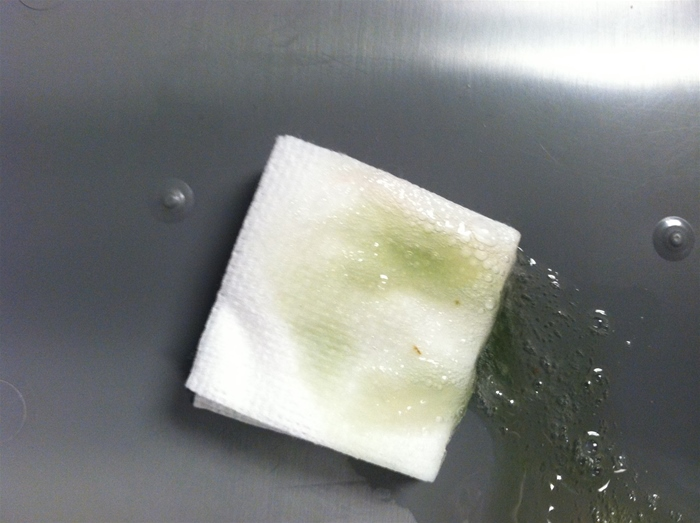 On laparotomy, fibrous bands are seen extending from the cecum and right colon to the retroperitoneum, causing extrinsic compression of the duodenum. Which of the following embryologic processes most likely failed in this patient?
A)Failure of gut recanalization
B)Fusion of the ventral and dorsal pancreatic buds
C)Midgut rotation around the superior mesenteric artery
D)Neural crest cell migration into the bowel wall
E)Obliteration of the omphalomesenteric duct
On laparotomy, fibrous bands are seen extending from the cecum and right colon to the retroperitoneum, causing extrinsic compression of the duodenum. Which of the following embryologic processes most likely failed in this patient?A)Failure of gut recanalization
B)Fusion of the ventral and dorsal pancreatic buds
C)Midgut rotation around the superior mesenteric artery
D)Neural crest cell migration into the bowel wall
E)Obliteration of the omphalomesenteric duct
سؤال
سؤال
سؤال
سؤال
A 35-year-old man visits the emergency room with recurrent stomach discomfort. He was involved in a full-speed collision with another player during a soccer game yesterday. He was experiencing generalized abdomen pain at the time but did not seek medical attention until this morning, when the agony seemed to grow. A CT scan of the abdomen is obtained as part of the patient's examination, as illustrated in the image below. It is found that his damage affects an organ that is primarily fed by a foregut artery, despite the fact that the organ itself is not a foregut derivation. Which of the following organs in this patient is most likely to be injured? 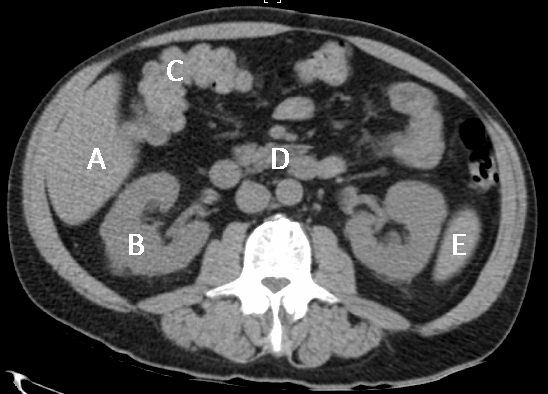
A)A
B)B
C)C
D)D
E)E
A)A
B)B
C)C
D)D
E)E
سؤال
سؤال
سؤال
سؤال
سؤال
A 32-year-old lady, gravida 2 para 1, with an easy prenatal history, spontaneously delivered a 4.1-kg (9-lb) infant at 39 weeks gestation. At 1 and 5 minutes, Apgar values were 8 and 10, respectively. Additional testing in the neonatal nursery reveals improper sexual differentiation. A 46,XY genotype was discovered during karyotype research. A biopsy of gonadal tissue reveals the absence of Sertoli cells but the presence of adequately functioning Leydig cells. Which of the following traits is the most likely? 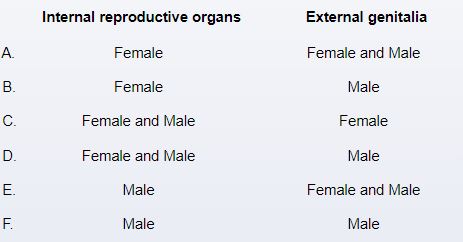
A)A
B)B
C)C
D)D
E)E
F)F
A)A
B)B
C)C
D)D
E)E
F)F
سؤال
سؤال
A 32-year-old woman, gravida 1 para 0, at 35 weeks gestation, presents to the emergency room owing to a 24-hour period of no fetal activity. The patient did not get any prenatal treatment. Fetal ultrasound confirms fetal death intrauterine. The fetus' autopsy revealed incomplete separation of the cerebral hemispheres with a single ventricle, as depicted in the figure below: 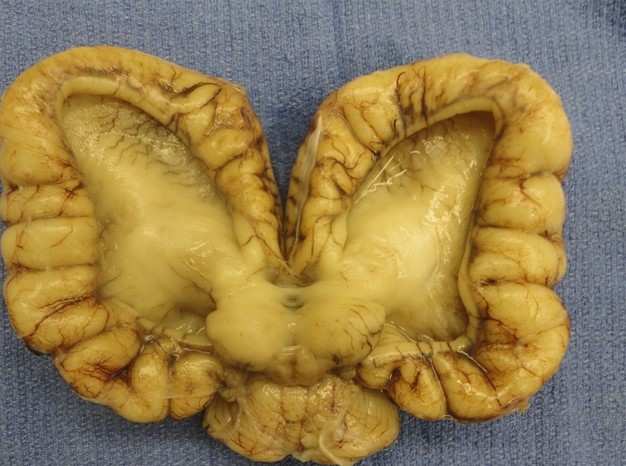 Which of the following is most closely associated with this fetal condition?
A)Congenital rubella syndrome
B)Intrauterine Zika virus infection
C)Maternal lithium use
D)Trisomy 13
E)Trisomy 21
Which of the following is most closely associated with this fetal condition?A)Congenital rubella syndrome
B)Intrauterine Zika virus infection
C)Maternal lithium use
D)Trisomy 13
E)Trisomy 21
سؤال
سؤال
سؤال
سؤال
سؤال
سؤال
After a car accident, a 38-year-old woman is taken to the emergency room. She was not hurt in the crash, but she insists she did not notice the automobile that hit her along the front side of her vehicle. The patient also reported experiencing everyday migraines and not having menstruated in 4 months. There is bitemporal hemianopsia but no other abnormalities on physical examination. A brain MRI is depicted below. 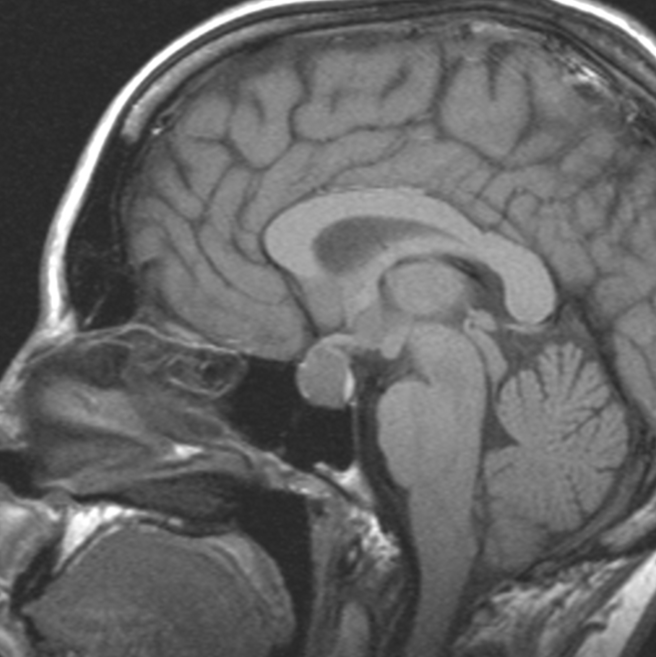 This patient's lesion most likely originates from which of the following embryologic layers?
A)Endoderm
B)Mesoderm
C)Neural crest
D)Neural tube
E)Notochord
F)Surface ectoderm
This patient's lesion most likely originates from which of the following embryologic layers?A)Endoderm
B)Mesoderm
C)Neural crest
D)Neural tube
E)Notochord
F)Surface ectoderm
سؤال
سؤال
سؤال
سؤال
سؤال
سؤال
Following an easy pregnancy, a newborn is delivered vaginally at 38 weeks gestation. The neonate is in respiratory distress immediately after birth. A physical examination reveals cyanosis, tachypnea, and poor perfusion. The patient is intubated as soon as possible, and mechanical ventilation is started. In addition, a nasogastric tube is placed. Auscultation reveals asymmetric aeration with diminished left-sided breath sounds. The abdomen has a scaphoid shape. The display includes a chest x-ray. 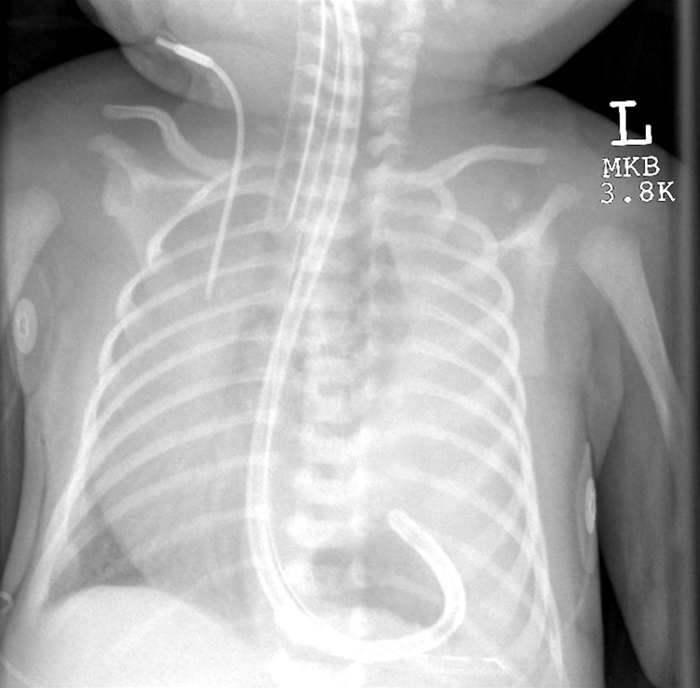 Which of the following is the most likely cause of this patient's respiratory distress?
A)Dilated airspaces with bronchiolar metaplasia
B)Increased pulmonary capillary wedge pressure
C)Loss of negative intrapleural pressure
D)Pulmonary surfactant deficiency
E)Underdevelopment of pulmonary tissue
Which of the following is the most likely cause of this patient's respiratory distress?A)Dilated airspaces with bronchiolar metaplasia
B)Increased pulmonary capillary wedge pressure
C)Loss of negative intrapleural pressure
D)Pulmonary surfactant deficiency
E)Underdevelopment of pulmonary tissue
سؤال
A 23-year-old woman with type 1 diabetes and hypothyroidism arrives at the hospital with a preterm, premature rupture of membranes at 30 weeks' gestation. Prenatal vitamins and insulin are among her prescriptions. The vital signs are normal, and the examination reveals a clear vaginal discharge. The cervix of the woman is closed, and she is not having uterine contractions. The following are the laboratory results: 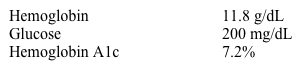 Which of the following medications has the greatest positive impact on fetal survival?
A)Dexamethasone
B)Insulin
C)Magnesium
D)Nifedipine
E)Terbutaline
Which of the following medications has the greatest positive impact on fetal survival?A)Dexamethasone
B)Insulin
C)Magnesium
D)Nifedipine
E)Terbutaline
سؤال
The concentrations of 2 substances in the amniotic fluid of pregnant women are graphed below. 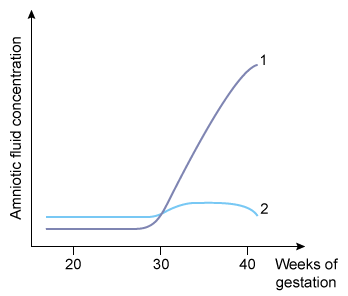 The two curves most likely correspond to which of the following?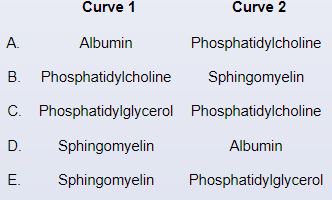
A)A
B)B
C)C
D)D
E)E
The two curves most likely correspond to which of the following? A)A
B)B
C)C
D)D
E)E
سؤال
The parents of a 3-week-old kid with umbilical discharge bring him to the clinic. His postnatal history was straightforward, with the chord shriveling about 14 days of life. Vital indicators are typical. A minor reducible umbilical hernia, little clear to straw-colored drainage from the umbilicus, and erythema around the region are discovered during an examination of the area. The following are the laboratory results: 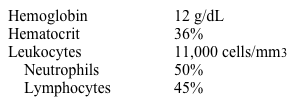 Which of the following is the most likely cause of this child's condition?
A)Absence of neutrophil migration
B)Duplication of the ureter
C)Incomplete closure of anterior abdominal wall
D)Persistence of allantois remnant
E)Persistence of omphalomesenteric duct
Which of the following is the most likely cause of this child's condition?A)Absence of neutrophil migration
B)Duplication of the ureter
C)Incomplete closure of anterior abdominal wall
D)Persistence of allantois remnant
E)Persistence of omphalomesenteric duct
سؤال
سؤال
سؤال
سؤال
سؤال
سؤال
سؤال

فتح الحزمة
قم بالتسجيل لفتح البطاقات في هذه المجموعة!
Unlock Deck
Unlock Deck
1/59

العب

ملء الشاشة (f)
Deck 4: Embryology
1
A 55-year-old man was admitted to the hospital due to the suspicion of having sepsis. The patient was diagnosed with pneumonia in a private clinic, 3 days ago. During the previous days, his temperature was not controlled by regular antipyretics. On examination, his blood pressure is 80/50, his pulse is 110/min and regular and his temperature is 40 C. During the evaluation, a central catheter was placed, that passes through the structure indicated by the arrow in the image. What is the origin of this structure?
A) The Truncus Arteriosus
B) The Endodermal Foregut
C)Bulbus Cordis
D) Common Cardinal Veins
E) Subcardinal and supracardinal vein.
A) The Truncus Arteriosus
B) The Endodermal Foregut
C)Bulbus Cordis
D) Common Cardinal Veins
E) Subcardinal and supracardinal vein.
Common Cardinal Veins
2
A 6-year-old female is being evaluated for persistent hypertension that was discovered incidentally. A week ago, the patient was in her usual check-up, the physician found the blood pressure to be 150/100. During the evaluation, the patient was found to have high blood pressure in the upper arms, while the lower limbs had normal blood pressure. Cardiac examination shows continuous murmur on the back between the scapulae. The problem is in the structure derivative of which of the following embryologic structures?
A)Fourth aortic arch
B)Primitive atria
C)Sinus venosus
D)Sixth aortic arch
A)Fourth aortic arch
B)Primitive atria
C)Sinus venosus
D)Sixth aortic arch
Fourth aortic arch
3
A 3-year-old girl is evaluated in the pediatric clinic due to exercise intolerance. The patient can not play with her peers, due to the shortness of breath and exercise intolerance. On examination, the patient was found to have continuous machinery murmur below the clavicle. Additionally, she has strong bounding pulses peripherally. The patient presentation involves an artery derived from which of the following embryological structures?
A)Truncus Arteriosus
B)Second aortic arch
C)Primitive Ventricle
D)Sixth aortic arch
A)Truncus Arteriosus
B)Second aortic arch
C)Primitive Ventricle
D)Sixth aortic arch
Sixth aortic arch
4
A 37-year-old woman is sent to the emergency room after experiencing abrupt right arm weakness and trouble speaking. Although she has no relevant medical history, she uses oral contraceptives. The examination reveals a decline in right upper extremity strength as well as expressive aphasia. Cardiac auscultation is completely normal. A brain MRI demonstrates an acute infarction in the left frontal lobe. An etiology is determined by further examination. During an echocardiogram, bubbles are visible flowing into the left side of the heart after agitated normal saline is injected into a peripheral vein. Which of the following is the most likely source of this patient's observed finding?
A)Aplasia of the atrial septum secundum
B)Failure of the aorticopulmonary septum to develop
C)Incomplete closure of the interventricular foramen
D)Incomplete fusion of atrial septum primum and secundum
E)Persistent channel between aorta and pulmonary artery
A)Aplasia of the atrial septum secundum
B)Failure of the aorticopulmonary septum to develop
C)Incomplete closure of the interventricular foramen
D)Incomplete fusion of atrial septum primum and secundum
E)Persistent channel between aorta and pulmonary artery
فتح الحزمة
افتح القفل للوصول البطاقات البالغ عددها 59 في هذه المجموعة.
فتح الحزمة
k this deck
5
A 64-year-old man passes out near the emergency room door. A doctor rushes over to the patient and feels a strong pulse along the inner side of the left sternocleidomastoid muscle. Which of the following aortic arches is the vessel palpated by the doctor a derivative of?
A)First
B)Second
C)Third
D)Fourth
E)Sixth
A)First
B)Second
C)Third
D)Fourth
E)Sixth
فتح الحزمة
افتح القفل للوصول البطاقات البالغ عددها 59 في هذه المجموعة.
فتح الحزمة
k this deck
6
The five measures of fetal blood oxygen saturation are: 67, 61, 56, 52, and 31%. Which of the following vessels is most likely to have the highest value?
A)Ductus arteriosus
B)Superior vena cava
C)Inferior vena cava
D)Pulmonary trunk
E)Descending aorta
F)Umbilical artery
A)Ductus arteriosus
B)Superior vena cava
C)Inferior vena cava
D)Pulmonary trunk
E)Descending aorta
F)Umbilical artery
فتح الحزمة
افتح القفل للوصول البطاقات البالغ عددها 59 في هذه المجموعة.
فتح الحزمة
k this deck
7
In the delivery room, a 1-hour-old baby girl is assessed. Following an easy pregnancy, the baby was delivered at term through spontaneous vaginal delivery. The woman is in her second trimester of pregnancy and has no significant medical history. At 1 and 5 minutes, the Apgar scores were 9 and 9. The patient has been skin-to-skin with her mother and has successfully nursed once. An inspection reveals a rosy, alert baby. Cardiac auscultation demonstrates normal S1 and S2 with no murmurs, as well as normal femoral pulses. Which of the following hemodynamic alterations are most likely to be observed in this infant than before birth?
A)A
B)B
C)C
D)D
E)E
A)A
B)B
C)C
D)D
E)E
فتح الحزمة
افتح القفل للوصول البطاقات البالغ عددها 59 في هذه المجموعة.
فتح الحزمة
k this deck
8
A 5-year-old youngster is brought to the office by his parents for cyanosis examination with no effort. The youngster has experienced instances of "turning blue" that began in infancy and are now becoming more regular. Throughout the episodes, the youngster squats because it makes him "feel better." The boy's family recently emigrated to the United States, and he had never received a medical examination previous to this visit. A significant right ventricular impulse and a loud systolic murmur are discovered during physical examination. Which of the following embryological events is the most likely cause of this patient's condition?
A)Anomalous pulmonary venous return
B)Aortic arch constriction
C)Deviation of the infundibular septum
D)Endocardial cushion defect
E)Linear development of the aorticopulmonary septum
A)Anomalous pulmonary venous return
B)Aortic arch constriction
C)Deviation of the infundibular septum
D)Endocardial cushion defect
E)Linear development of the aorticopulmonary septum
فتح الحزمة
افتح القفل للوصول البطاقات البالغ عددها 59 في هذه المجموعة.
فتح الحزمة
k this deck
9
A two-day-old baby is pale and fussy. He was born to a 22-year-old primigravida who had had only occasional prenatal care. The delivery went smoothly, with Apgar values of 7 and 8 at 1 and 5 minutes, respectively. His temperature is 36.7 degrees Celsius (98 degrees Fahrenheit), his blood pressure is 70/30 mm Hg, his pulse rate is 148 beats per minute, and his respiratory rate is 68 beats per minute. A cyanotic and irritable infant with mild-to-moderate respiratory distress is seen on physical examination. Auscultation indicates a constant, machine-like murmur heard between the scapulae. Serum lactate levels are high. The aorta is shown on an echocardiogram to be anterior, inferior, and to the right of the pulmonary artery. Which of the following embryologic processes is most likely to be at fault for this patient's condition?
A)Apoptosis
B)Fusion
C)Obliteration
D)Proliferation
E)Septation
F)Spiraling
A)Apoptosis
B)Fusion
C)Obliteration
D)Proliferation
E)Septation
F)Spiraling
فتح الحزمة
افتح القفل للوصول البطاقات البالغ عددها 59 في هذه المجموعة.
فتح الحزمة
k this deck
10
A 45-year-old woman is sent to the emergency room after having a widespread tonic-clonic seizure. She has no past history of seizures, but she has just developed right arm weakness. Her family history is noteworthy since her mother died of skin cancer. Physical examination reveals a 13-mm skin lesion on her back, as illustrated in the photograph below. This lesion most likely originated from which of the following embryologic derivatives?
A)Endoderm
B)Mesoderm
C)Neural crest
D)Neuroectoderm
E)Surface ectoderm
This lesion most likely originated from which of the following embryologic derivatives?A)Endoderm
B)Mesoderm
C)Neural crest
D)Neuroectoderm
E)Surface ectoderm
فتح الحزمة
افتح القفل للوصول البطاقات البالغ عددها 59 في هذه المجموعة.
فتح الحزمة
k this deck
11
A 4-hour-old child with a cleft lip is successfully nursing. The baby was delivered vaginally following a straightforward pregnancy and delivery. At 20 weeks gestation, routine prenatal sonography revealed no abnormalities. Physical examination reveals a palate that is intact and a unilateral cleft lip on the left side. There are no additional abnormalities found. Which of the following intrauterine procedures failed to result in this child's cleft lip?
A)Fusion of the 2 medial nasal prominences
B)Fusion of the maxillary prominence and intermaxillary segment
C)Fusion of the palatal processes
D)Hyperplasia of the frontonasal prominence
E)Hypoplasia of the mandibular prominence
A)Fusion of the 2 medial nasal prominences
B)Fusion of the maxillary prominence and intermaxillary segment
C)Fusion of the palatal processes
D)Hyperplasia of the frontonasal prominence
E)Hypoplasia of the mandibular prominence
فتح الحزمة
افتح القفل للوصول البطاقات البالغ عددها 59 في هذه المجموعة.
فتح الحزمة
k this deck
12
A baby girl is assessed in the neonatal intensive care unit for respiratory difficulties. The patient was born at full term by vaginal birth. She has struggled to breathe from infancy, with loud snoring and periodic oxygen deficiency. Because of her respiratory issues, she has been unable to breastfeed. When the patient is placed in a prone posture, his or her breathing improves dramatically. On inspection, there is a tiny mandible, a tongue that is posteriorly displaced, and a U-shaped cleft palate. Which of the following describes the anomalies described?
A)Association
B)Disruption
C)Imprinting
D)Sequence
E)Syndrome
A)Association
B)Disruption
C)Imprinting
D)Sequence
E)Syndrome
فتح الحزمة
افتح القفل للوصول البطاقات البالغ عددها 59 في هذه المجموعة.
فتح الحزمة
k this deck
13
A 7-year-old child is brought to the clinic for a neck mass assessment. The patient was sent to an urgent care center a week ago for nasal congestion and a sore throat. The symptoms went away after a few days, but his parents noted a persistent bulge in his neck. The patient has no past medical issues and is fully immunized. Physical examination reveals that he is healthy and well-nourished. A somewhat sensitive 2-cm midline lump travels up as the patient swallows, according to a neck examination. Which of the following is the most likely source of the lesion in this patient?
A)Abnormal migration of neural crest cells
B)Cervical implantation of thymic tissue
C)Dilation of cervical lymphatic channels
D)Incomplete obliteration of a duct
E)Persistence of second branchial arch structures
F)Trapping of skin structures along embryonic fusion lines
A)Abnormal migration of neural crest cells
B)Cervical implantation of thymic tissue
C)Dilation of cervical lymphatic channels
D)Incomplete obliteration of a duct
E)Persistence of second branchial arch structures
F)Trapping of skin structures along embryonic fusion lines
فتح الحزمة
افتح القفل للوصول البطاقات البالغ عددها 59 في هذه المجموعة.
فتح الحزمة
k this deck
14
A 1-week-old kid is brought to the ER with poor eating, lethargy, and odd "muscle motions" involving the left thumb and hand during the previous two days. The patient's mother had adequate prenatal care, had a normal pregnancy, and did not use any drugs other than prenatal vitamins. The infant's vital signs are normal, but cuff blood pressure measurement reveals remarkable bending of the left wrist and thumb and extension of the fingers. A hypoplastic mandible, low-set ears, bifid uvula, and cleft palate are discovered during a physical examination. An x-ray of the chest shows reduced soft-tissue attenuation in the right anterior mediastinum. Which of the following embryonic structures is most likely affected by these findings?
A)Anterior neuropore
B)Foramen cecum
C)Rathke pouch
D)Second pharyngeal cleft
E)Third pharyngeal pouch
A)Anterior neuropore
B)Foramen cecum
C)Rathke pouch
D)Second pharyngeal cleft
E)Third pharyngeal pouch
فتح الحزمة
افتح القفل للوصول البطاقات البالغ عددها 59 في هذه المجموعة.
فتح الحزمة
k this deck
15
A 13-year-old child is brought to the clinic because he is having increasing trouble breathing, hoarseness, and dysphagia. The symptoms began gradually six months ago but have drastically worsened in the last four weeks. There is no skin rash, pharyngeal discomfort, fever, weight loss, or lack of appetite. The patient's medical history is ordinary, and he or she is not on any drugs. He has received all of his planned vaccines. The patient's parents and siblings have no history of major health issues. He has normal vital signs and is in the 70th percentile for height and weight. A big, red lingual tumor is discovered during an oropharyngeal examination. The mass is then excised from the patient; histopathologic preparation of the retrieved tissue is shown in the figure below. Failure of which of the following embryologic processes is most likely responsible for this patient's lesion?
A)Apoptosis
B)Differentiation
C)Fusion
D)Migration
E)Proliferation
Failure of which of the following embryologic processes is most likely responsible for this patient's lesion?A)Apoptosis
B)Differentiation
C)Fusion
D)Migration
E)Proliferation
فتح الحزمة
افتح القفل للوصول البطاقات البالغ عددها 59 في هذه المجموعة.
فتح الحزمة
k this deck
16
A 33-year-old man arrives at the clinic after experiencing episodic headaches for many months, which are accompanied by perspiration and anxiety and disappear spontaneously within 15-30 minutes. He has no other medical issues and does not use any medications. His sibling just underwent hyperparathyroidism surgery. The blood pressure is 180/110 mm Hg and the pulse rate is 102/min. The laboratory findings reveal that the serum electrolytes and renal function are normal. An abdominal CT scan indicates a tumor in the right adrenal gland. Which of the following cells shares an embryological origin with the tissue causing this patient's present condition?
A)Capillary endothelial cells
B)Cardiac myocytes
C)Interstitial fibroblasts
D)Melanin-producing cells
E)Thyroid follicular cells
A)Capillary endothelial cells
B)Cardiac myocytes
C)Interstitial fibroblasts
D)Melanin-producing cells
E)Thyroid follicular cells
فتح الحزمة
افتح القفل للوصول البطاقات البالغ عددها 59 في هذه المجموعة.
فتح الحزمة
k this deck
17
A 33-year-old man arrives at the clinic after experiencing episodic headaches for many months, which are accompanied by perspiration and anxiety and disappear spontaneously within 15-30 minutes. He has no other medical issues and does not use any medications. His sibling just underwent hyperparathyroidism surgery. The blood pressure is 180/110 mm Hg and the pulse rate is 102/min. The laboratory findings reveal that the serum electrolytes and renal function are normal. An abdominal CT scan indicates a tumor in the right adrenal gland. Which of the following cells shares an embryological origin with the tissue causing this patient's present condition?
A)Capillary endothelial cells
B)Cardiac myocytes
C)Interstitial fibroblasts
D)Melanin-producing cells
E)Thyroid follicular cells
A)Capillary endothelial cells
B)Cardiac myocytes
C)Interstitial fibroblasts
D)Melanin-producing cells
E)Thyroid follicular cells
فتح الحزمة
افتح القفل للوصول البطاقات البالغ عددها 59 في هذه المجموعة.
فتح الحزمة
k this deck
18
A 15-year-old girl is brought to the office because she is experiencing amenorrhea. She has never menstruated, although her mother did at the age of 14. The patient does not have any chronic medical issues and does not use any medications. She does not smoke, drink, or use illegal drugs. The patient is the captain of her junior varsity tennis team and plays violin for her high school orchestra. She has no sexual desires. Weight is 65 kg and height is 175.3 cm (5 ft 9 in) (143.3 lb). 21.2 kg/m2 is the BMI. Secondary sexual features are fully established, according to the examination. A shorter vaginal canal with a rudimentary uterus is shown on a pelvic ultrasound. Which of the following diagnoses is more likely?
A)21-hydroxylase deficiency
B)Androgen insensitivity syndrome
C)Kallmann syndrome
D)Klinefelter syndrome
E)Müllerian agenesis
A)21-hydroxylase deficiency
B)Androgen insensitivity syndrome
C)Kallmann syndrome
D)Klinefelter syndrome
E)Müllerian agenesis
فتح الحزمة
افتح القفل للوصول البطاقات البالغ عددها 59 في هذه المجموعة.
فتح الحزمة
k this deck
19
A 32-year-old woman with gravida 4 para 0 arrives at the clinic for an examination of recurrent pregnancy loss. She has had four spontaneous abortions in a row with the same man. The patient's menstrual periods are 28 days apart, with minor bleeding for 2-3 days in between. She has no chronic medical concerns and does not use any drugs on a regular basis. The patient does not smoke, drink alcohol, or use illegal drugs. The exhibit displays the results of her hysterosalpingogram. Failure of which of the following processes is the most likely underlying mechanism of this patient's condition?
A)Development of the paramesonephric ducts
B)Differentiation of the mesonephric tubules
C)Fusion of the mesonephric ducts
D)Lateral fusion of the paramesonephric ducts
E)Vertical fusion of the paramesonephric ducts with the urogenital sinus
Failure of which of the following processes is the most likely underlying mechanism of this patient's condition?A)Development of the paramesonephric ducts
B)Differentiation of the mesonephric tubules
C)Fusion of the mesonephric ducts
D)Lateral fusion of the paramesonephric ducts
E)Vertical fusion of the paramesonephric ducts with the urogenital sinus
فتح الحزمة
افتح القفل للوصول البطاقات البالغ عددها 59 في هذه المجموعة.
فتح الحزمة
k this deck
20
A 32-year-old man arrives to the emergency room with a one-day history of severe abdominal discomfort, nausea, and vomiting. His agony is persistent and spreads all the way to his back. He admits to having "had a few drinks" with some buddies a few days earlier. Laboratory tests show that amylase and lipase levels are considerably high. An abdominal CT scan reveals pancreas divisum, a common congenital defect caused by the inability of the ventral and dorsal pancreatic primordia's pancreatic ductal networks to merge during development. The ventral pancreatic primordium gives rise to which of the following pancreatic structures?
A)Tail
B)Body
C)Superior aspect of the head
D)Accessory pancreatic duct
E)Main pancreatic duct
A)Tail
B)Body
C)Superior aspect of the head
D)Accessory pancreatic duct
E)Main pancreatic duct
فتح الحزمة
افتح القفل للوصول البطاقات البالغ عددها 59 في هذه المجموعة.
فتح الحزمة
k this deck
21
A 4-week-old kid is sent to the hospital due to frequent vomiting, fussiness, and feeding resistance. The emesis started clean but turned bilious in the past three hours. The baby had been solely breastfed. His body temperature is 37.2 degrees Celsius (99.0 F). Blood pressure and pulse rate are also normal. A normal abdomen with no rebound or guarding is revealed by physical examination. An upper gastrointestinal series is obtained urgently to evaluate for malrotation and volvulus and shows normal rotation but constriction of the duodenum. A CT scan of the abdomen reveals pancreatic tissue around the duodenum. Which of the following is most likely to be the source of this patient's condition?
A)Aberrant differentiation of the midgut structures
B)Abnormal migration of the ventral pancreatic bud
C)Ectopic rests not connected to the pancreas
D)Failure of apoptosis in the dorsal pancreatic bud
E)Failure of the ventral and dorsal pancreatic bud to fuse
A)Aberrant differentiation of the midgut structures
B)Abnormal migration of the ventral pancreatic bud
C)Ectopic rests not connected to the pancreas
D)Failure of apoptosis in the dorsal pancreatic bud
E)Failure of the ventral and dorsal pancreatic bud to fuse
فتح الحزمة
افتح القفل للوصول البطاقات البالغ عددها 59 في هذه المجموعة.
فتح الحزمة
k this deck
22
A term baby boy is assessed for respiratory distress in the neonatal intensive care unit. At 1 and 5 minutes, Apgar values are 2 and 5, respectively. Respirations are 84/min. The patient has a barrel chest, a scaphoid abdomen, and slight cyanosis of his limbs on examination. Auscultation reveals that the left lung has no breath sounds; the right lung has normal aeration. A chest x-ray shows several fluid-filled cystic regions on the left, as well as a mediastinal shift to the right. Which of the following embryologic events did not occur in this patient?
A)Closure of the pleuroperitoneal fold
B)Closure of the ventral body wall
C)Formation of the pleuropericardial membrane
D)Rotation of the midgut
E)Separation of the dorsal and ventral foregut
A)Closure of the pleuroperitoneal fold
B)Closure of the ventral body wall
C)Formation of the pleuropericardial membrane
D)Rotation of the midgut
E)Separation of the dorsal and ventral foregut
فتح الحزمة
افتح القفل للوصول البطاقات البالغ عددها 59 في هذه المجموعة.
فتح الحزمة
k this deck
23
A 23-year-old man arrives to the office complaining of lethargy, loss of appetite, and nonspecific abdominal pain over the past two weeks. There has been no nausea, vomiting, changes in bowel habits, dysuria, urine frequency, or hematuria in the patient. He underwent an appendectomy at the age of 15 for acute appendicitis; his medical history is otherwise normal. He does not use smoke or alcohol and has not traveled recently. At the age of 60, his father was diagnosed with colon cancer. Normal bowel sounds and no guarding or rebound discomfort are seen on physical examination. The picture below is an abdominal CT scan taken as part of this patient's examination. The anatomical structure indicated by the arrow originates from which of the following embryologic divisions?
A)Ectoderm
B)Endoderm
C)Mesoderm
D)Neural crest
E)Notochord
The anatomical structure indicated by the arrow originates from which of the following embryologic divisions?A)Ectoderm
B)Endoderm
C)Mesoderm
D)Neural crest
E)Notochord
فتح الحزمة
افتح القفل للوصول البطاقات البالغ عددها 59 في هذه المجموعة.
فتح الحزمة
k this deck
24
Researchers researching neural crest cell migration in a human baby see normal activity beginning during the eighth week of embryogenesis, with a brief pause during the 12th week, when migration is generally completed. As a result of this disruption, which of the following structures is most likely to be devoid of innervation?
A)Esophagus
B)Duodenum
C)Jejunum
D)Ileum
E)Cecum
F)Transverse colon
G)Rectum
A)Esophagus
B)Duodenum
C)Jejunum
D)Ileum
E)Cecum
F)Transverse colon
G)Rectum
فتح الحزمة
افتح القفل للوصول البطاقات البالغ عددها 59 في هذه المجموعة.
فتح الحزمة
k this deck
25
Due to recurrent vomiting and reluctance to feed, a 3-day-old child is taken to the emergency room by her parents. Vomiting started early in the morning and has been greenish-yellow in hue. There is no blood in the emesis. The baby appeared to be dehydrated. Her heart rate is 175 beats per minute, and her blood pressure is normal. Following the completion of the first assessment, the infant will have a laparotomy. A normal-looking duodenum, the lack of a substantial section of jejunum and ileum, and the remains of the distal ileum looping around a slender vascular stalk are among the findings. Which of the following intrauterine processes is most likely to be at the root of this patient's condition?
A)Abnormal rotation
B)Cell migration failure
C)Failure of partitioning
D)Recanalization failure
E)Vascular occlusion
A)Abnormal rotation
B)Cell migration failure
C)Failure of partitioning
D)Recanalization failure
E)Vascular occlusion
فتح الحزمة
افتح القفل للوصول البطاقات البالغ عددها 59 في هذه المجموعة.
فتح الحزمة
k this deck
26
A 3-day-old boy is brought to the ER owing to poor feeding, emesis, and lethargy over the previous 24 hours. The patient was born to a 30-year-old lady who had a normal pregnancy by straightforward spontaneous vaginal birth. The boy was released from the newborn nursery yesterday and was solely nursing until the beginning of symptoms. While he was in the newborn nursery, his stool and urine production were typical. The patient is awake and normal in blood pressure, but tachycardic and tachypneic. He seems dehydrated, with a swollen belly. During the examination, the patient vomits, and the vomitus is depicted in the display. On laparotomy, fibrous bands are seen extending from the cecum and right colon to the retroperitoneum, causing extrinsic compression of the duodenum. Which of the following embryologic processes most likely failed in this patient?
A)Failure of gut recanalization
B)Fusion of the ventral and dorsal pancreatic buds
C)Midgut rotation around the superior mesenteric artery
D)Neural crest cell migration into the bowel wall
E)Obliteration of the omphalomesenteric duct
On laparotomy, fibrous bands are seen extending from the cecum and right colon to the retroperitoneum, causing extrinsic compression of the duodenum. Which of the following embryologic processes most likely failed in this patient?A)Failure of gut recanalization
B)Fusion of the ventral and dorsal pancreatic buds
C)Midgut rotation around the superior mesenteric artery
D)Neural crest cell migration into the bowel wall
E)Obliteration of the omphalomesenteric duct
فتح الحزمة
افتح القفل للوصول البطاقات البالغ عددها 59 في هذه المجموعة.
فتح الحزمة
k this deck
27
After experiencing significant stomach discomfort and vomiting, a 3-year-old kid is taken to the emergency department by his parents. Palpation demonstrates diffuse discomfort, and abdominal imaging reveals a foreign body stuck inside the gut, resulting in a minor intestinal blockage. A laparotomy is conducted to remove the foreign body; an accidental cyst is detected during the surgery. A fibrous ring connects the cyst to the ileum and the umbilicus. Which of the following is related with the embryologic abnormality that led to the creation of this patient's cyst?
A)Gastroschisis
B)Malrotation
C)Meckel diverticulum
D)Omphalocele
E)Patent urachus
F)Umbilical hernia
A)Gastroschisis
B)Malrotation
C)Meckel diverticulum
D)Omphalocele
E)Patent urachus
F)Umbilical hernia
فتح الحزمة
افتح القفل للوصول البطاقات البالغ عددها 59 في هذه المجموعة.
فتح الحزمة
k this deck
28
A 30-year-old man arrives to the emergency department complaining of acute abdominal discomfort. The patient's discomfort began yesterday and has been progressively severe. He has also acquired bilious emesis in the previous several hours. The patient has never had surgery before. The temperature is 37.8 degrees Celsius (100 degrees Fahrenheit), and the pulse rate is 110 beats per minute. During palpation, there is broad abdominal soreness with guarding. Abdominal imaging demonstrates thickening of the gut wall within a blind pouch attached to the ileum. A laparotomy is carried out. During the surgery, a fibrous band is visible connecting the pouch's end to the umbilicus. Which of the following is most likely used to make the pouch's walls?
A)Fibrous scar tissue
B)Granulation tissue and peritoneum
C)Mucosa and submucosa layers
D)Omentum and adipose tissue
E)Submucosa, mucosa, and muscular layers
A)Fibrous scar tissue
B)Granulation tissue and peritoneum
C)Mucosa and submucosa layers
D)Omentum and adipose tissue
E)Submucosa, mucosa, and muscular layers
فتح الحزمة
افتح القفل للوصول البطاقات البالغ عددها 59 في هذه المجموعة.
فتح الحزمة
k this deck
29
A 4-year-old child is brought to the office by her parents after they see dark red blood on her toilet tissue following a bowel movement. She has experienced no stomach pain, dysuria, or bowel discomfort. The adolescent has no known medical issues and does not use any drugs. The temperature is 36.7 degrees Celsius (98.1 degrees Fahrenheit), the blood pressure is 100/40 mm Hg, and the pulse rate is 112/min. An examination reveals a soft, nontender abdomen with bowel noises. The hemoglobin concentration is 8 g/dL, and the platelet count is 215,000/mm3. Coagulation tests are common. Using 99mTc-pertechnetate scintigraphy, sequential imaging reveals focused radiotracer accumulation in the right lower quadrant. Which of the following embryologic processes is most likely to have caused this patient's condition?
A)Arrested hindgut descent along the inferior mesenteric artery
B)Defective neural crest cell migration into the bowel wall
C)Disrupted vascular flow to the ileum
D)Failed obliteration of the vitelline duct
E)Partial midgut rotation around the superior mesenteric artery
A)Arrested hindgut descent along the inferior mesenteric artery
B)Defective neural crest cell migration into the bowel wall
C)Disrupted vascular flow to the ileum
D)Failed obliteration of the vitelline duct
E)Partial midgut rotation around the superior mesenteric artery
فتح الحزمة
افتح القفل للوصول البطاقات البالغ عددها 59 في هذه المجموعة.
فتح الحزمة
k this deck
30
A 35-year-old man visits the emergency room with recurrent stomach discomfort. He was involved in a full-speed collision with another player during a soccer game yesterday. He was experiencing generalized abdomen pain at the time but did not seek medical attention until this morning, when the agony seemed to grow. A CT scan of the abdomen is obtained as part of the patient's examination, as illustrated in the image below. It is found that his damage affects an organ that is primarily fed by a foregut artery, despite the fact that the organ itself is not a foregut derivation. Which of the following organs in this patient is most likely to be injured?
A)A
B)B
C)C
D)D
E)E
A)A
B)B
C)C
D)D
E)E
فتح الحزمة
افتح القفل للوصول البطاقات البالغ عددها 59 في هذه المجموعة.
فتح الحزمة
k this deck
31
A 6-hour-old kid is having feeding challenges in the newborn nursery. The patient was delivered through cesarean section at 39 weeks gestation to a 33-year-old primigravida owing to fetal heart tracing failure and late decelerations. Although the Apgar scores were 8 and 9, an examination revealed an infant who was drooling and coughing excessively. At rest, cardiac, respiratory, and abdominal tests are normal. When the newborn tries to nurse, he experiences many bouts of coughing and perioral cyanosis, with an oxygen saturation of 85% on room air. Which of the following is most likely to be the source of this patient's condition?
A)Atresia of small intestine
B)Collapse of supraglottic structures during respiration
C)Failure of primitive foregut to separate from airway
D)Obstruction of posterior nasal passages
E)Thoracic herniation of abdominal viscera
A)Atresia of small intestine
B)Collapse of supraglottic structures during respiration
C)Failure of primitive foregut to separate from airway
D)Obstruction of posterior nasal passages
E)Thoracic herniation of abdominal viscera
فتح الحزمة
افتح القفل للوصول البطاقات البالغ عددها 59 في هذه المجموعة.
فتح الحزمة
k this deck
32
Shortly after delivery, a boy is inspected in the newborn nursery. He was delivered vaginally at full term to a 40-year-old lady who had not received prenatal care. His temperature is 36.7 degrees Celsius (98 degrees Fahrenheit), his pulse rate is 132/minute, and his respirations are 38 per minute. Slanted palpebral fissures, epicanthal folds, broad nuchal folds, and a single palmar wrinkle are all visible on examination. The patient has a huge, reducible midline abdominal protrusion that is covered by skin and becomes more visible when he screams. The stump of the umbilical cord is at the middle of the protrusion. Which of the following is the most likely source of the abdominal discovery in this patient?
A)Failure of the extraembryonic gut to return to the abdominal cavity
B)Incomplete closure of the umbilical ring
C)Incomplete recanalization of the fetal intestinal tract
D)Incomplete rotation of the midgut in utero
E)Persistent processus vaginalis
A)Failure of the extraembryonic gut to return to the abdominal cavity
B)Incomplete closure of the umbilical ring
C)Incomplete recanalization of the fetal intestinal tract
D)Incomplete rotation of the midgut in utero
E)Persistent processus vaginalis
فتح الحزمة
افتح القفل للوصول البطاقات البالغ عددها 59 في هذه المجموعة.
فتح الحزمة
k this deck
33
A 5-month-old kid arrives at the clinic for right-sided scrotal hypertrophy. The growth has been present since birth and worsens when he screams or attempts to urinate. There has been no trauma or illness. The boy's parents do not feel he is in discomfort, and no darkening of the region has been observed. The enlargement is discovered on ultrasonography to be a fluid accumulation around the right testis. Which of the following is a direct result of the precise embryologic abnormality that caused this patient's condition?
A)Direct inguinal hernia
B)Femoral hernia
C)Hypospadias
D)Indirect inguinal hernia
E)Orchitis
F)Testicular torsion
A)Direct inguinal hernia
B)Femoral hernia
C)Hypospadias
D)Indirect inguinal hernia
E)Orchitis
F)Testicular torsion
فتح الحزمة
افتح القفل للوصول البطاقات البالغ عددها 59 في هذه المجموعة.
فتح الحزمة
k this deck
34
Non-fusion of the urethral folds creates the labia minora and the vaginal vestibule in normal female development. Non-fusion of the urethral folds in men would most likely result in which of the following?
A)Bifid scrotum
B)Cryptorchidism
C)Epispadias
D)Hydrocele of the testis
E)Hypospadias
A)Bifid scrotum
B)Cryptorchidism
C)Epispadias
D)Hydrocele of the testis
E)Hypospadias
فتح الحزمة
افتح القفل للوصول البطاقات البالغ عددها 59 في هذه المجموعة.
فتح الحزمة
k this deck
35
A 32-year-old lady, gravida 2 para 1, with an easy prenatal history, spontaneously delivered a 4.1-kg (9-lb) infant at 39 weeks gestation. At 1 and 5 minutes, Apgar values were 8 and 10, respectively. Additional testing in the neonatal nursery reveals improper sexual differentiation. A 46,XY genotype was discovered during karyotype research. A biopsy of gonadal tissue reveals the absence of Sertoli cells but the presence of adequately functioning Leydig cells. Which of the following traits is the most likely?
A)A
B)B
C)C
D)D
E)E
F)F
A)A
B)B
C)C
D)D
E)E
F)F
فتح الحزمة
افتح القفل للوصول البطاقات البالغ عددها 59 في هذه المجموعة.
فتح الحزمة
k this deck
36
A 16-year-old obese primigravida girl arrives to the ER in active labor. The patient did not undergo prenatal care or take prenatal vitamins in order to conceal her pregnancy from her family. Her fetal heartbeat is undetectable, and she vaginally delivers a stillborn child. The stillborn has multiple dysmorphic characteristics, including narrowly set eyes and a midline lump consistent with a proboscis. An autopsy of a fetus reveals merged cerebral hemispheres, a missing forebrain fissure, and a single intracranial ventricle. Which of the following mechanisms is most likely to explain these findings?
A)Agenesis
B)Association
C)Deformation
D)Dysplasia
E)Field defect
A)Agenesis
B)Association
C)Deformation
D)Dysplasia
E)Field defect
فتح الحزمة
افتح القفل للوصول البطاقات البالغ عددها 59 في هذه المجموعة.
فتح الحزمة
k this deck
37
A 32-year-old woman, gravida 1 para 0, at 35 weeks gestation, presents to the emergency room owing to a 24-hour period of no fetal activity. The patient did not get any prenatal treatment. Fetal ultrasound confirms fetal death intrauterine. The fetus' autopsy revealed incomplete separation of the cerebral hemispheres with a single ventricle, as depicted in the figure below: Which of the following is most closely associated with this fetal condition?
A)Congenital rubella syndrome
B)Intrauterine Zika virus infection
C)Maternal lithium use
D)Trisomy 13
E)Trisomy 21
Which of the following is most closely associated with this fetal condition?A)Congenital rubella syndrome
B)Intrauterine Zika virus infection
C)Maternal lithium use
D)Trisomy 13
E)Trisomy 21
فتح الحزمة
افتح القفل للوصول البطاقات البالغ عددها 59 في هذه المجموعة.
فتح الحزمة
k this deck
38
A infant is checked in the delivery room immediately after a 38-year-old lady gives birth vaginally. Bipolar disorder and persistent hypertension affected the mother's pregnancy, which was worsened by sporadic prenatal care. The mother's interview displays forced and disjointed discourse. "I take my prescribed medications when I remember," she says, adding, "I have an excellent memory, and I took the meds the majority of the time throughout the pregnancy." She admits to smoking cigarettes on occasion, but changes the subject when asked if she took any other substances while pregnant. The infant has a nondysmorphic face and a mass covering the lower spine that is covered by a patch of hair, according to an examination. Which of the following maternal interventions could have most likely prevented this neonate's abnormalities?
A)Antenatal steroid therapy
B)Avoiding alcohol consumption
C)Increasing dose of mood stabilizer
D)Lowering dose of antihypertensive drug
E)Smoking cessation
F)Vitamin supplementation
A)Antenatal steroid therapy
B)Avoiding alcohol consumption
C)Increasing dose of mood stabilizer
D)Lowering dose of antihypertensive drug
E)Smoking cessation
F)Vitamin supplementation
فتح الحزمة
افتح القفل للوصول البطاقات البالغ عددها 59 في هذه المجموعة.
فتح الحزمة
k this deck
39
A 35-year-old woman with gravida 2 para 1 walks in for an usual prenatal appointment. Her first kid was born with a hydrocele and first and second toe syndactyly. Except for a multivitamin, the patient has no severe medical concerns and is not on any drugs. The lungs are clean, and the first and second heart sounds are normal. The abdomen is nontender and soft. Uterine size, fetal mobility, and fetal heart activity are all within normal ranges. During the 18th week of pregnancy, the patient has an amniocentesis. Acetylcholinesterase levels in amniotic fluid are elevated. Which of the following procedures is most likely to have failed in this patient's amniocentesis results?
A)Epithelial cell apoptosis in the embryonic duodenum
B)Fusion of the edges of the neural plate
C)Involution of the thyroglossal duct
D)Meiotic disjunction of chromosome 21
E)Migration of neural crest cells
F)Obliteration of the processus vaginalis
A)Epithelial cell apoptosis in the embryonic duodenum
B)Fusion of the edges of the neural plate
C)Involution of the thyroglossal duct
D)Meiotic disjunction of chromosome 21
E)Migration of neural crest cells
F)Obliteration of the processus vaginalis
فتح الحزمة
افتح القفل للوصول البطاقات البالغ عددها 59 في هذه المجموعة.
فتح الحزمة
k this deck
40
A 35-year-old woman, gravida 2 para 1, arrives at the office for a prenatal exam. The patient claims she had been using condoms for birth control and had became pregnant inadvertently. Her last period was two months ago, and home pregnancy tests came back positive. She did not take prenatal vitamins. The patient has a 5-year-old daughter who was born following a smooth pregnancy. She has a history of rheumatoid arthritis, and methotrexate treatment helps her joint discomfort. There are no additional medical issues or drugs that the patient is taking. She does not smoke, drink, or use illegal drugs. Vital signs are normal, and a physical examination reveals no abnormalities. Serum Beta-hCG is elevated, and transvaginal ultrasonography shows a normal gestational sac and embryo. This patient's unborn child is at the greatest risk for which of the following congenital defects?
A)Branchial arch anomalies
B)Neural tube defects
C)Renal dysplasia
D)Sacral agenesis
E)Skeletal lesions
F)Thyroid hypoplasia
A)Branchial arch anomalies
B)Neural tube defects
C)Renal dysplasia
D)Sacral agenesis
E)Skeletal lesions
F)Thyroid hypoplasia
فتح الحزمة
افتح القفل للوصول البطاقات البالغ عددها 59 في هذه المجموعة.
فتح الحزمة
k this deck
41
A 22-year-old man visits the clinic because he has periodic dull headaches that wake him up from sleep. There are no related neurologic impairments in the patient. There is no family history of migraines. His temperature is 37.2 degrees Celsius (99 degrees Fahrenheit), his blood pressure is 140/80 mm Hg, his pulse is 60 beats per minute, and his respirations are 12 beats per minute. On physical examination, his trunk has multiple 3- to 5-cm flat, pigmented patches. On his trunk and neck, there are also many subcentimeter soft, fleshy, cutaneous tumors. Which of the following structures is most likely the source of the majority cells developing these skin tumors?
A)Endoderm
B)Mesoderm
C)Neural crest
D)Neural tube
E)Notochord
F)Surface ectoderm
A)Endoderm
B)Mesoderm
C)Neural crest
D)Neural tube
E)Notochord
F)Surface ectoderm
فتح الحزمة
افتح القفل للوصول البطاقات البالغ عددها 59 في هذه المجموعة.
فتح الحزمة
k this deck
42
Because of respiratory problems, an infant is transported to the neonatal intensive care unit shortly after birth. The baby was born on time, and there were no difficulties during pregnancy or delivery. After the patient has been stabilized, a thorough physical examination is undertaken. The neonate's jaw is undeveloped, and his zygomatic bones are hypoplastic. A gene mutation causes aberrant development of the first and second pharyngeal arches, according to genetic tests. Which of the following structures in this patient is most likely abnormal?
A)Cricoid cartilage
B)Glossopharyngeal nerve
C)Greater horn of hyoid
D)Stapes
E)Thyroid cartilage
F)Vagus nerve
A)Cricoid cartilage
B)Glossopharyngeal nerve
C)Greater horn of hyoid
D)Stapes
E)Thyroid cartilage
F)Vagus nerve
فتح الحزمة
افتح القفل للوصول البطاقات البالغ عددها 59 في هذه المجموعة.
فتح الحزمة
k this deck
43
After a car accident, a 38-year-old woman is taken to the emergency room. She was not hurt in the crash, but she insists she did not notice the automobile that hit her along the front side of her vehicle. The patient also reported experiencing everyday migraines and not having menstruated in 4 months. There is bitemporal hemianopsia but no other abnormalities on physical examination. A brain MRI is depicted below. This patient's lesion most likely originates from which of the following embryologic layers?
A)Endoderm
B)Mesoderm
C)Neural crest
D)Neural tube
E)Notochord
F)Surface ectoderm
This patient's lesion most likely originates from which of the following embryologic layers?A)Endoderm
B)Mesoderm
C)Neural crest
D)Neural tube
E)Notochord
F)Surface ectoderm
فتح الحزمة
افتح القفل للوصول البطاقات البالغ عددها 59 في هذه المجموعة.
فتح الحزمة
k this deck
44
In the nursery, a newborn boy is being assessed. The patient was delivered through cesarean section at 39 weeks gestation to a 30-year-old primigravida. The 75th to 90th percentiles are reached for head circumference, weight, and length. The fontanelle anterior is open and soft. The neck is flexible. The cardiopulmonary exam was unremarkable, and the abdomen was soft. The back looks to be ordinary. A hip test reveals no hip clicks. Both feet are flexed and adducted, with the soles pointing medially. Both feet are resistant to range of motion testing. Muscle tone is normal, and neonatal reflexes are fully functional. Which of the following types of congenital defects are most likely represented by the aberrant results on this patient's physical examination?
A)Deformation
B)Disruption
C)Dysplasia
D)Malformation
E)Sequence
A)Deformation
B)Disruption
C)Dysplasia
D)Malformation
E)Sequence
فتح الحزمة
افتح القفل للوصول البطاقات البالغ عددها 59 في هذه المجموعة.
فتح الحزمة
k this deck
45
A 22-year-old woman, 14 weeks pregnant, visits her doctor for a prenatal appointment. She claims to be in good health, with the exception of occasional moderate weariness. So far, her pregnancy has been trouble-free. The patient's abdomen seems bigger than would be expected at 14 weeks on physical examination. An obstetrical ultrasound reveals male and female twins. Which of the following best defines this patient's form of twin placentation?
A)Dichorionic/diamniotic
B)Dichorionic/monoamniotic
C)Monochorionic/diamniotic
D)Monochorionic/monoamniotic
E)Monochorionic/monoamniotic conjoined
A)Dichorionic/diamniotic
B)Dichorionic/monoamniotic
C)Monochorionic/diamniotic
D)Monochorionic/monoamniotic
E)Monochorionic/monoamniotic conjoined
فتح الحزمة
افتح القفل للوصول البطاقات البالغ عددها 59 في هذه المجموعة.
فتح الحزمة
k this deck
46
A 41-year-old lady with gravida 0 arrives at the office for a pregnancy evaluation. Her menstruation began at the age of 12, and it lasted 5 days. The patient and her spouse have been trying to conceive for a year and plan to have sexual relations within her reproductive window, according to the ovulation prediction test. She has no medical issues, no prescriptions, and no allergies. The BMI is 23 kg/m22. The vital signs and physical exam are normal. When would the -hCG level in the serum be detected if fertilization and implantation happened this cycle?
A)1 day after fertilization
B)3 days after fertilization
C)8 days after fertilization
D)14 days after fertilization
E)On the day of fertilization
A)1 day after fertilization
B)3 days after fertilization
C)8 days after fertilization
D)14 days after fertilization
E)On the day of fertilization
فتح الحزمة
افتح القفل للوصول البطاقات البالغ عددها 59 في هذه المجموعة.
فتح الحزمة
k this deck
47
A 41-year-old lady with gravida 0 arrives at the office for a pregnancy evaluation. Her menstruation began at the age of 12, and it lasted 5 days. The patient and her spouse have been trying to conceive for a year and plan to have sexual relations within her reproductive window, according to the ovulation prediction test. She has no medical issues, no prescriptions, and no allergies. The BMI is 23 kg/m22. The vital signs and physical exam are normal. When would the -hCG level in the serum be detected if fertilization and implantation happened this cycle?
A)1 day after fertilization
B)3 days after fertilization
C)8 days after fertilization
D)14 days after fertilization
E)On the day of fertilization
A)1 day after fertilization
B)3 days after fertilization
C)8 days after fertilization
D)14 days after fertilization
E)On the day of fertilization
فتح الحزمة
افتح القفل للوصول البطاقات البالغ عددها 59 في هذه المجموعة.
فتح الحزمة
k this deck
48
A 32-year-old lady arrives at the office with dyspnea at 28 weeks pregnant. She has been experiencing shortness of breath when lying down but has no other symptoms. During her pregnancy, the patient had no prenatal treatment. She has a history of epilepsy, which she manages with medicine. She lives with her spouse and does not smoke, drink, or use illegal drugs. Her vaccines are current, and she does not have any allergies. The uterine size is bigger than predicted for gestational age, according to physical examination. Sonographic examination reveals significantly high amniotic fluid levels. Which of the following prenatal abnormalities is most likely to be the cause of this patient's polyhydramnios?
A)Anencephaly
B)Atrial septal defect
C)Posterior urethral valves
D)Pulmonary hypoplasia
E)Renal agenesis
F)Spina bifida occulta
A)Anencephaly
B)Atrial septal defect
C)Posterior urethral valves
D)Pulmonary hypoplasia
E)Renal agenesis
F)Spina bifida occulta
فتح الحزمة
افتح القفل للوصول البطاقات البالغ عددها 59 في هذه المجموعة.
فتح الحزمة
k this deck
49
Following an easy pregnancy, a newborn is delivered vaginally at 38 weeks gestation. The neonate is in respiratory distress immediately after birth. A physical examination reveals cyanosis, tachypnea, and poor perfusion. The patient is intubated as soon as possible, and mechanical ventilation is started. In addition, a nasogastric tube is placed. Auscultation reveals asymmetric aeration with diminished left-sided breath sounds. The abdomen has a scaphoid shape. The display includes a chest x-ray. Which of the following is the most likely cause of this patient's respiratory distress?
A)Dilated airspaces with bronchiolar metaplasia
B)Increased pulmonary capillary wedge pressure
C)Loss of negative intrapleural pressure
D)Pulmonary surfactant deficiency
E)Underdevelopment of pulmonary tissue
Which of the following is the most likely cause of this patient's respiratory distress?A)Dilated airspaces with bronchiolar metaplasia
B)Increased pulmonary capillary wedge pressure
C)Loss of negative intrapleural pressure
D)Pulmonary surfactant deficiency
E)Underdevelopment of pulmonary tissue
فتح الحزمة
افتح القفل للوصول البطاقات البالغ عددها 59 في هذه المجموعة.
فتح الحزمة
k this deck
50
A 23-year-old woman with type 1 diabetes and hypothyroidism arrives at the hospital with a preterm, premature rupture of membranes at 30 weeks' gestation. Prenatal vitamins and insulin are among her prescriptions. The vital signs are normal, and the examination reveals a clear vaginal discharge. The cervix of the woman is closed, and she is not having uterine contractions. The following are the laboratory results: Which of the following medications has the greatest positive impact on fetal survival?
A)Dexamethasone
B)Insulin
C)Magnesium
D)Nifedipine
E)Terbutaline
Which of the following medications has the greatest positive impact on fetal survival?A)Dexamethasone
B)Insulin
C)Magnesium
D)Nifedipine
E)Terbutaline
فتح الحزمة
افتح القفل للوصول البطاقات البالغ عددها 59 في هذه المجموعة.
فتح الحزمة
k this deck
51
The concentrations of 2 substances in the amniotic fluid of pregnant women are graphed below. The two curves most likely correspond to which of the following?
A)A
B)B
C)C
D)D
E)E
The two curves most likely correspond to which of the following? A)A
B)B
C)C
D)D
E)E
فتح الحزمة
افتح القفل للوصول البطاقات البالغ عددها 59 في هذه المجموعة.
فتح الحزمة
k this deck
52
The parents of a 3-week-old kid with umbilical discharge bring him to the clinic. His postnatal history was straightforward, with the chord shriveling about 14 days of life. Vital indicators are typical. A minor reducible umbilical hernia, little clear to straw-colored drainage from the umbilicus, and erythema around the region are discovered during an examination of the area. The following are the laboratory results: Which of the following is the most likely cause of this child's condition?
A)Absence of neutrophil migration
B)Duplication of the ureter
C)Incomplete closure of anterior abdominal wall
D)Persistence of allantois remnant
E)Persistence of omphalomesenteric duct
Which of the following is the most likely cause of this child's condition?A)Absence of neutrophil migration
B)Duplication of the ureter
C)Incomplete closure of anterior abdominal wall
D)Persistence of allantois remnant
E)Persistence of omphalomesenteric duct
فتح الحزمة
افتح القفل للوصول البطاقات البالغ عددها 59 في هذه المجموعة.
فتح الحزمة
k this deck
53
Pathological alterations that can occur during embryonic kidney development are being investigated by researchers at a national foundation for prematurity and birth abnormalities. Their study focuses on the inductive signals that are exchanged between the metanephric diverticulum and metanephric blastema, which promote their development into tissues that compose the adult kidney. Which of the following adult derivatives will fail to develop if a toxic insult occurs during early fetal development that preferentially inhibits the renal structures generated by the metanephric blastema?
A)Collecting ducts
B)Distal convoluted tubules
C)Major calyces
D)Minor calyces
E)Renal pelvis
A)Collecting ducts
B)Distal convoluted tubules
C)Major calyces
D)Minor calyces
E)Renal pelvis
فتح الحزمة
افتح القفل للوصول البطاقات البالغ عددها 59 في هذه المجموعة.
فتح الحزمة
k this deck
54
A 24-year-old lady arrives for a normal prenatal scan. Her latest menstrual cycle put her at 19 weeks pregnant. This is the patient's third pregnancy, with no difficulties. Her family background is ordinary, and she has two healthy children. A male baby with bilaterally enlarged fetal kidneys and widespread tiny cysts is seen by ultrasonography. The amount of amniotic fluid is relatively little. There are no further oddities discovered. Which of the following is most likely to be found in the infant after birth?
A)Bladder distension
B)Cerebral aneurysm
C)Hypertension
D)Respiratory distress
E)Vertebral anomalies
A)Bladder distension
B)Cerebral aneurysm
C)Hypertension
D)Respiratory distress
E)Vertebral anomalies
فتح الحزمة
افتح القفل للوصول البطاقات البالغ عددها 59 في هذه المجموعة.
فتح الحزمة
k this deck
55
A 1-hour-old boy is being treated in the neonatal critical care unit for tachypnea and hypoxia. Due to frequent varied decelerations, the child was delivered through cesarean section at 39 weeks gestation. A lack of prenatal care hampered the pregnancy. The baby weights 3.2 kilograms (7 lb 1 oz). A flattened nose and bilateral club feet are discovered during a physical checkup. Breath sounds are significantly reduced bilaterally. The baby is intubated and mechanically ventilated, but his oxygen levels remain unchanged. He passes away one hour later. Which of the following is most likely to be discovered during this infant's autopsy?
A)Congenital diaphragmatic hernia
B)Duodenal atresia
C)Renal agenesis
D)Surfactant deficiency
E)Tracheoesophageal fistula
A)Congenital diaphragmatic hernia
B)Duodenal atresia
C)Renal agenesis
D)Surfactant deficiency
E)Tracheoesophageal fistula
فتح الحزمة
افتح القفل للوصول البطاقات البالغ عددها 59 في هذه المجموعة.
فتح الحزمة
k this deck
56
A 34-year-old primigravida walks in for a normal prenatal assessment at 18 weeks gestation. The patient's pregnancy was straightforward. She takes a prenatal vitamin every day, and her test results have been normal so far. Personal and family medical histories for the patient are unremarkable. A comprehensive prenatal ultrasound performed during the appointment showed unilateral hydronephrosis. Male external genitalia can also be seen. Which of the following is the most likely location of fetal hydronephrosis if it is caused by obstruction?
A)Spinal cord
B)Ureteropelvic junction
C)Urethra
D)Urinary meatus
E)Vesicoureteral junction
A)Spinal cord
B)Ureteropelvic junction
C)Urethra
D)Urinary meatus
E)Vesicoureteral junction
فتح الحزمة
افتح القفل للوصول البطاقات البالغ عددها 59 في هذه المجموعة.
فتح الحزمة
k this deck
57
At the conclusion of each day, a 32-year-old lady complains of hand weakness and "heaviness" in her eyelids. An anterior mediastinal mass is seen on chest imaging. The organ from which this mass most likely arose has the same embryologic origin as:
A)Thyroid gland
B)Superior parathyroid glands
C)Inferior parathyroid glands
D)Larynx
E)Palatine tonsils
A)Thyroid gland
B)Superior parathyroid glands
C)Inferior parathyroid glands
D)Larynx
E)Palatine tonsils
فتح الحزمة
افتح القفل للوصول البطاقات البالغ عددها 59 في هذه المجموعة.
فتح الحزمة
k this deck
58
A 2-month-old kid is taken to the emergency room because of increased "floppiness" and poor eating. The child was delivered in Eastern Europe to a 38-year-old lady in an uneventful vaginal birth and later relocated to the United States with his family. The parents describe their child as a "excellent baby" who seldom cries and sleeps through the night but has recently been difficult to wake up for nursing. Stool frequency has also been reduced to every other day, and they are tiny and pellet-like. A hypotonic child with a big anterior fontanelle, large tongue, and a reducible umbilical hernia is seen on physical examination. He has a low tone and is unable to stand on his own. There are no additional abnormalities found. Which of the following is the most likely cause of this patient's condition?
A)Botulism
B)Down syndrome
C)Galactosemia
D)Hirschsprung disease
E)Hypothyroidism
F)Phenylketonuria
A)Botulism
B)Down syndrome
C)Galactosemia
D)Hirschsprung disease
E)Hypothyroidism
F)Phenylketonuria
فتح الحزمة
افتح القفل للوصول البطاقات البالغ عددها 59 في هذه المجموعة.
فتح الحزمة
k this deck
59
At 12 weeks gestation, a 40-year-old woman with gravida 5, para 0, aborta 4, presents to the emergency department with vaginal bleeding, midline pelvic discomfort, and severe nausea and vomiting. She has had four previous first-trimester miscarriages. A 16-week-sized uterus is discovered during a pelvic check. A vaginal speculum examination reveals dark crimson blood. A -hCG level of more than 100,000 mIU/mL is detected, and an ultrasound reveals no baby and a uterine cavity filled with many tiny cysts. In the operating theater, the patient undergoes dilatation and curettage, and a friable mass of tissue composed of multiple thin-walled cysts is evacuated from her uterus. Which of the following karyotypes would most likely be revealed by tissue examination?
A)46,XX
B)46,XY
C)47,XXX
D)47,XXY
E)69,XXX
F)69,XXY
A)46,XX
B)46,XY
C)47,XXX
D)47,XXY
E)69,XXX
F)69,XXY
فتح الحزمة
افتح القفل للوصول البطاقات البالغ عددها 59 في هذه المجموعة.
فتح الحزمة
k this deck
فتح الحزمة
افتح القفل للوصول البطاقات البالغ عددها 59 في هذه المجموعة.






