







 تكلم مع الذكاء الاصطناعي


Deck 20: Muscle
ملء الشاشة (f)

سؤال

سؤال
سؤال
سؤال
سؤال
Refer to the figure shown.
 In the figure, which numeral represents the A band?
A) I
B) II
C) III
D) IV
In the figure, which numeral represents the A band?A) I
B) II
C) III
D) IV
سؤال
Refer to the figure shown.
 What state of muscle activity does this figure represent?
A) Fully contracted
B) Somewhat contracted
C) Fully relaxed
D) Tetany
What state of muscle activity does this figure represent?A) Fully contracted
B) Somewhat contracted
C) Fully relaxed
D) Tetany
سؤال
Refer to the figure shown.
 Which area(s) shorten(s) during muscle contraction?
A) I
B) III
C) I and III
D) III and V
Which area(s) shorten(s) during muscle contraction?A) I
B) III
C) I and III
D) III and V
سؤال
سؤال
سؤال
سؤال
سؤال
Refer to the figure shown.
 In the figure, which panel represents the transient rigor state?
A) I
B) IV
C) V
D) VI
In the figure, which panel represents the transient rigor state?A) I
B) IV
C) V
D) VI
سؤال
Refer to the figure shown.
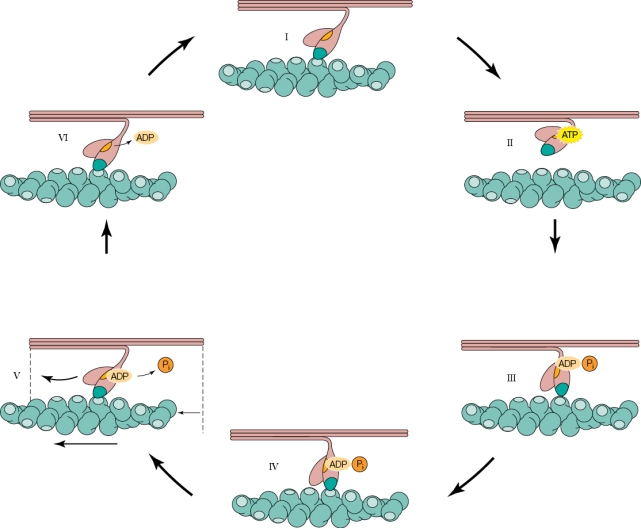 In the figure, which panel represents the power stroke?
A) I
B) IV
C) V
D) VI
In the figure, which panel represents the power stroke?A) I
B) IV
C) V
D) VI
سؤال
Refer to the figure shown.
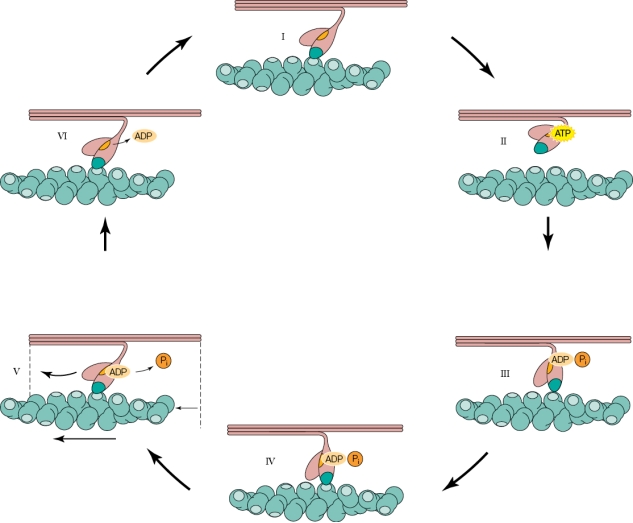 In the figure, which panel, taken out of context, represents a state where muscle relaxation could be occurring?
A) I
B) II
C) IV
D) VI
In the figure, which panel, taken out of context, represents a state where muscle relaxation could be occurring?A) I
B) II
C) IV
D) VI
سؤال
سؤال
سؤال
سؤال
سؤال
Refer to the figure shown.
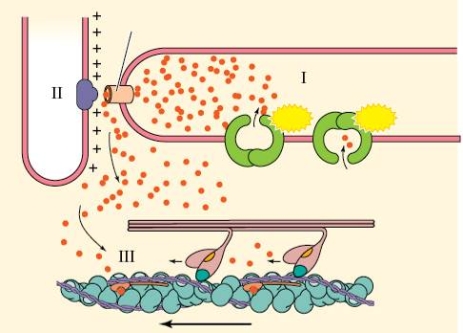 What do the tiny dots at area I represent?
A) Ca2+
B) ATP
C) Phosphate
D) Na+
What do the tiny dots at area I represent?A) Ca2+
B) ATP
C) Phosphate
D) Na+
سؤال
Refer to the figure shown.
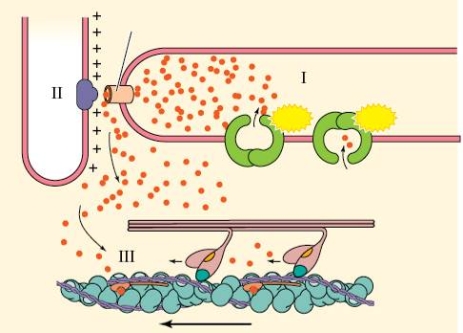 What is the best explanation for the release of the dots at area II?
A) DHPR actively pumping
B) DHPR changes conformation due to depolarization
C) RyR channel actively pumping
D) RyR changes conformation due to depolarization
What is the best explanation for the release of the dots at area II?A) DHPR actively pumping
B) DHPR changes conformation due to depolarization
C) RyR channel actively pumping
D) RyR changes conformation due to depolarization
سؤال
Refer to the figure shown.
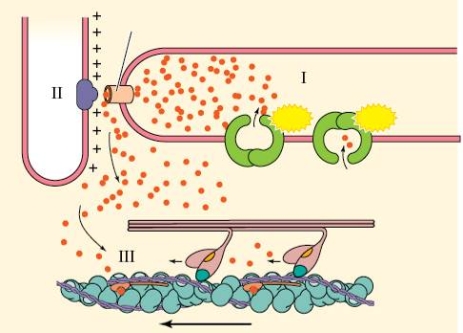 What are the tiny dots at area III binding to?
A) Ca2+
B) ATP
C) actin
D) troponin
What are the tiny dots at area III binding to?A) Ca2+
B) ATP
C) actin
D) troponin
سؤال
سؤال
سؤال
سؤال
سؤال
سؤال
سؤال
سؤال
سؤال
سؤال
سؤال
سؤال
سؤال
سؤال
سؤال
سؤال
سؤال
سؤال
سؤال
Refer to the figure shown.
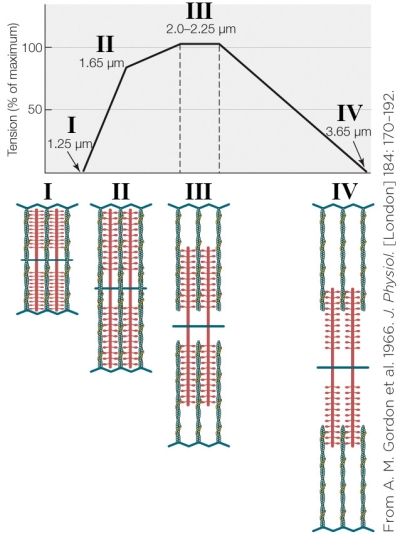 Which number on the diagram represents the most optimal positioning of actin and myosin before contraction?
A) I
B) II
C) III
D) IV
Which number on the diagram represents the most optimal positioning of actin and myosin before contraction?A) I
B) II
C) III
D) IV
سؤال
سؤال
سؤال
سؤال
سؤال
سؤال
سؤال
سؤال
سؤال
سؤال
سؤال
سؤال
سؤال
سؤال
سؤال
سؤال
سؤال
سؤال
سؤال
سؤال
سؤال
سؤال
سؤال
سؤال
سؤال
سؤال
سؤال
سؤال
سؤال
سؤال
سؤال
سؤال
سؤال
سؤال
سؤال
سؤال
سؤال
سؤال

فتح الحزمة
قم بالتسجيل لفتح البطاقات في هذه المجموعة!
Unlock Deck
Unlock Deck
1/78

العب

ملء الشاشة (f)
Deck 20: Muscle
1
The two primary contractile proteins that underlie muscle movement are
A) actin and tropomyosin.
B) myosin and troponin.
C) myosin and actin.
D) titin and nebulin.
A) actin and tropomyosin.
B) myosin and troponin.
C) myosin and actin.
D) titin and nebulin.
C
2
The organization of actin and myosin into sarcomeres appear in
A) only smooth muscle.
B) skeletal and smooth muscle.
C) only skeletal muscle.
D) skeletal and cardiac muscle.
A) only smooth muscle.
B) skeletal and smooth muscle.
C) only skeletal muscle.
D) skeletal and cardiac muscle.
D
3
A striated muscle fiber is made up of many parallel _______, each containing a series of _______.
A) fascicles; fibrils
B) myofibrils; sarcomeres
C) fascicles; Z discs
D) sarcomeres; myotomes
A) fascicles; fibrils
B) myofibrils; sarcomeres
C) fascicles; Z discs
D) sarcomeres; myotomes
B
4
The smallest unit of a skeletal muscle that shortens during a muscle contraction is the
A) myosin molecule.
B) thin filament.
C) sarcomere.
D) myofibril.
A) myosin molecule.
B) thin filament.
C) sarcomere.
D) myofibril.
فتح الحزمة
افتح القفل للوصول البطاقات البالغ عددها 78 في هذه المجموعة.
فتح الحزمة
k this deck
5
Refer to the figure shown.
In the figure, which numeral represents the A band?
A) I
B) II
C) III
D) IV
In the figure, which numeral represents the A band?A) I
B) II
C) III
D) IV
فتح الحزمة
افتح القفل للوصول البطاقات البالغ عددها 78 في هذه المجموعة.
فتح الحزمة
k this deck
6
Refer to the figure shown.
What state of muscle activity does this figure represent?
A) Fully contracted
B) Somewhat contracted
C) Fully relaxed
D) Tetany
What state of muscle activity does this figure represent?A) Fully contracted
B) Somewhat contracted
C) Fully relaxed
D) Tetany
فتح الحزمة
افتح القفل للوصول البطاقات البالغ عددها 78 في هذه المجموعة.
فتح الحزمة
k this deck
7
Refer to the figure shown.
Which area(s) shorten(s) during muscle contraction?
A) I
B) III
C) I and III
D) III and V
Which area(s) shorten(s) during muscle contraction?A) I
B) III
C) I and III
D) III and V
فتح الحزمة
افتح القفل للوصول البطاقات البالغ عددها 78 في هذه المجموعة.
فتح الحزمة
k this deck
8
According to the sliding filament theory of muscle contraction, myosin heads pull on _______ filaments and _______.
A) thick; move the Z discs apart
B) thick; move the Z discs together
C) thin; move the Z discs apart
D) thin; move the Z discs together
A) thick; move the Z discs apart
B) thick; move the Z discs together
C) thin; move the Z discs apart
D) thin; move the Z discs together
فتح الحزمة
افتح القفل للوصول البطاقات البالغ عددها 78 في هذه المجموعة.
فتح الحزمة
k this deck
9
In striated muscle, phosphate is released from the myosin head at the same instant that
A) the myosin head binds to actin.
B) the myosin head releases from actin.
C) the myosin head returns to the cocked position.
D) the myosin head starts the power stroke.
A) the myosin head binds to actin.
B) the myosin head releases from actin.
C) the myosin head returns to the cocked position.
D) the myosin head starts the power stroke.
فتح الحزمة
افتح القفل للوصول البطاقات البالغ عددها 78 في هذه المجموعة.
فتح الحزمة
k this deck
10
In relaxed skeletal muscle, myosin heads are
A) bound to actin with ADP and phosphate bound.
B) bound to actin with ATP bound.
C) dissociated from actin with ATP bound.
D) dissociated from actin with ADP and phosphate bound.
A) bound to actin with ADP and phosphate bound.
B) bound to actin with ATP bound.
C) dissociated from actin with ATP bound.
D) dissociated from actin with ADP and phosphate bound.
فتح الحزمة
افتح القفل للوصول البطاقات البالغ عددها 78 في هذه المجموعة.
فتح الحزمة
k this deck
11
In skeletal muscle cells, cytoplasmic Ca2+ is bound by
A) actin.
B) myosin.
C) troponin.
D) tropomyosin.
A) actin.
B) myosin.
C) troponin.
D) tropomyosin.
فتح الحزمة
افتح القفل للوصول البطاقات البالغ عددها 78 في هذه المجموعة.
فتح الحزمة
k this deck
12
Refer to the figure shown.
In the figure, which panel represents the transient rigor state?
A) I
B) IV
C) V
D) VI
In the figure, which panel represents the transient rigor state?A) I
B) IV
C) V
D) VI
فتح الحزمة
افتح القفل للوصول البطاقات البالغ عددها 78 في هذه المجموعة.
فتح الحزمة
k this deck
13
Refer to the figure shown.
In the figure, which panel represents the power stroke?
A) I
B) IV
C) V
D) VI
In the figure, which panel represents the power stroke?A) I
B) IV
C) V
D) VI
فتح الحزمة
افتح القفل للوصول البطاقات البالغ عددها 78 في هذه المجموعة.
فتح الحزمة
k this deck
14
Refer to the figure shown.
In the figure, which panel, taken out of context, represents a state where muscle relaxation could be occurring?
A) I
B) II
C) IV
D) VI
In the figure, which panel, taken out of context, represents a state where muscle relaxation could be occurring?A) I
B) II
C) IV
D) VI
فتح الحزمة
افتح القفل للوصول البطاقات البالغ عددها 78 في هذه المجموعة.
فتح الحزمة
k this deck
15
What happens when Ca2+ increases in the cytoplasm of a striated muscle cell?
A) Myosin-binding sites on actin are exposed, allowing a single cross-bridge cycle to occur.
B) Myosin-binding sites on actin are exposed, allowing cross-bridge cycles to occur until Ca2+ drops again.
C) Actin-binding sites on myosin are exposed, allowing a single cross-bridge cycle to occur.
D) Actin-binding sites on myosin are exposed, allowing cross-bridge cycles to occur until Ca2+ drops again.
A) Myosin-binding sites on actin are exposed, allowing a single cross-bridge cycle to occur.
B) Myosin-binding sites on actin are exposed, allowing cross-bridge cycles to occur until Ca2+ drops again.
C) Actin-binding sites on myosin are exposed, allowing a single cross-bridge cycle to occur.
D) Actin-binding sites on myosin are exposed, allowing cross-bridge cycles to occur until Ca2+ drops again.
فتح الحزمة
افتح القفل للوصول البطاقات البالغ عددها 78 في هذه المجموعة.
فتح الحزمة
k this deck
16
Running mice are capable of moving their legs back and forth much more quickly than elephants. Thus, compared to an elephant muscle cell, a mouse muscle cell likely contains more
A) actin.
B) myosin.
C) troponin C.
D) SR Ca2+-ATPase.
A) actin.
B) myosin.
C) troponin C.
D) SR Ca2+-ATPase.
فتح الحزمة
افتح القفل للوصول البطاقات البالغ عددها 78 في هذه المجموعة.
فتح الحزمة
k this deck
17
When the cell membrane of a vertebrate skeletal muscle is depolarized, ryanodine receptors change configuration and permit passage of Ca2+
A) passively, from the extracellular fluid to the cytoplasm.
B) passively, from the sarcoplasmic reticulum to the cytoplasm.
C) actively, from the extracellular fluid to the cytoplasm.
D) actively, from the sarcoplasmic reticulum to the cytoplasm.
A) passively, from the extracellular fluid to the cytoplasm.
B) passively, from the sarcoplasmic reticulum to the cytoplasm.
C) actively, from the extracellular fluid to the cytoplasm.
D) actively, from the sarcoplasmic reticulum to the cytoplasm.
فتح الحزمة
افتح القفل للوصول البطاقات البالغ عددها 78 في هذه المجموعة.
فتح الحزمة
k this deck
18
During the latent period of an isometric twitch,
A) myosin hydrolyzes ATP and releases from actin.
B) Ca2+ binds to troponin C.
C) ryanodine receptors open and conduct Ca2+ into the SR.
D) tropomyosin moves to block myosin-binding sites on actin.
A) myosin hydrolyzes ATP and releases from actin.
B) Ca2+ binds to troponin C.
C) ryanodine receptors open and conduct Ca2+ into the SR.
D) tropomyosin moves to block myosin-binding sites on actin.
فتح الحزمة
افتح القفل للوصول البطاقات البالغ عددها 78 في هذه المجموعة.
فتح الحزمة
k this deck
19
Refer to the figure shown.
What do the tiny dots at area I represent?
A) Ca2+
B) ATP
C) Phosphate
D) Na+
What do the tiny dots at area I represent?A) Ca2+
B) ATP
C) Phosphate
D) Na+
فتح الحزمة
افتح القفل للوصول البطاقات البالغ عددها 78 في هذه المجموعة.
فتح الحزمة
k this deck
20
Refer to the figure shown.
What is the best explanation for the release of the dots at area II?
A) DHPR actively pumping
B) DHPR changes conformation due to depolarization
C) RyR channel actively pumping
D) RyR changes conformation due to depolarization
What is the best explanation for the release of the dots at area II?A) DHPR actively pumping
B) DHPR changes conformation due to depolarization
C) RyR channel actively pumping
D) RyR changes conformation due to depolarization
فتح الحزمة
افتح القفل للوصول البطاقات البالغ عددها 78 في هذه المجموعة.
فتح الحزمة
k this deck
21
Refer to the figure shown.
What are the tiny dots at area III binding to?
A) Ca2+
B) ATP
C) actin
D) troponin
What are the tiny dots at area III binding to?A) Ca2+
B) ATP
C) actin
D) troponin
فتح الحزمة
افتح القفل للوصول البطاقات البالغ عددها 78 في هذه المجموعة.
فتح الحزمة
k this deck
22
In resting skeletal muscle, contraction does not occur because
A) there is very little ATP in the cytoplasm.
B) most of the ATP is bound to other molecules for storage.
C) there is very little calcium in the cytoplasm.
D) myosin is inactivated.
A) there is very little ATP in the cytoplasm.
B) most of the ATP is bound to other molecules for storage.
C) there is very little calcium in the cytoplasm.
D) myosin is inactivated.
فتح الحزمة
افتح القفل للوصول البطاقات البالغ عددها 78 في هذه المجموعة.
فتح الحزمة
k this deck
23
In striated muscle, _______ before the sarcomere can generate force.
A) Ca2+ must dissociate from troponin C
B) Ca2+ must be pumped by the SR Ca2+-ATPase
C) the SR calcium channel must open
D) calcium must bind to tropomyosin
A) Ca2+ must dissociate from troponin C
B) Ca2+ must be pumped by the SR Ca2+-ATPase
C) the SR calcium channel must open
D) calcium must bind to tropomyosin
فتح الحزمة
افتح القفل للوصول البطاقات البالغ عددها 78 في هذه المجموعة.
فتح الحزمة
k this deck
24
A _______ is a type of _______ and connects muscle tissue to bone.
A) sarcomere; connective tissue
B) sarcomere; contractile tissue
C) tendon; connective tissue
D) tendon; contractile tissue
A) sarcomere; connective tissue
B) sarcomere; contractile tissue
C) tendon; connective tissue
D) tendon; contractile tissue
فتح الحزمة
افتح القفل للوصول البطاقات البالغ عددها 78 في هذه المجموعة.
فتح الحزمة
k this deck
25
Lengthening of a muscle occurs
A) as a result of an external load that acts on the muscle.
B) as the muscle cell action potential repolarizes.
C) as Ca2+ levels drop following a contraction.
D) only when the muscle is generating negative force.
A) as a result of an external load that acts on the muscle.
B) as the muscle cell action potential repolarizes.
C) as Ca2+ levels drop following a contraction.
D) only when the muscle is generating negative force.
فتح الحزمة
افتح القفل للوصول البطاقات البالغ عددها 78 في هذه المجموعة.
فتح الحزمة
k this deck
26
During an eccentric muscle contraction, the
A) length of the sarcomeres remains unchanged, but the length of the elastic component increases.
B) sarcomeres shorten, but the length of the elastic component remains unchanged.
C) muscle produces force and its length decreases.
D) muscle produces force and its length increases.
A) length of the sarcomeres remains unchanged, but the length of the elastic component increases.
B) sarcomeres shorten, but the length of the elastic component remains unchanged.
C) muscle produces force and its length decreases.
D) muscle produces force and its length increases.
فتح الحزمة
افتح القفل للوصول البطاقات البالغ عددها 78 في هذه المجموعة.
فتح الحزمة
k this deck
27
During an isometric tetanic contraction, the sarcomeres
A) shorten, but the elastic components lengthen.
B) shorten, but the elastic components stay the same length.
C) and the elastic components shorten.
D) lengthen, but the elastic components shorten.
A) shorten, but the elastic components lengthen.
B) shorten, but the elastic components stay the same length.
C) and the elastic components shorten.
D) lengthen, but the elastic components shorten.
فتح الحزمة
افتح القفل للوصول البطاقات البالغ عددها 78 في هذه المجموعة.
فتح الحزمة
k this deck
28
During an isotonic muscle twitch, the presence of elastic elements causes the latent period to be _______ than during an isometric twitch, and the peak force transmitted through the tendon to be _______.
A) shorter; lower
B) shorter; higher
C) longer; higher
D) longer; lower
A) shorter; lower
B) shorter; higher
C) longer; higher
D) longer; lower
فتح الحزمة
افتح القفل للوصول البطاقات البالغ عددها 78 في هذه المجموعة.
فتح الحزمة
k this deck
29
Cross-bridges generate force in a skeletal muscle cell any time
A) the muscle is shortened.
B) there is an action potential in a motor neuron.
C) Ca2+ levels in the cytoplasm are high.
D) ATP levels are high enough.
A) the muscle is shortened.
B) there is an action potential in a motor neuron.
C) Ca2+ levels in the cytoplasm are high.
D) ATP levels are high enough.
فتح الحزمة
افتح القفل للوصول البطاقات البالغ عددها 78 في هذه المجموعة.
فتح الحزمة
k this deck
30
The elastic component of the gastrocnemius
A) is composed of the epimysium, perimysium, and endomysium surrounding the muscle.
B) is composed of actin and myosin proteins within the muscle cells.
C) must be fully stretched before the gastrocnemius can exert any external force.
D) must be fully stretched in order for the muscle to exert maximum tetanic force.
A) is composed of the epimysium, perimysium, and endomysium surrounding the muscle.
B) is composed of actin and myosin proteins within the muscle cells.
C) must be fully stretched before the gastrocnemius can exert any external force.
D) must be fully stretched in order for the muscle to exert maximum tetanic force.
فتح الحزمة
افتح القفل للوصول البطاقات البالغ عددها 78 في هذه المجموعة.
فتح الحزمة
k this deck
31
How can summation of skeletal muscle twitches occur if the motor neuron's refractory period prevents multiple action potentials from being transmitted to the neuromuscular junction at the same time?
A) The motor neuron's absolute refractory period is much shorter than the time it takes for calcium release and reuptake from the SR.
B) The motor neuron's absolute refractory period is much longer than the time it takes for calcium release and reuptake from the SR.
C) The motor neuron's absolute refractory period is much shorter than the muscle action potential.
D) The motor neuron's absolute refractory period is much longer than the muscle action potential.
A) The motor neuron's absolute refractory period is much shorter than the time it takes for calcium release and reuptake from the SR.
B) The motor neuron's absolute refractory period is much longer than the time it takes for calcium release and reuptake from the SR.
C) The motor neuron's absolute refractory period is much shorter than the muscle action potential.
D) The motor neuron's absolute refractory period is much longer than the muscle action potential.
فتح الحزمة
افتح القفل للوصول البطاقات البالغ عددها 78 في هذه المجموعة.
فتح الحزمة
k this deck
32
A muscle produces less force during a twitch than during a tetanic contraction because during a twitch
A) peak cytoplasmic Ca2+ is lower.
B) tropomyosin does not have time to unblock all of the actomyosin binding sites.
C) myosin does not have time to bind to as many actin molecules.
D) the elastic components of the muscle are not fully stretched.
A) peak cytoplasmic Ca2+ is lower.
B) tropomyosin does not have time to unblock all of the actomyosin binding sites.
C) myosin does not have time to bind to as many actin molecules.
D) the elastic components of the muscle are not fully stretched.
فتح الحزمة
افتح القفل للوصول البطاقات البالغ عددها 78 في هذه المجموعة.
فتح الحزمة
k this deck
33
In skeletal muscle, an incomplete tetanus would result from
A) action potentials arriving at a rate fast enough for the intracellular Ca2+ levels to rise much higher than they would in a muscle twitch.
B) action potentials arriving at a rate fast enough for sarcomeres to generate force while the elastic components of the muscle are still stretched.
C) action potentials arriving so quickly that there is no fluctuation in intracellular Ca2+ levels.
D) many, but not all, of the thin filaments being activated to permit cross-bridge formation.
A) action potentials arriving at a rate fast enough for the intracellular Ca2+ levels to rise much higher than they would in a muscle twitch.
B) action potentials arriving at a rate fast enough for sarcomeres to generate force while the elastic components of the muscle are still stretched.
C) action potentials arriving so quickly that there is no fluctuation in intracellular Ca2+ levels.
D) many, but not all, of the thin filaments being activated to permit cross-bridge formation.
فتح الحزمة
افتح القفل للوصول البطاقات البالغ عددها 78 في هذه المجموعة.
فتح الحزمة
k this deck
34
Which condition contributes to the length‒tension relationship observed in skeletal muscle?
A) When sarcomere lengths are long, thin filaments overlap.
B) When sarcomere lengths are long, thick and thin filaments do not overlap optimally.
C) When sarcomere lengths are short, thick and thin filaments do not overlap fully.
D) When sarcomere lengths are short, the elastic elements in the muscle are not fully stretched.
A) When sarcomere lengths are long, thin filaments overlap.
B) When sarcomere lengths are long, thick and thin filaments do not overlap optimally.
C) When sarcomere lengths are short, thick and thin filaments do not overlap fully.
D) When sarcomere lengths are short, the elastic elements in the muscle are not fully stretched.
فتح الحزمة
افتح القفل للوصول البطاقات البالغ عددها 78 في هذه المجموعة.
فتح الحزمة
k this deck
35
The sarcomeres of vertebrate skeletal muscles are all about the same length, but squid have different sarcomere lengths in different muscles in the body. If all other factors are equal, the muscle with shorter sarcomeres will
A) shorten more slowly.
B) shorten more rapidly.
C) generate more force.
D) generate less force.
A) shorten more slowly.
B) shorten more rapidly.
C) generate more force.
D) generate less force.
فتح الحزمة
افتح القفل للوصول البطاقات البالغ عددها 78 في هذه المجموعة.
فتح الحزمة
k this deck
36
The force‒velocity relationship for skeletal muscle indicates that a muscle
A) produces maximum force when contracting at its maximum velocity.
B) shortens at maximum velocity when contracting against the maximum load it can move.
C) produces maximum power when contracting isometrically.
D) shortens at maximum velocity when contracting against no load.
A) produces maximum force when contracting at its maximum velocity.
B) shortens at maximum velocity when contracting against the maximum load it can move.
C) produces maximum power when contracting isometrically.
D) shortens at maximum velocity when contracting against no load.
فتح الحزمة
افتح القفل للوصول البطاقات البالغ عددها 78 في هذه المجموعة.
فتح الحزمة
k this deck
37
Suppose that muscle A is long with a narrow diameter and muscle B is short with a large diameter. Compared to muscle A, muscle B is capable of producing a _______ maximum force and a _______ maximum velocity.
A) lower; lower
B) higher; higher
C) lower; higher
D) higher; lower
A) lower; lower
B) higher; higher
C) lower; higher
D) higher; lower
فتح الحزمة
افتح القفل للوصول البطاقات البالغ عددها 78 في هذه المجموعة.
فتح الحزمة
k this deck
38
Suppose that each cross-bridge cycle moves the thin filament 10 nanometers relative to the thick filament. If myosin in a particular muscle can go through the cross-bridge cycle at 250 cycles per second, what is the rate at which a muscle that is 30 cm long can shorten?
A) 75 mm/s
B) 0.30 m/s
C) 0.60 m/s
D) 2.5 m/s
A) 75 mm/s
B) 0.30 m/s
C) 0.60 m/s
D) 2.5 m/s
فتح الحزمة
افتح القفل للوصول البطاقات البالغ عددها 78 في هذه المجموعة.
فتح الحزمة
k this deck
39
Muscle A has a volume of 200 cm3, a length of 20 cm, and a cross-sectional area of 10 cm2. Muscle B has a volume of 200 cm3, a length of 10 cm, and a cross-sectional area of 20 cm2. Which of the following statements about these muscles is true?
A) Both muscles can produce the same power, but they will shorten at different speeds.
B) Both muscles will shorten at the same speed, but they can produce different amounts of power.
C) Both muscles can exert the same force, but one will shorten more quickly than the other.
D) Both muscles can produce the same power and the same force.
A) Both muscles can produce the same power, but they will shorten at different speeds.
B) Both muscles will shorten at the same speed, but they can produce different amounts of power.
C) Both muscles can exert the same force, but one will shorten more quickly than the other.
D) Both muscles can produce the same power and the same force.
فتح الحزمة
افتح القفل للوصول البطاقات البالغ عددها 78 في هذه المجموعة.
فتح الحزمة
k this deck
40
Refer to the figure shown.
Which number on the diagram represents the most optimal positioning of actin and myosin before contraction?
A) I
B) II
C) III
D) IV
Which number on the diagram represents the most optimal positioning of actin and myosin before contraction?A) I
B) II
C) III
D) IV
فتح الحزمة
افتح القفل للوصول البطاقات البالغ عددها 78 في هذه المجموعة.
فتح الحزمة
k this deck
41
For muscle, the work produced during any given contractile event is equal to
A) force multiplied by distance.
B) speed multiplied by the distance.
C) force of the contraction multiplied by the distance the load is displaced.
D) speed of the contraction multiplied by the distance the load is displaced.
A) force multiplied by distance.
B) speed multiplied by the distance.
C) force of the contraction multiplied by the distance the load is displaced.
D) speed of the contraction multiplied by the distance the load is displaced.
فتح الحزمة
افتح القفل للوصول البطاقات البالغ عددها 78 في هذه المجموعة.
فتح الحزمة
k this deck
42
Which of the following is not a function of ATP in skeletal muscle?
A) Releases calcium from the sarcoplasmic reticulum
B) Detachment of myosin from actin
C) Generates power strokes
D) Powers calcium pumps
A) Releases calcium from the sarcoplasmic reticulum
B) Detachment of myosin from actin
C) Generates power strokes
D) Powers calcium pumps
فتح الحزمة
افتح القفل للوصول البطاقات البالغ عددها 78 في هذه المجموعة.
فتح الحزمة
k this deck
43
When muscle is suddenly activated to perform contractions at a rapid rate, most of the ATP to fuel the first 3‒5 seconds of exercise comes from
A) the aerobic breakdown of glycogen.
B) creatine phosphate hydrolysis.
C) anaerobic glycolysis.
D) ATP stored in the cell.
A) the aerobic breakdown of glycogen.
B) creatine phosphate hydrolysis.
C) anaerobic glycolysis.
D) ATP stored in the cell.
فتح الحزمة
افتح القفل للوصول البطاقات البالغ عددها 78 في هذه المجموعة.
فتح الحزمة
k this deck
44
Fast glycolytic muscle fibers depend on carbohydrate as a fuel, whereas slow oxidative fibers are capable of metabolizing carbohydrates, lipids, or amino acids. What is the physiological reason for this difference?
A) Anaerobic glycolysis can produce ATP from glucose much more quickly than lipid or amino acid oxidation can take place.
B) The myosin in fast glycolytic fibers can only bind to glycogen.
C) Compared to fast glycolytic fibers, slow oxidative fibers need to metabolize a wider variety of fuels to meet a higher ATP demand.
D) Slow oxidative fibers need to metabolize lipid because they have less creatine kinase.
A) Anaerobic glycolysis can produce ATP from glucose much more quickly than lipid or amino acid oxidation can take place.
B) The myosin in fast glycolytic fibers can only bind to glycogen.
C) Compared to fast glycolytic fibers, slow oxidative fibers need to metabolize a wider variety of fuels to meet a higher ATP demand.
D) Slow oxidative fibers need to metabolize lipid because they have less creatine kinase.
فتح الحزمة
افتح القفل للوصول البطاقات البالغ عددها 78 في هذه المجموعة.
فتح الحزمة
k this deck
45
Lactate produced by muscle cells
A) is produced only during very intense exercise.
B) is always broken down to yield ATP within the muscle cell that produced it.
C) is always used to produce glucose by gluconeogenesis in the cell that produced it.
D) can be exported into the bloodstream and used by other cells.
A) is produced only during very intense exercise.
B) is always broken down to yield ATP within the muscle cell that produced it.
C) is always used to produce glucose by gluconeogenesis in the cell that produced it.
D) can be exported into the bloodstream and used by other cells.
فتح الحزمة
افتح القفل للوصول البطاقات البالغ عددها 78 في هذه المجموعة.
فتح الحزمة
k this deck
46
Which muscle can generate the most power per cubic centimeter of muscle?
A) A muscle containing mostly slow oxidative fibers contracting at its Vmax
B) A muscle containing mostly slow oxidative fibers contracting against a moderate load
C) A muscle containing mostly fast glycolytic fibers contracting at its Vmax
D) A muscle containing mostly fast glycolytic fibers contracting against a moderate load
A) A muscle containing mostly slow oxidative fibers contracting at its Vmax
B) A muscle containing mostly slow oxidative fibers contracting against a moderate load
C) A muscle containing mostly fast glycolytic fibers contracting at its Vmax
D) A muscle containing mostly fast glycolytic fibers contracting against a moderate load
فتح الحزمة
افتح القفل للوصول البطاقات البالغ عددها 78 في هذه المجموعة.
فتح الحزمة
k this deck
47
Tonic muscle
A) is a form of smooth muscle.
B) has large amounts of sarcoplasmic reticulum.
C) is found primarily in postural muscles.
D) consumes no ATP.
A) is a form of smooth muscle.
B) has large amounts of sarcoplasmic reticulum.
C) is found primarily in postural muscles.
D) consumes no ATP.
فتح الحزمة
افتح القفل للوصول البطاقات البالغ عددها 78 في هذه المجموعة.
فتح الحزمة
k this deck
48
One reason that fast glycolytic muscle fibers fatigue more rapidly than slow oxidative muscle fibers is that fast glycolytic fibers
A) contain lower amounts of ATP than slow oxidative fibers.
B) have a lower capacity for glycolysis than slow oxidative fibers.
C) have a higher capacity for oxidative phosphorylation than slow oxidative fibers.
D) use ATP more rapidly than slow oxidative fibers.
A) contain lower amounts of ATP than slow oxidative fibers.
B) have a lower capacity for glycolysis than slow oxidative fibers.
C) have a higher capacity for oxidative phosphorylation than slow oxidative fibers.
D) use ATP more rapidly than slow oxidative fibers.
فتح الحزمة
افتح القفل للوصول البطاقات البالغ عددها 78 في هذه المجموعة.
فتح الحزمة
k this deck
49
The diffusion rate of which factor best explains why vertebrates evolved to have slow oxidative muscle fibers that are smaller in diameter than fast glycolytic fibers?
A) Lipid
B) Oxygen
C) Ca2+
D) Glucose
A) Lipid
B) Oxygen
C) Ca2+
D) Glucose
فتح الحزمة
افتح القفل للوصول البطاقات البالغ عددها 78 في هذه المجموعة.
فتح الحزمة
k this deck
50
A skeletal muscle fiber with high myosin ATPase activity, a high rate of Ca2+ reuptake by the sarcoplasmic reticulum, and large number of mitochondria would be classified as a
A) slow oxidative fiber.
B) fast oxidative glycolytic fiber.
C) fast glycolytic fiber.
D) slow glycolytic fiber.
A) slow oxidative fiber.
B) fast oxidative glycolytic fiber.
C) fast glycolytic fiber.
D) slow glycolytic fiber.
فتح الحزمة
افتح القفل للوصول البطاقات البالغ عددها 78 في هذه المجموعة.
فتح الحزمة
k this deck
51
Fast oxidative glycolytic fibers in skeletal muscle are used
A) only for motions requiring maximum power output, such as jumping.
B) constantly, for postural activities such as standing and sitting.
C) intermittently, for activities requiring more force output than the fast glycolytic fibers alone can produce.
D) intermittently, for activities requiring more force output than the slow oxidative fibers alone can produce.
A) only for motions requiring maximum power output, such as jumping.
B) constantly, for postural activities such as standing and sitting.
C) intermittently, for activities requiring more force output than the fast glycolytic fibers alone can produce.
D) intermittently, for activities requiring more force output than the slow oxidative fibers alone can produce.
فتح الحزمة
افتح القفل للوصول البطاقات البالغ عددها 78 في هذه المجموعة.
فتح الحزمة
k this deck
52
Slow oxidative fibers in skeletal muscle have
A) few mitochondria but abundant sarcoplasmic reticulum.
B) few mitochondria but numerous capillaries.
C) large diameters, to hold many mitochondria.
D) low levels of glycolytic enzymes but high levels of oxidative enzymes.
A) few mitochondria but abundant sarcoplasmic reticulum.
B) few mitochondria but numerous capillaries.
C) large diameters, to hold many mitochondria.
D) low levels of glycolytic enzymes but high levels of oxidative enzymes.
فتح الحزمة
افتح القفل للوصول البطاقات البالغ عددها 78 في هذه المجموعة.
فتح الحزمة
k this deck
53
The small diameter of slow oxidative muscle fibers is particularly advantageous for minimizing the distance over which
A) calcium diffuses from the sarcolemma to the myofibrils.
B) oxygen diffuses from the sarcolemma to the mitochondria.
C) glycogen diffuses from the sarcolemma to the myofibrils.
D) lactate diffuses from the myofibrils to the sarcolemma.
A) calcium diffuses from the sarcolemma to the myofibrils.
B) oxygen diffuses from the sarcolemma to the mitochondria.
C) glycogen diffuses from the sarcolemma to the myofibrils.
D) lactate diffuses from the myofibrils to the sarcolemma.
فتح الحزمة
افتح القفل للوصول البطاقات البالغ عددها 78 في هذه المجموعة.
فتح الحزمة
k this deck
54
The extraocular muscles that move the mammalian eyeball can contract and relax at much higher frequencies than the muscles of the limbs, but they produce relatively low force as they rotate the eye. These characteristics tell us that extraocular muscles have
A) high levels of myosin.
B) a high volume fraction of myofibrils.
C) a high volume fraction of sarcoplasmic reticulum.
D) troponin C with high Ca2+ affinity.
A) high levels of myosin.
B) a high volume fraction of myofibrils.
C) a high volume fraction of sarcoplasmic reticulum.
D) troponin C with high Ca2+ affinity.
فتح الحزمة
افتح القفل للوصول البطاقات البالغ عددها 78 في هذه المجموعة.
فتح الحزمة
k this deck
55
A vertebrate motor unit consists of
A) a single motor neuron and all of the muscle fibers that it innervates.
B) all of the muscles that contract to complete a particular body movement.
C) a particular muscle and all of its synergistic and antagonistic muscles.
D) all of the fibers of a particular fiber type in a given muscle.
A) a single motor neuron and all of the muscle fibers that it innervates.
B) all of the muscles that contract to complete a particular body movement.
C) a particular muscle and all of its synergistic and antagonistic muscles.
D) all of the fibers of a particular fiber type in a given muscle.
فتح الحزمة
افتح القفل للوصول البطاقات البالغ عددها 78 في هذه المجموعة.
فتح الحزمة
k this deck
56
The force that a particular vertebrate skeletal muscle produces can be altered by a change in the
A) size of the action potentials in motor neurons.
B) number of motor units recruited.
C) amount of calcium released in response to each action potential.
D) proportion of myofibrils activated per muscle fiber.
A) size of the action potentials in motor neurons.
B) number of motor units recruited.
C) amount of calcium released in response to each action potential.
D) proportion of myofibrils activated per muscle fiber.
فتح الحزمة
افتح القفل للوصول البطاقات البالغ عددها 78 في هذه المجموعة.
فتح الحزمة
k this deck
57
Which statement is true of most arthropod and vertebrate skeletal muscle?
A) Muscle fibers are innervated by multiple neurons.
B) Muscle fibers receive both EPSPs and IPSPs.
C) Different myosin isoforms in adjacent fibers produce different maximum shortening velocities.
D) Ca2+ is released from the sarcoplasmic reticulum in response to depolarization of the fiber.
A) Muscle fibers are innervated by multiple neurons.
B) Muscle fibers receive both EPSPs and IPSPs.
C) Different myosin isoforms in adjacent fibers produce different maximum shortening velocities.
D) Ca2+ is released from the sarcoplasmic reticulum in response to depolarization of the fiber.
فتح الحزمة
افتح القفل للوصول البطاقات البالغ عددها 78 في هذه المجموعة.
فتح الحزمة
k this deck
58
Which statement provides the most likely explanation for the differing patterns of innervation in arthropod skeletal muscle (polyneuronal) and vertebrate skeletal muscle (single innervation)?
A) Vertebrates need to modulate muscle force, whereas arthropods always exert the same force with a given muscle.
B) Action potentials in vertebrate neurons are all-or-nothing, whereas arthropod neurons fire action potentials of varying magnitude.
C) Action potentials in arthropod neurons are all-or-nothing, whereas vertebrate neurons fire action potentials of varying magnitude.
D) The two patterns are products of the evolutionary history of the two taxa, and each one allows effective control of muscle contraction.
A) Vertebrates need to modulate muscle force, whereas arthropods always exert the same force with a given muscle.
B) Action potentials in vertebrate neurons are all-or-nothing, whereas arthropod neurons fire action potentials of varying magnitude.
C) Action potentials in arthropod neurons are all-or-nothing, whereas vertebrate neurons fire action potentials of varying magnitude.
D) The two patterns are products of the evolutionary history of the two taxa, and each one allows effective control of muscle contraction.
فتح الحزمة
افتح القفل للوصول البطاقات البالغ عددها 78 في هذه المجموعة.
فتح الحزمة
k this deck
59
Smooth muscle cells possess which component?
A) Sarcoplasmic reticulum
B) T-tubules
C) Multiple nuclei
D) Sarcomeres
A) Sarcoplasmic reticulum
B) T-tubules
C) Multiple nuclei
D) Sarcomeres
فتح الحزمة
افتح القفل للوصول البطاقات البالغ عددها 78 في هذه المجموعة.
فتح الحزمة
k this deck
60
Single-unit smooth muscle differs from multiunit smooth muscle in that multiunit smooth muscle
A) contains gap junctions that link the cells as an electrical syncytium.
B) is often spontaneously active.
C) is usually stretch-activated.
D) has cells that function as independent units.
A) contains gap junctions that link the cells as an electrical syncytium.
B) is often spontaneously active.
C) is usually stretch-activated.
D) has cells that function as independent units.
فتح الحزمة
افتح القفل للوصول البطاقات البالغ عددها 78 في هذه المجموعة.
فتح الحزمة
k this deck
61
For contraction to occur in smooth muscle,
A) myosin light chains must be phosphorylated.
B) myosin light-chain kinase must be phosphorylated.
C) calcium must bind to troponin C.
D) DHPR must interact physically with ryanodine receptor calcium channels.
A) myosin light chains must be phosphorylated.
B) myosin light-chain kinase must be phosphorylated.
C) calcium must bind to troponin C.
D) DHPR must interact physically with ryanodine receptor calcium channels.
فتح الحزمة
افتح القفل للوصول البطاقات البالغ عددها 78 في هذه المجموعة.
فتح الحزمة
k this deck
62
ATP use is lower in smooth muscle than in skeletal muscle in part because
A) there is no sarcoplasmic reticulum calcium ATPase in smooth muscle.
B) smooth muscle myosin does not require an ATP molecule for each cross-bridge cycle.
C) smooth muscle myosin completes the cross-bridge cycle more slowly than skeletal muscle myosin does.
D) calcium removal from the cytoplasm does not require ATP in smooth muscle.
A) there is no sarcoplasmic reticulum calcium ATPase in smooth muscle.
B) smooth muscle myosin does not require an ATP molecule for each cross-bridge cycle.
C) smooth muscle myosin completes the cross-bridge cycle more slowly than skeletal muscle myosin does.
D) calcium removal from the cytoplasm does not require ATP in smooth muscle.
فتح الحزمة
افتح القفل للوصول البطاقات البالغ عددها 78 في هذه المجموعة.
فتح الحزمة
k this deck
63
The force produced by a smooth muscle cell could be increased by
A) inhibition of myosin light-chain kinase.
B) inhibition of myosin light-chain phosphatase.
C) inhibition of calmodulin.
D) an increase in the amount of Ca2+ binding to troponin C.
A) inhibition of myosin light-chain kinase.
B) inhibition of myosin light-chain phosphatase.
C) inhibition of calmodulin.
D) an increase in the amount of Ca2+ binding to troponin C.
فتح الحزمة
افتح القفل للوصول البطاقات البالغ عددها 78 في هذه المجموعة.
فتح الحزمة
k this deck
64
In tonic smooth muscle that contracts continuously for long periods, the highly efficient "latch state" depends on
A) high myosin ATPase activity.
B) very slow turnover of ATP bound to myosin.
C) slow release of Ca2+ by troponin C.
D) high activity of myosin light-chain phosphatase.
A) high myosin ATPase activity.
B) very slow turnover of ATP bound to myosin.
C) slow release of Ca2+ by troponin C.
D) high activity of myosin light-chain phosphatase.
فتح الحزمة
افتح القفل للوصول البطاقات البالغ عددها 78 في هذه المجموعة.
فتح الحزمة
k this deck
65
Nervous signaling to smooth muscle cells
A) is always inhibitory.
B) can be excitatory or inhibitory.
C) is all-or-nothing.
D) can regulate frequency, but not force, of contraction.
A) is always inhibitory.
B) can be excitatory or inhibitory.
C) is all-or-nothing.
D) can regulate frequency, but not force, of contraction.
فتح الحزمة
افتح القفل للوصول البطاقات البالغ عددها 78 في هذه المجموعة.
فتح الحزمة
k this deck
66
Mammalian cardiac muscle cells are stimulated to contract by
A) hormonal signals that trigger Ca2+ release and myosin light-chain phosphorylation.
B) electrical signals transmitted through gap junctions from other autorhythmic cardiac muscle cells.
C) action potentials from excitatory autonomic neurons.
D) ion channels that open in response to stretch of the cardiac muscle cell membranes.
A) hormonal signals that trigger Ca2+ release and myosin light-chain phosphorylation.
B) electrical signals transmitted through gap junctions from other autorhythmic cardiac muscle cells.
C) action potentials from excitatory autonomic neurons.
D) ion channels that open in response to stretch of the cardiac muscle cell membranes.
فتح الحزمة
افتح القفل للوصول البطاقات البالغ عددها 78 في هذه المجموعة.
فتح الحزمة
k this deck
67
Which type of muscle does not use troponin as part of the excitation-contraction coupling mechanism?
A) Skeletal muscle
B) Smooth and cardiac muscle
C) Smooth muscle
D) All muscles use troponin.
A) Skeletal muscle
B) Smooth and cardiac muscle
C) Smooth muscle
D) All muscles use troponin.
فتح الحزمة
افتح القفل للوصول البطاقات البالغ عددها 78 في هذه المجموعة.
فتح الحزمة
k this deck
68
Explain why a muscle always works by shortening and cannot actively increase its length unless an external force pulls on it.
فتح الحزمة
افتح القفل للوصول البطاقات البالغ عددها 78 في هذه المجموعة.
فتح الحزمة
k this deck
69
Vertebrate skeletal muscle is characterized by thin-filament regulation of contraction while smooth muscle is characterized by thick-filament regulation. Explain the distinction between thin-filament and thick-filament regulation.
فتح الحزمة
افتح القفل للوصول البطاقات البالغ عددها 78 في هذه المجموعة.
فتح الحزمة
k this deck
70
List four factors that could allow a leg muscle in one animal to activate and relax more quickly than a leg muscle in another animal.
فتح الحزمة
افتح القفل للوصول البطاقات البالغ عددها 78 في هذه المجموعة.
فتح الحزمة
k this deck
71
Put the steps in neuromuscular junction synaptic transmission and EC-coupling in chronological order.
1. Myosin heads hydrolyze ATP during the cross-bridge cycle.
2. An EPSP is generated in the muscle cell.
3. An action potential is conducted along the sarcolemma.
4. Voltage-gated Na+ channels open in sarcolemma.
5. Ca²⁺ rises in the muscle cell cytoplasm.
6. Vesicles containing acetylcholine fuse with axon terminal membrane.
7. Tropomyosin rotates into groove of thin filament.
8. Ca²⁺ dissociates from troponin.
9. Motoneuron axon terminal are depolarized.
10. RyRs open.
11. Acetylcholine receptors open and conduct ions.
12. Ca²⁺+ binds to troponin C.
1. Myosin heads hydrolyze ATP during the cross-bridge cycle.
2. An EPSP is generated in the muscle cell.
3. An action potential is conducted along the sarcolemma.
4. Voltage-gated Na+ channels open in sarcolemma.
5. Ca²⁺ rises in the muscle cell cytoplasm.
6. Vesicles containing acetylcholine fuse with axon terminal membrane.
7. Tropomyosin rotates into groove of thin filament.
8. Ca²⁺ dissociates from troponin.
9. Motoneuron axon terminal are depolarized.
10. RyRs open.
11. Acetylcholine receptors open and conduct ions.
12. Ca²⁺+ binds to troponin C.
فتح الحزمة
افتح القفل للوصول البطاقات البالغ عددها 78 في هذه المجموعة.
فتح الحزمة
k this deck
72
Why does a skeletal muscle twitch last longer than a skeletal muscle action potential?
فتح الحزمة
افتح القفل للوصول البطاقات البالغ عددها 78 في هذه المجموعة.
فتح الحزمة
k this deck
73
Describe two mechanisms by which the human nervous system can voluntarily alter the force and velocity of a contraction of the biceps muscle of the arm.
فتح الحزمة
افتح القفل للوصول البطاقات البالغ عددها 78 في هذه المجموعة.
فتح الحزمة
k this deck
74
Briefly explain why fast glycolytic muscle fibers fatigue more rapidly than slow-twitch muscle fibers.
فتح الحزمة
افتح القفل للوصول البطاقات البالغ عددها 78 في هذه المجموعة.
فتح الحزمة
k this deck
75
Identify the two major uses of ATP in skeletal muscle cells that are involved in contraction and relaxation and explain why each process uses ATP more rapidly in fast-twitch muscles than in slow-twitch muscles.
فتح الحزمة
افتح القفل للوصول البطاقات البالغ عددها 78 في هذه المجموعة.
فتح الحزمة
k this deck
76
On the same set of axes, graph the relationship of velocity to force in two muscles of equal mass from the same animal. Muscle A contains predominantly fast glycolytic fibers, while muscle B contains predominantly slow oxidative fibers.
فتح الحزمة
افتح القفل للوصول البطاقات البالغ عددها 78 في هذه المجموعة.
فتح الحزمة
k this deck
77
Some crabs have giant skeletal muscle fibers that are much larger in diameter than muscle fibers found in most other animals. What fiber type are these fibers likely to be and why?
فتح الحزمة
افتح القفل للوصول البطاقات البالغ عددها 78 في هذه المجموعة.
فتح الحزمة
k this deck
78
Explain why muscles such as rattlesnake tail-shaker muscles, which are capable of very fast activation and relaxation, tend to produce lower forces than other skeletal muscles.
فتح الحزمة
افتح القفل للوصول البطاقات البالغ عددها 78 في هذه المجموعة.
فتح الحزمة
k this deck
فتح الحزمة
افتح القفل للوصول البطاقات البالغ عددها 78 في هذه المجموعة.






