







 تكلم مع الذكاء الاصطناعي


Deck 18: Integrating Systems at Work: Animal Navigation
ملء الشاشة (f)

سؤال

سؤال
سؤال
سؤال
سؤال
Refer to the figure shown.
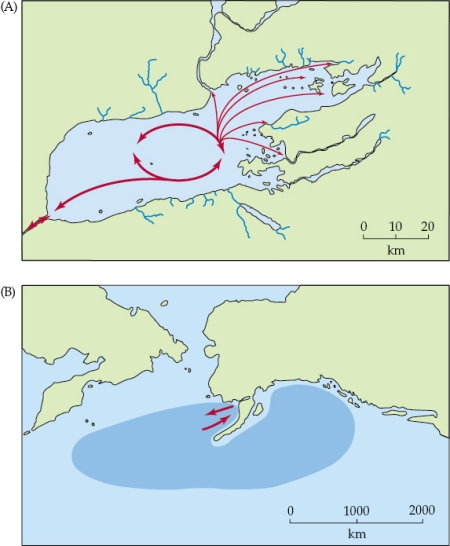 Panel A illustrates
A) migration.
B) path integration.
C) homing.
D) trail following.
Panel A illustratesA) migration.
B) path integration.
C) homing.
D) trail following.
سؤال
Refer to the figure shown.
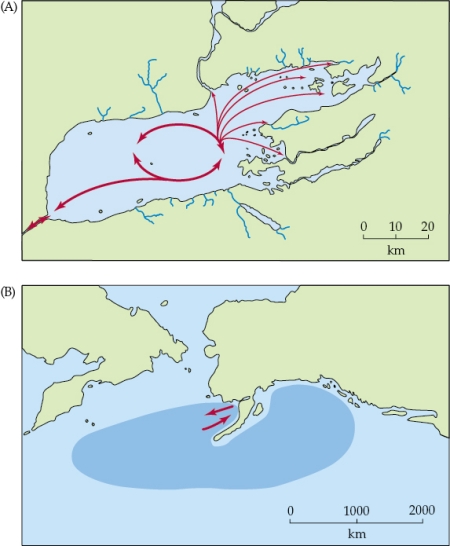 Choose the correct order of the life cycle illustrated in the panels:
1) Live in lake
2) Live in ocean
3) Migrate from ocean to lake
4) Migrate from lake to ocean
5) Young hatch in lake
6) Young hatch in ocean
7) Spawn in lake
8) Spawn in ocean
A) 5 → 1 → 4 → 2 → 3 → 7
B) 6 → 2 → 3 → 1 → 4 → 8
C) 6 → 3 → 1 → 7 → 4
D) 5 → 4 → 2 → 3 → 1 → 7
Choose the correct order of the life cycle illustrated in the panels:1) Live in lake
2) Live in ocean
3) Migrate from ocean to lake
4) Migrate from lake to ocean
5) Young hatch in lake
6) Young hatch in ocean
7) Spawn in lake
8) Spawn in ocean
A) 5 → 1 → 4 → 2 → 3 → 7
B) 6 → 2 → 3 → 1 → 4 → 8
C) 6 → 3 → 1 → 7 → 4
D) 5 → 4 → 2 → 3 → 1 → 7
سؤال
Refer to the figure shown.
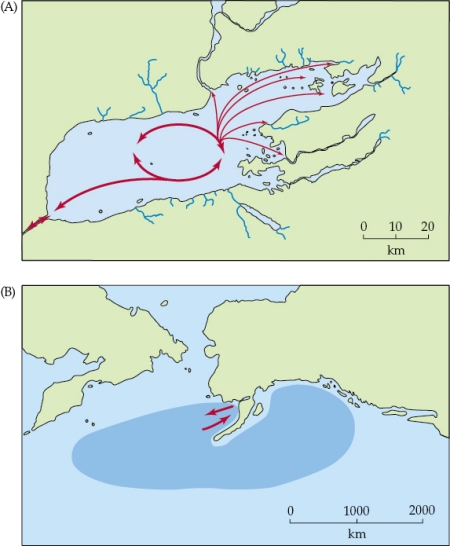 The panels illustrate the life cycle of the
A) humpback whale.
B) starling.
C) Pacific salmon.
D) arctic tern.
The panels illustrate the life cycle of theA) humpback whale.
B) starling.
C) Pacific salmon.
D) arctic tern.
سؤال
Refer to the figure shown.
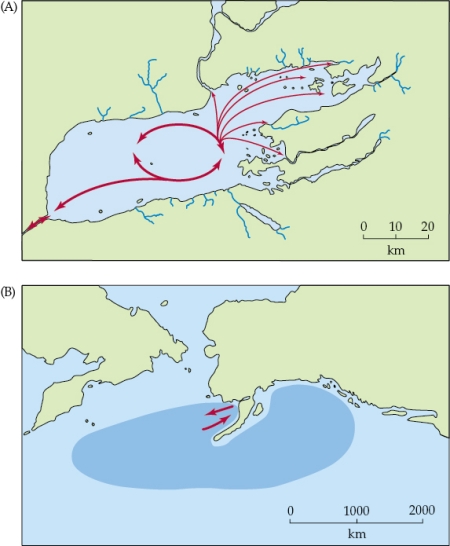 The main adaptive advantage of the process shown in the panels is
A) a consistent osmotic environment.
B) access to abundant food.
C) a predictable feeding environment.
D) adaptation to local breeding environments.
The main adaptive advantage of the process shown in the panels isA) a consistent osmotic environment.
B) access to abundant food.
C) a predictable feeding environment.
D) adaptation to local breeding environments.
سؤال
Refer to the figure shown.
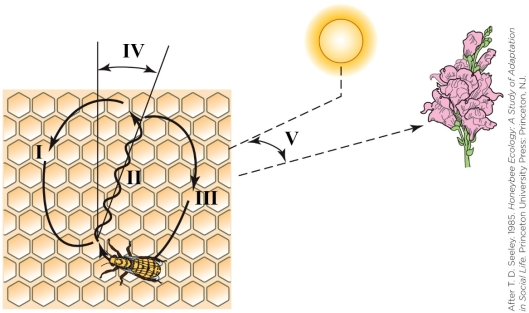 What process is illustrated by the figure?
A) Migration
B) Path integration
C) Homing
D) Trail following
What process is illustrated by the figure?A) Migration
B) Path integration
C) Homing
D) Trail following
سؤال
Refer to the figure shown.
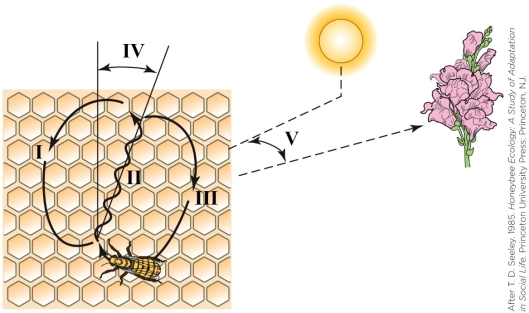 Which number(s) correspond(s) to information about the direction of the food source, as indicated by the honeybee?
A) I and III
B) II and IV
C) IV
D) V
Which number(s) correspond(s) to information about the direction of the food source, as indicated by the honeybee?A) I and III
B) II and IV
C) IV
D) V
سؤال
Refer to the figure shown.
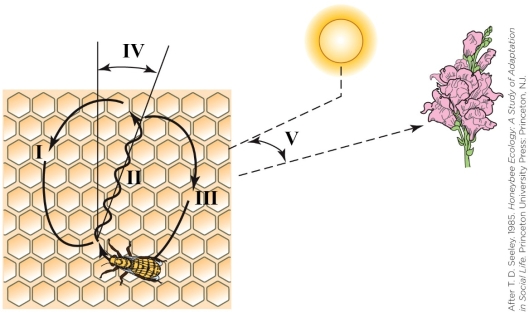 Which number(s) encode(s) information about the distance to the food source?
A) I and III
B) II
C) IV
D) V
Which number(s) encode(s) information about the distance to the food source?A) I and III
B) II
C) IV
D) V
سؤال
سؤال
سؤال
سؤال
Refer to the figure shown.
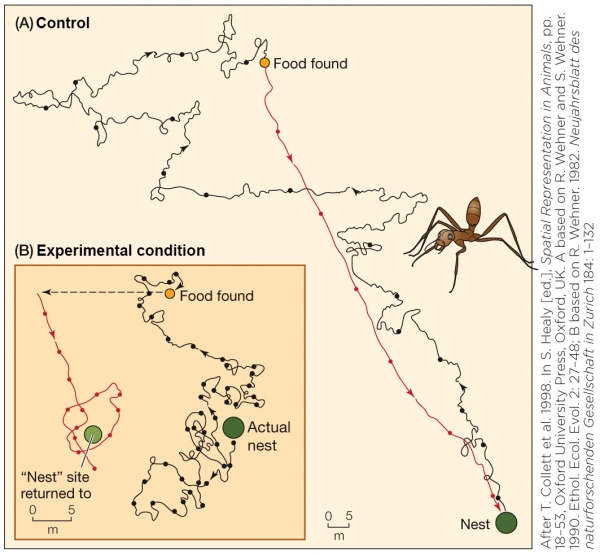 Part A of the figure illustrates which navigational strategy?
A) Trail following
B) Piloting
C) Path integration
D) Map-and-compass navigation
Part A of the figure illustrates which navigational strategy?A) Trail following
B) Piloting
C) Path integration
D) Map-and-compass navigation
سؤال
Refer to the figure shown.
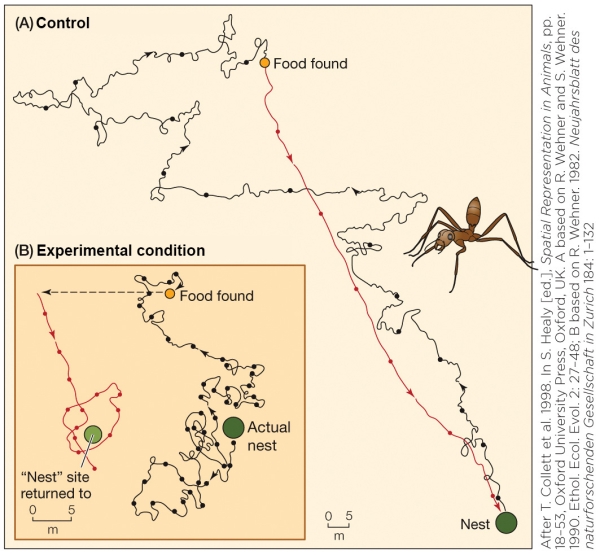 Part B of the figure illustrates which experimental procedure?
A) Displacement
B) Sensory deprivation
C) Sensory disruption
D) Landmark modification
Part B of the figure illustrates which experimental procedure?A) Displacement
B) Sensory deprivation
C) Sensory disruption
D) Landmark modification
سؤال
Refer to the figure shown.
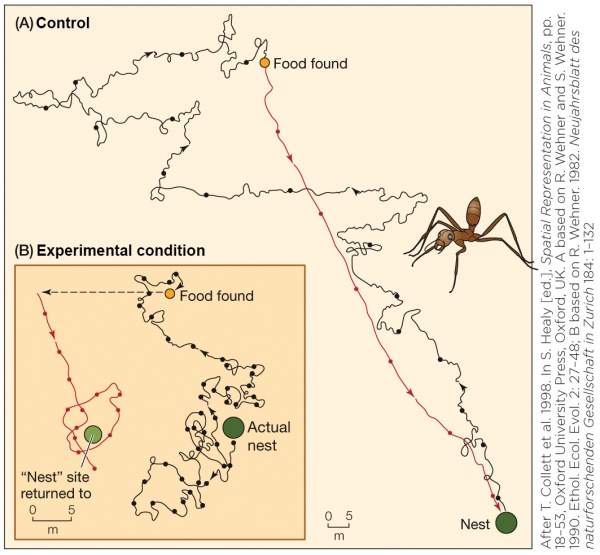 What did the experimental procedure reveal?
A) Desert ants use trail following for homing.
B) Desert ants use path integration for homing.
C) Desert ants use compass navigation.
D) Desert ants use landmarks in navigation.
What did the experimental procedure reveal?A) Desert ants use trail following for homing.
B) Desert ants use path integration for homing.
C) Desert ants use compass navigation.
D) Desert ants use landmarks in navigation.
سؤال
Refer to the figure shown.
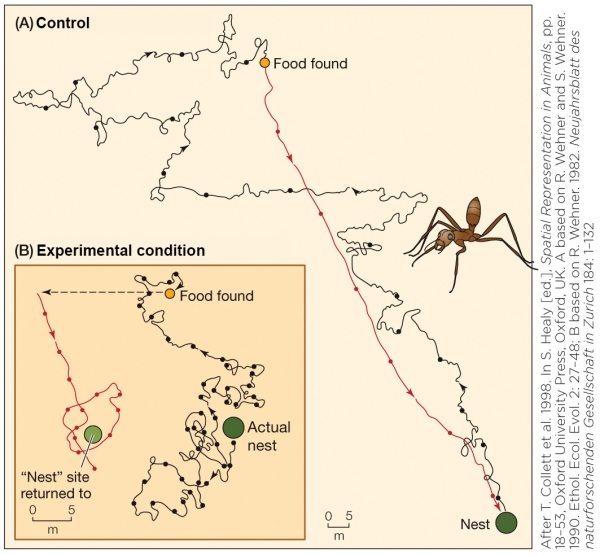 The animal searching for food in part B of the figure would need to use which navigational strategy to return to its original starting point (or home)?
A) Piloting
B) Path integration
C) Compass navigation
D) Map-and-compass navigation
The animal searching for food in part B of the figure would need to use which navigational strategy to return to its original starting point (or home)?A) Piloting
B) Path integration
C) Compass navigation
D) Map-and-compass navigation
سؤال
سؤال
سؤال
سؤال
سؤال
سؤال
سؤال
Refer to the figure shown.
 Based on the information presented in the figure, this bird uses which type of navigational strategy?
A) Piloting
B) Compass navigation
C) Path integration
D) Map-and-compass navigation
Based on the information presented in the figure, this bird uses which type of navigational strategy?A) Piloting
B) Compass navigation
C) Path integration
D) Map-and-compass navigation
سؤال
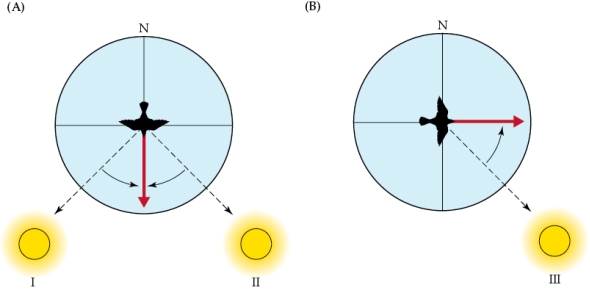
Refer to the figure shown.
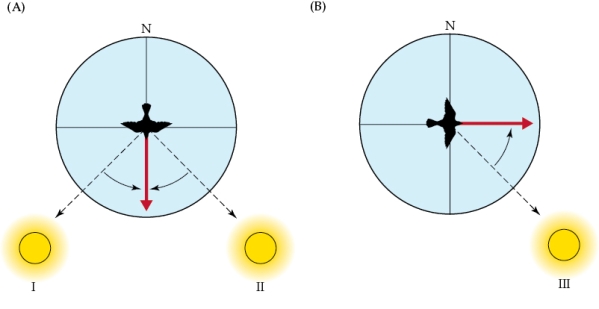 In part A of the figure above, if the time at point I is 1:00 pm, then the time at point II is
A) 7:00 am.
B) 9:00 am.
C) 3:00 pm.
D) 7:00 pm.
In part A of the figure above, if the time at point I is 1:00 pm, then the time at point II isA) 7:00 am.
B) 9:00 am.
C) 3:00 pm.
D) 7:00 pm.
سؤال
Refer to the figure shown.
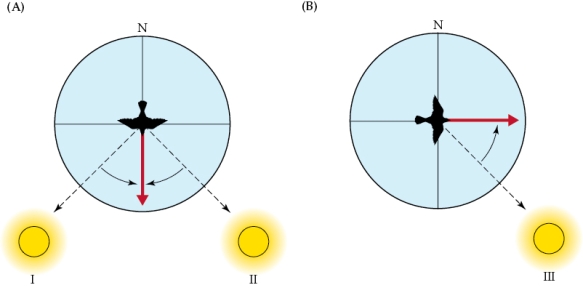 Suppose that the time at point I is 1:00 pm (under normal conditions). The pigeon's circadian clock is then shifted 6 hours ahead, and it flies in the direction indicated in panel B. What time must it be at point III?
A) 7:00 am
B) 9:00 am
C) 3:00 pm
D) 7:00 pm
Suppose that the time at point I is 1:00 pm (under normal conditions). The pigeon's circadian clock is then shifted 6 hours ahead, and it flies in the direction indicated in panel B. What time must it be at point III?A) 7:00 am
B) 9:00 am
C) 3:00 pm
D) 7:00 pm
سؤال
Refer to the figure shown.
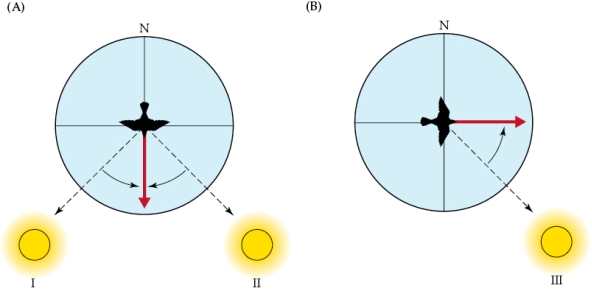 Suppose that the time at point I is 1:00 pm (under normal conditions). The pigeon's circadian clock is then shifted 3 hours backward. What direction heading will it then take at 7:00 am?
A) South
B) East
C) Southeast
D) Southwest
Suppose that the time at point I is 1:00 pm (under normal conditions). The pigeon's circadian clock is then shifted 3 hours backward. What direction heading will it then take at 7:00 am?A) South
B) East
C) Southeast
D) Southwest
سؤال
سؤال
سؤال
Refer to the figure shown.
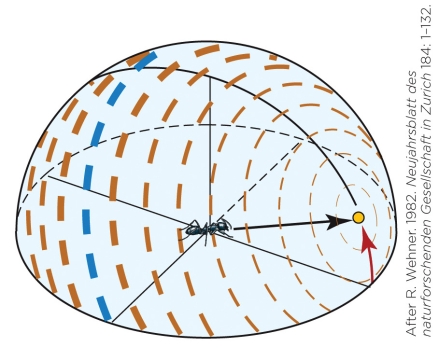 Which navigational strategy is illustrated by the figure?
A) Magnetic compass navigation
B) Polarized-light compass navigation
C) Sun compass navigation
D) Map-and-compass navigation
Which navigational strategy is illustrated by the figure?A) Magnetic compass navigation
B) Polarized-light compass navigation
C) Sun compass navigation
D) Map-and-compass navigation
سؤال
سؤال
سؤال
Refer to the figure shown.
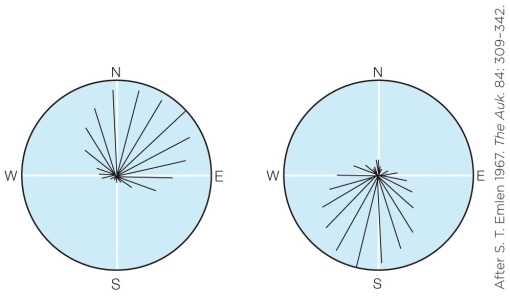 The illustrations, which were generated from data on indigo buntings held in a planetarium, show which navigational strategy?
A) Star compass navigation
B) Magnetic compass navigation
C) Olfactory cue navigation
D) Map-and-compass navigation
The illustrations, which were generated from data on indigo buntings held in a planetarium, show which navigational strategy?A) Star compass navigation
B) Magnetic compass navigation
C) Olfactory cue navigation
D) Map-and-compass navigation
سؤال
Refer to the figure shown.
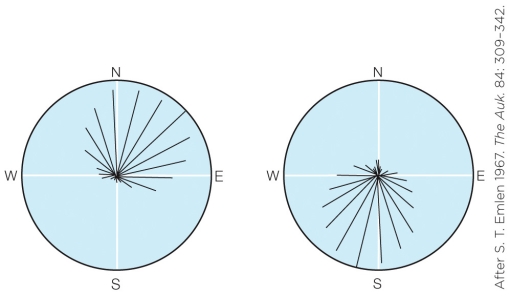 The illustration on the right represents an experimental treatment in which
A) the magnetic field was reversed.
B) circadian rhythm was shifted by 12 hours.
C) all sensory information was removed.
D) the star pattern was reversed.
The illustration on the right represents an experimental treatment in whichA) the magnetic field was reversed.
B) circadian rhythm was shifted by 12 hours.
C) all sensory information was removed.
D) the star pattern was reversed.
سؤال
سؤال
سؤال
سؤال
سؤال
Refer to the figure shown.
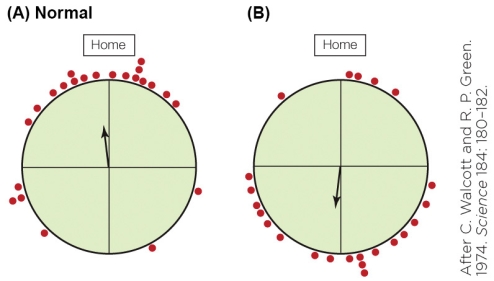 The illustrations, which are based on data from an experiment with pigeons, represent which navigational strategy?
A) Star compass navigation
B) Magnetic compass navigation
C) Olfactory cue navigation
D) Map-and-compass navigation
The illustrations, which are based on data from an experiment with pigeons, represent which navigational strategy?A) Star compass navigation
B) Magnetic compass navigation
C) Olfactory cue navigation
D) Map-and-compass navigation
سؤال
Refer to the figure shown.
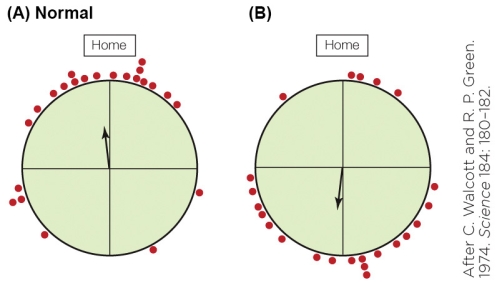 The red dots in the figure represent the
A) direction faced by a pigeon that is about to be released.
B) distance traveled in a particular direction.
C) direction in which one pigeon was heading as it vanished over the horizon.
D) time of day when the pigeon flew off.
The red dots in the figure represent theA) direction faced by a pigeon that is about to be released.
B) distance traveled in a particular direction.
C) direction in which one pigeon was heading as it vanished over the horizon.
D) time of day when the pigeon flew off.
سؤال
Refer to the figure shown.
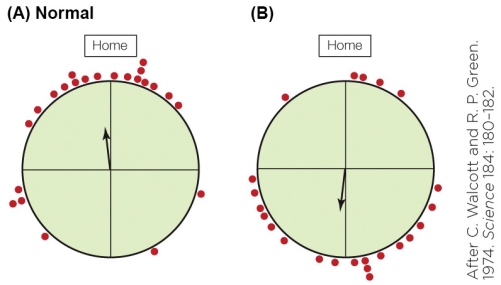 The illustration on the right represents an experimental treatment in which
A) the magnetic field was reversed.
B) circadian rhythm was shifted by 12 hours.
C) all sensory information was removed.
D) the star pattern was reversed.
The illustration on the right represents an experimental treatment in whichA) the magnetic field was reversed.
B) circadian rhythm was shifted by 12 hours.
C) all sensory information was removed.
D) the star pattern was reversed.
سؤال
Refer to the figure shown.
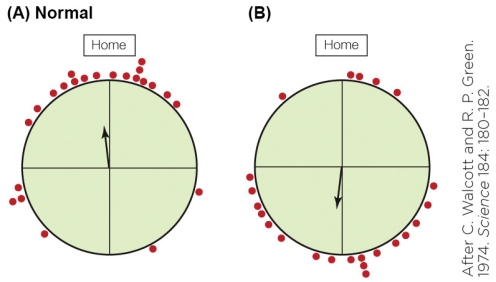 What would happen in the experiment depicted by the figure if the animals were also subjected to a time shift ahead 6 hours?
A) The animals would fly 90 degrees off their original heading.
B) The results would remain the same since the experiment was performed on an overcast day.
C) The magnetic treatment would no longer have an effect.
D) The animals would be unable to navigate whatsoever.
What would happen in the experiment depicted by the figure if the animals were also subjected to a time shift ahead 6 hours?A) The animals would fly 90 degrees off their original heading.
B) The results would remain the same since the experiment was performed on an overcast day.
C) The magnetic treatment would no longer have an effect.
D) The animals would be unable to navigate whatsoever.
سؤال
Refer to the figure shown.
 The data shown in the figure refer to the navigational strategies of which animal?
A) Whale
B) Pigeon
C) Salmon
D) Sea turtle
The data shown in the figure refer to the navigational strategies of which animal?A) Whale
B) Pigeon
C) Salmon
D) Sea turtle
سؤال
Refer to the figure shown.
 The data shown in the figure refer to which navigational strategy?
A) Star compass navigation
B) Magnetic compass navigation
C) Olfactory cue navigation
D) Map-and-compass navigation
The data shown in the figure refer to which navigational strategy?A) Star compass navigation
B) Magnetic compass navigation
C) Olfactory cue navigation
D) Map-and-compass navigation
سؤال
Refer to the figure shown.
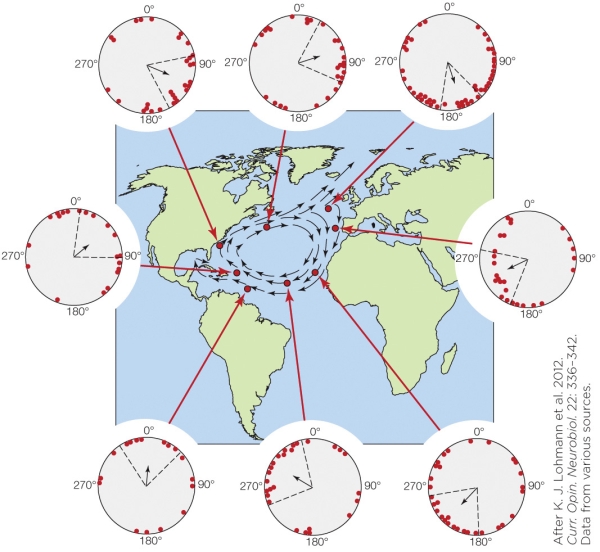 The red dots on the compasses in the figure represent the
A) direction faced by the animal about to be released.
B) distance traveled in a particular direction.
C) mean angle of one animal's oriented movement.
D) time of day when the animal began to move.
The red dots on the compasses in the figure represent theA) direction faced by the animal about to be released.
B) distance traveled in a particular direction.
C) mean angle of one animal's oriented movement.
D) time of day when the animal began to move.
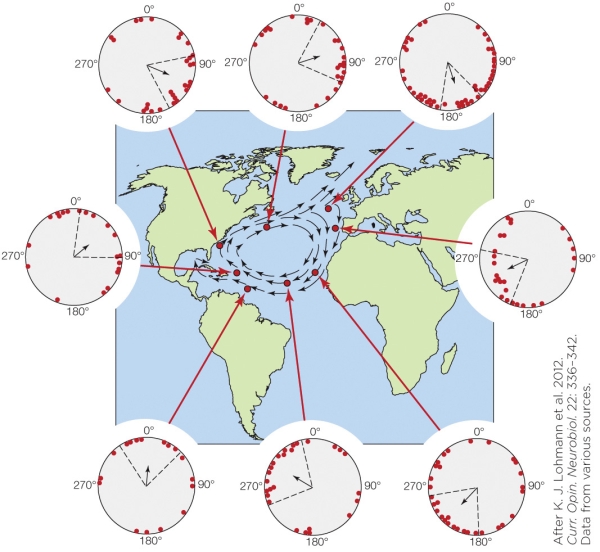
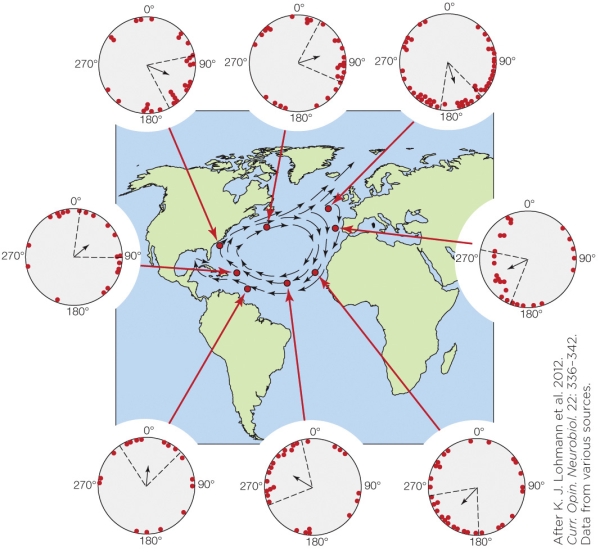
سؤال
سؤال
Refer to the figure shown.
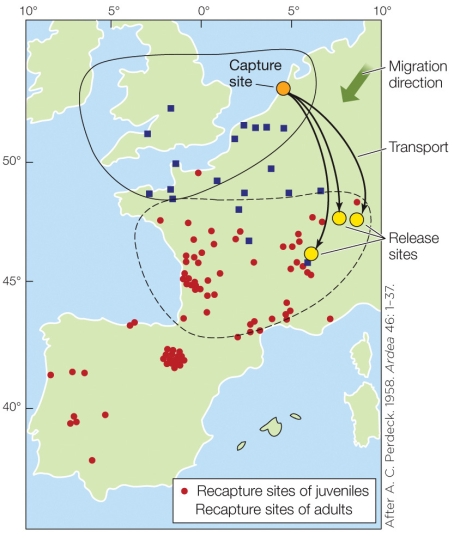 The data on this map suggests that adult starlings use which type of navigational strategy?
A) Star compass navigation
B) Magnetic compass navigation
C) Sun compass navigation
D) Map-and-compass navigation
The data on this map suggests that adult starlings use which type of navigational strategy?A) Star compass navigation
B) Magnetic compass navigation
C) Sun compass navigation
D) Map-and-compass navigation
سؤال
Refer to the figure shown.
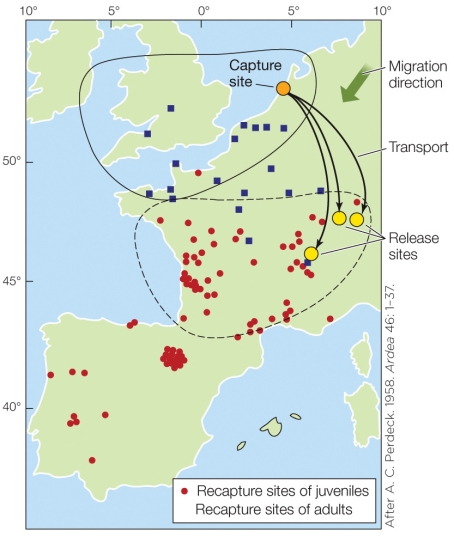 Which is the most accurate conclusion that can be derived from the data illustrated in the figure?
A) Juvenile birds migrate for longer distances than adults do.
B) Captured birds respond differently from naturally migrating birds.
C) Migrating adult and juvenile starlings respond differently to displacement.
D) Juvenile birds compensate for displacement by using map-and-compass navigation.
Which is the most accurate conclusion that can be derived from the data illustrated in the figure?A) Juvenile birds migrate for longer distances than adults do.
B) Captured birds respond differently from naturally migrating birds.
C) Migrating adult and juvenile starlings respond differently to displacement.
D) Juvenile birds compensate for displacement by using map-and-compass navigation.
سؤال
سؤال
سؤال
سؤال
سؤال
سؤال
سؤال
سؤال
سؤال
سؤال
سؤال
سؤال

فتح الحزمة
قم بالتسجيل لفتح البطاقات في هذه المجموعة!
Unlock Deck
Unlock Deck
1/61

العب

ملء الشاشة (f)
Deck 18: Integrating Systems at Work: Animal Navigation
1
The periodic movement of an animal from one region to another is called
A) migration.
B) homing.
C) piloting.
D) trail following.
A) migration.
B) homing.
C) piloting.
D) trail following.
A
2
Sea turtles use exceptional navigation strategies to
A) home in on their birth site to feed.
B) return to their birth site to breed.
C) find food in the open ocean.
D) locate mates in the open ocean.
A) home in on their birth site to feed.
B) return to their birth site to breed.
C) find food in the open ocean.
D) locate mates in the open ocean.
B
3
During the winter breeding season, humpback whales migrate from the polar seas to tropical waters because warm water provides
A) less thermoregulatory stress for the young.
B) more food for the adults and young.
C) less predatory pressure on the young.
D) better shelter for the young.
A) less thermoregulatory stress for the young.
B) more food for the adults and young.
C) less predatory pressure on the young.
D) better shelter for the young.
A
4
The _______ provides the most dramatic example of navigational skills involved in natal philopatry.
A) humpback whale
B) starling
C) Pacific salmon
D) honeybee
A) humpback whale
B) starling
C) Pacific salmon
D) honeybee
فتح الحزمة
افتح القفل للوصول البطاقات البالغ عددها 61 في هذه المجموعة.
فتح الحزمة
k this deck
5
Refer to the figure shown.
Panel A illustrates
A) migration.
B) path integration.
C) homing.
D) trail following.
Panel A illustratesA) migration.
B) path integration.
C) homing.
D) trail following.
فتح الحزمة
افتح القفل للوصول البطاقات البالغ عددها 61 في هذه المجموعة.
فتح الحزمة
k this deck
6
Refer to the figure shown.
Choose the correct order of the life cycle illustrated in the panels:
1) Live in lake
2) Live in ocean
3) Migrate from ocean to lake
4) Migrate from lake to ocean
5) Young hatch in lake
6) Young hatch in ocean
7) Spawn in lake
8) Spawn in ocean
A) 5 → 1 → 4 → 2 → 3 → 7
B) 6 → 2 → 3 → 1 → 4 → 8
C) 6 → 3 → 1 → 7 → 4
D) 5 → 4 → 2 → 3 → 1 → 7
Choose the correct order of the life cycle illustrated in the panels:1) Live in lake
2) Live in ocean
3) Migrate from ocean to lake
4) Migrate from lake to ocean
5) Young hatch in lake
6) Young hatch in ocean
7) Spawn in lake
8) Spawn in ocean
A) 5 → 1 → 4 → 2 → 3 → 7
B) 6 → 2 → 3 → 1 → 4 → 8
C) 6 → 3 → 1 → 7 → 4
D) 5 → 4 → 2 → 3 → 1 → 7
فتح الحزمة
افتح القفل للوصول البطاقات البالغ عددها 61 في هذه المجموعة.
فتح الحزمة
k this deck
7
Refer to the figure shown.
The panels illustrate the life cycle of the
A) humpback whale.
B) starling.
C) Pacific salmon.
D) arctic tern.
The panels illustrate the life cycle of theA) humpback whale.
B) starling.
C) Pacific salmon.
D) arctic tern.
فتح الحزمة
افتح القفل للوصول البطاقات البالغ عددها 61 في هذه المجموعة.
فتح الحزمة
k this deck
8
Refer to the figure shown.
The main adaptive advantage of the process shown in the panels is
A) a consistent osmotic environment.
B) access to abundant food.
C) a predictable feeding environment.
D) adaptation to local breeding environments.
The main adaptive advantage of the process shown in the panels isA) a consistent osmotic environment.
B) access to abundant food.
C) a predictable feeding environment.
D) adaptation to local breeding environments.
فتح الحزمة
افتح القفل للوصول البطاقات البالغ عددها 61 في هذه المجموعة.
فتح الحزمة
k this deck
9
Refer to the figure shown.
What process is illustrated by the figure?
A) Migration
B) Path integration
C) Homing
D) Trail following
What process is illustrated by the figure?A) Migration
B) Path integration
C) Homing
D) Trail following
فتح الحزمة
افتح القفل للوصول البطاقات البالغ عددها 61 في هذه المجموعة.
فتح الحزمة
k this deck
10
Refer to the figure shown.
Which number(s) correspond(s) to information about the direction of the food source, as indicated by the honeybee?
A) I and III
B) II and IV
C) IV
D) V
Which number(s) correspond(s) to information about the direction of the food source, as indicated by the honeybee?A) I and III
B) II and IV
C) IV
D) V
فتح الحزمة
افتح القفل للوصول البطاقات البالغ عددها 61 في هذه المجموعة.
فتح الحزمة
k this deck
11
Refer to the figure shown.
Which number(s) encode(s) information about the distance to the food source?
A) I and III
B) II
C) IV
D) V
Which number(s) encode(s) information about the distance to the food source?A) I and III
B) II
C) IV
D) V
فتح الحزمة
افتح القفل للوصول البطاقات البالغ عددها 61 في هذه المجموعة.
فتح الحزمة
k this deck
12
Which of the following is not one of the five behavioral strategies animals use to navigate?
A) Piloting
B) Path integration
C) Map-and-compass navigation
D) Map navigation
A) Piloting
B) Path integration
C) Map-and-compass navigation
D) Map navigation
فتح الحزمة
افتح القفل للوصول البطاقات البالغ عددها 61 في هذه المجموعة.
فتح الحزمة
k this deck
13
Which statement about piloting animals is true?
A) They follow a discontinuous series of learned landmarks to obtain compass-heading information.
B) They follow a continuous series of learned landmarks to determine where they are.
C) They follow a discontinuous series of learned landmarks to determine where they are.
D) They follow a continuous series of learned landmarks to obtain compass-heading information.
A) They follow a discontinuous series of learned landmarks to obtain compass-heading information.
B) They follow a continuous series of learned landmarks to determine where they are.
C) They follow a discontinuous series of learned landmarks to determine where they are.
D) They follow a continuous series of learned landmarks to obtain compass-heading information.
فتح الحزمة
افتح القفل للوصول البطاقات البالغ عددها 61 في هذه المجموعة.
فتح الحزمة
k this deck
14
In a classic experiment, Nikkolaas Tinbergen showed that digger wasps can use
A) flowers as landmarks for piloting.
B) pinecones as landmarks for navigation.
C) landmarks for remembering the locations of hidden food.
D) pheromones as olfactory cues for trail following.
A) flowers as landmarks for piloting.
B) pinecones as landmarks for navigation.
C) landmarks for remembering the locations of hidden food.
D) pheromones as olfactory cues for trail following.
فتح الحزمة
افتح القفل للوصول البطاقات البالغ عددها 61 في هذه المجموعة.
فتح الحزمة
k this deck
15
Refer to the figure shown.
Part A of the figure illustrates which navigational strategy?
A) Trail following
B) Piloting
C) Path integration
D) Map-and-compass navigation
Part A of the figure illustrates which navigational strategy?A) Trail following
B) Piloting
C) Path integration
D) Map-and-compass navigation
فتح الحزمة
افتح القفل للوصول البطاقات البالغ عددها 61 في هذه المجموعة.
فتح الحزمة
k this deck
16
Refer to the figure shown.
Part B of the figure illustrates which experimental procedure?
A) Displacement
B) Sensory deprivation
C) Sensory disruption
D) Landmark modification
Part B of the figure illustrates which experimental procedure?A) Displacement
B) Sensory deprivation
C) Sensory disruption
D) Landmark modification
فتح الحزمة
افتح القفل للوصول البطاقات البالغ عددها 61 في هذه المجموعة.
فتح الحزمة
k this deck
17
Refer to the figure shown.
What did the experimental procedure reveal?
A) Desert ants use trail following for homing.
B) Desert ants use path integration for homing.
C) Desert ants use compass navigation.
D) Desert ants use landmarks in navigation.
What did the experimental procedure reveal?A) Desert ants use trail following for homing.
B) Desert ants use path integration for homing.
C) Desert ants use compass navigation.
D) Desert ants use landmarks in navigation.
فتح الحزمة
افتح القفل للوصول البطاقات البالغ عددها 61 في هذه المجموعة.
فتح الحزمة
k this deck
18
Refer to the figure shown.
The animal searching for food in part B of the figure would need to use which navigational strategy to return to its original starting point (or home)?
A) Piloting
B) Path integration
C) Compass navigation
D) Map-and-compass navigation
The animal searching for food in part B of the figure would need to use which navigational strategy to return to its original starting point (or home)?A) Piloting
B) Path integration
C) Compass navigation
D) Map-and-compass navigation
فتح الحزمة
افتح القفل للوصول البطاقات البالغ عددها 61 في هذه المجموعة.
فتح الحزمة
k this deck
19
Animals that use path integration, such as desert ants, must collect information in order to identify the path home. What information do desert ants collect?
A) They collect directional information from the sun's position and measure distance by integrating proprioceptive information while walking.
B) They collect directional information from learned landmarks and measure distance by integrating proprioceptive information while walking.
C) They collect directional and distance information from the sun's position.
D) They collect directional information from the sun's position and distance information from learned landmarks
A) They collect directional information from the sun's position and measure distance by integrating proprioceptive information while walking.
B) They collect directional information from learned landmarks and measure distance by integrating proprioceptive information while walking.
C) They collect directional and distance information from the sun's position.
D) They collect directional information from the sun's position and distance information from learned landmarks
فتح الحزمة
افتح القفل للوصول البطاقات البالغ عددها 61 في هذه المجموعة.
فتح الحزمة
k this deck
20
In attempting to understand how desert ants calculate distance while walking in the desert, researchers altered the length of the ants' legs. What were the results of their experiment?
A) Ants with stilt legs found their home much faster compared to ants with normal legs.
B) Ants with stilt legs began their search for home far earlier than ants with normal legs.
C) Ants with stilt legs walked too far before searching for their home.
D) Ants with altered legs were able to use polarized light to correct their heading after they noticed an error in their search for home.
A) Ants with stilt legs found their home much faster compared to ants with normal legs.
B) Ants with stilt legs began their search for home far earlier than ants with normal legs.
C) Ants with stilt legs walked too far before searching for their home.
D) Ants with altered legs were able to use polarized light to correct their heading after they noticed an error in their search for home.
فتح الحزمة
افتح القفل للوصول البطاقات البالغ عددها 61 في هذه المجموعة.
فتح الحزمة
k this deck
21
Honeybees use _______ to estimate distances between the hive and food sources.
A) the sun
B) landmarks
C) optic flow
D) flight proprioception
A) the sun
B) landmarks
C) optic flow
D) flight proprioception
فتح الحزمة
افتح القفل للوصول البطاقات البالغ عددها 61 في هذه المجموعة.
فتح الحزمة
k this deck
22
A _______ is a mechanism that indicates geographical direction.
A) map
B) landmark
C) heading
D) compass
A) map
B) landmark
C) heading
D) compass
فتح الحزمة
افتح القفل للوصول البطاقات البالغ عددها 61 في هذه المجموعة.
فتح الحزمة
k this deck
23
The sun compass requires integration of the sun's position and
A) the direction of Earth's movement.
B) circadian time information.
C) polarized light information.
D) the direction of magnetic north.
A) the direction of Earth's movement.
B) circadian time information.
C) polarized light information.
D) the direction of magnetic north.
فتح الحزمة
افتح القفل للوصول البطاقات البالغ عددها 61 في هذه المجموعة.
فتح الحزمة
k this deck
24
Which statement about polarized light is true?
A) It is non-reflected light.
B) It vibrates in only one plane with respect to its line of propagation.
C) Light is never fully polarized.
D) It is perceived by all non-human mammals
A) It is non-reflected light.
B) It vibrates in only one plane with respect to its line of propagation.
C) Light is never fully polarized.
D) It is perceived by all non-human mammals
فتح الحزمة
افتح القفل للوصول البطاقات البالغ عددها 61 في هذه المجموعة.
فتح الحزمة
k this deck
25
Refer to the figure shown.
Based on the information presented in the figure, this bird uses which type of navigational strategy?
A) Piloting
B) Compass navigation
C) Path integration
D) Map-and-compass navigation
Based on the information presented in the figure, this bird uses which type of navigational strategy?A) Piloting
B) Compass navigation
C) Path integration
D) Map-and-compass navigation
فتح الحزمة
افتح القفل للوصول البطاقات البالغ عددها 61 في هذه المجموعة.
فتح الحزمة
k this deck
26
Refer to the figure shown.
In part A of the figure above, if the time at point I is 1:00 pm, then the time at point II is
A) 7:00 am.
B) 9:00 am.
C) 3:00 pm.
D) 7:00 pm.
In part A of the figure above, if the time at point I is 1:00 pm, then the time at point II isA) 7:00 am.
B) 9:00 am.
C) 3:00 pm.
D) 7:00 pm.
فتح الحزمة
افتح القفل للوصول البطاقات البالغ عددها 61 في هذه المجموعة.
فتح الحزمة
k this deck
27
Refer to the figure shown.
Suppose that the time at point I is 1:00 pm (under normal conditions). The pigeon's circadian clock is then shifted 6 hours ahead, and it flies in the direction indicated in panel B. What time must it be at point III?
A) 7:00 am
B) 9:00 am
C) 3:00 pm
D) 7:00 pm
Suppose that the time at point I is 1:00 pm (under normal conditions). The pigeon's circadian clock is then shifted 6 hours ahead, and it flies in the direction indicated in panel B. What time must it be at point III?A) 7:00 am
B) 9:00 am
C) 3:00 pm
D) 7:00 pm
فتح الحزمة
افتح القفل للوصول البطاقات البالغ عددها 61 في هذه المجموعة.
فتح الحزمة
k this deck
28
Refer to the figure shown.
Suppose that the time at point I is 1:00 pm (under normal conditions). The pigeon's circadian clock is then shifted 3 hours backward. What direction heading will it then take at 7:00 am?
A) South
B) East
C) Southeast
D) Southwest
Suppose that the time at point I is 1:00 pm (under normal conditions). The pigeon's circadian clock is then shifted 3 hours backward. What direction heading will it then take at 7:00 am?A) South
B) East
C) Southeast
D) Southwest
فتح الحزمة
افتح القفل للوصول البطاقات البالغ عددها 61 في هذه المجموعة.
فتح الحزمة
k this deck
29
Which statement about polarized light is true?
A) Light is never fully polarized.
B) Light is fully polarized when the animal is in the direct light path from the sun.
C) Light is fully polarized at a reflection angle of 45°.
D) Light is fully polarized at a reflection angle of 90°.
A) Light is never fully polarized.
B) Light is fully polarized when the animal is in the direct light path from the sun.
C) Light is fully polarized at a reflection angle of 45°.
D) Light is fully polarized at a reflection angle of 90°.
فتح الحزمة
افتح القفل للوصول البطاقات البالغ عددها 61 في هذه المجموعة.
فتح الحزمة
k this deck
30
How do animals use polarized light for compass information?
A) They can detect the angle of polarization.
B) They can detect the gradients in the degree of light polarization.
C) They can relate polarized light to direct light information coming from the sun.
D) They can detect the angle of polarization and relate polarized light to direct light information coming from the sun.
A) They can detect the angle of polarization.
B) They can detect the gradients in the degree of light polarization.
C) They can relate polarized light to direct light information coming from the sun.
D) They can detect the angle of polarization and relate polarized light to direct light information coming from the sun.
فتح الحزمة
افتح القفل للوصول البطاقات البالغ عددها 61 في هذه المجموعة.
فتح الحزمة
k this deck
31
Refer to the figure shown.
Which navigational strategy is illustrated by the figure?
A) Magnetic compass navigation
B) Polarized-light compass navigation
C) Sun compass navigation
D) Map-and-compass navigation
Which navigational strategy is illustrated by the figure?A) Magnetic compass navigation
B) Polarized-light compass navigation
C) Sun compass navigation
D) Map-and-compass navigation
فتح الحزمة
افتح القفل للوصول البطاقات البالغ عددها 61 في هذه المجموعة.
فتح الحزمة
k this deck
32
Which statement regarding the moon as a compass is true?
A) Many animals use the moon as a compass, but only at night.
B) Many animals use the moon as a compass, but only during the day.
C) Only aquatic animals can use the moon as a compass.
D) Animals do not use the moon as a compass.
A) Many animals use the moon as a compass, but only at night.
B) Many animals use the moon as a compass, but only during the day.
C) Only aquatic animals can use the moon as a compass.
D) Animals do not use the moon as a compass.
فتح الحزمة
افتح القفل للوصول البطاقات البالغ عددها 61 في هذه المجموعة.
فتح الحزمة
k this deck
33
Nocturnal migrants tend to use
A) a star compass.
B) a magnetic compass.
C) olfactory cues.
D) map-and-compass navigation.
A) a star compass.
B) a magnetic compass.
C) olfactory cues.
D) map-and-compass navigation.
فتح الحزمة
افتح القفل للوصول البطاقات البالغ عددها 61 في هذه المجموعة.
فتح الحزمة
k this deck
34
Refer to the figure shown.
The illustrations, which were generated from data on indigo buntings held in a planetarium, show which navigational strategy?
A) Star compass navigation
B) Magnetic compass navigation
C) Olfactory cue navigation
D) Map-and-compass navigation
The illustrations, which were generated from data on indigo buntings held in a planetarium, show which navigational strategy?A) Star compass navigation
B) Magnetic compass navigation
C) Olfactory cue navigation
D) Map-and-compass navigation
فتح الحزمة
افتح القفل للوصول البطاقات البالغ عددها 61 في هذه المجموعة.
فتح الحزمة
k this deck
35
Refer to the figure shown.
The illustration on the right represents an experimental treatment in which
A) the magnetic field was reversed.
B) circadian rhythm was shifted by 12 hours.
C) all sensory information was removed.
D) the star pattern was reversed.
The illustration on the right represents an experimental treatment in whichA) the magnetic field was reversed.
B) circadian rhythm was shifted by 12 hours.
C) all sensory information was removed.
D) the star pattern was reversed.
فتح الحزمة
افتح القفل للوصول البطاقات البالغ عددها 61 في هذه المجموعة.
فتح الحزمة
k this deck
36
Indigo buntings know how to fly north via
A) an innate magnetic compass.
B) an innate star compass.
C) learned migration routes by following their parents.
D) a learned north star by observing constellations rotating.
A) an innate magnetic compass.
B) an innate star compass.
C) learned migration routes by following their parents.
D) a learned north star by observing constellations rotating.
فتح الحزمة
افتح القفل للوصول البطاقات البالغ عددها 61 في هذه المجموعة.
فتح الحزمة
k this deck
37
Animals that use a magnetic compass must be able to sense _______ of Earth's magnetic field.
A) the polar component
B) the inclination component
C) the variation in amplitude
D) either the polar component or the inclination component
A) the polar component
B) the inclination component
C) the variation in amplitude
D) either the polar component or the inclination component
فتح الحزمة
افتح القفل للوصول البطاقات البالغ عددها 61 في هذه المجموعة.
فتح الحزمة
k this deck
38
Arthropods such as bees use their magnetic compass to sense _______ of Earth's magnetic field.
A) the polar component
B) the inclination component
C) the variation in amplitude
D) either the polar component or the inclination component
A) the polar component
B) the inclination component
C) the variation in amplitude
D) either the polar component or the inclination component
فتح الحزمة
افتح القفل للوصول البطاقات البالغ عددها 61 في هذه المجموعة.
فتح الحزمة
k this deck
39
Which animal does not use magnetic information for navigation?
A) Indigo Buntings
B) Monarch butterflies
C) Turtles
D) Pigeons
A) Indigo Buntings
B) Monarch butterflies
C) Turtles
D) Pigeons
فتح الحزمة
افتح القفل للوصول البطاقات البالغ عددها 61 في هذه المجموعة.
فتح الحزمة
k this deck
40
Refer to the figure shown.
The illustrations, which are based on data from an experiment with pigeons, represent which navigational strategy?
A) Star compass navigation
B) Magnetic compass navigation
C) Olfactory cue navigation
D) Map-and-compass navigation
The illustrations, which are based on data from an experiment with pigeons, represent which navigational strategy?A) Star compass navigation
B) Magnetic compass navigation
C) Olfactory cue navigation
D) Map-and-compass navigation
فتح الحزمة
افتح القفل للوصول البطاقات البالغ عددها 61 في هذه المجموعة.
فتح الحزمة
k this deck
41
Refer to the figure shown.
The red dots in the figure represent the
A) direction faced by a pigeon that is about to be released.
B) distance traveled in a particular direction.
C) direction in which one pigeon was heading as it vanished over the horizon.
D) time of day when the pigeon flew off.
The red dots in the figure represent theA) direction faced by a pigeon that is about to be released.
B) distance traveled in a particular direction.
C) direction in which one pigeon was heading as it vanished over the horizon.
D) time of day when the pigeon flew off.
فتح الحزمة
افتح القفل للوصول البطاقات البالغ عددها 61 في هذه المجموعة.
فتح الحزمة
k this deck
42
Refer to the figure shown.
The illustration on the right represents an experimental treatment in which
A) the magnetic field was reversed.
B) circadian rhythm was shifted by 12 hours.
C) all sensory information was removed.
D) the star pattern was reversed.
The illustration on the right represents an experimental treatment in whichA) the magnetic field was reversed.
B) circadian rhythm was shifted by 12 hours.
C) all sensory information was removed.
D) the star pattern was reversed.
فتح الحزمة
افتح القفل للوصول البطاقات البالغ عددها 61 في هذه المجموعة.
فتح الحزمة
k this deck
43
Refer to the figure shown.
What would happen in the experiment depicted by the figure if the animals were also subjected to a time shift ahead 6 hours?
A) The animals would fly 90 degrees off their original heading.
B) The results would remain the same since the experiment was performed on an overcast day.
C) The magnetic treatment would no longer have an effect.
D) The animals would be unable to navigate whatsoever.
What would happen in the experiment depicted by the figure if the animals were also subjected to a time shift ahead 6 hours?A) The animals would fly 90 degrees off their original heading.
B) The results would remain the same since the experiment was performed on an overcast day.
C) The magnetic treatment would no longer have an effect.
D) The animals would be unable to navigate whatsoever.
فتح الحزمة
افتح القفل للوصول البطاقات البالغ عددها 61 في هذه المجموعة.
فتح الحزمة
k this deck
44
Refer to the figure shown.
The data shown in the figure refer to the navigational strategies of which animal?
A) Whale
B) Pigeon
C) Salmon
D) Sea turtle
The data shown in the figure refer to the navigational strategies of which animal?A) Whale
B) Pigeon
C) Salmon
D) Sea turtle
فتح الحزمة
افتح القفل للوصول البطاقات البالغ عددها 61 في هذه المجموعة.
فتح الحزمة
k this deck
45
Refer to the figure shown.
The data shown in the figure refer to which navigational strategy?
A) Star compass navigation
B) Magnetic compass navigation
C) Olfactory cue navigation
D) Map-and-compass navigation
The data shown in the figure refer to which navigational strategy?A) Star compass navigation
B) Magnetic compass navigation
C) Olfactory cue navigation
D) Map-and-compass navigation
فتح الحزمة
افتح القفل للوصول البطاقات البالغ عددها 61 في هذه المجموعة.
فتح الحزمة
k this deck
46
Refer to the figure shown.
The red dots on the compasses in the figure represent the
A) direction faced by the animal about to be released.
B) distance traveled in a particular direction.
C) mean angle of one animal's oriented movement.
D) time of day when the animal began to move.
The red dots on the compasses in the figure represent theA) direction faced by the animal about to be released.
B) distance traveled in a particular direction.
C) mean angle of one animal's oriented movement.
D) time of day when the animal began to move.
فتح الحزمة
افتح القفل للوصول البطاقات البالغ عددها 61 في هذه المجموعة.
فتح الحزمة
k this deck
47
In one experiment, pigeons whose clocks were shifted 6 hours flew in the wrong direction when they attempted to navigate by following their sun compass. What happened when another group of identically treated pigeons navigated on a cloudy day?
A) They used their polarized-light compass and flew in circles.
B) They were able to navigate by using their polarized-light compass.
C) They were able to navigate on the basis of olfactory cues.
D) They were able to navigate by using their magnetic compass.
A) They used their polarized-light compass and flew in circles.
B) They were able to navigate by using their polarized-light compass.
C) They were able to navigate on the basis of olfactory cues.
D) They were able to navigate by using their magnetic compass.
فتح الحزمة
افتح القفل للوصول البطاقات البالغ عددها 61 في هذه المجموعة.
فتح الحزمة
k this deck
48
Refer to the figure shown.
The data on this map suggests that adult starlings use which type of navigational strategy?
A) Star compass navigation
B) Magnetic compass navigation
C) Sun compass navigation
D) Map-and-compass navigation
The data on this map suggests that adult starlings use which type of navigational strategy?A) Star compass navigation
B) Magnetic compass navigation
C) Sun compass navigation
D) Map-and-compass navigation
فتح الحزمة
افتح القفل للوصول البطاقات البالغ عددها 61 في هذه المجموعة.
فتح الحزمة
k this deck
49
Refer to the figure shown.
Which is the most accurate conclusion that can be derived from the data illustrated in the figure?
A) Juvenile birds migrate for longer distances than adults do.
B) Captured birds respond differently from naturally migrating birds.
C) Migrating adult and juvenile starlings respond differently to displacement.
D) Juvenile birds compensate for displacement by using map-and-compass navigation.
Which is the most accurate conclusion that can be derived from the data illustrated in the figure?A) Juvenile birds migrate for longer distances than adults do.
B) Captured birds respond differently from naturally migrating birds.
C) Migrating adult and juvenile starlings respond differently to displacement.
D) Juvenile birds compensate for displacement by using map-and-compass navigation.
فتح الحزمة
افتح القفل للوصول البطاقات البالغ عددها 61 في هذه المجموعة.
فتح الحزمة
k this deck
50
Which animal best demonstrates the innate component of navigation?
A) Pigeons
B) Monarch butterflies
C) European starlings
D) Honeybees
A) Pigeons
B) Monarch butterflies
C) European starlings
D) Honeybees
فتح الحزمة
افتح القفل للوصول البطاقات البالغ عددها 61 في هذه المجموعة.
فتح الحزمة
k this deck
51
The critical area for vertebrate spatial learning and memory is the
A) cerebellum.
B) hippocampus.
C) medulla oblongata.
D) cerebrum.
A) cerebellum.
B) hippocampus.
C) medulla oblongata.
D) cerebrum.
فتح الحزمة
افتح القفل للوصول البطاقات البالغ عددها 61 في هذه المجموعة.
فتح الحزمة
k this deck
52
Which statement does not describe one of the documented effects of hippocampal lesions?
A) Lesioned rats cannot remember the location of a submerged platform in the Morris water maze.
B) Lesioned rats cannot remember which radial arm (of a radial-arm maze) has food at the end.
C) Lesioned nutcracker birds hide food normally but cannot recover their caches.
D) Lesioned nutcracker birds cannot pair a sound with a reward.
A) Lesioned rats cannot remember the location of a submerged platform in the Morris water maze.
B) Lesioned rats cannot remember which radial arm (of a radial-arm maze) has food at the end.
C) Lesioned nutcracker birds hide food normally but cannot recover their caches.
D) Lesioned nutcracker birds cannot pair a sound with a reward.
فتح الحزمة
افتح القفل للوصول البطاقات البالغ عددها 61 في هذه المجموعة.
فتح الحزمة
k this deck
53
Which cells are involved in the active map-and-compass navigation of a rat in a nonuniform environment?
A) Place cells
B) Head direction cells
C) Grid cells
D) Both place cells and head direction cells
A) Place cells
B) Head direction cells
C) Grid cells
D) Both place cells and head direction cells
فتح الحزمة
افتح القفل للوصول البطاقات البالغ عددها 61 في هذه المجموعة.
فتح الحزمة
k this deck
54
You have lost your phone on a hike through a large forest. You are noting the forest edges in order to plan a spot to reenter the forest. Which cells are involved in this endeavor?
A) Place cells
B) Head direction cells
C) Boundary cells
D) Grid cells
A) Place cells
B) Head direction cells
C) Boundary cells
D) Grid cells
فتح الحزمة
افتح القفل للوصول البطاقات البالغ عددها 61 في هذه المجموعة.
فتح الحزمة
k this deck
55
Compare and contrast the terms "navigation," "migration," and "homing."
فتح الحزمة
افتح القفل للوصول البطاقات البالغ عددها 61 في هذه المجموعة.
فتح الحزمة
k this deck
56
Discuss how navigational abilities promote reproductive success, and provide an example.
فتح الحزمة
افتح القفل للوصول البطاقات البالغ عددها 61 في هذه المجموعة.
فتح الحزمة
k this deck
57
What is the adaptive significance of the honeybee waggle dance and how is information coded in this dance?
فتح الحزمة
افتح القفل للوصول البطاقات البالغ عددها 61 في هذه المجموعة.
فتح الحزمة
k this deck
58
Compare and contrast the navigational strategies of path integration versus trail following.
فتح الحزمة
افتح القفل للوصول البطاقات البالغ عددها 61 في هذه المجموعة.
فتح الحزمة
k this deck
59
Use the example of a sun compass to explain what a compass is and how it is used.
فتح الحزمة
افتح القفل للوصول البطاقات البالغ عددها 61 في هذه المجموعة.
فتح الحزمة
k this deck
60
Describe what displacement experiments tell us about navigational strategies.
فتح الحزمة
افتح القفل للوصول البطاقات البالغ عددها 61 في هذه المجموعة.
فتح الحزمة
k this deck
61
Describe and give an example of innate navigation and learned navigation.
فتح الحزمة
افتح القفل للوصول البطاقات البالغ عددها 61 في هذه المجموعة.
فتح الحزمة
k this deck
فتح الحزمة
افتح القفل للوصول البطاقات البالغ عددها 61 في هذه المجموعة.






