







 تكلم مع الذكاء الاصطناعي


Deck 15: Nervous System Organization and Biological Clocks
ملء الشاشة (f)

سؤال

سؤال
سؤال
سؤال
سؤال
سؤال
سؤال
سؤال
سؤال
سؤال
سؤال
Refer to the figure shown.
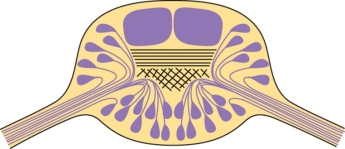 The figure depicts a cross section of a(n)
A) vertebrate spinal cord.
B) arthropod ganglion.
C) vertebrate ganglion.
D) arthropod connective.
The figure depicts a cross section of a(n)A) vertebrate spinal cord.
B) arthropod ganglion.
C) vertebrate ganglion.
D) arthropod connective.
سؤال
سؤال
Refer to the figure shown.
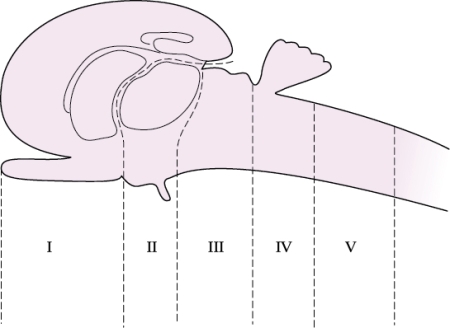 Which number(s) in the figure represent(s) the hindbrain?
A) III
B) III and IV
C) IV
D) IV and V
Which number(s) in the figure represent(s) the hindbrain?A) III
B) III and IV
C) IV
D) IV and V
سؤال
Refer to the figure shown.
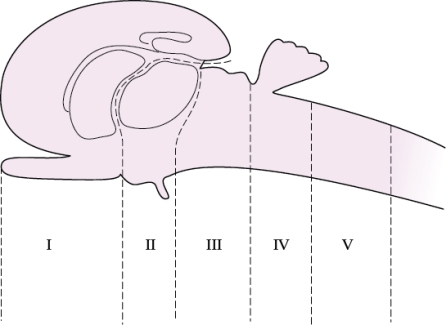 Which number in the figure best corresponds to the area of the brain responsible for learning and memory?
A) I
B) II
C) III
D) IV
Which number in the figure best corresponds to the area of the brain responsible for learning and memory?A) I
B) II
C) III
D) IV
سؤال
Refer to the figure shown.
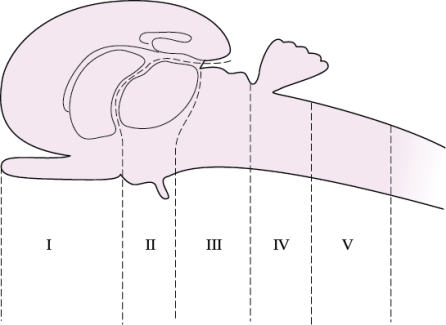 Which number in the figure best corresponds to the area of the brain responsible for autonomic and respiratory control?
A) II
B) III
C) IV
D) V
Which number in the figure best corresponds to the area of the brain responsible for autonomic and respiratory control?A) II
B) III
C) IV
D) V
سؤال
سؤال
سؤال
سؤال
Refer to the figure shown.
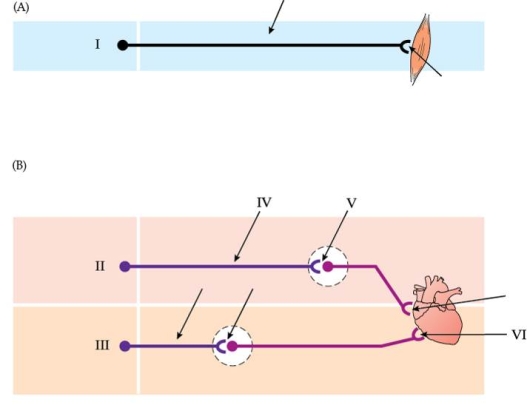 The labels in the figure correspond to which parts of the nervous system?
A) I = somatic; II = parasympathetic; III = sympathetic
B) I = sympathetic; II = parasympathetic; III = somatic
C) I = somatic; II = autonomic; III = sympathetic
D) I = peripheral; II = autonomic; III = somatic
The labels in the figure correspond to which parts of the nervous system?A) I = somatic; II = parasympathetic; III = sympathetic
B) I = sympathetic; II = parasympathetic; III = somatic
C) I = somatic; II = autonomic; III = sympathetic
D) I = peripheral; II = autonomic; III = somatic
سؤال
Refer to the figure shown.
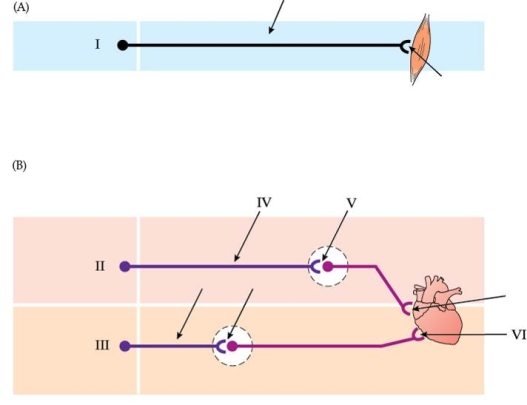 Which neurotransmitter is being released at arrow V?
A) Acetylcholine
B) Epinephrine/norepinephrine
C) Glutamate
D) GABA
Which neurotransmitter is being released at arrow V?A) Acetylcholine
B) Epinephrine/norepinephrine
C) Glutamate
D) GABA
سؤال
Refer to the figure shown.
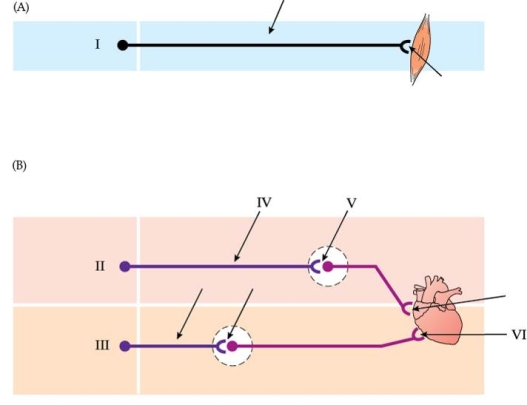 Describe the effect of adding acetylcholine to the area indicated by arrow IV in the figure.
A) Acceleration of heart rate
B) Deceleration of heart rate
C) Complete stopping of the heart
D) There is no effect.
Describe the effect of adding acetylcholine to the area indicated by arrow IV in the figure.A) Acceleration of heart rate
B) Deceleration of heart rate
C) Complete stopping of the heart
D) There is no effect.
سؤال
Refer to the figure shown.
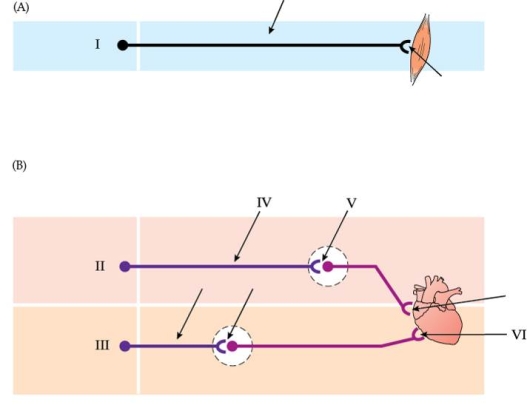 Describe the effect of adding acetylcholine to the area indicated by arrow V in the figure.
A) Acceleration of heart rate
B) Deceleration of heart rate
C) Complete stopping of the heart
D) There is no effect.
Describe the effect of adding acetylcholine to the area indicated by arrow V in the figure.A) Acceleration of heart rate
B) Deceleration of heart rate
C) Complete stopping of the heart
D) There is no effect.
سؤال
Refer to the figure shown.
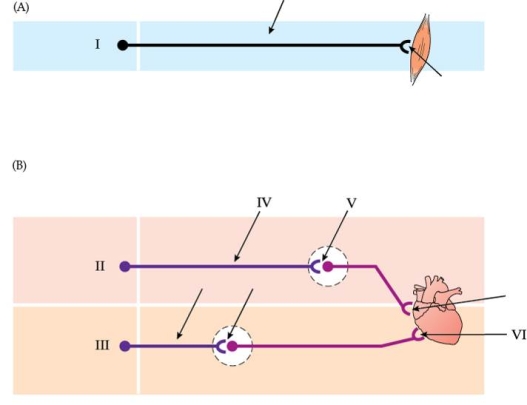 In the figure, how many arrows (including labeled and unlabeled) are in the vicinity of a possible EPSP?
A) Three
B) Four
C) Five
D) Eight
In the figure, how many arrows (including labeled and unlabeled) are in the vicinity of a possible EPSP?A) Three
B) Four
C) Five
D) Eight
سؤال
Refer to the figure shown.
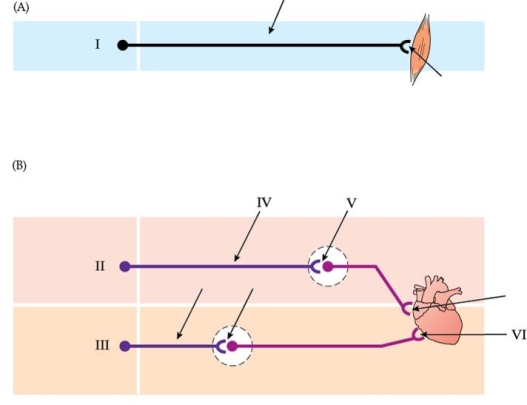 The peripheral synapses between the first and second neurons in the sympathetic and parasympathetic divisions are located within clusters of neuronal cell bodies called _______ ganglia.
A) enteric
B) peripheral
C) central
D) autonomic
The peripheral synapses between the first and second neurons in the sympathetic and parasympathetic divisions are located within clusters of neuronal cell bodies called _______ ganglia.A) enteric
B) peripheral
C) central
D) autonomic
سؤال
سؤال
سؤال
سؤال
Refer to the figure shown.
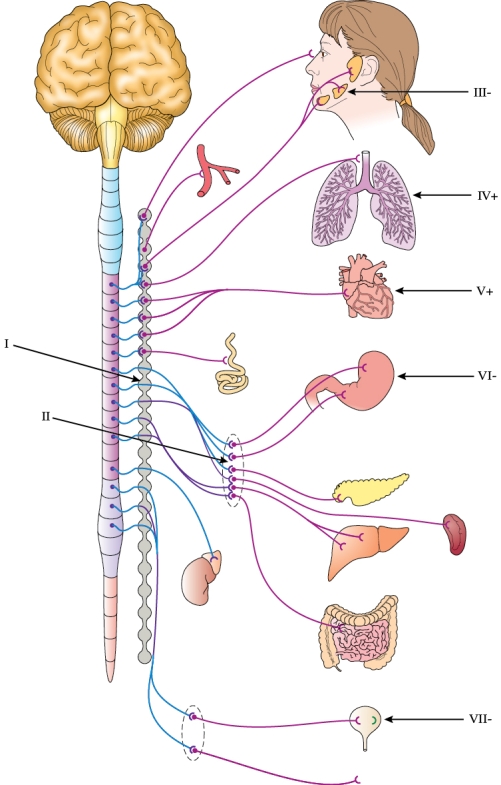 The structure at arrow I in the figure is the
A) paravertebral ganglion.
B) thoracic ganglion.
C) thoracic division of the spinal column.
D) inferior mesenteric ganglion.
The structure at arrow I in the figure is theA) paravertebral ganglion.
B) thoracic ganglion.
C) thoracic division of the spinal column.
D) inferior mesenteric ganglion.
سؤال
Refer to the figure shown.
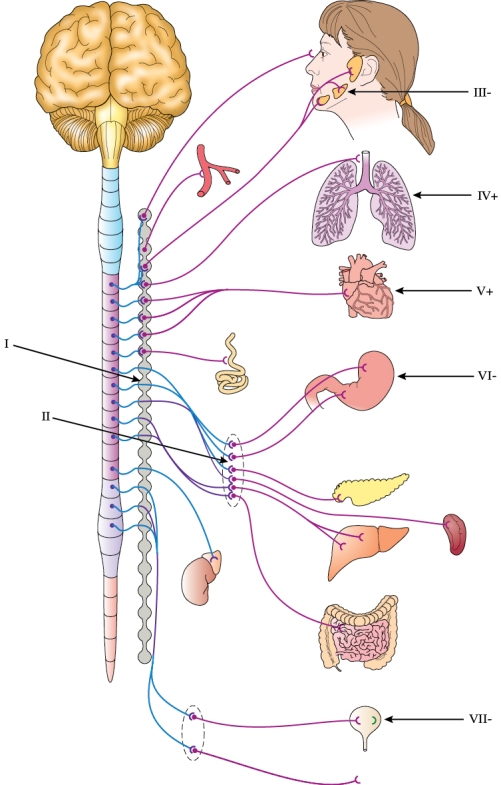 If epinephrine/norepinephrine were applied in the vicinity of arrow II in the figure,
A) heart rate would accelerate.
B) hormone and enzyme release in the stomach would be inhibited.
C) the gallbladder would be stimulated to release bile.
D) there would be no effect.
If epinephrine/norepinephrine were applied in the vicinity of arrow II in the figure,A) heart rate would accelerate.
B) hormone and enzyme release in the stomach would be inhibited.
C) the gallbladder would be stimulated to release bile.
D) there would be no effect.
سؤال
Refer to the figure shown.
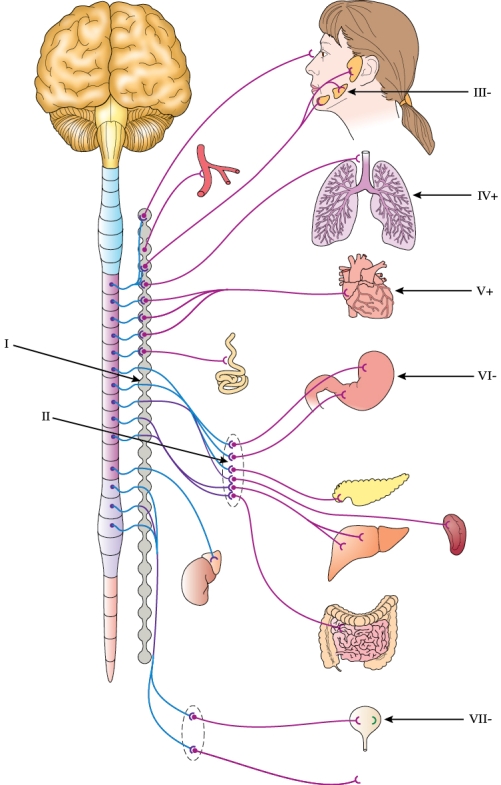 In the figure, the "+" symbol represents stimulation, increase, or constriction, and the "-" symbol represents inhibition, decrease, or relaxation. Which numeral in the figure is paired incorrectly with the symbol?
A) III
B) IV
C) V
D) VI
In the figure, the "+" symbol represents stimulation, increase, or constriction, and the "-" symbol represents inhibition, decrease, or relaxation. Which numeral in the figure is paired incorrectly with the symbol?A) III
B) IV
C) V
D) VI
سؤال
سؤال
سؤال
سؤال
Refer to the figure shown.
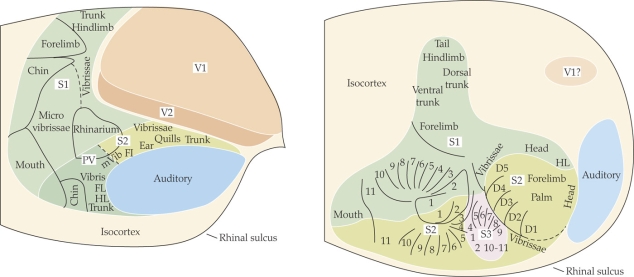 Which statement best reflects the adaptive significance of brain representations in the star-nosed mole?
A) The comparatively large brain representations reflect the importance of somatosensory functions.
B) The mole shows evidence of plasticity of brain development.
C) The brain of the mole has very little area devoted to auditory processes.
D) The brain of the mole demonstrates a clear visual processing area.
Which statement best reflects the adaptive significance of brain representations in the star-nosed mole?A) The comparatively large brain representations reflect the importance of somatosensory functions.
B) The mole shows evidence of plasticity of brain development.
C) The brain of the mole has very little area devoted to auditory processes.
D) The brain of the mole demonstrates a clear visual processing area.
سؤال
Refer to the figure shown.
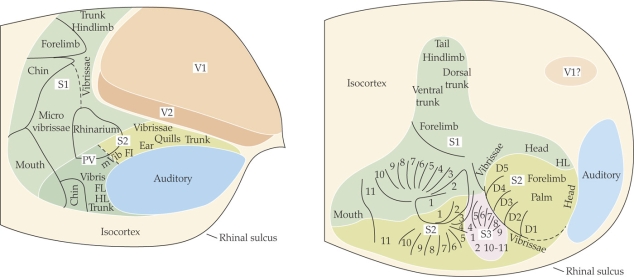 Which statement about the figure is true?
A) The figure on the left depicts a cross section of a somatosensory map in a star-nosed mole.
B) The figure on the right depicts a side view map of the cerebral cortex in a star-nosed mole.
C) The figure on the right depicts a somatosensory map of a hedgehog.
D) The figure on the left depicts a somatosensory map of a star-nosed mole.
Which statement about the figure is true?A) The figure on the left depicts a cross section of a somatosensory map in a star-nosed mole.
B) The figure on the right depicts a side view map of the cerebral cortex in a star-nosed mole.
C) The figure on the right depicts a somatosensory map of a hedgehog.
D) The figure on the left depicts a somatosensory map of a star-nosed mole.
سؤال
Refer to the figure shown.
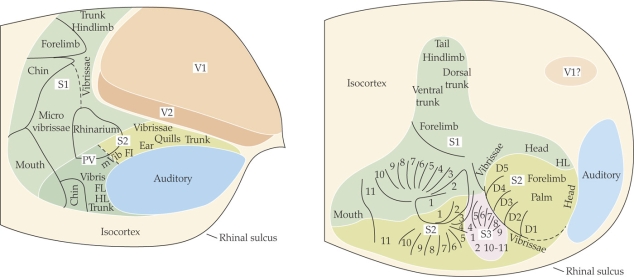 Which statement about the figure is false?
A) Both hedgehogs and star-nosed moles demonstrate localization of cerebral cortical function.
B) Star-nosed moles can hear.
C) Hedgehogs are incredibly specialized visual animals.
D) In star-nosed moles, large amounts of sensory information are sent from their star noses to their brains.
Which statement about the figure is false?A) Both hedgehogs and star-nosed moles demonstrate localization of cerebral cortical function.
B) Star-nosed moles can hear.
C) Hedgehogs are incredibly specialized visual animals.
D) In star-nosed moles, large amounts of sensory information are sent from their star noses to their brains.
سؤال
سؤال
سؤال
Refer to the figure shown.
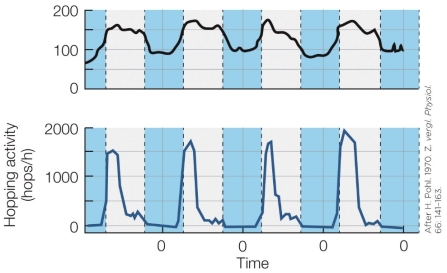 According to this figure, the light‒dark cycle _______ the physiological rhythms.
A) disrupts
B) phases
C) entrains
D) synchronizes
According to this figure, the light‒dark cycle _______ the physiological rhythms.A) disrupts
B) phases
C) entrains
D) synchronizes
سؤال
Refer to the figure shown.
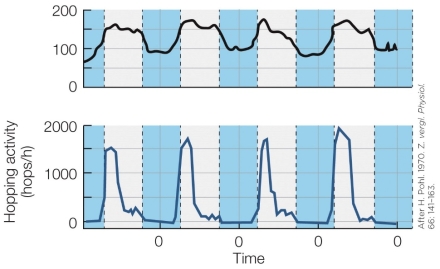 Which label is not appropriate for the y-axis of the figure?
A) Growth
B) Metabolic rate
C) Oxygen consumption
D) Urine output
Which label is not appropriate for the y-axis of the figure?A) Growth
B) Metabolic rate
C) Oxygen consumption
D) Urine output
سؤال
Refer to the figure shown.
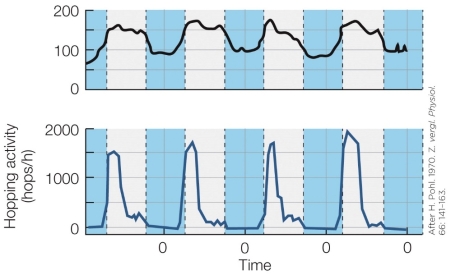 Which statement about the figure is false?
A) The two rhythms shown here are in phase.
B) The rhythms are entrained to the light‒dark cycle.
C) The period of this rhythm is about 24 hours.
D) The figure likely represents a nocturnal animal.
Which statement about the figure is false?A) The two rhythms shown here are in phase.
B) The rhythms are entrained to the light‒dark cycle.
C) The period of this rhythm is about 24 hours.
D) The figure likely represents a nocturnal animal.
سؤال
سؤال
سؤال
Refer to the figure shown.
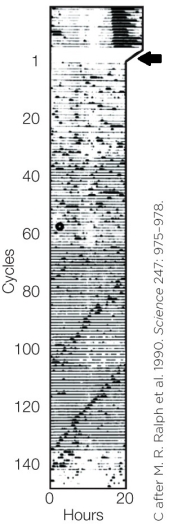 What is the likely experimental procedure is indicated by the arrow in the figure?
A) Removal of the medial pituitary
B) Destruction of the hypothalamus
C) Removal of the cerebral cortex
D) Destruction of the suprachiasmatic nucleus
What is the likely experimental procedure is indicated by the arrow in the figure?A) Removal of the medial pituitary
B) Destruction of the hypothalamus
C) Removal of the cerebral cortex
D) Destruction of the suprachiasmatic nucleus
سؤال
Refer to the figure shown.
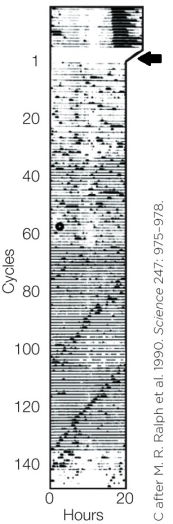 Which statement about the result of the experimental procedure indicated by the arrow in the figure is the most accurate?
A) The circadian oscillator was activated.
B) The free-running circadian activity ceased.
C) A zeitgeber was induced.
D) Activity remained constant.
Which statement about the result of the experimental procedure indicated by the arrow in the figure is the most accurate?A) The circadian oscillator was activated.
B) The free-running circadian activity ceased.
C) A zeitgeber was induced.
D) Activity remained constant.
سؤال
Refer to the figure shown.
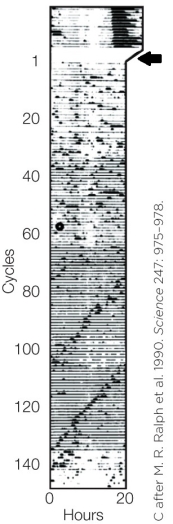 Which statement is the most accurate conclusion that can be drawn from the data in the figure?
A) The hamster's hypothalamus was destroyed, and therefore it could not control the animal's circadian rhythm.
B) The thalamus is significantly involved in the circadian rhythm of the golden hamster.
C) The suprachiasmatic nuclei are significantly involved in the circadian rhythm of the golden hamster.
D) The suprachiasmatic nuclei are likely not involved in the circadian rhythm of the golden hamster.
Which statement is the most accurate conclusion that can be drawn from the data in the figure?A) The hamster's hypothalamus was destroyed, and therefore it could not control the animal's circadian rhythm.
B) The thalamus is significantly involved in the circadian rhythm of the golden hamster.
C) The suprachiasmatic nuclei are significantly involved in the circadian rhythm of the golden hamster.
D) The suprachiasmatic nuclei are likely not involved in the circadian rhythm of the golden hamster.
سؤال
سؤال
سؤال
سؤال
سؤال
سؤال
سؤال
سؤال
سؤال
سؤال
سؤال
سؤال
سؤال

فتح الحزمة
قم بالتسجيل لفتح البطاقات في هذه المجموعة!
Unlock Deck
Unlock Deck
1/59

العب

ملء الشاشة (f)
Deck 15: Nervous System Organization and Biological Clocks
1
Which statement about the Cassiopiea jellyfish is true?
A) These jellyfish have a centralized nerve net that controls rhythmic contraction of the feeding musculature.
B) Interconnected motor neurons are used for coordinated movement.
C) The rhopalia control coordinated bell muscle contraction via connections with a motor nerve net.
D) There is no need for coordinated movement in these filter feeders.
A) These jellyfish have a centralized nerve net that controls rhythmic contraction of the feeding musculature.
B) Interconnected motor neurons are used for coordinated movement.
C) The rhopalia control coordinated bell muscle contraction via connections with a motor nerve net.
D) There is no need for coordinated movement in these filter feeders.
C
2
The Cassiopiea jellyfish
A) has neither coordinated intercellular control nor a biological clock.
B) has coordinated intercellular control but no measurable biological clock.
C) has no coordinated intercellular control but displays biological rhythms.
D) has coordinated intercellular control and displays biological rhythms.
A) has neither coordinated intercellular control nor a biological clock.
B) has coordinated intercellular control but no measurable biological clock.
C) has no coordinated intercellular control but displays biological rhythms.
D) has coordinated intercellular control and displays biological rhythms.
D
3
Which statement about the features of a nervous system is true?
A) The transmission rate is relatively slow.
B) Neurotransmitter release takes place throughout the body via the blood.
C) Neurons form highly discrete lines of communication.
D) In the PNS, a nerve consists of the axons of five or fewer neurons bundled together.
A) The transmission rate is relatively slow.
B) Neurotransmitter release takes place throughout the body via the blood.
C) Neurons form highly discrete lines of communication.
D) In the PNS, a nerve consists of the axons of five or fewer neurons bundled together.
C
4
Interneurons are located in
A) the central nervous system.
B) the peripheral nervous system.
C) the somatic system.
D) the autonomic system.
A) the central nervous system.
B) the peripheral nervous system.
C) the somatic system.
D) the autonomic system.
فتح الحزمة
افتح القفل للوصول البطاقات البالغ عددها 59 في هذه المجموعة.
فتح الحزمة
k this deck
5
Which statement describes a general feature of a nervous system?
A) Interneurons are collected into integrated areas at one end of the body rather than randomly dispersed.
B) Sensory receptor cells transform electrical stimuli into environmental signals.
C) Central interneurons integrate signals from sensory receptors and other signals arising within the animal, generating an integrated pattern of impulses.
D) Motor commands are sent out from the effectors to the CNS.
A) Interneurons are collected into integrated areas at one end of the body rather than randomly dispersed.
B) Sensory receptor cells transform electrical stimuli into environmental signals.
C) Central interneurons integrate signals from sensory receptors and other signals arising within the animal, generating an integrated pattern of impulses.
D) Motor commands are sent out from the effectors to the CNS.
فتح الحزمة
افتح القفل للوصول البطاقات البالغ عددها 59 في هذه المجموعة.
فتح الحزمة
k this deck
6
Which of the following is the effector in the startle response of the cockroach?
A) Movement of filiform hair receptors
B) Action potentials in the giant interneuron
C) Contraction of the hind leg muscle
D) A train of action potentials produced by the leg motor neuron.
A) Movement of filiform hair receptors
B) Action potentials in the giant interneuron
C) Contraction of the hind leg muscle
D) A train of action potentials produced by the leg motor neuron.
فتح الحزمة
افتح القفل للوصول البطاقات البالغ عددها 59 في هذه المجموعة.
فتح الحزمة
k this deck
7
Which is the most primitive organism that contains genes for nervous system organization?
A) Protists
B) Sponges
C) Arthropods
D) Echinoderms
A) Protists
B) Sponges
C) Arthropods
D) Echinoderms
فتح الحزمة
افتح القفل للوصول البطاقات البالغ عددها 59 في هذه المجموعة.
فتح الحزمة
k this deck
8
In an arthropod, the bundle of nerve axons located within a ganglion is called a
A) connective.
B) sheaf.
C) neuropile.
D) tract.
A) connective.
B) sheaf.
C) neuropile.
D) tract.
فتح الحزمة
افتح القفل للوصول البطاقات البالغ عددها 59 في هذه المجموعة.
فتح الحزمة
k this deck
9
A structural organization in which integrating neurons are all collected into central integrating areas rather than being randomly dispersed is referred to as
A) cephalization.
B) centralization.
C) centrification.
D) a ganglion.
A) cephalization.
B) centralization.
C) centrification.
D) a ganglion.
فتح الحزمة
افتح القفل للوصول البطاقات البالغ عددها 59 في هذه المجموعة.
فتح الحزمة
k this deck
10
A connective is a bundle of
A) axons in the PNS.
B) axons within a ganglion.
C) axons between ganglia in the CNS.
D) axons between the right and left sides of a bilaterally symmetrical ganglion.
A) axons in the PNS.
B) axons within a ganglion.
C) axons between ganglia in the CNS.
D) axons between the right and left sides of a bilaterally symmetrical ganglion.
فتح الحزمة
افتح القفل للوصول البطاقات البالغ عددها 59 في هذه المجموعة.
فتح الحزمة
k this deck
11
Refer to the figure shown.
The figure depicts a cross section of a(n)
A) vertebrate spinal cord.
B) arthropod ganglion.
C) vertebrate ganglion.
D) arthropod connective.
The figure depicts a cross section of a(n)A) vertebrate spinal cord.
B) arthropod ganglion.
C) vertebrate ganglion.
D) arthropod connective.
فتح الحزمة
افتح القفل للوصول البطاقات البالغ عددها 59 في هذه المجموعة.
فتح الحزمة
k this deck
12
In the vertebrate PNS, collections of neuronal cell bodies associated with peripheral nerves are called
A) central ganglia.
B) peripheral ganglia.
C) a tract.
D) a commissure.
A) central ganglia.
B) peripheral ganglia.
C) a tract.
D) a commissure.
فتح الحزمة
افتح القفل للوصول البطاقات البالغ عددها 59 في هذه المجموعة.
فتح الحزمة
k this deck
13
Refer to the figure shown.
Which number(s) in the figure represent(s) the hindbrain?
A) III
B) III and IV
C) IV
D) IV and V
Which number(s) in the figure represent(s) the hindbrain?A) III
B) III and IV
C) IV
D) IV and V
فتح الحزمة
افتح القفل للوصول البطاقات البالغ عددها 59 في هذه المجموعة.
فتح الحزمة
k this deck
14
Refer to the figure shown.
Which number in the figure best corresponds to the area of the brain responsible for learning and memory?
A) I
B) II
C) III
D) IV
Which number in the figure best corresponds to the area of the brain responsible for learning and memory?A) I
B) II
C) III
D) IV
فتح الحزمة
افتح القفل للوصول البطاقات البالغ عددها 59 في هذه المجموعة.
فتح الحزمة
k this deck
15
Refer to the figure shown.
Which number in the figure best corresponds to the area of the brain responsible for autonomic and respiratory control?
A) II
B) III
C) IV
D) V
Which number in the figure best corresponds to the area of the brain responsible for autonomic and respiratory control?A) II
B) III
C) IV
D) V
فتح الحزمة
افتح القفل للوصول البطاقات البالغ عددها 59 في هذه المجموعة.
فتح الحزمة
k this deck
16
A map of the body projected to a brain area is called a
A) somatotopic map.
B) sensory homunculus.
C) motor homunculus.
D) localization-of-function map.
A) somatotopic map.
B) sensory homunculus.
C) motor homunculus.
D) localization-of-function map.
فتح الحزمة
افتح القفل للوصول البطاقات البالغ عددها 59 في هذه المجموعة.
فتح الحزمة
k this deck
17
Which area has the most sensory neurons per unit area of epidermis?
A) Scalp
B) Upper arm
C) Lips
D) Ring finger
A) Scalp
B) Upper arm
C) Lips
D) Ring finger
فتح الحزمة
افتح القفل للوصول البطاقات البالغ عددها 59 في هذه المجموعة.
فتح الحزمة
k this deck
18
Which division of the nervous system regulates digestion?
A) Parasympathetic
B) Sympathetic
C) Enteric
D) Parasympathetic and enteric
A) Parasympathetic
B) Sympathetic
C) Enteric
D) Parasympathetic and enteric
فتح الحزمة
افتح القفل للوصول البطاقات البالغ عددها 59 في هذه المجموعة.
فتح الحزمة
k this deck
19
Refer to the figure shown.
The labels in the figure correspond to which parts of the nervous system?
A) I = somatic; II = parasympathetic; III = sympathetic
B) I = sympathetic; II = parasympathetic; III = somatic
C) I = somatic; II = autonomic; III = sympathetic
D) I = peripheral; II = autonomic; III = somatic
The labels in the figure correspond to which parts of the nervous system?A) I = somatic; II = parasympathetic; III = sympathetic
B) I = sympathetic; II = parasympathetic; III = somatic
C) I = somatic; II = autonomic; III = sympathetic
D) I = peripheral; II = autonomic; III = somatic
فتح الحزمة
افتح القفل للوصول البطاقات البالغ عددها 59 في هذه المجموعة.
فتح الحزمة
k this deck
20
Refer to the figure shown.
Which neurotransmitter is being released at arrow V?
A) Acetylcholine
B) Epinephrine/norepinephrine
C) Glutamate
D) GABA
Which neurotransmitter is being released at arrow V?A) Acetylcholine
B) Epinephrine/norepinephrine
C) Glutamate
D) GABA
فتح الحزمة
افتح القفل للوصول البطاقات البالغ عددها 59 في هذه المجموعة.
فتح الحزمة
k this deck
21
Refer to the figure shown.
Describe the effect of adding acetylcholine to the area indicated by arrow IV in the figure.
A) Acceleration of heart rate
B) Deceleration of heart rate
C) Complete stopping of the heart
D) There is no effect.
Describe the effect of adding acetylcholine to the area indicated by arrow IV in the figure.A) Acceleration of heart rate
B) Deceleration of heart rate
C) Complete stopping of the heart
D) There is no effect.
فتح الحزمة
افتح القفل للوصول البطاقات البالغ عددها 59 في هذه المجموعة.
فتح الحزمة
k this deck
22
Refer to the figure shown.
Describe the effect of adding acetylcholine to the area indicated by arrow V in the figure.
A) Acceleration of heart rate
B) Deceleration of heart rate
C) Complete stopping of the heart
D) There is no effect.
Describe the effect of adding acetylcholine to the area indicated by arrow V in the figure.A) Acceleration of heart rate
B) Deceleration of heart rate
C) Complete stopping of the heart
D) There is no effect.
فتح الحزمة
افتح القفل للوصول البطاقات البالغ عددها 59 في هذه المجموعة.
فتح الحزمة
k this deck
23
Refer to the figure shown.
In the figure, how many arrows (including labeled and unlabeled) are in the vicinity of a possible EPSP?
A) Three
B) Four
C) Five
D) Eight
In the figure, how many arrows (including labeled and unlabeled) are in the vicinity of a possible EPSP?A) Three
B) Four
C) Five
D) Eight
فتح الحزمة
افتح القفل للوصول البطاقات البالغ عددها 59 في هذه المجموعة.
فتح الحزمة
k this deck
24
Refer to the figure shown.
The peripheral synapses between the first and second neurons in the sympathetic and parasympathetic divisions are located within clusters of neuronal cell bodies called _______ ganglia.
A) enteric
B) peripheral
C) central
D) autonomic
The peripheral synapses between the first and second neurons in the sympathetic and parasympathetic divisions are located within clusters of neuronal cell bodies called _______ ganglia.A) enteric
B) peripheral
C) central
D) autonomic
فتح الحزمة
افتح القفل للوصول البطاقات البالغ عددها 59 في هذه المجموعة.
فتح الحزمة
k this deck
25
The nerve that runs from the paravertebral ganglia to the heart would be termed a(n) _______ neuron.
A) sympathetic postganglionic
B) parasympathetic postganglionic
C) sympathetic preganglionic
D) parasympathetic preganglionic
A) sympathetic postganglionic
B) parasympathetic postganglionic
C) sympathetic preganglionic
D) parasympathetic preganglionic
فتح الحزمة
افتح القفل للوصول البطاقات البالغ عددها 59 في هذه المجموعة.
فتح الحزمة
k this deck
26
What would be the effect of applying epinephrine/norepinephrine to the paravertebral ganglia in the upper thoracic area?
A) Acceleration of heart rate
B) Deceleration of heart rate
C) Complete stopping of the heart
D) There is no effect.
A) Acceleration of heart rate
B) Deceleration of heart rate
C) Complete stopping of the heart
D) There is no effect.
فتح الحزمة
افتح القفل للوصول البطاقات البالغ عددها 59 في هذه المجموعة.
فتح الحزمة
k this deck
27
A surprise phone call at 3 AM would likely cause which physiological reaction?
A) Increased salivation
B) Pupil dilation
C) Increased digestion
D) Decreased glucose production
A) Increased salivation
B) Pupil dilation
C) Increased digestion
D) Decreased glucose production
فتح الحزمة
افتح القفل للوصول البطاقات البالغ عددها 59 في هذه المجموعة.
فتح الحزمة
k this deck
28
Refer to the figure shown.
The structure at arrow I in the figure is the
A) paravertebral ganglion.
B) thoracic ganglion.
C) thoracic division of the spinal column.
D) inferior mesenteric ganglion.
The structure at arrow I in the figure is theA) paravertebral ganglion.
B) thoracic ganglion.
C) thoracic division of the spinal column.
D) inferior mesenteric ganglion.
فتح الحزمة
افتح القفل للوصول البطاقات البالغ عددها 59 في هذه المجموعة.
فتح الحزمة
k this deck
29
Refer to the figure shown.
If epinephrine/norepinephrine were applied in the vicinity of arrow II in the figure,
A) heart rate would accelerate.
B) hormone and enzyme release in the stomach would be inhibited.
C) the gallbladder would be stimulated to release bile.
D) there would be no effect.
If epinephrine/norepinephrine were applied in the vicinity of arrow II in the figure,A) heart rate would accelerate.
B) hormone and enzyme release in the stomach would be inhibited.
C) the gallbladder would be stimulated to release bile.
D) there would be no effect.
فتح الحزمة
افتح القفل للوصول البطاقات البالغ عددها 59 في هذه المجموعة.
فتح الحزمة
k this deck
30
Refer to the figure shown.
In the figure, the "+" symbol represents stimulation, increase, or constriction, and the "-" symbol represents inhibition, decrease, or relaxation. Which numeral in the figure is paired incorrectly with the symbol?
A) III
B) IV
C) V
D) VI
In the figure, the "+" symbol represents stimulation, increase, or constriction, and the "-" symbol represents inhibition, decrease, or relaxation. Which numeral in the figure is paired incorrectly with the symbol?A) III
B) IV
C) V
D) VI
فتح الحزمة
افتح القفل للوصول البطاقات البالغ عددها 59 في هذه المجموعة.
فتح الحزمة
k this deck
31
The preganglionic neuron of the sympathetic system releases the neurotransmitter
A) acetylcholine.
B) epinephrine/norepinephrine.
C) glutamate.
D) GABA.
A) acetylcholine.
B) epinephrine/norepinephrine.
C) glutamate.
D) GABA.
فتح الحزمة
افتح القفل للوصول البطاقات البالغ عددها 59 في هذه المجموعة.
فتح الحزمة
k this deck
32
Which principle of functional organization of the vertebrate brain explains the concept of memories?
A) Brains have maps.
B) The expansion of the forebrain is a recorded event in vertebrate brain evolution.
C) Brain function is somewhat localized.
D) Neural circuits are plastic.
A) Brains have maps.
B) The expansion of the forebrain is a recorded event in vertebrate brain evolution.
C) Brain function is somewhat localized.
D) Neural circuits are plastic.
فتح الحزمة
افتح القفل للوصول البطاقات البالغ عددها 59 في هذه المجموعة.
فتح الحزمة
k this deck
33
Which statement regarding the brain is true?
A) Processing capability is related to the hindbrain.
B) Primate brains have a similar cerebral cortex compared to amphibian brains.
C) The larger the cerebral cortex, the more the processing capability of the brain.
D) Primate brains are more evolved compared to the brains of fish.
A) Processing capability is related to the hindbrain.
B) Primate brains have a similar cerebral cortex compared to amphibian brains.
C) The larger the cerebral cortex, the more the processing capability of the brain.
D) Primate brains are more evolved compared to the brains of fish.
فتح الحزمة
افتح القفل للوصول البطاقات البالغ عددها 59 في هذه المجموعة.
فتح الحزمة
k this deck
34
Refer to the figure shown.
Which statement best reflects the adaptive significance of brain representations in the star-nosed mole?
A) The comparatively large brain representations reflect the importance of somatosensory functions.
B) The mole shows evidence of plasticity of brain development.
C) The brain of the mole has very little area devoted to auditory processes.
D) The brain of the mole demonstrates a clear visual processing area.
Which statement best reflects the adaptive significance of brain representations in the star-nosed mole?A) The comparatively large brain representations reflect the importance of somatosensory functions.
B) The mole shows evidence of plasticity of brain development.
C) The brain of the mole has very little area devoted to auditory processes.
D) The brain of the mole demonstrates a clear visual processing area.
فتح الحزمة
افتح القفل للوصول البطاقات البالغ عددها 59 في هذه المجموعة.
فتح الحزمة
k this deck
35
Refer to the figure shown.
Which statement about the figure is true?
A) The figure on the left depicts a cross section of a somatosensory map in a star-nosed mole.
B) The figure on the right depicts a side view map of the cerebral cortex in a star-nosed mole.
C) The figure on the right depicts a somatosensory map of a hedgehog.
D) The figure on the left depicts a somatosensory map of a star-nosed mole.
Which statement about the figure is true?A) The figure on the left depicts a cross section of a somatosensory map in a star-nosed mole.
B) The figure on the right depicts a side view map of the cerebral cortex in a star-nosed mole.
C) The figure on the right depicts a somatosensory map of a hedgehog.
D) The figure on the left depicts a somatosensory map of a star-nosed mole.
فتح الحزمة
افتح القفل للوصول البطاقات البالغ عددها 59 في هذه المجموعة.
فتح الحزمة
k this deck
36
Refer to the figure shown.
Which statement about the figure is false?
A) Both hedgehogs and star-nosed moles demonstrate localization of cerebral cortical function.
B) Star-nosed moles can hear.
C) Hedgehogs are incredibly specialized visual animals.
D) In star-nosed moles, large amounts of sensory information are sent from their star noses to their brains.
Which statement about the figure is false?A) Both hedgehogs and star-nosed moles demonstrate localization of cerebral cortical function.
B) Star-nosed moles can hear.
C) Hedgehogs are incredibly specialized visual animals.
D) In star-nosed moles, large amounts of sensory information are sent from their star noses to their brains.
فتح الحزمة
افتح القفل للوصول البطاقات البالغ عددها 59 في هذه المجموعة.
فتح الحزمة
k this deck
37
Which statement regarding the enteric system is true?
A) Neurons exit the CNS in the thoracic region to innervate the gut.
B) It plays a role in segmentation.
C) It is largely under autonomic control.
D) In humans, it contains about 2 million neurons.
A) Neurons exit the CNS in the thoracic region to innervate the gut.
B) It plays a role in segmentation.
C) It is largely under autonomic control.
D) In humans, it contains about 2 million neurons.
فتح الحزمة
افتح القفل للوصول البطاقات البالغ عددها 59 في هذه المجموعة.
فتح الحزمة
k this deck
38
Rhythms that continue in the absence of environmental information about time are called
A) entrained rhythms.
B) endogenous rhythms.
C) circadian rhythms.
D) free-running circadian rhythms.
A) entrained rhythms.
B) endogenous rhythms.
C) circadian rhythms.
D) free-running circadian rhythms.
فتح الحزمة
افتح القفل للوصول البطاقات البالغ عددها 59 في هذه المجموعة.
فتح الحزمة
k this deck
39
Refer to the figure shown.
According to this figure, the light‒dark cycle _______ the physiological rhythms.
A) disrupts
B) phases
C) entrains
D) synchronizes
According to this figure, the light‒dark cycle _______ the physiological rhythms.A) disrupts
B) phases
C) entrains
D) synchronizes
فتح الحزمة
افتح القفل للوصول البطاقات البالغ عددها 59 في هذه المجموعة.
فتح الحزمة
k this deck
40
Refer to the figure shown.
Which label is not appropriate for the y-axis of the figure?
A) Growth
B) Metabolic rate
C) Oxygen consumption
D) Urine output
Which label is not appropriate for the y-axis of the figure?A) Growth
B) Metabolic rate
C) Oxygen consumption
D) Urine output
فتح الحزمة
افتح القفل للوصول البطاقات البالغ عددها 59 في هذه المجموعة.
فتح الحزمة
k this deck
41
Refer to the figure shown.
Which statement about the figure is false?
A) The two rhythms shown here are in phase.
B) The rhythms are entrained to the light‒dark cycle.
C) The period of this rhythm is about 24 hours.
D) The figure likely represents a nocturnal animal.
Which statement about the figure is false?A) The two rhythms shown here are in phase.
B) The rhythms are entrained to the light‒dark cycle.
C) The period of this rhythm is about 24 hours.
D) The figure likely represents a nocturnal animal.
فتح الحزمة
افتح القفل للوصول البطاقات البالغ عددها 59 في هذه المجموعة.
فتح الحزمة
k this deck
42
Which statement regarding biological clocks is true?
A) The period of an animal's free-running rhythm is not affected by light‒dark cycles.
B) Biological clocks are very sensitive to internal (cellular) temperature.
C) Nocturnal animals often have periods of free-running rhythms much shorter than 24 hours.
D) Biological clocks permit the timing of processes during 24-hour periods when environmental cues are unreliable.
A) The period of an animal's free-running rhythm is not affected by light‒dark cycles.
B) Biological clocks are very sensitive to internal (cellular) temperature.
C) Nocturnal animals often have periods of free-running rhythms much shorter than 24 hours.
D) Biological clocks permit the timing of processes during 24-hour periods when environmental cues are unreliable.
فتح الحزمة
افتح القفل للوصول البطاقات البالغ عددها 59 في هذه المجموعة.
فتح الحزمة
k this deck
43
When the suprachiasmatic nucleus in a horse is destroyed,
A) circadian rhythm becomes free-running.
B) a zeitgeber is induced.
C) the animal loses its ability to navigate.
D) most circadian activity ceases.
A) circadian rhythm becomes free-running.
B) a zeitgeber is induced.
C) the animal loses its ability to navigate.
D) most circadian activity ceases.
فتح الحزمة
افتح القفل للوصول البطاقات البالغ عددها 59 في هذه المجموعة.
فتح الحزمة
k this deck
44
Refer to the figure shown.
What is the likely experimental procedure is indicated by the arrow in the figure?
A) Removal of the medial pituitary
B) Destruction of the hypothalamus
C) Removal of the cerebral cortex
D) Destruction of the suprachiasmatic nucleus
What is the likely experimental procedure is indicated by the arrow in the figure?A) Removal of the medial pituitary
B) Destruction of the hypothalamus
C) Removal of the cerebral cortex
D) Destruction of the suprachiasmatic nucleus
فتح الحزمة
افتح القفل للوصول البطاقات البالغ عددها 59 في هذه المجموعة.
فتح الحزمة
k this deck
45
Refer to the figure shown.
Which statement about the result of the experimental procedure indicated by the arrow in the figure is the most accurate?
A) The circadian oscillator was activated.
B) The free-running circadian activity ceased.
C) A zeitgeber was induced.
D) Activity remained constant.
Which statement about the result of the experimental procedure indicated by the arrow in the figure is the most accurate?A) The circadian oscillator was activated.
B) The free-running circadian activity ceased.
C) A zeitgeber was induced.
D) Activity remained constant.
فتح الحزمة
افتح القفل للوصول البطاقات البالغ عددها 59 في هذه المجموعة.
فتح الحزمة
k this deck
46
Refer to the figure shown.
Which statement is the most accurate conclusion that can be drawn from the data in the figure?
A) The hamster's hypothalamus was destroyed, and therefore it could not control the animal's circadian rhythm.
B) The thalamus is significantly involved in the circadian rhythm of the golden hamster.
C) The suprachiasmatic nuclei are significantly involved in the circadian rhythm of the golden hamster.
D) The suprachiasmatic nuclei are likely not involved in the circadian rhythm of the golden hamster.
Which statement is the most accurate conclusion that can be drawn from the data in the figure?A) The hamster's hypothalamus was destroyed, and therefore it could not control the animal's circadian rhythm.
B) The thalamus is significantly involved in the circadian rhythm of the golden hamster.
C) The suprachiasmatic nuclei are significantly involved in the circadian rhythm of the golden hamster.
D) The suprachiasmatic nuclei are likely not involved in the circadian rhythm of the golden hamster.
فتح الحزمة
افتح القفل للوصول البطاقات البالغ عددها 59 في هذه المجموعة.
فتح الحزمة
k this deck
47
In mammals, what inhibits the activity of CLOCK/BMAL1?
A) PER
B) period mRNA
C) PER/CRY
D) PER/TIM
A) PER
B) period mRNA
C) PER/CRY
D) PER/TIM
فتح الحزمة
افتح القفل للوصول البطاقات البالغ عددها 59 في هذه المجموعة.
فتح الحزمة
k this deck
48
Which statement best describes the mechanism for circadian rhythm?
A) There is an alternation between enhanced and inhibited expression of clock genes.
B) Clock genes inhibit gene expression of positive elements.
C) Clock genes inhibit expression of negative elements.
D) The time-keeping mechanism depends only on the breakdown of negative elements.
A) There is an alternation between enhanced and inhibited expression of clock genes.
B) Clock genes inhibit gene expression of positive elements.
C) Clock genes inhibit expression of negative elements.
D) The time-keeping mechanism depends only on the breakdown of negative elements.
فتح الحزمة
افتح القفل للوصول البطاقات البالغ عددها 59 في هذه المجموعة.
فتح الحزمة
k this deck
49
Which of the following is a documented benefit of biological rhythms?
A) increased response to external cues
B) increased sensory responses in locating food
C) escape from predators
D) determining compass directions from the sun
A) increased response to external cues
B) increased sensory responses in locating food
C) escape from predators
D) determining compass directions from the sun
فتح الحزمة
افتح القفل للوصول البطاقات البالغ عددها 59 في هذه المجموعة.
فتح الحزمة
k this deck
50
In vertebrates, melatonin is secreted in a circadian rhythm from the
A) pineal gland.
B) suprachiasmatic nucleus.
C) circadian oscillator.
D) clock genes.
A) pineal gland.
B) suprachiasmatic nucleus.
C) circadian oscillator.
D) clock genes.
فتح الحزمة
افتح القفل للوصول البطاقات البالغ عددها 59 في هذه المجموعة.
فتح الحزمة
k this deck
51
Describe the two major trends in nervous system evolution once animal lineages became bilaterally symmetrical.
فتح الحزمة
افتح القفل للوصول البطاقات البالغ عددها 59 في هذه المجموعة.
فتح الحزمة
k this deck
52
Compare and contrast the organization of arthropod and vertebrate central nervous systems.
فتح الحزمة
افتح القفل للوصول البطاقات البالغ عددها 59 في هذه المجموعة.
فتح الحزمة
k this deck
53
Explain a somatotopic map.
فتح الحزمة
افتح القفل للوصول البطاقات البالغ عددها 59 في هذه المجموعة.
فتح الحزمة
k this deck
54
If atropine is an antagonist to acetylcholine, explain what this drug would do to the heart.
فتح الحزمة
افتح القفل للوصول البطاقات البالغ عددها 59 في هذه المجموعة.
فتح الحزمة
k this deck
55
Briefly explain what is meant by synaptic plasticity. Provide one example.
فتح الحزمة
افتح القفل للوصول البطاقات البالغ عددها 59 في هذه المجموعة.
فتح الحزمة
k this deck
56
How do star-nosed moles exemplify the principles of brain functional organization?
فتح الحزمة
افتح القفل للوصول البطاقات البالغ عددها 59 في هذه المجموعة.
فتح الحزمة
k this deck
57
Describe what is meant by entrainment and provide an example.
فتح الحزمة
افتح القفل للوصول البطاقات البالغ عددها 59 في هذه المجموعة.
فتح الحزمة
k this deck
58
Compare and contrast free-running circadian rhythms of nocturnal and diurnal mammals.
فتح الحزمة
افتح القفل للوصول البطاقات البالغ عددها 59 في هذه المجموعة.
فتح الحزمة
k this deck
59
Explain how the pineal gland may operate differently in nonmammalian vertebrates compared to mammals.
فتح الحزمة
افتح القفل للوصول البطاقات البالغ عددها 59 في هذه المجموعة.
فتح الحزمة
k this deck
فتح الحزمة
افتح القفل للوصول البطاقات البالغ عددها 59 في هذه المجموعة.






