







 تكلم مع الذكاء الاصطناعي


Deck 5: Coping With Environmental Variation: Energy
ملء الشاشة (f)

سؤال

سؤال
سؤال
سؤال
سؤال
سؤال
سؤال
سؤال
سؤال
سؤال
سؤال
سؤال
Refer to the figure.
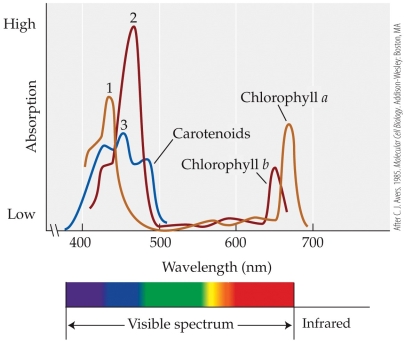 Based on the figure, which group or groups of pigments absorb visible light primarily in the red and orange part of the spectrum?
A) Chlorophyll a only
B) Carotenoids only
C) Chlorophyll a and carotenoids
D) Chlorophyll a and chlorophyll b
Based on the figure, which group or groups of pigments absorb visible light primarily in the red and orange part of the spectrum?A) Chlorophyll a only
B) Carotenoids only
C) Chlorophyll a and carotenoids
D) Chlorophyll a and chlorophyll b
سؤال
سؤال
سؤال
سؤال
سؤال
سؤال
Refer to the figure showing the results of Bjorkman and colleagues' studies of plant responses to different light levels. The plants were reared at three different levels of light intensity: high (red line), medium (blue line), and low (green line). The acclimatized plants were then subjected to various light levels, and their ability to photosynthesize was measured.
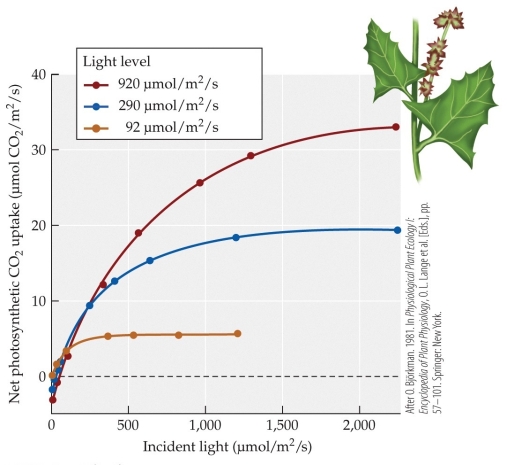 At the light intensity of 500 μmol/m2/s, the plants that are light-limited are those that are acclimatized to
A) high-intensity light only.
B) low-intensity light only.
C) both high-intensity and medium-intensity light.
D) both medium-intensity and low-intensity light.
At the light intensity of 500 μmol/m2/s, the plants that are light-limited are those that are acclimatized toA) high-intensity light only.
B) low-intensity light only.
C) both high-intensity and medium-intensity light.
D) both medium-intensity and low-intensity light.
سؤال
Refer to the figure showing the results of Bjorkman and colleagues' studies of plant responses to different light levels. The plants were reared at three different levels of light intensity: high (red line), medium (blue line), and low (green line). The acclimatized plants were then subjected to various light levels, and their ability to photosynthesize was measured.
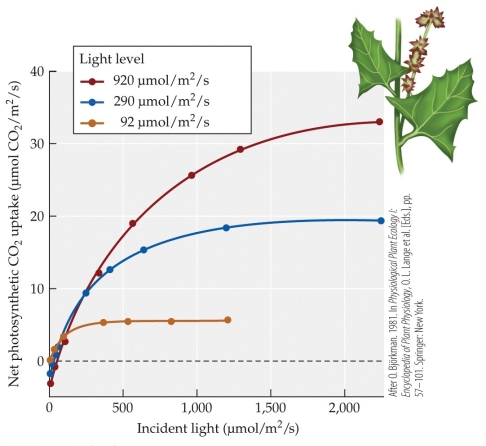
-At approximately what light intensity level are the plants acclimatized to high-intensity light photosynthesizing at twice the rate of those plants acclimatized to low-intensity light?
A) 100 ?mol/m2/s
B) 300 ?mol/m2/s
C) 600 ?mol/m2/s
D) 1,000 ?mol/m2/s
-At approximately what light intensity level are the plants acclimatized to high-intensity light photosynthesizing at twice the rate of those plants acclimatized to low-intensity light?
A) 100 ?mol/m2/s
B) 300 ?mol/m2/s
C) 600 ?mol/m2/s
D) 1,000 ?mol/m2/s
سؤال
Refer to the figure. showing the results of Bjorkman and colleagues' studies of plant responses to different light levels. The plants were reared at three different levels of light intensity: high (red line), medium (blue line), and low (green line). The acclimatized plants were then subjected to various light levels, and their ability to photosynthesize was measured.
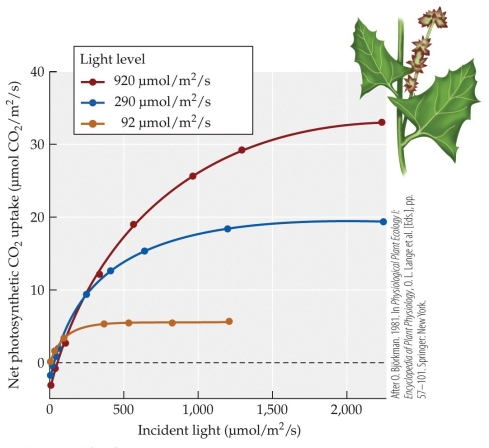
-What is the light compensation point for those plants that are acclimatized to high-intensity light?
A) Less than 200 ?mol/m2/s
B) 200-500 ?mol/m2/s
C) 500?800 ?mol/m2/s
D) 1,000?1,500 ?mol/m2/s
-What is the light compensation point for those plants that are acclimatized to high-intensity light?
A) Less than 200 ?mol/m2/s
B) 200-500 ?mol/m2/s
C) 500?800 ?mol/m2/s
D) 1,000?1,500 ?mol/m2/s
سؤال
سؤال
سؤال
سؤال
Refer to the figure showing acclimatization to two different growth temperature regimes from different populations of a shrub occurring in the Mojave Desert and in cool coastal zones in California. The two temperatures regimes used are representative of the two habitats.
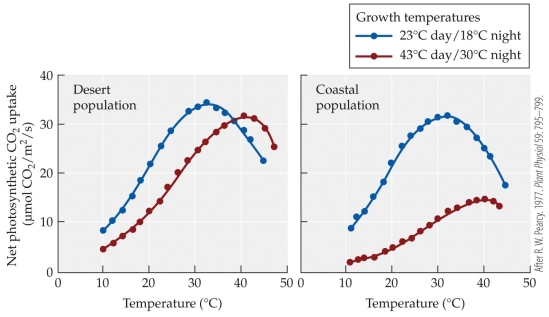 Of the four temperature curves in the two populations, which combination appears least able to acclimate to the given temperature regime?
A) Desert population at the 23°C day/18°C night regime
B) Desert population at the 43°C day/30°C night regime
C) Coastal population at the 23°C day/18°C night regime
D) Coastal population at the 43°C day/30°C night regime
Of the four temperature curves in the two populations, which combination appears least able to acclimate to the given temperature regime?A) Desert population at the 23°C day/18°C night regime
B) Desert population at the 43°C day/30°C night regime
C) Coastal population at the 23°C day/18°C night regime
D) Coastal population at the 43°C day/30°C night regime
سؤال
سؤال
سؤال
Refer to the table showing the oxygen and carbon dioxide concentrations of four different environments.
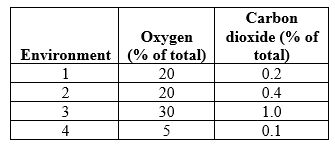 In which environment would we expect photorespiration to be highest?
A) Environment 1
B) Environment 2
C) Environment 3
D) Environment 4
In which environment would we expect photorespiration to be highest?A) Environment 1
B) Environment 2
C) Environment 3
D) Environment 4
سؤال
Refer to the figure showing the CO2 uptake in soybean leaves in response to increasing O2 concentration for soybean leaves exposed to two different CO2 levels.
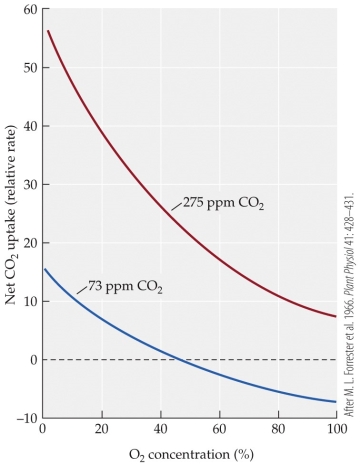 Based on the figure, the best explanation for the relationship of CO2 uptake and O2 concentration is that
A) CO2 uptake increases with increasing O2 concentration at both CO2 levels.
B) CO2 uptake decreases with increasing O2 concentration at both CO2 levels.
C) CO2 uptake becomes negative by 100% O2 concentration at both CO2 levels.
D) CO2 uptake becomes negative by 100% O2 concentration at high CO2 levels.
Based on the figure, the best explanation for the relationship of CO2 uptake and O2 concentration is thatA) CO2 uptake increases with increasing O2 concentration at both CO2 levels.
B) CO2 uptake decreases with increasing O2 concentration at both CO2 levels.
C) CO2 uptake becomes negative by 100% O2 concentration at both CO2 levels.
D) CO2 uptake becomes negative by 100% O2 concentration at high CO2 levels.
سؤال
سؤال
Refer to the figure showing results from an experiment by Kozaki and Takeba on genetically altered tobacco plants under conditions that promote damage to photosynthetic membranes.
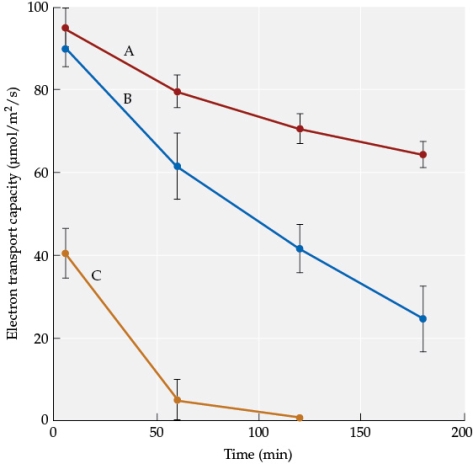 Curve _______ represents the plants altered to reduce their photorespiration rates; curve _______ represents plants altered to increase photorespiration rates.
A) A; C
B) B; C
C) C; A
D) A; B
Curve _______ represents the plants altered to reduce their photorespiration rates; curve _______ represents plants altered to increase photorespiration rates.A) A; C
B) B; C
C) C; A
D) A; B
سؤال
سؤال
سؤال
سؤال
سؤال
سؤال
سؤال
Refer to the figure showing delta values for plants using three different biochemical pathways for photosynthesis.
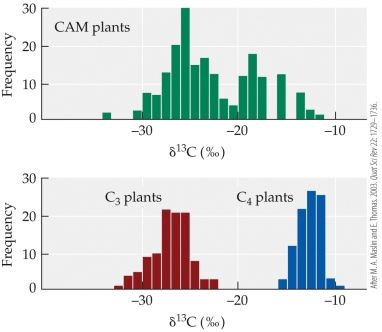 Which of these types of plants shows the most negative delta value, that is, the greatest discrimination against the uptake of 13C?
A) C3 plants only
B) C4 plants only
C) C3 and CAM plants
D) C4 and CAM plants
Which of these types of plants shows the most negative delta value, that is, the greatest discrimination against the uptake of 13C?A) C3 plants only
B) C4 plants only
C) C3 and CAM plants
D) C4 and CAM plants
سؤال
سؤال
سؤال
سؤال
سؤال
سؤال
سؤال
سؤال
Refer to the figure.
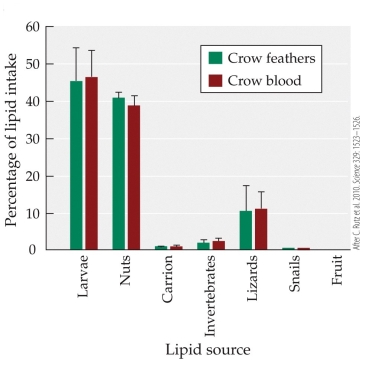 You are conducting an experiment on food preferences in New Caledonian crows. Based on previous isotopic analyses, use the figure to predict foods from most preferred to least preferred based on the available choices.
A) Fruits, snails, carrion, invertebrates
B) Lizards, invertebrates, carrion
C) Lizards, snails, larvae
D) Nuts, invertebrates, lizards
You are conducting an experiment on food preferences in New Caledonian crows. Based on previous isotopic analyses, use the figure to predict foods from most preferred to least preferred based on the available choices.A) Fruits, snails, carrion, invertebrates
B) Lizards, invertebrates, carrion
C) Lizards, snails, larvae
D) Nuts, invertebrates, lizards
سؤال
سؤال
سؤال
سؤال
سؤال
Refer to the figure showing the pattern of photosynthesis in a typical plant that occurs under different levels of light, from complete darkness to full sun.
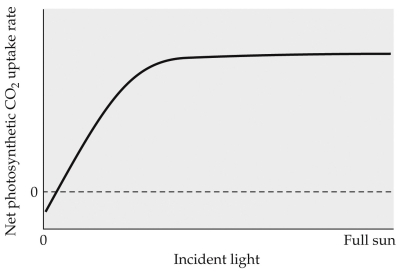 Describe this plant's reaction to light in terms of the concepts of "light compensation point," "light limitation," and "light saturation."
Describe this plant's reaction to light in terms of the concepts of "light compensation point," "light limitation," and "light saturation." سؤال
سؤال
سؤال
سؤال
سؤال
سؤال
سؤال
سؤال
سؤال
سؤال
Refer to the figure showing the results of Bjorkman and colleagues' studies of plant responses to different light levels. The plants were reared at three different levels of light: high (red line), medium (blue line), and low (green line). The acclimatized plants were then subjected to various light levels, and their ability to photosynthesize was measured.
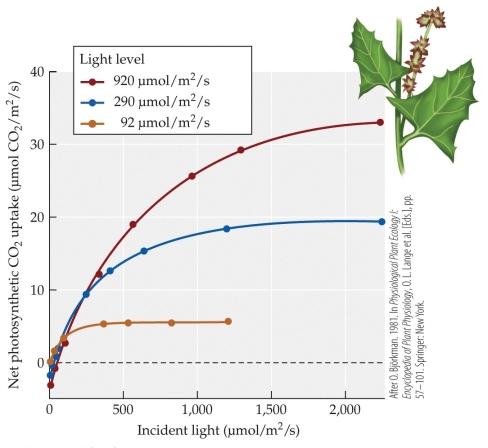 At the light intensity of 1,500 μmol/m2/s, which plants are light-limited?
A) Those acclimatized to high-intensity light
B) Those acclimatized to medium-intensity light
C) Those acclimatized to low-intensity light
D) None; they have all reached the light saturation point.
At the light intensity of 1,500 μmol/m2/s, which plants are light-limited?A) Those acclimatized to high-intensity light
B) Those acclimatized to medium-intensity light
C) Those acclimatized to low-intensity light
D) None; they have all reached the light saturation point.
سؤال
سؤال
Refer to the figure. illustrating the effect of tissue temperature on photosynthetic rates in four different plant species.
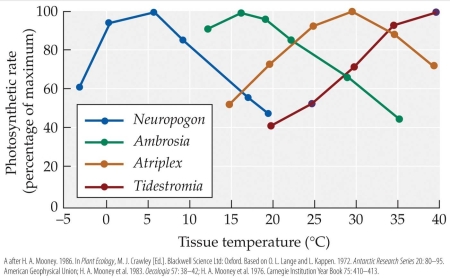 Which plant is most effective in photosynthesizing at tissue temperatures of 15°C?
A) Neuropogon
B) Ambrosia
C) Atriplex
D) Tidestromia
Which plant is most effective in photosynthesizing at tissue temperatures of 15°C?A) Neuropogon
B) Ambrosia
C) Atriplex
D) Tidestromia
سؤال
Refer to the table showing the oxygen and carbon dioxide concentrations of three different environments.
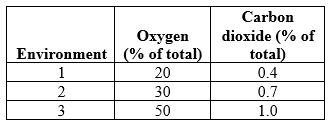 In which environment, if any, would we expect photorespiration to be lowest?
A) Environment 1
B) Environment 2
C) Environment 3
D) Photorespiration rates should be roughly the same in all environments.
In which environment, if any, would we expect photorespiration to be lowest?A) Environment 1
B) Environment 2
C) Environment 3
D) Photorespiration rates should be roughly the same in all environments.
سؤال
سؤال
سؤال
سؤال
سؤال
سؤال
سؤال
سؤال

فتح الحزمة
قم بالتسجيل لفتح البطاقات في هذه المجموعة!
Unlock Deck
Unlock Deck
1/71

العب

ملء الشاشة (f)
Deck 5: Coping With Environmental Variation: Energy
1
Which statement about radiant energy from the sun is false?
A) It is converted directly to chemical energy in plants.
B) It is the original source for the fuel we use in our cars and homes.
C) It can be converted directly to chemical energy by heterotrophs.
D) It is responsible for most of the warmth of our atmosphere.
A) It is converted directly to chemical energy in plants.
B) It is the original source for the fuel we use in our cars and homes.
C) It can be converted directly to chemical energy by heterotrophs.
D) It is responsible for most of the warmth of our atmosphere.
C
2
Organisms that can convert energy from sunlight or from inorganic compounds in their environment, without having to consume other organisms for their energy needs, are called
A) heterotrophs.
B) monotrophs.
C) decomposers.
D) autotrophs.
A) heterotrophs.
B) monotrophs.
C) decomposers.
D) autotrophs.
D
3
Which of these organisms would be considered a true autotroph?
A) A dodder that pierces into the phloem of its host plant to obtain nutrients
B) A mistletoe that receives energy from both photosynthesis and its host plant
C) An oak tree that receives all of its energy through photosynthesis
D) A sea slug that obtains nutrients from the algae it feeds on
A) A dodder that pierces into the phloem of its host plant to obtain nutrients
B) A mistletoe that receives energy from both photosynthesis and its host plant
C) An oak tree that receives all of its energy through photosynthesis
D) A sea slug that obtains nutrients from the algae it feeds on
C
4
Which of these organisms are not heterotrophs?
A) Chemosynthetic archaea synthesizing carbohydrates
B) Bacteria consuming dissolved organic compounds
C) Parasitic protozoa living in the gut of a pig
D) Fungi feeding on soil detritus
A) Chemosynthetic archaea synthesizing carbohydrates
B) Bacteria consuming dissolved organic compounds
C) Parasitic protozoa living in the gut of a pig
D) Fungi feeding on soil detritus
فتح الحزمة
افتح القفل للوصول البطاقات البالغ عددها 71 في هذه المجموعة.
فتح الحزمة
k this deck
5
Orchid species that have lost their ability to photosynthesize, and instead parasitize fungi for all their energy needs, would best be classified as
A) chemosynthetic organisms.
B) holoparasites.
C) photosynthetic organisms.
D) hemiparasites.
A) chemosynthetic organisms.
B) holoparasites.
C) photosynthetic organisms.
D) hemiparasites.
فتح الحزمة
افتح القفل للوصول البطاقات البالغ عددها 71 في هذه المجموعة.
فتح الحزمة
k this deck
6
Which of the following is an example of chemical energy transfer?
A) A lion metabolizing the lamb it ate
B) A lizard warming up by sitting in the sun
C) The heating of a lake by the sun
D) The heating of the atmosphere by solar radiation
A) A lion metabolizing the lamb it ate
B) A lizard warming up by sitting in the sun
C) The heating of a lake by the sun
D) The heating of the atmosphere by solar radiation
فتح الحزمة
افتح القفل للوصول البطاقات البالغ عددها 71 في هذه المجموعة.
فتح الحزمة
k this deck
7
When you touch something hot, your hand becomes warm; this is an example of the transfer of which type of energy?
A) Autotrophic
B) Kinetic
C) Chemical
D) Radiant
A) Autotrophic
B) Kinetic
C) Chemical
D) Radiant
فتح الحزمة
افتح القفل للوصول البطاقات البالغ عددها 71 في هذه المجموعة.
فتح الحزمة
k this deck
8
A bacterium that obtains energy by converting inorganic compounds in its environment is a(n)
A) autotroph because it carries out photosynthesis.
B) autotroph because it carries out chemosynthesis.
C) heterotroph because it does not obtain energy from photosynthesis.
D) heterotroph because it does not obtain energy from organic compounds.
A) autotroph because it carries out photosynthesis.
B) autotroph because it carries out chemosynthesis.
C) heterotroph because it does not obtain energy from photosynthesis.
D) heterotroph because it does not obtain energy from organic compounds.
فتح الحزمة
افتح القفل للوصول البطاقات البالغ عددها 71 في هذه المجموعة.
فتح الحزمة
k this deck
9
An autotrophic organism living in a hydrothermal vent on the bottom of the ocean would be expected to obtain its energy through
A) chemosynthesis only.
B) photosynthesis only.
C) equal amounts chemosynthesis and photosynthesis.
D) mostly chemosynthesis, with only small amounts of photosynthesis.
A) chemosynthesis only.
B) photosynthesis only.
C) equal amounts chemosynthesis and photosynthesis.
D) mostly chemosynthesis, with only small amounts of photosynthesis.
فتح الحزمة
افتح القفل للوصول البطاقات البالغ عددها 71 في هذه المجموعة.
فتح الحزمة
k this deck
10
The biochemical pathway most commonly used by plants and chemosynthetic bacteria to fix CO2 in order to synthesize carbohydrates is
A) glycolysis.
B) the Calvin cycle.
C) the C4 photosynthetic pathway.
D) the Krebs cycle.
A) glycolysis.
B) the Calvin cycle.
C) the C4 photosynthetic pathway.
D) the Krebs cycle.
فتح الحزمة
افتح القفل للوصول البطاقات البالغ عددها 71 في هذه المجموعة.
فتح الحزمة
k this deck
11
What takes place during the first step of photosynthesis, referred to as the "light-driven reactions"?
A) CO2 is fixed, producing carbohydrates.
B) CO2 is oxidized by solar radiation.
C) Water is split to provide electrons to synthesize ATP and NADPH.
D) Chlorophyll is oxidized by water.
A) CO2 is fixed, producing carbohydrates.
B) CO2 is oxidized by solar radiation.
C) Water is split to provide electrons to synthesize ATP and NADPH.
D) Chlorophyll is oxidized by water.
فتح الحزمة
افتح القفل للوصول البطاقات البالغ عددها 71 في هذه المجموعة.
فتح الحزمة
k this deck
12
Refer to the figure.
Based on the figure, which group or groups of pigments absorb visible light primarily in the red and orange part of the spectrum?
A) Chlorophyll a only
B) Carotenoids only
C) Chlorophyll a and carotenoids
D) Chlorophyll a and chlorophyll b
Based on the figure, which group or groups of pigments absorb visible light primarily in the red and orange part of the spectrum?A) Chlorophyll a only
B) Carotenoids only
C) Chlorophyll a and carotenoids
D) Chlorophyll a and chlorophyll b
فتح الحزمة
افتح القفل للوصول البطاقات البالغ عددها 71 في هذه المجموعة.
فتح الحزمة
k this deck
13
Suppose that a small plant, through photosynthesis, has generated 12 trillion molecules of glucose. Based on the net reaction of photosynthesis, the cell has split how many molecules of water?
A) 6 trillion
B) 12 trillion
C) 24 trillion
D) 72 trillion
A) 6 trillion
B) 12 trillion
C) 24 trillion
D) 72 trillion
فتح الحزمة
افتح القفل للوصول البطاقات البالغ عددها 71 في هذه المجموعة.
فتح الحزمة
k this deck
14
Suppose that a small plant, through photosynthesis, has generated 12 trillion molecules of glucose. Based on the net reaction of photosynthesis, the cell has generated how many molecules of oxygen?
A) 6 trillion
B) 12 trillion
C) 24 trillion
D) 72 trillion
A) 6 trillion
B) 12 trillion
C) 24 trillion
D) 72 trillion
فتح الحزمة
افتح القفل للوصول البطاقات البالغ عددها 71 في هذه المجموعة.
فتح الحزمة
k this deck
15
What takes place during the second step of photosynthesis, referred to as the "carbon reactions"?
A) CO2 is fixed, producing carbohydrates.
B) CO2 is oxidized by solar radiation.
C) Water is split to provide electrons to synthesize ATP and NADPH.
D) Chlorophyll is oxidized by water.
A) CO2 is fixed, producing carbohydrates.
B) CO2 is oxidized by solar radiation.
C) Water is split to provide electrons to synthesize ATP and NADPH.
D) Chlorophyll is oxidized by water.
فتح الحزمة
افتح القفل للوصول البطاقات البالغ عددها 71 في هذه المجموعة.
فتح الحزمة
k this deck
16
If photosynthesis had not developed on Earth, living organisms would have led a harsher existence because of
A) a much hotter atmosphere.
B) more intense UV radiation reaching Earth.
C) an overabundance of oxygen in the atmosphere.
D) an inability to obtain energy from inorganic compounds.
A) a much hotter atmosphere.
B) more intense UV radiation reaching Earth.
C) an overabundance of oxygen in the atmosphere.
D) an inability to obtain energy from inorganic compounds.
فتح الحزمة
افتح القفل للوصول البطاقات البالغ عددها 71 في هذه المجموعة.
فتح الحزمة
k this deck
17
Rubisco is important in both photosynthesis and respiration because it
A) catalyzes the uptake of CO2 and the synthesis of PGA.
B) catalyzes the uptake of CO2 and the synthesis of PGA.
C) slows down photosynthesis to allow the plant to store carbon.
D) slows down photorespiration to allow the plant to store carbon.
A) catalyzes the uptake of CO2 and the synthesis of PGA.
B) catalyzes the uptake of CO2 and the synthesis of PGA.
C) slows down photosynthesis to allow the plant to store carbon.
D) slows down photorespiration to allow the plant to store carbon.
فتح الحزمة
افتح القفل للوصول البطاقات البالغ عددها 71 في هذه المجموعة.
فتح الحزمة
k this deck
18
Refer to the figure showing the results of Bjorkman and colleagues' studies of plant responses to different light levels. The plants were reared at three different levels of light intensity: high (red line), medium (blue line), and low (green line). The acclimatized plants were then subjected to various light levels, and their ability to photosynthesize was measured.
At the light intensity of 500 μmol/m2/s, the plants that are light-limited are those that are acclimatized to
A) high-intensity light only.
B) low-intensity light only.
C) both high-intensity and medium-intensity light.
D) both medium-intensity and low-intensity light.
At the light intensity of 500 μmol/m2/s, the plants that are light-limited are those that are acclimatized toA) high-intensity light only.
B) low-intensity light only.
C) both high-intensity and medium-intensity light.
D) both medium-intensity and low-intensity light.
فتح الحزمة
افتح القفل للوصول البطاقات البالغ عددها 71 في هذه المجموعة.
فتح الحزمة
k this deck
19
Refer to the figure showing the results of Bjorkman and colleagues' studies of plant responses to different light levels. The plants were reared at three different levels of light intensity: high (red line), medium (blue line), and low (green line). The acclimatized plants were then subjected to various light levels, and their ability to photosynthesize was measured.
-At approximately what light intensity level are the plants acclimatized to high-intensity light photosynthesizing at twice the rate of those plants acclimatized to low-intensity light?
A) 100 ?mol/m2/s
B) 300 ?mol/m2/s
C) 600 ?mol/m2/s
D) 1,000 ?mol/m2/s
-At approximately what light intensity level are the plants acclimatized to high-intensity light photosynthesizing at twice the rate of those plants acclimatized to low-intensity light?
A) 100 ?mol/m2/s
B) 300 ?mol/m2/s
C) 600 ?mol/m2/s
D) 1,000 ?mol/m2/s
فتح الحزمة
افتح القفل للوصول البطاقات البالغ عددها 71 في هذه المجموعة.
فتح الحزمة
k this deck
20
Refer to the figure. showing the results of Bjorkman and colleagues' studies of plant responses to different light levels. The plants were reared at three different levels of light intensity: high (red line), medium (blue line), and low (green line). The acclimatized plants were then subjected to various light levels, and their ability to photosynthesize was measured.
-What is the light compensation point for those plants that are acclimatized to high-intensity light?
A) Less than 200 ?mol/m2/s
B) 200-500 ?mol/m2/s
C) 500?800 ?mol/m2/s
D) 1,000?1,500 ?mol/m2/s
-What is the light compensation point for those plants that are acclimatized to high-intensity light?
A) Less than 200 ?mol/m2/s
B) 200-500 ?mol/m2/s
C) 500?800 ?mol/m2/s
D) 1,000?1,500 ?mol/m2/s
فتح الحزمة
افتح القفل للوصول البطاقات البالغ عددها 71 في هذه المجموعة.
فتح الحزمة
k this deck
21
As light increases, photosynthetic rates increase. The point at which photosynthetic rates level off is called the _______ point.
A) limitation
B) saturation
C) response potential
D) compensation
A) limitation
B) saturation
C) response potential
D) compensation
فتح الحزمة
افتح القفل للوصول البطاقات البالغ عددها 71 في هذه المجموعة.
فتح الحزمة
k this deck
22
Which of these is the best example of acclimatization to light variation that is accomplished by morphological, rather than physiological means?
A) Plants in different climates have different forms of the same photosynthetic enzymes, according to which form operates best in the plant's particular environment.
B) Spearscale plants grown in different light environments vary in maximum net photosynthesis rate, nighttime respiration values, and light compensation points.
C) Unlike other plants, lichens in the Arctic can photosynthesize at temperatures close to freezing.
D) Golden banner plants adapt to varying light conditions by adjusting their number of chloroplasts and the thickness of their leaves.
A) Plants in different climates have different forms of the same photosynthetic enzymes, according to which form operates best in the plant's particular environment.
B) Spearscale plants grown in different light environments vary in maximum net photosynthesis rate, nighttime respiration values, and light compensation points.
C) Unlike other plants, lichens in the Arctic can photosynthesize at temperatures close to freezing.
D) Golden banner plants adapt to varying light conditions by adjusting their number of chloroplasts and the thickness of their leaves.
فتح الحزمة
افتح القفل للوصول البطاقات البالغ عددها 71 في هذه المجموعة.
فتح الحزمة
k this deck
23
A plant living through a drought keeps most of its stomates closed. This results in a trade-off of physiological processes in which
A) photosynthesis increases and energy accumulates in the leaf.
B) water is conserved and energy accumulates in the leaf.
C) CO2 uptake and water loss both increase, but leaves are light-damaged.
D) CO2 uptake and water loss both decrease, but photosynthesis increases.
A) photosynthesis increases and energy accumulates in the leaf.
B) water is conserved and energy accumulates in the leaf.
C) CO2 uptake and water loss both increase, but leaves are light-damaged.
D) CO2 uptake and water loss both decrease, but photosynthesis increases.
فتح الحزمة
افتح القفل للوصول البطاقات البالغ عددها 71 في هذه المجموعة.
فتح الحزمة
k this deck
24
Refer to the figure showing acclimatization to two different growth temperature regimes from different populations of a shrub occurring in the Mojave Desert and in cool coastal zones in California. The two temperatures regimes used are representative of the two habitats.
Of the four temperature curves in the two populations, which combination appears least able to acclimate to the given temperature regime?
A) Desert population at the 23°C day/18°C night regime
B) Desert population at the 43°C day/30°C night regime
C) Coastal population at the 23°C day/18°C night regime
D) Coastal population at the 43°C day/30°C night regime
Of the four temperature curves in the two populations, which combination appears least able to acclimate to the given temperature regime?A) Desert population at the 23°C day/18°C night regime
B) Desert population at the 43°C day/30°C night regime
C) Coastal population at the 23°C day/18°C night regime
D) Coastal population at the 43°C day/30°C night regime
فتح الحزمة
افتح القفل للوصول البطاقات البالغ عددها 71 في هذه المجموعة.
فتح الحزمة
k this deck
25
The bacteria and archaea that inhabited the early Earth oxidized inorganic compounds to obtain energy to fix carbon dioxide. These organisms were probably least likely to oxidize which inorganic compound?
A) carbon.
B) hydrogen.
C) ammonium.
D) methane.
A) carbon.
B) hydrogen.
C) ammonium.
D) methane.
فتح الحزمة
افتح القفل للوصول البطاقات البالغ عددها 71 في هذه المجموعة.
فتح الحزمة
k this deck
26
In van Helmont's experiment measuring a growing tree, which possible energy source for the tree's growth was he able to rule out?
A) Oxygen
B) Water
C) Carbon dioxide
D) Soil
A) Oxygen
B) Water
C) Carbon dioxide
D) Soil
فتح الحزمة
افتح القفل للوصول البطاقات البالغ عددها 71 في هذه المجموعة.
فتح الحزمة
k this deck
27
Refer to the table showing the oxygen and carbon dioxide concentrations of four different environments.
In which environment would we expect photorespiration to be highest?
A) Environment 1
B) Environment 2
C) Environment 3
D) Environment 4
In which environment would we expect photorespiration to be highest?A) Environment 1
B) Environment 2
C) Environment 3
D) Environment 4
فتح الحزمة
افتح القفل للوصول البطاقات البالغ عددها 71 في هذه المجموعة.
فتح الحزمة
k this deck
28
Refer to the figure showing the CO2 uptake in soybean leaves in response to increasing O2 concentration for soybean leaves exposed to two different CO2 levels.
Based on the figure, the best explanation for the relationship of CO2 uptake and O2 concentration is that
A) CO2 uptake increases with increasing O2 concentration at both CO2 levels.
B) CO2 uptake decreases with increasing O2 concentration at both CO2 levels.
C) CO2 uptake becomes negative by 100% O2 concentration at both CO2 levels.
D) CO2 uptake becomes negative by 100% O2 concentration at high CO2 levels.
Based on the figure, the best explanation for the relationship of CO2 uptake and O2 concentration is thatA) CO2 uptake increases with increasing O2 concentration at both CO2 levels.
B) CO2 uptake decreases with increasing O2 concentration at both CO2 levels.
C) CO2 uptake becomes negative by 100% O2 concentration at both CO2 levels.
D) CO2 uptake becomes negative by 100% O2 concentration at high CO2 levels.
فتح الحزمة
افتح القفل للوصول البطاقات البالغ عددها 71 في هذه المجموعة.
فتح الحزمة
k this deck
29
Which hypothesis about the benefits of photorespiration was supported by Kozaki and Takeba's experiment with tobacco plants, in which the plants were genetically altered to elevate and lower their rates of photorespiration?
A) Photorespiration takes up the excess O2 that builds up at high light levels.
B) Photorespiration protects the plant's photosynthetic machinery at high light levels.
C) Photorespiration cools the plant at high light levels.
D) Photorespiration releases CO2, which in turn increases the rate of photosynthesis.
A) Photorespiration takes up the excess O2 that builds up at high light levels.
B) Photorespiration protects the plant's photosynthetic machinery at high light levels.
C) Photorespiration cools the plant at high light levels.
D) Photorespiration releases CO2, which in turn increases the rate of photosynthesis.
فتح الحزمة
افتح القفل للوصول البطاقات البالغ عددها 71 في هذه المجموعة.
فتح الحزمة
k this deck
30
Refer to the figure showing results from an experiment by Kozaki and Takeba on genetically altered tobacco plants under conditions that promote damage to photosynthetic membranes.
Curve _______ represents the plants altered to reduce their photorespiration rates; curve _______ represents plants altered to increase photorespiration rates.
A) A; C
B) B; C
C) C; A
D) A; B
Curve _______ represents the plants altered to reduce their photorespiration rates; curve _______ represents plants altered to increase photorespiration rates.A) A; C
B) B; C
C) C; A
D) A; B
فتح الحزمة
افتح القفل للوصول البطاقات البالغ عددها 71 في هذه المجموعة.
فتح الحزمة
k this deck
31
Which two pathways, which provide high concentrations of CO2 to the Calvin cycle, also substantially reduce photorespiration?
A) C3 and C4 photosynthetic
B) C4 photosynthetic and ATP
C) ATP and CAM
D) CAM and C4 photosynthetic
A) C3 and C4 photosynthetic
B) C4 photosynthetic and ATP
C) ATP and CAM
D) CAM and C4 photosynthetic
فتح الحزمة
افتح القفل للوصول البطاقات البالغ عددها 71 في هذه المجموعة.
فتح الحزمة
k this deck
32
In contrast to C3 plants, C4 plants have which structure that keeps the CO2 concentration high where the Calvin cycle operates?
A) Well-differentiated mesophyll cells and bundle sheath tissue with a waxy coating
B) A waxy coating around the xylem
C) Spongy mesophyll cells
D) Stomata in the lower and upper epidermis
A) Well-differentiated mesophyll cells and bundle sheath tissue with a waxy coating
B) A waxy coating around the xylem
C) Spongy mesophyll cells
D) Stomata in the lower and upper epidermis
فتح الحزمة
افتح القفل للوصول البطاقات البالغ عددها 71 في هذه المجموعة.
فتح الحزمة
k this deck
33
As CO2 concentrations continue to increase in our atmosphere, photorespiration rates are likely to _______, a change that should _______ the advantage C4 plants have over C3 plants.
A) decrease; increase
B) decrease; decrease
C) increase; increase
D) increase; decrease
A) decrease; increase
B) decrease; decrease
C) increase; increase
D) increase; decrease
فتح الحزمة
افتح القفل للوصول البطاقات البالغ عددها 71 في هذه المجموعة.
فتح الحزمة
k this deck
34
In the CAM pathway, in contrast to pathways in C3 and C4 plants, CO2 uptake and the Calvin cycle are separated in time, with
A) both CO2 uptake and the Calvin cycle occurring at night.
B) both CO2 uptake and the Calvin cycle occurring during the day.
C) CO2 uptake occurring at night and the Calvin cycle during the day.
D) CO2 uptake occurring during the day and the Calvin cycle at night.
A) both CO2 uptake and the Calvin cycle occurring at night.
B) both CO2 uptake and the Calvin cycle occurring during the day.
C) CO2 uptake occurring at night and the Calvin cycle during the day.
D) CO2 uptake occurring during the day and the Calvin cycle at night.
فتح الحزمة
افتح القفل للوصول البطاقات البالغ عددها 71 في هذه المجموعة.
فتح الحزمة
k this deck
35
Which statement about CAM and C4 plants is true?
A) They both make use of the enzyme PEPcase.
B) They both have differentiated mesophyll and bundle sheath tissue separated by a waxy layer.
C) They both are typically found in wet climates.
D) They both open their stomata during the night.
A) They both make use of the enzyme PEPcase.
B) They both have differentiated mesophyll and bundle sheath tissue separated by a waxy layer.
C) They both are typically found in wet climates.
D) They both open their stomata during the night.
فتح الحزمة
افتح القفل للوصول البطاقات البالغ عددها 71 في هذه المجموعة.
فتح الحزمة
k this deck
36
The ratio of carbon-13 to carbon-12 in a sample of material from a C3 plant is 122:10,000. The same ratio for the reference standard is 125:10,000. Delta (δ) is thus _______ per thousand.
A) ‒24
B) ‒3
C) 3
D) 24
A) ‒24
B) ‒3
C) 3
D) 24
فتح الحزمة
افتح القفل للوصول البطاقات البالغ عددها 71 في هذه المجموعة.
فتح الحزمة
k this deck
37
Refer to the figure showing delta values for plants using three different biochemical pathways for photosynthesis.
Which of these types of plants shows the most negative delta value, that is, the greatest discrimination against the uptake of 13C?
A) C3 plants only
B) C4 plants only
C) C3 and CAM plants
D) C4 and CAM plants
Which of these types of plants shows the most negative delta value, that is, the greatest discrimination against the uptake of 13C?A) C3 plants only
B) C4 plants only
C) C3 and CAM plants
D) C4 and CAM plants
فتح الحزمة
افتح القفل للوصول البطاقات البالغ عددها 71 في هذه المجموعة.
فتح الحزمة
k this deck
38
When heterotrophs consume food (organic compounds), they convert it to usable chemical energy, primarily in the form of _______, during the process of _______.
A) sugar; glycolysis
B) sugar; the Calvin cycle
C) ATP; glycolysis
D) ATP; the Calvin cycle
A) sugar; glycolysis
B) sugar; the Calvin cycle
C) ATP; glycolysis
D) ATP; the Calvin cycle
فتح الحزمة
افتح القفل للوصول البطاقات البالغ عددها 71 في هذه المجموعة.
فتح الحزمة
k this deck
39
The use of specialized bacteria to help break down a toxic organic pesticide spilled during an industrial accident is an example of
A) the practical application of the CAM pathway.
B) metabolomics.
C) biological control.
D) bioremediation.
A) the practical application of the CAM pathway.
B) metabolomics.
C) biological control.
D) bioremediation.
فتح الحزمة
افتح القفل للوصول البطاقات البالغ عددها 71 في هذه المجموعة.
فتح الحزمة
k this deck
40
Benkman's experiment with five species of birds of the crossbill species complex showed that each species' bill morphology had a positive correlation with its preferred pine cone, which also provided the highest survival rate of each bird type. What major conclusion did Benkman make in response to this evidence?
A) The crossbills' differences are due to past geographical isolation.
B) The crossbills are currently undergoing evolutionary divergence.
C) The crossbills that prefer the most common type of cone will eventually outcompete the others.
D) The crossbills are very flexible in the type of cone they can eat, leading to their success as a species.
A) The crossbills' differences are due to past geographical isolation.
B) The crossbills are currently undergoing evolutionary divergence.
C) The crossbills that prefer the most common type of cone will eventually outcompete the others.
D) The crossbills are very flexible in the type of cone they can eat, leading to their success as a species.
فتح الحزمة
افتح القفل للوصول البطاقات البالغ عددها 71 في هذه المجموعة.
فتح الحزمة
k this deck
41
One animal species (A) spends 10 minutes finding and obtaining one food item that contains 50 calories. The other animal species (B) spends 1 minute finding and obtaining one food item that contains 0.1 calories. Which statement best describes these animals?
A) Species A is more likely to be an autotroph than species B.
B) Species B is more likely to be a heterotroph than species A.
C) Species B is more likely to be a detritivore than species A.
D) Species B is more likely to be a predator than species A.
A) Species A is more likely to be an autotroph than species B.
B) Species B is more likely to be a heterotroph than species A.
C) Species B is more likely to be a detritivore than species A.
D) Species B is more likely to be a predator than species A.
فتح الحزمة
افتح القفل للوصول البطاقات البالغ عددها 71 في هذه المجموعة.
فتح الحزمة
k this deck
42
Suppose you are studying a population of herbivores. The traditional food source for these herbivores is a small native plant species. In the last 200 years, the traditional food source of these herbivores was replaced by an invasive grass. The herbivores gained 5 calories of food from every 1 minute of grazing on the native plant, but gain only 3 calories of food from every 1 minute of grazing on the invasive grass. If you compared the current population of herbivores to the historical populations 200 years ago, which change would you be least likely to observe?
A) An increase in coprophagy
B) A decrease in the overall length of the digestive tract
C) An increase in bacterial symbionts associated with digestion
D) An increased ability to acclimatize to different food sources
A) An increase in coprophagy
B) A decrease in the overall length of the digestive tract
C) An increase in bacterial symbionts associated with digestion
D) An increased ability to acclimatize to different food sources
فتح الحزمة
افتح القفل للوصول البطاقات البالغ عددها 71 في هذه المجموعة.
فتح الحزمة
k this deck
43
The first organisms on Earth were most likely
A) autotrophs that obtained energy through the C4 photosynthetic pathway.
B) autotrophs that obtained energy through the CAM photosynthetic pathway.
C) heterotrophs that obtained energy from amino acids and sugars forming spontaneously in the early atmosphere.
D) heterotrophs that obtained energy from CO2 and high-energy nitrogen compounds.
A) autotrophs that obtained energy through the C4 photosynthetic pathway.
B) autotrophs that obtained energy through the CAM photosynthetic pathway.
C) heterotrophs that obtained energy from amino acids and sugars forming spontaneously in the early atmosphere.
D) heterotrophs that obtained energy from CO2 and high-energy nitrogen compounds.
فتح الحزمة
افتح القفل للوصول البطاقات البالغ عددها 71 في هذه المجموعة.
فتح الحزمة
k this deck
44
The experiments of Kenward and colleagues with New Caledonian crows showed that
A) crows that have not been exposed to other toolmaking birds are unable to make tools.
B) all groups of crows living on the island use the same set of tools.
C) the ability of crows to manufacture tools is at least partially inherited.
D) captive crows are unable to make tools.
A) crows that have not been exposed to other toolmaking birds are unable to make tools.
B) all groups of crows living on the island use the same set of tools.
C) the ability of crows to manufacture tools is at least partially inherited.
D) captive crows are unable to make tools.
فتح الحزمة
افتح القفل للوصول البطاقات البالغ عددها 71 في هذه المجموعة.
فتح الحزمة
k this deck
45
Refer to the figure.
You are conducting an experiment on food preferences in New Caledonian crows. Based on previous isotopic analyses, use the figure to predict foods from most preferred to least preferred based on the available choices.
A) Fruits, snails, carrion, invertebrates
B) Lizards, invertebrates, carrion
C) Lizards, snails, larvae
D) Nuts, invertebrates, lizards
You are conducting an experiment on food preferences in New Caledonian crows. Based on previous isotopic analyses, use the figure to predict foods from most preferred to least preferred based on the available choices.A) Fruits, snails, carrion, invertebrates
B) Lizards, invertebrates, carrion
C) Lizards, snails, larvae
D) Nuts, invertebrates, lizards
فتح الحزمة
افتح القفل للوصول البطاقات البالغ عددها 71 في هذه المجموعة.
فتح الحزمة
k this deck
46
Why do researchers think that "sponging" behavior in bottlenose dolphins is a learned trait?
A) The behavior occurs in all individuals in the population.
B) The behavior occurs only in females.
C) The behavior is due to a sex-linked gene.
D) The behavior appears to be socially transmitted through the maternal line.
A) The behavior occurs in all individuals in the population.
B) The behavior occurs only in females.
C) The behavior is due to a sex-linked gene.
D) The behavior appears to be socially transmitted through the maternal line.
فتح الحزمة
افتح القفل للوصول البطاقات البالغ عددها 71 في هذه المجموعة.
فتح الحزمة
k this deck
47
Would bioremediation through the use of microorganisms be more efficient in cleaning up an oil spill during summer, when water temperatures are warm, or during winter, when water temperatures are cold? Why?
فتح الحزمة
افتح القفل للوصول البطاقات البالغ عددها 71 في هذه المجموعة.
فتح الحزمة
k this deck
48
A group of sulfur bacteria live in a hydrothermal vent community at the bottom of the ocean, and obtain energy through chemosynthesis. A group of single-celled algae live far above them, in the open ocean, and obtain energy through photosynthesis. Briefly compare and contrast the mechanism by which the two groups of organisms survive. Consider their sources of energy and how they extract and transform that energy.
فتح الحزمة
افتح القفل للوصول البطاقات البالغ عددها 71 في هذه المجموعة.
فتح الحزمة
k this deck
49
To determine where plants obtain the raw materials needed for growth, van Helmont collected data on the growth of a willow tree for over 5 years. He measured the amount of soil in a pot, planted the tree in the soil, and then watered the tree with rainwater. After 5 years, he weighed the soil and the tree. He concluded that the tree did not gain its mass from the soil, but incorrectly concluded that the tree had gained its mass from the water. What are two critical problems with this study design? How could you redesign the study to fix these two study design problems?
فتح الحزمة
افتح القفل للوصول البطاقات البالغ عددها 71 في هذه المجموعة.
فتح الحزمة
k this deck
50
Refer to the figure showing the pattern of photosynthesis in a typical plant that occurs under different levels of light, from complete darkness to full sun.
Describe this plant's reaction to light in terms of the concepts of "light compensation point," "light limitation," and "light saturation."
Describe this plant's reaction to light in terms of the concepts of "light compensation point," "light limitation," and "light saturation." فتح الحزمة
افتح القفل للوصول البطاقات البالغ عددها 71 في هذه المجموعة.
فتح الحزمة
k this deck
51
Lichens and other Arctic plants can carry out photosynthesis at very low temperatures, some near freezing. As the Arctic warms rapidly due to climate change, what adaptations might the Arctic's autotrophs make as a result of the changing environmental temperatures?
فتح الحزمة
افتح القفل للوصول البطاقات البالغ عددها 71 في هذه المجموعة.
فتح الحزمة
k this deck
52
There are three basic photosynthetic pathways: C3, C4, and CAM. Briefly explain the likely reasons for the evolution of three different pathways rather than just one.
فتح الحزمة
افتح القفل للوصول البطاقات البالغ عددها 71 في هذه المجموعة.
فتح الحزمة
k this deck
53
Two people go to a restaurant. One is a vegan and eats only plant material and one is an omnivore and has no dietary restrictions. They both order 500 g of food; the vegan orders plant-based food and the omnivore orders a steak. Which meal contains more energy? If these two individuals had to forage for the same types of food in the wild, which one would expend more energy?
فتح الحزمة
افتح القفل للوصول البطاقات البالغ عددها 71 في هذه المجموعة.
فتح الحزمة
k this deck
54
Orangutans are herbivorous primates. Two orangutans have the same physical characteristics except that one individual has a longer digestive system. Is this difference an adaptive trait? Why? What benefit would it provide to the orangutan?
فتح الحزمة
افتح القفل للوصول البطاقات البالغ عددها 71 في هذه المجموعة.
فتح الحزمة
k this deck
55
Both New Caledonian crows and bottlenose dolphins have been observed using tools. What is a major similarity in their tool use? What are the major differences?
فتح الحزمة
افتح القفل للوصول البطاقات البالغ عددها 71 في هذه المجموعة.
فتح الحزمة
k this deck
56
Suppose that the bottlenose dolphin population in Shark Bay, Australia (as discussed in the textbook) is completely exterminated by an illness. Another population of bottlenose dolphins that have had no contact with the infected individuals eventually moves into the bay. Would you expect these new dolphins to display tool use (use of a sponge)? If they didn't have the behavior would you expect them to display it at some point in the future? Why or why not?
فتح الحزمة
افتح القفل للوصول البطاقات البالغ عددها 71 في هذه المجموعة.
فتح الحزمة
k this deck
57
Despite being photosynthetic, mistletoe receives some of its energy from its host plant. Mistletoe is thus an example of a
A) holoparasite.
B) hyperparasite.
C) hemiparasite.
D) heterotroph.
A) holoparasite.
B) hyperparasite.
C) hemiparasite.
D) heterotroph.
فتح الحزمة
افتح القفل للوصول البطاقات البالغ عددها 71 في هذه المجموعة.
فتح الحزمة
k this deck
58
The nitrite that is oxidized by a bacterium in the process of chemosynthesis _______ electrons. The opposite of oxidation is _______.
A) gains; addition
B) gains; reduction
C) loses; addition
D) loses; reduction
A) gains; addition
B) gains; reduction
C) loses; addition
D) loses; reduction
فتح الحزمة
افتح القفل للوصول البطاقات البالغ عددها 71 في هذه المجموعة.
فتح الحزمة
k this deck
59
In the net reaction of photosynthesis, 24 carbon dioxide molecules are converted into how many molecule(s) of glucose (a 6-carbon sugar) and how many molecules of oxygen?
A) 1; 4
B) 1; 6
C) 4; 6
D) 4; 24
A) 1; 4
B) 1; 6
C) 4; 6
D) 4; 24
فتح الحزمة
افتح القفل للوصول البطاقات البالغ عددها 71 في هذه المجموعة.
فتح الحزمة
k this deck
60
Refer to the figure showing the results of Bjorkman and colleagues' studies of plant responses to different light levels. The plants were reared at three different levels of light: high (red line), medium (blue line), and low (green line). The acclimatized plants were then subjected to various light levels, and their ability to photosynthesize was measured.
At the light intensity of 1,500 μmol/m2/s, which plants are light-limited?
A) Those acclimatized to high-intensity light
B) Those acclimatized to medium-intensity light
C) Those acclimatized to low-intensity light
D) None; they have all reached the light saturation point.
At the light intensity of 1,500 μmol/m2/s, which plants are light-limited?A) Those acclimatized to high-intensity light
B) Those acclimatized to medium-intensity light
C) Those acclimatized to low-intensity light
D) None; they have all reached the light saturation point.
فتح الحزمة
افتح القفل للوصول البطاقات البالغ عددها 71 في هذه المجموعة.
فتح الحزمة
k this deck
61
During a dry period, a plant's rates of photosynthesis and transpiration both decrease. This suggests that the plant
A) has its stomates open.
B) has its stomates closed.
C) is operating under light saturation.
D) is operating under light limitation.
A) has its stomates open.
B) has its stomates closed.
C) is operating under light saturation.
D) is operating under light limitation.
فتح الحزمة
افتح القفل للوصول البطاقات البالغ عددها 71 في هذه المجموعة.
فتح الحزمة
k this deck
62
Refer to the figure. illustrating the effect of tissue temperature on photosynthetic rates in four different plant species.
Which plant is most effective in photosynthesizing at tissue temperatures of 15°C?
A) Neuropogon
B) Ambrosia
C) Atriplex
D) Tidestromia
Which plant is most effective in photosynthesizing at tissue temperatures of 15°C?A) Neuropogon
B) Ambrosia
C) Atriplex
D) Tidestromia
فتح الحزمة
افتح القفل للوصول البطاقات البالغ عددها 71 في هذه المجموعة.
فتح الحزمة
k this deck
63
Refer to the table showing the oxygen and carbon dioxide concentrations of three different environments.
In which environment, if any, would we expect photorespiration to be lowest?
A) Environment 1
B) Environment 2
C) Environment 3
D) Photorespiration rates should be roughly the same in all environments.
In which environment, if any, would we expect photorespiration to be lowest?A) Environment 1
B) Environment 2
C) Environment 3
D) Photorespiration rates should be roughly the same in all environments.
فتح الحزمة
افتح القفل للوصول البطاقات البالغ عددها 71 في هذه المجموعة.
فتح الحزمة
k this deck
64
Which morphological difference is associated with C4 plants but not C3 plants?
A) A waxy coating of the bundle sheath
B) Xylem
C) Spongy mesophyll cells
D) Stomata in the lower epidermis
A) A waxy coating of the bundle sheath
B) Xylem
C) Spongy mesophyll cells
D) Stomata in the lower epidermis
فتح الحزمة
افتح القفل للوصول البطاقات البالغ عددها 71 في هذه المجموعة.
فتح الحزمة
k this deck
65
In which photosynthetic pathway are carbon dioxide uptake and the Calvin cycle separated in time?
A) C3 pathway
B) C4 pathway
C) CAM pathway
D) Photorespiration pathway
A) C3 pathway
B) C4 pathway
C) CAM pathway
D) Photorespiration pathway
فتح الحزمة
افتح القفل للوصول البطاقات البالغ عددها 71 في هذه المجموعة.
فتح الحزمة
k this deck
66
Some species in the genus Clusia start out as epiphytes but eventually can take on the tree form, a transformation that is facilitated by a property known as facultative CAM. This property allows them to switch between different types of photosynthesis. Specifically, they are switching between
A) C4 and CAM.
B) C3 and CAM.
C) C3 and C4.
D) C3, C4, and CAM.
A) C4 and CAM.
B) C3 and CAM.
C) C3 and C4.
D) C3, C4, and CAM.
فتح الحزمة
افتح القفل للوصول البطاقات البالغ عددها 71 في هذه المجموعة.
فتح الحزمة
k this deck
67
The ratio of carbon-13 to carbon-12 in a sample of material from a CAM plant is 124:10,000. The same ratio for the reference standard is 125:10,000. Delta (δ) is thus _______ per thousand.
A) ‒124
B) ‒8
C) ‒1
D) 1
A) ‒124
B) ‒8
C) ‒1
D) 1
فتح الحزمة
افتح القفل للوصول البطاقات البالغ عددها 71 في هذه المجموعة.
فتح الحزمة
k this deck
68
Which is the correct order of energy per unit mass, from highest to lowest?
A) Amino acids > carbohydrates > fats
B) Carbohydrates > fats > amino acids
C) Fats > carbohydrates > amino acids
D) Fats > amino acids > carbohydrates
A) Amino acids > carbohydrates > fats
B) Carbohydrates > fats > amino acids
C) Fats > carbohydrates > amino acids
D) Fats > amino acids > carbohydrates
فتح الحزمة
افتح القفل للوصول البطاقات البالغ عددها 71 في هذه المجموعة.
فتح الحزمة
k this deck
69
Suppose a crow normally uses 50 energy units to extract larvae from holes in trees and only 5 energy units foraging for nuts. The crow can get 60 energy units from eating larvae and 15 energy units from eating nuts. The crow can decrease the amount of energy used to extract larvae from holes to 5 energy units, but only if it first spends 15 energy units building a tool. In which case does the crow obtain the most net energy?
A) When the crow forages for larvae without a tool
B) When the crow forages for nuts
C) When the crow forages for larvae with a tool
D) When the crow forages for nuts with a tool
A) When the crow forages for larvae without a tool
B) When the crow forages for nuts
C) When the crow forages for larvae with a tool
D) When the crow forages for nuts with a tool
فتح الحزمة
افتح القفل للوصول البطاقات البالغ عددها 71 في هذه المجموعة.
فتح الحزمة
k this deck
70
Suppose a crow normally uses 50 energy units to extract larvae from holes in trees and only 5 energy units foraging for nuts. The crow can get 60 energy units from eating larvae and 15 energy units from eating nuts. The crow can decrease the amount of energy used to extract larvae from holes to 5 energy units, but only if it first spends 15 energy units building a tool. Under which conditions would tool use in these crows be adaptive?
A) The larvae suddenly decrease in size so that crows gain only 5 energy units from each larva.
B) Nuts become very abundant and the amount of energy spent foraging for each nut decreases to 1 energy unit.
C) One year the nut trees fail to produce any nuts and larvae burrow deeper holes in trees so that the only way that crows can catch them is through tool use.
D) Crows take so long to learn to make and use tools that, by the time they are successful, they are past reproductive age.
A) The larvae suddenly decrease in size so that crows gain only 5 energy units from each larva.
B) Nuts become very abundant and the amount of energy spent foraging for each nut decreases to 1 energy unit.
C) One year the nut trees fail to produce any nuts and larvae burrow deeper holes in trees so that the only way that crows can catch them is through tool use.
D) Crows take so long to learn to make and use tools that, by the time they are successful, they are past reproductive age.
فتح الحزمة
افتح القفل للوصول البطاقات البالغ عددها 71 في هذه المجموعة.
فتح الحزمة
k this deck
71
Characteristics of an animal's digestive tract can impact the efficiency with which nutrients and energy can be absorbed from food. Which individual's digestive system would probably be most efficient?
A) A cow with a shorter than average digestive system
B) An elephant with a longer than average digestive system
C) A buffalo with a wider than average digestive system
D) A rabbit with a narrower than average digestive system
A) A cow with a shorter than average digestive system
B) An elephant with a longer than average digestive system
C) A buffalo with a wider than average digestive system
D) A rabbit with a narrower than average digestive system
فتح الحزمة
افتح القفل للوصول البطاقات البالغ عددها 71 في هذه المجموعة.
فتح الحزمة
k this deck
فتح الحزمة
افتح القفل للوصول البطاقات البالغ عددها 71 في هذه المجموعة.






