







 تكلم مع الذكاء الاصطناعي


Deck 14: Policy, Ethics, and Decision-Making
ملء الشاشة (f)

سؤال

سؤال
سؤال
سؤال
سؤال
سؤال
سؤال
سؤال
سؤال
سؤال
سؤال
سؤال
سؤال
سؤال
سؤال
سؤال
سؤال
سؤال
سؤال
سؤال
سؤال
سؤال
سؤال
Refer to the figure below showing projections of population trends for woodpeckers. Scenario 1 is no change (current conditions), Scenario 2 is enhanced adult survival, and Scenario 3 is enhanced juvenile survival.
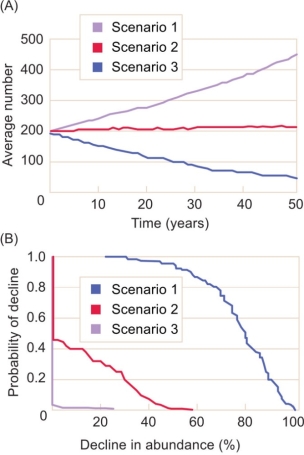
-Based on this figure, which of the following conclusions is true?
A) Enhancing juvenile populations will lead to increased probability of low percent decline in abundance.
B) Maintaining the current trends will cause both juveniles and adults to increase in number.
C) The highest probability of decline is associated with enhancing adult survival.
D) The best approach for maintaining populations at their current, stable level is to make no changes.
E) Enhancing the survival of either juveniles or adults would come at great cost.
-Based on this figure, which of the following conclusions is true?
A) Enhancing juvenile populations will lead to increased probability of low percent decline in abundance.
B) Maintaining the current trends will cause both juveniles and adults to increase in number.
C) The highest probability of decline is associated with enhancing adult survival.
D) The best approach for maintaining populations at their current, stable level is to make no changes.
E) Enhancing the survival of either juveniles or adults would come at great cost.
سؤال
Refer to the figure below showing projections of population trends for woodpeckers. Scenario 1 is no change (current conditions), Scenario 2 is enhanced adult survival, and Scenario 3 is enhanced juvenile survival.
-What is the probability that this species of woodpecker eventually will become extinct if the survival of juveniles and adults remains unchanged?
A) 1%
B) 10%
C) 25%
D) 60%
E) 99%
-What is the probability that this species of woodpecker eventually will become extinct if the survival of juveniles and adults remains unchanged?
A) 1%
B) 10%
C) 25%
D) 60%
E) 99%
سؤال
سؤال
سؤال
سؤال
سؤال
سؤال
سؤال
سؤال
سؤال
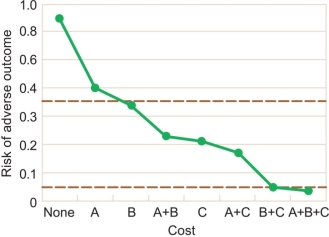
Explain how the graph below can be used in risk analysis.
سؤال
سؤال
سؤال

فتح الحزمة
قم بالتسجيل لفتح البطاقات في هذه المجموعة!
Unlock Deck
Unlock Deck
1/36

العب

ملء الشاشة (f)
Deck 14: Policy, Ethics, and Decision-Making
1
Transforming knowledge into public practice is called
A) decision making.
B) the law.
C) policy making.
D) institutionalization.
E) conscription.
A) decision making.
B) the law.
C) policy making.
D) institutionalization.
E) conscription.
C
2
Environmental policy is made by
A) the United Nations.
B) the Audubon Society.
C) religious organizations.
D) citizens' groups.
E) All of the above
A) the United Nations.
B) the Audubon Society.
C) religious organizations.
D) citizens' groups.
E) All of the above
E
3
Of the various policy-making entities listed below, none have enforcement power except
A) international agencies.
B) non-governmental organizations.
C) religious institutions.
D) media.
E) corporations.
A) international agencies.
B) non-governmental organizations.
C) religious institutions.
D) media.
E) corporations.
A
4
Institutions that make policy and own land most likely would not include
A) educational institutions.
B) international agencies.
C) non-governmental organizations.
D) federal government.
E) corporations.
A) educational institutions.
B) international agencies.
C) non-governmental organizations.
D) federal government.
E) corporations.
فتح الحزمة
افتح القفل للوصول البطاقات البالغ عددها 36 في هذه المجموعة.
فتح الحزمة
k this deck
5
Policy from international agencies
A) includes managing local resources.
B) has a strong enforcement component.
C) de-emphasizes human impacts.
D) regulates globally shared resources through the formation of treaties.
E) discourages open exchange of information.
A) includes managing local resources.
B) has a strong enforcement component.
C) de-emphasizes human impacts.
D) regulates globally shared resources through the formation of treaties.
E) discourages open exchange of information.
فتح الحزمة
افتح القفل للوصول البطاقات البالغ عددها 36 في هذه المجموعة.
فتح الحزمة
k this deck
6
Policy from non-governmental organizations
A) are general in nature and tend to avoid specific issues.
B) are not bound by the requirement of a consensus among their members.
C) attempt to influence governing bodies through the use of lobbying and media.
D) focus too broadly .
E) discourage environmental research.
A) are general in nature and tend to avoid specific issues.
B) are not bound by the requirement of a consensus among their members.
C) attempt to influence governing bodies through the use of lobbying and media.
D) focus too broadly .
E) discourage environmental research.
فتح الحزمة
افتح القفل للوصول البطاقات البالغ عددها 36 في هذه المجموعة.
فتح الحزمة
k this deck
7
Policy from the media
A) often is motivated by economic rewards.
B) is openly accepted by all sides of most issues.
C) includes broad enforcement power.
D) tends to make even the most simple concepts far too complex.
E) is limited by the lack of an audience.
A) often is motivated by economic rewards.
B) is openly accepted by all sides of most issues.
C) includes broad enforcement power.
D) tends to make even the most simple concepts far too complex.
E) is limited by the lack of an audience.
فتح الحزمة
افتح القفل للوصول البطاقات البالغ عددها 36 في هذه المجموعة.
فتح الحزمة
k this deck
8
The role of scientists in policy making is to
A) draft the legal language of legislation.
B) sway public opinion.
C) provide knowledge and informed assessments of proposals.
D) serve as advocates for their constituents.
E) provide legitimacy to lobbying groups.
A) draft the legal language of legislation.
B) sway public opinion.
C) provide knowledge and informed assessments of proposals.
D) serve as advocates for their constituents.
E) provide legitimacy to lobbying groups.
فتح الحزمة
افتح القفل للوصول البطاقات البالغ عددها 36 في هذه المجموعة.
فتح الحزمة
k this deck
9
Which of the following statements about uncertainty faced by policy makers is true?
A) Most people are willing to sacrifice the environment for technological progress but this is not known precisely.
B) Lack of relevant data is a significant component of uncertainty.
C) The precision of supporting data is usually known with certainty.
D) Future population dynamics are predictable.
E) Uncertainties are easily resolved.
A) Most people are willing to sacrifice the environment for technological progress but this is not known precisely.
B) Lack of relevant data is a significant component of uncertainty.
C) The precision of supporting data is usually known with certainty.
D) Future population dynamics are predictable.
E) Uncertainties are easily resolved.
فتح الحزمة
افتح القفل للوصول البطاقات البالغ عددها 36 في هذه المجموعة.
فتح الحزمة
k this deck
10
Methods of evaluating or reducing uncertainty do not include
A) sensitivity analysis.
B) impact assessment.
C) the collection of more data.
D) discarding data that do not support conclusions.
E) worst case analysis.
A) sensitivity analysis.
B) impact assessment.
C) the collection of more data.
D) discarding data that do not support conclusions.
E) worst case analysis.
فتح الحزمة
افتح القفل للوصول البطاقات البالغ عددها 36 في هذه المجموعة.
فتح الحزمة
k this deck
11
Impact assessment includes all of the following except
A) decomposing the uncertainty in data to sets of assumptions.
B) comparing risks with and without sets of assumptions.
C) finding means to determine relative risk.
D) establishing high, low, and medium groups of vital rates.
E) determining the absolute risk.
A) decomposing the uncertainty in data to sets of assumptions.
B) comparing risks with and without sets of assumptions.
C) finding means to determine relative risk.
D) establishing high, low, and medium groups of vital rates.
E) determining the absolute risk.
فتح الحزمة
افتح القفل للوصول البطاقات البالغ عددها 36 في هذه المجموعة.
فتح الحزمة
k this deck
12
Determining the maximum risk of the extinction of a species through the use of computer models is called
A) impact assessment.
B) sensitivity analysis.
C) scenario building.
D) worst-case analysis.
E) similar entities.
A) impact assessment.
B) sensitivity analysis.
C) scenario building.
D) worst-case analysis.
E) similar entities.
فتح الحزمة
افتح القفل للوصول البطاقات البالغ عددها 36 في هذه المجموعة.
فتح الحزمة
k this deck
13
_______ can be used to reduce uncertainty in endangered species issues by reducing data gaps through the use of data from similar or related species.
A) Worst-case analysis
B) Similar entities
C) Impact assessment
D) Sensitivity analysis
E) Risk minimization
A) Worst-case analysis
B) Similar entities
C) Impact assessment
D) Sensitivity analysis
E) Risk minimization
فتح الحزمة
افتح القفل للوصول البطاقات البالغ عددها 36 في هذه المجموعة.
فتح الحزمة
k this deck
14
The process in which a model is run many times with different combinations of low and high values of each experimental parameter to help account for uncertainty in parameter values is called
A) sensitivity analysis.
B) iterative digression.
C) risk assessment.
D) scenario building.
E) modeling.
A) sensitivity analysis.
B) iterative digression.
C) risk assessment.
D) scenario building.
E) modeling.
فتح الحزمة
افتح القفل للوصول البطاقات البالغ عددها 36 في هذه المجموعة.
فتح الحزمة
k this deck
15
Risk assessment is most effective if the costs and benefits of potential options are
A) known in advance.
B) in direct opposition.
C) put in the most simple terms possible.
D) in the same units.
E) discussed only in terms of money.
A) known in advance.
B) in direct opposition.
C) put in the most simple terms possible.
D) in the same units.
E) discussed only in terms of money.
فتح الحزمة
افتح القفل للوصول البطاقات البالغ عددها 36 في هذه المجموعة.
فتح الحزمة
k this deck
16
The basic goal of risk assessment is to
A) minimize adverse effects.
B) minimize benefits.
C) predict the occurrence of an accident.
D) generate ecological regulations.
E) All of the above
A) minimize adverse effects.
B) minimize benefits.
C) predict the occurrence of an accident.
D) generate ecological regulations.
E) All of the above
فتح الحزمة
افتح القفل للوصول البطاقات البالغ عددها 36 في هذه المجموعة.
فتح الحزمة
k this deck
17
In a given risk analysis, one observes that risk declines incrementally as more is invested to make changes intended to reduce risk. This infers that
A) the best approach is to do nothing.
B) a balance will be determined between increased cost and reduced risk.
C) the only acceptable risk is no risk at all.
D) as long as risk decreases with increased investment of funds, the money is well spent.
E) zero risk will be easily and affordably attained.
A) the best approach is to do nothing.
B) a balance will be determined between increased cost and reduced risk.
C) the only acceptable risk is no risk at all.
D) as long as risk decreases with increased investment of funds, the money is well spent.
E) zero risk will be easily and affordably attained.
فتح الحزمة
افتح القفل للوصول البطاقات البالغ عددها 36 في هذه المجموعة.
فتح الحزمة
k this deck
18
Population viability analysis is not used for
A) revealing the sensitivity of a population to certain external factors.
B) predicting the response of a given species to a combination of parameters.
C) assisting in allocating resources to the conservation of species.
D) determining the increased incidence of disease when increased populations of that species leads to overcrowding.
E) assisting species to retain their potential for natural progressions (including evolutionary change) without the need for intensive management.
A) revealing the sensitivity of a population to certain external factors.
B) predicting the response of a given species to a combination of parameters.
C) assisting in allocating resources to the conservation of species.
D) determining the increased incidence of disease when increased populations of that species leads to overcrowding.
E) assisting species to retain their potential for natural progressions (including evolutionary change) without the need for intensive management.
فتح الحزمة
افتح القفل للوصول البطاقات البالغ عددها 36 في هذه المجموعة.
فتح الحزمة
k this deck
19
Which of the following is not part of population viability analysis?
A) Predictive modeling of species populations
B) Assisting species adapt to changing conditions
C) Instituting and enforcing strict regulations when the hunting traditions of indigenous humans are contradictory with species conservation
D) Making predictions to shape inputs
E) Improving the odds of survival of endangered species
A) Predictive modeling of species populations
B) Assisting species adapt to changing conditions
C) Instituting and enforcing strict regulations when the hunting traditions of indigenous humans are contradictory with species conservation
D) Making predictions to shape inputs
E) Improving the odds of survival of endangered species
فتح الحزمة
افتح القفل للوصول البطاقات البالغ عددها 36 في هذه المجموعة.
فتح الحزمة
k this deck
20
Computer models are a critical part of population viability analysis because
A) modeling is better than collecting data.
B) field data can be imprecise, and computers are highly precise.
C) computer models can predict the future with uncanny accuracy.
D) although computer modeling is more expensive than data collection, it allows the scientists to work more efficiently.
E) PVA requires projecting what will happen in the future, and computer models are the best approach.
A) modeling is better than collecting data.
B) field data can be imprecise, and computers are highly precise.
C) computer models can predict the future with uncanny accuracy.
D) although computer modeling is more expensive than data collection, it allows the scientists to work more efficiently.
E) PVA requires projecting what will happen in the future, and computer models are the best approach.
فتح الحزمة
افتح القفل للوصول البطاقات البالغ عددها 36 في هذه المجموعة.
فتح الحزمة
k this deck
21
The first step in population viability analysis is
A) determining the species of animals that people value most and focus on protecting them.
B) asking the question, "Is this species threatened?".
C) building a conceptual model as the foundation for a computer simulation.
D) running scenarios.
E) filling in data gaps with using data from similar or related species.
A) determining the species of animals that people value most and focus on protecting them.
B) asking the question, "Is this species threatened?".
C) building a conceptual model as the foundation for a computer simulation.
D) running scenarios.
E) filling in data gaps with using data from similar or related species.
فتح الحزمة
افتح القفل للوصول البطاقات البالغ عددها 36 في هذه المجموعة.
فتح الحزمة
k this deck
22
If population viability analysis reveals that a species is at risk, appropriate response measures would include
A) reintroduction of the species into impacted areas.
B) prescribed burning to remove competition or enhance survival.
C) captive breeding to increase numbers.
D) restoration of disturbed or destroyed habitats.
E) All of the above
A) reintroduction of the species into impacted areas.
B) prescribed burning to remove competition or enhance survival.
C) captive breeding to increase numbers.
D) restoration of disturbed or destroyed habitats.
E) All of the above
فتح الحزمة
افتح القفل للوصول البطاقات البالغ عددها 36 في هذه المجموعة.
فتح الحزمة
k this deck
23
Refer to the figure below showing projections of population trends for woodpeckers. Scenario 1 is no change (current conditions), Scenario 2 is enhanced adult survival, and Scenario 3 is enhanced juvenile survival.
-Based on this figure, which of the following conclusions is true?
A) Enhancing juvenile populations will lead to increased probability of low percent decline in abundance.
B) Maintaining the current trends will cause both juveniles and adults to increase in number.
C) The highest probability of decline is associated with enhancing adult survival.
D) The best approach for maintaining populations at their current, stable level is to make no changes.
E) Enhancing the survival of either juveniles or adults would come at great cost.
-Based on this figure, which of the following conclusions is true?
A) Enhancing juvenile populations will lead to increased probability of low percent decline in abundance.
B) Maintaining the current trends will cause both juveniles and adults to increase in number.
C) The highest probability of decline is associated with enhancing adult survival.
D) The best approach for maintaining populations at their current, stable level is to make no changes.
E) Enhancing the survival of either juveniles or adults would come at great cost.
فتح الحزمة
افتح القفل للوصول البطاقات البالغ عددها 36 في هذه المجموعة.
فتح الحزمة
k this deck
24
Refer to the figure below showing projections of population trends for woodpeckers. Scenario 1 is no change (current conditions), Scenario 2 is enhanced adult survival, and Scenario 3 is enhanced juvenile survival.
-What is the probability that this species of woodpecker eventually will become extinct if the survival of juveniles and adults remains unchanged?
A) 1%
B) 10%
C) 25%
D) 60%
E) 99%
-What is the probability that this species of woodpecker eventually will become extinct if the survival of juveniles and adults remains unchanged?
A) 1%
B) 10%
C) 25%
D) 60%
E) 99%
فتح الحزمة
افتح القفل للوصول البطاقات البالغ عددها 36 في هذه المجموعة.
فتح الحزمة
k this deck
25
A mathematical description of a population is called a
A) theorem.
B) set theory.
C) model.
D) matrix.
E) scenario.
A) theorem.
B) set theory.
C) model.
D) matrix.
E) scenario.
فتح الحزمة
افتح القفل للوصول البطاقات البالغ عددها 36 في هذه المجموعة.
فتح الحزمة
k this deck
26
How do the goals of policy from international agencies differ from those of governments?
فتح الحزمة
افتح القفل للوصول البطاقات البالغ عددها 36 في هذه المجموعة.
فتح الحزمة
k this deck
27
Explain the differences between governments and corporations in their ability to make policy.
فتح الحزمة
افتح القفل للوصول البطاقات البالغ عددها 36 في هذه المجموعة.
فتح الحزمة
k this deck
28
Explain how religious institutions and educational institutions are similar in their goals and contributions in developing environmental policy despite different basic missions.
فتح الحزمة
افتح القفل للوصول البطاقات البالغ عددها 36 في هذه المجموعة.
فتح الحزمة
k this deck
29
What is the role of scientists in the decision-making process? List three roles that scientists play and which decision-making bodies rely on them.
فتح الحزمة
افتح القفل للوصول البطاقات البالغ عددها 36 في هذه المجموعة.
فتح الحزمة
k this deck
30
What is sensitivity analysis in the context of uncertainty?
فتح الحزمة
افتح القفل للوصول البطاقات البالغ عددها 36 في هذه المجموعة.
فتح الحزمة
k this deck
31
What is the goal of risk assessment?
فتح الحزمة
افتح القفل للوصول البطاقات البالغ عددها 36 في هذه المجموعة.
فتح الحزمة
k this deck
32
A new law will impose fines for any industry in violation of revised air emission standards. Explain the analysis that a company in this industry might make to determine whether or not they will comply with the new standards.
فتح الحزمة
افتح القفل للوصول البطاقات البالغ عددها 36 في هذه المجموعة.
فتح الحزمة
k this deck
33
Explain how the graph below can be used in risk analysis.
فتح الحزمة
افتح القفل للوصول البطاقات البالغ عددها 36 في هذه المجموعة.
فتح الحزمة
k this deck
34
Briefly explain population viability analysis.
فتح الحزمة
افتح القفل للوصول البطاقات البالغ عددها 36 في هذه المجموعة.
فتح الحزمة
k this deck
35
Could population viability analysis be used to determine the impact of hunting on the long-term population trends of a threatened species of deer? Explain.
فتح الحزمة
افتح القفل للوصول البطاقات البالغ عددها 36 في هذه المجموعة.
فتح الحزمة
k this deck
36
Explain how sensitivity analysis is used as part of population viability analysis.
فتح الحزمة
افتح القفل للوصول البطاقات البالغ عددها 36 في هذه المجموعة.
فتح الحزمة
k this deck
فتح الحزمة
افتح القفل للوصول البطاقات البالغ عددها 36 في هذه المجموعة.






