







 تكلم مع الذكاء الاصطناعي


Deck 7: The Transformation of the Roman Empire, 284-600 C.E
ملء الشاشة (f)

سؤال

سؤال
سؤال
سؤال
سؤال
سؤال
سؤال
سؤال
سؤال
سؤال
سؤال
سؤال
سؤال
سؤال
سؤال
سؤال
سؤال
سؤال
سؤال
سؤال
سؤال
سؤال
Based on this map, which of the following districts would have been the most vulnerable to invasion by Germanic peoples?
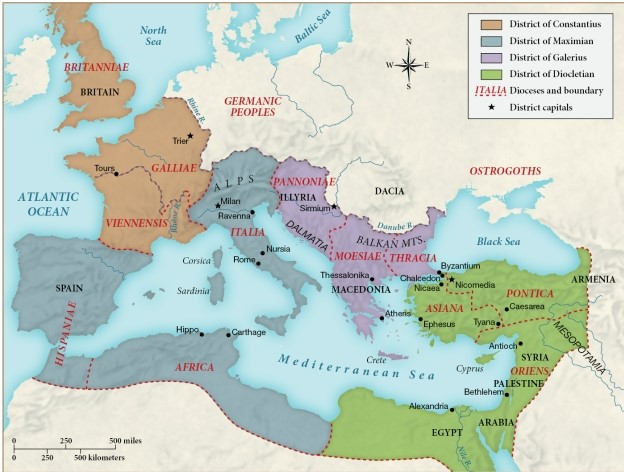
A) District of Diocletian
B) District of Africa
C) District of Hispaniae
D) District of Constantius
A) District of Diocletian
B) District of Africa
C) District of Hispaniae
D) District of Constantius
سؤال
سؤال
سؤال
سؤال
سؤال
سؤال
سؤال
سؤال
سؤال
سؤال
سؤال
سؤال
Which of the following statements is supported by this map?
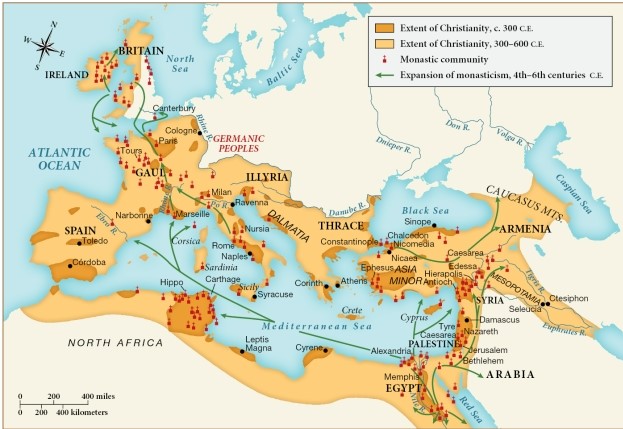
A) Christianity spread significantly between 300 and 600 C.E.
B) Monastic communities were rare in areas of early Christian influence.
C) Monasticism expanded from Spain throughout the region.
D) The influence of Christianity declined from 300 to 600 C.E.
A) Christianity spread significantly between 300 and 600 C.E.
B) Monastic communities were rare in areas of early Christian influence.
C) Monasticism expanded from Spain throughout the region.
D) The influence of Christianity declined from 300 to 600 C.E.
سؤال
سؤال
سؤال
سؤال
سؤال
سؤال
سؤال
سؤال
سؤال
سؤال
سؤال
سؤال
سؤال
سؤال
سؤال
سؤال
Which group invaded North Africa and, from there, across the Mediterranean Sea into present-day Italian territories?
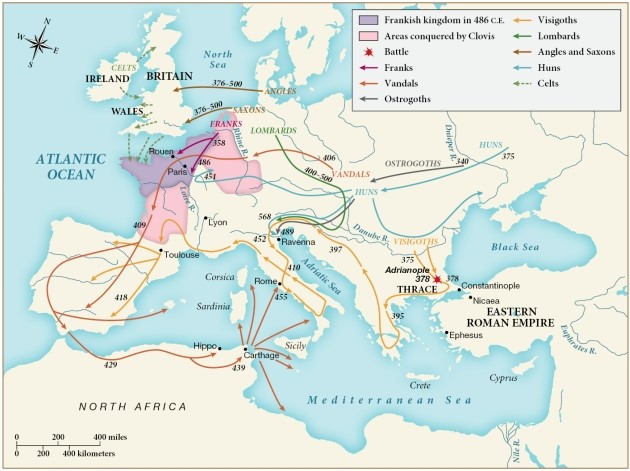
A) The Franks
B) The Vandals
C) The Huns
D) The Lombards
A) The Franks
B) The Vandals
C) The Huns
D) The Lombards
سؤال
The Angles and the Saxons migrated to which of the following regions?
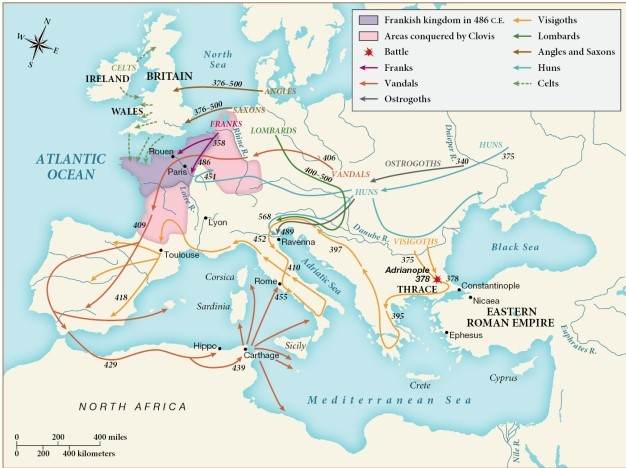
A) The Frankish Kingdom
B) Ireland
C) Britain
D) Thrace
A) The Frankish Kingdom
B) Ireland
C) Britain
D) Thrace
سؤال
سؤال
سؤال
سؤال
سؤال
سؤال
سؤال
سؤال
سؤال
سؤال
سؤال
سؤال
سؤال
By the time of Justinian's death in 565 C.E., which of the following regions had come under the control of the eastern Roman Empire?
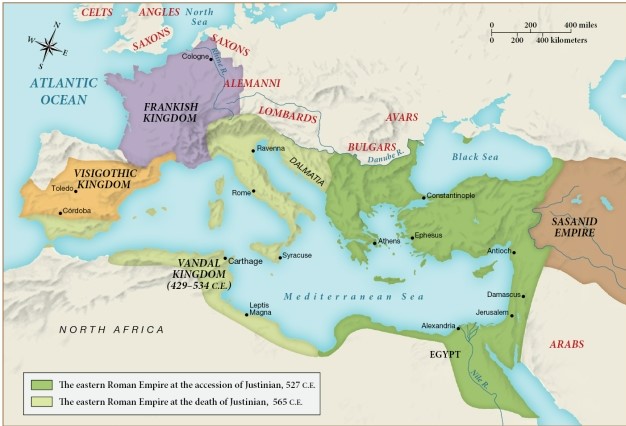
A) The Frankish Kingdom
B) The Vandal Kingdom
C) The Visigothic Kingdom
D) The Sasanid Empire
A) The Frankish Kingdom
B) The Vandal Kingdom
C) The Visigothic Kingdom
D) The Sasanid Empire

فتح الحزمة
قم بالتسجيل لفتح البطاقات في هذه المجموعة!
Unlock Deck
Unlock Deck
1/64

العب

ملء الشاشة (f)
Deck 7: The Transformation of the Roman Empire, 284-600 C.E
1
How did Diocletian use titles and court ceremony to reinforce and legitimize his demand for absolute obedience to his rule?
Answer would ideally include the following. Diocletian insisted on the title
dominus ("master" or "lord") rather than princeps (meaning "first man" among social equals). Historians now refer to this period of Roman rule as the dominate. To this title he added spectacle, public works, and court ceremony. The dominus began receiving people while seated on an elevated platform, dressed in jeweled robes, and wearing on his head a diadem, the jeweled band associated with the old monarchy. To illustrate the dominus's distance from other men, a series of veils separated the waiting room from the audience room. All of these practices were designed to emphasize Diocletian's superiority to and separation from those he ruled over.
dominus ("master" or "lord") rather than princeps (meaning "first man" among social equals). Historians now refer to this period of Roman rule as the dominate. To this title he added spectacle, public works, and court ceremony. The dominus began receiving people while seated on an elevated platform, dressed in jeweled robes, and wearing on his head a diadem, the jeweled band associated with the old monarchy. To illustrate the dominus's distance from other men, a series of veils separated the waiting room from the audience room. All of these practices were designed to emphasize Diocletian's superiority to and separation from those he ruled over.
2
Who were the curials? What role did they play in the late empire?
Answer would ideally include the following. The curials were the social elites in the cities and towns of the empire. During the late empire, men of the curial class were required to serve as city council members without salary, and to use their own money to pay for community expenses, including the water supply and the feeding of troops. Even more onerous was their responsibility to compensate for shortfalls in tax collection out of their own pockets, especially at a time when the emperors demanded ever-increasing revenue. These oppressive regulations depleted the number of individuals willing to act as community officials, as curials did whatever they could to avoid public service, even if it meant abandoning home and property to flee their town.
3
Why were Jews deemed a special problem for Christian emperors? How did the rulers place increasing pressure on them?
Answer would ideally include the following. Jews were neither polytheists nor Christians. Most previous emperors had allowed them to practice their religion, and most Christian emperors felt that Jews seemed entitled to special treatment because Jesus had been a Jew. Yet, while synagogues continued to exist and worship was allowed to continue, civil pressure was increasingly exerted on the Jews. First, they were burdened with curial financial duties but with none of the power or honor that traditionally went with that status. By the late sixth century, Roman emperors had barred Jews from making wills or receiving inheritances, and they could not testify in court.
4
What was Arianism, and how did the Council of Nicaea, called in 325, attempt to resolve the issue?
فتح الحزمة
افتح القفل للوصول البطاقات البالغ عددها 64 في هذه المجموعة.
فتح الحزمة
k this deck
5
How did the religious communities established by Basil of Caesarea and Benedict of Nursia reflect two different approaches to monasticism?
فتح الحزمة
افتح القفل للوصول البطاقات البالغ عددها 64 في هذه المجموعة.
فتح الحزمة
k this deck
6
Who were the Huns? How did their invasions start a "ripple effect" across Europe?
فتح الحزمة
افتح القفل للوصول البطاقات البالغ عددها 64 في هذه المجموعة.
فتح الحزمة
k this deck
7
Why did the deposition of the last Roman emperor in 476 by Ostrogothic troops under the command of Odoacer have more of a symbolic than an actual political impact?
فتح الحزمة
افتح القفل للوصول البطاقات البالغ عددها 64 في هذه المجموعة.
فتح الحزمة
k this deck
8
What was wergild? What was the principle behind it, and how does this explain why the murder of a woman of childbearing age required a higher wergild than that of an older woman?
فتح الحزمة
افتح القفل للوصول البطاقات البالغ عددها 64 في هذه المجموعة.
فتح الحزمة
k this deck
9
Explain how Justinian's military campaigns, which successfully regained large parts of the old Roman Empire, actually weakened the empire.
فتح الحزمة
افتح القفل للوصول البطاقات البالغ عددها 64 في هذه المجموعة.
فتح الحزمة
k this deck
10
How did the development of Christian literature, specifically of the codex, tend to preserve classical literature?
فتح الحزمة
افتح القفل للوصول البطاقات البالغ عددها 64 في هذه المجموعة.
فتح الحزمة
k this deck
11
What political and economic reforms did Diocletian initiate to save the Roman Empire, and what were the consequences, both intended and unintended, of these attempts at reform?
فتح الحزمة
افتح القفل للوصول البطاقات البالغ عددها 64 في هذه المجموعة.
فتح الحزمة
k this deck
12
It is common to attribute the expansion of Christianity in the Roman Empire to the conversion of Constantine in 312. But in fact, this process was gradual rather than sudden. Why was this the case? Discuss the gradual Christianization of the Roman Empire from the reign of Constantine through the early sixth century.
فتح الحزمة
افتح القفل للوصول البطاقات البالغ عددها 64 في هذه المجموعة.
فتح الحزمة
k this deck
13
Describe the ways in which Roman culture and traditions were continued in the new multiethnic kingdoms established by men such as Clovis and Theodoric.
فتح الحزمة
افتح القفل للوصول البطاقات البالغ عددها 64 في هذه المجموعة.
فتح الحزمة
k this deck
14
How did the development of the eastern Roman Empire differ from that of the western Roman Empire? Who was Justinian? Explain his role in the eastern Roman Empire.
فتح الحزمة
افتح القفل للوصول البطاقات البالغ عددها 64 في هذه المجموعة.
فتح الحزمة
k this deck
15
Discuss the ways in which the eastern empire preserved or attempted to preserve Greek and Roman culture.
فتح الحزمة
افتح القفل للوصول البطاقات البالغ عددها 64 في هذه المجموعة.
فتح الحزمة
k this deck
16
After fifty years of civil war in the third century, the emperors of the reunified empire
A) made taxation more efficient by sending imperial tax collectors to replace local elites.
B) asserted their autocracy aggressively, through harsh laws and punishments.
C) signed a truce with the tribes on the frontiers of the empire.
D) required that Christianity be universally practiced as the new state religion.
A) made taxation more efficient by sending imperial tax collectors to replace local elites.
B) asserted their autocracy aggressively, through harsh laws and punishments.
C) signed a truce with the tribes on the frontiers of the empire.
D) required that Christianity be universally practiced as the new state religion.
فتح الحزمة
افتح القفل للوصول البطاقات البالغ عددها 64 في هذه المجموعة.
فتح الحزمة
k this deck
17
Why was Diocletian (r. 284-305) an unlikely candidate for emperor?
A) Unlike most third- and fourth-century emperors, Diocletian had no formal ties to the Roman army.
B) He hailed from a peasant family in the Balkans, far removed from Rome.
C) He spoke only Greek and no Latin.
D) He had once served as a gladiator, an occupation that would ordinarily have precluded him from high positions of authority.
A) Unlike most third- and fourth-century emperors, Diocletian had no formal ties to the Roman army.
B) He hailed from a peasant family in the Balkans, far removed from Rome.
C) He spoke only Greek and no Latin.
D) He had once served as a gladiator, an occupation that would ordinarily have precluded him from high positions of authority.
فتح الحزمة
افتح القفل للوصول البطاقات البالغ عددها 64 في هذه المجموعة.
فتح الحزمة
k this deck
18
How did Diocletian indicate his autocratic intentions when he came to power in 284?
A) He replaced the title princeps with dominus, which was what slaves called their owners.
B) He proclaimed himself the head of the state and of the Christian church.
C) He eliminated the Senate, consuls, and all other vestiges of republican rule.
D) He appointed only fellow Balkan peoples to important positions.
A) He replaced the title princeps with dominus, which was what slaves called their owners.
B) He proclaimed himself the head of the state and of the Christian church.
C) He eliminated the Senate, consuls, and all other vestiges of republican rule.
D) He appointed only fellow Balkan peoples to important positions.
فتح الحزمة
افتح القفل للوصول البطاقات البالغ عددها 64 في هذه المجموعة.
فتح الحزمة
k this deck
19
The autocratic emperors of the dominate
A) shared governmental power with the members of the Senate.
B) continued to refer to the empire as the Roman republic.
C) ruled fairly and administered laws wisely in order to preserve the empire.
D) granted increased powers to provincial officials.
A) shared governmental power with the members of the Senate.
B) continued to refer to the empire as the Roman republic.
C) ruled fairly and administered laws wisely in order to preserve the empire.
D) granted increased powers to provincial officials.
فتح الحزمة
افتح القفل للوصول البطاقات البالغ عددها 64 في هذه المجموعة.
فتح الحزمة
k this deck
20
How did the dominate's emperors take cues for their style of ruling from the Sasanid Empire in Persia?
A) They emphasized their superiority by wearing a diadem and jeweled clothing.
B) They disbanded the Senate and other institutions left over from the ancient Roman republic.
C) They married only within other royal families.
D) They used their imperial authority to pardon criminals and evildoers.
A) They emphasized their superiority by wearing a diadem and jeweled clothing.
B) They disbanded the Senate and other institutions left over from the ancient Roman republic.
C) They married only within other royal families.
D) They used their imperial authority to pardon criminals and evildoers.
فتح الحزمة
افتح القفل للوصول البطاقات البالغ عددها 64 في هذه المجموعة.
فتح الحزمة
k this deck
21
What did the term tetrarchy under Emperor Diocletian refer to?
A) His division of the empire into four loosely defined administrative units
B) His appointment of a four-man council to advise him on military and fiscal policy
C) The division of the early apostolic Christian church into four regional units
D) The curial-class appointees who governed the Roman dioceses
A) His division of the empire into four loosely defined administrative units
B) His appointment of a four-man council to advise him on military and fiscal policy
C) The division of the early apostolic Christian church into four regional units
D) The curial-class appointees who governed the Roman dioceses
فتح الحزمة
افتح القفل للوصول البطاقات البالغ عددها 64 في هذه المجموعة.
فتح الحزمة
k this deck
22
Based on this map, which of the following districts would have been the most vulnerable to invasion by Germanic peoples?
A) District of Diocletian
B) District of Africa
C) District of Hispaniae
D) District of Constantius
A) District of Diocletian
B) District of Africa
C) District of Hispaniae
D) District of Constantius
فتح الحزمة
افتح القفل للوصول البطاقات البالغ عددها 64 في هذه المجموعة.
فتح الحزمة
k this deck
23
Why did Rome lose its status as the Roman Empire's most important city as a result of Diocletian's reforms?
A) Its population shrank so dramatically because of the exodus of governmental officials that it ranked only as the fifth-largest city in the empire.
B) The Vandals and the Visigoths both sacked the city, since Diocletian's reforms had taken funds away from the armed forces protecting the city.
C) Diocletian had the Christian officials of the city executed, destroying the Christian leadership of the entire empire.
D) Diocletian divided the empire into smaller units, thereby turning Italy into a section of the empire like any other.
A) Its population shrank so dramatically because of the exodus of governmental officials that it ranked only as the fifth-largest city in the empire.
B) The Vandals and the Visigoths both sacked the city, since Diocletian's reforms had taken funds away from the armed forces protecting the city.
C) Diocletian had the Christian officials of the city executed, destroying the Christian leadership of the entire empire.
D) Diocletian divided the empire into smaller units, thereby turning Italy into a section of the empire like any other.
فتح الحزمة
افتح القفل للوصول البطاقات البالغ عددها 64 في هذه المجموعة.
فتح الحزمة
k this deck
24
In 395, the Roman Empire was formally divided into two halves; what was the capital of the western half of the empire?
A) Milan
B) Constantinople
C) Ravenna
D) Rome
A) Milan
B) Constantinople
C) Ravenna
D) Rome
فتح الحزمة
افتح القفل للوصول البطاقات البالغ عددها 64 في هذه المجموعة.
فتح الحزمة
k this deck
25
Why did Constantinople become the capital of the eastern half of the empire?
A) The name of the city reminded the emperor Theodosius of his predecessor Constantine.
B) Its location was militarily and commercially strategic.
C) Its population was overwhelmingly Christian, and Theodosius had just declared Christianity to be the official religion of the empire.
D) The majority of the population of the Roman Empire now lived in the city of Constantinople and not in the city of Rome.
A) The name of the city reminded the emperor Theodosius of his predecessor Constantine.
B) Its location was militarily and commercially strategic.
C) Its population was overwhelmingly Christian, and Theodosius had just declared Christianity to be the official religion of the empire.
D) The majority of the population of the Roman Empire now lived in the city of Constantinople and not in the city of Rome.
فتح الحزمة
افتح القفل للوصول البطاقات البالغ عددها 64 في هذه المجموعة.
فتح الحزمة
k this deck
26
How did Diocletian respond to the hyperinflation brought on by the civil wars of the third century?
A) He got rid of all Roman coinage.
B) He decreased levels of taxation so that the population would have more to spend.
C) He imposed price and wage controls in the worst-hit areas.
D) He introduced paper money.
A) He got rid of all Roman coinage.
B) He decreased levels of taxation so that the population would have more to spend.
C) He imposed price and wage controls in the worst-hit areas.
D) He introduced paper money.
فتح الحزمة
افتح القفل للوصول البطاقات البالغ عددها 64 في هذه المجموعة.
فتح الحزمة
k this deck
27
What new obligations did the emperors impose on the curials, the social elite in the towns, in response to Rome's economic problems?
A) The emperors forced them to perform menial labor on tenant farms because so many tenant farmers had fled.
B) The emperors drafted them into the army and required them to serve a minimum of five years.
C) The emperors forced them to come to Ravenna and Constantinople to work as servants for the emperors.
D) The emperors forced them to serve as unsalaried members of the city senate and to use their own money to support the community.
A) The emperors forced them to perform menial labor on tenant farms because so many tenant farmers had fled.
B) The emperors drafted them into the army and required them to serve a minimum of five years.
C) The emperors forced them to come to Ravenna and Constantinople to work as servants for the emperors.
D) The emperors forced them to serve as unsalaried members of the city senate and to use their own money to support the community.
فتح الحزمة
افتح القفل للوصول البطاقات البالغ عددها 64 في هذه المجموعة.
فتح الحزمة
k this deck
28
Why did Diocletian launch his Great Persecution of Christians?
A) He believed that the wrath of the gods had caused the crisis of the third century and that returning to the ancient gods would win back divine favor.
B) Christian communities were attacking Roman temples and priests in an effort to purge Rome of its polytheistic character.
C) He needed scapegoats to account for some of the disasters of the third century, such as the great fire in the city of Rome.
D) He falsely believed that Christians were trying to invite in and make peace with hostile barbarian tribes on the Roman frontiers.
A) He believed that the wrath of the gods had caused the crisis of the third century and that returning to the ancient gods would win back divine favor.
B) Christian communities were attacking Roman temples and priests in an effort to purge Rome of its polytheistic character.
C) He needed scapegoats to account for some of the disasters of the third century, such as the great fire in the city of Rome.
D) He falsely believed that Christians were trying to invite in and make peace with hostile barbarian tribes on the Roman frontiers.
فتح الحزمة
افتح القفل للوصول البطاقات البالغ عددها 64 في هذه المجموعة.
فتح الحزمة
k this deck
29
Which group did Diocletian and his co-rulers persecute in response to the crisis at the close of the third century?
A) Jews
B) Christians
C) Muslims
D) Polytheists
A) Jews
B) Christians
C) Muslims
D) Polytheists
فتح الحزمة
افتح القفل للوصول البطاقات البالغ عددها 64 في هذه المجموعة.
فتح الحزمة
k this deck
30
Why did the emperor Constantine (r. 306-337) convert to Christianity?
A) He dreamed just before winning a crucial battle that the Christian God would make him victorious.
B) He saw how bravely Christians fought compared to foreign mercenaries.
C) He read and was moved by Augustine's The City of God.
D) He was influenced by the unexpected conversion of his best friend and trusted adviser, Ambrose.
A) He dreamed just before winning a crucial battle that the Christian God would make him victorious.
B) He saw how bravely Christians fought compared to foreign mercenaries.
C) He read and was moved by Augustine's The City of God.
D) He was influenced by the unexpected conversion of his best friend and trusted adviser, Ambrose.
فتح الحزمة
افتح القفل للوصول البطاقات البالغ عددها 64 في هذه المجموعة.
فتح الحزمة
k this deck
31
The Edict of Milan, promulgated by Constantine and Licinius in 313, decreed
A) polytheism to be illegal.
B) Christianity to be the official religion of the empire.
C) religious tolerance for all inhabitants of the Roman Empire.
D) that all property seized from Christians during the Great Persecution be returned.
A) polytheism to be illegal.
B) Christianity to be the official religion of the empire.
C) religious tolerance for all inhabitants of the Roman Empire.
D) that all property seized from Christians during the Great Persecution be returned.
فتح الحزمة
افتح القفل للوصول البطاقات البالغ عددها 64 في هذه المجموعة.
فتح الحزمة
k this deck
32
What factor allowed Christianity to become the dominant religion in the course of the fourth century, however gradual the process?
A) The conversion of the emperors, all of whom promoted the new faith
B) Christian appropriation of many polytheistic beliefs and traditions, including belief in many gods
C) The acceptance that Christianity found among men and women of all social groups and classes
D) The division of the Roman Empire into eastern and western kingdoms, with the result that the emperors competed against each other in a race for converts
A) The conversion of the emperors, all of whom promoted the new faith
B) Christian appropriation of many polytheistic beliefs and traditions, including belief in many gods
C) The acceptance that Christianity found among men and women of all social groups and classes
D) The division of the Roman Empire into eastern and western kingdoms, with the result that the emperors competed against each other in a race for converts
فتح الحزمة
افتح القفل للوصول البطاقات البالغ عددها 64 في هذه المجموعة.
فتح الحزمة
k this deck
33
Following the emperors' conversion to Christianity, the plight of the Jews
A) improved, as emperors respected their monotheism and the fact that Jesus had been a Jew.
B) worsened, as later emperors imposed legal and political restrictions on Jews and continued to impose significant financial burdens on them.
C) remained much as it had been under previous polytheist Roman emperors, who had permitted Jews to live and worship undisturbed.
D) worsened, as the construction of new synagogues was banned and many of those already built were destroyed.
A) improved, as emperors respected their monotheism and the fact that Jesus had been a Jew.
B) worsened, as later emperors imposed legal and political restrictions on Jews and continued to impose significant financial burdens on them.
C) remained much as it had been under previous polytheist Roman emperors, who had permitted Jews to live and worship undisturbed.
D) worsened, as the construction of new synagogues was banned and many of those already built were destroyed.
فتح الحزمة
افتح القفل للوصول البطاقات البالغ عددها 64 في هذه المجموعة.
فتح الحزمة
k this deck
34
Which of the following statements is supported by this map?
A) Christianity spread significantly between 300 and 600 C.E.
B) Monastic communities were rare in areas of early Christian influence.
C) Monasticism expanded from Spain throughout the region.
D) The influence of Christianity declined from 300 to 600 C.E.
A) Christianity spread significantly between 300 and 600 C.E.
B) Monastic communities were rare in areas of early Christian influence.
C) Monasticism expanded from Spain throughout the region.
D) The influence of Christianity declined from 300 to 600 C.E.
فتح الحزمة
افتح القفل للوصول البطاقات البالغ عددها 64 في هذه المجموعة.
فتح الحزمة
k this deck
35
Why were many unmarried women throughout the Roman Empire attracted to Christianity in the fourth and fifth centuries?
A) They were able to assume leadership roles in the church hierarchy.
B) The unmarried women who had been martyred in the previous centuries served as inspirations for them.
C) Their participation in the church provided them with a respectable alternative to raising a family.
D) The church sometimes paid dowries for women whose families couldn't afford them.
A) They were able to assume leadership roles in the church hierarchy.
B) The unmarried women who had been martyred in the previous centuries served as inspirations for them.
C) Their participation in the church provided them with a respectable alternative to raising a family.
D) The church sometimes paid dowries for women whose families couldn't afford them.
فتح الحزمة
افتح القفل للوصول البطاقات البالغ عددها 64 في هذه المجموعة.
فتح الحزمة
k this deck
36
As the church's influence in state affairs grew,
A) women were able to assume a greater role in politics.
B) the bishops came to replace the curials as the emperors' partners in local rule.
C) the bishops began to assume positions as officers in the imperial army.
D) Christians successfully pressured imperial officials to exempt monasteries from taxes.
A) women were able to assume a greater role in politics.
B) the bishops came to replace the curials as the emperors' partners in local rule.
C) the bishops began to assume positions as officers in the imperial army.
D) Christians successfully pressured imperial officials to exempt monasteries from taxes.
فتح الحزمة
افتح القفل للوصول البطاقات البالغ عددها 64 في هذه المجموعة.
فتح الحزمة
k this deck
37
The doctrine of Arianism stemmed from the belief that
A) Jesus was not co-eternal or identical with God the Father.
B) God the Father, God the son, and God the Holy Spirit made up equal thirds of the Holy Trinity.
C) Jesus was not divine.
D) human beings were not tainted by original sin.
A) Jesus was not co-eternal or identical with God the Father.
B) God the Father, God the son, and God the Holy Spirit made up equal thirds of the Holy Trinity.
C) Jesus was not divine.
D) human beings were not tainted by original sin.
فتح الحزمة
افتح القفل للوصول البطاقات البالغ عددها 64 في هذه المجموعة.
فتح الحزمة
k this deck
38
Monophysitism, Nestorianism, and Arianism were all part of the debate about the
A) supremacy of the bishop of Rome.
B) selection of priests.
C) types of monasticism.
D) nature of Christ.
A) supremacy of the bishop of Rome.
B) selection of priests.
C) types of monasticism.
D) nature of Christ.
فتح الحزمة
افتح القفل للوصول البطاقات البالغ عددها 64 في هذه المجموعة.
فتح الحزمة
k this deck
39
Where did the most important attempt to end doctrinal disputes and clarify Christian orthodoxy take place in the mid-fifth century?
A) The Council of Chalcedon
B) The Council of Nicaea
C) The Council of Ravenna
D) The Council of Theodosius
A) The Council of Chalcedon
B) The Council of Nicaea
C) The Council of Ravenna
D) The Council of Theodosius
فتح الحزمة
افتح القفل للوصول البطاقات البالغ عددها 64 في هذه المجموعة.
فتح الحزمة
k this deck
40
In his mammoth work The City of God, Augustine put forward the notion of original sin and argued that human beings had a duty to
A) obey secular authority, whose purpose was to uphold a social and moral order.
B) disobey secular authority, since it too was cursed by original sin.
C) place religious leaders at the helm of the state, since they alone could guarantee and uphold morality.
D) withdraw from political life, since it was fundamentally tainted by corruption and original sin.
A) obey secular authority, whose purpose was to uphold a social and moral order.
B) disobey secular authority, since it too was cursed by original sin.
C) place religious leaders at the helm of the state, since they alone could guarantee and uphold morality.
D) withdraw from political life, since it was fundamentally tainted by corruption and original sin.
فتح الحزمة
افتح القفل للوصول البطاقات البالغ عددها 64 في هذه المجموعة.
فتح الحزمة
k this deck
41
Why did Augustine argue that sexual abstinence represented the highest course for Christians?
A) Many emperors had had profligate sexual appetites, and Augustine believed that human beings needed to withdraw from the corrupt world of politics.
B) Augustine believed that having fewer children would hasten the Second Coming of Christ.
C) The early Christians had all remained celibate because Christ had condemned sexuality.
D) Augustine believed that sexuality had been a disruptive and uncontrollable force ever since the fall of Adam and Eve.
A) Many emperors had had profligate sexual appetites, and Augustine believed that human beings needed to withdraw from the corrupt world of politics.
B) Augustine believed that having fewer children would hasten the Second Coming of Christ.
C) The early Christians had all remained celibate because Christ had condemned sexuality.
D) Augustine believed that sexuality had been a disruptive and uncontrollable force ever since the fall of Adam and Eve.
فتح الحزمة
افتح القفل للوصول البطاقات البالغ عددها 64 في هذه المجموعة.
فتح الحزمة
k this deck
42
What was one of the primary attractions of monasticism for early Christians?
A) It was a safe haven, offering abundant food and shelter in an increasingly insecure world.
B) Early Christian teachings encouraged withdrawal from familial entanglements.
C) It earned them recognition through continual worship and self-mastery.
D) It ensured a strong sense of community with other Christians.
A) It was a safe haven, offering abundant food and shelter in an increasingly insecure world.
B) Early Christian teachings encouraged withdrawal from familial entanglements.
C) It earned them recognition through continual worship and self-mastery.
D) It ensured a strong sense of community with other Christians.
فتح الحزمة
افتح القفل للوصول البطاقات البالغ عددها 64 في هذه المجموعة.
فتح الحزمة
k this deck
43
During the transformation of the Roman Empire, becoming a monk and living a life of self-denial was seen as
A) heroic and admirable-a living martyrdom that emulated the sacrifice of Christ.
B) the necessary qualification to become a bishop or an abbot.
C) valid only if the monk engaged in social service.
D) a perversion of Jesus's teachings derived from Greek philosophy.
A) heroic and admirable-a living martyrdom that emulated the sacrifice of Christ.
B) the necessary qualification to become a bishop or an abbot.
C) valid only if the monk engaged in social service.
D) a perversion of Jesus's teachings derived from Greek philosophy.
فتح الحزمة
افتح القفل للوصول البطاقات البالغ عددها 64 في هذه المجموعة.
فتح الحزمة
k this deck
44
What group of Christians felt their authority most threatened by monasteries?
A) Emperors
B) Priests
C) Bishops
D) Urban communities
A) Emperors
B) Priests
C) Bishops
D) Urban communities
فتح الحزمة
افتح القفل للوصول البطاقات البالغ عددها 64 في هذه المجموعة.
فتح الحزمة
k this deck
45
The standard code of monastic conduct in the west that took shape around 540 was known as the rule of Saint
A) Basil.
B) Benedict.
C) Jerome.
D) Macrina.
A) Basil.
B) Benedict.
C) Jerome.
D) Macrina.
فتح الحزمة
افتح القفل للوصول البطاقات البالغ عددها 64 في هذه المجموعة.
فتح الحزمة
k this deck
46
The various barbarian tribes that moved into the Roman Empire during the fourth and fifth centuries shared both a terror of the Asiatic Huns, who had invaded eastern Europe in the fourth century, and
A) polytheistic religious practices.
B) the concept of wergild as a penalty for certain crimes.
C) a hatred of the Romans, who had never accepted them as citizens.
D) a desire to share in Roman prosperity.
A) polytheistic religious practices.
B) the concept of wergild as a penalty for certain crimes.
C) a hatred of the Romans, who had never accepted them as citizens.
D) a desire to share in Roman prosperity.
فتح الحزمة
افتح القفل للوصول البطاقات البالغ عددها 64 في هذه المجموعة.
فتح الحزمة
k this deck
47
Why is the label "Germanic peoples" misleading when used to describe the non-Roman peoples who flooded into the empire?
A) The barbarian peoples were ethnically and linguistically diverse.
B) This was a term of abuse created by the Romans themselves to describe the barbarians.
C) None of these peoples lived in regions that correspond to the borders of Germany in the nineteenth and twentieth centuries.
D) Most of these peoples spoke languages that were more closely related to modern East Asian languages, including Korean and Japanese.
A) The barbarian peoples were ethnically and linguistically diverse.
B) This was a term of abuse created by the Romans themselves to describe the barbarians.
C) None of these peoples lived in regions that correspond to the borders of Germany in the nineteenth and twentieth centuries.
D) Most of these peoples spoke languages that were more closely related to modern East Asian languages, including Korean and Japanese.
فتح الحزمة
افتح القفل للوصول البطاقات البالغ عددها 64 في هذه المجموعة.
فتح الحزمة
k this deck
48
In tribal societies of the fourth and fifth centuries, women
A) could not inherit or control property, not even their dowries.
B) performed work such as herding cattle or sheep and harvesting crops.
C) were valued primarily for their ability to bear children.
D) fought alongside men in battle, though they were equipped with spears rather than swords.
A) could not inherit or control property, not even their dowries.
B) performed work such as herding cattle or sheep and harvesting crops.
C) were valued primarily for their ability to bear children.
D) fought alongside men in battle, though they were equipped with spears rather than swords.
فتح الحزمة
افتح القفل للوصول البطاقات البالغ عددها 64 في هذه المجموعة.
فتح الحزمة
k this deck
49
Why did the Huns ultimately direct their energies westward and not toward the eastern half of the empire?
A) The western emperors invited the Huns in under the condition that they serve in the western army.
B) The Huns had adopted the Arian form of Christianity and sought to punish the western church for its persecution of heresy.
C) The Huns' move toward Constantinople was blocked by the Alps.
D) The eastern emperors paid the Huns to spare the eastern half of the empire.
A) The western emperors invited the Huns in under the condition that they serve in the western army.
B) The Huns had adopted the Arian form of Christianity and sought to punish the western church for its persecution of heresy.
C) The Huns' move toward Constantinople was blocked by the Alps.
D) The eastern emperors paid the Huns to spare the eastern half of the empire.
فتح الحزمة
افتح القفل للوصول البطاقات البالغ عددها 64 في هذه المجموعة.
فتح الحزمة
k this deck
50
Which group invaded North Africa and, from there, across the Mediterranean Sea into present-day Italian territories?
A) The Franks
B) The Vandals
C) The Huns
D) The Lombards
A) The Franks
B) The Vandals
C) The Huns
D) The Lombards
فتح الحزمة
افتح القفل للوصول البطاقات البالغ عددها 64 في هذه المجموعة.
فتح الحزمة
k this deck
51
The Angles and the Saxons migrated to which of the following regions?
A) The Frankish Kingdom
B) Ireland
C) Britain
D) Thrace
A) The Frankish Kingdom
B) Ireland
C) Britain
D) Thrace
فتح الحزمة
افتح القفل للوصول البطاقات البالغ عددها 64 في هذه المجموعة.
فتح الحزمة
k this deck
52
The Visigoths, whom the western emperor Honorius permitted to settle in southwestern Gaul, were the first of the barbarian tribes to
A) organize a political state and develop a distinct ethnic identity.
B) settle a disagreement with a Roman emperor without bloodshed.
C) convert to Christianity to make themselves acceptable to the local populace.
D) adopt Latin as their official language.
A) organize a political state and develop a distinct ethnic identity.
B) settle a disagreement with a Roman emperor without bloodshed.
C) convert to Christianity to make themselves acceptable to the local populace.
D) adopt Latin as their official language.
فتح الحزمة
افتح القفل للوصول البطاقات البالغ عددها 64 في هذه المجموعة.
فتح الحزمة
k this deck
53
The eighty thousand Vandals who captured North Africa early in the fifth century
A) interrupted shipments of food to Rome.
B) enslaved those they conquered.
C) settled peacefully in their new location.
D) were nearly isolated there because they had few ships.
A) interrupted shipments of food to Rome.
B) enslaved those they conquered.
C) settled peacefully in their new location.
D) were nearly isolated there because they had few ships.
فتح الحزمة
افتح القفل للوصول البطاقات البالغ عددها 64 في هذه المجموعة.
فتح الحزمة
k this deck
54
Which Roman territory did the Anglo-Saxons conquer in the 440s?
A) Denmark
B) France
C) Germany
D) Britain
A) Denmark
B) France
C) Germany
D) Britain
فتح الحزمة
افتح القفل للوصول البطاقات البالغ عددها 64 في هذه المجموعة.
فتح الحزمة
k this deck
55
From 493 to 526 Theodoric ruled over an Ostrogothic kingdom that
A) tried to maintain the Roman Empire's prestige by retaining elements of its rule, such as the Senate.
B) sought to eliminate all reminders of Roman rule in order to emphasize the power of the new king.
C) was supposedly ruled by the puppet emperor Romulus Augustulus.
D) forcibly converted its inhabitants to Arian Christianity.
A) tried to maintain the Roman Empire's prestige by retaining elements of its rule, such as the Senate.
B) sought to eliminate all reminders of Roman rule in order to emphasize the power of the new king.
C) was supposedly ruled by the puppet emperor Romulus Augustulus.
D) forcibly converted its inhabitants to Arian Christianity.
فتح الحزمة
افتح القفل للوصول البطاقات البالغ عددها 64 في هذه المجموعة.
فتح الحزمة
k this deck
56
The Merovingian dynasty lasted two hundred years mainly because the Merovingians
A) successfully melded Frankish and Roman traditions and avoided Justinian's campaign to reconquer the western empire.
B) embraced Christianity, which pleased their subjects and made their regime popular.
C) overthrew the Ostrogoths and ruled Italy using Roman institutions.
D) were outstanding warrior-kings who ruled autocratically.
A) successfully melded Frankish and Roman traditions and avoided Justinian's campaign to reconquer the western empire.
B) embraced Christianity, which pleased their subjects and made their regime popular.
C) overthrew the Ostrogoths and ruled Italy using Roman institutions.
D) were outstanding warrior-kings who ruled autocratically.
فتح الحزمة
افتح القفل للوصول البطاقات البالغ عددها 64 في هذه المجموعة.
فتح الحزمة
k this deck
57
The Visigoths and the Franks were the first of the Frankish tribes to have written codes of law. What language were their laws written in?
A) Local dialects
B) Latin
C) Frankish
D) Greek
A) Local dialects
B) Latin
C) Frankish
D) Greek
فتح الحزمة
افتح القفل للوصول البطاقات البالغ عددها 64 في هذه المجموعة.
فتح الحزمة
k this deck
58
Beginning around the late fourth century, what was one result of the socioeconomic dislocation caused by the successive waves of invaders into western Europe?
A) Many wealthy Romans retreated into the isolated countryside, where they built large estates worked by tenant farmers who were bound to the land.
B) Disease and outbreaks of plague spread as a result of a deterioration in living standards.
C) Latin disappeared as the language of learning and scholarship.
D) Christian mystical cults emerged as people sought solace from everyday concerns.
A) Many wealthy Romans retreated into the isolated countryside, where they built large estates worked by tenant farmers who were bound to the land.
B) Disease and outbreaks of plague spread as a result of a deterioration in living standards.
C) Latin disappeared as the language of learning and scholarship.
D) Christian mystical cults emerged as people sought solace from everyday concerns.
فتح الحزمة
افتح القفل للوصول البطاقات البالغ عددها 64 في هذه المجموعة.
فتح الحزمة
k this deck
59
How did Byzantine emperors try to limit the influence of non-Roman mercenaries?
A) The emperors insisted that all mercenaries be housed on the outskirts of Constantinople.
B) The emperors passed laws prohibiting intermarriage between tribesmen and Roman citizens.
C) The emperors required the adoption of Byzantine culture as a prerequisite for advancement in the imperial army.
D) The emperors enacted laws prohibiting Romans from wearing barbarian-style clothing such as furs and boots.
A) The emperors insisted that all mercenaries be housed on the outskirts of Constantinople.
B) The emperors passed laws prohibiting intermarriage between tribesmen and Roman citizens.
C) The emperors required the adoption of Byzantine culture as a prerequisite for advancement in the imperial army.
D) The emperors enacted laws prohibiting Romans from wearing barbarian-style clothing such as furs and boots.
فتح الحزمة
افتح القفل للوصول البطاقات البالغ عددها 64 في هذه المجموعة.
فتح الحزمة
k this deck
60
Who exerted a strong influence on Justinian's rule despite a humble upbringing as the child of a bear trainer?
A) Empress Theodora
B) Cassiodorus
C) Emperor Theodosius
D) The patriarch of Constantinople
A) Empress Theodora
B) Cassiodorus
C) Emperor Theodosius
D) The patriarch of Constantinople
فتح الحزمة
افتح القفل للوصول البطاقات البالغ عددها 64 في هذه المجموعة.
فتح الحزمة
k this deck
61
The epidemic that swept through Byzantium in the 540s killed one-third of its people and
A) led to a widespread movement into monasteries.
B) disastrously reduced the pool of army recruits and the number of taxpayers.
C) led many to believe that Justinian had angered God by allowing chariot races.
D) finally convinced Justinian to outlaw prostitution.
A) led to a widespread movement into monasteries.
B) disastrously reduced the pool of army recruits and the number of taxpayers.
C) led many to believe that Justinian had angered God by allowing chariot races.
D) finally convinced Justinian to outlaw prostitution.
فتح الحزمة
افتح القفل للوصول البطاقات البالغ عددها 64 في هذه المجموعة.
فتح الحزمة
k this deck
62
Scholars under the direction of Justinian I produced the Codex (529), the Digest (533), and the Institutes (533), all of which had an enormous impact on European
A) literature.
B) orthodoxy.
C) medicine.
D) law.
A) literature.
B) orthodoxy.
C) medicine.
D) law.
فتح الحزمة
افتح القفل للوصول البطاقات البالغ عددها 64 في هذه المجموعة.
فتح الحزمة
k this deck
63
Why did classical polytheist texts in Latin and Greek survive in the Byzantine Empire, even though its leaders had become ardent Christians?
A) Byzantine leaders were simply not able to wipe out all of the pagan texts, since so many copies were in circulation.
B) Byzantine leaders subscribed to classical ideals of tolerance and believed that societies function best when diverse viewpoints flourish.
C) Byzantine leaders did not regard this literature as important or dangerous enough to destroy.
D) Christian education and literature in this bilingual empire depended on non-Christian Latin and Greek models.
A) Byzantine leaders were simply not able to wipe out all of the pagan texts, since so many copies were in circulation.
B) Byzantine leaders subscribed to classical ideals of tolerance and believed that societies function best when diverse viewpoints flourish.
C) Byzantine leaders did not regard this literature as important or dangerous enough to destroy.
D) Christian education and literature in this bilingual empire depended on non-Christian Latin and Greek models.
فتح الحزمة
افتح القفل للوصول البطاقات البالغ عددها 64 في هذه المجموعة.
فتح الحزمة
k this deck
64
By the time of Justinian's death in 565 C.E., which of the following regions had come under the control of the eastern Roman Empire?
A) The Frankish Kingdom
B) The Vandal Kingdom
C) The Visigothic Kingdom
D) The Sasanid Empire
A) The Frankish Kingdom
B) The Vandal Kingdom
C) The Visigothic Kingdom
D) The Sasanid Empire
فتح الحزمة
افتح القفل للوصول البطاقات البالغ عددها 64 في هذه المجموعة.
فتح الحزمة
k this deck
فتح الحزمة
افتح القفل للوصول البطاقات البالغ عددها 64 في هذه المجموعة.






