







 تكلم مع الذكاء الاصطناعي


Deck 3: Spatial Vision: From Spots to Stripes
ملء الشاشة (f)

سؤال

سؤال
سؤال
سؤال
سؤال
سؤال
سؤال
سؤال
سؤال
سؤال
سؤال
سؤال
Refer to the graph.
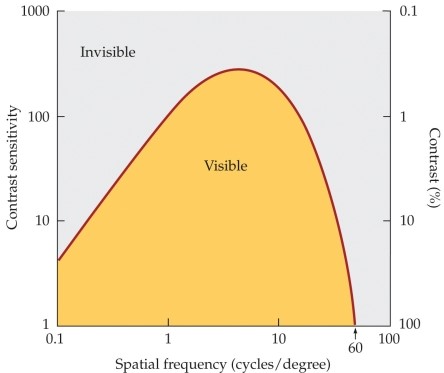 What does the "visible" region in the graph refer to?
A) Acuity
B) The visibility of any object whose spatial frequencies and contrasts fall within it
C) The degree to which one can see from a distance of 20 feet
D) The lowest contrast one can distinguish
E) The distance at which an eye chart should be readable to a normal observer
What does the "visible" region in the graph refer to?A) Acuity
B) The visibility of any object whose spatial frequencies and contrasts fall within it
C) The degree to which one can see from a distance of 20 feet
D) The lowest contrast one can distinguish
E) The distance at which an eye chart should be readable to a normal observer
سؤال
سؤال
سؤال
سؤال
سؤال
Refer to the figure showing the responses (right) of an ON-center retinal ganglion cell to gratings of different spatial frequencies (left).
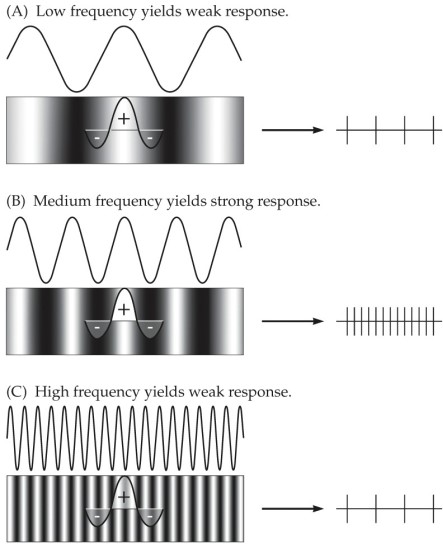 The retinal ganglion cell depicted is most responsive to which spatial frequency?
A) Low frequency (top)
B) Medium frequency (middle)
C) High frequency (bottom)
D) Both low and high frequencies (top and bottom)
E) All frequencies equally (top, middle, and bottom)
The retinal ganglion cell depicted is most responsive to which spatial frequency?A) Low frequency (top)
B) Medium frequency (middle)
C) High frequency (bottom)
D) Both low and high frequencies (top and bottom)
E) All frequencies equally (top, middle, and bottom)
سؤال
سؤال
Refer to the figure.
 The retinal ganglion cell pictured here would respond most strongly to which of the phases of the sine wave grating?
A) A
B) B
C) C
D) D
E) The ganglion cell would respond equally well to all of these.
The retinal ganglion cell pictured here would respond most strongly to which of the phases of the sine wave grating?A) A
B) B
C) C
D) D
E) The ganglion cell would respond equally well to all of these.
سؤال
سؤال
سؤال
سؤال
سؤال
سؤال
Refer to the figure.
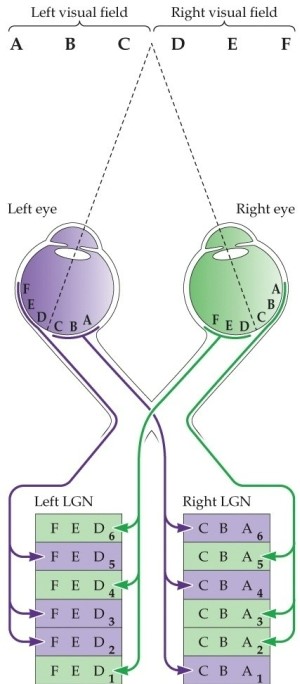 In the figure, the right LGN contains information from the
A) left visual field.
B) right visual field.
C) right eye.
D) left eye.
E) magnocellular layer.
In the figure, the right LGN contains information from theA) left visual field.
B) right visual field.
C) right eye.
D) left eye.
E) magnocellular layer.
سؤال
سؤال
سؤال
سؤال
سؤال
سؤال
سؤال
سؤال
سؤال
سؤال
سؤال
سؤال
Refer to the figure.
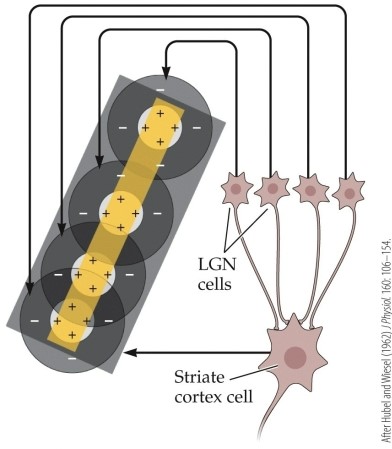 This figure shows
A) how images end up on the retina.
B) the firing patterns of four cells.
C) how cortical simple cells get their orientation tuning.
D) how simple cells and complex cells interact.
E) how magnocellular and parvocellular cells interact.
This figure showsA) how images end up on the retina.
B) the firing patterns of four cells.
C) how cortical simple cells get their orientation tuning.
D) how simple cells and complex cells interact.
E) how magnocellular and parvocellular cells interact.
سؤال
سؤال
سؤال
Refer to the figure.
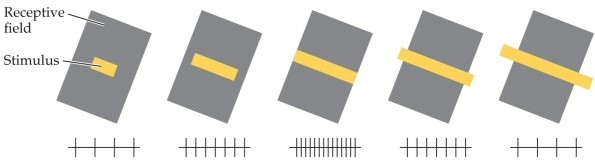 What phenomenon does the figure demonstrate?
A) Cortical magnification
B) Ocular dominance
C) Filtering
D) End stopping
E) Orientation tuning
What phenomenon does the figure demonstrate?A) Cortical magnification
B) Ocular dominance
C) Filtering
D) End stopping
E) Orientation tuning
سؤال
سؤال
سؤال
سؤال
سؤال
سؤال
سؤال
سؤال
سؤال
سؤال
سؤال
سؤال
سؤال
سؤال
سؤال
سؤال
سؤال
سؤال
سؤال
سؤال
سؤال
سؤال
سؤال

فتح الحزمة
قم بالتسجيل لفتح البطاقات في هذه المجموعة!
Unlock Deck
Unlock Deck
1/63

العب

ملء الشاشة (f)
Deck 3: Spatial Vision: From Spots to Stripes
1
The difference in illumination between a figure and its background is known as
A) contrast.
B) definition.
C) visual angle.
D) surround.
E) brightness.
A) contrast.
B) definition.
C) visual angle.
D) surround.
E) brightness.
contrast.
2
During a foggy day, what aspect of visual acuity has been reduced?
A) Spatial frequency
B) Contrast
C) Visual angle
D) Resolution
E) Orientation
A) Spatial frequency
B) Contrast
C) Visual angle
D) Resolution
E) Orientation
Contrast
3
Spatial frequency refers to the
A) flicker rate of a grating.
B) distance between the observer and a grating.
C) amount of contrast in a room.
D) contrast threshold.
E) number of cycles of a grating per unit of visual angle.
A) flicker rate of a grating.
B) distance between the observer and a grating.
C) amount of contrast in a room.
D) contrast threshold.
E) number of cycles of a grating per unit of visual angle.
number of cycles of a grating per unit of visual angle.
4
The spatial frequency of a stimulus is measured in
A) Snellen units.
B) angles per degree.
C) cycles per second.
D) degrees per second.
E) cycles per degree.
A) Snellen units.
B) angles per degree.
C) cycles per second.
D) degrees per second.
E) cycles per degree.
فتح الحزمة
افتح القفل للوصول البطاقات البالغ عددها 63 في هذه المجموعة.
فتح الحزمة
k this deck
5
The _______ function describes how spatial frequency and contrast interact to make a grating more or less visible.
A) spatial frequency
B) contrast sensitivity
C) spatial layout
D) grating positioning
E) visual angle
A) spatial frequency
B) contrast sensitivity
C) spatial layout
D) grating positioning
E) visual angle
فتح الحزمة
افتح القفل للوصول البطاقات البالغ عددها 63 في هذه المجموعة.
فتح الحزمة
k this deck
6
Visual angle is a measure of the
A) actual size of an object.
B) perceived size of an object.
C) angle between the observer and an object.
D) object's contrast divided by its spatial frequency.
E) size an object takes up on the retina.
A) actual size of an object.
B) perceived size of an object.
C) angle between the observer and an object.
D) object's contrast divided by its spatial frequency.
E) size an object takes up on the retina.
فتح الحزمة
افتح القفل للوصول البطاقات البالغ عددها 63 في هذه المجموعة.
فتح الحزمة
k this deck
7
Which manipulation would cause the visual angle of a balloon to increase?
A) Moving the balloon farther away
B) Rotating the balloon
C) Inflating the balloon
D) Deflating the balloon
E) Inverting the balloon
A) Moving the balloon farther away
B) Rotating the balloon
C) Inflating the balloon
D) Deflating the balloon
E) Inverting the balloon
فتح الحزمة
افتح القفل للوصول البطاقات البالغ عددها 63 في هذه المجموعة.
فتح الحزمة
k this deck
8
The smallest spatial detail that can be resolved at 100% contrast is known as
A) sharpness.
B) spatial frequency.
C) acuity.
D) visual angle.
E) phase.
A) sharpness.
B) spatial frequency.
C) acuity.
D) visual angle.
E) phase.
فتح الحزمة
افتح القفل للوصول البطاقات البالغ عددها 63 في هذه المجموعة.
فتح الحزمة
k this deck
9
Eye doctors specify acuity in terms like "20/20," but vision scientists prefer to talk about the smallest _______ of a cycle of a grating that one can perceive.
A) sine wave
B) segment
C) visual angle
D) viewing distance
E) width
A) sine wave
B) segment
C) visual angle
D) viewing distance
E) width
فتح الحزمة
افتح القفل للوصول البطاقات البالغ عددها 63 في هذه المجموعة.
فتح الحزمة
k this deck
10
If somebody has 20/100 vision, this means
A) they see at 20 feet what a person with normal vision sees at 100 feet.
B) they see at 100 feet what a person with normal vision sees at 20 feet.
C) they see only 20/100 (or 1/5th) as well as a person with normal vision.
D) only 20 out of 100 people have vision as poor as theirs.
E) only 20 out of 100 people have vision better than theirs.
A) they see at 20 feet what a person with normal vision sees at 100 feet.
B) they see at 100 feet what a person with normal vision sees at 20 feet.
C) they see only 20/100 (or 1/5th) as well as a person with normal vision.
D) only 20 out of 100 people have vision as poor as theirs.
E) only 20 out of 100 people have vision better than theirs.
فتح الحزمة
افتح القفل للوصول البطاقات البالغ عددها 63 في هذه المجموعة.
فتح الحزمة
k this deck
11
_______ is the smallest amount of contrast required to detect a pattern.
A) Spatial frequency
B) Visual acuity
C) Luminance threshold
D) Contrast threshold
E) Activation threshold
A) Spatial frequency
B) Visual acuity
C) Luminance threshold
D) Contrast threshold
E) Activation threshold
فتح الحزمة
افتح القفل للوصول البطاقات البالغ عددها 63 في هذه المجموعة.
فتح الحزمة
k this deck
12
Refer to the graph.
What does the "visible" region in the graph refer to?
A) Acuity
B) The visibility of any object whose spatial frequencies and contrasts fall within it
C) The degree to which one can see from a distance of 20 feet
D) The lowest contrast one can distinguish
E) The distance at which an eye chart should be readable to a normal observer
What does the "visible" region in the graph refer to?A) Acuity
B) The visibility of any object whose spatial frequencies and contrasts fall within it
C) The degree to which one can see from a distance of 20 feet
D) The lowest contrast one can distinguish
E) The distance at which an eye chart should be readable to a normal observer
فتح الحزمة
افتح القفل للوصول البطاقات البالغ عددها 63 في هذه المجموعة.
فتح الحزمة
k this deck
13
Scientists study contrast sensitivity for sine wave gratings because
A) patterns of stripes with fuzzy boundaries are common in the real world.
B) the eye is especially sensitive to sine wave gratings.
C) sine wave gratings involve no shadows.
D) sine wave gratings are easy to study.
E) contrast sensitivity is easy to study.
A) patterns of stripes with fuzzy boundaries are common in the real world.
B) the eye is especially sensitive to sine wave gratings.
C) sine wave gratings involve no shadows.
D) sine wave gratings are easy to study.
E) contrast sensitivity is easy to study.
فتح الحزمة
افتح القفل للوصول البطاقات البالغ عددها 63 في هذه المجموعة.
فتح الحزمة
k this deck
14
_______ is a mathematical procedure by which a signal can be separated into component sine waves at different frequencies. Combining these sine waves will reproduce the original signal.
A) Fourier analysis
B) Signal detection theory
C) Weber's law
D) Fechner's law
E) Stevens' power law
A) Fourier analysis
B) Signal detection theory
C) Weber's law
D) Fechner's law
E) Stevens' power law
فتح الحزمة
افتح القفل للوصول البطاقات البالغ عددها 63 في هذه المجموعة.
فتح الحزمة
k this deck
15
The distance required for one full cycle of a repeating waveform is its
A) phase.
B) sign.
C) amplitude.
D) wavelength.
E) angle.
A) phase.
B) sign.
C) amplitude.
D) wavelength.
E) angle.
فتح الحزمة
افتح القفل للوصول البطاقات البالغ عددها 63 في هذه المجموعة.
فتح الحزمة
k this deck
16
In a referee's uniform, the number of white and black stripes per inch could be considered its
A) phase.
B) spatial frequency.
C) amplitude.
D) wavelength.
E) angle.
A) phase.
B) spatial frequency.
C) amplitude.
D) wavelength.
E) angle.
فتح الحزمة
افتح القفل للوصول البطاقات البالغ عددها 63 في هذه المجموعة.
فتح الحزمة
k this deck
17
Refer to the figure showing the responses (right) of an ON-center retinal ganglion cell to gratings of different spatial frequencies (left).
The retinal ganglion cell depicted is most responsive to which spatial frequency?
A) Low frequency (top)
B) Medium frequency (middle)
C) High frequency (bottom)
D) Both low and high frequencies (top and bottom)
E) All frequencies equally (top, middle, and bottom)
The retinal ganglion cell depicted is most responsive to which spatial frequency?A) Low frequency (top)
B) Medium frequency (middle)
C) High frequency (bottom)
D) Both low and high frequencies (top and bottom)
E) All frequencies equally (top, middle, and bottom)
فتح الحزمة
افتح القفل للوصول البطاقات البالغ عددها 63 في هذه المجموعة.
فتح الحزمة
k this deck
18
Each retinal ganglion cell responds not only to spots of light but also to certain
A) fields of uniform gray.
B) circles of uniform gray.
C) squares of uniform gray.
D) patterns of stripes.
E) motion directions.
A) fields of uniform gray.
B) circles of uniform gray.
C) squares of uniform gray.
D) patterns of stripes.
E) motion directions.
فتح الحزمة
افتح القفل للوصول البطاقات البالغ عددها 63 في هذه المجموعة.
فتح الحزمة
k this deck
19
Refer to the figure.
The retinal ganglion cell pictured here would respond most strongly to which of the phases of the sine wave grating?
A) A
B) B
C) C
D) D
E) The ganglion cell would respond equally well to all of these.
The retinal ganglion cell pictured here would respond most strongly to which of the phases of the sine wave grating?A) A
B) B
C) C
D) D
E) The ganglion cell would respond equally well to all of these.
فتح الحزمة
افتح القفل للوصول البطاقات البالغ عددها 63 في هذه المجموعة.
فتح الحزمة
k this deck
20
The axons of retinal ganglion cells synapse in the two
A) magnocellular layers.
B) parvocellular layers.
C) cortexes.
D) koniocellular layers.
E) lateral geniculate nuclei.
A) magnocellular layers.
B) parvocellular layers.
C) cortexes.
D) koniocellular layers.
E) lateral geniculate nuclei.
فتح الحزمة
افتح القفل للوصول البطاقات البالغ عددها 63 في هذه المجموعة.
فتح الحزمة
k this deck
21
Which neurons are found in the lateral geniculate nucleus (LGN)?
A) Magnocellular only
B) Parvocellular only
C) Koniocellular only
D) Magnocellular and parvocellular only
E) Magnocellular, parvocellular, and koniocellular
A) Magnocellular only
B) Parvocellular only
C) Koniocellular only
D) Magnocellular and parvocellular only
E) Magnocellular, parvocellular, and koniocellular
فتح الحزمة
افتح القفل للوصول البطاقات البالغ عددها 63 في هذه المجموعة.
فتح الحزمة
k this deck
22
If two objects appear near each other in the world, they will also be processed by cells near each other
A) on the retina only.
B) in the LGN only.
C) in striate cortex only.
D) in the LGN and striate cortex only.
E) on the retina, in the LGN, and in the striate cortex.
A) on the retina only.
B) in the LGN only.
C) in striate cortex only.
D) in the LGN and striate cortex only.
E) on the retina, in the LGN, and in the striate cortex.
فتح الحزمة
افتح القفل للوصول البطاقات البالغ عددها 63 في هذه المجموعة.
فتح الحزمة
k this deck
23
Topographical mapping is the
A) layout of the brain.
B) guide to the structures of the brain.
C) orderly mapping of the world in the LGN and visual cortex.
D) simultaneous mapping of two objects in the visual system.
E) mapping of gyri and sulci in the brain.
A) layout of the brain.
B) guide to the structures of the brain.
C) orderly mapping of the world in the LGN and visual cortex.
D) simultaneous mapping of two objects in the visual system.
E) mapping of gyri and sulci in the brain.
فتح الحزمة
افتح القفل للوصول البطاقات البالغ عددها 63 في هذه المجموعة.
فتح الحزمة
k this deck
24
The right visual field projects to the _______ half of each eye and then is analyzed by the LGN in the _______ hemisphere.
A) left; left
B) left; right
C) right; left
D) right; right
E) upper; lower
A) left; left
B) left; right
C) right; left
D) right; right
E) upper; lower
فتح الحزمة
افتح القفل للوصول البطاقات البالغ عددها 63 في هذه المجموعة.
فتح الحزمة
k this deck
25
Refer to the figure.
In the figure, the right LGN contains information from the
A) left visual field.
B) right visual field.
C) right eye.
D) left eye.
E) magnocellular layer.
In the figure, the right LGN contains information from theA) left visual field.
B) right visual field.
C) right eye.
D) left eye.
E) magnocellular layer.
فتح الحزمة
افتح القفل للوصول البطاقات البالغ عددها 63 في هذه المجموعة.
فتح الحزمة
k this deck
26
Each of the following are different names for the same structure except
A) area V1.
B) primary visual cortex.
C) LGN.
D) striate cortex.
E) area 17.
A) area V1.
B) primary visual cortex.
C) LGN.
D) striate cortex.
E) area 17.
فتح الحزمة
افتح القفل للوصول البطاقات البالغ عددها 63 في هذه المجموعة.
فتح الحزمة
k this deck
27
Cortical magnification is the _______ devoted to a specific region in the visual field.
A) topographical map
B) amount of cortical area
C) amount of blood
D) number of photoreceptors
E) amount of retinal area
A) topographical map
B) amount of cortical area
C) amount of blood
D) number of photoreceptors
E) amount of retinal area
فتح الحزمة
افتح القفل للوصول البطاقات البالغ عددها 63 في هذه المجموعة.
فتح الحزمة
k this deck
28
Which object would have the most neurons responding to it in striate cortex, and why?
A) An object in the periphery, because the periphery has greater cortical magnification than the fovea.
B) An object in the periphery, because the fovea has greater cortical magnification than the periphery.
C) An object in the fovea, because the periphery has greater cortical magnification than the fovea.
D) An object in the fovea, because the fovea has greater cortical magnification than the periphery.
E) An object in the periphery, because objects in the fovea are not processed by the striate cortex.
A) An object in the periphery, because the periphery has greater cortical magnification than the fovea.
B) An object in the periphery, because the fovea has greater cortical magnification than the periphery.
C) An object in the fovea, because the periphery has greater cortical magnification than the fovea.
D) An object in the fovea, because the fovea has greater cortical magnification than the periphery.
E) An object in the periphery, because objects in the fovea are not processed by the striate cortex.
فتح الحزمة
افتح القفل للوصول البطاقات البالغ عددها 63 في هذه المجموعة.
فتح الحزمة
k this deck
29
If you look into somebody's eyes, which part of their face is being processed by the fewest cells in striate cortex, based on the principles of topographic mapping and cortical magnification?
A) Chin
B) Nose
C) Mouth
D) Eyebrows
E) Eyes
A) Chin
B) Nose
C) Mouth
D) Eyebrows
E) Eyes
فتح الحزمة
افتح القفل للوصول البطاقات البالغ عددها 63 في هذه المجموعة.
فتح الحزمة
k this deck
30
The deleterious effect of clutter on peripheral object recognition is known as
A) clutter induced blindness.
B) lateral agnosia.
C) horizontal masking.
D) visual noise.
E) visual crowding.
A) clutter induced blindness.
B) lateral agnosia.
C) horizontal masking.
D) visual noise.
E) visual crowding.
فتح الحزمة
افتح القفل للوصول البطاقات البالغ عددها 63 في هذه المجموعة.
فتح الحزمة
k this deck
31
Suppose you are looking for your friend's face in a crowd. Due to visual clutter, it will be hardest to identify her if she is standing
A) by herself and is in your central vision.
B) between two people and is in your central vision.
C) by herself and is in your peripheral vision.
D) between two people and is in your peripheral vision.
E) between three people and is in your central vision.
A) by herself and is in your central vision.
B) between two people and is in your central vision.
C) by herself and is in your peripheral vision.
D) between two people and is in your peripheral vision.
E) between three people and is in your central vision.
فتح الحزمة
افتح القفل للوصول البطاقات البالغ عددها 63 في هذه المجموعة.
فتح الحزمة
k this deck
32
Hubel and Wiesel uncovered some important properties of the _______ of neurons in the striate cortex.
A) photoreceptors
B) neurotransmitters
C) axons
D) dendrites
E) receptive fields
A) photoreceptors
B) neurotransmitters
C) axons
D) dendrites
E) receptive fields
فتح الحزمة
افتح القفل للوصول البطاقات البالغ عددها 63 في هذه المجموعة.
فتح الحزمة
k this deck
33
Which stimulus would a striate cortex neuron respond to most vigorously?
A) An oriented bar of light
B) A filled circle of light
C) A spot of light surrounded by a ring of darkness
D) A spot of darkness surrounded by a ring of light
E) A spot of darkness on a field of light
A) An oriented bar of light
B) A filled circle of light
C) A spot of light surrounded by a ring of darkness
D) A spot of darkness surrounded by a ring of light
E) A spot of darkness on a field of light
فتح الحزمة
افتح القفل للوصول البطاقات البالغ عددها 63 في هذه المجموعة.
فتح الحزمة
k this deck
34
A neuron that allows the passage of some frequencies and blocks the passage of others is a
A) selector cell.
B) ganglion cell.
C) filter.
D) bipolar cell.
E) contrast cell.
A) selector cell.
B) ganglion cell.
C) filter.
D) bipolar cell.
E) contrast cell.
فتح الحزمة
افتح القفل للوصول البطاقات البالغ عددها 63 في هذه المجموعة.
فتح الحزمة
k this deck
35
Which term refers to the fact that striate cortex neurons tend to respond more strongly to stimuli presented in one eye as compared to the other?
A) Cortical magnification
B) Ocular dominance
C) Filtering
D) End stopping
E) Orientation tuning
A) Cortical magnification
B) Ocular dominance
C) Filtering
D) End stopping
E) Orientation tuning
فتح الحزمة
افتح القفل للوصول البطاقات البالغ عددها 63 في هذه المجموعة.
فتح الحزمة
k this deck
36
The tendency of neurons in striate cortex to respond optimally to certain orientations and less to others is known as
A) spatial frequency.
B) spatial selection.
C) orientation tuning.
D) cortical magnification.
E) orientation agnosia.
A) spatial frequency.
B) spatial selection.
C) orientation tuning.
D) cortical magnification.
E) orientation agnosia.
فتح الحزمة
افتح القفل للوصول البطاقات البالغ عددها 63 في هذه المجموعة.
فتح الحزمة
k this deck
37
Refer to the figure.
This figure shows
A) how images end up on the retina.
B) the firing patterns of four cells.
C) how cortical simple cells get their orientation tuning.
D) how simple cells and complex cells interact.
E) how magnocellular and parvocellular cells interact.
This figure showsA) how images end up on the retina.
B) the firing patterns of four cells.
C) how cortical simple cells get their orientation tuning.
D) how simple cells and complex cells interact.
E) how magnocellular and parvocellular cells interact.
فتح الحزمة
افتح القفل للوصول البطاقات البالغ عددها 63 في هذه المجموعة.
فتح الحزمة
k this deck
38
A _______ cell is a neuron whose receptive field does not have clearly defined excitatory and inhibitory regions.
A) complex
B) simple
C) stop
D) ganglion
E) blob
A) complex
B) simple
C) stop
D) ganglion
E) blob
فتح الحزمة
افتح القفل للوصول البطاقات البالغ عددها 63 في هذه المجموعة.
فتح الحزمة
k this deck
39
________ is the phenomenon in which a striate cortex neuron responds most strongly when a bar of light fills its receptive field rather than being either smaller than the receptive field or extending beyond it.
A) Cortical magnification
B) End stopping
C) Ocular dominance
D) Filtering
E) Orientation tuning
A) Cortical magnification
B) End stopping
C) Ocular dominance
D) Filtering
E) Orientation tuning
فتح الحزمة
افتح القفل للوصول البطاقات البالغ عددها 63 في هذه المجموعة.
فتح الحزمة
k this deck
40
Refer to the figure.
What phenomenon does the figure demonstrate?
A) Cortical magnification
B) Ocular dominance
C) Filtering
D) End stopping
E) Orientation tuning
What phenomenon does the figure demonstrate?A) Cortical magnification
B) Ocular dominance
C) Filtering
D) End stopping
E) Orientation tuning
فتح الحزمة
افتح القفل للوصول البطاقات البالغ عددها 63 في هذه المجموعة.
فتح الحزمة
k this deck
41
Hubel and Wiesel concluded that neurons with similar orientation preferences were arranged in _______ that extended vertically through the cortex.
A) horizontal tracks
B) branches
C) rows
D) tangles
E) columns
A) horizontal tracks
B) branches
C) rows
D) tangles
E) columns
فتح الحزمة
افتح القفل للوصول البطاقات البالغ عددها 63 في هذه المجموعة.
فتح الحزمة
k this deck
42
A _______ is a 1-mm block of striate cortex containing two sets of columns, each covering every possible orientation (0-180 degrees), with one set preferring input from the left eye and the other set preferring input from the right eye.
A) V1 module
B) hypercolumn
C) CO blob
D) simple cell
E) complex cell
A) V1 module
B) hypercolumn
C) CO blob
D) simple cell
E) complex cell
فتح الحزمة
افتح القفل للوصول البطاقات البالغ عددها 63 في هذه المجموعة.
فتح الحزمة
k this deck
43
_______ is an enzyme used to reveal the regular array of CO blobs, which are spaced about 0.5 mm apart in the primary visual cortex.
A) Chromophore
B) Rhodopsin
C) Cytochrome oxidase
D) Carbon dioxide
E) Carbon monoxide
A) Chromophore
B) Rhodopsin
C) Cytochrome oxidase
D) Carbon dioxide
E) Carbon monoxide
فتح الحزمة
افتح القفل للوصول البطاقات البالغ عددها 63 في هذه المجموعة.
فتح الحزمة
k this deck
44
Which aspect of a visual stimulus do neurons in CO blobs process?
A) Blur
B) Orientation
C) Spatial frequency
D) Motion
E) Color
A) Blur
B) Orientation
C) Spatial frequency
D) Motion
E) Color
فتح الحزمة
افتح القفل للوصول البطاقات البالغ عددها 63 في هذه المجموعة.
فتح الحزمة
k this deck
45
The diminishing response of a sense organ to a sustained stimulus is referred to as
A) constant stimulation.
B) response decrease.
C) adaptation.
D) accommodation.
E) convergence.
A) constant stimulation.
B) response decrease.
C) adaptation.
D) accommodation.
E) convergence.
فتح الحزمة
افتح القفل للوصول البطاقات البالغ عددها 63 في هذه المجموعة.
فتح الحزمة
k this deck
46
The tilt aftereffect is the perceptual illusion of tilt, produced by
A) adapting to a pattern of a given orientation.
B) changing the direction of gaze.
C) tilting the head.
D) constantly moving the head.
E) spinning in circles for 30 seconds.
A) adapting to a pattern of a given orientation.
B) changing the direction of gaze.
C) tilting the head.
D) constantly moving the head.
E) spinning in circles for 30 seconds.
فتح الحزمة
افتح القفل للوصول البطاقات البالغ عددها 63 في هذه المجموعة.
فتح الحزمة
k this deck
47
No single neuron receives input from both eyes until the
A) LGN.
B) primary visual cortex.
C) parietal lobe.
D) magnocellular layer.
E) parvocellular layer.
A) LGN.
B) primary visual cortex.
C) parietal lobe.
D) magnocellular layer.
E) parvocellular layer.
فتح الحزمة
افتح القفل للوصول البطاقات البالغ عددها 63 في هذه المجموعة.
فتح الحزمة
k this deck
48
Spatial frequency channels are often referred to as
A) a set of simple cells.
B) a set of complex cells.
C) orientation tuned cells.
D) filters.
E) pattern analyzers.
A) a set of simple cells.
B) a set of complex cells.
C) orientation tuned cells.
D) filters.
E) pattern analyzers.
فتح الحزمة
افتح القفل للوصول البطاقات البالغ عددها 63 في هذه المجموعة.
فتح الحزمة
k this deck
49
If a movie projector is out of focus and the images on the screen are blurry, which spatial frequencies are missing?
A) Low frequencies
B) High frequencies
C) Horizontal frequencies
D) Vertical frequencies
E) Diagonal frequencies
A) Low frequencies
B) High frequencies
C) Horizontal frequencies
D) Vertical frequencies
E) Diagonal frequencies
فتح الحزمة
افتح القفل للوصول البطاقات البالغ عددها 63 في هذه المجموعة.
فتح الحزمة
k this deck
50
In a line drawing of an object, which spatial frequencies are least represented?
A) Low frequencies
B) High frequencies
C) Horizontal frequencies
D) Vertical frequencies
E) Diagonal frequencies
A) Low frequencies
B) High frequencies
C) Horizontal frequencies
D) Vertical frequencies
E) Diagonal frequencies
فتح الحزمة
افتح القفل للوصول البطاقات البالغ عددها 63 في هذه المجموعة.
فتح الحزمة
k this deck
51
What term describes a phase in the life span during which abnormal early experience can alter normal neuronal development?
A) Impressionable era
B) Sensitive phase
C) Ontologically sensitive era
D) Critical period
E) Delicate span
A) Impressionable era
B) Sensitive phase
C) Ontologically sensitive era
D) Critical period
E) Delicate span
فتح الحزمة
افتح القفل للوصول البطاقات البالغ عددها 63 في هذه المجموعة.
فتح الحزمة
k this deck
52
_______ is a developmental disorder characterized by reduced spatial vision in an otherwise healthy eye, even with proper correction for refractive error.
A) Astigmatism
B) Anisometropia
C) Strabismus
D) Amblyopia
E) Hyperopia
A) Astigmatism
B) Anisometropia
C) Strabismus
D) Amblyopia
E) Hyperopia
فتح الحزمة
افتح القفل للوصول البطاقات البالغ عددها 63 في هذه المجموعة.
فتح الحزمة
k this deck
53
_______ is a misalignment of the two eyes such that a single object in space is imaged on the fovea of one eye and on the nonfoveal area of the other (turned) eye.
A) Astigmatism
B) Anisometropia
C) Strabismus
D) Amblyopia
E) Hyperopia
A) Astigmatism
B) Anisometropia
C) Strabismus
D) Amblyopia
E) Hyperopia
فتح الحزمة
افتح القفل للوصول البطاقات البالغ عددها 63 في هذه المجموعة.
فتح الحزمة
k this deck
54
_______ is a condition in which the two eyes have different refractive errors.
A) Astigmatism
B) Anisometropia
C) Strabismus
D) Amblyopia
E) Hyperopia
A) Astigmatism
B) Anisometropia
C) Strabismus
D) Amblyopia
E) Hyperopia
فتح الحزمة
افتح القفل للوصول البطاقات البالغ عددها 63 في هذه المجموعة.
فتح الحزمة
k this deck
55
Which experimental technique is used to determine which stimuli infants can and cannot see?
A) Signal detection
B) Method of constant stimuli
C) Preferential looking paradigm
D) Method of adjustment
E) Method of limits
A) Signal detection
B) Method of constant stimuli
C) Preferential looking paradigm
D) Method of adjustment
E) Method of limits
فتح الحزمة
افتح القفل للوصول البطاقات البالغ عددها 63 في هذه المجموعة.
فتح الحزمة
k this deck
56
If an infant looks longer at a striped square than a gray square, what does that indicate?
A) The infant's visual acuity is high enough that they can perceive the stripes, and they are attracted to low contrast images.
B) The infant's visual acuity is high enough that they can perceive the stripes, and they are attracted to high contrast images.
C) The infant's visual acuity is too low to perceive the stripes, but they do not like to look at gray squares.
D) The infant's visual acuity is high enough that they can perceive the gray square, and they are repelled by gray squares.
E) You can't learn anything about infant perception based on where they like to look.
A) The infant's visual acuity is high enough that they can perceive the stripes, and they are attracted to low contrast images.
B) The infant's visual acuity is high enough that they can perceive the stripes, and they are attracted to high contrast images.
C) The infant's visual acuity is too low to perceive the stripes, but they do not like to look at gray squares.
D) The infant's visual acuity is high enough that they can perceive the gray square, and they are repelled by gray squares.
E) You can't learn anything about infant perception based on where they like to look.
فتح الحزمة
افتح القفل للوصول البطاقات البالغ عددها 63 في هذه المجموعة.
فتح الحزمة
k this deck
57
Describe two ways that visual acuity can be measured.
فتح الحزمة
افتح القفل للوصول البطاقات البالغ عددها 63 في هذه المجموعة.
فتح الحزمة
k this deck
58
Why do vision scientists study sine wave gratings?
فتح الحزمة
افتح القفل للوصول البطاقات البالغ عددها 63 في هذه المجموعة.
فتح الحزمة
k this deck
59
What is the difference between simple and complex cortical neurons in primary visual cortex?
فتح الحزمة
افتح القفل للوصول البطاقات البالغ عددها 63 في هذه المجموعة.
فتح الحزمة
k this deck
60
What is a "hypercolumn" in primary visual cortex?
فتح الحزمة
افتح القفل للوصول البطاقات البالغ عددها 63 في هذه المجموعة.
فتح الحزمة
k this deck
61
Describe the receptive field properties of retinal ganglion cells, LGN cells, and V1 cells. In what ways are they similar and in what ways are they different? How do the response properties of the cells change from retina to LGN to V1?
فتح الحزمة
افتح القفل للوصول البطاقات البالغ عددها 63 في هذه المجموعة.
فتح الحزمة
k this deck
62
Describe how selective adaptation works and why it is useful for studying visual perception.
فتح الحزمة
افتح القفل للوصول البطاقات البالغ عددها 63 في هذه المجموعة.
فتح الحزمة
k this deck
63
Describe the development of contrast sensitivity in infants and how it might be affected by developmental disorders such as amblyopia, strabismus, or anisometropia.
فتح الحزمة
افتح القفل للوصول البطاقات البالغ عددها 63 في هذه المجموعة.
فتح الحزمة
k this deck
فتح الحزمة
افتح القفل للوصول البطاقات البالغ عددها 63 في هذه المجموعة.






