Deck 12: Molecular Characterisation

ملء الشاشة (f)
exit full mode
سؤال
By elemental analysis, the carbon content of an unknown compound was found to be 85.7%. From the following molecular formulae, (a)-(d), pick out the most likely formula for this unknown compound:

A) C4H8O
B) C5H8O
C) C6H12
D) C6H6
استخدم زر المسافة أو
up arrow
down arrow
لقلب البطاقة.
سؤال
Pick out the isotopic distribution pattern for 2-phenylpropanoic acid (hint: 1.1% of all carbon atoms have an atomic mass of 13).

A) 150 (M, 100%), 151 (1%), 152 (0.01%).
B) 150 (M, 100%), 151 (5%), 152 (0.05%).
C) 150 (M, 100%), 151 (10%), 152 (0.1%).
D) 150 (M, 100%), 151 (20%), 152 (0.2%).
سؤال
Pick out the molecular ion peak for a molecule containing a single nitrogen atom.

A) 84.
B) 93.
C) 108.
D) 114.
سؤال
Match the following molecular formulae to the mass spectra A-C:
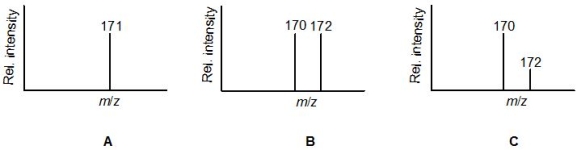
<strong>Match the following molecular formulae to the mass spectra A-C:   -C<sub>7</sub>H<sub>7</sub>Br</strong> A) B B) C C) A <div style=padding-top: 35px>
-C7H7Br

A) B
B) C
C) A
سؤال
Match the following molecular formulae to the mass spectra A-C:
<strong>Match the following molecular formulae to the mass spectra A-C:   -C<sub>8</sub>H<sub>9</sub>NOCl</strong> A) B B) C C) A <div style=padding-top: 35px>
-C8H9NOCl

A) B
B) C
C) A
سؤال
Match the following molecular formulae to the mass spectra A-C:
<strong>Match the following molecular formulae to the mass spectra A-C:   -C<sub>10</sub>H<sub>21</sub>NO</strong> A) B B) C C) A <div style=padding-top: 35px>
-C10H21NO

A) B
B) C
C) A
سؤال
Which of the following bonds has the strongest IR absorption?

<strong>Which of the following bonds has the strongest IR absorption?  </strong> A) A. B) B. C) C. D) D. <div style=padding-top: 35px>

A) A.
B) B.
C) C.
D) D.
سؤال
Match the following aliphatic molecules to their infrared carbonyl stretching frequency:

<strong>Match the following aliphatic molecules to their infrared carbonyl stretching frequency:   -1815 cm<sup>-1</sup></strong> A) A B) C C) D D) B <div style=padding-top: 35px>
-1815 cm-1

A) A
B) C
C) D
D) B
سؤال
Match the following aliphatic molecules to their infrared carbonyl stretching frequency:
<strong>Match the following aliphatic molecules to their infrared carbonyl stretching frequency:   -1740 cm<sup>-1</sup></strong> A) A B) C C) D D) B <div style=padding-top: 35px>
-1740 cm-1

A) A
B) C
C) D
D) B
سؤال
Match the following aliphatic molecules to their infrared carbonyl stretching frequency:
<strong>Match the following aliphatic molecules to their infrared carbonyl stretching frequency:   -1715 cm<sup>-1</sup></strong> A) A B) C C) D D) B <div style=padding-top: 35px>
-1715 cm-1

A) A
B) C
C) D
D) B
سؤال
Match the following aliphatic molecules to their infrared carbonyl stretching frequency:
<strong>Match the following aliphatic molecules to their infrared carbonyl stretching frequency:   -1650 cm<sup>-1</sup></strong> A) A B) C C) D D) B <div style=padding-top: 35px>
-1650 cm-1

A) A
B) C
C) D
D) B
سؤال
From the following molecules, pick out those which have no infrared absorption for a symmetrical stretch involving their corresponding double/triple bond(s). Please select all that apply.
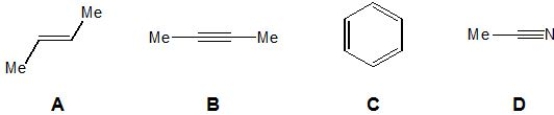
<strong>From the following molecules, pick out those which have no infrared absorption for a symmetrical stretch involving their corresponding double/triple bond(s). Please select all that apply.  </strong> A) A. B) B. C) C. D) D. <div style=padding-top: 35px>

A) A.
B) B.
C) C.
D) D.
سؤال
From the following molecules, pick out those which have four proton signals in their 1H NMR spectrum. Please select all that apply.
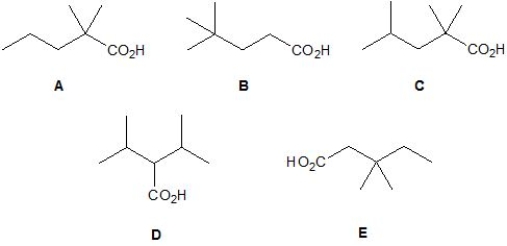
<strong>From the following molecules, pick out those which have four proton signals in their <sup>1</sup>H NMR spectrum. Please select all that apply.  </strong> A) A. B) B. C) C. D) D. E) E. <div style=padding-top: 35px>

A) A.
B) B.
C) C.
D) D.
E) E.
سؤال
From the following molecules, pick out those which do not have four proton signals in their 1H NMR spectrum. Please select all that apply.
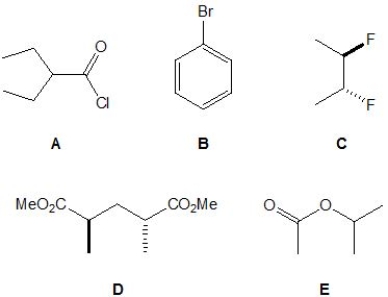
<strong>From the following molecules, pick out those which do not have four proton signals in their <sup>1</sup>H NMR spectrum. Please select all that apply.  </strong> A) A. B) B. C) C. D) D. E) E. <div style=padding-top: 35px>

A) A.
B) B.
C) C.
D) D.
E) E.
سؤال
How many magnetically non-equivalent carbon atoms are there in toluene?

A) 4.
B) 5.
C) 6.
D) 7.
سؤال
How many magnetically non-equivalent carbon atoms are there in the following molecule?
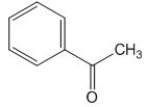
<strong>How many magnetically non-equivalent carbon atoms are there in the following molecule?  </strong> A) 5. B) 8. C) 4. D) 6. <div style=padding-top: 35px>

A) 5.
B) 8.
C) 4.
D) 6.
سؤال
How many magnetically non-equivalent carbon atoms are there in the following molecule?
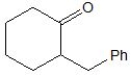
<strong>How many magnetically non-equivalent carbon atoms are there in the following molecule?  </strong> A) 7. B) 8. C) 10. D) 11. E) 13. <div style=padding-top: 35px>

A) 7.
B) 8.
C) 10.
D) 11.
E) 13.
سؤال
From the following molecules, pick out those which have six carbon signals in their 13C NMR spectrum. Please select all that apply.
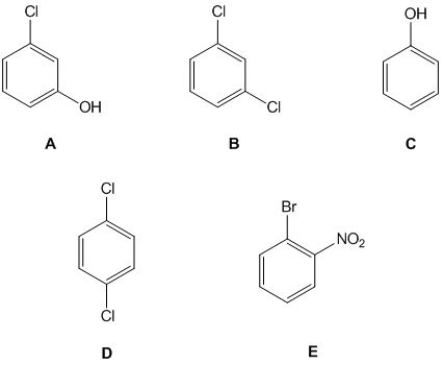
<strong>From the following molecules, pick out those which have six carbon signals in their <sup>13</sup>C NMR spectrum. Please select all that apply.  </strong> A) A. B) B. C) C. D) D. E) E. <div style=padding-top: 35px>

A) A.
B) B.
C) C.
D) D.
E) E.
سؤال
For an unknown compound, its proton and carbon NMR spectra showed three proton and four carbon signals, respectively. Pick out this unknown compound from the following molecules.
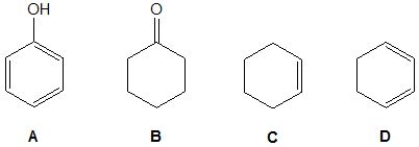
<strong>For an unknown compound, its proton and carbon NMR spectra showed three proton and four carbon signals, respectively. Pick out this unknown compound from the following molecules.  </strong> A) A. B) B. C) C. D) D. <div style=padding-top: 35px>

A) A.
B) B.
C) C.
D) D.
سؤال
The following molecules were examined by 1H NMR spectroscopy. Rank them in order of decreasing chemical shift for their methyl group (where 1 indicates the largest ppm and 3 indicates the smallest ppm):
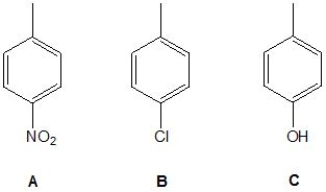
<strong>The following molecules were examined by <sup>1</sup>H NMR spectroscopy. Rank them in order of decreasing chemical shift for their methyl group (where 1 indicates the largest ppm and 3 indicates the smallest ppm):  </strong> A) Molecule A B) Molecule B C) Molecule C <div style=padding-top: 35px>

A) Molecule A
B) Molecule B
C) Molecule C
سؤال
Which one of the following 1H NMR signals is a quintet?
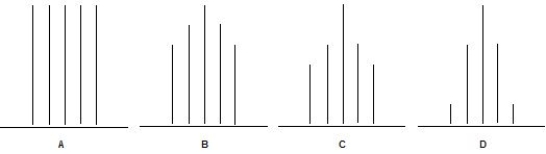
<strong>Which one of the following <sup>1</sup>H NMR signals is a quintet?  </strong> A) A. B) B. C) C. D) D. <div style=padding-top: 35px>

A) A.
B) B.
C) C.
D) D.
سؤال
By 1H NMR spectroscopy, what is the expected signal intensity for the eight lines of an octet?

A) 1:1:1:1:1:1:1:1.
B) 1:2:3:4:4:3:2:1.
C) 1:3:6:12:12:6:3:1.
D) 1:5:10:15:15:10:5:1.
E) 1:7:21:35:35:21:7:1.
سؤال
How many degrees of unsaturation are there in a compound with the molecular formula C6H10NOCl?

A) 1.
B) 2.
C) 3.
D) 4.
E) 5.
سؤال
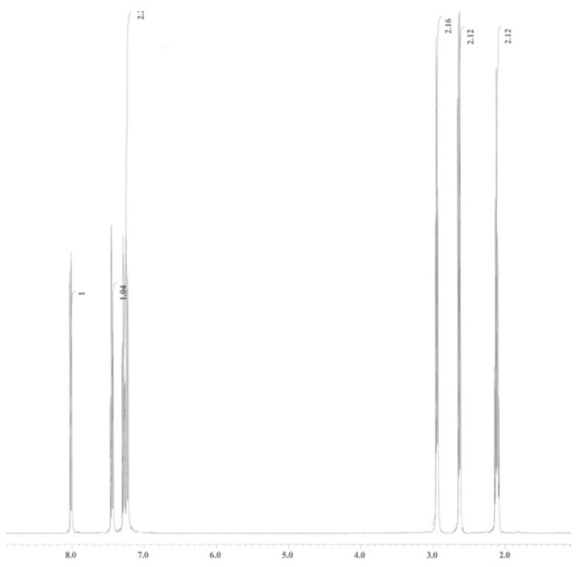
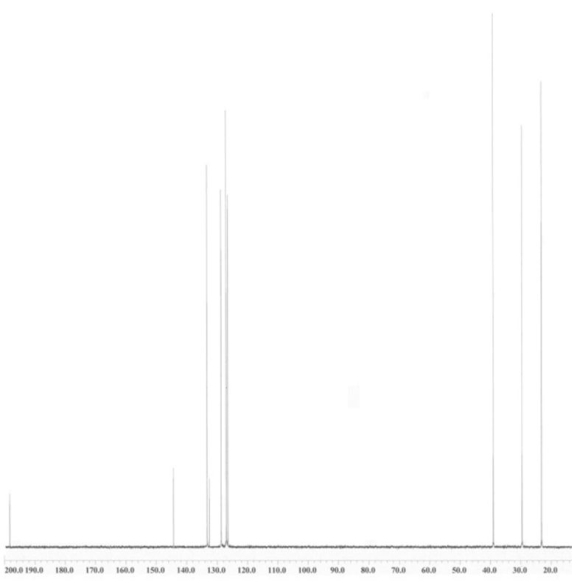
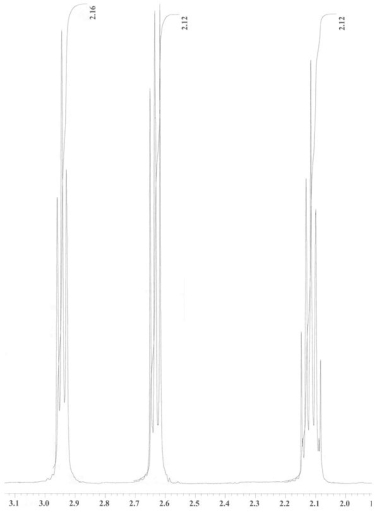
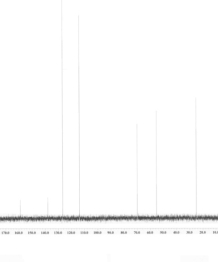
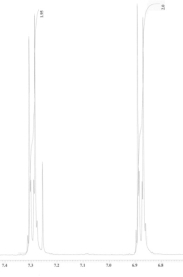
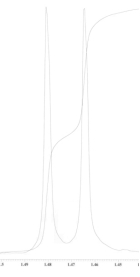
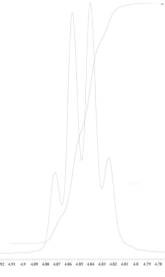
An unknown compound is analysed using NMR spectroscopy, generating the NMR spectra shown below. What is the structure of the unknown compound?
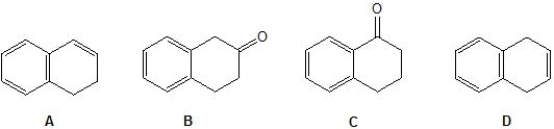
<strong>An unknown compound is analysed using NMR spectroscopy, generating the NMR spectra shown below. What is the structure of the unknown compound?   <sup>1</sup>H NMR spectrum of unknown compound   <sup>13</sup>C NMR spectrum of unknown compound   <sup>1</sup>H NMR expansion 1   <sup>1</sup>H NMR expansion 2  </strong> A) A. B) B. C) C. D) D. <div style=padding-top: 35px>
1H NMR spectrum of unknown compound
<strong>An unknown compound is analysed using NMR spectroscopy, generating the NMR spectra shown below. What is the structure of the unknown compound?   <sup>1</sup>H NMR spectrum of unknown compound   <sup>13</sup>C NMR spectrum of unknown compound   <sup>1</sup>H NMR expansion 1   <sup>1</sup>H NMR expansion 2  </strong> A) A. B) B. C) C. D) D. <div style=padding-top: 35px>
13C NMR spectrum of unknown compound
<strong>An unknown compound is analysed using NMR spectroscopy, generating the NMR spectra shown below. What is the structure of the unknown compound?   <sup>1</sup>H NMR spectrum of unknown compound   <sup>13</sup>C NMR spectrum of unknown compound   <sup>1</sup>H NMR expansion 1   <sup>1</sup>H NMR expansion 2  </strong> A) A. B) B. C) C. D) D. <div style=padding-top: 35px>
1H NMR expansion 1
<strong>An unknown compound is analysed using NMR spectroscopy, generating the NMR spectra shown below. What is the structure of the unknown compound?   <sup>1</sup>H NMR spectrum of unknown compound   <sup>13</sup>C NMR spectrum of unknown compound   <sup>1</sup>H NMR expansion 1   <sup>1</sup>H NMR expansion 2  </strong> A) A. B) B. C) C. D) D. <div style=padding-top: 35px>
1H NMR expansion 2
<strong>An unknown compound is analysed using NMR spectroscopy, generating the NMR spectra shown below. What is the structure of the unknown compound?   <sup>1</sup>H NMR spectrum of unknown compound   <sup>13</sup>C NMR spectrum of unknown compound   <sup>1</sup>H NMR expansion 1   <sup>1</sup>H NMR expansion 2  </strong> A) A. B) B. C) C. D) D. <div style=padding-top: 35px>

A) A.
B) B.
C) C.
D) D.
سؤال
An unknown compound is analysed using NMR spectroscopy, generating the NMR spectra shown below. What is the structure of the unknown compound?
<strong>An unknown compound is analysed using NMR spectroscopy, generating the NMR spectra shown below. What is the structure of the unknown compound?   <sup>1</sup>H NMR spectrum of unknown compound   <sup>13</sup>C NMR spectrum of unknown compound   <sup>1</sup>H NMR expansion 1   <sup>1</sup>H NMR expansion 2   <sup>1</sup>H NMR expansion 3  </strong> A) A. B) B. C) C. D) D. <div style=padding-top: 35px>
1H NMR spectrum of unknown compound
<strong>An unknown compound is analysed using NMR spectroscopy, generating the NMR spectra shown below. What is the structure of the unknown compound?   <sup>1</sup>H NMR spectrum of unknown compound   <sup>13</sup>C NMR spectrum of unknown compound   <sup>1</sup>H NMR expansion 1   <sup>1</sup>H NMR expansion 2   <sup>1</sup>H NMR expansion 3  </strong> A) A. B) B. C) C. D) D. <div style=padding-top: 35px>
13C NMR spectrum of unknown compound
<strong>An unknown compound is analysed using NMR spectroscopy, generating the NMR spectra shown below. What is the structure of the unknown compound?   <sup>1</sup>H NMR spectrum of unknown compound   <sup>13</sup>C NMR spectrum of unknown compound   <sup>1</sup>H NMR expansion 1   <sup>1</sup>H NMR expansion 2   <sup>1</sup>H NMR expansion 3  </strong> A) A. B) B. C) C. D) D. <div style=padding-top: 35px>
1H NMR expansion 1
<strong>An unknown compound is analysed using NMR spectroscopy, generating the NMR spectra shown below. What is the structure of the unknown compound?   <sup>1</sup>H NMR spectrum of unknown compound   <sup>13</sup>C NMR spectrum of unknown compound   <sup>1</sup>H NMR expansion 1   <sup>1</sup>H NMR expansion 2   <sup>1</sup>H NMR expansion 3  </strong> A) A. B) B. C) C. D) D. <div style=padding-top: 35px>
1H NMR expansion 2
<strong>An unknown compound is analysed using NMR spectroscopy, generating the NMR spectra shown below. What is the structure of the unknown compound?   <sup>1</sup>H NMR spectrum of unknown compound   <sup>13</sup>C NMR spectrum of unknown compound   <sup>1</sup>H NMR expansion 1   <sup>1</sup>H NMR expansion 2   <sup>1</sup>H NMR expansion 3  </strong> A) A. B) B. C) C. D) D. <div style=padding-top: 35px>
1H NMR expansion 3
<strong>An unknown compound is analysed using NMR spectroscopy, generating the NMR spectra shown below. What is the structure of the unknown compound?   <sup>1</sup>H NMR spectrum of unknown compound   <sup>13</sup>C NMR spectrum of unknown compound   <sup>1</sup>H NMR expansion 1   <sup>1</sup>H NMR expansion 2   <sup>1</sup>H NMR expansion 3  </strong> A) A. B) B. C) C. D) D. <div style=padding-top: 35px>

A) A.
B) B.
C) C.
D) D.
سؤال
Select all of the following statements on expected IR frequencies that are true. Please select all that apply.

A) Acid chlorides will appear between 1820 - 1650 cm-1
B) Esters will appear between 3600 - 2500 cm-1
C) Phenols will appear between 3600 - 2500 cm-1
D) Aromatic C-H will appear between 3000 - 2850 cm-1
سؤال
Select the following analytical techniques that would allow a pair of enantiomers of a molecule to be distinguished. Please select all that apply.

A) Chiral liquid chromatography
B) Mass Spectrometry
C) 1H-NMR
D) Polarimetry
سؤال
Select the molecule from the following structure that will have 6 carbon peaks, 4 hydrogen peaks in its NMR spectra.
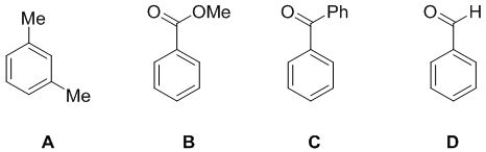
<strong>Select the molecule from the following structure that will have 6 carbon peaks, 4 hydrogen peaks in its NMR spectra.  </strong> A) A B) B C) C D) D <div style=padding-top: 35px>

A) A
B) B
C) C
D) D
سؤال
Based on the information given, select the molecule to which it fits best.
7 carbon and 5 hydrogen peaks in its NMR spectra. MS 183.95 (100 %), 185.95 (100 %). IR frequency at 1740 cm-1
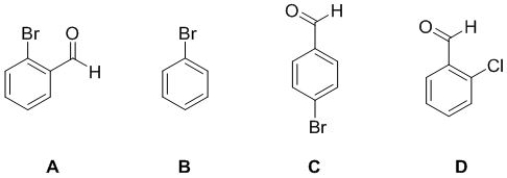
<strong>Based on the information given, select the molecule to which it fits best. 7 carbon and 5 hydrogen peaks in its NMR spectra. MS 183.95 (100 %), 185.95 (100 %). IR frequency at 1740 cm<sup>-1</sup>  </strong> A) A B) B C) C D) D <div style=padding-top: 35px>

A) A
B) B
C) C
D) D
سؤال
Select the two major factors which influence chemical shifts from the list below. Please select all that apply.

A) Electron density
B) Anisotropic effects
C) Symmetry effects
D) Number of adjacent atoms
فتح الحزمة
قم بالتسجيل لفتح البطاقات في هذه المجموعة!
Unlock Deck
Unlock Deck
1/30
auto play flashcards
العب
simple tutorial
ملء الشاشة (f)
exit full mode
Deck 12: Molecular Characterisation
1
By elemental analysis, the carbon content of an unknown compound was found to be 85.7%. From the following molecular formulae, (a)-(d), pick out the most likely formula for this unknown compound:

A) C4H8O
B) C5H8O
C) C6H12
D) C6H6
C
2
Pick out the isotopic distribution pattern for 2-phenylpropanoic acid (hint: 1.1% of all carbon atoms have an atomic mass of 13).

A) 150 (M, 100%), 151 (1%), 152 (0.01%).
B) 150 (M, 100%), 151 (5%), 152 (0.05%).
C) 150 (M, 100%), 151 (10%), 152 (0.1%).
D) 150 (M, 100%), 151 (20%), 152 (0.2%).
C
3
Pick out the molecular ion peak for a molecule containing a single nitrogen atom.

A) 84.
B) 93.
C) 108.
D) 114.
B
4
Match the following molecular formulae to the mass spectra A-C:
<strong>Match the following molecular formulae to the mass spectra A-C:   -C<sub>7</sub>H<sub>7</sub>Br</strong> A) B B) C C) A
-C7H7Br

A) B
B) C
C) A
فتح الحزمة
افتح القفل للوصول البطاقات البالغ عددها 30 في هذه المجموعة.
فتح الحزمة
k this deck
5
Match the following molecular formulae to the mass spectra A-C:
<strong>Match the following molecular formulae to the mass spectra A-C:   -C<sub>8</sub>H<sub>9</sub>NOCl</strong> A) B B) C C) A
-C8H9NOCl

A) B
B) C
C) A
فتح الحزمة
افتح القفل للوصول البطاقات البالغ عددها 30 في هذه المجموعة.
فتح الحزمة
k this deck
6
Match the following molecular formulae to the mass spectra A-C:
<strong>Match the following molecular formulae to the mass spectra A-C:   -C<sub>10</sub>H<sub>21</sub>NO</strong> A) B B) C C) A
-C10H21NO

A) B
B) C
C) A
فتح الحزمة
افتح القفل للوصول البطاقات البالغ عددها 30 في هذه المجموعة.
فتح الحزمة
k this deck
7
Which of the following bonds has the strongest IR absorption?
<strong>Which of the following bonds has the strongest IR absorption?  </strong> A) A. B) B. C) C. D) D.

A) A.
B) B.
C) C.
D) D.
فتح الحزمة
افتح القفل للوصول البطاقات البالغ عددها 30 في هذه المجموعة.

فتح الحزمة
k this deck
8
Match the following aliphatic molecules to their infrared carbonyl stretching frequency:
<strong>Match the following aliphatic molecules to their infrared carbonyl stretching frequency:   -1815 cm<sup>-1</sup></strong> A) A B) C C) D D) B
-1815 cm-1

A) A
B) C
C) D
D) B
فتح الحزمة
افتح القفل للوصول البطاقات البالغ عددها 30 في هذه المجموعة.

فتح الحزمة
k this deck
9
Match the following aliphatic molecules to their infrared carbonyl stretching frequency:
<strong>Match the following aliphatic molecules to their infrared carbonyl stretching frequency:   -1740 cm<sup>-1</sup></strong> A) A B) C C) D D) B
-1740 cm-1

A) A
B) C
C) D
D) B
فتح الحزمة
افتح القفل للوصول البطاقات البالغ عددها 30 في هذه المجموعة.
فتح الحزمة
k this deck
10
Match the following aliphatic molecules to their infrared carbonyl stretching frequency:
<strong>Match the following aliphatic molecules to their infrared carbonyl stretching frequency:   -1715 cm<sup>-1</sup></strong> A) A B) C C) D D) B
-1715 cm-1

A) A
B) C
C) D
D) B
فتح الحزمة
افتح القفل للوصول البطاقات البالغ عددها 30 في هذه المجموعة.
فتح الحزمة
k this deck
11
Match the following aliphatic molecules to their infrared carbonyl stretching frequency:
<strong>Match the following aliphatic molecules to their infrared carbonyl stretching frequency:   -1650 cm<sup>-1</sup></strong> A) A B) C C) D D) B
-1650 cm-1

A) A
B) C
C) D
D) B
فتح الحزمة
افتح القفل للوصول البطاقات البالغ عددها 30 في هذه المجموعة.
فتح الحزمة
k this deck
12
From the following molecules, pick out those which have no infrared absorption for a symmetrical stretch involving their corresponding double/triple bond(s). Please select all that apply.
<strong>From the following molecules, pick out those which have no infrared absorption for a symmetrical stretch involving their corresponding double/triple bond(s). Please select all that apply.  </strong> A) A. B) B. C) C. D) D.

A) A.
B) B.
C) C.
D) D.
فتح الحزمة
افتح القفل للوصول البطاقات البالغ عددها 30 في هذه المجموعة.
فتح الحزمة
k this deck
13
From the following molecules, pick out those which have four proton signals in their 1H NMR spectrum. Please select all that apply.
<strong>From the following molecules, pick out those which have four proton signals in their <sup>1</sup>H NMR spectrum. Please select all that apply.  </strong> A) A. B) B. C) C. D) D. E) E.

A) A.
B) B.
C) C.
D) D.
E) E.
فتح الحزمة
افتح القفل للوصول البطاقات البالغ عددها 30 في هذه المجموعة.
فتح الحزمة
k this deck
14
From the following molecules, pick out those which do not have four proton signals in their 1H NMR spectrum. Please select all that apply.
<strong>From the following molecules, pick out those which do not have four proton signals in their <sup>1</sup>H NMR spectrum. Please select all that apply.  </strong> A) A. B) B. C) C. D) D. E) E.

A) A.
B) B.
C) C.
D) D.
E) E.
فتح الحزمة
افتح القفل للوصول البطاقات البالغ عددها 30 في هذه المجموعة.
فتح الحزمة
k this deck
15
How many magnetically non-equivalent carbon atoms are there in toluene?

A) 4.
B) 5.
C) 6.
D) 7.
فتح الحزمة
افتح القفل للوصول البطاقات البالغ عددها 30 في هذه المجموعة.
فتح الحزمة
k this deck
16
How many magnetically non-equivalent carbon atoms are there in the following molecule?
<strong>How many magnetically non-equivalent carbon atoms are there in the following molecule?  </strong> A) 5. B) 8. C) 4. D) 6.

A) 5.
B) 8.
C) 4.
D) 6.
فتح الحزمة
افتح القفل للوصول البطاقات البالغ عددها 30 في هذه المجموعة.
فتح الحزمة
k this deck
17
How many magnetically non-equivalent carbon atoms are there in the following molecule?
<strong>How many magnetically non-equivalent carbon atoms are there in the following molecule?  </strong> A) 7. B) 8. C) 10. D) 11. E) 13.

A) 7.
B) 8.
C) 10.
D) 11.
E) 13.
فتح الحزمة
افتح القفل للوصول البطاقات البالغ عددها 30 في هذه المجموعة.
فتح الحزمة
k this deck
18
From the following molecules, pick out those which have six carbon signals in their 13C NMR spectrum. Please select all that apply.
<strong>From the following molecules, pick out those which have six carbon signals in their <sup>13</sup>C NMR spectrum. Please select all that apply.  </strong> A) A. B) B. C) C. D) D. E) E.

A) A.
B) B.
C) C.
D) D.
E) E.
فتح الحزمة
افتح القفل للوصول البطاقات البالغ عددها 30 في هذه المجموعة.
فتح الحزمة
k this deck
19
For an unknown compound, its proton and carbon NMR spectra showed three proton and four carbon signals, respectively. Pick out this unknown compound from the following molecules.
<strong>For an unknown compound, its proton and carbon NMR spectra showed three proton and four carbon signals, respectively. Pick out this unknown compound from the following molecules.  </strong> A) A. B) B. C) C. D) D.

A) A.
B) B.
C) C.
D) D.
فتح الحزمة
افتح القفل للوصول البطاقات البالغ عددها 30 في هذه المجموعة.
فتح الحزمة
k this deck
20
The following molecules were examined by 1H NMR spectroscopy. Rank them in order of decreasing chemical shift for their methyl group (where 1 indicates the largest ppm and 3 indicates the smallest ppm):
<strong>The following molecules were examined by <sup>1</sup>H NMR spectroscopy. Rank them in order of decreasing chemical shift for their methyl group (where 1 indicates the largest ppm and 3 indicates the smallest ppm):  </strong> A) Molecule A B) Molecule B C) Molecule C

A) Molecule A
B) Molecule B
C) Molecule C
فتح الحزمة
افتح القفل للوصول البطاقات البالغ عددها 30 في هذه المجموعة.
فتح الحزمة
k this deck
21
Which one of the following 1H NMR signals is a quintet?
<strong>Which one of the following <sup>1</sup>H NMR signals is a quintet?  </strong> A) A. B) B. C) C. D) D.

A) A.
B) B.
C) C.
D) D.
فتح الحزمة
افتح القفل للوصول البطاقات البالغ عددها 30 في هذه المجموعة.
فتح الحزمة
k this deck
22
By 1H NMR spectroscopy, what is the expected signal intensity for the eight lines of an octet?

A) 1:1:1:1:1:1:1:1.
B) 1:2:3:4:4:3:2:1.
C) 1:3:6:12:12:6:3:1.
D) 1:5:10:15:15:10:5:1.
E) 1:7:21:35:35:21:7:1.
فتح الحزمة
افتح القفل للوصول البطاقات البالغ عددها 30 في هذه المجموعة.
فتح الحزمة
k this deck
23
How many degrees of unsaturation are there in a compound with the molecular formula C6H10NOCl?

A) 1.
B) 2.
C) 3.
D) 4.
E) 5.
فتح الحزمة
افتح القفل للوصول البطاقات البالغ عددها 30 في هذه المجموعة.
فتح الحزمة
k this deck
24
An unknown compound is analysed using NMR spectroscopy, generating the NMR spectra shown below. What is the structure of the unknown compound?
<strong>An unknown compound is analysed using NMR spectroscopy, generating the NMR spectra shown below. What is the structure of the unknown compound?   <sup>1</sup>H NMR spectrum of unknown compound   <sup>13</sup>C NMR spectrum of unknown compound   <sup>1</sup>H NMR expansion 1   <sup>1</sup>H NMR expansion 2  </strong> A) A. B) B. C) C. D) D.
1H NMR spectrum of unknown compound
<strong>An unknown compound is analysed using NMR spectroscopy, generating the NMR spectra shown below. What is the structure of the unknown compound?   <sup>1</sup>H NMR spectrum of unknown compound   <sup>13</sup>C NMR spectrum of unknown compound   <sup>1</sup>H NMR expansion 1   <sup>1</sup>H NMR expansion 2  </strong> A) A. B) B. C) C. D) D.
13C NMR spectrum of unknown compound
<strong>An unknown compound is analysed using NMR spectroscopy, generating the NMR spectra shown below. What is the structure of the unknown compound?   <sup>1</sup>H NMR spectrum of unknown compound   <sup>13</sup>C NMR spectrum of unknown compound   <sup>1</sup>H NMR expansion 1   <sup>1</sup>H NMR expansion 2  </strong> A) A. B) B. C) C. D) D.
1H NMR expansion 1
<strong>An unknown compound is analysed using NMR spectroscopy, generating the NMR spectra shown below. What is the structure of the unknown compound?   <sup>1</sup>H NMR spectrum of unknown compound   <sup>13</sup>C NMR spectrum of unknown compound   <sup>1</sup>H NMR expansion 1   <sup>1</sup>H NMR expansion 2  </strong> A) A. B) B. C) C. D) D.
1H NMR expansion 2
<strong>An unknown compound is analysed using NMR spectroscopy, generating the NMR spectra shown below. What is the structure of the unknown compound?   <sup>1</sup>H NMR spectrum of unknown compound   <sup>13</sup>C NMR spectrum of unknown compound   <sup>1</sup>H NMR expansion 1   <sup>1</sup>H NMR expansion 2  </strong> A) A. B) B. C) C. D) D.

A) A.
B) B.
C) C.
D) D.
فتح الحزمة
افتح القفل للوصول البطاقات البالغ عددها 30 في هذه المجموعة.
فتح الحزمة
k this deck
25
An unknown compound is analysed using NMR spectroscopy, generating the NMR spectra shown below. What is the structure of the unknown compound?
<strong>An unknown compound is analysed using NMR spectroscopy, generating the NMR spectra shown below. What is the structure of the unknown compound?   <sup>1</sup>H NMR spectrum of unknown compound   <sup>13</sup>C NMR spectrum of unknown compound   <sup>1</sup>H NMR expansion 1   <sup>1</sup>H NMR expansion 2   <sup>1</sup>H NMR expansion 3  </strong> A) A. B) B. C) C. D) D.
1H NMR spectrum of unknown compound
<strong>An unknown compound is analysed using NMR spectroscopy, generating the NMR spectra shown below. What is the structure of the unknown compound?   <sup>1</sup>H NMR spectrum of unknown compound   <sup>13</sup>C NMR spectrum of unknown compound   <sup>1</sup>H NMR expansion 1   <sup>1</sup>H NMR expansion 2   <sup>1</sup>H NMR expansion 3  </strong> A) A. B) B. C) C. D) D.
13C NMR spectrum of unknown compound
<strong>An unknown compound is analysed using NMR spectroscopy, generating the NMR spectra shown below. What is the structure of the unknown compound?   <sup>1</sup>H NMR spectrum of unknown compound   <sup>13</sup>C NMR spectrum of unknown compound   <sup>1</sup>H NMR expansion 1   <sup>1</sup>H NMR expansion 2   <sup>1</sup>H NMR expansion 3  </strong> A) A. B) B. C) C. D) D.
1H NMR expansion 1
<strong>An unknown compound is analysed using NMR spectroscopy, generating the NMR spectra shown below. What is the structure of the unknown compound?   <sup>1</sup>H NMR spectrum of unknown compound   <sup>13</sup>C NMR spectrum of unknown compound   <sup>1</sup>H NMR expansion 1   <sup>1</sup>H NMR expansion 2   <sup>1</sup>H NMR expansion 3  </strong> A) A. B) B. C) C. D) D.
1H NMR expansion 2
<strong>An unknown compound is analysed using NMR spectroscopy, generating the NMR spectra shown below. What is the structure of the unknown compound?   <sup>1</sup>H NMR spectrum of unknown compound   <sup>13</sup>C NMR spectrum of unknown compound   <sup>1</sup>H NMR expansion 1   <sup>1</sup>H NMR expansion 2   <sup>1</sup>H NMR expansion 3  </strong> A) A. B) B. C) C. D) D.
1H NMR expansion 3
<strong>An unknown compound is analysed using NMR spectroscopy, generating the NMR spectra shown below. What is the structure of the unknown compound?   <sup>1</sup>H NMR spectrum of unknown compound   <sup>13</sup>C NMR spectrum of unknown compound   <sup>1</sup>H NMR expansion 1   <sup>1</sup>H NMR expansion 2   <sup>1</sup>H NMR expansion 3  </strong> A) A. B) B. C) C. D) D.

A) A.
B) B.
C) C.
D) D.
فتح الحزمة
افتح القفل للوصول البطاقات البالغ عددها 30 في هذه المجموعة.
فتح الحزمة
k this deck
26
Select all of the following statements on expected IR frequencies that are true. Please select all that apply.

A) Acid chlorides will appear between 1820 - 1650 cm-1
B) Esters will appear between 3600 - 2500 cm-1
C) Phenols will appear between 3600 - 2500 cm-1
D) Aromatic C-H will appear between 3000 - 2850 cm-1
فتح الحزمة
افتح القفل للوصول البطاقات البالغ عددها 30 في هذه المجموعة.
فتح الحزمة
k this deck
27
Select the following analytical techniques that would allow a pair of enantiomers of a molecule to be distinguished. Please select all that apply.

A) Chiral liquid chromatography
B) Mass Spectrometry
C) 1H-NMR
D) Polarimetry
فتح الحزمة
افتح القفل للوصول البطاقات البالغ عددها 30 في هذه المجموعة.
فتح الحزمة
k this deck
28
Select the molecule from the following structure that will have 6 carbon peaks, 4 hydrogen peaks in its NMR spectra.
<strong>Select the molecule from the following structure that will have 6 carbon peaks, 4 hydrogen peaks in its NMR spectra.  </strong> A) A B) B C) C D) D

A) A
B) B
C) C
D) D
فتح الحزمة
افتح القفل للوصول البطاقات البالغ عددها 30 في هذه المجموعة.
فتح الحزمة
k this deck
29
Based on the information given, select the molecule to which it fits best.
7 carbon and 5 hydrogen peaks in its NMR spectra. MS 183.95 (100 %), 185.95 (100 %). IR frequency at 1740 cm-1
<strong>Based on the information given, select the molecule to which it fits best. 7 carbon and 5 hydrogen peaks in its NMR spectra. MS 183.95 (100 %), 185.95 (100 %). IR frequency at 1740 cm<sup>-1</sup>  </strong> A) A B) B C) C D) D

A) A
B) B
C) C
D) D
فتح الحزمة
افتح القفل للوصول البطاقات البالغ عددها 30 في هذه المجموعة.
فتح الحزمة
k this deck
30
Select the two major factors which influence chemical shifts from the list below. Please select all that apply.

A) Electron density
B) Anisotropic effects
C) Symmetry effects
D) Number of adjacent atoms
فتح الحزمة
افتح القفل للوصول البطاقات البالغ عددها 30 في هذه المجموعة.
فتح الحزمة
k this deck
locked card icon
فتح الحزمة
افتح القفل للوصول البطاقات البالغ عددها 30 في هذه المجموعة.