







 تكلم مع الذكاء الاصطناعي


Deck 5: Axonal Pathfinding
ملء الشاشة (f)

سؤال

سؤال
سؤال
سؤال
سؤال
سؤال
سؤال
سؤال
سؤال
سؤال
سؤال
سؤال
سؤال
سؤال
سؤال
سؤال
سؤال
سؤال
سؤال
سؤال
سؤال
سؤال
سؤال
سؤال
سؤال
سؤال
سؤال
Refer to the figure.
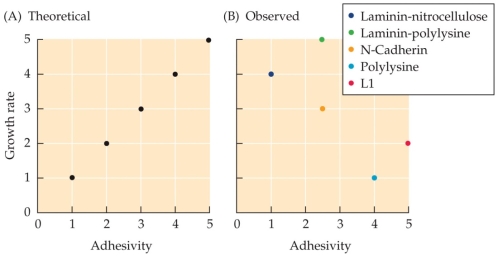 These data are from an experiment using growth cones cultured on substrates with different levels of adhesivity, ranked from least adhesive (laminin-nitrocellulose) to most adhesive (L1). Based on the theoretical prediction in graph A, what was the researchers' hypothesis about adhesivity and growth cone growth rate? Based on the observed data in graph B, how does growth rate actually correlate to adhesivity? What does this suggest about the role of adhesion in axonal growth?
These data are from an experiment using growth cones cultured on substrates with different levels of adhesivity, ranked from least adhesive (laminin-nitrocellulose) to most adhesive (L1). Based on the theoretical prediction in graph A, what was the researchers' hypothesis about adhesivity and growth cone growth rate? Based on the observed data in graph B, how does growth rate actually correlate to adhesivity? What does this suggest about the role of adhesion in axonal growth? سؤال
سؤال
سؤال
سؤال
سؤال
Refer to the figure.
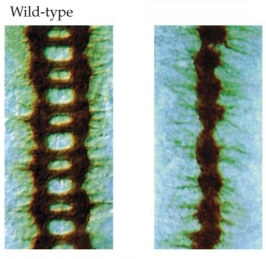 In a wild-type Drosophila, some axons (stained brown) cross over the midline and some project longitudinally on either side of it, forming a ladder-like pattern of axons. In the image on the right, all axons are bundled at the midline. What mutation could have caused the abnormal axonal projection pattern in the right-hand image?
In a wild-type Drosophila, some axons (stained brown) cross over the midline and some project longitudinally on either side of it, forming a ladder-like pattern of axons. In the image on the right, all axons are bundled at the midline. What mutation could have caused the abnormal axonal projection pattern in the right-hand image? سؤال
سؤال
سؤال

فتح الحزمة
قم بالتسجيل لفتح البطاقات في هذه المجموعة!
Unlock Deck
Unlock Deck
1/35

العب

ملء الشاشة (f)
Deck 5: Axonal Pathfinding
1
Ramón y Cajal's visualization of growth cones showed that neurons
A) are separate from one another.
B) are continuous networks of fibers.
C) do not move independently.
D) use electricity to communicate.
A) are separate from one another.
B) are continuous networks of fibers.
C) do not move independently.
D) use electricity to communicate.
A
2
What provides a structural core to an extending growth cone?
A) Filopodia
B) Microtubules
C) Lamellipodia
D) Actin
A) Filopodia
B) Microtubules
C) Lamellipodia
D) Actin
B
3
What provides force to push the tip of a growth cone out and pull it back again?
A) Filopodia
B) Microtubules
C) Lamellipodia
D) Actin
A) Filopodia
B) Microtubules
C) Lamellipodia
D) Actin
D
4
Axons push growth cones forward when microtubules are added
A) close to the cell body.
B) at every point along the axon.
C) at the growth cone end of the axon.
D) at each end of the cell.
A) close to the cell body.
B) at every point along the axon.
C) at the growth cone end of the axon.
D) at each end of the cell.
فتح الحزمة
افتح القفل للوصول البطاقات البالغ عددها 35 في هذه المجموعة.
فتح الحزمة
k this deck
5
In later development, after axons have innervated their targets, neurons grow to accommodate the overall growth of the body by adding microtubules
A) close to the cell body.
B) at every point along the axon.
C) at the growth cone end of the axon.
D) at each end of the cell.
A) close to the cell body.
B) at every point along the axon.
C) at the growth cone end of the axon.
D) at each end of the cell.
فتح الحزمة
افتح القفل للوصول البطاقات البالغ عددها 35 في هذه المجموعة.
فتح الحزمة
k this deck
6
How do growth cones interact with attractive and repulsive cues in their environment?
A) Receptor proteins in the filopodia membrane interact with cues in the environment.
B) The growth process is a random one of extension and contraction in any direction.
C) The cues provide physical barriers around which the growth cone moves.
D) The attractive and repulsive cues are located within the growing cell.
A) Receptor proteins in the filopodia membrane interact with cues in the environment.
B) The growth process is a random one of extension and contraction in any direction.
C) The cues provide physical barriers around which the growth cone moves.
D) The attractive and repulsive cues are located within the growing cell.
فتح الحزمة
افتح القفل للوصول البطاقات البالغ عددها 35 في هذه المجموعة.
فتح الحزمة
k this deck
7
The process by which growth cones move toward a specific chemical is called
A) contact guidance.
B) diffusion.
C) chemotaxis.
D) neurotropism.
A) contact guidance.
B) diffusion.
C) chemotaxis.
D) neurotropism.
فتح الحزمة
افتح القفل للوصول البطاقات البالغ عددها 35 في هذه المجموعة.
فتح الحزمة
k this deck
8
Whether an external cue is attractive or repulsive to a growth cone depends on
A) which class of molecules the cue belongs to.
B) the concentration of the cue.
C) the polarity of the external molecule.
D) the molecules on the growth cone membrane.
A) which class of molecules the cue belongs to.
B) the concentration of the cue.
C) the polarity of the external molecule.
D) the molecules on the growth cone membrane.
فتح الحزمة
افتح القفل للوصول البطاقات البالغ عددها 35 في هذه المجموعة.
فتح الحزمة
k this deck
9
When a growth cone reaches a repulsive cue,
A) filopodia may stick to it.
B) filopodia may expand.
C) microtubules are severed.
D) tubulin polymerizes.
A) filopodia may stick to it.
B) filopodia may expand.
C) microtubules are severed.
D) tubulin polymerizes.
فتح الحزمة
افتح القفل للوصول البطاقات البالغ عددها 35 في هذه المجموعة.
فتح الحزمة
k this deck
10
Guidance cues can attract growth cones by encouraging _______ in the growing cell.
A) depolymerization
B) actomyosin contraction
C) polymerization
D) fasciculation
A) depolymerization
B) actomyosin contraction
C) polymerization
D) fasciculation
فتح الحزمة
افتح القفل للوصول البطاقات البالغ عددها 35 في هذه المجموعة.
فتح الحزمة
k this deck
11
Which family of guidance proteins contains both diffusible and contact guidance molecules?
A) CAMs
B) Ephrins
C) Integrins
D) Semaphorins
A) CAMs
B) Ephrins
C) Integrins
D) Semaphorins
فتح الحزمة
افتح القفل للوصول البطاقات البالغ عددها 35 في هذه المجموعة.
فتح الحزمة
k this deck
12
Which of the following is a receptor for Slit?
A) Ephrin
B) Robo
C) Frazzled
D) Unc5
A) Ephrin
B) Robo
C) Frazzled
D) Unc5
فتح الحزمة
افتح القفل للوصول البطاقات البالغ عددها 35 في هذه المجموعة.
فتح الحزمة
k this deck
13
Which of the following is a receptor for netrin?
A) Noggin
B) Frazzled
C) Robo
D) Ephrin
A) Noggin
B) Frazzled
C) Robo
D) Ephrin
فتح الحزمة
افتح القفل للوصول البطاقات البالغ عددها 35 في هذه المجموعة.
فتح الحزمة
k this deck
14
If the band of semaphorins between the outer leg and inner leg of a developing grasshopper is removed experimentally before early sensory pioneer neurons send their axons to their targets, what will happen to the migration of the sensory neurons?
A) The growth cones on sensory neurons will not be able to project their filopodia outward.
B) The growth cones on sensory neurons will collapse.
C) The sensory neurons will not reach the abdominal ganglion.
D) The sensory neurons will never leave their site of origin.
A) The growth cones on sensory neurons will not be able to project their filopodia outward.
B) The growth cones on sensory neurons will collapse.
C) The sensory neurons will not reach the abdominal ganglion.
D) The sensory neurons will never leave their site of origin.
فتح الحزمة
افتح القفل للوصول البطاقات البالغ عددها 35 في هذه المجموعة.
فتح الحزمة
k this deck
15
Growth cones move fastest when growing via
A) fasciculation.
B) guideposts.
C) pioneering.
D) chemotaxis.
A) fasciculation.
B) guideposts.
C) pioneering.
D) chemotaxis.
فتح الحزمة
افتح القفل للوصول البطاقات البالغ عددها 35 في هذه المجموعة.
فتح الحزمة
k this deck
16
If a section of the embryonic amphibian brainstem is removed and rotated early in development, what will happen to the axonal projections of the Mauthner cells, which normally project to the spinal cord?
A) They will still project the spinal cord.
B) They will project to the brain instead.
C) They will not be able to project at all.
D) They will die.
A) They will still project the spinal cord.
B) They will project to the brain instead.
C) They will not be able to project at all.
D) They will die.
فتح الحزمة
افتح القفل للوصول البطاقات البالغ عددها 35 في هذه المجموعة.
فتح الحزمة
k this deck
17
Neurons that send axons across the midline are known as _______ neurons.
A) longitudinal
B) commissural
C) pioneer
D) guidepost
A) longitudinal
B) commissural
C) pioneer
D) guidepost
فتح الحزمة
افتح القفل للوصول البطاقات البالغ عددها 35 في هذه المجموعة.
فتح الحزمة
k this deck
18
If a Drosophila is found to have axons that cross back and forth over the body's midline several times, it is most likely
A) a Robo knockout.
B) a Slit knockout.
C) a commissureless mutant.
D) normal.
A) a Robo knockout.
B) a Slit knockout.
C) a commissureless mutant.
D) normal.
فتح الحزمة
افتح القفل للوصول البطاقات البالغ عددها 35 في هذه المجموعة.
فتح الحزمة
k this deck
19
Growing longitudinal neurons express _______ and do so _______.
A) robo; continuously
B) frazzled; continuously
C) robo; only at first
D) frazzled; only at first
A) robo; continuously
B) frazzled; continuously
C) robo; only at first
D) frazzled; only at first
فتح الحزمة
افتح القفل للوصول البطاقات البالغ عددها 35 في هذه المجموعة.
فتح الحزمة
k this deck
20
Motor neuron axons are
A) attracted to ephrins.
B) repelled by ephrins.
C) either attracted to or repelled by ephrins, depending on their location.
D) not affected by ephrins.
A) attracted to ephrins.
B) repelled by ephrins.
C) either attracted to or repelled by ephrins, depending on their location.
D) not affected by ephrins.
فتح الحزمة
افتح القفل للوصول البطاقات البالغ عددها 35 في هذه المجموعة.
فتح الحزمة
k this deck
21
Why do motor neuron axons only grow though the rostral half of a somite?
A) They are attracted to ephrins in the rostral half.
B) They are repelled by ephrins in the caudal half.
C) They are attracted to ephrins in the caudal half.
D) They are repelled by ephrins in the rostral half.
A) They are attracted to ephrins in the rostral half.
B) They are repelled by ephrins in the caudal half.
C) They are attracted to ephrins in the caudal half.
D) They are repelled by ephrins in the rostral half.
فتح الحزمة
افتح القفل للوصول البطاقات البالغ عددها 35 في هذه المجموعة.
فتح الحزمة
k this deck
22
If you wanted to determine whether motor neurons are already fated to innervate a particular target muscle before their axons exit the ventral root of the spinal cord, or if they just follow a path that leads them to the closest muscle in need of innervation, the best experimental design would be to
A) inject ephrins into a target muscle and track the axons that normally innervate that muscle.
B) use a Slit or Robo knockout model to track axonal growth.
C) remove a section of the spinal cord, place it somewhere else, and track the axonal growth.
D) remove a section of a muscle tissue, place it somewhere else, and track its innervation.
A) inject ephrins into a target muscle and track the axons that normally innervate that muscle.
B) use a Slit or Robo knockout model to track axonal growth.
C) remove a section of the spinal cord, place it somewhere else, and track the axonal growth.
D) remove a section of a muscle tissue, place it somewhere else, and track its innervation.
فتح الحزمة
افتح القفل للوصول البطاقات البالغ عددها 35 في هذه المجموعة.
فتح الحزمة
k this deck
23
Axonal growth cones from amphibian retinal ganglion cells are directed to their tectal targets by
A) ephrin receptor gradients in the tectum.
B) ephrin ligand gradients in the retina.
C) ephrin ligand gradients in the tectum.
D) slit gradients in the retina.
A) ephrin receptor gradients in the tectum.
B) ephrin ligand gradients in the retina.
C) ephrin ligand gradients in the tectum.
D) slit gradients in the retina.
فتح الحزمة
افتح القفل للوصول البطاقات البالغ عددها 35 في هذه المجموعة.
فتح الحزمة
k this deck
24
Conditions resulting in the total or partial absence of a corpus callosum in childhood
A) are lethal.
B) show "disconnection syndrome."
C) only happen before birth.
D) may be asymptomatic.
A) are lethal.
B) show "disconnection syndrome."
C) only happen before birth.
D) may be asymptomatic.
فتح الحزمة
افتح القفل للوصول البطاقات البالغ عددها 35 في هذه المجموعة.
فتح الحزمة
k this deck
25
Corpus callosum axons grow toward the midline because they are
A) following guidepost neurons.
B) attracted to Robo.
C) attracted to Slit.
D) glia.
A) following guidepost neurons.
B) attracted to Robo.
C) attracted to Slit.
D) glia.
فتح الحزمة
افتح القفل للوصول البطاقات البالغ عددها 35 في هذه المجموعة.
فتح الحزمة
k this deck
26
What is the difference between anterograde and retrograde axonal transport, and in what way is each responsible for how a growth cone responds to its environment?
فتح الحزمة
افتح القفل للوصول البطاقات البالغ عددها 35 في هذه المجموعة.
فتح الحزمة
k this deck
27
Refer to the figure.
These data are from an experiment using growth cones cultured on substrates with different levels of adhesivity, ranked from least adhesive (laminin-nitrocellulose) to most adhesive (L1). Based on the theoretical prediction in graph A, what was the researchers' hypothesis about adhesivity and growth cone growth rate? Based on the observed data in graph B, how does growth rate actually correlate to adhesivity? What does this suggest about the role of adhesion in axonal growth?
These data are from an experiment using growth cones cultured on substrates with different levels of adhesivity, ranked from least adhesive (laminin-nitrocellulose) to most adhesive (L1). Based on the theoretical prediction in graph A, what was the researchers' hypothesis about adhesivity and growth cone growth rate? Based on the observed data in graph B, how does growth rate actually correlate to adhesivity? What does this suggest about the role of adhesion in axonal growth? فتح الحزمة
افتح القفل للوصول البطاقات البالغ عددها 35 في هذه المجموعة.
فتح الحزمة
k this deck
28
In growth cone guidance, what is the difference between contact guidance and chemotropism?
فتح الحزمة
افتح القفل للوصول البطاقات البالغ عددها 35 في هذه المجموعة.
فتح الحزمة
k this deck
29
What mechanism of axonal growth do the growth cones of early-arising pioneer neurons in the grasshopper leg use to find their destination? What two factors in their environment guide the path they take?
فتح الحزمة
افتح القفل للوصول البطاقات البالغ عددها 35 في هذه المجموعة.
فتح الحزمة
k this deck
30
What is one possible reason that the developing nervous system sends axons across the body's midline rather than keeping them all on one side of the body or the other?
فتح الحزمة
افتح القفل للوصول البطاقات البالغ عددها 35 في هذه المجموعة.
فتح الحزمة
k this deck
31
Why do neurons that cross the midline not cross back over more than once? Describe how the changes in expression of membrane receptors in the crossing neuron influence the neuron's movement in response to the diffusible proteins secreted by the midline.
فتح الحزمة
افتح القفل للوصول البطاقات البالغ عددها 35 في هذه المجموعة.
فتح الحزمة
k this deck
32
Refer to the figure.
In a wild-type Drosophila, some axons (stained brown) cross over the midline and some project longitudinally on either side of it, forming a ladder-like pattern of axons. In the image on the right, all axons are bundled at the midline. What mutation could have caused the abnormal axonal projection pattern in the right-hand image?
In a wild-type Drosophila, some axons (stained brown) cross over the midline and some project longitudinally on either side of it, forming a ladder-like pattern of axons. In the image on the right, all axons are bundled at the midline. What mutation could have caused the abnormal axonal projection pattern in the right-hand image? فتح الحزمة
افتح القفل للوصول البطاقات البالغ عددها 35 في هذه المجموعة.
فتح الحزمة
k this deck
33
In the experiment that led to Sperry's chemoaffinity hypothesis optic nerve of a frog was severed and then put back in place after being rotated. When the nerve regenerated, the frog's vision was mirror-reversed (as demonstrated by the frog's behavioral responses to stimuli in the eye). What did these results suggest about where the retina reinnervated the tectum, and what directed this reinnervation? What is the chemoaffinity hypothesis that was derived from this result?
فتح الحزمة
افتح القفل للوصول البطاقات البالغ عددها 35 في هذه المجموعة.
فتح الحزمة
k this deck
34
How did the results of Sperry's rotated frog eye experiment relate to the nature versus nurture debate?
فتح الحزمة
افتح القفل للوصول البطاقات البالغ عددها 35 في هذه المجموعة.
فتح الحزمة
k this deck
35
How is it that agenesis of the corpus callosum at birth can go undetected, but if the corpus callosum is severed in adults, they experience "disconnection syndrome"?
فتح الحزمة
افتح القفل للوصول البطاقات البالغ عددها 35 في هذه المجموعة.
فتح الحزمة
k this deck
فتح الحزمة
افتح القفل للوصول البطاقات البالغ عددها 35 في هذه المجموعة.






