







 تكلم مع الذكاء الاصطناعي


Deck 5: The Economics of Environmental Regulation I: Emission Standards and Effluent Charge
ملء الشاشة (f)

سؤال

سؤال
سؤال
سؤال
سؤال
سؤال
سؤال
سؤال
سؤال
سؤال
سؤال
سؤال
سؤال
سؤال
سؤال
سؤال
سؤال
سؤال
Figure 5A
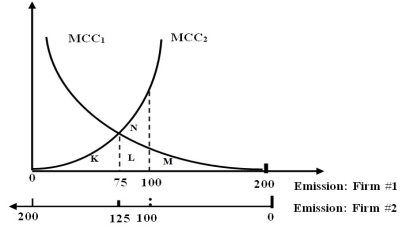
-Refer to Figure 5A. Which of the following is incorrect concerning the figure.
A) There are two polluting firms in this market.
B) These firms employ different emission control technologies.
C) If the emission standard set by government is 100 for all firms, each firm will
would be responsible for cleaning up 100 units of waste.
D) If the emission standard is set at 100, the total waste control cost for these two
firms would be represented by area K + L + N.
-Refer to Figure 5A. Which of the following is incorrect concerning the figure.
A) There are two polluting firms in this market.
B) These firms employ different emission control technologies.
C) If the emission standard set by government is 100 for all firms, each firm will
would be responsible for cleaning up 100 units of waste.
D) If the emission standard is set at 100, the total waste control cost for these two
firms would be represented by area K + L + N.
سؤال
Figure 5A
-Refer to Figure 5A. Which of the following is correct?
A) If the emission standard is set at 75, the total waste control cost for these two
firms would be represented by area K + L + M.
B) If the emission standard is set at 75, the total waste control cost for these two
firms would be represented by area K + L + N.
C) If the emission standard is set at 75, the total waste control costs of Firm 1 is area
K + L.
D) If the emission standard is set at 75, the total waste control costs of Firm 2 is area
K + L.
-Refer to Figure 5A. Which of the following is correct?
A) If the emission standard is set at 75, the total waste control cost for these two
firms would be represented by area K + L + M.
B) If the emission standard is set at 75, the total waste control cost for these two
firms would be represented by area K + L + N.
C) If the emission standard is set at 75, the total waste control costs of Firm 1 is area
K + L.
D) If the emission standard is set at 75, the total waste control costs of Firm 2 is area
K + L.
سؤال
Figure 5A
-Refer to Figure 5A. Which of the following are correct?
A) Total control cost can be reduced by using a non-uniform assignment of emission
standard where Firm 2 is to clean up 75 units of the total waste, and Firm 1 is to
clean up 125 units.
B) Total control cost can be reduced by using a non-uniform assignment of emission
standard where Firm 1 is to clean up 75 units of the total waste, and Firm 2 is to
clean up 125 units.
C) Total control cost can be reduced by using a non-uniform assignment of emission
standard where Firm 1 is to clean up 75 units of the total waste, and Firm 2 is to
clean up 75 units.
D) Total control cost can be reduced by using a non-uniform assignment of emission
standard where Firm 1 is to clean up 125 units of the total waste, and Firm 2 is to
clean up 125 units.
-Refer to Figure 5A. Which of the following are correct?
A) Total control cost can be reduced by using a non-uniform assignment of emission
standard where Firm 2 is to clean up 75 units of the total waste, and Firm 1 is to
clean up 125 units.
B) Total control cost can be reduced by using a non-uniform assignment of emission
standard where Firm 1 is to clean up 75 units of the total waste, and Firm 2 is to
clean up 125 units.
C) Total control cost can be reduced by using a non-uniform assignment of emission
standard where Firm 1 is to clean up 75 units of the total waste, and Firm 2 is to
clean up 75 units.
D) Total control cost can be reduced by using a non-uniform assignment of emission
standard where Firm 1 is to clean up 125 units of the total waste, and Firm 2 is to
clean up 125 units.
سؤال
Figure 5A
-Refer to Figure 5A. Which of the following is correct?
A) When a uniform emission standard is applied, the total cost of waste control is
area K + L + M + N.
B) When a non-uniform emission standard is applied, the total cost of waste control
is area K + L + N.
C) When a uniform emission standard is applied, the total cost of waste control is
area K + L.
D) When a non-uniform emission standard is applied, the total cost of waste control
is area M + N.
-Refer to Figure 5A. Which of the following is correct?
A) When a uniform emission standard is applied, the total cost of waste control is
area K + L + M + N.
B) When a non-uniform emission standard is applied, the total cost of waste control
is area K + L + N.
C) When a uniform emission standard is applied, the total cost of waste control is
area K + L.
D) When a non-uniform emission standard is applied, the total cost of waste control
is area M + N.
سؤال
Figure 5B
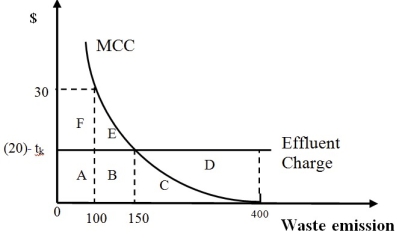
-Refer to Figure 5B. Assume that the initial effluent tax in the amount of tk, or $20 per unit of waste discharged and that the MCC curve represents the nature of the pollution control technology of this firm. Which of the following is correct?
A) A private firm interested in minimizing its cost would control 0 units of waste
using its technology to clean the waste.
B) If the firm decided to reduce its emission to 100 units, then paying the tax would
be cheaper than to clean the waste.
C) If the firm decided to reduce its emission to 100 units, then paying the tax would
be more expensive than to clean the waste.
D) If the firm decided to reduce its emission to 100 units, then paying the tax would
cost the same as cleaning the waste.
-Refer to Figure 5B. Assume that the initial effluent tax in the amount of tk, or $20 per unit of waste discharged and that the MCC curve represents the nature of the pollution control technology of this firm. Which of the following is correct?
A) A private firm interested in minimizing its cost would control 0 units of waste
using its technology to clean the waste.
B) If the firm decided to reduce its emission to 100 units, then paying the tax would
be cheaper than to clean the waste.
C) If the firm decided to reduce its emission to 100 units, then paying the tax would
be more expensive than to clean the waste.
D) If the firm decided to reduce its emission to 100 units, then paying the tax would
cost the same as cleaning the waste.
سؤال
Figure 5B
-Refer to Figure 5B. Assume that the initial effluent tax in the amount of tk, or $20 per unit of waste discharged and that the MCC curve represents the nature of the pollution control technology of this firm. Which of the following is correct?
A) At $20 per unit of waste, the total expenditure by the firm at 150 units of waste is
$3000.
B) At $20 per unit of waste, the total expenditure by the firm at 150 units of waste is
$8000.
C) At $20 per unit of waste, the total expenditure by the firm at 150 units of waste is
$1500.
D) At $20 per unit of waste, the total expenditure by the firm at 0 units of waste is
$3000.
E) At $20 per unit of waste, the total expenditure by the firm at 100 units of waste is
$3000.
-Refer to Figure 5B. Assume that the initial effluent tax in the amount of tk, or $20 per unit of waste discharged and that the MCC curve represents the nature of the pollution control technology of this firm. Which of the following is correct?
A) At $20 per unit of waste, the total expenditure by the firm at 150 units of waste is
$3000.
B) At $20 per unit of waste, the total expenditure by the firm at 150 units of waste is
$8000.
C) At $20 per unit of waste, the total expenditure by the firm at 150 units of waste is
$1500.
D) At $20 per unit of waste, the total expenditure by the firm at 0 units of waste is
$3000.
E) At $20 per unit of waste, the total expenditure by the firm at 100 units of waste is
$3000.
سؤال
Figure 5C
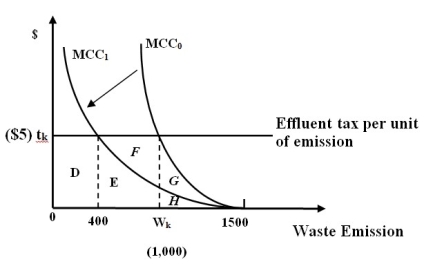
-Refer to Figure 5C. In Figure 5C, a polluting firm is subjected to an effluent charge of tk per unit of emission. Assume that the shift of this firm's marginal control cost curve
from MCC0 to MCC1 is caused by an introduction of a new and improved method of
pollution control. Which of the following statements does not apply to Figure 5C?
A) The ability to shift from MCC0 to MCC1 implies that firms can be provided with
incentives to reduce their pollution through improved technological.
B) When compared to emission standards, a policy based on effluent charge will
provide smaller financial incentives to investors in pollution control technology.
C) Before the introduction of the new technology, the firm is discharging 1,000 units
of its waste.
D) Before the introduction of the new technology, for discharging 1,000 units, the
regulatory agency would be able to collect effluent tax of $5,000.
-Refer to Figure 5C. In Figure 5C, a polluting firm is subjected to an effluent charge of tk per unit of emission. Assume that the shift of this firm's marginal control cost curve
from MCC0 to MCC1 is caused by an introduction of a new and improved method of
pollution control. Which of the following statements does not apply to Figure 5C?
A) The ability to shift from MCC0 to MCC1 implies that firms can be provided with
incentives to reduce their pollution through improved technological.
B) When compared to emission standards, a policy based on effluent charge will
provide smaller financial incentives to investors in pollution control technology.
C) Before the introduction of the new technology, the firm is discharging 1,000 units
of its waste.
D) Before the introduction of the new technology, for discharging 1,000 units, the
regulatory agency would be able to collect effluent tax of $5,000.
سؤال
Figure 5C
-Refer to Figure 5C. In Figure 5C, a polluting firm is subjected to an effluent charge of tk per unit of emission. Assume that the shift of this firm's marginal control cost curve from MCC0 to MCC1 is caused by an introduction of a new and improved method of pollution control. Which of the following statements applies to Figure 5C?
A) Before the introduction of the new technology, for discharging 1,000 units, the
regulatory agency would be able to collect effluent tax equal to area F + G.
B) Before the introduction of the new technology, the area F + G + H represents the
combined expenditure of effluent tax and waste processing for this firm.
C) Before the introduction of the new technology, the area D + E + F + G + H
represents the combined expenditure of effluent tax and waste processing for this
firm.
D) After the new waste processing technology is adopted, area D + E represents the
total expenditure of this firm.
E) After the new waste processing technology is adopted, area E + H represents the
-Refer to Figure 5C. In Figure 5C, a polluting firm is subjected to an effluent charge of tk per unit of emission. Assume that the shift of this firm's marginal control cost curve from MCC0 to MCC1 is caused by an introduction of a new and improved method of pollution control. Which of the following statements applies to Figure 5C?
A) Before the introduction of the new technology, for discharging 1,000 units, the
regulatory agency would be able to collect effluent tax equal to area F + G.
B) Before the introduction of the new technology, the area F + G + H represents the
combined expenditure of effluent tax and waste processing for this firm.
C) Before the introduction of the new technology, the area D + E + F + G + H
represents the combined expenditure of effluent tax and waste processing for this
firm.
D) After the new waste processing technology is adopted, area D + E represents the
total expenditure of this firm.
E) After the new waste processing technology is adopted, area E + H represents the

فتح الحزمة
قم بالتسجيل لفتح البطاقات في هذه المجموعة!
Unlock Deck
Unlock Deck
1/25

العب

ملء الشاشة (f)
Deck 5: The Economics of Environmental Regulation I: Emission Standards and Effluent Charge
1
Public intervention in the market for environmental goods and services is justifiable
because private markets usually cannot achieve a socially optimal level of emission
control.
because private markets usually cannot achieve a socially optimal level of emission
control.
True
2
Emission standards, effluent charges and transferable emission credits favor a centralized
or command-and-control approach to pollution control.
or command-and-control approach to pollution control.
False
3
When a polluter has many options for pollution control, then technology standards are
best among those options.
best among those options.
False
4
Enforcement of environmental standards is usually a state or local responsibility, but
many enforcement actions require the resources of both federal and state authorities.
many enforcement actions require the resources of both federal and state authorities.
فتح الحزمة
افتح القفل للوصول البطاقات البالغ عددها 25 في هذه المجموعة.
فتح الحزمة
k this deck
5
If public authorities set an emission standard at the social optimal level and strictly
enforce it, polluters will end up internalizing the cost of controlling pollution emissions up to the socially optimal level.
enforce it, polluters will end up internalizing the cost of controlling pollution emissions up to the socially optimal level.
فتح الحزمة
افتح القفل للوصول البطاقات البالغ عددها 25 في هذه المجموعة.
فتح الحزمة
k this deck
6
Emission standards adhere to the polluter pays principles, and thus tend have a moral
appeal.
appeal.
فتح الحزمة
افتح القفل للوصول البطاقات البالغ عددها 25 في هذه المجموعة.
فتح الحزمة
k this deck
7
A drawback of emission standards is that they are likely to benefit existing firms.
فتح الحزمة
افتح القفل للوصول البطاقات البالغ عددها 25 في هذه المجموعة.
فتح الحزمة
k this deck
8
Emission standards tend to perform well in inducing innovation and technological
change.
change.
فتح الحزمة
افتح القفل للوصول البطاقات البالغ عددها 25 في هذه المجموعة.
فتح الحزمة
k this deck
9
When a profit-maximizing firm is confronted with an effluent charge, it would be in its
best interests to treat its waste whenever the cost of treating an additional unit of waste
was more than the effluent tax.
best interests to treat its waste whenever the cost of treating an additional unit of waste
was more than the effluent tax.
فتح الحزمة
افتح القفل للوصول البطاقات البالغ عددها 25 في هذه المجموعة.
فتح الحزمة
k this deck
10
The optimal effluent charge is attained any point where MCC > MDC.
فتح الحزمة
افتح القفل للوصول البطاقات البالغ عددها 25 في هذه المجموعة.
فتح الحزمة
k this deck
11
When control costs turn out to be less than expected, environmental policy based on
effluent taxes would allow waste discharges in excess of what is considered to be socially
optimal.
effluent taxes would allow waste discharges in excess of what is considered to be socially
optimal.
فتح الحزمة
افتح القفل للوصول البطاقات البالغ عددها 25 في هذه المجموعة.
فتح الحزمة
k this deck
12
Environmental regulations operate purely on a command-and-control principle, and not
on the premise of financial incentive or disincentive.
on the premise of financial incentive or disincentive.
فتح الحزمة
افتح القفل للوصول البطاقات البالغ عددها 25 في هذه المجموعة.
فتح الحزمة
k this deck
13
The double dividend feature of pollution tax is an important advantage that an effluent
charge has over emission standards.
charge has over emission standards.
فتح الحزمة
افتح القفل للوصول البطاقات البالغ عددها 25 في هذه المجموعة.
فتح الحزمة
k this deck
14
The total cost of pollution control is minimized when the marginal control costs are the
same for all the firms engaged in pollution control activities.
same for all the firms engaged in pollution control activities.
فتح الحزمة
افتح القفل للوصول البطاقات البالغ عددها 25 في هذه المجموعة.
فتح الحزمة
k this deck
15
When an effluent charge is cost-effective, it is also socially optimal.
فتح الحزمة
افتح القفل للوصول البطاقات البالغ عددها 25 في هذه المجموعة.
فتح الحزمة
k this deck
16
A transferable discharge permit places the _________ limit of pollution for a(n) _________ is allowed to discharge into the environment.
A) Maximum, firm
B) Maximum, household
C) Minimum, firm
D) Standard, government
E) Standard, industry
A) Maximum, firm
B) Maximum, household
C) Minimum, firm
D) Standard, government
E) Standard, industry
فتح الحزمة
افتح القفل للوصول البطاقات البالغ عددها 25 في هذه المجموعة.
فتح الحزمة
k this deck
17
Which of the following is not an advantage of emission standards?
A) Emission standards can be simple and direct.
B) Emission standards aim at the attainment of clearly defined technological
objectives.
C) Emission standards adhere to the polluter pays principles.
D) Environmental regulations based on emission standards they are largely framed on
legal rulings and not necessarily economics or efficiency considerations.
E) None of the above is an advantage.
A) Emission standards can be simple and direct.
B) Emission standards aim at the attainment of clearly defined technological
objectives.
C) Emission standards adhere to the polluter pays principles.
D) Environmental regulations based on emission standards they are largely framed on
legal rulings and not necessarily economics or efficiency considerations.
E) None of the above is an advantage.
فتح الحزمة
افتح القفل للوصول البطاقات البالغ عددها 25 في هذه المجموعة.
فتح الحزمة
k this deck
18
Figure 5A
-Refer to Figure 5A. Which of the following is incorrect concerning the figure.
A) There are two polluting firms in this market.
B) These firms employ different emission control technologies.
C) If the emission standard set by government is 100 for all firms, each firm will
would be responsible for cleaning up 100 units of waste.
D) If the emission standard is set at 100, the total waste control cost for these two
firms would be represented by area K + L + N.
-Refer to Figure 5A. Which of the following is incorrect concerning the figure.
A) There are two polluting firms in this market.
B) These firms employ different emission control technologies.
C) If the emission standard set by government is 100 for all firms, each firm will
would be responsible for cleaning up 100 units of waste.
D) If the emission standard is set at 100, the total waste control cost for these two
firms would be represented by area K + L + N.
فتح الحزمة
افتح القفل للوصول البطاقات البالغ عددها 25 في هذه المجموعة.
فتح الحزمة
k this deck
19
Figure 5A
-Refer to Figure 5A. Which of the following is correct?
A) If the emission standard is set at 75, the total waste control cost for these two
firms would be represented by area K + L + M.
B) If the emission standard is set at 75, the total waste control cost for these two
firms would be represented by area K + L + N.
C) If the emission standard is set at 75, the total waste control costs of Firm 1 is area
K + L.
D) If the emission standard is set at 75, the total waste control costs of Firm 2 is area
K + L.
-Refer to Figure 5A. Which of the following is correct?
A) If the emission standard is set at 75, the total waste control cost for these two
firms would be represented by area K + L + M.
B) If the emission standard is set at 75, the total waste control cost for these two
firms would be represented by area K + L + N.
C) If the emission standard is set at 75, the total waste control costs of Firm 1 is area
K + L.
D) If the emission standard is set at 75, the total waste control costs of Firm 2 is area
K + L.
فتح الحزمة
افتح القفل للوصول البطاقات البالغ عددها 25 في هذه المجموعة.
فتح الحزمة
k this deck
20
Figure 5A
-Refer to Figure 5A. Which of the following are correct?
A) Total control cost can be reduced by using a non-uniform assignment of emission
standard where Firm 2 is to clean up 75 units of the total waste, and Firm 1 is to
clean up 125 units.
B) Total control cost can be reduced by using a non-uniform assignment of emission
standard where Firm 1 is to clean up 75 units of the total waste, and Firm 2 is to
clean up 125 units.
C) Total control cost can be reduced by using a non-uniform assignment of emission
standard where Firm 1 is to clean up 75 units of the total waste, and Firm 2 is to
clean up 75 units.
D) Total control cost can be reduced by using a non-uniform assignment of emission
standard where Firm 1 is to clean up 125 units of the total waste, and Firm 2 is to
clean up 125 units.
-Refer to Figure 5A. Which of the following are correct?
A) Total control cost can be reduced by using a non-uniform assignment of emission
standard where Firm 2 is to clean up 75 units of the total waste, and Firm 1 is to
clean up 125 units.
B) Total control cost can be reduced by using a non-uniform assignment of emission
standard where Firm 1 is to clean up 75 units of the total waste, and Firm 2 is to
clean up 125 units.
C) Total control cost can be reduced by using a non-uniform assignment of emission
standard where Firm 1 is to clean up 75 units of the total waste, and Firm 2 is to
clean up 75 units.
D) Total control cost can be reduced by using a non-uniform assignment of emission
standard where Firm 1 is to clean up 125 units of the total waste, and Firm 2 is to
clean up 125 units.
فتح الحزمة
افتح القفل للوصول البطاقات البالغ عددها 25 في هذه المجموعة.
فتح الحزمة
k this deck
21
Figure 5A
-Refer to Figure 5A. Which of the following is correct?
A) When a uniform emission standard is applied, the total cost of waste control is
area K + L + M + N.
B) When a non-uniform emission standard is applied, the total cost of waste control
is area K + L + N.
C) When a uniform emission standard is applied, the total cost of waste control is
area K + L.
D) When a non-uniform emission standard is applied, the total cost of waste control
is area M + N.
-Refer to Figure 5A. Which of the following is correct?
A) When a uniform emission standard is applied, the total cost of waste control is
area K + L + M + N.
B) When a non-uniform emission standard is applied, the total cost of waste control
is area K + L + N.
C) When a uniform emission standard is applied, the total cost of waste control is
area K + L.
D) When a non-uniform emission standard is applied, the total cost of waste control
is area M + N.
فتح الحزمة
افتح القفل للوصول البطاقات البالغ عددها 25 في هذه المجموعة.
فتح الحزمة
k this deck
22
Figure 5B
-Refer to Figure 5B. Assume that the initial effluent tax in the amount of tk, or $20 per unit of waste discharged and that the MCC curve represents the nature of the pollution control technology of this firm. Which of the following is correct?
A) A private firm interested in minimizing its cost would control 0 units of waste
using its technology to clean the waste.
B) If the firm decided to reduce its emission to 100 units, then paying the tax would
be cheaper than to clean the waste.
C) If the firm decided to reduce its emission to 100 units, then paying the tax would
be more expensive than to clean the waste.
D) If the firm decided to reduce its emission to 100 units, then paying the tax would
cost the same as cleaning the waste.
-Refer to Figure 5B. Assume that the initial effluent tax in the amount of tk, or $20 per unit of waste discharged and that the MCC curve represents the nature of the pollution control technology of this firm. Which of the following is correct?
A) A private firm interested in minimizing its cost would control 0 units of waste
using its technology to clean the waste.
B) If the firm decided to reduce its emission to 100 units, then paying the tax would
be cheaper than to clean the waste.
C) If the firm decided to reduce its emission to 100 units, then paying the tax would
be more expensive than to clean the waste.
D) If the firm decided to reduce its emission to 100 units, then paying the tax would
cost the same as cleaning the waste.
فتح الحزمة
افتح القفل للوصول البطاقات البالغ عددها 25 في هذه المجموعة.
فتح الحزمة
k this deck
23
Figure 5B
-Refer to Figure 5B. Assume that the initial effluent tax in the amount of tk, or $20 per unit of waste discharged and that the MCC curve represents the nature of the pollution control technology of this firm. Which of the following is correct?
A) At $20 per unit of waste, the total expenditure by the firm at 150 units of waste is
$3000.
B) At $20 per unit of waste, the total expenditure by the firm at 150 units of waste is
$8000.
C) At $20 per unit of waste, the total expenditure by the firm at 150 units of waste is
$1500.
D) At $20 per unit of waste, the total expenditure by the firm at 0 units of waste is
$3000.
E) At $20 per unit of waste, the total expenditure by the firm at 100 units of waste is
$3000.
-Refer to Figure 5B. Assume that the initial effluent tax in the amount of tk, or $20 per unit of waste discharged and that the MCC curve represents the nature of the pollution control technology of this firm. Which of the following is correct?
A) At $20 per unit of waste, the total expenditure by the firm at 150 units of waste is
$3000.
B) At $20 per unit of waste, the total expenditure by the firm at 150 units of waste is
$8000.
C) At $20 per unit of waste, the total expenditure by the firm at 150 units of waste is
$1500.
D) At $20 per unit of waste, the total expenditure by the firm at 0 units of waste is
$3000.
E) At $20 per unit of waste, the total expenditure by the firm at 100 units of waste is
$3000.
فتح الحزمة
افتح القفل للوصول البطاقات البالغ عددها 25 في هذه المجموعة.
فتح الحزمة
k this deck
24
Figure 5C
-Refer to Figure 5C. In Figure 5C, a polluting firm is subjected to an effluent charge of tk per unit of emission. Assume that the shift of this firm's marginal control cost curve
from MCC0 to MCC1 is caused by an introduction of a new and improved method of
pollution control. Which of the following statements does not apply to Figure 5C?
A) The ability to shift from MCC0 to MCC1 implies that firms can be provided with
incentives to reduce their pollution through improved technological.
B) When compared to emission standards, a policy based on effluent charge will
provide smaller financial incentives to investors in pollution control technology.
C) Before the introduction of the new technology, the firm is discharging 1,000 units
of its waste.
D) Before the introduction of the new technology, for discharging 1,000 units, the
regulatory agency would be able to collect effluent tax of $5,000.
-Refer to Figure 5C. In Figure 5C, a polluting firm is subjected to an effluent charge of tk per unit of emission. Assume that the shift of this firm's marginal control cost curve
from MCC0 to MCC1 is caused by an introduction of a new and improved method of
pollution control. Which of the following statements does not apply to Figure 5C?
A) The ability to shift from MCC0 to MCC1 implies that firms can be provided with
incentives to reduce their pollution through improved technological.
B) When compared to emission standards, a policy based on effluent charge will
provide smaller financial incentives to investors in pollution control technology.
C) Before the introduction of the new technology, the firm is discharging 1,000 units
of its waste.
D) Before the introduction of the new technology, for discharging 1,000 units, the
regulatory agency would be able to collect effluent tax of $5,000.
فتح الحزمة
افتح القفل للوصول البطاقات البالغ عددها 25 في هذه المجموعة.
فتح الحزمة
k this deck
25
Figure 5C
-Refer to Figure 5C. In Figure 5C, a polluting firm is subjected to an effluent charge of tk per unit of emission. Assume that the shift of this firm's marginal control cost curve from MCC0 to MCC1 is caused by an introduction of a new and improved method of pollution control. Which of the following statements applies to Figure 5C?
A) Before the introduction of the new technology, for discharging 1,000 units, the
regulatory agency would be able to collect effluent tax equal to area F + G.
B) Before the introduction of the new technology, the area F + G + H represents the
combined expenditure of effluent tax and waste processing for this firm.
C) Before the introduction of the new technology, the area D + E + F + G + H
represents the combined expenditure of effluent tax and waste processing for this
firm.
D) After the new waste processing technology is adopted, area D + E represents the
total expenditure of this firm.
E) After the new waste processing technology is adopted, area E + H represents the
-Refer to Figure 5C. In Figure 5C, a polluting firm is subjected to an effluent charge of tk per unit of emission. Assume that the shift of this firm's marginal control cost curve from MCC0 to MCC1 is caused by an introduction of a new and improved method of pollution control. Which of the following statements applies to Figure 5C?
A) Before the introduction of the new technology, for discharging 1,000 units, the
regulatory agency would be able to collect effluent tax equal to area F + G.
B) Before the introduction of the new technology, the area F + G + H represents the
combined expenditure of effluent tax and waste processing for this firm.
C) Before the introduction of the new technology, the area D + E + F + G + H
represents the combined expenditure of effluent tax and waste processing for this
firm.
D) After the new waste processing technology is adopted, area D + E represents the
total expenditure of this firm.
E) After the new waste processing technology is adopted, area E + H represents the
فتح الحزمة
افتح القفل للوصول البطاقات البالغ عددها 25 في هذه المجموعة.
فتح الحزمة
k this deck
فتح الحزمة
افتح القفل للوصول البطاقات البالغ عددها 25 في هذه المجموعة.






