







 تكلم مع الذكاء الاصطناعي


Deck 11: Regional Economic Arrangements
ملء الشاشة (f)

سؤال

سؤال
سؤال
سؤال
سؤال
سؤال
سؤال
سؤال
سؤال
سؤال
سؤال
سؤال
سؤال
سؤال
سؤال
سؤال
سؤال
سؤال
سؤال
سؤال
سؤال
سؤال
سؤال
سؤال
سؤال
سؤال
The following figure illustrates Country A's domestic market for a specific imported good.
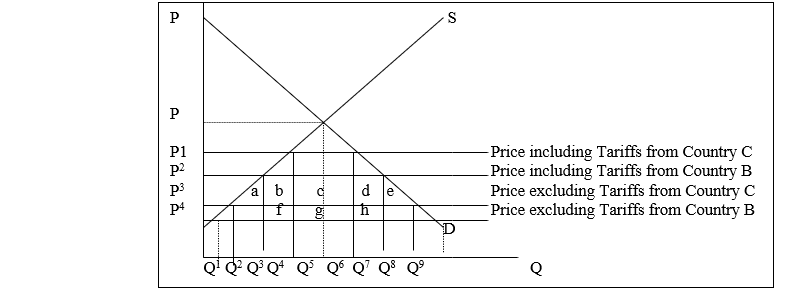
-With free trade Country A imports:
A) Q1 to Q9 from Country B.
B) Q2 to Q8 from Country C.
C) Q3 to Q7 from Country B.
D) Q4 to Q6 from Country C.
E) None of the above
-With free trade Country A imports:
A) Q1 to Q9 from Country B.
B) Q2 to Q8 from Country C.
C) Q3 to Q7 from Country B.
D) Q4 to Q6 from Country C.
E) None of the above
سؤال
The following figure illustrates Country A's domestic market for a specific imported good.
-If Country A imposes a tariff on imports from both Country B and C, Country A will import:
A) Q1 to Q9 from Country B.
B) Q2 to Q8 from Country C.
C) Q3 to Q7 from Country B.
D) Q4 to Q6 from Country C.
E) Q2 to Q3 from country B.
-If Country A imposes a tariff on imports from both Country B and C, Country A will import:
A) Q1 to Q9 from Country B.
B) Q2 to Q8 from Country C.
C) Q3 to Q7 from Country B.
D) Q4 to Q6 from Country C.
E) Q2 to Q3 from country B.
سؤال
The following figure illustrates Country A's domestic market for a specific imported good.
-Suppose Country A forms a customs union with Country B, Country A will import:
A) Q1 to Q9 from Country B.
B) Q2 to Q8 from Country C.
C) Q3 to Q7 from Country B.
D) Q4 to Q6 from Country C.
E) Q2 to Q5 from country B.
-Suppose Country A forms a customs union with Country B, Country A will import:
A) Q1 to Q9 from Country B.
B) Q2 to Q8 from Country C.
C) Q3 to Q7 from Country B.
D) Q4 to Q6 from Country C.
E) Q2 to Q5 from country B.
سؤال
The following figure illustrates Country A's domestic market for a specific imported good.
-Suppose Country A forms a customs union with Country C, Country A will import:
A) Q1 to Q9 from Country B.
B) Q2 to Q8 from Country C.
C) Q3 to Q7 from Country B.
D) Q4 to Q6 from Country C.
E) Q1 to Q2 from Country B.
-Suppose Country A forms a customs union with Country C, Country A will import:
A) Q1 to Q9 from Country B.
B) Q2 to Q8 from Country C.
C) Q3 to Q7 from Country B.
D) Q4 to Q6 from Country C.
E) Q1 to Q2 from Country B.
سؤال
The following figure illustrates Country A's domestic market for a specific imported good.
-Suppose Country A forms a customs union with Country C, trade creation is represented by the area:
A) a + b + c + d + e.
B) a + e.
C) b + c + d.
D)+ g + h.
E) d only.
-Suppose Country A forms a customs union with Country C, trade creation is represented by the area:
A) a + b + c + d + e.
B) a + e.
C) b + c + d.
D)+ g + h.
E) d only.
سؤال
The following figure illustrates Country A's domestic market for a specific imported good.
-Suppose Country A forms a customs union with Country C, trade diversion is represented by the area:
A) g.
B)+ h.
C)+ g + h.
D) b + c +d.
E)only.
-Suppose Country A forms a customs union with Country C, trade diversion is represented by the area:
A) g.
B)+ h.
C)+ g + h.
D) b + c +d.
E)only.
سؤال
سؤال
سؤال
سؤال
سؤال
سؤال
سؤال
سؤال
سؤال
سؤال
سؤال
سؤال
سؤال
سؤال
سؤال
سؤال
سؤال
سؤال
سؤال
سؤال
سؤال
سؤال
سؤال
سؤال
سؤال
سؤال
سؤال
سؤال
سؤال
سؤال
سؤال
سؤال
سؤال
سؤال
سؤال
سؤال
سؤال
سؤال
سؤال
سؤال
سؤال
سؤال
سؤال
سؤال
سؤال
سؤال
سؤال
سؤال
سؤال

فتح الحزمة
قم بالتسجيل لفتح البطاقات في هذه المجموعة!
Unlock Deck
Unlock Deck
1/126

العب

ملء الشاشة (f)
Deck 11: Regional Economic Arrangements
1
Preferential trade agreements are troublesome in the sense that they weaken the important principle of international trade policy known as:
A) TC.
B) TD.
C) WTO.
D) MFN.
E) RTAA.
A) TC.
B) TD.
C) WTO.
D) MFN.
E) RTAA.
MFN.
2
Preferential trade agreements inherently discriminate against countries that do not belong to the agreement and inflict losses on their exporters. This phenomenon is know as:
A) Trade deflection.
B) Trade creation.
C) Trade diversion.
D) The gains from trade.
E) None of the above
A) Trade deflection.
B) Trade creation.
C) Trade diversion.
D) The gains from trade.
E) None of the above
Trade diversion.
3
Which of the following is an exception to the most favored nation principle?
A) Trade in petroleum
B) trade with Japan
C) A free-trade area or a customs union
D) Trade in services
E) None of the above
A) Trade in petroleum
B) trade with Japan
C) A free-trade area or a customs union
D) Trade in services
E) None of the above
A free-trade area or a customs union
4
Regional trade agreements:
A) are the same for all countries.
B) reduce tariffs and trade barriers equally in all countries.
C) result in the negotiating countries obtaining a margin of preference over countries that are not part of the agreement.
D) favor developed countries.
E) are now very rare.
A) are the same for all countries.
B) reduce tariffs and trade barriers equally in all countries.
C) result in the negotiating countries obtaining a margin of preference over countries that are not part of the agreement.
D) favor developed countries.
E) are now very rare.
فتح الحزمة
افتح القفل للوصول البطاقات البالغ عددها 126 في هذه المجموعة.
فتح الحزمة
k this deck
5
In order for a preferential trade agreement to be legal under international trade rules:
A) it must reduce trade barriers on all agricultural products among member countries.
B) it must reduce trade barriers on a substantial proportion of trade among the member countries.
C) it must reduce restrictions on the mobility of labor and capital among member countries.
D) it must provide a common external tariff for member countries.
E) All of the above
A) it must reduce trade barriers on all agricultural products among member countries.
B) it must reduce trade barriers on a substantial proportion of trade among the member countries.
C) it must reduce restrictions on the mobility of labor and capital among member countries.
D) it must provide a common external tariff for member countries.
E) All of the above
فتح الحزمة
افتح القفل للوصول البطاقات البالغ عددها 126 في هذه المجموعة.
فتح الحزمة
k this deck
6
GATT/WTO regulations state that in order for a regional trade agreement to be legal:
A) trade barriers must be reduced on substantially all trade within the group.
B) trade barriers must be reduced on only some of the trade within the group.
C) all countries must come to an agreement on the number and size of the quotas that will be in force.
D) all members will be subject to membership fees.
E) All of the above
A) trade barriers must be reduced on substantially all trade within the group.
B) trade barriers must be reduced on only some of the trade within the group.
C) all countries must come to an agreement on the number and size of the quotas that will be in force.
D) all members will be subject to membership fees.
E) All of the above
فتح الحزمة
افتح القفل للوصول البطاقات البالغ عددها 126 في هذه المجموعة.
فتح الحزمة
k this deck
7
Which of the following is not a level of economic integration between countries?
A) A free-trade area
B) A customs union
C) A common union
D) An economic union
E) None of the above
A) A free-trade area
B) A customs union
C) A common union
D) An economic union
E) None of the above
فتح الحزمة
افتح القفل للوصول البطاقات البالغ عددها 126 في هذه المجموعة.
فتح الحزمة
k this deck
8
The least integrated category of economic integration is:
A) a common market.
B) a free-trade area.
C) an economic union.
D) a customs union.
E) a political union.
A) a common market.
B) a free-trade area.
C) an economic union.
D) a customs union.
E) a political union.
فتح الحزمة
افتح القفل للوصول البطاقات البالغ عددها 126 في هذه المجموعة.
فتح الحزمة
k this deck
9
A significant feature of a customs union is:
A) that agricultural products are always excluded.
B) that corporate tax rates are always made common.
C) that the only WTO legal customs union is the EU.
D) a common external tariff.
E) a uniform tariff.
A) that agricultural products are always excluded.
B) that corporate tax rates are always made common.
C) that the only WTO legal customs union is the EU.
D) a common external tariff.
E) a uniform tariff.
فتح الحزمة
افتح القفل للوصول البطاقات البالغ عددها 126 في هذه المجموعة.
فتح الحزمة
k this deck
10
Which statement is correct?
A) Both customs unions and free-trade areas have a common external tariff.
B) A free-trade area has a common external tariff and a custom union does not.
C) Neither free-trade areas nor customs unions have a common external tariff.
D) A customs union has a common external tariff but a free-trade area does not.
E) Preferential trade agreements cover trade in services.
A) Both customs unions and free-trade areas have a common external tariff.
B) A free-trade area has a common external tariff and a custom union does not.
C) Neither free-trade areas nor customs unions have a common external tariff.
D) A customs union has a common external tariff but a free-trade area does not.
E) Preferential trade agreements cover trade in services.
فتح الحزمة
افتح القفل للوصول البطاقات البالغ عددها 126 في هذه المجموعة.
فتح الحزمة
k this deck
11
To solve the problems associated with trade deflection within an FTA, countries may adopt:
A) a common market.
B) a common external tariff.
C) rules of origin.
D) rules of negotiation.
E) an industrial policy.
A) a common market.
B) a common external tariff.
C) rules of origin.
D) rules of negotiation.
E) an industrial policy.
فتح الحزمة
افتح القفل للوصول البطاقات البالغ عددها 126 في هذه المجموعة.
فتح الحزمة
k this deck
12
What is the major difference between a customs union and a free-trade area?
A) Each country replaces its national tariff schedule with a common external tariff under a customs union.
B) A customs union usually means a shallower level of economic integration.
C) A free-trade area is national in nature and a customs union is regional.
D) In a customs union, tariffs are eliminated and in a free-trade area they are not.
E) A customs union does not have a common external tariff.
A) Each country replaces its national tariff schedule with a common external tariff under a customs union.
B) A customs union usually means a shallower level of economic integration.
C) A free-trade area is national in nature and a customs union is regional.
D) In a customs union, tariffs are eliminated and in a free-trade area they are not.
E) A customs union does not have a common external tariff.
فتح الحزمة
افتح القفل للوصول البطاقات البالغ عددها 126 في هذه المجموعة.
فتح الحزمة
k this deck
13
Which of the following is not one of the features of a common market?
A) Free mobility of labor
B) Free mobility of capital
C) A common external tariff
D) A common currency
E) A political union
A) Free mobility of labor
B) Free mobility of capital
C) A common external tariff
D) A common currency
E) A political union
فتح الحزمة
افتح القفل للوصول البطاقات البالغ عددها 126 في هذه المجموعة.
فتح الحزمة
k this deck
14
Which of the following is not a characteristic of a common market?
A) Capital and labor can freely move within member countries.
B) The are no trade restrictions between member countries.
C) Member countries have a common external tariff.
D) Member countries have a common currency.
E) None of the above
A) Capital and labor can freely move within member countries.
B) The are no trade restrictions between member countries.
C) Member countries have a common external tariff.
D) Member countries have a common currency.
E) None of the above
فتح الحزمة
افتح القفل للوصول البطاقات البالغ عددها 126 في هذه المجموعة.
فتح الحزمة
k this deck
15
To create an economic union, countries must complete all of the following except:
A) for the adoption of a common currency.
B) for the harmonizing of specific country policies to those of other members.
C) providing for the mobility of labor and capital among member countries.
D) creating only one political party within the member countries.
E) None of the above
A) for the adoption of a common currency.
B) for the harmonizing of specific country policies to those of other members.
C) providing for the mobility of labor and capital among member countries.
D) creating only one political party within the member countries.
E) None of the above
فتح الحزمة
افتح القفل للوصول البطاقات البالغ عددها 126 في هذه المجموعة.
فتح الحزمة
k this deck
16
Rules of origin are necessary for which of the following reasons?
A) To determine which company produced the product
B) To determine which country produced the product
C) To determine which country consumes the product
D) To determine where the profits of the firm are taxed
E) To certify FDI.
A) To determine which company produced the product
B) To determine which country produced the product
C) To determine which country consumes the product
D) To determine where the profits of the firm are taxed
E) To certify FDI.
فتح الحزمة
افتح القفل للوصول البطاقات البالغ عددها 126 في هذه المجموعة.
فتح الحزمة
k this deck
17
When compliance costs associated with the rules of origin exceed the value associated with the reduction of the tariff, then rules of origin become:
A) an effective nontariff barrier to trade.
B) an effective tariff imposed on the foreign firm.
C) a non-effective nontariff barrier to trade.
D) a non-effective tariff imposed on the foreign firm.
E) None of the above
A) an effective nontariff barrier to trade.
B) an effective tariff imposed on the foreign firm.
C) a non-effective nontariff barrier to trade.
D) a non-effective tariff imposed on the foreign firm.
E) None of the above
فتح الحزمة
افتح القفل للوصول البطاقات البالغ عددها 126 في هذه المجموعة.
فتح الحزمة
k this deck
18
Rules of origin are used to counteract:
A) offshore assembly provisions.
B) trade deflection.
C) technical regulations.
D) government procurement regulations.
E) trade diversion
A) offshore assembly provisions.
B) trade deflection.
C) technical regulations.
D) government procurement regulations.
E) trade diversion
فتح الحزمة
افتح القفل للوصول البطاقات البالغ عددها 126 في هذه المجموعة.
فتح الحزمة
k this deck
19
Which of the following is not one of the reasons rules of origin are necessary?
A) To gather statistical information on imports
B) To enforce health and safety regulations
C) To enforce higher tariffs on imports from nonWTO countries
D) To assist in balancing the balance of payments
E) None of the above
A) To gather statistical information on imports
B) To enforce health and safety regulations
C) To enforce higher tariffs on imports from nonWTO countries
D) To assist in balancing the balance of payments
E) None of the above
فتح الحزمة
افتح القفل للوصول البطاقات البالغ عددها 126 في هذه المجموعة.
فتح الحزمة
k this deck
20
Traditionally, the U.S. has relied on the _____ transformation test to determine the "nationality" of an import.
A) imports
B) environmental
C) substantial
D) legal
E) overall
A) imports
B) environmental
C) substantial
D) legal
E) overall
فتح الحزمة
افتح القفل للوصول البطاقات البالغ عددها 126 في هذه المجموعة.
فتح الحزمة
k this deck
21
In recent trade agreements, the U.S. has been moving toward defining the origin of imports using a percentage of ______.
A) value added
B) imports
C) exports
D) weight
E) profits
A) value added
B) imports
C) exports
D) weight
E) profits
فتح الحزمة
افتح القفل للوصول البطاقات البالغ عددها 126 في هذه المجموعة.
فتح الحزمة
k this deck
22
Trade creation refers to:
A) the expansion of trade among member countries as a result of the elimination of tariffs.
B) the creation of new products for trade in countries.
C) the creation of a trade program that enhances multinational corporations.
D) the creation of government sanctioned trade with terrorist countries.
E) a form of economic sanctions.
A) the expansion of trade among member countries as a result of the elimination of tariffs.
B) the creation of new products for trade in countries.
C) the creation of a trade program that enhances multinational corporations.
D) the creation of government sanctioned trade with terrorist countries.
E) a form of economic sanctions.
فتح الحزمة
افتح القفل للوصول البطاقات البالغ عددها 126 في هذه المجموعة.
فتح الحزمة
k this deck
23
When preferential trade agreements are formed, the result is often a reduction of trade with countries that are not members of the group. Such a result is known as:
A) reciprocity.
B) trade creation.
C) purchasing power parity.
D) trade diversion.
E) trade distortion.
A) reciprocity.
B) trade creation.
C) purchasing power parity.
D) trade diversion.
E) trade distortion.
فتح الحزمة
افتح القفل للوصول البطاقات البالغ عددها 126 في هذه المجموعة.
فتح الحزمة
k this deck
24
The U.K. joins the EU and imports wheat from France rather than from Canada and/or the U.S. This is an example of:
A) trade creation.
B) trade diversion.
C) trade modification.
D) trade deflection.
E) trade distortion.
A) trade creation.
B) trade diversion.
C) trade modification.
D) trade deflection.
E) trade distortion.
فتح الحزمة
افتح القفل للوصول البطاقات البالغ عددها 126 في هذه المجموعة.
فتح الحزمة
k this deck
25
When developed countries extend tariff preferences to developing countries and imports from the latter displace imports from the former, a phenomenon known as _____ is taking place.
A) trade creation
B) trade inflation
C) trade diversion
D) trade deflection
E) trade distortion
A) trade creation
B) trade inflation
C) trade diversion
D) trade deflection
E) trade distortion
فتح الحزمة
افتح القفل للوصول البطاقات البالغ عددها 126 في هذه المجموعة.
فتح الحزمة
k this deck
26
The following figure illustrates Country A's domestic market for a specific imported good.
-With free trade Country A imports:
A) Q1 to Q9 from Country B.
B) Q2 to Q8 from Country C.
C) Q3 to Q7 from Country B.
D) Q4 to Q6 from Country C.
E) None of the above
-With free trade Country A imports:
A) Q1 to Q9 from Country B.
B) Q2 to Q8 from Country C.
C) Q3 to Q7 from Country B.
D) Q4 to Q6 from Country C.
E) None of the above
فتح الحزمة
افتح القفل للوصول البطاقات البالغ عددها 126 في هذه المجموعة.
فتح الحزمة
k this deck
27
The following figure illustrates Country A's domestic market for a specific imported good.
-If Country A imposes a tariff on imports from both Country B and C, Country A will import:
A) Q1 to Q9 from Country B.
B) Q2 to Q8 from Country C.
C) Q3 to Q7 from Country B.
D) Q4 to Q6 from Country C.
E) Q2 to Q3 from country B.
-If Country A imposes a tariff on imports from both Country B and C, Country A will import:
A) Q1 to Q9 from Country B.
B) Q2 to Q8 from Country C.
C) Q3 to Q7 from Country B.
D) Q4 to Q6 from Country C.
E) Q2 to Q3 from country B.
فتح الحزمة
افتح القفل للوصول البطاقات البالغ عددها 126 في هذه المجموعة.
فتح الحزمة
k this deck
28
The following figure illustrates Country A's domestic market for a specific imported good.
-Suppose Country A forms a customs union with Country B, Country A will import:
A) Q1 to Q9 from Country B.
B) Q2 to Q8 from Country C.
C) Q3 to Q7 from Country B.
D) Q4 to Q6 from Country C.
E) Q2 to Q5 from country B.
-Suppose Country A forms a customs union with Country B, Country A will import:
A) Q1 to Q9 from Country B.
B) Q2 to Q8 from Country C.
C) Q3 to Q7 from Country B.
D) Q4 to Q6 from Country C.
E) Q2 to Q5 from country B.
فتح الحزمة
افتح القفل للوصول البطاقات البالغ عددها 126 في هذه المجموعة.
فتح الحزمة
k this deck
29
The following figure illustrates Country A's domestic market for a specific imported good.
-Suppose Country A forms a customs union with Country C, Country A will import:
A) Q1 to Q9 from Country B.
B) Q2 to Q8 from Country C.
C) Q3 to Q7 from Country B.
D) Q4 to Q6 from Country C.
E) Q1 to Q2 from Country B.
-Suppose Country A forms a customs union with Country C, Country A will import:
A) Q1 to Q9 from Country B.
B) Q2 to Q8 from Country C.
C) Q3 to Q7 from Country B.
D) Q4 to Q6 from Country C.
E) Q1 to Q2 from Country B.
فتح الحزمة
افتح القفل للوصول البطاقات البالغ عددها 126 في هذه المجموعة.
فتح الحزمة
k this deck
30
The following figure illustrates Country A's domestic market for a specific imported good.
-Suppose Country A forms a customs union with Country C, trade creation is represented by the area:
A) a + b + c + d + e.
B) a + e.
C) b + c + d.
D)+ g + h.
E) d only.
-Suppose Country A forms a customs union with Country C, trade creation is represented by the area:
A) a + b + c + d + e.
B) a + e.
C) b + c + d.
D)+ g + h.
E) d only.
فتح الحزمة
افتح القفل للوصول البطاقات البالغ عددها 126 في هذه المجموعة.
فتح الحزمة
k this deck
31
The following figure illustrates Country A's domestic market for a specific imported good.
-Suppose Country A forms a customs union with Country C, trade diversion is represented by the area:
A) g.
B)+ h.
C)+ g + h.
D) b + c +d.
E)only.
-Suppose Country A forms a customs union with Country C, trade diversion is represented by the area:
A) g.
B)+ h.
C)+ g + h.
D) b + c +d.
E)only.
فتح الحزمة
افتح القفل للوصول البطاقات البالغ عددها 126 في هذه المجموعة.
فتح الحزمة
k this deck
32
The economic integration of Western Europe began in the:
A) 1930s.
B) 1950s.
C) 1970s.
D) 1990s.
E) 2000s.
A) 1930s.
B) 1950s.
C) 1970s.
D) 1990s.
E) 2000s.
فتح الحزمة
افتح القفل للوصول البطاقات البالغ عددها 126 في هذه المجموعة.
فتح الحزمة
k this deck
33
The beginning of the European Union can be traced back to the early 1950s and the creation of:
A) the European Coal and Steel Community.
B) the European Monetary Union.
C) the International Monetary Fund.
D) the Treaty on European Enlargement.
E) the Maastricht Treaty.
A) the European Coal and Steel Community.
B) the European Monetary Union.
C) the International Monetary Fund.
D) the Treaty on European Enlargement.
E) the Maastricht Treaty.
فتح الحزمة
افتح القفل للوصول البطاقات البالغ عددها 126 في هذه المجموعة.
فتح الحزمة
k this deck
34
European economic integration began with:
A) the European Coal and Steel Community.
B) the Treaty of Rome.
C) the European Economic Community.
D) the European Free Trade Area.
E) end of WWI.
A) the European Coal and Steel Community.
B) the Treaty of Rome.
C) the European Economic Community.
D) the European Free Trade Area.
E) end of WWI.
فتح الحزمة
افتح القفل للوصول البطاقات البالغ عددها 126 في هذه المجموعة.
فتح الحزمة
k this deck
35
The treaty in the late 1950s calling for establishment of a European common market known as the EEC was:
A) the Treaty of Paris.
B) the Treaty of Rome.
C) the Treaty of Brussels.
D) the Treaty on European Union.
E) the Maastricht Treaty.
A) the Treaty of Paris.
B) the Treaty of Rome.
C) the Treaty of Brussels.
D) the Treaty on European Union.
E) the Maastricht Treaty.
فتح الحزمة
افتح القفل للوصول البطاقات البالغ عددها 126 في هذه المجموعة.
فتح الحزمة
k this deck
36
The European Union is:
A) a free-trade area.
B) a customs union.
C) a limited preferential trade agreement covering only agricultural products.
D) an economic union.
E) only a political entity.
A) a free-trade area.
B) a customs union.
C) a limited preferential trade agreement covering only agricultural products.
D) an economic union.
E) only a political entity.
فتح الحزمة
افتح القفل للوصول البطاقات البالغ عددها 126 في هذه المجموعة.
فتح الحزمة
k this deck
37
Which of the following countries is not a member of the EU?
A) Portugal
B) Austria
C) Switzerland
D) Finland
E) the UK.
A) Portugal
B) Austria
C) Switzerland
D) Finland
E) the UK.
فتح الحزمة
افتح القفل للوصول البطاقات البالغ عددها 126 في هذه المجموعة.
فتح الحزمة
k this deck
38
Which of the following countries was not among the founders of what is now known as the EU?
A) Belgium
B) the U.K.
C) Italy
D) France
E) Luxembourg.
A) Belgium
B) the U.K.
C) Italy
D) France
E) Luxembourg.
فتح الحزمة
افتح القفل للوصول البطاقات البالغ عددها 126 في هذه المجموعة.
فتح الحزمة
k this deck
39
A U.S. exporter of wheat to the EU faces the same tariff rate on exports to Germany and the U.K. This type of tariff schedule is called:
A) a common external tariff.
B) a common agricultural policy.
C) a common internal tariff.
D) a common market.
E) a uniform tariff.
A) a common external tariff.
B) a common agricultural policy.
C) a common internal tariff.
D) a common market.
E) a uniform tariff.
فتح الحزمة
افتح القفل للوصول البطاقات البالغ عددها 126 في هذه المجموعة.
فتح الحزمة
k this deck
40
The Common Agricultural Policy was adopted by which group of countries?
A) EFTA
B) EU
C) NAFTA
D) WTO members
E) NAFTA.
A) EFTA
B) EU
C) NAFTA
D) WTO members
E) NAFTA.
فتح الحزمة
افتح القفل للوصول البطاقات البالغ عددها 126 في هذه المجموعة.
فتح الحزمة
k this deck
41
Which of the following is the acronym for the EU policy of subsidizing farmers?
A) APA
B) EURO
C) CAP
D) CBI
E) MTN
A) APA
B) EURO
C) CAP
D) CBI
E) MTN
فتح الحزمة
افتح القفل للوصول البطاقات البالغ عددها 126 في هذه المجموعة.
فتح الحزمة
k this deck
42
Which of the following is not strongly in favor of liberalizing world trade in agricultural products?
A) New Zealand
B) The EU
C) Australia
D) Chile
E) Canada
A) New Zealand
B) The EU
C) Australia
D) Chile
E) Canada
فتح الحزمة
افتح القفل للوصول البطاقات البالغ عددها 126 في هذه المجموعة.
فتح الحزمة
k this deck
43
Which of the following is not true concerning the EU?
A) Its integration began over 50 years ago.
B) Its integration began with the ECSC.
C) It includes all Western European countries.
D) It does not include Turkey.
E) It has a common external tariff.
A) Its integration began over 50 years ago.
B) Its integration began with the ECSC.
C) It includes all Western European countries.
D) It does not include Turkey.
E) It has a common external tariff.
فتح الحزمة
افتح القفل للوصول البطاقات البالغ عددها 126 في هذه المجموعة.
فتح الحزمة
k this deck
44
One of the most problematic areas for the EU is:
A) the common currency.
B) agriculture.
C) labor movements between member countries.
D) trade barriers between member countries.
E) FDI.
A) the common currency.
B) agriculture.
C) labor movements between member countries.
D) trade barriers between member countries.
E) FDI.
فتح الحزمة
افتح القفل للوصول البطاقات البالغ عددها 126 في هذه المجموعة.
فتح الحزمة
k this deck
45
Which country is not a member of the European Union?
A) Norway
B) Spain
C) Greece
D) The UK
E) Germany
A) Norway
B) Spain
C) Greece
D) The UK
E) Germany
فتح الحزمة
افتح القفل للوصول البطاقات البالغ عددها 126 في هذه المجموعة.
فتح الحزمة
k this deck
46
The creation of the Euro was an important milestone for the EU. This new currency was created through the:
A) Treaty of Rome.
B) Uruguay Round.
C) Maastricht Treaty.
D) European Free Trade Association.
E) the Treaty of London.
A) Treaty of Rome.
B) Uruguay Round.
C) Maastricht Treaty.
D) European Free Trade Association.
E) the Treaty of London.
فتح الحزمة
افتح القفل للوصول البطاقات البالغ عددها 126 في هذه المجموعة.
فتح الحزمة
k this deck
47
The name of the currency to be issued by the European Monetary Union is the _________ and it began to circulate as a currency in __________ .
A) Eurodollar; 2000
B) ECU; 2002
C) euro; 2005
D) euro; 2002
E) euro, 2007
A) Eurodollar; 2000
B) ECU; 2002
C) euro; 2005
D) euro; 2002
E) euro, 2007
فتح الحزمة
افتح القفل للوصول البطاقات البالغ عددها 126 في هذه المجموعة.
فتح الحزمة
k this deck
48
NAFTA is:
A) a free-trade area.
B) a customs union.
C) a limited preferential trade agreement covering only trade in automobiles and parts.
D) an economic union.
E) no longer in force.
A) a free-trade area.
B) a customs union.
C) a limited preferential trade agreement covering only trade in automobiles and parts.
D) an economic union.
E) no longer in force.
فتح الحزمة
افتح القفل للوصول البطاقات البالغ عددها 126 في هذه المجموعة.
فتح الحزمة
k this deck
49
The NAFTA agreement was most strongly opposed in the U.S. by which group?
A) Automobile firms
B) Labor unions
C) Manufacturing firms
D) Financial institutions
E) farmers.
A) Automobile firms
B) Labor unions
C) Manufacturing firms
D) Financial institutions
E) farmers.
فتح الحزمة
افتح القفل للوصول البطاقات البالغ عددها 126 في هذه المجموعة.
فتح الحزمة
k this deck
50
NAFTA:
A) is a free-trade area.
B) must be renewed every five years.
C) will eventually eliminate restrictions on the movement of labor among the member countries.
D) is a customs union.
E) is illegal under WTO rules.
A) is a free-trade area.
B) must be renewed every five years.
C) will eventually eliminate restrictions on the movement of labor among the member countries.
D) is a customs union.
E) is illegal under WTO rules.
فتح الحزمة
افتح القفل للوصول البطاقات البالغ عددها 126 في هذه المجموعة.
فتح الحزمة
k this deck
51
The level of integration provided under NAFTA is:
A) a free-trade area.
B) a customs union.
C) a common market.
D) an economic union.
E) a preferential trade agreement.
A) a free-trade area.
B) a customs union.
C) a common market.
D) an economic union.
E) a preferential trade agreement.
فتح الحزمة
افتح القفل للوصول البطاقات البالغ عددها 126 في هذه المجموعة.
فتح الحزمة
k this deck
52
When NAFTA was authorized in 1994, the maximum phase in period for tariff reductions was:
A) 1 year.
B) 3 years.
C) 8 years.
D) 15 years.
E) 20 years.
A) 1 year.
B) 3 years.
C) 8 years.
D) 15 years.
E) 20 years.
فتح الحزمة
افتح القفل للوصول البطاقات البالغ عددها 126 في هذه المجموعة.
فتح الحزمة
k this deck
53
NAFTA and its side agreements do not have provisions dealing with which of the following:
A) tariff reductions.
B) environmental regulations.
C) labor standards.
D) a common currency.
E) FDI.
A) tariff reductions.
B) environmental regulations.
C) labor standards.
D) a common currency.
E) FDI.
فتح الحزمة
افتح القفل للوصول البطاقات البالغ عددها 126 في هذه المجموعة.
فتح الحزمة
k this deck
54
Which of the following statements is correct concerning NAFTA?
A) The agreement includes Mexico, Canada, and the U.S.
B) The agreement covers merchandise trade, trade in services, and investment.
C) Tariff reductions are to be phased in over 15 years.
D) All of the above
E) None of the above
A) The agreement includes Mexico, Canada, and the U.S.
B) The agreement covers merchandise trade, trade in services, and investment.
C) Tariff reductions are to be phased in over 15 years.
D) All of the above
E) None of the above
فتح الحزمة
افتح القفل للوصول البطاقات البالغ عددها 126 في هذه المجموعة.
فتح الحزمة
k this deck
55
Which of the following is not a member of MERCOSUR?
A) Brazil
B) Uruguay
C) Paraguay
D) Venezuela
E) Mexico
A) Brazil
B) Uruguay
C) Paraguay
D) Venezuela
E) Mexico
فتح الحزمة
افتح القفل للوصول البطاقات البالغ عددها 126 في هذه المجموعة.
فتح الحزمة
k this deck
56
Which of the following countries is not a full member of MERCOSUR?
A) Brazil
B) Chile
C) Argentina
D) Uruguay
E) Paraguay
A) Brazil
B) Chile
C) Argentina
D) Uruguay
E) Paraguay
فتح الحزمة
افتح القفل للوصول البطاقات البالغ عددها 126 في هذه المجموعة.
فتح الحزمة
k this deck
57
Until the _____, trade liberalization was occurring primarily through _____ .
A) 1970s, WTO
B) 1980s, multilateral trade negotiations
C) 1950s, GATT
D) 1990s, MFN
E) 2000s, MFN
A) 1970s, WTO
B) 1980s, multilateral trade negotiations
C) 1950s, GATT
D) 1990s, MFN
E) 2000s, MFN
فتح الحزمة
افتح القفل للوصول البطاقات البالغ عددها 126 في هذه المجموعة.
فتح الحزمة
k this deck
58
Which form of economic integration is closer to the degree of economic integration characteristic of a country?
A) free-trade agreement
B) customs union
C) common market
D) economic union
E) NAFTA
A) free-trade agreement
B) customs union
C) common market
D) economic union
E) NAFTA
فتح الحزمة
افتح القفل للوصول البطاقات البالغ عددها 126 في هذه المجموعة.
فتح الحزمة
k this deck
59
If the U.S. and Mexico sign free-trade agreement, then Japan could experience:
A) trade creation.
B) trade diversion.
C) trade deflection.
D) the harmonization problem.
E) none of the above
A) trade creation.
B) trade diversion.
C) trade deflection.
D) the harmonization problem.
E) none of the above
فتح الحزمة
افتح القفل للوصول البطاقات البالغ عددها 126 في هذه المجموعة.
فتح الحزمة
k this deck
60
The founding document of the EU is:
A) the treaty of Maastricht.
B) the treaty of Rome.
C) the articles of Brussels.
D) the Magna Carta.
E) the treaty of Versailles.
A) the treaty of Maastricht.
B) the treaty of Rome.
C) the articles of Brussels.
D) the Magna Carta.
E) the treaty of Versailles.
فتح الحزمة
افتح القفل للوصول البطاقات البالغ عددها 126 في هذه المجموعة.
فتح الحزمة
k this deck
61
The EU was formed in:
A) 1914
B) 1946
C) 1957
D) 1962
E) 1971
A) 1914
B) 1946
C) 1957
D) 1962
E) 1971
فتح الحزمة
افتح القفل للوصول البطاقات البالغ عددها 126 في هذه المجموعة.
فتح الحزمة
k this deck
62
Multilateral reductions in the MFN tariff are essentially nondiscriminatory.
فتح الحزمة
افتح القفل للوصول البطاقات البالغ عددها 126 في هذه المجموعة.
فتح الحزمة
k this deck
63
Regional trade agreements are inherently discriminatory because they include some countries and exclude other countries.
فتح الحزمة
افتح القفل للوصول البطاقات البالغ عددها 126 في هذه المجموعة.
فتح الحزمة
k this deck
64
Regional trade agreements and the associated reduction of trade barriers embodied in them are nondiscriminatory.
فتح الحزمة
افتح القفل للوصول البطاقات البالغ عددها 126 في هذه المجموعة.
فتح الحزمة
k this deck
65
Preferential trade agreements are relatively rare in today's world economy.
فتح الحزمة
افتح القفل للوصول البطاقات البالغ عددها 126 في هذه المجموعة.
فتح الحزمة
k this deck
66
Free-trade areas and customs unions were legal under GATT and also under the WTO.
فتح الحزمة
افتح القفل للوصول البطاقات البالغ عددها 126 في هذه المجموعة.
فتح الحزمة
k this deck
67
Regional trade agreements between countries are becoming less important than they were 20 years ago because most countries now participate in multilateral trade negotiations.
فتح الحزمة
افتح القفل للوصول البطاقات البالغ عددها 126 في هذه المجموعة.
فتح الحزمة
k this deck
68
In terms of the depth and scope of trade, a free-trade area usually is a more comprehensive agreement concerning free trade than the agreement associated with a customs union.
فتح الحزمة
افتح القفل للوصول البطاقات البالغ عددها 126 في هذه المجموعة.
فتح الحزمة
k this deck
69
If two countries mutually eliminate their tariffs, trade between them will generally increase. This effect is called trade creation.
فتح الحزمة
افتح القفل للوصول البطاقات البالغ عددها 126 في هذه المجموعة.
فتح الحزمة
k this deck
70
One of the characteristics of a common market is that member countries agree to eliminate trade with nonmember countries.
فتح الحزمة
افتح القفل للوصول البطاقات البالغ عددها 126 في هذه المجموعة.
فتح الحزمة
k this deck
71
Members of a free-trade area generally allow unrestricted movements of labor and capital among member countries.
فتح الحزمة
افتح القفل للوصول البطاقات البالغ عددها 126 في هذه المجموعة.
فتح الحزمة
k this deck
72
Preferential trade agreements make the rules of origin governing imports less important.
فتح الحزمة
افتح القفل للوصول البطاقات البالغ عددها 126 في هذه المجموعة.
فتح الحزمة
k this deck
73
The rules of origin refer to the determination of what company actually produced the product.
فتح الحزمة
افتح القفل للوصول البطاقات البالغ عددها 126 في هذه المجموعة.
فتح الحزمة
k this deck
74
Rules of origin are so trivial that they have no impact on international trade.
فتح الحزمة
افتح القفل للوصول البطاقات البالغ عددها 126 في هذه المجموعة.
فتح الحزمة
k this deck
75
Rules of origin are more important when a country is a party to various preferential trade agreements.
فتح الحزمة
افتح القفل للوصول البطاقات البالغ عددها 126 في هذه المجموعة.
فتح الحزمة
k this deck
76
The U.S. currently relies on the export transformation test to determine the nationality of an imported product.
فتح الحزمة
افتح القفل للوصول البطاقات البالغ عددها 126 في هذه المجموعة.
فتح الحزمة
k this deck
77
If the costs of complying with a country's rules of origin are higher than the cost of the tariff then the importer is better off just paying the tariff.
فتح الحزمة
افتح القفل للوصول البطاقات البالغ عددها 126 في هذه المجموعة.
فتح الحزمة
k this deck
78
The increasing complexity of rules of origin allows countries to legally engage in a new form of protectionism.
فتح الحزمة
افتح القفل للوصول البطاقات البالغ عددها 126 في هذه المجموعة.
فتح الحزمة
k this deck
79
Businesses engaging in international trade would like to see a global harmonization of the rules of origin.
فتح الحزمة
افتح القفل للوصول البطاقات البالغ عددها 126 في هذه المجموعة.
فتح الحزمة
k this deck
80
The principle embodied in the rules of origin is to determine the "nationality" of the imported product.
فتح الحزمة
افتح القفل للوصول البطاقات البالغ عددها 126 في هذه المجموعة.
فتح الحزمة
k this deck
فتح الحزمة
افتح القفل للوصول البطاقات البالغ عددها 126 في هذه المجموعة.






