







 تكلم مع الذكاء الاصطناعي


Deck 26: Taxonomy and Systematics
ملء الشاشة (f)

سؤال

سؤال
سؤال
سؤال
سؤال
سؤال
The three phylogenetic trees above all contain the same members, all have a common ancestor, but are divided up in three different ways. Which tree has members circled that are of several evolutionary lines and does not include the most recent common ancestor of the included lineages? What is this 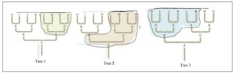 type of group is this?
A) Tree 3; polyphyletic.
B) Tree 2; polyphyletic.
C) Tree 1; monophyletic.
D) Tree 3; monophyletic.
E) Tree 2; paraphyletic.
type of group is this?A) Tree 3; polyphyletic.
B) Tree 2; polyphyletic.
C) Tree 1; monophyletic.
D) Tree 3; monophyletic.
E) Tree 2; paraphyletic.
سؤال
سؤال
سؤال
سؤال
سؤال
In Figure 26.09 (above) the animals across are a lancelet, lamprey, salmon, lizard, and rabbit. If the salmon, lizard, and rabbit are an ingroup, which animals above would be an outgroup and which 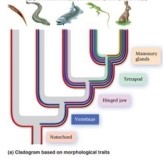 characteristics are necessary to be in the ingroup?
A) Lamprey and lancelet; notochord and vertebrae.
B) Lamprey only; vertebrae, hinged jaw, tetrapod, and mammary glands.
C) Lancelet and lamprey; hinged jaw, tetrapod, and mammary glands.
D) Lancelet, lamprey and salmon; hinged jaw, tetrapod, and mammary glands.
E) Lizard and rabbit; tetrapod and mammary glands.
characteristics are necessary to be in the ingroup?A) Lamprey and lancelet; notochord and vertebrae.
B) Lamprey only; vertebrae, hinged jaw, tetrapod, and mammary glands.
C) Lancelet and lamprey; hinged jaw, tetrapod, and mammary glands.
D) Lancelet, lamprey and salmon; hinged jaw, tetrapod, and mammary glands.
E) Lizard and rabbit; tetrapod and mammary glands.
سؤال
The animals across are a lancelet, lamprey, salmon, lizard, and rabbit. Which synapomorphy is 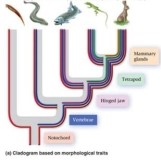 common to the lizard and rabbit but not the salmon?
A) Notochord.
B) Vertebrae.
C) Tetrapod.
D) Mammary glands.
common to the lizard and rabbit but not the salmon?A) Notochord.
B) Vertebrae.
C) Tetrapod.
D) Mammary glands.
سؤال
What nucleotide change is a shared derived character for species A, B, and C, but not for species G? 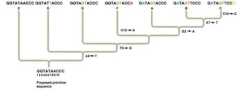
Note: A,T,G, and C refer to nucleotide bases, and the numbers refer to the position of the base in the nucleotide sequences. For example, A6 refers to an adenine at the sixth position.
A) Changing the second G to an A is common to species A, B, and C, but not to species G.
B) Changing the fifth T to a G is common to species A, B, and C, but not to species G.
C) Changing the second G to a T is common to species A, B, and C, but not to species G.
D) Changing the second G to an A and the fifth T to a G is common to species A, B, and C, but not to species G.
E) None of these show a change in derived characteristics for A, B, and C that are not found in G.
Note: A,T,G, and C refer to nucleotide bases, and the numbers refer to the position of the base in the nucleotide sequences. For example, A6 refers to an adenine at the sixth position.
A) Changing the second G to an A is common to species A, B, and C, but not to species G.
B) Changing the fifth T to a G is common to species A, B, and C, but not to species G.
C) Changing the second G to a T is common to species A, B, and C, but not to species G.
D) Changing the second G to an A and the fifth T to a G is common to species A, B, and C, but not to species G.
E) None of these show a change in derived characteristics for A, B, and C that are not found in G.
سؤال
سؤال
Use the principle of parsimony and molecular genetic data to choose a phylogenetic tree for your 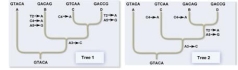
hypothesis of how the species were derived from the ancestor.
A) Tree 1 requires the most mutations therefore it would be the best choice.
B) Tree 2 requires 4 mutations while Tree 1 requires 6 mutations therefore Tree 2 would be the best choice.
C) Tree 2 requires the least mutations, therefore it would be the best choice.
D) Tree 2 requires 5 mutations while Tree 1 requires 7 mutations therefore Tree 2, with the least mutations, would be the best choice.
E) Tree 1 requires 7 mutations and Tree 2 requires 4 mutations, therefore Tree 2 would be the best choice.
hypothesis of how the species were derived from the ancestor.
A) Tree 1 requires the most mutations therefore it would be the best choice.
B) Tree 2 requires 4 mutations while Tree 1 requires 6 mutations therefore Tree 2 would be the best choice.
C) Tree 2 requires the least mutations, therefore it would be the best choice.
D) Tree 2 requires 5 mutations while Tree 1 requires 7 mutations therefore Tree 2, with the least mutations, would be the best choice.
E) Tree 1 requires 7 mutations and Tree 2 requires 4 mutations, therefore Tree 2 would be the best choice.
سؤال
سؤال
سؤال
سؤال
سؤال
سؤال
سؤال
سؤال
سؤال
Which pair of species would be expected to have fewer genetic differences: orangutans and gorillas or 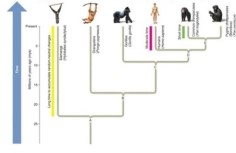 gorillas and humans? Why?
A) Gorillas and humans because their common ancestor (C) is more recent than that of orangutans and gorillas (B).
B) Gorillas and humans because their common ancestor (B) is more recent than that of orangutans and gorillas (D).
C) Gorillas and orangutans because their common ancestor (C) is more recent than that of humans and gorillas (B).
D) Humans and orangutans because their common ancestor (C) is more recent than that of orangutans and gorillas (D).
gorillas and humans? Why?A) Gorillas and humans because their common ancestor (C) is more recent than that of orangutans and gorillas (B).
B) Gorillas and humans because their common ancestor (B) is more recent than that of orangutans and gorillas (D).
C) Gorillas and orangutans because their common ancestor (C) is more recent than that of humans and gorillas (B).
D) Humans and orangutans because their common ancestor (C) is more recent than that of orangutans and gorillas (D).
سؤال
سؤال
سؤال
سؤال
سؤال
سؤال
سؤال
The shaded group includes all of the species that were derived from one common ancestor, this group 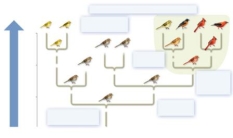 could also be called a(n)
A) polyphyetic taxon.
B) paraphyletic taxon.
C) phylum.
D) homology.
E) clade.
could also be called a(n)A) polyphyetic taxon.
B) paraphyletic taxon.
C) phylum.
D) homology.
E) clade.

فتح الحزمة
قم بالتسجيل لفتح البطاقات في هذه المجموعة!
Unlock Deck
Unlock Deck
1/31

العب

ملء الشاشة (f)
Deck 26: Taxonomy and Systematics
1
Once organisms are classified as to their domain, there are still millions of different species in each domain. Subdividing them even further makes it easier to understand their relationships to each other. A domain is divided into more subgroups until genus species is reached. Which of the groups listed is the broader group (contains more members)?
A) Order.
B) Class.
C) Family.
D) Phylum.
E) Kingdom.
A) Order.
B) Class.
C) Family.
D) Phylum.
E) Kingdom.
Kingdom.
2
Linnaeus began naming organisms that were alike by using Latin names, he gave each organism two names; for example a wolf is called Canis lupis by scientists. What type of naming system is this and what group does "lupis" designate?
A) Binomial nomenclature; genus.
B) Binomial nomenclature; species.
C) Zoological nomenclature; genus.
D) Zoological nomenclature; species.
E) Both binomial and zoological nomenclature; species are correct.
A) Binomial nomenclature; genus.
B) Binomial nomenclature; species.
C) Zoological nomenclature; genus.
D) Zoological nomenclature; species.
E) Both binomial and zoological nomenclature; species are correct.
Binomial nomenclature; species.
3
The evolutionary history of a species or group of species is called
A) Draculoides bramstokeri.
B) anagenology.
C) cladonomy.
D) taxonomy.
E) phylogeny.
A) Draculoides bramstokeri.
B) anagenology.
C) cladonomy.
D) taxonomy.
E) phylogeny.
phylogeny.
4
A phylogenetic tree is actually a ____________ that depicts the evolutionary relationships among species.
A) drawing
B) hypothesis
C) theory
D) paraphylogy
E) monophylogy
A) drawing
B) hypothesis
C) theory
D) paraphylogy
E) monophylogy
فتح الحزمة
افتح القفل للوصول البطاقات البالغ عددها 31 في هذه المجموعة.
فتح الحزمة
k this deck
5
When species of a single large population slowly evolves over generations into a new species, this an example of
A) adogenesis.
B) cladogenesis.
C) anagenesis.
D) monospeciation.
E) punctuated equilibrium.
A) adogenesis.
B) cladogenesis.
C) anagenesis.
D) monospeciation.
E) punctuated equilibrium.
فتح الحزمة
افتح القفل للوصول البطاقات البالغ عددها 31 في هذه المجموعة.
فتح الحزمة
k this deck
6
The three phylogenetic trees above all contain the same members, all have a common ancestor, but are divided up in three different ways. Which tree has members circled that are of several evolutionary lines and does not include the most recent common ancestor of the included lineages? What is this type of group is this?
A) Tree 3; polyphyletic.
B) Tree 2; polyphyletic.
C) Tree 1; monophyletic.
D) Tree 3; monophyletic.
E) Tree 2; paraphyletic.
type of group is this?A) Tree 3; polyphyletic.
B) Tree 2; polyphyletic.
C) Tree 1; monophyletic.
D) Tree 3; monophyletic.
E) Tree 2; paraphyletic.
فتح الحزمة
افتح القفل للوصول البطاقات البالغ عددها 31 في هذه المجموعة.
فتح الحزمة
k this deck
7
Can two different species, from the same clade, have more than one common ancestor? Choose the MOST correct answer and explanation.
A) No, if they are a clade then you have to assume that they have the same common ancestor.
B) No. They can have many common ancestors, depending on how far back you go in the tree. They cannot have more than one most recent common ancestor.
C) Maybe. Only a paraphyletic clade would have more than one common ancestors.
D) Yes. Dogs and cats have a common ancestor that gave rise to mammals, and an older common ancestor that gave rise to vertebrates. The most recent common ancestor is the point at which two species diverged from each other.
E) Yes. If they are related then they must have common ancestors all along the way. Doesn't everyone?
A) No, if they are a clade then you have to assume that they have the same common ancestor.
B) No. They can have many common ancestors, depending on how far back you go in the tree. They cannot have more than one most recent common ancestor.
C) Maybe. Only a paraphyletic clade would have more than one common ancestors.
D) Yes. Dogs and cats have a common ancestor that gave rise to mammals, and an older common ancestor that gave rise to vertebrates. The most recent common ancestor is the point at which two species diverged from each other.
E) Yes. If they are related then they must have common ancestors all along the way. Doesn't everyone?
فتح الحزمة
افتح القفل للوصول البطاقات البالغ عددها 31 في هذه المجموعة.
فتح الحزمة
k this deck
8
When you look at a phylogenetic tree of reptile classes, turtles, lizards and snake, and crocodiles are grouped together and birds are set off to the side but with a common ancestor for both groups. This would
A) be a monophyletic tree.
B) be a paraphyletic tree.
C) be a polyphyletic tree.
D) have the taxonomy wrong because birds should be included with the others to make it a monophyletic tree.
E) be a paraphyletic tree but the taxonomy wrong, because birds should be included with the others to make it a monophyletic tree.
A) be a monophyletic tree.
B) be a paraphyletic tree.
C) be a polyphyletic tree.
D) have the taxonomy wrong because birds should be included with the others to make it a monophyletic tree.
E) be a paraphyletic tree but the taxonomy wrong, because birds should be included with the others to make it a monophyletic tree.
فتح الحزمة
افتح القفل للوصول البطاقات البالغ عددها 31 في هذه المجموعة.
فتح الحزمة
k this deck
9
When you are classifying a species based on evolutionary relationships, a phylotenetic tree is then being used as a ___.
A) node.
B) speciation plan.
C) morphological cut off point.
D) molecular diagram.
E) cladogram.
A) node.
B) speciation plan.
C) morphological cut off point.
D) molecular diagram.
E) cladogram.
فتح الحزمة
افتح القفل للوصول البطاقات البالغ عددها 31 في هذه المجموعة.
فتح الحزمة
k this deck
10
Cladograms include in the phylogenetic tree shared primitive characters and shared derived characters. The derived characters can also be called ______ why the primitive characters can also be called __________.
A) character states; symplesiomorphy
B) symplesiomorphy; ingroup
C) outgroup; synapomorphy
D) synapomorphy; outgroup
E) synapomorphy; symplesiomorphy
A) character states; symplesiomorphy
B) symplesiomorphy; ingroup
C) outgroup; synapomorphy
D) synapomorphy; outgroup
E) synapomorphy; symplesiomorphy
فتح الحزمة
افتح القفل للوصول البطاقات البالغ عددها 31 في هذه المجموعة.
فتح الحزمة
k this deck
11
In Figure 26.09 (above) the animals across are a lancelet, lamprey, salmon, lizard, and rabbit. If the salmon, lizard, and rabbit are an ingroup, which animals above would be an outgroup and which characteristics are necessary to be in the ingroup?
A) Lamprey and lancelet; notochord and vertebrae.
B) Lamprey only; vertebrae, hinged jaw, tetrapod, and mammary glands.
C) Lancelet and lamprey; hinged jaw, tetrapod, and mammary glands.
D) Lancelet, lamprey and salmon; hinged jaw, tetrapod, and mammary glands.
E) Lizard and rabbit; tetrapod and mammary glands.
characteristics are necessary to be in the ingroup?A) Lamprey and lancelet; notochord and vertebrae.
B) Lamprey only; vertebrae, hinged jaw, tetrapod, and mammary glands.
C) Lancelet and lamprey; hinged jaw, tetrapod, and mammary glands.
D) Lancelet, lamprey and salmon; hinged jaw, tetrapod, and mammary glands.
E) Lizard and rabbit; tetrapod and mammary glands.
فتح الحزمة
افتح القفل للوصول البطاقات البالغ عددها 31 في هذه المجموعة.
فتح الحزمة
k this deck
12
The animals across are a lancelet, lamprey, salmon, lizard, and rabbit. Which synapomorphy is common to the lizard and rabbit but not the salmon?
A) Notochord.
B) Vertebrae.
C) Tetrapod.
D) Mammary glands.
common to the lizard and rabbit but not the salmon?A) Notochord.
B) Vertebrae.
C) Tetrapod.
D) Mammary glands.
فتح الحزمة
افتح القفل للوصول البطاقات البالغ عددها 31 في هذه المجموعة.
فتح الحزمة
k this deck
13
What nucleotide change is a shared derived character for species A, B, and C, but not for species G?
Note: A,T,G, and C refer to nucleotide bases, and the numbers refer to the position of the base in the nucleotide sequences. For example, A6 refers to an adenine at the sixth position.
A) Changing the second G to an A is common to species A, B, and C, but not to species G.
B) Changing the fifth T to a G is common to species A, B, and C, but not to species G.
C) Changing the second G to a T is common to species A, B, and C, but not to species G.
D) Changing the second G to an A and the fifth T to a G is common to species A, B, and C, but not to species G.
E) None of these show a change in derived characteristics for A, B, and C that are not found in G.
Note: A,T,G, and C refer to nucleotide bases, and the numbers refer to the position of the base in the nucleotide sequences. For example, A6 refers to an adenine at the sixth position.
A) Changing the second G to an A is common to species A, B, and C, but not to species G.
B) Changing the fifth T to a G is common to species A, B, and C, but not to species G.
C) Changing the second G to a T is common to species A, B, and C, but not to species G.
D) Changing the second G to an A and the fifth T to a G is common to species A, B, and C, but not to species G.
E) None of these show a change in derived characteristics for A, B, and C that are not found in G.
فتح الحزمة
افتح القفل للوصول البطاقات البالغ عددها 31 في هذه المجموعة.
فتح الحزمة
k this deck
14
Which concept states that " the preferred hypothesis is the one that is the simplest for all the characters and their states" when deciding which hypothesis to accept when deciphering a cladogram?
A) Maximum likelihood.
B) Principle of parsimony.
C) Bayesian method.
D) Both Maximum likelihood and Bayesian method.
E) Both the Molecular clock and Maximum likelihood.
A) Maximum likelihood.
B) Principle of parsimony.
C) Bayesian method.
D) Both Maximum likelihood and Bayesian method.
E) Both the Molecular clock and Maximum likelihood.
فتح الحزمة
افتح القفل للوصول البطاقات البالغ عددها 31 في هذه المجموعة.
فتح الحزمة
k this deck
15
Use the principle of parsimony and molecular genetic data to choose a phylogenetic tree for your
hypothesis of how the species were derived from the ancestor.
A) Tree 1 requires the most mutations therefore it would be the best choice.
B) Tree 2 requires 4 mutations while Tree 1 requires 6 mutations therefore Tree 2 would be the best choice.
C) Tree 2 requires the least mutations, therefore it would be the best choice.
D) Tree 2 requires 5 mutations while Tree 1 requires 7 mutations therefore Tree 2, with the least mutations, would be the best choice.
E) Tree 1 requires 7 mutations and Tree 2 requires 4 mutations, therefore Tree 2 would be the best choice.
hypothesis of how the species were derived from the ancestor.
A) Tree 1 requires the most mutations therefore it would be the best choice.
B) Tree 2 requires 4 mutations while Tree 1 requires 6 mutations therefore Tree 2 would be the best choice.
C) Tree 2 requires the least mutations, therefore it would be the best choice.
D) Tree 2 requires 5 mutations while Tree 1 requires 7 mutations therefore Tree 2, with the least mutations, would be the best choice.
E) Tree 1 requires 7 mutations and Tree 2 requires 4 mutations, therefore Tree 2 would be the best choice.
فتح الحزمة
افتح القفل للوصول البطاقات البالغ عددها 31 في هذه المجموعة.
فتح الحزمة
k this deck
16
Maximum Likelihood and Bayesian Methods
A) involve the use of an evolutionary model.
B) are a set of assumptions about how evolution is likely to happen.
C) can be applied along with the principle of parsimony.
D) ask the questions "what is the probability that an evolutionary model and proposed phylogenetic tree . would give rise to the observed data and what is the probability that a particular phylogenetic tree is correct given the observed data and particular evolutionary model" respectively.
E) involve the use of an evolutionary model; are a set of assumptions about how evolution is likely to happen; can be applied along with the principle of parsimony and ask the questions "what is the probability that an evolutionary model and proposed phylogenetic tree would give rise to the observed data and what is the probability that a particular phylogenetic tree is correct given the observed data and particular evolutionary model" respectively.
A) involve the use of an evolutionary model.
B) are a set of assumptions about how evolution is likely to happen.
C) can be applied along with the principle of parsimony.
D) ask the questions "what is the probability that an evolutionary model and proposed phylogenetic tree . would give rise to the observed data and what is the probability that a particular phylogenetic tree is correct given the observed data and particular evolutionary model" respectively.
E) involve the use of an evolutionary model; are a set of assumptions about how evolution is likely to happen; can be applied along with the principle of parsimony and ask the questions "what is the probability that an evolutionary model and proposed phylogenetic tree would give rise to the observed data and what is the probability that a particular phylogenetic tree is correct given the observed data and particular evolutionary model" respectively.
فتح الحزمة
افتح القفل للوصول البطاقات البالغ عددها 31 في هذه المجموعة.
فتح الحزمة
k this deck
17
If the genus Quercus (oaks) is monophyletic, then this means that
A) all species of oaks grow in similar habitats.
B) oaks all have nearly identical appearance.
C) all species of oaks are descended from a common ancestor.
D) oaks cannot be classified in a single family or order.
E) all species of trees are classified as being in a single order.
A) all species of oaks grow in similar habitats.
B) oaks all have nearly identical appearance.
C) all species of oaks are descended from a common ancestor.
D) oaks cannot be classified in a single family or order.
E) all species of trees are classified as being in a single order.
فتح الحزمة
افتح القفل للوصول البطاقات البالغ عددها 31 في هذه المجموعة.
فتح الحزمة
k this deck
18
A modern goal of systematics is to create taxa based on similarity of form and function, regardless of evolutionary relationships.
فتح الحزمة
افتح القفل للوصول البطاقات البالغ عددها 31 في هذه المجموعة.
فتح الحزمة
k this deck
19
When researchers calibrate the molecular clock they are
A) determining how much time it takes to accumulate a certain percentage of nucleotide changes.
B) setting the geological time scale according to the position in which the fossil was found in the rock.
C) investigating where the least common ancestor was found.
D) generalizing about the amount of time between speciations.
E) setting the geological time scale according to the position in which the fossil was found in the rock . and investigating where the least common ancestor was found.
A) determining how much time it takes to accumulate a certain percentage of nucleotide changes.
B) setting the geological time scale according to the position in which the fossil was found in the rock.
C) investigating where the least common ancestor was found.
D) generalizing about the amount of time between speciations.
E) setting the geological time scale according to the position in which the fossil was found in the rock . and investigating where the least common ancestor was found.
فتح الحزمة
افتح القفل للوصول البطاقات البالغ عددها 31 في هذه المجموعة.
فتح الحزمة
k this deck
20
Which of the following are commonly used to study phylogeny?
A) Whole genomes because they are easy to obtain.
B) Segments of membrane proteins because the proteins are encoded by DNA.
C) Specific mRNA chloroplast sequences because they are found in the genomes of all living organisms.
D) Small ribosomal subunit (SSU) RNA because it is found in the genomes of all living organisms.
E) None of these answers are correct.
A) Whole genomes because they are easy to obtain.
B) Segments of membrane proteins because the proteins are encoded by DNA.
C) Specific mRNA chloroplast sequences because they are found in the genomes of all living organisms.
D) Small ribosomal subunit (SSU) RNA because it is found in the genomes of all living organisms.
E) None of these answers are correct.
فتح الحزمة
افتح القفل للوصول البطاقات البالغ عددها 31 في هذه المجموعة.
فتح الحزمة
k this deck
21
Given the following list of characteristics:
Which of the following would be considered to be a symplesiomorphy of mosses, ferns, conifers, and flowering plants?
A) Chlorophylls a & b
B) Vascular tissue.
C) Seeds.
D) Flowers.
E) Both flowers and vascular tissue.
فتح الحزمة
افتح القفل للوصول البطاقات البالغ عددها 31 في هذه المجموعة.
فتح الحزمة
k this deck
22
Given the following list of characteristics:
Which of the following would be considered to be a synapomorphy of conifers and flowering plants?
A) Chlorophylls a & b
B) Vascular tissue.
C) Seeds.
D) Flowers.
E) Both chlofophyls a & b and vascular tissue.
فتح الحزمة
افتح القفل للوصول البطاقات البالغ عددها 31 في هذه المجموعة.
فتح الحزمة
k this deck
23
Given the following list of characteristics:
Which of the following would be considered to be a synapomorphy of ferns, conifers, and flowering plants?
A) chlorophylls a & b
B) vascular tissue
C) seeds
D) flowers
Which of the following would be considered to be a synapomorphy of ferns, conifers, and flowering plants?
A) chlorophylls a & b
B) vascular tissue
C) seeds
D) flowers
فتح الحزمة
افتح القفل للوصول البطاقات البالغ عددها 31 في هذه المجموعة.
فتح الحزمة
k this deck
24
Which pair of species would be expected to have fewer genetic differences: orangutans and gorillas or gorillas and humans? Why?
A) Gorillas and humans because their common ancestor (C) is more recent than that of orangutans and gorillas (B).
B) Gorillas and humans because their common ancestor (B) is more recent than that of orangutans and gorillas (D).
C) Gorillas and orangutans because their common ancestor (C) is more recent than that of humans and gorillas (B).
D) Humans and orangutans because their common ancestor (C) is more recent than that of orangutans and gorillas (D).
gorillas and humans? Why?A) Gorillas and humans because their common ancestor (C) is more recent than that of orangutans and gorillas (B).
B) Gorillas and humans because their common ancestor (B) is more recent than that of orangutans and gorillas (D).
C) Gorillas and orangutans because their common ancestor (C) is more recent than that of humans and gorillas (B).
D) Humans and orangutans because their common ancestor (C) is more recent than that of orangutans and gorillas (D).
فتح الحزمة
افتح القفل للوصول البطاقات البالغ عددها 31 في هذه المجموعة.
فتح الحزمة
k this deck
25
Alan Cooper, Cécile Mourer Chauviré, Geoffrey Chambers, Arndt von Haeseler, Allan Wilson and Svante Pääbo investigated the evolutionary relationship among some extinct and living species of flightless birds. They used tissue samples from museums and from living birds. This is an example of discovery-based science.
فتح الحزمة
افتح القفل للوصول البطاقات البالغ عددها 31 في هذه المجموعة.
فتح الحزمة
k this deck
26
Alan Cooper, Cécile Mourer Chauviré, Geoffrey Chambers, Arndt von Haeseler, Allan Wilson and Svante Pääbo investigated the evolutionary relationship among some extinct and living species of flightless birds. They concluded that kiwis are more closely related to African and Australian flightless birds than they are to the moas. What hypothesis did they propose from this conclusion?
A) That their data was incorrect and the sample from the museum was corrupted.
B) That flightless birds only occurred once in New Zealand.
C) That New Zealand was colonized twice by ancestors of flightless birds.
D) That the South American species ancestors flew to New Zealand before the flightless mutation occurred.
E) That the North American flightless bird originated from an ancestor of the New Zealand species.
A) That their data was incorrect and the sample from the museum was corrupted.
B) That flightless birds only occurred once in New Zealand.
C) That New Zealand was colonized twice by ancestors of flightless birds.
D) That the South American species ancestors flew to New Zealand before the flightless mutation occurred.
E) That the North American flightless bird originated from an ancestor of the New Zealand species.
فتح الحزمة
افتح القفل للوصول البطاقات البالغ عددها 31 في هذه المجموعة.
فتح الحزمة
k this deck
27
Mammals and birds are descendents of reptiles, but are not included within the taxon Reptilia. As a taxon Reptilia is
A) polyphyletic.
B) polygenetic.
C) paraphyletic.
D) a supergroup.
E) a kingdom.
A) polyphyletic.
B) polygenetic.
C) paraphyletic.
D) a supergroup.
E) a kingdom.
فتح الحزمة
افتح القفل للوصول البطاقات البالغ عددها 31 في هذه المجموعة.
فتح الحزمة
k this deck
28
Thick-skinned rhinoceroses and elephants were once classified together as pachyderms. They actually descended from different ancestors that in turn evolved from a thin-skinned common ancestor that was not included in the pachyderms. Pachyderms were therefore, as a taxon,
A) polyphyletic.
B) polygenetic.
C) paraphyletic.
D) a supergroup.
E) a kingdom.
A) polyphyletic.
B) polygenetic.
C) paraphyletic.
D) a supergroup.
E) a kingdom.
فتح الحزمة
افتح القفل للوصول البطاقات البالغ عددها 31 في هذه المجموعة.
فتح الحزمة
k this deck
29
Horizontal gene transfer is thought to have been an important factor in the early evolution of the three domains.
فتح الحزمة
افتح القفل للوصول البطاقات البالغ عددها 31 في هذه المجموعة.
فتح الحزمة
k this deck
30
How does the phenomenon of horizontal gene transfer muddle the concept of monophyletic groups?
A) Horizontal gene transfer makes it impossible to distinguish monophyletic groups.
B) Monophyletic groups are based on the concept that a particular group of species descended from a common ancestor. When horizontal gene transfer occurs, not all of the genes in a species were inherited from the common ancestor.
C) Since horizontal gene transfer includes transfer from one group of species to another group with a common ancestor, there is no muddling of the concept of monophyletics.
D) All of these are correct.
A) Horizontal gene transfer makes it impossible to distinguish monophyletic groups.
B) Monophyletic groups are based on the concept that a particular group of species descended from a common ancestor. When horizontal gene transfer occurs, not all of the genes in a species were inherited from the common ancestor.
C) Since horizontal gene transfer includes transfer from one group of species to another group with a common ancestor, there is no muddling of the concept of monophyletics.
D) All of these are correct.
فتح الحزمة
افتح القفل للوصول البطاقات البالغ عددها 31 في هذه المجموعة.
فتح الحزمة
k this deck
31
The shaded group includes all of the species that were derived from one common ancestor, this group could also be called a(n)
A) polyphyetic taxon.
B) paraphyletic taxon.
C) phylum.
D) homology.
E) clade.
could also be called a(n)A) polyphyetic taxon.
B) paraphyletic taxon.
C) phylum.
D) homology.
E) clade.
فتح الحزمة
افتح القفل للوصول البطاقات البالغ عددها 31 في هذه المجموعة.
فتح الحزمة
k this deck
فتح الحزمة
افتح القفل للوصول البطاقات البالغ عددها 31 في هذه المجموعة.






