







 تكلم مع الذكاء الاصطناعي


Deck 21: Enterobacteriaceae
ملء الشاشة (f)

سؤال

سؤال
سؤال
سؤال
سؤال
سؤال
سؤال
سؤال
سؤال
سؤال
سؤال
سؤال
سؤال
سؤال
سؤال
سؤال
سؤال
A 25-year-old female complained of burning on urination. The urine culture grew a clear colony on MacConkey agar. Biochemical testing revealed the following: 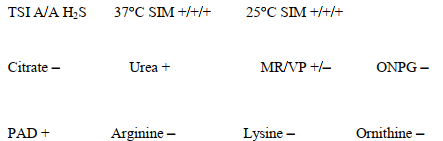 This organism will also
A) swarm.
B) need to be serotyped.
C) appear as a mucoid colony.
D) exhibit multiple antibiotic resistance.
This organism will alsoA) swarm.
B) need to be serotyped.
C) appear as a mucoid colony.
D) exhibit multiple antibiotic resistance.
سؤال
An 8-year-old female was admitted with a complaint of right lower quadrant pain. She was taken to surgery for removal of her appendix. The appendix appeared normal, but lymph nodes in the peritoneal cavity were inflamed. Cultures of the nodes were taken and sent to the microbiology department. The organism that grew appeared as clear colonies on MAC and provided the following reactions: 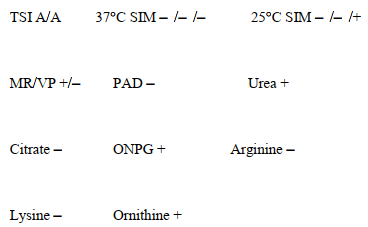 This is organism will also produce
A) bulls-eye colonies on CIN agar.
B) DNase.
C) clear colonies on XLD agar.
D) lipase.
This is organism will also produceA) bulls-eye colonies on CIN agar.
B) DNase.
C) clear colonies on XLD agar.
D) lipase.
سؤال
A sputum from a cancer patient grew a pink colony on MAC. The biochemical reactions were as follows:
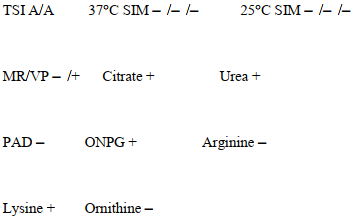 What colony characteristic is often associated with this organism?
A) Swarmer
B) Yellow pigment
C) Red pigment
D) Mucoid
What colony characteristic is often associated with this organism?A) Swarmer
B) Yellow pigment
C) Red pigment
D) Mucoid
سؤال
A pink colony on MAC grew from an abdominal wound. The biochemical reactions included:
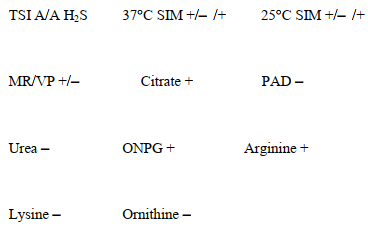 The organism identified is
A) serologically similar to Salmonella spp.
B) often found hiding in the gallbladder in carriers.
C) characterized by the production of the Vi antigen.
D) able to produce only a small amount of H2S in TSI.
The organism identified isA) serologically similar to Salmonella spp.
B) often found hiding in the gallbladder in carriers.
C) characterized by the production of the Vi antigen.
D) able to produce only a small amount of H2S in TSI.

فتح الحزمة
قم بالتسجيل لفتح البطاقات في هذه المجموعة!
Unlock Deck
Unlock Deck
1/20

العب

ملء الشاشة (f)
Deck 21: Enterobacteriaceae
1
Which of the following characteristics has recently changed when defining the family Enterobacteriaceae?
A) Gram-negative rods
B) Ferment glucose
C) Reduce nitrates to nitrites
D) Oxidase negative
A) Gram-negative rods
B) Ferment glucose
C) Reduce nitrates to nitrites
D) Oxidase negative
Oxidase negative
2
Which of the following antigens remains after boiling a suspension of a member of the Enterobacteriaceae for 10 minutes?
A) K
B) O
C) H
D) Vi
A) K
B) O
C) H
D) Vi
O
3
Which of the following properties or reactions consistently differentiates gram-negative rods of the Enterobacteriaceae from the non-fermenting gram-negative rods?
A) Growth on MacConkey
B) TSI reaction of K/A or A/A
C) Oxidase reaction
D) Presence of LPS
A) Growth on MacConkey
B) TSI reaction of K/A or A/A
C) Oxidase reaction
D) Presence of LPS
TSI reaction of K/A or A/A
4
Phenylalanine deaminase is produced by all of the following organisms except
A) Proteus vulgaris.
B) Morganella morganii.
C) Serratia marcescens.
D) Providencia stuartii.
A) Proteus vulgaris.
B) Morganella morganii.
C) Serratia marcescens.
D) Providencia stuartii.
فتح الحزمة
افتح القفل للوصول البطاقات البالغ عددها 20 في هذه المجموعة.
فتح الحزمة
k this deck
5
Which genera of the Enterobacteriaceae are considered enteric pathogens?
A) Enterobacter, Providencia, and Proteus
B) Enterobacter, Citrobacter, and Morganella
C) E. coli, Citrobacter, and Klebsiella
D) Yersinia, Salmonella, and Shigella
A) Enterobacter, Providencia, and Proteus
B) Enterobacter, Citrobacter, and Morganella
C) E. coli, Citrobacter, and Klebsiella
D) Yersinia, Salmonella, and Shigella
فتح الحزمة
افتح القفل للوصول البطاقات البالغ عددها 20 في هذه المجموعة.
فتح الحزمة
k this deck
6
Given the presence of blood and white blood cells in stool, which of the following organisms is the most likely pathogen?
A) non-motile, urea-negative, non-lactose fermenter.
B) H2S-positive, lysine-positive, citrate-negative, non-lactose fermenter.
C) H2S-positive, lysine-positive, citrate-positive, non-lactose fermenter.
D) PAD-positive, urea-positive non-lactose fermenter.
A) non-motile, urea-negative, non-lactose fermenter.
B) H2S-positive, lysine-positive, citrate-negative, non-lactose fermenter.
C) H2S-positive, lysine-positive, citrate-positive, non-lactose fermenter.
D) PAD-positive, urea-positive non-lactose fermenter.
فتح الحزمة
افتح القفل للوصول البطاقات البالغ عددها 20 في هذه المجموعة.
فتح الحزمة
k this deck
7
All of the following organisms are commonly associated with urinary tract infections except a
A) VP-negative, citrate-negative, indole-positive, lactose fermenter.
B) H2S-positive, urea-negative, lysine-positive, non-lactose fermenter.
C) H2S-positive, urea-positive, indole-negative, non-lactose fermenter.
D) non-motile, VP-positive, indole-negative, lactose fermenter.
A) VP-negative, citrate-negative, indole-positive, lactose fermenter.
B) H2S-positive, urea-negative, lysine-positive, non-lactose fermenter.
C) H2S-positive, urea-positive, indole-negative, non-lactose fermenter.
D) non-motile, VP-positive, indole-negative, lactose fermenter.
فتح الحزمة
افتح القفل للوصول البطاقات البالغ عددها 20 في هذه المجموعة.
فتح الحزمة
k this deck
8
Pus collected from a draining axillary lymph node is sent to the laboratory. A gramnegative rod is observed on Gram stain. Twenty-four hours after incubation at 35°C in CO2, a poorly growing non-lactose fermenter is observed. After 48 hours, the colonies on BAP and MAC were slightly larger. The organism proved to be
Citrate: green
This organism is the causative agent of
A) typhoid fever.
B) gastroenteritis.
C) plague.
D) mesenteric lymph adenitis.
Citrate: green
This organism is the causative agent of
A) typhoid fever.
B) gastroenteritis.
C) plague.
D) mesenteric lymph adenitis.
فتح الحزمة
افتح القفل للوصول البطاقات البالغ عددها 20 في هذه المجموعة.
فتح الحزمة
k this deck
9
The lipopolysaccharide associated with the Enterobacteriaceae is
A) used in conjugation.
B) part of the plasma membrane.
C) protective against antimicrobial agents.
D) an endotoxin.
A) used in conjugation.
B) part of the plasma membrane.
C) protective against antimicrobial agents.
D) an endotoxin.
فتح الحزمة
افتح القفل للوصول البطاقات البالغ عددها 20 في هذه المجموعة.
فتح الحزمة
k this deck
10
Which of the following reactions is associated with the gram-negative rod best known for its capsule production?
A) Positive motility
B) H2S production
C) VP positive
D) PAD positive
A) Positive motility
B) H2S production
C) VP positive
D) PAD positive
فتح الحزمة
افتح القفل للوصول البطاقات البالغ عددها 20 في هذه المجموعة.
فتح الحزمة
k this deck
11
A beta-hemolytic, lactose fermenter is isolated in pure culture from catheterized urine of an 88-year-old female. What additional spot or rapid test result is necessary to presumptively identify this organism?
A) Indole negative
B) Indole positive
C) MUG negative
D) Oxidase positive
A) Indole negative
B) Indole positive
C) MUG negative
D) Oxidase positive
فتح الحزمة
افتح القفل للوصول البطاقات البالغ عددها 20 في هذه المجموعة.
فتح الحزمة
k this deck
12
A voided urine culture from a 46-year-old female grows dark lactose fermenting as well as non-lactose fermenting colonies. The BAP shows gray, beta-hemolytic colonies under a swarming film of growth. The microbiologist performs a spot indole test on swarming colony and it is positive. She reports the organism as presumptive Proteus vulgaris using the department's rapid identification criteria. The next day the second colony identifies as E. coli using a commercial identification system. Your next step in this process is to
A) report Proteus vulgaris and E. coli isolated.
B) question the identification of the E. coli colony and repeat testing.
C) identify the non-lactose fermenting,, swarming colony using a commercial identification system.
D) repeat the identification of both organisms using a commercial identification system.
A) report Proteus vulgaris and E. coli isolated.
B) question the identification of the E. coli colony and repeat testing.
C) identify the non-lactose fermenting,, swarming colony using a commercial identification system.
D) repeat the identification of both organisms using a commercial identification system.
فتح الحزمة
افتح القفل للوصول البطاقات البالغ عددها 20 في هذه المجموعة.
فتح الحزمة
k this deck
13
A stool culture from an 11-month-old male suffering from bloody diarrhea gave the following results on differential enteric media:
MacConkey agar: clear colonies
Xylose Lysine Deoxycholate agar: clear colonies
Hecktoen Enteric agar: clear colonies
Which of the following tests must be performed to confirm the final identification of
This enteric pathogen?
A) Salmonella serotyping
B) Shigella serotyping
C) Latex agglutination for E. coli O157:H7
D) No further testing is required
MacConkey agar: clear colonies
Xylose Lysine Deoxycholate agar: clear colonies
Hecktoen Enteric agar: clear colonies
Which of the following tests must be performed to confirm the final identification of
This enteric pathogen?
A) Salmonella serotyping
B) Shigella serotyping
C) Latex agglutination for E. coli O157:H7
D) No further testing is required
فتح الحزمة
افتح القفل للوصول البطاقات البالغ عددها 20 في هذه المجموعة.
فتح الحزمة
k this deck
14
A black colony on HE and XLD agars, isolated from a stool culture, produces the following biochemical reactions:
If this organism is a strict pathogen, you expect it to also be
A) citrate positive and lysine positive
B) citrate negative and lysine positive.
C) citrate positive and lysine negative.
D) citrate negative and lysine negative.
If this organism is a strict pathogen, you expect it to also be
A) citrate positive and lysine positive
B) citrate negative and lysine positive.
C) citrate positive and lysine negative.
D) citrate negative and lysine negative.
فتح الحزمة
افتح القفل للوصول البطاقات البالغ عددها 20 في هذه المجموعة.
فتح الحزمة
k this deck
15
One of the most resistant genus and species of the Enterobacteriaceae is a
A) beta-hemolytic, indole-positive, lactose fermenter.
B) swarming, indole-negative, non-lactose fermenter.
C) nonmotile, VP-negative, non-lactose fermenter.
D) VP-positive, nonmotile, indole-negative, lactose fermenter.
A) beta-hemolytic, indole-positive, lactose fermenter.
B) swarming, indole-negative, non-lactose fermenter.
C) nonmotile, VP-negative, non-lactose fermenter.
D) VP-positive, nonmotile, indole-negative, lactose fermenter.
فتح الحزمة
افتح القفل للوصول البطاقات البالغ عددها 20 في هذه المجموعة.
فتح الحزمة
k this deck
16
Which of the following organisms always requires antibiotic therapy when isolated in a stool culture?
A) Salmonella spp.
B) Shigella spp.
C) Salmonella typhi
D) Edwardsella tarda
A) Salmonella spp.
B) Shigella spp.
C) Salmonella typhi
D) Edwardsella tarda
فتح الحزمة
افتح القفل للوصول البطاقات البالغ عددها 20 في هذه المجموعة.
فتح الحزمة
k this deck
17
A 25-year-old female complained of burning on urination. The urine culture grew a clear colony on MacConkey agar. Biochemical testing revealed the following: This organism will also
A) swarm.
B) need to be serotyped.
C) appear as a mucoid colony.
D) exhibit multiple antibiotic resistance.
This organism will alsoA) swarm.
B) need to be serotyped.
C) appear as a mucoid colony.
D) exhibit multiple antibiotic resistance.
فتح الحزمة
افتح القفل للوصول البطاقات البالغ عددها 20 في هذه المجموعة.
فتح الحزمة
k this deck
18
An 8-year-old female was admitted with a complaint of right lower quadrant pain. She was taken to surgery for removal of her appendix. The appendix appeared normal, but lymph nodes in the peritoneal cavity were inflamed. Cultures of the nodes were taken and sent to the microbiology department. The organism that grew appeared as clear colonies on MAC and provided the following reactions: This is organism will also produce
A) bulls-eye colonies on CIN agar.
B) DNase.
C) clear colonies on XLD agar.
D) lipase.
This is organism will also produceA) bulls-eye colonies on CIN agar.
B) DNase.
C) clear colonies on XLD agar.
D) lipase.
فتح الحزمة
افتح القفل للوصول البطاقات البالغ عددها 20 في هذه المجموعة.
فتح الحزمة
k this deck
19
A sputum from a cancer patient grew a pink colony on MAC. The biochemical reactions were as follows:
What colony characteristic is often associated with this organism?
A) Swarmer
B) Yellow pigment
C) Red pigment
D) Mucoid
What colony characteristic is often associated with this organism?A) Swarmer
B) Yellow pigment
C) Red pigment
D) Mucoid
فتح الحزمة
افتح القفل للوصول البطاقات البالغ عددها 20 في هذه المجموعة.
فتح الحزمة
k this deck
20
A pink colony on MAC grew from an abdominal wound. The biochemical reactions included:
The organism identified is
A) serologically similar to Salmonella spp.
B) often found hiding in the gallbladder in carriers.
C) characterized by the production of the Vi antigen.
D) able to produce only a small amount of H2S in TSI.
The organism identified isA) serologically similar to Salmonella spp.
B) often found hiding in the gallbladder in carriers.
C) characterized by the production of the Vi antigen.
D) able to produce only a small amount of H2S in TSI.
فتح الحزمة
افتح القفل للوصول البطاقات البالغ عددها 20 في هذه المجموعة.
فتح الحزمة
k this deck
فتح الحزمة
افتح القفل للوصول البطاقات البالغ عددها 20 في هذه المجموعة.






