







 تكلم مع الذكاء الاصطناعي


Deck 3: The Classical Marketplace Demand and Supply
ملء الشاشة (f)

سؤال

سؤال
سؤال
سؤال
سؤال
سؤال
سؤال
سؤال
سؤال
سؤال
سؤال
سؤال
سؤال
سؤال
سؤال
سؤال
سؤال
سؤال
سؤال
سؤال
سؤال
سؤال
سؤال
سؤال
سؤال
سؤال
سؤال
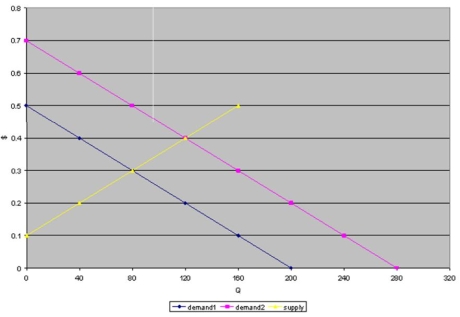
-In Figure 3.2, when the demand curve 'demand1' shifts to 'demand2' this creates an excess demand at the initial price of:
A) 40.
B) 60.
C) 80.
D) 160.
سؤال
-In Figure 3.2, the change in equilibrium to a higher price reflects the fact that:
A) demand has increased.
B) the new equilibrium price and quantity are $0.40 and 120 respectively.
C) quantity supplied increased.
D) all the above.
سؤال
-In Figure 3.2, it is not the case that:
A) quantity supplied increased.
B) supply has increased.
C) the new equilibrium price is $0.40.
D) supply has not changed.
سؤال
-Referring to Table 3.1, what are the equilibrium values of price and quantity?
A) $1.2 million and 18.
B) $1.4 million and 18.
C) $1.6 million and 18.
D) $1.8 million and 18.
سؤال
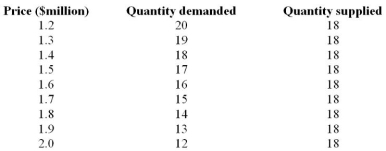 Table 3.2
These data reflect supply and demand conditions for luxurious apartments in the downtown area.
-Referring to Table 3.2, if the developer decides to set the price at $1.8 million for each apartment, what are the new market price and quantity demanded?
A) $1.8 million and 14.
B) $1.8 million and 15.
C) $1.8 million and 16.
D) $1.8 million and 17.
سؤال
Table 3.2These data reflect supply and demand conditions for luxurious apartments in the downtown area.
-Referring to Table 3.2, if two potential buyers decide to leave this market, what are the new equilibrium values of price and quantity?
A) $2.0 million and 10.
B) $1.8 million and 12.
C) $1.6 million and 14.
D) $1.2 million and 18.
Figure 3.3
سؤال
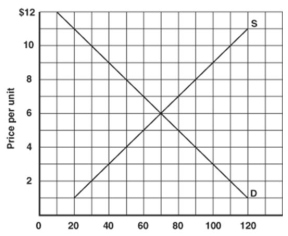
-Referring to figure 3.3, what is the state of the market if price is currently $5?
A) There is a surplus of 20.
B) There is a shortage of 20.
C) The quantity supplied is 80.
D) The quantity demanded is 60.
سؤال
-In figure 3.3, if there is a shortage of 40 units, what does this mean?
A) Price will fall.
B) Price must be $8.
C) The quantity traded is 40.
D) Buyers would be willing to pay an additional $4 per unit for the quantity that they are now buying.
سؤال
-In figure 3.3, if there is a surplus of 20 units, what does this mean?
A) Price will rise.
B) Price must be $5.
C) The quantity traded is 80.
D) Buyers are only willing to pay $2 less than the current price in order to buy all of the quantity supplied.
سؤال
-In figure 3.3, assume that the market was at equilibrium and that demand increases by 20 units. What will be the new equilibrium price and quantity?
A) Price will rise by $2 and quantity traded will rise by 20 units.
B) Price will fall by $2 and quantity traded will fall by 20 units.
C) Price will rise by $1 and quantity traded will rise by 10 units.
D) Price will fall by $1 and quantity traded will fall by 10 units.
سؤال
سؤال
سؤال
سؤال
سؤال
سؤال
سؤال
سؤال
سؤال
سؤال
سؤال
سؤال
سؤال
سؤال
سؤال
سؤال
سؤال
سؤال
سؤال
سؤال
سؤال
سؤال
سؤال
سؤال
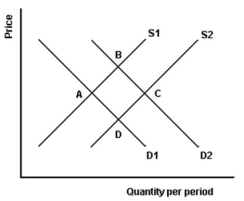
-In figure 3.6, what could cause the movement from point A to point B?
A) An increase in the supply.
B) An increase in the price.
C) An increase in prices of resources.
D) An increase in the price of a substitute product.
سؤال
-In figure 3.6, what could cause the movement from point B to point C?
A) An increase in the demand.
B) A decrease in the price.
C) A decrease in prices of resources.
D) An increase in the price of a substitute product.
سؤال
-In figure 3.6, what could cause the movement from point C to point D?
A) A decrease in the supply.
B) A decrease in the price.
C) A decrease in prices of productive resources.
D) An increase in the price of a complementary product.
سؤال
-In figure 3.6, what could cause the movement from point D to point A?
A) A decrease in the demand.
B) An increase in the price.
C) An increase in prices of resources.
D) An increase in the price of a substitute product.
سؤال
Table 3.3
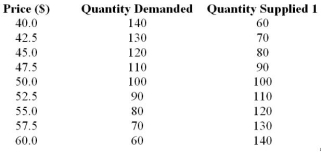
-In Table 3.3, what is true if price is $45?
A) Price will soon fall.
B) There is a surplus of 40.
C) The quantity supplied is 200.
D) The quantity exchanged is 80.
-In Table 3.3, what is true if price is $45?
A) Price will soon fall.
B) There is a surplus of 40.
C) The quantity supplied is 200.
D) The quantity exchanged is 80.
سؤال
Table 3.3
-In Table 3.3, what is true if price is $52.50?
A) Price will soon rise.
B) There is a surplus of 110.
C) The quantity supplied is 90.
D) The quantity demanded is 90.
-In Table 3.3, what is true if price is $52.50?
A) Price will soon rise.
B) There is a surplus of 110.
C) The quantity supplied is 90.
D) The quantity demanded is 90.
سؤال
Table 3.3
-In the Table above, if demand increases by 20 units, what will be the new equilibrium price and quantity?
A) $45 and 120.
B) $50 and 120.
C) $55 and 120.
D) $52.50 and 110.
-In the Table above, if demand increases by 20 units, what will be the new equilibrium price and quantity?
A) $45 and 120.
B) $50 and 120.
C) $55 and 120.
D) $52.50 and 110.
سؤال
Table 3.3
-In Table 3.3, if supply increases by 40 units, what will be the new values of equilibrium price and quantity?
A) $40 and 140.
B) $45 and 120.
C) $50 and 140.
D) $60 and 120.
-In Table 3.3, if supply increases by 40 units, what will be the new values of equilibrium price and quantity?
A) $40 and 140.
B) $45 and 120.
C) $50 and 140.
D) $60 and 120.
سؤال
Table 3.3
-In Table 3.3, if both demand and supply increase by 40 units, what will be the new values of equilibrium price and quantity?
A) $40 and 140.
B) $50 and 140.
C) $60 and 100.
D) $60 and 140.
-In Table 3.3, if both demand and supply increase by 40 units, what will be the new values of equilibrium price and quantity?
A) $40 and 140.
B) $50 and 140.
C) $60 and 100.
D) $60 and 140.
سؤال
سؤال
سؤال
سؤال
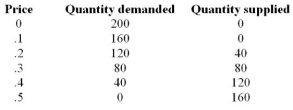
-In Table 3.4 a price ceiling of $0.2 means that:
A) the market is in equilibrium because quantity demanded equals quantity supplied.
B) there is a surplus in the market of 80 units.
C) there is a shortage in the market of 40 units.
D) there is a shortage in the market of 80 units.
سؤال
-In Table 3.4, to maintain the market price at p = $0.4:
A) the government should allocate production quotas to the suppliers.
B) the government set a price floor at p = $0.2.
C) the government should set a price ceiling at p = $0.4.
D) the government should do none of the above.
سؤال
-In Table 3.4, to keep the price at $0.2, the government should:
A) introduce a supply quota.
B) introduce a demand quota.
C) tax suppliers.
D) all of the above.
سؤال
سؤال
سؤال
سؤال
سؤال
سؤال
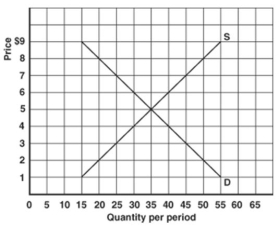 Figure 3.7
-In figure 3.7, what is the effect of a price ceiling of $4?
A) A shortage of 5 units.
B) A shortage of 10 units.
C) A surplus of 5 units.
D) A surplus of 10 units.

فتح الحزمة
قم بالتسجيل لفتح البطاقات في هذه المجموعة!
Unlock Deck
Unlock Deck
1/111

العب

ملء الشاشة (f)
Deck 3: The Classical Marketplace Demand and Supply
1
Which of the following statements is false?
A) The interaction of demand and supply determines the price and amount of output produced and sold in the market.
B) Markets may be either formally or informally organized.
C) In a market, buyers and sellers of a good are in communication to trade the good.
D) Most of the western industrialized economies rely upon governments to allocate resources.
A) The interaction of demand and supply determines the price and amount of output produced and sold in the market.
B) Markets may be either formally or informally organized.
C) In a market, buyers and sellers of a good are in communication to trade the good.
D) Most of the western industrialized economies rely upon governments to allocate resources.
Most of the western industrialized economies rely upon governments to allocate resources.
2
Which of the following statements is false?
A) When a market is in equilibrium, excess demand is zero.
B) When a market is in equilibrium, quantity demanded equals quantity supplied.
C) When a market is in equilibrium, a price is established that clears the market.
D) When a market is in equilibrium, shortages may still exist.
A) When a market is in equilibrium, excess demand is zero.
B) When a market is in equilibrium, quantity demanded equals quantity supplied.
C) When a market is in equilibrium, a price is established that clears the market.
D) When a market is in equilibrium, shortages may still exist.
When a market is in equilibrium, shortages may still exist.
3
At the market equilibrium price:
A) there is no excess demand, but excess supply is greater than zero.
B) quantity demanded equals quantity supplied.
C) excess demand is greater than zero, so the market does not clear.
D) quantity demanded may not equal quantity supplied.
A) there is no excess demand, but excess supply is greater than zero.
B) quantity demanded equals quantity supplied.
C) excess demand is greater than zero, so the market does not clear.
D) quantity demanded may not equal quantity supplied.
quantity demanded equals quantity supplied.
4
When a demand schedule is graphed, it generates:
A) an equilibrium price.
B) a demand curve.
C) an equilibrium quantity.
D) excess demand.
A) an equilibrium price.
B) a demand curve.
C) an equilibrium quantity.
D) excess demand.
فتح الحزمة
افتح القفل للوصول البطاقات البالغ عددها 111 في هذه المجموعة.
فتح الحزمة
k this deck
5
At the prices below the equilibrium price:
A) there is an excess demand.
B) there is an excess supply.
C) there is neither excess demand nor excess supply.
D) there is zero excess demand.
A) there is an excess demand.
B) there is an excess supply.
C) there is neither excess demand nor excess supply.
D) there is zero excess demand.
فتح الحزمة
افتح القفل للوصول البطاقات البالغ عددها 111 في هذه المجموعة.
فتح الحزمة
k this deck
6
At the prices below the equilibrium prices:
A) there will be an upward pressure on price.
B) there will be a downward pressure on price.
C) there will be an excess supply.
D) there will be price changes in both upward and downward direction.
A) there will be an upward pressure on price.
B) there will be a downward pressure on price.
C) there will be an excess supply.
D) there will be price changes in both upward and downward direction.
فتح الحزمة
افتح القفل للوصول البطاقات البالغ عددها 111 في هذه المجموعة.
فتح الحزمة
k this deck
7
At the prices above the equilibrium price:
A) there is an excess demand.
B) there is an excess supply.
C) there is neither excess demand nor excess supply.
D) there is zero excess demand.
A) there is an excess demand.
B) there is an excess supply.
C) there is neither excess demand nor excess supply.
D) there is zero excess demand.
فتح الحزمة
افتح القفل للوصول البطاقات البالغ عددها 111 في هذه المجموعة.
فتح الحزمة
k this deck
8
At the prices above the equilibrium prices:
A) there will be an upward pressure on price.
B) there will be a downward pressure on price.
C) there will be an excess demand.
D) there will be shortages.
A) there will be an upward pressure on price.
B) there will be a downward pressure on price.
C) there will be an excess demand.
D) there will be shortages.
فتح الحزمة
افتح القفل للوصول البطاقات البالغ عددها 111 في هذه المجموعة.
فتح الحزمة
k this deck
9
The demand curve:
A) slopes down and to the right.
B) shows that a negative relationship exists between price and quantity demanded.
C) shows the quantity demanded at each specific price.
D) all of the above.
A) slopes down and to the right.
B) shows that a negative relationship exists between price and quantity demanded.
C) shows the quantity demanded at each specific price.
D) all of the above.
فتح الحزمة
افتح القفل للوصول البطاقات البالغ عددها 111 في هذه المجموعة.
فتح الحزمة
k this deck
10
The supply curve:
A) shows the quantity supplied at each specific price.
B) slopes downward.
C) shows the positive relationship between price and quantity supplied.
D) A and C
A) shows the quantity supplied at each specific price.
B) slopes downward.
C) shows the positive relationship between price and quantity supplied.
D) A and C
فتح الحزمة
افتح القفل للوصول البطاقات البالغ عددها 111 في هذه المجموعة.
فتح الحزمة
k this deck
11
All the following statements are incorrect except:
A) When a market is in equilibrium, there may be either excess demand or excess supply.
B) When a market is in equilibrium, buyers are happy because price is low.
C) When a market is in equilibrium, both excess demand and excess supply are zero.
D) When a market is in equilibrium, sellers are happy because price is high.
A) When a market is in equilibrium, there may be either excess demand or excess supply.
B) When a market is in equilibrium, buyers are happy because price is low.
C) When a market is in equilibrium, both excess demand and excess supply are zero.
D) When a market is in equilibrium, sellers are happy because price is high.
فتح الحزمة
افتح القفل للوصول البطاقات البالغ عددها 111 في هذه المجموعة.
فتح الحزمة
k this deck
12
In a market system, the supply curve of a product describes:
A) how much producers are willing and able to supply at a particular price.
B) the potential of the market to produce goods and offer them for sale.
C) various amounts of a product that sellers want to sell at different prices.
D) the effect of changes in technology on the amount of a good produced.
A) how much producers are willing and able to supply at a particular price.
B) the potential of the market to produce goods and offer them for sale.
C) various amounts of a product that sellers want to sell at different prices.
D) the effect of changes in technology on the amount of a good produced.
فتح الحزمة
افتح القفل للوصول البطاقات البالغ عددها 111 في هذه المجموعة.
فتح الحزمة
k this deck
13
Which of the following statements is true?
A) The amount of goods bought always equals the amount sold.
B) Demand always equals supply.
C) Quantity demanded always equals quantity supplied.
D) The price paid by buyers of a good is always greater than that received by sellers.
A) The amount of goods bought always equals the amount sold.
B) Demand always equals supply.
C) Quantity demanded always equals quantity supplied.
D) The price paid by buyers of a good is always greater than that received by sellers.
فتح الحزمة
افتح القفل للوصول البطاقات البالغ عددها 111 في هذه المجموعة.
فتح الحزمة
k this deck
14
Other things equal, when the price of a good increases, we would expect:
A) demand to decrease
B) supply to decrease.
C) supply to increase.
D) quantity supplied to increase.
A) demand to decrease
B) supply to decrease.
C) supply to increase.
D) quantity supplied to increase.
فتح الحزمة
افتح القفل للوصول البطاقات البالغ عددها 111 في هذه المجموعة.
فتح الحزمة
k this deck
15
Other things equal, when the price of a good increases, we would expect:
A) demand to decrease
B) supply to decrease.
C) supply to increase.
D) quantity demanded to decrease.
A) demand to decrease
B) supply to decrease.
C) supply to increase.
D) quantity demanded to decrease.
فتح الحزمة
افتح القفل للوصول البطاقات البالغ عددها 111 في هذه المجموعة.
فتح الحزمة
k this deck
16
When we study the quantity demanded of a good and invoke the "other things equal" assumption, we assume all of the following are constant except the:
A) prices of related goods.
B) tastes and preferences of consumers.
C) price of the good itself.
D) income of consumers.
A) prices of related goods.
B) tastes and preferences of consumers.
C) price of the good itself.
D) income of consumers.
فتح الحزمة
افتح القفل للوصول البطاقات البالغ عددها 111 في هذه المجموعة.
فتح الحزمة
k this deck
17
on the basis of the following, where P is the price per unit of output Q:
P = 2000 - 10Q
P = 1000 + 10Q
-The equilibrium price is:
A) $50.
B) $100.
C) $1,000.
D) $75,000.
P = 2000 - 10Q
P = 1000 + 10Q
-The equilibrium price is:
A) $50.
B) $100.
C) $1,000.
D) $75,000.
فتح الحزمة
افتح القفل للوصول البطاقات البالغ عددها 111 في هذه المجموعة.
فتح الحزمة
k this deck
18
on the basis of the following, where P is the price per unit of output Q:
P = 2000 - 10Q
P = 1000 + 10Q
-The equilibrium quantity is:
A) 1000.
B) 1500.
C) 2000.
D) none of the above.
P = 2000 - 10Q
P = 1000 + 10Q
-The equilibrium quantity is:
A) 1000.
B) 1500.
C) 2000.
D) none of the above.
فتح الحزمة
افتح القفل للوصول البطاقات البالغ عددها 111 في هذه المجموعة.
فتح الحزمة
k this deck
19
Along any given demand curve, the price of a good changes. The other variable that changes as you move along a demand curve is:
A) the income of the consumer.
B) the quantity of the good demanded.
C) the cost of producing an extra unit of the good.
D) the prices of related goods.
A) the income of the consumer.
B) the quantity of the good demanded.
C) the cost of producing an extra unit of the good.
D) the prices of related goods.
فتح الحزمة
افتح القفل للوصول البطاقات البالغ عددها 111 في هذه المجموعة.
فتح الحزمة
k this deck
20
A movement along any given demand curve for a particular good reflects a changing quantity demanded of the good and a change in:
A) the number of buyers in the market for the good.
B) the income level of consumers.
C) the prices of related goods.
D) the price of the good itself.
A) the number of buyers in the market for the good.
B) the income level of consumers.
C) the prices of related goods.
D) the price of the good itself.
فتح الحزمة
افتح القفل للوصول البطاقات البالغ عددها 111 في هذه المجموعة.
فتح الحزمة
k this deck
21
All of the following are determinants of the level of demand except:
A) the costs of producing the good.
B) tastes and preferences of consumers.
C) consumers' income.
D) the price of substitute and complementary goods.
A) the costs of producing the good.
B) tastes and preferences of consumers.
C) consumers' income.
D) the price of substitute and complementary goods.
فتح الحزمة
افتح القفل للوصول البطاقات البالغ عددها 111 في هذه المجموعة.
فتح الحزمة
k this deck
22
When the demand for a good increases:
A) less is bought at each and every prices.
B) buyers move down the given demand curve.
C) demand curve shifts to the right. In other words, more is bought at each price and every prices.
D) the demand curve shifts toward the origin.
A) less is bought at each and every prices.
B) buyers move down the given demand curve.
C) demand curve shifts to the right. In other words, more is bought at each price and every prices.
D) the demand curve shifts toward the origin.
فتح الحزمة
افتح القفل للوصول البطاقات البالغ عددها 111 في هذه المجموعة.
فتح الحزمة
k this deck
23
The demand curve for a product describes:
A) the amount of a good buyers want to purchase at different prices.
B) the amount of a good buyers can but are not willing to purchase at different prices.
C) the amount of a good buyers are both willing and able to buy at one particular price.
D) the effect of the price of one good on the quantity demanded of another.
A) the amount of a good buyers want to purchase at different prices.
B) the amount of a good buyers can but are not willing to purchase at different prices.
C) the amount of a good buyers are both willing and able to buy at one particular price.
D) the effect of the price of one good on the quantity demanded of another.
فتح الحزمة
افتح القفل للوصول البطاقات البالغ عددها 111 في هذه المجموعة.
فتح الحزمة
k this deck
24
A negative relationship exists between changes in price and:
A) quantity supplied.
B) supply.
C) quantity demanded.
D) demand.
A) quantity supplied.
B) supply.
C) quantity demanded.
D) demand.
فتح الحزمة
افتح القفل للوصول البطاقات البالغ عددها 111 في هذه المجموعة.
فتح الحزمة
k this deck
25
In a market system:
A) buyers and sellers must be in face-to-face contact with each other.
B) prices serve to allocate goods and services.
C) prices affect the distribution of goods but not the allocation of resources.
D) the "what," "how," and "for whom" questions are not significantly affected.
A) buyers and sellers must be in face-to-face contact with each other.
B) prices serve to allocate goods and services.
C) prices affect the distribution of goods but not the allocation of resources.
D) the "what," "how," and "for whom" questions are not significantly affected.
فتح الحزمة
افتح القفل للوصول البطاقات البالغ عددها 111 في هذه المجموعة.
فتح الحزمة
k this deck
26
The demand curve for a product slopes downward to the right because, when the price of the good falls:
A) consumers' preferences change, so they buy more of the good.
B) consumers substitute the relatively lower-priced good for the now more expensive goods.
C) suppliers reduce their output.
D) consumers do not care about the prices of related goods.
A) consumers' preferences change, so they buy more of the good.
B) consumers substitute the relatively lower-priced good for the now more expensive goods.
C) suppliers reduce their output.
D) consumers do not care about the prices of related goods.
فتح الحزمة
افتح القفل للوصول البطاقات البالغ عددها 111 في هذه المجموعة.
فتح الحزمة
k this deck
27
-In Figure 3.2, when the demand curve 'demand1' shifts to 'demand2' this creates an excess demand at the initial price of:
A) 40.
B) 60.
C) 80.
D) 160.
فتح الحزمة
افتح القفل للوصول البطاقات البالغ عددها 111 في هذه المجموعة.
فتح الحزمة
k this deck
28
-In Figure 3.2, the change in equilibrium to a higher price reflects the fact that:
A) demand has increased.
B) the new equilibrium price and quantity are $0.40 and 120 respectively.
C) quantity supplied increased.
D) all the above.
فتح الحزمة
افتح القفل للوصول البطاقات البالغ عددها 111 في هذه المجموعة.
فتح الحزمة
k this deck
29
-In Figure 3.2, it is not the case that:
A) quantity supplied increased.
B) supply has increased.
C) the new equilibrium price is $0.40.
D) supply has not changed.
فتح الحزمة
افتح القفل للوصول البطاقات البالغ عددها 111 في هذه المجموعة.
فتح الحزمة
k this deck
30
-Referring to Table 3.1, what are the equilibrium values of price and quantity?
A) $1.2 million and 18.
B) $1.4 million and 18.
C) $1.6 million and 18.
D) $1.8 million and 18.
فتح الحزمة
افتح القفل للوصول البطاقات البالغ عددها 111 في هذه المجموعة.
فتح الحزمة
k this deck
31
Table 3.2These data reflect supply and demand conditions for luxurious apartments in the downtown area.
-Referring to Table 3.2, if the developer decides to set the price at $1.8 million for each apartment, what are the new market price and quantity demanded?
A) $1.8 million and 14.
B) $1.8 million and 15.
C) $1.8 million and 16.
D) $1.8 million and 17.
فتح الحزمة
افتح القفل للوصول البطاقات البالغ عددها 111 في هذه المجموعة.
فتح الحزمة
k this deck
32
Table 3.2These data reflect supply and demand conditions for luxurious apartments in the downtown area.
-Referring to Table 3.2, if two potential buyers decide to leave this market, what are the new equilibrium values of price and quantity?
A) $2.0 million and 10.
B) $1.8 million and 12.
C) $1.6 million and 14.
D) $1.2 million and 18.
Figure 3.3
فتح الحزمة
افتح القفل للوصول البطاقات البالغ عددها 111 في هذه المجموعة.
فتح الحزمة
k this deck
33
-Referring to figure 3.3, what is the state of the market if price is currently $5?
A) There is a surplus of 20.
B) There is a shortage of 20.
C) The quantity supplied is 80.
D) The quantity demanded is 60.
فتح الحزمة
افتح القفل للوصول البطاقات البالغ عددها 111 في هذه المجموعة.
فتح الحزمة
k this deck
34
-In figure 3.3, if there is a shortage of 40 units, what does this mean?
A) Price will fall.
B) Price must be $8.
C) The quantity traded is 40.
D) Buyers would be willing to pay an additional $4 per unit for the quantity that they are now buying.
فتح الحزمة
افتح القفل للوصول البطاقات البالغ عددها 111 في هذه المجموعة.
فتح الحزمة
k this deck
35
-In figure 3.3, if there is a surplus of 20 units, what does this mean?
A) Price will rise.
B) Price must be $5.
C) The quantity traded is 80.
D) Buyers are only willing to pay $2 less than the current price in order to buy all of the quantity supplied.
فتح الحزمة
افتح القفل للوصول البطاقات البالغ عددها 111 في هذه المجموعة.
فتح الحزمة
k this deck
36
-In figure 3.3, assume that the market was at equilibrium and that demand increases by 20 units. What will be the new equilibrium price and quantity?
A) Price will rise by $2 and quantity traded will rise by 20 units.
B) Price will fall by $2 and quantity traded will fall by 20 units.
C) Price will rise by $1 and quantity traded will rise by 10 units.
D) Price will fall by $1 and quantity traded will fall by 10 units.
فتح الحزمة
افتح القفل للوصول البطاقات البالغ عددها 111 في هذه المجموعة.
فتح الحزمة
k this deck
37
If goods J and K are substitutes, an increase in the price of J causes:
A) quantity demanded of J to fall and the demand curve for K to shift toward the origin.
B) a decrease in quantity demanded for J and an outward shift of K's demand curve.
C) quantity demanded of J remains constant, but the demand for K decreases.
D) the demand curve for both J and K shift.
A) quantity demanded of J to fall and the demand curve for K to shift toward the origin.
B) a decrease in quantity demanded for J and an outward shift of K's demand curve.
C) quantity demanded of J remains constant, but the demand for K decreases.
D) the demand curve for both J and K shift.
فتح الحزمة
افتح القفل للوصول البطاقات البالغ عددها 111 في هذه المجموعة.
فتح الحزمة
k this deck
38
Which of the following pairs of goods are considered substitutes?
A) Snowboards and wax.
B) Coffee and muffins.
C) Insulin and mouthwash.
D) Margarine and butter.
A) Snowboards and wax.
B) Coffee and muffins.
C) Insulin and mouthwash.
D) Margarine and butter.
فتح الحزمة
افتح القفل للوصول البطاقات البالغ عددها 111 في هذه المجموعة.
فتح الحزمة
k this deck
39
All the following are complementary goods except:
A) beer and peanuts.
B) iPods and CD players.
C) gasoline and motor oil.
D) tennis balls and tennis rackets.
A) beer and peanuts.
B) iPods and CD players.
C) gasoline and motor oil.
D) tennis balls and tennis rackets.
فتح الحزمة
افتح القفل للوصول البطاقات البالغ عددها 111 في هذه المجموعة.
فتح الحزمة
k this deck
40
Two goods are complements if:
A) a decrease in the price of one causes more of the other to be consumed.
B) they are consumed together.
C) an increase in the price of one causes less of the other to be consumed.
D) all of the above.
A) a decrease in the price of one causes more of the other to be consumed.
B) they are consumed together.
C) an increase in the price of one causes less of the other to be consumed.
D) all of the above.
فتح الحزمة
افتح القفل للوصول البطاقات البالغ عددها 111 في هذه المجموعة.
فتح الحزمة
k this deck
41
All the following will cause the demand curve to shift to the left except:
A) a reduction in income if the good is normal.
B) an increase in the price of a complementary good.
C) an increase in the price of a substitute good.
D) an increase in income if the good is inferior.
A) a reduction in income if the good is normal.
B) an increase in the price of a complementary good.
C) an increase in the price of a substitute good.
D) an increase in income if the good is inferior.
فتح الحزمة
افتح القفل للوصول البطاقات البالغ عددها 111 في هذه المجموعة.
فتح الحزمة
k this deck
42
We can expect the demand for a product to decrease if:
A) the number of buyers in the market increases.
B) the price of the product rises.
C) the price of a complementary good increases.
D) the price of a substitute good increases.
A) the number of buyers in the market increases.
B) the price of the product rises.
C) the price of a complementary good increases.
D) the price of a substitute good increases.
فتح الحزمة
افتح القفل للوصول البطاقات البالغ عددها 111 في هذه المجموعة.
فتح الحزمة
k this deck
43
When the price of a good rises, consumers reduce the quantity of the good demanded in a given time period because:
A) substitute goods become relatively cheaper.
B) consumers' purchasing power increases, so they buy other goods.
C) consumers' preferences are not the same for higher priced goods as they are for lower priced items.
D) substitute goods become relatively more expensive.
A) substitute goods become relatively cheaper.
B) consumers' purchasing power increases, so they buy other goods.
C) consumers' preferences are not the same for higher priced goods as they are for lower priced items.
D) substitute goods become relatively more expensive.
فتح الحزمة
افتح القفل للوصول البطاقات البالغ عددها 111 في هذه المجموعة.
فتح الحزمة
k this deck
44
If chicken and pork are substitute goods, then an increase in the price of chicken, other things constant, causes:
A) pork to become relatively more expensive than chicken.
B) the demand for pork to decrease.
C) pork to become relatively less expensive than chicken.
D) the quantity demanded of pork to fall.
A) pork to become relatively more expensive than chicken.
B) the demand for pork to decrease.
C) pork to become relatively less expensive than chicken.
D) the quantity demanded of pork to fall.
فتح الحزمة
افتح القفل للوصول البطاقات البالغ عددها 111 في هذه المجموعة.
فتح الحزمة
k this deck
45
Assuming that peanut butter and jam are complementary goods, an increase in the price of peanut butter will cause:
A) a decrease in the demand for peanut butter.
B) a decrease in the demand for jam.
C) an increase in the demand for jam.
D) no change in the demand for jam but a decrease in the quantity demanded of peanut butter.
A) a decrease in the demand for peanut butter.
B) a decrease in the demand for jam.
C) an increase in the demand for jam.
D) no change in the demand for jam but a decrease in the quantity demanded of peanut butter.
فتح الحزمة
افتح القفل للوصول البطاقات البالغ عددها 111 في هذه المجموعة.
فتح الحزمة
k this deck
46
Suppose that widgets and zaflings are complementary goods. An increase in the price of zaflings causes:
A) an increase in the quantity supplied of widgets.
B) an increase in the quantity demanded of widgets.
C) no change in the demand for widgets but a decrease in the quantity demanded of zaflings.
D) a decrease in the quantity of zaflings demanded and a decrease in the demand for widgets.
A) an increase in the quantity supplied of widgets.
B) an increase in the quantity demanded of widgets.
C) no change in the demand for widgets but a decrease in the quantity demanded of zaflings.
D) a decrease in the quantity of zaflings demanded and a decrease in the demand for widgets.
فتح الحزمة
افتح القفل للوصول البطاقات البالغ عددها 111 في هذه المجموعة.
فتح الحزمة
k this deck
47
A downward sloping demand curve for beef means that:
A)as the price of beef rises, consumers substitute other meats for beef, and as the price of beef falls,consumers substitute beef for other goods.
B) as the price of beef rises, consumers buy more beef because they can afford less of other meats.
C) as the price of beef falls, consumers substitute other meats for beef.
D) as the price of chicken falls, consumers feel that the opportunity cost of consuming beef has increased.
A)as the price of beef rises, consumers substitute other meats for beef, and as the price of beef falls,consumers substitute beef for other goods.
B) as the price of beef rises, consumers buy more beef because they can afford less of other meats.
C) as the price of beef falls, consumers substitute other meats for beef.
D) as the price of chicken falls, consumers feel that the opportunity cost of consuming beef has increased.
فتح الحزمة
افتح القفل للوصول البطاقات البالغ عددها 111 في هذه المجموعة.
فتح الحزمة
k this deck
48
Consider a normal good X. Due to economic recession, we will see:
A) an increase in demand.
B) a decrease in demand.
C) an increase in quantity demanded.
D) a decrease in quantity demanded.
A) an increase in demand.
B) a decrease in demand.
C) an increase in quantity demanded.
D) a decrease in quantity demanded.
فتح الحزمة
افتح القفل للوصول البطاقات البالغ عددها 111 في هذه المجموعة.
فتح الحزمة
k this deck
49
Consider an inferior good X. Due to economic recession, we may see:
A) an increase in demand.
B) a decrease in demand.
C) an increase in quantity demanded.
D) a decrease in quantity demanded.
A) an increase in demand.
B) a decrease in demand.
C) an increase in quantity demanded.
D) a decrease in quantity demanded.
فتح الحزمة
افتح القفل للوصول البطاقات البالغ عددها 111 في هذه المجموعة.
فتح الحزمة
k this deck
50
Consider good X. Due to economic recession, we may see:
A) an increase in demand.
B) a decrease in demand.
C) a decrease in demand, if good X is inferior.
D) a decrease in demand, if good X is normal.
A) an increase in demand.
B) a decrease in demand.
C) a decrease in demand, if good X is inferior.
D) a decrease in demand, if good X is normal.
فتح الحزمة
افتح القفل للوصول البطاقات البالغ عددها 111 في هذه المجموعة.
فتح الحزمة
k this deck
51
Assume that spinach is a normal good. Assume further that medical researches have proven that eating spinach will reduce risks of cancer. Due to economic recession:
A) there will be a leftward shift of the demand curve
B) there will be a rightward shift of the demand curve
C) the demand curve may remain the same or may shift to the right or may shift to the left.
D) there will be lower price of spinach.
A) there will be a leftward shift of the demand curve
B) there will be a rightward shift of the demand curve
C) the demand curve may remain the same or may shift to the right or may shift to the left.
D) there will be lower price of spinach.
فتح الحزمة
افتح القفل للوصول البطاقات البالغ عددها 111 في هذه المجموعة.
فتح الحزمة
k this deck
52
With a given supply curve, a decrease in demand causes:
A) an overall decrease in price but an increase in equilibrium quantity.
B) an overall increase in price but a decrease in equilibrium quantity.
C) an overall decrease in price and a decrease in equilibrium quantity.
D) an overall increase in price and an increase in equilibrium quantity.
A) an overall decrease in price but an increase in equilibrium quantity.
B) an overall increase in price but a decrease in equilibrium quantity.
C) an overall decrease in price and a decrease in equilibrium quantity.
D) an overall increase in price and an increase in equilibrium quantity.
فتح الحزمة
افتح القفل للوصول البطاقات البالغ عددها 111 في هذه المجموعة.
فتح الحزمة
k this deck
53
Which of the following determinants will not lead to a shift of the supply curve?
A) Input costs.
B) The market price of the good.
C) The level of taxes and government regulation.
D) The existing state of technology used by the firm.
A) Input costs.
B) The market price of the good.
C) The level of taxes and government regulation.
D) The existing state of technology used by the firm.
فتح الحزمة
افتح القفل للوصول البطاقات البالغ عددها 111 في هذه المجموعة.
فتح الحزمة
k this deck
54
An improvement in overall technology that allows more output to be produced with the same level of inputs causes:
A) a movement up the supply curve, resulting in both a higher equilibrium price and quantity.
B) a leftward shift of the supply curve so that less is offered for sale at every price.
C) no movement of the supply curve but a fall in price and an increase in quantity supplied.
D) a rightward shift of the supply curve so that more is offered for sale at every price.
A) a movement up the supply curve, resulting in both a higher equilibrium price and quantity.
B) a leftward shift of the supply curve so that less is offered for sale at every price.
C) no movement of the supply curve but a fall in price and an increase in quantity supplied.
D) a rightward shift of the supply curve so that more is offered for sale at every price.
فتح الحزمة
افتح القفل للوصول البطاقات البالغ عددها 111 في هذه المجموعة.
فتح الحزمة
k this deck
55
An increase in supply can be caused by:
A) an increase in the consumers' income.
B) a relaxation of government regulations on the industry.
C) a fall in the prices of inputs used in the production process.
D) all of the above.
A) an increase in the consumers' income.
B) a relaxation of government regulations on the industry.
C) a fall in the prices of inputs used in the production process.
D) all of the above.
فتح الحزمة
افتح القفل للوصول البطاقات البالغ عددها 111 في هذه المجموعة.
فتح الحزمة
k this deck
56
If Southern Ontario experiences a late frost that damages the state's peach crop, then we would expect:
A) the demand curve for peaches to shift downward and to the left.
B) the supply curve for peaches to shift outward and to the right.
C) the demand curve for peaches to shift upward and to the right.
D) the price of nectarines, a substitute fruit, to rise.
A) the demand curve for peaches to shift downward and to the left.
B) the supply curve for peaches to shift outward and to the right.
C) the demand curve for peaches to shift upward and to the right.
D) the price of nectarines, a substitute fruit, to rise.
فتح الحزمة
افتح القفل للوصول البطاقات البالغ عددها 111 في هذه المجموعة.
فتح الحزمة
k this deck
57
If the cost of inputs used in producing apples increases, then other things constant, we would expect to see:
A) a decrease in the supply of apples.
B) an increase in the supply of apples.
C) a decrease in the demand for apples.
D) an increase in the quantity supplied of apples.
A) a decrease in the supply of apples.
B) an increase in the supply of apples.
C) a decrease in the demand for apples.
D) an increase in the quantity supplied of apples.
فتح الحزمة
افتح القفل للوصول البطاقات البالغ عددها 111 في هذه المجموعة.
فتح الحزمة
k this deck
58
John Jones grows both wheat and corn on his farm. All of the following will cause his supply curve of wheat to shift except:
A) the price of wheat increases.
B) the price of fertilizer used to produce wheat rises.
C) the price of corn relative to wheat rises.
D) there is a substantial increase in the price of a loaf of bread.
A) the price of wheat increases.
B) the price of fertilizer used to produce wheat rises.
C) the price of corn relative to wheat rises.
D) there is a substantial increase in the price of a loaf of bread.
فتح الحزمة
افتح القفل للوصول البطاقات البالغ عددها 111 في هذه المجموعة.
فتح الحزمة
k this deck
59
An increase in both demand and supply causes an:
A) increase in equilibrium price but a decrease in equilibrium quantity.
B) increase in equilibrium quantity and either an increase or decrease in equilibrium price.
C) increase in equilibrium quantity but a decrease in equilibrium price.
D) increase in equilibrium price and increase in equilibrium quantity.
A) increase in equilibrium price but a decrease in equilibrium quantity.
B) increase in equilibrium quantity and either an increase or decrease in equilibrium price.
C) increase in equilibrium quantity but a decrease in equilibrium price.
D) increase in equilibrium price and increase in equilibrium quantity.
فتح الحزمة
افتح القفل للوصول البطاقات البالغ عددها 111 في هذه المجموعة.
فتح الحزمة
k this deck
60
-In figure 3.6, what could cause the movement from point A to point B?
A) An increase in the supply.
B) An increase in the price.
C) An increase in prices of resources.
D) An increase in the price of a substitute product.
فتح الحزمة
افتح القفل للوصول البطاقات البالغ عددها 111 في هذه المجموعة.
فتح الحزمة
k this deck
61
-In figure 3.6, what could cause the movement from point B to point C?
A) An increase in the demand.
B) A decrease in the price.
C) A decrease in prices of resources.
D) An increase in the price of a substitute product.
فتح الحزمة
افتح القفل للوصول البطاقات البالغ عددها 111 في هذه المجموعة.
فتح الحزمة
k this deck
62
-In figure 3.6, what could cause the movement from point C to point D?
A) A decrease in the supply.
B) A decrease in the price.
C) A decrease in prices of productive resources.
D) An increase in the price of a complementary product.
فتح الحزمة
افتح القفل للوصول البطاقات البالغ عددها 111 في هذه المجموعة.
فتح الحزمة
k this deck
63
-In figure 3.6, what could cause the movement from point D to point A?
A) A decrease in the demand.
B) An increase in the price.
C) An increase in prices of resources.
D) An increase in the price of a substitute product.
فتح الحزمة
افتح القفل للوصول البطاقات البالغ عددها 111 في هذه المجموعة.
فتح الحزمة
k this deck
64
Table 3.3
-In Table 3.3, what is true if price is $45?
A) Price will soon fall.
B) There is a surplus of 40.
C) The quantity supplied is 200.
D) The quantity exchanged is 80.
-In Table 3.3, what is true if price is $45?
A) Price will soon fall.
B) There is a surplus of 40.
C) The quantity supplied is 200.
D) The quantity exchanged is 80.
فتح الحزمة
افتح القفل للوصول البطاقات البالغ عددها 111 في هذه المجموعة.
فتح الحزمة
k this deck
65
Table 3.3
-In Table 3.3, what is true if price is $52.50?
A) Price will soon rise.
B) There is a surplus of 110.
C) The quantity supplied is 90.
D) The quantity demanded is 90.
-In Table 3.3, what is true if price is $52.50?
A) Price will soon rise.
B) There is a surplus of 110.
C) The quantity supplied is 90.
D) The quantity demanded is 90.
فتح الحزمة
افتح القفل للوصول البطاقات البالغ عددها 111 في هذه المجموعة.
فتح الحزمة
k this deck
66
Table 3.3
-In the Table above, if demand increases by 20 units, what will be the new equilibrium price and quantity?
A) $45 and 120.
B) $50 and 120.
C) $55 and 120.
D) $52.50 and 110.
-In the Table above, if demand increases by 20 units, what will be the new equilibrium price and quantity?
A) $45 and 120.
B) $50 and 120.
C) $55 and 120.
D) $52.50 and 110.
فتح الحزمة
افتح القفل للوصول البطاقات البالغ عددها 111 في هذه المجموعة.
فتح الحزمة
k this deck
67
Table 3.3
-In Table 3.3, if supply increases by 40 units, what will be the new values of equilibrium price and quantity?
A) $40 and 140.
B) $45 and 120.
C) $50 and 140.
D) $60 and 120.
-In Table 3.3, if supply increases by 40 units, what will be the new values of equilibrium price and quantity?
A) $40 and 140.
B) $45 and 120.
C) $50 and 140.
D) $60 and 120.
فتح الحزمة
افتح القفل للوصول البطاقات البالغ عددها 111 في هذه المجموعة.
فتح الحزمة
k this deck
68
Table 3.3
-In Table 3.3, if both demand and supply increase by 40 units, what will be the new values of equilibrium price and quantity?
A) $40 and 140.
B) $50 and 140.
C) $60 and 100.
D) $60 and 140.
-In Table 3.3, if both demand and supply increase by 40 units, what will be the new values of equilibrium price and quantity?
A) $40 and 140.
B) $50 and 140.
C) $60 and 100.
D) $60 and 140.
فتح الحزمة
افتح القفل للوصول البطاقات البالغ عددها 111 في هذه المجموعة.
فتح الحزمة
k this deck
69
Technology-driven price declines are the results of:
A) rightward shift of the demand curve.
B) leftward shift of the demand curve.
C) rightward shift of the supply curve.
D) leftward shift of the supply curve.
A) rightward shift of the demand curve.
B) leftward shift of the demand curve.
C) rightward shift of the supply curve.
D) leftward shift of the supply curve.
فتح الحزمة
افتح القفل للوصول البطاقات البالغ عددها 111 في هذه المجموعة.
فتح الحزمة
k this deck
70
"Mad cow" disease led to lower price of Alberta beef, because:
A) The leftward shift of the demand curve of Alberta beef was greater than the leftward shift of the supply curve of Alberta beef.
B) The leftward shift of the demand curve of Alberta beef was smaller than the leftward shift of the supply curve of Alberta beef.
C) The leftward shift of the demand curve of Alberta beef was greater than the rightward shift of the supply curve of Alberta beef.
D) The rightward shift of the demand curve of Alberta beef was greater than the leftward shift of the supply curve of Alberta beef.
A) The leftward shift of the demand curve of Alberta beef was greater than the leftward shift of the supply curve of Alberta beef.
B) The leftward shift of the demand curve of Alberta beef was smaller than the leftward shift of the supply curve of Alberta beef.
C) The leftward shift of the demand curve of Alberta beef was greater than the rightward shift of the supply curve of Alberta beef.
D) The rightward shift of the demand curve of Alberta beef was greater than the leftward shift of the supply curve of Alberta beef.
فتح الحزمة
افتح القفل للوصول البطاقات البالغ عددها 111 في هذه المجموعة.
فتح الحزمة
k this deck
71
Massive increases in food prices in 2008 were the result of:
A) growing demand for food leading to the rightward shift of the demand curve of food along with the rightward shift of the supply curve of food.
B) growing demand for food leading to the rightward shift of the demand curve of food along with the leftward shift of the supply curve of food due to the use of corn for oil.
C) lesser demand for food due to the growing demand for ethanol-based corn.
D) the rightward shift of the demand curve of corn was greater than the rightward shift of the supply curve of corn.
A) growing demand for food leading to the rightward shift of the demand curve of food along with the rightward shift of the supply curve of food.
B) growing demand for food leading to the rightward shift of the demand curve of food along with the leftward shift of the supply curve of food due to the use of corn for oil.
C) lesser demand for food due to the growing demand for ethanol-based corn.
D) the rightward shift of the demand curve of corn was greater than the rightward shift of the supply curve of corn.
فتح الحزمة
افتح القفل للوصول البطاقات البالغ عددها 111 في هذه المجموعة.
فتح الحزمة
k this deck
72
-In Table 3.4 a price ceiling of $0.2 means that:
A) the market is in equilibrium because quantity demanded equals quantity supplied.
B) there is a surplus in the market of 80 units.
C) there is a shortage in the market of 40 units.
D) there is a shortage in the market of 80 units.
فتح الحزمة
افتح القفل للوصول البطاقات البالغ عددها 111 في هذه المجموعة.
فتح الحزمة
k this deck
73
-In Table 3.4, to maintain the market price at p = $0.4:
A) the government should allocate production quotas to the suppliers.
B) the government set a price floor at p = $0.2.
C) the government should set a price ceiling at p = $0.4.
D) the government should do none of the above.
فتح الحزمة
افتح القفل للوصول البطاقات البالغ عددها 111 في هذه المجموعة.
فتح الحزمة
k this deck
74
-In Table 3.4, to keep the price at $0.2, the government should:
A) introduce a supply quota.
B) introduce a demand quota.
C) tax suppliers.
D) all of the above.
فتح الحزمة
افتح القفل للوصول البطاقات البالغ عددها 111 في هذه المجموعة.
فتح الحزمة
k this deck
75
Rent controls inevitably:
A) increase the supply of rental housing.
B) lead to an improvement in rental housing quality.
C) lead to a deterioration in the rental housing stock.
D) make landlords better off.
A) increase the supply of rental housing.
B) lead to an improvement in rental housing quality.
C) lead to a deterioration in the rental housing stock.
D) make landlords better off.
فتح الحزمة
افتح القفل للوصول البطاقات البالغ عددها 111 في هذه المجموعة.
فتح الحزمة
k this deck
76
A quota results in:
A) a reduction in demand.
B) a redefinition of the supply curve.
C) a shift in the demand curve.
D) none of the above.
A) a reduction in demand.
B) a redefinition of the supply curve.
C) a shift in the demand curve.
D) none of the above.
فتح الحزمة
افتح القفل للوصول البطاقات البالغ عددها 111 في هذه المجموعة.
فتح الحزمة
k this deck
77
An example of a price floor is:
A) the minimum wage.
B) rent controls.
C) the price of a milk quota.
D) the price of carpeting.
A) the minimum wage.
B) rent controls.
C) the price of a milk quota.
D) the price of carpeting.
فتح الحزمة
افتح القفل للوصول البطاقات البالغ عددها 111 في هذه المجموعة.
فتح الحزمة
k this deck
78
What is a minimum wage?
A) A government regulation stipulating the minimum price must be paid to the factor labour.
B) A government regulation stipulating the lowest rate of pay per hour for workers.
C) A type of price floor.
D) All of the above.
A) A government regulation stipulating the minimum price must be paid to the factor labour.
B) A government regulation stipulating the lowest rate of pay per hour for workers.
C) A type of price floor.
D) All of the above.
فتح الحزمة
افتح القفل للوصول البطاقات البالغ عددها 111 في هذه المجموعة.
فتح الحزمة
k this deck
79
What do economists mean when they speak of price as a rationing mechanism?
A) That all goods produced will be sold.
B) Consumers get the products they want at prices they can afford.
C)That shortages of goods in the market price will disappear as a result of price rising which results in the quantity demanded increasing.
D)That shortages of goods in the market price will disappear as a result of price rising which results in the quantity demanded decreasing
A) That all goods produced will be sold.
B) Consumers get the products they want at prices they can afford.
C)That shortages of goods in the market price will disappear as a result of price rising which results in the quantity demanded increasing.
D)That shortages of goods in the market price will disappear as a result of price rising which results in the quantity demanded decreasing
فتح الحزمة
افتح القفل للوصول البطاقات البالغ عددها 111 في هذه المجموعة.
فتح الحزمة
k this deck
80
Figure 3.7-In figure 3.7, what is the effect of a price ceiling of $4?
A) A shortage of 5 units.
B) A shortage of 10 units.
C) A surplus of 5 units.
D) A surplus of 10 units.
فتح الحزمة
افتح القفل للوصول البطاقات البالغ عددها 111 في هذه المجموعة.
فتح الحزمة
k this deck
فتح الحزمة
افتح القفل للوصول البطاقات البالغ عددها 111 في هذه المجموعة.






