







 تكلم مع الذكاء الاصطناعي


Deck 4: Elasticity of Demand and Supply
ملء الشاشة (f)

سؤال

سؤال
Suppose you are given the following data on demand for a product. The price elasticity of demand when price decreases from $9 to $7 is: 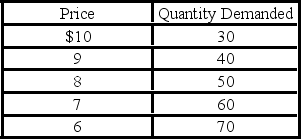
A) 0.63.
B) 1.16.
C) 1.60.
D) 2.27.
A) 0.63.
B) 1.16.
C) 1.60.
D) 2.27.
سؤال
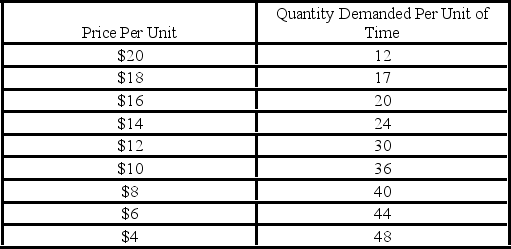
- Refer to the above data. Over which price range is the price elasticity of demand elastic?
A) $4-$6
B) $6-$8
C) $10-$12
D) $12-$14
سؤال
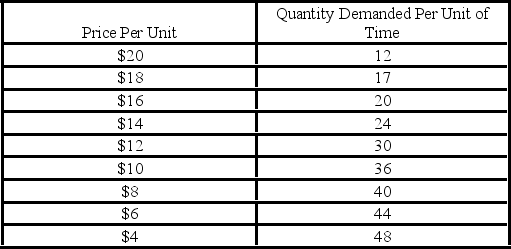
-Refer to the above data. What is the price elasticity of demand over the range of $8 to $10?
A) 0.11
B) 0.47
C) 1.93
D) 1.43
سؤال
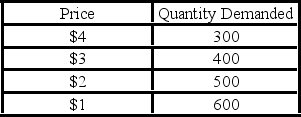
- Refer to the above data. What is the elasticity of demand between the prices of $4 and $3?
A) 0.2
B) 0.5
C) 1
D) 2
سؤال
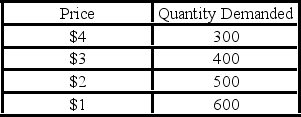
-Refer to the above data. What is the elasticity of demand between the prices of $3 and $2?
A) 0.22
B) 0.40
C) 0.56
D) 1.22
سؤال
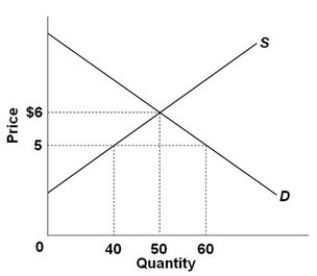 Refer to the figure above. Over the $5-$6 range, the elasticity of demand using the midpoint formula is:
A) 0.22.
B) 0.88.
C) 1.00.
D) 1.16.
سؤال
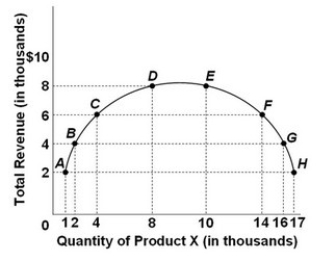 Refer to the above graph. When the quantity of product X sold increases from 8,000 to 10,000, the price elasticity of demand for product X over that range is:
A) elastic.
B) inelastic.
C) unit-elastic.
D) perfectly inelastic.
سؤال
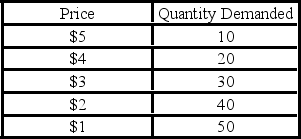
- Refer to the table above. Starting at a $5 price, at what price range does demand become inelastic?
A) $1-2
B) $2-3
C) $3-4
D) $4-5
سؤال
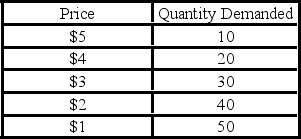
-Refer to the table above. Starting at a $1 price, at what price range does demand become elastic?
A) $1-2
B) $2-3
C) $3-4
D) $4-5
سؤال
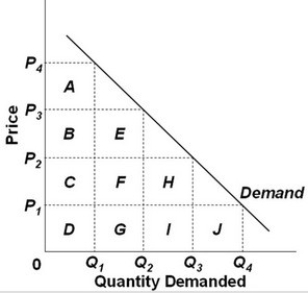
- Refer to the graph above and assume that the areas of the boxes are the same. Consider a situation where price increases from P3 to P4. In this price range, demand is relatively:
A) inelastic because the loss in total revenue (areas E + F + G) is greater than the gain in total revenue (area A).
B) elastic because the loss in total revenue (areas E + F + G) is greater than the gain in total revenue (area A).
C) elastic because the loss in total revenue (area A) is greater than the gain in total revenue (areas E + F + G).
D) inelastic because the loss in total revenue (area A) is greater than the gain in total revenue (areas E + F + G).
سؤال
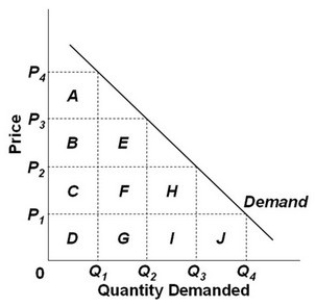
- Refer to the graph above and assume that the areas of the boxes are the same. Consider a situation where price decreases from P2 to P1. In this price range, demand is relatively:
A) inelastic because the loss in total revenue (areas D + G + I + J) is greater than the gain in total revenue (areas C + F + H).
B) elastic because the loss in total revenue (areas C + F + H) is greater than the gain in total revenue (area J).
C) elastic because the loss in total revenue (area J) is less than the gain in total revenue (areas C + F + H).
D) inelastic because the gain in total revenue (area J) is less than the loss in total revenue (areas C + F + H).
سؤال
سؤال
سؤال
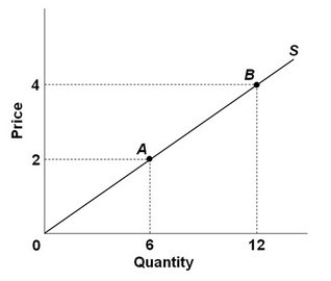
- Refer to the figure above. What is the price elasticity of supply between points A and B above?
A) -1
B) 1/3
C) 1
D) 2
سؤال
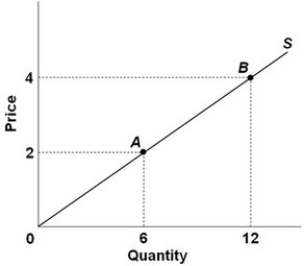
- Refer to the figure above. The elasticity of supply for a product will be 2 when:
A) a 1 percent decrease in the price causes a 0.2 percent decrease in quantity supplied.
B) a 2 percent decrease in price causes a 1 percent decrease in quantity supplied.
C) a 1 percent decrease in price causes a 2 percent decrease in quantity supplied.
D) a 2 percent decrease in price causes a 2 percent decrease in quantity supplied.
سؤال
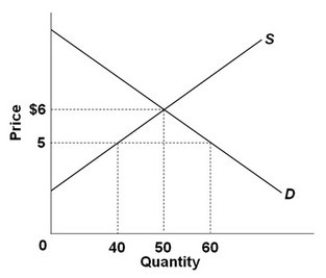 Refer to the graph above. Over the $5-$6 range, the elasticity of supply using the midpoints formula is:
A) 0.22.
B) 0.88.
C) 1.00.
D) 1.22.
سؤال
سؤال
سؤال
سؤال
سؤال
سؤال

فتح الحزمة
قم بالتسجيل لفتح البطاقات في هذه المجموعة!
Unlock Deck
Unlock Deck
1/23

العب

ملء الشاشة (f)
Deck 4: Elasticity of Demand and Supply
1
Augi sells 300 cat toys each month when the price is $5 per toy. When Augi lowered the price to $4, she sold 400 toys. The price elasticity of demand over the $4 to $5 range is approximately:
A) 0.78 and elastic.
B) 1.29 and elastic.
C) 0.78 and inelastic.
D) 1.29 and inelastic.
A) 0.78 and elastic.
B) 1.29 and elastic.
C) 0.78 and inelastic.
D) 1.29 and inelastic.
1.29 and elastic.
2
Suppose you are given the following data on demand for a product. The price elasticity of demand when price decreases from $9 to $7 is:
A) 0.63.
B) 1.16.
C) 1.60.
D) 2.27.
A) 0.63.
B) 1.16.
C) 1.60.
D) 2.27.
1.60.
3
- Refer to the above data. Over which price range is the price elasticity of demand elastic?
A) $4-$6
B) $6-$8
C) $10-$12
D) $12-$14
$12-$14
4
-Refer to the above data. What is the price elasticity of demand over the range of $8 to $10?
A) 0.11
B) 0.47
C) 1.93
D) 1.43
فتح الحزمة
افتح القفل للوصول البطاقات البالغ عددها 23 في هذه المجموعة.
فتح الحزمة
k this deck
5
- Refer to the above data. What is the elasticity of demand between the prices of $4 and $3?
A) 0.2
B) 0.5
C) 1
D) 2
فتح الحزمة
افتح القفل للوصول البطاقات البالغ عددها 23 في هذه المجموعة.
فتح الحزمة
k this deck
6
-Refer to the above data. What is the elasticity of demand between the prices of $3 and $2?
A) 0.22
B) 0.40
C) 0.56
D) 1.22
فتح الحزمة
افتح القفل للوصول البطاقات البالغ عددها 23 في هذه المجموعة.
فتح الحزمة
k this deck
7
Refer to the figure above. Over the $5-$6 range, the elasticity of demand using the midpoint formula is:A) 0.22.
B) 0.88.
C) 1.00.
D) 1.16.
فتح الحزمة
افتح القفل للوصول البطاقات البالغ عددها 23 في هذه المجموعة.
فتح الحزمة
k this deck
8
Refer to the above graph. When the quantity of product X sold increases from 8,000 to 10,000, the price elasticity of demand for product X over that range is:A) elastic.
B) inelastic.
C) unit-elastic.
D) perfectly inelastic.
فتح الحزمة
افتح القفل للوصول البطاقات البالغ عددها 23 في هذه المجموعة.
فتح الحزمة
k this deck
9
- Refer to the table above. Starting at a $5 price, at what price range does demand become inelastic?
A) $1-2
B) $2-3
C) $3-4
D) $4-5
فتح الحزمة
افتح القفل للوصول البطاقات البالغ عددها 23 في هذه المجموعة.
فتح الحزمة
k this deck
10
-Refer to the table above. Starting at a $1 price, at what price range does demand become elastic?
A) $1-2
B) $2-3
C) $3-4
D) $4-5
فتح الحزمة
افتح القفل للوصول البطاقات البالغ عددها 23 في هذه المجموعة.
فتح الحزمة
k this deck
11
- Refer to the graph above and assume that the areas of the boxes are the same. Consider a situation where price increases from P3 to P4. In this price range, demand is relatively:
A) inelastic because the loss in total revenue (areas E + F + G) is greater than the gain in total revenue (area A).
B) elastic because the loss in total revenue (areas E + F + G) is greater than the gain in total revenue (area A).
C) elastic because the loss in total revenue (area A) is greater than the gain in total revenue (areas E + F + G).
D) inelastic because the loss in total revenue (area A) is greater than the gain in total revenue (areas E + F + G).
فتح الحزمة
افتح القفل للوصول البطاقات البالغ عددها 23 في هذه المجموعة.
فتح الحزمة
k this deck
12
- Refer to the graph above and assume that the areas of the boxes are the same. Consider a situation where price decreases from P2 to P1. In this price range, demand is relatively:
A) inelastic because the loss in total revenue (areas D + G + I + J) is greater than the gain in total revenue (areas C + F + H).
B) elastic because the loss in total revenue (areas C + F + H) is greater than the gain in total revenue (area J).
C) elastic because the loss in total revenue (area J) is less than the gain in total revenue (areas C + F + H).
D) inelastic because the gain in total revenue (area J) is less than the loss in total revenue (areas C + F + H).
فتح الحزمة
افتح القفل للوصول البطاقات البالغ عددها 23 في هذه المجموعة.
فتح الحزمة
k this deck
13
In some markets consumers may buy many different brands of a product. Which of the statements below best represents a situation where demand for a particular brand would be very elastic?
A) "The different brands are almost identical so I always buy the cheapest."
B) "I use so little of that product that when I do buy it, I don't pay much attention to the price."
C) "The brand I buy is so superior to other available brands that I hardly consider the others."
D) "I pinch pennies in buying other products, but like most people I feel I owe it to myself to get the best brand of this product."
A) "The different brands are almost identical so I always buy the cheapest."
B) "I use so little of that product that when I do buy it, I don't pay much attention to the price."
C) "The brand I buy is so superior to other available brands that I hardly consider the others."
D) "I pinch pennies in buying other products, but like most people I feel I owe it to myself to get the best brand of this product."
فتح الحزمة
افتح القفل للوصول البطاقات البالغ عددها 23 في هذه المجموعة.
فتح الحزمة
k this deck
14
If in the short run the demand for mass transit is inelastic and in the long run the demand is elastic, then a price:
A) increase will decrease total revenue in the short run but increase total revenue in the long run.
B) increase will increase total revenue in the short run but decrease total revenue in the long run.
C) decrease will increase total revenue in the short run but decrease total revenue in the long run.
D) decrease will decrease total revenue in the short run and decrease total revenue in the long run.
A) increase will decrease total revenue in the short run but increase total revenue in the long run.
B) increase will increase total revenue in the short run but decrease total revenue in the long run.
C) decrease will increase total revenue in the short run but decrease total revenue in the long run.
D) decrease will decrease total revenue in the short run and decrease total revenue in the long run.
فتح الحزمة
افتح القفل للوصول البطاقات البالغ عددها 23 في هذه المجموعة.
فتح الحزمة
k this deck
15
- Refer to the figure above. What is the price elasticity of supply between points A and B above?
A) -1
B) 1/3
C) 1
D) 2
فتح الحزمة
افتح القفل للوصول البطاقات البالغ عددها 23 في هذه المجموعة.
فتح الحزمة
k this deck
16
- Refer to the figure above. The elasticity of supply for a product will be 2 when:
A) a 1 percent decrease in the price causes a 0.2 percent decrease in quantity supplied.
B) a 2 percent decrease in price causes a 1 percent decrease in quantity supplied.
C) a 1 percent decrease in price causes a 2 percent decrease in quantity supplied.
D) a 2 percent decrease in price causes a 2 percent decrease in quantity supplied.
فتح الحزمة
افتح القفل للوصول البطاقات البالغ عددها 23 في هذه المجموعة.
فتح الحزمة
k this deck
17
Refer to the graph above. Over the $5-$6 range, the elasticity of supply using the midpoints formula is:A) 0.22.
B) 0.88.
C) 1.00.
D) 1.22.
فتح الحزمة
افتح القفل للوصول البطاقات البالغ عددها 23 في هذه المجموعة.
فتح الحزمة
k this deck
18
If a union argues that a price cut will boost revenues of the firm and management argues that the opposite is true, then the price elasticity of demand is:
A) unit-elastic from the union's perspective and unit-inelastic from management's perspective.
B) perfectly inelastic from the union's perspective and perfectly elastic from management's perspective.
C) elastic from the union's perspective; inelastic from management's perspective.
D) inelastic from the union's perspective; elastic from management's perspective.
A) unit-elastic from the union's perspective and unit-inelastic from management's perspective.
B) perfectly inelastic from the union's perspective and perfectly elastic from management's perspective.
C) elastic from the union's perspective; inelastic from management's perspective.
D) inelastic from the union's perspective; elastic from management's perspective.
فتح الحزمة
افتح القفل للوصول البطاقات البالغ عددها 23 في هذه المجموعة.
فتح الحزمة
k this deck
19
Those who oppose the legalization of cocaine and heroin argue that:
A) demand is inelastic for both addicts and occasional users.
B) demand is highly elastic for both addicts and occasional users.
C) addict demand is inelastic, but the demand by occasional users is elastic.
D) addict demand is elastic, but the demand by occasional users is inelastic.
A) demand is inelastic for both addicts and occasional users.
B) demand is highly elastic for both addicts and occasional users.
C) addict demand is inelastic, but the demand by occasional users is elastic.
D) addict demand is elastic, but the demand by occasional users is inelastic.
فتح الحزمة
افتح القفل للوصول البطاقات البالغ عددها 23 في هذه المجموعة.
فتح الحزمة
k this deck
20
Those who support legalizing the sale and use of cocaine and heroin argue that:
A) demand is highly inelastic, so legalization would reduce expenditures on drugs and reduce street crime.
B) demand is highly elastic because there are so many substitutes for these drugs.
C) addict demand is inelastic, but the demand by occasional users is elastic.
D) addict demand is elastic, but the demand by occasional users is inelastic.
A) demand is highly inelastic, so legalization would reduce expenditures on drugs and reduce street crime.
B) demand is highly elastic because there are so many substitutes for these drugs.
C) addict demand is inelastic, but the demand by occasional users is elastic.
D) addict demand is elastic, but the demand by occasional users is inelastic.
فتح الحزمة
افتح القفل للوصول البطاقات البالغ عددها 23 في هذه المجموعة.
فتح الحزمة
k this deck
21
When universities announce a large tuition increase and follow it with an announcement that more financial aid will be available, they are assuming that students who pay full tuition:
A) have elastic demand and students who use financial aid have inelastic demand.
B) have inelastic demand and students who use financial aid have elastic demand.
C) view a college education as an inferior good and students who use financial aid view it as a normal good.
D) view a college education as a normal good and students who use financial aid view it as an inferior good.
A) have elastic demand and students who use financial aid have inelastic demand.
B) have inelastic demand and students who use financial aid have elastic demand.
C) view a college education as an inferior good and students who use financial aid view it as a normal good.
D) view a college education as a normal good and students who use financial aid view it as an inferior good.
فتح الحزمة
افتح القفل للوصول البطاقات البالغ عددها 23 في هذه المجموعة.
فتح الحزمة
k this deck
22
Which of the following consumer goods and services is most like to suffer declining sales during a recession?
A) haircuts.
B) ground beef.
C) toothpaste.
D) restaurant meals.
A) haircuts.
B) ground beef.
C) toothpaste.
D) restaurant meals.
فتح الحزمة
افتح القفل للوصول البطاقات البالغ عددها 23 في هذه المجموعة.
فتح الحزمة
k this deck
23
The government is most likely to block a proposed merger between two companies when:
A) the cross-elasticity between the companies' products is positive and large.
B) the cross-elasticity between the companies' products is negative and large.
C) the income elasticity of the companies' products is positive.
D) the income elasticity of the companies' products is negative.
A) the cross-elasticity between the companies' products is positive and large.
B) the cross-elasticity between the companies' products is negative and large.
C) the income elasticity of the companies' products is positive.
D) the income elasticity of the companies' products is negative.
فتح الحزمة
افتح القفل للوصول البطاقات البالغ عددها 23 في هذه المجموعة.
فتح الحزمة
k this deck
فتح الحزمة
افتح القفل للوصول البطاقات البالغ عددها 23 في هذه المجموعة.






