







 تكلم مع الذكاء الاصطناعي


Deck 10: Preparing for Sexual Reproduction: Meiosis
ملء الشاشة (f)

سؤال

سؤال
سؤال
سؤال
سؤال
سؤال
سؤال
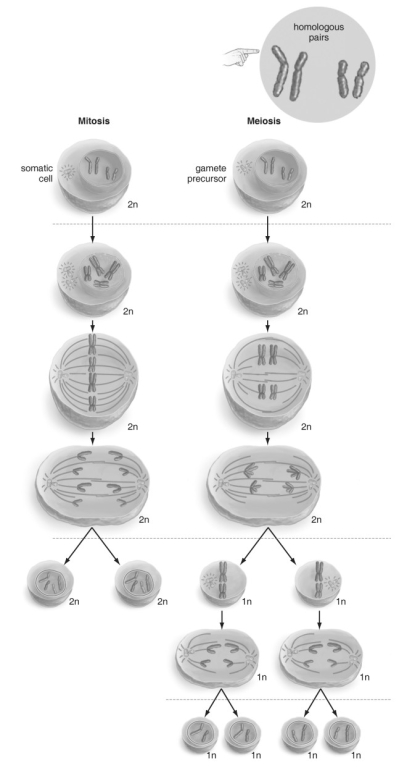 Refer to the figure above and then answer the question that follows.
-What is one of the ways that mitosis and meiosis are different?
A) DNA is replicated before mitosis but not before meiosis.
B) Pairing of homologous chromosomes occurs only in mitosis.
C) Recombination (crossing over) occurs only in mitosis.
D) There are two divisions in meiosis and only one in mitosis.
E) Mitosis generates genetic variation, whereas meiosis generates exact cell copies.
سؤال
Refer to the figure above and then answer the question that follows.-A single cell begins meiosis. How many cells will there be after meiosis I, to begin meiosis II?
A) one
B) four
C) eight
D) three
E) two
سؤال
Refer to the figure above and then answer the question that follows.-What is one of the events in meiosis II?
A) DNA replicates.
B) Diploid gametes fuse to make a haploid zygote.
C) Crossing over occurs.
D) Sister chromatids separate.
E) Homologous chromosomes pair.
سؤال
سؤال
سؤال
سؤال
سؤال
سؤال
سؤال
سؤال
سؤال
سؤال
سؤال
سؤال
سؤال
سؤال
سؤال
سؤال
سؤال
سؤال
سؤال
سؤال
سؤال
سؤال

فتح الحزمة
قم بالتسجيل لفتح البطاقات في هذه المجموعة!
Unlock Deck
Unlock Deck
1/31

العب

ملء الشاشة (f)
Deck 10: Preparing for Sexual Reproduction: Meiosis
1
Which choice is false about the products of a single cell that has gone through meiosis?
A) The daughter cells are genetically diverse.
B) The result is eight daughter cells.
C) The result is four daughter cells.
D) The daughter cells are haploid.
A) The daughter cells are genetically diverse.
B) The result is eight daughter cells.
C) The result is four daughter cells.
D) The daughter cells are haploid.
The result is eight daughter cells.
2
The products of meiosis are:
A) two genetically identical, diploid cells.
B) four genetically identical, haploid cells.
C) four genetically identical, diploid cells.
D) two genetically different, diploid cells.
E) four genetically different, haploid cells.
A) two genetically identical, diploid cells.
B) four genetically identical, haploid cells.
C) four genetically identical, diploid cells.
D) two genetically different, diploid cells.
E) four genetically different, haploid cells.
four genetically different, haploid cells.
3
How are the products of meiosis different from the products of mitosis?
A) Mitotic products are gametes.
B) Mitotic products are always haploid.
C) Meiotic products are genetically identical to each other.
D) Meiotic products are gametes.
E) Meiotic products are always diploid.
A) Mitotic products are gametes.
B) Mitotic products are always haploid.
C) Meiotic products are genetically identical to each other.
D) Meiotic products are gametes.
E) Meiotic products are always diploid.
Meiotic products are gametes.
4
If a eukaryotic cell has 22 chromosomes and it undergoes meiosis, how many chromosomes will the resulting gametes contain?
A) 11
B) 23
C) 44
D) 46
E) 22
A) 11
B) 23
C) 44
D) 46
E) 22
فتح الحزمة
افتح القفل للوصول البطاقات البالغ عددها 31 في هذه المجموعة.
فتح الحزمة
k this deck
5
For this species with four pairs of homologous chromosomes, the number of unique chromosomes (the number 1n) is:
A) 64
B) 4
C) 8
D) 16
E) 32
A) 64
B) 4
C) 8
D) 16
E) 32
فتح الحزمة
افتح القفل للوصول البطاقات البالغ عددها 31 في هذه المجموعة.
فتح الحزمة
k this deck
6
What is the term for two chromosomes that have the same length, shape, and genes but do not have exactly the same DNA sequence?
A) sister chromatids
B) centrioles
C) centromeres
D) haploid chromosomes
E) homologous chromosomes
A) sister chromatids
B) centrioles
C) centromeres
D) haploid chromosomes
E) homologous chromosomes
فتح الحزمة
افتح القفل للوصول البطاقات البالغ عددها 31 في هذه المجموعة.
فتح الحزمة
k this deck
7
Refer to the figure above and then answer the question that follows.-What is one of the ways that mitosis and meiosis are different?
A) DNA is replicated before mitosis but not before meiosis.
B) Pairing of homologous chromosomes occurs only in mitosis.
C) Recombination (crossing over) occurs only in mitosis.
D) There are two divisions in meiosis and only one in mitosis.
E) Mitosis generates genetic variation, whereas meiosis generates exact cell copies.
فتح الحزمة
افتح القفل للوصول البطاقات البالغ عددها 31 في هذه المجموعة.
فتح الحزمة
k this deck
8
Refer to the figure above and then answer the question that follows.-A single cell begins meiosis. How many cells will there be after meiosis I, to begin meiosis II?
A) one
B) four
C) eight
D) three
E) two
فتح الحزمة
افتح القفل للوصول البطاقات البالغ عددها 31 في هذه المجموعة.
فتح الحزمة
k this deck
9
Refer to the figure above and then answer the question that follows.-What is one of the events in meiosis II?
A) DNA replicates.
B) Diploid gametes fuse to make a haploid zygote.
C) Crossing over occurs.
D) Sister chromatids separate.
E) Homologous chromosomes pair.
فتح الحزمة
افتح القفل للوصول البطاقات البالغ عددها 31 في هذه المجموعة.
فتح الحزمة
k this deck
10
What can separate linked genes?
A) duplication involving the chromosome on which they are located
B) segregation of the homologous chromosomes on which they reside
C) inversion involving the chromosome on which they are located
D) crossing over (recombination)
E) separation of the sister chromatids on which they reside
A) duplication involving the chromosome on which they are located
B) segregation of the homologous chromosomes on which they reside
C) inversion involving the chromosome on which they are located
D) crossing over (recombination)
E) separation of the sister chromatids on which they reside
فتح الحزمة
افتح القفل للوصول البطاقات البالغ عددها 31 في هذه المجموعة.
فتح الحزمة
k this deck
11
What is the purpose of recombination (crossing over)?
A) to ensure retention of genetic information and preserve cell characteristics
B) to bind homologous chromosomes tightly, so they do not accidentally separate
C) to eliminate unused genes by removing them
D) to complete DNA replication
E) to create chromosomes that are a new combination of paternal and maternal material
A) to ensure retention of genetic information and preserve cell characteristics
B) to bind homologous chromosomes tightly, so they do not accidentally separate
C) to eliminate unused genes by removing them
D) to complete DNA replication
E) to create chromosomes that are a new combination of paternal and maternal material
فتح الحزمة
افتح القفل للوصول البطاقات البالغ عددها 31 في هذه المجموعة.
فتح الحزمة
k this deck
12
In a human cell that is haploid, how many chromosomes are there, and of what type are the chromosomes?
A) 45: 44 autosomes and 1 sex chromosome
B) 46: 44 autosomes and 2 sex chromosomes
C) 23: 22 autosomes and 1 sex chromosome
D) 11: 11 autosomes and no sex chromosomes
E) 12: 11 autosomes and 1 sex chromosome
A) 45: 44 autosomes and 1 sex chromosome
B) 46: 44 autosomes and 2 sex chromosomes
C) 23: 22 autosomes and 1 sex chromosome
D) 11: 11 autosomes and no sex chromosomes
E) 12: 11 autosomes and 1 sex chromosome
فتح الحزمة
افتح القفل للوصول البطاقات البالغ عددها 31 في هذه المجموعة.
فتح الحزمة
k this deck
13
All of the following processes generate variation in populations except:
A) DNA replication.
B) independent assortment.
C) fertilization.
D) crossing over (recombination).
A) DNA replication.
B) independent assortment.
C) fertilization.
D) crossing over (recombination).
فتح الحزمة
افتح القفل للوصول البطاقات البالغ عددها 31 في هذه المجموعة.
فتح الحزمة
k this deck
14
What would happen if crossing over no longer occurred in human meiosis?
A) There would be no independent assortment in human populations.
B) Only females would be born.
C) Chromosomes could not separate during anaphase.
D) There would be less genetic variation in subsequent generations.
A) There would be no independent assortment in human populations.
B) Only females would be born.
C) Chromosomes could not separate during anaphase.
D) There would be less genetic variation in subsequent generations.
فتح الحزمة
افتح القفل للوصول البطاقات البالغ عددها 31 في هذه المجموعة.
فتح الحزمة
k this deck
15
In birds, the female carries an unmatched pair of chromosomes (denoted WZ), corresponding roughly to the XY chromosomes in mammalian males, and male birds carry a matched set of chromosomes (denoted WW), corresponding to the pair of XX chromosomes in mammalian females. Therefore, in birds the ________ chromosome determines the sex of the offspring, and it is gametes from the ________ parent that determine sex.
A) Z, male
B) Z, female
C) W, female
D) W, male
E) W, either male or female
A) Z, male
B) Z, female
C) W, female
D) W, male
E) W, either male or female
فتح الحزمة
افتح القفل للوصول البطاقات البالغ عددها 31 في هذه المجموعة.
فتح الحزمة
k this deck
16
What makes the Y chromosome unusual?
A) It has very few genes.
B) It does not attach to spindle fibers at mitosis.
C) It undergoes more recombination than any other chromosome.
D) It does not attach to spindle fibers at mitosis or meiosis.
E) It does not attach to spindle fibers at meiosis.
A) It has very few genes.
B) It does not attach to spindle fibers at mitosis.
C) It undergoes more recombination than any other chromosome.
D) It does not attach to spindle fibers at mitosis or meiosis.
E) It does not attach to spindle fibers at meiosis.
فتح الحزمة
افتح القفل للوصول البطاقات البالغ عددها 31 في هذه المجموعة.
فتح الحزمة
k this deck
17
If polar bodies formed during spermatogenesis, how would this affect sperm production?
A) Sperm would swim more efficiently.
B) There would be fewer sperm produced.
C) Sperm would be produced by mitosis instead of meiosis.
D) Sperm would be diploid instead of haploid.
E) All sperm would all be smaller.
A) Sperm would swim more efficiently.
B) There would be fewer sperm produced.
C) Sperm would be produced by mitosis instead of meiosis.
D) Sperm would be diploid instead of haploid.
E) All sperm would all be smaller.
فتح الحزمة
افتح القفل للوصول البطاقات البالغ عددها 31 في هذه المجموعة.
فتح الحزمة
k this deck
18
A human male has:
A) a Y from his mother and an X from his father.
B) two X chromosomes, one from each parent.
C) an X from his mother and a Y from his father.
D) two Y chromosomes, one from each parent.
E) an X and a Y, either of which could have come from either parent.
A) a Y from his mother and an X from his father.
B) two X chromosomes, one from each parent.
C) an X from his mother and a Y from his father.
D) two Y chromosomes, one from each parent.
E) an X and a Y, either of which could have come from either parent.
فتح الحزمة
افتح القفل للوصول البطاقات البالغ عددها 31 في هذه المجموعة.
فتح الحزمة
k this deck
19
Which organelle would be most important for a sperm cell?
A) lysosome
B) Golgi complex
C) endoplasmic reticulum
D) ribosome
E) mitochondria
A) lysosome
B) Golgi complex
C) endoplasmic reticulum
D) ribosome
E) mitochondria
فتح الحزمة
افتح القفل للوصول البطاقات البالغ عددها 31 في هذه المجموعة.
فتح الحزمة
k this deck
20
Why does ova production result in one egg and three polar bodies?
A) This allows the egg to receive most of the cytoplasm.
B) This reduces egg size by distributing most of the cytoplasm to the polar bodies.
C) This allows the egg to receive all the chromosomes.
D) This removes Golgi complex, lysosomes, and other organelles from the egg.
E) This creates more polar bodies, which are the cells that will actually be fertilized.
A) This allows the egg to receive most of the cytoplasm.
B) This reduces egg size by distributing most of the cytoplasm to the polar bodies.
C) This allows the egg to receive all the chromosomes.
D) This removes Golgi complex, lysosomes, and other organelles from the egg.
E) This creates more polar bodies, which are the cells that will actually be fertilized.
فتح الحزمة
افتح القفل للوصول البطاقات البالغ عددها 31 في هذه المجموعة.
فتح الحزمة
k this deck
21
From the list below, which choice represents a correct difference between sperm production and egg production?
A) Sperm are produced by mitosis; eggs are produced by meiosis.
B) Sperm are produced by meiosis; eggs are produced by mitosis.
C) Four mature sperm are produced from one cell; one large egg is produced from one cell.
D) Eight mature sperm are produced from one cell; two eggs are produced from one cell.
E) Sperm are produced by somatic (body) cells; eggs are produced by gametes.
A) Sperm are produced by mitosis; eggs are produced by meiosis.
B) Sperm are produced by meiosis; eggs are produced by mitosis.
C) Four mature sperm are produced from one cell; one large egg is produced from one cell.
D) Eight mature sperm are produced from one cell; two eggs are produced from one cell.
E) Sperm are produced by somatic (body) cells; eggs are produced by gametes.
فتح الحزمة
افتح القفل للوصول البطاقات البالغ عددها 31 في هذه المجموعة.
فتح الحزمة
k this deck
22
Imagine you start a population of 1 million individuals from a single bacterial cell. Now imagine that a population this large is started from a male and female housefly. How would these two populations differ?
A) The cells of the bacterial population would be larger on average than the cells that make up the houseflies.
B) Individuals of the housefly population would differ from each other genetically much more than would cells of the bacterial population.
C) No cells of the housefly population would ever divide by meiosis, but some cells of the bacterial population would divide by meiosis.
D) The cells of the bacterial population would differ from each other genetically much more than would individuals of the housefly population.
E) No cells of the bacterial population would ever divide by binary fission, but some cells of the housefly population would divide by binary fission.
A) The cells of the bacterial population would be larger on average than the cells that make up the houseflies.
B) Individuals of the housefly population would differ from each other genetically much more than would cells of the bacterial population.
C) No cells of the housefly population would ever divide by meiosis, but some cells of the bacterial population would divide by meiosis.
D) The cells of the bacterial population would differ from each other genetically much more than would individuals of the housefly population.
E) No cells of the bacterial population would ever divide by binary fission, but some cells of the housefly population would divide by binary fission.
فتح الحزمة
افتح القفل للوصول البطاقات البالغ عددها 31 في هذه المجموعة.
فتح الحزمة
k this deck
23
Assume that the starting cell or parents of the bacteria and housefly populations in the question above were well adapted to their environment. Now imagine that the populations are subjected to very different environment. How do you think these two populations may respond to the environmental change?
A) It's more likely that the housefly population will contain some genetic variants that are better adapted to the new conditions than the bacterial population.
B) Both would prosper because every individual would generate new beneficial mutations.
C) The bacteria would prosper because they are simpler organisms than a housefly.
D) Both would die out because there would be no genetic variants suitable for the new conditions.
E) It's more likely that the bacterial population will contain some genetic variants that are better adapted to the new conditions than the housefly population.
A) It's more likely that the housefly population will contain some genetic variants that are better adapted to the new conditions than the bacterial population.
B) Both would prosper because every individual would generate new beneficial mutations.
C) The bacteria would prosper because they are simpler organisms than a housefly.
D) Both would die out because there would be no genetic variants suitable for the new conditions.
E) It's more likely that the bacterial population will contain some genetic variants that are better adapted to the new conditions than the housefly population.
فتح الحزمة
افتح القفل للوصول البطاقات البالغ عددها 31 في هذه المجموعة.
فتح الحزمة
k this deck
24
Linked genes are more likely to be separated if they are farther apart on the chromosome.
فتح الحزمة
افتح القفل للوصول البطاقات البالغ عددها 31 في هذه المجموعة.
فتح الحزمة
k this deck
25
A haploid cell from an organism has 20 chromosomes. How many chromosomes are in a diploid cell from the same organism? How many in a gamete from this organism?
فتح الحزمة
افتح القفل للوصول البطاقات البالغ عددها 31 في هذه المجموعة.
فتح الحزمة
k this deck
26
A zygote develops into a whole human through the ________ division of cells.
فتح الحزمة
افتح القفل للوصول البطاقات البالغ عددها 31 في هذه المجموعة.
فتح الحزمة
k this deck
27
Match the events with the step in meiosis in which it occurs. Steps may be used more than once or not used at all.
-Chromosomes line up with the sister chromatids on opposite sides of the metaphase plate.
A) Anaphase II
B) Metaphase I
C) Prophase I
D) Prophase/Metaphase II
-Chromosomes line up with the sister chromatids on opposite sides of the metaphase plate.
A) Anaphase II
B) Metaphase I
C) Prophase I
D) Prophase/Metaphase II
فتح الحزمة
افتح القفل للوصول البطاقات البالغ عددها 31 في هذه المجموعة.
فتح الحزمة
k this deck
28
Suppose a researcher claims to be able to make a hybrid animal that is a cross between a human and a rhesus monkey. The normal diploid number for humans is 46, and the normal diploid number for rhesus monkeys is 48. Based on normal meiosis, how many chromosomes should the human gamete have, and how many chromosomes should the rhesus monkey have? Given these numbers, how many chromosomes would you expect the hybrid embryo to contain?
فتح الحزمة
افتح القفل للوصول البطاقات البالغ عددها 31 في هذه المجموعة.
فتح الحزمة
k this deck
29
Assume you are starting with a cell whose diploid number is 6. Draw this cell going through all the meiotic phases. For each drawing, account for chromosome number at that phase, and indicate the number of chromosomes at that phase. Once you have completed your drawings, characterize the daughter cells.
فتح الحزمة
افتح القفل للوصول البطاقات البالغ عددها 31 في هذه المجموعة.
فتح الحزمة
k this deck
30
In human life cycles, fertilization (sex) and reproduction are closely associated, yet they are very different processes. In what way are fertilization and reproduction opposites?
فتح الحزمة
افتح القفل للوصول البطاقات البالغ عددها 31 في هذه المجموعة.
فتح الحزمة
k this deck
31
Organisms that reproduce asexually produce "cones of genetically identical organisms. What would be the advantage to an organism of reproducing asexually?
فتح الحزمة
افتح القفل للوصول البطاقات البالغ عددها 31 في هذه المجموعة.
فتح الحزمة
k this deck
فتح الحزمة
افتح القفل للوصول البطاقات البالغ عددها 31 في هذه المجموعة.






