







 تكلم مع الذكاء الاصطناعي


Deck 4: Lifes Home: The Cell
ملء الشاشة (f)

سؤال

سؤال
سؤال
سؤال
سؤال
سؤال
سؤال
سؤال
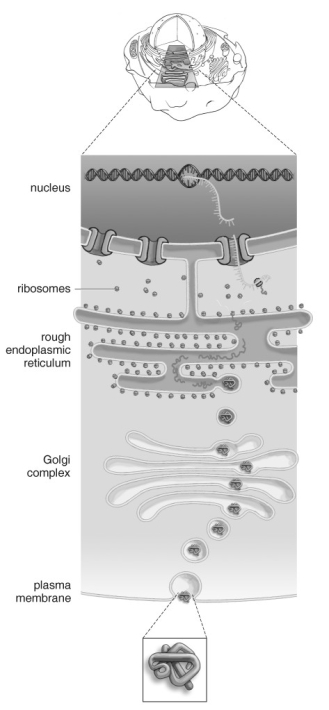 Refer to the figure above and then answer the question that follows.
-Which choice is the best description of what is happening?
A) DNA moves into the cytoplasm by moving through the endoplasmic reticulum, where it will be used to make proteins.
B) A RNA copy of the DNA moves into the cytoplasm, where it docks with a ribosome to produce proteins.
C) A piece of RNA fuses with the DNA at the ribosome. This complex is used to make proteins that float through the endoplasmic reticulum.
D) Proteins are made in the nucleus from the RNA; they move into the endoplasmic reticulum and are then shuttled to the Golgi complex.
سؤال
Refer to the figure above and then answer the question that follows.-Within the cisternae of the RER:
A) proteins get phospholipids added to them.
B) proteins get a side-chain of carbohydrate added to them.
C) proteins get fatty acids added to them.
D) proteins assume their tertiary structure.
E) proteins are synthesized from nucleotides.
سؤال
Refer to the figure above and then answer the question that follows.-What determines whether a protein will be produced on a "free ribosome or on one attached to the endoplasmic reticulum?
A) a chemical signal on the protein being produced
B) Every ribosome will migrate to the ER.
C) The mRNA of certain proteins moves directly to ribosomes already attached to the ER.
D) Microtubules attach randomly to ribosomes and move a fraction of them to the ER.
سؤال
Refer to the figure above and then answer the question that follows.-Which of the following is a function of nuclear pores?
A) to allow DNA to enter the nucleus from the cytoplasm
B) to allow RNA to enter the nucleus from the cytoplasm
C) to allow RNA to leave the nucleus to go to the cytoplasm
D) to allow DNA to leave the nucleus to go to the cytoplasm
E) to allow newly synthesized protein to leave the nucleus to go to the cytoplasm
سؤال
Refer to the figure above and then answer the question that follows.-Insulin is a protein made in large amounts in cells of the pancreas. These cells secrete insulin into the blood, where it controls the uptake of sugar by body cells. How is insulin transported from the ER to the surface of the cell?
A) It is sent through the cavities (lumen) of the endoplasmic reticulum that attach directly to the plasma membrane.
B) It moves along tracks of cytoskeleton proteins.
C) It moves through plasmodesmata to the surface of the cell.
D) It is carried in small sacs of membrane (vesicles) that move from the endoplasmic reticulum to the Golgi apparatus and then to the plasma membrane.
E) It is carried by lysosomes that empty their contents outside the cell.
سؤال
سؤال
سؤال
سؤال
سؤال
سؤال
سؤال
سؤال
سؤال
سؤال
سؤال
سؤال
سؤال
سؤال
سؤال
سؤال
سؤال
سؤال
سؤال
سؤال
سؤال
سؤال
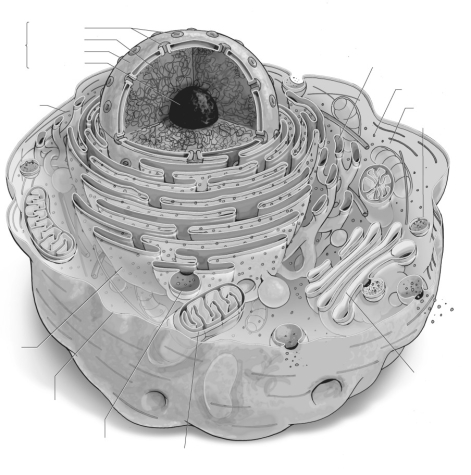
Label the parts of the animal cell.
سؤال
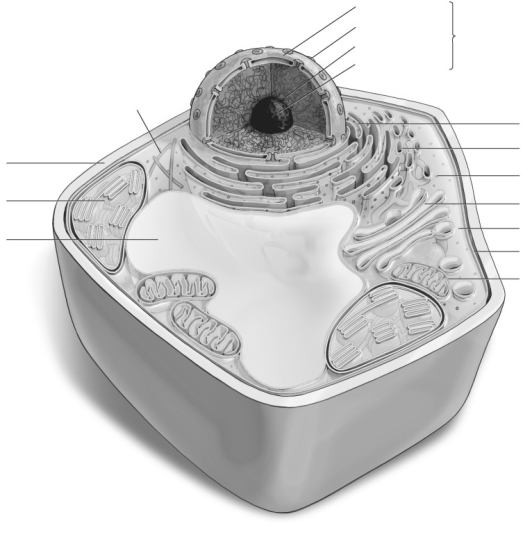
Label the parts of the plant cell.
سؤال
سؤال
سؤال
سؤال
سؤال

فتح الحزمة
قم بالتسجيل لفتح البطاقات في هذه المجموعة!
Unlock Deck
Unlock Deck
1/40

العب

ملء الشاشة (f)
Deck 4: Lifes Home: The Cell
1
The basic building compartments of life on this planet are called:
A) phospholipids.
B) energy.
C) proteins.
D) organelles.
E) cells.
A) phospholipids.
B) energy.
C) proteins.
D) organelles.
E) cells.
cells.
2
Which of the following is not considered an organelle?
A) DNA
B) a mitochondrion
C) a lysosome
D) a ribosome
A) DNA
B) a mitochondrion
C) a lysosome
D) a ribosome
DNA
3
Which of the following describes a prokaryotic cell?
A) It would not have a nucleus.
B) It would contain endoplasmic reticulum.
C) It would have mitochondria.
D) A plant cells is an example.
E) A human cells are an example.
A) It would not have a nucleus.
B) It would contain endoplasmic reticulum.
C) It would have mitochondria.
D) A plant cells is an example.
E) A human cells are an example.
It would not have a nucleus.
4
Which of the following is an example of a eukaryotic cell?
A) an archaea
B) a virus
C) a bacterium
D) a plant cell
A) an archaea
B) a virus
C) a bacterium
D) a plant cell
فتح الحزمة
افتح القفل للوصول البطاقات البالغ عددها 40 في هذه المجموعة.
فتح الحزمة
k this deck
5
Which of the following explains why cells are so small?
A) As cell volume increases, surface area decreases.
B) As cell surface area increases, cell volume decreases.
C) As cell volume increases, surface area increases faster.
D) As cell surface area increases, cell volume increases faster.
E) They can only produce a limited amount of cell membrane components.
A) As cell volume increases, surface area decreases.
B) As cell surface area increases, cell volume decreases.
C) As cell volume increases, surface area increases faster.
D) As cell surface area increases, cell volume increases faster.
E) They can only produce a limited amount of cell membrane components.
فتح الحزمة
افتح القفل للوصول البطاقات البالغ عددها 40 في هذه المجموعة.
فتح الحزمة
k this deck
6
Indicate which of the following choices correctly ranks the given objects in size, from smallest to largest.
A) bacterium, virus, protein, animal cell, frog egg
B) protein, bacterium, virus, animal cell, frog egg
C) virus, protein, bacterium, animal cell, frog egg
D) protein, virus, bacterium, frog egg, animal cell
E) protein, virus, bacterium, animal cell, frog egg
A) bacterium, virus, protein, animal cell, frog egg
B) protein, bacterium, virus, animal cell, frog egg
C) virus, protein, bacterium, animal cell, frog egg
D) protein, virus, bacterium, frog egg, animal cell
E) protein, virus, bacterium, animal cell, frog egg
فتح الحزمة
افتح القفل للوصول البطاقات البالغ عددها 40 في هذه المجموعة.
فتح الحزمة
k this deck
7
You have isolated a new organism that is 0.5 micrometers in size. This organism is most likely:
A) a virus.
B) a plant cell.
C) an animal cell.
D) a bacterium.
E) This organism could be any of the above.
A) a virus.
B) a plant cell.
C) an animal cell.
D) a bacterium.
E) This organism could be any of the above.
فتح الحزمة
افتح القفل للوصول البطاقات البالغ عددها 40 في هذه المجموعة.
فتح الحزمة
k this deck
8
Refer to the figure above and then answer the question that follows.-Which choice is the best description of what is happening?
A) DNA moves into the cytoplasm by moving through the endoplasmic reticulum, where it will be used to make proteins.
B) A RNA copy of the DNA moves into the cytoplasm, where it docks with a ribosome to produce proteins.
C) A piece of RNA fuses with the DNA at the ribosome. This complex is used to make proteins that float through the endoplasmic reticulum.
D) Proteins are made in the nucleus from the RNA; they move into the endoplasmic reticulum and are then shuttled to the Golgi complex.
فتح الحزمة
افتح القفل للوصول البطاقات البالغ عددها 40 في هذه المجموعة.
فتح الحزمة
k this deck
9
Refer to the figure above and then answer the question that follows.-Within the cisternae of the RER:
A) proteins get phospholipids added to them.
B) proteins get a side-chain of carbohydrate added to them.
C) proteins get fatty acids added to them.
D) proteins assume their tertiary structure.
E) proteins are synthesized from nucleotides.
فتح الحزمة
افتح القفل للوصول البطاقات البالغ عددها 40 في هذه المجموعة.
فتح الحزمة
k this deck
10
Refer to the figure above and then answer the question that follows.-What determines whether a protein will be produced on a "free ribosome or on one attached to the endoplasmic reticulum?
A) a chemical signal on the protein being produced
B) Every ribosome will migrate to the ER.
C) The mRNA of certain proteins moves directly to ribosomes already attached to the ER.
D) Microtubules attach randomly to ribosomes and move a fraction of them to the ER.
فتح الحزمة
افتح القفل للوصول البطاقات البالغ عددها 40 في هذه المجموعة.
فتح الحزمة
k this deck
11
Refer to the figure above and then answer the question that follows.-Which of the following is a function of nuclear pores?
A) to allow DNA to enter the nucleus from the cytoplasm
B) to allow RNA to enter the nucleus from the cytoplasm
C) to allow RNA to leave the nucleus to go to the cytoplasm
D) to allow DNA to leave the nucleus to go to the cytoplasm
E) to allow newly synthesized protein to leave the nucleus to go to the cytoplasm
فتح الحزمة
افتح القفل للوصول البطاقات البالغ عددها 40 في هذه المجموعة.
فتح الحزمة
k this deck
12
Refer to the figure above and then answer the question that follows.-Insulin is a protein made in large amounts in cells of the pancreas. These cells secrete insulin into the blood, where it controls the uptake of sugar by body cells. How is insulin transported from the ER to the surface of the cell?
A) It is sent through the cavities (lumen) of the endoplasmic reticulum that attach directly to the plasma membrane.
B) It moves along tracks of cytoskeleton proteins.
C) It moves through plasmodesmata to the surface of the cell.
D) It is carried in small sacs of membrane (vesicles) that move from the endoplasmic reticulum to the Golgi apparatus and then to the plasma membrane.
E) It is carried by lysosomes that empty their contents outside the cell.
فتح الحزمة
افتح القفل للوصول البطاقات البالغ عددها 40 في هذه المجموعة.
فتح الحزمة
k this deck
13
Mitochondria require which of the following in order to function?
A) oxygen
B) carbon dioxide
C) water
D) ATP
A) oxygen
B) carbon dioxide
C) water
D) ATP
فتح الحزمة
افتح القفل للوصول البطاقات البالغ عددها 40 في هذه المجموعة.
فتح الحزمة
k this deck
14
Two organelles that are believed to be remnants of unicellular bacteria are:
A) flagella and ribosomes.
B) mitochondria and ER.
C) ribosomes and chloroplasts.
D) mitochondria and chloroplasts.
E) ER and flagella.
A) flagella and ribosomes.
B) mitochondria and ER.
C) ribosomes and chloroplasts.
D) mitochondria and chloroplasts.
E) ER and flagella.
فتح الحزمة
افتح القفل للوصول البطاقات البالغ عددها 40 في هذه المجموعة.
فتح الحزمة
k this deck
15
Which of the following is not involved in transport of materials within a eukaryotic cell?
A) the rough endoplasmic reticulum
B) mitochondrion
C) the Golgi complex
D) lysosome
A) the rough endoplasmic reticulum
B) mitochondrion
C) the Golgi complex
D) lysosome
فتح الحزمة
افتح القفل للوصول البطاقات البالغ عددها 40 في هذه المجموعة.
فتح الحزمة
k this deck
16
The cytoskeleton of animal cells really is a bit like the skeleton of the whole animal in the way it provides structure to cells. But the cytoskeleton is also like another important part of animals. This is the:
A) digestive system.
B) immune system.
C) nervous system.
D) muscular system.
A) digestive system.
B) immune system.
C) nervous system.
D) muscular system.
فتح الحزمة
افتح القفل للوصول البطاقات البالغ عددها 40 في هذه المجموعة.
فتح الحزمة
k this deck
17
You owe your very life to chloroplasts. The reason is that:
A) chloroplasts supply all the ATP needed by living organisms.
B) when we eat plants, it is the chloroplasts that are the nutritious part of plant cells.
C) chloroplasts produce all the water and carbon dioxide essential for life.
D) chloroplasts produce the oxygen we breathe and ultimately are the source of most nutrients we consume.
E) like the ancestors of mitochondria, the ancestors of chloroplasts were once bacteria taken up by a eukaryotic cell.
A) chloroplasts supply all the ATP needed by living organisms.
B) when we eat plants, it is the chloroplasts that are the nutritious part of plant cells.
C) chloroplasts produce all the water and carbon dioxide essential for life.
D) chloroplasts produce the oxygen we breathe and ultimately are the source of most nutrients we consume.
E) like the ancestors of mitochondria, the ancestors of chloroplasts were once bacteria taken up by a eukaryotic cell.
فتح الحزمة
افتح القفل للوصول البطاقات البالغ عددها 40 في هذه المجموعة.
فتح الحزمة
k this deck
18
One of the main structural ingredients of the eukaryotic plant cell wall is:
A) cellulose.
B) protein.
C) granola.
D) mitochondria.
E) glucose.
A) cellulose.
B) protein.
C) granola.
D) mitochondria.
E) glucose.
فتح الحزمة
افتح القفل للوصول البطاقات البالغ عددها 40 في هذه المجموعة.
فتح الحزمة
k this deck
19
Who was the first person to refer to a single unit within a living organism as a "cell"?
A) Anton van Leeuwenhoek
B) James Watson
C) Robert Downy
D) Robert Hooke
A) Anton van Leeuwenhoek
B) James Watson
C) Robert Downy
D) Robert Hooke
فتح الحزمة
افتح القفل للوصول البطاقات البالغ عددها 40 في هذه المجموعة.
فتح الحزمة
k this deck
20
The surface-to-volume ratio of a cube 1 centimeter on a side is 6 (the cube has a surface area of 6 square centimeters, a volume of 1 cubic centimeter). What would be the surface-to-volume ratio of a cube 2 centimeters on a side?
A) 6
B) 1/2
C) 3
D) 20
E) 1
A) 6
B) 1/2
C) 3
D) 20
E) 1
فتح الحزمة
افتح القفل للوصول البطاقات البالغ عددها 40 في هذه المجموعة.
فتح الحزمة
k this deck
21
The relationship between surface and volume (the surface-to-volume ratio) of cubes of two different sizes has a lot to do with explaining why cells are small. Cells are small so that they maintain a:
A) low surface-to-volume ratio.
B) constant surface area.
C) high surface-to-volume ratio.
D) constant volume.
E) nucleus and cytomembrane system.
A) low surface-to-volume ratio.
B) constant surface area.
C) high surface-to-volume ratio.
D) constant volume.
E) nucleus and cytomembrane system.
فتح الحزمة
افتح القفل للوصول البطاقات البالغ عددها 40 في هذه المجموعة.
فتح الحزمة
k this deck
22
Which of the following is evidence that mitochondria may have at one time been independently living bacteria?
A) Mitochondria can live and reproduce outside cells in the laboratory.
B) The sequence of mitochondrial DNA is very similar to that of bacterial DNA.
C) Bacteria, like mitochondria, have internal membranes.
D) Mitochondria can produce their own food.
A) Mitochondria can live and reproduce outside cells in the laboratory.
B) The sequence of mitochondrial DNA is very similar to that of bacterial DNA.
C) Bacteria, like mitochondria, have internal membranes.
D) Mitochondria can produce their own food.
فتح الحزمة
افتح القفل للوصول البطاقات البالغ عددها 40 في هذه المجموعة.
فتح الحزمة
k this deck
23
A nanometer is larger than a micrometer.
فتح الحزمة
افتح القفل للوصول البطاقات البالغ عددها 40 في هذه المجموعة.
فتح الحزمة
k this deck
24
Most animal cells are between 10 and 100 ?m.
فتح الحزمة
افتح القفل للوصول البطاقات البالغ عددها 40 في هذه المجموعة.
فتح الحزمة
k this deck
25
The nucleolus protects the DNA inside the nucleus while it is being copied into RNA.
فتح الحزمة
افتح القفل للوصول البطاقات البالغ عددها 40 في هذه المجموعة.
فتح الحزمة
k this deck
26
Lysosomes produce within a cell.
فتح الحزمة
افتح القفل للوصول البطاقات البالغ عددها 40 في هذه المجموعة.
فتح الحزمة
k this deck
27
Plant cells often contain large central vacuoles and chloroplasts.
فتح الحزمة
افتح القفل للوصول البطاقات البالغ عددها 40 في هذه المجموعة.
فتح الحزمة
k this deck
28
Ribosomes are found only with eukaryotic cells.
فتح الحزمة
افتح القفل للوصول البطاقات البالغ عددها 40 في هذه المجموعة.
فتح الحزمة
k this deck
29
The part of a prokaryotic cell that contains the cellular DNA is called the ________.
فتح الحزمة
افتح القفل للوصول البطاقات البالغ عددها 40 في هذه المجموعة.
فتح الحزمة
k this deck
30
You are a physician treating a child with a genetic disorder in which the child does not secrete an enzyme for lipid metabolism. What organelle would be dysfunctional and prohibit this enzyme's secretion?
فتح الحزمة
افتح القفل للوصول البطاقات البالغ عددها 40 في هذه المجموعة.
فتح الحزمة
k this deck
31
Actin and myosin are called ________.
فتح الحزمة
افتح القفل للوصول البطاقات البالغ عددها 40 في هذه المجموعة.
فتح الحزمة
k this deck
32
The protein structures that support cilia and flagella of eukaryotic cells are called ________.
فتح الحزمة
افتح القفل للوصول البطاقات البالغ عددها 40 في هذه المجموعة.
فتح الحزمة
k this deck
33
You isolate a cell with a cell wall, chloroplasts, and a central vacuole. This cell is most likely a ________ cell.
فتح الحزمة
افتح القفل للوصول البطاقات البالغ عددها 40 في هذه المجموعة.
فتح الحزمة
k this deck
34
Label the parts of the animal cell.
فتح الحزمة
افتح القفل للوصول البطاقات البالغ عددها 40 في هذه المجموعة.
فتح الحزمة
k this deck
35
Label the parts of the plant cell.
فتح الحزمة
افتح القفل للوصول البطاقات البالغ عددها 40 في هذه المجموعة.
فتح الحزمة
k this deck
36
Name and describe the five main components of a eukaryotic animal cell.
فتح الحزمة
افتح القفل للوصول البطاقات البالغ عددها 40 في هذه المجموعة.
فتح الحزمة
k this deck
37
If you were in the first group of scientists to discover a cell on Mars, how would you decide whether the cell was a plant or an animal cell?
فتح الحزمة
افتح القفل للوصول البطاقات البالغ عددها 40 في هذه المجموعة.
فتح الحزمة
k this deck
38
What organelles are involved in protein synthesis?
فتح الحزمة
افتح القفل للوصول البطاقات البالغ عددها 40 في هذه المجموعة.
فتح الحزمة
k this deck
39
What structures would distinguish a plant cell from a bacterial cell? What structures are similar in a plant cell and a bacterial cell?
فتح الحزمة
افتح القفل للوصول البطاقات البالغ عددها 40 في هذه المجموعة.
فتح الحزمة
k this deck
40
If a mutation occurred and a plant could not produce plasmodesmata, what effect would this have on the plant's development? Do you think the plant could develop normally? If not, why?
فتح الحزمة
افتح القفل للوصول البطاقات البالغ عددها 40 في هذه المجموعة.
فتح الحزمة
k this deck
فتح الحزمة
افتح القفل للوصول البطاقات البالغ عددها 40 في هذه المجموعة.






