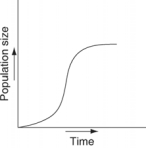
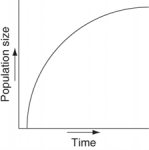
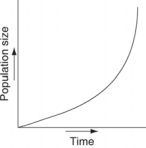
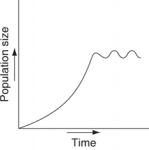
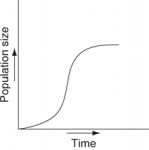
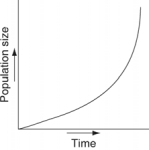
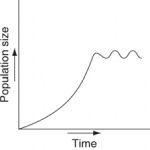
Deck 1: The Chemical Context of Life, Population Ecology, Genomes and Their Evolution

ملء الشاشة (f)
exit full mode
سؤال
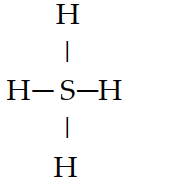
If an atom of sulfur (atomic number 16) were allowed to react with atoms of hydrogen (atomic number 1), which of the molecules below would be formed?

A) S-H

B) H-S-H

C)
HSHIH\begin{array}{c}\mathrm{H}-\mathrm{S}-\mathrm{H} \\ \mathrm{I} \\ \mathrm{H}\end{array}

D)
 <strong>If an atom of sulfur (atomic number 16) were allowed to react with atoms of hydrogen (atomic number 1), which of the molecules below would be formed?</strong> A) S-H  B) H-S-H  C)  \begin{array}{c}\mathrm{H}-\mathrm{S}-\mathrm{H} \\ \mathrm{I} \\ \mathrm{H}\end{array}    D)    E) H=S=H <div style=padding-top: 35px>

E) H=S=H
استخدم زر المسافة أو
up arrow
down arrow
لقلب البطاقة.
سؤال
In ammonium chloride salt (NH4 Cl) the anion is a single chloride ion, Cl-. What is the cation of NH4 Cl?

A) N, with a charge of +3
B) H, with a charge of +1
C) H2 with a charge of +4
D) NH4 with a charge of +1
E) NH4 with a charge of +4
سؤال
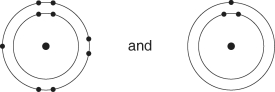
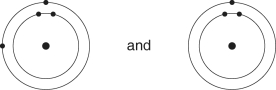
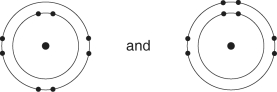
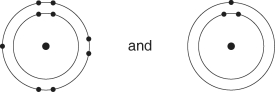
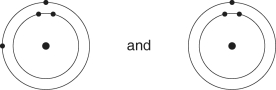
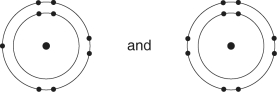
Which one of the atoms shown would be most likely to form a cation with a charge of +1?

A)
<strong>Which one of the atoms shown would be most likely to form a cation with a charge of +1?</strong> A)   B)   C)   D)   E)   <div style=padding-top: 35px>
B)
<strong>Which one of the atoms shown would be most likely to form a cation with a charge of +1?</strong> A)   B)   C)   D)   E)   <div style=padding-top: 35px>
C)
<strong>Which one of the atoms shown would be most likely to form a cation with a charge of +1?</strong> A)   B)   C)   D)   E)   <div style=padding-top: 35px>
D)
<strong>Which one of the atoms shown would be most likely to form a cation with a charge of +1?</strong> A)   B)   C)   D)   E)   <div style=padding-top: 35px>
E)
<strong>Which one of the atoms shown would be most likely to form a cation with a charge of +1?</strong> A)   B)   C)   D)   E)   <div style=padding-top: 35px>
سؤال
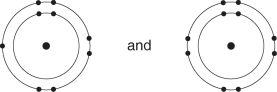
Which one of the atoms shown would be most likely to form an anion with a charge of -1?

A)
<strong>Which one of the atoms shown would be most likely to form an anion with a charge of -1?</strong> A)   B)   C)   D)   E)   <div style=padding-top: 35px>
B)
<strong>Which one of the atoms shown would be most likely to form an anion with a charge of -1?</strong> A)   B)   C)   D)   E)   <div style=padding-top: 35px>
C)
<strong>Which one of the atoms shown would be most likely to form an anion with a charge of -1?</strong> A)   B)   C)   D)   E)   <div style=padding-top: 35px>
D)
<strong>Which one of the atoms shown would be most likely to form an anion with a charge of -1?</strong> A)   B)   C)   D)   E)   <div style=padding-top: 35px>
E)
<strong>Which one of the atoms shown would be most likely to form an anion with a charge of -1?</strong> A)   B)   C)   D)   E)   <div style=padding-top: 35px>
سؤال
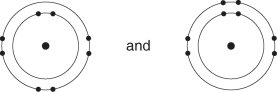
Which of the following pairs of atoms would be most likely to form a covalent bond?

A)
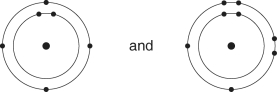
<strong>Which of the following pairs of atoms would be most likely to form a covalent bond?</strong> A)    B)    C)    D)    E)   <div style=padding-top: 35px>

B)
<strong>Which of the following pairs of atoms would be most likely to form a covalent bond?</strong> A)    B)    C)    D)    E)   <div style=padding-top: 35px>

C)
<strong>Which of the following pairs of atoms would be most likely to form a covalent bond?</strong> A)    B)    C)    D)    E)   <div style=padding-top: 35px>

D)
<strong>Which of the following pairs of atoms would be most likely to form a covalent bond?</strong> A)    B)    C)    D)    E)   <div style=padding-top: 35px>

E)
<strong>Which of the following pairs of atoms would be most likely to form a covalent bond?</strong> A)    B)    C)    D)    E)   <div style=padding-top: 35px>
سؤال
Which of the following pairs of atoms would be most likely to form an ionic bond?

A)
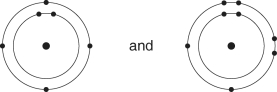
<strong>Which of the following pairs of atoms would be most likely to form an ionic bond?</strong> A)    B)    C)    D)    E)   <div style=padding-top: 35px>

B)
<strong>Which of the following pairs of atoms would be most likely to form an ionic bond?</strong> A)    B)    C)    D)    E)   <div style=padding-top: 35px>

C)
<strong>Which of the following pairs of atoms would be most likely to form an ionic bond?</strong> A)    B)    C)    D)    E)   <div style=padding-top: 35px>

D)
<strong>Which of the following pairs of atoms would be most likely to form an ionic bond?</strong> A)    B)    C)    D)    E)   <div style=padding-top: 35px>

E)
<strong>Which of the following pairs of atoms would be most likely to form an ionic bond?</strong> A)    B)    C)    D)    E)   <div style=padding-top: 35px>
سؤال
A given solution contains 0.0001(10-4) moles of hydrogen ions [H+] per liter. Which of the following best describes this solution?

A) acidic: H+ acceptor
B) basic: H+ acceptor
C) acidic: H+ donor
D) basic: H+ donor
E) neutral
سؤال
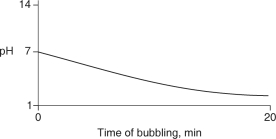
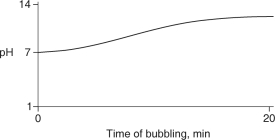
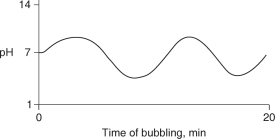
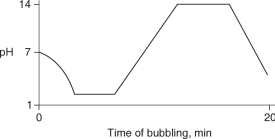
Carbon dioxide (CO2) is readily soluble in water, according to the equation CO2 + H2O \rightarrow H2CO3. Carbonic acid (H2CO3) is a weak acid. If CO2 is bubbled into a beaker containing pure, freshly-distilled water, which of the following graphs correctly describes the results?

A)
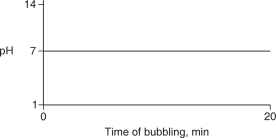
 <strong>Carbon dioxide (CO<sub>2</sub>) is readily soluble in water, according to the equation CO<sub>2</sub> + H<sub>2</sub>O   \rightarrow   H<sub>2</sub>CO<sub>3</sub>. Carbonic acid (H<sub>2</sub>CO<sub>3</sub>) is a weak acid. If CO<sub>2</sub> is bubbled into a beaker containing pure, freshly-distilled water, which of the following graphs correctly describes the results?</strong> A)    B)    C)    D)    E)   <div style=padding-top: 35px>

B)
 <strong>Carbon dioxide (CO<sub>2</sub>) is readily soluble in water, according to the equation CO<sub>2</sub> + H<sub>2</sub>O   \rightarrow   H<sub>2</sub>CO<sub>3</sub>. Carbonic acid (H<sub>2</sub>CO<sub>3</sub>) is a weak acid. If CO<sub>2</sub> is bubbled into a beaker containing pure, freshly-distilled water, which of the following graphs correctly describes the results?</strong> A)    B)    C)    D)    E)   <div style=padding-top: 35px>

C)
 <strong>Carbon dioxide (CO<sub>2</sub>) is readily soluble in water, according to the equation CO<sub>2</sub> + H<sub>2</sub>O   \rightarrow   H<sub>2</sub>CO<sub>3</sub>. Carbonic acid (H<sub>2</sub>CO<sub>3</sub>) is a weak acid. If CO<sub>2</sub> is bubbled into a beaker containing pure, freshly-distilled water, which of the following graphs correctly describes the results?</strong> A)    B)    C)    D)    E)   <div style=padding-top: 35px>

D)
 <strong>Carbon dioxide (CO<sub>2</sub>) is readily soluble in water, according to the equation CO<sub>2</sub> + H<sub>2</sub>O   \rightarrow   H<sub>2</sub>CO<sub>3</sub>. Carbonic acid (H<sub>2</sub>CO<sub>3</sub>) is a weak acid. If CO<sub>2</sub> is bubbled into a beaker containing pure, freshly-distilled water, which of the following graphs correctly describes the results?</strong> A)    B)    C)    D)    E)   <div style=padding-top: 35px>

E)
 <strong>Carbon dioxide (CO<sub>2</sub>) is readily soluble in water, according to the equation CO<sub>2</sub> + H<sub>2</sub>O   \rightarrow   H<sub>2</sub>CO<sub>3</sub>. Carbonic acid (H<sub>2</sub>CO<sub>3</sub>) is a weak acid. If CO<sub>2</sub> is bubbled into a beaker containing pure, freshly-distilled water, which of the following graphs correctly describes the results?</strong> A)    B)    C)    D)    E)   <div style=padding-top: 35px>
سؤال
Carbon dioxide (CO2) is readily soluble in water, according to the equation CO2 + H2O \rightarrow H2CO3. Carbonic acid (H2CO3) is a weak acid. Respiring cells release CO2. What prediction can we make about the pH of blood as that blood first comes in contact with respiring cells?

A) Blood pH will decrease slightly.
B) Blood pH will increase slightly.
C) Blood pH will remain unchanged.
D) Blood pH will first increase, then decrease as CO2 combines with hemoglobin
E)Blood pH will first decrease, then increase sharply as CO2 combines with hemoglobin.
سؤال
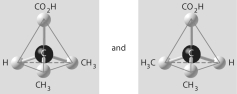
Which of the pairs of molecular structures shown below depict enantiomers (enantiomeric forms) of the same molecule?

A)
<strong>Which of the pairs of molecular structures shown below depict enantiomers (enantiomeric forms) of the same molecule?</strong> A)    B)    C)    D)    E)   <div style=padding-top: 35px>

B)
<strong>Which of the pairs of molecular structures shown below depict enantiomers (enantiomeric forms) of the same molecule?</strong> A)    B)    C)    D)    E)   <div style=padding-top: 35px>

C)
<strong>Which of the pairs of molecular structures shown below depict enantiomers (enantiomeric forms) of the same molecule?</strong> A)    B)    C)    D)    E)   <div style=padding-top: 35px>

D)
<strong>Which of the pairs of molecular structures shown below depict enantiomers (enantiomeric forms) of the same molecule?</strong> A)    B)    C)    D)    E)   <div style=padding-top: 35px>

E)
<strong>Which of the pairs of molecular structures shown below depict enantiomers (enantiomeric forms) of the same molecule?</strong> A)    B)    C)    D)    E)   <div style=padding-top: 35px>
سؤال
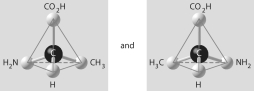
Which of the pairs of molecular structures shown below do NOT depict enantiomers (enantiomeric forms) of the same molecule?

A)
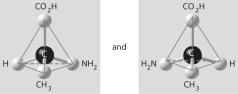
<strong>Which of the pairs of molecular structures shown below do NOT depict enantiomers (enantiomeric forms) of the same molecule?</strong> A)    B)    C)    D)    E)   <div style=padding-top: 35px>

B)
<strong>Which of the pairs of molecular structures shown below do NOT depict enantiomers (enantiomeric forms) of the same molecule?</strong> A)    B)    C)    D)    E)   <div style=padding-top: 35px>

C)
<strong>Which of the pairs of molecular structures shown below do NOT depict enantiomers (enantiomeric forms) of the same molecule?</strong> A)    B)    C)    D)    E)   <div style=padding-top: 35px>

D)
<strong>Which of the pairs of molecular structures shown below do NOT depict enantiomers (enantiomeric forms) of the same molecule?</strong> A)    B)    C)    D)    E)   <div style=padding-top: 35px>

E)
<strong>Which of the pairs of molecular structures shown below do NOT depict enantiomers (enantiomeric forms) of the same molecule?</strong> A)    B)    C)    D)    E)   <div style=padding-top: 35px>
سؤال
Identify the asymmetric carbon in this molecule:
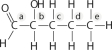
Identify the asymmetric carbon in this molecule:  <div style=padding-top: 35px>
سؤال
For the following questions, match the labeled component of the cell membrane (Figure 7.1) with its description.
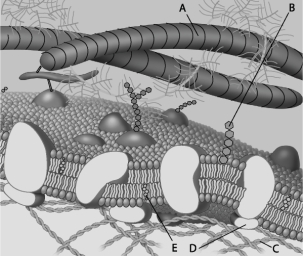
For the following questions, match the labeled component of the cell membrane (Figure 7.1) with its description.   Figure 7.1 -peripheral protein<div style=padding-top: 35px> Figure 7.1
-peripheral protein
سؤال
For the following questions, match the labeled component of the cell membrane (Figure 7.1) with its description.
For the following questions, match the labeled component of the cell membrane (Figure 7.1) with its description.   Figure 7.1 -cholesterol<div style=padding-top: 35px> Figure 7.1
-cholesterol
سؤال
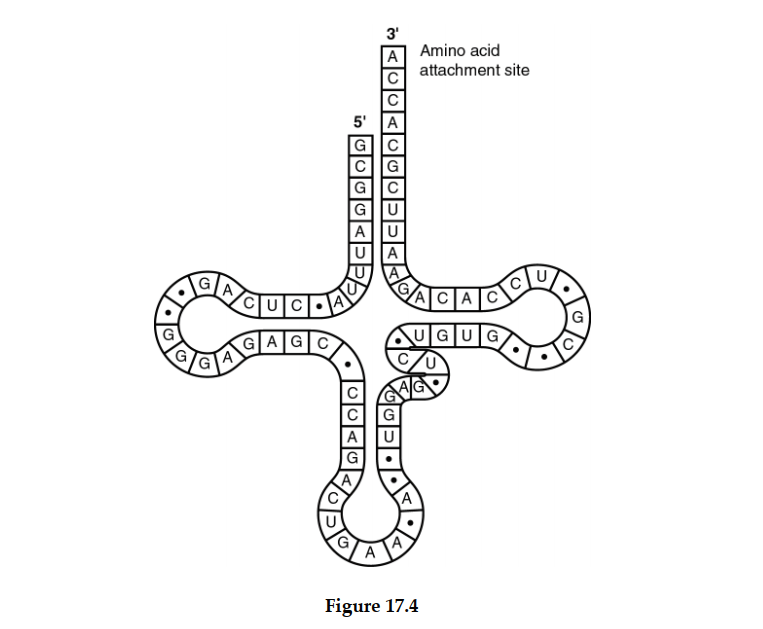
 <strong>   -The tRNA shown in Figure 17.4 has its 3 \prime end projecting beyond its 5 \prime  end. What will occur at this 3 \prime  end?</strong> A) The codon and anticodon complement one another. B) The amino acid binds covalently. C) The excess nucleotides (ACCA) will be cleaved off at the ribosome. D) The small and large subunits of the ribosome will attach to it. E) The 5? cap of the mRNA will become covalently bound. <div style=padding-top: 35px>

-The tRNA shown in Figure 17.4 has its 3 \prime end projecting beyond its 5 \prime end. What will occur at this 3 \prime end?

A) The codon and anticodon complement one another.
B) The amino acid binds covalently.
C) The excess nucleotides (ACCA) will be cleaved off at the ribosome.
D) The small and large subunits of the ribosome will attach to it.
E) The 5? cap of the mRNA will become covalently bound.
سؤال
Review the roles of RNA by filling in the following table:
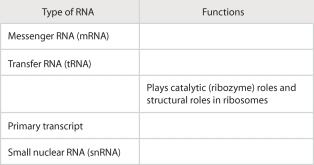
Review the roles of RNA by filling in the following table:  <div style=padding-top: 35px>
سؤال
Exponential growth of a population is represented by dN/dt =

A) rNK \frac{r N}{K}

B)rN

C)rN (K + N)

D) rN(KN)K r N \frac{(K-N)}{K}

E) rN(NK)K r N \frac{(N-K)}{K}
سؤال
Logistic growth of a population is represented by dN/dt =

A) rNK \frac{r N}{K}

B)rN

C)rN (K + N)

D) rN(KN)K r N \frac{(K-N)}{K}

E) rN(NK)K r N \frac{(N-K)}{K}
سؤال
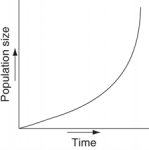
Which of the following graphs refer to this equation?
dNdt=0.5 N \frac{d N}{d t}=0.5 \mathrm{~N}

A)
 <strong>Which of the following graphs refer to this equation?   \frac{d N}{d t}=0.5 \mathrm{~N}   </strong> A)    B)    C)   D)    E)   <div style=padding-top: 35px>

B)
 <strong>Which of the following graphs refer to this equation?   \frac{d N}{d t}=0.5 \mathrm{~N}   </strong> A)    B)    C)   D)    E)   <div style=padding-top: 35px>

C)
 <strong>Which of the following graphs refer to this equation?   \frac{d N}{d t}=0.5 \mathrm{~N}   </strong> A)    B)    C)   D)    E)   <div style=padding-top: 35px>
D)
 <strong>Which of the following graphs refer to this equation?   \frac{d N}{d t}=0.5 \mathrm{~N}   </strong> A)    B)    C)   D)    E)   <div style=padding-top: 35px>

E)
 <strong>Which of the following graphs refer to this equation?   \frac{d N}{d t}=0.5 \mathrm{~N}   </strong> A)    B)    C)   D)    E)   <div style=padding-top: 35px>
سؤال
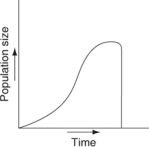
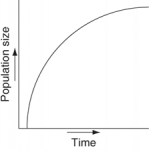
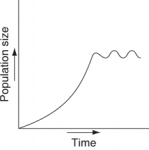
Which of the following graphs illustrates the growth curve of a small population of rodents that has grown to reach a static carrying capacity?

A)
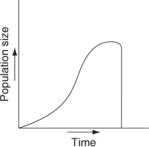
<strong>Which of the following graphs illustrates the growth curve of a small population of rodents that has grown to reach a static carrying capacity?</strong> A)   B)   C)   D)   E)   <div style=padding-top: 35px>
B)
<strong>Which of the following graphs illustrates the growth curve of a small population of rodents that has grown to reach a static carrying capacity?</strong> A)   B)   C)   D)   E)   <div style=padding-top: 35px>
C)
<strong>Which of the following graphs illustrates the growth curve of a small population of rodents that has grown to reach a static carrying capacity?</strong> A)   B)   C)   D)   E)   <div style=padding-top: 35px>
D)
<strong>Which of the following graphs illustrates the growth curve of a small population of rodents that has grown to reach a static carrying capacity?</strong> A)   B)   C)   D)   E)   <div style=padding-top: 35px>
E)
<strong>Which of the following graphs illustrates the growth curve of a small population of rodents that has grown to reach a static carrying capacity?</strong> A)   B)   C)   D)   E)   <div style=padding-top: 35px>
سؤال
Which of the following graphs illustrates the growth curve of a population of snowshoe hares over several seasons in northern Canada?

A)
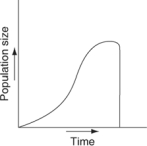
<strong>Which of the following graphs illustrates the growth curve of a population of snowshoe hares over several seasons in northern Canada?</strong> A)   B)   C)   D)   E)   <div style=padding-top: 35px>
B)
<strong>Which of the following graphs illustrates the growth curve of a population of snowshoe hares over several seasons in northern Canada?</strong> A)   B)   C)   D)   E)   <div style=padding-top: 35px>
C)
<strong>Which of the following graphs illustrates the growth curve of a population of snowshoe hares over several seasons in northern Canada?</strong> A)   B)   C)   D)   E)   <div style=padding-top: 35px>
D)
<strong>Which of the following graphs illustrates the growth curve of a population of snowshoe hares over several seasons in northern Canada?</strong> A)   B)   C)   D)   E)   <div style=padding-top: 35px>
E)
<strong>Which of the following graphs illustrates the growth curve of a population of snowshoe hares over several seasons in northern Canada?</strong> A)   B)   C)   D)   E)   <div style=padding-top: 35px>
سؤال
When levels of CO2 are experimentally increased, C3 plants generally respond with a greater increase in productivity than C4 plants. This is because

A) C3 plants are more efficient in their use of CO2.
B) C3 plants are able to obtain the same amount of CO 2 by keeping their stomata open for shorter periods of time.
C) C4 plants dont use CO2 as their source of carbon.
D) C3 plants are more limited than C4 plants by CO2 availability because of transpirational water loss.
E) C3 plants have special adaptations for CO2 uptake, such as larger stomata.
سؤال
If ψ \psi P = 0.3 MPa and ψ \psi S = -0.45 MPa, the resulting ψ \psi is

A) +0.75 MPa.
B) -0.75 MPa.
C) -0.15 MPa.
D) +0.15 MPa.
E) -0.42 MPa.
سؤال
Which of the following seems to be the known upper and lower size limits of genomes?

A) 1-2900 Mb (million base pairs)
B) 1,500-40,000 Mb
C) 1-580,000 Mb
D) 100-120,000 Mb
E) 100-200,000 Mb
سؤال
The following questions refer to this information:
In the year 2500, five male space colonists and five female space colonists (all unrelated to each other) settle on an uninhabited Earthlike planet in the Andromeda galaxy. The colonists and their offspring randomly mate for generations. All ten of the original colonists had free earlobes, and two were heterozygous for that trait. The allele for free earlobes is dominant to the allele for attached earlobes

-Which of these is closest to the allele frequency in the founding population?

A) 0.1 a, 0.9 A
B) 0.2 a, 0.8 A
C) 0.5 a, 0.5 A
D) 0.8 a, 0.2 A
E) 0.4 a, 0.6 A
فتح الحزمة
قم بالتسجيل لفتح البطاقات في هذه المجموعة!
Unlock Deck
Unlock Deck
1/25
auto play flashcards
العب
simple tutorial
ملء الشاشة (f)
exit full mode
Deck 1: The Chemical Context of Life, Population Ecology, Genomes and Their Evolution
1
If an atom of sulfur (atomic number 16) were allowed to react with atoms of hydrogen (atomic number 1), which of the molecules below would be formed?

A) S-H

B) H-S-H

C)
HSHIH\begin{array}{c}\mathrm{H}-\mathrm{S}-\mathrm{H} \\ \mathrm{I} \\ \mathrm{H}\end{array}

D)
 <strong>If an atom of sulfur (atomic number 16) were allowed to react with atoms of hydrogen (atomic number 1), which of the molecules below would be formed?</strong> A) S-H  B) H-S-H  C)  \begin{array}{c}\mathrm{H}-\mathrm{S}-\mathrm{H} \\ \mathrm{I} \\ \mathrm{H}\end{array}    D)    E) H=S=H

E) H=S=H
H-S-H
2
In ammonium chloride salt (NH4 Cl) the anion is a single chloride ion, Cl-. What is the cation of NH4 Cl?

A) N, with a charge of +3
B) H, with a charge of +1
C) H2 with a charge of +4
D) NH4 with a charge of +1
E) NH4 with a charge of +4
NH4 with a charge of +1
3
Which one of the atoms shown would be most likely to form a cation with a charge of +1?

A)
<strong>Which one of the atoms shown would be most likely to form a cation with a charge of +1?</strong> A)   B)   C)   D)   E)
B)
<strong>Which one of the atoms shown would be most likely to form a cation with a charge of +1?</strong> A)   B)   C)   D)   E)
C)
<strong>Which one of the atoms shown would be most likely to form a cation with a charge of +1?</strong> A)   B)   C)   D)   E)
D)
<strong>Which one of the atoms shown would be most likely to form a cation with a charge of +1?</strong> A)   B)   C)   D)   E)
E)
<strong>Which one of the atoms shown would be most likely to form a cation with a charge of +1?</strong> A)   B)   C)   D)   E)

4
Which one of the atoms shown would be most likely to form an anion with a charge of -1?

A)
<strong>Which one of the atoms shown would be most likely to form an anion with a charge of -1?</strong> A)   B)   C)   D)   E)
B)
<strong>Which one of the atoms shown would be most likely to form an anion with a charge of -1?</strong> A)   B)   C)   D)   E)
C)
<strong>Which one of the atoms shown would be most likely to form an anion with a charge of -1?</strong> A)   B)   C)   D)   E)
D)
<strong>Which one of the atoms shown would be most likely to form an anion with a charge of -1?</strong> A)   B)   C)   D)   E)
E)
<strong>Which one of the atoms shown would be most likely to form an anion with a charge of -1?</strong> A)   B)   C)   D)   E)
فتح الحزمة
افتح القفل للوصول البطاقات البالغ عددها 25 في هذه المجموعة.
فتح الحزمة
k this deck
5
Which of the following pairs of atoms would be most likely to form a covalent bond?

A)
<strong>Which of the following pairs of atoms would be most likely to form a covalent bond?</strong> A)    B)    C)    D)    E)

B)
<strong>Which of the following pairs of atoms would be most likely to form a covalent bond?</strong> A)    B)    C)    D)    E)

C)
<strong>Which of the following pairs of atoms would be most likely to form a covalent bond?</strong> A)    B)    C)    D)    E)

D)
<strong>Which of the following pairs of atoms would be most likely to form a covalent bond?</strong> A)    B)    C)    D)    E)

E)
<strong>Which of the following pairs of atoms would be most likely to form a covalent bond?</strong> A)    B)    C)    D)    E)
فتح الحزمة
افتح القفل للوصول البطاقات البالغ عددها 25 في هذه المجموعة.
فتح الحزمة
k this deck
6
Which of the following pairs of atoms would be most likely to form an ionic bond?

A)
<strong>Which of the following pairs of atoms would be most likely to form an ionic bond?</strong> A)    B)    C)    D)    E)

B)
<strong>Which of the following pairs of atoms would be most likely to form an ionic bond?</strong> A)    B)    C)    D)    E)

C)
<strong>Which of the following pairs of atoms would be most likely to form an ionic bond?</strong> A)    B)    C)    D)    E)

D)
<strong>Which of the following pairs of atoms would be most likely to form an ionic bond?</strong> A)    B)    C)    D)    E)

E)
<strong>Which of the following pairs of atoms would be most likely to form an ionic bond?</strong> A)    B)    C)    D)    E)
فتح الحزمة
افتح القفل للوصول البطاقات البالغ عددها 25 في هذه المجموعة.
فتح الحزمة
k this deck
7
A given solution contains 0.0001(10-4) moles of hydrogen ions [H+] per liter. Which of the following best describes this solution?

A) acidic: H+ acceptor
B) basic: H+ acceptor
C) acidic: H+ donor
D) basic: H+ donor
E) neutral
فتح الحزمة
افتح القفل للوصول البطاقات البالغ عددها 25 في هذه المجموعة.

فتح الحزمة
k this deck
8
Carbon dioxide (CO2) is readily soluble in water, according to the equation CO2 + H2O \rightarrow H2CO3. Carbonic acid (H2CO3) is a weak acid. If CO2 is bubbled into a beaker containing pure, freshly-distilled water, which of the following graphs correctly describes the results?

A)
 <strong>Carbon dioxide (CO<sub>2</sub>) is readily soluble in water, according to the equation CO<sub>2</sub> + H<sub>2</sub>O   \rightarrow   H<sub>2</sub>CO<sub>3</sub>. Carbonic acid (H<sub>2</sub>CO<sub>3</sub>) is a weak acid. If CO<sub>2</sub> is bubbled into a beaker containing pure, freshly-distilled water, which of the following graphs correctly describes the results?</strong> A)    B)    C)    D)    E)

B)
 <strong>Carbon dioxide (CO<sub>2</sub>) is readily soluble in water, according to the equation CO<sub>2</sub> + H<sub>2</sub>O   \rightarrow   H<sub>2</sub>CO<sub>3</sub>. Carbonic acid (H<sub>2</sub>CO<sub>3</sub>) is a weak acid. If CO<sub>2</sub> is bubbled into a beaker containing pure, freshly-distilled water, which of the following graphs correctly describes the results?</strong> A)    B)    C)    D)    E)

C)
 <strong>Carbon dioxide (CO<sub>2</sub>) is readily soluble in water, according to the equation CO<sub>2</sub> + H<sub>2</sub>O   \rightarrow   H<sub>2</sub>CO<sub>3</sub>. Carbonic acid (H<sub>2</sub>CO<sub>3</sub>) is a weak acid. If CO<sub>2</sub> is bubbled into a beaker containing pure, freshly-distilled water, which of the following graphs correctly describes the results?</strong> A)    B)    C)    D)    E)

D)
 <strong>Carbon dioxide (CO<sub>2</sub>) is readily soluble in water, according to the equation CO<sub>2</sub> + H<sub>2</sub>O   \rightarrow   H<sub>2</sub>CO<sub>3</sub>. Carbonic acid (H<sub>2</sub>CO<sub>3</sub>) is a weak acid. If CO<sub>2</sub> is bubbled into a beaker containing pure, freshly-distilled water, which of the following graphs correctly describes the results?</strong> A)    B)    C)    D)    E)

E)
 <strong>Carbon dioxide (CO<sub>2</sub>) is readily soluble in water, according to the equation CO<sub>2</sub> + H<sub>2</sub>O   \rightarrow   H<sub>2</sub>CO<sub>3</sub>. Carbonic acid (H<sub>2</sub>CO<sub>3</sub>) is a weak acid. If CO<sub>2</sub> is bubbled into a beaker containing pure, freshly-distilled water, which of the following graphs correctly describes the results?</strong> A)    B)    C)    D)    E)
فتح الحزمة
افتح القفل للوصول البطاقات البالغ عددها 25 في هذه المجموعة.

فتح الحزمة
k this deck
9
Carbon dioxide (CO2) is readily soluble in water, according to the equation CO2 + H2O \rightarrow H2CO3. Carbonic acid (H2CO3) is a weak acid. Respiring cells release CO2. What prediction can we make about the pH of blood as that blood first comes in contact with respiring cells?

A) Blood pH will decrease slightly.
B) Blood pH will increase slightly.
C) Blood pH will remain unchanged.
D) Blood pH will first increase, then decrease as CO2 combines with hemoglobin
E)Blood pH will first decrease, then increase sharply as CO2 combines with hemoglobin.
فتح الحزمة
افتح القفل للوصول البطاقات البالغ عددها 25 في هذه المجموعة.
فتح الحزمة
k this deck
10
Which of the pairs of molecular structures shown below depict enantiomers (enantiomeric forms) of the same molecule?

A)
<strong>Which of the pairs of molecular structures shown below depict enantiomers (enantiomeric forms) of the same molecule?</strong> A)    B)    C)    D)    E)

B)
<strong>Which of the pairs of molecular structures shown below depict enantiomers (enantiomeric forms) of the same molecule?</strong> A)    B)    C)    D)    E)

C)
<strong>Which of the pairs of molecular structures shown below depict enantiomers (enantiomeric forms) of the same molecule?</strong> A)    B)    C)    D)    E)

D)
<strong>Which of the pairs of molecular structures shown below depict enantiomers (enantiomeric forms) of the same molecule?</strong> A)    B)    C)    D)    E)

E)
<strong>Which of the pairs of molecular structures shown below depict enantiomers (enantiomeric forms) of the same molecule?</strong> A)    B)    C)    D)    E)
فتح الحزمة
افتح القفل للوصول البطاقات البالغ عددها 25 في هذه المجموعة.
فتح الحزمة
k this deck
11
Which of the pairs of molecular structures shown below do NOT depict enantiomers (enantiomeric forms) of the same molecule?

A)
<strong>Which of the pairs of molecular structures shown below do NOT depict enantiomers (enantiomeric forms) of the same molecule?</strong> A)    B)    C)    D)    E)

B)
<strong>Which of the pairs of molecular structures shown below do NOT depict enantiomers (enantiomeric forms) of the same molecule?</strong> A)    B)    C)    D)    E)

C)
<strong>Which of the pairs of molecular structures shown below do NOT depict enantiomers (enantiomeric forms) of the same molecule?</strong> A)    B)    C)    D)    E)

D)
<strong>Which of the pairs of molecular structures shown below do NOT depict enantiomers (enantiomeric forms) of the same molecule?</strong> A)    B)    C)    D)    E)

E)
<strong>Which of the pairs of molecular structures shown below do NOT depict enantiomers (enantiomeric forms) of the same molecule?</strong> A)    B)    C)    D)    E)
فتح الحزمة
افتح القفل للوصول البطاقات البالغ عددها 25 في هذه المجموعة.
فتح الحزمة
k this deck
12
Identify the asymmetric carbon in this molecule:
فتح الحزمة
افتح القفل للوصول البطاقات البالغ عددها 25 في هذه المجموعة.
فتح الحزمة
k this deck
13
For the following questions, match the labeled component of the cell membrane (Figure 7.1) with its description.
For the following questions, match the labeled component of the cell membrane (Figure 7.1) with its description.   Figure 7.1 -peripheral protein Figure 7.1
-peripheral protein
فتح الحزمة
افتح القفل للوصول البطاقات البالغ عددها 25 في هذه المجموعة.
فتح الحزمة
k this deck
14
For the following questions, match the labeled component of the cell membrane (Figure 7.1) with its description.
For the following questions, match the labeled component of the cell membrane (Figure 7.1) with its description.   Figure 7.1 -cholesterol Figure 7.1
-cholesterol
فتح الحزمة
افتح القفل للوصول البطاقات البالغ عددها 25 في هذه المجموعة.
فتح الحزمة
k this deck
15
 <strong>   -The tRNA shown in Figure 17.4 has its 3 \prime end projecting beyond its 5 \prime  end. What will occur at this 3 \prime  end?</strong> A) The codon and anticodon complement one another. B) The amino acid binds covalently. C) The excess nucleotides (ACCA) will be cleaved off at the ribosome. D) The small and large subunits of the ribosome will attach to it. E) The 5? cap of the mRNA will become covalently bound.

-The tRNA shown in Figure 17.4 has its 3 \prime end projecting beyond its 5 \prime end. What will occur at this 3 \prime end?

A) The codon and anticodon complement one another.
B) The amino acid binds covalently.
C) The excess nucleotides (ACCA) will be cleaved off at the ribosome.
D) The small and large subunits of the ribosome will attach to it.
E) The 5? cap of the mRNA will become covalently bound.
فتح الحزمة
افتح القفل للوصول البطاقات البالغ عددها 25 في هذه المجموعة.
فتح الحزمة
k this deck
16
Review the roles of RNA by filling in the following table:
فتح الحزمة
افتح القفل للوصول البطاقات البالغ عددها 25 في هذه المجموعة.
فتح الحزمة
k this deck
17
Exponential growth of a population is represented by dN/dt =

A) rNK \frac{r N}{K}

B)rN

C)rN (K + N)

D) rN(KN)K r N \frac{(K-N)}{K}

E) rN(NK)K r N \frac{(N-K)}{K}
فتح الحزمة
افتح القفل للوصول البطاقات البالغ عددها 25 في هذه المجموعة.
فتح الحزمة
k this deck
18
Logistic growth of a population is represented by dN/dt =

A) rNK \frac{r N}{K}

B)rN

C)rN (K + N)

D) rN(KN)K r N \frac{(K-N)}{K}

E) rN(NK)K r N \frac{(N-K)}{K}
فتح الحزمة
افتح القفل للوصول البطاقات البالغ عددها 25 في هذه المجموعة.
فتح الحزمة
k this deck
19
Which of the following graphs refer to this equation?
dNdt=0.5 N \frac{d N}{d t}=0.5 \mathrm{~N}

A)
 <strong>Which of the following graphs refer to this equation?   \frac{d N}{d t}=0.5 \mathrm{~N}   </strong> A)    B)    C)   D)    E)

B)
 <strong>Which of the following graphs refer to this equation?   \frac{d N}{d t}=0.5 \mathrm{~N}   </strong> A)    B)    C)   D)    E)

C)
 <strong>Which of the following graphs refer to this equation?   \frac{d N}{d t}=0.5 \mathrm{~N}   </strong> A)    B)    C)   D)    E)
D)
 <strong>Which of the following graphs refer to this equation?   \frac{d N}{d t}=0.5 \mathrm{~N}   </strong> A)    B)    C)   D)    E)

E)
 <strong>Which of the following graphs refer to this equation?   \frac{d N}{d t}=0.5 \mathrm{~N}   </strong> A)    B)    C)   D)    E)
فتح الحزمة
افتح القفل للوصول البطاقات البالغ عددها 25 في هذه المجموعة.
فتح الحزمة
k this deck
20
Which of the following graphs illustrates the growth curve of a small population of rodents that has grown to reach a static carrying capacity?

A)
<strong>Which of the following graphs illustrates the growth curve of a small population of rodents that has grown to reach a static carrying capacity?</strong> A)   B)   C)   D)   E)
B)
<strong>Which of the following graphs illustrates the growth curve of a small population of rodents that has grown to reach a static carrying capacity?</strong> A)   B)   C)   D)   E)
C)
<strong>Which of the following graphs illustrates the growth curve of a small population of rodents that has grown to reach a static carrying capacity?</strong> A)   B)   C)   D)   E)
D)
<strong>Which of the following graphs illustrates the growth curve of a small population of rodents that has grown to reach a static carrying capacity?</strong> A)   B)   C)   D)   E)
E)
<strong>Which of the following graphs illustrates the growth curve of a small population of rodents that has grown to reach a static carrying capacity?</strong> A)   B)   C)   D)   E)
فتح الحزمة
افتح القفل للوصول البطاقات البالغ عددها 25 في هذه المجموعة.
فتح الحزمة
k this deck
21
Which of the following graphs illustrates the growth curve of a population of snowshoe hares over several seasons in northern Canada?

A)
<strong>Which of the following graphs illustrates the growth curve of a population of snowshoe hares over several seasons in northern Canada?</strong> A)   B)   C)   D)   E)
B)
<strong>Which of the following graphs illustrates the growth curve of a population of snowshoe hares over several seasons in northern Canada?</strong> A)   B)   C)   D)   E)
C)
<strong>Which of the following graphs illustrates the growth curve of a population of snowshoe hares over several seasons in northern Canada?</strong> A)   B)   C)   D)   E)
D)
<strong>Which of the following graphs illustrates the growth curve of a population of snowshoe hares over several seasons in northern Canada?</strong> A)   B)   C)   D)   E)
E)
<strong>Which of the following graphs illustrates the growth curve of a population of snowshoe hares over several seasons in northern Canada?</strong> A)   B)   C)   D)   E)
فتح الحزمة
افتح القفل للوصول البطاقات البالغ عددها 25 في هذه المجموعة.
فتح الحزمة
k this deck
22
When levels of CO2 are experimentally increased, C3 plants generally respond with a greater increase in productivity than C4 plants. This is because

A) C3 plants are more efficient in their use of CO2.
B) C3 plants are able to obtain the same amount of CO 2 by keeping their stomata open for shorter periods of time.
C) C4 plants dont use CO2 as their source of carbon.
D) C3 plants are more limited than C4 plants by CO2 availability because of transpirational water loss.
E) C3 plants have special adaptations for CO2 uptake, such as larger stomata.
فتح الحزمة
افتح القفل للوصول البطاقات البالغ عددها 25 في هذه المجموعة.
فتح الحزمة
k this deck
23
If ψ \psi P = 0.3 MPa and ψ \psi S = -0.45 MPa, the resulting ψ \psi is

A) +0.75 MPa.
B) -0.75 MPa.
C) -0.15 MPa.
D) +0.15 MPa.
E) -0.42 MPa.
فتح الحزمة
افتح القفل للوصول البطاقات البالغ عددها 25 في هذه المجموعة.
فتح الحزمة
k this deck
24
Which of the following seems to be the known upper and lower size limits of genomes?

A) 1-2900 Mb (million base pairs)
B) 1,500-40,000 Mb
C) 1-580,000 Mb
D) 100-120,000 Mb
E) 100-200,000 Mb
فتح الحزمة
افتح القفل للوصول البطاقات البالغ عددها 25 في هذه المجموعة.
فتح الحزمة
k this deck
25
The following questions refer to this information:
In the year 2500, five male space colonists and five female space colonists (all unrelated to each other) settle on an uninhabited Earthlike planet in the Andromeda galaxy. The colonists and their offspring randomly mate for generations. All ten of the original colonists had free earlobes, and two were heterozygous for that trait. The allele for free earlobes is dominant to the allele for attached earlobes

-Which of these is closest to the allele frequency in the founding population?

A) 0.1 a, 0.9 A
B) 0.2 a, 0.8 A
C) 0.5 a, 0.5 A
D) 0.8 a, 0.2 A
E) 0.4 a, 0.6 A
فتح الحزمة
افتح القفل للوصول البطاقات البالغ عددها 25 في هذه المجموعة.
فتح الحزمة
k this deck
locked card icon
فتح الحزمة
افتح القفل للوصول البطاقات البالغ عددها 25 في هذه المجموعة.