







 تكلم مع الذكاء الاصطناعي


Deck 7: In Between the Extremes: Imperfect Competition
ملء الشاشة (f)

سؤال

سؤال
سؤال
سؤال
سؤال
سؤال
سؤال
سؤال
سؤال
سؤال
سؤال
سؤال
سؤال
سؤال
سؤال
سؤال
 Figure 7.1
-In Figure 7.1, the profit maximizing output and price for this monopolistic competitor is
A) 80 and $11.
B) 50 and $8.
C) 60 and $9.
D) 60 and $14.
سؤال
Figure 7.1-In Figure 7.1, what is the total revenue at the profit maximizing point?
A) $540
B) $840
C) $360
D) $880
سؤال
Figure 7.1-In Figure 7.1, what would happen in the long run?
A) More producers would enter the market and the share of the market to this firm would fall until there was zero economic profit.
B) More producers would exit the market and the share of the market to this firm would fall until there was zero economic profit.
C) More producers would enter the market and the share of the market to this firm would rise until there was zero economic profit.
D) More producers would enter the market and the share of the market to this firm would fall until there was negative economic profit.
سؤال
سؤال
The monopolistic competitor depicted below would find that which of the following is INCORRECT?
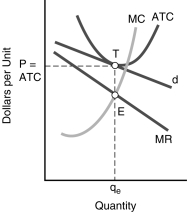 Figure 7.2
A) The profit-maximizing rate of output is qe, and the profit maximizing price is P.
B) The demand curve shows that the firm faces a perfectly elastic demand.
C) The profit maximizing rate of output is indicated by E, where MR intersects MC.
D) A downward sloping marginal revenue curve lies below the demand curve.
Figure 7.2A) The profit-maximizing rate of output is qe, and the profit maximizing price is P.
B) The demand curve shows that the firm faces a perfectly elastic demand.
C) The profit maximizing rate of output is indicated by E, where MR intersects MC.
D) A downward sloping marginal revenue curve lies below the demand curve.
سؤال
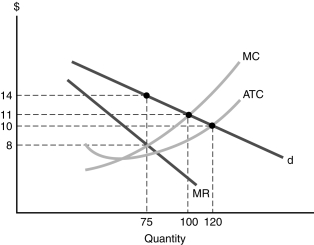 Figure 7.3
-For the monopolistic competitor depicted in Figure 7.3, what is the profit-maximizing quantity?
A) 0
B) 75
C) 100
D) 120
سؤال
Figure 7.3-For the monopolistic competitor depicted in Figure 7.3, what is the profit-maximizing price?
A) 8
B) 10
C) 11
D) 14
سؤال
Figure 7.3-For the monopolistic competitor depicted in Figure 7.3, what quantity would have to be produced in order for the firm to engage in marginal-cost pricing?
A) 0
B) 75
C) 100
D) 120
سؤال
Figure 7.3-For the monopolistic competitor depicted in Figure 7.3, what quantity would have to be produced in order for the firm to be at its breakeven point?
A) 0
B) 75
C) 100
D) 120
سؤال
Figure 7.3-If the monopolistic competitor in Figure 7.3 produced 120 units and sold them at a price of $10 each, how much profit would it make?
A) $0.
B) $200.
C) $240.
D) Over $300.
سؤال
Figure 7.3-If the monopolistic competitor in Figure 7.3 is free to choose the profit-maximizing price and quantity, how much profit will be earned?
A) $525.
B) $300.
C) $225.
D) Less than $100.
سؤال
Table 7.1 depicts price, quantity, and the marginal revenue and marginal costs the campus bookstore faces. Based on marginal analysis, what is the profit maximizing level of output for the bookstore?
Table 7.1

A) 1 book
B) 2 books
C) 3 books
D) 4 books
Table 7.1
A) 1 book
B) 2 books
C) 3 books
D) 4 books
سؤال
Table 7.1 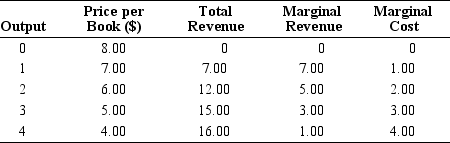 Refer to Table 7.1. What price will the bookstore charge in order to maximize profit?
A) $7.00
B) $6.00
C) $5.00
D) $4.00
Refer to Table 7.1. What price will the bookstore charge in order to maximize profit?A) $7.00
B) $6.00
C) $5.00
D) $4.00
سؤال
سؤال
سؤال
سؤال
سؤال
 Figure 7.4
-Using Figure 7.4, the profit maximizing output and price for this firm is
A) 100 and $19.
B) 160 and $13.
C) 160 and $16.
D) 210 and $16.
سؤال
Figure 7.4-Using Figure 7.4, the total revenue earned by this firm is
A) $2,560.
B) $1,600.
C) $480.
D) $1,900.
سؤال
Figure 7.4-Using Figure 7.4, the total profit earned by this firm is
A) $2,560.
B) $1,600.
C) $480.
D) $1,900
سؤال
 Figure 7.5
-Using Figure 7.5, the firm depicted in the figure
A) is earning an economic profit.
B) is earning an accounting profit.
C) is producing at a loss.
D) must increase output in order to earn an economic profit.
سؤال
Figure 7.5-Using Figure 7.5, the firm depicted in the figure
A) will minimize losses by producing the quantity at which average total cost is minimized.
B) will minimize losses by producing the quantity at which marginal cost is minimized.
C) will minimize losses by producing the quantity at which marginal revenue equals marginal cost, as long as average variable cost is covered.
D) will minimize losses by producing the quantity at which marginal cost intersects the demand curve, as long as average variable cost is covered.
سؤال
سؤال
سؤال
سؤال
سؤال
سؤال
سؤال
سؤال
سؤال
سؤال
سؤال
سؤال
سؤال
سؤال
سؤال
سؤال
سؤال
سؤال
سؤال
سؤال
سؤال
سؤال
سؤال
سؤال
سؤال
سؤال
سؤال
سؤال
سؤال
سؤال
سؤال
سؤال
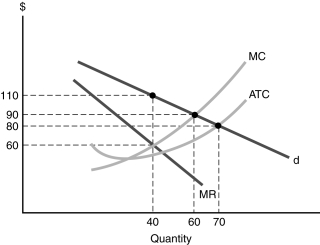 Figure 7.6
-Using Figure 7.6, which quantity is the profit-maximizing quantity for this monopolistic competitor?
A) 70.
B) 60.
C) 40.
D) 0.
سؤال
Figure 7.6-Using Figure 7.6, which price-and-quantity combination would simulate the perfectly competitive outcome of marginal-cost pricing?
A) Price of $90 and quantity of 60.
B) Price of $90 and quantity of 40.
C) Price of $60 and quantity of 40.
D) Price of $80 and quantity of 70.
سؤال
Figure 7.6-Using Figure 7.6, which price-and-quantity combination would generate the outcome in which economic profits are zero?
A) Price of $90 and quantity of 60.
B) Price of $90 and quantity of 40.
C) Price of $60 and quantity of 40.
D) Price of $80 and quantity of 70.
سؤال
Figure 7.6-Using Figure 7.6, how much profit would this monopolistic competitor earn if she were regulated by the government to produce 60 units and to charge a price corresponding to that quantity on the demand curve?
A) $0.
B) Less than $1000.
C) Between $1000 and $2000.
D) Over $2000.
سؤال
سؤال
سؤال
سؤال
سؤال
سؤال
سؤال
سؤال

فتح الحزمة
قم بالتسجيل لفتح البطاقات في هذه المجموعة!
Unlock Deck
Unlock Deck
1/150

العب

ملء الشاشة (f)
Deck 7: In Between the Extremes: Imperfect Competition
1
Which of the following is NOT a feature of a monopolistic competitor?
A) Relatively easy entry
B) Differentiated product
C) Advertising
D) Homogenous product
A) Relatively easy entry
B) Differentiated product
C) Advertising
D) Homogenous product
Homogenous product
2
The type of product sold by a monopolistically competitive business
A) is differentiated.
B) is homogeneous.
C) can be either homogeneous or differentiated.
D) is neither homogeneous nor differentiated.
A) is differentiated.
B) is homogeneous.
C) can be either homogeneous or differentiated.
D) is neither homogeneous nor differentiated.
is differentiated.
3
The most common form of market structure in the U.S. is
A) perfect competition.
B) pure monopoly.
C) oligopoly.
D) monopolistic competition.
A) perfect competition.
B) pure monopoly.
C) oligopoly.
D) monopolistic competition.
monopolistic competition.
4
One difference between perfect competition and monopolistic competition is that
A) in perfect competition the products are differentiated while in monopolistic competition the products are homogeneous.
B) in perfect competition the products are homogeneous while in monopolistic competition the products are differentiated.
C) in perfect competition there are a large number of sellers while in monopolistic competition there is only one seller.
D) in perfect competition the firm faces a perfectly inelastic demand while in monopolistic competition the firm faces a perfectly elastic demand.
A) in perfect competition the products are differentiated while in monopolistic competition the products are homogeneous.
B) in perfect competition the products are homogeneous while in monopolistic competition the products are differentiated.
C) in perfect competition there are a large number of sellers while in monopolistic competition there is only one seller.
D) in perfect competition the firm faces a perfectly inelastic demand while in monopolistic competition the firm faces a perfectly elastic demand.
فتح الحزمة
افتح القفل للوصول البطاقات البالغ عددها 150 في هذه المجموعة.
فتح الحزمة
k this deck
5
One difference between perfect competition and monopolistic competition is that
A) monopolistic competitors advertise to increase sales of their product, whereas perfect competitors do not.
B) monopolistic competitors earn positive economic profits in the long run, whereas perfect competitors do not.
C) perfect competitors earn positive economic profits in the long run, whereas monopolistic competitors do not.
D) monopolistic competitors face a perfectly elastic demand for their product, whereas perfect competitors do not.
A) monopolistic competitors advertise to increase sales of their product, whereas perfect competitors do not.
B) monopolistic competitors earn positive economic profits in the long run, whereas perfect competitors do not.
C) perfect competitors earn positive economic profits in the long run, whereas monopolistic competitors do not.
D) monopolistic competitors face a perfectly elastic demand for their product, whereas perfect competitors do not.
فتح الحزمة
افتح القفل للوصول البطاقات البالغ عددها 150 في هذه المجموعة.
فتح الحزمة
k this deck
6
Monopolistic competition is a form of
A) barrier to entry.
B) market structure.
C) cartel.
D) monopoly.
A) barrier to entry.
B) market structure.
C) cartel.
D) monopoly.
فتح الحزمة
افتح القفل للوصول البطاقات البالغ عددها 150 في هذه المجموعة.
فتح الحزمة
k this deck
7
In the long run, the monopolistic competitor will
A) face a perfectly elastic demand curve.
B) charge a price equal to average total cost.
C) earn positive economic profits.
D) drive his other competitors out of the industry.
A) face a perfectly elastic demand curve.
B) charge a price equal to average total cost.
C) earn positive economic profits.
D) drive his other competitors out of the industry.
فتح الحزمة
افتح القفل للوصول البطاقات البالغ عددها 150 في هذه المجموعة.
فتح الحزمة
k this deck
8
One difference between monopoly and monopolistic competition is that
A) the monopolist can earn positive economic profits in the long run, whereas the monopolistic competitor will earn zero economic profit in the long run.
B) the monopolist seeks to maximize profit, whereas the monopolistic competitor does not.
C) the monopolist produces the quantity at which marginal revenue equals marginal cost, whereas the monopolistic competitor does not.
D) the monopolist faces a downward-sloping demand curve, whereas the monopolistic competitor does not.
A) the monopolist can earn positive economic profits in the long run, whereas the monopolistic competitor will earn zero economic profit in the long run.
B) the monopolist seeks to maximize profit, whereas the monopolistic competitor does not.
C) the monopolist produces the quantity at which marginal revenue equals marginal cost, whereas the monopolistic competitor does not.
D) the monopolist faces a downward-sloping demand curve, whereas the monopolistic competitor does not.
فتح الحزمة
افتح القفل للوصول البطاقات البالغ عددها 150 في هذه المجموعة.
فتح الحزمة
k this deck
9
One of the differences between perfect competition and monopolistic competition is that
A) the monopolistic competitor charges a price above average total cost in the long run, whereas the perfect competitor does not.
B) the monopolistic competitor sells a homogeneous product, whereas the perfect competitor does not.
C) the monopolistic competitor seeks to maximize profits, whereas the perfect competitor does not.
D) the monopolistic competitor has some control over price, whereas the perfect competitor does not.
A) the monopolistic competitor charges a price above average total cost in the long run, whereas the perfect competitor does not.
B) the monopolistic competitor sells a homogeneous product, whereas the perfect competitor does not.
C) the monopolistic competitor seeks to maximize profits, whereas the perfect competitor does not.
D) the monopolistic competitor has some control over price, whereas the perfect competitor does not.
فتح الحزمة
افتح القفل للوصول البطاقات البالغ عددها 150 في هذه المجموعة.
فتح الحزمة
k this deck
10
Which of the following is the best example of a product likely to be found in a monopolistically competitive market structure?
A) Fast food restaurants
B) Coal
C) Wheat
D) Electricity
A) Fast food restaurants
B) Coal
C) Wheat
D) Electricity
فتح الحزمة
افتح القفل للوصول البطاقات البالغ عددها 150 في هذه المجموعة.
فتح الحزمة
k this deck
11
Which one of the following is true of perfect competition but NOT true of monopolistic competition?
A) The firm seeks to maximize profit.
B) The firm's profit is equal to its total revenue minus its total cost.
C) The firm will incur a loss if price falls below ATC.
D) In the long run, the firm produces at a point where average total cost is minimized.
A) The firm seeks to maximize profit.
B) The firm's profit is equal to its total revenue minus its total cost.
C) The firm will incur a loss if price falls below ATC.
D) In the long run, the firm produces at a point where average total cost is minimized.
فتح الحزمة
افتح القفل للوصول البطاقات البالغ عددها 150 في هذه المجموعة.
فتح الحزمة
k this deck
12
In the long run, the monopolistic competitor will charge a price that is equal to
A) average variable cost.
B) average total cost.
C) marginal cost.
D) fixed cost.
A) average variable cost.
B) average total cost.
C) marginal cost.
D) fixed cost.
فتح الحزمة
افتح القفل للوصول البطاقات البالغ عددها 150 في هذه المجموعة.
فتح الحزمة
k this deck
13
A monopolistically competitive firm uses advertising to
A) differentiate its product.
B) lower its costs.
C) motivate its work force.
D) signal its competitors that it is serious about staying in business.
A) differentiate its product.
B) lower its costs.
C) motivate its work force.
D) signal its competitors that it is serious about staying in business.
فتح الحزمة
افتح القفل للوصول البطاقات البالغ عددها 150 في هذه المجموعة.
فتح الحزمة
k this deck
14
Which of the following is true of monopolistic competition but is NOT true of perfect competition?
A) The firm has some control over price.
B) The firm faces a perfectly elastic demand curve.
C) In the long run, the firm will earn zero economic profit.
D) In the long run, the firm will charge a price equal to ATC.
A) The firm has some control over price.
B) The firm faces a perfectly elastic demand curve.
C) In the long run, the firm will earn zero economic profit.
D) In the long run, the firm will charge a price equal to ATC.
فتح الحزمة
افتح القفل للوصول البطاقات البالغ عددها 150 في هذه المجموعة.
فتح الحزمة
k this deck
15
When Crest toothpaste claims that their product whitens teeth more than their competitor they are practicing
A) product differentiation.
B) irrational behavior.
C) marginal revenue pricing.
D) marginal cost pricing.
A) product differentiation.
B) irrational behavior.
C) marginal revenue pricing.
D) marginal cost pricing.
فتح الحزمة
افتح القفل للوصول البطاقات البالغ عددها 150 في هذه المجموعة.
فتح الحزمة
k this deck
16
Figure 7.1-In Figure 7.1, the profit maximizing output and price for this monopolistic competitor is
A) 80 and $11.
B) 50 and $8.
C) 60 and $9.
D) 60 and $14.
فتح الحزمة
افتح القفل للوصول البطاقات البالغ عددها 150 في هذه المجموعة.
فتح الحزمة
k this deck
17
Figure 7.1-In Figure 7.1, what is the total revenue at the profit maximizing point?
A) $540
B) $840
C) $360
D) $880
فتح الحزمة
افتح القفل للوصول البطاقات البالغ عددها 150 في هذه المجموعة.
فتح الحزمة
k this deck
18
Figure 7.1-In Figure 7.1, what would happen in the long run?
A) More producers would enter the market and the share of the market to this firm would fall until there was zero economic profit.
B) More producers would exit the market and the share of the market to this firm would fall until there was zero economic profit.
C) More producers would enter the market and the share of the market to this firm would rise until there was zero economic profit.
D) More producers would enter the market and the share of the market to this firm would fall until there was negative economic profit.
فتح الحزمة
افتح القفل للوصول البطاقات البالغ عددها 150 في هذه المجموعة.
فتح الحزمة
k this deck
19
For the monopolistic competitor, which is INCORRECT?
A) Because the firm has some control over price, its demand curve slopes downward.
B) The marginal revenue curve is downward sloping and lies below the demand curve.
C) The profit maximizing rate of output is where the marginal cost curve intersects the marginal revenue curve.
D) If the firm in a monopolistically competitive industry were making economic losses, firms would enter the industry.
A) Because the firm has some control over price, its demand curve slopes downward.
B) The marginal revenue curve is downward sloping and lies below the demand curve.
C) The profit maximizing rate of output is where the marginal cost curve intersects the marginal revenue curve.
D) If the firm in a monopolistically competitive industry were making economic losses, firms would enter the industry.
فتح الحزمة
افتح القفل للوصول البطاقات البالغ عددها 150 في هذه المجموعة.
فتح الحزمة
k this deck
20
The monopolistic competitor depicted below would find that which of the following is INCORRECT?
Figure 7.2
A) The profit-maximizing rate of output is qe, and the profit maximizing price is P.
B) The demand curve shows that the firm faces a perfectly elastic demand.
C) The profit maximizing rate of output is indicated by E, where MR intersects MC.
D) A downward sloping marginal revenue curve lies below the demand curve.
Figure 7.2A) The profit-maximizing rate of output is qe, and the profit maximizing price is P.
B) The demand curve shows that the firm faces a perfectly elastic demand.
C) The profit maximizing rate of output is indicated by E, where MR intersects MC.
D) A downward sloping marginal revenue curve lies below the demand curve.
فتح الحزمة
افتح القفل للوصول البطاقات البالغ عددها 150 في هذه المجموعة.
فتح الحزمة
k this deck
21
Figure 7.3-For the monopolistic competitor depicted in Figure 7.3, what is the profit-maximizing quantity?
A) 0
B) 75
C) 100
D) 120
فتح الحزمة
افتح القفل للوصول البطاقات البالغ عددها 150 في هذه المجموعة.
فتح الحزمة
k this deck
22
Figure 7.3-For the monopolistic competitor depicted in Figure 7.3, what is the profit-maximizing price?
A) 8
B) 10
C) 11
D) 14
فتح الحزمة
افتح القفل للوصول البطاقات البالغ عددها 150 في هذه المجموعة.
فتح الحزمة
k this deck
23
Figure 7.3-For the monopolistic competitor depicted in Figure 7.3, what quantity would have to be produced in order for the firm to engage in marginal-cost pricing?
A) 0
B) 75
C) 100
D) 120
فتح الحزمة
افتح القفل للوصول البطاقات البالغ عددها 150 في هذه المجموعة.
فتح الحزمة
k this deck
24
Figure 7.3-For the monopolistic competitor depicted in Figure 7.3, what quantity would have to be produced in order for the firm to be at its breakeven point?
A) 0
B) 75
C) 100
D) 120
فتح الحزمة
افتح القفل للوصول البطاقات البالغ عددها 150 في هذه المجموعة.
فتح الحزمة
k this deck
25
Figure 7.3-If the monopolistic competitor in Figure 7.3 produced 120 units and sold them at a price of $10 each, how much profit would it make?
A) $0.
B) $200.
C) $240.
D) Over $300.
فتح الحزمة
افتح القفل للوصول البطاقات البالغ عددها 150 في هذه المجموعة.
فتح الحزمة
k this deck
26
Figure 7.3-If the monopolistic competitor in Figure 7.3 is free to choose the profit-maximizing price and quantity, how much profit will be earned?
A) $525.
B) $300.
C) $225.
D) Less than $100.
فتح الحزمة
افتح القفل للوصول البطاقات البالغ عددها 150 في هذه المجموعة.
فتح الحزمة
k this deck
27
Table 7.1 depicts price, quantity, and the marginal revenue and marginal costs the campus bookstore faces. Based on marginal analysis, what is the profit maximizing level of output for the bookstore?
Table 7.1
A) 1 book
B) 2 books
C) 3 books
D) 4 books
Table 7.1
A) 1 book
B) 2 books
C) 3 books
D) 4 books
فتح الحزمة
افتح القفل للوصول البطاقات البالغ عددها 150 في هذه المجموعة.
فتح الحزمة
k this deck
28
Table 7.1 Refer to Table 7.1. What price will the bookstore charge in order to maximize profit?
A) $7.00
B) $6.00
C) $5.00
D) $4.00
Refer to Table 7.1. What price will the bookstore charge in order to maximize profit?A) $7.00
B) $6.00
C) $5.00
D) $4.00
فتح الحزمة
افتح القفل للوصول البطاقات البالغ عددها 150 في هذه المجموعة.
فتح الحزمة
k this deck
29
A firm in a monopolistically competitive market determines the profit maximizing output where
A) MR = P.
B) MR =ATC.
C) MR = AVC.
D) MR = MC.
A) MR = P.
B) MR =ATC.
C) MR = AVC.
D) MR = MC.
فتح الحزمة
افتح القفل للوصول البطاقات البالغ عددها 150 في هذه المجموعة.
فتح الحزمة
k this deck
30
At the profit maximizing level of output for the monopolistic competitor
A) P MC.
B) P = MC.
C) P = MR.
D) P < MC.
A) P MC.
B) P = MC.
C) P = MR.
D) P < MC.
فتح الحزمة
افتح القفل للوصول البطاقات البالغ عددها 150 في هذه المجموعة.
فتح الحزمة
k this deck
31
A monopolistic competitor will maximize its profits at the output level where
A) average total cost is minimized.
B) marginal cost equals marginal revenue.
C) marginal cost intersects the demand curve.
D) marginal revenue equals average total cost.
A) average total cost is minimized.
B) marginal cost equals marginal revenue.
C) marginal cost intersects the demand curve.
D) marginal revenue equals average total cost.
فتح الحزمة
افتح القفل للوصول البطاقات البالغ عددها 150 في هذه المجموعة.
فتح الحزمة
k this deck
32
In the long run, what kind of profits can a monopolistic competitor expect to receive?
A) Greater than normal rate of return
B) A normal rate of accounting profit
C) Less than a normal rate of return
D) Zero accounting profits
A) Greater than normal rate of return
B) A normal rate of accounting profit
C) Less than a normal rate of return
D) Zero accounting profits
فتح الحزمة
افتح القفل للوصول البطاقات البالغ عددها 150 في هذه المجموعة.
فتح الحزمة
k this deck
33
Figure 7.4-Using Figure 7.4, the profit maximizing output and price for this firm is
A) 100 and $19.
B) 160 and $13.
C) 160 and $16.
D) 210 and $16.
فتح الحزمة
افتح القفل للوصول البطاقات البالغ عددها 150 في هذه المجموعة.
فتح الحزمة
k this deck
34
Figure 7.4-Using Figure 7.4, the total revenue earned by this firm is
A) $2,560.
B) $1,600.
C) $480.
D) $1,900.
فتح الحزمة
افتح القفل للوصول البطاقات البالغ عددها 150 في هذه المجموعة.
فتح الحزمة
k this deck
35
Figure 7.4-Using Figure 7.4, the total profit earned by this firm is
A) $2,560.
B) $1,600.
C) $480.
D) $1,900
فتح الحزمة
افتح القفل للوصول البطاقات البالغ عددها 150 في هذه المجموعة.
فتح الحزمة
k this deck
36
Figure 7.5-Using Figure 7.5, the firm depicted in the figure
A) is earning an economic profit.
B) is earning an accounting profit.
C) is producing at a loss.
D) must increase output in order to earn an economic profit.
فتح الحزمة
افتح القفل للوصول البطاقات البالغ عددها 150 في هذه المجموعة.
فتح الحزمة
k this deck
37
Figure 7.5-Using Figure 7.5, the firm depicted in the figure
A) will minimize losses by producing the quantity at which average total cost is minimized.
B) will minimize losses by producing the quantity at which marginal cost is minimized.
C) will minimize losses by producing the quantity at which marginal revenue equals marginal cost, as long as average variable cost is covered.
D) will minimize losses by producing the quantity at which marginal cost intersects the demand curve, as long as average variable cost is covered.
فتح الحزمة
افتح القفل للوصول البطاقات البالغ عددها 150 في هذه المجموعة.
فتح الحزمة
k this deck
38
Which of the following statements is true for the monopolistically competitive firm in the long-run?
A) P MC and P = ATC.
B) MC P ATC.
C) P MC ATC.
D) P = MC = MR.
A) P MC and P = ATC.
B) MC P ATC.
C) P MC ATC.
D) P = MC = MR.
فتح الحزمة
افتح القفل للوصول البطاقات البالغ عددها 150 في هذه المجموعة.
فتح الحزمة
k this deck
39
Which one of the following is true of perfect competition but not of monopolistic competition?
A) The firm will incur a loss if price falls below ATC.
B) The firm advertises in order to signal product quality to consumers.
C) The firm will earn zero economic profits in the long run.
D) The firm will produce the quantity that minimizes ATC.
A) The firm will incur a loss if price falls below ATC.
B) The firm advertises in order to signal product quality to consumers.
C) The firm will earn zero economic profits in the long run.
D) The firm will produce the quantity that minimizes ATC.
فتح الحزمة
افتح القفل للوصول البطاقات البالغ عددها 150 في هذه المجموعة.
فتح الحزمة
k this deck
40
The industry of fine art auction houses is
A) a duopoly.
B) a monopoly.
C) monopolistically competitive.
D) perfectly competitive.
A) a duopoly.
B) a monopoly.
C) monopolistically competitive.
D) perfectly competitive.
فتح الحزمة
افتح القفل للوصول البطاقات البالغ عددها 150 في هذه المجموعة.
فتح الحزمة
k this deck
41
To the extent that an oligopolist has market power, he can
A) determine his own quantity of production.
B) influence the market price of the product.
C) raise the barriers to entry to the industry.
D) affect government regulation of the industry.
A) determine his own quantity of production.
B) influence the market price of the product.
C) raise the barriers to entry to the industry.
D) affect government regulation of the industry.
فتح الحزمة
افتح القفل للوصول البطاقات البالغ عددها 150 في هذه المجموعة.
فتح الحزمة
k this deck
42
The industry concentration ratio is a measure of
A) how closely the firms cluster geographically.
B) how closely the advertising campaigns of each firm mirror one another.
C) the percentage of industry sales accounted for by the four largest firms.
D) the length of time considered to be the long run.
A) how closely the firms cluster geographically.
B) how closely the advertising campaigns of each firm mirror one another.
C) the percentage of industry sales accounted for by the four largest firms.
D) the length of time considered to be the long run.
فتح الحزمة
افتح القفل للوصول البطاقات البالغ عددها 150 في هذه المجموعة.
فتح الحزمة
k this deck
43
By saying that firms in an oligopoly are interdependent, we mean that
A) actions by one will prompt reactions by others.
B) if one increases its profits, all others will lose profits.
C) if one increases its profits, all others will increase profits as well.
D) all firms sell identical products.
A) actions by one will prompt reactions by others.
B) if one increases its profits, all others will lose profits.
C) if one increases its profits, all others will increase profits as well.
D) all firms sell identical products.
فتح الحزمة
افتح القفل للوصول البطاقات البالغ عددها 150 في هذه المجموعة.
فتح الحزمة
k this deck
44
The monopolistic competitor advertises in order to
A) attract good employees.
B) achieve product differentiation.
C) signal the nature of his cost structure to his competitors.
D) make the demand curve he faces more elastic.
A) attract good employees.
B) achieve product differentiation.
C) signal the nature of his cost structure to his competitors.
D) make the demand curve he faces more elastic.
فتح الحزمة
افتح القفل للوصول البطاقات البالغ عددها 150 في هذه المجموعة.
فتح الحزمة
k this deck
45
Which of the following is NOT a characteristic of monopolistic competition?
A) Zero economic profits in the long run
B) Producing the quantity at which marginal revenue equals marginal cost
C) Average total cost is minimized.
D) The firm has some degree of control over price.
A) Zero economic profits in the long run
B) Producing the quantity at which marginal revenue equals marginal cost
C) Average total cost is minimized.
D) The firm has some degree of control over price.
فتح الحزمة
افتح القفل للوصول البطاقات البالغ عددها 150 في هذه المجموعة.
فتح الحزمة
k this deck
46
Price discrimination occurs when
A) a poor person cannot afford a high-priced good.
B) some firms in an industry charge higher prices than others.
C) the firm has one published price, but customers who are savvy can bargain for a lower one.
D) different consumers are charged different prices for the same product, even when there is no difference in the cost of providing the product for each consumer.
A) a poor person cannot afford a high-priced good.
B) some firms in an industry charge higher prices than others.
C) the firm has one published price, but customers who are savvy can bargain for a lower one.
D) different consumers are charged different prices for the same product, even when there is no difference in the cost of providing the product for each consumer.
فتح الحزمة
افتح القفل للوصول البطاقات البالغ عددها 150 في هذه المجموعة.
فتح الحزمة
k this deck
47
Oligopoly is a market situation in which
A) there is no product differentiation.
B) there are very few sellers.
C) firms seldom react to price changes.
D) only homogenous products are sold.
A) there is no product differentiation.
B) there are very few sellers.
C) firms seldom react to price changes.
D) only homogenous products are sold.
فتح الحزمة
افتح القفل للوصول البطاقات البالغ عددها 150 في هذه المجموعة.
فتح الحزمة
k this deck
48
Firms engage in price discrimination in order to
A) favor poor consumers.
B) favor wealthy consumers.
C) enhance profits.
D) determine a fair price.
A) favor poor consumers.
B) favor wealthy consumers.
C) enhance profits.
D) determine a fair price.
فتح الحزمة
افتح القفل للوصول البطاقات البالغ عددها 150 في هذه المجموعة.
فتح الحزمة
k this deck
49
If an industry had 25 firms which collectively had $150 million in total sales and the top four firms in this industry accounted for $90 million in sales, what would be the four-firm concentration ratio?
A) 70%
B) 42%
C) 80%
D) 60%
A) 70%
B) 42%
C) 80%
D) 60%
فتح الحزمة
افتح القفل للوصول البطاقات البالغ عددها 150 في هذه المجموعة.
فتح الحزمة
k this deck
50
All of the following are characteristics of an oligopoly EXCEPT
A) firms engage in marginal-cost pricing.
B) small number of firms.
C) high barriers to entry.
D) interdependence.
A) firms engage in marginal-cost pricing.
B) small number of firms.
C) high barriers to entry.
D) interdependence.
فتح الحزمة
افتح القفل للوصول البطاقات البالغ عددها 150 في هذه المجموعة.
فتح الحزمة
k this deck
51
A pricing campaign designed to capture additional market share by repeatedly cutting prices leads to
A) a price war.
B) price leadership.
C) inflation.
D) limit pricing.
A) a price war.
B) price leadership.
C) inflation.
D) limit pricing.
فتح الحزمة
افتح القفل للوصول البطاقات البالغ عددها 150 في هذه المجموعة.
فتح الحزمة
k this deck
52
Nonprice competition is found in all of the following market structures EXCEPT
A) oligopoly.
B) perfect competition.
C) monopolistic competition.
D) monopoly.
A) oligopoly.
B) perfect competition.
C) monopolistic competition.
D) monopoly.
فتح الحزمة
افتح القفل للوصول البطاقات البالغ عددها 150 في هذه المجموعة.
فتح الحزمة
k this deck
53
Profitable price discrimination involves
A) charging a higher price to new customers and a low price to old ones.
B) charging a higher price to customers with a relatively low elasticity of demand.
C) charging a higher price for goods that cost more to produce.
D) charging a higher price to wealthier customers.
A) charging a higher price to new customers and a low price to old ones.
B) charging a higher price to customers with a relatively low elasticity of demand.
C) charging a higher price for goods that cost more to produce.
D) charging a higher price to wealthier customers.
فتح الحزمة
افتح القفل للوصول البطاقات البالغ عددها 150 في هذه المجموعة.
فتح الحزمة
k this deck
54
Oligopoly is characterized by _________ among firms in the industry.
A) cooperation.
B) collusion.
C) interdependence.
D) opportunistic behavior.
A) cooperation.
B) collusion.
C) interdependence.
D) opportunistic behavior.
فتح الحزمة
افتح القفل للوصول البطاقات البالغ عددها 150 في هذه المجموعة.
فتح الحزمة
k this deck
55
Collusion occurs when firms
A) engage in opportunistic behavior.
B) engage in noncooperative behavior.
C) are interdependent.
D) influence the market price by their collective action.
A) engage in opportunistic behavior.
B) engage in noncooperative behavior.
C) are interdependent.
D) influence the market price by their collective action.
فتح الحزمة
افتح القفل للوصول البطاقات البالغ عددها 150 في هذه المجموعة.
فتح الحزمة
k this deck
56
Which market structure(s) is (are) characterized by strategic dependence?
A) perfect competition.
B) oligopoly.
C) perfect competition and monopoly.
D) monopoly and oligopoly.
A) perfect competition.
B) oligopoly.
C) perfect competition and monopoly.
D) monopoly and oligopoly.
فتح الحزمة
افتح القفل للوصول البطاقات البالغ عددها 150 في هذه المجموعة.
فتح الحزمة
k this deck
57
Signaling occurs as part of
A) advertising.
B) opportunistic behavior.
C) noncooperative behavior.
D) price leadership.
A) advertising.
B) opportunistic behavior.
C) noncooperative behavior.
D) price leadership.
فتح الحزمة
افتح القفل للوصول البطاقات البالغ عددها 150 في هذه المجموعة.
فتح الحزمة
k this deck
58
Which of the following situations characterizes price discrimination?
A) Different customers pay different prices for the same good.
B) A dominant firm in a price leadership dynamic charges a higher price than does her competitors.
C) A dominant firm in a price leadership dynamic charges a lower price than does her competitors.
D) Noncooperative behavior on the part of several firms within an industry encourages all firms to engage in the same opportunistic behavior.
A) Different customers pay different prices for the same good.
B) A dominant firm in a price leadership dynamic charges a higher price than does her competitors.
C) A dominant firm in a price leadership dynamic charges a lower price than does her competitors.
D) Noncooperative behavior on the part of several firms within an industry encourages all firms to engage in the same opportunistic behavior.
فتح الحزمة
افتح القفل للوصول البطاقات البالغ عددها 150 في هذه المجموعة.
فتح الحزمة
k this deck
59
Which of the following is a characteristic of both perfect competition and oligopoly?
A) There are no barriers to entry of new firms.
B) Firms sell a differentiated product.
C) The firm seeks to maximize profit.
D) The firm recognizes its strategic dependence on its competitors.
A) There are no barriers to entry of new firms.
B) Firms sell a differentiated product.
C) The firm seeks to maximize profit.
D) The firm recognizes its strategic dependence on its competitors.
فتح الحزمة
افتح القفل للوصول البطاقات البالغ عددها 150 في هذه المجموعة.
فتح الحزمة
k this deck
60
Which of the following is a characteristic of both monopolistic competition and oligopoly?
A) There are no barriers to the entry of new firms.
B) Firms engage in nonprice competition.
C) Firms will produce the level of output that minimizes average total cost.
D) The industry sells a homogeneous product.
A) There are no barriers to the entry of new firms.
B) Firms engage in nonprice competition.
C) Firms will produce the level of output that minimizes average total cost.
D) The industry sells a homogeneous product.
فتح الحزمة
افتح القفل للوصول البطاقات البالغ عددها 150 في هذه المجموعة.
فتح الحزمة
k this deck
61
Which of the following is a characteristic of both perfect competition and monopolistic competition?
A) The firm seeks to differentiate its product from those of its competitors.
B) Firms sell a homogeneous product.
C) In the long run, the firm will produce the output which minimizes average total cost.
D) In the long run, the firm will earn zero economic profit.
A) The firm seeks to differentiate its product from those of its competitors.
B) Firms sell a homogeneous product.
C) In the long run, the firm will produce the output which minimizes average total cost.
D) In the long run, the firm will earn zero economic profit.
فتح الحزمة
افتح القفل للوصول البطاقات البالغ عددها 150 في هذه المجموعة.
فتح الحزمة
k this deck
62
Which of the following is a characteristic of monopolistic competition but NOT of perfect competition?
A) The firm seeks to differentiate its product from those of its competitors.
B) Firms sell a homogeneous product.
C) In the long run, the firm will earn zero economic profit.
D) There are no barriers to the entry of new firms.
A) The firm seeks to differentiate its product from those of its competitors.
B) Firms sell a homogeneous product.
C) In the long run, the firm will earn zero economic profit.
D) There are no barriers to the entry of new firms.
فتح الحزمة
افتح القفل للوصول البطاقات البالغ عددها 150 في هذه المجموعة.
فتح الحزمة
k this deck
63
Which of the following is TRUE?
A) The strategic dependence that characterizes oligopoly means that no firms can earn positive accounting profits.
B) In the model of price leadership, the dominant firm consistently charges the lowest price.
C) Opportunistic behavior is discouraged by the desire to have repeat transactions.
D) Price wars are most common in perfect competition.
A) The strategic dependence that characterizes oligopoly means that no firms can earn positive accounting profits.
B) In the model of price leadership, the dominant firm consistently charges the lowest price.
C) Opportunistic behavior is discouraged by the desire to have repeat transactions.
D) Price wars are most common in perfect competition.
فتح الحزمة
افتح القفل للوصول البطاقات البالغ عددها 150 في هذه المجموعة.
فتح الحزمة
k this deck
64
Which of the following is TRUE?
A) In both perfect competition and oligopoly, the strategic dependence of the firms means that none can earn positive economic profits.
B) Whether firms in an industry can consistently earn positive economic profits depends on whether there are barriers to the entry of new firms.
C) A duopoly arises when firms engage in a price war.
D) An oligopoly arises when one firm can lower its cost below those of its competitors.
A) In both perfect competition and oligopoly, the strategic dependence of the firms means that none can earn positive economic profits.
B) Whether firms in an industry can consistently earn positive economic profits depends on whether there are barriers to the entry of new firms.
C) A duopoly arises when firms engage in a price war.
D) An oligopoly arises when one firm can lower its cost below those of its competitors.
فتح الحزمة
افتح القفل للوصول البطاقات البالغ عددها 150 في هذه المجموعة.
فتح الحزمة
k this deck
65
Textbook publishing is an example of
A) oligopoly.
B) duopoly.
C) perfect competition.
D) monopoly.
A) oligopoly.
B) duopoly.
C) perfect competition.
D) monopoly.
فتح الحزمة
افتح القفل للوصول البطاقات البالغ عددها 150 في هذه المجموعة.
فتح الحزمة
k this deck
66
When airlines charge different ticket price to different passengers in the same type of seats on the same flights, they are engaging in
A) illegal behavior.
B) price discrimination.
C) price leadership.
D) collusion.
A) illegal behavior.
B) price discrimination.
C) price leadership.
D) collusion.
فتح الحزمة
افتح القفل للوصول البطاقات البالغ عددها 150 في هذه المجموعة.
فتح الحزمة
k this deck
67
The fact that an industry can be described by the price leadership model is evidence that the industry is characterized by
A) noncooperative behavior.
B) opportunistic behavior.
C) strategic dependence.
D) collusion.
A) noncooperative behavior.
B) opportunistic behavior.
C) strategic dependence.
D) collusion.
فتح الحزمة
افتح القفل للوصول البطاقات البالغ عددها 150 في هذه المجموعة.
فتح الحزمة
k this deck
68
The fact that firms seek to have repeat transactions with their customers means that they have an incentive to
A) engage in price wars.
B) avoid opportunistic behavior.
C) collude with other firms in the industry.
D) engage in price discrimination.
A) engage in price wars.
B) avoid opportunistic behavior.
C) collude with other firms in the industry.
D) engage in price discrimination.
فتح الحزمة
افتح القفل للوصول البطاقات البالغ عددها 150 في هذه المجموعة.
فتح الحزمة
k this deck
69
Figure 7.6-Using Figure 7.6, which quantity is the profit-maximizing quantity for this monopolistic competitor?
A) 70.
B) 60.
C) 40.
D) 0.
فتح الحزمة
افتح القفل للوصول البطاقات البالغ عددها 150 في هذه المجموعة.
فتح الحزمة
k this deck
70
Figure 7.6-Using Figure 7.6, which price-and-quantity combination would simulate the perfectly competitive outcome of marginal-cost pricing?
A) Price of $90 and quantity of 60.
B) Price of $90 and quantity of 40.
C) Price of $60 and quantity of 40.
D) Price of $80 and quantity of 70.
فتح الحزمة
افتح القفل للوصول البطاقات البالغ عددها 150 في هذه المجموعة.
فتح الحزمة
k this deck
71
Figure 7.6-Using Figure 7.6, which price-and-quantity combination would generate the outcome in which economic profits are zero?
A) Price of $90 and quantity of 60.
B) Price of $90 and quantity of 40.
C) Price of $60 and quantity of 40.
D) Price of $80 and quantity of 70.
فتح الحزمة
افتح القفل للوصول البطاقات البالغ عددها 150 في هذه المجموعة.
فتح الحزمة
k this deck
72
Figure 7.6-Using Figure 7.6, how much profit would this monopolistic competitor earn if she were regulated by the government to produce 60 units and to charge a price corresponding to that quantity on the demand curve?
A) $0.
B) Less than $1000.
C) Between $1000 and $2000.
D) Over $2000.
فتح الحزمة
افتح القفل للوصول البطاقات البالغ عددها 150 في هذه المجموعة.
فتح الحزمة
k this deck
73
Which of the following is true of oligopoly but NOT true of perfect competition?
A) The firm seeks to maximize profit.
B) The industry produces a homogeneous product.
C) There are no barriers to the entry of new firms.
D) The firm recognizes its strategic dependence on its competitors.
A) The firm seeks to maximize profit.
B) The industry produces a homogeneous product.
C) There are no barriers to the entry of new firms.
D) The firm recognizes its strategic dependence on its competitors.
فتح الحزمة
افتح القفل للوصول البطاقات البالغ عددها 150 في هذه المجموعة.
فتح الحزمة
k this deck
74
Which of the following is true of monopolistic competition but not of monopoly?
A) The firm will earn zero economic profit in the long run.
B) The firm will produce at the point where average total cost is minimized.
C) There are barriers to the entry of new firms.
D) The firm will produce at the point where marginal revenue equals marginal cost.
A) The firm will earn zero economic profit in the long run.
B) The firm will produce at the point where average total cost is minimized.
C) There are barriers to the entry of new firms.
D) The firm will produce at the point where marginal revenue equals marginal cost.
فتح الحزمة
افتح القفل للوصول البطاقات البالغ عددها 150 في هذه المجموعة.
فتح الحزمة
k this deck
75
Price leadership is a form of
A) opportunistic behavior.
B) barrier to entry.
C) tacit collusion.
D) noncooperative behavior.
A) opportunistic behavior.
B) barrier to entry.
C) tacit collusion.
D) noncooperative behavior.
فتح الحزمة
افتح القفل للوصول البطاقات البالغ عددها 150 في هذه المجموعة.
فتح الحزمة
k this deck
76
In a price war,
A) the nondominant firms cut prices below what the dominant firm sets.
B) opportunistic behavior by one firm results in higher prices for consumers.
C) an industry seeks to permanently increase the size of its market.
D) all firms become more profitable.
A) the nondominant firms cut prices below what the dominant firm sets.
B) opportunistic behavior by one firm results in higher prices for consumers.
C) an industry seeks to permanently increase the size of its market.
D) all firms become more profitable.
فتح الحزمة
افتح القفل للوصول البطاقات البالغ عددها 150 في هذه المجموعة.
فتح الحزمة
k this deck
77
In _________ competition, there are many firms, each selling a differentiated product within the industry.
فتح الحزمة
افتح القفل للوصول البطاقات البالغ عددها 150 في هذه المجموعة.
فتح الحزمة
k this deck
78
For the monopolistic competitor, marginal revenue is _________ than price.
فتح الحزمة
افتح القفل للوصول البطاقات البالغ عددها 150 في هذه المجموعة.
فتح الحزمة
k this deck
79
The monopolistic competitor produces the quantity at which marginal _________ equals marginal cost.
فتح الحزمة
افتح القفل للوصول البطاقات البالغ عددها 150 في هذه المجموعة.
فتح الحزمة
k this deck
80
The monopolistic competitor will produce a quantity _________ than the one which minimizes average total cost.
فتح الحزمة
افتح القفل للوصول البطاقات البالغ عددها 150 في هذه المجموعة.
فتح الحزمة
k this deck
فتح الحزمة
افتح القفل للوصول البطاقات البالغ عددها 150 في هذه المجموعة.






