







 تكلم مع الذكاء الاصطناعي


Deck 17: Proton Nuclear Magnetic Resonance Spectroscopy
ملء الشاشة (f)

سؤال
List the following protons in order of increasing chemical shift (smallest shift first).


سؤال
سؤال
How many types of nonequivalent protons does each of the following compounds contain? (Example: CH3CH2Cl has two types, CH3 and CH2.)

سؤال
سؤال
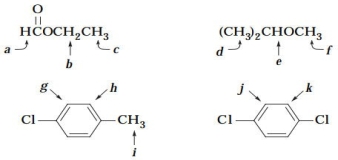
5 What would be the splitting pattern (singlet, doublet, etc.) observed for each of the following indicated protons?
سؤال
A NMR spectrum shows a singlet at 7.3 ppm, a triplet at 4.3, a triplet at 2.9, and a singlet at 2.0. The relative areas are 5, 2, 2, and 3, respectively. Which of the following compounds is compat- ible with this spectrum?

سؤال
How would you distinguish between the following pairs of compounds using NMR spectros- copy? (Include in your answer the expected splitting patterns and relative areas of the NMR absorption.)

سؤال
The following types of protons (underlined) all show NMR absorption between d = 10-16 ppm. How would you use the infrared spectrum to identify the type of compound?


فتح الحزمة
قم بالتسجيل لفتح البطاقات في هذه المجموعة!
Unlock Deck
Unlock Deck
1/8

العب

ملء الشاشة (f)
Deck 17: Proton Nuclear Magnetic Resonance Spectroscopy
1
List the following protons in order of increasing chemical shift (smallest shift first).
b > c > a, because of inductive effects.
2
Pyrrole shows two principal CH signals in its NMR spectrum: at 6.5 ppm and 6.7 ppm. Is pyr- role an aromatic compound or a conjugated diene?
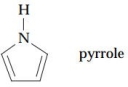 Absorption is downfield in the aromatic region; therefore, pyrrole is an aromatic compound.
 3
How many types of nonequivalent protons does each of the following compounds contain? (Example: CH3CH2Cl has two types, CH3 and CH2.)
(a) two
(b) three
(c) three
(d) two
(e) one
(b) three
(c) three
(d) two
(e) one
4
In the preceding problem, determine the relative areas under the principal signals for each compound.
فتح الحزمة
افتح القفل للوصول البطاقات البالغ عددها 8 في هذه المجموعة.
فتح الحزمة
k this deck
5
5 What would be the splitting pattern (singlet, doublet, etc.) observed for each of the following indicated protons?
فتح الحزمة
افتح القفل للوصول البطاقات البالغ عددها 8 في هذه المجموعة.
فتح الحزمة
k this deck
6
A NMR spectrum shows a singlet at 7.3 ppm, a triplet at 4.3, a triplet at 2.9, and a singlet at 2.0. The relative areas are 5, 2, 2, and 3, respectively. Which of the following compounds is compat- ible with this spectrum?
فتح الحزمة
افتح القفل للوصول البطاقات البالغ عددها 8 في هذه المجموعة.
فتح الحزمة
k this deck
7
How would you distinguish between the following pairs of compounds using NMR spectros- copy? (Include in your answer the expected splitting patterns and relative areas of the NMR absorption.)
فتح الحزمة
افتح القفل للوصول البطاقات البالغ عددها 8 في هذه المجموعة.
فتح الحزمة
k this deck
8
The following types of protons (underlined) all show NMR absorption between d = 10-16 ppm. How would you use the infrared spectrum to identify the type of compound?
فتح الحزمة
افتح القفل للوصول البطاقات البالغ عددها 8 في هذه المجموعة.
فتح الحزمة
k this deck
فتح الحزمة
افتح القفل للوصول البطاقات البالغ عددها 8 في هذه المجموعة.






