







 تكلم مع الذكاء الاصطناعي


Deck 14: Premolars
ملء الشاشة (f)

سؤال
Figure "A" below is which tooth? 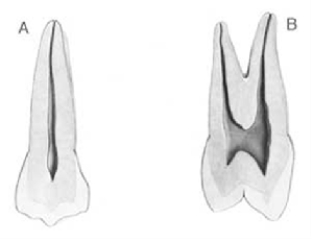
A) Maxillary right second premolar
B) Maxillary left second premolar
C) Maxillary right first premolar
D) Maxillary left first premolar
A) Maxillary right second premolar
B) Maxillary left second premolar
C) Maxillary right first premolar
D) Maxillary left first premolar

سؤال
سؤال
سؤال
Figure "B" below illustrates a view of which surface? 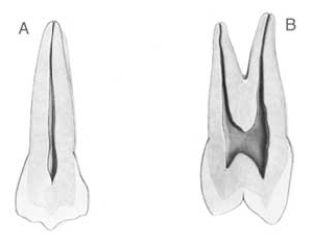
A) Buccal
B) Lingual
C) Mesial
D) Distal
A) Buccal
B) Lingual
C) Mesial
D) Distal
سؤال
سؤال
In figure "B" below, identify the tooth, the number of cusps, and groove pattern. 
A) Mandibular second premolar; two cusps; "H" groove pattern
B) Mandibular second premolar; two cusps; "Y" groove pattern
C) Mandibular first premolar; two cusps; "U" groove pattern
D) Mandibular second premolar; three cusps; "U" groove pattern
A) Mandibular second premolar; two cusps; "H" groove pattern
B) Mandibular second premolar; two cusps; "Y" groove pattern
C) Mandibular first premolar; two cusps; "U" groove pattern
D) Mandibular second premolar; three cusps; "U" groove pattern
سؤال
سؤال
سؤال
In figure "A" below, identify the tooth, the number of cusps, and groove pattern. 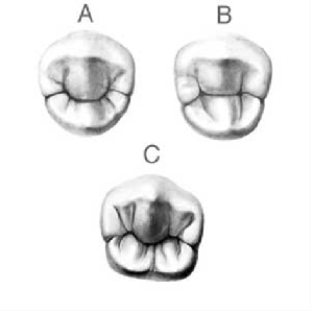
A) Mandibular first premolar; two cusps; "C" groove pattern
B) Mandibular second premolar; two cusps; "Y" groove pattern
C) Mandibular first premolar; two cusps; "H" groove pattern
D) Mandibular second premolar; two cusps; "U" groove pattern
A) Mandibular first premolar; two cusps; "C" groove pattern
B) Mandibular second premolar; two cusps; "Y" groove pattern
C) Mandibular first premolar; two cusps; "H" groove pattern
D) Mandibular second premolar; two cusps; "U" groove pattern
سؤال
سؤال
سؤال
سؤال
سؤال
سؤال
سؤال
سؤال
سؤال
سؤال
سؤال
سؤال
سؤال
سؤال
سؤال
سؤال
سؤال
سؤال
In figure "C" below, identify the tooth, the number of cusps, and groove pattern. 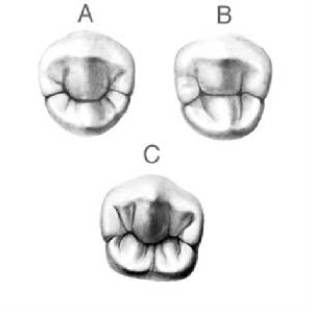
A) Mandibular second premolar; three cusps; "Y" groove pattern
B) Mandibular first premolar; three cusps; "H" groove pattern
C) Mandibular first premolar; three cusps; "U" groove pattern
D) Mandibular second premolar; two cusps; "C" groove pattern
A) Mandibular second premolar; three cusps; "Y" groove pattern
B) Mandibular first premolar; three cusps; "H" groove pattern
C) Mandibular first premolar; three cusps; "U" groove pattern
D) Mandibular second premolar; two cusps; "C" groove pattern
سؤال
سؤال

فتح الحزمة
قم بالتسجيل لفتح البطاقات في هذه المجموعة!
Unlock Deck
Unlock Deck
1/29

العب

ملء الشاشة (f)
Deck 14: Premolars
1
Figure "A" below is which tooth?
A) Maxillary right second premolar
B) Maxillary left second premolar
C) Maxillary right first premolar
D) Maxillary left first premolar
A) Maxillary right second premolar
B) Maxillary left second premolar
C) Maxillary right first premolar
D) Maxillary left first premolar
C
Figure "A" represents a maxillary right first premolar because it has two roots and an extremely well formed lingual cusp. Figure "A" depicts this tooth from a buccal view; note that from the contact area cervically, the distal surface is straight, whereas the corresponding mesial surface is more concave.
Figure "A" represents a maxillary right first premolar because it has two roots and an extremely well formed lingual cusp. Figure "A" depicts this tooth from a buccal view; note that from the contact area cervically, the distal surface is straight, whereas the corresponding mesial surface is more concave.
2
Mandibular first premolars typically have two roots, a mesial and a distal. An anomaly is formation of a third auxiliary root.
A) Both statements are true.
B) The first statement is true; the second is false.
C) The first statement is false; the second is true.
D) Both statements are false.
A) Both statements are true.
B) The first statement is true; the second is false.
C) The first statement is false; the second is true.
D) Both statements are false.
D
Mandibular first premolars typically have one root. An anomaly is formation of two roots, one buccal and one lingual. In mandibular first premolars with two roots, a deep longitudinal groove separates the roots on the proximal sides.
Mandibular first premolars typically have one root. An anomaly is formation of two roots, one buccal and one lingual. In mandibular first premolars with two roots, a deep longitudinal groove separates the roots on the proximal sides.
3
Which premolar has the smallest lingual cusp?
A) Maxillary first
B) Maxillary second
C) Mandibular first
D) Mandibular second
A) Maxillary first
B) Maxillary second
C) Mandibular first
D) Mandibular second
C
The lingual cusp of the mandibular first premolar is so small in height and width that it does not occlude with any of the maxillary teeth. For this reason the lingual cusp of the mandibular first premolar is considered afunctional.
The lingual cusp of the mandibular first premolar is so small in height and width that it does not occlude with any of the maxillary teeth. For this reason the lingual cusp of the mandibular first premolar is considered afunctional.
4
Figure "B" below illustrates a view of which surface?
A) Buccal
B) Lingual
C) Mesial
D) Distal
A) Buccal
B) Lingual
C) Mesial
D) Distal
فتح الحزمة
افتح القفل للوصول البطاقات البالغ عددها 29 في هذه المجموعة.
فتح الحزمة
k this deck
5
Each of the following is evident on a maxillary first premolar EXCEPT one. Which one is the EXCEPTION?
A) Mesial marginal groove
B) Mesial developmental depression
C) Mesial marginal ridge
D) Distinct distal marginal ridge
E) Two small, afunctional lingual cusp tips
A) Mesial marginal groove
B) Mesial developmental depression
C) Mesial marginal ridge
D) Distinct distal marginal ridge
E) Two small, afunctional lingual cusp tips
فتح الحزمة
افتح القفل للوصول البطاقات البالغ عددها 29 في هذه المجموعة.
فتح الحزمة
k this deck
6
In figure "B" below, identify the tooth, the number of cusps, and groove pattern.
A) Mandibular second premolar; two cusps; "H" groove pattern
B) Mandibular second premolar; two cusps; "Y" groove pattern
C) Mandibular first premolar; two cusps; "U" groove pattern
D) Mandibular second premolar; three cusps; "U" groove pattern
A) Mandibular second premolar; two cusps; "H" groove pattern
B) Mandibular second premolar; two cusps; "Y" groove pattern
C) Mandibular first premolar; two cusps; "U" groove pattern
D) Mandibular second premolar; three cusps; "U" groove pattern
فتح الحزمة
افتح القفل للوصول البطاقات البالغ عددها 29 في هذه المجموعة.
فتح الحزمة
k this deck
7
The lingual surface of premolars is formed from how many lobes?
A) One
B) Two
C) Three
D) Not all premolars are formed from the same number of lobes.
A) One
B) Two
C) Three
D) Not all premolars are formed from the same number of lobes.
فتح الحزمة
افتح القفل للوصول البطاقات البالغ عددها 29 في هذه المجموعة.
فتح الحزمة
k this deck
8
A prominent characteristic of the maxillary first premolar is a
A) Mesiolingual developmental groove
B) Central fossa
C) Mesial marginal developmental groove
D) Distal marginal developmental groove
A) Mesiolingual developmental groove
B) Central fossa
C) Mesial marginal developmental groove
D) Distal marginal developmental groove
فتح الحزمة
افتح القفل للوصول البطاقات البالغ عددها 29 في هذه المجموعة.
فتح الحزمة
k this deck
9
In figure "A" below, identify the tooth, the number of cusps, and groove pattern.
A) Mandibular first premolar; two cusps; "C" groove pattern
B) Mandibular second premolar; two cusps; "Y" groove pattern
C) Mandibular first premolar; two cusps; "H" groove pattern
D) Mandibular second premolar; two cusps; "U" groove pattern
A) Mandibular first premolar; two cusps; "C" groove pattern
B) Mandibular second premolar; two cusps; "Y" groove pattern
C) Mandibular first premolar; two cusps; "H" groove pattern
D) Mandibular second premolar; two cusps; "U" groove pattern
فتح الحزمة
افتح القفل للوصول البطاقات البالغ عددها 29 في هذه المجموعة.
فتح الحزمة
k this deck
10
Which type of cusp pattern does the letter "Y" represent on the mandibular second premolar (how many total cusps)?
A) 2
B) 3
C) 4
D) None of the above
A) 2
B) 3
C) 4
D) None of the above
فتح الحزمة
افتح القفل للوصول البطاقات البالغ عددها 29 في هذه المجموعة.
فتح الحزمة
k this deck
11
Premolars erupt between 9 and 12 years of age. Premolars are the succedaneous teeth that replace primary canines.
A) Both statements are true.
B) The first statement is true; the second is false.
C) The first statement is false; the second is true.
D) Both statements are false.
A) Both statements are true.
B) The first statement is true; the second is false.
C) The first statement is false; the second is true.
D) Both statements are false.
فتح الحزمة
افتح القفل للوصول البطاقات البالغ عددها 29 في هذه المجموعة.
فتح الحزمة
k this deck
12
As a rule, the mandibular first premolars are always smaller than the mandibular second premolars. The most striking identifying feature of the mandibular first premolar is the mesiolingual developmental groove.
A) Both statements are true.
B) The first statement is true; the second is false.
C) The first statement is false; the second is true.
D) Both statements are false.
A) Both statements are true.
B) The first statement is true; the second is false.
C) The first statement is false; the second is true.
D) Both statements are false.
فتح الحزمة
افتح القفل للوصول البطاقات البالغ عددها 29 في هذه المجموعة.
فتح الحزمة
k this deck
13
Which selection best describes the roots of the maxillary first premolar?
A) Two roots, one mesial and one distal
B) Two roots, one buccal and one lingual
C) Fused roots
D) One root only
A) Two roots, one mesial and one distal
B) Two roots, one buccal and one lingual
C) Fused roots
D) One root only
فتح الحزمة
افتح القفل للوصول البطاقات البالغ عددها 29 في هذه المجموعة.
فتح الحزمة
k this deck
14
The overall height of the premolars is longer than that of the canines because the root of the premolars is considerably longer than those of the canines.
A) Both the statement and the reason are correct and related.
B) Both the statement and the reason are correct but are NOT related.
C) The statement is correct, but the reason is NOT correct.
D) The statement is NOT correct, but the reason is correct.
E) NEITHER the statement NOR the reason is correct.
A) Both the statement and the reason are correct and related.
B) Both the statement and the reason are correct but are NOT related.
C) The statement is correct, but the reason is NOT correct.
D) The statement is NOT correct, but the reason is correct.
E) NEITHER the statement NOR the reason is correct.
فتح الحزمة
افتح القفل للوصول البطاقات البالغ عددها 29 في هذه المجموعة.
فتح الحزمة
k this deck
15
Which premolar has buccal and lingual cusps that are almost the same height?
A) Maxillary first
B) Maxillary second
C) Mandibular first
D) Mandibular second
E) None of the above
A) Maxillary first
B) Maxillary second
C) Mandibular first
D) Mandibular second
E) None of the above
فتح الحزمة
افتح القفل للوصول البطاقات البالغ عددها 29 في هذه المجموعة.
فتح الحزمة
k this deck
16
The mandibular second premolar always has three cusps because this tooth always forms from five lobes.
A) Both the statement and the reason are correct and related.
B) Both the statement and the reason are correct but are NOT related.
C) The statement is correct, but the reason is NOT correct.
D) The statement is NOT correct, but the reason is correct.
E) NEITHER the statement NOR the reason is correct.
A) Both the statement and the reason are correct and related.
B) Both the statement and the reason are correct but are NOT related.
C) The statement is correct, but the reason is NOT correct.
D) The statement is NOT correct, but the reason is correct.
E) NEITHER the statement NOR the reason is correct.
فتح الحزمة
افتح القفل للوصول البطاقات البالغ عددها 29 في هذه المجموعة.
فتح الحزمة
k this deck
17
Any ridge that extends from the cusp tip to the central groove of the occlusal surface is called a marginal ridge. When two marginal ridges join, after traversing the tooth buccolingually, they form a transverse ridge.
A) Both statements are true.
B) The first statement is true; the second is false.
C) The first statement is false; the second is true.
D) Both statements are false.
A) Both statements are true.
B) The first statement is true; the second is false.
C) The first statement is false; the second is true.
D) Both statements are false.
فتح الحزمة
افتح القفل للوصول البطاقات البالغ عددها 29 في هذه المجموعة.
فتح الحزمة
k this deck
18
All of the premolars usually have a transverse ridge that crosses an occlusal developmental groove EXCEPT one. Which one is the EXCEPTION?
A) Maxillary first
B) Maxillary second
C) Mandibular first
D) Mandibular second
A) Maxillary first
B) Maxillary second
C) Mandibular first
D) Mandibular second
فتح الحزمة
افتح القفل للوصول البطاقات البالغ عددها 29 في هذه المجموعة.
فتح الحزمة
k this deck
19
The mandibular second premolar shows evidence of calcification at years. Completion of enamel formation does not occur; until 11 to 12 years.
A) Both statements are true.
B) The first statement is true; the second is false.
C) The first statement is false; the second is true.
D) Both statements are false.
A) Both statements are true.
B) The first statement is true; the second is false.
C) The first statement is false; the second is true.
D) Both statements are false.
فتح الحزمة
افتح القفل للوصول البطاقات البالغ عددها 29 في هذه المجموعة.
فتح الحزمة
k this deck
20
Any ridge that runs from the cusp tip to the central groove of the occlusal surface is called a triangular ridge. Triangular ridges are located near the mesial marginal ridge of premolars but not near the distal marginal ridge.
A) Both statements are true.
B) The first statement is true; the second is false.
C) The first statement is false; the second is true.
D) Both statements are false.
A) Both statements are true.
B) The first statement is true; the second is false.
C) The first statement is false; the second is true.
D) Both statements are false.
فتح الحزمة
افتح القفل للوصول البطاقات البالغ عددها 29 في هذه المجموعة.
فتح الحزمة
k this deck
21
Bicuspid means the same thing as premolars.
فتح الحزمة
افتح القفل للوصول البطاقات البالغ عددها 29 في هذه المجموعة.
فتح الحزمة
k this deck
22
The buccal cusp of a maxillary first premolar is longer than the buccal cusp of the second premolar.
فتح الحزمة
افتح القفل للوصول البطاقات البالغ عددها 29 في هذه المجموعة.
فتح الحزمة
k this deck
23
All premolars have lingual cusps that are afunctional.
فتح الحزمة
افتح القفل للوصول البطاقات البالغ عددها 29 في هذه المجموعة.
فتح الحزمة
k this deck
24
Which of the following are true of both maxillary first premolars and maxillary second premolars (select all that apply)?
A) Both have two cusps.
B) Both have two roots.
C) Both are formed from four developmental lobes.
D) Both have two pulp horns.
A) Both have two cusps.
B) Both have two roots.
C) Both are formed from four developmental lobes.
D) Both have two pulp horns.
فتح الحزمة
افتح القفل للوصول البطاقات البالغ عددها 29 في هذه المجموعة.
فتح الحزمة
k this deck
25
The maxillary first premolar has a canine fossa.
فتح الحزمة
افتح القفل للوصول البطاقات البالغ عددها 29 في هذه المجموعة.
فتح الحزمة
k this deck
26
Which of the following are located on the occlusal surfaces of premolars (select all that apply)?
A) Marginal ridges
B) Transverse ridges
C) Triangular ridges
D) Premolar eminence
A) Marginal ridges
B) Transverse ridges
C) Triangular ridges
D) Premolar eminence
فتح الحزمة
افتح القفل للوصول البطاقات البالغ عددها 29 في هذه المجموعة.
فتح الحزمة
k this deck
27
In figure "C" below, identify the tooth, the number of cusps, and groove pattern.
A) Mandibular second premolar; three cusps; "Y" groove pattern
B) Mandibular first premolar; three cusps; "H" groove pattern
C) Mandibular first premolar; three cusps; "U" groove pattern
D) Mandibular second premolar; two cusps; "C" groove pattern
A) Mandibular second premolar; three cusps; "Y" groove pattern
B) Mandibular first premolar; three cusps; "H" groove pattern
C) Mandibular first premolar; three cusps; "U" groove pattern
D) Mandibular second premolar; two cusps; "C" groove pattern
فتح الحزمة
افتح القفل للوصول البطاقات البالغ عددها 29 في هذه المجموعة.
فتح الحزمة
k this deck
28
Maxillary second premolars have a smoother, less detailed occlusal surface than first premolars.
فتح الحزمة
افتح القفل للوصول البطاقات البالغ عددها 29 في هذه المجموعة.
فتح الحزمة
k this deck
29
Which of the following are true of the maxillary second premolars (select all that apply)?
A) Evidence of calcification is seen at 2 years of age.
B) Completion of enamel formation occurs at 4 years of age.
C) Eruption occurs at 11 to 13 years of age.
D) Root formation is completed by 12 to 14 years of age.
A) Evidence of calcification is seen at 2 years of age.
B) Completion of enamel formation occurs at 4 years of age.
C) Eruption occurs at 11 to 13 years of age.
D) Root formation is completed by 12 to 14 years of age.
فتح الحزمة
افتح القفل للوصول البطاقات البالغ عددها 29 في هذه المجموعة.
فتح الحزمة
k this deck
فتح الحزمة
افتح القفل للوصول البطاقات البالغ عددها 29 في هذه المجموعة.






